| Learning Objective | Essential Knowledge |
|---|---|
4.1.A |
|
Linear Momentum
AP Physics C: Mechanics · Topic 4
 7:00
7:00
Linear Momentum
A car stops in a crash. With an airbag, the driver walks away. Without one, they do not. In both cases the momentum change is exactly the same — from full…
English narration · English + 中文 subtitles burned in
4.1
Linear Momentum
Syllabus
Source: College Board AP Course and Exam Description
Linear momentum 动量 is mass times velocity:
$$\vec{p}=m\vec{v}.$$
It is a vector 矢量 pointing along the velocity, and it is the quantity for analysing collisions 碰撞 and explosions 爆炸. A collection of objects can be treated as one system moving with the velocity of its center of mass 质心:
$$\vec{v}_{\text{cm}}=\frac{\sum m_i\vec{v}_i}{\sum m_i},$$
so the system's total momentum is its total mass times $\vec{v}_{\text{cm}}$ – one object's worth of bookkeeping for any number of parts.
Vocabulary
Train
| English |
|---|
| Linear momentum/ˈlɪnɪə məʊˈmentəm/ |
| vector/ˈvektə/ |
| collisions/kəˈlɪʒnz/ |
| explosions/ekˈspləʊʒnz/ |
| center of mass/ˈsentə ɒv mæs/ |
4.2
Change in Momentum and Impulse
Syllabus
| Learning Objective | Essential Knowledge |
|---|---|
4.2.A |
|
4.2.B |
|
Source: College Board AP Course and Exam Description
Newton's second law is really a statement about momentum:
$$\vec{F}_{\text{net}}=\frac{d\vec{p}}{dt},$$
which reduces to $m\vec{a}$ when the mass is constant – and handles a changing mass when it is not (the special case $\vec{F}=\dfrac{dm}{dt}\vec{v}$ holds only when the velocity is constant, e.g. a chain piling onto a scale or sand landing on a belt moving at fixed speed; a rocket does not fit, since it accelerates). The impulse 冲量 delivered by a force is its time integral, and the impulse–momentum theorem 冲量-动量定理 says it equals the change in momentum:
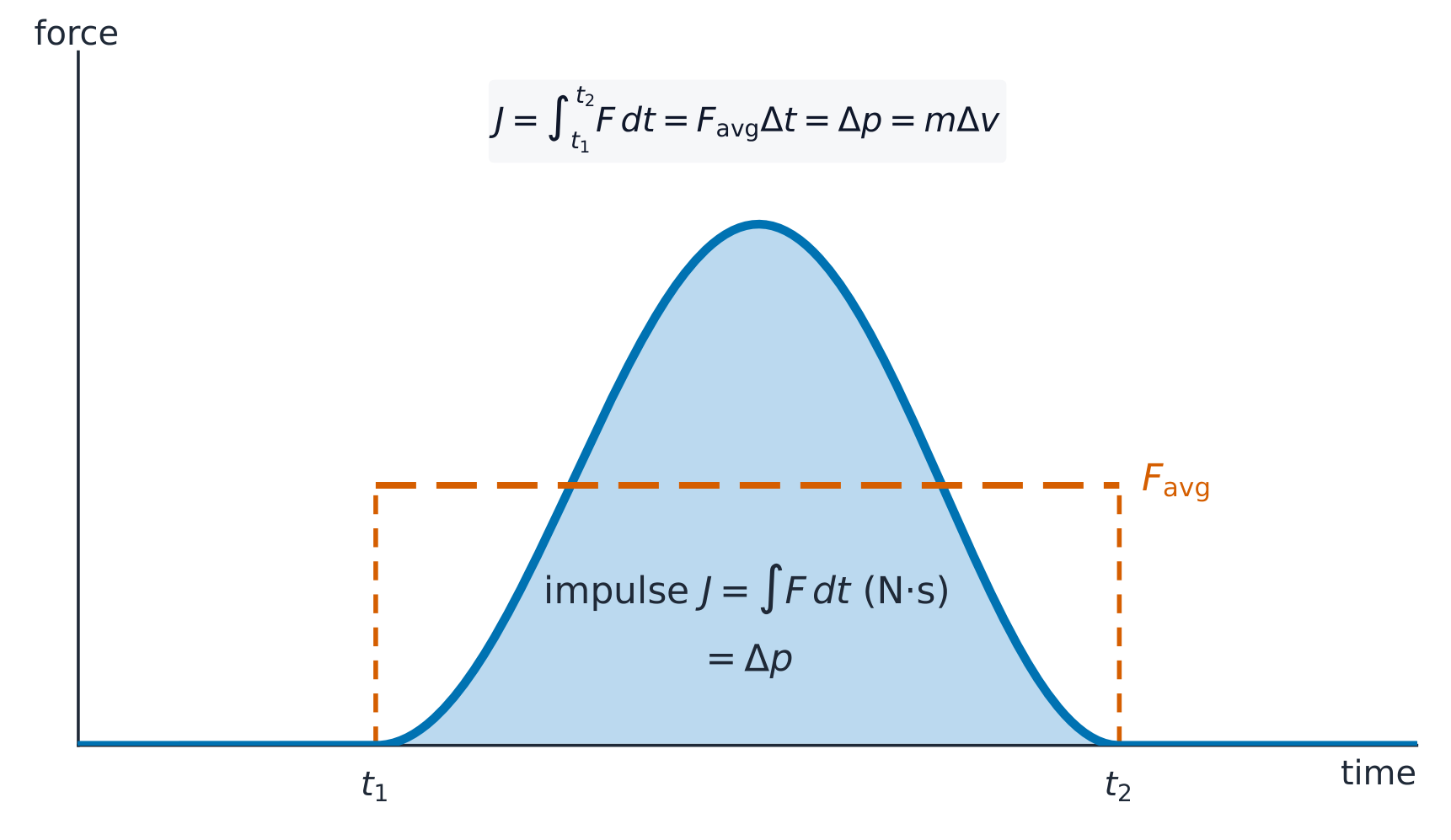
$$\vec{J}=\int_{t_1}^{t_2}\vec{F}_{\text{net}}\,dt=\Delta\vec{p}.$$
Impulse is a vector along the net force. Read it off graphs both ways:
- On a force–time graph, impulse is the area under the curve.
- On a momentum–time graph, the net force is the slope 斜率 at each instant.
Spreading the same $\Delta p$ over a longer time lowers the force – that is why airbags, crumple zones, and soft landings work, and why you bend your knees when you land.
Worked example. A time-varying force $F(t)=10t\ \text{N}$ acts on a $2.0\ \text{kg}$ object for $2.0\ \text{s}$. The impulse is $J=\displaystyle\int_0^2 10t\,dt=\big[5t^2\big]_0^2=20\ \text{N}\cdot\text{s}$, so the speed changes by $\Delta v=J/m=10\ \text{m/s}$.
Vocabulary
Train
| English |
|---|
| impulse/ˈɪmpʌls/ |
| impulse–momentum theorem/ˈɪmpʌls məʊˈmentəm ˈθɪərəm/ |
| slope/sləʊp/ |
4.3
Conservation of Linear Momentum
Syllabus
| Learning Objective | Essential Knowledge |
|---|---|
4.3.A |
Boundary statement: AP Physics C: Mechanics only expects students to quantitatively analyze collisions and interactions in one or two dimensions. Three-dimensional collisions may be analyzed qualitatively. |
4.3.B |
|
Source: College Board AP Course and Exam Description
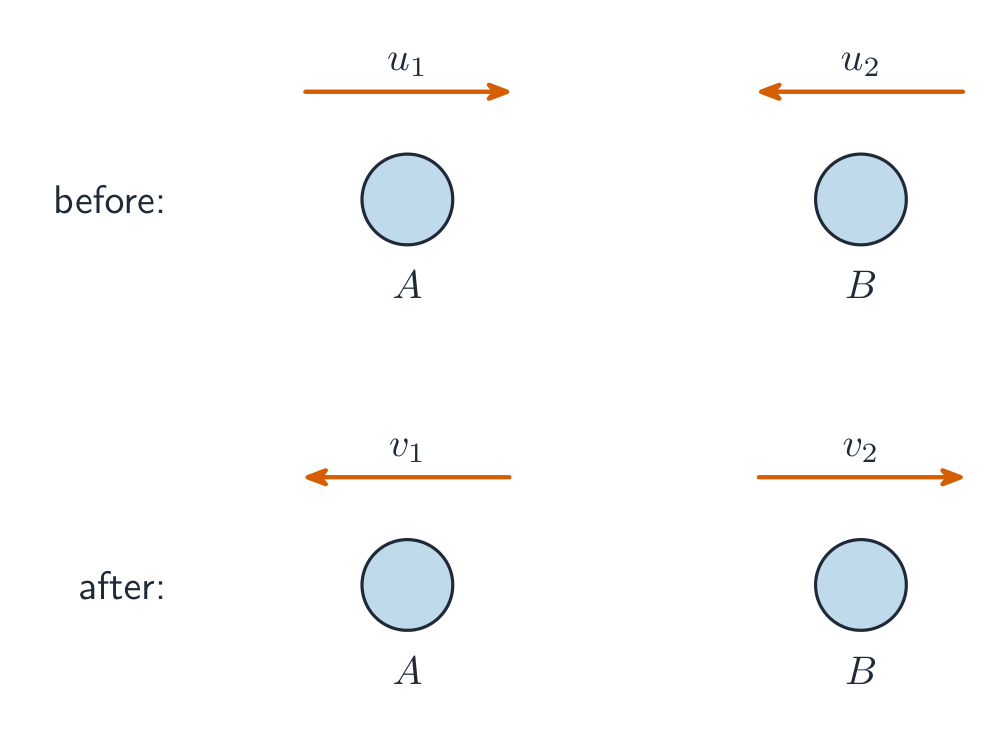
Internal forces come in Newton's-third-law pairs, so they cancel inside any system: they can shuffle momentum between parts but never change the total. Momentum only enters or leaves a system through a net external force ($\vec{J}=\Delta\vec{p}$). So, with zero net external force, total momentum is conserved 守恒:
$$\sum\vec{p}_{\text{before}}=\sum\vec{p}_{\text{after}}.$$
Momentum is conserved in every collision, however violent – choose the system large enough that the collision forces are internal. Apply conservation separately along each axis; AP asks for quantitative work in one or two dimensions.
Worked example (explosion). A $6.0\ \text{kg}$ shell at rest splits into a $2.0\ \text{kg}$ piece moving at $9.0\ \text{m/s}$ east and a $4.0\ \text{kg}$ piece. Total momentum stays zero, so the heavy piece moves west at $v=\dfrac{2.0(9.0)}{4.0}=4.5\ \text{m/s}$. The kinetic energy came from stored (chemical or spring) energy – momentum conservation does not require kinetic-energy conservation.
Explore
Collide two carts and conserve momentum
In any collision the total momentum $\sum mv$ before equals the total after. Set the masses and speeds and check the momentum bookkeeping.
Vocabulary
Train
| English |
|---|
| conserved/kənˈsɜːvd/ |
4.4
Elastic and Inelastic Collisions
Syllabus
| Learning Objective | Essential Knowledge |
|---|---|
4.4.A |
|
Source: College Board AP Course and Exam Description
All collisions conserve momentum; they differ in what happens to the kinetic energy 动能:
| type | momentum | kinetic energy |
|---|---|---|
| elastic collision 弹性碰撞 | conserved | total conserved (individual shares may change) |
| inelastic collision 非弹性碰撞 | conserved | decreases – some becomes heat, sound, deformation 形变 |
| perfectly inelastic collision 完全非弹性碰撞 | conserved | largest possible loss – the objects stick and share one velocity |
Strategy: always write momentum conservation first; add the kinetic-energy equation only when the problem says "elastic". Two useful elastic facts: equal masses in a 1D elastic collision simply exchange velocities, and in the center-of-mass frame each object just reverses its velocity.
Worked example. A $1000\ \text{kg}$ car at $20\ \text{m/s}$ strikes a stationary $1500\ \text{kg}$ car and they lock together – perfectly inelastic. Momentum: $v=\dfrac{1000(20)}{2500}=8.0\ \text{m/s}$. Kinetic energy falls from $2.0\times10^5\ \text{J}$ to $\tfrac12(2500)(8.0)^2=8.0\times10^4\ \text{J}$: about $60\%$ is lost, even though momentum is exactly conserved.
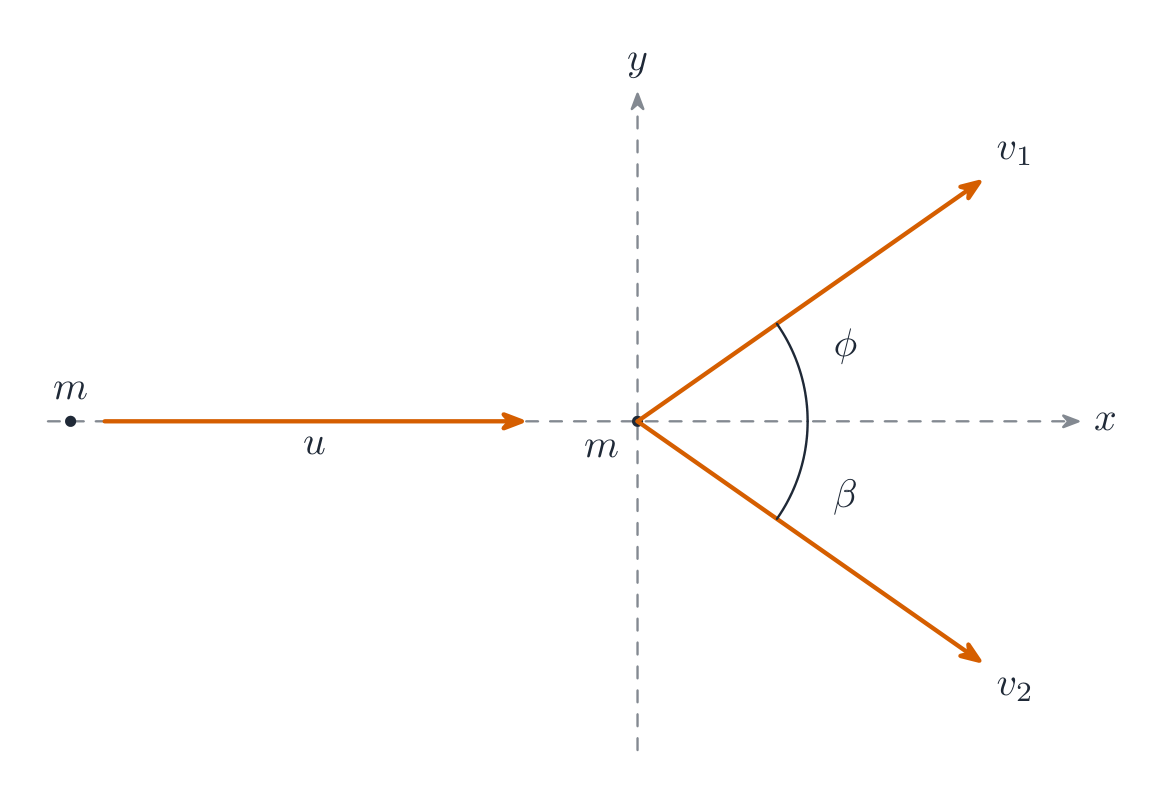
Worked example (2D). A puck moving east at $4.0\ \text{m/s}$ strikes an identical puck at rest; after the glancing hit, one moves at $2.0\ \text{m/s}$ at $60^\circ$ north of east. Conserve each axis: east–west, $m(4.0)=m(2.0)\cos60^\circ+mv_x$, so $v_x=3.0\ \text{m/s}$; north–south, $0=m(2.0)\sin60^\circ-mv_y$, so $v_y=1.7\ \text{m/s}$. The second puck moves at $\sqrt{3.0^2+1.7^2}=3.5\ \text{m/s}$, about $30^\circ$ south of east.
Exam skill. On FRQs, justify with the condition, not the slogan: "the net external force on the two-puck system is zero during the collision, so its total momentum is constant." If asked whether the collision is elastic, compute the kinetic energy before and after and compare – never assume.
Explore
Compare elastic and inelastic collisions
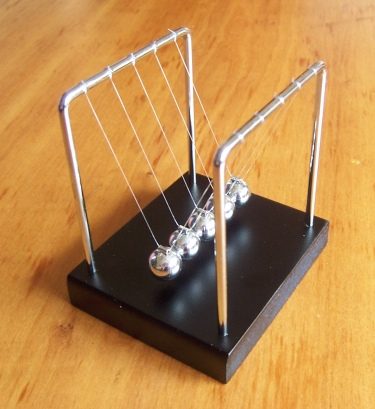
Momentum is always conserved, but kinetic energy is only conserved in an elastic collision. In an inelastic one the carts stick and some energy becomes heat.
Vocabulary
Train
| English |
|---|
| kinetic energy/kɪˈnetɪk ˈenədʒi/ |
| elastic collision/ɪˈlæstɪk kəˈlɪʒn/ |
| inelastic collision/ɪnɪˈlæstɪk kəˈlɪʒn/ |
| deformation/ˌdiːfɔːˈmeɪʃn/ |
| perfectly inelastic collision/ˈpɜːfektlɪ ɪnɪˈlæstɪk kəˈlɪʒn/ |
4.4
Exam tips
- Impulse equals the momentum change: $\vec J=\int \vec F\,dt=\Delta\vec p$, and it is the area under a force–time graph.
- Momentum is conserved whenever the net external force is zero — always the go-to for collisions.
- Distinguish elastic (kinetic energy conserved) from inelastic (kinetic energy decreases) collisions; in a perfectly inelastic collision the objects stick and move with one velocity.
- Apply conservation to each component (x and y) separately in 2-D.
- Connect to center of mass: total momentum $=M\vec v_{cm}$.
Interactive lessons on this topic
Work through it step by step, with instant-check exercises.