| Learning Objective | Essential Knowledge |
|---|---|
3.1.A |
|
Work, Energy, and Power
AP Physics C: Mechanics · Topic 3
 7:46
7:46
Work, Energy, and Power
A block slides into a spring and squashes it until it stops. How far does the spring compress? Try that with a kinematic equation. You cannot — the force grows…
English narration · English + 中文 subtitles burned in
3.1
Translational Kinetic Energy
Syllabus
Source: College Board AP Course and Exam Description
Kinetic energy 动能 describes motion. For a particle of mass $m$ and speed $v$,
$$K=\frac12mv^2.$$
It is a scalar 标量 measured in joules 焦耳 (J), and is nonnegative. At fixed mass, doubling speed quadruples kinetic energy. Velocity direction does not change $K$ when speed is unchanged.
The observer's reference frame 参考系 matters. A passenger at rest relative to a train moving at 10 metres per second has zero translational kinetic energy in the train frame but nonzero kinetic energy in the platform frame. Use one consistent frame throughout a calculation.
Original comparison. For a 2.0-kilogram object, $K=\tfrac12mv^2=\tfrac12(2.0\text{ kg})(3.0\text{ m/s})^2=9.0\text{ J}$. At 6.0 metres per second, $K=\tfrac12mv^2=\tfrac12(2.0\text{ kg})(6.0\text{ m/s})^2=36\text{ J}$. Reversing velocity from positive 3 to negative 3 metres per second would leave the energy at 9 joules.
Vocabulary
Train
| English |
|---|
| Kinetic energy/kɪˈnetɪk ˈenədʒi/ |
| scalar/ˈskeɪlə/ |
| joules/dʒuːlz/ |
| reference frame/ˈrefrəns freɪm/ |
3.2
Work
Syllabus
| Learning Objective | Essential Knowledge |
|---|---|
3.2.A |
Boundary statement: AP Physics C: Mechanics only expects students to analyze the transfer of mechanical energy, although students should be aware that mechanical energy may be dissipated in the form of thermal energy or sound. |
Source: College Board AP Course and Exam Description
Work 功 is energy transfer by a force acting through displacement of its point of application. For a variable force, use an integral 积分 along the actual path:
$$W=\int_a^b\vec F\cdot d\vec r.$$
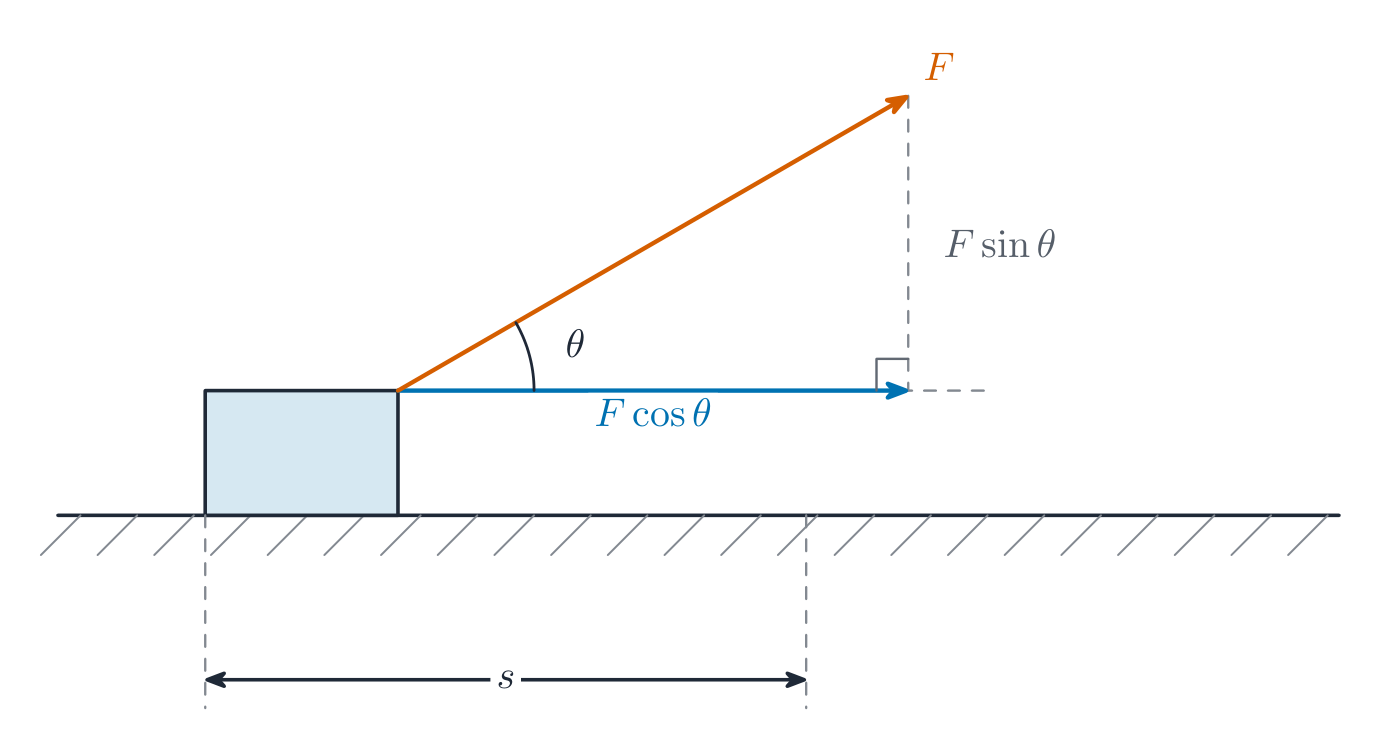
For a constant force, $W=Fd\cos\theta$, with $\theta$ between force and displacement. In one dimension, signed area under $F_x(x)$ gives work. A region below the axis contributes negative area; the full force magnitude is not always the component along the path.
The work–energy theorem 动能定理 states
$$W_{\mathrm{net}}=\sum_iW_i=\Delta K.$$
Positive work by one force can coexist with negative net work. Friction 摩擦力 does negative work on a block sliding over a stationary rough surface, but can do positive work on an object carried along by a moving belt. A normal force 法向力 does zero work only when perpendicular to the displacement of its application point. Do not classify work from the force's name alone.
Original signed-work task. Over 2.0 metres rightward, a constant 10-newton pull acts rightward and a 12-newton resistance acts leftward. $W_{\mathrm{pull}}=Fd\cos\theta=(10\text{ N})(2.0\text{ m})\cos0=20\text{ J}$; $W_{\mathrm{res}}=Fd\cos\theta=(12\text{ N})(2.0\text{ m})\cos180^\circ=-24\text{ J}$. Therefore $W_{\mathrm{net}}=W_{\mathrm{pull}}+W_{\mathrm{res}}=20\text{ J}-24\text{ J}=-4\text{ J}$. The pull does positive work while kinetic energy falls.
Original variable-force task. Let $F_x=ax^2$, with $a=3.0\text{ N/m}^2$, from 0 to 2.0 metres. Then
$$W=\int_0^LF_x\,dx=\frac{aL^3}{3}.$$
$$W=\frac{aL^3}{3}=\frac{(3.0\text{ N/m}^2)(2.0\text{ m})^3}{3}=8.0\text{ J}.$$
If this is the net force on a 1.0-kilogram object initially at rest, $W_{\mathrm{net}}=\tfrac12mv_f^2$, giving $v_f=\sqrt{2W_{\mathrm{net}}/m}=4.0\text{ m/s}$. If other forces also do work, include them before finding the speed.
Vocabulary
Train
| English |
|---|
| Work/wɜːk/ |
| integral/ˈɪntɪɡrəl/ |
| friction/ˈfrɪkʃn/ |
| normal force/ˈnɔːml fɔːs/ |
| work–energy theorem/wɜːk ˈenədʒi ˈθɪərəm/ |
3.3
Potential Energy
Syllabus
| Learning Objective | Essential Knowledge |
|---|---|
3.3.A |
|
Source: College Board AP Course and Exam Description
Potential energy 势能 belongs to the configuration of an interacting system. Conservative forces 保守力 have path-independent work and an associated potential:
$$\Delta U=-\int_a^b\vec F_c\cdot d\vec r.$$
A conservative force does zero net work around a closed path. Choose a convenient zero of $U$; adding a constant does not change forces or energy differences.
| Interaction | Potential relation |
|---|---|
| Near-surface gravity | $\Delta U_g=mg\Delta y$ for nearly constant $g$ |
| Two spherical masses | $U_g=-Gm_1m_2/r$ with zero at infinity |
| Ideal spring | $U_s=\tfrac12kx^2$, $x$ from natural length |
Sum each interacting pair once in a multi-object system. In one dimension, the conservative force is minus the derivative 导数:
$$F_x=-\frac{dU}{dx}.$$
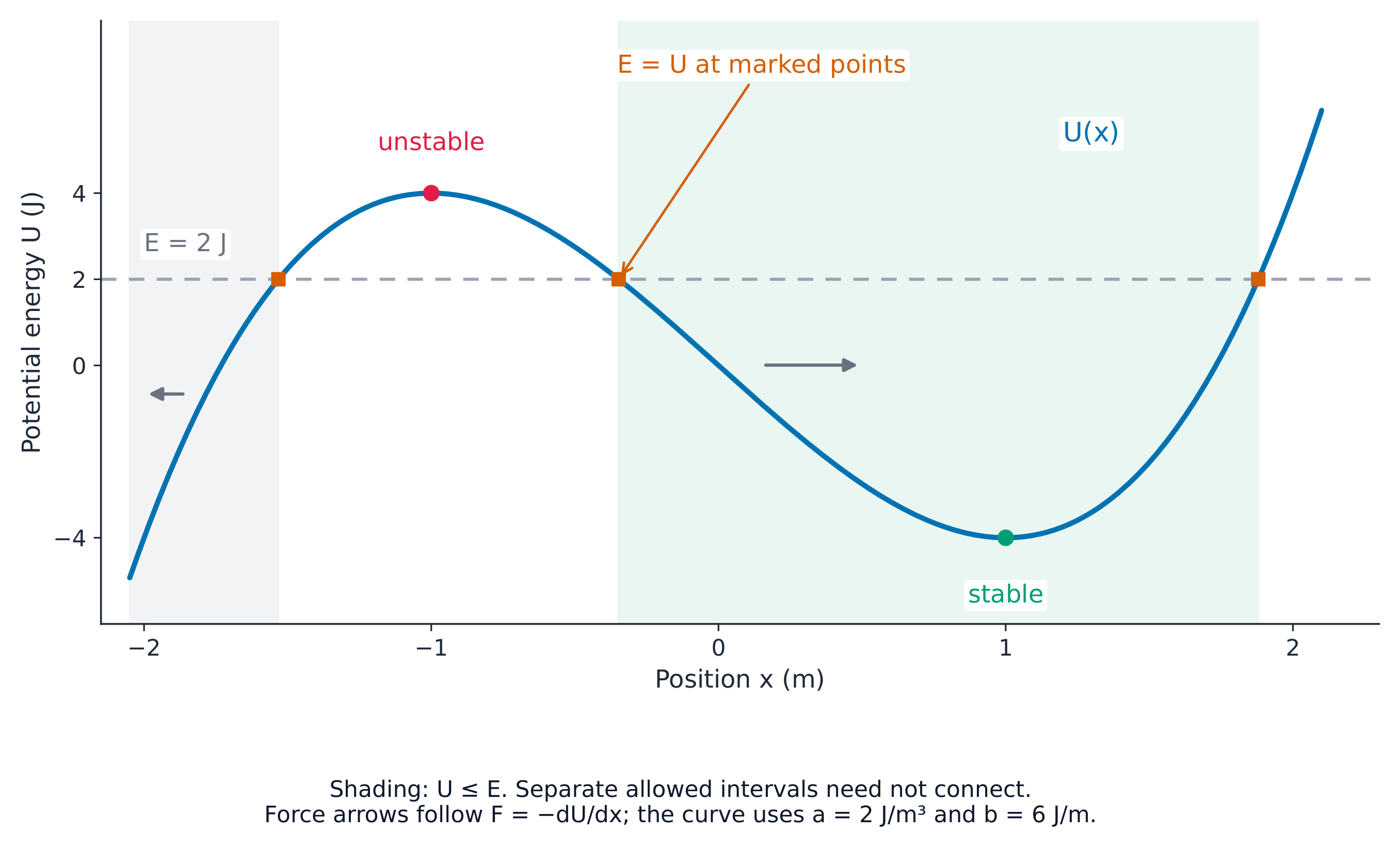
A positive slope gives force in the negative $x$ direction; a negative slope gives positive force. Zero slope gives equilibrium, not necessarily zero speed. A stable equilibrium 稳定平衡 has a restoring force after a small displacement; an unstable equilibrium 不稳定平衡 has a force away from it. Local minima and maxima provide these classifications in the usual smooth one-dimensional cases.
Original differentiation task. Take $U(x)=ax^3-bx$, where $a=2.0\text{ J/m}^3$ and $b=6.0\text{ J/m}$. Then $F_x=b-3ax^2$. Equilibria satisfy $x=\pm\sqrt{b/(3a)}=\pm1.0\text{ m}$. Since $U''=6ax$, the positive position is a minimum and stable; the negative position is a maximum and unstable. At $x=0$, $F_x=b=6.0\text{ N}$ in the positive direction. The coefficients carry units; writing only $2x^3-6x$ without specifying the coordinate units hides that information.
Explore
Store elastic potential energy in a spring
Stretching a spring stores elastic potential energy $\tfrac12 kx^2$ — the area under the force-extension line. Release it and that energy becomes kinetic.
Vocabulary
Train
| English |
|---|
| Potential energy/pəˈtenʃl ˈenədʒi/ |
| conservative forces/kənˈsɜːvətɪv ˈfɔːsɪz/ |
| derivative/dɪˈrɪvətɪv/ |
| stable equilibrium/ˈsteɪbl ˌiːkwɪˈlɪbrɪəm/ |
| unstable equilibrium/ʌnˈsteɪbl ˌiːkwɪˈlɪbrɪəm/ |
3.4
Conservation of Energy
Syllabus
| Learning Objective | Essential Knowledge |
|---|---|
3.4.A |
|
3.4.B |
|
3.4.C |
Boundary statement: AP Physics C: Mechanics expects students to know that mechanical energy can be dissipated as thermal energy or sound by nonconservative forces. |
Source: College Board AP Course and Exam Description
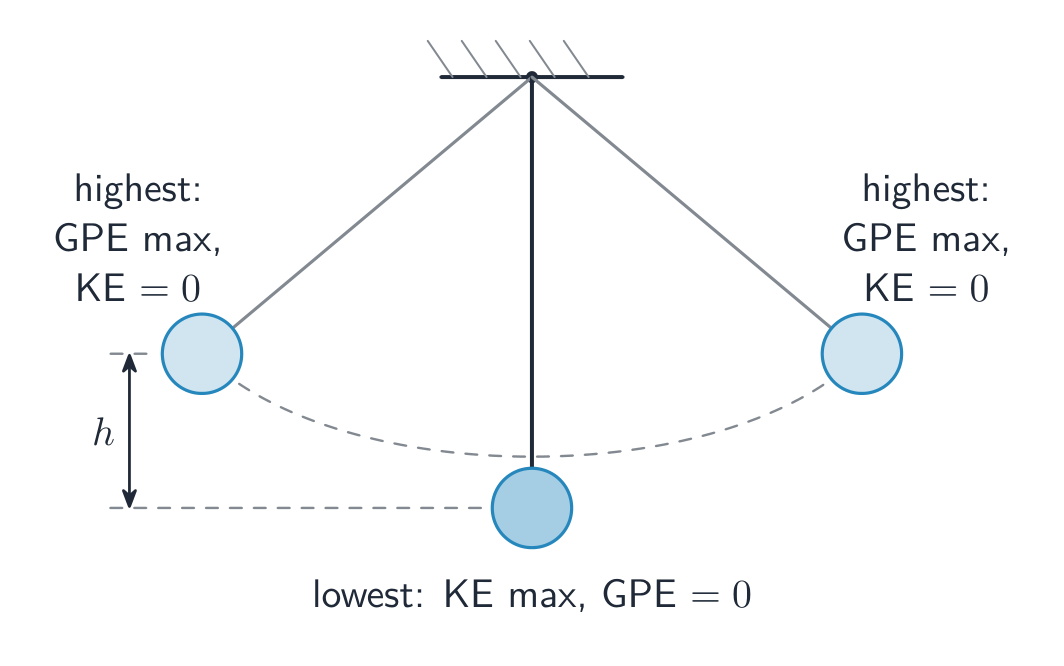
Mechanical energy 机械能 is $E_{\mathrm{mech}}=K+U$. In the course's particle model, a single object has kinetic energy; include Earth or the spring to account for the relevant interaction potential. This is a mechanical model, not a claim that a real body has no internal energy.
For an isolated ideal mechanical system with no dissipative interactions,
$$K_i+U_i=K_f+U_f.$$
Nonconservative forces 非保守力 can transfer or dissipate mechanical energy; they do not invariably remove it. Sliding friction over a fixed rough track converts mechanical energy into thermal energy 热能. For constant kinetic friction and path length $s$, $\Delta E_{\mathrm{mech}}=-f_ks$ under the stated model. Variable friction requires an integral. Choose the system before classifying forces as internal or external.
With block, Earth and track inside the system, negligible energy transfer to the surroundings, and only kinetic, potential and thermal changes relevant,
$$0=\Delta K+\Delta U+\Delta E_{\mathrm{thermal}}.$$
External work changes system energy when work is the only transfer; heat or other transfers require additional terms. Do not count gravitational work and the same gravitational potential change twice. AP mechanics recognises dissipation as thermal energy or sound without requiring a thermodynamics treatment.
For fixed mechanical energy in one-dimensional motion, $K=E-U(x)\ge0$. Positions with $U>E$ are inaccessible. The turning points 转折点 of a bounded motion occur where $E=U$ and the particle reverses. An object at rest at a potential minimum with $E=U_{\min}$ stays at equilibrium; equality alone does not prove reversal. Distinct accessible intervals need not connect.
Original graph task. In the plotted cubic potential, $E=2.0\text{ J}$. At $x=1.0\text{ m}$, $U=-4.0\text{ J}$, so $K=E-U=2.0\text{ J}-(-4.0\text{ J})=6.0\text{ J}$. For a 2.0-kilogram particle, $v=\sqrt{2K/m}=\sqrt{(2)(6.0\text{ J})/(2.0\text{ kg})}\approx2.45\text{ m/s}$. It is fastest at this minimum within the bounded well, not necessarily over every disconnected allowed interval.
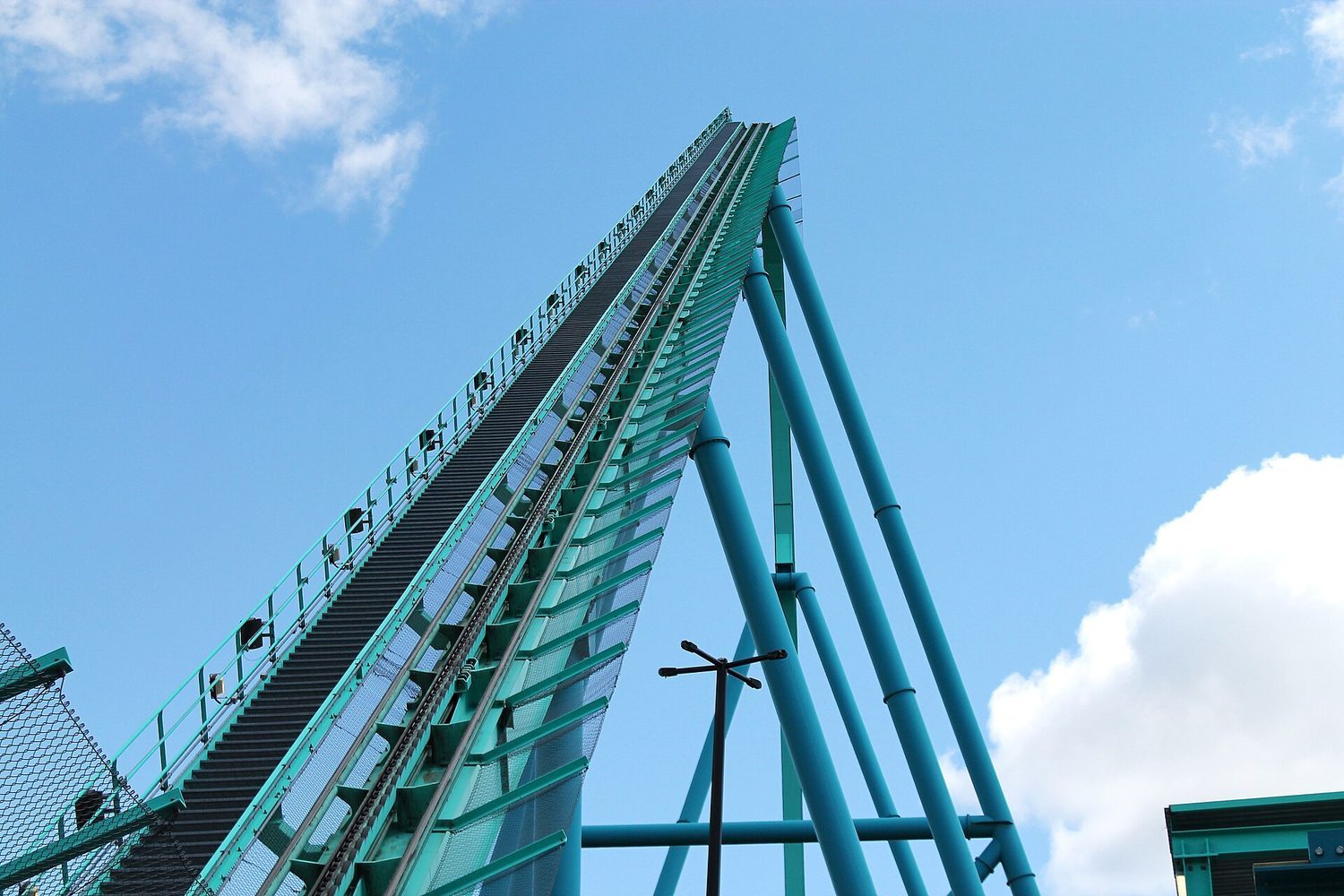
Original ramp task. A 2.0-kilogram block starts from rest 1.5 metres above the bottom and arrives at 4.0 metres per second. Use $g=9.8\text{ m/s}^2$. The initial gravitational energy is $U_i=mgh=29.4\text{ J}$; the final kinetic energy is $K_f=\tfrac12mv_f^2=16.0\text{ J}$. For the block–Earth–track system with no other transfer, $\Delta E_{\mathrm{thermal}}=U_i-K_f=29.4\text{ J}-16.0\text{ J}=13.4\text{ J}$. The conclusion depends on the stated energy model.
Verified exam connection — 2025 Q2(A/B), Version J. Two wall-mounted springs of constants $k$ and $2k$ are relaxed at $x=0$ and both change length by magnitude $|x|$. At release from rest at $x=x_1$, the spring energies have ratio $U_A:U_B=1:2$ and block kinetic energy is zero. At $x=x_1/2$, conservation gives $\tfrac12mv^2=\tfrac98kx_1^2$, hence $v=\tfrac32x_1\sqrt{k/m}$ for positive $x_1$. Both spring energies must be included. The official question explicitly requests a fundamental principle at the start of part B; this is a demand of this question, not a universal scoring guarantee.
Explore
Watch energy convert as an object falls
With no friction, mechanical energy is conserved: as an object falls, gravitational potential energy turns into kinetic energy while the total stays fixed.
Vocabulary
Train
| English |
|---|
| Mechanical energy/mɪˈkænɪkl ˈenədʒi/ |
| nonconservative forces/ˌnɒŋkənˈsɜːvətɪv ˈfɔːsɪz/ |
| thermal energy/ˈθɜːml ˈenədʒi/ |
| turning points/ˈtɜːnɪŋ pɔɪnts/ |
3.5
Power
Syllabus
| Learning Objective | Essential Knowledge |
|---|---|
3.5.A |
|
Source: College Board AP Course and Exam Description
Power 功率 is the rate of energy transfer or conversion, measured in watts 瓦特 (one joule per second):
$$P_{\mathrm{avg}}=\frac{\Delta E}{\Delta t},\qquad P_{\mathrm{inst}}=\frac{dW}{dt}=\vec F\cdot\vec v.$$
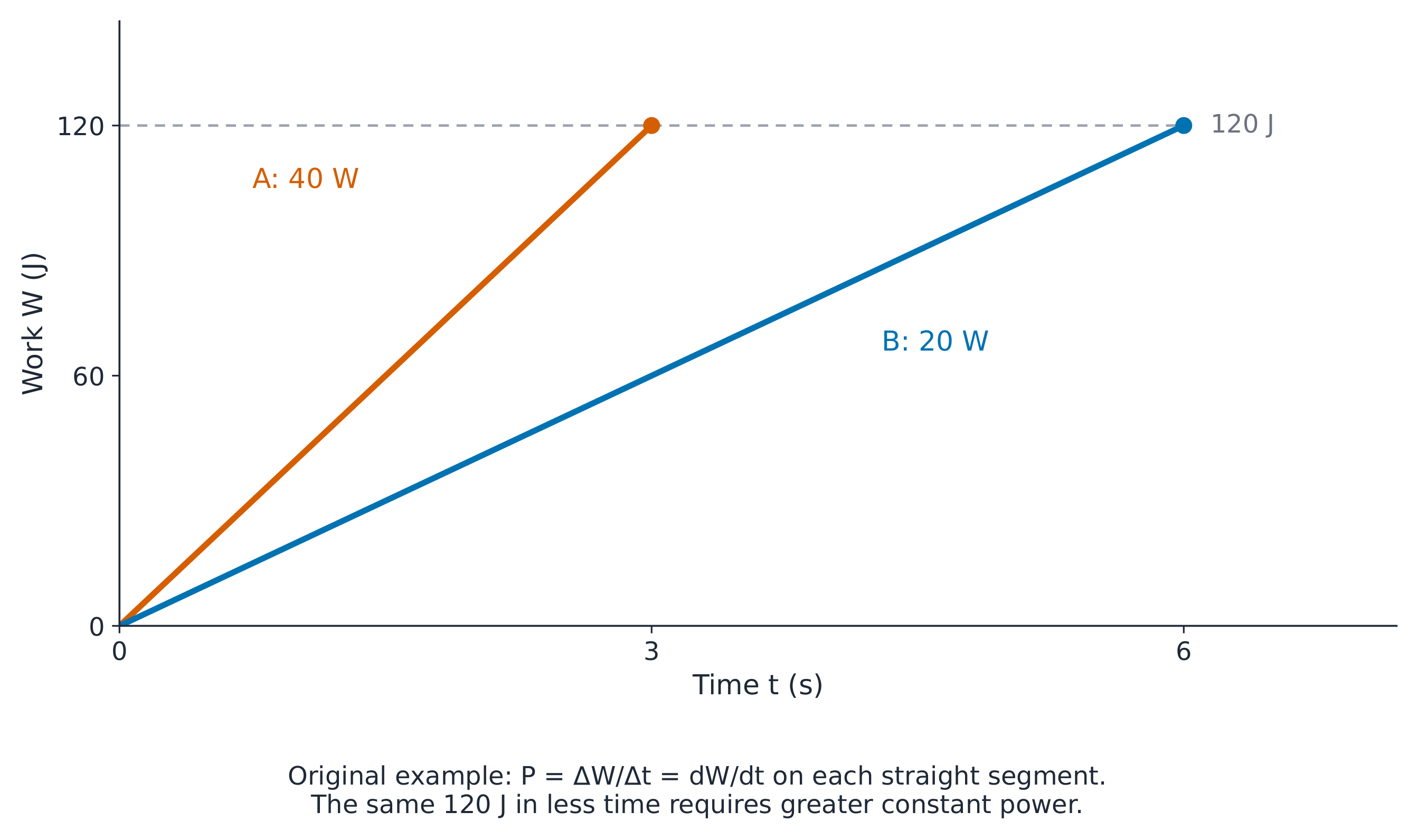
Average and instantaneous power need not agree. A tangent slope on a work–time graph gives instantaneous power; a secant over an interval gives average power. The displayed straight lines have constant slopes and therefore equal instantaneous and interval-average powers on each line.
For A, $P=W/\Delta t=120\text{ J}/3.0\text{ s}=40\text{ W}$; for B, $P=W/\Delta t=120\text{ J}/6.0\text{ s}=20\text{ W}$. Each straight segment has constant instantaneous power equal to its interval average.
Original ramp-to-motor task. A particle released from rest drops through 3.0 metres on a fixed frictionless ramp. If it stays on the track with no other energy transfer, $v=\sqrt{2gh}=\sqrt{(2)(9.8\text{ m/s}^2)(3.0\text{ m})}\approx7.7\text{ m/s}$. A motor maintaining that speed against a 20-newton resistance needs $P=Fv=(20\text{ N})(7.7\text{ m/s})\approx150\text{ W}$. These ideal results exclude other losses.
Original lift task. Lifting 50 kilograms steadily upward at 2.0 metres per second, with negligible losses, requires $F=mg=(50\text{ kg})(9.8\text{ m/s}^2)=490\text{ N}$. Then $P=Fv=(490\text{ N})(2.0\text{ m/s})=980\text{ W}$. Doubling the speed doubles this ideal power, not the work required to reach the same height.
Original hill task. A 1,200-kilogram car climbs at 15 metres per second along a road rising 1.0 metre per 20 metres travelled. The vertical speed is $v_y=v\Delta y/\Delta s=(15\text{ m/s})(1.0\text{ m}/20\text{ m})=0.75\text{ m/s}$. Against gravity, $P=mgv_y=(1200\text{ kg})(9.8\text{ m/s}^2)(0.75\text{ m/s})=8820\text{ W}\approx8.8\text{ kW}$. Air resistance, rolling losses and efficiency would increase the required input power.
Original varying-power task. Let $W(t)=ct^2$, with $c=2.0\text{ J/s}^2$. From 0 to 3.0 seconds, $P_{\mathrm{avg}}=[W(3)-W(0)]/(3.0\text{ s})=6.0\text{ W}$. At 3.0 seconds, $P_{\mathrm{inst}}=dW/dt=2ct=12\text{ W}$. The final power is not the interval average.
Vocabulary
Train
| English |
|---|
| Power/ˈpaʊə/ |
| watts/wɒts/ |
3.5
Exam tips
Name the system and energy transfers. Start from the relevant principle, preserve signs and units, and distinguish one force's work from net work. Read signed area, slope and energy gaps as different graph operations. State assumptions before using conservation or a friction model; follow the actual prompt rather than a memorised scoring claim.
Interactive lessons on this topic
Work through it step by step, with instant-check exercises.