| Learning Objective | Essential Knowledge |
|---|---|
2.1.A |
|
2.1.B |
|
Force and Translational Dynamics
AP Physics C: Mechanics · Topic 2
 9:06
9:06
Force and Translational Dynamics
A cart runs around a vertical loop. At the very top it is completely upside down, with nothing holding it up. Why does it not fall off? The answer is not some…
English narration · English + 中文 subtitles burned in
2.1
Systems and Center of Mass
Syllabus
Source: College Board AP Course and Exam Description
A system 系统 is the object or objects you analyze, treated as a point at its center of mass 质心. For a set of masses, $x_{\text{cm}}=\dfrac{\sum m_i x_i}{\sum m_i}$; for a continuous body, $x_{\text{cm}}=\dfrac{1}{M}\int x\,dm$. Only external forces move the center of mass.
Vocabulary
Train
| English |
|---|
| system/ˈsɪstəm/ |
| center of mass/ˈsentə ɒv mæs/ |
2.2
Forces and Free-Body Diagrams
Syllabus
| Learning Objective | Essential Knowledge |
|---|---|
2.2.A |
|
2.2.B |
Boundary statement: AP Physics C: Mechanics and AP Physics C: Electricity and Magnetism only expect students to depict the forces exerted on objects, not the force components on free-body diagrams. On the AP Physics exams, individual forces represented on a free-body diagram must be drawn as individual straight arrows, originating on the dot and pointing in the direction of the force. Individual forces that are in the same direction must be drawn side by side, not overlapping. |
Source: College Board AP Course and Exam Description
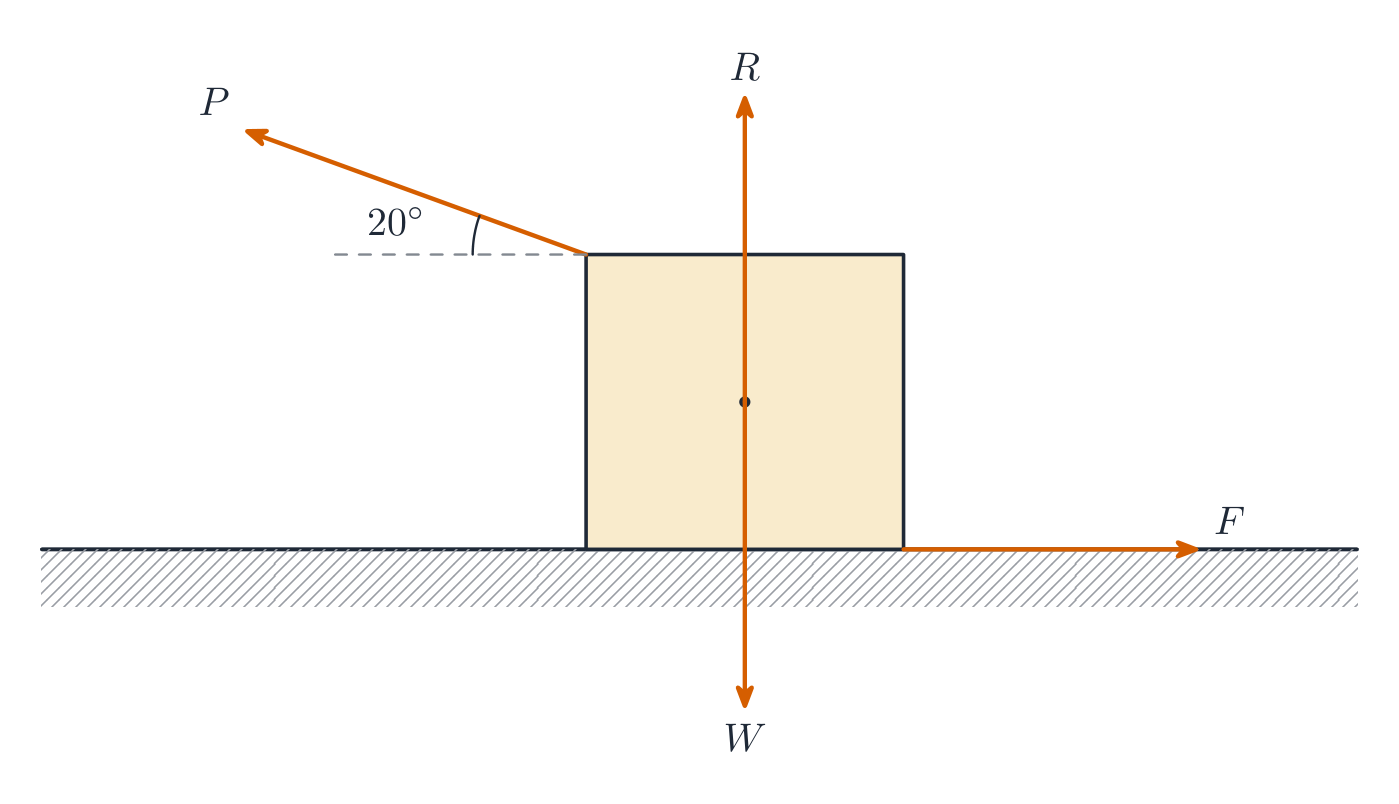
A force 力 is a push or pull (a vector, in newtons). A free-body diagram 受力图 draws one object with an arrow for every force on it – weight, normal, tension, friction, applied, drag. Draw it first; it sets up every dynamics equation.
Explore
Balance the forces on a free-body diagram
A free-body diagram shows every force on one object as an arrow. The object accelerates only if the forces don't cancel — the net force sets $a=F/m$.
Vocabulary
Train
| English |
|---|
| force/fɔːs/ |
| free-body diagram/friː ˈbɒdi ˈdaɪəɡræm/ |
2.3
Newton's Third Law
Syllabus
| Learning Objective | Essential Knowledge |
|---|---|
2.3.A |
|
Source: College Board AP Course and Exam Description
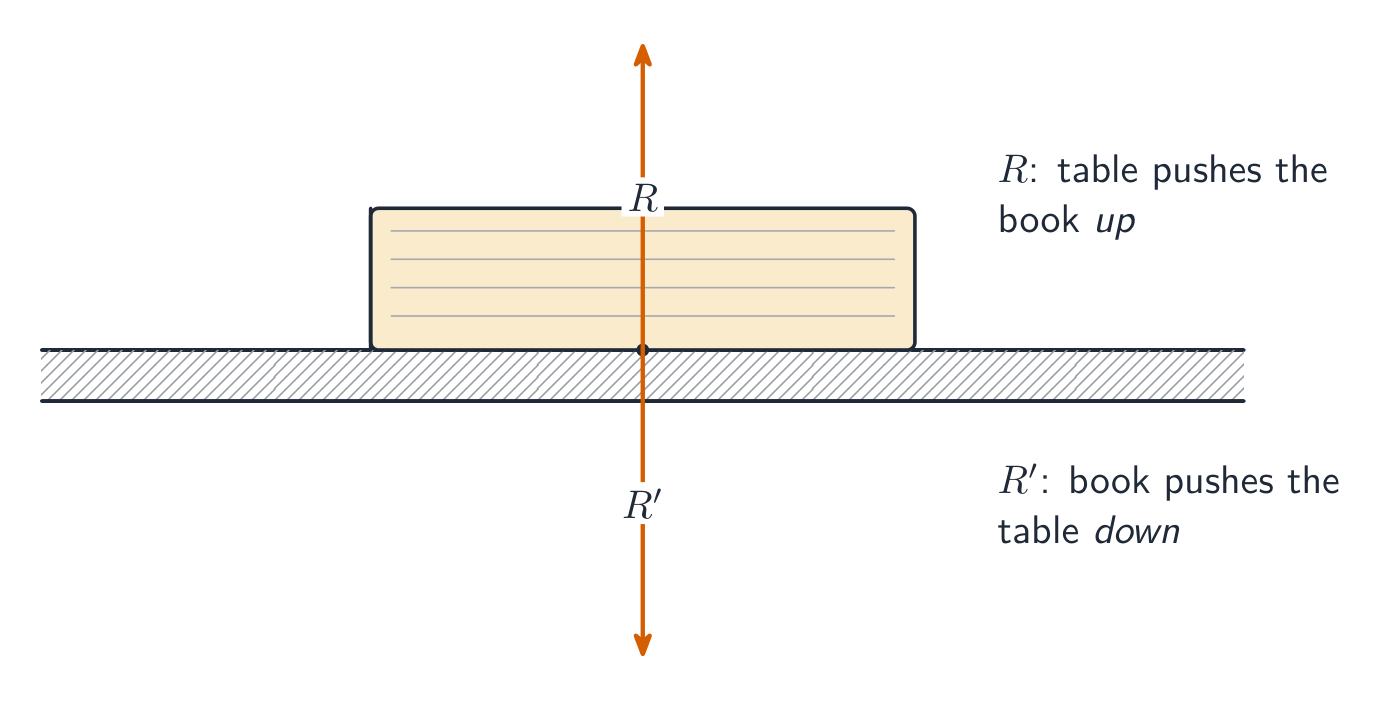
Newton's third law 牛顿第三定律: A pushes B, B pushes back equally and oppositely. The pair acts on different objects, so it never cancels within one free-body diagram.
Vocabulary
Train
| English |
|---|
| Newton's third law/ˈnjuːtnz θɜːd lɔː/ |
2.4
Newton's First Law
Syllabus
| Learning Objective | Essential Knowledge |
|---|---|
2.4.A |
|
Source: College Board AP Course and Exam Description
Newton's first law (inertia 惯性): with zero net force 合力, velocity stays constant – the object is in translational equilibrium 平动平衡.
Vocabulary
Train
| English |
|---|
| inertia/ɪˈnɜːʃə/ |
| net force/net fɔːs/ |
| translational equilibrium/trænˈsleɪʃənl ˌiːkwɪˈlɪbrɪəm/ |
2.5
Newton's Second Law

Syllabus
| Learning Objective | Essential Knowledge |
|---|---|
2.5.A |
|
Source: College Board AP Course and Exam Description
The general form uses momentum:
$$\sum\vec{F}=\frac{d\vec{p}}{dt}=m\vec{a}\ \ (\text{for constant mass}).$$
Apply it one axis at a time. When forces depend on velocity or position, this becomes a differential equation 微分方程 to solve.
Worked example. A $2.0\ \text{kg}$ block slides down a frictionless incline 斜面 at $30^{\circ}$. Only the along-ramp component of gravity drives it, so $a=g\sin30^{\circ}=9.8(0.5)=4.9\ \text{m/s}^2$, independent of the mass.
Worked example (two bodies). A $6.0\ \text{kg}$ cart on a frictionless table is pulled by a string over a light pulley to a hanging $2.0\ \text{kg}$ mass. Treat the pair as one system: only the hanging weight drives it, so $a=\dfrac{2.0(9.8)}{8.0}=2.45\ \text{m/s}^2$. Then isolate the cart alone to find the string tension 张力: $T=6.0(2.45)\approx15\ \text{N}$. System first for $a$, single body for internal forces – that two-step is the standard pattern.
Vocabulary
Train
| English |
|---|
| differential equation/ˌdɪfəˈrenʃl ɪˈkweɪʒn/ |
| incline/ɪnˈklaɪn/ |
| tension/ˈtenʃn/ |
2.6
Gravitational Force
Syllabus
| Learning Objective | Essential Knowledge |
|---|---|
2.6.A |
|
2.6.B |
|
2.6.C |
|
2.6.D |
|
2.6.E |
Boundary statement: AP Physics C: Mechanics does not expect students to mathematically prove or derive Newton's shell theorem. |
Source: College Board AP Course and Exam Description
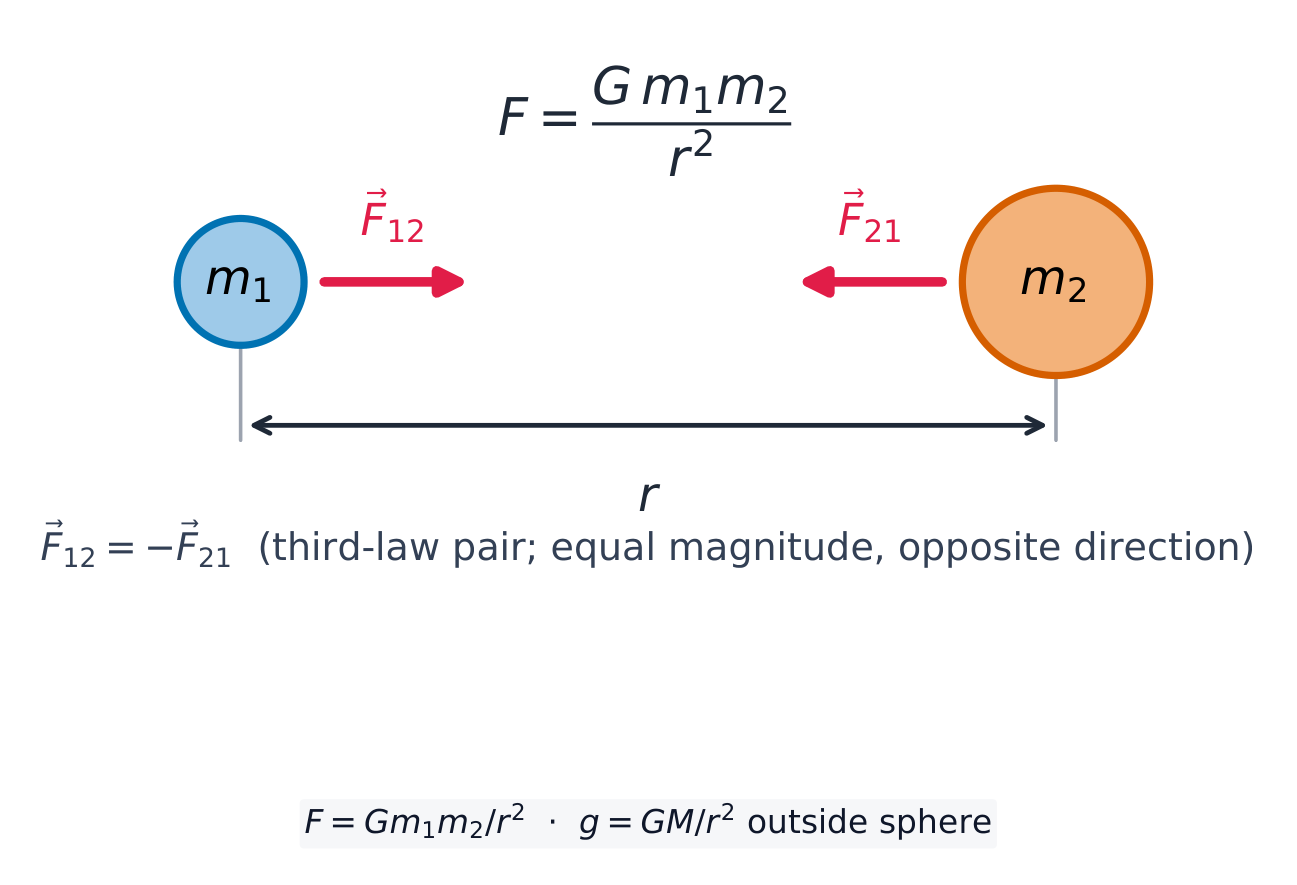
Near a surface, weight is $F_g=mg$. In general, Newton's law of gravitation 万有引力定律:
$$F_g=\frac{Gm_1m_2}{r^2},$$
attractive and inverse-square. The gravitational field is $g=\dfrac{GM}{r^2}$.
Vocabulary
Train
| English |
|---|
| Newton's law of gravitation/ˈnjuːtnz lɔː ɒv ˌɡrævɪˈteɪʃn/ |
2.7
Kinetic and Static Friction
Syllabus
| Learning Objective | Essential Knowledge |
|---|---|
2.7.A |
|
2.7.B |
|
Source: College Board AP Course and Exam Description
Friction 摩擦力 opposes sliding along a surface: kinetic 动摩擦 $f_k=\mu_k N$ while sliding, and static 静摩擦 $f_s\le\mu_s N$ up to a maximum before sliding. $N$ is the normal force 法向力. Note the inequality: static friction is only as large as it needs to be, and $\mu_s N$ is its ceiling, not its value.
Worked example. The same block on the same $30^{\circ}$ incline, now with $\mu_k=0.20$. Perpendicular to the ramp: $N=mg\cos30^{\circ}$. Along the ramp: $ma=mg\sin30^{\circ}-\mu_k mg\cos30^{\circ}$, so $a=g(\sin30^{\circ}-0.20\cos30^{\circ})=9.8(0.500-0.173)=3.2\ \text{m/s}^2$ – the mass cancels again.
Explore
Slide a block down a slope with friction
Friction opposes motion up to a maximum $\mu N$. Tilt the slope until gravity's pull along it beats static friction and the block starts to slide.
Vocabulary
Train
| English |
|---|
| Friction/ˈfrɪkʃn/ |
| kinetic/kɪˈnetɪk/ |
| static/ˈstætɪk/ |
| normal force/ˈnɔːml fɔːs/ |
2.8
Spring Forces
Syllabus
| Learning Objective | Essential Knowledge |
|---|---|
2.8.A |
|
2.8.B |
Boundary statement: AP Physics C: Mechanics only expects students to find the effective spring constant of systems of springs that are arranged either in series or in parallel and does not expect students to find the effective spring constant of a system in which springs are arranged in both series and parallel. |
Source: College Board AP Course and Exam Description
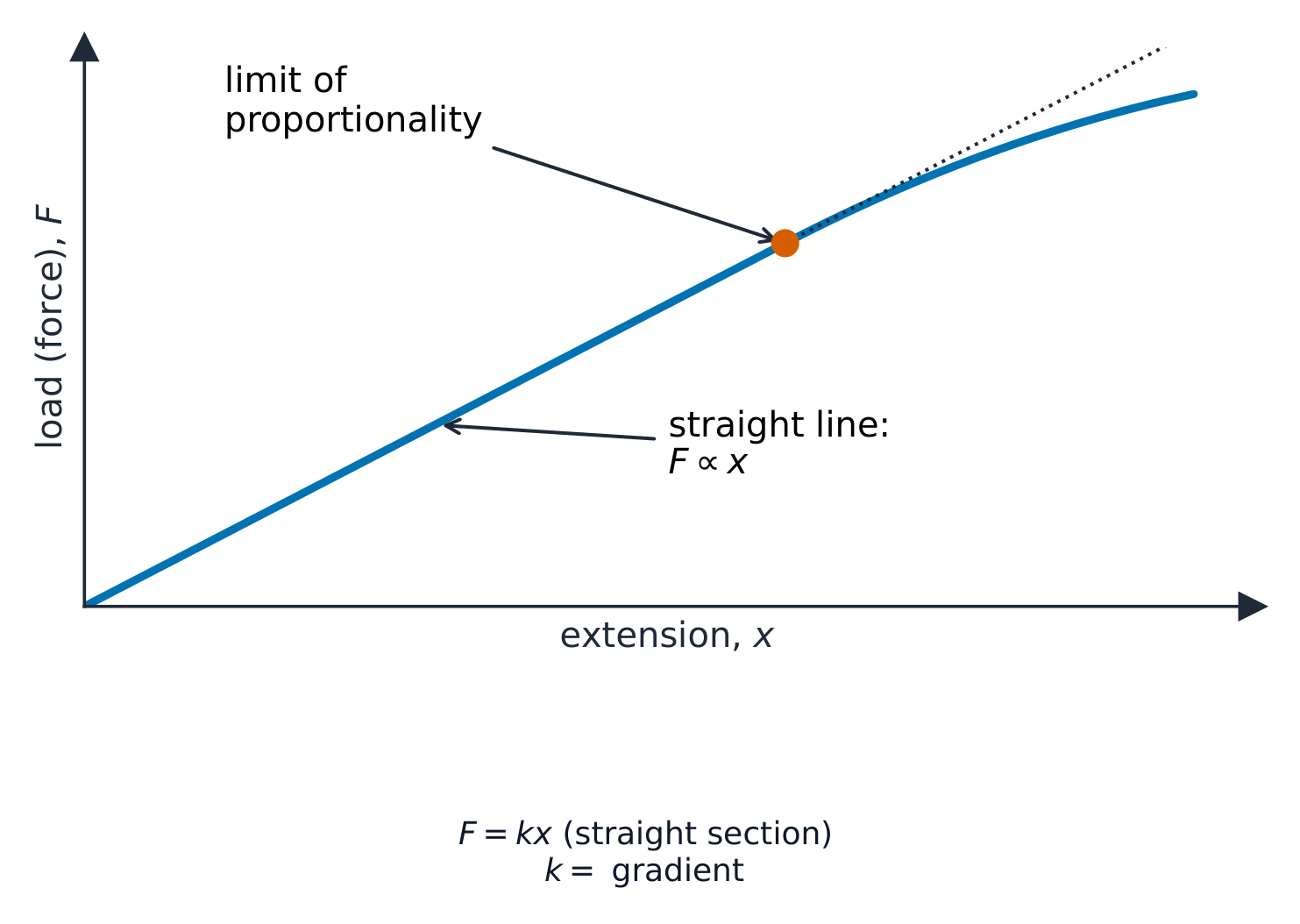
An ideal spring obeys Hooke's law 胡克定律 $F_s=-kx$, a restoring force set by the spring constant 弹簧劲度系数 $k$. Its stored energy is $U=\tfrac12 kx^2$.
Combined springs act as one equivalent spring of constant $k_{\text{eq}}$. In parallel (side by side, sharing the load) the constants add, $k_{\text{eq}}=k_1+k_2$ – stiffer than either. In series (end to end) they combine as $\dfrac{1}{k_{\text{eq}}}=\dfrac{1}{k_1}+\dfrac{1}{k_2}$ – softer than the softest one. Two springs pulling a mass from opposite sides also act in parallel, giving a restoring constant $k_1+k_2$. Whichever you have, the SHM period uses $k_{\text{eq}}$: $T=2\pi\sqrt{m/k_{\text{eq}}}$.
Explore
Stretch a spring (Hooke's law)
A spring's force is proportional to its extension, $F=kx$ (Hooke's law). Pull harder and the extension grows in step — until the spring's limit.
Vocabulary
Train
| English |
|---|
| Hooke's law/hʊks lɔː/ |
| spring constant/sprɪŋ ˈkɒnstənt/ |
2.9
Resistive Forces
Syllabus
| Learning Objective | Essential Knowledge |
|---|---|
2.9.A |
|
Source: College Board AP Course and Exam Description
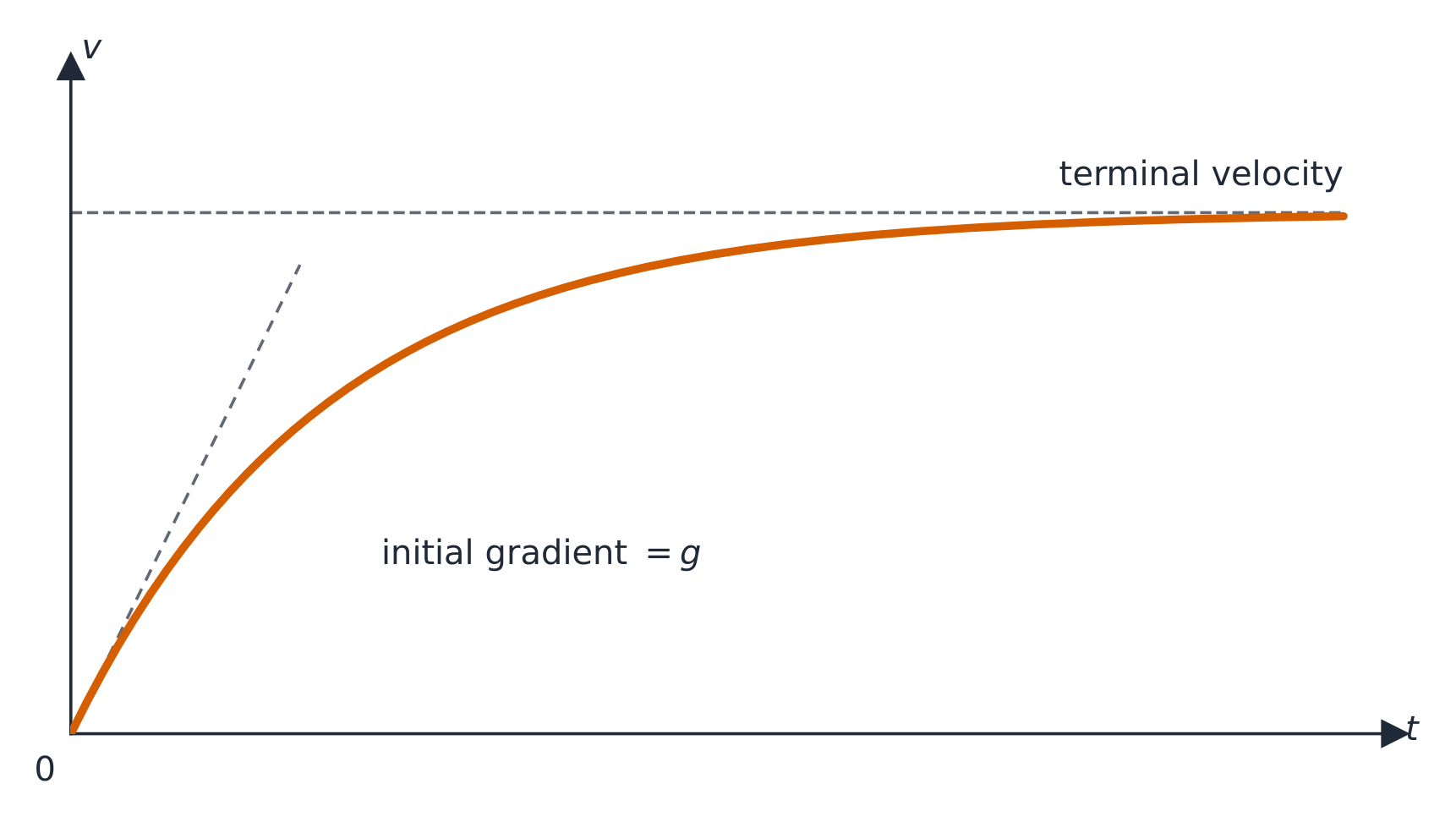
A resistive force 阻力 (drag) opposes motion through a fluid and grows with speed, often modeled as $F=-bv$ or $F=-cv^2$. Newton's second law then gives a differential equation, e.g. $m\dfrac{dv}{dt}=mg-bv$ for a falling object. As speed rises, drag builds until it balances the driving force; the object then stops accelerating and moves at a constant terminal velocity 终极速度, found by setting the net force (and $dv/dt$) to zero.
Worked example. For a falling object with $m\dfrac{dv}{dt}=mg-bv$, the terminal velocity is where $\dfrac{dv}{dt}=0$: $mg=bv_T$, so $v_T=\dfrac{mg}{b}$. With $m=0.10\ \text{kg}$ and $b=0.50\ \text{kg/s}$, $v_T=\dfrac{0.10(9.8)}{0.50}=2.0\ \text{m/s}$.
To get the full motion $v(t)$, separate the variables 分离变量 and integrate from rest:
$$\int_0^{v}\frac{dv'}{mg-bv'}=\int_0^{t}\frac{dt'}{m}\;\Rightarrow\;-\frac{1}{b}\ln\!\frac{mg-bv}{mg}=\frac{t}{m},$$
which rearranges to $v(t)=v_T\left(1-e^{-bt/m}\right)$ – the speed rising exponentially toward $v_T$. Showing this integration is the calculus skill a Physics C free-response rewards, not just quoting the final formula.

Vocabulary
Train
| English |
|---|
| resistive force/rɪˈzɪstɪv fɔːs/ |
| terminal velocity/ˈtɜːmɪnl vəˈlɒsɪti/ |
| separate the variables/ˈseprət ðə ˈveərɪəblz/ |
2.10
Circular Motion
Syllabus
| Learning Objective | Essential Knowledge |
|---|---|
2.10.A |
|
2.10.B |
Boundary statement: AP Physics C: Mechanics does not expect students to know Kepler's first or second laws of planetary motion. |
Source: College Board AP Course and Exam Description
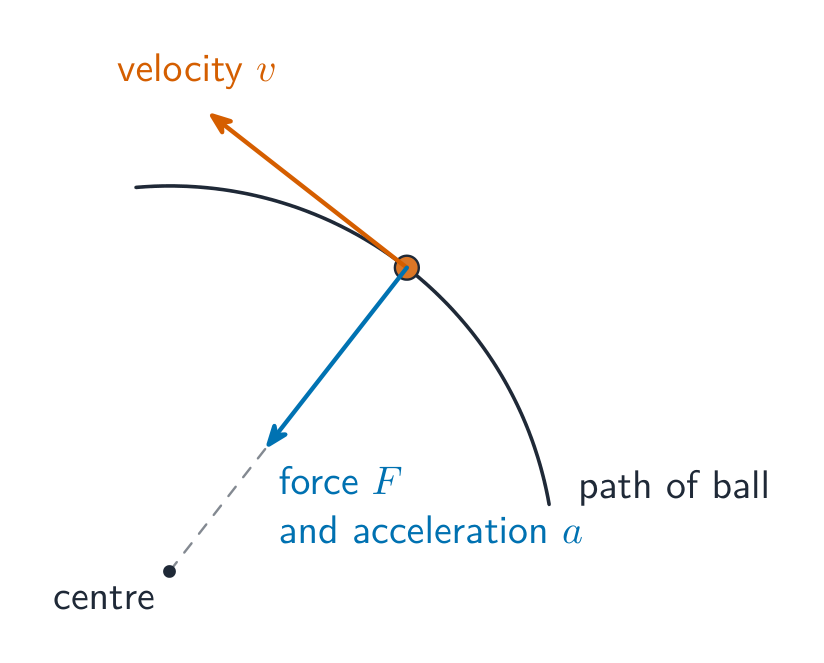
Uniform circular motion has a centripetal acceleration 向心加速度 $a_c=\dfrac{v^2}{r}$ pointing to the center, requiring a net inward force $F_c=\dfrac{mv^2}{r}$ supplied by a real force (tension, gravity, friction, normal). There is no outward force. For vertical circles and banked curves, decompose the real forces to find which provides the centripetal requirement.
Worked example. A $0.50\ \text{kg}$ ball is whirled on a $1.0\ \text{m}$ string in a horizontal circle at $3.0\ \text{m/s}$. The string tension supplies the whole centripetal force: $T=\dfrac{mv^2}{r}=\dfrac{0.50(3.0)^2}{1.0}=4.5\ \text{N}$.
Worked example (vertical circle). At the top of a vertical loop of radius $r$, gravity and the normal force both point toward the center: $N+mg=\dfrac{mv^2}{r}$. The slowest possible speed at the top is where the track pushes with nothing at all ($N=0$): $v_{\min}=\sqrt{gr}$. For $r=2.5\ \text{m}$: $v_{\min}=\sqrt{9.8(2.5)}=4.9\ \text{m/s}$. Any slower and the cart leaves the track before the top.
Vocabulary
Train
| English |
|---|
| centripetal acceleration/senˈtrɪpɪtl əkˌseləˈreɪʃn/ |
2.10
Exam tips
- Locate the center of mass with $x_{cm}=\tfrac{1}{M}\int x\,dm$ (or $\tfrac{\sum m_i x_i}{\sum m_i}$ for point masses) and use $\lambda,\sigma,\rho$ for the mass element.
- The net external force moves the center of mass as if all mass sat there: $\vec F_{net}=M\vec a_{cm}$.
- Define your system clearly — internal forces cancel, so only external forces change its momentum.
- Exploit symmetry to shortcut a center-of-mass integral.
- Distinguish center of mass from center of gravity (identical in a uniform field).
Interactive lessons on this topic
Work through it step by step, with instant-check exercises.