| Learning Objective | Essential Knowledge |
|---|---|
1.1.A |
|
Kinematics
AP Physics C: Mechanics · Topic 1
 7:31
7:31
Kinematics
A rocket lifts off. Every second, its engine burns harder, so its acceleration keeps growing. Now try to find its speed with the equations from your first…
English narration · English + 中文 subtitles burned in
1.1
Scalars and Vectors
Syllabus
Source: College Board AP Course and Exam Description
Kinematics 运动学 describes motion. Two kinds of quantity:
- A scalar 标量 has only size (magnitude 大小): distance, speed, mass, time.
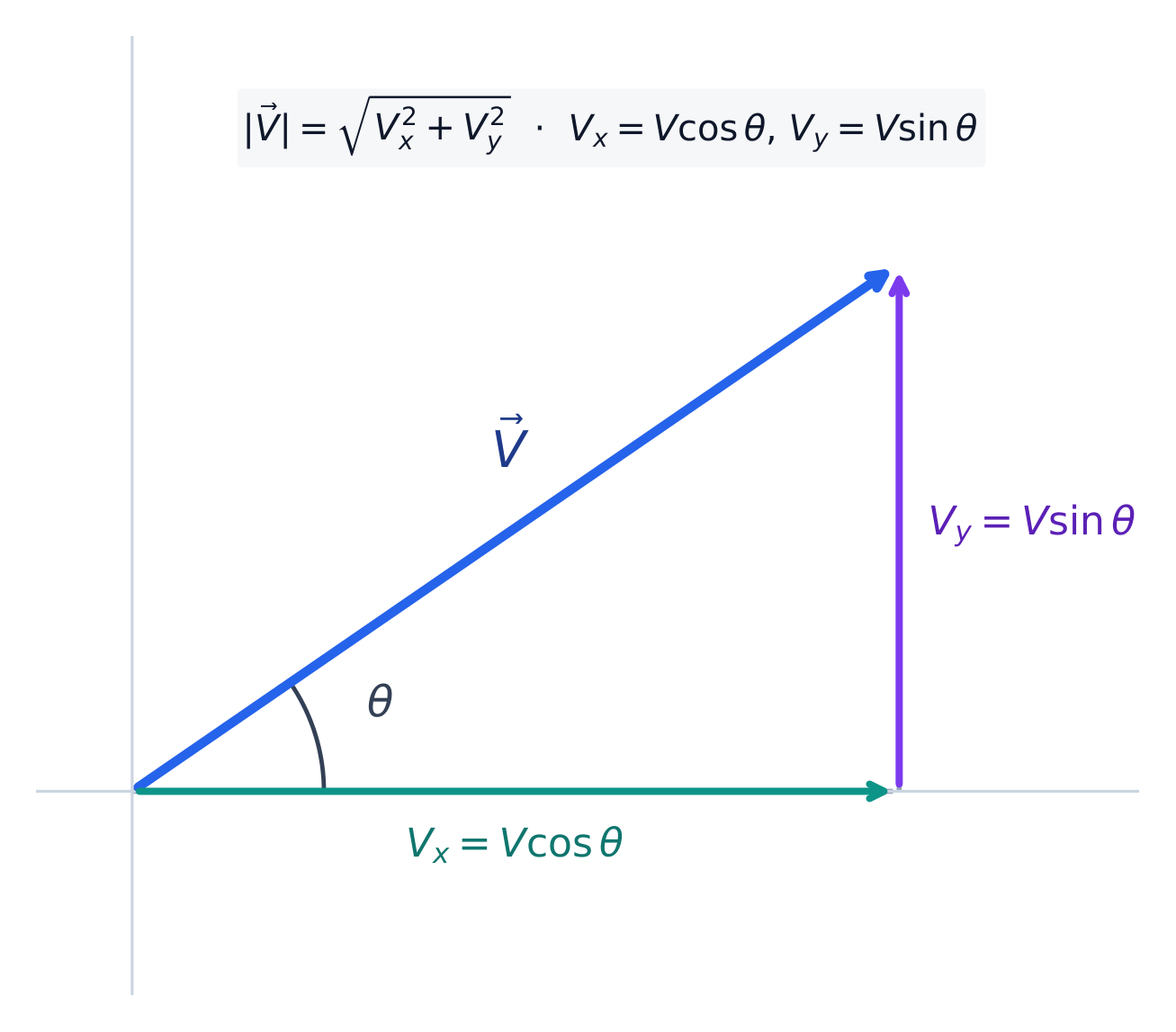
- A vector 矢量 has magnitude and direction: displacement, velocity, acceleration, force.
In this calculus-based course you resolve vectors into components 分量 and add them component by component; a vector's magnitude is $\sqrt{v_x^2+v_y^2+\cdots}$. Physics C also writes vectors with unit vectors 单位矢量: $\vec{v}=v_x\hat{i}+v_y\hat{j}$, where $\hat{i}$ and $\hat{j}$ are directions of length one along $x$ and $y$ – handy because calculus can then act on each component separately.
Explore
Explore the dot product
Drag the components of $\vec{A}$ and $\vec{B}$. The dot product $\vec{A}\cdot\vec{B}=A_xB_x+A_yB_y$ reaches zero exactly when the two vectors are perpendicular — the geometry behind $\cos\theta$.
Vocabulary
Train
| English |
|---|
| Kinematics/ˌkɪnɪˈmætɪks/ |
| scalar/ˈskeɪlə/ |
| magnitude/ˈmæɡnɪtjuːd/ |
| vector/ˈvektə/ |
| components/kəmˈpəʊnənts/ |
| unit vectors/ˈjuːnɪt ˈvektəz/ |
1.2
Displacement, Velocity, and Acceleration
Syllabus
| Learning Objective | Essential Knowledge |
|---|---|
1.2.A |
|
1.2.B |
|
1.2.C |
|
Source: College Board AP Course and Exam Description
Because motion can change continuously, define the rates as derivatives 导数:
$$v=\frac{dx}{dt},\qquad a=\frac{dv}{dt}=\frac{d^2x}{dt^2}.$$
Reversing this, integrate to recover velocity and position:
$$v(t)=v_0+\int_0^t a\,dt,\qquad x(t)=x_0+\int_0^t v\,dt.$$
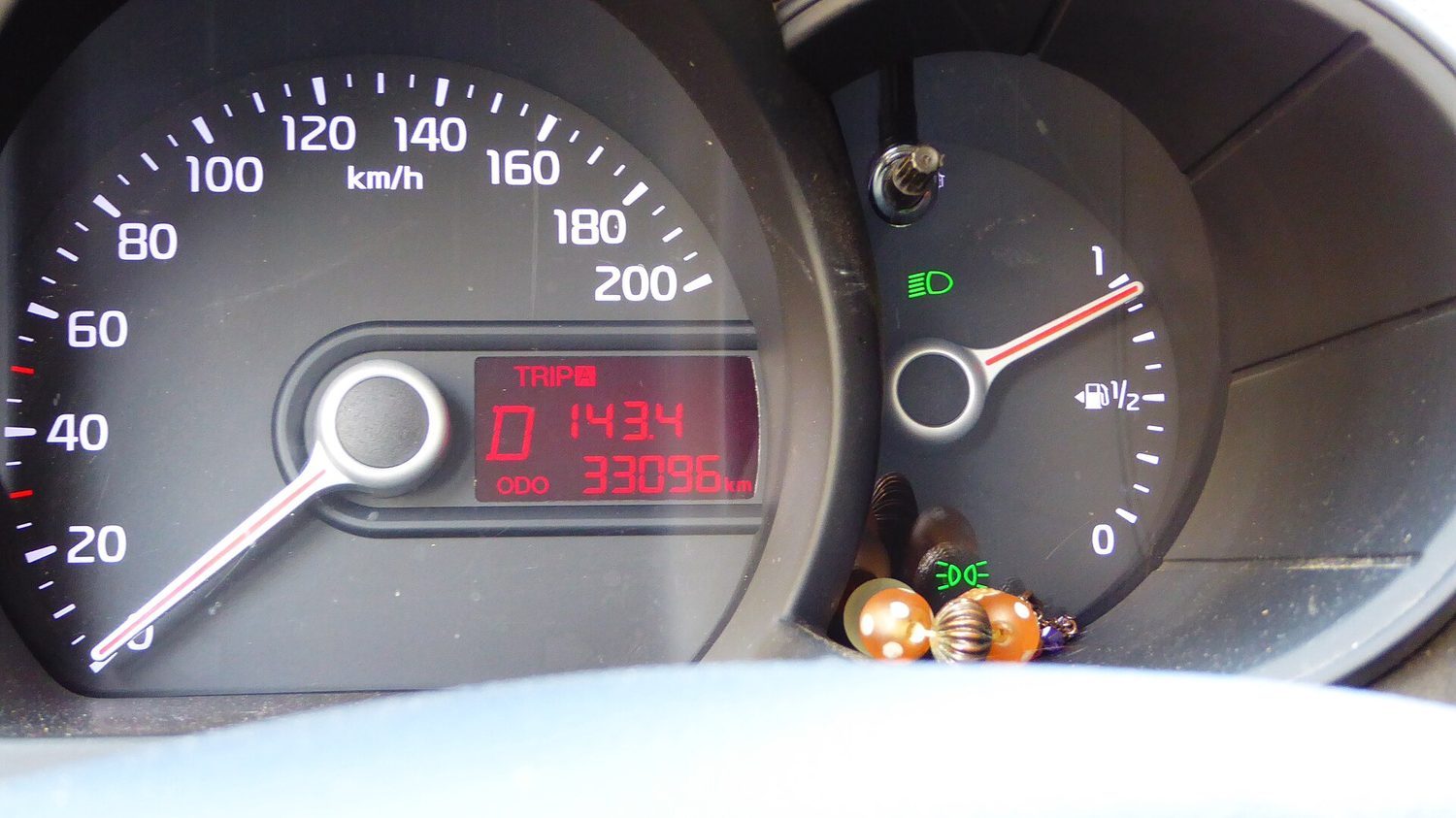
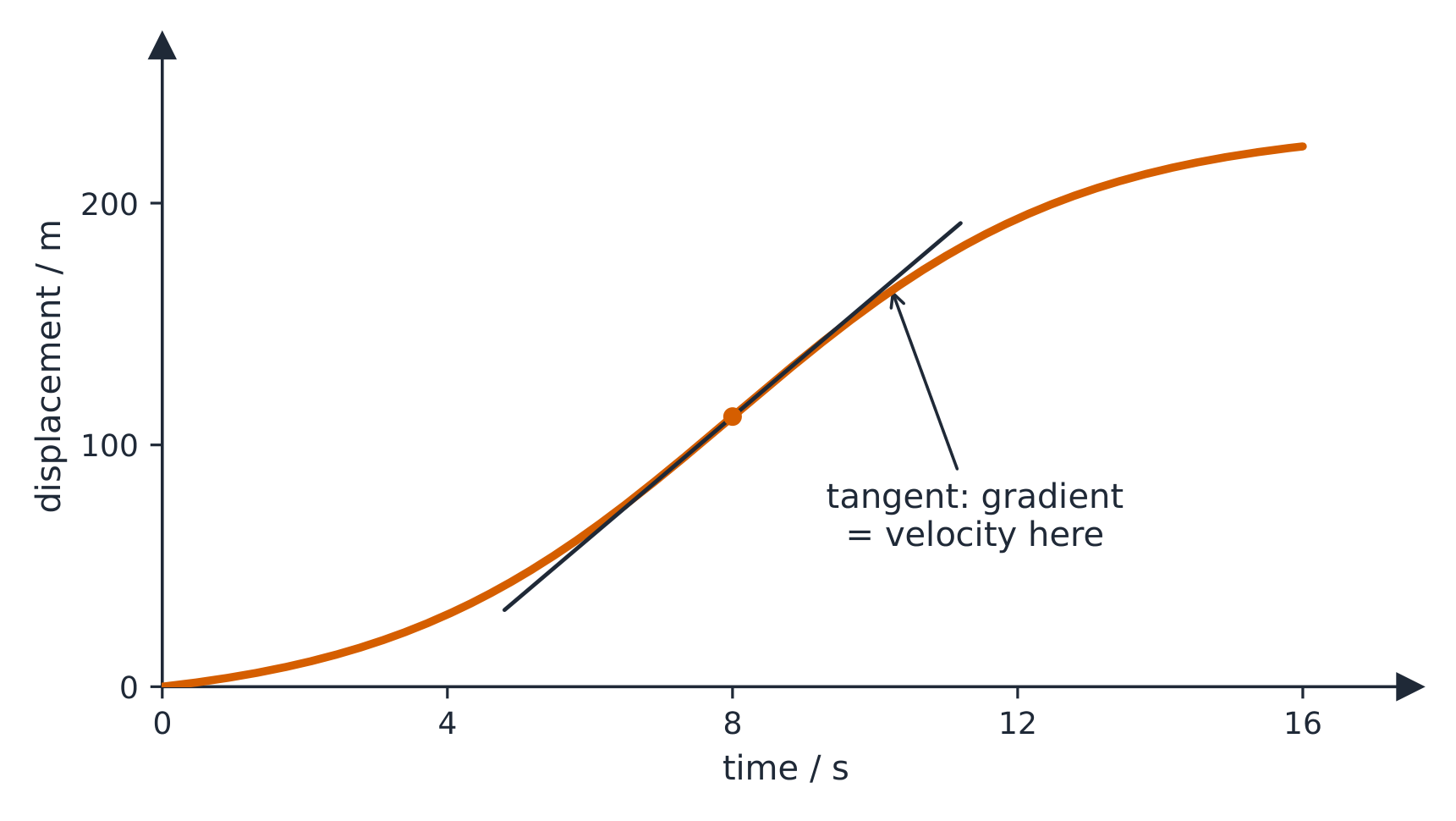
Distinguish the average from the instantaneous: average velocity 平均速度 is $\Delta x/\Delta t$ over an interval, while instantaneous velocity 瞬时速度 is the derivative at one moment – the slope of the tangent line, and what a speedometer shows.
For constant acceleration these give the familiar kinematic equations ($v=v_0+at$, $x=x_0+v_0t+\tfrac12at^2$, $v^2=v_0^2+2a\,\Delta x$). The most important constant-$a$ case is free fall 自由落体: near Earth's surface every object, heavy or light, accelerates downward at $g=9.8\ \text{m/s}^2$ once air resistance is negligible. When $a$ or $v$ varies with time, use the integrals directly.
Worked example. A particle moves with $x(t)=2t^3-3t^2$ (metres). Differentiate for velocity and acceleration:
$$v=\frac{dx}{dt}=6t^2-6t,\qquad a=\frac{dv}{dt}=12t-6.$$
At $t=2\ \text{s}$, $v=24-12=12\ \text{m/s}$ and $a=24-6=18\ \text{m/s}^2$. This calculus link – not just the constant-$a$ formulas – is what distinguishes Physics C.
Worked example. A particle starts from rest at the origin with $a(t)=6t$. Integrate: $v=\int 6t\,dt=3t^2$ and $x=\int 3t^2\,dt=t^3$. At $t=2\ \text{s}$, $v=12\ \text{m/s}$ and $x=8\ \text{m}$.

Vocabulary
Train
| English |
|---|
| derivatives/dɪˈrɪvətɪvz/ |
| average velocity/ˈævrɪdʒ vəˈlɒsɪti/ |
| instantaneous velocity/ˌɪnstənˈteɪnɪəs vəˈlɒsɪti/ |
| free fall/friː fɔːl/ |
1.3
Representing Motion
Syllabus
| Learning Objective | Essential Knowledge |
|---|---|
1.3.A |
Boundary statement: AP Physics C: Mechanics and AP Physics C: Electricity and Magnetism expects that for all situations in which a numerical quantity is required for g, the value $g \approx 10 \ \text{m/s}^2$ will be used. However, students will not be penalized for correctly using the more precise commonly accepted values of $g = 9.81 \ \text{m/s}^2$ or $g = 9.8 \ \text{m/s}^2$. |
Source: College Board AP Course and Exam Description
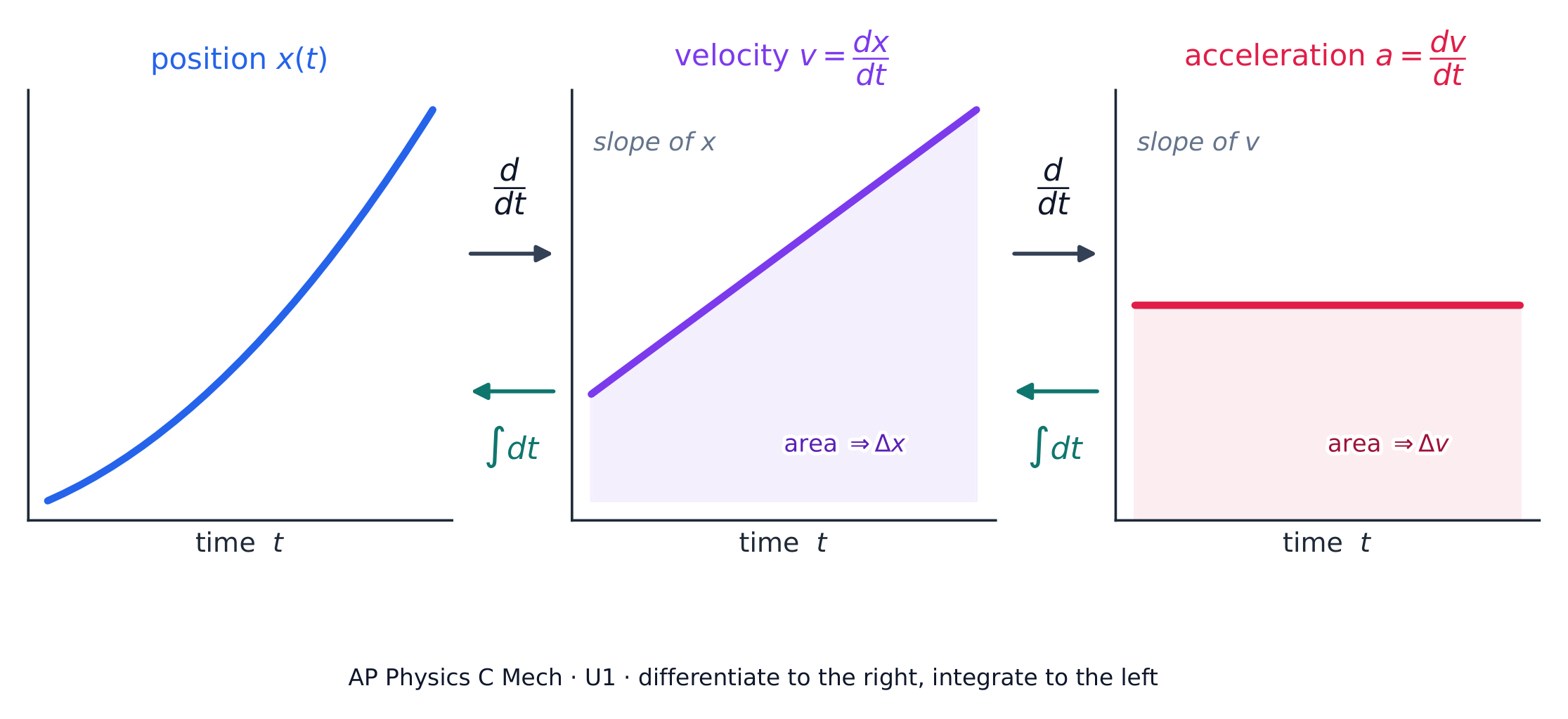
Move fluently between description, graph, table, and equation:
- On a position–time graph, the slope ($dx/dt$) is velocity.
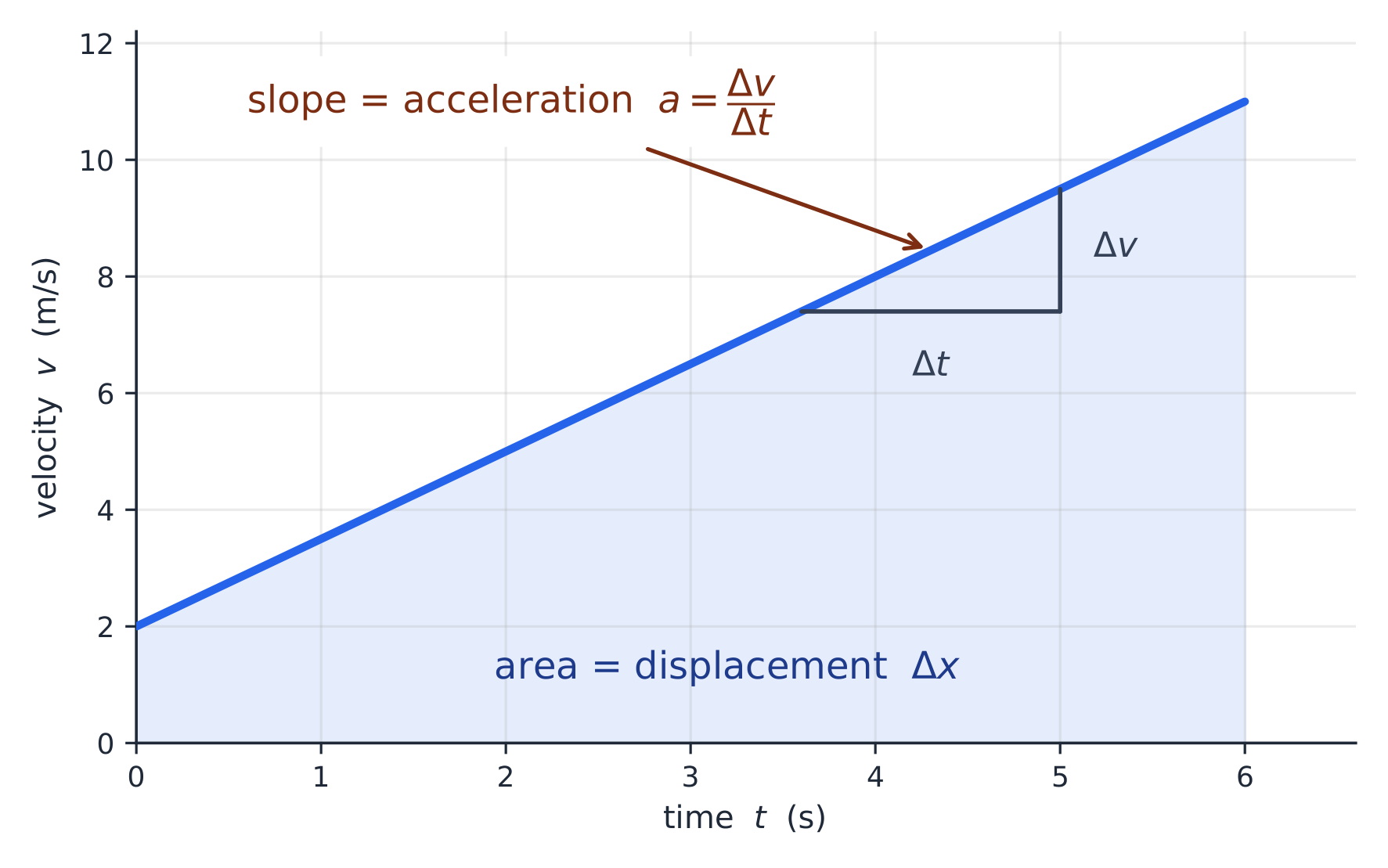
- On a velocity–time graph, the slope is acceleration and the area ($\int v\,dt$) is displacement.
- On an acceleration–time graph, the area ($\int a\,dt$) is the change in velocity.
Slopes are derivatives; areas are integrals – the two are inverse operations here.
Explore
Explore the velocity–time graph
Change the start velocity and acceleration. The slope of a $v$–$t$ line is the acceleration $a=\tfrac{dv}{dt}$, and the area underneath is the displacement $\Delta x=\int v\,dt$ — slope and area are the graphical faces of the derivative and the integral.
1.4
Reference Frames and Relative Motion
Syllabus
| Learning Objective | Essential Knowledge |
|---|---|
1.4.A |
|
1.4.B |
Boundary statement: Unless otherwise stated, the frame of reference of any problem may be assumed to be inertial. |
Source: College Board AP Course and Exam Description
All motion is relative to a reference frame 参考系. Combine velocities by vector addition: $\vec{v}_{A/C}=\vec{v}_{A/B}+\vec{v}_{B/C}$. This handles boats crossing rivers and passengers on moving vehicles – relative motion 相对运动 problems. Read the subscripts as a chain: "A relative to B" plus "B relative to C" gives "A relative to C".
Worked example. A boat that moves at $4.0\ \text{m/s}$ in still water heads straight across a river flowing at $3.0\ \text{m/s}$. Relative to the ground the boat moves at $\sqrt{4.0^2+3.0^2}=5.0\ \text{m/s}$, angled downstream. If the river is $80\ \text{m}$ wide, the crossing still takes $t=\dfrac{80}{4.0}=20\ \text{s}$ – only the across-stream component crosses the river; the current just carries the boat $60\ \text{m}$ downstream.
Vocabulary
Train
| English |
|---|
| reference frame/ˈrefrəns freɪm/ |
| relative motion/ˈrelətɪv ˈməʊʃn/ |
1.5
Motion in Two or Three Dimensions
Syllabus
| Learning Objective | Essential Knowledge |
|---|---|
1.5.A |
Boundary statement: AP Physics C: Mechanics only expects students to quantitatively analyze the motion of an object in two dimensions. AP Physics C: Electricity and Magnetism expects students to also qualitatively describe the motion of a particle in three dimensions. |
Source: College Board AP Course and Exam Description
In two or three dimensions, position is a vector $\vec{r}(t)=\langle x(t),y(t),z(t)\rangle$, and velocity and acceleration are its successive derivatives – each component handled independently.
Worked example. $\vec{r}(t)=\big(2t^2\big)\hat{i}+\big(4t-t^3\big)\hat{j}$ (metres). Differentiating each component: $\vec{v}=4t\,\hat{i}+(4-3t^2)\,\hat{j}$ and $\vec{a}=4\,\hat{i}-6t\,\hat{j}$. At $t=1\ \text{s}$: $\vec{v}=4\hat{i}+1\hat{j}$, so the speed is $\sqrt{17}\approx4.1\ \text{m/s}$ – no new physics, just one derivative per component.
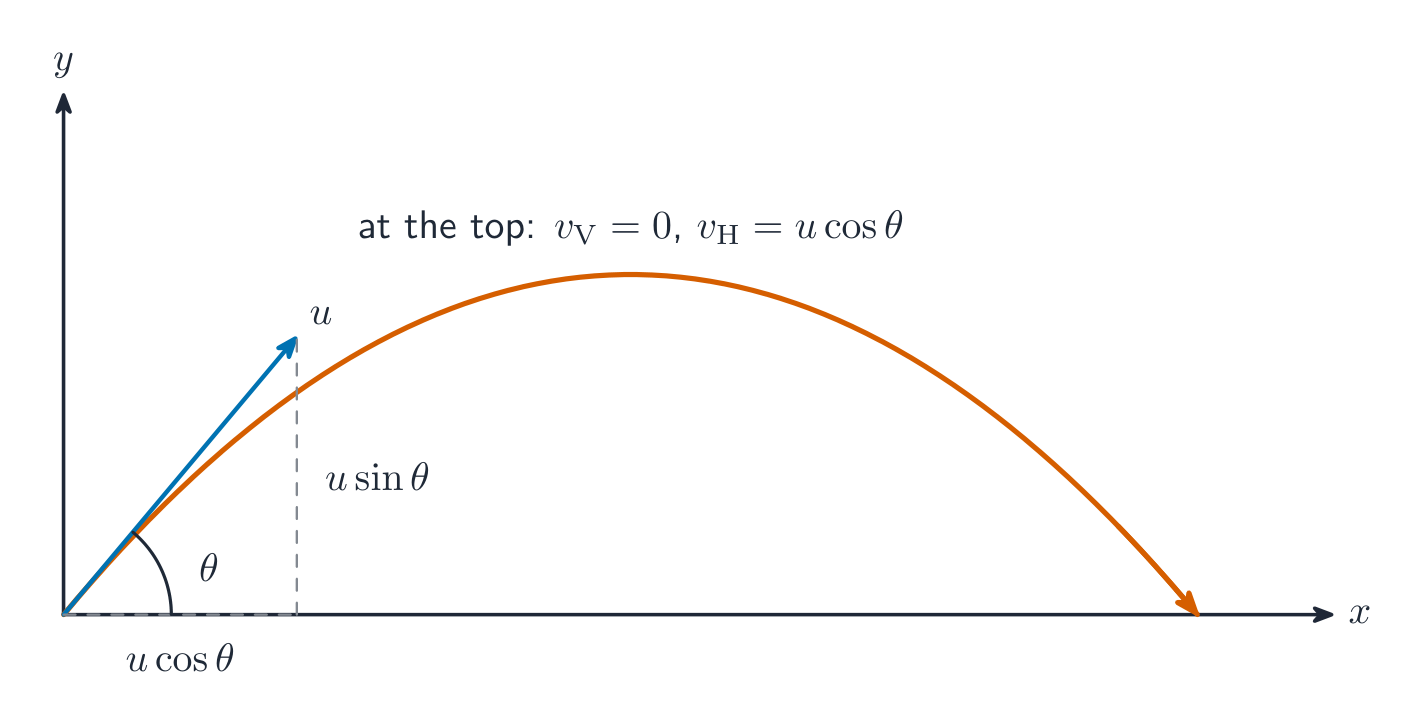
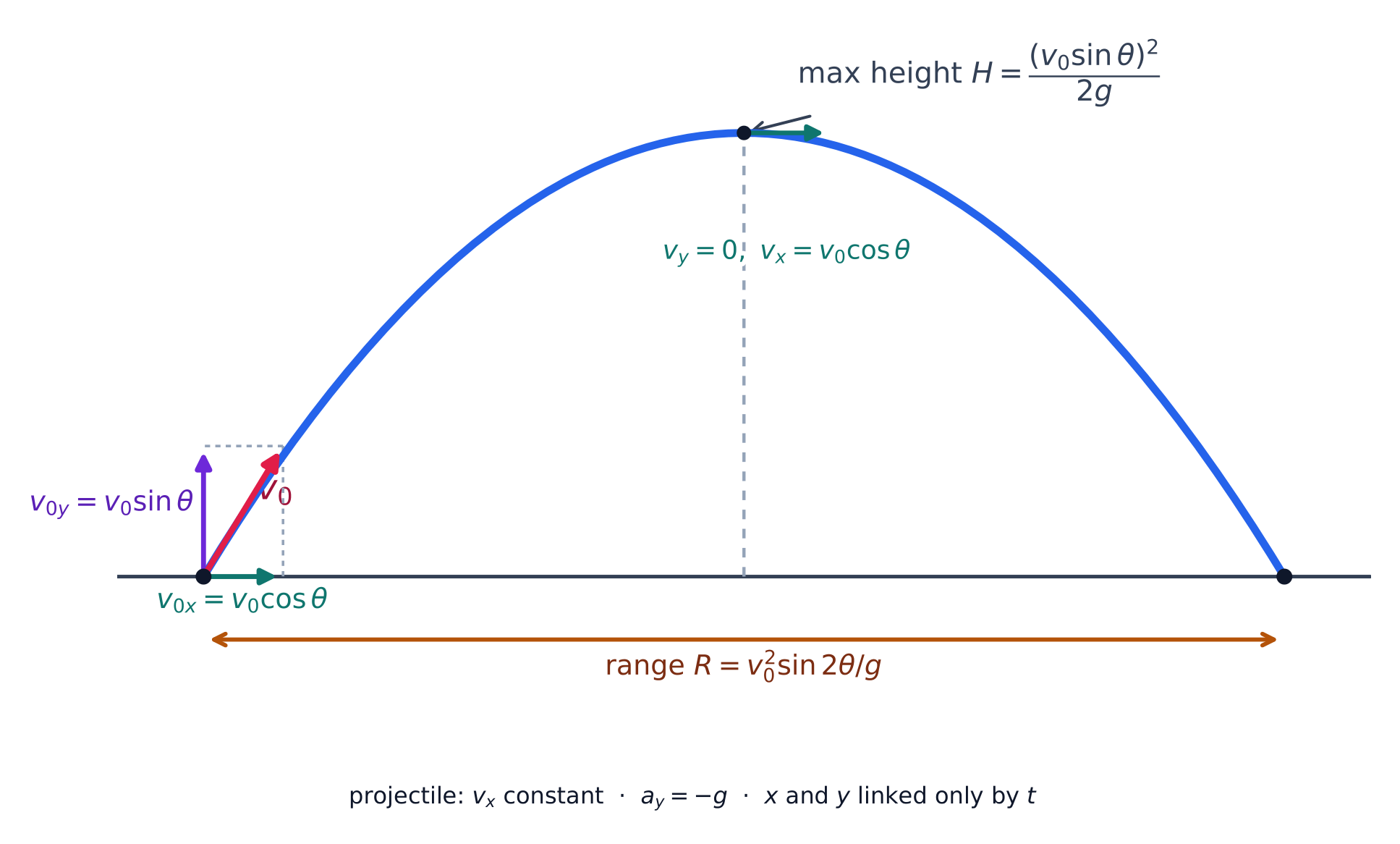
For projectile motion 抛体运动, horizontal and vertical motions are independent, linked only by time $t$: horizontally $a_x=0$ (constant velocity), vertically $a_y=-g$. The path is a parabola. This component method extends to any two-dimensional motion where the accelerations along each axis are known.
Worked example. A ball is launched at $20\ \text{m/s}$, $30^{\circ}$ above the horizontal ($g=9.8\ \text{m/s}^2$). The components are $v_{0x}=20\cos30^{\circ}=17.3\ \text{m/s}$ and $v_{0y}=20\sin30^{\circ}=10\ \text{m/s}$. The vertical motion sets the time: total flight $=\dfrac{2v_{0y}}{g}=\dfrac{20}{9.8}=2.0\ \text{s}$, maximum height $=\dfrac{v_{0y}^2}{2g}=5.1\ \text{m}$, and range $=v_{0x}\times2.0=35\ \text{m}$.
Explore
Explore projectile motion
Fire the projectile, then vary the angle and speed. The horizontal motion is steady while gravity acts only downward — together they trace a parabola. Find the angle that gives the greatest range (it peaks near $45^\circ$), and try the Moon.
Vocabulary
Train
| English |
|---|
| projectile motion/prəˈdʒektaɪl ˈməʊʃn/ |
1.5
Exam tips
- Resolve every vector into components before adding — never add magnitudes at an angle directly.
- On Physics C you are expected to use calculus: velocity is $\vec v=\tfrac{d\vec r}{dt}$ and acceleration $\vec a=\tfrac{d\vec v}{dt}$; reverse with integration.
- Carry and check units and treat direction with signs (choose a positive axis and stick to it).
- Use the dot product for work-type quantities and the cross product for torque and angular momentum.
- Sketch the vectors — a diagram catches sign and direction errors the algebra hides.
Interactive lessons on this topic
Work through it step by step, with instant-check exercises.