| Learning Objective | Essential Knowledge |
|---|---|
7.1.A |
|
Oscillations
AP Physics C: Mechanics · Topic 7
 8:14
8:14
Oscillations
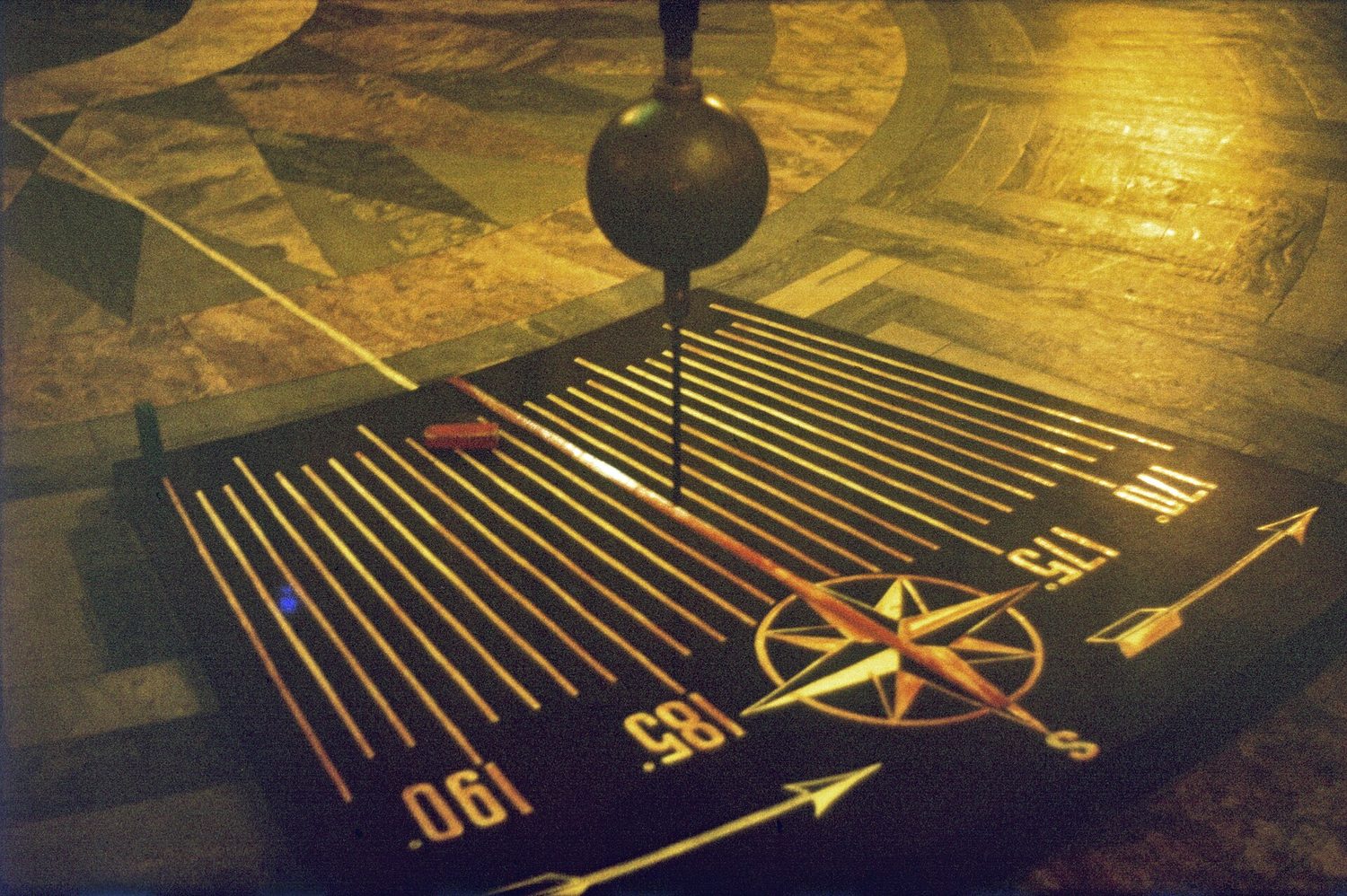
In a science museum, a brass ball hangs from a very long wire. It swings all day above a marked floor, untouched. Every swing takes the same time as the last.…
English narration · English + 中文 subtitles burned in
7.1
Defining Simple Harmonic Motion
Syllabus
Source: College Board AP Course and Exam Description
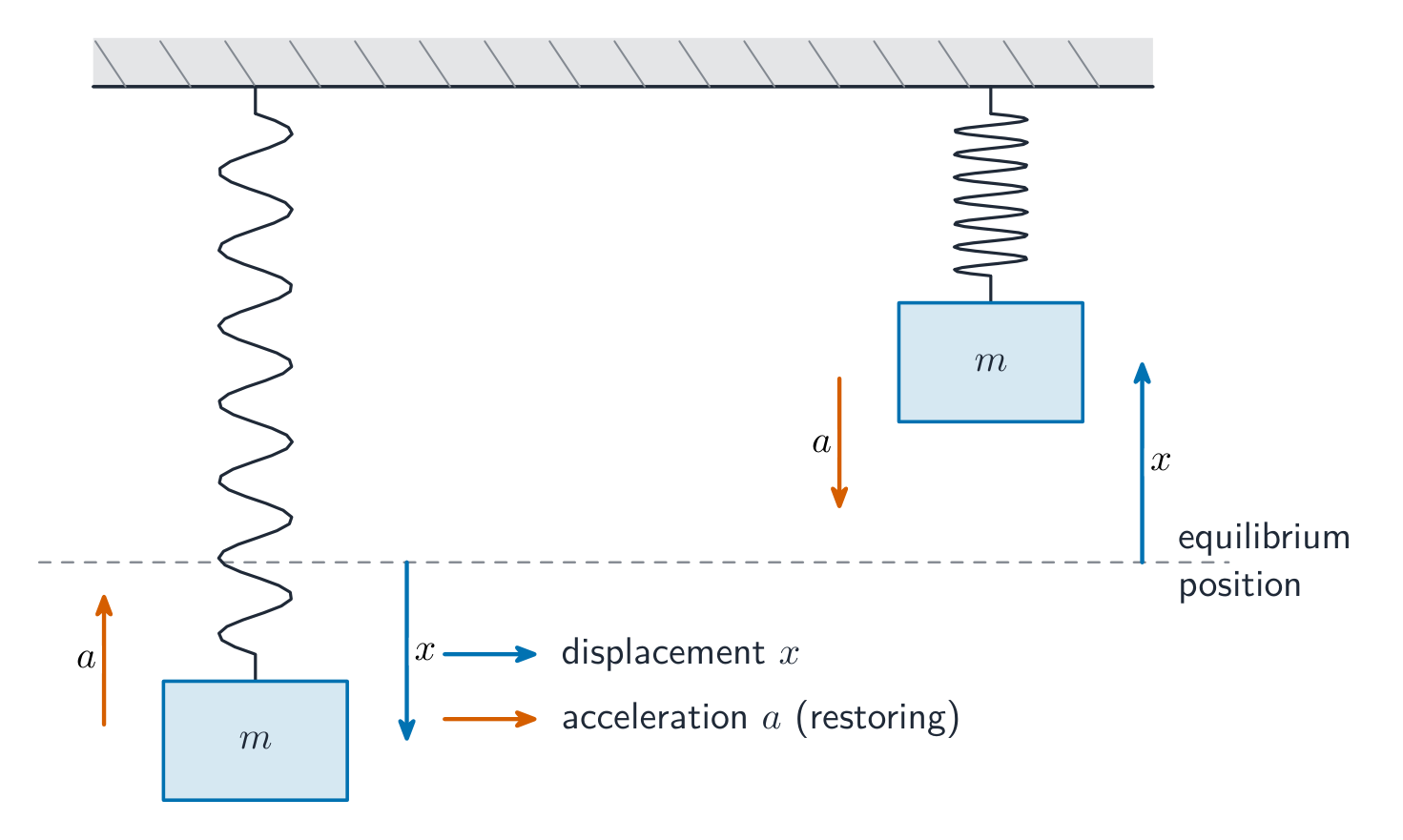
Simple harmonic motion 简谐运动 (SHM) is a special case of periodic motion 周期运动. It appears whenever two things are true: there is an equilibrium 平衡位置 position where the net force is zero, and displacing the object produces a restoring force 回复力 – a force pointing back toward equilibrium – whose magnitude is proportional to the displacement:
$$F=-k\,\Delta x.$$
Newton's second law then gives the defining differential equation 微分方程:
$$\frac{d^2x}{dt^2}=-\frac{k}{m}\,x=-\omega^2 x,\qquad \omega=\sqrt{\frac{k}{m}}.$$
Its solution is sinusoidal, $x(t)=A\cos(\omega t+\phi)$. You do not need to prove this solution – you need to recognise the equation: any system whose motion obeys "$\ddot{x}=-\omega^2x$" is a simple harmonic oscillator, whatever it is made of. (A mass hanging on a vertical spring works the same way: gravity only shifts the equilibrium point; the oscillation about it is unchanged.)
Vocabulary
Train
| English |
|---|
| Simple harmonic motion/ˈsɪmpl hɑːˈmɒnɪk ˈməʊʃn/ |
| periodic motion/ˌpɪərɪˈɒdɪk ˈməʊʃn/ |
| equilibrium/ˌiːkwɪˈlɪbrɪəm/ |
| restoring force/rɪˈstɔːrɪŋ fɔːs/ |
| differential equation/ˌdɪfəˈrenʃl ɪˈkweɪʒn/ |
7.2
Frequency and Period of SHM
Syllabus
| Learning Objective | Essential Knowledge |
|---|---|
7.2.A |
|
Source: College Board AP Course and Exam Description
The angular frequency 角频率 $\omega$ sets the period 周期 and frequency 频率:
$$T=\frac{2\pi}{\omega}=\frac{1}{f}.$$
For the two standard systems:
$$T_{\text{spring}}=2\pi\sqrt{\frac{m}{k}},\qquad T_{\text{pendulum}}=2\pi\sqrt{\frac{\ell}{g}}.$$
Two classic conceptual traps: the period of SHM never depends on the amplitude 振幅, and each system ignores one obvious variable – the pendulum's period does not involve its mass, and the spring's period does not involve $g$ (a spring–block oscillator keeps perfect time in orbit; a pendulum clock does not).
Explore
Time a pendulum's swing
A pendulum's period depends on its length and gravity, not its mass or (small) amplitude: $T=2\pi\sqrt{L/g}$. Lengthen it and each swing takes longer.
Vocabulary
Train
| English |
|---|
| angular frequency/ˈæŋɡjʊlə ˈfriːkwənsi/ |
| period/ˈpɪərɪəd/ |
| frequency/ˈfriːkwənsi/ |
| amplitude/ˈæmplɪtjuːd/ |
7.3
Representing and Analyzing SHM
Syllabus
| Learning Objective | Essential Knowledge |
|---|---|
7.3.A |
Boundary statement: AP Physics C: Mechanics only expects students to know the solution to the second-order differential equation that describes SHM, as well as be able to identify SHM. AP Physics C: Mechanics does not expect students to mathematically prove that the solution is correct. |
Source: College Board AP Course and Exam Description
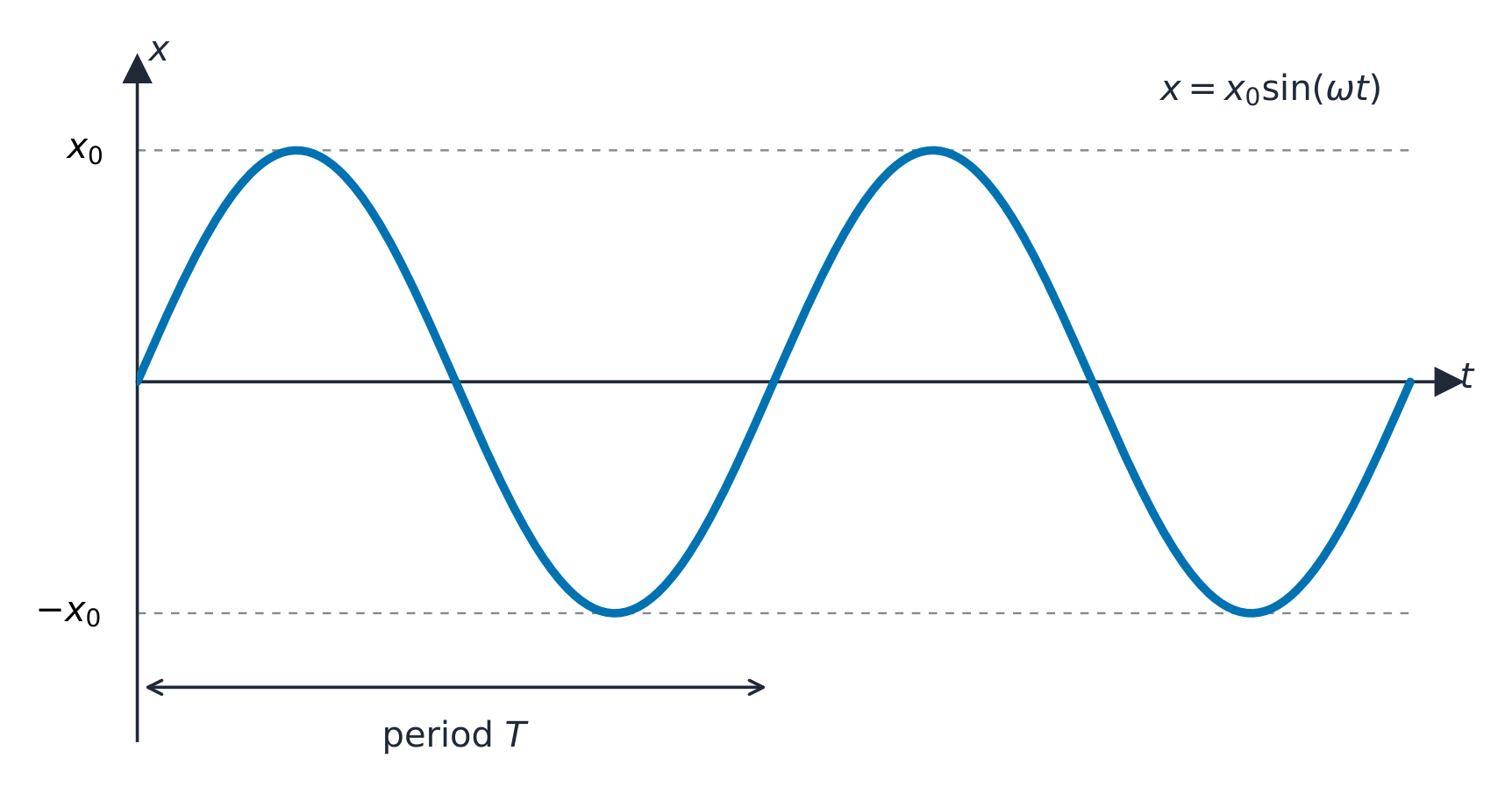
Differentiate $x(t)=A\cos(\omega t+\phi)$ twice:
$$v=-A\omega\sin(\omega t+\phi),\qquad a=-A\omega^2\cos(\omega t+\phi)=-\omega^2x.$$
So at the ends of the swing ($x=\pm A$) the speed is zero and the acceleration is largest; passing through equilibrium ($x=0$) the acceleration is zero and the speed is largest, $v_{\max}=A\omega$. The amplitude $A$ and the phase constant 相位常数 $\phi$ come from the initial conditions: where the object starts and how fast it is moving. Eliminating $t$ (or using energy, below) gives speed as a function of position:
$$v=\pm\,\omega\sqrt{A^2-x^2}.$$
Worked example. A $0.50\ \text{kg}$ mass on a $k=200\ \text{N/m}$ spring: $\omega=\sqrt{k/m}=20\ \text{rad/s}$, $T=2\pi/\omega=0.31\ \text{s}$. With $A=0.10\ \text{m}$: $v_{\max}=A\omega=2.0\ \text{m/s}$ at equilibrium, and at $x=0.050\ \text{m}$ the speed is $v=\omega\sqrt{A^2-x^2}=20\sqrt{0.10^2-0.050^2}=1.7\ \text{m/s}$.
Vocabulary
Train
| English |
|---|
| phase constant/feɪz ˈkɒnstənt/ |
7.4
Energy of Simple Harmonic Oscillators
Syllabus
| Learning Objective | Essential Knowledge |
|---|---|
7.4.A |
|
Source: College Board AP Course and Exam Description
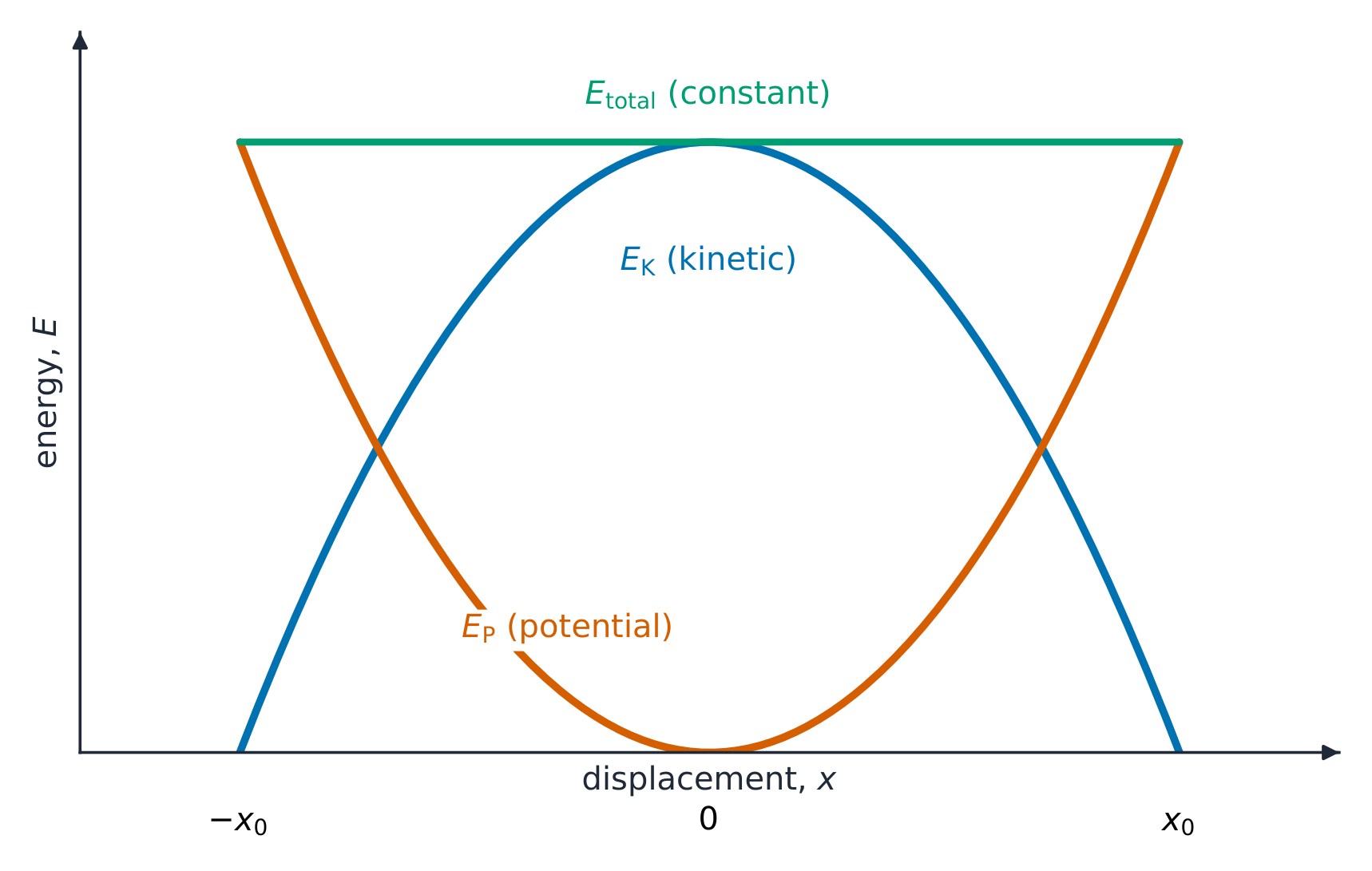
The total energy of the oscillator is the sum $E=U+K$, and with no friction it is constant – energy just trades back and forth between the spring's potential energy and the mass's kinetic energy:
$$E=\tfrac12kA^2=\tfrac12kx^2+\tfrac12mv^2.$$
All potential at the ends (where $K=0$), all kinetic at equilibrium (where $U$ is minimum). Because $E\propto A^2$, doubling the amplitude quadruples the energy.
Worked example. Where is the energy split evenly? Set $\tfrac12kx^2=\tfrac12E=\tfrac14kA^2$, so $x=A/\sqrt2\approx0.71A$ – much closer to the end than to the middle. For the system above ($A=0.10\ \text{m}$): $x=0.071\ \text{m}$.
Left alone, a system oscillates at its own natural frequency 固有频率 (set by $k$ and $m$: $f_0=\frac{1}{2\pi}\sqrt{k/m}$). Drive it with a periodic force at that same frequency and the amplitude grows dramatically – resonance 共振. Each well-timed push adds energy faster than damping removes it, so the driven amplitude peaks sharply when the driving frequency matches $f_0$ (a swing pumped in time, a bridge shaken by wind).
Explore
Trade kinetic and potential energy in SHM
In simple harmonic motion, energy sloshes between kinetic (fastest at the centre) and potential (greatest at the extremes) while the total stays constant.
Vocabulary
Train
| English |
|---|
| natural frequency/ˈnætʃərəl ˈfriːkwənsi/ |
| resonance/ˈrezənəns/ |
7.5
Simple and Physical Pendulums
Syllabus
| Learning Objective | Essential Knowledge |
|---|---|
7.5.A |
|
Source: College Board AP Course and Exam Description
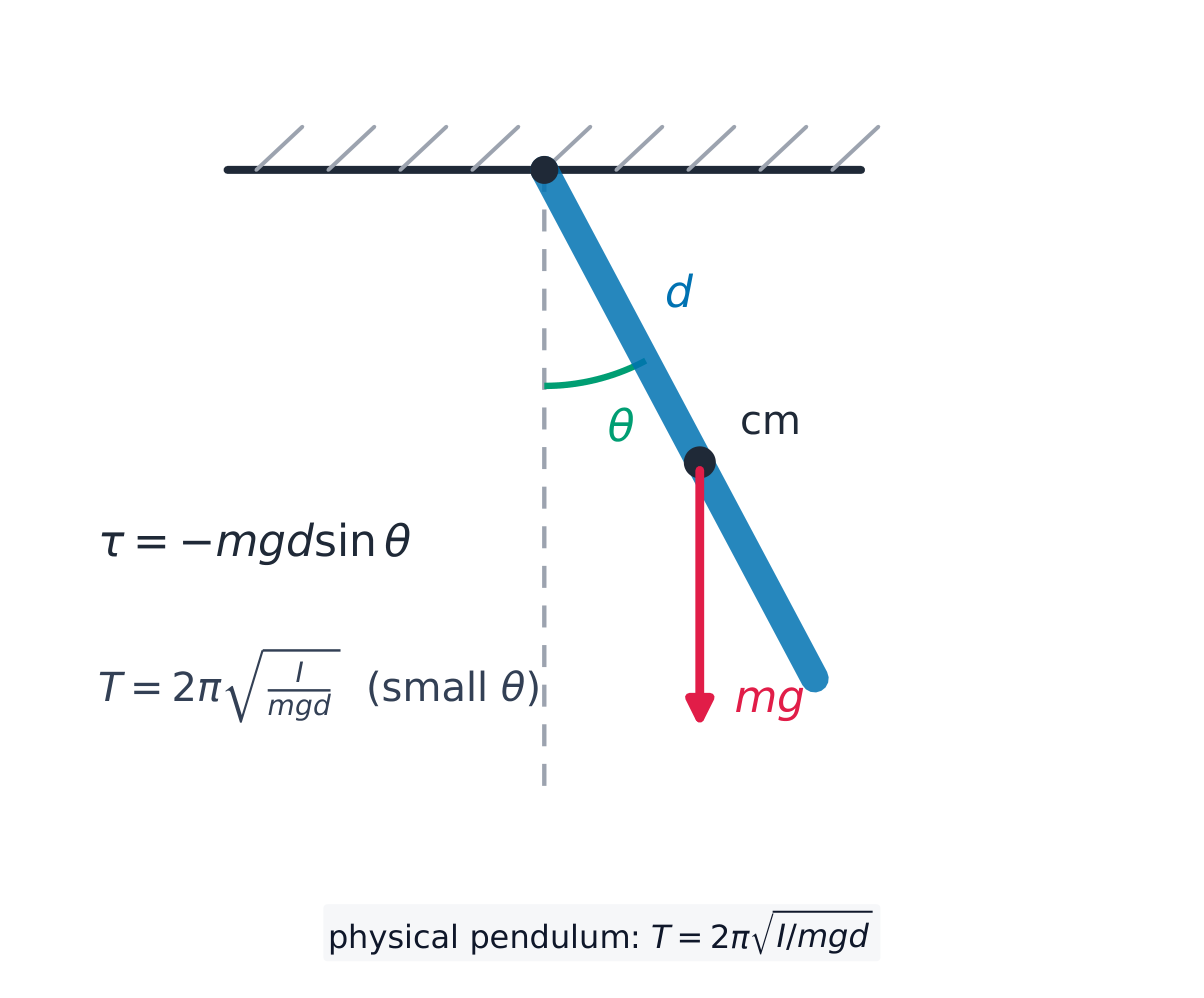
A physical pendulum 物理摆 is any rigid body swinging about a fixed pivot. Displace it by an angle $\theta$ and gravity, acting at the center of mass a distance $d$ from the pivot, supplies a restoring torque
$$\tau=-mgd\sin\theta.$$
For small angles, apply the small-angle approximation 小角度近似 $\sin\theta\approx\theta$ and Newton's second law in rotational form ($\tau=I\alpha$):
$$\frac{d^2\theta}{dt^2}=-\frac{mgd}{I}\,\theta=-\omega^2\theta\quad\Rightarrow\quad T_{\text{phys}}=2\pi\sqrt{\frac{I}{mgd}}.$$
This is the same "$\ddot\theta=-\omega^2\theta$" pattern as before – recognising it is the derivation. A simple pendulum 单摆 is the special case of a point mass on a light string: $I=m\ell^2$ and $d=\ell$ give $T=2\pi\sqrt{\ell/g}$.
Worked example. A uniform rod (mass $M$, length $L$) swings from one end: $I=\tfrac13ML^2$, $d=\tfrac{L}{2}$, so
$$T=2\pi\sqrt{\frac{\tfrac13ML^2}{Mg\,\tfrac{L}{2}}}=2\pi\sqrt{\frac{2L}{3g}}$$
– shorter than a simple pendulum of length $L$, because the rod's mass sits nearer the pivot.
A torsion pendulum 扭摆 – a disk hanging from a wire that twists – is SHM one more time: the wire's restoring torque is proportional to the twist angle, $I\alpha=-\kappa\,\Delta\theta$, giving $T=2\pi\sqrt{I/\kappa}$.
Exam skill. Every pendulum FRQ wants the same three steps: write the restoring torque about the pivot, apply the small-angle approximation, and match the result to $\ddot\theta=-\omega^2\theta$ to read off $\omega$. State the small-angle step explicitly – it is a scored point, and it is why large-amplitude swings are not simple harmonic.
Vocabulary
Train
| English |
|---|
| physical pendulum/ˈfɪzɪkl ˈpendjʊləm/ |
| small-angle approximation/smɔːl ˈæŋɡl əˌprɒksɪˈmeɪʃn/ |
| simple pendulum/ˈsɪmpl ˈpendjʊləm/ |
| torsion pendulum/ˈtɔːʃn ˈpendjʊləm/ |
7.5
Exam tips
- Identify SHM from a linear restoring force $F=-kx$, which gives $\tfrac{d^2x}{dt^2}=-\omega^2 x$ with $\omega=\sqrt{k/m}$.
- Write the solution $x=A\cos(\omega t+\phi)$ and get $v,a$ by differentiating; period $T=\tfrac{2\pi}{\omega}$ is amplitude-independent.
- Energy trades between $\tfrac12 kx^2$ and $\tfrac12 mv^2$, with total $\tfrac12 kA^2$.
- For a pendulum, use the small-angle approximation $\sin\theta\approx\theta$ to reach SHM.
- Match phase to the start: released from rest at maximum displacement uses cosine.
Interactive lessons on this topic
Work through it step by step, with instant-check exercises.