Skip to content · ⁨ข้ามไปยังเนื้อหา⁩

Magnetic Fields and Electromagnetism · ⁨สนามแม่เหล็กและแม่เหล็กไฟฟ้า⁩

AP Physics C: Electricity and Magnetism · Topic 12 · ⁨หัวข้อ 12⁩

Video lesson for this topic · ⁨บทเรียนวิดีโอสำหรับหัวข้อนี้⁩ Open the video page · ⁨เปิดหน้าวิดีโอ⁩
12:45

สนามแม่เหล็กและแม่เหล็กไฟฟ้า

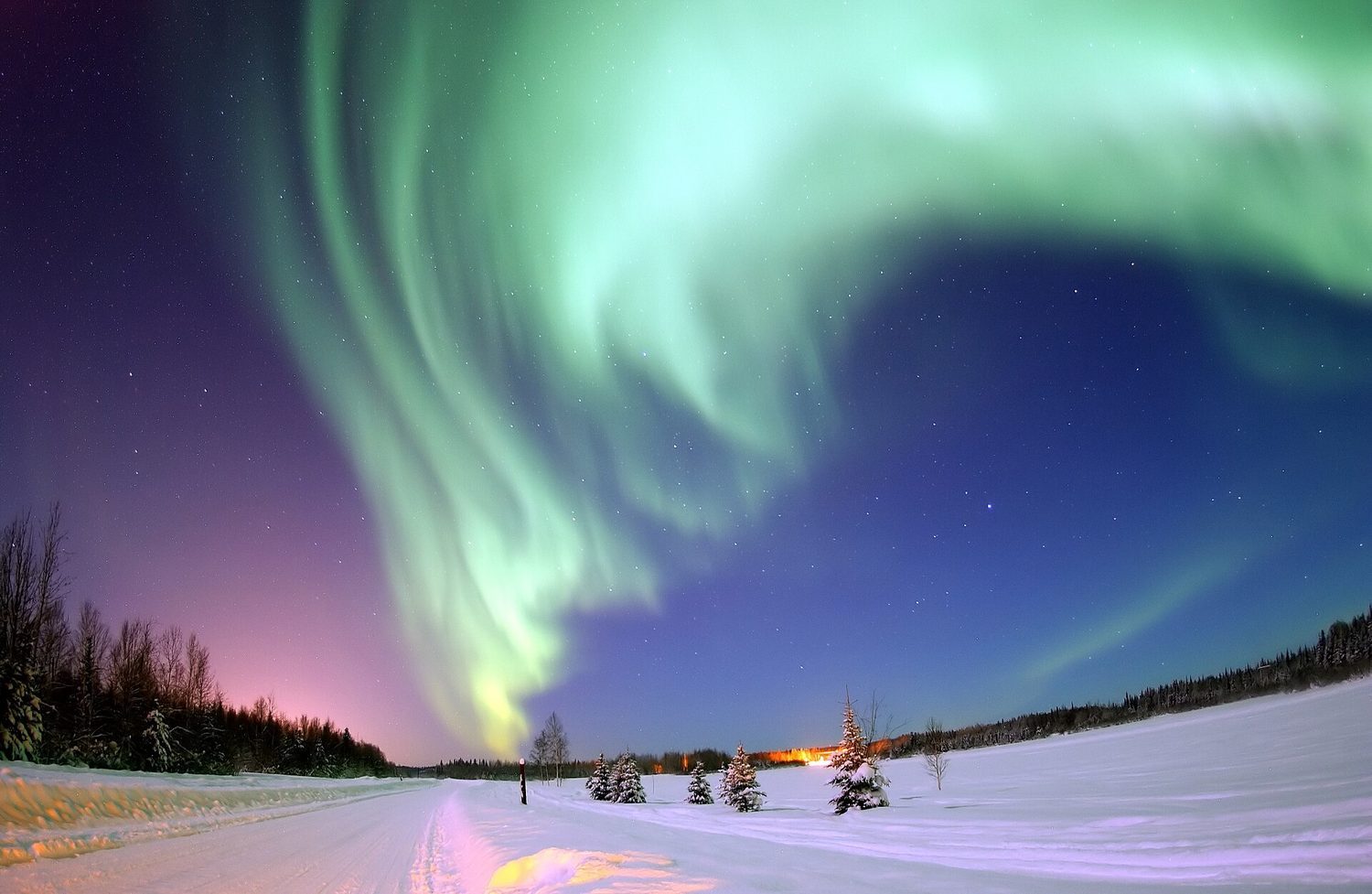
หากมองไปทางทิศเหนือในคืนฤดูหนาวที่ฟ้าใส และอยู่พอไกลทางทิศเหนือพอ สky จะเรืองแสงสีเขียว แสงเหล่านั้นเกิดจากสนามแม่เหล็ก ทดปัดอนุภาคที่มีประจุไฟฟ้าออกมา…

English narration · English + 中文 subtitles burned in · ⁨การบรรยายภาษาอังกฤษ · คำบรรยายภาษาอังกฤษ + 中文 ลอยตัวบนภาพ⁩

12.1

Magnetic Fields · ⁨สนามแม่เหล็ก⁩

Syllabus · ⁨หลักสูตร⁩
English

Learning Objective 12.1.A: Describe the properties of a magnetic field.

  • 12.1.A.1 A magnetic field is a vector field that can be used to determine the magnetic force exerted on moving electric charges, electric currents, or magnetic materials.
    • 12.1.A.1.i Magnetic fields can be produced by magnetic dipoles or combinations of dipoles, but never by monopoles.
    • 12.1.A.1.ii Magnetic dipoles have north and south polarity.
  • 12.1.A.2 A magnetic field is a vector quantity and can be represented using vector field maps.
  • 12.1.A.3 Magnetic field lines must form closed loops, as described by Gauss's law for magnetism.
    • 12.1.A.3.i Maxwell's equations are the collection of equations that fully describe electromagnetism. Gauss's law for magnetism is Maxwell's second equation.
      • Equation: $\oint \vec{B} \cdot d\vec{A} = 0$
    • 12.1.A.3.ii Magnetic fields in a bar magnet form closed loops, with the external magnetic field pointing away from one end (defined as the north pole) and returning to the other end (defined as the south pole).

Learning Objective 12.1.B: Describe the magnetic behavior of a material as a result of the configuration of magnetic dipoles in the material.

  • 12.1.B.1 Magnetic dipoles result from the circular or rotational motion of electric charges. In magnetic materials, this can be the motion of electrons.
    • 12.1.B.1.i Permanent magnetism and induced magnetism are system properties that both result from the alignment of magnetic dipoles within a system.
    • 12.1.B.1.ii No magnetic north pole is ever found in isolation from a south pole. For example, if a bar magnet is broken in half, both halves are magnetic dipoles.
    • 12.1.B.1.iii Magnetic poles of the same polarity will repel; magnetic poles of opposite polarity will attract.
    • 12.1.B.1.iv The magnitude of the magnetic field from a magnetic dipole decreases with increasing distance from the dipole.
  • 12.1.B.2 A magnetic dipole, such as a magnetic compass, placed in a magnetic field will tend to align with the magnetic field.
  • 12.1.B.3 A material's composition influences its magnetic behavior in the presence of an external magnetic field.
    • 12.1.B.3.i Ferromagnetic materials such as iron, nickel, and cobalt can be permanently magnetized by an external field that causes the alignment of magnetic domains or atomic magnetic dipoles.
    • 12.1.B.3.ii Paramagnetic materials such as aluminum, titanium, and magnesium interact weakly with an external magnetic field, in that the magnetic dipoles of the material do not remain aligned after the external field is removed.
    • 12.1.B.3.iii All materials have the property of diamagnetism, in that their electronic structure creates a usually weak alignment of the dipole moments of the material opposite the external magnetic field.
  • 12.1.B.4 Earth's magnetic field may be approximated as a magnetic dipole.

Learning Objective 12.1.C: Describe the magnetic permeability of a material.

  • 12.1.C.1 Magnetic permeability is a measurement of the amount of magnetization in a material in response to an external magnetic field.
  • 12.1.C.2 Free space has a constant value of magnetic permeability, known as the vacuum permeability $\mu_0$, that appears in equations representing physical relationships.
  • 12.1.C.3 The permeability of matter has values different from that of free space and arises from the matter's composition and arrangement. It is not a constant for a material and varies based on many factors, including temperature, orientation, and strength of the external field.
ไทย

วัตถุประสงค์การเรียนรู้ 12.1.A: อธิบายคุณสมบัติของสนามแม่เหล็ก

  • 12.1.A.1 สนามแม่เหล็กเป็นฟิสิกส์เวกเตอร์ที่สามารถใช้เพื่อกำหนดแรงแม่เหล็กที่กระทำต่อบรรจบประจุไฟฟ้าเคลื่อนที่ กระแสไฟฟ้า หรือวัสดุแม่เหล็ก
    • 12.1.A.1.i Magnetic fields can be produced by magnetic dipoles or combinations of dipoles, but never by monopoles.
    • 12.1.A.1.ii dipoleแม่เหล็กมีขั้วเหนือและขั้วใต้
  • 12.1.A.2 สนามแม่เหล็กเป็นปริมาณเวกเตอร์และสามารถแสดงด้วยแผนที่สนามเวกเตอร์
  • 12.1.A.3 เส้นสนามแม่เหล็กต้องเป็นวงปิด ตามที่กฎของเกาส์สำหรับสนามแม่เหล็กอธิบายไว้
    • 12.1.A.3.i สมการของแมกซ์เวลล์คือชุดสมการที่อธิบายปรากฏการณ์ทางไฟฟ้าและแม่เหล็กอย่างครบถ้วน กฎของเกาส์สำหรับสนามแม่เหล็กคือสมการที่สองของแมกซ์เวลล์
      • สมการ: $\oint \vec{B} \cdot d\vec{A} = 0$
    • 12.1.A.3.ii สนามแม่เหล็กในแท่งแม่เหล็กเป็นวงปิด โดยมีสนามแม่เหล็กภายนอกชี้ออกจากปลายด้านหนึ่ง (กำหนดให้เป็นขั้วเหนือ) และกลับไปยังอีกปลายด้านหนึ่ง (กำหนดให้เป็นขั้วใต้)

วัตถุประสงค์การเรียนรู้ 12.1.B: อธิบายพฤติกรรมแม่เหล็กของวัสดุอันเป็นผลมาจากการจัดเรียงของคู่ขั้วแม่เหล็กภายในวัสดุนั้น

  • 12.1.B.1 คู่ขั้วแม่เหล็กเกิดจากการเคลื่อนที่แบบวงกลมหรือหมุนของประจุไฟฟ้า ในวัสดุแม่เหล็กสิ่งนี้อาจเป็นการเคลื่อนที่ของอิเล็กตรอน
    • 12.1.B.1.i แม่เหล็กถาวรและแม่เหล็กเหนี่ยวนำเป็นคุณสมบัติของระบบที่ทั้งสองเกิดจากการเรียงตัวของ dipoleแม่เหล็กภายในระบบ
    • 12.1.B.1.ii ไม่มีขั้วเหนือแม่เหล็กใดถูกพบแยกจากขั้วใต้ ตัวอย่างเช่น หากหักแท่งแม่เหล็กออกเป็นสองส่วน ทั้งสองครึ่งจะเป็น dipoleแม่เหล็ก
    • 12.1.B.1.iii ขั้วแม่เหล็กที่มีขั้วเดียวกันจะผลักกัน; ขั้วแม่เหล็กที่มีขั้วตรงข้ามจะดึงดูดกัน
    • 12.1.B.1.iv ขนาดของสนามแม่เหล็กจาก dipoleแม่เหล็กจะลดลงเมื่อระยะห่างจาก dipoleเพิ่มขึ้น
  • 12.1.B.2 คู่ขั้วแม่เหล็ก เช่น เข็มทิศแม่เหล็ก เมื่อวางในสนามแม่เหล็กจะมีแนวโน้มจัดตัวให้ขนานกับสนามแม่เหล็กนั้น
  • 12.1.B.3 องค์ประกอบของวัสดุมีผลต่อพฤติกรรมแม่เหล็กเมื่ออยู่ในสนามแม่เหล็กภายนอก
    • 12.1.B.3.i วัสดุERENCEMAGNETIC เช่น เหล็ก นิกเกิล และโคบอลต์ สามารถทำให้เป็นแม่เหล็กถาวรได้ด้วยสนามภายนอกที่ทำให้เกิดการจัดเรียงของโดเมนแม่เหล็กหรือ dipoleแม่เหล็กอะตอม
    • 12.1.B.3.ii วัสดุPARAMAGNETIC เช่น อะลูมิเนียม ไทเทเนียม และแมกนีเซียม มีปฏิสัมพันธ์กับสนามแม่เหล็กภายนอกอย่างอ่อน weakly โดยที่ dipoleแม่เหล็กของวัสดุจะไม่คงการเรียงตัวหลังจากที่สนามภายนอกหายไป
    • 12.1.B.3.iii วัสดุทุกชนิดมีคุณสมบัติDiamagnetism โดยโครงสร้างอิเล็กตรอน将它们สร้างการจัดเรียงของโมเมนต์dipole ของวัสดุซึ่งมักจะเป็นไปทางตรงข้ามกับสนามแม่เหล็กภายนอก
  • 12.1.B.4 สนามแม่เหล็กของโลกสามารถประมาณได้ว่าเป็นไดโพลแม่เหล็ก

วัตถุประสงค์การเรียนรู้ 12.1.C: อธิบายความไวต่อสนามแม่เหล็กของวัสดุ

  • 12.1.C.1 ความไวต่อสนามแม่เหล็กคือการวัดปริมาณการแม่เหล็กในวัสดุเมื่อตอบสนองต่อสนามแม่เหล็กภายนอก
  • 12.1.C.2空间中มีค่าคงที่ของความไวต่อสนามแม่เหล็ก Known as the vacuum permeability $\mu_0$, which appears in equations representing physical relationships.
  • 12.1.C.3 ความสามารถในการผ่านของสนามแม่เหล็ก (Permeability) ของสสารมีค่าแตกต่างจากในสุญญากาศ และเกิดขึ้นจากองค์ประกอบและการจัดเรียงตัวของสสารนั้นๆ ไม่ใช่ค่าคงที่สำหรับวัสดุหนึ่งๆ แต่จะแปรผันตามปัจจัยหลายอย่าง รวมถึงอุณหภูมิ ทิศทาง และความเข้มของสนามภายนอก
Source: College Board AP Course and Exam Description · ⁨แหล่งที่มา: คำอธิบายหลักสูตรและข้อสอบ College Board AP⁩

English

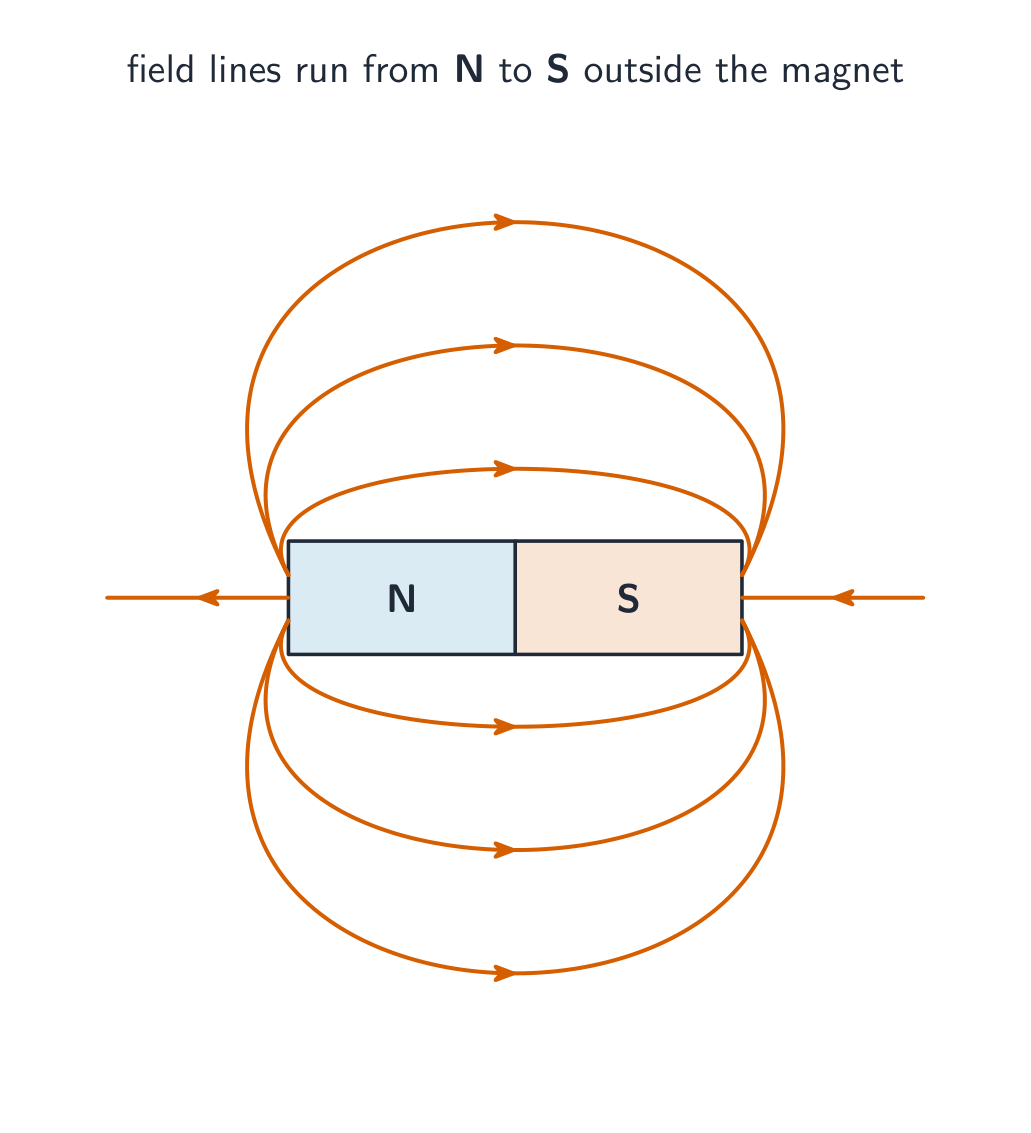
A magnetic field 磁场 $\vec{B}$ is a vector field 矢量场 that surrounds magnets, moving charges, and currents; it determines the magnetic force on any moving charge placed in it. Magnetic field lines 磁感线 must form closed loops: they leave the north pole, return to the south pole, and continue through the magnet. Denser lines mean a stronger field.

Closed loops are the content of Gauss's law for magnetism, the second of Maxwell's equations 麦克斯韦方程组:

$$\oint \vec{B}\cdot d\vec{A}=0.$$

The net magnetic flux through any closed surface is zero – as many field lines leave as enter. That is exactly the statement that isolated magnetic monopoles 磁单极子 do not exist. Every source of magnetism is a magnetic dipole 磁偶极子 (a north–south pair), made by circulating charge – in materials, the motion of electrons. Break a bar magnet in half and you get two smaller dipoles, never a lone pole. Like poles repel, opposite poles attract, and a free dipole – a compass 指南针 – rotates to line up with the local field. Earth's own field is approximately a dipole, which is why a compass works. Dipole fields weaken with distance.

How a material responds to an external field depends on how its internal dipoles behave:

  • Ferromagnetic 铁磁性 (iron, nickel, cobalt): an external field aligns whole magnetic domains 磁畴, and the alignment survives after the field is removed – a permanent magnet.
  • Paramagnetic 顺磁性 (aluminum, titanium): dipoles align weakly with the field but relax when it is removed.
  • Diamagnetic 抗磁性 (all materials): the electronic structure produces a usually weak alignment opposite to the field.

The strength of a material's response is its magnetic permeability 磁导率. Free space has the constant value $\mu_0$ (the vacuum permeability); the permeability of matter differs from $\mu_0$ and is not even constant – it varies with temperature, orientation, and field strength.

ไทย

สนามแม่เหล็ก $\vec{B}$ เป็น เวกเตอร์ฟิลด์ ที่ล้อมรอบแม่เหล็ก, ประจุเคลื่อนที่ และกระแสไฟฟ้า; มันกำหนดแรงแม่เหล็กบนประจุเคลื่อนที่ใดๆ ที่วางอยู่ในนั้น เส้นสนามแม่เหล็ก ต้องเป็นวงปิด: ออกจากขั้วเหนือ กลับเข้าขั้วใต้ และต่อเนื่องผ่านตัวแม่เหล็ก เส้นที่หนาแน่นกว่าแสดงถึงสนามที่แข็งแกร่งกว่า

เส้นสนามวิ่งจาก N ไป S ข้างนอกแม่เหล็กแท่ง

วงปิดคือเนื้อหาของกฎเกาส์สำหรับแม่เหล็ก ซึ่งเป็นข้อที่สองของ สมการแม็กซ์เวลล์:

$$\oint \vec{B}\cdot d\vec{A}=0.$$

ฟลักซ์แม่เหล็กสุทธิผ่าน พื้นผิวปิด ใดๆ เป็นศูนย์ – มีเส้นสนามออก autant เข้า เท่ากับจำนวนที่เข้า นั่นคือการยืนยันว่าไม่มี มอโนโพลแม่เหล็ก แยกเดี่ยวอยู่ ทุกแหล่งกำเนิดแม่เหล็กคือ ไดโพลแม่เหล็ก (คู่เหนือ-ใต้) เกิดจากการหมุนเวียนของประจุ – ในวัสดุ คือการเคลื่อนที่ของอิเล็กตรอน หักแม่เหล็กแท่งออกเป็นสองครึ่ง จะได้ไดโพลเล็กสองตัว ไม่เคยได้ขั้วเดียว เปรียบเหมือนขั้วเดียวกันจะผลักกัน ขั้วต่างชนิดจะดูดกัน และไดโพลอิสระ – เช่น เข็มทิศ – จะหมุนเพื่อจัดแนวตามสนามในพื้นที่周围环境 Earth's own field is approximately a dipole, which is why a compass works. Dipole fields weaken with distance.

วิธีที่วัสดุตอบสนองต่อสนามภายนอกขึ้นอยู่กับพฤติกรรมของไดโพลภายใน:

  • เฟอโรแม่เหล็ก (เหล็ก, นิกเกิล, คอบอลต์): สนามภายนอกจัดเรียง โดเมนแม่เหล็ก ทั้งกลุ่ม และการจัดเรียงนี้ยังคงอยู่หลังสนามถูกกำจัด – กลายเป็นแม่เหล็กถาวร
  • พาราแม่เหล็ก (อะลูมิเนียม, ไทเทเนียม): ไดโพลจัดเรียงอ่อนๆ กับสนาม แต่จะคลายตัวเมื่อสนามหายไป
  • ไดแอมแม่เหล็ก (ทุกวัสดุ): โครงสร้างอิเล็กตรอนทำให้เกิดการจัดเรียงที่มักอ่อนและ ตรงข้าม กับสนาม

ความเข้มของการตอบสนองของวัสดุคือ ความไวต่อแม่เหล็ก (magnetic permeability) อากาศว่างมีค่าคงที่ $\mu_0$ (vacuum permeability); ความไวต่อแม่เหล็กของสสารแตกต่างจาก $\mu_0$ และไม่คงที่เลย – เปลี่ยนแปลงตามอุณหภูมิ ทิศทาง และความเข้มของสนาม

ออโรรา: อนุภาคมีประจุจากดวงอาทิตย์ถูกสนามแม่เหล็กโลกเบี่ยงเบนเข้าสู่ขั้วโลก
Explore · ⁨สำรวจ⁩

See a magnet's field lines · ⁨เห็นเส้นสนามแม่เหล็กของแม่เหล็ก⁩

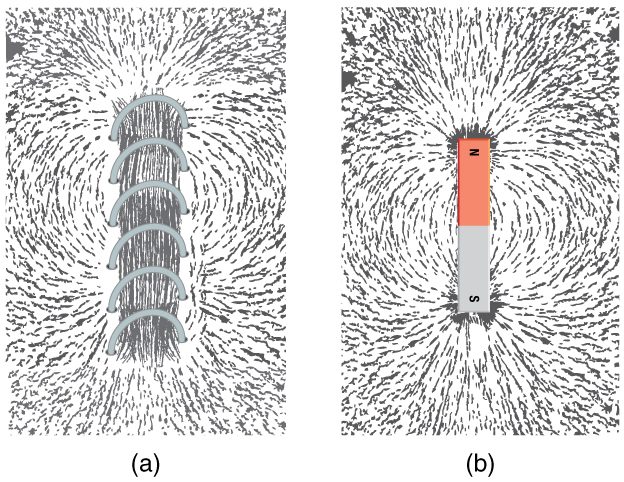
Magnetic field lines run from north to south outside a magnet; where they crowd together the field is strongest. · ⁨เส้นสนามแม่เหล็ก ไหลจากเหนือไปใต้ภายนอกแม่เหล็ก; บริเวณที่เส้นรวมตัวกันคือตำแหน่งที่สนามแรงที่สุด⁩

Vocabulary · ⁨คำศัพท์⁩ Train · ⁨ฝึกฝน⁩
English ไทย
compass/ˈkʌmpəs/ เข็มทิศ (compass)
Ferromagnetic/ˌferəməɡˈnetɪk/ ERENCE Ferromagnetic
magnetic domains/mæɡˈnetɪk dəˈmeɪnz/ โดเมนแม่เหล็ก
Paramagnetic/ˌpærəməɡˈnetɪk/ PARAMAGNETIC Paramagnetic
Diamagnetic/ˌdaɪəməɡˈnetɪk/ Diamagnetic
magnetic permeability/mæɡˈnetɪk ˌpɜːməˈbɪlɪti/ การซึมผ่านแม่เหล็ก
Watch lesson · ⁨ดูบทเรียน⁩
12.2

Magnetism and Moving Charges · ⁨แม่เหล็กและประจุที่เคลื่อนที่⁩

Syllabus · ⁨หลักสูตร⁩
English

Learning Objective 12.2.A: Describe the magnetic field produced by moving charged objects.

  • 12.2.A.1 A single moving charged object produces a magnetic field.
    • 12.2.A.1.i The magnetic field at a particular point produced by a moving charged object depends on the object's velocity and the distance between the point and the object.
    • 12.2.A.1.ii At a point in space, the direction of the magnetic field produced by a moving charged object is perpendicular to both the velocity of the object and the position vector from the object to that point in space and can be determined using the right-hand rule.
    • 12.2.A.1.iii The magnitude of the magnetic field is a maximum when the velocity vector and the position vector from the object to that point in space are perpendicular.

Learning Objective 12.2.B: Describe the force exerted on moving charged objects by a magnetic field.

  • 12.2.B.1 A magnetic field will exert a force on a charged object moving within that field, with magnitude and direction that depend on the cross-product of the charge's velocity and the magnetic field.
    • Equation: $\vec{F}_B = q\left(\vec{v} \times \vec{B}\right)$
  • 12.2.B.2 In a region containing both a magnetic field and an electric field, a moving charged object will experience independent forces from each field.
  • 12.2.B.3 The Hall effect describes the potential difference created in a conductor by an external magnetic field that has a component perpendicular to the direction of charges moving in the conductor.
ไทย

วัตถุประสงค์การเรียนรู้ 12.2.A: อธิบายสนามแม่เหล็กที่เกิดจากวัตถุที่มีประจุไฟฟ้าเคลื่อนที่

  • 12.2.A.1 วัตถุเดียวที่มีประจุไฟฟ้าเคลื่อนที่จะสร้างสนามแม่เหล็กได้
    • 12.2.A.1.i สนามแม่เหล็ก ณ จุดใดจุดหนึ่งซึ่งเกิดจากวัตถุที่มีประจุไฟฟ้าเคลื่อนที่ ขึ้นอยู่กับความเร็วของวัตถุนั้นและความห่างระหว่างจุดกับวัตถุ
    • 12.2.A.1.ii ณ จุดใดๆ ในอวกาศ ทิศทางของสนามแม่เหล็กที่เกิดจากวัตถุที่มีประจุไฟฟ้าเคลื่อนที่จะตั้งฉากกับทั้งความเร็วของวัตถุและเวกเตอร์ตำแหน่งจากวัตถุไปยังจุดนั้นในอวกาศ และสามารถหาได้โดยใช้กฎมือขวา
    • 12.2.A.1.iii ขนาดของสนามแม่เหล็กจะมีค่าสูงสุดเมื่อเวกเตอร์ความเร็วและเวกเตอร์ตำแหน่งจากวัตถุไปยังจุดนั้นในอวกาศตั้งฉากกัน

วัตถุประสงค์การเรียนรู้ 12.2.B: อธิบายแรงที่กระทำต่อวัตถุที่มีประจุไฟฟ้าเคลื่อนที่โดยสนามแม่เหล็ก

  • 12.2.B.1 สนามแม่เหล็กจะ exert แรงต่อวัตถุที่มีประจุไฟฟ้าเคลื่อนที่ภายในสนามนั้น โดยมีขนาดและทิศทางขึ้นอยู่กับผลคูณไขว้ของความเร็วของประจุกับสนามแม่เหล็ก
    • สมการ: $\vec{F}_B = q\left(\vec{v} \times \vec{B}\right)$
  • 12.2.B.2 ในพื้นที่ที่มีทั้งสนามแม่เหล็กและสนามไฟฟ้า วัตถุที่มีประจุไฟฟ้าเคลื่อนที่จะได้รับแรงจากแต่ละสนามโดยอิสระต่อกัน
  • 12.2.B.3 เอฟเฟกต์ฮอลล์อธิบายความต่างศักย์ที่เกิดขึ้นในตัวนำจากสนามแม่เหล็กภายนอกซึ่งมีองค์ประกอบตั้งฉากกับทิศทางการเคลื่อนที่ของประจุในตัวนำ

Source: College Board AP Course and Exam Description · ⁨แหล่งที่มา: คำอธิบายหลักสูตรและข้อสอบ College Board AP⁩

English
A moving charge in a magnetic field

A moving charge does two things: it creates a magnetic field, and it feels a force in an external one. The field it creates at a point is perpendicular 垂直 to both its velocity and the position vector from charge to point (right-hand rule again), and is largest where those two are perpendicular – zero directly ahead of or behind the motion.

The force on a charge moving in a field $\vec{B}$ is the cross product

$$\vec{F}_B=q\,\vec{v}\times\vec{B},\qquad F=qvB\sin\theta,$$

perpendicular to both $\vec{v}$ and $\vec{B}$ – point the fingers of your right hand along $\vec{v}$, curl toward $\vec{B}$, and the thumb gives the force on a positive charge (reverse it for negative). Because $\vec{F}_B\perp\vec{v}$, the magnetic force does no work on the charge: it changes direction, never speed.

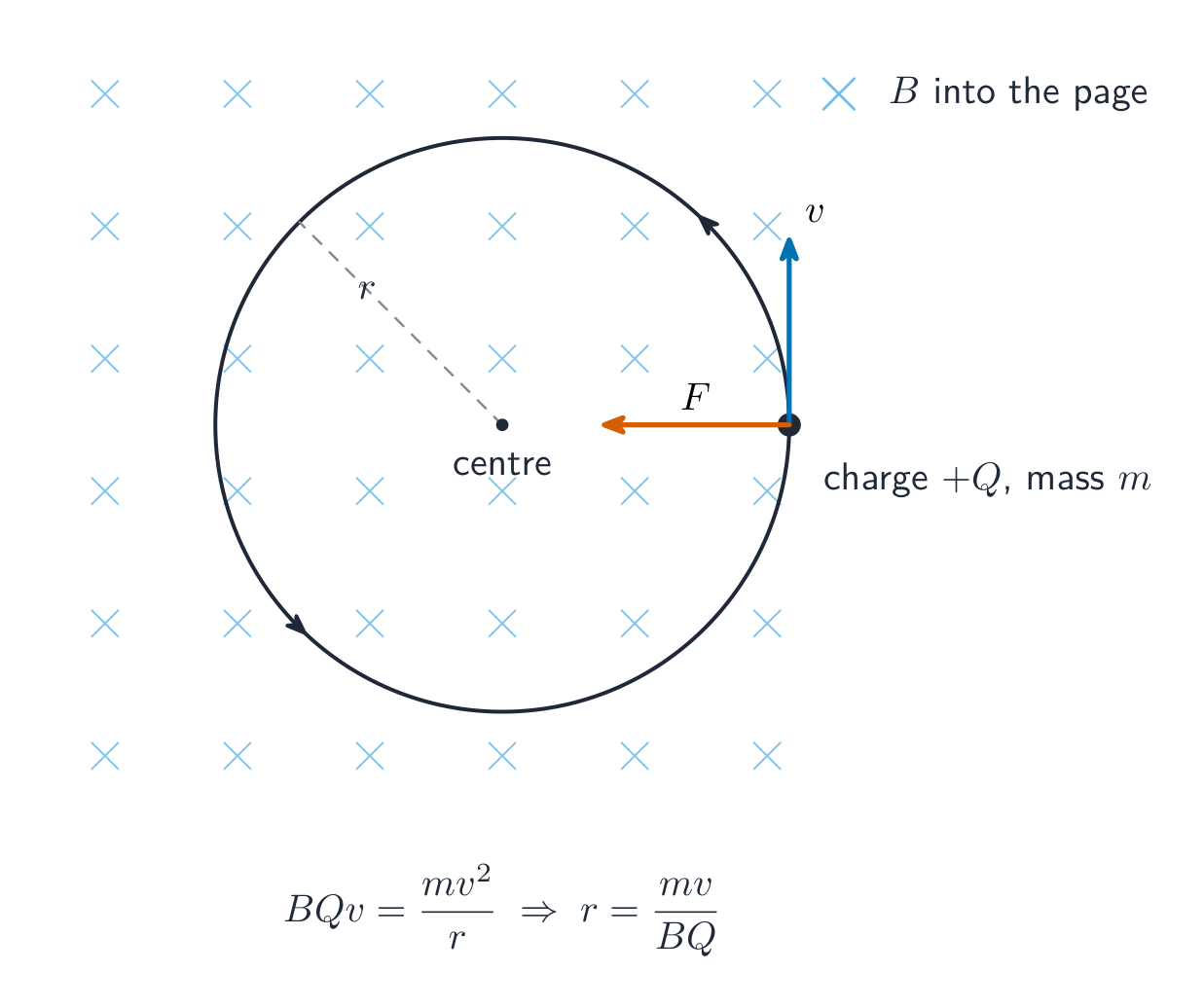
A charge moving perpendicular to a uniform field therefore travels in a circle, the magnetic force supplying the centripetal force 向心力:

$$qvB=\frac{mv^2}{r}\quad\Rightarrow\quad r=\frac{mv}{qB},\qquad T=\frac{2\pi m}{qB}.$$

Notice the period $T$ does not depend on the speed – faster particles ride larger circles in the same time.

Worked example. A proton ($q=1.6\times10^{-19}\ \text{C}$, $m=1.67\times10^{-27}\ \text{kg}$) enters a $0.50\ \text{T}$ field at $2.0\times10^{5}\ \text{m/s}$, perpendicular to it. The magnetic force $F=qvB=1.6\times10^{-14}\ \text{N}$ bends it into a circle of radius $r=\dfrac{mv}{qB}=\dfrac{1.67\times10^{-27}(2.0\times10^{5})}{1.6\times10^{-19}(0.50)}=4.2\times10^{-3}\ \text{m}$.

In a region with both an electric and a magnetic field, the two forces act independently and add as vectors. Balancing them makes a velocity selector 速度选择器: with $\vec{E}$ and $\vec{B}$ crossed, only charges with $qE=qvB$, i.e. $v=E/B$, pass straight through. The Hall effect 霍尔效应 is the same physics inside a conductor: a field with a component perpendicular to the current pushes the moving carriers sideways, charge builds up on one face, and a measurable potential difference appears across the conductor – its sign reveals whether the carriers are positive or negative.

ไทย
ประจุที่เคลื่อนที่ในสนามแม่เหล็ก

ประจุเคลื่อนที่ทำสองอย่าง: มัน สร้าง สนามแม่เหล็ก และมัน รู้สึกถึง แรงในสนามภายนอก สนามที่มันสร้างที่จุดหนึ่งตั้งฉากกับทั้งความเร็วและเวกเตอร์ตำแหน่งจากประจุไปยังจุด (ใช้มือขวาอีกครั้ง) และมากสุดเมื่อทั้งสองตั้งฉากกัน – เป็นศูนย์ตรงหน้าหรือด้านหลังการเคลื่อนที่โดยตรง

แรงบนประจุที่เคลื่อนที่ในสนาม $\vec{B}$ เป็นผลคูณไขว้

$$\vec{F}_B=q\,\vec{v}\times\vec{B},\qquad F=qvB\sin\theta,$$

ตั้งฉากกับทั้ง $\vec{v}$ และ $\vec{B}$ – ชี้นิ้วมือขวาไปตาม $\vec{v}$, ม้วนนิ้วเข้าหา $\vec{B}$, และนิ้วโป้งชี้ทิศทางแรงบนประจุ บวก (กลับด้านสำหรับประจุลบ) เนื่องจาก $\vec{F}_B\perp\vec{v}$, แรงแม่เหล็กไม่ทำงานกับประจุ: เปลี่ยนแค่ทิศทาง ไม่เปลี่ยนความเร็ว

ประจุที่เคลื่อนที่ตั้งฉากกับสนามสม่ำเสมอจึงเดินทางเป็นวงกลม, แรงแม่เหล็กทำหน้าที่เป็น แรงสู่ศูนย์กลาง:

$$qvB=\frac{mv^2}{r}\quad\Rightarrow\quad r=\frac{mv}{qB},\qquad T=\frac{2\pi m}{qB}.$$

สังเกตว่าช่วง $T$ ไม่ขึ้นกับความเร็ว – อนุภาคเร็วขึ้นวิ่งเป็นวงใหญ่ขึ้นแต่ใช้เวลาเท่าเดิม

อนุภาคที่มีประจุเคลื่อนที่ผ่านสนามแม่เหล็กจะเคลื่อนที่ตามเส้นทางวงกลม

ตัวอย่างทำพร้อมคำตอบ. โปรตอน ($q=1.6\times10^{-19}\ \text{C}$, $m=1.67\times10^{-27}\ \text{kg}$) เข้าสนาม $0.50\ \text{T}$ ที่ $2.0\times10^{5}\ \text{m/s}$, ตั้งฉากกับมัน แรงแม่เหล็ก $F=qvB=1.6\times10^{-14}\ \text{N}$ บิดเบือนให้เป็นวงกลมรัศมี $r=\dfrac{mv}{qB}=\dfrac{1.67\times10^{-27}(2.0\times10^{5})}{1.6\times10^{-19}(0.50)}=4.2\times10^{-3}\ \text{m}$

ในบริเวณที่มีทั้งสนามไฟฟ้าและสนามแม่เหล็ก แรงทั้งสองกระทำแยกกันและบวกกันเป็นเวกเตอร์ การสมดุล将它们 creates a velocity selector: With $\vec{E}$ and $\vec{B}$ crossed, only charges with $qE=qvB$, i.e. $v=E/B$, pass straight through. The Hall effect is the same physics inside a conductor: a field with a component perpendicular to the current pushes the moving carriers sideways, charge builds up on one face, and a measurable potential difference appears across the conductor – its sign reveals whether the carriers are positive or negative.

Explore · ⁨สำรวจ⁩

Force on a moving charge · ⁨แรงแบบเคลื่อนที่ต่อประจุที่เคลื่อนที่⁩

A charge moving through a magnetic field feels a force $F=qvB$ at right angles to both its velocity and the field — the basis of the motor effect. Reverse either and the force flips. · ⁨ประจุที่เคลื่อนที่ผ่านสนามแม่เหล็กได้รับแรง $F=qvB$ ในแนวตั้งฉากกับทั้งความเร็วและสนาม — นี่คือพื้นฐานของผลมอเตอร์ เปลี่ยนอย่างใดอย่างหนึ่งแล้วแรงจะกลับทิศทาง⁩

Vocabulary · ⁨คำศัพท์⁩ Train · ⁨ฝึกฝน⁩
English ไทย
perpendicular/ˌpɜːpənˈdɪkjʊlə/ ตั้งฉาก
centripetal force/senˈtrɪpɪtl fɔːs/ แรงเข้าสู่ศูนย์กลาง
velocity selector/vəˈlɒsɪti sɪˈlektə/ ตัวเลือกความเร็ว
Hall effect/hɔːl ɪˈfekt/ เอฟเฟกต์霍尔
Biot–Savart law/ˈbɪɒt ˈsævɑːt lɔː/ กฎไบโอ-ซาวาร์
tangent/ˈtændʒənt/ เส้นสัมผัส
concentric circles/kənˈsentrɪk ˈsɜːklz/ วงกลมซ้อนกัน
Watch lesson · ⁨ดูบทเรียน⁩
12.3

Magnetic Fields of Current-Carrying Wires · ⁨สนามแม่เหล็กของลวดที่มีกระแสไฟฟ้าไหลผ่าน⁩

Syllabus · ⁨หลักสูตร⁩
English

Learning Objective 12.3.A: Describe the magnetic field produced by a current-carrying wire.

  • 12.3.A.1 The Biot-Savart law defines the magnitude and direction of a magnetic field created by an electrical current.
    • Equation: $d\vec{B} = \dfrac{\mu_0}{4\pi} \dfrac{I(d\vec{\ell} \times \hat{r})}{r^2}$
  • 12.3.A.2 The magnetic field vectors around a small segment of a current-carrying wire are tangent to concentric circles centered on that wire. The field has no component toward, away from, or parallel to the segment of the current-carrying wire.
  • 12.3.A.3 The Biot-Savart law can be used to derive the magnitudes and directions of magnetic fields around segments of current-carrying wires, for example at the center of a circular loop of wire.
    • Equation: $B_{\text{center of loop}} = \dfrac{\mu_0 I}{2R}$

Learning Objective 12.3.B: Describe the force exerted on current-carrying wires by a magnetic field.

  • 12.3.B.1 A magnetic field will exert a force on a current-carrying wire.
    • Equation: $\vec{F}_B = \int I\left(d\vec{\ell} \times \vec{B}\right)$

Boundary statement: AP Physics C: Electricity & Magnetism only expects students to perform quantitative analysis of certain cases of current-carrying conductors using the Biot-Savart law, such as at a location along the perpendicular bisector of a straight conductor, at a location along the central axis of a circular loop, or at the center of a segment of a circular loop.

ไทย

วัตถุประสงค์การเรียนรู้ 12.3.A: อธิบายสนามแม่เหล็กที่เกิดจากสายไฟที่มีกระแสไหลผ่าน

  • 12.3.A.1 กฎของบิออ-ซาฟาร์กำหนดขนาดและทิศทางของสนามแม่เหล็กที่เกิดจากกระแสไฟฟ้า
    • สมการ: $d\vec{B} = \dfrac{\mu_0}{4\pi} \dfrac{I(d\vec{\ell} \times \hat{r})}{r^2}$
  • 12.3.A.2 เวกเตอร์สนามแม่เหล็กรอบๆ ส่วนเล็กๆ ของสายไฟที่มีกระแสไหลผ่านจะเป็นสัมผัสกับวงกลมที่มีจุดศูนย์กลางอยู่ที่สายไฟนั้น สนามไม่มีองค์ประกอบชี้เข้าหา ชี้ห่าง หรือขนานกับส่วนนั้นของสายไฟที่มีกระแสไหลผ่าน
  • 12.3.A.3 กฎของบิออ-ซาฟาร์สามารถใช้หาขนาดและทิศทางของสนามแม่เหล็กรอบๆ ส่วนต่างๆ ของสายไฟที่มีกระแสไหลผ่าน เช่น ที่ศูนย์กลางของวงลวดรูปวงกลม
    • สมการ: $B_{\text{center of loop}} = \dfrac{\mu_0 I}{2R}$

จุดประสงค์การเรียนรู้ 12.3.B: อธิบายแรงที่กระทำต่อสายไฟที่มีกระแสไหลผ่านโดยสนามแม่เหล็ก

  • 12.3.B.1 สนามแม่เหล็กจะ exert แรงต่อสายไฟที่มีกระแสไหลผ่าน
    • สมการ: $\vec{F}_B = \int I\left(d\vec{\ell} \times \vec{B}\right)$

คำประกาศขอบเขต: AP Physics C: Electricity & Magnetism คาดหวังให้นักเรียนทำการวิเคราะห์เชิงปริมาณกรณีเฉพาะของตัวนำที่มีกระแสไหลผ่านโดยใช้กฎของบิออ-ซาฟาร์เท่านั้น เช่น ที่ตำแหน่งบนเส้นกลางตั้งฉากของตัวนำตรง, ที่ตำแหน่งบนแกนกลางของวงลวด, หรือที่ศูนย์กลางของส่วนหนึ่งของวงลวด

Source: College Board AP Course and Exam Description · ⁨แหล่งที่มา: คำอธิบายหลักสูตรและข้อสอบ College Board AP⁩

English
The magnetic field around a current

A current is a stream of moving charges, so it creates a magnetic field. The Biot–Savart law 毕奥-萨伐尔定律 adds up the field of each current element:

$$d\vec{B}=\frac{\mu_0}{4\pi}\frac{I\,d\vec{l}\times\hat{r}}{r^2}.$$

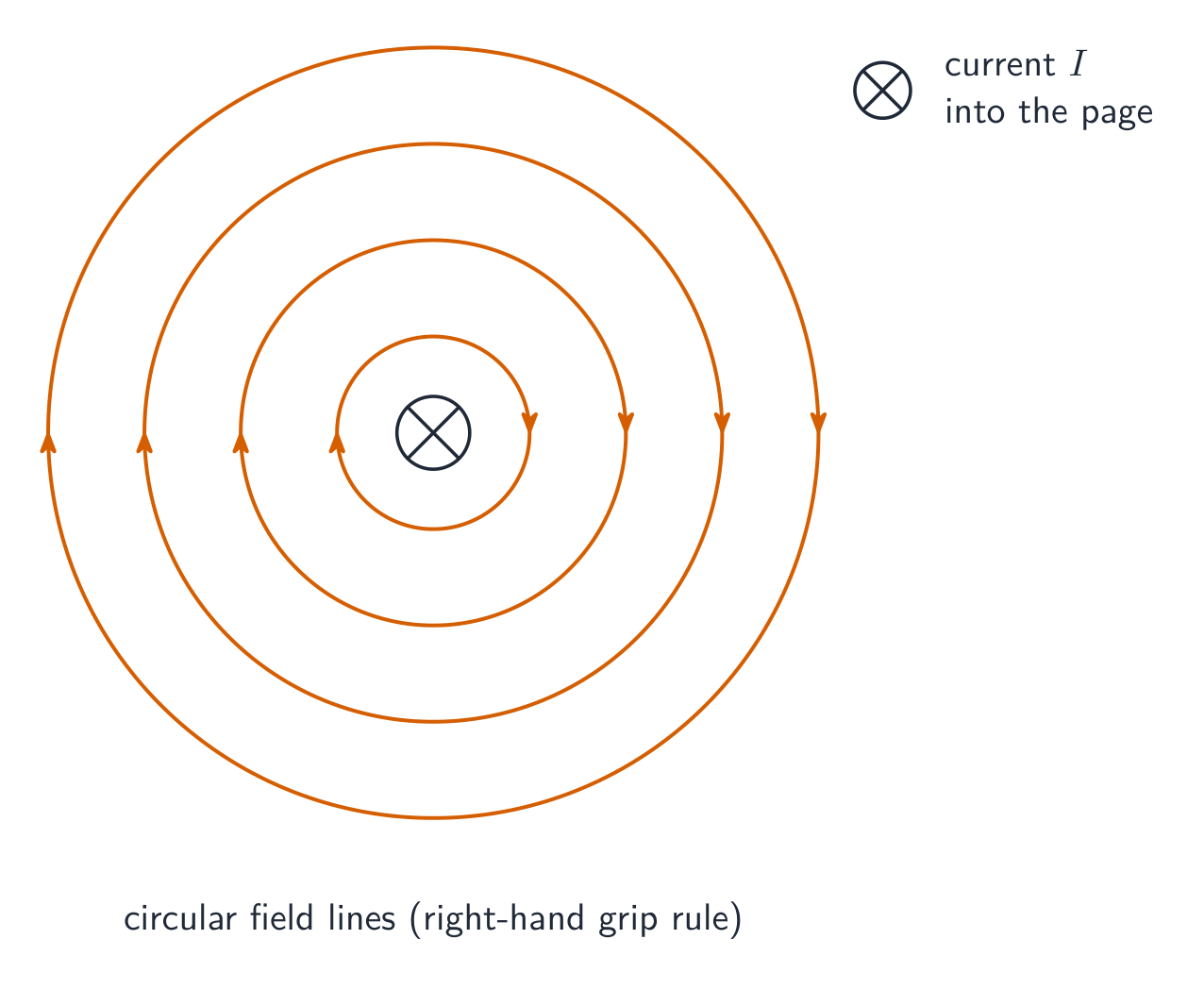
Around any straight segment the field vectors are tangent 相切 to concentric circles 同心圆 centred on the wire – no component toward, away from, or along the wire. Curl your right hand around the wire with the thumb along the current: your fingers give the field direction.

The Biot–Savart integrals AP expects: a long straight wire ($B=\dfrac{\mu_0 I}{2\pi r}$, or a point on the perpendicular bisector of a finite wire), and the centre of a circular loop,

$$B_{\text{centre of loop}}=\frac{\mu_0 I}{2R},$$

where every element $d\vec{l}$ is perpendicular to $\hat{r}$ and equally distant $R$ – say that in an FRQ derivation. An arc that is a fraction of a full circle contributes that same fraction of $\mu_0 I/2R$ at its centre.

A field also pushes on a current-carrying wire, element by element:

$$\vec{F}_B=\int I\,d\vec{l}\times\vec{B}\qquad(\vec{F}=I\vec{L}\times\vec{B}\ \text{for a straight wire in a uniform field}).$$

Worked example. Two long parallel wires a distance $d=0.10\ \text{m}$ apart each carry $5.0\ \text{A}$ in the same direction. Wire 1's field at wire 2 is $B=\dfrac{\mu_0 I}{2\pi d}=1.0\times10^{-5}\ \text{T}$, so wire 2 feels $\dfrac{F}{L}=I B=5.0\times10^{-5}\ \text{N/m}$, pulled toward wire 1. Same-direction currents attract; opposite currents repel.

ไทย
สนามแม่เหล็กรอบกระแสไฟฟ้า

กระแสไฟฟ้าคือกระแสน้ำไหลของประจุเคลื่อนที่ จึงสร้างสนามแม่เหล็ก กฎไบโอ-ซา瓦尔ต - บวกสะสมสนามของแต่ละองค์ประกอบกระแส:

$$d\vec{B}=\frac{\mu_0}{4\pi}\frac{I\,d\vec{l}\times\hat{r}}{r^2}.$$

รอบ任何直段,场矢量与以导线为中心的同心圆相切——没有指向、远离或沿导线的分量。用右手握住导线,拇指沿电流方向:手指指示磁场方向。

เส้นสนามวงกลมซ้อนกันล้อมรอบสายไฟที่ไหลผ่านกระแสไฟฟ้าตรง

อินทิกรัล Biot-Savart ที่ AP ต้องการ: ลวดตรงยาว ($B=\dfrac{\mu_0 I}{2\pi r}$, หรือจุดบนเส้นแบ่งครึ่งตั้งฉากของลวดจำกัด), และศูนย์กลางของวงกลม,

$$B_{\text{centre of loop}}=\frac{\mu_0 I}{2R},$$

ซึ่งแต่ละองค์ประกอบ $d\vec{l}$ ตั้งฉากกับ $\hat{r}$ และห่างจากศูนย์กลางเท่ากัน $R$ – บอกสิ่งนี้ในการพิสูจน์ FRQ ส่วนโค้งที่เป็นเศษหนึ่งของวงกลมเต็ม จะมีส่วนร่วมด้วยเศษส่วนนั้นของ $\mu_0 I/2R$ ที่ศูนย์กลางของมัน

สนามยังดันลวดที่มีกระแสไฟฟ้า流动的, element by element:

$$\vec{F}_B=\int I\,d\vec{l}\times\vec{B}\qquad(\vec{F}=I\vec{L}\times\vec{B}\ \text{for a straight wire in a uniform field}).$$

ตัวอย่างทำพร้อมคำตอบ. ลวดขนานยาวสองเส้น ห่างกัน $d=0.10\ \text{m}$ กระแส $5.0\ \text{A}$ ในทิศทางเดียวกัน สนามของ Wire 1 ที่ Wire 2 คือ $B=\dfrac{\mu_0 I}{2\pi d}=1.0\times10^{-5}\ \text{T}$, ดังนั้น Wire 2 รู้สึกถึง $\dfrac{F}{L}=I B=5.0\times10^{-5}\ \text{N/m}$, ถูก ดึงเข้าหา Wire 1 กระแสทิศทางเดียวกันดูดกัน; กระแสตรงข้ามผลักกัน

ตะกั่วเหล็กรอบคอยล์ที่มีกระแสไฟฟ้าไหลผ่าน
คอยล์ที่ไหลผ่านกระแสไฟฟ้า (โซเลนอยด์) สร้างสนามแม่เหล็กที่มีรูปทรงเหมือนแท่งแม่เหล็ก
Vocabulary · ⁨คำศัพท์⁩ Train · ⁨ฝึกฝน⁩
English ไทย
magnetic field/mæɡˈnetɪk fiːld/ สนามแม่เหล็ก
vector field/ˈvektə fiːld/ สนามเวกเตอร์
magnetic field lines/mæɡˈnetɪk fiːld laɪnz/ เส้นสนามแม่เหล็ก
Maxwell's equations/ˈmækswelz ɪˈkweɪʒnz/ สมการของ แมกซ์เวลล์
magnetic monopoles/mæɡˈnetɪk ˈmɒnəʊpəʊlz/ โมโนโพลแม่เหล็ก
magnetic dipole/mæɡˈnetɪk ˈdaɪpəʊl/ ไดโพลแม่เหล็ก
solenoid/ˈsəʊlənɔɪd/ โซเลนอยด์
Watch lesson · ⁨ดูบทเรียน⁩
12.4

Ampère's Law · ⁨กฎของแอมแปร์⁩

Syllabus · ⁨หลักสูตร⁩
English

Learning Objective 12.4.A: Use Ampère's law to describe the magnetic field created by a moving charge carrier.

  • 12.4.A.1 Ampère's law relates the magnitude of the magnetic field to the current enclosed by a closed imaginary path called an Amperian loop.
    • Equation: $\oint \vec{B} \cdot d\vec{\ell} = \mu_0 I_{\text{enc}}$
    • 12.4.A.1.i Ampère's law can be used to determine the magnetic field near a long, straight current-carrying wire.
      • Equation: $B_{\text{wire}} = \dfrac{\mu_0}{2\pi} \dfrac{I}{r}$
    • 12.4.A.1.ii Unless otherwise stated, all solenoids are assumed to be very long, with uniform magnetic fields inside the solenoids and negligible magnetic fields outside the solenoids.
    • 12.4.A.1.iii Ampère's law can be used to determine the magnetic field inside of a long solenoid.
      • Equation: $B_{\text{sol}} = \mu_0 n I$
  • 12.4.A.2 An Amperian loop is a closed path around a current-carrying conductor.
  • 12.4.A.3 The principle of superposition can be used to determine the net magnetic field at a point in space created by various combinations of current-carrying conductors, or conducting loops, segments, or cylinders.
  • 12.4.A.4 Maxwell's equations are the collection of equations that fully describe electromagnetism. Maxwell's fourth equation is Ampère's law with Maxwell's addition; it states that magnetic fields can be generated by electric current (Ampère's law) and that a changing electric field creates a magnetic field, similar to the way a moving charge creates a magnetic field (Maxwell's addition).
    • Equation: $\oint \vec{B} \cdot d\vec{\ell} = \mu_0 I + \mu_0 \varepsilon_0 \dfrac{d\Phi_E}{dt}$

Boundary statement: AP Physics C: Electricity & Magnetism only expects quantitative application of Ampère's law limited to situations involving symmetrical magnetic fields. Long straight wires, long solenoids carrying currents, as well as conductive slabs or cylindrical conductors carrying a current density, are the types of shapes to which Ampère's law will be applied on the AP Physics C: Electricity & Magnetism Exam.

Boundary statement: AP Physics C: Electricity & Magnetism does not expect students to use Maxwell's fourth equation with a changing electric field. However, students should understand that a changing electric field generates a magnetic field.

ไทย

จุดประสงค์การเรียนรู้ 12.4.A: ใช้กฎของแอมแปร์เพื่ออธิบายสนามแม่เหล็กที่เกิดจากตัวพาประจุเคลื่อนที่

  • 12.4.A.1 กฎของแอมแปร์ความสัมพันธ์ระหว่างขนาดของสนามแม่เหล็กกับกระแสไฟฟ้าที่ถูกห้อมล้อมด้วยเส้นโค้งจินตนาการปิดที่เรียกว่าวงลวดแอมแปร์
    • สมการ: $\oint \vec{B} \cdot d\vec{\ell} = \mu_0 I_{\text{enc}}$
    • 12.4.A.1.i กฎของแอมแปร์สามารถใช้หาสนามแม่เหล็กใกล้ๆ สายไฟตรงยาวที่มีกระแสไหลผ่าน
      • สมการ: $B_{\text{wire}} = \dfrac{\mu_0}{2\pi} \dfrac{I}{r}$
    • 12.4.A.1.ii เว้นแต่จะระบุไว้เป็นอย่างอื่น ลูคักแม่เหล็กทั้งหมดถูกพิจารณาว่ามีความยาวมาก มีสนามแม่เหล็กสม่ำเสมอภายในลูคัก และมีสนามแม่เหล็กที่น้อยมากจนabaikanได้ภายนอกลูคัก
    • 12.4.A.1.iii กฎของแอมแปร์สามารถใช้หาสนามแม่เหล็กภายในลูคักแม่เหล็กที่ยาว
      • สมการ: $B_{\text{sol}} = \mu_0 n I$
  • 12.4.A.2 วงลวดแอมแปร์คือเส้นโค้งปิดรอบตัวนำที่มีกระแสไหลผ่าน
  • 12.4.A.3 หลักการของการซ้อนทับสามารถใช้ในการหาสนามแม่เหล็กสุทธิที่จุดหนึ่งในอวกาศที่เกิดจากการรวมกันของตัวนำที่มีกระแสไหลผ่าน หรือวงลวด ส่วน หรือทรงกระบอกต่างๆ
  • 12.4.A.4 สมการของแมกซ์เวลล์คือชุดสมการที่อธิบายปรากฏการณ์ทางไฟฟ้าและแม่เหล็กอย่างครบถ้วน สมการที่สี่ของแมกซ์เวลล์คือกฎของแอมแปร์พร้อมการเพิ่มของแมกซ์เวลล์ ซึ่งระบุว่าสนามแม่เหล็กสามารถเกิดได้จากกระแสไฟฟ้า (กฎของแอมแปร์) และสนามไฟฟ้าที่เปลี่ยนแปลงสร้างสนามแม่เหล็กขึ้นได้ เหมือนกับการที่ประจุไฟฟ้าเคลื่อนที่สร้างสนามแม่เหล็ก (การเพิ่มของแมกซ์เวลล์)
    • สมการ: $\oint \vec{B} \cdot d\vec{\ell} = \mu_0 I + \mu_0 \varepsilon_0 \dfrac{d\Phi_E}{dt}$

คำประกาศขอบเขต: AP Physics C: Electricity & Magnetism คาดหวังเพียงการประยุกต์ใช้กฎของแอมแปร์เชิงปริมาณในสถานการณ์ที่มีสนามแม่เหล็กสมมาตร สายไฟตรงยาว ลูคักแม่เหล็กยาวที่มีกระแสไหลผ่าน รวมถึงแผ่นตัวนำหรือตัวนำทรงกระบอกที่มีหนาแน่นกระแส เป็นรูปแบบเรขาคณิตที่จะมีการใช้กฎของแอมแปร์ในการสอบ AP Physics C: Electricity & Magnetism

คำประกาศขอบเขต: AP Physics C: Electricity & Magnetism ไม่คาดหวังให้นักเรียนใช้สมการที่สี่ของแมกซ์เวลล์เมื่อมีสนามไฟฟ้าที่เปลี่ยนแปลง อย่างไรก็ตาม นักเรียนควรเข้าใจว่าสนามไฟฟ้าที่เปลี่ยนแปลงจะสร้างสนามแม่เหล็ก

Source: College Board AP Course and Exam Description · ⁨แหล่งที่มา: คำอธิบายหลักสูตรและข้อสอบ College Board AP⁩

English

For symmetric current distributions, Ampère's law 安培定律 finds the field far faster than Biot–Savart:

$$\oint \vec{B}\cdot d\vec{l}=\mu_0 I_{\text{enc}}.$$

Choose an Amperian loop 安培环路 that matches the symmetry, so that $B$ is constant along the loop (and parallel to it) and comes out of the integral. AP applies it to long straight wires, long solenoids, and conductors carrying a current density 电流密度 (slabs and cylinders); combinations are handled by superposition 叠加.

Worked example. Find the field $0.10\ \text{m}$ from a long wire carrying $5.0\ \text{A}$. A circular loop of radius $r$ shares the field's symmetry, so $B(2\pi r)=\mu_0 I$ and

$$B=\frac{\mu_0 I}{2\pi r}=\frac{(4\pi\times10^{-7})(5.0)}{2\pi(0.10)}=1.0\times10^{-5}\ \text{T}.$$

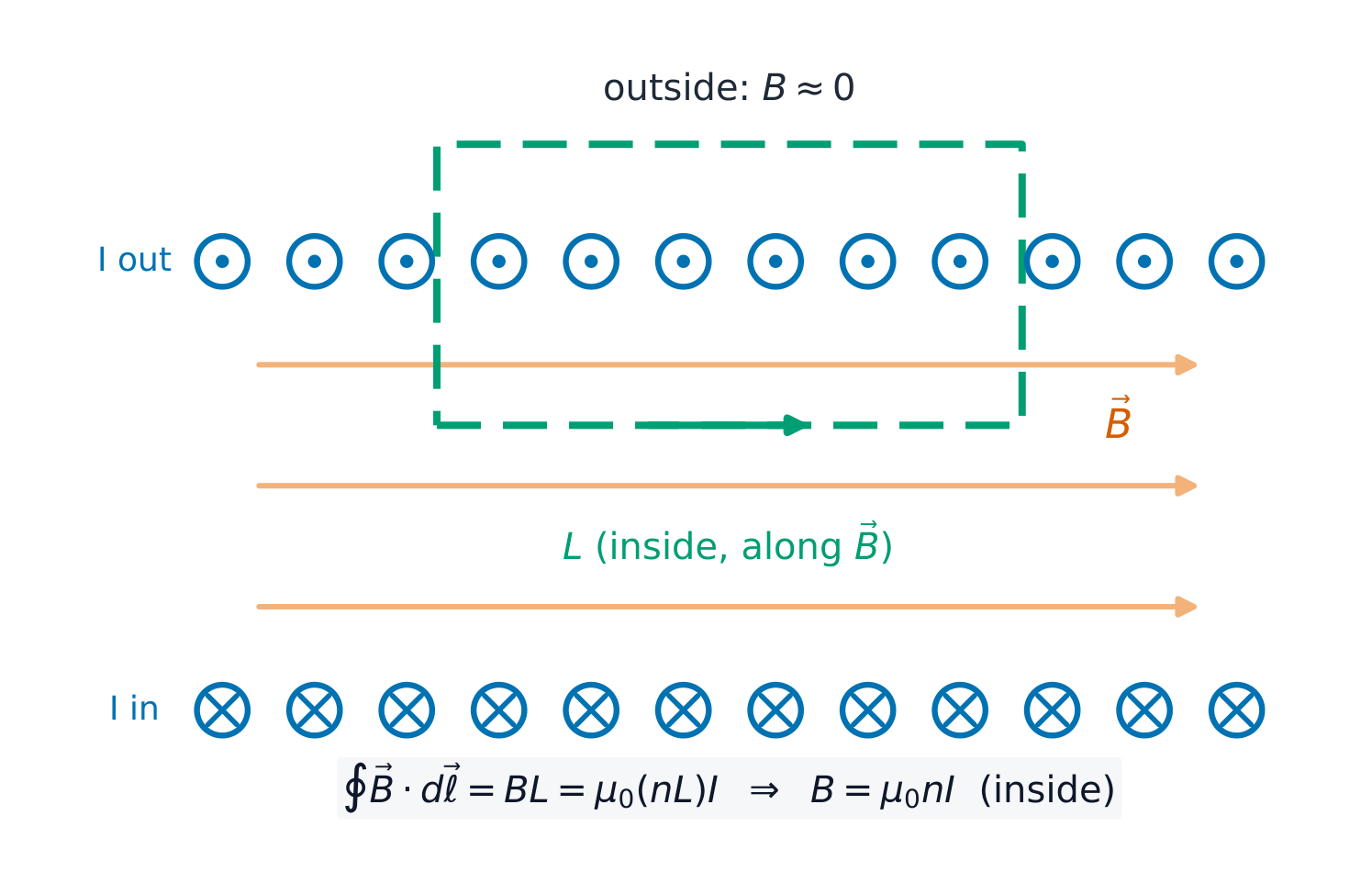
A long solenoid 螺线管 (assumed: uniform field inside, negligible field outside) is the other classic. Take a rectangular loop with one side of length $L$ inside, parallel to the axis: only that side contributes to the integral, so $BL=\mu_0 (nL) I$ and

$$B_{\text{sol}}=\mu_0 n I,$$

with $n$ the turns per metre.

Worked example (cylinder). A solid cylindrical conductor of radius $R$ carries current $I$ spread uniformly over its cross-section. Inside ($r), a circular loop encloses $I_{\text{enc}}=I\dfrac{r^2}{R^2}$, so $B=\dfrac{\mu_0 I r}{2\pi R^2}$ – the field grows linearly to the surface, then falls off as $1/r$ outside.

Exam skill. Every Ampère's-law answer earns its marks in the setup: name the loop, state why $B$ is constant and parallel to it (symmetry), and count $I_{\text{enc}}$ carefully before you solve. Maxwell's fourth equation adds one more idea you should know qualitatively: a changing electric field also creates a magnetic field – but AP will not ask you to compute with that term.

ไทย

สำหรับการกระจายกระแสที่มีสมมาตร, กฎของแอมแปร์ หาสนามได้เร็วกว่า Biot-Savart มาก:

$$\oint \vec{B}\cdot d\vec{l}=\mu_0 I_{\text{enc}}.$$

เลือก วงลูปแอมแปร์ ที่สอดคล้องกับความสมมาตร เพื่อให้ $B$ มีค่าคงที่ตลอดวงลูป (และขนานกับวงลูป) sehinggaสามารถดึงออกมานอกสัญลักษณ์อินทิกรัลได้ AP นำไปใช้กับสายยาวตรง เกลียวขดลวดยาว และตัวนำที่มี ความหนาแน่นกระแส (แผ่นและทรงกระบอก); กรณีผสมผสานจัดการด้วยหลักการ email叠加

ตัวอย่างวิธีทำ หาสนาม $0.10\ \text{m}$ จากสายยาวที่ไหลกระแส $5.0\ \text{A}$ วงกลมรัศมี $r$ มีความสมมาตรเดียวกับสนาม ดังนั้น $B(2\pi r)=\mu_0 I$ และ

$$B=\frac{\mu_0 I}{2\pi r}=\frac{(4\pi\times10^{-7})(5.0)}{2\pi(0.10)}=1.0\times10^{-5}\ \text{T}.$$

ขดลวดยาว (สมมติ: สนามสม่ำเสมอภายใน, สนามภายนอกน้อยมากจนตัดทิ้งได้) เป็นอีกกรณีคลาสสิก之一Take rectangular loop with one side of length $L$ inside, parallel to the axis: only that side contributes to the integral, so $BL=\mu_0 (nL) I$ and

$$B_{\text{sol}}=\mu_0 n I,$$

โดยที่ $n$ คือจำนวนรอบต่อเมตร

วงลูปแอมแปร์รูปสี่เหลี่ยมผืนผ้าหาสนามสม่ำเสมอภายในขดลวด

ตัวอย่างวิธีทำ (ทรงกระบอก) ตัวนำทรงกระบอกทึบรัศมี $R$ ไหลกระแส $I$ กระจายสม่ำเสมอทั่วหน้าตัด ภายใน ($r), วงกลมปิด $I_{\text{enc}}=I\dfrac{r^2}{R^2}$, ดังนั้น $B=\dfrac{\mu_0 I r}{2\pi R^2}$ – สนามเพิ่มขึ้นเป็นเส้นตรงจนถึงพื้นผิว แล้วลดลงตาม $1/r$ ด้านนอก

ทักษะการสอบ. ทุกคำตอบจากกฎของ Ampère ได้คะแนนจากการจัดเตรียม: ตั้งชื่อ loop, บอก ทำไม $B$ ถึงคงที่และขนานกับมัน (symmetry), และนับ $I_{\text{enc}}$ อย่างระมัดระวังก่อนแก้ Maxwell fourth equation เพิ่มไอเดียอีกข้อที่คุณควรรู้เชิงคุณภาพ: change电场 ก็สร้างสนามแม่เหล็ก – แต่ AP จะไม่ถามให้คุณคำนวณด้วยเทอมนี้

12.4

Exam tips · ⁨ข้อแนะนำสำหรับการสอบ⁩

English
  • The magnetic force $\vec F=q\vec v\times\vec B$ is perpendicular to velocity — use the right-hand rule and note it does no work.
  • A charge in a uniform field moves in a circle with $r=\tfrac{mv}{qB}$.
  • Find the field of currents with Biot–Savart $d\vec B=\tfrac{\mu_0}{4\pi}\tfrac{I\,d\vec l\times\hat r}{r^2}$ or Ampère's law $\oint \vec B\cdot d\vec l=\mu_0 I_{enc}$ when there is symmetry.
  • Force on a wire is $\vec F=I\vec L\times\vec B$; keep the cross-product direction straight.
  • Distinguish the force on a charge from the field the current creates.
ไทย
  • แรงแม่เหล็ก $\vec F=q\vec v\times\vec B$ เป็น ฉาก กับความเร็ว — ใช้กฎมือขวาและสังเกตว่ามัน ไม่ทำงาน
  • ประจุในสนามสม่ำเสมอเคลื่อนที่เป็นวงกลมด้วย $r=\tfrac{mv}{qB}$
  • หาสนามของกระแสด้วย Biot–Savart $d\vec B=\tfrac{\mu_0}{4\pi}\tfrac{I\,d\vec l\times\hat r}{r^2}$ หรือ Ampère's law $\oint \vec B\cdot d\vec l=\mu_0 I_{enc}$ เมื่อมีความสมมาตร
  • แรงบนสายคือ $\vec F=I\vec L\times\vec B$; รักษาทิศทางของผลคูณไขว้ให้ถูกต้อง
  • แยกแยะแรง กระทำต่อ ประจุ กับสนามที่กระแส สร้าง
Vocabulary · ⁨คำศัพท์⁩ Train · ⁨ฝึกฝน⁩
English ไทย
Ampère's law/ˈæmpeəz lɔː/ กฎของ แอมแปร์
Amperian loop/æmˈpɪərɪən luːp/ วงลูปแอมแปร์
current density/ˈkʌrənt ˈdensɪti/ ความหนาแน่นกระแส
superposition/ˌsuːpəpəˈzɪʃn/ การ叠加 (email: superposition)

Interactive lessons on this topic · ⁨บทเรียนเชิงโต้ตอบสำหรับหัวข้อนี้⁩

Work through it step by step, with instant-check exercises. · ⁨ทำทีละขั้นตอน พร้อมแบบฝึกหัดตรวจสอบผลทันที⁩

Past Papers · ⁨ข้อสอบย้อนหลัง⁩

More topics in AP Physics C: Electricity and Magnetism · ⁨หัวข้อเพิ่มเติมใน AP Physics C: Electricity and Magnetism⁩

Log in or create account · ⁨เข้าสู่ระบบหรือสร้างบัญชี⁩

IGCSE, A-Level & AP