Skip to content · ⁨ข้ามไปยังเนื้อหา⁩
Subjects · ⁨รายวิชา⁩

AP Physics C: Electricity and Magnetism

Tips · ⁨เคล็ดลับ⁩

AP Physics C: ไฟฟ้าและแม่เหล็ก เป็นรายวิชาแม่เหล็กไฟฟ้าที่ ใช้แคลคูลัส: ประจุ, สนามและ กฎของก๊อซ, ศักย์ไฟฟ้า, ตัวนำและ ตัวเก็บประจุ, วงจรไฟฟ้า, สนามแม่เหล็ก และ การเหนี่ยวนำแม่เหล็กไฟฟ้า โดยทั่วไปจะเรียนหลังจากกลศาสตร์ และต้องใช้ระดับแคลคูลัสนั้น

กฎของก๊อซและกฎของแอมแปร์กำหนดความรู้สึกของรายวิชานี้ ทั้งคู่จริงๆ แล้ว是关于 การเลือกพื้นผิวหรือวงรอบที่ทำให้อินทิกรัลง่าย — ทักษะที่คุณสร้างได้ด้วยการฝึกปฏิบัติหลายครั้ง ไม่ใช่การอ่านกฎ ความสมมาตรคือเกมทั้งหมด

ข้อเกี่ยวกับการเหนี่ยวนำลงโทษข้อผิดพลาดเรื่องเครื่องหมาย มากกว่าสิ่งอื่นใด ดังนั้น กำหนดเครื่องหมายสำหรับทิศทางการไหลเพียงหนึ่งแบบและใช้มันทุกครั้ง

หมายเหตุครอบคลุมตั้งแต่กฎของก๊อซจนถึงสมการของแม็กซ์เวลล์ แบบรายหน่วย พร้อมการเขียนเวกเตอร์แคลคูลัสอย่างละเอียด ห้องสมุดมีข้อ FRQ ที่ออกจริง; คะแนนที่ยากที่สุดใน E&M ไปอยู่ที่ การเลือกความสมมาตรที่เหมาะสม ก่อนทำการอินทิเกรต ดังนั้นตัวอย่างจึงเริ่มต้นที่นั่น

  • 8

    Electric Charges, Fields, and Gauss's Law · ⁨ประจุไฟฟ้า สนาม และกฎของเกาส์⁩

    Watch lesson · ⁨ดูบทเรียน⁩
    8.1

    Electric Charge and Electric Force

    Syllabus · ⁨หลักสูตร⁩
    English

    Learning Objective 8.1.A: Describe the electric force that results from the interactions between charged objects or systems.

    • 8.1.A.1 Charge is a fundamental property of all matter.
      • 8.1.A.1.i Charge is a scalar quantity and is described as positive or negative.
      • 8.1.A.1.ii The magnitude of the charge of a single electron or proton, the elementary charge $e$, can be considered to be the smallest indivisible amount of charge.
      • 8.1.A.1.iii The charge of an electron is $-e$ and the charge of a proton is $+e$, and a neutron has no electric charge.
      • 8.1.A.1.iv A point charge is a model in which the physical size of a charged object or system is negligible in the context of the situation being analyzed.
    • 8.1.A.2 Coulomb's law describes the electrostatic force between two charged objects as directly proportional to the magnitude of each of the charges and inversely proportional to the square of the distance between the objects.
      • Relevant equation: $\left| \vec{F}_E \right| = \dfrac{1}{4\pi\varepsilon_0} \dfrac{|q_1 q_2|}{r^2} = k \dfrac{|q_1 q_2|}{r^2}$
    • 8.1.A.3 The direction of the electrostatic force depends on the signs of the charges of the interacting objects and is along the line of separation between the objects.
      • 8.1.A.3.i Two objects with charges of the same sign exert repulsive forces on each other.
      • 8.1.A.3.ii Two objects with charges of opposite signs exert attractive forces on each other.
    • 8.1.A.4 Electric forces are responsible for some of the macroscopic properties of objects in everyday experiences. However, the large number of particle interactions that occur make it more convenient to treat everyday forces in terms of nonfundamental forces called contact forces, such as normal force, friction, and tension.

    Learning Objective 8.1.B: Describe the electric and gravitational forces that result from interactions between charged objects with mass.

    • 8.1.B.1 Electrostatic forces can be attractive or repulsive, while gravitational forces are always attractive.
    • 8.1.B.2 For any two objects that have mass and electric charge, the magnitude of the gravitational force is usually much smaller than the magnitude of the electrostatic force.
    • 8.1.B.3 Gravitational forces dominate at larger scales even though they are weaker than electrostatic forces, because systems at large scales tend to be electrically neutral.

    Learning Objective 8.1.C: Describe the electric permittivity of a material or medium.

    • 8.1.C.1 Electric permittivity is a measurement of the degree to which a material or medium is polarized in the presence of an electric field.
    • 8.1.C.2 Electric polarization can be modeled as the induced rearrangement of electrons by an external electric field, resulting in a separation of positive and negative charges within a material or medium.
    • 8.1.C.3 Free space has a constant value of electric permittivity, $\varepsilon_0$, that appears in physical relationships.
    • 8.1.C.4 The permittivity of matter has a value different from that of free space that arises from the matter's composition and arrangement.
      • 8.1.C.4.i In a given material, electric permittivity is determined by the ease with which electrons can change configurations within the material.
      • 8.1.C.4.ii Conductors are made from electrically conducting materials in which charge carriers move easily; insulators are made from electrically nonconducting materials in which charge carriers cannot move easily.

    Boundary statement: AP Physics C: Electricity & Magnetism only expects students to make calculations of the electric force between four or fewer interacting charged objects or systems. The analysis of the resulting electric force from more charges is allowed in situations of high symmetry. Note that students are expected to calculate the electric fields of charge distributions, as described in Topics 8.4 and 8.6.

    ไทย

    วัตถุประสงค์การเรียนรู้ 8.1.A: อธิบายแรงไฟฟ้าที่เกิดขึ้นจากการมีปฏิสัมพันธ์ระหว่างวัตถุหรือระบบที่มีประจุ

    • 8.1.A.1 ประจุเป็นคุณสมบัติพื้นฐานของสสารทุกชนิด
      • 8.1.A.1.iประจุเป็นปริมาณสเกลาร์และอธิบายได้ว่าเป็นบวกหรือลบ
      • 8.1.A.1.ii The magnitude of the charge of a single electron or proton, the elementary charge $e$, can be considered to be the smallest indivisible amount of charge.
      • 8.1.A.1.iii The charge of an electron is $-e$ and the charge of a proton is $+e$, and a neutron has no electric charge.
      • 8.1.A.1.iv A point charge is a model in which the physical size of a charged object or system is negligible in the context of the situation being analyzed.
    • 8.1.A.2 กฎของคูลอมบ์อธิบายแรงสถิตไฟฟ้าระหว่างวัตถุสองชิ้นที่เป็นประจุ โดยมีความสัมพันธ์โดยตรงกับขนาดของประจุแต่ละด้าน และสัมพันธ์ผกผันกับกำลังสองของระยะห่างระหว่างวัตถุทั้งสอง
      • สมการที่เกี่ยวข้อง: $\left| \vec{F}_E \right| = \dfrac{1}{4\pi\varepsilon_0} \dfrac{|q_1 q_2|}{r^2} = k \dfrac{|q_1 q_2|}{r^2}$
    • 8.1.A.3 ทิศทางของแรงสถิตไฟฟ้าขึ้นอยู่กับเครื่องหมายของประจุของวัตถุที่มีปฏิสัมพันธ์กัน และเป็นไปตามเส้นตรงที่เชื่อมระหว่างวัตถุทั้งสอง
      • 8.1.A.3.i Two objects with charges of the same sign exert repulsive forces on each other.
      • 8.1.A.3.ii Two objects with charges of opposite signs exert attractive forces on each other.
    • 8.1.A.4 แรงไฟฟ้ามีส่วนทำให้เกิดคุณสมบัติระดับมหภาคบางอย่างของวัตถุในชีวิตประจำวัน อย่างไรก็ตาม จำนวนการมีปฏิสัมพันธ์ของอนุภาคจำนวนมากที่เกิดขึ้นทำให้สะดวกกว่าที่จะจัดการกับแรงในชีวิตประจำวันโดยใช้แรงที่ไม่ใช่พื้นฐานที่เรียกว่า "แรงสัมผัส" (contact forces) เช่น แรงปกติ แรงเสียดทาน และแรงตึงเชือก

    วัตถุประสงค์การเรียนรู้ 8.1.B: อธิบายแรงไฟฟ้าและแรงโน้มถ่วงที่เกิดจากการมีปฏิสัมพันธ์ระหว่างวัตถุที่มีประจุและมีมวล

    • 8.1.B.1 แรงสถิตไฟฟ้าอาจเป็นแรงดูดหรือแรงผลัก ในขณะที่แรงโน้มถ่วงจะเป็นแรงดูดเสมอ
    • 8.1.B.2 สำหรับวัตถุสองชิ้นที่มีทั้งมวลและประจุไฟฟ้า ขนาดของแรงโน้มถ่วงมักจะมีค่าน้อยกว่ามากเมื่อเทียบกับขนาดของแรงสถิตไฟฟ้า
    • 8.1.B.3 แรงโน้มถ่วงมีอิทธิพลเหนือในระดับมหภาคแม้ว่าจะอ่อนกว่าแรงสถิตไฟฟ้าก็ตาม เนื่องจากระบบในระดับมหภาคมักจะมีความเป็นกลางทางไฟฟ้า

    วัตถุประสงค์การเรียนรู้ 8.1.C: อธิบายค่าความยอมให้ประจุไฟฟ้า (electric permittivity) ของวัสดุหรือสื่อ

    • 8.1.C.1 ค่าความยอมให้ประจุไฟฟ้าเป็นการวัดระดับที่วัสดุหรือสื่อเกิดการขั้วไฟฟ้า (polarized) เมื่ออยู่ในสนามไฟฟ้า
    • 8.1.C.2 การขั้วไฟฟ้าสามารถจำลองได้เป็นการจัดเรียง ulangของอิเล็กตรอนที่ถูกเหนี่ยวนำโดยสนามไฟฟ้าภายนอก ส่งผลให้เกิดการแยกตัวของประจุบวกและประจุลบภายในวัสดุหรือสื่อ
    • 8.1.C.3 สペースว่างมีค่าคงที่ของความจุไฟฟ้า $\varepsilon_0$ ซึ่งปรากฏในความสัมพันธ์ทางฟิสิกส์ต่างๆ
    • 8.1.C.4 ค่าความยอมให้ประจุไฟฟ้าของสสารมีค่าแตกต่างจากอวกาศว่าง ซึ่งเกิดจากองค์ประกอบและการจัดเรียงตัวของสสารนั้นเอง
      • 8.1.C.4.i In a given material, electric permittivity is determined by the ease with which electrons can change configurations within the material.
      • 8.1.C.4.ii Conductors are made from electrically conducting materials in which charge carriers move easily; insulators are made from electrically nonconducting materials in which charge carriers cannot move easily.

    คำชี้แจงขอบเขต: AP Physics C: ไฟฟ้าและแม่เหล็ก ต้องการให้นักเรียนทำการคำนวณแรงไฟฟ้าระหว่างวัตถุหรือระบบที่มีประจุสี่ตัวหรือน้อยกว่าเท่านั้น การวิเคราะห์แรงไฟฟ้าที่เกิดขึ้นจากประจุที่มากกว่านี้สามารถทำได้ในสถานการณ์ที่มีความสมมาตรสูง หมายเหตุ: นักเรียนต้องสามารถคำนวณสนามไฟฟ้าจากการกระจายของประจุได้ตามหัวข้อ 8.4 และ 8.6
    Source: College Board AP Course and Exam Description · ⁨แหล่งที่มา: คำอธิบายหลักสูตรและข้อสอบ College Board AP⁩

    Electric charge 电荷 comes in positive and negative; like charges repel, opposites attract. Charge is quantized 量子化 – every charge is a whole-number multiple of the elementary charge 基本电荷 $e=1.6\times10^{-19}\ \text{C}$ – and obeys conservation of charge 电荷守恒: charge is never created or destroyed, only moved. The force between two point charges 点电荷 is Coulomb's law 库仑定律:

    $$\vec{F}=\frac{1}{4\pi\varepsilon_0}\frac{q_1 q_2}{r^2}\,\hat{r},$$

    an inverse-square 平方反比 force along the line joining them, with $\dfrac{1}{4\pi\varepsilon_0}=k=9.0\times10^{9}\ \text{N}\cdot\text{m}^2/\text{C}^2$. For several charges (AP uses four or fewer, unless symmetry helps), add the force vectors on the charge you care about – superposition 叠加.

    Charge is a fundamental property 基本属性 of matter, and a point charge is a model that ignores the size of a charged object. The constant $\varepsilon_0$ is the permittivity of free space 真空介电常数 – a material property of the vacuum. The permittivity of matter differs from $\varepsilon_0$, set by how easily the material polarizes, which is why a dielectric between charges weakens the force. Note too that although the electric force is far stronger than gravity, gravity dominates at astronomical scales because large bodies are nearly neutral.

    Worked example. Two $+2.0\ \mu\text{C}$ charges sit $0.30\ \text{m}$ apart: $F=\dfrac{kq_1q_2}{r^2}=\dfrac{9.0\times10^{9}(2.0\times10^{-6})^2}{(0.30)^2}=0.40\ \text{N}$, repulsive.

    Worked example (vectors). Charges $+3.0\ \mu\text{C}$ and $-3.0\ \mu\text{C}$ sit at two corners of a right angle, each $0.30\ \text{m}$ from a $+1.0\ \mu\text{C}$ charge at the corner. Each exerts $F=\dfrac{(9.0\times10^{9})(3.0\times10^{-6})(1.0\times10^{-6})}{0.09}=0.30\ \text{N}$ – one a push, one a pull, at right angles to each other. The net force is $F_{\text{net}}=\sqrt{0.30^2+0.30^2}=0.42\ \text{N}$, pointing between them. Never add magnitudes blindly: components first.

    Explore · ⁨สำรวจ⁩

    Explore the field of a source charge · ⁨สำรวจสนามของประจุแหล่งกำเนิด⁩

    Change the charge's sign and size. Lines point away from positive and toward negative, and their $1/r^2$ crowding near the charge mirrors why Coulomb's force $F = k\,|q_1 q_2|/r^2$ weakens with distance. · ⁨เปลี่ยน เครื่องหมายและขนาด ของประจุ เส้นชี้ ออกจากประจุบวก และ เข้าหาประจุลบ และการ $1/r^2$ รวมตัวใกล้ประจุสะท้อนว่าแรงคูลอมบ์ $F = k\,|q_1 q_2|/r^2$ ลดลงตามระยะทาง⁩

    Vocabulary · ⁨คำศัพท์⁩ Train · ⁨ฝึกฝน⁩
    English ไทย
    Electric charge/ɪˈlektrɪk tʃɑːdʒ/ ประจุไฟฟ้า
    quantized/ˈkwɒntaɪzd/ 量子化的
    elementary charge/ˌelɪˈmentəri tʃɑːdʒ/ ประจุขั้นพื้นฐาน
    conservation of charge/ˌkɒnsəˈveɪʃn ɒv tʃɑːdʒ/ การอนุรักษ์ประจุไฟฟ้า
    point charges/pɔɪnt ˈtʃɑːdʒɪz/ ประจุจุด
    Coulomb's law/ˈkuːlɒmz lɔː/ กฎของคูลอม
    inverse-square/ɪnˈvɜːs skweə/ กำลังสองผกผัน
    superposition/ˌsuːpəpəˈzɪʃn/ การ叠加 (email: superposition)
    fundamental property/ˌfʌndəˈmentl ˈprɒpəti/ คุณสมบัติพื้นฐาน
    permittivity of free space/ˌpɜːmɪˈtɪvəti ɒv friː speɪs/ ค่าความยอมให้ของสุญญากาศ
    8.2

    Electric Charge and the Process of Charging

    Syllabus · ⁨หลักสูตร⁩
    English

    Learning Objective 8.2.A: Describe the behavior of a system using conservation of charge.

    • 8.2.A.1 The net charge or charge distribution of a system can change in response to the presence of, or changes in, the net charge or charge distribution of other systems.
      • 8.2.A.1.i The net charge of a system can change due to friction or contact between systems.
      • 8.2.A.1.ii Induced charge separation occurs when the electrostatic force between two systems alters the distribution of charges within the systems, resulting in the polarization of one or both systems.
      • 8.2.A.1.iii Induced charge separation can occur in neutral systems.
    • 8.2.A.2 Any change to a system's net charge is due to a transfer of charge between the system and its surroundings.
      • 8.2.A.2.i The charging of a system typically involves the transfer of electrons to and from the system.
      • 8.2.A.2.ii The net charge of a system will be constant unless there is a transfer of charge to or from the system.
    • 8.2.A.3 Grounding involves electrically connecting a charged object to a much larger and approximately neutral system (e.g., Earth).
    ไทย

    วัตถุประสงค์การเรียนรู้ 8.2.A: อธิบายพฤติกรรมของระบบโดยใช้หลักการอนุรักษ์ประจุไฟฟ้า

    • 8.2.A.1 ประจุสุทธิหรือการกระจายประจุของระบบสามารถเปลี่ยนแปลงได้เมื่อมีระบบอื่นที่มีประจุสุทธิหรือการกระจายประจุอยู่ใกล้เคียง หรือมีการเปลี่ยนแปลงในสิ่งเหล่านั้น
      • 8.2.A.1.i The net charge of a system can change due to friction or contact between systems.
      • 8.2.A.1.ii Induced charge separation occurs when the electrostatic force between two systems alters the distribution of charges within the systems, resulting in the polarization of one or both systems.
      • 8.2.A.1.iii Induced charge separation can occur in neutral systems.
    • 8.2.A.2 การเปลี่ยนแปลงใดๆ ในประจุสุทธิของระบบเกิดจากการถ่ายโอนประจุระหว่างระบบกับสิ่งแวดล้อมรอบข้าง
      • 8.2.A.2.i กระบวนการชาร์จระบบมักเกี่ยวข้องกับการถ่ายโอนอิเล็กตรอนเข้าและออกจากระบบ
      • 8.2.A.2.ii ประจุสุทธิของระบบจะคงที่ เว้นแต่จะมีการถ่ายโอนประจุเข้าหรือออกจากระบบ
    • 8.2.A.3 การต่อกราวด์ (Grounding) คือการเชื่อมต่อวัตถุที่มีประจุเข้ากับระบบที่ใหญ่กว่ามากและมีประจุสุทธิประมาณเป็นศูนย์ (เช่น โลก) อย่างทางไฟฟ้า

    Source: College Board AP Course and Exam Description · ⁨แหล่งที่มา: คำอธิบายหลักสูตรและข้อสอบ College Board AP⁩

    A conductor 导体 lets charge move freely; an insulator 绝缘体 holds it in place. Objects gain net charge three ways:

    • Charging by friction 摩擦起电: rubbing transfers electrons from one surface to the other.
    • Charging by conduction 传导起电: touching a charged object shares charge of the same sign.
    • Charging by induction 感应起电: a nearby charge pushes the conductor's charge apart; ground 接地 the far side, remove the ground wire first, and the conductor is left with the opposite sign – all without contact.

    An insulator cannot pass charge, but it can develop polarization 极化: its molecules stretch or turn so one face is slightly positive and the other slightly negative. That is why a charged comb picks up neutral paper scraps. An electroscope 验电器 shows net charge by its leaves repelling; on any isolated conductor the excess charge sits entirely on the outer surface.

    Explore · ⁨สำรวจ⁩

    Explore charging by rubbing · ⁨สำรวจการชาร์จด้วยการถู⁩

    Rubbing transfers electrons onto the object, leaving it negative. A charged object then attracts a neutral wall or hair (by polarization) but repels another like-charged object — the same electron transfer behind friction, conduction, and induction. · ⁨การถูถ่ายโอน อิเล็กตรอน เข้าสู่วัตถุ ทำให้มีประจุลบ วัตถุที่มีประจุจะ ดึงดูดผนังหรือเส้นผมที่เป็นกลาง (โดยการเหนี่ยวนำ) แต่ ผลัก วัตถุที่มีประจุชนิดเดียวกัน — การถ่ายโอนอิเล็กตรอนนี้เป็นสาเหตุของการเสียดสี การนำไฟฟ้า และการเหนี่ยวนำ⁩

    Vocabulary · ⁨คำศัพท์⁩ Train · ⁨ฝึกฝน⁩
    English ไทย
    conductor/kənˈdʌktə/ ตัวนำ
    insulator/ˈɪnsjuːleɪtə/ ฉนวน
    Charging by friction/ˈtʃɑːdʒɪŋ baɪ ˈfrɪkʃn/ การทำให้เป็นประจุด้วยการเสียดสี
    Charging by conduction/ˈtʃɑːdʒɪŋ baɪ kənˈdʌkʃn/ การทำให้เป็นประจุด้วยการสัมผัส
    Charging by induction/ˈtʃɑːdʒɪŋ baɪ ɪnˈdʌkʃn/ การทำให้เป็นประจุด้วยการเหนี่ยวนำ
    ground/ɡraʊnd/ กราวด์ (ดิน)
    polarization/ˌpəʊləraɪˈzeɪʃn/ การโพลาไรซ์
    electroscope/ɪˌlektrəʊˈskəʊp/ เครื่องตรวจประจุไฟฟ้า electroscope
    8.3

    Electric Fields

    Syllabus · ⁨หลักสูตร⁩
    English

    Learning Objective 8.3.A: Describe the electric field produced by a charged object or configuration of point charges.

    • 8.3.A.1 Electric fields may originate from charged objects.
    • 8.3.A.2 The electric field at a given point is the ratio of the electric force exerted on a test charge at the point to the charge of the test charge.
      • Relevant equation: $\vec{E} = \dfrac{\vec{F}_E}{q}$
      • 8.3.A.2.i A test charge is a point charge of small enough magnitude such that its presence does not significantly affect an electric field in its vicinity.
      • 8.3.A.2.ii An electric field points away from isolated positive charges and toward isolated negative charges.
      • 8.3.A.2.iii The electric force exerted on a positive test charge by an electric field is in the same direction as the electric field.
    • 8.3.A.3 The electric field is a vector quantity and can be represented in space using vector field maps.
      • 8.3.A.3.i The net electric field at a given location is the vector sum of individual electric fields created by nearby charged objects.
      • 8.3.A.3.ii Electric field maps use vectors to depict the magnitude and direction of the electric field at many locations within a given region.
      • 8.3.A.3.iii Electric field line diagrams are simplified models of electric field maps and can be used to determine the relative magnitude and direction of the electric field at any position in the diagram.

    Learning Objective 8.3.B: Describe the electric field generated by charged conductors or insulators.

    • 8.3.B.1 While in electrostatic equilibrium, the excess charge of a conductor is distributed on the surface of the conductor, and the electric field within the conductor is zero.
      • 8.3.B.1.i At the surface of a charged conductor, the electric field is perpendicular to the surface.
      • 8.3.B.1.ii The electric field outside an isolated sphere with spherically symmetric charge distribution is the same as the electric field due to a point charge with the same net charge as the sphere located at the center of the sphere.
    • 8.3.B.2 While in electrostatic equilibrium, the excess charge of an insulator is distributed throughout the interior of the insulator as well as at the surface, and the electric field within the insulator may have a nonzero value.
    ไทย

    จุดประสงค์การเรียนรู้ 8.3.A: อธิบายสนามไฟฟ้าที่เกิดจากวัตถุที่มีประจุหรือการจัดเรียงของประจุจุด

    • 8.3.A.1 สนามไฟฟ้าอาจมีต้นกำเนิดมาจากวัตถุที่มีประจุ
    • 8.3.A.2 สนามไฟฟ้าที่จุดหนึ่งใดคืออัตราส่วนระหว่างแรงไฟฟ้าที่กระทำต่อบททดสอบประจุ (test charge) ที่จุดนั้น ต่อขนาดของบททดสอบประจุ
      • สมการที่เกี่ยวข้อง: $\vec{E} = \dfrac{\vec{F}_E}{q}$
      • 8.3.A.2.i บททดสอบประจุคือประจุจุดที่มีขนาดเล็กพอที่การมีอยู่ของมันจะไม่ส่งผลต่อสนามไฟฟ้าในบริเวณใกล้เคียงอย่างมีนัยสำคัญ
      • 8.3.A.2.ii ทิศทางของสนามไฟฟ้าชี้ห่างจากประจุบวกที่โดดเดี่ยว และชี้เข้าหาประจุลบที่โดดเดี่ยว
      • 8.3.A.2.iii แรงไฟฟ้าที่กระทำต่อบททดสอบประจุบวกโดยสนามไฟฟ้าจะมีทิศทางเดียวกับทิศทางของสนามไฟฟ้า
    • 8.3.A.3 สนามไฟฟ้าเป็นปริมาณเวกเตอร์ และสามารถแสดงออกในพื้นที่โดยใช้แผนที่สนามเวกเตอร์ (vector field maps)
      • 8.3.A.3.i สนามไฟฟ้าสุทธิที่ตำแหน่งหนึ่งใดคือผลรวมเชิงเวกเตอร์ของสนามไฟฟ้าแต่ละตัวที่เกิดจากวัตถุที่มีประจุที่อยู่ใกล้ๆ
      • 8.3.A.3.ii แผนที่สนามไฟฟ้าใช้เวกเตอร์เพื่อแสดงขนาดและทิศทางของสนามไฟฟ้า ณ ตำแหน่งต่างๆ หลายตำแหน่งภายในพื้นที่ที่กำหนด
      • 8.3.A.3.iii แผนภาพเส้นสนามไฟฟ้าเป็นแบบจำลองที่ลดรูปมาจากรูปแผนที่สนามไฟฟ้า สามารถใช้เพื่อกำหนดขนาดสัมพัทธ์และทิศทางของสนามไฟฟ้าได้ทุกตำแหน่งในแผนภาพ

    จุดประสงค์การเรียนรู้ 8.3.B: อธิบายสนามไฟฟ้าที่เกิดจากตัวนำหรือฉนวนที่มีประจุ

    • 8.3.B.1 ในขณะที่อยู่ในสภาวะสมดุลทางสถิต (electrostatic equilibrium) ประจุส่วนเกินของตัวนำจะถูกกระจายอยู่บนพื้นผิวของตัวนำ และสนามไฟฟ้าภายในตัวนำจะเป็นศูนย์
      • 8.3.B.1.i ที่พื้นผิวของตัวนำที่มีประจุ ทิศทางของสนามไฟฟ้าจะตั้งฉากกับพื้นผิว
      • 8.3.B.1.ii สนามไฟฟ้าภายนอกทรงกลมที่โดดเดี่ยวซึ่งมีการกระจายประจุแบบสมมาตรทรงกลม จะมีค่าเท่ากับสนามไฟฟ้าเนื่องจากประจุจุดที่มีประจุสุทธิเท่ากันกับทรงกลม ตั้งอยู่ที่ศูนย์กลางของทรงกลม
    • 8.3.B.2 ในขณะที่อยู่ในสภาวะสมดุลทางสถิต ประจุส่วนเกินของฉนวนจะถูกกระจายทั้งภายในของฉนวนและที่พื้นผิว และสนามไฟฟ้าภายในฉนวนอาจมีค่าไม่เท่ากับศูนย์

    Source: College Board AP Course and Exam Description · ⁨แหล่งที่มา: คำอธิบายหลักสูตรและข้อสอบ College Board AP⁩

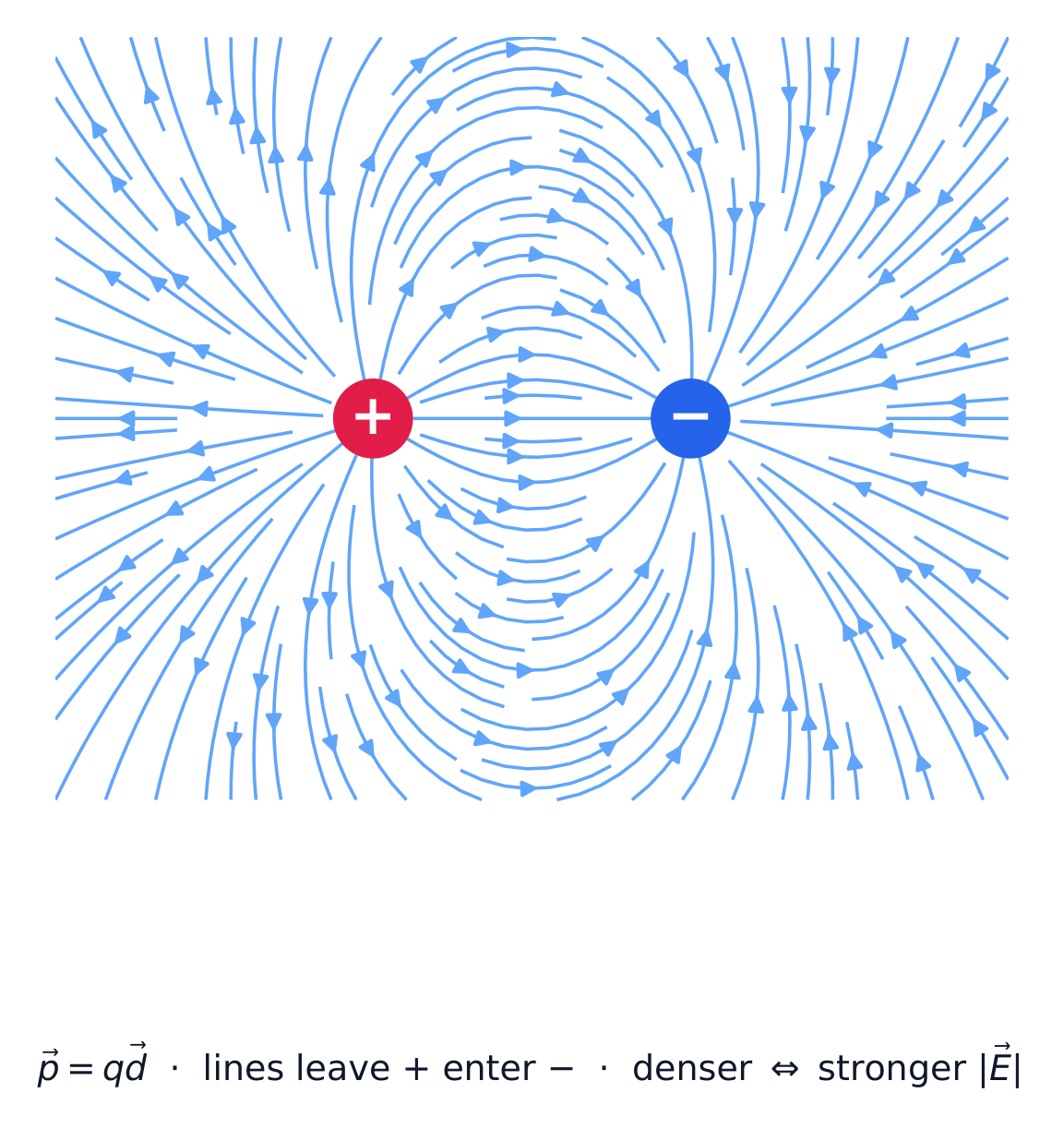
    The electric field of a dipole
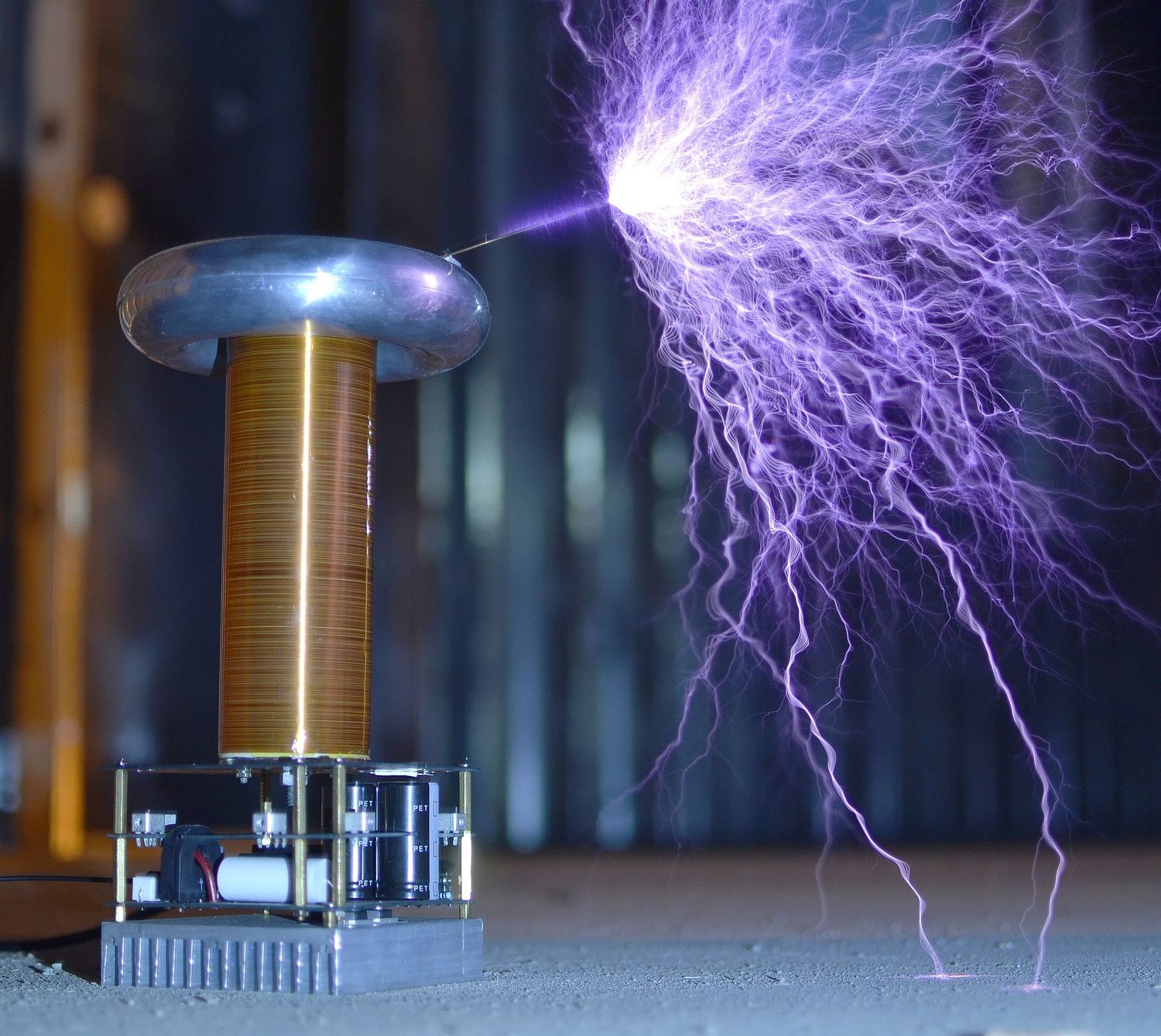
    A Tesla coil topped by a metal ring, throwing long purple sparks out into the air
    A Tesla coil throws sparks: it raises the voltage so high that the electric field ionizes the surrounding air, and charge leaps across as a visible discharge

    The electric field 电场 at a point is the force per unit charge that a small positive test charge 检验电荷 would feel there:

    $$\vec{E}=\frac{\vec{F}}{q},\qquad \vec{E}=\frac{1}{4\pi\varepsilon_0}\frac{q}{r^2}\,\hat{r}\ \text{(point charge)}.$$

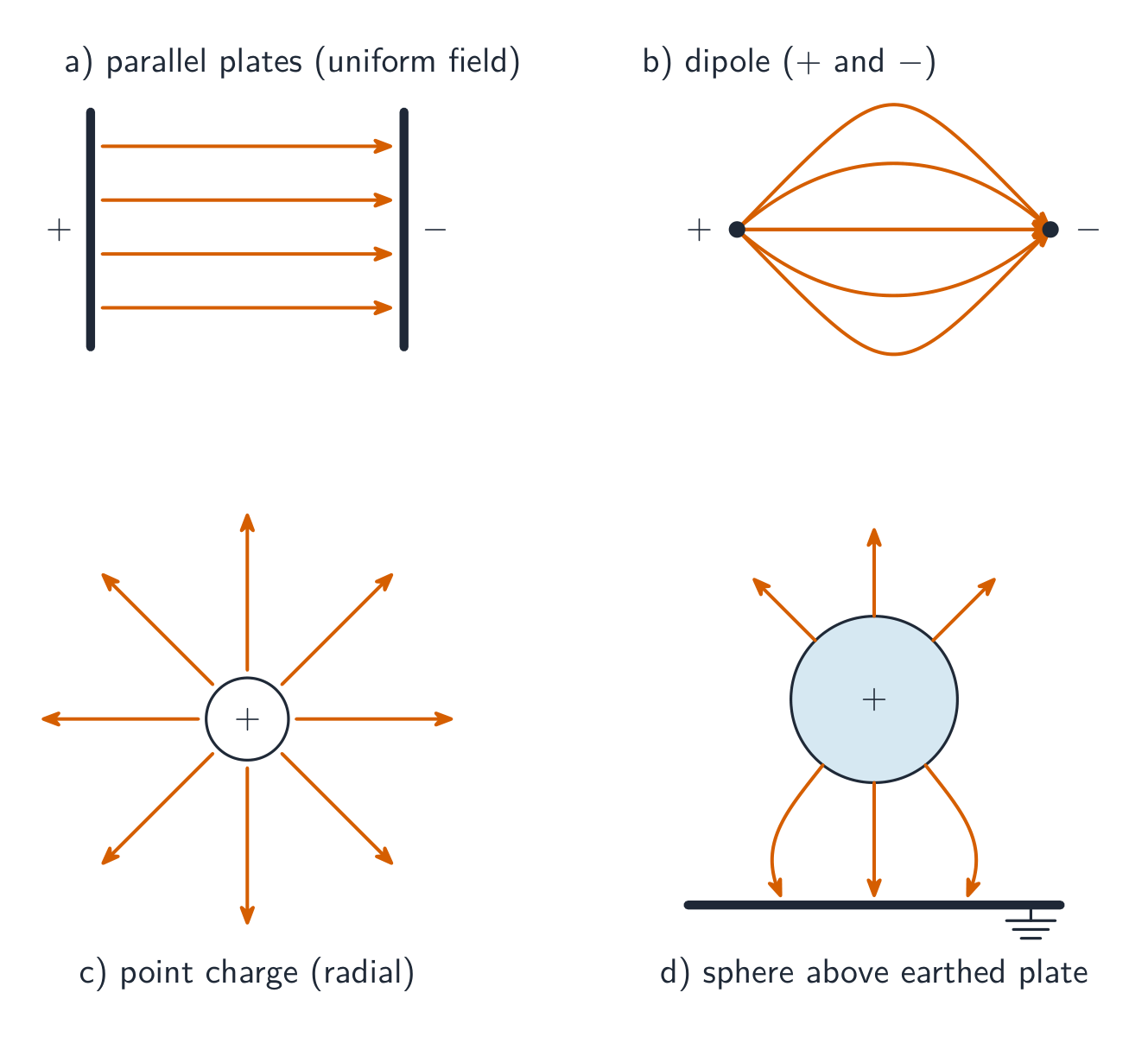
    A charge placed in a field feels $\vec{F}=q\vec{E}$ – positive charges along the field, negative charges against it. Fields from several sources add as vectors (superposition again). Field lines 电场线 make the field visible: they point away from positive charge and toward negative, their density shows the strength, and they never cross.

    Electric field-line patterns for parallel plates, a dipole, and a point charge
    Electric field-line patterns for parallel plates, a dipole, and a point charge
    Electric field lines of a dipole point from the positive to the negative charge
    Electric field lines of a dipole point from the positive to the negative charge

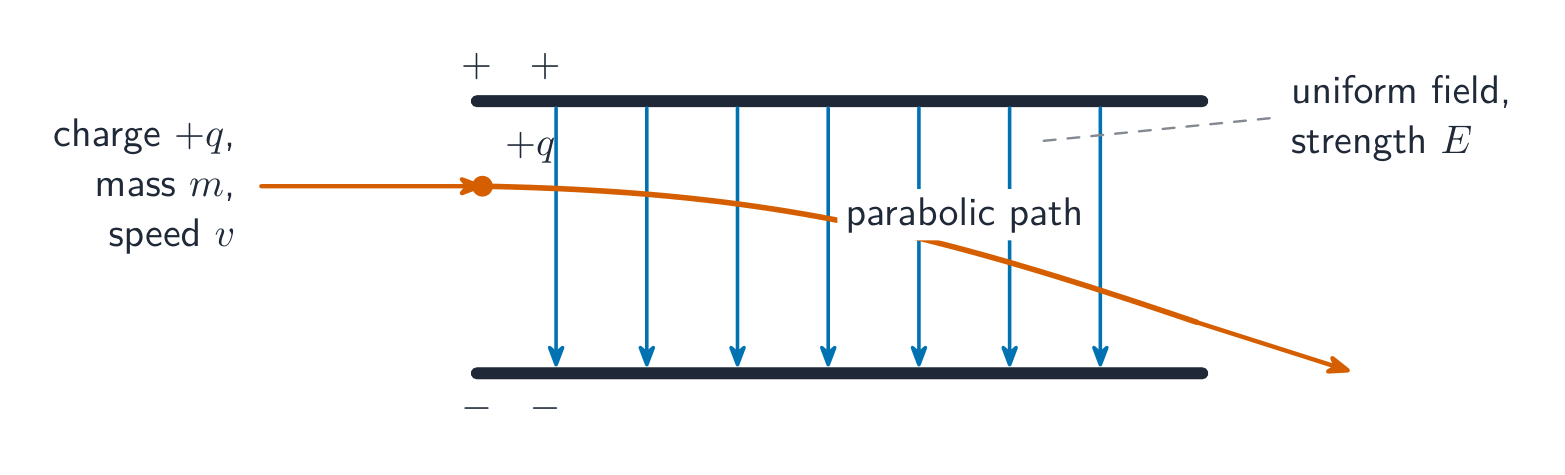
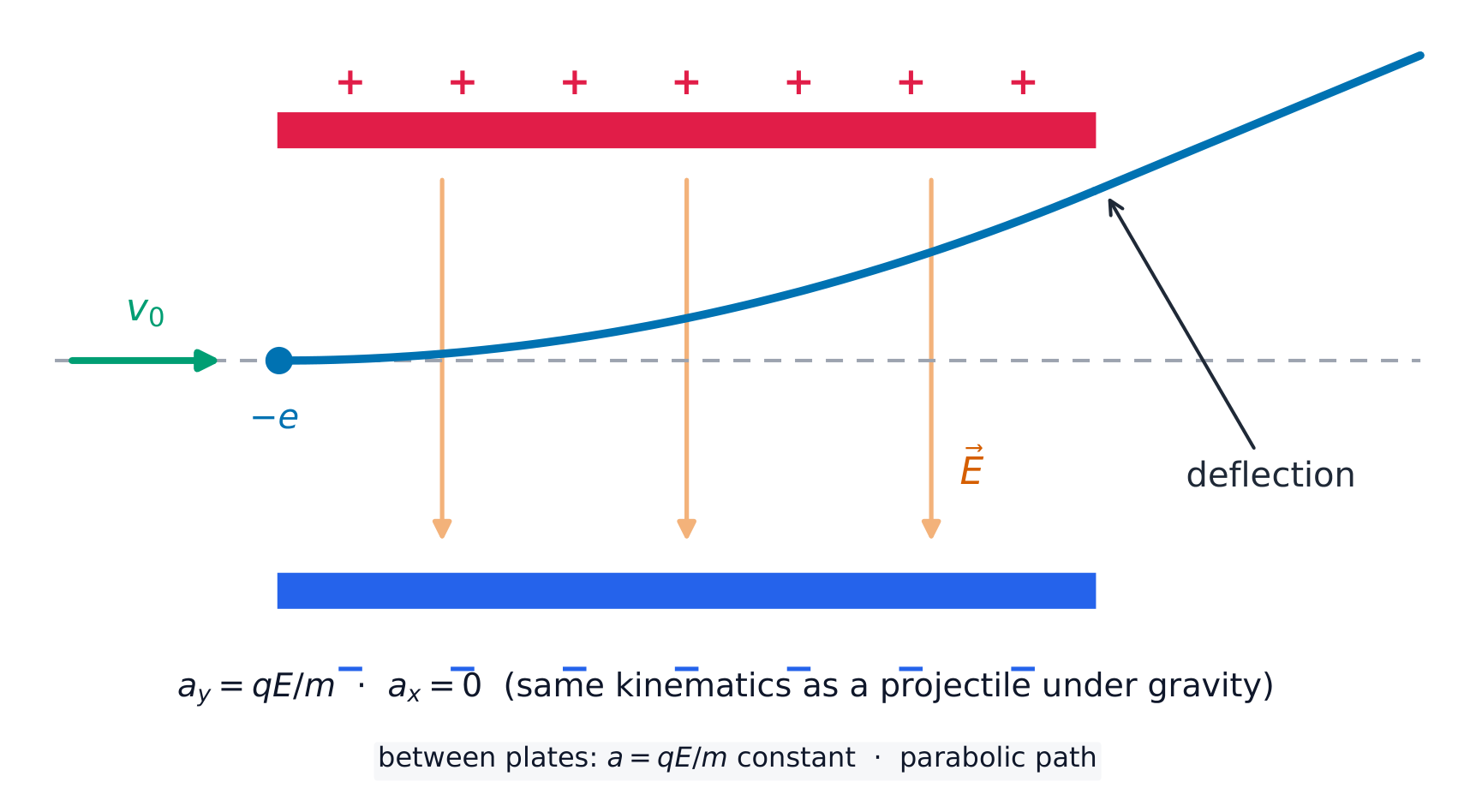
    In a uniform 均匀 field a charge feels a constant force, so it accelerates uniformly – launched sideways, it follows a parabola, just like a projectile in gravity.

    A charge crossing a uniform field follows a parabolic path
    A charge crossing a uniform field follows a parabolic path
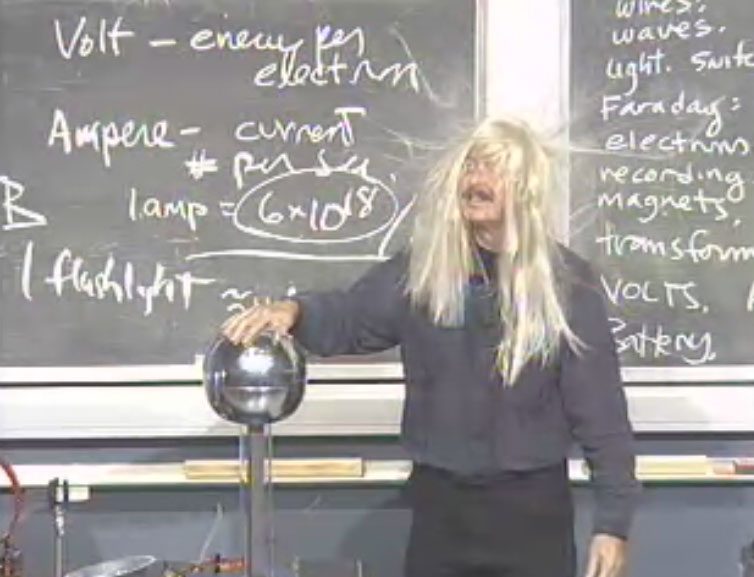
    A person touching a Van de Graaff generator with their hair standing up
    Charge spreads over the dome and onto the hair; like charges repel, so the strands push apart
    Explore · ⁨สำรวจ⁩

    Explore field lines of a point charge · ⁨สำรวจเส้นสนามของประจุจุด⁩

    Set the charge positive or negative. Field lines start on positive and end on negative charge, never cross, and crowd together where $\vec{E}$ is strongest — the line density is proportional to the field magnitude. · ⁨ตั้งประจุเป็นบวกหรือลบ เส้นสนามเริ่มจาก ประจุบวก และสิ้นสุดที่ ประจุลบ ไม่ตัดกัน และ รวมตัวกันบริเวณที่ $\vec{E}$ เข้มข้นที่สุด — ความหนาแน่นของเส้นแปรผันตรงกับขนาดของสนาม⁩

    Vocabulary · ⁨คำศัพท์⁩ Train · ⁨ฝึกฝน⁩
    English ไทย
    electric field/ɪˈlektrɪk fiːld/ สนามไฟฟ้า
    test charge/test tʃɑːdʒ/ ประจุทดสอบ
    Field lines/fiːld laɪnz/ เส้นสนามไฟฟ้า
    uniform/ˈjuːnɪfɔːm/ สม่ำเสมอ
    8.4

    Electric Fields of Charge Distributions

    Syllabus · ⁨หลักสูตร⁩
    English

    Learning Objective 8.4.A: Describe the electric field resulting from a given charge distribution.

    • 8.4.A.1 Expressions for the electric field of specified charge distributions can be found using integration and the principle of superposition.
      • Relevant equation: $\vec{E} = \dfrac{1}{4\pi\varepsilon_0} \displaystyle\int \dfrac{dq}{r^2} \hat{r}$
    • 8.4.A.2 Symmetry considerations of certain charge distributions can simplify analysis of the electric field resulting from those charge distributions.

    Boundary statement: AP Physics C: Electricity & Magnetism only expects students to use calculus to find the electric field resulting from the following charge distributions and locations: an infinitely long, uniformly charged wire or cylinder at a distance from its central axis, a thin ring of charge at a location along the axis of the ring, a semicircular arc or part of a semicircular arc at its center, and a finite wire or line charge at a point collinear with the line charge or at a location along its perpendicular bisector.

    ไทย

    จุดประสงค์การเรียนรู้ 8.4.A: อธิบายสนามไฟฟ้าที่เกิดจากการกระจายประจุที่กำหนดให้

    • 8.4.A.1 สมการสำหรับสนามไฟฟ้าของการกระจายประจุที่กำหนดสามารถหาได้โดยใช้การอินทิเกรตและหลักการซ้อนทับ
      • สมการที่เกี่ยวข้อง: $\vec{E} = \dfrac{1}{4\pi\varepsilon_0} \displaystyle\int \dfrac{dq}{r^2} \hat{r}$
    • 8.4.A.2 การพิจารณาความสมมาตรของการกระจายประจุบางชนิดสามารถทำให้การวิเคราะห์สนามไฟฟ้าที่เกิดจากการกระจายประจุเหล่านั้นง่ายขึ้น

    คำประกาศขอบเขต: AP Physics C: ไฟฟ้าและแม่เหล็ก только要求学生使用微积分计算以下电荷分布和位置产生的电场:距无限长均匀带电导线或圆柱体中心轴一定距离处,沿圆环轴线某位置的薄带电圆环,半圆弧或半圆弧一部分的中心,以及与线电荷共线的点或位于其垂直平分线上的有限导线或线电荷。

    Source: College Board AP Course and Exam Description · ⁨แหล่งที่มา: คำอธิบายหลักสูตรและข้อสอบ College Board AP⁩

    For a continuous charge distribution 连续电荷分布, cut the object into pieces $dq$ and integrate their point-charge fields:

    $$\vec{E}=\frac{1}{4\pi\varepsilon_0}\int \frac{dq}{r^2}\,\hat{r}.$$

    Write $dq$ using the right density: $\lambda\,dl$ with the linear charge density 线电荷密度 (a line or ring), $\sigma\,dA$ with the surface charge density 面电荷密度, or $\rho\,dV$ with the volume charge density 体电荷密度. Then use symmetry 对称性 to cancel components before integrating – that sentence is usually a scored step. AP's calculus cases: a finite line (collinear point or perpendicular bisector), an infinite wire or cylinder, a ring on its axis, and an arc at its centre.

    Worked example (ring, on axis). A ring of radius $R$ carries charge $Q$. At a point $z$ along the axis, each element is a distance $\sqrt{R^2+z^2}$ away, and by symmetry the sideways components cancel, leaving only the axial part ($\cos\alpha=z/\sqrt{R^2+z^2}$):

    $$E_z=\frac{1}{4\pi\varepsilon_0}\int\frac{dq}{R^2+z^2}\cdot\frac{z}{\sqrt{R^2+z^2}}=\frac{1}{4\pi\varepsilon_0}\frac{Qz}{(R^2+z^2)^{3/2}}.$$

    Check the limits: $E=0$ at the centre ($z=0$), and far away ($z\gg R$) it becomes $kQ/z^2$ – a point charge, as it must.

    Vocabulary · ⁨คำศัพท์⁩ Train · ⁨ฝึกฝน⁩
    English ไทย
    continuous charge distribution/kənˈtɪnjuːəs tʃɑːdʒ ˌdɪstrɪˈbjuːʃn/ การกระจายประจุต่อเนื่อง
    linear charge density/ˈlɪnɪə tʃɑːdʒ ˈdensɪti/ ความหนาแน่นประจุเชิงเส้น
    surface charge density/ˈsɜːfɪs tʃɑːdʒ ˈdensɪti/ ความหนาแน่นประจุบนพื้นผิว
    volume charge density/ˈvɒljuːm tʃɑːdʒ ˈdensɪti/ ความหนาแน่นประจุปริมาตร
    symmetry/ˈsɪmətri/ symmetry
    8.5

    Electric Flux

    Syllabus · ⁨หลักสูตร⁩
    English

    Learning Objective 8.5.A: Describe the electric flux through an arbitrary area or geometric shape.

    • 8.5.A.1 Flux describes the amount of a given quantity that passes through a given area.
    • 8.5.A.2 For an electric field $\vec{E}$ that is constant across an area $\vec{A}$, the electric flux through the area is defined as $\Phi_E = \vec{E} \bullet \vec{A}$.
      • 8.5.A.2.i The direction of the area vector is defined as perpendicular to the plane of the surface and outward from a closed surface.
      • 8.5.A.2.ii The sign of flux is given by the dot product of the electric field vector and the area vector.
    • 8.5.A.3 The total electric flux passing through a surface is defined by the surface integral of the electric field over the surface.
      • Relevant equation: $\Phi_E = \displaystyle\int \vec{E} \cdot d\vec{A}$
    ไทย

    จุดประสงค์การเรียนรู้ 8.5.A: อธิบายฟลักซ์ไฟฟ้าผ่านพื้นที่หรือรูปร่างเรขาคณิตใดๆ

    • 8.5.A.1 ฟลักซ์อธิบายปริมาณของสิ่ง某的给定 quantity ที่ผ่านพื้นที่ที่กำหนด
    • 8.5.A.2 สำหรับสนามไฟฟ้า $\vec{E}$ ที่มีความสม่ำเสมอข้ามพื้นที่ $\vec{A}$ ฟลักซ์ไฟฟ้าผ่านพื้นที่นี้ถูกนิยามว่า $\Phi_E = \vec{E} \bullet \vec{A}$
      • 8.5.A.2.i ทิศทางของเวกเตอร์พื้นที่ถูกนิยามว่าเป็นตั้งฉากกับระนาบของพื้นผิวและชี้ออกจากพื้นผิวปิด
      • 8.5.A.2.ii สัญญาณของฟลักซ์กำหนดโดยผลคูณสเกลาร์ (dot product) ของเวกเตอร์สนามไฟฟ้าและเวกเตอร์พื้นที่
    • 8.5.A.3 ฟลักซ์ไฟฟ้ารวมที่ผ่านพื้นผิวถูกนิยามด้วยอินทิกรัลพื้นผิวของสนามไฟฟ้าเหนือพื้นผิวนั้น
      • สมการที่เกี่ยวข้อง: $\Phi_E = \displaystyle\int \vec{E} \cdot d\vec{A}$

    Source: College Board AP Course and Exam Description · ⁨แหล่งที่มา: คำอธิบายหลักสูตรและข้อสอบ College Board AP⁩

    Electric flux & Gauss's law

    Electric flux 电通量 measures how much field passes through a surface:

    $$\Phi_E=\int \vec{E}\cdot d\vec{A}.$$

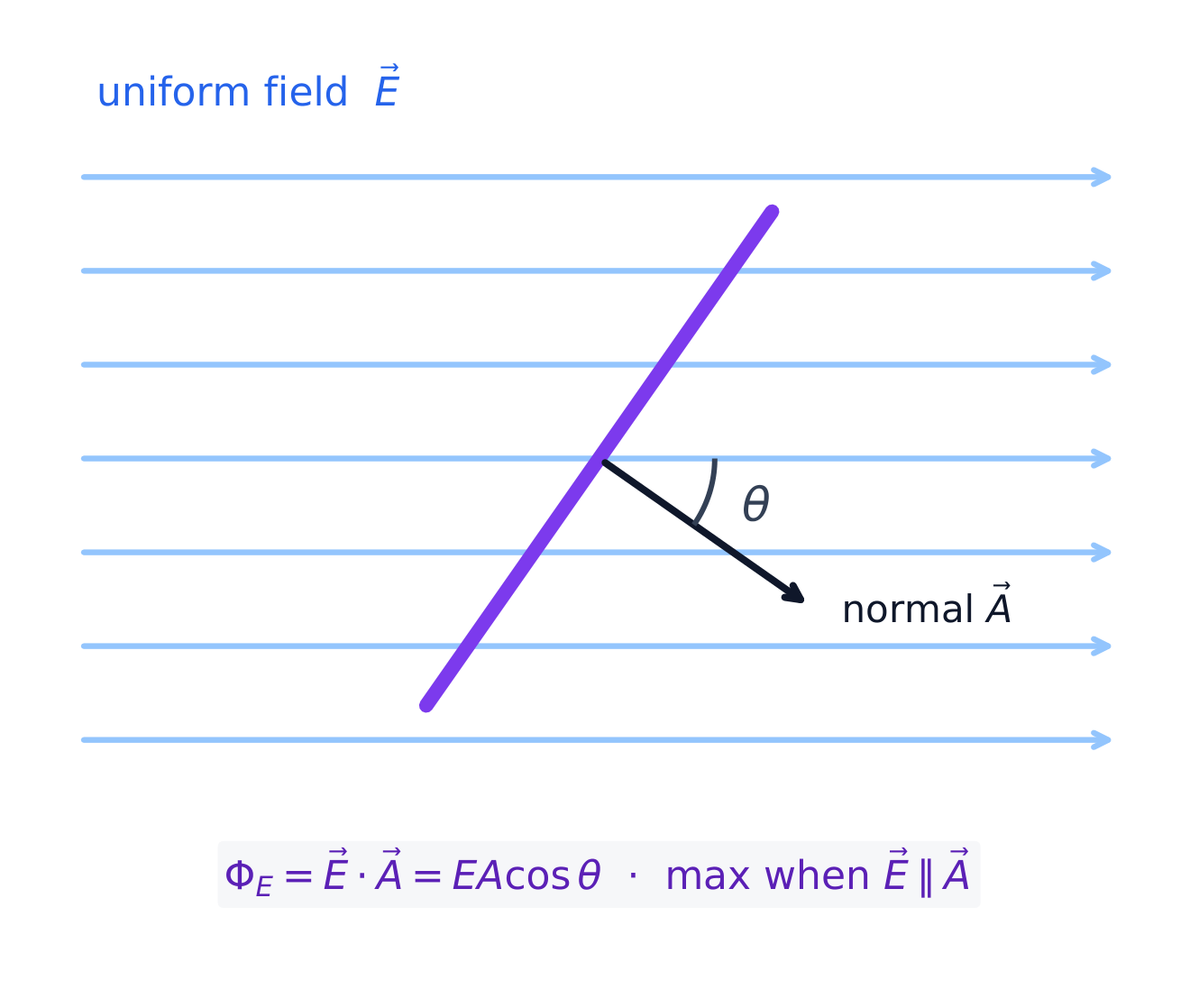
    For a uniform field through a flat area, $\Phi_E=EA\cos\theta$, where the area vector 面积矢量 is perpendicular to the surface. Flux is positive where field lines exit a closed surface and negative where they enter – only the perpendicular component of $\vec{E}$ counts.

    Electric flux through a surface depends on the angle between the field and the surface normal
    Electric flux through a surface depends on the angle between the field and the surface normal
    Vocabulary · ⁨คำศัพท์⁩ Train · ⁨ฝึกฝน⁩
    English ไทย
    Electric flux/ɪˈlektrɪk flʌks/ ฟลักซ์ไฟฟ้า
    area vector/ˈeərɪə ˈvektə/ เวกเตอร์พื้นที่
    8.6
    Gauss's Law

    Syllabus · ⁨หลักสูตร⁩
    English

    Learning Objective 8.6.A: Describe the properties of a charge distribution by applying Gauss's law.

    • 8.6.A.1 Gauss's law relates electric flux through a Gaussian surface to the charge enclosed by that surface.
      • Relevant equations: $\Phi_E = \dfrac{q_{\text{enc}}}{\varepsilon_0}$ and $\displaystyle\oint \vec{E} \cdot d\vec{A} = \dfrac{q_{\text{enc}}}{\varepsilon_0}$
    • 8.6.A.2 A Gaussian surface is a three-dimensional, closed surface.
    • 8.6.A.3 The total electric flux through a Gaussian surface is independent of the size of the Gaussian surface if the amount of enclosed charge remains constant.
    • 8.6.A.4 Gaussian surfaces are typically constructed such that the electric field generated by the enclosed charge is either perpendicular or parallel to different regions of the Gaussian surface, resulting in a simplified surface integral.
    • 8.6.A.5 If a function of charge density is given for a charge distribution, the total charge can be determined by integrating the charge density over the length (one dimension), area (two dimensions), or volume (three dimensions) of the charge distribution. For example: $Q_{\text{total}} = \displaystyle\int \rho(\vec{r})\, dV$
    • 8.6.A.6 Maxwell's equations are the collection of equations that fully describe electromagnetism. Gauss's law is Maxwell's first equation.
      • Relevant equation: $\displaystyle\oint \vec{E} \cdot d\vec{A} = \dfrac{q_{\text{enc}}}{\varepsilon_0}$

    Boundary statement: AP Physics C: Electricity & Magnetism only expects students to quantitatively apply Gauss's law to point charges and charge distributions that have spherical, cylindrical, or planar symmetry.

    ไทย

    จุดประสงค์การเรียนรู้ 8.6.A: อธิบายคุณสมบัติของการกระจายประจุโดยการประยุกต์ใช้กฎของเกาส์

    • 8.6.A.1 กฎของเกาส์เชื่อมโยงฟลักซ์ไฟฟ้าผ่านพื้นผิวเกาส์กับประจุที่ถูกกักขังภายในพื้นผิวนั้น
      • สมการที่เกี่ยวข้อง: $\Phi_E = \dfrac{q_{\text{enc}}}{\varepsilon_0}$ และ $\displaystyle\oint \vec{E} \cdot d\vec{A} = \dfrac{q_{\text{enc}}}{\varepsilon_0}$
    • 8.6.A.2 พื้นผิวเกาส์คือพื้นผิวสามมิติที่ปิด
    • 8.6.A.3 ฟลักซ์ไฟฟ้ารวมผ่านพื้นผิวเกาส์จะขึ้นอยู่กับขนาดของพื้นผิวเกาส์หากปริมาณประจุที่ถูกกักขังคงที่
    • 8.6.A.4 พื้นผิวเกาส์มักถูกสร้างขึ้นเพื่อให้สนามไฟฟ้าที่เกิดจากประจุที่ถูกกักขังตั้งฉากหรือขนานกับภูมิภาคต่างๆ ของพื้นผิวเกาส์ ซึ่งนำไปสู่การลดรูปอินทิกรัลพื้นผิว
    • 8.6.A.5 หากกำหนดฟังก์ชันของความหนาแน่นประจุสำหรับการกระจายประจุ สามารถหาประจุรวมได้โดยการอินทิเกรตความหนาแน่นประจุตามความยาว (หนึ่งมิติ) พื้นที่ (สองมิติ) หรือปริมาตร (สามมิติ) ของการกระจายประจุ ตัวอย่างเช่น: $Q_{\text{total}} = \displaystyle\int \rho(\vec{r})\, dV$
    • 8.6.A.6 สมการของแม็กซ์เวลล์คือชุดสมการที่อธิบายปรากฏการณ์แม่เหล็กไฟฟ้าได้อย่างสมบูรณ์ กฎของเกาส์เป็นสมการแรกในชุดสมการของแม็กซ์เวลล์
      • สมการที่เกี่ยวข้อง: $\displaystyle\oint \vec{E} \cdot d\vec{A} = \dfrac{q_{\text{enc}}}{\varepsilon_0}$

    คำจำกัดขอบเขต: AP Physics C: ไฟฟ้าและแม่เหล็ก expects students to quantitatively apply Gauss's law to point charges and charge distributions that have spherical, cylindrical, or planar symmetry.

    Source: College Board AP Course and Exam Description · ⁨แหล่งที่มา: คำอธิบายหลักสูตรและข้อสอบ College Board AP⁩

    Gauss's law 高斯定律 – the first of Maxwell's equations – relates the flux through any closed surface to the charge inside it:

    $$\oint \vec{E}\cdot d\vec{A}=\frac{Q_{\text{enc}}}{\varepsilon_0}.$$

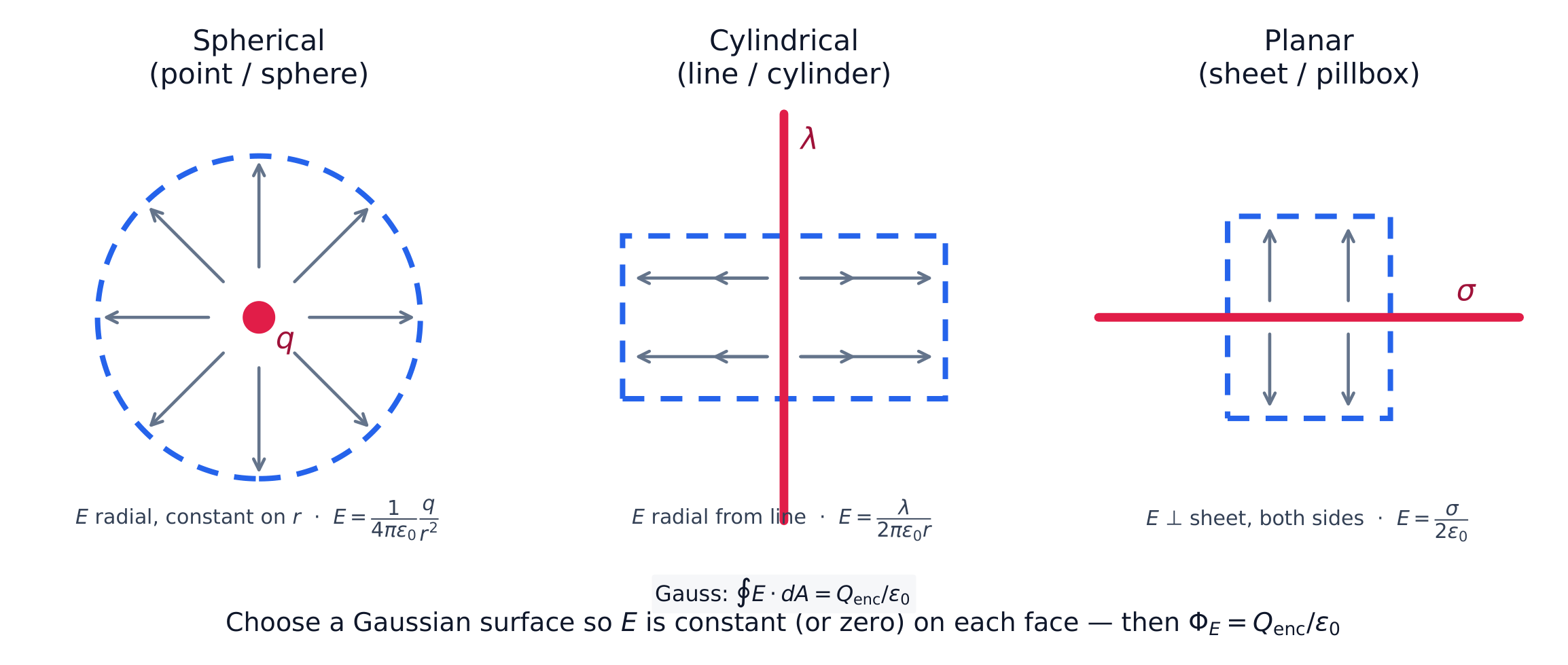
    It is true for any closed surface, but it solves for $E$ only when symmetry lets you choose a Gaussian surface 高斯面 on which $E$ is constant and perpendicular (or parallel, contributing zero). The three symmetries AP tests: spherical symmetry 球对称 (concentric sphere), cylindrical symmetry 柱对称 (coaxial cylinder), and planar symmetry 平面对称 (a straddling "pillbox").

    A Gaussian surface is chosen to match the symmetry of the charge
    A Gaussian surface is chosen to match the symmetry of the charge

    Worked example (sphere). Outside a sphere of total charge $Q$, a spherical Gaussian surface of radius $r$ gives $E(4\pi r^2)=Q/\varepsilon_0$, so $E=\dfrac{kQ}{r^2}$ – identical to a point charge at the centre. Inside a uniformly charged solid sphere of radius $R$, the surface encloses only $Q_{\text{enc}}=Q\,r^3/R^3$, so $E=\dfrac{kQr}{R^3}$: zero at the centre, growing linearly to the surface.

    Worked example (wire). For an infinite wire with charge per length $\lambda$, take a coaxial cylinder of radius $r$ and length $L$. The ends contribute nothing ($\vec{E}\perp d\vec{A}$), so $E(2\pi rL)=\dfrac{\lambda L}{\varepsilon_0}$ and $E=\dfrac{\lambda}{2\pi\varepsilon_0 r}$. The same pillbox method gives an infinite sheet's field, $E=\dfrac{\sigma}{2\varepsilon_0}$, uniform on both sides.

    Exam skill. A full-credit Gauss's-law answer has four parts: name the surface, state the symmetry argument (why $E$ is constant and perpendicular on it), count $Q_{\text{enc}}$, then solve. Skipping the symmetry sentence loses the reasoning point – and remember Gauss's law also explains why $E=0$ inside any conductor in equilibrium.

    Vocabulary · ⁨คำศัพท์⁩ Train · ⁨ฝึกฝน⁩
    English ไทย
    Gauss's law/ˈɡaʊsɪz lɔː/ กฎของเกาส์
    Gaussian surface/ˈɡaʊʃn ˈsɜːfɪs/ พื้นผิวเกาซ
    spherical symmetry/sˈferɪkl ˈsɪmətri/ สมมาตรทรงกลม
    cylindrical symmetry/sɪˈlɪndrɪkl ˈsɪmətri/ สมมาตรทรงกระบอก
    planar symmetry/ˈpleɪnə ˈsɪmətri/ สมมาตรระนาบ
    8.6

    Exam tips

    • Use Coulomb's law $F=\tfrac{1}{4\pi\varepsilon_0}\tfrac{q_1 q_2}{r^2}$ and superpose forces as vectors (components, not magnitudes).
    • For a continuous charge, integrate $d\vec E$ over $dq=\lambda\,dl,\ \sigma\,dA,\ \rho\,dV$; use symmetry to cancel components.
    • The field points away from positive and toward negative charge; draw field lines correctly.
    • Distinguish the force on a charge ($\vec F=q\vec E$) from the field the charge creates.
    • Keep the constant $k=\tfrac{1}{4\pi\varepsilon_0}$ straight and check units.
  • 9

    Electric Potential · ⁨ศักย์ไฟฟ้า⁩

    Watch lesson · ⁨ดูบทเรียน⁩
    9.1

    Electric Potential Energy

    Syllabus · ⁨หลักสูตร⁩
    English

    Learning Objective 9.1.A: Describe the electric potential energy of a system.

    • 9.1.A.1 The electric potential energy of a system of two point charges equals the amount of work required for an external force to bring the point charges to their current positions from infinitely far away.
    • 9.1.A.2 The general form for the electric potential energy between two charged objects is given by the equation
      • Equation: $U_E = \dfrac{1}{4\pi\varepsilon_0}\dfrac{q_1 q_2}{r} = k\dfrac{q_1 q_2}{r}$.
    • 9.1.A.3 The total electric potential energy of a system can be determined by finding the sum of the electric potential energies of the individual interactions between each pair of charged objects in the system.
    ไทย

    จุดประสงค์การเรียนรู้ 9.1.A: อธิบายพลังงานศักย์ไฟฟ้าของระบบ

    • 9.1.A.1 พลังงานศักย์ไฟฟ้าของระบบประจุจุดสองตัวเท่ากับปริมาณงานที่ต้องใช้โดยแรงภายนอกในการนำประจุจุดทั้งสองมาอยู่ในตำแหน่งปัจจุบันจากระยะห่าง vôกาศ
    • 9.1.A.2 รูปแบบทั่วไปของพลังงานศักย์ไฟฟ้าระหว่างวัตถุที่มีประจุสองตัวให้โดยสมการ
      • สมการ: $U_E = \dfrac{1}{4\pi\varepsilon_0}\dfrac{q_1 q_2}{r} = k\dfrac{q_1 q_2}{r}$.
    • 9.1.A.3 พลังงานศักย์ไฟฟ้ารวมของระบบสามารถหาได้จากการหาค่าผลบวกของพลังงานศักย์ไฟฟ้าของแต่ละ happened ของวัตถุที่มีประจุในระบบ

    Source: College Board AP Course and Exam Description · ⁨แหล่งที่มา: คำอธิบายหลักสูตรและข้อสอบ College Board AP⁩

    When you push two like charges together, you do work 功 against the electric force. That work is stored by the pair as electric potential energy 电势能:

    $$U_E=\frac{1}{4\pi\varepsilon_0}\frac{q_1 q_2}{r}=k\frac{q_1 q_2}{r}.$$

    $U_E$ is defined as the work an external force must do to bring the charges from infinitely far away to a distance $r$ apart. The signs carry the physics:

    • Like charges: $U_E>0$. An outside push was needed to bring them together. If released, they fly apart, and the stored energy becomes kinetic energy 动能.
    • Opposite charges: $U_E<0$. The pair is bound. You must supply $|U_E|$ of work to pull them apart to infinity.

    The electric force is a conservative force 保守力: the work it does depends only on the start and end points, not the path, and equals $-\Delta U_E$.

    For a system 系统 of several charges, add the potential energy of every distinct pair:

    $$U_{\text{total}}=k\!\left(\frac{q_1q_2}{r_{12}}+\frac{q_1q_3}{r_{13}}+\frac{q_2q_3}{r_{23}}\right).$$

    Worked example. Three $+2.0\ \mu\text{C}$ charges sit at the corners of an equilateral triangle with sides $0.30\ \text{m}$. Each pair stores $U=\dfrac{kq^2}{r}=\dfrac{(9.0\times10^{9})(2.0\times10^{-6})^2}{0.30}=0.12\ \text{J}$. There are three pairs, so $U_{\text{total}}=3\times0.12\ \text{J}=0.36\ \text{J}$. This is the work needed to assemble the triangle from infinity – and the kinetic energy the charges would share if all three were released.

    Vocabulary · ⁨คำศัพท์⁩ Train · ⁨ฝึกฝน⁩
    English ไทย
    work/wɜːk/ งาน
    electric potential energy/ɪˈlektrɪk pəˈtenʃl ˈenədʒi/ พลังงานศักย์ไฟฟ้า
    kinetic energy/kɪˈnetɪk ˈenədʒi/ พลังงานจลน์
    conservative force/kənˈsɜːvətɪv fɔːs/ แรงอนุรักษ์
    system/ˈsɪstəm/ ระบบ
    9.2

    Electric Potential

    Syllabus · ⁨หลักสูตร⁩
    English

    Learning Objective 9.2.A: Describe the electric potential due to a configuration of charged objects.

    • 9.2.A.1 Electric potential describes the electric potential energy per unit charge at a point in space.
    • 9.2.A.2 Expressions for the electric potential of charge distributions can be found using integration and the principle of superposition.
      • Equation: $V = \dfrac{1}{4\pi\varepsilon_0}\displaystyle\int \dfrac{dq}{r}$
      • 9.2.A.2.i The electric potential for single point charge is
        • Equation: $V = \dfrac{q}{4\pi\varepsilon_0 r}$.
      • 9.2.A.2.ii The electric potential due to multiple point charges can be determined by the principle of scalar superposition of the electric potential due to each of the point charges.
        • Equation: $V = \dfrac{1}{4\pi\varepsilon_0}\displaystyle\sum_i \dfrac{q_i}{r_i}$
    • 9.2.A.3 The electric potential difference between two points is the change in electric potential energy per unit charge when a test charge is moved between the two points.
      • Equation: $\Delta V = \dfrac{\Delta U_E}{q}$
    • 9.2.A.4 Electric potential difference may also result from chemical processes that cause positive and negative charges to separate, such as in a battery.

    Boundary statement: AP Physics C: Electricity & Magnetism only expects students to use calculus to find the electric potential resulting from the following charge distributions and locations: an infinitely long, uniformly charged wire or cylinder at a distance from its central axis, a thin ring of charge at a location along the axis of the ring, a semicircular arc or part of a semicircular arc at its center, and a finite wire or line charge at a point collinear with the line charge or at a location along its perpendicular bisector.

    Learning Objective 9.2.B: Describe the relationship between electric potential and electric field.

    • 9.2.B.1 The value of an electric field component in any direction at a given location is equal to the negative of the spatial rate of change in electric potential at that location.
      • Equation: $E_x = -\dfrac{dV}{dx}$
    • 9.2.B.2 The change in electric potential between two points can be determined by integrating the dot product of the electric field and the displacement along the path connecting the points.
      • Equation: $\Delta V = V_b - V_a = -\displaystyle\int_a^b \vec{E}\cdot d\vec{r}$
    • 9.2.B.3 Electric field vector maps and equipotential lines are tools to describe the field produced by a charge or configuration of charges and can be used to predict the motion of charged objects in the field.
      • 9.2.B.3.i Equipotential lines represent lines of equal electric potential. These lines are also referred to as isolines of electric potential.
      • 9.2.B.3.ii Isolines are perpendicular to electric field vectors. An isoline map of electric potential can be constructed from an electric field vector map, and an electric field map may be constructed from an isoline map.
      • 9.2.B.3.iii An electric field vector points in the direction of decreasing potential.
      • 9.2.B.3.iv There is no component of an electric field along an isoline.
    ไทย

    จุดประสงค์การเรียนรู้ 9.2.A: อธิบายศักย์ไฟฟ้าที่เกิดจากการจัดวางวัตถุที่มีประจุ

    • 9.2.A.1 ศักย์ไฟฟ้าอธิบายถึงพลังงานศักย์ไฟฟ้าต่อหน่วยประจุ ณ จุดหนึ่งในอวกาศ
    • 9.2.A.2 นิพจน์สำหรับศักย์ไฟฟ้าของการกระจายประจุสามารถหาได้โดยใช้การอินทิเกรตและหลักการซ้อนทับ
      • สมการ: $V = \dfrac{1}{4\pi\varepsilon_0}\displaystyle\int \dfrac{dq}{r}$
      • 9.2.A.2.i ศักย์ไฟฟ้าสำหรับประจุจุดเดี่ยวคือ
        • สมการ: $V = \dfrac{q}{4\pi\varepsilon_0 r}$
      • 9.2.A.2.ii ศักย์ไฟฟ้าจากประจุจุดหลายตัวสามารถหาได้ตามหลักการซ้อนทับสเกลาร์ของศักย์ไฟฟ้าจากแต่ละประจุจุด
        • สมการ: $V = \dfrac{1}{4\pi\varepsilon_0}\displaystyle\sum_i \dfrac{q_i}{r_i}$
    • 9.2.A.3 ความต่างศักย์ไฟฟ้าระหว่างสองจุดคือการเปลี่ยนแปลงของพลังงานศักย์ไฟฟ้าต่อหน่วยประจุเมื่อเคลื่อนย้ายประจุทดสอบระหว่างสองจุดนั้น
      • สมการ: $\Delta V = \dfrac{\Delta U_E}{q}$
    • 9.2.A.4 ความต่างศักย์ไฟฟ้าอาจเกิดจากกระบวนการทางเคมีที่ทำให้ประจุบวกและประจุลบแยกออกจากกัน เช่น ในแบตเตอรี่

    คำจำกัดขอบเขต: AP Physics C: ไฟฟ้าและแม่เหล็ก expects students to use calculus to find the electric potential resulting from the following charge distributions and locations: an infinitely long, uniformly charged wire or cylinder at a distance from its central axis, a thin ring of charge at a location along the axis of the ring, a semicircular arc or part of a semicircular arc at its center, and a finite wire or line charge at a point collinear with the line charge or at a location along its perpendicular bisector.

    จุดประสงค์การเรียนรู้ 9.2.B: อธิบายความสัมพันธ์ระหว่างศักย์ไฟฟ้ากับสนามไฟฟ้า

    • 9.2.B.1 ค่าขององค์ประกอบสนามไฟฟ้าในทิศทางใด ๆ ณ ตำแหน่งที่กำหนดมีค่าเท่ากับค่าลบของอัตราการเปลี่ยนแปลงเชิงพื้นที่ของศักย์ไฟฟ้า ณ ตำแหน่งนั้น
      • สมการ: $E_x = -\dfrac{dV}{dx}$
    • 9.2.B.2 การเปลี่ยนแปลงของศักย์ไฟฟ้าระหว่างสองจุดสามารถหาได้โดยการอินทิเกรตผลคูณจุดของสนามไฟฟ้าและการกระจัดตามเส้นทางที่เชื่อมสองจุดนั้น
      • สมการ: $\Delta V = V_b - V_a = -\displaystyle\int_a^b \vec{E}\cdot d\vec{r}$
    • 9.2.B.3 แผนที่เวกเตอร์สนามไฟฟ้าและเส้น equipotential เป็นเครื่องมือเพื่ออธิบายสนามที่เกิดจากประจุหรือการจัดวางของประจุ และสามารถใช้ทำนายการเคลื่อนที่ของวัตถุที่มีประจุในสนามได้
      • 9.2.B.3.i เส้น equipotential แทนเส้นที่มีศักย์ไฟฟ้าเท่ากัน เส้นเหล่านี้ยังเรียกว่า isolines ของศักย์ไฟฟ้า
      • 9.2.B.3.ii Isolines ตั้งฉากกับเวกเตอร์สนามไฟฟ้า แผนภาพ isolines ของศักย์ไฟฟ้าสามารถสร้างได้จากแผนที่เวกเตอร์สนามไฟฟ้า และแผนที่สนามไฟฟ้าสามารถสร้างได้จากแผนภาพ isolines
      • 9.2.B.3.iii เวกเตอร์สนามไฟฟ้าชี้ไปในทิศที่ศักย์ลดลง
      • 9.2.B.3.iv ไม่มีองค์ประกอบของสนามไฟฟ้าตามแนว isoline

    Source: College Board AP Course and Exam Description · ⁨แหล่งที่มา: คำอธิบายหลักสูตรและข้อสอบ College Board AP⁩

    Electric potential 电势 is electric potential energy per unit charge at a point in space. It is measured in volts ($1\ \text{V}=1\ \text{J/C}$):

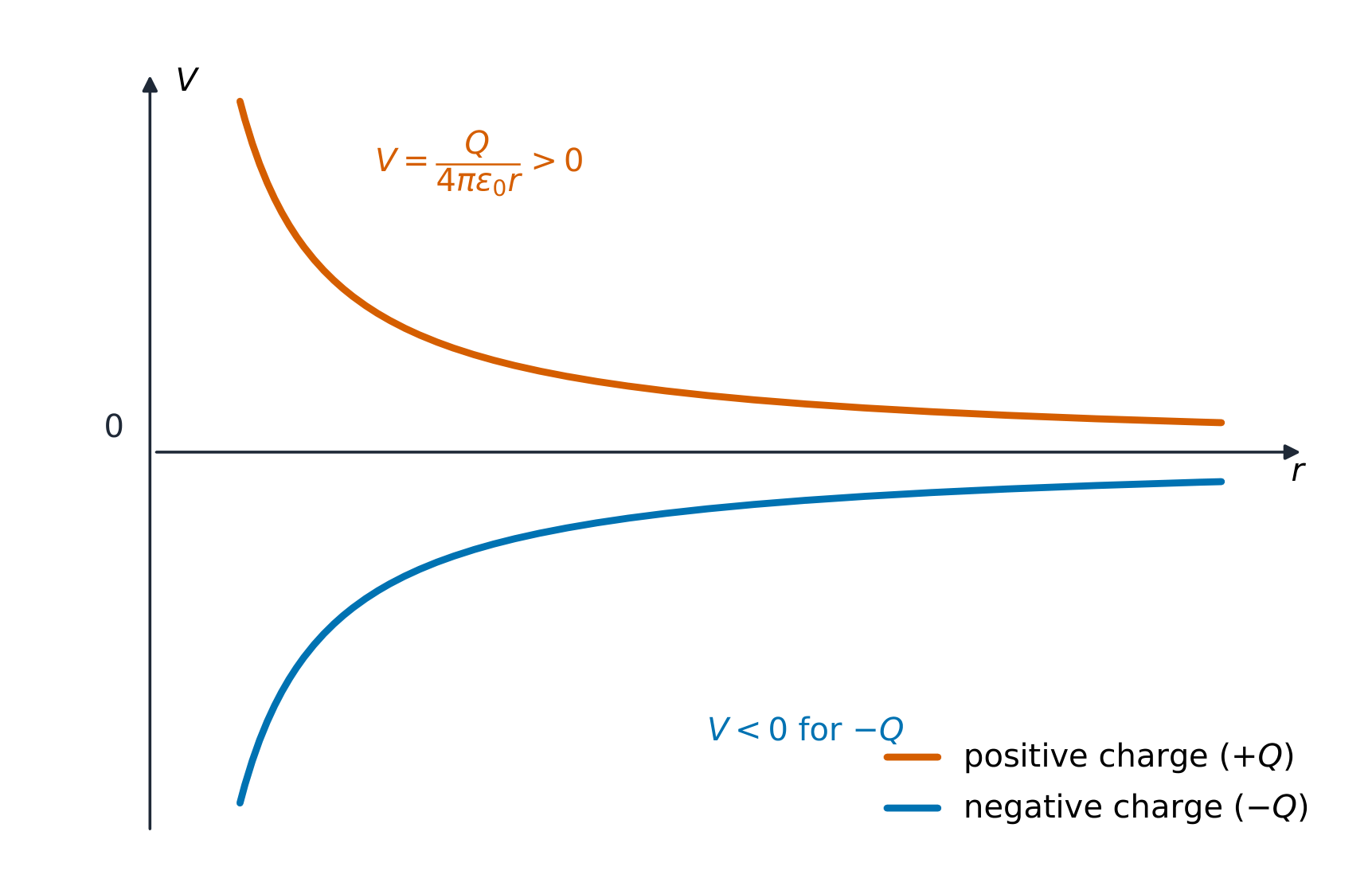
    $$V=\frac{U_E}{q},\qquad V=\frac{1}{4\pi\varepsilon_0}\frac{q}{r}\ \text{(point charge)}.$$

    Potential is a scalar 标量: it has a sign but no direction. This makes $V$ far easier to work with than the field $\vec{E}$. For several point charges 点电荷, use scalar superposition 叠加 – add the potentials with their signs:

    $$V=\frac{1}{4\pi\varepsilon_0}\sum_i \frac{q_i}{r_i}.$$

    Worked example. The potential $0.10\ \text{m}$ from a $+3.0\ \text{nC}$ point charge is $V=\dfrac{kq}{r}=\dfrac{9.0\times10^{9}(3.0\times10^{-9})}{0.10}=270\ \text{V}$. Now add a $-3.0\ \text{nC}$ charge $0.30\ \text{m}$ from the same point: it contributes $\dfrac{9.0\times10^{9}(-3.0\times10^{-9})}{0.30}=-90\ \text{V}$, so the total is $270-90=180\ \text{V}$. Just a signed sum – no vector components to resolve.

    Continuous charge distributions

    For a continuous charge distribution 连续电荷分布, cut it into small pieces $dq$, treat each piece as a point charge, and integrate 积分:

    $$V=\frac{1}{4\pi\varepsilon_0}\int\frac{dq}{r}.$$

    This is a scalar integral, so it is usually much easier than the field integral. AP expects you to handle four shapes with calculus: a thin ring (at a point on its axis), an arc (at its centre), a finite line or wire (collinear, or on its perpendicular bisector), and an infinitely long wire or cylinder (at a distance from its axis).

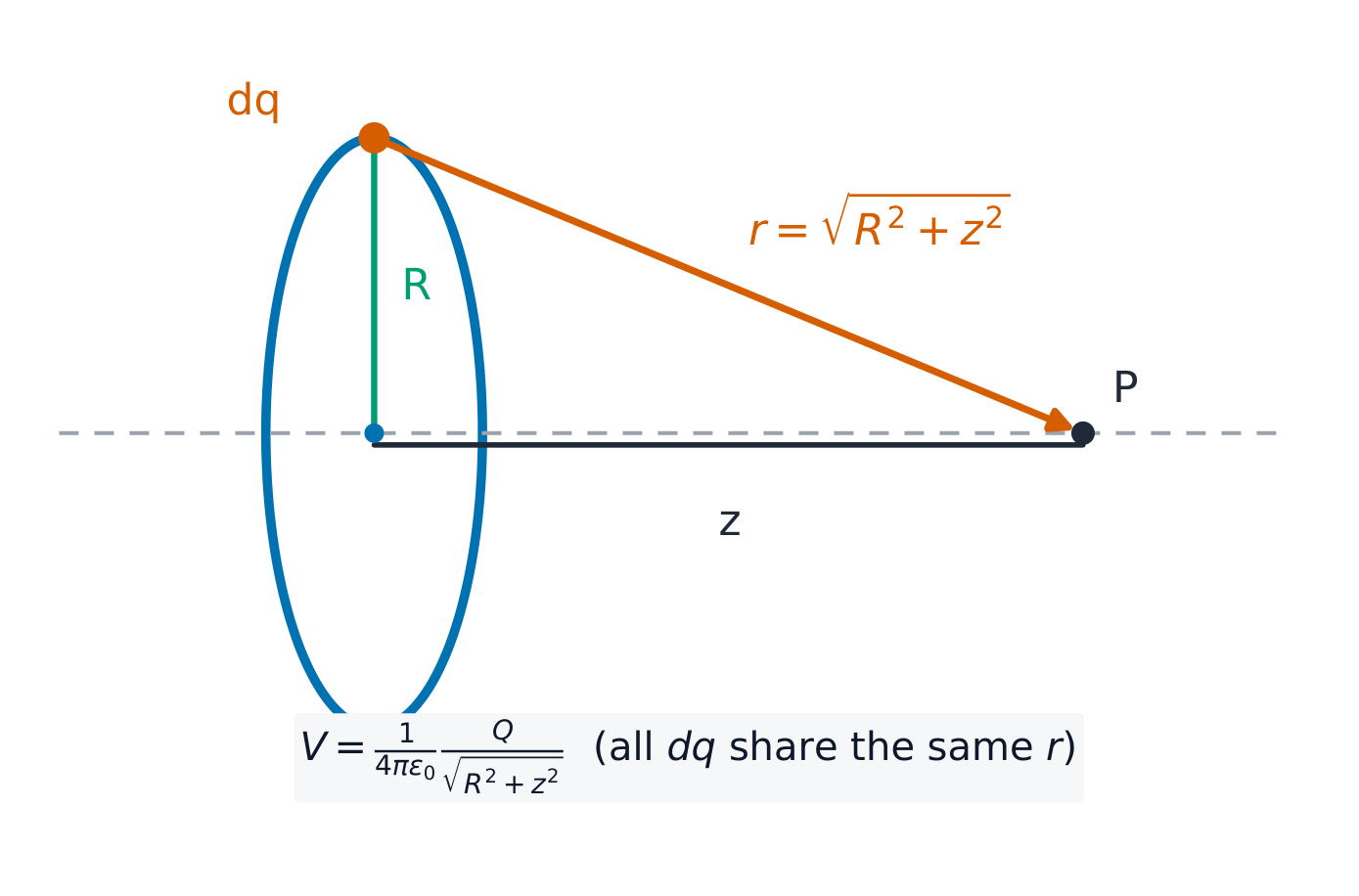
    A ring of charge: every element dq is the same distance from an axis point
    A ring of charge: every element dq is the same distance from an axis point

    Worked example (ring of charge). A thin ring of radius $R$ carries total charge $Q$. For a point $P$ on the axis a distance $z$ from the centre, every element $dq$ sits at the same distance $r=\sqrt{R^2+z^2}$ from $P$. The distance is constant, so it comes out of the integral:

    $$V=\frac{1}{4\pi\varepsilon_0}\int\frac{dq}{\sqrt{R^2+z^2}}=\frac{1}{4\pi\varepsilon_0}\frac{Q}{\sqrt{R^2+z^2}}.$$

    On an FRQ, say that $r$ is the same for every element – that statement is the marked step. The same idea gives $V=kQ/R$ at the centre of any arc, whatever its angle.

    From potential to field

    Potential and field contain the same information, linked by a derivative in each direction and by a path integral:

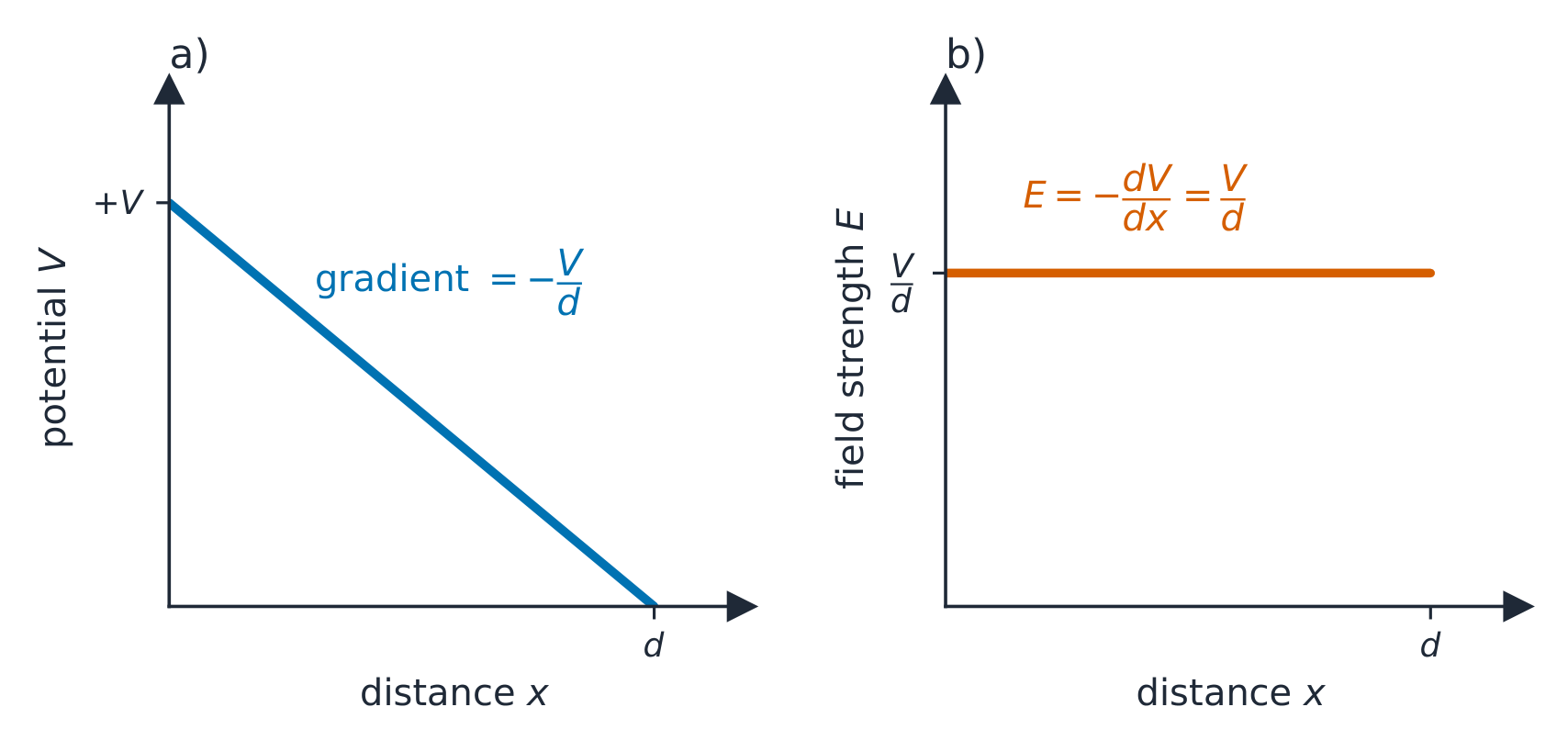
    $$E_x=-\frac{dV}{dx},\qquad \Delta V=V_b-V_a=-\int_a^b \vec{E}\cdot d\vec{r}.$$

    The field is the negative gradient 梯度 of the potential: $\vec{E}$ points from high potential to low potential, "downhill". Where $V$ changes quickly, the field is strong.

    Worked example. Along the $x$-axis, $V(x)=3x^{2}-2x$ (volts, with $x$ in metres). Then $E_x=-\dfrac{dV}{dx}=2-6x\ \text{V/m}$. At $x=0.50\ \text{m}$, $E_x=-1.0\ \text{V/m}$: the field there points in the $-x$ direction.

    In a uniform field the potential falls steadily with distance
    In a uniform field the potential falls steadily with distance

    The potential difference 电势差 between two points is the change in potential energy per unit charge moved between them: $\Delta V=\Delta U_E/q$. A battery makes a potential difference chemically: reactions inside separate positive from negative charge and hold the terminals a fixed $\Delta V$ apart.

    The potential near a point charge varies as 1/r
    The potential near a point charge varies as 1/r

    Equipotential maps

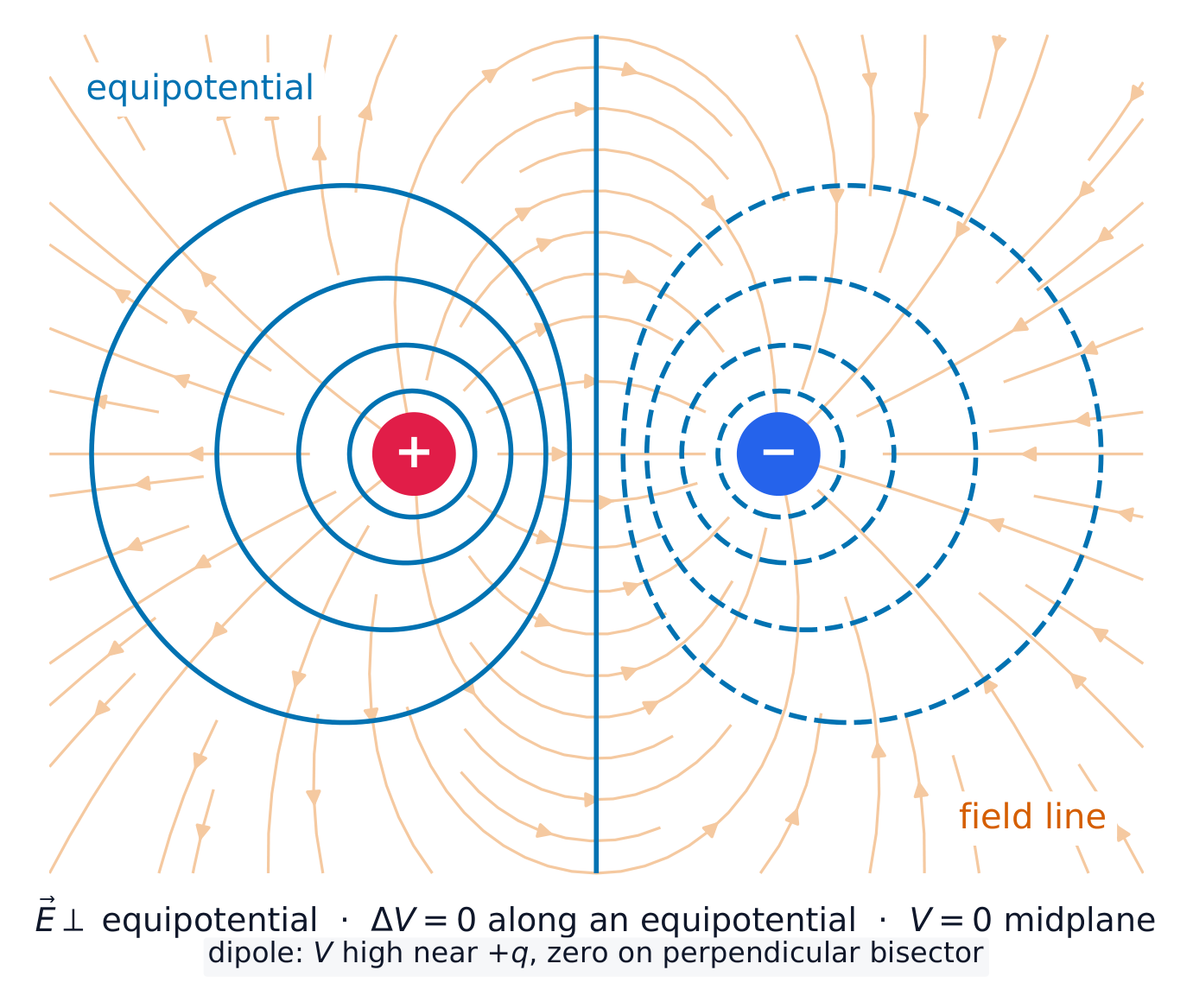
    An equipotential 等势面 line (also called an isoline 等值线) joins points that share the same potential. Four rules let you read any map:

    • Isolines are perpendicular 垂直 to field lines 电场线 everywhere they cross.
    • $\vec{E}$ points from high $V$ to low $V$ – never along an isoline. Moving a charge along an isoline takes no work.
    • Closely spaced isolines mean a strong field: $E\approx-\Delta V/\Delta x$.
    • You can sketch the field map from an isoline map, and the isoline map from a field map.
    Equipotential lines around a dipole cross the field lines at right angles
    Equipotential lines around a dipole cross the field lines at right angles

    Exam skill. Given a map with isolines every $10\ \text{V}$ spaced about $2\ \text{cm}$ apart, estimate $E\approx\dfrac{10}{0.02}=500\ \text{V/m}$, pointing from the higher-value line to the lower one. The work an external agent does moving a charge $q$ slowly from $A$ to $B$ is $W=q(V_B-V_A)$ – the path taken does not matter.

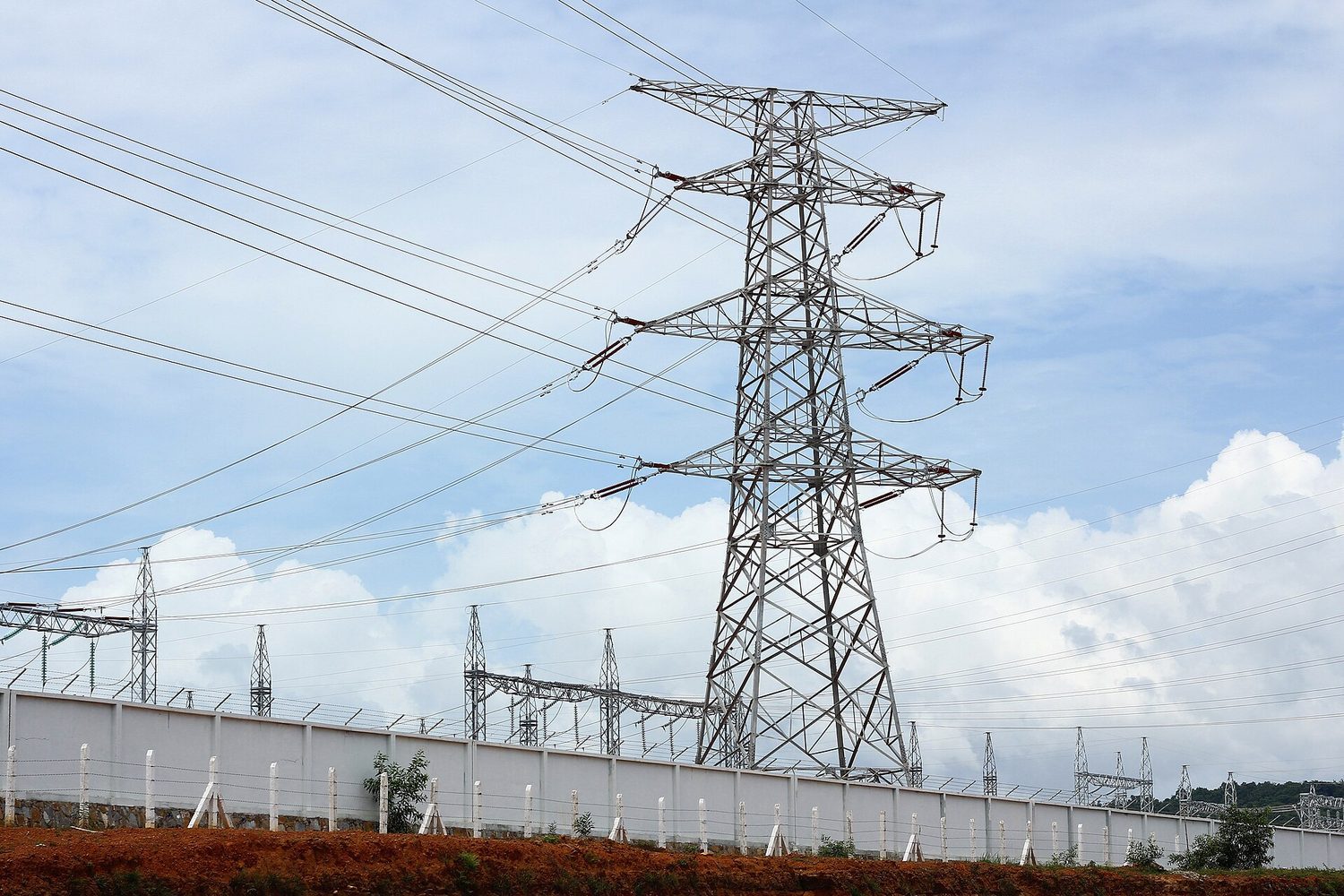
    High-voltage power lines: electric potential energy is converted and transmitted as current at high voltage
    High-voltage power lines: electric potential energy is converted and transmitted as current at high voltage
    Explore · ⁨สำรวจ⁩

    Field lines and the potential around a charge · ⁨เส้นสนามและศักย์ไฟฟ้ารอบๆ ประจุ⁩

    Electric potential is the energy per unit charge. It falls off with distance from a positive charge; the field lines point from high potential to low. · ⁨ศักย์ไฟฟ้า คือพลังงานต่อหน่วยประจุ มันลดลงตามระยะห่างจากประจุบวก; เส้นสนามชี้จากศักย์สูงไปต่ำ⁩

    Vocabulary · ⁨คำศัพท์⁩ Train · ⁨ฝึกฝน⁩
    English ไทย
    Electric potential/ɪˈlektrɪk pəˈtenʃl/ ศักย์ไฟฟ้า
    scalar/ˈskeɪlə/ สเกลาร์
    point charges/pɔɪnt ˈtʃɑːdʒɪz/ ประจุจุด
    superposition/ˌsuːpəpəˈzɪʃn/ การ叠加 (email: superposition)
    continuous charge distribution/kənˈtɪnjuːəs tʃɑːdʒ ˌdɪstrɪˈbjuːʃn/ การกระจายประจุต่อเนื่อง
    integrate/ˈɪntɪɡreɪt/ อินทิเกรต
    gradient/ˈɡreɪdɪənt/ ความชัน
    potential difference/pəˈtenʃl ˈdɪfrəns/ ต่างศักย์
    equipotential/ˌiːkwɪpəˈtenʃl/ equipotential
    isoline/ˈaɪsəliːn/ เส้น iso potential isoline
    perpendicular/ˌpɜːpənˈdɪkjʊlə/ ตั้งฉาก
    field lines/fiːld laɪnz/ เส้นสนาม
    9.3

    Conservation of Electric Energy

    Syllabus · ⁨หลักสูตร⁩
    English

    Learning Objective 9.3.A: Describe changes in a system due to a difference in electric potential between two locations.

    • 9.3.A.1 When a charged object moves between two locations with different electric potentials, the resulting change in the electric potential energy of the object-field system is given by the following equation.
      • Equation: $\Delta U_E = q\Delta V$
    • 9.3.A.2 The movement of a charged object between two points with different electric potentials results in a change in kinetic energy of the object consistent with the conservation of energy.
    ไทย

    จุดประสงค์การเรียนรู้ 9.3.A: อธิบายการเปลี่ยนแปลงของระบบเนื่องจากความแตกต่างของศักย์ไฟฟ้าระหว่างสองตำแหน่ง

    • 9.3.A.1 เมื่อวัตถุที่มีประจุเคลื่อนที่ระหว่างสองตำแหน่งที่มีศักย์ไฟฟ้าต่างกัน การเปลี่ยนแปลงของพลังงานศักย์ไฟฟ้าของระบบวัตถุ-สนามที่ได้จะถูกกำหนดโดยสมการต่อไปนี้
      • สมการ: $\Delta U_E = q\Delta V$
    • 9.3.A.2 การเคลื่อนที่ของวัตถุที่มีประจุระหว่างสองจุดที่มีศักย์ไฟฟ้าต่างกันส่งผลให้เกิดการเปลี่ยนแปลงของพลังงานจลน์ของวัตถุสอดคล้องกับการอนุรักษ์พลังงาน

    Source: College Board AP Course and Exam Description · ⁨แหล่งที่มา: คำอธิบายหลักสูตรและข้อสอบ College Board AP⁩

    When a charge $q$ moves between two points that differ in potential by $\Delta V$, the potential energy of the charge–field system changes by

    $$\Delta U_E=q\,\Delta V.$$

    If only the electric force acts, total energy is conserved, so the kinetic energy changes by the opposite amount:

    $$\Delta K=-\Delta U_E=-q\,\Delta V.$$

    Watch the two signs together: a positive charge speeds up when it moves to lower potential, while a negative charge speeds up when it moves to higher potential. Both are just the system trading potential energy for kinetic energy. This is how particle accelerators give charged particles their energy, and it underlies energy analysis in circuits.

    Worked example. A proton ($q=1.6\times10^{-19}\ \text{C}$, $m=1.67\times10^{-27}\ \text{kg}$) starts at rest and is accelerated through a potential drop of $500\ \text{V}$ (it moves to lower potential, so $\Delta V=-500\ \text{V}$ and $\Delta K=-q\,\Delta V=+8.0\times10^{-17}\ \text{J}$). Setting $\Delta K=\tfrac12 mv^2$:

    $$v=\sqrt{\frac{2(8.0\times10^{-17})}{1.67\times10^{-27}}}=3.1\times10^{5}\ \text{m/s}.$$

    Exam skill. Choose energy methods, not kinematics, whenever the field is non-uniform or the path curves: only the end-point potentials matter. A typical FRQ chain is $q\,\Delta V \to \Delta K \to v$, with one line of justification: "the electric force is conservative, so energy is conserved."

    9.3

    Exam tips

    • Relate field and potential by $V=-\int \vec E\cdot d\vec l$ and $\vec E=-\nabla V$ (in 1-D, $E_x=-\tfrac{dV}{dx}$).
    • Potential is a scalar — add contributions with signs, no vector components needed.
    • Potential energy of a pair is $U=\tfrac{1}{4\pi\varepsilon_0}\tfrac{q_1 q_2}{r}$; use energy conservation for a charge's speed.
    • Know that no work is done moving along an equipotential, which is perpendicular to $\vec E$.
    • Choose the zero of potential (usually infinity) and state it.
  • 10

    Conductors and Capacitors · ⁨ตัวนำและตัวเก็บประจุ⁩

    Watch lesson · ⁨ดูบทเรียน⁩
    10.1

    Electrostatics with Conductors · ⁨ไฟฟ้าสถิตกับตัวนำ⁩

    Syllabus · ⁨หลักสูตร⁩
    Learning ObjectiveEssential Knowledge

    10.1.A
    Describe the charge distribution within a conductor.

    • 10.1.A.1 An ideal conductor is a material in which electrons are able to move freely.
    • 10.1.A.2 When a conductor is in electrostatic equilibrium, mutual repulsion of excess charge carriers results in those charge carriers residing entirely on the surface of the conductor.
      • 10.1.A.2.i In a conductor with a negative net charge, excess electrons reside on the surface of the conductor.
      • 10.1.A.2.ii In a conductor with a positive net charge, the surface becomes deficient in electrons, and can be modeled as if positive charge carriers reside on the surface of the conductor.
    • 10.1.A.3 Excess charges will move to the surface of a conductor to create a state of electrostatic equilibrium within the conductor.
      • 10.1.A.3.i The time interval over which charges reach electrostatic equilibrium within a conductor is so short as to be negligible.
      • 10.1.A.3.ii When a conductor reaches electrostatic equilibrium, all points on the surface of the conductor have the same electric potential, and the conductor becomes an equipotential surface.
      • 10.1.A.3.iii The charge density on the surface of a conductor will be greater where there are points or edges compared to planar areas.
    • 10.1.A.4 All excess charges reside on the surface of a conductor, which means there is no net charge in the interior of the conductor, and the electric field is zero within the conductor.
    • 10.1.A.5 The electric field is perpendicular to the outer surface of a conductor.
    • 10.1.A.6 A conductor can be polarized in the presence of an external electric field. This is a consequence of the conductor remaining an equipotential surface.
    • 10.1.A.7 Electrostatic shielding is the process of surrounding an area with a closed, conducting shell to create a region inside the conductor that is free from external electric fields.

    Source: College Board AP Course and Exam Description · ⁨แหล่งที่มา: คำอธิบายหลักสูตรและข้อสอบ College Board AP⁩

    English

    In an ideal conductor 导体, electrons move freely. Put extra charge on one and the charges repel each other until, almost instantly, they settle into electrostatic equilibrium 静电平衡. In that state the conductor has four properties you must be able to state and use:

    • The electric field inside the conductor is zero. If it were not, free electrons would still be moving.
    • All excess charge sits on the surface. (Negative net charge = extra electrons on the surface; positive = a shortage of electrons there.)
    • The field just outside is perpendicular 垂直 to the surface, with magnitude $E=\sigma/\varepsilon_0$. Any parallel component would push charge sideways along the surface.
    • The whole conductor is one equipotential surface 等势面: every point, inside and on the surface, is at the same potential.

    Charge density is largest where the surface curves sharply – at points and edges – so the outside field is strongest there. In an external field a conductor polarizes: charge shifts on its surface so that the interior stays field-free and the body stays an equipotential. Surrounding a region with a closed conducting shell keeps outside fields out entirely – electrostatic shielding 静电屏蔽, the idea behind the Faraday cage 法拉第笼.

    ไทย

    ในตัวนำในทางทฤษฎี conductor อิเล็กตรอนจะเคลื่อนที่ได้อย่างอิสระ เมื่อเพิ่มประจุเข้าไปด้านหนึ่ง ประจุเหล่านั้นจะผลักกันจนเกือบจะทันทีที่จะเข้าสู่สภาวะ electrostatic equilibrium ในสถานะนี้ตัวนำจะมีคุณสมบัติสี่ประการที่คุณต้องสามารถระบุและนำไปใช้ได้:

    • สนามไฟฟ้า ภายใน ตัวนำมีค่าเป็นศูนย์ หากไม่เป็นเช่นนั้น อิเล็กตรอนอิสระก็จะยังคงเคลื่อนที่อยู่
    • ประจุส่วนเกินทั้งหมดจะอยู่ที่ บนพื้นผิว (ประจุสุทธิติดลบ = อิเล็กตรอนส่วนเกินอยู่บนพื้นผิว; บวก = ขาดแคลนอิเล็กตรอนบริเวณนั้น)
    • สนามไฟฟ้าด้านนอกใกล้ๆ จะ ตั้งฉาก กับพื้นผิว โดยมีขนาด $E=\sigma/\varepsilon_0$ ส่วนประกอบแบบขนานใด ๆ จะผลักประจุไปข้างเคียงตามพื้นผิว
    • ตัวนำทั้งชิ้นเป็น ** equipotential surface** เดียว: ทุกจุด ทั้งภายในและบนพื้นผิว มีศักย์ไฟฟ้าเท่ากัน

    ความหนาแน่นของประจุจะมากที่สุดในบริเวณที่พื้นผิวโค้งชัน – ที่จุดยอดและขอบ – ดังนั้นสนามภายนอกจึงแรงที่สุดบริเวณนั้น ในสนามภายนอก ตัวนำจะเกิด polarization: ประจุจะเคลื่อนที่บนพื้นผิวเพื่อให้ภายในไม่มีสนามและร่างกายคงเป็น equipotential การล้อมรอบพื้นที่ด้วยเปลือกตัวนำปิดจะช่วยป้องกันสนามภายนอกไม่ให้เข้าได้เลย – electrostatic shielding ซึ่งเป็นแนวคิดพื้นฐานของ Faraday cage

    Vocabulary · ⁨คำศัพท์⁩ Train · ⁨ฝึกฝน⁩
    English ไทย
    conductor/kənˈdʌktə/ ตัวนำ
    electrostatic equilibrium/ɪˌlektrəʊˈstætɪk ˌiːkwɪˈlɪbrɪəm/ สมดุลไฟฟ้าสถิต
    perpendicular/ˌpɜːpənˈdɪkjʊlə/ ตั้งฉาก
    equipotential surface/ˌiːkwɪpəˈtenʃl ˈsɜːfɪs/ พื้นผิว equipotential surface
    electrostatic shielding/ɪˌlektrəʊˈstætɪk ˈʃiːldɪŋ/ การป้องกันไฟฟ้าสถิต
    Faraday cage/ˈfærədeɪ keɪdʒ/ กรงฟาราเดย์
    10.2

    Redistribution of Charge Between Conductors · ⁨การกระจายตัวของประจุระหว่างตัวนำ⁩

    Syllabus · ⁨หลักสูตร⁩
    English

    Learning Objective 10.2.A: Describe the movement of charge and the resulting interactions when conductors physically contact each other.

    • 10.2.A.1 When conductors are in electrical contact, charges will be redistributed such that the surfaces of each conductor are at the same electric potential.
    • 10.2.A.2 Ground is an idealized reference point that has zero electric potential and can absorb or provide an infinite amount of charge without changing its electric potential.
    • 10.2.A.3 Charge can be induced on a conductor by grounding the conductor in the presence of an external electric field.
    ไทย

    วัตถุประสงค์การเรียนรู้ 10.2.A: อธิบายการเคลื่อนที่ของประจุและการเกิดปฏิสัมพันธ์ที่เกิดขึ้นเมื่อตัวนำสัมผัสกันโดยตรง

    • 10.2.A.1 เมื่อตัวนำมีการเชื่อมต่อทางไฟฟ้า ประจุจะถูกจัดเรียงใหม่เพื่อให้พื้นผิวของแต่ละตัวนำมีศักย์ไฟฟ้าเท่ากัน
    • 10.2.A.2 ดิน (ground) เป็นจุดอ้างอิงในทางอุดมคติที่มีศักย์ไฟฟ้าเป็นศูนย์ และสามารถดูดซับหรือจ่ายประจุได้ไม่จำกัดโดยไม่เปลี่ยนศักย์ไฟฟ้าของตน
    • 10.2.A.3 สามารถเหนี่ยวนำให้เกิดขึ้นซึ่งประจุไฟฟ้าบนตัวนำได้โดยการต่อดินตัวนำในขณะที่มีสนามไฟฟ้าภายนอก

    Source: College Board AP Course and Exam Description · ⁨แหล่งที่มา: คำอธิบายหลักสูตรและข้อสอบ College Board AP⁩

    English

    When two conductors touch (or are wired together), charge flows between them until both surfaces reach the same potential – that is the stopping condition, not "equal charges". A larger sphere holds more charge at the same potential ($V=kQ/R$), so it takes the larger share.

    Worked example. A small sphere of radius $R$ carrying $+6.0\ \mu\text{C}$ touches a distant sphere of radius $2R$, then they separate. Equal potentials require $\dfrac{kq_1}{R}=\dfrac{kq_2}{2R}$, so $q_2=2q_1$. With $q_1+q_2=6.0\ \mu\text{C}$: $q_1=2.0\ \mu\text{C}$ and $q_2=4.0\ \mu\text{C}$.

    Ground 接地 is an idealized reference at zero potential that can absorb or supply any amount of charge. Grounding a conductor while an external charge is nearby leaves the conductor with a net induced charge 感应电荷: the external field pushes charge of one sign to ground, and cutting the ground wire before removing the external charge traps the rest.

    ไทย

    เมื่อตัวนำสองชิ้นสัมผัสกัน (หรือต่อด้วยสาย) ประจุจะไหลระหว่างกันจนทั้งสองพื้นผิวมี ศักย์ไฟฟ้าเท่ากัน นั่นคือเงื่อนไขการหยุดนิ่ง ไม่ใช่ "ประจุเท่ากัน" spheres ขนาดใหญ่กว่าจะเก็บประจุได้มากกว่าที่ศักย์เดียวกัน ($V=kQ/R$) จึงได้รับสัดส่วนที่ใหญ่กว่า

    ตัวอย่างวิธีทำ. Sphere เล็กที่มีรัศมี $R$ Mangsten $+6.0\ \mu\text{C}$ สัมผัสกับ sphere อื่นที่มีรัศมี $2R$ จากนั้นแยกออกจากกัน ศักย์เท่ากันต้องการ $\dfrac{kq_1}{R}=\dfrac{kq_2}{2R}$ ดังนั้น $q_2=2q_1$ ด้วย $q_1+q_2=6.0\ \mu\text{C}$: $q_1=2.0\ \mu\text{C}$ และ $q_2=4.0\ \mu\text{C}$.

    Ground เป็น مرج/reference ที่สมมติไว้ที่ศูนย์ศักย์ที่สามารถดูดซับหรือจ่ายประจุได้ปริมาณwhatever Grounding ตัวนำในขณะที่มีประจุภายนอกอยู่ใกล้จะทำให้ตัวนำมีประจุ induced charge สุทธิ: สนามภายนอกผลักประจุเครื่องหมายหนึ่งไปยัง ground และการตัดสาย ground ก่อนเอาประจุภายนอกออกจะกักเก็บส่วนที่เหลือไว้

    Vocabulary · ⁨คำศัพท์⁩ Train · ⁨ฝึกฝน⁩
    English ไทย
    ground/ɡraʊnd/ กราวด์ (ดิน)
    induced charge/ɪnˈdjuːst tʃɑːdʒ/ ประจุเหนี่ยวนำ
    10.3

    Capacitors · ⁨ตัวเก็บประจุ⁩

    Syllabus · ⁨หลักสูตร⁩
    English

    Learning Objective 10.3.A: Describe the physical properties of a parallel-plate capacitor.

    • 10.3.A.1 A parallel-plate capacitor consists of two separated parallel conducting surfaces that can hold equal amounts of charge with opposite signs.
    • 10.3.A.2 Capacitance relates the magnitude of the charge stored on each plate to the electric potential difference created by the separation of those charges.
      • Equation: $C = \dfrac{Q}{\Delta V}$
      • 10.3.A.2.i The capacitance of a capacitor depends only on the physical properties of the capacitor, such as the capacitor's shape and the material used to separate the plates.
      • 10.3.A.2.ii The capacitance of a parallel-plate capacitor is proportional to the area of one of its plates and inversely proportional to the distance between its plates. The constant of proportionality is the product of the dielectric constant, $\kappa$, of the material between the plates and the electric permittivity of free space, $\varepsilon_0$.
        • Equation: $C = \dfrac{\kappa \varepsilon_0 A}{d}$
    • 10.3.A.3 The electric field between two charged parallel plates with uniformly distributed electric charge, such as in a parallel-plate capacitor, is constant in both magnitude and direction, except near the edges of the plates.
      • 10.3.A.3.i The magnitude of the electric field between two charged parallel plates, where the plate separation is much smaller than the dimensions of the plates, can be determined by applying Gauss's law and the principle of superposition.
        • Equation: $E = \dfrac{Q}{\varepsilon_0 A}$
      • 10.3.A.3.ii The electric field is proportional to the surface charge density on either plate of the capacitor.
      • 10.3.A.3.iii A charged particle between two oppositely charged parallel plates undergoes constant acceleration, and therefore its motion shares characteristics with the projectile motion of an object with mass in the gravitational field near Earth's surface.
    • 10.3.A.4 The electric potential energy stored in a capacitor is equal to the work done by an external force to separate that amount of charge on the capacitor.
    • 10.3.A.5 The electric potential energy stored in a capacitor is described by the equation $U_C = \dfrac{1}{2} Q \Delta V$.

    Boundary statement: While other shapes are also able to separate charges, AP Physics C: Electricity & Magnetism only expects the quantitative analysis and description of parallel-plate capacitors, concentric spherical capacitors, and coaxial cylindrical capacitors.

    ไทย

    วัตถุประสงค์การเรียนรู้ 10.3.A: อธิบายคุณสมบัติทางกายภาพของตัวเก็บประจุแบบแผ่นขนาน

    • 10.3.A.1 ตัวเก็บประจุแบบแผ่นขนานประกอบด้วยพื้นผิวนำไฟฟ้าแบบขนานสองแผ่นที่แยกออกจากกันและสามารถกักเก็บประจุปริมาณเท่ากันแต่มีสัญญาณตรงข้ามกันได้
    • 10.3.A.2 ความจุไฟฟ้ามีความสัมพันธ์กับขนาดของประจุที่เก็บไว้บนแต่ละแผ่นกับผลต่างศักย์ไฟฟ้าที่เกิดจากการแยกประจุเหล่านั้นออก
      • สมการ: $C = \dfrac{Q}{\Delta V}$
      • 10.3.A.2.i ความจุไฟฟ้าของตัวเก็บประจุขึ้นอยู่กับคุณสมบัติทางกายภาพของตัวเก็บประจุเท่านั้น เช่น รูปร่างของตัวเก็บประจุและวัสดุที่ใช้แยกแผ่นทั้งสอง
      • 10.3.A.2.ii ความจุไฟฟ้าของตัวเก็บประจุแบบแผ่นขนานแปรผันตรงกับพื้นที่ของแผ่นหนึ่งๆ และแปรผกผันกับระยะห่างระหว่างแผ่น ค่าคงที่แปรผันคือผลคูณของความไดอิเล็กทริกคอนสแตนต์, $\kappa$ ของวัสดุระหว่างแผ่น กับความอ่อนตัวทางไฟฟ้าของสุญญากาศ, $\varepsilon_0$
        • สมการ: $C = \dfrac{\kappa \varepsilon_0 A}{d}$
    • 10.3.A.3 สนามไฟฟ้าระหว่างแผ่นนำไฟฟ้าสองแผ่นที่มีประจุไฟฟ้ากระจายตัวอย่างสม่ำเสมอ (เช่น ในตัวเก็บประจุแบบแผ่นขนาน) มีทั้งขนาดและทิศทางคงที่ ยกเว้นใกล้ขอบของแผ่น
      • 10.3.A.3.i ขนาดของสนามไฟฟ้าระหว่างแผ่นนำไฟฟ้าสองแผ่นที่มีประจุ โดยที่ระยะห่างระหว่างแผ่นน้อยกว่าขนาดของแผ่นอย่างมาก สามารถหาได้โดยการใช้กฎของเกาส์และหลักการซ้อนทับ
        • สมการ: $E = \dfrac{Q}{\varepsilon_0 A}$
      • 10.3.A.3.ii สนามไฟฟ้าแปรผันกับความหนาแน่นของประจุบนพื้นผิวของแผ่นใดแผ่นหนึ่งของตัวเก็บประจุ
      • 10.3.A.3.iiiอนุภาคที่มีประจุที่อยู่ระหว่างแผ่นนำไฟฟ้าสองแผ่นที่มีประจุตรงข้ามกัน จะเกิดการเร่งความเร็วอย่างสม่ำเสมอ ดังนั้นการเคลื่อนที่ของมันจึงมีลักษณะคล้ายกับการเคลื่อนที่ของวัตถุที่มีมวลในสนามโน้มถ่วงใกล้พื้นผิวโลก
    • 10.3.A.4 พลังงานศักย์ไฟฟ้าที่สะสมอยู่ในตัวเก็บประจุเท่ากับงานที่ทำโดยแรงภายนอกในการแยกประจุจำนวนนั้นออกจากกันบนตัวเก็บประจุ
    • 10.3.A.5 พลังงานศักย์ไฟฟ้าที่สะสมอยู่ในตัวเก็บประจุอธิบายได้ด้วยสมการ $U_C = \dfrac{1}{2} Q \Delta V$

    คำชี้แจงขอบเขต: แม้รูปทรงอื่นจะสามารถแยกประจุได้เช่นกัน แต่ AP Physics C: Electricity & Magnetism ต้องการเพียงการวิเคราะห์เชิงปริมาณและการอธิบายของตัวเก็บประจุแบบแผ่นขนาน ตัวเก็บประจุทรงกลมแบบรวมศูนย์ และตัวเก็บประจุทรงกระบอกแบบ coaxial เท่านั้น

    Source: College Board AP Course and Exam Description · ⁨แหล่งที่มา: คำอธิบายหลักสูตรและข้อสอบ College Board AP⁩

    English
    Charging a capacitor (RC)

    A capacitor 电容器 stores charge on two conductors separated by a gap: $+Q$ on one plate, $-Q$ on the other. Its capacitance 电容 relates the stored charge to the potential difference between the plates:

    $$C=\frac{Q}{\Delta V}.$$

    Capacitance depends only on geometry and the material in the gap – never on $Q$ or $\Delta V$ themselves.

    Worked derivation (parallel plates). For a parallel-plate capacitor 平行板电容器 with plate area $A$ and small gap $d$: Gauss's law plus superposition 叠加 gives a uniform 均匀 field between the plates, $E=\dfrac{\sigma}{\varepsilon_0}=\dfrac{Q}{\varepsilon_0 A}$ (each plate alone contributes $\sigma/2\varepsilon_0$; between the plates the two add, outside they cancel). A uniform field means $\Delta V=Ed=\dfrac{Qd}{\varepsilon_0 A}$, so

    $$C=\frac{Q}{\Delta V}=\frac{\varepsilon_0 A}{d}.$$

    This $E\to\Delta V\to C$ chain is a standard FRQ derivation – learn it as three steps, and quote each one. The same method handles the other two shapes AP expects: concentric spheres ($C=4\pi\varepsilon_0\dfrac{ab}{b-a}$) and a coaxial cylinder of length $L$, where $E=\dfrac{\lambda}{2\pi\varepsilon_0 r}$ gives $\Delta V=\dfrac{\lambda}{2\pi\varepsilon_0}\ln\dfrac{b}{a}$ and so $C=\dfrac{2\pi\varepsilon_0 L}{\ln(b/a)}$.

    Worked example. Plates of area $A=0.020\ \text{m}^2$ and gap $d=1.0\ \text{mm}$: $C=\dfrac{8.85\times10^{-12}(0.020)}{1.0\times10^{-3}}=1.8\times10^{-10}\ \text{F}$. Charged to $100\ \text{V}$ it holds $Q=CV=1.8\times10^{-8}\ \text{C}$.

    Because the field between the plates is uniform, a charged particle there feels a constant force, so it moves with constant acceleration – exactly like projectile motion 抛体运动 in gravity: constant speed across, uniform acceleration towards a plate.

    Worked example. An electron enters midway between plates at $v_0=2.0\times10^{7}\ \text{m/s}$, parallel to them. The field is $E=1.0\times10^{3}\ \text{N/C}$ and the plates are $4.0\ \text{cm}$ long. Acceleration: $a=\dfrac{eE}{m}=\dfrac{(1.6\times10^{-19})(1.0\times10^{3})}{9.11\times10^{-31}}=1.8\times10^{14}\ \text{m/s}^2$. Time between the plates: $t=\dfrac{0.040}{2.0\times10^{7}}=2.0\times10^{-9}\ \text{s}$. Deflection: $y=\tfrac12at^{2}=\tfrac12(1.8\times10^{14})(2.0\times10^{-9})^{2}\approx3.5\times10^{-4}\ \text{m}$ – about $0.35\ \text{mm}$ towards the positive plate.

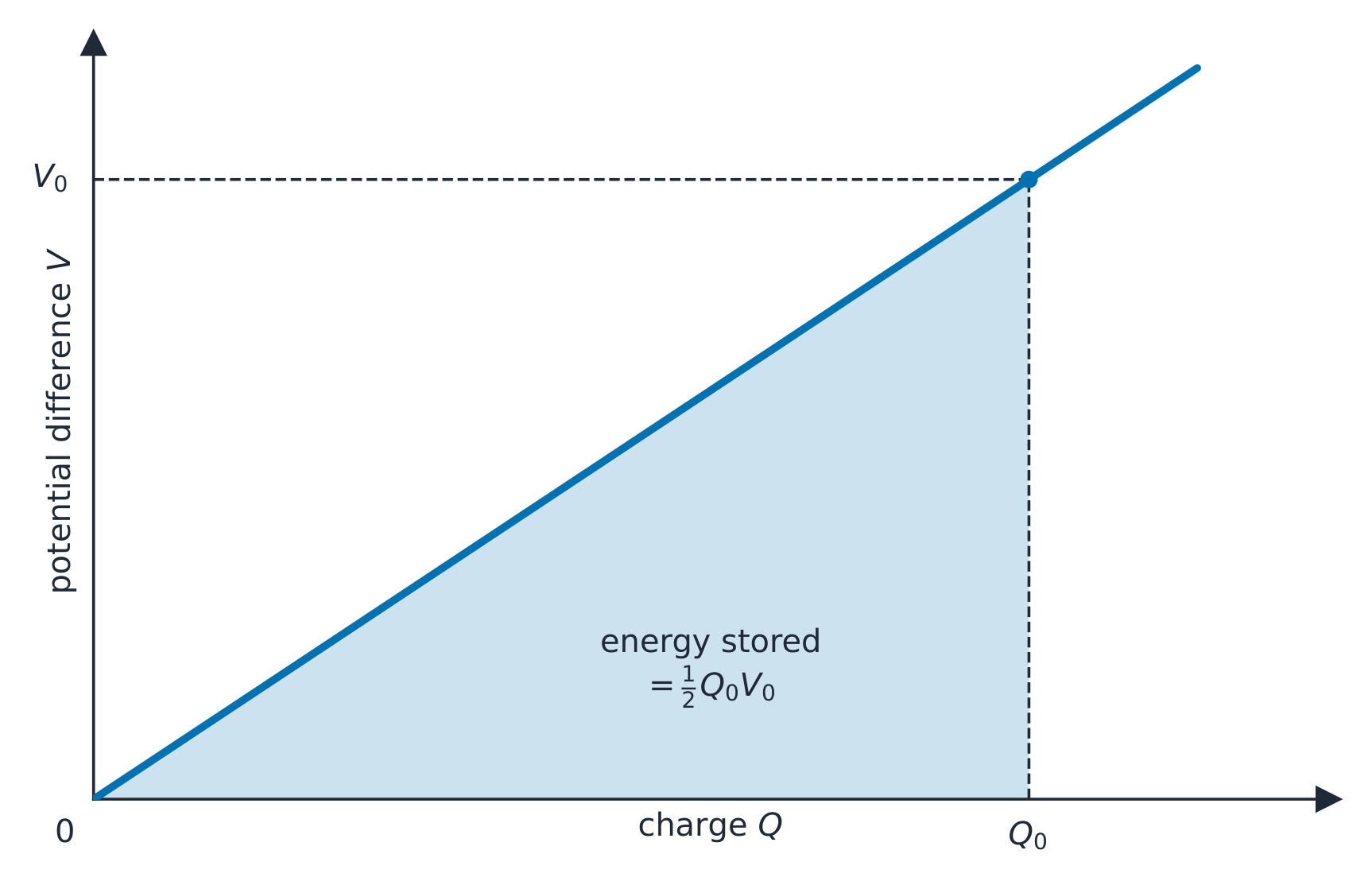
    Storing charge takes work 功: an external force must move each bit of charge against the field of the charge already there. The total work ends up as stored potential energy,

    $$U_C=\tfrac12\,Q\,\Delta V=\tfrac12 C(\Delta V)^2=\frac{Q^2}{2C}.$$

    The factor $\tfrac12$ is the area of the triangle under the $Q$–$\Delta V$ line: the first charge moved across costs almost nothing, the last costs the full $\Delta V$.

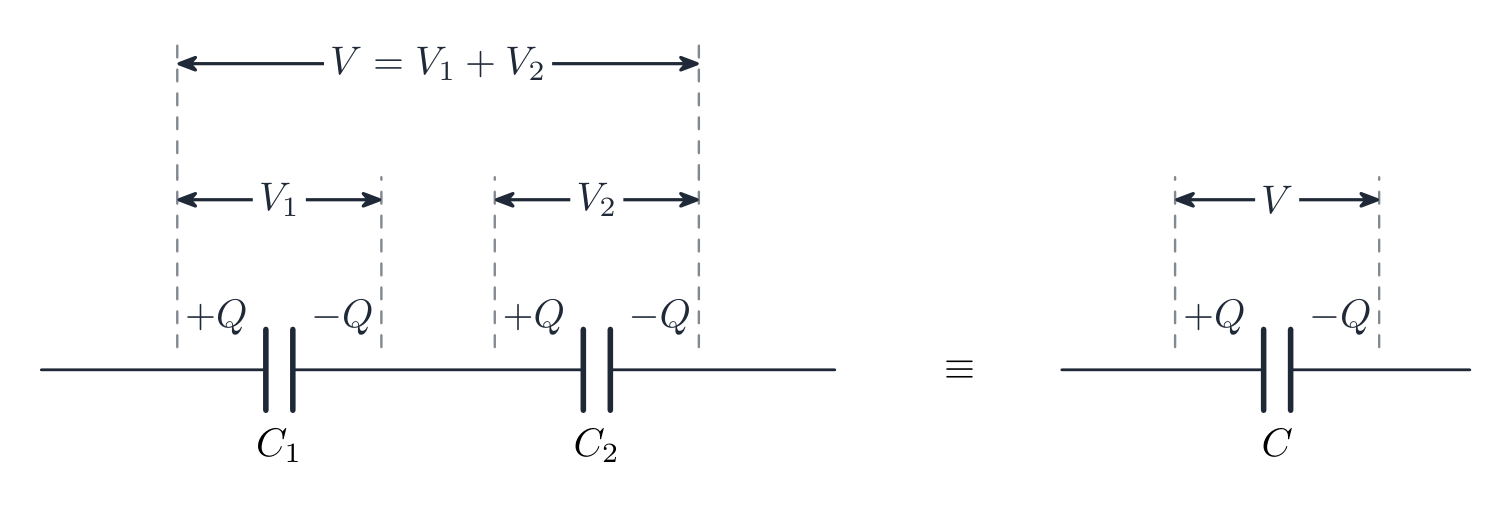
    Capacitors combine oppositely to resistors: in parallel 并联 the capacitances add ($C_{\text{eq}}=C_1+C_2$, same $\Delta V$, charges add), while in series 串联 the reciprocals add ($\tfrac{1}{C_{\text{eq}}}=\tfrac{1}{C_1}+\tfrac{1}{C_2}$, same $Q$, voltages add).

    Worked example. A $2\ \mu\text{F}$ and a $4\ \mu\text{F}$ capacitor in series: $\tfrac{1}{C}=\tfrac12+\tfrac14$, so $C=\tfrac43\ \mu\text{F}$. The same pair in parallel: $6\ \mu\text{F}$.

    ไทย
    การชาร์จตัวเก็บประจุ (RC)

    Capacitor เก็บประจุบนตัวนำสองชิ้นที่แยกด้วยช่องว่าง: $+Q$ บนแผ่นหนึ่ง, $-Q$ อีกแผ่นหนึ่ง Capacitance ของมันเชื่อมโยงประจุที่เก็บไว้กับความต่างศักย์ระหว่างแผ่น:

    $$C=\frac{Q}{\Delta V}.$$

    Capacitance ขึ้นอยู่กับเรขาคณิตและวัสดุในช่องว่างเท่านั้น – ไม่เคยขึ้นอยู่กับ $Q$ หรือ $\Delta V$ เอง

    ตัวอย่างวิธีทำ (แผ่นขนาน). สำหรับ parallel-plate capacitor ที่มีพื้นที่แผ่น $A$ และช่องว่างเล็ก $d$: กฎของ Gauss บวกกับ superposition ให้ uniform field ระหว่างแผ่น, $E=\dfrac{\sigma}{\varepsilon_0}=\dfrac{Q}{\varepsilon_0 A}$ (แต่ละแผ่นให้ $\sigma/2\varepsilon_0$; ระหว่างแผ่นทั้งสองบวกกัน, ด้านนอกหักล้างกัน) สนามสม่ำเสมอหมายถึง $\Delta V=Ed=\dfrac{Qd}{\varepsilon_0 A}$ ดังนั้น

    $$C=\frac{Q}{\Delta V}=\frac{\varepsilon_0 A}{d}.$$

    อนุกรม $E\to\Delta V\to C$ นี้เป็นการหาคำตอบแบบ FRQ มาตรฐาน – ให้เรียนรู้โดยแบ่งเป็นสามขั้นตอน และยกคำอธิบายแต่ละข้อออกมาใช้ วิธีเดียวกันนี้ยังใช้กับอีกสองรูปทรงที่ AP คาดหวังได้ ได้แก่ สpheres ลอยซ้อนกัน ($C=4\pi\varepsilon_0\dfrac{ab}{b-a}$) และกระบอกสูบแบบ coaxial ที่มีความยาว $L$ โดยที่ $E=\dfrac{\lambda}{2\pi\varepsilon_0 r}$ จะให้ $\Delta V=\dfrac{\lambda}{2\pi\varepsilon_0}\ln\dfrac{b}{a}$ และ以此类推 $C=\dfrac{2\pi\varepsilon_0 L}{\ln(b/a)}$

    ตัวอย่างวิธีทำ แผ่นมีพื้นที่ $A=0.020\ \text{m}^2$ และช่องว่าง $d=1.0\ \text{mm}$: $C=\dfrac{8.85\times10^{-12}(0.020)}{1.0\times10^{-3}}=1.8\times10^{-10}\ \text{F}$. ชาร์จด้วยแรงดัน $100\ \text{V}$ จะเก็บประจุได้ $Q=CV=1.8\times10^{-8}\ \text{C}$.

    เนื่องจากสนามไฟฟ้าระหว่างแผ่นมีความสม่ำเสมออนุภาคที่มีประจุจะ受到的แรงคงที่ ทำให้เคลื่อนที่ด้วยความเร่งคงที่ – เหมือนกับการเคลื่อนที่แบบ โปรเจกไทล์ ในสนามโน้มถ่วง: ความเร็วในแนวนอนคงที่ และความเร่งในแนวตั้งคงที่เข้าหาแผ่นหนึ่ง

    อนุภาคที่มีประจุระหว่างแผ่นเคลื่อนที่เป็นพาราโบลาเหมือนโปรเจกไทล์
    อนุภาคที่มีประจุระหว่างแผ่นเคลื่อนที่เป็นพาราโบลาเหมือนโปรเจกไทล์

    ตัวอย่างวิธีทำ อิเล็กตรอนเข้าสู่กลางระหว่างแผ่นที่ความเร็ว $v_0=2.0\times10^{7}\ \text{m/s}$, ขนานกับแผ่น สนามไฟฟ้าคือ $E=1.0\times10^{3}\ \text{N/C}$ และแผ่นยาว $4.0\ \text{cm}$. ความเร่ง: $a=\dfrac{eE}{m}=\dfrac{(1.6\times10^{-19})(1.0\times10^{3})}{9.11\times10^{-31}}=1.8\times10^{14}\ \text{m/s}^2$. เวลาที่ผ่านระหว่างแผ่น: $t=\dfrac{0.040}{2.0\times10^{7}}=2.0\times10^{-9}\ \text{s}$. การเบี่ยงเบน: $y=\tfrac12at^{2}=\tfrac12(1.8\times10^{14})(2.0\times10^{-9})^{2}\approx3.5\times10^{-4}\ \text{m}$ – ประมาณ $0.35\ \text{mm}$ เข้าหาแผ่นบวก

    การเก็บประจุต้องใช้เวลา ทำงาน: แรงภายนอกต้องเคลื่อนย้ายแต่ละหน่วยของประจุข้ามสนามของประจุที่มีอยู่แล้ว งานทั้งหมดจะกลายเป็นพลังงานศักย์ที่เก็บไว้,

    $$U_C=\tfrac12\,Q\,\Delta V=\tfrac12 C(\Delta V)^2=\frac{Q^2}{2C}.$$
    พลังงานที่เก็บไว้ในตัวเก็บประจุคือพื้นที่ใต้เส้นกราฟประจุ-แรงดัน
    พลังงานที่เก็บไว้ในตัวเก็บประจุคือพื้นที่ใต้เส้นกราฟประจุ-แรงดัน

    ค่าสัมประสิทธิ์ $\tfrac12$ คือพื้นที่ของสามเหลี่ยมใต้เส้น $Q$–$\Delta V$: หน่วยประจุแรกที่ใช้เคลื่อนย้ายแทบไม่เสียค่าใช้สอย ส่วนสุดท้ายเสียค่าเต็ม $\Delta V$

    ตัวเก็บประจุรวมกันตรงข้ามกับตัวต้านทาน: ใน ขนาน ค่าความจุรวมกัน ($C_{\text{eq}}=C_1+C_2$, แรงดัน $\Delta V$ เท่ากัน, ประจุรวม), ในขณะที่ใน อนุกรม ค่าผกผันรวมกัน ($\tfrac{1}{C_{\text{eq}}}=\tfrac{1}{C_1}+\tfrac{1}{C_2}$, ประจุ $Q$ เท่ากัน, แรงดันรวม).

    ตัวเก็บประจุแบบอนุกรมมีประจุเท่ากัน และผลต่างศักย์รวมกัน
    ตัวเก็บประจุแบบอนุกรมมีประจุเท่ากัน และผลต่างศักย์รวมกัน

    ตัวอย่างวิธีทำ ตัวเก็บประจุ $2\ \mu\text{F}$ และ $4\ \mu\text{F}$ แบบอนุกรม: $\tfrac{1}{C}=\tfrac12+\tfrac14$, ดังนั้น $C=\tfrac43\ \mu\text{F}$. คู่เดียวกันนี้แบบขนาน: $6\ \mu\text{F}$.

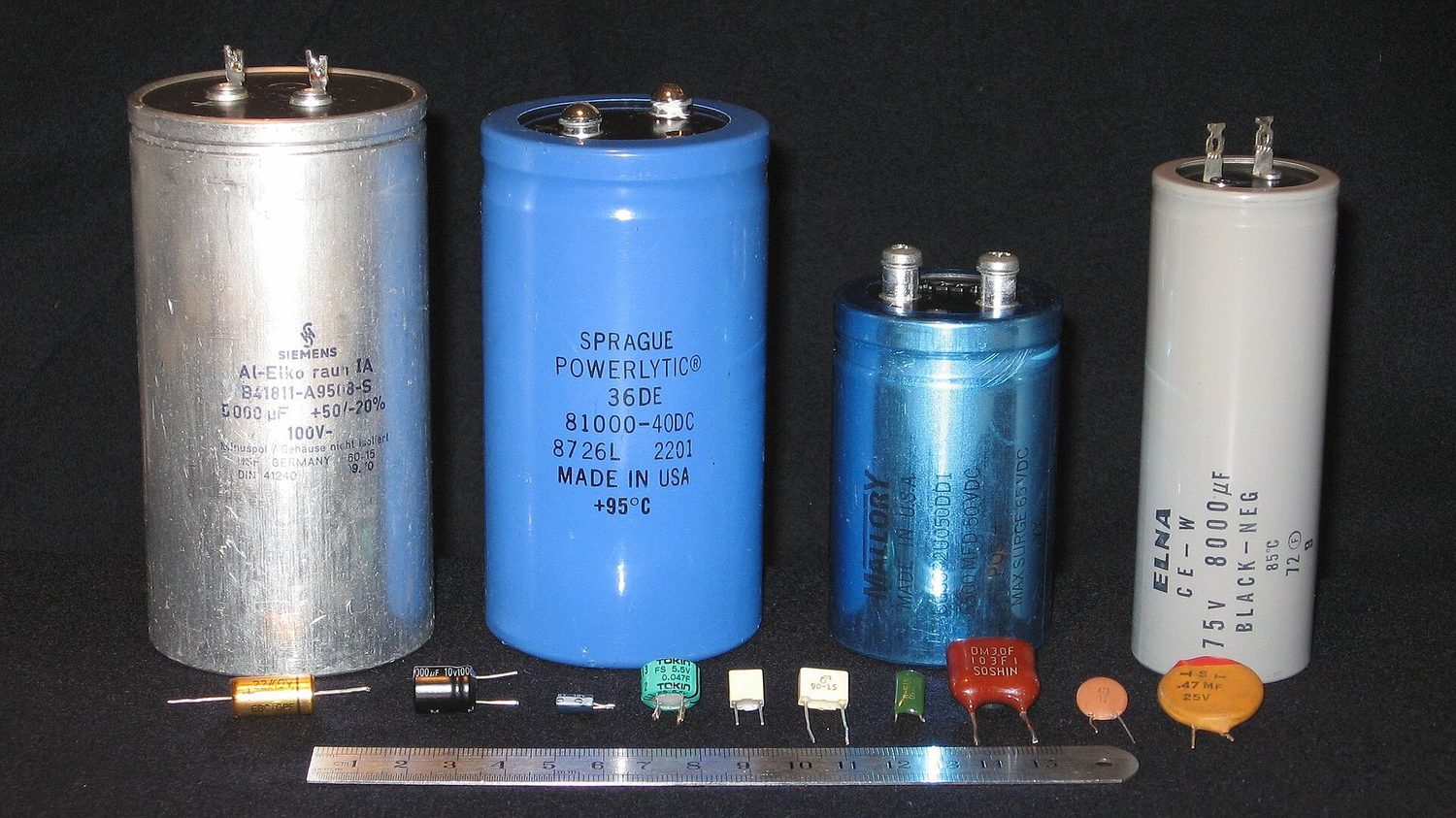
    ตัวเก็บประจุหลากหลายชนิด: อุปกรณ์ที่เก็บประจุและพลังงานในสนามไฟฟ้าระหว่างตัวนำ
    ตัวเก็บประจุหลากหลายชนิด: อุปกรณ์ที่เก็บประจุและพลังงานในสนามไฟฟ้าระหว่างตัวนำ
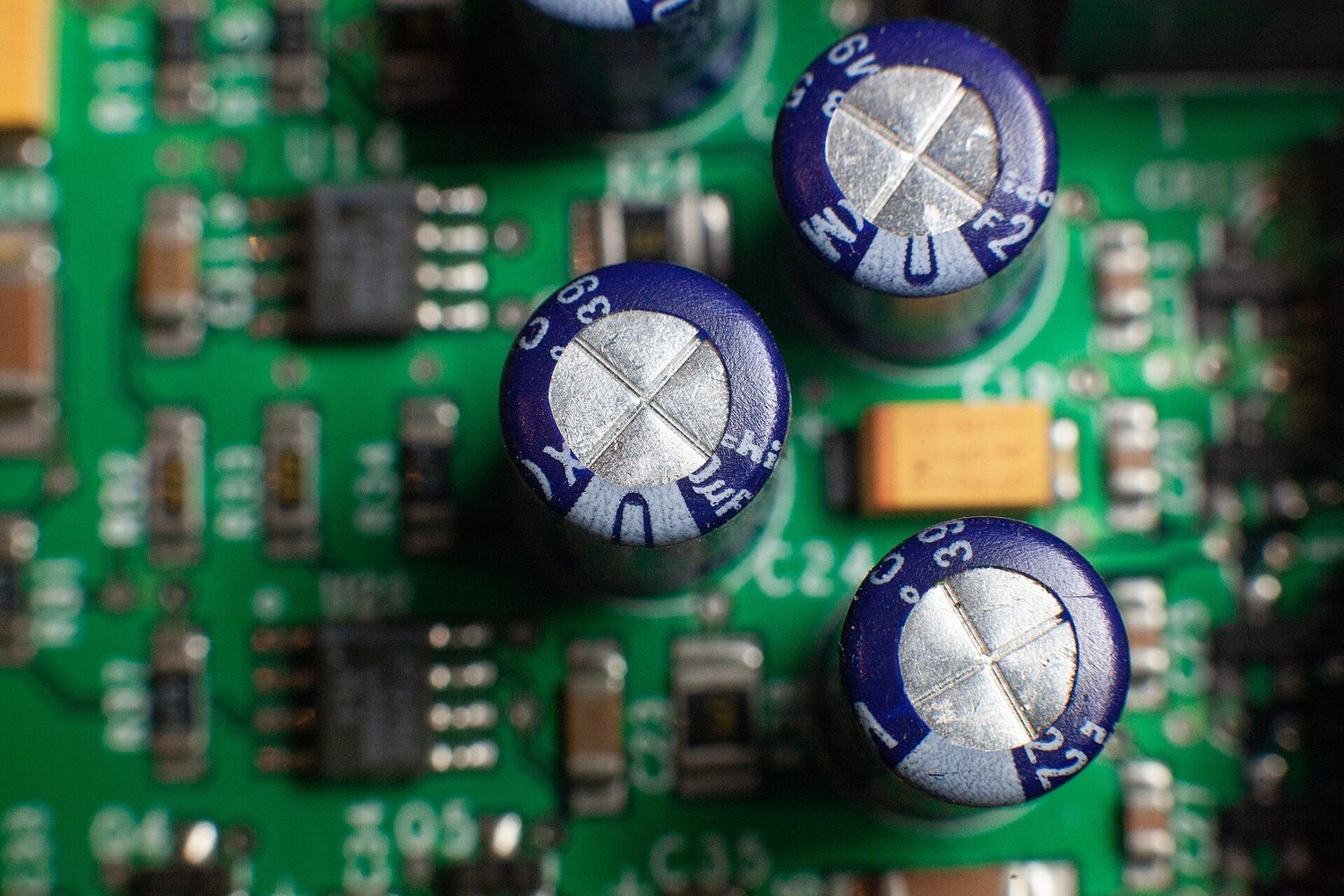
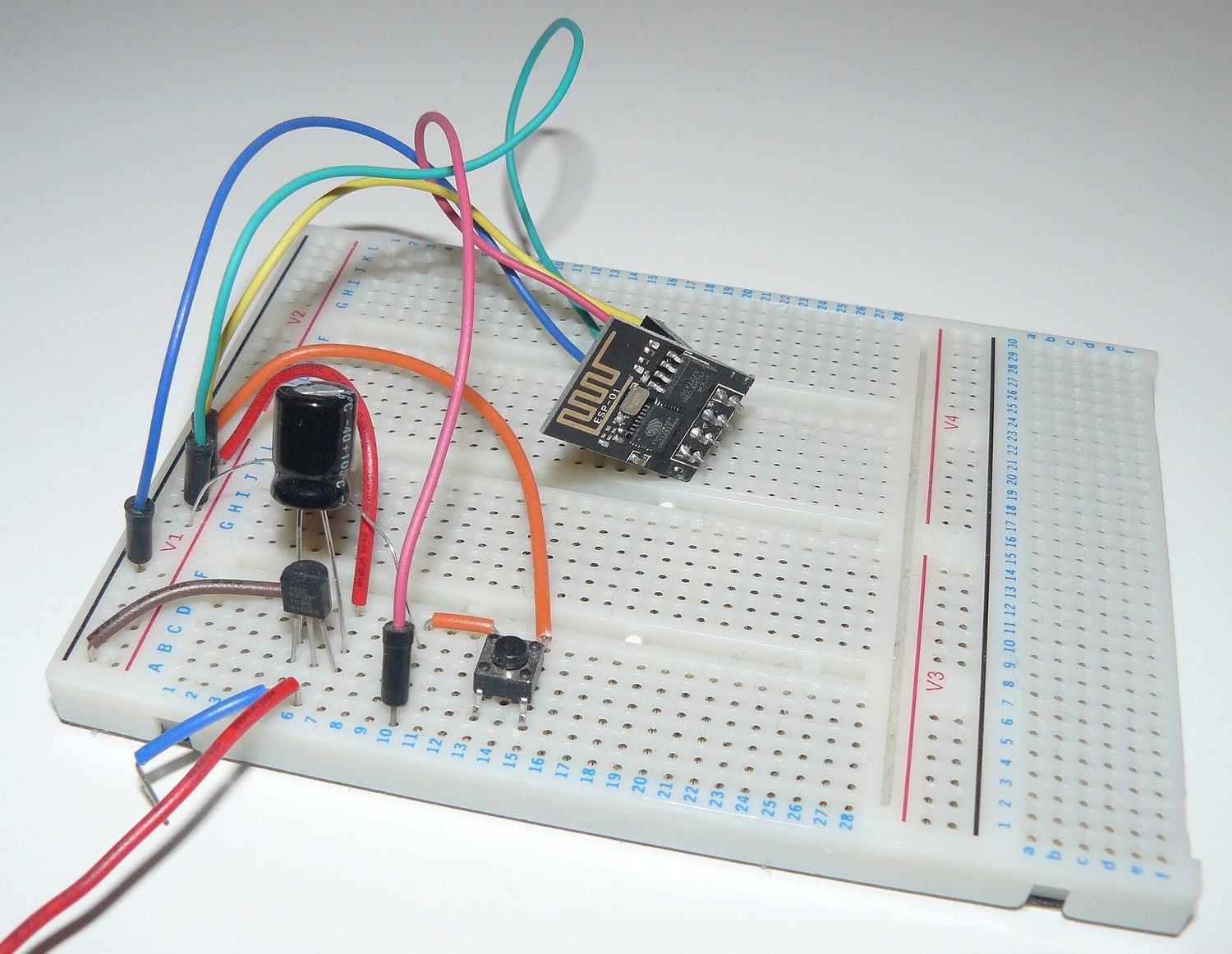
    ตัวเก็บประจุอิเล็กโทรไลต์บนแผงวงจร: ความจุเก็บพลังงานในรูป U = ½CV²
    ตัวเก็บประจุอิเล็กโทรไลต์บนแผงวงจร: ความจุเก็บพลังงานในรูป U = ½CV²
    Explore · ⁨สำรวจ⁩

    Charge and discharge a capacitor · ⁨ชาร์จและคายประจุตัวเก็บประจุ⁩

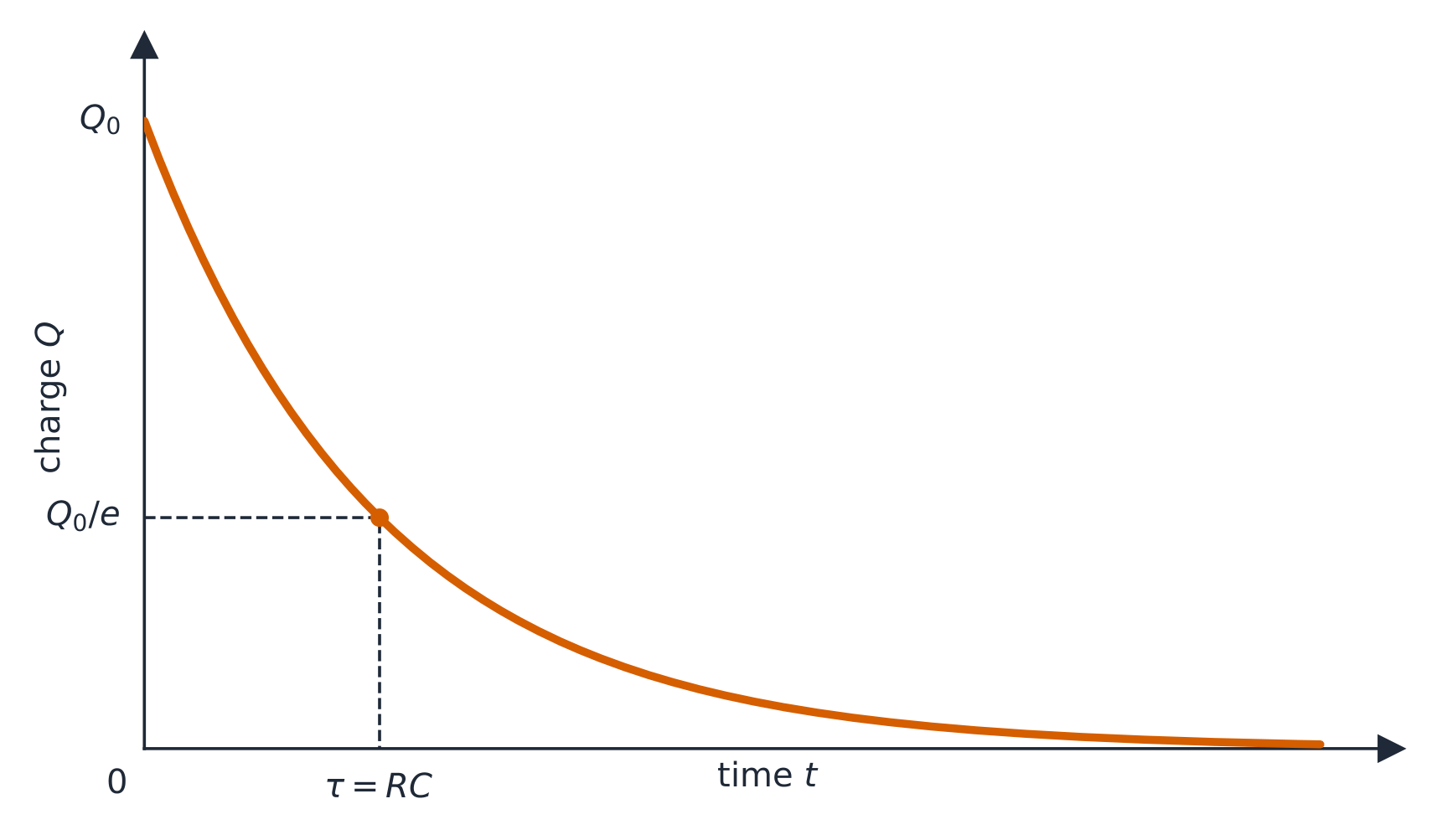
    A capacitor stores charge on two plates, filling and emptying exponentially with time constant $\tau=RC$. Bigger $R$ or $C$ slows it down. · ⁨ตัวเก็บประจุ เก็บประจุบนแผ่นทั้งสอง โดยเติมและปล่อยประจุแบบเอกซ์โพเนนเชียลด้วยค่าคงที่เวลา $\tau=RC$ ค่า $R$ หรือ $C$ ที่ใหญ่กว่าจะทำให้ช้าลง⁩

    Vocabulary · ⁨คำศัพท์⁩ Train · ⁨ฝึกฝน⁩
    English ไทย
    capacitor/kəˈpæsɪtə/ ตัวเก็บประจุ
    capacitance/kəˈpæsɪtəns/ ความจุไฟฟ้า
    parallel-plate capacitor/ˈpærəlel pleɪt kəˈpæsɪtə/ ตัวเก็บประจุแผ่นขนาน
    superposition/ˌsuːpəpəˈzɪʃn/ การ叠加 (email: superposition)
    uniform/ˈjuːnɪfɔːm/ สม่ำเสมอ
    projectile motion/prəˈdʒektaɪl ˈməʊʃn/ การเคลื่อนที่ของโปรเจกไทล์
    work/wɜːk/ งาน
    parallel/ˈpærəlel/ 并联电路中
    series/ˈsɪəriːz/ 串联电路中
    10.4

    Dielectrics · ⁨ไดอิเลคทริก⁩

    Syllabus · ⁨หลักสูตร⁩
    English

    Learning Objective 10.4.A: Describe how a dielectric inserted between the plates of a capacitor changes the properties of the capacitor.

    • 10.4.A.1 In a dielectric material, electric charges are not as free to move as they are in a conductor. Instead, the material becomes polarized in the presence of an external electric field.
    • 10.4.A.2 The dielectric constant of a material relates the electric permittivity of that material to the permittivity of free space.
      • Equation: $\kappa = \dfrac{\varepsilon}{\varepsilon_0}$
    • 10.4.A.3 The electric field created by a polarized dielectric is opposite in direction to the external field.
    • 10.4.A.4 The electric field between the plates of an isolated parallel-plate capacitor decreases when a dielectric is placed between the plates.
      • Equation: $\kappa = \dfrac{E_0}{E}$
    • 10.4.A.5 The insertion of a dielectric into a capacitor may change the capacitance of the capacitor.
      • Equation: $C = \kappa C_0$
    ไทย

    วัตถุประสงค์การเรียนรู้ 10.4.A: อธิบายว่าไดอิเล็กทริกที่ใส่ระหว่างแผ่นของตัวเก็บประจุจะเปลี่ยนแปลงคุณสมบัติของตัวเก็บประจุอย่างไร

    • 10.4.A.1 ในวัสดุไดอิเล็กทริก ประจุไฟฟ้าจะไม่อิสระในการเคลื่อนที่เท่าที่มันทำได้ในตัวนำ แทนที่จะเป็นแบบนั้น วัสดุนี้จะถูกทำให้เกิดขั้วไฟฟ้าเมื่ออยู่ในสนามไฟฟ้าภายนอก
    • 10.4.A.2 ค่าความไดอิเล็กทริกคอนสแตนต์ของวัสดุมีความสัมพันธ์กับความอ่อนตัวทางไฟฟ้าของวัสดุนั้นกับความอ่อนตัวทางไฟฟ้าของสุญญากาศ
      • สมการ: $\kappa = \dfrac{\varepsilon}{\varepsilon_0}$
    • 10.4.A.3 สนามไฟฟ้าที่เกิดจากไดอิเล็กทริกที่ถูกทำให้เกิดขั้วไฟฟ้าจะมีทิศทางตรงข้ามกับสนามไฟฟ้าภายนอก
    • 10.4.A.4 สนามไฟฟ้าระหว่างแผ่นของตัวเก็บประจุแบบแผ่นขนานแบบ isolated จะลดลงเมื่อใส่ไดอิเล็กทริกเข้าระหว่างแผ่น
      • สมการ: $\kappa = \dfrac{E_0}{E}$
    • 10.4.A.5 การใส่ไดอิเล็กทริกเข้าไปในตัวเก็บประจุอาจทำให้ความจุไฟฟ้าของตัวเก็บประจุเปลี่ยนแปลงได้
      • สมการ: $C = \kappa C_0$

    Source: College Board AP Course and Exam Description · ⁨แหล่งที่มา: คำอธิบายหลักสูตรและข้อสอบ College Board AP⁩

    English

    A dielectric 电介质 is an insulating material. Its charges cannot travel, but in an external field each molecule stretches or turns slightly – the material becomes polarized 极化. The lined-up molecules create their own small field opposite to the applied one, so the net field inside the material drops:

    $$E=\frac{E_0}{\kappa},\qquad \kappa=\frac{\varepsilon}{\varepsilon_0}\ \ (\kappa>1),$$

    where $\kappa$ is the dielectric constant 介电常数, the ratio of the material's permittivity to the permittivity of free space 真空介电常数.

    Filling a capacitor with dielectric multiplies its capacitance:

    $$C=\kappa\,C_0\qquad\left(\text{parallel plates: } C=\frac{\kappa\varepsilon_0 A}{d}\right).$$

    What happens next depends on what stays fixed – a favourite exam trap:

    battery stays connected ($\Delta V$ fixed) battery removed first ($Q$ fixed)
    charge $Q$ rises to $\kappa Q_0$ unchanged
    voltage $\Delta V$ unchanged drops to $\Delta V_0/\kappa$
    field $E$ unchanged drops to $E_0/\kappa$
    energy $U$ rises to $\kappa U_0$ drops to $U_0/\kappa$

    Worked example. A $100\ \text{pF}$ capacitor is charged to $12\ \text{V}$, disconnected, then filled with a $\kappa=3$ dielectric. $Q$ is trapped, so $\Delta V$ falls to $4\ \text{V}$ and the stored energy falls to one-third – the missing energy went into pulling the dielectric in. Reconnected to the $12\ \text{V}$ battery instead, the capacitor would hold three times the charge and three times the energy.

    Exam skill. Always begin dielectric questions by writing down which quantity is held fixed ($Q$ or $\Delta V$), then let $C=\kappa C_0$ drive everything else through $Q=C\Delta V$ and $U=\tfrac12 C(\Delta V)^2$.

    ไทย

    ไดอิเลคทริก คือวัสดุฉนวนประจุไม่สามารถเคลื่อนที่ได้ แต่ภายใต้สนามภายนอกโมเลกุลแต่ละตัวจะยืดออกหรือหมุนเล็กน้อย – วัสดุนั้นจะเกิด โพลาไรเซชัน โมเลกุลที่เรียงตัวกันสร้างสนามขนาดเล็ก สวนทาง กับสนามที่ใส่เข้าไป ทำให้สนามสุทธิภายในวัสดุลดลง:

    $$E=\frac{E_0}{\kappa},\qquad \kappa=\frac{\varepsilon}{\varepsilon_0}\ \ (\kappa>1),$$

    โดยที่ $\kappa$ คือ ค่าคงที่ไดอิเลคทริก, อัตราส่วนของความอ่อนต่อสนามไฟฟ้าของวัสดุต่อ ความอ่อนต่อสนามไฟฟ้าของสุญญากาศ.

    ไดอิเลคทริกที่เกิดโพลาไรเซชันสร้างสนามภายในสวนทางกับสนามที่ใส่เข้าไป
    ไดอิเลคทริกที่เกิดโพลาไรเซชันสร้างสนามภายในสวนทางกับสนามที่ใส่เข้าไป

    การเติมไดอิเลคทริกลงในตัวเก็บประจุจะทำให้ความจุเพิ่มขึ้น:

    $$C=\kappa\,C_0\qquad\left(\text{parallel plates: } C=\frac{\kappa\varepsilon_0 A}{d}\right).$$

    สิ่งที่เกิดขึ้นต่อไปขึ้นอยู่กับสิ่งใดถูกคงที่ – ซึ่งเป็นกับดักที่มักออกสอบ:

    เชื่อมแบตเตอรี่ไว้ ($\Delta V$ คงที่) ถอดแบตเตอรี่ออกก่อน ($Q$ คงที่)
    ประจุ $Q$ เพิ่มเป็น $\kappa Q_0$ ไม่เปลี่ยน
    แรงดัน $\Delta V$ ไม่เปลี่ยน ลดลงเหลือ $\Delta V_0/\kappa$
    สนาม $E$ ไม่เปลี่ยน ลดลงเหลือ $E_0/\kappa$
    พลังงาน $U$ เพิ่มเป็น $\kappa U_0$ ลดลงเหลือ $U_0/\kappa$

    ตัวอย่างวิธีทำ ตัวเก็บประจุ $100\ \text{pF}$ ชาร์จด้วยแรงดัน $12\ \text{V}$, ถอดสายออก, แล้วเติมไดอิเลคทริก $\kappa=3$. $Q$ ถูกกักไว้, ดังนั้น $\Delta V$ ลดลงเหลือ $4\ \text{V}$ และพลังงานที่เก็บไว้ลดลงเหลือหนึ่งในสาม – พลังงานที่หายไปใช้ในการดึงไดอิเลคทริกเข้าไปใหม่ หากเชื่อมกลับเข้ากับแบตเตอรี่ $12\ \text{V}$ แทน ตัวเก็บประจุจะเก็บประจุได้สามเท่าและพลังงานสามเท่า

    ทักษะการสอบ ต้องเริ่มตอบคำถามเกี่ยวกับไดอิเลคทริกด้วยการระบุก่อนว่าปริมาณใดถูกคงที่ ($Q$ หรือ $\Delta V$), จากนั้นให้ $C=\kappa C_0$ นำพาทุกอย่างไปตาม $Q=C\Delta V$ และ $U=\tfrac12 C(\Delta V)^2$

    Explore · ⁨สำรวจ⁩

    Add a dielectric · ⁨เพิ่ม dielectric⁩

    A dielectric between the plates raises the capacitance, so the capacitor holds more charge at the same voltage. Watch the charge build faster. · ⁨ไดอิเล็กทริก ระหว่างแผ่นทำให้ความจุเพิ่มขึ้น ตัวเก็บประจุจึงเก็บประจุได้มากกว่าเดิมที่แรงดันเท่ากัน สังเกตการสะสมประจุเร็วขึ้น⁩

    Vocabulary · ⁨คำศัพท์⁩ Train · ⁨ฝึกฝน⁩
    English ไทย
    dielectric/ˌdaɪɪˈlektrɪk/ ไดอิเล็กทริก
    polarized/ˈpəʊləraɪzd/ โพลาไรซ์ polarized
    dielectric constant/ˌdaɪɪˈlektrɪk ˈkɒnstənt/ ค่าคงที่ไดอิเล็กทริก
    permittivity of free space/ˌpɜːmɪˈtɪvəti ɒv friː speɪs/ ค่าความยอมให้ของสุญญากาศ
    10.4

    Exam tips · ⁨ข้อแนะนำสำหรับการสอบ⁩

    English
    • In electrostatic equilibrium a conductor has $\vec E=0$ inside and all excess charge on the surface.
    • Apply Gauss's law $\oint \vec E\cdot d\vec A=\tfrac{q_{enc}}{\varepsilon_0}$ with a symmetry-matched Gaussian surface (sphere, cylinder, pillbox).
    • The whole conductor is one equipotential, and the surface field is perpendicular to it.
    • For a capacitor use $C=\tfrac{Q}{V}$, energy $U=\tfrac12 CV^2$, and how a dielectric raises $C$.
    • Pick the Gaussian surface so $\vec E$ is constant and parallel (or zero) on each part.
    ไทย
    • ในสภาวะสมดุลทางสถิตตัวนำจะมี $\vec E=0$ ภายใน และประจุส่วนเกินทั้งหมดอยู่ที่ พื้นผิว
    • ใช้ กฎของเกาส์ $\oint \vec E\cdot d\vec A=\tfrac{q_{enc}}{\varepsilon_0}$ พร้อมพื้นผิวเกาส์ที่สอดคล้องกับความสมมาตร (ทรงกลม, กระบอก, กล่องทรงสูง)
    • ตัวนำทั้งชิ้นเป็น ** equipotential** เดียวกัน และสนามที่พื้นผิวตั้งฉากกับมัน
    • สำหรับตัวเก็บประจุใช้ $C=\tfrac{Q}{V}$, พลังงาน $U=\tfrac12 CV^2$, และการเพิ่ม $C$ ของ ไดอิเลคทริก
    • เลือกพื้นผิวเกาส์ให้ $\vec E$ มีค่าคงที่และขนาน (หรือเป็นศูนย์) บนแต่ละส่วน
  • 11

    Electric Circuits · ⁨วงจรไฟฟ้า⁩

    Watch lesson · ⁨ดูบทเรียน⁩
    11.1

    Electric Current · ⁨กระแสไฟฟ้า⁩

    Syllabus · ⁨หลักสูตร⁩
    English

    Learning Objective 11.1.A: Describe the movement of electric charges through a medium.

    • 11.1.A.1 Current is the rate at which charge passes through a cross-sectional area of a wire.
      • Equation: $I = \dfrac{dq}{dt}$
      • 11.1.A.1.i Current within a conductor consists of charge carriers traveling through the conductor with an average drift velocity.
        • Equation: $I = nqv_d A$
      • 11.1.A.1.ii Electric charge moves in a circuit in response to an electric potential difference, sometimes referred to as electromotive force, or $\mathrm{emf}$ ($\mathcal{E}$).
      • 11.1.A.1.iii If the current is zero in a section of wire, the net motion of charge carriers in the wire is also zero, although individual charge carriers will not have zero speed.
    • 11.1.A.2 Current density is the flow of charge per unit area.
      • Equation: $I = \int \vec{J} \cdot d\vec{A}$
      • 11.1.A.2.i Current density is related to the motion of the charge carriers within a conductor.
        • Equation: $\vec{J} = nq\vec{v}_d$
      • 11.1.A.2.ii Current density is a vector quantity.
      • 11.1.A.2.iii A potential difference across a conductor creates an electric field within the conductor that is proportional to the resistivity of the conductor and the current density.
        • Equation: $\vec{E} = \rho\vec{J}$
    • 11.1.A.3 If a function of current density is given, the total current can be determined by integrating the current density over the area.
      • Equation: $I_{\text{tot}} = \int \vec{J}(r) \cdot d\vec{A}$
    • 11.1.A.4 Although current is a scalar quantity, it does have a direction. Because its direction is relative to the current carrier and not space, current does not obey the laws of vector addition and has no vector components.
      • 11.1.A.4.i The direction of conventional current is chosen to be the direction in which positive charge would move.
      • 11.1.A.4.ii In common circuits, the current is actually due to the movement of electrons (negative charge carriers).
    ไทย

    จุดประสงค์การเรียนรู้ 11.1.A: อธิบายการเคลื่อนที่ของประจุไฟฟ้าผ่านตัวกลาง

    • 11.1.A.1 กระแสไฟฟ้าคืออัตราการไหลของประจุไฟฟ้าที่ผ่านพื้นที่หน้าตัดของสายไฟ
      • สมการ: $I = \dfrac{dq}{dt}$
      • 11.1.A.1.i กระแสไฟภายในตัวนำประกอบด้วยตัวพาประจุที่เคลื่อนที่ผ่านตัวนำด้วยความเร็วลอยตัวเฉลี่ย (drift velocity)
        • สมการ: $I = nqv_d A$
      • 11.1.A.1.ii ประจุไฟฟ้าเคลื่อนที่ในวงจรตามผลต่างศักย์ไฟฟ้า บางครั้งเรียกว่า แรงดันไฟฟ้า หรือ $\mathrm{emf}$ ($\mathcal{E}$)
      • 11.1.A.1.iii หากกระแสไฟฟ้าเป็นศูนย์ในส่วนใดส่วนของลวด การเคลื่อนที่สุทธิของตัวพาประจุในลวดก็เป็นศูนย์เช่นกัน although ตัวพาประจุแต่ละตัวจะมีскорไม่เท่ากับศูนย์
    • 11.1.A.2 ความหนาแน่นของกระแสคืออัตราการไหลของประจุต่อหน่วยพื้นที่
      • สมการ: $I = \int \vec{J} \cdot d\vec{A}$
      • 11.1.A.2.i ความหนาแน่นกระแสสัมพันธ์กับการเคลื่อนที่ของพาหะประจุภายในตัวนำ
        • สมการ: $\vec{J} = nq\vec{v}_d$
      • 11.1.A.2.ii ความหนาแน่นกระแสเป็นปริมาณเวกเตอร์
      • 11.1.A.2.iii ความต่างศักย์ระหว่างปลายตัวนำจะสร้างสนามไฟฟ้าภายในตัวนำซึ่งแปรผันตรงกับค่าความต้านทานจำเพาะของความต้านทานและความหนาแน่นกระแส
        • สมการ: $\vec{E} = \rho\vec{J}$
    • 11.1.A.3 หากกำหนดฟังก์ชันของความหนาแน่นกระแสไว้ สามารถหากระแสรวมได้โดยการอินทิเกรตความหนาแน่นกระแสบนพื้นที่
      • สมการ: $I_{\text{tot}} = \int \vec{J}(r) \cdot d\vec{A}$
    • 11.1.A.4 แม้กระแสจะเป็นปริมาณสเกลาร์ แต่ก็มีทิศทาง เนื่องจากทิศทางขึ้นอยู่กับตัวพากระแสไม่ใช่ตำแหน่งในอวกาศ กระแสจึงไม่ปฏิบัติตามกฎการบวกเวกเตอร์และไม่มีส่วนประกอบของเวกเตอร์
      • 11.1.A.4.i ทิศทางของกระแสแบบดั้งเดิมถูกกำหนดให้เป็นทิศทางที่ประจุบวกจะเคลื่อนที่
      • 11.1.A.4.ii ในวงจรทั่วไป กระแสไฟฟ้าเกิดจากการเคลื่อนที่ของอิเล็กตรอน (พาหะประจุลบ)

    Source: College Board AP Course and Exam Description · ⁨แหล่งที่มา: คำอธิบายหลักสูตรและข้อสอบ College Board AP⁩

    English

    Electric current 电流 is the rate at which charge passes a cross-section of wire, $I=\dfrac{dq}{dt}$, measured in amperes 安培. Conventional current points the way positive charge would move. Microscopically, a current is a slow drift of many carriers:

    $$I=nqv_dA,$$

    with $n$ the number of carriers per volume, $q$ the charge each carries, $v_d$ the drift velocity 漂移速度, and $A$ the cross-sectional area 横截面积.

    Worked example. A copper wire with $A=1.0\times10^{-6}\ \text{m}^2$ and $n=8.5\times10^{28}\ \text{m}^{-3}$ carries $1.7\ \text{A}$. Then $v_d=\dfrac{I}{nqA}=\dfrac{1.7}{(8.5\times10^{28})(1.6\times10^{-19})(1.0\times10^{-6})}\approx1.3\times10^{-4}\ \text{m/s}$ – the carriers drift slower than a snail, even though the signal travels near light speed.

    Current density 电流密度 is charge flow per unit area, $\vec{J}=nq\vec{v}_d$, linked to the field driving it by $\vec{E}=\rho\vec{J}$. In general $I=\int\vec{J}\cdot d\vec{A}$; if $J(r)$ varies across the wire, integrate it over the cross-section to get the total current. One care point: current has a direction along its wire, but it is a scalar 标量 – currents do not add as vectors, and there are no "components of current".

    ไทย

    กระแสไฟฟ้า คืออัตราการไหลของประจุผ่านหน้าตัดของลวด, $I=\dfrac{dq}{dt}$, วัดในหน่วย แอมแปร์ กระแสปกติชี้ไปในทิศทางที่ ประจุบวก จะเคลื่อนที่ ในระดับจุลภาค กระแสคือการเคลื่อนที่ช้าๆ ของตัวพาจำนวนมาก:

    $$I=nqv_dA,$$

    โดยที่ $n$ คือจำนวนตัวพาต่อปริมาตร, $q$ เป็นประจุที่แต่ละตัวพาถือ, $v_d$ คือ ความเร็วลอยตัว, และ $A$ คือ พื้นที่หน้าตัด

    ตัวพาประจุลอยตัวช้าๆ ผ่านตัวนำเพื่อสร้างกระแส
    ตัวพาประจุลอยตัวช้าๆ ผ่านตัวนำเพื่อสร้างกระแส

    ตัวอย่างวิธีทำ ลวดทองแดงที่มี $A=1.0\times10^{-6}\ \text{m}^2$ และ $n=8.5\times10^{28}\ \text{m}^{-3}$ ไหลกระแส $1.7\ \text{A}$. แล้ว $v_d=\dfrac{I}{nqA}=\dfrac{1.7}{(8.5\times10^{28})(1.6\times10^{-19})(1.0\times10^{-6})}\approx1.3\times10^{-4}\ \text{m/s}$ – ตัวพาเคลื่อนที่ช้ากว่าเต่า แม้สัญญาณจะเดินทางด้วยความ接近แสงก็ตาม

    ความหนาแน่นกระแส คือการไหลของประจุต่อหน่วยพื้นที่, $\vec{J}=nq\vec{v}_d$, เชื่อมโยงกับสนามที่ขับเคลื่อน它以 $\vec{E}=\rho\vec{J}$. โดยทั่วไป $I=\int\vec{J}\cdot d\vec{A}$; ถ้า $J(r)$ เปลี่ยนแปลงไปตามหน้าตัดลวด ให้อินทิกรัลมันเพื่อหากระแสรวม ข้อควรระวัง: กระแสมีทิศทางตามลวด但它เป็น สเกลาร์ – กระแสไม่รวมกันแบบเวกเตอร์ และไม่มี "องค์ประกอบของกระแส"

    ออสซิลโลสโคป: แรงดันเทียบกับเวลาแสดงถึงวิวัฒนาการของกระแสและประจุในวงจร
    ออสซิลโลสโคป: กราฟแรงดันไฟฟ้าเทียบกับเวลาแสดงการเปลี่ยนแปลงของกระแสและประจุในวงจร
    Vocabulary · ⁨คำศัพท์⁩ Train · ⁨ฝึกฝน⁩
    English ไทย
    Electric current/ɪˈlektrɪk ˈkʌrənt/ กระแสไฟฟ้า
    amperes/ˈæmpeəz/ แอมแปร์ (amperes)
    drift velocity/drɪft vəˈlɒsɪti/ ความเร็วลอยตัว
    cross-sectional area/krɒs ˈsekʃənl ˈeərɪə/ พื้นที่หน้าตัด
    Current density/ˈkʌrənt ˈdensɪti/ ความหนาแน่นกระแส
    scalar/ˈskeɪlə/ สเกลาร์
    circuit diagram/ˈsɜːkɪt ˈdaɪəɡræm/ แผนวงจรไฟฟ้า
    series/ˈsɪəriːz/ 串联电路中
    11.2

    Electric Circuits · ⁨วงจรไฟฟ้า⁩

    Syllabus · ⁨หลักสูตร⁩
    English

    Learning Objective 11.2.A: Describe the behavior of a circuit.

    • 11.2.A.1 A circuit is composed of electrical loops, which can include wires, batteries, resistors, lightbulbs, capacitors, inductors, switches, ammeters, and voltmeters.
    • 11.2.A.2 A closed electrical loop is a closed path through which charges may flow.
      • 11.2.A.2.i A closed circuit is one in which charges would be able to flow.
      • 11.2.A.2.ii An open circuit is one in which charges would not be able to flow.
      • 11.2.A.2.iii A short circuit is one in which charges would be able to flow with no change in potential difference.
    • 11.2.A.3 A single circuit element may be part of multiple electrical loops.
    • 11.2.A.4 Circuit schematics are representations used to describe and analyze electric circuits.
      • 11.2.A.4.i The properties of an electric circuit are dependent on the physical arrangement of its constituent elements.
      • 11.2.A.4.ii Circuit elements have common symbols that are used to create schematic diagrams. Variable elements are indicated by a diagonal strikethrough arrow across the standard symbol for that element. (Symbols: Battery, Bulb, Switch, Capacitor, Resistor, Ammeter, Voltmeter, Inductor.)

    Boundary statement: Unless otherwise specified, all circuit schematic diagrams will be drawn using conventional current.

    ไทย

    จุดประสงค์การเรียนรู้ 11.2.A: อธิบายพฤติกรรมของวงจรไฟฟ้า

    • 11.2.A.1 วงจรประกอบด้วยลูปไฟฟ้า ซึ่งอาจมีสายไฟ แบตเตอรี่ ตัวต้านทาน หลอดไฟ condensers Inductors สวิตช์ อมมิเตอร์ และโวลต์มิเตอร์
    • 11.2.A.2 วงจรรอบไฟฟ้าปิดคือเส้นทางปิดที่ประจุสามารถไหลผ่านได้
      • 11.2.A.2.i วงจรปิดคือวงจรที่ประจุจะสามารถไหลผ่านได้
      • 11.2.A.2.ii วงจรเปิดคือวงจรที่ประจุไม่สามารถไหลผ่านได้
      • 11.2.A.2.iii วงจรลัดคือวงจรที่ประจุจะสามารถไหลผ่านได้โดยไม่มีการเปลี่ยนแปลงของความต่างศักย์
    • 11.2.A.3 องค์ประกอบวงจรหนึ่งอาจเป็นส่วนหนึ่งของวงจรรอบไฟฟ้าหลายวง
    • 11.2.A.4 แผนภาพวงจรใช้เพื่ออธิบายและวิเคราะห์วงจรไฟฟ้า
      • 11.2.A.4.i คุณสมบัติของวงจรไฟฟ้าขึ้นอยู่กับการจัดวางทางกายภาพขององค์ประกอบต่างๆ ที่ประกอบกัน
      • 11.2.A.4.ii องค์ประกอบในวงจรมีสัญลักษณ์มาตรฐานที่ใช้ในการวาดแผนภาพวงจร องค์ประกอบที่ปรับค่าได้จะแสดงด้วยลูกศรขีดฆ่าเฉียงทับสัญลักษณ์มาตรฐานขององค์ประกอบนั้น (สัญลักษณ์: แบตเตอรี่, หลอดไฟ, สวิตช์, ตัวเก็บประจุ, ตัวต้านทาน, แอมมิเตอร์, โวลต์มิเตอร์, คอยล์เหนี่ยวนำ)

    คำประกาศขอบเขต: เว้นแต่จะระบุไว้เป็นพิเศษ แผนภาพวงจรทั้งหมดจะถูกวาดโดยใช้กระแสไฟฟ้าแบบดั้งเดิม

    Source: College Board AP Course and Exam Description · ⁨แหล่งที่มา: คำอธิบายหลักสูตรและข้อสอบ College Board AP⁩

    English

    A circuit is a set of closed loops built from wires, batteries, resistors, lightbulbs, capacitors, inductors, switches, and meters; charge can flow only around a closed path. One element can belong to several loops at once – that is what makes multi-loop problems interesting. Every analysis starts by reading the circuit diagram 电路图: trace each loop and identify which elements share the same current (series 串联) and which share the same potential difference (parallel 并联).

    ไทย

    วงจรคือชุดของวงปิดที่สร้างจากสายไฟ แบตเตอรี่ ตัวต้านทาน หลอดไฟ ตัวเก็บประจุ ตัวเหนี่ยวนำ สวิตช์ และมิเตอร์; ประจุสามารถไหลได้เฉพาะรอบเส้นทาง ปิด เท่านั้น องค์ประกอบหนึ่งอาจเป็นส่วนหนึ่งของหลายวงพร้อมกัน – นั่นคือสิ่งที่ทำให้ปัญหาหลายวงน่าสนใจ การวิเคราะห์ทุกแบบเริ่มต้นด้วยการอ่าน แผนภาพวงจร: ตามแต่ละวงและระบุว่าองค์ประกอบใดแบ่งกระแสเดียวกัน (อนุกรม) และองค์ประกอบใดแบ่งผลต่างศักย์เดียวกัน (ขนาน)

    Explore · ⁨สำรวจ⁩

    Build series and parallel circuits · ⁨สร้างวงจรแบบอนุกรมและขนาน⁩

    In series the same current flows through every bulb and voltage divides; in parallel each branch gets the full voltage. Switch mode to see the bulbs' brightness change. · ⁨ใน แบบอนุกรม กระแสไฟเท่ากันไหลผ่านหลอดไฟทุกดวงและแรงดันไฟฟ้าแบ่งกัน; ใน แบบขนาน แต่ละสาขาได้รับแรงดันไฟฟ้าเต็ม สลับโหมดเพื่อดูความสว่างของหลอดไฟเปลี่ยนไป⁩

    11.3

    Resistance, Resistivity, and Ohm's Law · ⁨ความต้านทาน, ความต้านทานจำเพาะ, และกฎของโอห์ม⁩

    Syllabus · ⁨หลักสูตร⁩
    English

    Learning Objective 11.3.A: Describe the resistance of an object using physical properties of that object.

    • 11.3.A.1 Resistance is a measure of the degree to which an object opposes the movement of electric charge.
    • 11.3.A.2 The resistance of a resistor with uniform geometry is proportional to its resistivity and length and is inversely proportional to its cross-sectional area.
      • Equation: $R = \dfrac{\rho\ell}{A}$
      • 11.3.A.2.i Resistivity is a fundamental property of a material that depends on its atomic and molecular structure and quantifies how strongly the material opposes the motion of electric charge.
      • 11.3.A.2.ii The resistivity of a conductor typically increases with temperature.
      • 11.3.A.2.iii The total resistance of a resistor with uniform geometry, but that is made of a material whose resistivity varies along the length of the resistor, is given by $R = \int \dfrac{\rho(\ell)\,d\ell}{A}$.

    Learning Objective 11.3.B: Describe the electrical characteristics of elements of a circuit.

    • 11.3.B.1 Ohm's law relates current, resistance, and potential difference across a conductive element of a circuit.
      • Equation: $I = \dfrac{\Delta V}{R}$
      • 11.3.B.1.i Materials that obey Ohm's law have constant resistance for all currents and are called ohmic materials.
      • 11.3.B.1.ii The resistivity of an ohmic material is constant regardless of temperature.
      • 11.3.B.1.iii Resistors can also convert electrical energy to thermal energy, which may change the temperature of both the resistor and the resistor's environment.
      • 11.3.B.1.iv The resistance of an ohmic circuit element can be determined from the slope of a graph of the current in the element as a function of the potential difference across the element.
    ไทย

    จุดประสงค์การเรียนรู้ 11.3.A: อธิบายความต้านทานของวัตถุโดยใช้คุณสมบัติทางกายภาพของวัตถุนั้น

    • 11.3.A.1 ความต้านทานคือตัวบ่งชี้ถึงระดับที่วัตถุขัดขวางการเคลื่อนที่ของประจุไฟฟ้า
    • 11.3.A.2 ความต้านทานของตัวต้านทานที่มีรูปทรงสม่ำเสมอจะแปรผันตรงกับค่าความต้านทานจำเพาะและความยาวของมัน และแปรผกผันกับพื้นที่หน้าตัดของมัน
      • สมการ: $R = \dfrac{\rho\ell}{A}$
      • 11.3.A.2.i ความต้านทานจำเพาะเป็นคุณสมบัติพื้นฐานของวัสดุที่ขึ้นอยู่กับโครงสร้างอะตอมและโมเลกุลของวัสดุนั้น และวัดระดับที่วัสดุนั้นขัดขวางการเคลื่อนที่ของประจุไฟฟ้า
      • 11.3.A.2.ii ความต้านทานจำเพาะของตัวนำมักเพิ่มขึ้นเมื่ออุณหภูมิสูงขึ้น
      • 11.3.A.2.iii ความต้านทานรวมของตัวต้านทานที่มีเรขาคณิตสม่ำเสมอแต่ทำจากวัสดุwhoseความต้านทานจำเพาะแปรผันตามความยาวของตัวต้านทาน ให้โดย $R = \int \dfrac{\rho(\ell)\,d\ell}{A}$

    จุดประสงค์การเรียนรู้ 11.3.B: อธิบายลักษณะทางไฟฟ้าขององค์ประกอบในวงจร

    • 11.3.B.1 กฎของโอห์มเชื่อมโยงความสัมพันธ์ระหว่างกระแสไฟฟ้า ความต้านทาน และความต่างศักย์ข้ามองค์ประกอบนำไฟฟ้าในวงจร
      • สมการ: $I = \dfrac{\Delta V}{R}$
      • 11.3.B.1.i วัสดุที่ปฏิบัติตามกฎของโอห์มมีความต้านทานคงที่สำหรับทุกกระแสและเรียกว่า วัสดุแบบโอห์มิก
      • 11.3.B.1.ii ความต้านทานจำเพาะของวัสดุแบบโอห์มิกจะคงที่ไม่ว่าอุณหภูมิจะเปลี่ยนแปลงหรือไม่
      • 11.3.B.1.iii ตัวต้านทานยังสามารถแปลงพลังงานไฟฟ้าเป็นพลังงานความร้อนได้ ซึ่งอาจทำให้ทั้งตัวต้านทานและสภาพแวดล้อมรอบตัวมันมีอุณหภูมิเปลี่ยนแปลงไป
      • 11.3.B.1.iv ความต้านทานขององค์ประกอบวงจรแบบโอห์มิกสามารถหาได้จากความชันของกราฟที่แสดงความสัมพันธ์ระหว่างกระแสในองค์ประกอบกับความต่างศักย์ข้ามองค์ประกอบนั้น

    Source: College Board AP Course and Exam Description · ⁨แหล่งที่มา: คำอธิบายหลักสูตรและข้อสอบ College Board AP⁩

    English

    Resistance 电阻 measures how strongly an object opposes charge flow. It grows with the material's resistivity 电阻率 and the conductor's length, and shrinks with its area:

    $$R=\frac{\rho\,\ell}{A}.$$

    Ohm's law 欧姆定律 relates the current through an element to the potential difference across it:

    $$I=\frac{\Delta V}{R}.$$

    Worked example. Stretch a wire to double its length: the volume is fixed, so the area halves, and $R=\rho\ell/A$ becomes $\rho(2\ell)/(A/2)=4R$ – four times the resistance. An element is ohmic 欧姆性 if $R$ stays constant (a straight line through the origin on an $I$–$\Delta V$ graph); a lightbulb filament, which heats up, is not.

    ไทย

    ความต้านทาน บ่งบอกถึงความสามารถในการขัดขวางการไหลของประจุ มันเพิ่มขึ้นตาม ความต้านทานจำเพาะ ของวัสดุและความยาวของตัวนำ และลดลงตามพื้นที่หน้าตัด:

    $$R=\frac{\rho\,\ell}{A}.$$

    กฎของโอห์ม เชื่อมโยงกระแสที่ผ่านองค์ประกอบกับผลต่างศักย์ที่ตกคร่อมมัน:

    $$I=\frac{\Delta V}{R}.$$
    ตัวนำที่ยาวขึ้นมีความต้านทานมากกว่า; ตัวนำที่กว้างขึ้นมีความต้านทานน้อยกว่า
    ตัวนำที่ยาวขึ้นมีความต้านทานมากกว่า; ตัวนำที่กว้างขึ้นมีความต้านทานน้อยกว่า

    ตัวอย่างวิธีทำ. ดึงลวดให้ยาวเป็นสองเท่า: ปริมาตรคงที่ ดังนั้นพื้นที่หน้าตัดจะเหลือครึ่งหนึ่ง, และ $R=\rho\ell/A$ จะกลายเป็น $\rho(2\ell)/(A/2)=4R$ – ความต้านทานเพิ่มสี่เท่า องค์ประกอบที่เป็น โอห์มิก คือเมื่อ $R$ คงที่ (เส้นตรงผ่านจุดกำเนิดบนกราฟ $I$–$\Delta V$); เกลียวหลอดไฟซึ่งร้อนขึ้น就不是.

    Explore · ⁨สำรวจ⁩

    Apply Ohm's law · ⁨ใช้กฎของโอห์ม⁩

    Ohm's law $V=IR$: for a fixed resistance, current is proportional to voltage. Raise the resistance and the same voltage pushes less current. · ⁨กฎของโอห์ม $V=IR$: สำหรับความต้านทานคงที่ กระแสไฟแปรผันตรงกับแรงดันไฟฟ้า เพิ่มความต้านทานแล้วแรงดันไฟฟ้าเท่าเดิมจะดันกระแสไฟได้น้อยลง⁩

    Vocabulary · ⁨คำศัพท์⁩ Train · ⁨ฝึกฝน⁩
    English ไทย
    resistivity/ˌriːzɪˈstɪvəti/ ความต้านทานจำเพาะ
    Ohm's law/əʊmz lɔː/ กฎของโอห์ม
    ohmic/ˈəʊmɪk/ ohmic ohmic
    equivalent resistance/ɪˈkwɪvələnt rɪˈzɪstəns/ ความต้านทานเทียบเท่า
    ideal battery/aɪˈdɪəl ˈbætəri/ แบตเตอรี่ในอุดมคติ
    internal resistance/ɪnˈtɜːnl rɪˈzɪstəns/ ความต้านทานภายใน
    terminal voltage/ˈtɜːmɪnl ˈvəʊltɪdʒ/ แรงดันขั้ว
    ammeter/ˈæmiːtə/ แอมมิเตอร์
    voltmeter/ˈvəʊltmiːtə/ โวลต์มิเตอร์
    Kirchhoff's loop rule/ˈkɜːkhɒfs luːp ruːl/ กฎวงจรของเคิร์ชโฮฟฟ์
    Kirchhoff's junction rule/ˈkɜːkhɒfs ˈdʒʌŋkʃn ruːl/ กฎโหนดของเคิร์ชโฮฟฟ์
    junction/ˈdʒʌŋkʃn/ จุดแยก
    equivalent capacitance/ɪˈkwɪvələnt kəˈpæsɪtəns/ ความจุเทียบเท่า
    RC circuit/ˌɑː ˈsiː ˈsɜːkɪt/ วงจร RC
    11.4

    Electric Power · ⁨กำลังไฟฟ้า⁩

    Syllabus · ⁨หลักสูตร⁩
    English

    Learning Objective 11.4.A: Describe the transfer of energy into, out of, or within an electric circuit, in terms of power.

    • 11.4.A.1 The rate at which energy is transferred, converted, or dissipated by a circuit element depends on the current in the element and the electric potential difference across it.
      • Equation: $P = I\Delta V$
      • Equation: $P = I^2 R = \dfrac{\Delta V^2}{R}$
    • 11.4.A.2 The brightness of a lightbulb increases with power, so power can be used to qualitatively predict the brightness of lightbulbs in a circuit.

    Boundary statement: AP Physics C: Electricity & Magnetism only expects students to analyze the transfer of mechanical and electrical energy, although students should be aware that electrical energy can also be dissipated in the form of thermal energy.

    ไทย

    จุดประสงค์การเรียนรู้ 11.4.A: อธิบายการถ่ายโอนพลังงานเข้าสู่ ออก หรือภายในวงจรไฟฟ้า โดยใช้หน่วยกำลังไฟฟ้า

    • 11.4.A.1 อัตราที่พลังงานถูกถ่ายโอน แปลงสภาพ หรือสูญเสียโดยองค์ประกอบวงจรขึ้นอยู่กับกระแสไฟฟ้าในองค์ประกอบและความต่างศักย์ไฟฟ้าข้ามองค์ประกอบนั้น
      • สมการ: $P = I\Delta V$
      • สมการ: $P = I^2 R = \dfrac{\Delta V^2}{R}$
    • 11.4.A.2 ความสว่างของหลอดไฟเพิ่มขึ้นตามกำลังไฟฟ้า ดังนั้นกำลังไฟฟ้าจึงสามารถใช้ทำนายความสว่างของหลอดไฟในวงจรได้อย่างเชิงคุณภาพ

    คำชี้ขอบเขต: AP Physics C: ไฟฟ้าและแม่เหล็ก จะเน้นให้ผู้เรียนวิเคราะห์การถ่ายโอนพลังงานกลและไฟฟ้าเท่านั้น แม้ว่าผู้เรียนควรทราบว่าพลังงานไฟฟ้าสามารถสูญเสียไป的形式เป็นพลังงานความร้อนได้เช่นกัน

    Source: College Board AP Course and Exam Description · ⁨แหล่งที่มา: คำอธิบายหลักสูตรและข้อสอบ College Board AP⁩

    English

    A charge $q$ falling through a potential difference $\Delta V$ gives up energy $q\Delta V$, so the rate of energy transfer in an element is

    $$P=I\,\Delta V=I^2R=\frac{(\Delta V)^2}{R}.$$

    In a resistor all of it becomes heat. Use the form whose quantities you actually know – and use power to rank lightbulb brightness: brighter = more power, not necessarily more resistance. In series, the larger resistance is brighter ($P=I^2R$, same $I$); in parallel, the smaller one is ($P=\Delta V^2/R$, same $\Delta V$).

    ไทย

    ประจุ $q$ ที่ตกลงผ่านผลต่างศักย์ $\Delta V$ จะปล่อยพลังงาน $q\Delta V$, ดังนั้นอัตราการถ่ายโอนพลังงานในองค์ประกอบคือ

    $$P=I\,\Delta V=I^2R=\frac{(\Delta V)^2}{R}.$$

    ในตัวต้านทานทั้งหมดจะเปลี่ยนเป็นความร้อน ใช้รูปแบบที่มีปริมาณที่คุณรู้จริง – และใช้กำลังไฟเพื่อจัดอันดับความสว่างของหลอดไฟ: สว่างกว่า = กำลังไฟมากกว่า ไม่ใช่ความต้านทานมากกว่าเสมอไป ในอนุกรม, ตัวต้านทานที่ ใหญ่กว่า จะสว่างกว่า ($P=I^2R$, กระแส $I$ เดียวกัน); ในขนาน, ตัวที่ เล็กกว่า จะสว่างกว่า ($P=\Delta V^2/R$, ผลต่างศักย์ $\Delta V$ เดียวกัน).

    Explore · ⁨สำรวจ⁩

    Read an I-V characteristic · ⁨อ่านกราฟลักษณะ I-V⁩

    Power is $P=IV$. A resistor's I-V line is straight, but a lamp curves as it heats and its resistance rises. The area under I-V relates to the energy delivered. · ⁨กำลังคือ $P=IV$. กราฟ I-V ของตัวต้านทานเป็นเส้นตรง แต่ โคมไฟ มีเส้นโค้งเมื่อร้อนขึ้นและความต้านทานเพิ่มขึ้น พื้นที่ใต้กราฟ I-Vสัมพันธ์กับพลังงานที่ส่งมอบ⁩

    11.5

    Compound Direct Current Circuits · ⁨วงจรกระแสตรงแบบผสม⁩

    Syllabus · ⁨หลักสูตร⁩
    English

    Learning Objective 11.5.A: Describe the equivalent resistance of multiple resistors connected in a circuit.

    • 11.5.A.1 Circuit elements may be connected in series and/or in parallel.
      • 11.5.A.1.i A series connection is one in which any charge passing through one circuit element must proceed through all elements in that connection and has no other path available. The current in each element in series must be the same.
      • 11.5.A.1.ii A parallel connection is one in which charges may pass through one of two or more paths. Across each path, the potential difference is the same.
    • 11.5.A.2 A collection of resistors in a circuit may be analyzed as though it were a single resistor with an equivalent resistance $R_{\text{eq}}$.
      • 11.5.A.2.i The equivalent resistance of a set of resistors in series is the sum of the individual resistances.
        • Equation: $R_{\text{eq},s} = \sum_{i} R_i$
      • 11.5.A.2.ii The inverse of the equivalent resistance of a set of resistors connected in parallel is equal to the sum of the inverses of the individual resistances.
        • Equation: $\dfrac{1}{R_{\text{eq},p}} = \sum_{i} \dfrac{1}{R_i}$
      • 11.5.A.2.iii When resistors are connected in parallel, the number of paths available to charges increases, and the equivalent resistance of the group of resistors decreases.

    Learning Objective 11.5.B: Describe a circuit with resistive wires and a battery with internal resistance.

    • 11.5.B.1 Ideal batteries have negligible internal resistance. Ideal wires have negligible resistance.
      • 11.5.B.1.i The resistance of wires that are good conductors may normally be neglected, because their resistance is much smaller than that of other elements of a circuit.
      • 11.5.B.1.ii The resistance of wires may only be neglected if the circuit contains other elements that do have resistance.
      • 11.5.B.1.iii The potential difference a battery would supply if it were ideal is the potential difference measured across the terminals when there is no current in the battery and is sometimes referred to as its $\mathrm{emf}$ ($\mathcal{E}$).
    • 11.5.B.2 The internal resistance of a nonideal battery may be treated as the resistance of a resistor in series with an ideal battery and the remainder of the circuit.
    • 11.5.B.3 When there is current in a nonideal battery with internal resistance $r$, the potential difference across the terminals of the battery is reduced relative to the potential difference when there is no current in the battery.
      • Equation: $\Delta V_{\text{terminal}} = \mathcal{E} - Ir$

    Learning Objective 11.5.C: Describe the measurement of current and potential difference in a circuit.

    • 11.5.C.1 Ammeters are used to measure current at a specific point in a circuit.
      • 11.5.C.1.i Ammeters must be connected in series with the element in which current is being measured.
      • 11.5.C.1.ii Ideal ammeters have zero resistance so that they do not affect the current in the element that they are in series with.
    • 11.5.C.2 Voltmeters are used to measure electric potential difference between two points in a circuit.
      • 11.5.C.2.i Voltmeters must be connected in parallel with the element across which potential difference is being measured.
      • 11.5.C.2.ii Ideal voltmeters have infinite resistance so that no charge flows through them.
    • 11.5.C.3 Nonideal ammeters and voltmeters will change the properties of the circuit being measured.

    Boundary statement: Unless otherwise stated, all batteries, wires, and meters are assumed to be ideal. Circuits with batteries of different potential differences connected in parallel will not be assessed.

    ไทย

    จุดประสงค์การเรียนรู้ 11.5.A: อธิบายความต้านทานเทียบเท่าของตัวต้านทานหลายตัวที่ต่ออยู่ในวงจร

    • 11.5.A.1 องค์ประกอบวงจรอาจต่อกันแบบอนุกรมและ/หรือแบบขนาน
      • 11.5.A.1.i การต่อแบบอนุกรมคือการเชื่อมต่อที่ประจุใดๆ ที่ไหลผ่านองค์ประกอบวงจรหนึ่งจะต้องไหลผ่านองค์ประกอบทั้งหมดในการต่อนั้นและไม่ไม่มีเส้นทางอื่นให้เลือก กระแสไฟฟ้าในแต่ละองค์ประกอบที่ต่อกันแบบอนุกรมต้องมีค่าเท่ากัน
      • 11.5.A.1.ii การต่อขนานคือการจัดวางที่ประจุสามารถไหลผ่านเส้นทางหนึ่งใด路径หนึ่งจากสองหรือหลายเส้นทางAcrossแต่ละเส้นทางมีความต่างศักย์เท่ากัน
    • 11.5.A.2 ชุดตัวต้านทานในวงจรอาจวิเคราะห์เสมือนว่าเป็นตัวต้านทานเดี่ยวที่มีค่าความต้านทานสมมูล $R_{\text{eq}}$
      • 11.5.A.2.i ความต้านทานสมมูลของชุดตัวต้านทานที่ต่อกันแบบอนุกรมคือผลบวกของความต้านทานแต่ละตัว
        • สมการ: $R_{\text{eq},s} = \sum_{i} R_i$
      • 11.5.A.2.ii ค่าผกผันของความต้านทานสมมูลของชุดตัวต้านทานที่ต่อกันแบบขนานเท่ากับผลบวกของค่าผกผันของความต้านทานแต่ละตัว
        • สมการ: $\dfrac{1}{R_{\text{eq},p}} = \sum_{i} \dfrac{1}{R_i}$
      • 11.5.A.2.iii เมื่อตัวต้านทานต่อแบบขนาน จำนวนเส้นทางที่ประจุไฟฟ้าสามารถไหลผ่านจะเพิ่มขึ้น และค่าความต้านทานเทียบเท่าของชุดตัวต้านทานจะลดลง

    วัตถุประสงค์การเรียนรู้ 11.5.B: อธิบายวงจรที่มีสายไฟที่มีความต้านทานและแบตเตอรี่ที่มีความต้านทานภายใน

    • 11.5.B.1 แบตเตอรี่ในอุดมคติมีความต้านทานภายในน้อยมากจนละเลยได้ สายไฟในอุดมียก็มีความต้านทานต่ำมากจนละเลยได้
      • 11.5.B.1.i ความต้านทานของสายไฟที่เป็นตัวนำที่ดีมักถูกมองข้ามได้ เนื่องจากมีความต้านทานน้อยกว่าองค์ประกอบอื่นๆ ในวงจรอย่างมาก
      • 11.5.B.1.ii สามารถมองข้ามความต้านทานของสายไฟได้ก็ต่อเมื่อวงจรมีองค์ประกอบอื่นที่มีค่าความต้านทานอยู่ด้วย
      • 11.5.B.1.iii แรงดันไฟฟ้าที่แบตเตอรี่จะจ่ายออกมาหากเป็นแบตเตอรี่ในอุดมคติ คือแรงดันไฟฟ้าที่วัดได้ระหว่างขั้วแบตเตอรี่เมื่อไม่มีกระแสไฟฟ้าไหลผ่าน และบางครั้งเรียกว่า $\mathrm{emf}$ ($\mathcal{E}$)
    • 11.5.B.2 ความต้านทานภายในของแบตเตอรี่ที่ไม่ใช่ในอุดมียสามารถพิจารณา等效เป็นความต้านทานของตัวต้านทานที่ต่อกับแบตเตอรี่ในอุดมียและส่วนที่เหลือของวงจรแบบอนุกรม
    • 11.5.B.3 เมื่อมีกระแสไหลผ่านแบตเตอรี่ที่ไม่ใช่ในอุดมียที่มีความต้านทานภายใน $r$ ความต่างศักย์ระหว่างขั้วทั้งสองของแบตเตอรี่จะลดลงเมื่อเทียบกับความต่างศักย์เมื่อไม่มีกระแสไหลผ่านแบตเตอรี่
      • สมการ: $\Delta V_{\text{terminal}} = \mathcal{E} - Ir$

    วัตถุประสงค์การเรียนรู้ 11.5.C: อธิบายการวัดกระแสและความต่างศักย์ในวงจร

    • 11.5.C.1 อะมมิเตอร์ใช้เพื่อวัดกระแสที่จุดเฉพาะในวงจร
      • 11.5.C.1.i อะมมิเตอร์ต้องต่อแบบอนุกรมกับองค์ประกอบที่ต้องการวัดกระแสไฟฟ้า
      • 11.5.C.1.ii อะมมิเตอร์ในอุดมคติมีความต้านทานเป็นศูนย์เพื่อให้ไม่รบกวนกระแสไฟฟ้าในองค์ประกอบที่ต่อแบบอนุกรมด้วยกัน
    • 11.5.C.2 โวลต์มิเตอร์ใช้เพื่อวัดความต่างศักย์ไฟฟ้าระหว่างสองจุดในวงจร
      • 11.5.C.2.i โวลต์มิเตอร์ต้องต่อแบบขนานกับองค์ประกอบที่ต้องการวัดแรงดันไฟฟ้าตกคร่อม
      • 11.5.C.2.ii โวลต์มิเตอร์ในอุดมคติมีความต้านทานเป็นอนันต์ดังนั้นไม่มีประจุไหลผ่านมัน
    • 11.5.C.3 อะมมิเตอร์และโวลต์มิเตอร์ที่ไม่ใช่ในอุดมียจะทำให้คุณสมบัติของวงจรที่ต้องการวัดเปลี่ยนแปลงไป

    คำชี้ขอบเขต: เว้นแต่จะระบุไว้เป็นอย่างอื่น สมมติว่าแบตเตอรี่ สายไฟ และเครื่องวัดทั้งหมดเป็นแบบอุดมคติ วงจรที่มีแบตเตอรี่ที่มีค่าความต่างศักย์ต่างกันต่อแบบขนานจะไม่อยู่ในขอบเขตการประเมิน

    Source: College Board AP Course and Exam Description · ⁨แหล่งที่มา: คำอธิบายหลักสูตรและข้อสอบ College Board AP⁩

    English

    Reduce resistor networks to an equivalent resistance 等效电阻: series resistances add ($R_{\text{eq}}=R_1+R_2+\cdots$), while parallel resistances add as reciprocals ($\tfrac{1}{R_{\text{eq}}}=\tfrac{1}{R_1}+\tfrac{1}{R_2}+\cdots$ – always less than the smallest branch). Collapse the network step by step to find the battery current, then expand back out to find each element's current and voltage.

    Worked example. A $12\ \text{V}$ battery drives a $4.0\ \Omega$ and a $2.0\ \Omega$ resistor in series: $R_{\text{eq}}=6.0\ \Omega$, $I=2.0\ \text{A}$, the voltages split $8.0\ \text{V}$ and $4.0\ \text{V}$, and the $4.0\ \Omega$ resistor dissipates $P=I^2R=16\ \text{W}$.

    Real batteries are not ideal. Model a battery as an ideal battery 理想电池 of emf $\varepsilon$ in series with its own internal resistance 内阻 $r$. When current flows, some emf is used up inside, so the terminal voltage 端电压 – what a voltmeter across the battery actually reads – drops:

    $$\Delta V_{\text{terminal}}=\varepsilon-Ir.$$

    Worked example. A battery with $\varepsilon=12\ \text{V}$ and $r=0.50\ \Omega$ supplies $2.0\ \text{A}$: the terminals sit at $\Delta V=12-2.0(0.50)=11\ \text{V}$. With no current, a voltmeter reads the full $12\ \text{V}$.

    Meters: an ammeter 电流表 goes in series at the point whose current you want (ideal ammeter: zero resistance); a voltmeter 电压表 goes in parallel across the element (ideal voltmeter: infinite resistance). Non-ideal meters disturb the circuit they measure – a real ammeter adds series resistance, a real voltmeter steals current.

    ไทย

    ลดเครือข่ายตัวต้านทานให้เป็น ความต้านทานสมมูล: ตัวต้านทานแบบ อนุกรม บวกกัน ($R_{\text{eq}}=R_1+R_2+\cdots$), ส่วนตัวต้านทานแบบ ขนาน บวกกันด้วยค่าผกผัน ($\tfrac{1}{R_{\text{eq}}}=\tfrac{1}{R_1}+\tfrac{1}{R_2}+\cdots$ – น้อยกว่าสาขาที่น้อยที่สุดเสมอ) รวมนetwork แบบขั้นตอนเพื่อหากระแสแบตเตอรี่ แล้วขยายกลับออกมาเพื่อหากระแสและแรงดันของแต่ละองค์ประกอบ

    ตัวอย่างวิธีทำ. แบตเตอรี่ $12\ \text{V}$ ขับเคลื่อนตัวต้านทาน $4.0\ \Omega$ และ $2.0\ \Omega$ แบบอนุกรม: $R_{\text{eq}}=6.0\ \Omega$, $I=2.0\ \text{A}$, แรงดันแยกเป็น $8.0\ \text{V}$ และ $4.0\ \text{V}$, และตัวต้านทาน $4.0\ \Omega$ กระจายพลังงาน $P=I^2R=16\ \text{W}$.

    ตัวต้านทานแบบขนานรวมกันเป็นความต้านทานสมมูลที่น้อยลง
    ตัวต้านทานแบบขนานรวมกันเป็นความต้านทานสมมูลที่น้อยลง

    แบตเตอรี่จริงไม่ใช่แบตเตอรี่ในอุดมคติ สร้างโมเดลแบตเตอรี่เป็น แบตเตอรี่ในอุดมคติ ที่มี emf $\varepsilon$ ต่ออนุกรมกับความต้านทานภายในของตัวเอง $r$ เมื่อมีกระแสไหล Some emf ถูกใช้ไปในภายใน, ดังนั้น แรงดันขั้ว – สิ่งที่โวลต์มิเตอร์วัดข้ามแบตเตอรี่ได้จริง – จะลดลง:

    $$\Delta V_{\text{terminal}}=\varepsilon-Ir.$$

    ตัวอย่างวิธีทำ. แบตเตอรี่ที่มี $\varepsilon=12\ \text{V}$ และ $r=0.50\ \Omega$ จ่าย $2.0\ \text{A}$: ขั้วอยู่ที่ $\Delta V=12-2.0(0.50)=11\ \text{V}$. เมื่อไม่มีกระแส โวลต์มิเตอร์จะอ่านค่าเต็ม $12\ \text{V}$.

    มิเตอร์: แอมมิเตอร์ ต่อ แบบอนุกรม ที่จุดที่มีกระแสที่ต้องการ (แอมมิเตอร์ในอุดมคติ: ความต้านทานเป็นศูนย์); โวลต์มิเตอร์ ต่อ แบบขนาน ข้ามองค์ประกอบ (โวลต์มิเตอร์ในอุดมคติ: ความต้านทานเป็นอนันต์) มิเตอร์ที่ไม่ใช่ในอุดมคติรบกวนวงจรที่กำลังวัด – แอมมิเตอร์จริงเพิ่มความต้านทานแบบอนุกรม, โวลต์มิเตอร์จริงดึงกระแสไป

    Vocabulary · ⁨คำศัพท์⁩ Train · ⁨ฝึกฝน⁩
    English ไทย
    parallel/ˈpærəlel/ 并联电路中
    Resistance/rɪˈzɪstəns/ การต่อต้าน
    11.6

    Kirchhoff's Loop Rule · ⁨กฎวงจรรอบของเคอร์ชอฟฟ์⁩

    Syllabus · ⁨หลักสูตร⁩
    English

    Learning Objective 11.6.A: Describe a circuit or elements of a circuit by applying Kirchhoff's loop rule.

    • 11.6.A.1 Energy changes in simple electrical circuits may be represented in terms of charges moving through electric potential differences within circuit elements.
      • Equation: $\Delta U_E = q\Delta V$
    • 11.6.A.2 Kirchhoff's loop rule is a consequence of the conservation of energy.
      • 11.6.A.2.i Kirchhoff's loop rule states that the sum of potential differences across all circuit elements in a single closed loop must equal zero.
        • Equation: $\sum \Delta V = 0$
      • 11.6.A.2.ii The values of electric potential at points in a circuit can be represented by a graph of electric potential as a function of position within a loop.
    ไทย

    วัตถุประสงค์การเรียนรู้ 11.6.A: อธิบายวงจรหรือองค์ประกอบของวงจรโดยใช้กฎลูปของคีร์ชฮอฟฟ์

    • 11.6.A.1 การเปลี่ยนแปลงพลังงานในวงจรรวมไฟฟ้าอย่างง่ายสามารถแสดงได้ในรูปของประจุที่เคลื่อนที่ผ่านความต่างศักย์ไฟฟ้าภายในองค์ประกอบของวงจร
      • สมการ: $\Delta U_E = q\Delta V$
    • 11.6.A.2 กฎลูปของคีร์ชฮอฟฟ์เป็นผลมาจากการอนุรักษ์พลังงาน
      • 11.6.A.2.i กฎลูปของเคอร์ชอฟฟ์ระบุว่าผลรวมของความต่างศักย์Acrossองค์ประกอบทั้งหมดในวงจรบนลูปปิดเดียวมีค่าเท่ากับศูนย์
        • สมการ: $\sum \Delta V = 0$
      • 11.6.A.2.ii ค่าศักย์ไฟฟ้าที่จุดต่างๆในวงจรสามารถแสดงได้ด้วยกราฟของศักย์ไฟฟ้าในฐานะฟังก์ชันของตำแหน่งภายในลูป

    Source: College Board AP Course and Exam Description · ⁨แหล่งที่มา: คำอธิบายหลักสูตรและข้อสอบ College Board AP⁩

    English

    Charges moving through potential differences exchange energy ($\Delta U_E=q\Delta V$), and energy must balance around any closed path. That is Kirchhoff's loop rule 基尔霍夫回路定则:

    $$\sum\Delta V=0\ \text{around any closed loop}.$$

    Sign discipline wins these problems: crossing a battery from $-$ to $+$ is $+\varepsilon$; crossing a resistor with the assumed current is $-IR$ (against it, $+IR$). Write one equation per independent loop.

    ไทย

    ประจุที่เคลื่อนที่ผ่านผลต่างศักย์แลกเปลี่ยนพลังงาน ($\Delta U_E=q\Delta V$), และพลังงานต้องสมดุลรอบเส้นทางปิดใดๆ นั่นคือ กฎวงของเคอร์ชอฟฟ์:

    $$\sum\Delta V=0\ \text{around any closed loop}.$$

    วินัยเรื่องเครื่องหมายชนะโจทย์เหล่านี้: ผ่านแบตเตอรี่จาก $-$ ไป $+$ คือ $+\varepsilon$; ผ่าน resistor ตาม ทิศทางกระแสที่สมมติไว้คือ $-IR$ (ตรงข้ามกัน, $+IR$) เขียนสมการหนึ่งต่อหนึ่ง loop ที่ไม่ซ้ำกัน

    11.7

    Kirchhoff's Junction Rule · ⁨กฎจุดต่อของเคอร์ชอฟฟ์⁩

    Syllabus · ⁨หลักสูตร⁩
    English

    Learning Objective 11.7.A: Describe a circuit or elements of a circuit by applying Kirchhoff's junction rule.

    • 11.7.A.1 Kirchhoff's junction rule is a consequence of the conservation of electric charge.
    • 11.7.A.2 Kirchhoff's junction rule states that the total amount of charge entering a junction per unit time must equal the total amount of charge exiting that junction per unit time.
      • Equation: $\sum I_{\text{in}} = \sum I_{\text{out}}$
    ไทย

    วัตถุประสงค์การเรียนรู้ 11.7.A: อธิบายวงจรหรือองค์ประกอบของวงจรโดยใช้กฎจุดต่อของคีร์ชฮอฟฟ์

    • 11.7.A.1 กฎจุดต่อของคีร์ชฮอฟฟ์เป็นผลมาจากการอนุรักษ์ประจุไฟฟ้า
    • 11.7.A.2 กฎจุดต่อของคีร์ชฮอฟฟ์ระบุว่าปริมาณประจุทั้งหมดที่เข้าสู่จุดต่อต่อหน่วยเวลาต้องเท่ากับปริมาณประจุทั้งหมดที่ออกจากจุดต่อนั้นต่อหน่วยเวลา
      • สมการ: $\sum I_{\text{in}} = \sum I_{\text{out}}$

    Source: College Board AP Course and Exam Description · ⁨แหล่งที่มา: คำอธิบายหลักสูตรและข้อสอบ College Board AP⁩

    English

    Kirchhoff's junction rule 基尔霍夫节点定则 is conservation of charge at a junction 节点:

    $$\sum I_{\text{in}}=\sum I_{\text{out}}.$$

    Together the two rules solve any multi-loop circuit: assign a current to each branch, write junction equations, then loop equations, and solve. A negative answer just means that current flows opposite to your assumed direction.

    Worked example. In the circuit above, $\varepsilon_1=12\ \text{V}$ with $R_1=1.0\ \Omega$ on the left, $\varepsilon_2=9.0\ \text{V}$ with $R_2=1.0\ \Omega$ on the right, and a shared middle resistor $R_3=2.0\ \Omega$ carrying $I_3=I_1+I_2$ (junction rule). The two loop equations are

    $$12=I_1+2(I_1+I_2)=3I_1+2I_2,\qquad 9=I_2+2(I_1+I_2)=2I_1+3I_2.$$

    Solving: $I_1=3.6\ \text{A}$, $I_2=0.60\ \text{A}$, so $I_3=4.2\ \text{A}$ through the middle. Check with the second loop: $2(3.6)+3(0.60)=9.0$ ✓.

    ไทย

    กฎจุดต่อของเคอร์ชอฟฟ์ คือการอนุรักษ์ประจุที่ จุดต่อ:

    $$\sum I_{\text{in}}=\sum I_{\text{out}}.$$
    กระแสแยกที่จุดต่อ:สิ่งที่ไหลเข้าเท่ากับสิ่งที่ไหลออก
    กระแสแยกที่จุดต่อ:สิ่งที่ไหลเข้าเท่ากับสิ่งที่ไหลออก

    ทั้งสองกฎร่วมกันแก้วงจรหลายวงได้ทุกชนิด: กำหนดกระแสให้แต่ละสาขา, เขียนสมการจุดต่อ, จากนั้นสมการวง, และแก้สมการ คำตอบติดลบหมายความว่ากระแสไหลทวนทิศทางที่คุณสมมติไว้

    สมการวงสองสมการและสมการจุดต่อหนึ่งสมการแก้วงจรแบตเตอรี่สองตัวนี้
    สมการวงสองสมการและสมการจุดต่อหนึ่งสมการแก้วงจรแบตเตอรี่สองตัวนี้

    ตัวอย่างวิธีทำ. ในวงจรข้างต้น, $\varepsilon_1=12\ \text{V}$ พร้อม $R_1=1.0\ \Omega$ ทางซ้าย, $\varepsilon_2=9.0\ \text{V}$ พร้อม $R_2=1.0\ \Omega$ ทางขวา, และตัวต้านทานกลาง shared $R_3=2.0\ \Omega$ Mangsten $I_3=I_1+I_2$ (กฎจุดเชื่อมต่อ) สมการสอง loop คือ

    $$12=I_1+2(I_1+I_2)=3I_1+2I_2,\qquad 9=I_2+2(I_1+I_2)=2I_1+3I_2.$$

    การแก้: $I_1=3.6\ \text{A}$, $I_2=0.60\ \text{A}$, ดังนั้น $I_3=4.2\ \text{A}$ ผ่านทางกลาง ตรวจสอบด้วยวงที่สอง: $2(3.6)+3(0.60)=9.0$ ✓.

    11.8

    Resistor-Capacitor (RC) Circuits · ⁨วงจรตัวต้านทาน-ตัวเก็บประจุ (RC)⁩

    Syllabus · ⁨หลักสูตร⁩
    Learning ObjectiveEssential Knowledge

    11.8.A
    Describe the equivalent capacitance of multiple capacitors.

    • 11.8.A.1 A collection of capacitors in a circuit may be analyzed as though it was a single capacitor with an equivalent capacitance $C_{\text{eq}}$.
      • 11.8.A.1.i The inverse of the equivalent capacitance of a set of capacitors connected in series is equal to the sum of the inverses of the individual capacitances.
        • Equation: $\dfrac{1}{C_{\text{eq},s}} = \sum_{i} \dfrac{1}{C_i}$
      • 11.8.A.1.ii The equivalent capacitance of a set of capacitors in series is less than the capacitance of the smallest capacitor.
      • 11.8.A.1.iii The equivalent capacitance of a set of capacitors in parallel is the sum of the individual capacitances.
        • Equation: $C_{\text{eq},p} = \sum_{i} C_i$
    • 11.8.A.2 As a result of conservation of charge, each of the capacitors in series must have the same magnitude of charge on each plate.

    11.8.B
    Describe the behavior of a circuit containing combinations of resistors and capacitors.

    • 11.8.B.1 The charge on a capacitor or the current in a resistor in an RC circuit can be described by a fundamental differential equation derived from Kirchhoff's loop rule.
      • Equation: $\mathcal{E} = \dfrac{dq}{dt}R + \dfrac{q}{C}$
    • 11.8.B.2 The time constant ($\tau$) is a significant feature of an RC circuit.
      • 11.8.B.2.i The time constant of an RC circuit is a measure of how quickly the capacitor will charge or discharge and is defined as $\tau = R_{\text{eq}}C_{\text{eq}}$.
      • 11.8.B.2.ii For a charging capacitor, the time constant represents the time required for the capacitor's charge to increase from zero to approximately 63 percent of its final asymptotic value.
      • 11.8.B.2.iii For a discharging capacitor, the time constant represents the time required for the capacitor's charge to decrease from fully charged to approximately 37 percent of its initial value.
    • 11.8.B.3 The potential difference across a capacitor and the current in the branch of the circuit containing the capacitor each change over time as the capacitor charges and discharges, but both will reach a steady state after a long time interval.
      • 11.8.B.3.i Immediately after being placed in a circuit, an uncharged capacitor acts like a wire, and charge can easily flow to or from the plates of the capacitor.
      • 11.8.B.3.ii As a capacitor charges, changes to the potential difference across the capacitor affect the charge on the plates of the capacitor, the current in the circuit branch in which the capacitor is located, and the electric potential energy stored in the capacitor.
      • 11.8.B.3.iii The potential difference across a capacitor, the current in the circuit branch in which the capacitor is located, and the electric potential energy stored in the capacitor all change with respect to time and asymptotically approach steady state conditions.
      • 11.8.B.3.iv After a long time, a charging capacitor approaches a state of being fully charged, reaching a maximum potential difference at which there is zero current in the circuit branch in which the capacitor is located.
      • 11.8.B.3.v Immediately after a charged capacitor begins discharging, the amount of charge on the capacitor and the energy stored in the capacitor begin to decrease.
      • 11.8.B.3.vi As a capacitor discharges, the amount of charge on the capacitor, the potential difference across the capacitor, and the current in the circuit branch in which the capacitor is located all decrease until a steady state is reached.
      • 11.8.B.3.vii After either charging or discharging for times much greater than the time constant, the capacitor and the relevant circuit branch may be modeled using steady-state conditions.

    Source: College Board AP Course and Exam Description · ⁨แหล่งที่มา: คำอธิบายหลักสูตรและข้อสอบ College Board AP⁩

    English
    Discharging a capacitor: τ = RC
    Charging a capacitor (RC)

    Capacitor networks reduce like resistors but with the rules swapped: parallel capacitances add ($C_{\text{eq}}=C_1+C_2$), series add as reciprocals – and capacitors in series must carry the same charge on each plate, by conservation of charge. Use the equivalent capacitance 等效电容 to analyse the network, then expand back.

    In an RC circuit RC电路, Kirchhoff's loop rule gives the differential equation

    $$\varepsilon=R\frac{dq}{dt}+\frac{q}{C},$$

    whose solutions are exponentials with time constant 时间常数 $\tau=RC$:

    $$q(t)=Q\big(1-e^{-t/RC}\big)\ \text{(charging)},\qquad q(t)=Q\,e^{-t/RC}\ \text{(discharging)},\qquad i(t)=\frac{\varepsilon}{R}e^{-t/RC}.$$

    The current is largest at the first instant and decays – it never "waits" for the capacitor. Learn the two limits: at $t=0$ an uncharged capacitor acts like a plain wire (maximum current); after a long time it is fully charged, no current flows in its branch, and it acts like a break. In any steady state 稳态, cover the capacitor branch with your finger, solve the resistor circuit, then read the capacitor's voltage from the element it sits across.

    Worked example. With $R=5.0\ \text{k}\Omega$, $C=200\ \mu\text{F}$, and a $10\ \text{V}$ battery: $\tau=RC=1.0\ \text{s}$; initial current $\dfrac{\varepsilon}{R}=2.0\ \text{mA}$; after one time constant the charge is $q=CV(1-e^{-1})\approx1.3\times10^{-3}\ \text{C}$, about $63\%$ of full charge, and the current has fallen to $37\%$ of its initial value.

    ไทย
    การคายประจุของตัวเก็บประจุ: τ = RC
    การชาร์จตัวเก็บประจุ (RC)

    เครือข่ายตัวเก็บประจุลดรูปเหมือนตัวต้านทานแต่สลับกฎ: ความจุแบบขนานบวกกัน ($C_{\text{eq}}=C_1+C_2$), แบบอนุกรมบวกกันด้วยค่าผกผัน – และตัวเก็บประจุแบบอนุกรมต้องมี ประจุเดียวกัน บนแต่ละแผ่น, โดยหลักการอนุรักษ์ประจุ ใช้ ความจุสมมูล เพื่อวิเคราะห์ network แล้วขยายกลับ

    ใน วง RC RC, กฎวงของเคอร์ชอฟฟ์ให้สมการเชิงอนุพันธ์

    $$\varepsilon=R\frac{dq}{dt}+\frac{q}{C},$$

    ซึ่งคำตอบเป็นฟังก์ชันเอกซ์โพเนนเชียลที่มี ค่าคงที่เวลา $\tau=RC$:

    $$q(t)=Q\big(1-e^{-t/RC}\big)\ \text{(charging)},\qquad q(t)=Q\,e^{-t/RC}\ \text{(discharging)},\qquad i(t)=\frac{\varepsilon}{R}e^{-t/RC}.$$

    กระแสมีค่ามากที่สุดในช่วงแรกแล้วลดลง – มันไม่ "รอ" ให้ตัวเก็บประจุ learning了两个极限: ที่ $t=0$ ตัวเก็บประจุที่ไม่มีประจุ behaves like a plain wire (maximum current); หลังจากระยะเวลานานมันจะถูกชาร์จเต็ม, ไม่มีกระแสไหลในสาขาของมัน, และ behaves like a break. ใน任何 steady state, ******************** capacitor branch with your finger, solve the resistor circuit, then read the capacitor's voltage from the element it sits across.

    ประจุบนตัวเก็บประจุลดลงแบบเอ็กซ์โพเนนเชียลขณะคายประจุ
    ประจุบนตัวเก็บประจุลดลงแบบเอ็กซ์โพเนนเชียลขณะคายประจุ

    ตัวอย่างวิธีทำ. ด้วย $R=5.0\ \text{k}\Omega$, $C=200\ \mu\text{F}$, และแบตเตอรี่ $10\ \text{V}$: $\tau=RC=1.0\ \text{s}$; กระแสเริ่มต้น $\dfrac{\varepsilon}{R}=2.0\ \text{mA}$; หลังหนึ่ง time constant ประจุคือ $q=CV(1-e^{-1})\approx1.3\times10^{-3}\ \text{C}$, ประมาณ $63\%$ ของประจุเต็ม, และกระแสลดลงเหลือ $37\%$ ของค่าเริ่มต้น

    วงจรอิเล็กทรอนิกส์ที่สร้างบนบอร์ดทดลอง
    วงจรจริงบนบอร์ดทดลอง: ตัวต้านทานและตัวเก็บประจุร่วมกันกำหนดความเร็วในการเพิ่มขึ้นและลดลงของแรงดันไฟฟ้า
    Vocabulary · ⁨คำศัพท์⁩ Train · ⁨ฝึกฝน⁩
    English ไทย
    time constant/taɪm ˈkɒnstənt/ ค่าคงที่เวลา
    steady state/ˈstedi steɪt/ สถานะคงที่
    11.8

    Exam tips · ⁨ข้อแนะนำสำหรับการสอบ⁩

    English
    • Relate current to charge flow $I=\tfrac{dQ}{dt}$ and use $J=\sigma E$, $R=\tfrac{\rho L}{A}$ for resistance.
    • Apply Kirchhoff's laws (junction: charge; loop: energy) with consistent sign conventions.
    • Analyse RC circuits with calculus: charging/discharging give exponentials with time constant $\tau=RC$.
    • Combine resistors (series add, parallel reciprocal) and track power $P=IV=I^2R$.
    • At $t=0$ a capacitor acts like a wire; after a long time ($t\to\infty$) it acts like an open branch.
    ไทย
    • เชื่อมโยงกระแสไฟฟ้ากับการไหลของประจุ $I=\tfrac{dQ}{dt}$ และใช้ $J=\sigma E$, $R=\tfrac{\rho L}{A}$ สำหรับความต้านทาน
    • ใช้ กฎของเคอร์ชอฟฟ์ (จุดต่อ: ประจุ; ลูป: พลังงาน) พร้อมเครื่องหมายที่สอดคล้องกัน
    • วิเคราะห์ วงจร RC ด้วยแคลคูลัส: การชาร์จ/การคายประจุให้กราฟเอกซ์โพเนนเชียลที่มีค่าคงที่เวลา $\tau=RC$
    • รวมตัวต้านทาน (แบบอนุกรมบวกกัน, แบบขนานหาส่วนกลับ) และติดตามกำลัง $P=IV=I^2R$
    • ที่ $t=0$ ตัวเก็บประจุ behaves เหมือนสายไฟ; หลังผ่านไปนาน ($t\to\infty$) จะ behaves เหมือนวงจรเปิด
  • 12

    Magnetic Fields and Electromagnetism · ⁨สนามแม่เหล็กและแม่เหล็กไฟฟ้า⁩

    Watch lesson · ⁨ดูบทเรียน⁩
    12.1

    Magnetic Fields · ⁨สนามแม่เหล็ก⁩

    Syllabus · ⁨หลักสูตร⁩
    English

    Learning Objective 12.1.A: Describe the properties of a magnetic field.

    • 12.1.A.1 A magnetic field is a vector field that can be used to determine the magnetic force exerted on moving electric charges, electric currents, or magnetic materials.
      • 12.1.A.1.i Magnetic fields can be produced by magnetic dipoles or combinations of dipoles, but never by monopoles.
      • 12.1.A.1.ii Magnetic dipoles have north and south polarity.
    • 12.1.A.2 A magnetic field is a vector quantity and can be represented using vector field maps.
    • 12.1.A.3 Magnetic field lines must form closed loops, as described by Gauss's law for magnetism.
      • 12.1.A.3.i Maxwell's equations are the collection of equations that fully describe electromagnetism. Gauss's law for magnetism is Maxwell's second equation.
        • Equation: $\oint \vec{B} \cdot d\vec{A} = 0$
      • 12.1.A.3.ii Magnetic fields in a bar magnet form closed loops, with the external magnetic field pointing away from one end (defined as the north pole) and returning to the other end (defined as the south pole).

    Learning Objective 12.1.B: Describe the magnetic behavior of a material as a result of the configuration of magnetic dipoles in the material.

    • 12.1.B.1 Magnetic dipoles result from the circular or rotational motion of electric charges. In magnetic materials, this can be the motion of electrons.
      • 12.1.B.1.i Permanent magnetism and induced magnetism are system properties that both result from the alignment of magnetic dipoles within a system.
      • 12.1.B.1.ii No magnetic north pole is ever found in isolation from a south pole. For example, if a bar magnet is broken in half, both halves are magnetic dipoles.
      • 12.1.B.1.iii Magnetic poles of the same polarity will repel; magnetic poles of opposite polarity will attract.
      • 12.1.B.1.iv The magnitude of the magnetic field from a magnetic dipole decreases with increasing distance from the dipole.
    • 12.1.B.2 A magnetic dipole, such as a magnetic compass, placed in a magnetic field will tend to align with the magnetic field.
    • 12.1.B.3 A material's composition influences its magnetic behavior in the presence of an external magnetic field.
      • 12.1.B.3.i Ferromagnetic materials such as iron, nickel, and cobalt can be permanently magnetized by an external field that causes the alignment of magnetic domains or atomic magnetic dipoles.
      • 12.1.B.3.ii Paramagnetic materials such as aluminum, titanium, and magnesium interact weakly with an external magnetic field, in that the magnetic dipoles of the material do not remain aligned after the external field is removed.
      • 12.1.B.3.iii All materials have the property of diamagnetism, in that their electronic structure creates a usually weak alignment of the dipole moments of the material opposite the external magnetic field.
    • 12.1.B.4 Earth's magnetic field may be approximated as a magnetic dipole.

    Learning Objective 12.1.C: Describe the magnetic permeability of a material.

    • 12.1.C.1 Magnetic permeability is a measurement of the amount of magnetization in a material in response to an external magnetic field.
    • 12.1.C.2 Free space has a constant value of magnetic permeability, known as the vacuum permeability $\mu_0$, that appears in equations representing physical relationships.
    • 12.1.C.3 The permeability of matter has values different from that of free space and arises from the matter's composition and arrangement. It is not a constant for a material and varies based on many factors, including temperature, orientation, and strength of the external field.
    ไทย

    วัตถุประสงค์การเรียนรู้ 12.1.A: อธิบายคุณสมบัติของสนามแม่เหล็ก

    • 12.1.A.1 สนามแม่เหล็กเป็นฟิสิกส์เวกเตอร์ที่สามารถใช้เพื่อกำหนดแรงแม่เหล็กที่กระทำต่อบรรจบประจุไฟฟ้าเคลื่อนที่ กระแสไฟฟ้า หรือวัสดุแม่เหล็ก
      • 12.1.A.1.i Magnetic fields can be produced by magnetic dipoles or combinations of dipoles, but never by monopoles.
      • 12.1.A.1.ii dipoleแม่เหล็กมีขั้วเหนือและขั้วใต้
    • 12.1.A.2 สนามแม่เหล็กเป็นปริมาณเวกเตอร์และสามารถแสดงด้วยแผนที่สนามเวกเตอร์
    • 12.1.A.3 เส้นสนามแม่เหล็กต้องเป็นวงปิด ตามที่กฎของเกาส์สำหรับสนามแม่เหล็กอธิบายไว้
      • 12.1.A.3.i สมการของแมกซ์เวลล์คือชุดสมการที่อธิบายปรากฏการณ์ทางไฟฟ้าและแม่เหล็กอย่างครบถ้วน กฎของเกาส์สำหรับสนามแม่เหล็กคือสมการที่สองของแมกซ์เวลล์
        • สมการ: $\oint \vec{B} \cdot d\vec{A} = 0$
      • 12.1.A.3.ii สนามแม่เหล็กในแท่งแม่เหล็กเป็นวงปิด โดยมีสนามแม่เหล็กภายนอกชี้ออกจากปลายด้านหนึ่ง (กำหนดให้เป็นขั้วเหนือ) และกลับไปยังอีกปลายด้านหนึ่ง (กำหนดให้เป็นขั้วใต้)

    วัตถุประสงค์การเรียนรู้ 12.1.B: อธิบายพฤติกรรมแม่เหล็กของวัสดุอันเป็นผลมาจากการจัดเรียงของคู่ขั้วแม่เหล็กภายในวัสดุนั้น

    • 12.1.B.1 คู่ขั้วแม่เหล็กเกิดจากการเคลื่อนที่แบบวงกลมหรือหมุนของประจุไฟฟ้า ในวัสดุแม่เหล็กสิ่งนี้อาจเป็นการเคลื่อนที่ของอิเล็กตรอน
      • 12.1.B.1.i แม่เหล็กถาวรและแม่เหล็กเหนี่ยวนำเป็นคุณสมบัติของระบบที่ทั้งสองเกิดจากการเรียงตัวของ dipoleแม่เหล็กภายในระบบ
      • 12.1.B.1.ii ไม่มีขั้วเหนือแม่เหล็กใดถูกพบแยกจากขั้วใต้ ตัวอย่างเช่น หากหักแท่งแม่เหล็กออกเป็นสองส่วน ทั้งสองครึ่งจะเป็น dipoleแม่เหล็ก
      • 12.1.B.1.iii ขั้วแม่เหล็กที่มีขั้วเดียวกันจะผลักกัน; ขั้วแม่เหล็กที่มีขั้วตรงข้ามจะดึงดูดกัน
      • 12.1.B.1.iv ขนาดของสนามแม่เหล็กจาก dipoleแม่เหล็กจะลดลงเมื่อระยะห่างจาก dipoleเพิ่มขึ้น
    • 12.1.B.2 คู่ขั้วแม่เหล็ก เช่น เข็มทิศแม่เหล็ก เมื่อวางในสนามแม่เหล็กจะมีแนวโน้มจัดตัวให้ขนานกับสนามแม่เหล็กนั้น
    • 12.1.B.3 องค์ประกอบของวัสดุมีผลต่อพฤติกรรมแม่เหล็กเมื่ออยู่ในสนามแม่เหล็กภายนอก
      • 12.1.B.3.i วัสดุERENCEMAGNETIC เช่น เหล็ก นิกเกิล และโคบอลต์ สามารถทำให้เป็นแม่เหล็กถาวรได้ด้วยสนามภายนอกที่ทำให้เกิดการจัดเรียงของโดเมนแม่เหล็กหรือ dipoleแม่เหล็กอะตอม
      • 12.1.B.3.ii วัสดุPARAMAGNETIC เช่น อะลูมิเนียม ไทเทเนียม และแมกนีเซียม มีปฏิสัมพันธ์กับสนามแม่เหล็กภายนอกอย่างอ่อน weakly โดยที่ dipoleแม่เหล็กของวัสดุจะไม่คงการเรียงตัวหลังจากที่สนามภายนอกหายไป
      • 12.1.B.3.iii วัสดุทุกชนิดมีคุณสมบัติDiamagnetism โดยโครงสร้างอิเล็กตรอน将它们สร้างการจัดเรียงของโมเมนต์dipole ของวัสดุซึ่งมักจะเป็นไปทางตรงข้ามกับสนามแม่เหล็กภายนอก
    • 12.1.B.4 สนามแม่เหล็กของโลกสามารถประมาณได้ว่าเป็นไดโพลแม่เหล็ก

    วัตถุประสงค์การเรียนรู้ 12.1.C: อธิบายความไวต่อสนามแม่เหล็กของวัสดุ

    • 12.1.C.1 ความไวต่อสนามแม่เหล็กคือการวัดปริมาณการแม่เหล็กในวัสดุเมื่อตอบสนองต่อสนามแม่เหล็กภายนอก
    • 12.1.C.2空间中มีค่าคงที่ของความไวต่อสนามแม่เหล็ก Known as the vacuum permeability $\mu_0$, which appears in equations representing physical relationships.
    • 12.1.C.3 ความสามารถในการผ่านของสนามแม่เหล็ก (Permeability) ของสสารมีค่าแตกต่างจากในสุญญากาศ และเกิดขึ้นจากองค์ประกอบและการจัดเรียงตัวของสสารนั้นๆ ไม่ใช่ค่าคงที่สำหรับวัสดุหนึ่งๆ แต่จะแปรผันตามปัจจัยหลายอย่าง รวมถึงอุณหภูมิ ทิศทาง และความเข้มของสนามภายนอก

    Source: College Board AP Course and Exam Description · ⁨แหล่งที่มา: คำอธิบายหลักสูตรและข้อสอบ College Board AP⁩

    English

    A magnetic field 磁场 $\vec{B}$ is a vector field 矢量场 that surrounds magnets, moving charges, and currents; it determines the magnetic force on any moving charge placed in it. Magnetic field lines 磁感线 must form closed loops: they leave the north pole, return to the south pole, and continue through the magnet. Denser lines mean a stronger field.

    Closed loops are the content of Gauss's law for magnetism, the second of Maxwell's equations 麦克斯韦方程组:

    $$\oint \vec{B}\cdot d\vec{A}=0.$$

    The net magnetic flux through any closed surface is zero – as many field lines leave as enter. That is exactly the statement that isolated magnetic monopoles 磁单极子 do not exist. Every source of magnetism is a magnetic dipole 磁偶极子 (a north–south pair), made by circulating charge – in materials, the motion of electrons. Break a bar magnet in half and you get two smaller dipoles, never a lone pole. Like poles repel, opposite poles attract, and a free dipole – a compass 指南针 – rotates to line up with the local field. Earth's own field is approximately a dipole, which is why a compass works. Dipole fields weaken with distance.

    How a material responds to an external field depends on how its internal dipoles behave:

    • Ferromagnetic 铁磁性 (iron, nickel, cobalt): an external field aligns whole magnetic domains 磁畴, and the alignment survives after the field is removed – a permanent magnet.
    • Paramagnetic 顺磁性 (aluminum, titanium): dipoles align weakly with the field but relax when it is removed.
    • Diamagnetic 抗磁性 (all materials): the electronic structure produces a usually weak alignment opposite to the field.

    The strength of a material's response is its magnetic permeability 磁导率. Free space has the constant value $\mu_0$ (the vacuum permeability); the permeability of matter differs from $\mu_0$ and is not even constant – it varies with temperature, orientation, and field strength.

    ไทย

    สนามแม่เหล็ก $\vec{B}$ เป็น เวกเตอร์ฟิลด์ ที่ล้อมรอบแม่เหล็ก, ประจุเคลื่อนที่ และกระแสไฟฟ้า; มันกำหนดแรงแม่เหล็กบนประจุเคลื่อนที่ใดๆ ที่วางอยู่ในนั้น เส้นสนามแม่เหล็ก ต้องเป็นวงปิด: ออกจากขั้วเหนือ กลับเข้าขั้วใต้ และต่อเนื่องผ่านตัวแม่เหล็ก เส้นที่หนาแน่นกว่าแสดงถึงสนามที่แข็งแกร่งกว่า

    เส้นสนามวิ่งจาก N ไป S ข้างนอกแม่เหล็กแท่ง
    เส้นสนามวิ่งจาก N ไป S ข้างนอกแม่เหล็กแท่ง

    วงปิดคือเนื้อหาของกฎเกาส์สำหรับแม่เหล็ก ซึ่งเป็นข้อที่สองของ สมการแม็กซ์เวลล์:

    $$\oint \vec{B}\cdot d\vec{A}=0.$$

    ฟลักซ์แม่เหล็กสุทธิผ่าน พื้นผิวปิด ใดๆ เป็นศูนย์ – มีเส้นสนามออก autant เข้า เท่ากับจำนวนที่เข้า นั่นคือการยืนยันว่าไม่มี มอโนโพลแม่เหล็ก แยกเดี่ยวอยู่ ทุกแหล่งกำเนิดแม่เหล็กคือ ไดโพลแม่เหล็ก (คู่เหนือ-ใต้) เกิดจากการหมุนเวียนของประจุ – ในวัสดุ คือการเคลื่อนที่ของอิเล็กตรอน หักแม่เหล็กแท่งออกเป็นสองครึ่ง จะได้ไดโพลเล็กสองตัว ไม่เคยได้ขั้วเดียว เปรียบเหมือนขั้วเดียวกันจะผลักกัน ขั้วต่างชนิดจะดูดกัน และไดโพลอิสระ – เช่น เข็มทิศ – จะหมุนเพื่อจัดแนวตามสนามในพื้นที่周围环境 Earth's own field is approximately a dipole, which is why a compass works. Dipole fields weaken with distance.

    วิธีที่วัสดุตอบสนองต่อสนามภายนอกขึ้นอยู่กับพฤติกรรมของไดโพลภายใน:

    • เฟอโรแม่เหล็ก (เหล็ก, นิกเกิล, คอบอลต์): สนามภายนอกจัดเรียง โดเมนแม่เหล็ก ทั้งกลุ่ม และการจัดเรียงนี้ยังคงอยู่หลังสนามถูกกำจัด – กลายเป็นแม่เหล็กถาวร
    • พาราแม่เหล็ก (อะลูมิเนียม, ไทเทเนียม): ไดโพลจัดเรียงอ่อนๆ กับสนาม แต่จะคลายตัวเมื่อสนามหายไป
    • ไดแอมแม่เหล็ก (ทุกวัสดุ): โครงสร้างอิเล็กตรอนทำให้เกิดการจัดเรียงที่มักอ่อนและ ตรงข้าม กับสนาม

    ความเข้มของการตอบสนองของวัสดุคือ ความไวต่อแม่เหล็ก (magnetic permeability) อากาศว่างมีค่าคงที่ $\mu_0$ (vacuum permeability); ความไวต่อแม่เหล็กของสสารแตกต่างจาก $\mu_0$ และไม่คงที่เลย – เปลี่ยนแปลงตามอุณหภูมิ ทิศทาง และความเข้มของสนาม

    ออโรรา: อนุภาคมีประจุจากดวงอาทิตย์ถูกสนามแม่เหล็กโลกเบี่ยงเบนเข้าสู่ขั้วโลก
    ออโรรา: อนุภาคมีประจุจากดวงอาทิตย์ถูกสนามแม่เหล็กโลกเบี่ยงเบนเข้าสู่ขั้วโลก
    Explore · ⁨สำรวจ⁩

    See a magnet's field lines · ⁨เห็นเส้นสนามแม่เหล็กของแม่เหล็ก⁩

    Magnetic field lines run from north to south outside a magnet; where they crowd together the field is strongest. · ⁨เส้นสนามแม่เหล็ก ไหลจากเหนือไปใต้ภายนอกแม่เหล็ก; บริเวณที่เส้นรวมตัวกันคือตำแหน่งที่สนามแรงที่สุด⁩

    Vocabulary · ⁨คำศัพท์⁩ Train · ⁨ฝึกฝน⁩
    English ไทย
    compass/ˈkʌmpəs/ เข็มทิศ (compass)
    Ferromagnetic/ˌferəməɡˈnetɪk/ ERENCE Ferromagnetic
    magnetic domains/mæɡˈnetɪk dəˈmeɪnz/ โดเมนแม่เหล็ก
    Paramagnetic/ˌpærəməɡˈnetɪk/ PARAMAGNETIC Paramagnetic
    Diamagnetic/ˌdaɪəməɡˈnetɪk/ Diamagnetic
    magnetic permeability/mæɡˈnetɪk ˌpɜːməˈbɪlɪti/ การซึมผ่านแม่เหล็ก
    Watch lesson · ⁨ดูบทเรียน⁩
    12.2

    Magnetism and Moving Charges · ⁨แม่เหล็กและประจุที่เคลื่อนที่⁩

    Syllabus · ⁨หลักสูตร⁩
    English

    Learning Objective 12.2.A: Describe the magnetic field produced by moving charged objects.

    • 12.2.A.1 A single moving charged object produces a magnetic field.
      • 12.2.A.1.i The magnetic field at a particular point produced by a moving charged object depends on the object's velocity and the distance between the point and the object.
      • 12.2.A.1.ii At a point in space, the direction of the magnetic field produced by a moving charged object is perpendicular to both the velocity of the object and the position vector from the object to that point in space and can be determined using the right-hand rule.
      • 12.2.A.1.iii The magnitude of the magnetic field is a maximum when the velocity vector and the position vector from the object to that point in space are perpendicular.

    Learning Objective 12.2.B: Describe the force exerted on moving charged objects by a magnetic field.

    • 12.2.B.1 A magnetic field will exert a force on a charged object moving within that field, with magnitude and direction that depend on the cross-product of the charge's velocity and the magnetic field.
      • Equation: $\vec{F}_B = q\left(\vec{v} \times \vec{B}\right)$
    • 12.2.B.2 In a region containing both a magnetic field and an electric field, a moving charged object will experience independent forces from each field.
    • 12.2.B.3 The Hall effect describes the potential difference created in a conductor by an external magnetic field that has a component perpendicular to the direction of charges moving in the conductor.
    ไทย

    วัตถุประสงค์การเรียนรู้ 12.2.A: อธิบายสนามแม่เหล็กที่เกิดจากวัตถุที่มีประจุไฟฟ้าเคลื่อนที่

    • 12.2.A.1 วัตถุเดียวที่มีประจุไฟฟ้าเคลื่อนที่จะสร้างสนามแม่เหล็กได้
      • 12.2.A.1.i สนามแม่เหล็ก ณ จุดใดจุดหนึ่งซึ่งเกิดจากวัตถุที่มีประจุไฟฟ้าเคลื่อนที่ ขึ้นอยู่กับความเร็วของวัตถุนั้นและความห่างระหว่างจุดกับวัตถุ
      • 12.2.A.1.ii ณ จุดใดๆ ในอวกาศ ทิศทางของสนามแม่เหล็กที่เกิดจากวัตถุที่มีประจุไฟฟ้าเคลื่อนที่จะตั้งฉากกับทั้งความเร็วของวัตถุและเวกเตอร์ตำแหน่งจากวัตถุไปยังจุดนั้นในอวกาศ และสามารถหาได้โดยใช้กฎมือขวา
      • 12.2.A.1.iii ขนาดของสนามแม่เหล็กจะมีค่าสูงสุดเมื่อเวกเตอร์ความเร็วและเวกเตอร์ตำแหน่งจากวัตถุไปยังจุดนั้นในอวกาศตั้งฉากกัน

    วัตถุประสงค์การเรียนรู้ 12.2.B: อธิบายแรงที่กระทำต่อวัตถุที่มีประจุไฟฟ้าเคลื่อนที่โดยสนามแม่เหล็ก

    • 12.2.B.1 สนามแม่เหล็กจะ exert แรงต่อวัตถุที่มีประจุไฟฟ้าเคลื่อนที่ภายในสนามนั้น โดยมีขนาดและทิศทางขึ้นอยู่กับผลคูณไขว้ของความเร็วของประจุกับสนามแม่เหล็ก
      • สมการ: $\vec{F}_B = q\left(\vec{v} \times \vec{B}\right)$
    • 12.2.B.2 ในพื้นที่ที่มีทั้งสนามแม่เหล็กและสนามไฟฟ้า วัตถุที่มีประจุไฟฟ้าเคลื่อนที่จะได้รับแรงจากแต่ละสนามโดยอิสระต่อกัน
    • 12.2.B.3 เอฟเฟกต์ฮอลล์อธิบายความต่างศักย์ที่เกิดขึ้นในตัวนำจากสนามแม่เหล็กภายนอกซึ่งมีองค์ประกอบตั้งฉากกับทิศทางการเคลื่อนที่ของประจุในตัวนำ

    Source: College Board AP Course and Exam Description · ⁨แหล่งที่มา: คำอธิบายหลักสูตรและข้อสอบ College Board AP⁩

    English
    A moving charge in a magnetic field

    A moving charge does two things: it creates a magnetic field, and it feels a force in an external one. The field it creates at a point is perpendicular 垂直 to both its velocity and the position vector from charge to point (right-hand rule again), and is largest where those two are perpendicular – zero directly ahead of or behind the motion.

    The force on a charge moving in a field $\vec{B}$ is the cross product

    $$\vec{F}_B=q\,\vec{v}\times\vec{B},\qquad F=qvB\sin\theta,$$

    perpendicular to both $\vec{v}$ and $\vec{B}$ – point the fingers of your right hand along $\vec{v}$, curl toward $\vec{B}$, and the thumb gives the force on a positive charge (reverse it for negative). Because $\vec{F}_B\perp\vec{v}$, the magnetic force does no work on the charge: it changes direction, never speed.

    A charge moving perpendicular to a uniform field therefore travels in a circle, the magnetic force supplying the centripetal force 向心力:

    $$qvB=\frac{mv^2}{r}\quad\Rightarrow\quad r=\frac{mv}{qB},\qquad T=\frac{2\pi m}{qB}.$$

    Notice the period $T$ does not depend on the speed – faster particles ride larger circles in the same time.

    Worked example. A proton ($q=1.6\times10^{-19}\ \text{C}$, $m=1.67\times10^{-27}\ \text{kg}$) enters a $0.50\ \text{T}$ field at $2.0\times10^{5}\ \text{m/s}$, perpendicular to it. The magnetic force $F=qvB=1.6\times10^{-14}\ \text{N}$ bends it into a circle of radius $r=\dfrac{mv}{qB}=\dfrac{1.67\times10^{-27}(2.0\times10^{5})}{1.6\times10^{-19}(0.50)}=4.2\times10^{-3}\ \text{m}$.

    In a region with both an electric and a magnetic field, the two forces act independently and add as vectors. Balancing them makes a velocity selector 速度选择器: with $\vec{E}$ and $\vec{B}$ crossed, only charges with $qE=qvB$, i.e. $v=E/B$, pass straight through. The Hall effect 霍尔效应 is the same physics inside a conductor: a field with a component perpendicular to the current pushes the moving carriers sideways, charge builds up on one face, and a measurable potential difference appears across the conductor – its sign reveals whether the carriers are positive or negative.

    ไทย
    ประจุที่เคลื่อนที่ในสนามแม่เหล็ก

    ประจุเคลื่อนที่ทำสองอย่าง: มัน สร้าง สนามแม่เหล็ก และมัน รู้สึกถึง แรงในสนามภายนอก สนามที่มันสร้างที่จุดหนึ่งตั้งฉากกับทั้งความเร็วและเวกเตอร์ตำแหน่งจากประจุไปยังจุด (ใช้มือขวาอีกครั้ง) และมากสุดเมื่อทั้งสองตั้งฉากกัน – เป็นศูนย์ตรงหน้าหรือด้านหลังการเคลื่อนที่โดยตรง

    แรงบนประจุที่เคลื่อนที่ในสนาม $\vec{B}$ เป็นผลคูณไขว้

    $$\vec{F}_B=q\,\vec{v}\times\vec{B},\qquad F=qvB\sin\theta,$$

    ตั้งฉากกับทั้ง $\vec{v}$ และ $\vec{B}$ – ชี้นิ้วมือขวาไปตาม $\vec{v}$, ม้วนนิ้วเข้าหา $\vec{B}$, และนิ้วโป้งชี้ทิศทางแรงบนประจุ บวก (กลับด้านสำหรับประจุลบ) เนื่องจาก $\vec{F}_B\perp\vec{v}$, แรงแม่เหล็กไม่ทำงานกับประจุ: เปลี่ยนแค่ทิศทาง ไม่เปลี่ยนความเร็ว

    ประจุที่เคลื่อนที่ตั้งฉากกับสนามสม่ำเสมอจึงเดินทางเป็นวงกลม, แรงแม่เหล็กทำหน้าที่เป็น แรงสู่ศูนย์กลาง:

    $$qvB=\frac{mv^2}{r}\quad\Rightarrow\quad r=\frac{mv}{qB},\qquad T=\frac{2\pi m}{qB}.$$

    สังเกตว่าช่วง $T$ ไม่ขึ้นกับความเร็ว – อนุภาคเร็วขึ้นวิ่งเป็นวงใหญ่ขึ้นแต่ใช้เวลาเท่าเดิม

    อนุภาคที่มีประจุเคลื่อนที่ผ่านสนามแม่เหล็กจะเคลื่อนที่ตามเส้นทางวงกลม
    อนุภาคที่มีประจุเคลื่อนที่ผ่านสนามแม่เหล็กจะเคลื่อนที่ตามเส้นทางวงกลม

    ตัวอย่างทำพร้อมคำตอบ. โปรตอน ($q=1.6\times10^{-19}\ \text{C}$, $m=1.67\times10^{-27}\ \text{kg}$) เข้าสนาม $0.50\ \text{T}$ ที่ $2.0\times10^{5}\ \text{m/s}$, ตั้งฉากกับมัน แรงแม่เหล็ก $F=qvB=1.6\times10^{-14}\ \text{N}$ บิดเบือนให้เป็นวงกลมรัศมี $r=\dfrac{mv}{qB}=\dfrac{1.67\times10^{-27}(2.0\times10^{5})}{1.6\times10^{-19}(0.50)}=4.2\times10^{-3}\ \text{m}$

    ในบริเวณที่มีทั้งสนามไฟฟ้าและสนามแม่เหล็ก แรงทั้งสองกระทำแยกกันและบวกกันเป็นเวกเตอร์ การสมดุล将它们 creates a velocity selector: With $\vec{E}$ and $\vec{B}$ crossed, only charges with $qE=qvB$, i.e. $v=E/B$, pass straight through. The Hall effect is the same physics inside a conductor: a field with a component perpendicular to the current pushes the moving carriers sideways, charge builds up on one face, and a measurable potential difference appears across the conductor – its sign reveals whether the carriers are positive or negative.

    Explore · ⁨สำรวจ⁩

    Force on a moving charge · ⁨แรงแบบเคลื่อนที่ต่อประจุที่เคลื่อนที่⁩

    A charge moving through a magnetic field feels a force $F=qvB$ at right angles to both its velocity and the field — the basis of the motor effect. Reverse either and the force flips. · ⁨ประจุที่เคลื่อนที่ผ่านสนามแม่เหล็กได้รับแรง $F=qvB$ ในแนวตั้งฉากกับทั้งความเร็วและสนาม — นี่คือพื้นฐานของผลมอเตอร์ เปลี่ยนอย่างใดอย่างหนึ่งแล้วแรงจะกลับทิศทาง⁩

    Vocabulary · ⁨คำศัพท์⁩ Train · ⁨ฝึกฝน⁩
    English ไทย
    perpendicular/ˌpɜːpənˈdɪkjʊlə/ ตั้งฉาก
    centripetal force/senˈtrɪpɪtl fɔːs/ แรงเข้าสู่ศูนย์กลาง
    velocity selector/vəˈlɒsɪti sɪˈlektə/ ตัวเลือกความเร็ว
    Hall effect/hɔːl ɪˈfekt/ เอฟเฟกต์霍尔
    Biot–Savart law/ˈbɪɒt ˈsævɑːt lɔː/ กฎไบโอ-ซาวาร์
    tangent/ˈtændʒənt/ เส้นสัมผัส
    concentric circles/kənˈsentrɪk ˈsɜːklz/ วงกลมซ้อนกัน
    Watch lesson · ⁨ดูบทเรียน⁩
    12.3

    Magnetic Fields of Current-Carrying Wires · ⁨สนามแม่เหล็กของลวดที่มีกระแสไฟฟ้าไหลผ่าน⁩

    Syllabus · ⁨หลักสูตร⁩
    English

    Learning Objective 12.3.A: Describe the magnetic field produced by a current-carrying wire.

    • 12.3.A.1 The Biot-Savart law defines the magnitude and direction of a magnetic field created by an electrical current.
      • Equation: $d\vec{B} = \dfrac{\mu_0}{4\pi} \dfrac{I(d\vec{\ell} \times \hat{r})}{r^2}$
    • 12.3.A.2 The magnetic field vectors around a small segment of a current-carrying wire are tangent to concentric circles centered on that wire. The field has no component toward, away from, or parallel to the segment of the current-carrying wire.
    • 12.3.A.3 The Biot-Savart law can be used to derive the magnitudes and directions of magnetic fields around segments of current-carrying wires, for example at the center of a circular loop of wire.
      • Equation: $B_{\text{center of loop}} = \dfrac{\mu_0 I}{2R}$

    Learning Objective 12.3.B: Describe the force exerted on current-carrying wires by a magnetic field.

    • 12.3.B.1 A magnetic field will exert a force on a current-carrying wire.
      • Equation: $\vec{F}_B = \int I\left(d\vec{\ell} \times \vec{B}\right)$

    Boundary statement: AP Physics C: Electricity & Magnetism only expects students to perform quantitative analysis of certain cases of current-carrying conductors using the Biot-Savart law, such as at a location along the perpendicular bisector of a straight conductor, at a location along the central axis of a circular loop, or at the center of a segment of a circular loop.

    ไทย

    วัตถุประสงค์การเรียนรู้ 12.3.A: อธิบายสนามแม่เหล็กที่เกิดจากสายไฟที่มีกระแสไหลผ่าน

    • 12.3.A.1 กฎของบิออ-ซาฟาร์กำหนดขนาดและทิศทางของสนามแม่เหล็กที่เกิดจากกระแสไฟฟ้า
      • สมการ: $d\vec{B} = \dfrac{\mu_0}{4\pi} \dfrac{I(d\vec{\ell} \times \hat{r})}{r^2}$
    • 12.3.A.2 เวกเตอร์สนามแม่เหล็กรอบๆ ส่วนเล็กๆ ของสายไฟที่มีกระแสไหลผ่านจะเป็นสัมผัสกับวงกลมที่มีจุดศูนย์กลางอยู่ที่สายไฟนั้น สนามไม่มีองค์ประกอบชี้เข้าหา ชี้ห่าง หรือขนานกับส่วนนั้นของสายไฟที่มีกระแสไหลผ่าน
    • 12.3.A.3 กฎของบิออ-ซาฟาร์สามารถใช้หาขนาดและทิศทางของสนามแม่เหล็กรอบๆ ส่วนต่างๆ ของสายไฟที่มีกระแสไหลผ่าน เช่น ที่ศูนย์กลางของวงลวดรูปวงกลม
      • สมการ: $B_{\text{center of loop}} = \dfrac{\mu_0 I}{2R}$

    จุดประสงค์การเรียนรู้ 12.3.B: อธิบายแรงที่กระทำต่อสายไฟที่มีกระแสไหลผ่านโดยสนามแม่เหล็ก

    • 12.3.B.1 สนามแม่เหล็กจะ exert แรงต่อสายไฟที่มีกระแสไหลผ่าน
      • สมการ: $\vec{F}_B = \int I\left(d\vec{\ell} \times \vec{B}\right)$

    คำประกาศขอบเขต: AP Physics C: Electricity & Magnetism คาดหวังให้นักเรียนทำการวิเคราะห์เชิงปริมาณกรณีเฉพาะของตัวนำที่มีกระแสไหลผ่านโดยใช้กฎของบิออ-ซาฟาร์เท่านั้น เช่น ที่ตำแหน่งบนเส้นกลางตั้งฉากของตัวนำตรง, ที่ตำแหน่งบนแกนกลางของวงลวด, หรือที่ศูนย์กลางของส่วนหนึ่งของวงลวด

    Source: College Board AP Course and Exam Description · ⁨แหล่งที่มา: คำอธิบายหลักสูตรและข้อสอบ College Board AP⁩

    English
    The magnetic field around a current

    A current is a stream of moving charges, so it creates a magnetic field. The Biot–Savart law 毕奥-萨伐尔定律 adds up the field of each current element:

    $$d\vec{B}=\frac{\mu_0}{4\pi}\frac{I\,d\vec{l}\times\hat{r}}{r^2}.$$

    Around any straight segment the field vectors are tangent 相切 to concentric circles 同心圆 centred on the wire – no component toward, away from, or along the wire. Curl your right hand around the wire with the thumb along the current: your fingers give the field direction.

    The Biot–Savart integrals AP expects: a long straight wire ($B=\dfrac{\mu_0 I}{2\pi r}$, or a point on the perpendicular bisector of a finite wire), and the centre of a circular loop,

    $$B_{\text{centre of loop}}=\frac{\mu_0 I}{2R},$$

    where every element $d\vec{l}$ is perpendicular to $\hat{r}$ and equally distant $R$ – say that in an FRQ derivation. An arc that is a fraction of a full circle contributes that same fraction of $\mu_0 I/2R$ at its centre.

    A field also pushes on a current-carrying wire, element by element:

    $$\vec{F}_B=\int I\,d\vec{l}\times\vec{B}\qquad(\vec{F}=I\vec{L}\times\vec{B}\ \text{for a straight wire in a uniform field}).$$

    Worked example. Two long parallel wires a distance $d=0.10\ \text{m}$ apart each carry $5.0\ \text{A}$ in the same direction. Wire 1's field at wire 2 is $B=\dfrac{\mu_0 I}{2\pi d}=1.0\times10^{-5}\ \text{T}$, so wire 2 feels $\dfrac{F}{L}=I B=5.0\times10^{-5}\ \text{N/m}$, pulled toward wire 1. Same-direction currents attract; opposite currents repel.

    ไทย
    สนามแม่เหล็กรอบกระแสไฟฟ้า

    กระแสไฟฟ้าคือกระแสน้ำไหลของประจุเคลื่อนที่ จึงสร้างสนามแม่เหล็ก กฎไบโอ-ซา瓦尔ต - บวกสะสมสนามของแต่ละองค์ประกอบกระแส:

    $$d\vec{B}=\frac{\mu_0}{4\pi}\frac{I\,d\vec{l}\times\hat{r}}{r^2}.$$

    รอบ任何直段,场矢量与以导线为中心的同心圆相切——没有指向、远离或沿导线的分量。用右手握住导线,拇指沿电流方向:手指指示磁场方向。

    เส้นสนามวงกลมซ้อนกันล้อมรอบสายไฟที่ไหลผ่านกระแสไฟฟ้าตรง
    เส้นสนามวงกลมซ้อนกันล้อมรอบสายไฟที่ไหลผ่านกระแสไฟฟ้าตรง

    อินทิกรัล Biot-Savart ที่ AP ต้องการ: ลวดตรงยาว ($B=\dfrac{\mu_0 I}{2\pi r}$, หรือจุดบนเส้นแบ่งครึ่งตั้งฉากของลวดจำกัด), และศูนย์กลางของวงกลม,

    $$B_{\text{centre of loop}}=\frac{\mu_0 I}{2R},$$

    ซึ่งแต่ละองค์ประกอบ $d\vec{l}$ ตั้งฉากกับ $\hat{r}$ และห่างจากศูนย์กลางเท่ากัน $R$ – บอกสิ่งนี้ในการพิสูจน์ FRQ ส่วนโค้งที่เป็นเศษหนึ่งของวงกลมเต็ม จะมีส่วนร่วมด้วยเศษส่วนนั้นของ $\mu_0 I/2R$ ที่ศูนย์กลางของมัน

    สนามยังดันลวดที่มีกระแสไฟฟ้า流动的, element by element:

    $$\vec{F}_B=\int I\,d\vec{l}\times\vec{B}\qquad(\vec{F}=I\vec{L}\times\vec{B}\ \text{for a straight wire in a uniform field}).$$

    ตัวอย่างทำพร้อมคำตอบ. ลวดขนานยาวสองเส้น ห่างกัน $d=0.10\ \text{m}$ กระแส $5.0\ \text{A}$ ในทิศทางเดียวกัน สนามของ Wire 1 ที่ Wire 2 คือ $B=\dfrac{\mu_0 I}{2\pi d}=1.0\times10^{-5}\ \text{T}$, ดังนั้น Wire 2 รู้สึกถึง $\dfrac{F}{L}=I B=5.0\times10^{-5}\ \text{N/m}$, ถูก ดึงเข้าหา Wire 1 กระแสทิศทางเดียวกันดูดกัน; กระแสตรงข้ามผลักกัน

    ตะกั่วเหล็กรอบคอยล์ที่มีกระแสไฟฟ้าไหลผ่าน
    คอยล์ที่ไหลผ่านกระแสไฟฟ้า (โซเลนอยด์) สร้างสนามแม่เหล็กที่มีรูปทรงเหมือนแท่งแม่เหล็ก
    Vocabulary · ⁨คำศัพท์⁩ Train · ⁨ฝึกฝน⁩
    English ไทย
    magnetic field/mæɡˈnetɪk fiːld/ สนามแม่เหล็ก
    vector field/ˈvektə fiːld/ สนามเวกเตอร์
    magnetic field lines/mæɡˈnetɪk fiːld laɪnz/ เส้นสนามแม่เหล็ก
    Maxwell's equations/ˈmækswelz ɪˈkweɪʒnz/ สมการของ แมกซ์เวลล์
    magnetic monopoles/mæɡˈnetɪk ˈmɒnəʊpəʊlz/ โมโนโพลแม่เหล็ก
    magnetic dipole/mæɡˈnetɪk ˈdaɪpəʊl/ ไดโพลแม่เหล็ก
    solenoid/ˈsəʊlənɔɪd/ โซเลนอยด์
    Watch lesson · ⁨ดูบทเรียน⁩
    12.4

    Ampère's Law · ⁨กฎของแอมแปร์⁩

    Syllabus · ⁨หลักสูตร⁩
    English

    Learning Objective 12.4.A: Use Ampère's law to describe the magnetic field created by a moving charge carrier.

    • 12.4.A.1 Ampère's law relates the magnitude of the magnetic field to the current enclosed by a closed imaginary path called an Amperian loop.
      • Equation: $\oint \vec{B} \cdot d\vec{\ell} = \mu_0 I_{\text{enc}}$
      • 12.4.A.1.i Ampère's law can be used to determine the magnetic field near a long, straight current-carrying wire.
        • Equation: $B_{\text{wire}} = \dfrac{\mu_0}{2\pi} \dfrac{I}{r}$
      • 12.4.A.1.ii Unless otherwise stated, all solenoids are assumed to be very long, with uniform magnetic fields inside the solenoids and negligible magnetic fields outside the solenoids.
      • 12.4.A.1.iii Ampère's law can be used to determine the magnetic field inside of a long solenoid.
        • Equation: $B_{\text{sol}} = \mu_0 n I$
    • 12.4.A.2 An Amperian loop is a closed path around a current-carrying conductor.
    • 12.4.A.3 The principle of superposition can be used to determine the net magnetic field at a point in space created by various combinations of current-carrying conductors, or conducting loops, segments, or cylinders.
    • 12.4.A.4 Maxwell's equations are the collection of equations that fully describe electromagnetism. Maxwell's fourth equation is Ampère's law with Maxwell's addition; it states that magnetic fields can be generated by electric current (Ampère's law) and that a changing electric field creates a magnetic field, similar to the way a moving charge creates a magnetic field (Maxwell's addition).
      • Equation: $\oint \vec{B} \cdot d\vec{\ell} = \mu_0 I + \mu_0 \varepsilon_0 \dfrac{d\Phi_E}{dt}$

    Boundary statement: AP Physics C: Electricity & Magnetism only expects quantitative application of Ampère's law limited to situations involving symmetrical magnetic fields. Long straight wires, long solenoids carrying currents, as well as conductive slabs or cylindrical conductors carrying a current density, are the types of shapes to which Ampère's law will be applied on the AP Physics C: Electricity & Magnetism Exam.

    Boundary statement: AP Physics C: Electricity & Magnetism does not expect students to use Maxwell's fourth equation with a changing electric field. However, students should understand that a changing electric field generates a magnetic field.

    ไทย

    จุดประสงค์การเรียนรู้ 12.4.A: ใช้กฎของแอมแปร์เพื่ออธิบายสนามแม่เหล็กที่เกิดจากตัวพาประจุเคลื่อนที่

    • 12.4.A.1 กฎของแอมแปร์ความสัมพันธ์ระหว่างขนาดของสนามแม่เหล็กกับกระแสไฟฟ้าที่ถูกห้อมล้อมด้วยเส้นโค้งจินตนาการปิดที่เรียกว่าวงลวดแอมแปร์
      • สมการ: $\oint \vec{B} \cdot d\vec{\ell} = \mu_0 I_{\text{enc}}$
      • 12.4.A.1.i กฎของแอมแปร์สามารถใช้หาสนามแม่เหล็กใกล้ๆ สายไฟตรงยาวที่มีกระแสไหลผ่าน
        • สมการ: $B_{\text{wire}} = \dfrac{\mu_0}{2\pi} \dfrac{I}{r}$
      • 12.4.A.1.ii เว้นแต่จะระบุไว้เป็นอย่างอื่น ลูคักแม่เหล็กทั้งหมดถูกพิจารณาว่ามีความยาวมาก มีสนามแม่เหล็กสม่ำเสมอภายในลูคัก และมีสนามแม่เหล็กที่น้อยมากจนabaikanได้ภายนอกลูคัก
      • 12.4.A.1.iii กฎของแอมแปร์สามารถใช้หาสนามแม่เหล็กภายในลูคักแม่เหล็กที่ยาว
        • สมการ: $B_{\text{sol}} = \mu_0 n I$
    • 12.4.A.2 วงลวดแอมแปร์คือเส้นโค้งปิดรอบตัวนำที่มีกระแสไหลผ่าน
    • 12.4.A.3 หลักการของการซ้อนทับสามารถใช้ในการหาสนามแม่เหล็กสุทธิที่จุดหนึ่งในอวกาศที่เกิดจากการรวมกันของตัวนำที่มีกระแสไหลผ่าน หรือวงลวด ส่วน หรือทรงกระบอกต่างๆ
    • 12.4.A.4 สมการของแมกซ์เวลล์คือชุดสมการที่อธิบายปรากฏการณ์ทางไฟฟ้าและแม่เหล็กอย่างครบถ้วน สมการที่สี่ของแมกซ์เวลล์คือกฎของแอมแปร์พร้อมการเพิ่มของแมกซ์เวลล์ ซึ่งระบุว่าสนามแม่เหล็กสามารถเกิดได้จากกระแสไฟฟ้า (กฎของแอมแปร์) และสนามไฟฟ้าที่เปลี่ยนแปลงสร้างสนามแม่เหล็กขึ้นได้ เหมือนกับการที่ประจุไฟฟ้าเคลื่อนที่สร้างสนามแม่เหล็ก (การเพิ่มของแมกซ์เวลล์)
      • สมการ: $\oint \vec{B} \cdot d\vec{\ell} = \mu_0 I + \mu_0 \varepsilon_0 \dfrac{d\Phi_E}{dt}$

    คำประกาศขอบเขต: AP Physics C: Electricity & Magnetism คาดหวังเพียงการประยุกต์ใช้กฎของแอมแปร์เชิงปริมาณในสถานการณ์ที่มีสนามแม่เหล็กสมมาตร สายไฟตรงยาว ลูคักแม่เหล็กยาวที่มีกระแสไหลผ่าน รวมถึงแผ่นตัวนำหรือตัวนำทรงกระบอกที่มีหนาแน่นกระแส เป็นรูปแบบเรขาคณิตที่จะมีการใช้กฎของแอมแปร์ในการสอบ AP Physics C: Electricity & Magnetism

    คำประกาศขอบเขต: AP Physics C: Electricity & Magnetism ไม่คาดหวังให้นักเรียนใช้สมการที่สี่ของแมกซ์เวลล์เมื่อมีสนามไฟฟ้าที่เปลี่ยนแปลง อย่างไรก็ตาม นักเรียนควรเข้าใจว่าสนามไฟฟ้าที่เปลี่ยนแปลงจะสร้างสนามแม่เหล็ก

    Source: College Board AP Course and Exam Description · ⁨แหล่งที่มา: คำอธิบายหลักสูตรและข้อสอบ College Board AP⁩

    English

    For symmetric current distributions, Ampère's law 安培定律 finds the field far faster than Biot–Savart:

    $$\oint \vec{B}\cdot d\vec{l}=\mu_0 I_{\text{enc}}.$$

    Choose an Amperian loop 安培环路 that matches the symmetry, so that $B$ is constant along the loop (and parallel to it) and comes out of the integral. AP applies it to long straight wires, long solenoids, and conductors carrying a current density 电流密度 (slabs and cylinders); combinations are handled by superposition 叠加.

    Worked example. Find the field $0.10\ \text{m}$ from a long wire carrying $5.0\ \text{A}$. A circular loop of radius $r$ shares the field's symmetry, so $B(2\pi r)=\mu_0 I$ and

    $$B=\frac{\mu_0 I}{2\pi r}=\frac{(4\pi\times10^{-7})(5.0)}{2\pi(0.10)}=1.0\times10^{-5}\ \text{T}.$$

    A long solenoid 螺线管 (assumed: uniform field inside, negligible field outside) is the other classic. Take a rectangular loop with one side of length $L$ inside, parallel to the axis: only that side contributes to the integral, so $BL=\mu_0 (nL) I$ and

    $$B_{\text{sol}}=\mu_0 n I,$$

    with $n$ the turns per metre.

    Worked example (cylinder). A solid cylindrical conductor of radius $R$ carries current $I$ spread uniformly over its cross-section. Inside ($r), a circular loop encloses $I_{\text{enc}}=I\dfrac{r^2}{R^2}$, so $B=\dfrac{\mu_0 I r}{2\pi R^2}$ – the field grows linearly to the surface, then falls off as $1/r$ outside.

    Exam skill. Every Ampère's-law answer earns its marks in the setup: name the loop, state why $B$ is constant and parallel to it (symmetry), and count $I_{\text{enc}}$ carefully before you solve. Maxwell's fourth equation adds one more idea you should know qualitatively: a changing electric field also creates a magnetic field – but AP will not ask you to compute with that term.

    ไทย

    สำหรับการกระจายกระแสที่มีสมมาตร, กฎของแอมแปร์ หาสนามได้เร็วกว่า Biot-Savart มาก:

    $$\oint \vec{B}\cdot d\vec{l}=\mu_0 I_{\text{enc}}.$$

    เลือก วงลูปแอมแปร์ ที่สอดคล้องกับความสมมาตร เพื่อให้ $B$ มีค่าคงที่ตลอดวงลูป (และขนานกับวงลูป) sehinggaสามารถดึงออกมานอกสัญลักษณ์อินทิกรัลได้ AP นำไปใช้กับสายยาวตรง เกลียวขดลวดยาว และตัวนำที่มี ความหนาแน่นกระแส (แผ่นและทรงกระบอก); กรณีผสมผสานจัดการด้วยหลักการ email叠加

    ตัวอย่างวิธีทำ หาสนาม $0.10\ \text{m}$ จากสายยาวที่ไหลกระแส $5.0\ \text{A}$ วงกลมรัศมี $r$ มีความสมมาตรเดียวกับสนาม ดังนั้น $B(2\pi r)=\mu_0 I$ และ

    $$B=\frac{\mu_0 I}{2\pi r}=\frac{(4\pi\times10^{-7})(5.0)}{2\pi(0.10)}=1.0\times10^{-5}\ \text{T}.$$

    ขดลวดยาว (สมมติ: สนามสม่ำเสมอภายใน, สนามภายนอกน้อยมากจนตัดทิ้งได้) เป็นอีกกรณีคลาสสิก之一Take rectangular loop with one side of length $L$ inside, parallel to the axis: only that side contributes to the integral, so $BL=\mu_0 (nL) I$ and

    $$B_{\text{sol}}=\mu_0 n I,$$

    โดยที่ $n$ คือจำนวนรอบต่อเมตร

    วงลูปแอมแปร์รูปสี่เหลี่ยมผืนผ้าหาสนามสม่ำเสมอภายในขดลวด
    วงลูปแอมแปร์รูปสี่เหลี่ยมผืนผ้าหาสนามสม่ำเสมอภายในขดลวด

    ตัวอย่างวิธีทำ (ทรงกระบอก) ตัวนำทรงกระบอกทึบรัศมี $R$ ไหลกระแส $I$ กระจายสม่ำเสมอทั่วหน้าตัด ภายใน ($r), วงกลมปิด $I_{\text{enc}}=I\dfrac{r^2}{R^2}$, ดังนั้น $B=\dfrac{\mu_0 I r}{2\pi R^2}$ – สนามเพิ่มขึ้นเป็นเส้นตรงจนถึงพื้นผิว แล้วลดลงตาม $1/r$ ด้านนอก

    ทักษะการสอบ. ทุกคำตอบจากกฎของ Ampère ได้คะแนนจากการจัดเตรียม: ตั้งชื่อ loop, บอก ทำไม $B$ ถึงคงที่และขนานกับมัน (symmetry), และนับ $I_{\text{enc}}$ อย่างระมัดระวังก่อนแก้ Maxwell fourth equation เพิ่มไอเดียอีกข้อที่คุณควรรู้เชิงคุณภาพ: change电场 ก็สร้างสนามแม่เหล็ก – แต่ AP จะไม่ถามให้คุณคำนวณด้วยเทอมนี้

    12.4

    Exam tips · ⁨ข้อแนะนำสำหรับการสอบ⁩

    English
    • The magnetic force $\vec F=q\vec v\times\vec B$ is perpendicular to velocity — use the right-hand rule and note it does no work.
    • A charge in a uniform field moves in a circle with $r=\tfrac{mv}{qB}$.
    • Find the field of currents with Biot–Savart $d\vec B=\tfrac{\mu_0}{4\pi}\tfrac{I\,d\vec l\times\hat r}{r^2}$ or Ampère's law $\oint \vec B\cdot d\vec l=\mu_0 I_{enc}$ when there is symmetry.
    • Force on a wire is $\vec F=I\vec L\times\vec B$; keep the cross-product direction straight.
    • Distinguish the force on a charge from the field the current creates.
    ไทย
    • แรงแม่เหล็ก $\vec F=q\vec v\times\vec B$ เป็น ฉาก กับความเร็ว — ใช้กฎมือขวาและสังเกตว่ามัน ไม่ทำงาน
    • ประจุในสนามสม่ำเสมอเคลื่อนที่เป็นวงกลมด้วย $r=\tfrac{mv}{qB}$
    • หาสนามของกระแสด้วย Biot–Savart $d\vec B=\tfrac{\mu_0}{4\pi}\tfrac{I\,d\vec l\times\hat r}{r^2}$ หรือ Ampère's law $\oint \vec B\cdot d\vec l=\mu_0 I_{enc}$ เมื่อมีความสมมาตร
    • แรงบนสายคือ $\vec F=I\vec L\times\vec B$; รักษาทิศทางของผลคูณไขว้ให้ถูกต้อง
    • แยกแยะแรง กระทำต่อ ประจุ กับสนามที่กระแส สร้าง
    Vocabulary · ⁨คำศัพท์⁩ Train · ⁨ฝึกฝน⁩
    English ไทย
    Ampère's law/ˈæmpeəz lɔː/ กฎของ แอมแปร์
    Amperian loop/æmˈpɪərɪən luːp/ วงลูปแอมแปร์
    current density/ˈkʌrənt ˈdensɪti/ ความหนาแน่นกระแส
    superposition/ˌsuːpəpəˈzɪʃn/ การ叠加 (email: superposition)
  • 13

    Electromagnetic Induction · ⁨การเหนี่ยวนำแม่เหล็กไฟฟ้า⁩

    Watch lesson · ⁨ดูบทเรียน⁩
    13.1

    Magnetic Flux · ⁨การไหลผ่านแม่เหล็ก⁩

    Syllabus · ⁨หลักสูตร⁩
    English

    Learning Objective 13.1.A: Describe the magnetic flux through an arbitrary area or geometric shape.

    • 13.1.A.1 For a magnetic field $\vec{B}$ that is constant across an area $\vec{A}$, the magnetic flux through the area is defined as $\Phi_B = \vec{B} \cdot \vec{A}$ .
      • 13.1.A.1.i The area vector is defined as perpendicular to the plane of the surface and outward from a closed surface.
      • 13.1.A.1.ii The sign of flux is given by the dot product of the magnetic field vector and the area vector.
    • 13.1.A.2 The total magnetic flux passing through a surface is defined by the surface integral of the magnetic field over the surface area.
      • Equation: $\Phi_B = \displaystyle\int \vec{B} \cdot d\vec{A}$
    ไทย

    จุดประสงค์การเรียนรู้ 13.1.A: อธิบายฟลักซ์แม่เหล็กผ่านพื้นผิวหรือรูปร่างเรขาคณิตใดๆ

    • 13.1.A.1 สำหรับสนามแม่เหล็ก $\vec{B}$ ที่มีค่าคงที่ทั่วทั้งพื้นที่ $\vec{A}$ ฟลักซ์แม่เหล็กผ่านพื้นที่นี้ถูกกำหนดให้เท่ากับ $\Phi_B = \vec{B} \cdot \vec{A}$ .
      • 13.1.A.1.i เวกเตอร์พื้นที่ถูกกำหนดให้เป็นตั้งฉากกับระนาบของพื้นผิวและชี้ออกด้านนอกจากพื้นผิวปิด
      • 13.1.A.1.ii สัญญาณของฟลักซ์กำหนดโดยผลคูณสเกลาร์ของเวกเตอร์สนามแม่เหล็กและเวกเตอร์พื้นที่
    • 13.1.A.2 ฟลักซ์แม่เล็กรวมที่ไหลผ่านพื้นผิวนั้นถูกกำหนดโดยอินทิกรัลพื้นผิวของสนามแม่เหล็กทั่วพื้นที่พื้นผิว
      • สมการ: $\Phi_B = \displaystyle\int \vec{B} \cdot d\vec{A}$

    Source: College Board AP Course and Exam Description · ⁨แหล่งที่มา: คำอธิบายหลักสูตรและข้อสอบ College Board AP⁩

    English

    Magnetic flux 磁通量 measures how much magnetic field passes through a surface. For a uniform field through a flat loop it is the dot product $\Phi_B=\vec{B}\cdot\vec{A}=BA\cos\theta$; in general it is the surface integral 面积分

    $$\Phi_B=\int \vec{B}\cdot d\vec{A}.$$

    The area vector 面积矢量 is perpendicular to the surface (outward from a closed one), and the sign of the flux comes from the dot product. Flux changes if $B$ changes, the area changes, or the loop turns – keep all three routes in mind, because each one is an exam question.

    ไทย

    การไหลผ่านแม่เหล็ก วัดปริมาณสนามแม่เหล็กที่ทะลุผ่านพื้นผิว สำหรับสนามสม่ำเสมอที่ทะลุผ่านวงลูปแบน ค่า它是一个 dot product $\Phi_B=\vec{B}\cdot\vec{A}=BA\cos\theta$; โดยทั่วไปคือ อินทิกรัลพื้นผิว

    $$\Phi_B=\int \vec{B}\cdot d\vec{A}.$$

    เวกเตอร์พื้นที่ เป็นฉากกับพื้นผิว (ออกด้านนอกสำหรับรูปปิด), และเครื่องหมายของการไหลผ่านมาจาก dot product การไหลผ่านเปลี่ยนได้เมื่อ $B$ เปลี่ยน, พื้นที่เปลี่ยน, หรือวงลูปหมุน — จงจำเส้นทางทั้งสามนี้ไว้ เพราะแต่ละอย่างคือข้อสอบ

    13.2

    Electromagnetic Induction · ⁨การเหนี่ยวนำแม่เหล็กไฟฟ้า⁩

    Syllabus · ⁨หลักสูตร⁩
    Learning ObjectiveEssential Knowledge

    13.2.A
    Describe the induced electric potential difference resulting from a change in magnetic flux.

    • 13.2.A.1 Faraday's law describes the relationship between changing magnetic flux and the resulting induced emf in a system.
      • Equation: $\mathcal{E} = -\dfrac{d\Phi_B}{dt} = -\dfrac{d\left(\vec{B} \cdot \vec{A}\right)}{dt}$
      • 13.2.A.1.i When the area of the surface being considered is constant, the induced emf is equal to the area multiplied by the rate of change in the component of the magnetic field perpendicular to the surface.
      • 13.2.A.1.ii When the magnetic field is constant, the induced emf is equal to the magnetic field multiplied by the rate of change in area perpendicular to the magnetic field.
      • 13.2.A.1.iii When an emf is induced in a long solenoid, the total induced emf is equal to the induced emf in a single loop multiplied by the number of loops in the solenoid.
        • Equation: $\left|\mathcal{E}_{\text{sol}}\right| = N\left|\dfrac{d\Phi_B}{dt}\right|$
    • 13.2.A.2 Lenz's law is used to determine the direction of an induced emf resulting from a changing magnetic flux.
      • 13.2.A.2.i An induced emf generates a current that creates a magnetic field that opposes the change in magnetic flux.
      • 13.2.A.2.ii The right-hand rule is used to determine the relationships between current, emf, and magnetic flux.
    • 13.2.A.3 Maxwell's equations are the collection of equations that fully describe electromagnetism. Maxwell's third equation is Faraday's law of induction, which describes the relationship between a changing magnetic flux and an induced electric field.
      • Equation: $\mathcal{E} = \oint \vec{E} \cdot d\vec{\ell} = -\dfrac{d\Phi_B}{dt}$
    • 13.2.A.4 Maxwell's equations can be used to show that electric and magnetic fields obey wave equations and that electromagnetic waves travel at a constant speed in free space.
      • Equation (derived): $c = \dfrac{1}{\sqrt{\varepsilon_0 \mu_0}}$

    Boundary statement: AP Physics C: Electricity & Magnetism does not expect students to mathematically derive the speed of light in free space from Maxwell's equations. This relationship is included above solely as an indication of the further applications, implications, and connections to physical phenomena that students may study in more advanced physics courses.

    Source: College Board AP Course and Exam Description · ⁨แหล่งที่มา: คำอธิบายหลักสูตรและข้อสอบ College Board AP⁩

    English
    Electromagnetic induction

    A changing flux induces an emf 电动势 – Faraday's law 法拉第定律:

    $$\varepsilon=-\frac{d\Phi_B}{dt}.$$

    With constant area, $\varepsilon=-A\,\dfrac{dB_\perp}{dt}$; with constant field, $\varepsilon=-B\,\dfrac{dA_\perp}{dt}$. A coil of $N$ turns multiplies the single-loop emf: $|\varepsilon_{\text{sol}}|=N\left|\dfrac{d\Phi_B}{dt}\right|$.

    Lenz's law 楞次定律 is the minus sign: the induced current 感应电流 flows so that its own magnetic field opposes the change in flux that created it. Push a magnet toward a loop and the loop pushes back; pull it away and the loop pulls it in. Use the right-hand rule 右手定则 to turn "oppose the change" into a current direction.

    A rod of length $L$ sliding at speed $v$ across a field is the special case worth memorising – the motional emf 动生电动势 $\varepsilon=BLv$.

    Worked example. A $0.20\ \text{m}$ rod slides at $3.0\ \text{m/s}$ across a $0.50\ \text{T}$ field: $\varepsilon=BLv=0.50(0.20)(3.0)=0.30\ \text{V}$. Equivalently, if a single loop's flux drops from $0.020\ \text{Wb}$ to $0.008\ \text{Wb}$ in $0.030\ \text{s}$, the average emf is $\varepsilon=\dfrac{0.012}{0.030}=0.40\ \text{V}$.

    Faraday's law is also the third of Maxwell's equations 麦克斯韦方程组, in a deeper form: a changing magnetic flux creates a circulating electric field, $\oint\vec{E}\cdot d\vec{l}=-\dfrac{d\Phi_B}{dt}$ – that field is what pushes the charges around the loop. Together, Maxwell's equations predict electromagnetic waves 电磁波 travelling at $c=1/\sqrt{\varepsilon_0\mu_0}$ (you should know this connection, but AP will not ask you to derive it).

    ไทย
    การเหนี่ยวนำแม่เหล็กไฟฟ้า

    การเปลี่ยนแปลง ของการไหลผ่านเหนี่ยวนำ emf – กฎของฟาราเดย์:

    $$\varepsilon=-\frac{d\Phi_B}{dt}.$$

    ด้วยพื้นที่คงที่, $\varepsilon=-A\,\dfrac{dB_\perp}{dt}$; ด้วยสนามคงที่, $\varepsilon=-B\,\dfrac{dA_\perp}{dt}$. ขดลวด $N$ รอบ เพิ่มผลคูณ emf ของวงลูปเดียว: $|\varepsilon_{\text{sol}}|=N\left|\dfrac{d\Phi_B}{dt}\right|$.

    กฎของเลนซ์ คือเครื่องหมายลบ: กระแสเหนี่ยวนำ ไหลในทิศทางที่ทำให้สนามแม่เหล็กของตัวเอง ต้านทานการเปลี่ยนแปลง ของการไหลผ่านที่ก่อให้เกิดมัน ดันแม่เหล็กเข้าหาวงลูปแล้ววงลูปดันกลับ; ดึงออกจากวงลูปแล้ววงลูปดึงเข้าหา ใช้ กฎมือขวา เพื่อแปลง "ต้านทานการเปลี่ยนแปลง" เป็นทิศทางกระแส

    การนำแม่เหล็กเข้าไปในคอยล์จะเหนี่ยวนำ e.m.f. ที่กระตุ้นให้กระแสไหล
    การนำแม่เหล็กเข้าไปในคอยล์จะเหนี่ยวนำ e.m.f. ที่กระตุ้นให้กระแสไหล

    แท่งยาว $L$ ลื่นด้วยความเร็ว $v$ ตัดผ่านสนาม เป็นกรณีพิเศษที่ควรจดจำ – motional emf $\varepsilon=BLv$

    ตัวอย่างที่คำนวณแล้ว. ก้าน $0.20\ \text{m}$ ลื่นเคลื่อนที่ด้วยความเร็ว $3.0\ \text{m/s}$ ผ่านสนามแม่เหล็ก $0.50\ \text{T}$: $\varepsilon=BLv=0.50(0.20)(3.0)=0.30\ \text{V}$. ในทางเทียบเท่า หากฟลักซ์แม่เหล็กของลูปเดียวลดลงจาก $0.020\ \text{Wb}$ เป็น $0.008\ \text{Wb}$ ภายในเวลา $0.030\ \text{s}$ แรงดันไฟฟ้าเหนี่ยวนำเฉลี่ยจะมีค่าเท่ากับ $\varepsilon=\dfrac{0.012}{0.030}=0.40\ \text{V}$.

    กฎของ فارาเดย์ยังเป็นสมการแม็กซ์เวลล์ข้อที่สามในรูปที่ลึกซึ้งกว่านั้นด้วย: การเปลี่ยนแปลงของฟลักซ์แม่เหล็กจะสร้าง สนามไฟฟ้า ที่หมุนวน $\oint\vec{E}\cdot d\vec{l}=-\dfrac{d\Phi_B}{dt}$ – สนามนี้เองที่เป็นตัวผลักให้ประจุเคลื่อนที่ไปตามลูป สมการแม็กซ์เวลล์รวมกันนี้ทำนาย คลื่นแม่เหล็กไฟฟ้า ที่เดินทางด้วยความเร็ว $c=1/\sqrt{\varepsilon_0\mu_0}$ (คุณควรทราบถึงความเชื่อมโยงนี้ แต่ข้อสอบ AP จะไม่ถามให้คุณพิสูจน์สมการนี้)

    โรเตอร์พันลวดของมอเตอร์ไฟฟ้า
    ขดลวดลวดหมุนในสนามแม่เหล็ก: เคลื่อน它们在สนามเหนี่ยวนำกระแส, เป็นพื้นฐานของเครื่องกำเนิดไฟฟ้า
    หม้อแปลงสถานีไฟฟ้า: ฟลักซ์แม่เหล็กที่เปลี่ยนแปลงในคอยล์เหนี่ยวนำโวลเทจที่ใช้จ่ายไฟสู่ระบบโครงข่าย
    หม้อแปลงสถานีไฟฟ้า: ฟลักซ์แม่เหล็กที่เปลี่ยนแปลงในคอยล์เหนี่ยวนำโวลเทจที่ใช้จ่ายไฟสู่ระบบโครงข่าย
    Explore · ⁨สำรวจ⁩

    Induce a current by moving a magnet · ⁨เหนี่ยวนำกระแสไฟ bằngการขยับแม่เหล็ก⁩

    A changing magnetic flux through a coil induces an EMF (Faraday's law); its direction opposes the change (Lenz's law). Move the magnet faster for a bigger EMF. · ⁨การไหลของสนามแม่เหล็ก ที่เปลี่ยนผ่านคอยล์เหนี่ยวนำ EMF (กฎของฟาราเดย์); ทิศทางของมันต้านทานการเปลี่ยนแปลง (กฎของเลนซ์) ขยับแม่เหล็กเร็วขึ้นจะได้ EMF มากขึ้น⁩

    Vocabulary · ⁨คำศัพท์⁩ Train · ⁨ฝึกฝน⁩
    English ไทย
    Magnetic flux/mæɡˈnetɪk flʌks/ ฟลักซ์แม่เหล็ก
    surface integral/ˈsɜːfɪs ˈɪntɪɡrəl/ อินทิกรัลพื้นผิว
    area vector/ˈeərɪə ˈvektə/ เวกเตอร์พื้นที่
    emf/emf/ EMF emf
    Faraday's law/ˈfærədeɪz lɔː/ กฎของ فارาเดย์
    Lenz's law/ˈlentsɪz lɔː/ กฎของเลนซ์
    induced current/ɪnˈdjuːst ˈkʌrənt/ induced current
    right-hand rule/raɪt hænd ruːl/ กฎมือขวา
    motional emf/ˈməʊʃənl emf/ EMF การเคลื่อนที่ motional emf
    Maxwell's equations/ˈmækswelz ɪˈkweɪʒnz/ สมการของ แมกซ์เวลล์
    electromagnetic waves/ɪˌlektrəʊməɡˈnetɪk weɪvz/ คลื่นแม่เหล็กไฟฟ้า
    eddy currents/ˈedi ˈkʌrənts/ กระแส渦流
    generator/ˈdʒenəreɪtə/ เครื่องกำเนิดไฟฟ้า
    inductance/ɪnˈdʌktəns/ inductance
    13.3

    Induced Currents and Magnetic Forces · ⁨กระแสเหนี่ยวนำและแรงแม่เหล็ก⁩

    Syllabus · ⁨หลักสูตร⁩
    English

    Learning Objective 13.3.A: Describe the force exerted on a conductor due to the interaction between an external magnetic field and an induced current within that conductor.

    • 13.3.A.1 When an induced current is created in a conductive loop, the already-present magnetic field will exert a magnetic force on the moving charge carriers within the loop.
      • Equation: $\vec{F}_B = \displaystyle\int I\left(d\vec{\ell} \times \vec{B}\right)$
    • 13.3.A.2 When current is induced in a conducting loop, magnetic forces are only exerted on the segments of the loop that are within the external magnetic field. These magnetic forces may cause translational or rotational acceleration.
    • 13.3.A.3 The force on a conducting loop is proportional to the induced current in the loop, which depends on the rate of change of magnetic flux, the resistance of the loop, and the velocity of the loop.
    • 13.3.A.4 Newton's second law can be applied to a conducting loop moving in a magnetic field as it experiences an induced emf.
    ไทย

    วัตถุประสงค์การเรียนรู้ 13.3.A: อธิบายแรงที่กระทำต่อตัวนำอันเนื่องจากการมีปฏิสัมพันธ์ระหว่างสนามแม่เหล็กภายนอกและกระแสไฟฟ้านำภายในตัวนำนั้น

    • 13.3.A.1 เมื่อเกิดกระแสไฟฟ้านำในวงลูปนำ สนามแม่เหล็กที่มีอยู่แล้วจะกระทำแรงแม่เหล็กต่อบรรจากรถเคลื่อนที่ภายในวงลูปนั้น
      • สมการ: $\vec{F}_B = \displaystyle\int I\left(d\vec{\ell} \times \vec{B}\right)$
    • 13.3.A.2 เมื่อเกิดกระแสไฟฟ้าในวงลูปนำ แรงแม่เหล็กจะถูกกระทำเฉพาะบนส่วนประกอบของวงลูปที่อยู่ภายในสนามแม่เหล็กภายนอกเท่านั้น แรงเหล่านี้สามารถก่อให้เกิดความเร่งแบบเลื่อนหรือแบบหมุนได้
    • 13.3.A.3 แรงที่ทำต่อวงลูปนำแปรผันตามกระแสไฟฟ้านำในวงลูป ซึ่งขึ้นอยู่กับอัตราการเปลี่ยนแปลงของฟลักส์แม่เหล็ก ความต้านทานของวงลูป และความเร็วของวงลูป
    • 13.3.A.4 กฎข้อที่สองของนิวตันสามารถนำไปใช้กับวงลูปนำที่กำลังเคลื่อนที่ในสนามแม่เหล็กซึ่งกำลัง experiencing induced emf ได้

    Source: College Board AP Course and Exam Description · ⁨แหล่งที่มา: คำอธิบายหลักสูตรและข้อสอบ College Board AP⁩

    English

    Once an induced current flows, the external field exerts forces on it ($\vec{F}=\int I\,d\vec{l}\times\vec{B}$) – and by Lenz's law those forces always resist the motion that causes the induction. Only the segments of the loop actually inside the field feel a force, which can make a loop accelerate, rotate, or brake. This is the origin of eddy currents 涡电流 braking, and you can apply Newton's second law to a moving loop or rod like any other mechanics problem.

    The classic setup is a rod sliding on conducting rails connected by a resistor:

    Worked example (the full chain). Rails $L=0.20\ \text{m}$ apart with resistance $R=0.60\ \Omega$ sit in a $0.50\ \text{T}$ field into the page. The rod is pushed at a constant $3.0\ \text{m/s}$. Then: $\varepsilon=BLv=0.30\ \text{V}$; $I=\varepsilon/R=0.50\ \text{A}$; the field pushes back on the rod with $F=BIL=0.50(0.50)(0.20)=0.050\ \text{N}$. The pushing force does work at $P=Fv=0.15\ \text{W}$ – exactly the $P=I^2R=0.15\ \text{W}$ dissipated in the resistor. Mechanical work becomes electrical energy: that is a generator 发电机, and energy is conserved. Released with no push, the rod slows exponentially: $ma=-\dfrac{B^2L^2}{R}v$.

    Exam skill. FRQs walk this exact chain: flux $\to$ emf $\to$ current $\to$ force $\to$ Newton's second law. Write each link separately and check the direction with Lenz's law at the end.

    ไทย

    เมื่อกระแสเหนี่ยวนำไหล, สนามภายนอกกระทำแรง对它们 ($\vec{F}=\int I\,d\vec{l}\times\vec{B}$) – และโดยกฎของเลนซ์, แรงเหล่านั้นจะ ต้านทานการเคลื่อนที่ ที่ทำให้เกิดการเหนี่ยวนำเสมอ เพียงส่วนหนึ่งของวงลูปที่อยู่จริงในสนามเท่านั้นที่รู้สึกถึงแรง, ซึ่งอาจทำให้วงลูปเร่ง, หมุน, หรือเบรก นี่คือต้นกำเนิดของ กระแส渦流 เบรก, คุณสามารถใช้กฎข้อที่สองของนิวตันกับวงลูปหรือแท่งที่เคลื่อนที่เหมือนปัญหากลศาสตร์อื่นๆ

    กระแส涡流เหนี่ยวนำต้านทานการเคลื่อนที่, ลดการแกว่งของแผ่นโลหะในสนามอย่างรวดเร็ว
    กระแส涡流เหนี่ยวนำต้านทานการเคลื่อนที่, ลดการแกว่งของแผ่นโลหะในสนามอย่างรวดเร็ว

    setup คลาสสิกคือแท่งลื่นบนรางนำไฟฟ้าที่ต่อกันด้วยตัวต้านทาน:

    แท่งลื่นบนราง: กระแสเหนี่ยวนำรู้สึกถึงแรงต้านทานการเคลื่อนที่
    แท่งลื่นบนราง: กระแสเหนี่ยวนำรู้สึกถึงแรงต้านทานการเคลื่อนที่

    ตัวอย่างวิธีทำ (ห่วงโซ่เต็ม) ราง $L=0.20\ \text{m}$ ห่างกัน มีตัวต้านทาน $R=0.60\ \Omega$ อยู่ในสนาม $0.50\ \text{T}$ เข้าหน้ากระดาษ แท่งถูกดันด้วย $3.0\ \text{m/s}$ แบบคงที่. แล้ว: $\varepsilon=BLv=0.30\ \text{V}$; $I=\varepsilon/R=0.50\ \text{A}$; สนามดันกลับที่แท่งด้วย $F=BIL=0.50(0.50)(0.20)=0.050\ \text{N}$. แรงดันทำงานที่ $P=Fv=0.15\ \text{W}$ – พอดีกับ $P=I^2R=0.15\ \text{W}$ ที่สูญเสียในตัวต้านทาน. งานกลกลายเป็นพลังงานไฟฟ้า: นั่นคือ เครื่องกำเนิดไฟฟ้า, และพลังงาน守恒 Released with no push, the rod slows exponentially: $ma=-\dfrac{B^2L^2}{R}v$.

    ทักษะสำหรับการทำข้อสอบ. ข้อ FRQ จะแสดงลำดับเหตุผลนี้โดยตรง: ฟลักซ์ $\to$ → แรงดันไฟฟ้าเหนี่ยวนำ $\to$ → กระแสไฟ $\to$ → แรง Lorentz $\to$ → กฎข้อที่สองของนิวตัน เขียนแต่ละขั้นตอนแยกต่างหากและตรวจสอบทิศทางด้วยกฎของเลนซ์ในขั้นสุดท้าย

    13.4

    Inductance · ⁨ความเหนี่ยวนำ⁩

    Syllabus · ⁨หลักสูตร⁩
    English

    Learning Objective 13.4.A: Describe the physical and electrical properties of an inductor.

    • 13.4.A.1 Inductance is the tendency of a conductor to oppose a change in electrical current.
      • 13.4.A.1.i Inductance of a conductor depends on the physical properties of the conductor. Straight wires are typically modeled as having zero inductance.
      • 13.4.A.1.ii An inductor, such as a solenoid, is a circuit element that has significant inductance.
      • 13.4.A.1.iii The inductance of a solenoid is dependent on the total number of turns, the length of the solenoid, the cross-sectional area of the solenoid, and magnetic permeability of the solenoid's core.
        • Equation: $L_{\text{sol}} = \dfrac{\mu_{\text{core}} N^2 A}{\ell}$
    • 13.4.A.2 Inductors store energy in the magnetic field that is generated by current in the inductor.
      • Equation: $U_L = \dfrac{1}{2} L I^2$
      • 13.4.A.2.i The energy stored in the magnetic field generated by an inductor in which current is flowing can be dissipated through a resistor or used to charge a capacitor.
      • 13.4.A.2.ii The transfer of energy generated in an inductor to other forms of energy obeys conservation laws.
    • 13.4.A.3 By applying Faraday's law to an inductor and using the definition of inductance, induced emf can be related to inductance and the rate of change of current.
      • Equation: $\mathcal{E}_i = -L\dfrac{dI}{dt}$
    ไทย

    วัตถุประสงค์การเรียนรู้ 13.4.A: อธิบายคุณสมบัติทางกายภาพและทางไฟฟ้าของตัวเหนี่ยวนำ (inductor)

    • 13.4.A.1 ความเหนี่ยวนำคือแนวโน้มของตัวนำในการต้านทานการเปลี่ยนแปลงของกระแสไฟฟ้า
      • 13.4.A.1.i ความเหนี่ยวนำของตัวนำขึ้นอยู่กับคุณสมบัติทางกายภาพของตัวนำ Those straight wires are typically modeled as having zero inductance
      • 13.4.A.1.ii ตัวเหนี่ยวนำ เช่น โซเลนอยด์ เป็นองค์ประกอบวงจรที่มีค่าความเหนี่ยวนำอย่างมีนัยสำคัญ
      • 13.4.A.1.iii ความเหนี่ยวนำของโซเลนอยด์ขึ้นอยู่กับจำนวนรอบทั้งหมด ความยาวของโซเลนอยด์ พื้นที่หน้าตัดของโซเลนอยด์ และสัมประสิทธิ์การทะลุผ่านของสนามแม่เหล็ก (magnetic permeability) ของแกนโซเลนอยด์
        • สมการ: $L_{\text{sol}} = \dfrac{\mu_{\text{core}} N^2 A}{\ell}$
    • 13.4.A.2 ตัวเหนี่ยวนำเก็บพลังงานไว้ในสนามแม่เหล็กที่ถูกสร้างโดยกระแสไฟฟ้าในตัวเหนี่ยวนำ
      • สมการ: $U_L = \dfrac{1}{2} L I^2$
      • 13.4.A.2.i พลังงานที่เก็บไว้ในสนามแม่เหล็กที่ถูกสร้างโดยตัวเหนี่ยวนำซึ่งมีกระแสไหลผ่าน สามารถกระจาย出去 through a resistor หรือใช้ charge a capacitor ได้
      • 13.4.A.2.ii การถ่ายโอนพลังงานที่ถูกสร้างในตัวเหนี่ยวนำไปยังรูปพลังงานอื่นๆ เป็นไปตามกฎการอนุรักษ์พลังงาน
    • 13.4.A.3 โดยการประยุกต์ใช้กฎของฟาราเดย์กับตัวเหนี่ยวนำและใช้คำจำกัดความของความเหนี่ยวนำ แรงดันไฟฟ้าเหนี่ยวนำสามารถเชื่อมโยงกับความเหนี่ยวนำและอัตราการเปลี่ยนแปลงของกระแสไฟฟ้าได้
      • สมการ: $\mathcal{E}_i = -L\dfrac{dI}{dt}$

    Source: College Board AP Course and Exam Description · ⁨แหล่งที่มา: คำอธิบายหลักสูตรและข้อสอบ College Board AP⁩

    English

    Inductance 电感 is a conductor's tendency to oppose a change in its own current: changing current changes its own flux, which self-induces an emf. From Faraday's law,

    $$\varepsilon=-L\frac{dI}{dt}.$$

    An inductor 电感器 is a circuit element built to have large inductance – usually a solenoid 螺线管, where geometry gives

    $$L_{\text{sol}}=\frac{\mu_{\text{core}}N^2A}{\ell},$$

    with $N$ total turns, area $A$, length $\ell$, and the magnetic permeability 磁导率 of the core. (Straight wires are modelled as having zero inductance.) An inductor carrying current $I$ stores energy in its magnetic field:

    $$U_L=\tfrac{1}{2}LI^2,$$

    which can later be dissipated in a resistor or moved into a capacitor – conservation of energy applies as usual.

    ไทย

    ความเหนี่ยวนำ เป็นแนวโน้มของตัวนำในการต้านทานการเปลี่ยนแปลงของกระแสตัวเอง: กระแสที่เปลี่ยนแปลงเปลี่ยนแปลงการไหลผ่านของตัวเอง, ซึ่งเหนี่ยวนำ emf ด้วยตัวเอง จากกฎของฟาราเดย์,

    $$\varepsilon=-L\frac{dI}{dt}.$$

    ตัวเหนี่ยวนำ (inductor) คือองค์ประกอบวงจรที่ออกแบบให้มีค่าความเหนี่ยวนำสูง – โดยทั่วไปเป็น คอยล์โซเลนอยด์ ซึ่งเรขาคณิตของคอยล์ทำให้มี

    $$L_{\text{sol}}=\frac{\mu_{\text{core}}N^2A}{\ell},$$

    จำนวนรอบทั้งหมด $N$, พื้นที่หน้าตัด $A$, ความยาว $\ell$ และ ค่าการนำแม่เหล็ก ของแกนกลาง (straight wires ถูกจำลองให้มีความเหนี่ยวนำเป็นศูนย์) ตัวเหนี่ยวนำที่มีกระแสไฟฟ้า $I$ ไหลผ่านจะเก็บพลังงานไว้ในสนามแม่เหล็กของมัน:

    $$U_L=\tfrac{1}{2}LI^2,$$

    ซึ่งสามารถปลดปล่อยในภายหลังผ่านตัวต้านทาน หรือถ่ายโอนเข้าไปในตัวเก็บประจุ – กฎการอนุรักษ์พลังงานใช้ได้เหมือนปกติ

    Vocabulary · ⁨คำศัพท์⁩ Train · ⁨ฝึกฝน⁩
    English ไทย
    inductor/ɪnˈdʌktə/ inductor
    solenoid/ˈsəʊlənɔɪd/ โซเลนอยด์
    magnetic permeability/mæɡˈnetɪk ˌpɜːməˈbɪlɪti/ การซึมผ่านแม่เหล็ก
    RL circuit/ˌɑː ˈel ˈsɜːkɪt/ วงจร RL
    differential equation/ˌdɪfəˈrenʃl ɪˈkweɪʒn/ สมการเชิงอนุพันธ์
    time constant/taɪm ˈkɒnstənt/ ค่าคงที่เวลา
    LC circuit/ˌel ˈsiː ˈsɜːkɪt/ วงจร LC
    oscillates/ˈɒsɪleɪts/ แกว่งไปมา
    simple harmonic motion/ˈsɪmpl hɑːˈmɒnɪk ˈməʊʃn/ การเคลื่อนที่แบบฮาร์มอนิกอย่างง่าย
    conservation of energy/ˌkɒnsəˈveɪʃn ɒv ˈenədʒi/ กฎการอนุรักษ์พลังงาน
    13.5

    Circuits with Resistors and Inductors · ⁨วงจรที่มีตัวต้านทานและตัวเหนี่ยวนำ⁩

    Syllabus · ⁨หลักสูตร⁩
    English

    Learning Objective 13.5.A: Describe the physical and electrical properties of a circuit containing a combination of resistors and a single inductor.

    • 13.5.A.1 A resistor will dissipate energy that was stored in an inductor as the current changes.
    • 13.5.A.2 Kirchhoff's loop rule can be applied to a series LR circuit with a battery of emf $\mathcal{E}$, resulting in a differential equation that describes the current in the loop.
      • Equation (derived): $\mathcal{E} = IR + L\dfrac{dI}{dt}$
    • 13.5.A.3 The time constant is a significant feature of the behavior of an LR circuit.
      • 13.5.A.3.i The time constant of a circuit is a measure of how quickly an LR circuit will reach a steady state and is described with the equation $\tau = \dfrac{L}{R_{\text{eq}}}$ .
      • 13.5.A.3.ii The time constant represents the time an LR circuit would take to reach a steady state if the system continued to change at the initial rate of change.
      • 13.5.A.3.iii For an inductor that has zero initial current, the time constant represents the time required for the current in the inductor to reach approximately 63 percent of its final asymptotic value.
      • 13.5.A.3.iv For an inductor with an initial current, the time constant represents the time required for the current in the inductor to reach approximately 37 percent of its initial value.
    • 13.5.A.4 The electric properties of inductors change during the time interval in which the current in the inductor changes, but will exhibit steady state behavior after a long time interval.
      • 13.5.A.4.i When a switch is initially closed or opened in a circuit containing an inductor, the induced emf will be equal in magnitude and opposite in direction to the applied potential difference across the branch containing the inductor.
      • 13.5.A.4.ii The potential difference across an inductor, the current in the inductor, and the energy stored in the inductor are exponential with respect to time and have asymptotes that are determined by the initial conditions of the circuit.
      • 13.5.A.4.iii After a time much greater than the time constant of the circuit, an inductor will behave as a conducting wire with zero resistance.
    ไทย

    วัตถุประสงค์การเรียนรู้ 13.5.A: อธิบายคุณสมบัติทางกายภาพและทางไฟฟ้าของวงจรที่ประกอบด้วยตัวต้านทานและตัวเหนี่ยวนำหนึ่งตัว

    • 13.5.A.1 ตัวต้านทานจะกระจายพลังงานที่ถูกเก็บไว้ในตัวเหนี่ยวนำเมื่อกระแสไฟฟ้าเปลี่ยนแปลง
    • 13.5.A.2 กฎวงจอกีร์ชอฟฟ์ (Kirchhoff's loop rule) สามารถนำไปใช้กับวงจร LR แบบอนุกรมที่มีแบตเตอรี่แรงดันไฟฟ้า $\mathcal{E}$ เพื่อให้เกิดสมการเชิงอนุพันธ์ที่อธิบายกระแสไฟฟ้าในวงลูป
      • สมการ (ที่หาได้): $\mathcal{E} = IR + L\dfrac{dI}{dt}$
    • 13.5.A.3 ค่าคงที่เวลา (time constant) เป็นลักษณะสำคัญของการพฤติกรรมของวงจร LR
      • 13.5.A.3.i ค่าคงที่เวลาของวงจรเป็นเกณฑ์วัดว่าวงจร LR จะเข้าสู่สภาวะคงตัว (steady state) ได้รวดเร็วเพียงใด และอธิบายได้ด้วยสมการ $\tau = \dfrac{L}{R_{\text{eq}}}$
      • 13.5.A.3.ii ค่าคงที่เวลาแทนถึงระยะเวลาที่วงจร LR จะต้องใช้เพื่อให้เข้าสู่สภาวะคงตัว หากระบบยังคงมีการเปลี่ยนแปลงด้วยอัตราการเปลี่ยนแปลงเริ่มต้น
      • 13.5.A.3.iii สำหรับตัวเหนี่ยวนำที่มีค่าเริ่มต้นเป็นศูนย์ ค่าคงที่เวลาแทนถึงระยะเวลาที่ต้องใช้เพื่อให้กระแสไฟฟ้าในตัวเหนี่ยวนำเข้าใกล้ 63 เปอร์เซ็นต์ของค่า asymptotic สุดท้าย
      • 13.5.A.3.iv สำหรับตัวเหนี่ยวนำที่มีกระแสเริ่มต้น ค่าคงที่เวลาแทนถึงระยะเวลาที่ต้องใช้เพื่อให้กระแสไฟฟ้าในตัวเหนี่ยวนำลดลงเหลือประมาณ 37 เปอร์เซ็นต์ของค่าเริ่มต้น
    • 13.5.A.4 คุณสมบัติทางไฟฟ้าของตัวเหนี่ยวนำจะเปลี่ยนแปลงในช่วงเวลาที่กระแสไฟฟ้าในตัวเหนี่ยวนำเปลี่ยนแปลง แต่จะแสดงพฤติกรรมแบบ steady state หลังจากช่วงเวลาที่ยาวนาน
      • 13.5.A.4.i เมื่อสวิตช์ถูกปิดหรือเปิดครั้งแรกในวงจรที่มีตัวเหนี่ยวนำ แรงดันไฟฟ้าเหนี่ยวนำจะมีขนาดเท่ากันแต่มีทิศทางตรงข้ามกับความต่างศักย์ที่ใส่เข้าไป across the branch containing the inductor
      • 13.5.A.4.ii ความต่างศักย์Across coils, current in the coil, and energy stored in the coil are exponential with respect to time and have asymptotes that are determined by the initial conditions of the circuit.
      • 13.5.A.4.iii หลังผ่านเวลาที่ยาวนานกว่าค่าคงที่เวลาของวงจรมาก Inductor will behave as a conducting wire with zero resistance.

    Source: College Board AP Course and Exam Description · ⁨แหล่งที่มา: คำอธิบายหลักสูตรและข้อสอบ College Board AP⁩

    English

    In an RL circuit RL电路, Kirchhoff's loop rule for a battery $\varepsilon$, resistor $R$, and inductor $L$ in series gives a differential equation 微分方程:

    $$\varepsilon=IR+L\frac{dI}{dt}\quad\Rightarrow\quad I(t)=\frac{\varepsilon}{R}\big(1-e^{-t/\tau}\big),\qquad \tau=\frac{L}{R}.$$

    The time constant 时间常数 $\tau$ sets the pace: after one $\tau$ a rising current reaches about $63\%$ of its final value (a decaying one falls to $37\%$); it is also how long the change would take at the initial rate. Learn the two limits – they answer most conceptual questions:

    • Just after the switch closes ($t=0$): current cannot jump, so the inductor momentarily blocks it, self-inducing an emf equal and opposite to the applied potential difference.
    • Long after ($t\gg\tau$): the current is steady, $dI/dt=0$, and the inductor behaves as a plain wire – the exact opposite of a capacitor.

    Worked example. $\varepsilon=12\ \text{V}$, $R=6.0\ \Omega$, $L=3.0\ \text{H}$: final current $\varepsilon/R=2.0\ \text{A}$, $\tau=L/R=0.50\ \text{s}$. At $t=0.50\ \text{s}$ the current is $2.0(1-e^{-1})\approx1.3\ \text{A}$. At $t=0$ the inductor's potential difference is the full $12\ \text{V}$; as $t\to\infty$ it falls to zero. Current, inductor voltage, and stored energy are all exponential in time.

    ไทย

    ใน วงจร RL Kirchhoff’s loop rule สำหรับแบตเตอรี่ $\varepsilon$, ตัวต้านทาน $R$ และตัวเหนี่ยวนำ $L$ ที่ต่อแบบอนุกรม จะได้สมการเชิงอนุพันธ์:

    $$\varepsilon=IR+L\frac{dI}{dt}\quad\Rightarrow\quad I(t)=\frac{\varepsilon}{R}\big(1-e^{-t/\tau}\big),\qquad \tau=\frac{L}{R}.$$

    ค่าคงที่เวลา $\tau$ กำหนดอัตราความเร็ว: หลังผ่านไปหนึ่ง $\tau$ กระแสไฟฟ้าที่กำลังเพิ่มขึ้นจะถึงประมาณ $63\%$ ของค่าสุดท้าย (หรือกระแสที่ลดทอนลงจะเหลือ $37\%$);它还代表了如果以初始速率变化所需的时间。เรียนรู้สองกรณีสุดขั้วเหล่านี้ – พวกเขาตอบคำถามเชิงแนวคิดส่วนใหญ่ได้:

    • ทันทีหลังจากสวิตช์เปิด ($t=0$): กระแสไม่สามารถกระโดดได้ ดังนั้นตัวเหนี่ยวนำจะขัดขวางกระแสชั่วคราวโดยเหนี่ยวนำ EMF ในตัวเองที่มีขนาดเท่ากันแต่ทิศทางตรงข้ามกับแรงดันไฟฟ้าที่จ่ายเข้ามา
    • นานหลังจากนั้น ($t\gg\tau$): กระแสคงที่ $dI/dt=0$ และตัวเหนี่ยวนำทำหน้าที่เสมือนสายไฟธรรมดา – ขัดแย้งอย่างสมบูรณ์กับตัวเก็บประจุ
    กระแสในวงจร RL เพิ่มแบบเอ็กซ์โพเนนเชียล ถึง 63% ที่หนึ่งค่าคงที่เวลา
    กระแสในวงจร RL เพิ่มแบบเอ็กซ์โพเนนเชียล ถึง 63% ที่หนึ่งค่าคงที่เวลา

    ตัวอย่างวิธีทำ. $\varepsilon=12\ \text{V}$, $R=6.0\ \Omega$, $L=3.0\ \text{H}$: กระแสสุดท้าย $\varepsilon/R=2.0\ \text{A}$, $\tau=L/R=0.50\ \text{s}$. ที่ $t=0.50\ \text{s}$ กระแสคือ $2.0(1-e^{-1})\approx1.3\ \text{A}$. ที่ $t=0$ แรงดันไฟฟ้าของตัวเหนี่ยวนำเท่ากับ $12\ \text{V}$ ทั้งหมด; เมื่อ $t\to\infty$它会ลดลงเป็นศูนย์. กระแส, แรงดันไฟฟ้าของตัวเหนี่ยวนำ และพลังงานที่เก็บไว้ ล้วนแปรผันตามเวลาแบบเอ็กซ์โพเนนเชียล

    13.6

    Circuits with Capacitors and Inductors · ⁨วงจรที่มีตัวเก็บประจุและตัวเหนี่ยวนำ⁩

    Syllabus · ⁨หลักสูตร⁩
    English

    Learning Objective 13.6.A: Describe the physical and electrical properties of a circuit containing a combination of capacitors and a single inductor.

    • 13.6.A.1 In circuits containing only a charged capacitor and an inductor (LC circuits), the maximum current in the inductor can be determined using conservation of energy within the circuit.
    • 13.6.A.2 In LC circuits, the time dependence of the charge stored in the capacitor can be modeled as simple harmonic motion.
      • Equation (derived): $\dfrac{d^2 q}{dt^2} = -\dfrac{1}{LC} q$
    • 13.6.A.3 The angular frequency of an oscillating LC circuit can be derived from the differential equation that describes an LC circuit.
      • Equation (derived): $\omega = \dfrac{1}{\sqrt{LC}}$
    ไทย

    วัตถุประสงค์การเรียนรู้ 13.6.A: อธิบายคุณสมบัติทางกายภาพและทางไฟฟ้าของวงจรที่ประกอบด้วยตัวเก็บประจุและตัวเหนี่ยวนำหนึ่งตัว

    • 13.6.A.1 ในวงจรที่มีเฉพาะตัวเก็บประจุที่ถูกชาร์จแล้วกับตัวเหนี่ยวนำ (วงจร LC) ค่ากระแสสูงสุดที่ไหลผ่านตัวเหนี่ยวนำสามารถหาได้จากการใช้กฎการอนุรักษ์พลังงานภายในวงจร
    • 13.6.A.2 ในวงจร LC การแปรผันตามเวลาของประจุที่สะสมในตัวเก็บประจุสามารถจำลองได้ด้วยการเคลื่อนที่แบบฮาร์มอนิกอย่างง่าย
      • สมการ (ที่หาได้): $\dfrac{d^2 q}{dt^2} = -\dfrac{1}{LC} q$
    • 13.6.A.3 ความถี่เชิงมุมของการสั่นของวงจร LC สามารถหาได้จากสมการเชิงอนุพันธ์ที่อธิบายวงจร LC
      • สมการ (ที่หาได้): $\omega = \dfrac{1}{\sqrt{LC}}$

    Source: College Board AP Course and Exam Description · ⁨แหล่งที่มา: คำอธิบายหลักสูตรและข้อสอบ College Board AP⁩

    English
    LC circuit: energy sloshes like a spring

    An LC circuit LC电路 has no resistance, so nothing dissipates energy: it oscillates 振荡, sloshing energy between the capacitor's electric field and the inductor's magnetic field. The loop rule gives

    $$\frac{d^2q}{dt^2}=-\frac{1}{LC}\,q,$$

    the same equation as a mass on a spring – simple harmonic motion 简谐运动 with charge playing the role of displacement and

    $$\omega=\frac{1}{\sqrt{LC}}.$$

    The total energy $\dfrac{q^2}{2C}+\tfrac12LI^2$ stays constant: all in the capacitor at maximum charge, all in the inductor at maximum current.

    Worked example. $L=2.0\ \text{H}$, $C=8.0\ \mu\text{F}$: $\omega=\dfrac{1}{\sqrt{2.0(8.0\times10^{-6})}}=250\ \text{rad/s}$, period $T=2\pi/\omega\approx0.025\ \text{s}$. If the capacitor starts charged to $12\ \text{V}$, then $U=\tfrac12CV^2=5.8\times10^{-4}\ \text{J}$, and the maximum current follows from $\tfrac12LI_{\max}^2=U$: $I_{\max}=\sqrt{2U/L}=0.024\ \text{A}$ – conservation of energy 能量守恒, no calculus needed.

    ไทย
    วงจร LC: พลังงานส่ายไปมาเหมือนสปริง

    วงจร LC ไม่มีตัวต้านทาน จึงไม่มีการสูญเสียพลังงาน: มัน แกว่ง ส่ายพลังงานระหว่างสนามไฟฟ้าของตัวเก็บประจุกับสนามแม่เหล็กของตัวเหนี่ยวนำกฎลูปให้

    $$\frac{d^2q}{dt^2}=-\frac{1}{LC}\,q,$$

    สมการเดียวกันกับมวลบนสปริง – การเคลื่อนที่แบบฮาร์มอนิกง่าย โดยประจุทำหน้าที่แทนการกระจัดและ

    $$\omega=\frac{1}{\sqrt{LC}}.$$

    พลังงานรวม $\dfrac{q^2}{2C}+\tfrac12LI^2$ คงที่: ทั้งหมดอยู่ในตัวเก็บประจุที่ประจุสูงสุด หรือทั้งหมดอยู่ในตัวเหนี่ยวนำที่กระแสสูงสุด

    ตัวอย่างวิธีทำ. $L=2.0\ \text{H}$, $C=8.0\ \mu\text{F}$: $\omega=\dfrac{1}{\sqrt{2.0(8.0\times10^{-6})}}=250\ \text{rad/s}$, ช่วงเวลา $T=2\pi/\omega\approx0.025\ \text{s}$. ถ้าตัวเก็บประจุเริ่มมีประจุ $12\ \text{V}$, แล้ว $U=\tfrac12CV^2=5.8\times10^{-4}\ \text{J}$, และกระแสสูงสุดหาได้จาก $\tfrac12LI_{\max}^2=U$: $I_{\max}=\sqrt{2U/L}=0.024\ \text{A}$ – การอนุรักษ์พลังงาน, ไม่ต้องใช้แคลคูลัส

    13.6

    Exam tips · ⁨ข้อแนะนำสำหรับการสอบ⁩

    English
    • Compute flux $\Phi_B=\int \vec B\cdot d\vec A$ and get the induced EMF from Faraday's law $\varepsilon=-\tfrac{d\Phi_B}{dt}$.
    • Use Lenz's law (the minus sign) to fix the direction: the induced current opposes the change in flux.
    • Flux changes three ways — changing $B$, changing area, or changing angle — identify which and differentiate.
    • For a rod of length $L$ moving at speed $v$, the motional EMF is $BLv$.
    • An inductor stores energy $\tfrac12 LI^2$ and resists changes in current (RL time constant $\tau=L/R$).
    ไทย
    • คำนวณ ฟลักซ์ $\Phi_B=\int \vec B\cdot d\vec A$ และหา EMF ที่เหนี่ยวนำจาก กฎของ فارาเดย์ $\varepsilon=-\tfrac{d\Phi_B}{dt}$.
    • ใช้ กฎของ เลนซ์ (เครื่องหมายลบ) เพื่อระบุทิศทาง: กระแสเหนี่ยวนำจะต้านทานการเปลี่ยนแปลงของฟลักซ์
    • ฟลักซ์เปลี่ยนแปลงได้สามแบบ – เปลี่ยน $B$, เปลี่ยนพื้นที่, หรือเปลี่ยนมุม – ระบุ哪种แล้วทำ differentiation
    • สำหรับแท่งยาว $L$ เคลื่อนที่ด้วยความเร็ว $v$, EMF ที่เกิดจากการเคลื่อนที่จะเป็น $BLv$.
    • ตัวเหนี่ยวนำเก็บพลังงาน $\tfrac12 LI^2$ และต้านทาน การเปลี่ยนแปลง ของกระแส (ค่าคงที่เวลา RL $\tau=L/R$).

Log in or create account · ⁨เข้าสู่ระบบหรือสร้างบัญชี⁩

IGCSE, A-Level & AP