Skip to content · ⁨ข้ามไปยังเนื้อหา⁩

Magnetism and Electromagnetism · ⁨แม่เหล็กและแม่เหล็กไฟฟ้า⁩

AP Physics 2 · Topic 12 · ⁨หัวข้อ 12⁩

Video lesson for this topic · ⁨บทเรียนวิดีโอสำหรับหัวข้อนี้⁩ Open the video page · ⁨เปิดหน้าวิดีโอ⁩
9:21

แม่เหล็กและแม่เหล็กไฟฟ้า

เหนือเหนือขั้วโลกเหนือสูงมาก ท้องฟ้ายามค่ำคืนเปล่งแสงสีเขียว ม่านไฟเหล่านี้ไม่ใช่เพลิง它们是带电粒子来自太阳到达一百万...

English narration · English + 中文 subtitles burned in · ⁨การบรรยายภาษาอังกฤษ · คำบรรยายภาษาอังกฤษ + 中文 ลอยตัวบนภาพ⁩

12.1

Magnetic Fields · ⁨สนามแม่เหล็ก⁩

Syllabus · ⁨หลักสูตร⁩
English

Learning Objective 12.1.A: Describe the properties of a magnetic field.

  • 12.1.A.1 A magnetic field is a vector field that can be used to determine the magnetic force exerted on moving electric charges, electric currents, or magnetic materials.
    • 12.1.A.1.i Magnetic fields can be produced by magnetic dipoles or combinations of dipoles, but never by monopoles.
    • 12.1.A.1.ii Magnetic dipoles have north and south polarity.
  • 12.1.A.2 A magnetic field is a vector quantity and can be represented using vector field maps.
    • 12.1.A.2.i Magnetic field lines form closed loops.
    • 12.1.A.2.ii Magnetic fields in a bar magnet form closed loops, with the external magnetic field pointing away from one end (defined as the north pole) and returning to the other end (defined as the south pole).

Learning Objective 12.1.B: Describe the magnetic behavior of a material as a result of the configuration of magnetic dipoles in the material.

  • 12.1.B.1 Magnetic dipoles result from the circular or rotational motion of electric charges. In magnetic materials, this can be the motion of electrons.
    • 12.1.B.1.i Permanent magnetism and induced magnetism are system properties that both result from the alignment of magnetic dipoles within a system.
    • 12.1.B.1.ii No magnetic north pole is ever found in isolation from a south pole. For example, if a bar magnet is broken in half, both halves are magnetic dipoles.
    • 12.1.B.1.iii Magnetic poles of the same polarity will repel; magnetic poles of opposite polarity will attract.
    • 12.1.B.1.iv The magnitude of the magnetic field from a magnetic dipole decreases with increasing distance from the dipole.
  • 12.1.B.2 A magnetic dipole, such as a magnetic compass, placed in a magnetic field will tend to align with the magnetic field.
  • 12.1.B.3 A material's composition influences its magnetic behavior in the presence of an external magnetic field.
    • 12.1.B.3.i Ferromagnetic materials such as iron, nickel, and cobalt can be permanently magnetized by an external field that causes the alignment of magnetic domains or atomic magnetic dipoles.
    • 12.1.B.3.ii Paramagnetic materials such as aluminum, titanium, and magnesium interact weakly with an external magnetic field, in that the magnetic dipoles of the material do not remain aligned after the external field is removed.
    • 12.1.B.3.iii All materials have the property of diamagnetism, in that their electronic structure creates a usually weak alignment of the dipole moments of the material opposite the external magnetic field.
  • 12.1.B4 Earth's magnetic field may be approximated as a magnetic dipole.

Learning Objective 12.1.C: Describe the magnetic permeability of a material.

  • 12.1.C.1 Magnetic permeability is a measurement of the amount of magnetization in a material in response to an external magnetic field.
  • 12.1.C.2 Free space has a constant value of magnetic permeability, known as the vacuum permeability $\mu_0$, that appears in equations representing physical relationships.
  • 12.1.C.3 The permeability of matter has values different from that of free space and arises from the matter's composition and arrangement. It is not a constant for a material and varies based on many factors, including temperature, orientation, and strength of the external field.
ไทย

วัตถุประสงค์การเรียนรู้ 12.1.A: อธิบายคุณสมบัติของสนามแม่เหล็ก

  • 12.1.A.1 สนามแม่เหล็กเป็นฟิสิกส์เวกเตอร์ที่สามารถใช้เพื่อกำหนดแรงแม่เหล็กที่กระทำต่อบรรจบประจุไฟฟ้าเคลื่อนที่ กระแสไฟฟ้า หรือวัสดุแม่เหล็ก
    • 12.1.A.1.i Magnetic fields can be produced by magnetic dipoles or combinations of dipoles, but never by monopoles.
    • 12.1.A.1.ii dipoleแม่เหล็กมีขั้วเหนือและขั้วใต้
  • 12.1.A.2 สนามแม่เหล็กเป็นปริมาณเวกเตอร์และสามารถแสดงด้วยแผนที่สนามเวกเตอร์
    • 12.1.A.2.i เส้นสนามแม่เหล็กเป็นวงปิด
    • 12.1.A.2.ii สนามแม่เหล็กในแท่งแม่เหล็กเป็นวงปิด โดยสนามแม่เหล็กภายนอกชี้ออกจากปลายหนึ่ง (กำหนดให้เป็นขั้วเหนือ) และกลับไปยังอีกปลายหนึ่ง (กำหนดให้เป็นขั้วใต้)

วัตถุประสงค์การเรียนรู้ 12.1.B: อธิบายพฤติกรรมแม่เหล็กของวัสดุอันเป็นผลมาจากการจัดเรียงของคู่ขั้วแม่เหล็กภายในวัสดุนั้น

  • 12.1.B.1 คู่ขั้วแม่เหล็กเกิดจากการเคลื่อนที่แบบวงกลมหรือหมุนของประจุไฟฟ้า ในวัสดุแม่เหล็กสิ่งนี้อาจเป็นการเคลื่อนที่ของอิเล็กตรอน
    • 12.1.B.1.i แม่เหล็กถาวรและแม่เหล็กเหนี่ยวนำเป็นคุณสมบัติของระบบที่ทั้งสองเกิดจากการเรียงตัวของ dipoleแม่เหล็กภายในระบบ
    • 12.1.B.1.ii ไม่มีขั้วเหนือแม่เหล็กใดถูกพบแยกจากขั้วใต้ ตัวอย่างเช่น หากหักแท่งแม่เหล็กออกเป็นสองส่วน ทั้งสองครึ่งจะเป็น dipoleแม่เหล็ก
    • 12.1.B.1.iii ขั้วแม่เหล็กที่มีขั้วเดียวกันจะผลักกัน; ขั้วแม่เหล็กที่มีขั้วตรงข้ามจะดึงดูดกัน
    • 12.1.B.1.iv ขนาดของสนามแม่เหล็กจาก dipoleแม่เหล็กจะลดลงเมื่อระยะห่างจาก dipoleเพิ่มขึ้น
  • 12.1.B.2 คู่ขั้วแม่เหล็ก เช่น เข็มทิศแม่เหล็ก เมื่อวางในสนามแม่เหล็กจะมีแนวโน้มจัดตัวให้ขนานกับสนามแม่เหล็กนั้น
  • 12.1.B.3 องค์ประกอบของวัสดุมีผลต่อพฤติกรรมแม่เหล็กเมื่ออยู่ในสนามแม่เหล็กภายนอก
    • 12.1.B.3.i วัสดุERENCEMAGNETIC เช่น เหล็ก นิกเกิล และโคบอลต์ สามารถทำให้เป็นแม่เหล็กถาวรได้ด้วยสนามภายนอกที่ทำให้เกิดการจัดเรียงของโดเมนแม่เหล็กหรือ dipoleแม่เหล็กอะตอม
    • 12.1.B.3.ii วัสดุPARAMAGNETIC เช่น อะลูมิเนียม ไทเทเนียม และแมกนีเซียม มีปฏิสัมพันธ์กับสนามแม่เหล็กภายนอกอย่างอ่อน weakly โดยที่ dipoleแม่เหล็กของวัสดุจะไม่คงการเรียงตัวหลังจากที่สนามภายนอกหายไป
    • 12.1.B.3.iii วัสดุทุกชนิดมีคุณสมบัติDiamagnetism โดยโครงสร้างอิเล็กตรอน将它们สร้างการจัดเรียงของโมเมนต์dipole ของวัสดุซึ่งมักจะเป็นไปทางตรงข้ามกับสนามแม่เหล็กภายนอก
  • 12.1.B4 สนามแม่เหล็กของโลกสามารถประมาณได้ว่าเป็นคู่ขั้วแม่เหล็ก

วัตถุประสงค์การเรียนรู้ 12.1.C: อธิบายความไวต่อสนามแม่เหล็กของวัสดุ

  • 12.1.C.1 ความไวต่อสนามแม่เหล็กคือการวัดปริมาณการแม่เหล็กในวัสดุเมื่อตอบสนองต่อสนามแม่เหล็กภายนอก
  • 12.1.C.2空间中มีค่าคงที่ของความไวต่อสนามแม่เหล็ก Known as the vacuum permeability $\mu_0$, which appears in equations representing physical relationships.
  • 12.1.C.3 ความสามารถในการผ่านของสนามแม่เหล็ก (Permeability) ของสสารมีค่าแตกต่างจากในสุญญากาศ และเกิดขึ้นจากองค์ประกอบและการจัดเรียงตัวของสสารนั้นๆ ไม่ใช่ค่าคงที่สำหรับวัสดุหนึ่งๆ แต่จะแปรผันตามปัจจัยหลายอย่าง รวมถึงอุณหภูมิ ทิศทาง และความเข้มของสนามภายนอก
Source: College Board AP Course and Exam Description · ⁨แหล่งที่มา: คำอธิบายหลักสูตรและข้อสอบ College Board AP⁩

English
The magnetic field around a current

Different materials respond very differently to a magnetic field, and the course names three. Ferromagnetic 铁磁性 materials (iron, nickel, cobalt) have dipoles that align strongly and stay aligned, so they can be permanent magnets. Paramagnetic 顺磁性 materials (aluminium, titanium) align only weakly and do not stay aligned. Diamagnetic 抗磁性 materials - in fact all materials have some diamagnetism - align weakly opposite the field. This behaviour comes from a material property, the permeability 磁导率: free space has a fixed permeability of free space $\mu_0$, while the permeability of matter differs from it and is not even constant for a given material.

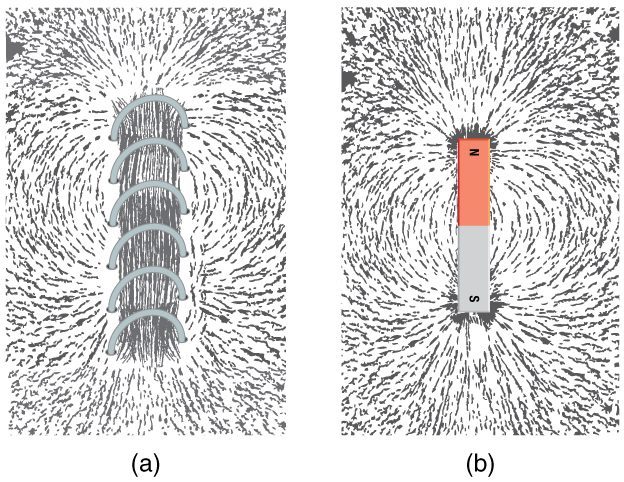
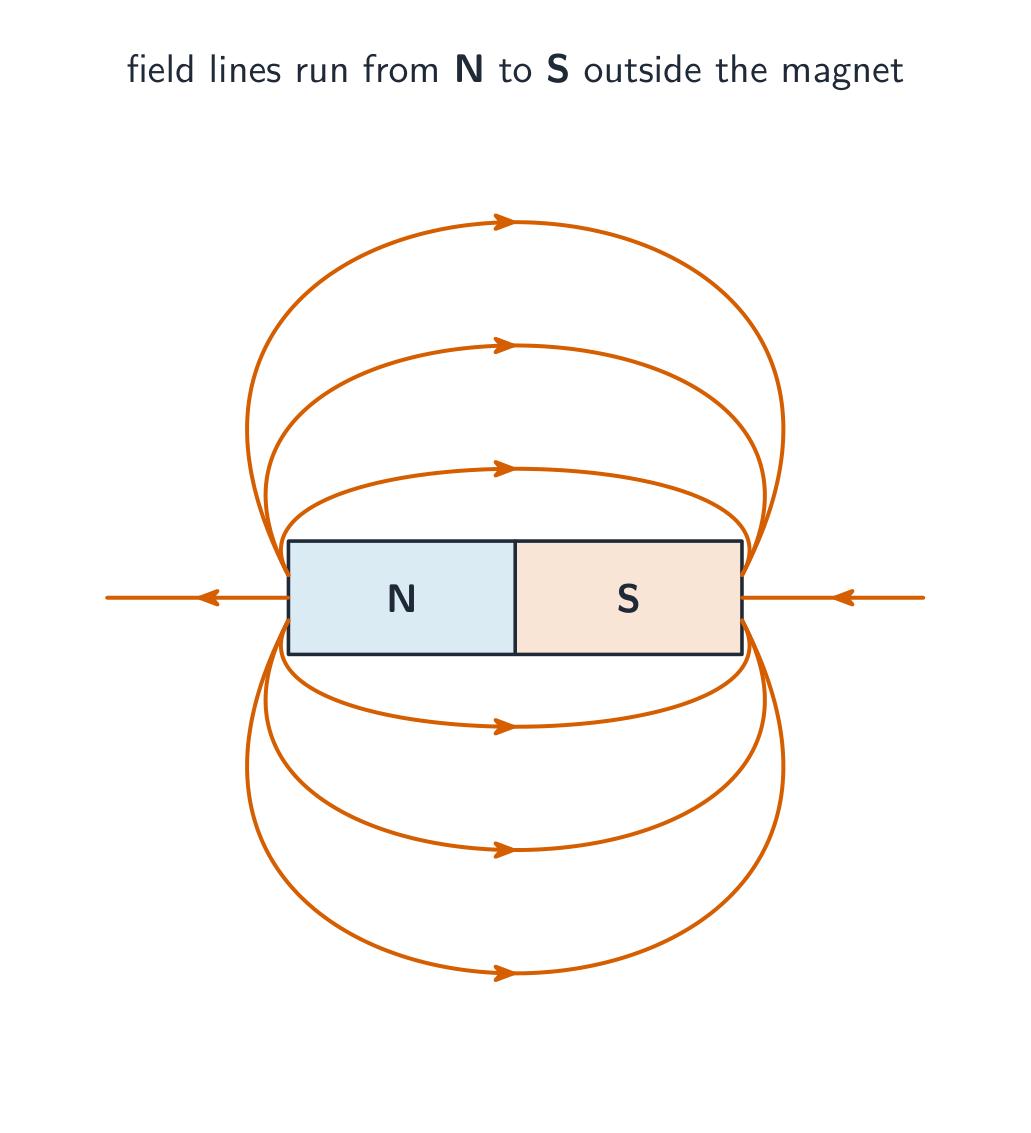
A magnetic field 磁场 $\vec{B}$ surrounds magnets and moving charges. Field lines run from a magnet's north pole to its south pole outside the magnet, and denser lines mean a stronger field. Magnetic poles always come in pairs – cutting a magnet in half makes two smaller magnets, never an isolated pole.

ไทย
สนามแม่เหล็กรอบกระแสไฟฟ้า
ม่านแสงสีเขียวเรืองแสงในท้องฟ้ายามค่ำคืนเหนือภูมิประเทศปกคลุมด้วยหิมะ
ออรора:อนุภาคที่มีประจุจากดวงอาทิตย์ถูก引导โดยสนามแม่เหล็กของโลกสู่ขั้วโลก, ที่ซึ่งพวกมันชนอากาศและทำให้มันเรืองแสง

วัสดุต่างๆ ตอบสนองต่อสนามแม่เหล็กแตกต่างกันอย่างมาก, และรายวิชาตั้งชื่อสามชนิด. วัสดุ เฟโรแม่เหล็ก (เหล็ก, นิกเกิล, คอปเปอร์) มีไดโพลที่จัดเรียงตัวแน่นหนาและ คง การจัดเรียงไว้, ดังนั้นจึงสามารถเป็นแม่เหล็กถาวรได้. วัสดุ พาราแม่เหล็ก (อะลูมิเนียม, ไทเทเนียม) จัดเรียงตัวได้เพียงเล็กน้อยและไม่คงการจัดเรียงไว้. วัสดุ ไดอะแม่เหล็ก - จริงๆ แล้ว ทุก วัสดุมีไดอะแม่เหล็กบางอย่าง - จัดเรียงตัวอ่อน ตรงข้าม กับสนาม. พฤติกรรมนี้เกิดจากคุณสมบัติของวัสดุ, ความไวต่อแม่เหล็ก: อากาศว่างเปล่ามีความไวต่อแม่เหล็กคงที่ $\mu_0$, ในขณะที่ความไวต่อแม่เหล็กของสสารแตกต่างจากมันและไม่แม้กระทั่งคงที่สำหรับวัสดุที่กำหนด

สนามแม่เหล็ก $\vec{B}$ ล้อมรอบแม่เหล็กและประจุที่เคลื่อนที่. เส้นสนามวิ่งจากขั้วเหนือไปขั้วใต้ของแม่เหล็กภายนอกแม่เหล็ก, และเส้นที่หนาแน่นกว่าหมายถึงสนามที่แรงขึ้น. ขั้วแม่เหล็กมาพร้อมกันเสมอเป็น คู่ – ตัดแม่เหล็กครึ่งหนึ่งจะได้แม่เหล็กเล็กสองชิ้น, ไม่เคยเป็นขั้วเดี่ยว

เส้นสนามวิ่งจาก N ไป S ภายนอกแม่เหล็กแท่ง, ใกล้เคียงกันเมื่อสนามแรงขึ้น
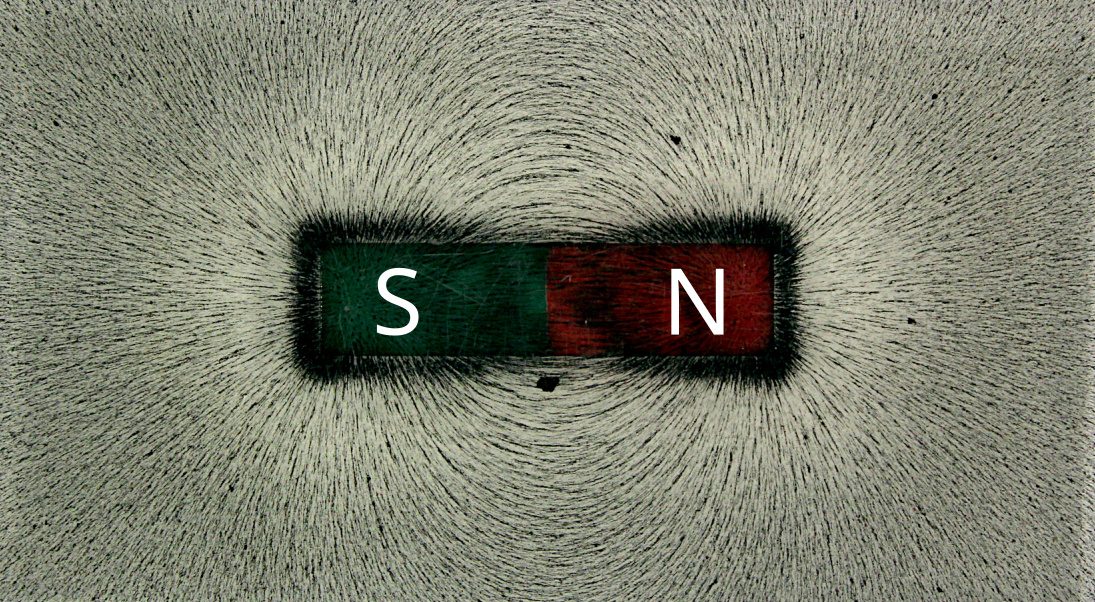
เกล็ดเหล็กจัดเรียงเป็นเส้นโค้งรอบแม่เหล็กแท่ง
เกล็ดเหล็กเรียงตัวตามสนามแม่เหล็ก, ทำให้เส้นสนามที่มองไม่เห็นของแม่เหล็กแท่งมองเห็นได้
Explore · ⁨สำรวจ⁩

See a magnet's field lines · ⁨เห็นเส้นสนามแม่เหล็กของแม่เหล็ก⁩

Magnetic field lines run from the north pole to the south pole outside the magnet. Where the lines crowd together the field is strongest. · ⁨เส้นสนามแม่เหล็ก วิ่งจากขั้วเหนือไปยังขั้วใต้ภายนอกแม่เหล็ก的地方ที่เส้น場的线หนาแน่นขึ้น意味着磁场最强。⁩

Vocabulary · ⁨คำศัพท์⁩ Train · ⁨ฝึกฝน⁩
English ไทย
Ferromagnetic/ˌferəməɡˈnetɪk/ ERENCE Ferromagnetic
Paramagnetic/ˌpærəməɡˈnetɪk/ PARAMAGNETIC Paramagnetic
Diamagnetic/ˌdaɪəməɡˈnetɪk/ Diamagnetic
permeability/ˌpɜːməˈbɪlɪti/ permeability
magnetic field/mæɡˈnetɪk fiːld/ สนามแม่เหล็ก
12.2

Magnetism and Moving Charges · ⁨แม่เหล็กและประจุที่เคลื่อนที่⁩

Syllabus · ⁨หลักสูตร⁩
English

Learning Objective 12.2.A: Describe the magnetic field produced by moving charged objects.

  • 12.2.A.1 A single moving charged object produces a magnetic field.
    • 12.2.A.1.i The magnetic field at a particular point produced by a moving charged object depends on the object's velocity and the distance between the point and the object.
    • 12.2.A.1.ii At a point in space, the direction of the magnetic field produced by a moving charged object is perpendicular to both the velocity of the object and the position vector from the object to that point in space and can be determined using the right-hand rule.
    • 12.2.A.1.iii The magnitude of the magnetic field is a maximum when the velocity vector and the position vector from the object to that point in space are perpendicular.

Learning Objective 12.2.B: Describe the force exerted on moving charged objects by a magnetic field.

  • 12.2.B.1 Magnetic forces describe interactions between moving charged objects.
  • 12.2.B.2 A magnetic field may exert a force on a charged object moving in that field.
    • 12.2.B.2.i The magnitude of the force exerted by a magnetic field on a moving charged object is proportional to the magnitude of the charge, the magnitude of the charged object's velocity, and the magnitude of the magnetic field and also depends on the angle between the velocity and magnetic field vectors.
      • Equation: $F_B = qvB\sin\theta$
    • 12.2.B.2.ii The direction of the force exerted by a magnetic field on a moving charged object is perpendicular to both the direction of the magnetic field and the velocity of the charge, as defined by the right-hand rule.
  • 12.2.B.3 In a region containing both a magnetic field and an electric field, a moving charged object will experience independent forces from each field.
  • 12.2.B.4 The Hall effect describes the potential difference created in a conductor by an external magnetic field that has a component perpendicular to the direction of charges moving in the conductor.

Boundary statement: Quantitative treatment of the magnitude of the magnetic force exerted by a magnetic field on a moving charge is limited to angles of 0, 90, and 180 degrees between the velocity and the magnetic field. Qualitative analysis of other angles is permitted.

ไทย

วัตถุประสงค์การเรียนรู้ 12.2.A: อธิบายสนามแม่เหล็กที่เกิดจากวัตถุที่มีประจุไฟฟ้าเคลื่อนที่

  • 12.2.A.1 วัตถุเดียวที่มีประจุไฟฟ้าเคลื่อนที่จะสร้างสนามแม่เหล็กได้
    • 12.2.A.1.i สนามแม่เหล็ก ณ จุดใดจุดหนึ่งซึ่งเกิดจากวัตถุที่มีประจุไฟฟ้าเคลื่อนที่ ขึ้นอยู่กับความเร็วของวัตถุนั้นและความห่างระหว่างจุดกับวัตถุ
    • 12.2.A.1.ii ณ จุดใดๆ ในอวกาศ ทิศทางของสนามแม่เหล็กที่เกิดจากวัตถุที่มีประจุไฟฟ้าเคลื่อนที่จะตั้งฉากกับทั้งความเร็วของวัตถุและเวกเตอร์ตำแหน่งจากวัตถุไปยังจุดนั้นในอวกาศ และสามารถหาได้โดยใช้กฎมือขวา
    • 12.2.A.1.iii ขนาดของสนามแม่เหล็กจะมีค่าสูงสุดเมื่อเวกเตอร์ความเร็วและเวกเตอร์ตำแหน่งจากวัตถุไปยังจุดนั้นในอวกาศตั้งฉากกัน

วัตถุประสงค์การเรียนรู้ 12.2.B: อธิบายแรงที่กระทำต่อวัตถุที่มีประจุไฟฟ้าเคลื่อนที่โดยสนามแม่เหล็ก

  • 12.2.B.1 แรงแม่เหล็กอธิบายถึงปฏิสัมพันธ์ระหว่างวัตถุที่มีประจุไฟฟ้าเคลื่อนที่
  • 12.2.B.2 สนามแม่เหล็กอาจ exert แรงต่อวัตถุที่มีประจุไฟฟ้าเคลื่อนที่ผ่านสนามนั้น
    • 12.2.B.2.i ขนาดของแรงที่กระทำโดยสนามแม่เหล็กต่อวัตถุที่มีประจุไฟฟ้าเคลื่อนที่ เป็นสัดส่วนกับขนาดของประจุไฟฟ้า, ขนาดของความเร็วของวัตถุที่มีประจุ, และขนาดของสนามแม่เหล็ก และยังขึ้นอยู่กับมุมระหว่างเวกเตอร์ความเร็วกับเวกเตอร์สนามแม่เหล็ก
      • สมการ: $F_B = qvB\sin\theta$
    • 12.2.B.2.ii ทิศทางของแรงที่กระทำโดยสนามแม่เหล็กต่อวัตถุที่มีประจุไฟฟ้าเคลื่อนที่จะตั้งฉากกับทั้งทิศทางของสนามแม่เหล็กและความเร็วของประจุ ตามที่กำหนดโดยกฎมือขวา
  • 12.2.B.3 ในบริเวณที่มีทั้งสนามแม่เหล็กและสนามไฟฟ้า วัตถุที่มีประจุไฟฟ้าเคลื่อนที่จะได้รับแรง分别从แต่ละสนามอย่างอิสระต่อกัน
  • 12.2.B.4 ผล Hall (Hall effect) อธิบายถึงความต่างศักย์ที่เกิดขึ้นในตัวนำเนื่องจากสนามแม่เหล็กภายนอกที่มีส่วนประกอบตั้งฉากกับทิศทางการเคลื่อนที่ของประจุไฟฟ้าในตัวนำ

คำจำกัดขอบเขต: การคำนวณเชิงปริมาณของขนาดแรงแม่เหล็กที่กระทำต่อประจุไฟฟ้าเคลื่อนที่จำกัดอยู่ที่มุม 0, 90 และ 180 องศา ระหว่างความเร็วและสนามแม่เหล็ก การวิเคราะห์เชิงคุณภาพสำหรับมุมอื่นๆ อนุญาตให้ทำได้

Source: College Board AP Course and Exam Description · ⁨แหล่งที่มา: คำอธิบายหลักสูตรและข้อสอบ College Board AP⁩

English
A moving charge in a magnetic field

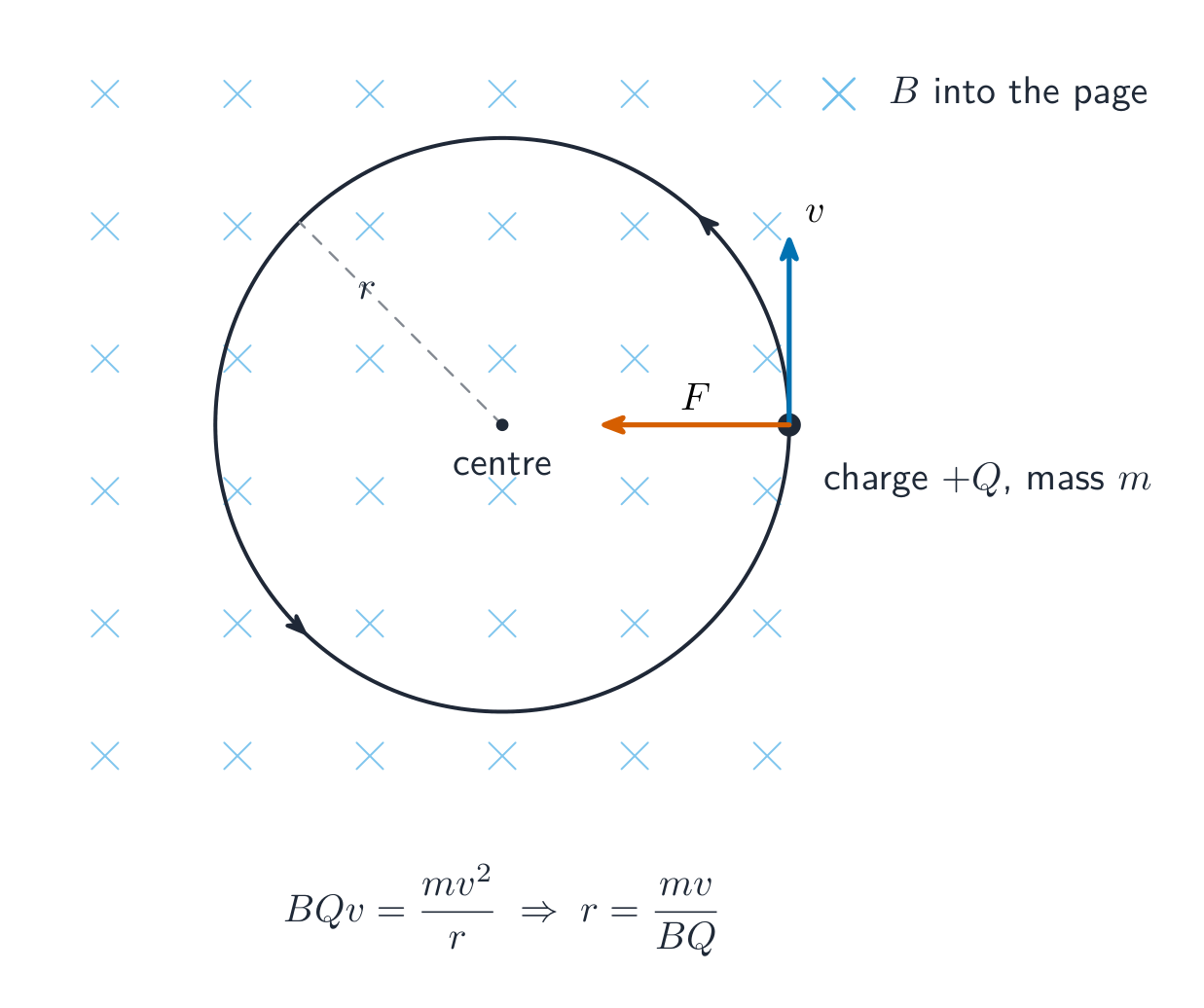
A charge moving through a magnetic field feels a magnetic force 磁力:

$$F=qvB\sin\theta,$$
where $\theta$ is the angle between the velocity and the field. The force is perpendicular to both $\vec{v}$ and $\vec{B}$ (use the right-hand rule), so it changes direction but not speed – a charge moving perpendicular to a uniform field travels in a circle. A stationary charge, or one moving parallel to the field, feels no magnetic force.

Worked example. A proton ($q=1.6\times10^{-19}\ \text{C}$, $m=1.67\times10^{-27}\ \text{kg}$) enters a $0.50\ \text{T}$ field at $2.0\times10^{5}\ \text{m/s}$, at right angles to the field. The magnetic force is

$$F=qvB=1.6\times10^{-19}\times2.0\times10^{5}\times0.50=1.6\times10^{-14}\ \text{N}.$$
This force is the centripetal force, so it bends the proton into a circle of radius
$$r=\frac{mv}{qB}=\frac{1.67\times10^{-27}\times2.0\times10^{5}}{1.6\times10^{-19}\times0.50}=4.2\times10^{-3}\ \text{m}.$$
Setting $qvB=\dfrac{mv^2}{r}$ and cancelling gives that neat $r=mv/(qB)$ – the principle behind mass spectrometers.

ไทย
ประจุที่เคลื่อนที่ในสนามแม่เหล็ก

ประจุที่เคลื่อนที่ผ่านสนามแม่เหล็กจะสัมผัสกับ แรงแม่เหล็ก:

$$F=qvB\sin\theta,$$
โดยที่ $\theta$ คือมุมระหว่างความเร็วและสนาม แรงนี้ ตั้งฉาก กับทั้ง $\vec{v}$ และ $\vec{B}$ (ใช้กฎมือขวา) ดังนั้นจึงเปลี่ยนทิศทางแต่ไม่เปลี่ยนความเร็ว – ประจุที่เคลื่อนที่ตั้งฉากกับสนามสม่ำเสมอจะเคลื่อนที่ตาม วงกลม ประจุที่หยุดนิ่งหรือเคลื่อนที่ขนานกับสนามจะไม่สัมผัสแรงแม่เหล็ก

อนุภาคที่มีประจุเคลื่อนที่ผ่านสนามแม่เหล็กจะเคลื่อนที่ตามเส้นทางวงกลม

ตัวอย่างโจทย์พร้อมวิธีทำ. โปรตอน ($q=1.6\times10^{-19}\ \text{C}$, $m=1.67\times10^{-27}\ \text{kg}$) เข้าสู่สนาม $0.50\ \text{T}$ ที่ $2.0\times10^{5}\ \text{m/s}$ โดยตั้งฉากกับสนาม แรงแม่เหล็กคือ

$$F=qvB=1.6\times10^{-19}\times2.0\times10^{5}\times0.50=1.6\times10^{-14}\ \text{N}.$$
แรงนี้เป็นแรงเข้าศูนย์กลาง จึงทำให้โปรตอนโค้งเป็นวงกลมที่มีรัศมี
$$r=\frac{mv}{qB}=\frac{1.67\times10^{-27}\times2.0\times10^{5}}{1.6\times10^{-19}\times0.50}=4.2\times10^{-3}\ \text{m}.$$
เมื่อแทนค่า $qvB=\dfrac{mv^2}{r}$ และตัดตัวประกอบจะได้ $r=mv/(qB)$ ที่สวยงาม – ซึ่งเป็นหลักการของสเปกโตรมิเตอร์มวล

Vocabulary · ⁨คำศัพท์⁩ Train · ⁨ฝึกฝน⁩
English ไทย
magnetic force/mæɡˈnetɪk fɔːs/ แรงแม่เหล็ก
12.3

Magnetism and Current-Carrying Wires · ⁨แม่เหล็กไฟฟ้าและสายไฟที่ไหลผ่านกระแสไฟฟ้า⁩

Syllabus · ⁨หลักสูตร⁩
English

Learning Objective 12.3.A: Describe the magnetic field produced by a current-carrying wire.

  • 12.3.A.1 A current-carrying wire produces a magnetic field.
    • 12.3.A.1.i The magnetic field vectors around a long, straight, current-carrying wire are tangent to concentric circles centered on that wire. The field has no component toward, away from, or parallel to the long, straight, current-carrying wire.
    • 12.3.A.1.ii At a point in space, the magnitude of the magnetic field due to a long, straight, current-carrying wire is proportional to the magnitude of the current in the wire and inversely proportional to the perpendicular distance from the central axis of the wire to the point.
      • Equation: $B = \dfrac{\mu_0}{2\pi}\dfrac{I}{r}$
    • 12.3.A.1.iii The direction of the magnetic field created by a current-carrying wire is determined with the right-hand rule.
    • 12.3.A.1.iv The direction of the magnetic field at the center of a current-carrying loop is directed along the axis of the loop and can be found using the right-hand rule.
    • 12.3.A.1.v The magnetic field at a location near two or more current-carrying wires can be determined using vector addition principles.

Learning Objective 12.3.B: Describe the force exerted on a current-carrying wire by a magnetic field.

  • 12.3.B.1 A magnetic field may exert a force on a current-carrying wire.
    • 12.3.B.1.i The magnitude of the force exerted by a magnetic field on a current-carrying wire is proportional to the current, the length of the portion of the wire within the magnetic field, and the magnitude of the magnetic field, and also depends on the angle between the direction of the current in the wire and the direction of the magnetic field.
      • Equation: $F_B = I\ell B\sin\theta$
    • 12.3.B.1.ii The direction of the force exerted by the magnetic field on a current-carrying wire is determined by the right-hand rule.
ไทย

วัตถุประสงค์การเรียนรู้ 12.3.A: อธิบายสนามแม่เหล็กที่เกิดจากสายไฟที่มีกระแสไหลผ่าน

  • 12.3.A.1 สายไฟที่มีกระแสไหลผ่านจะสร้างสนามแม่เหล็กได้
    • 12.3.A.1.i เวกเตอร์สนามแม่เหล็กรอบๆ สายไฟตรงยาวที่มีกระแสไหลผ่านจะเป็นเส้นสัมผัสกับวงกลมร่วมศูนย์ที่มีศูนย์กลางอยู่ที่สายฟ้านั้น สนามไม่มีส่วนประกอบชี้เข้าหา ชี้ห่างออก หรือขนานกับสายไฟตรงยาวที่มีกระแสไหลผ่าน
    • 12.3.A.1.ii ณ จุดใดจุดหนึ่งในอวกาศ ขนาดของสนามแม่เหล็กเนื่องจากสายไฟตรงยาวที่มีกระแสไหลผ่าน เป็นสัดส่วนกับขนาดของกระแสในสายไฟและผกผันกับความห่างตั้งฉากจากแกนกลางของสายไฟไปยังจุดนั้น
      • สมการ: $B = \dfrac{\mu_0}{2\pi}\dfrac{I}{r}$
    • 12.3.A.1.iii ทิศทางของสนามแม่เหล็กที่เกิดจากสายไฟที่มีกระแสไหลผ่าน สามารถกำหนดได้ด้วยกฎมือขวา
    • 12.3.A.1.iv ทิศทางของสนามแม่เหล็กที่ศูนย์กลางของวงลูปที่มีกระแสไหลผ่าน จะชี้ไปตามแกนของวงลูป และสามารถหาได้โดยใช้กฎมือขวา
    • 12.3.A.1.v สนามแม่เหล็ก ณ ตำแหน่งใกล้สายไฟที่มีกระแสไหลผ่านสองเส้นขึ้นไป สามารถหาได้โดยใช้หลักการบวกเวกเตอร์

วัตถุประสงค์การเรียนรู้ 12.3.B: อธิบายแรงที่กระทำต่อสายไฟที่มีกระแสไหลผ่านโดยสนามแม่เหล็ก

  • 12.3.B.1 สนามแม่เหล็กอาจ exert แรงต่อสายไฟที่มีกระแสไหลผ่าน
    • 12.3.B.1.i ขนาดของแรงที่กระทำโดยสนามแม่เหล็กต่อสายไฟที่มีกระแสไหลผ่าน เป็นสัดส่วนกับกระแส, ความยาวของส่วนสายไฟที่อยู่ในสนามแม่เหล็ก, และขนาดของสนามแม่เหล็ก และยังขึ้นอยู่กับมุมระหว่างทิศทางการไหลของกระแสในสายไฟกับทิศทางของสนามแม่เหล็ก
      • สมการ: $F_B = I\ell B\sin\theta$
    • 12.3.B.1.ii ทิศทางของแรงที่กระทำโดยสนามแม่เหล็กต่อสายไฟที่มีกระแสไหลผ่าน สามารถกำหนดได้ด้วยกฎมือขวา

Source: College Board AP Course and Exam Description · ⁨แหล่งที่มา: คำอธิบายหลักสูตรและข้อสอบ College Board AP⁩

English

Because a current is moving charge, a magnetic field pushes on a current-carrying wire:

$$F=BIL\sin\theta.$$
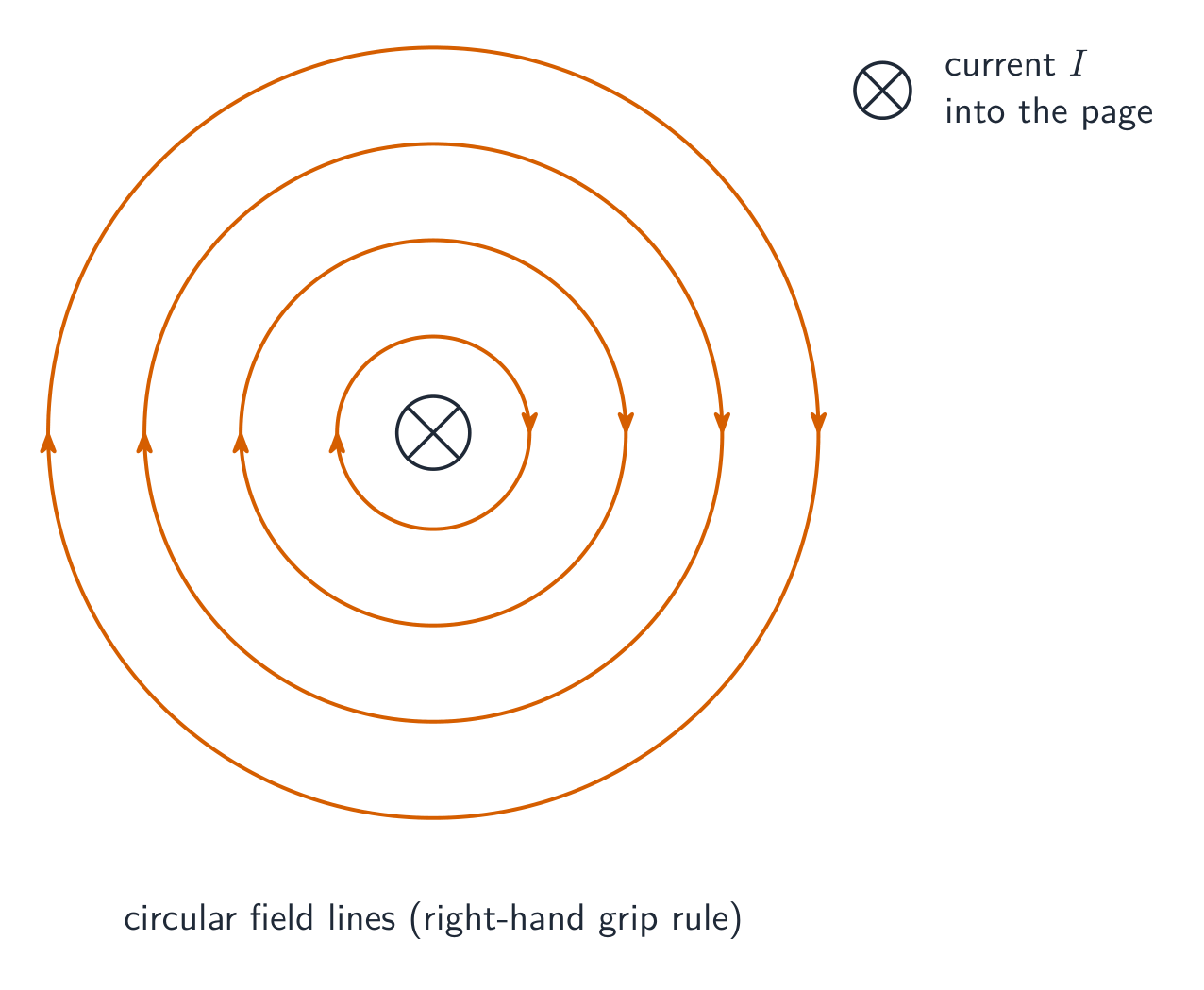
A current also creates its own magnetic field: circular field lines wrap around a straight wire (right-hand rule), and a coil (solenoid) makes a field like a bar magnet. This is how electromagnets and motors work.

Worked example. A $0.30\ \text{m}$ length of wire carries $4.0\ \text{A}$ at right angles to a $0.20\ \text{T}$ field. The force on it is $F=BIL=0.20\times4.0\times0.30=0.24\ \text{N}$ – the push that turns a motor's coil.

ไทย

เนื่องจากกระแสไฟฟ้าคือประจุที่เคลื่อนที่ สนามแม่เหล็กจึงกระทำต่อ สายไฟที่ไหลผ่านกระแสไฟฟ้า:

$$F=BIL\sin\theta.$$
กระแสไฟฟ้ายัง สร้าง สนามแม่เหล็กของตนเอง: เส้นสนามวงกลมพันรอบสายตรง (กฎมือขวา) และคอยล์ (โซเลนอยด์) สร้างสนามคล้ายแท่งแม่เหล็ก นี่คือวิธีการทำงานของแม่เหล็กไฟฟ้าและมอเตอร์

เส้นสนามวงกลมซ้อนกันล้อมรอบสายไฟที่ไหลผ่านกระแสไฟฟ้าตรง

ตัวอย่างโจทย์พร้อมวิธีทำ. สายยาว $0.30\ \text{m}$ ไหลผ่านกระแส $4.0\ \text{A}$ ตั้งฉากกับสนาม $0.20\ \text{T}$ แรงที่เกิดขึ้นคือ $F=BIL=0.20\times4.0\times0.30=0.24\ \text{N}$ – وهيแรงดันที่ทำให้คอยล์ของมอเตอร์หมุน

คอยล์ที่ไหลผ่านกระแสไฟฟ้า (โซเลนอยด์) สร้างสนามแม่เหล็กที่มีรูปทรงเหมือนแท่งแม่เหล็ก
Explore · ⁨สำรวจ⁩

Find the force on a current in a field · ⁨หาแรงที่กระทำต่อกระแสไฟในสนาม⁩

A current in a magnetic field feels a force $F = BIL$, at right angles to both. Use the left-hand rule; reverse the current or field and the force flips. · ⁨กระแสไฟในสนามแม่เหล็กจะได้รับแรง $F = BIL$, ตั้งฉากกับทั้งสองอย่าง ใช้กฎมือซ้าย; กลับด้านกระแสไฟหรือสนามแล้วแรงจะกลับทิศทาง⁩

12.4

Electromagnetic Induction and Faraday's Law · ⁨การเหนี่ยวนำแม่เหล็กไฟฟ้าและกฎของฟาราเดย์⁩

Syllabus · ⁨หลักสูตร⁩
English

Learning Objective 12.4.A: Describe the induced electric potential difference resulting from a change in magnetic flux.

  • 12.4.A.1 Magnetic flux is a description of the amount of the component of a magnetic field that is perpendicular to a cross-sectional area.
  • 12.4.A.2 Magnetic flux through a surface is proportional to the magnitude of the component of the magnetic field perpendicular to the surface and to the cross-sectional area of the surface.
    • Equation: $\Phi_B = BA\cos\theta$
    • 12.4.A.2.i The area vector is defined to be perpendicular to the plane of the surface and directed outward from a closed surface.
    • 12.4.A.2.ii The sign of the magnetic flux indicates whether the magnetic field is parallel to or antiparallel to the area vector.
  • 12.4.A.3 Faraday’s law describes the relationship between changing magnetic flux and the resulting induced emf in a system.
    • Equation: $|\mathcal{E}| = \left|\dfrac{\Delta\Phi_B}{\Delta t}\right|$
  • 12.4.A.4 Lenz’s law is used to determine the direction of an induced emf resulting from a changing magnetic flux.
    • Equation: $\mathcal{E} = -\dfrac{\Delta\Phi_B}{\Delta t} = -\dfrac{\Delta(BA\cos\theta)}{\Delta t}$
    • 12.4.A.4.i An induced emf generates a current that creates a magnetic field that opposes the change in magnetic flux.
    • 12.4.A.4.ii The right-hand rule is used to determine the relationships between current, emf, and magnetic flux.
  • 12.4.A.5 A common example of electromagnetic induction is a conducting rod on conducting rails in a region with a uniform magnetic field.
    • Derived equation: $\mathcal{E} = B\ell v$
ไทย

วัตถุประสงค์การเรียนรู้ 12.4.A: อธิบายความต่างศักย์ไฟฟ้าเหนี่ยวนำที่เกิดจากการเปลี่ยนแปลงของฟลักซ์แม่เหล็ก

  • 12.4.A.1 ฟลักซ์แม่เหล็กคือคำอธิบายถึงปริมาณของส่วนประกอบของสนามแม่เหล็กที่ตั้งฉากกับพื้นที่หน้าตัด
  • 12.4.A.2 ฟลักซ์แม่เหล็กผ่านพื้นผิวเป็นสัดส่วนกับขนาดของส่วนประกอบของสนามแม่เหล็กที่ตั้งฉากกับพื้นผิวและกับพื้นที่หน้าตัดของพื้นผิวนั้น
    • สมการ: $\Phi_B = BA\cos\theta$
    • 12.4.A.2.i เวกเตอร์พื้นที่ถูกกำหนดให้เป็นตั้งฉากกับระนาบของพื้นผิวและชี้ออกจากพื้นผิวปิด
    • 12.4.A.2.ii สัญญาณของฟลักซ์แม่เหล็กบ่งบอก whether สนามแม่เหล็กขนานหรือตรงข้ามกับเวกเตอร์พื้นที่
  • 12.4.A.3 กฎของفارาเดย์อธิบายความสัมพันธ์ระหว่างการเปลี่ยนแปลงของฟลักซ์แม่เหล็กและ EMF ที่เหนี่ยวนำขึ้นในระบบ
    • สมการ: $|\mathcal{E}| = \left|\dfrac{\Delta\Phi_B}{\Delta t}\right|$
  • 12.4.A.4 กฎของเลนซ์ (Lenz’s law) ใช้เพื่อบังคับทิศทางของ EMF ที่เหนี่ยวนำขึ้นจากการเปลี่ยนแปลงของฟลักซ์แม่เหล็ก
    • สมการ: $\mathcal{E} = -\dfrac{\Delta\Phi_B}{\Delta t} = -\dfrac{\Delta(BA\cos\theta)}{\Delta t}$
    • 12.4.A.4.i EMF ที่เหนี่ยวนำจะเกิดกระแสไฟฟ้าซึ่งสร้างสนามแม่เหล็กที่ต้านทานการเปลี่ยนแปลงของฟลักซ์แม่เหล็ก
    • 12.4.A.4.ii กฎมือขวาใช้เพื่อกำหนดความสัมพันธ์ระหว่างกระแสไฟฟ้า EMF และฟลักซ์แม่เหล็ก
  • 12.4.A.5 ตัวอย่างที่พบบ่อยของการเหนี่ยวนำแม่เหล็กไฟฟ้าคือแท่งนำไฟฟ้าบนรางนำไฟฟ้าในบริเวณที่มีสนามแม่เหล็กสม่ำเสมอ
    • สมการที่ได้มา: $\mathcal{E} = B\ell v$

Source: College Board AP Course and Exam Description · ⁨แหล่งที่มา: คำอธิบายหลักสูตรและข้อสอบ College Board AP⁩

English
Electromagnetic induction

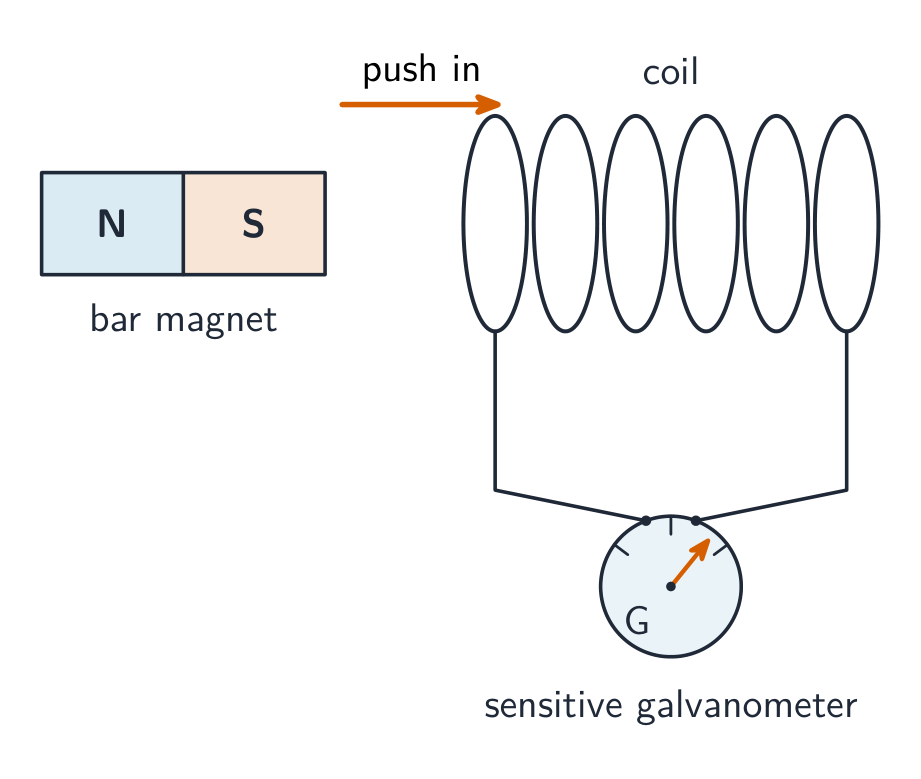
A changing magnetic field through a loop drives a current – electromagnetic induction 电磁感应. The magnetic flux 磁通量 $\Phi=BA\cos\theta$ measures how much field passes through the loop. Faraday's law 法拉第定律 gives the induced emf:

$$\varepsilon=-\frac{\Delta\Phi}{\Delta t}.$$
The flux changes if the field, the area, or the loop's orientation changes. Lenz's law 楞次定律 (the minus sign) says the induced current flows so as to oppose the change that caused it – the basis of generators.

Worked example. The magnetic flux through a single loop drops from $0.020\ \text{Wb}$ to $0.008\ \text{Wb}$ in $0.030\ \text{s}$. The average induced emf is

$$\varepsilon=\left|\frac{\Delta\Phi}{\Delta t}\right|=\frac{0.020-0.008}{0.030}=0.40\ \text{V}.$$
A coil of $N$ turns would give $N$ times this – which is why generators and transformers use many-turn coils.

ไทย
การเหนี่ยวนำแม่เหล็กไฟฟ้า

สนามแม่เหล็กที่เปลี่ยนแปลงผ่านวงลวดจะเกิดกระแสไฟฟ้า – การเหนี่ยวนำแม่เหล็กไฟฟ้า ฟลักซ์แม่เหล็ก $\Phi=BA\cos\theta$ วัดปริมาณสนามที่ผ่านวงลวด กฎของฟาราเดย์ ให้ค่า emf ที่เหนี่ยวนำ:

$$\varepsilon=-\frac{\Delta\Phi}{\Delta t}.$$
ฟลักซ์จะเปลี่ยนแปลงหากสนาม พื้นที่ หรือทิศทางของลูปเปลี่ยนไป กฎของเลนซ์ (เครื่องหมายลบ) บอกว่ากระแสที่ถูกเหนี่ยวนำจะไหลในทิศทางที่ ต้านทาน การเปลี่ยนแปลงที่ทำให้เกิดมัน – เป็นพื้นฐานของเครื่องกำเนิดไฟฟ้า

การนำแม่เหล็กเข้าไปในคอยล์จะเหนี่ยวนำ e.m.f. ที่กระตุ้นให้กระแสไหล

ตัวอย่างฝึกหัด. ฟลักซ์แม่เหล็กผ่านวงลวดเดียวลดลงจาก $0.020\ \text{Wb}$ เป็น $0.008\ \text{Wb}$ ในเวลา $0.030\ \text{s}$ ค่า emf ที่เหนี่ยวนำเฉลี่ยคือ

$$\varepsilon=\left|\frac{\Delta\Phi}{\Delta t}\right|=\frac{0.020-0.008}{0.030}=0.40\ \text{V}.$$
คอยล์จำนวน $N$ เสน่ จะให้ค่า × $N$ เท่า – นี่คือเหตุผลที่เครื่องกำเนิดไฟฟ้าและหม้อแปลงใช้คอยล์หลายชั้น

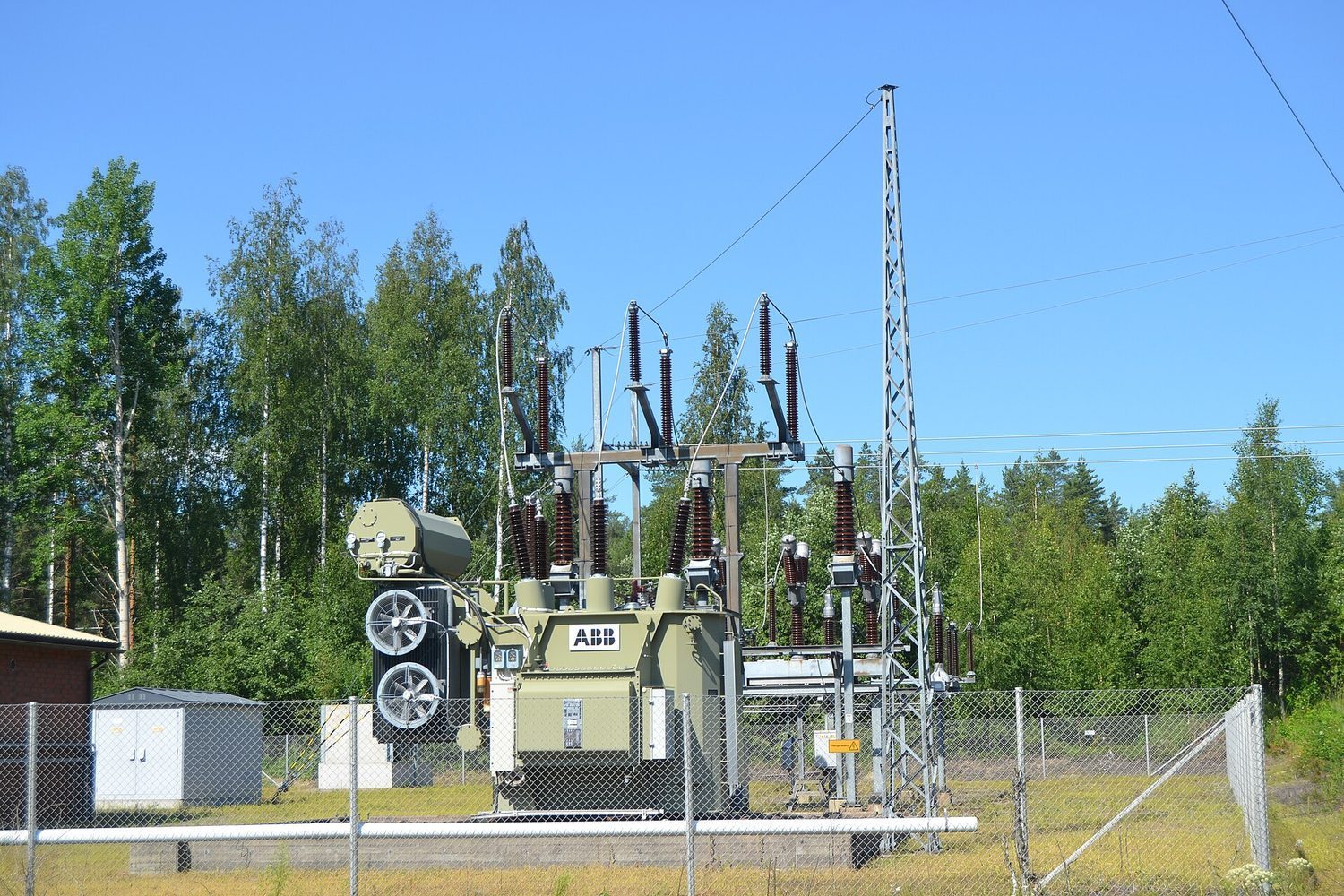
หม้อแปลงสถานีไฟฟ้า: ฟลักซ์แม่เหล็กที่เปลี่ยนแปลงในคอยล์เหนี่ยวนำโวลเทจที่ใช้จ่ายไฟสู่ระบบโครงข่าย
Explore · ⁨สำรวจ⁩

Induce a voltage by moving a magnet · ⁨เหนี่ยวนำแรงดันไฟฟ้าโดยการเคลื่อนย้ายแม่เหล็ก⁩

Faraday's law: a changing magnetic flux through a coil induces a voltage. Move the magnet faster and the induced EMF grows; Lenz's law sets its direction to oppose the change. · ⁨กฎของฟาราเดย์: การเปลี่ยนแปลงของฟลักซ์แม่เหล็กผ่านคอยล์จะเหนี่ยวนำแรงดันไฟฟ้า เคลื่อนย้ายแม่เหล็กเร็วขึ้นแล้ว EMF ที่เหนี่ยวนำจะเพิ่มขึ้น; กฎของเลนซ์ กำหนดทิศทางของมันเพื่อต่อต้านการเปลี่ยนแปลง⁩

Vocabulary · ⁨คำศัพท์⁩ Train · ⁨ฝึกฝน⁩
English ไทย
electromagnetic induction/ɪˌlektrəʊməɡˈnetɪk ɪnˈdʌkʃn/ การเหนี่ยวนำแม่เหล็กไฟฟ้า
magnetic flux/mæɡˈnetɪk flʌks/ ฟลักซ์แม่เหล็ก
Faraday's law/ˈfærədeɪz lɔː/ กฎของ فارาเดย์
Lenz's law/ˈlentsɪz lɔː/ กฎของเลนซ์
12.4

Exam tips · ⁨ข้อแนะนำสำหรับการสอบ⁩

English
  • The magnetic force $F=qvB\sin\theta$ is perpendicular to the velocity, so it changes direction (a circle) but not speed; a stationary charge or one moving along the field feels no force.
  • Use $F=BIL$ for the force on a current-carrying wire (the motor effect).
  • A current creates a magnetic field (circles around a wire; a solenoid acts like a bar magnet).
  • Induction needs a changing flux $\Phi=BA$ — a stationary magnet in a coil induces nothing.
  • Faraday: $\varepsilon=\Delta\Phi/\Delta t$ (times $N$ turns); Lenz: the induced current opposes the change (energy conservation).
ไทย
  • แรงแม่เหล็ก $F=qvB\sin\theta$ ตั้งฉาก กับความเร็ว จึงเปลี่ยนทิศทาง (เป็นวงกลม) แต่ไม่เปลี่ยนความเร็ว; ประจุที่หยุดนิ่งหรือเคลื่อนที่ ตาม ทิศทางของสนามจะไม่สัมผัสแรง
  • ใช้ $F=BIL$ สำหรับแรงกระทำต่อสายไฟที่ไหลผ่านกระแสไฟฟ้า (ผลของมอเตอร์)
  • กระแสไฟฟ้า สร้าง สนามแม่เหล็ก (วงกลมรอบสาย; โซเลนอยด์ทำหน้าที่เหมือนแท่งแม่เหล็ก)
  • การเหนี่ยวนำ ต้องอาศัยฟลักซ์ เปลี่ยนแปลง $\Phi=BA$ – แม่เหล็กที่หยุดนิ่งอยู่ในคอยล์จะไม่เหนี่ยวนำอะไร
  • ฟาราเดย์: $\varepsilon=\Delta\Phi/\Delta t$ (× $N$ ชั้น); เลนซ์: กระแสที่ถูกเหนี่ยวนำต้านทานการเปลี่ยนแปลง (การอนุรักษ์พลังงาน)

Interactive lessons on this topic · ⁨บทเรียนเชิงโต้ตอบสำหรับหัวข้อนี้⁩

Work through it step by step, with instant-check exercises. · ⁨ทำทีละขั้นตอน พร้อมแบบฝึกหัดตรวจสอบผลทันที⁩

Past Papers · ⁨ข้อสอบย้อนหลัง⁩

More topics in AP Physics 2 · ⁨หัวข้อเพิ่มเติมใน AP Physics 2⁩

Log in or create account · ⁨เข้าสู่ระบบหรือสร้างบัญชี⁩

IGCSE, A-Level & AP