Skip to content · ⁨ข้ามไปยังเนื้อหา⁩

Electric Force, Field, and Potential · ⁨แรงไฟฟ้า สนาม และศักย์ไฟฟ้า⁩

AP Physics 2 · Topic 10 · ⁨หัวข้อ 10⁩

Video lesson for this topic · ⁨บทเรียนวิดีโอสำหรับหัวข้อนี้⁩ Open the video page · ⁨เปิดหน้าวิดีโอ⁩
8:05

แรงไฟฟ้า สนาม และศักย์ไฟฟ้า

เมฆพายุคือโรงงานผลิตประจุ Interior ของคริสตัลน้ำแข็งชนกัน และอิเล็กตรอนสะสมอยู่ที่ด้านล่างของเมฆ พื้นดินด้านล่างกลายเป็นประจุบวก strlen...

English narration · English + 中文 subtitles burned in · ⁨การบรรยายภาษาอังกฤษ · คำบรรยายภาษาอังกฤษ + 中文 ลอยตัวบนภาพ⁩

10.1

Electric Charge and Electric Force · ⁨ประจุไฟฟ้าและแรงไฟฟ้า⁩

Syllabus · ⁨หลักสูตร⁩
English

Learning Objective 10.1.A: Describe the electric force that results from the interactions between charged objects or systems.

  • 10.1.A.1 Charge is a fundamental property of all matter.
    • 10.1.A.1.i Charge is described as positive or negative.
    • 10.1.A.1.ii The magnitude of the charge of a single electron or proton, the elementary charge $e$, can be considered to be the smallest indivisible amount of charge.
    • 10.1.A.1.iii The charge of an electron is $-e$, the charge of a proton is $+e$, and a neutron has no electric charge.
    • 10.1.A.1.iv A point charge is a model in which the physical size of a charged object or system is negligible in the context of the situation being analyzed.
  • 10.1.A.2 Coulomb's law describes the electrostatic force between two charged objects as directly proportional to the magnitude of each of the charges and inversely proportional to the square of the distance between the objects.
    • Equation: $\left|\vec{F}_E\right| = \dfrac{1}{4\pi\varepsilon_0}\dfrac{\left|q_1 q_2\right|}{r^2} = k\dfrac{\left|q_1 q_2\right|}{r^2}$
  • 10.1.A.3 The direction of the electrostatic force depends on the signs of the charges of the interacting objects and is parallel to the line of separation between the objects.
    • 10.1.A.3.i Two objects with charges of the same sign exert repulsive forces on each other.
    • 10.1.A.3.ii Two objects with charges of opposite signs exert attractive forces on each other.
  • 10.1.A.4 Electric forces are responsible for some of the macroscopic properties of objects in everyday experiences. However, the large number of particle interactions that occur make it more convenient to treat everyday forces in terms of nonfundamental forces called contact forces, such as normal force, friction, and tension.

Learning Objective 10.1.B: Describe the electric and gravitational forces that result from interactions between charged objects with mass.

  • 10.1.B.1 Electrostatic forces can be attractive or repulsive, while gravitational forces are always attractive.
  • 10.1.B.2 For any two objects that have mass and electric charge, the magnitude of the gravitational force is usually much smaller than the magnitude of the electrostatic force.
  • 10.1.B.3 Gravitational forces dominate at larger scales even though they are weaker than electrostatic forces, because systems at large scales tend to be electrically neutral.

Learning Objective 10.1.C: Describe the electric permittivity of a material or medium.

  • 10.1.C.1 Electric permittivity is a measurement of the degree to which a material or medium is polarized in the presence of an electric field.
  • 10.1.C.2 Electric polarization can be modeled as the induced rearrangement of electrons by an external electric field, resulting in a separation of positive and negative charges within a material or medium.
  • 10.1.C.3 Free space has a constant value of electric permittivity, $\varepsilon_0$, that appears in physical relationships.
  • 10.1.C.4 The permittivity of matter has a value different from that of free space that arises from the matter's composition and arrangement.
    • 10.1.C.4.i In a given material, electric permittivity is determined by the ease with which electrons can change configurations within the material.
    • 10.1.C.4.ii Conductors are made from electrically conducting materials in which charge carriers move easily; insulators are made from electrically nonconducting materials in which charge carriers cannot move easily.

Boundary statement: AP Physics 2 only expects students to make calculations of the electric force between four or fewer interacting charged objects or systems. The analysis of the resulting electric force from more charges is allowed in situations of high symmetry.

ไทย

จุดประสงค์การเรียนรู้ 10.1.A: อธิบายแรงไฟฟ้าที่เกิดจากปฏิสัมพันธ์ระหว่างวัตถุหรือระบบที่มีประจุ

  • 10.1.A.1 ประจุเป็นคุณสมบัติพื้นฐานของสสารทุกชนิด
    • 10.1.A.1.i ประจุถูกอธิบายว่าเป็นบวกหรือลบ
    • 10.1.A.1.ii ขนาดของประจุของอิเล็กตรอนหรือโปรตอนหนึ่งตัว ซึ่งเรียกว่าประจุพื้นฐาน $e$ สามารถพิจารณาได้ว่าเป็นหน่วยของประจุที่เล็กที่สุดและไม่แบ่งแยกได้อีก
    • 10.1.A.1.iii ประจุของอิเล็กตรอนคือ $-e$ ประจุของโปรตอนคือ $+e$ และนิวตรอนไม่มีประจุไฟฟ้า
    • 10.1.A.1.iv จุดประจุคือแบบจำลองที่ขนาดทางกายภาพของวัตถุหรือระบบที่มีประจุมีนัยสำคัญน้อยมากเมื่อเทียบกับบริบทที่กำลังวิเคราะห์อยู่
  • 10.1.A.2 กฎของคูลอมบ์อธิบายแรงอิเล็กโทรสแตติกระหว่างวัตถุที่มีประจุสองชนิดว่าแปรผันตรงกับขนาดของประจุแต่ละชนิดและแปรผกผันกับกำลังสองของระยะห่างระหว่างวัตถุ
    • สมการ: $\left|\vec{F}_E\right| = \dfrac{1}{4\pi\varepsilon_0}\dfrac{\left|q_1 q_2\right|}{r^2} = k\dfrac{\left|q_1 q_2\right|}{r^2}$
  • 10.1.A.3 ทิศทางของแรงอิเล็กโทรสแตติกขึ้นอยู่กับสัญญาณของประจุของวัตถุที่มีปฏิสัมพันธ์กัน และเป็นขนานกับเส้นที่เชื่อมระหว่างวัตถุทั้งสอง
    • 10.1.A.3.i วัตถุสองชนิดที่มีประจุชนิดเดียวกันจะ exert แรงผลักกันเอง
    • 10.1.A.3.ii วัตถุสองชนิดที่มีประจุต่างชนิดกันจะ exert แรงดูดกันเอง
  • 10.1.A.4 แรงไฟฟ้าเป็นสาเหตุของคุณสมบัติระดับมหภาคบางอย่างของวัตถุในประสบการณ์ประจำวัน อย่างไรก็ตาม จำนวนมากของปฏิสัมพันธ์ระหว่างอนุภาคที่เกิดขึ้นทำให้สะดวกกว่าที่จะพิจารณาแรงในชีวิตประจำวันใน terms of แรงที่ไม่ใช่พื้นฐานซึ่งเรียกว่าแรงสัมผัส เช่น แรงปกติ แรงเสียดทาน และแรงตึง

จุดประสงค์การเรียนรู้ 10.1.B: อธิบายแรงไฟฟ้าและแรงโน้มถ่วงที่เกิดจากปฏิสัมพันธ์ระหว่างวัตถุที่มีประจุและมีมวล

  • 10.1.B.1 แรงอิเล็กโทรสแตติกอาจเป็นแรงดึงดูดหรือแรงผลัก ในขณะที่แรงโน้มถ่วงจะเป็นแรงดึงดูดเสมอ
  • 10.1.B.2 สำหรับวัตถุสองวัตถุที่มีมวลและประจุไฟฟ้า แรงโน้มถ่วงจะมีขนาดน้อยกว่าแรงไฟฟ้าสถิตอย่างมีนัยสำคัญโดยทั่วไป
  • 10.1.B.3 แรงโน้มถ่วงมีอิทธิพลเหนือกว่าในระดับขนาดใหญ่แม้ว่าจะอ่อนกว่าแรงไฟฟ้าสถิต เนื่องจากระบบในระดับใหญ่มักจะเป็นกลางทางไฟฟ้า

จุดประสงค์การเรียนรู้ 10.1.C: อธิบายค่าความอนุจุนไฟฟ้า (electric permittivity) ของวัสดุหรือสื่อ

  • 10.1.C.1 ค่าความอนุจุนไฟฟ้าเป็นการวัดระดับการเกิดขั้วไฟฟ้าของวัสดุหรือสื่อเมื่ออยู่ในสนามไฟฟ้า
  • 10.1.C.2 การเกิดขั้วไฟฟ้าสามารถจำลองได้ด้วยการจัดเรียงตัวใหม่ของอิเล็กตรอนภายใต้สนามไฟฟ้าภายนอก ส่งผลให้เกิดการแยกตัวของประจุบวกและประจุลบภายในวัสดุหรือสื่อ
  • 10.1.C.3的空间มีค่าคงที่ของความอนุจุนไฟฟ้า $\varepsilon_0$ ซึ่งปรากฏในความสัมพันธ์ทางฟิสิกส์
  • 10.1.C.4 ความอนุจุนไฟฟ้าของสสารมีค่าแตกต่างจากค่าของพื้นที่ว่าง ซึ่งเกิดจากองค์ประกอบและการจัดเรียงตัวของสสารนั้นๆ
    • 10.1.C.4.i ในวัสดุที่กำหนด ค่าความอนุจุนไฟฟ้าถูกกำหนดโดยความสะดวกที่อิเล็กตรอนจะเปลี่ยนการจัดวางภายในวัสดุนั้น
    • 10.1.C.4.ii ตัวนำทำจากวัสดุที่นำไฟฟ้าซึ่งพาประจุเคลื่อนที่ได้ง่าย ส่วนฉนวนทำจากวัสดุที่ไม่สามารถนำไฟฟ้าซึ่งพาประจุเคลื่อนที่ได้ยาก

คำจำกัดขอบเขต: AP Physics 2 คาดหวังให้นักเรียนคำนวณแรงไฟฟ้าระหว่างวัตถุหรือระบบที่มีประจุสี่ตัวหรือน้อยกว่าเท่านั้น การวิเคราะห์แรงไฟฟ้าที่เกิดจากประจุมากกว่านี้อนุญาตได้ในสถานการณ์ที่มีความสมมาตรสูง

Source: College Board AP Course and Exam Description · ⁨แหล่งที่มา: คำอธิบายหลักสูตรและข้อสอบ College Board AP⁩

English

Electric charge 电荷 is a fundamental property of matter, and it comes in two kinds, positive and negative; like charges repel and opposite charges attract. Charge is conserved and quantized (a multiple of the elementary charge $e$). The force between two point charges is Coulomb's law 库仑定律:

$$F=\frac{k q_1 q_2}{r^2},$$
directed along the line joining them – an inverse-square law like gravity, but it can push or pull.

The constant $k$ hides a property of the medium: the permittivity 介电常数. Free space has a fixed permittivity of free space $\varepsilon_0$ (with $k = 1/4\pi\varepsilon_0$), while the permittivity of matter differs from $\varepsilon_0$, depending on the material's composition and arrangement - which is why a material between two charges changes the force. Note also that although the electric force is vastly stronger than gravity, gravity dominates at large scales, because large objects are usually electrically neutral (equal + and −), leaving only gravity to act.

Worked example. Two point charges, $+3.0\ \mu\text{C}$ and $-2.0\ \mu\text{C}$, sit $0.10\ \text{m}$ apart ($k=9.0\times10^{9}$). The force between them is

$$F=\frac{k q_1 q_2}{r^2}=\frac{9.0\times10^{9}\times(3.0\times10^{-6})(2.0\times10^{-6})}{(0.10)^2}=5.4\ \text{N},$$
attractive, because the charges have opposite signs. (Use the magnitudes for the size and decide the direction from the signs.)

ไทย

ประจุไฟฟ้า เป็น คุณสมบัติพื้นฐาน ของสสาร และมีสองชนิด คือ บวก และ ลบ; ประจุเหมือนกันจะผลักกัน และประจุต่างกันจะดึงดูดกัน ประจุถูก อนุรักษ์ และ ควอนไทซ์ (เป็นพหุคูณของประจุพื้นฐาน $e$). แรงระหว่างประจุจุดสองจุดคือ กฎของคูลอมบ์:

$$F=\frac{k q_1 q_2}{r^2},$$
ชี้ไปตามเส้นเชื่อมระหว่างมัน – เป็นกฎกำลังสองผกผันเหมือนแรงโน้มถ่วง แต่สามารถผลักหรือดึงได้

ค่าคงที่ $k$ ซ่อนคุณสมบัติของสื่อ: ค่าการยอมให้ไฟฟ้า.空间中มีค่าการยอมให้ไฟฟ้าของสุญญากาศคงที่ $\varepsilon_0$ (พร้อม $k = 1/4\pi\varepsilon_0$), ในขณะที่ค่าการยอมให้ไฟฟ้าของ สสาร แตกต่างจาก $\varepsilon_0$ ขึ้นอยู่กับองค์ประกอบและการจัดเรียงของวัสดุนั้น – นี่คือเหตุผลที่วัสดุระหว่างประจุสองจุดเปลี่ยนแรง需要注意的是,虽然电力远强于重力,但在大尺度上重力占主导,因为大物体通常是电中性的(正负电荷相等),只剩下重力作用。

ตัวอย่างฝึกหัด. ประจุจุดสองจุด มีขนาด $+3.0\ \mu\text{C}$ และ $-2.0\ \mu\text{C}$ วางห่างกัน $0.10\ \text{m}$ ($k=9.0\times10^{9}$). แรงระหว่าง нихคือ

$$F=\frac{k q_1 q_2}{r^2}=\frac{9.0\times10^{9}\times(3.0\times10^{-6})(2.0\times10^{-6})}{(0.10)^2}=5.4\ \text{N},$$
เป็นแรงดึงดูด เพราะประจุมีเครื่องหมายต่างกัน (ใช้ขนาดเพื่อหาขนาดแรง และใช้เครื่องหมายเพื่อกำหนดทิศทาง)

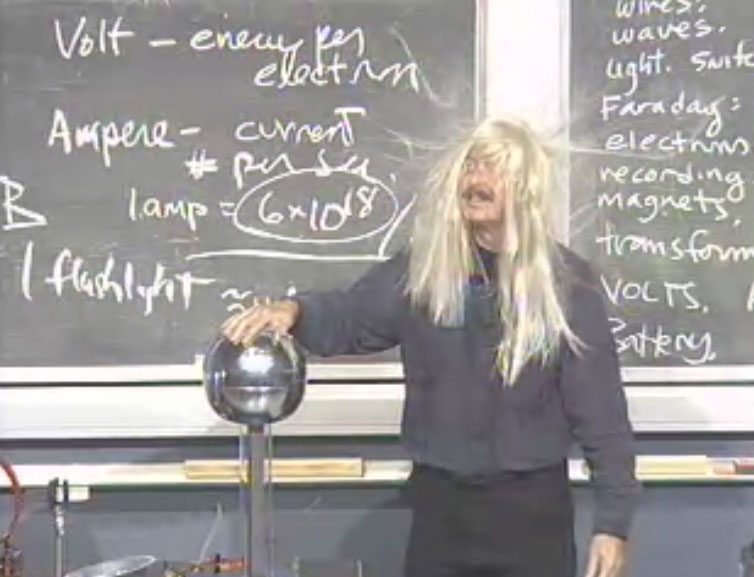
บุคคลสัมผัสเครื่อง Van de Graaff กับผมตั้งตรง
ประจุเหมือนกันผลักกัน: ผมแต่ละเส้นมีประจุเดียวกันมาจากเครื่อง Van de Graaff จึงผลักกัน
10.2

The Process of Charging · ⁨กระบวนการการทำให้มีประจุ⁩

Syllabus · ⁨หลักสูตร⁩
English

Learning Objective 10.2.A: Describe the behavior of a system using conservation of charge.

  • 10.2.A.1 The net charge or charge distribution of a system can change in response to the presence of, or changes in, the net charge or charge distribution of other systems.
    • 10.2.A.1.i The net charge of a system can change due to friction or contact between systems.
    • 10.2.A.1.ii Induced charge separation occurs when the electrostatic force between two systems alters the distribution of charges within the systems, resulting in the polarization of one or both systems.
    • 10.2.A.1.iii Induced charge separation can occur in neutral systems.
  • 10.2.A.2 Any change to a system's net charge is due to a transfer of charge between the system and its surroundings.
    • 10.2.A.2.i The charging of a system typically involves the transfer of electrons to and from the system.
    • 10.2.A.2.ii The net charge of a system will be constant unless there is a transfer of charge to or from the system.
  • 10.2.A.3 Grounding involves electrically connecting a charged system to a much larger and approximately neutral system (e.g., Earth).
ไทย

จุดประสงค์การเรียนรู้ 10.2.A: อธิบายพฤติกรรมของระบบโดยใช้หลักการอนุรักษ์ประจุ

  • 10.2.A.1 ประจุสุทธิหรือการกระจายตัวของประจุของระบบสามารถเปลี่ยนแปลงได้ตามการมีอยู่หรือการเปลี่ยนแปลงของประจุสุทธิหรือการกระจายตัวของประจุของระบบอื่น
    • 10.2.A.1.i ประจุสุทธิของระบบสามารถเปลี่ยนแปลงได้จากการเสียดสีหรือการสัมผัสระหว่างระบบ
    • 10.2.A.1.ii การแยกตัวของประจุด้วยวิธีเหนี่ยวนำเกิดขึ้นเมื่อแรงไฟฟ้าสถิตระหว่างระบบสองระบบ alters การกระจายตัวของประจุภายในระบบ ส่งผลให้เกิดการเกิดขั้วไฟฟ้าของระบบหนึ่งหรือทั้งสองระบบ
    • 10.2.A.1.iii การแยกตัวของประจุด้วยวิธีเหนี่ยวนำสามารถเกิดขึ้นในระบบที่เป็นกลางได้
  • 10.2.A.2 การเปลี่ยนแปลงใดๆ ของประจุสุทธิของระบบเกิดจากการถ่ายโอนประจุระหว่างระบบกับสิ่งแวดล้อมรอบข้าง
    • 10.2.A.2.i การทำให้ระบบเป็นไฟฟ้ามักเกี่ยวข้องกับการถ่ายโอนอิเล็กตรอนเข้าสู่และออกจากระบบ
    • 10.2.A.2.ii ประจุสุทธิของระบบจะคงที่เว้นแต่จะมีการถ่ายโอนประจุเข้าสู่หรือออกจากระบบ
  • 10.2.A.3 การต่อพื้น (grounding) เกี่ยวข้องกับการเชื่อมต่อระบบที่มีประจุเข้ากับระบบที่ใหญ่กว่ามากและเป็นกลางทางไฟฟ้าโดยประมาณ (เช่น โลก)

Source: College Board AP Course and Exam Description · ⁨แหล่งที่มา: คำอธิบายหลักสูตรและข้อสอบ College Board AP⁩

English

Objects charge by moving electrons. A conductor 导体 lets charge move freely; an insulator 绝缘体 holds it in place. Three methods:

  • Friction: rubbing transfers electrons.
  • Conduction 接触起电: touching shares charge.
  • Induction 感应起电: a nearby charge rearranges charge in a neutral object, which can then be grounded to leave it charged.
ไทย

วัตถุมีประจุโดยการเคลื่อนย้ายอิเล็กตรอน ตัวนำ อนุญาตให้ประจุเคลื่อนที่อิสระ; ฉนวน ยึดประจุไว้ที่เดิม มีสามวิธีการ:

  • การเสียดสี: การถูถ่ายโอนอิเล็กตรอน
  • การนำไฟฟ้า: การสัมผัสแบ่งปันประจุ
  • การเหนี่ยวนำ: ประจุใกล้เคียงจัดเรียง ulangประจุในวัตถุที่เป็นกลาง ซึ่งสามารถทำให้เป็นดินได้เพื่อให้มีประจุตกค้าง
Explore · ⁨สำรวจ⁩

Charge an object by rubbing · ⁨ทำให้วัตถุมีประจุด้วยการถู⁩

Rubbing transfers electrons from one surface to another, leaving one positively and one negatively charged. Like charges repel, opposite charges attract. · ⁨การถูถ่ายโอน อิเล็กตรอน จากพื้นผิวหนึ่งไปยังอีกพื้นผิวหนึ่ง ทำให้หนึ่งด้านมีประจุบวกและอีกด้านมีประจุลบ ประจุชนิดเดียวกันผลักกัน ประจุต่างชนิดกันดึงดูดกัน⁩

10.3

Electric Fields · ⁨สนามไฟฟ้า⁩

Syllabus · ⁨หลักสูตร⁩
English

Learning Objective 10.3.A: Describe the electric field produced by a charged object or configuration of point charges.

  • 10.3.A.1 Electric fields may originate from charged objects.
  • 10.3.A.2 The electric field at a given point is the ratio of the electric force exerted on a test charge at that point to the charge of the test charge.
    • Equation: $\vec{E} = \dfrac{\vec{F}_E}{q}$
    • 10.3.A.2.i A test charge is a point charge of small enough magnitude such that its presence does not significantly affect an electric field in its vicinity.
    • 10.3.A.2.ii An electric field points away from isolated positive charges and toward isolated negative charges.
    • 10.3.A.2.iii The electric force exerted on a positive test charge by an electric field is in the same direction as the electric field.
  • 10.3.A.3 The electric field is a vector quantity and can be represented in space using vector field maps.
    • 10.3.A.3.i The net electric field at a given location is the vector sum of individual electric fields created by nearby charged objects.
    • 10.3.A.3.ii Electric field maps use vectors to depict the magnitude and direction of the electric field at many locations within a given region.
    • 10.3.A.3.iii Electric field line diagrams are simplified models of electric field maps and can be used to determine the relative magnitude and direction of the electric field at any position in the diagram.

Learning Objective 10.3.B: Describe the electric field generated by charged conductors or insulators.

  • 10.3.B.1 While in electrostatic equilibrium, the excess charge of a solid conductor is distributed on the surface of the conductor, and the electric field within the conductor is zero.
    • 10.3.B.1.i At the surface of a charged conductor, the electric field is perpendicular to the surface.
    • 10.3.B.1.ii The electric field outside an isolated sphere with spherically symmetric charge distribution is the same as the electric field due to a point charge with the same net charge as the sphere located at the center of the sphere.
  • 10.3.B.2 While in electrostatic equilibrium, the excess charge of an insulator is distributed throughout the interior of the insulator as well as at the surface, and the electric field within the insulator may have a nonzero value.

Boundary statement: AP Physics 2 only expects students to make calculations of the electric field resulting from four or fewer charged objects or systems. Analysis of the electric field resulting from more charges is allowed in situations of high symmetry. Students will only be expected to perform qualitative analysis of electric fields within insulators.

ไทย

จุดประสงค์การเรียนรู้ 10.3.A: อธิบายสนามไฟฟ้าที่เกิดจากวัตถุที่มีประจุหรือการจัดวางของประจุจุด

  • 10.3.A.1 สนามไฟฟ้าอาจเกิดจากวัตถุที่มีประจุ
  • 10.3.A.2 สนามไฟฟ้าที่จุดใดจุดหนึ่งคืออัตราส่วนระหว่างแรงไฟฟ้าที่กระทำต่อบรรจุทดสอบที่จุดนั้นต่อประจุของบรรจุทดสอบ
    • สมการ: $\vec{E} = \dfrac{\vec{F}_E}{q}$
    • 10.3.A.2.i บรรจุภัณฑ์ทดสอบคือประจุจุดที่มีขนาดเล็กพอจนไม่ส่งผลกระทบอย่างมากต่อสนามไฟฟ้าบริเวณใกล้เคียง
    • 10.3.A.2.ii สนามไฟฟ้าชี้ออกจากประจุบวกแบบโดดเดี่ยวและชี้เข้าหาประจุลบแบบโดดเดี่ยว
    • 10.3.A.2.iii แรงไฟฟ้าที่กระทำต่อบรรจุทดสอบบวกโดยสนามไฟฟ้ามีทิศทางเดียวกับทิศทางของสนามไฟฟ้า
  • 10.3.A.3 สนามไฟฟ้าเป็นปริมาณเวกเตอร์และสามารถแสดงในพื้นที่ได้โดยใช้แผนที่สนามเวกเตอร์
    • 10.3.A.3.i สนามไฟฟ้าสุทธิที่ตำแหน่งใดตำแหน่งหนึ่งคือผลรวมเชิงเวกเตอร์ของสนามไฟฟ้า individuais ที่เกิดจากวัตถุที่มีประจุใกล้เคียง
    • 10.3.A.3.ii แผนที่สนามไฟฟ้าใช้เวกเตอร์เพื่อแสดงขนาดและทิศทางของสนามไฟฟ้า ณ หลายตำแหน่งภายในบริเวณที่กำหนด
    • 10.3.A.3.iii แผนภาพเส้นสนามไฟฟ้าเป็นโมเดลที่ลดทอนของแผนที่สนามไฟฟ้าและสามารถใช้เพื่อบ่งบอกขนาดสัมพัทธ์และทิศทางของสนามไฟฟ้าได้ทุกตำแหน่งในแผนภาพ

จุดประสงค์การเรียนรู้ 10.3.B: อธิบายสนามไฟฟ้าที่สร้างโดยตัวนำหรือฉนวนที่มีประจุ

  • 10.3.B.1 ในขณะที่อยู่ในสมดุลไฟฟ้าสถิต ประจุเกินของตัวนำแข็งจะกระจายอยู่บนพื้นผิวของตัวนำ และสนามไฟฟ้าภายในตัวนำจะมีค่าเป็นศูนย์
    • 10.3.B.1.i ที่พื้นผิวของตัวนำที่มีประจุ สนามไฟฟ้าจะตั้งฉากกับพื้นผิว
    • 10.3.B.1.ii สนามไฟฟ้าภายนอกทรงกลมแบบโดดเดี่ยวที่มีการกระจายตัวของประจุตามความสมมาตรทรงกลม จะมีค่าเท่ากับสนามไฟฟ้าเนื่องจากประจุจุดที่มีประจุสุทธิเท่ากันกับทรงกลม โดยตั้งอยู่ที่ศูนย์กลางของทรงกลม
  • 10.3.B.2 ในขณะที่อยู่ในสมดุลไฟฟ้าสถิต ประจุเกินของฉนวนจะกระจายอยู่ทั่วทั้งภายในของฉนวนรวมทั้งบนพื้นผิว และสนามไฟฟ้าภายในฉนวนอาจมีค่าไม่เท่ากับศูนย์

คำจำกัดขอบเขต: AP Physics 2 คาดหวังให้นักเรียนคำนวณสนามไฟฟ้าที่เกิดจากวัตถุหรือระบบที่มีประจุสี่ตัวหรือน้อยกว่าเท่านั้น การวิเคราะห์สนามไฟฟ้าที่เกิดจากประจุมากกว่านี้อนุญาตได้ในสถานการณ์ที่มีความสมมาตรสูง นักเรียนจะถูกคาดหวังให้ทำการวิเคราะห์เชิงคุณภาพของสนามไฟฟ้าภายในฉนวนเท่านั้น
Source: College Board AP Course and Exam Description · ⁨แหล่งที่มา: คำอธิบายหลักสูตรและข้อสอบ College Board AP⁩

English
The electric field of a dipole

An electric field 电场 $\vec{E}$ is the force per unit charge that a small positive test charge would feel:

$$\vec{E}=\frac{\vec{F}}{q},\qquad E=\frac{kQ}{r^2}\ \text{for a point charge}.$$
Field lines point away from positive charges and toward negative ones; where they are denser, the field is stronger. A charge in a field feels $\vec{F}=q\vec{E}$.

Worked example. Find the electric field $0.20\ \text{m}$ from a $+5.0\ \mu\text{C}$ point charge: $E=\dfrac{kQ}{r^2}=\dfrac{9.0\times10^{9}\times5.0\times10^{-6}}{(0.20)^2}=1.1\times10^{6}\ \text{N/C}$, pointing away from the charge. A $+2\ \text{nC}$ charge placed there would feel $F=qE=2\times10^{-9}\times1.1\times10^{6}=2.2\times10^{-3}\ \text{N}$.

ไทย
สนามไฟฟ้าของไดโพล
สายฟ้าฟาดหลายสายแยกสาขาจากท้องฟ้าฝนร้าวลงมายังท่าเรือ
สายฟ้า: ประจุสะสมจนสนามไฟฟ้าระหว่างเมฆและพื้นดินแข็งแกร่งพอที่จะดึงอิเล็กตรอนออกจากโมเลกุลอากาศ และมีกระแสไฟฟ้าขนาดใหญ่ไหลผ่าน

สนามไฟฟ้า $\vec{E}$ คือแรงต่อหน่วยประจุที่ประจุทดสอบบวกขนาดเล็กจะรู้สึกได้:

$$\vec{E}=\frac{\vec{F}}{q},\qquad E=\frac{kQ}{r^2}\ \text{for a point charge}.$$
เส้นสนามชี้ออกจากประจุบวกและเข้าสู่ประจุลบ;的地方越密,场越强。ประจุในสนามจะรู้สึกถึง $\vec{F}=q\vec{E}$

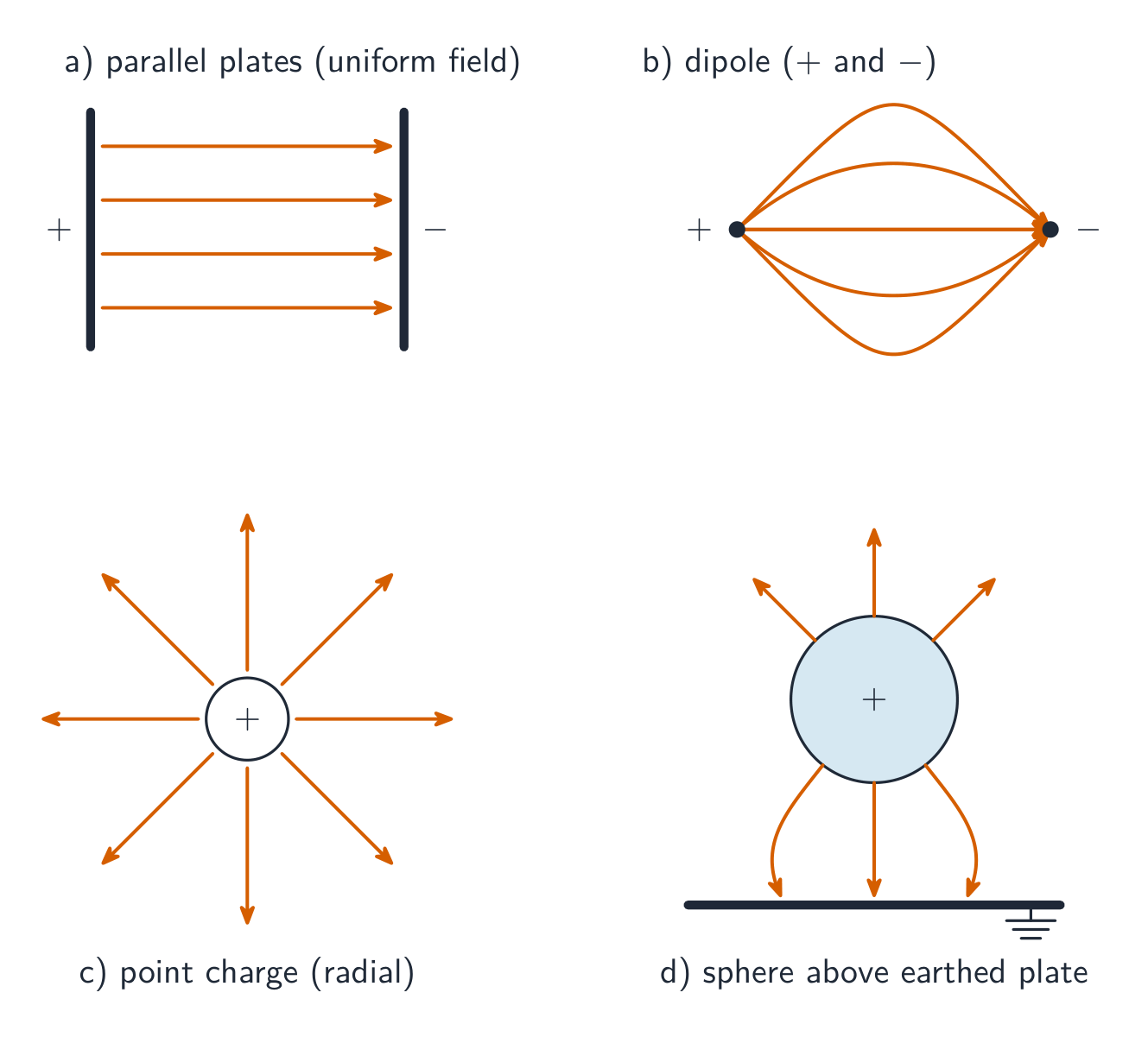
รูปแบบเส้นสนามไฟฟ้าสำหรับแผ่นขนาน Dipole และประจุจุด

ตัวอย่างฝึกหัด. หาสนามไฟฟ้า $0.20\ \text{m}$ จากประจุจุด $+5.0\ \mu\text{C}$: $E=\dfrac{kQ}{r^2}=\dfrac{9.0\times10^{9}\times5.0\times10^{-6}}{(0.20)^2}=1.1\times10^{6}\ \text{N/C}$ ชี้ออกจากประจุ. หากวางประจุ $+2\ \text{nC}$ ที่那儿จะรู้สึกถึง $F=qE=2\times10^{-9}\times1.1\times10^{6}=2.2\times10^{-3}\ \text{N}$

Explore · ⁨สำรวจ⁩

Map the field around a charge · ⁨แผนที่สนามรอบประจุ⁩

An electric field points the way a positive test charge would be pushed: away from a positive charge, toward a negative one. Closer lines mean a stronger field. · ⁨สนามไฟฟ้า ชี้ไปในทิศทางที่ประจุทดสอบบวกจะถูกผลัก: ออกจากประจุบวก เข้าหาประจุลบ เส้นที่ใกล้กันหมายถึงสนามที่แข็งแรงกว่า⁩

Vocabulary · ⁨คำศัพท์⁩ Train · ⁨ฝึกฝน⁩
English ไทย
Electric charge/ɪˈlektrɪk tʃɑːdʒ/ ประจุไฟฟ้า
Coulomb's law/ˈkuːlɒmz lɔː/ กฎของคูลอม
permittivity/ˌpɜːmɪˈtɪvəti/ permittivity
conductor/kənˈdʌktə/ ตัวนำ
insulator/ˈɪnsjuːleɪtə/ ฉนวน
Conduction/kənˈdʌkʃn/ การนำความร้อน
Induction/ɪnˈdʌkʃn/ การแนะนำตัว
electric field/ɪˈlektrɪk fiːld/ สนามไฟฟ้า
electric potential energy/ɪˈlektrɪk pəˈtenʃl ˈenədʒi/ พลังงานศักย์ไฟฟ้า
Electric potential/ɪˈlektrɪk pəˈtenʃl/ ศักย์ไฟฟ้า
10.4

Electric Potential Energy · ⁨พลังงานศักย์ไฟฟ้า⁩

Syllabus · ⁨หลักสูตร⁩
English

Learning Objective 10.4.A: Describe the electric potential energy of a system.

  • 10.4.A.1 The electric potential energy of a system of two point charges equals the amount of work required for an external force to bring the point charges to their current positions from infinitely far away.
  • 10.4.A.2 The general form for the electric potential energy of two charged objects is given by the equation
    • Equation: $U_E = \dfrac{1}{4\pi\varepsilon_0}\dfrac{q_1 q_2}{r} = k\dfrac{q_1 q_2}{r}$
  • 10.4.A.3 The total electric potential energy of a system can be determined by finding the sum of the electric potential energies of the individual interactions between each pair of charged objects in the system.

Boundary statement: As the methods to calculate the electric potential energy due to extended charge distributions exceed the scope of the course, AP Physics 2 only requires that students calculate the electric potential energy of configurations of four or fewer point charges.

ไทย

จุดประสงค์การเรียนรู้ 10.4.A: อธิบายพลังงานศักย์ไฟฟ้าของระบบ

  • 10.4.A.1 พลังงานศักย์ไฟฟ้าของระบบประจุจุดสองตัวเท่ากับปริมาณงานที่แรงภายนอกต้องทำเพื่อเคลื่อนย้ายประจุจุดเหล่านั้นจากระยะไกลไม่จำกัดมาสู่ตำแหน่งปัจจุบัน
  • 10.4.A.2 รูปแบบทั่วไปของพลังงานศักย์ไฟฟ้าของวัตถุที่มีประจุสองชิ้นถูกกำหนดโดยสมการ
    • สมการ: $U_E = \dfrac{1}{4\pi\varepsilon_0}\dfrac{q_1 q_2}{r} = k\dfrac{q_1 q_2}{r}$
  • 10.4.A.3 พลังงานศักย์ไฟฟ้ารวมของระบบสามารถหาได้จากการหาผลรวมของพลังงานศักย์ไฟฟ้าของการมีปฏิสัมพันธ์ระหว่างแต่ละคู่ของวัตถุที่มีประจุในระบบ

คำชี้ขอบเขต: เนื่องจากวิธีการคำนวณพลังงานศักย์ไฟฟ้าจากกระจายตัวของประจุขนาดใหญ่เกินขอบเขตของรายวิชา AP Physics 2 จึงกำหนดให้เพียงให้นักเรียนคำนวณพลังงานศักย์ไฟฟ้าของการจัดเรียงประจุจุดสี่ตัวหรือน้อยกว่าเท่านั้น

Source: College Board AP Course and Exam Description · ⁨แหล่งที่มา: คำอธิบายหลักสูตรและข้อสอบ College Board AP⁩

English

Two charges have electric potential energy 电势能 stored in their arrangement:

$$U=\frac{k q_1 q_2}{r}.$$
Like charges pushed together store positive energy; opposite charges have negative energy (bound). Moving a charge changes $U$, and the electric force does work equal to $-\Delta U$.

ไทย

ประจุสองชนิดมี พลังงานศักย์ไฟฟ้า เก็บอยู่ในการจัดวาง:

$$U=\frac{k q_1 q_2}{r}.$$
ประจุเหมือนกันที่ผลักกันจะเก็บพลังงานบวก; ประจุตรงข้ามจะมีพลังงานลบ (ถูกผูกมัด) การเคลื่อนย้ายประจุจะเปลี่ยน $U$, และแรงไฟฟ้าจะทำ功เท่ากับ $-\Delta U$.

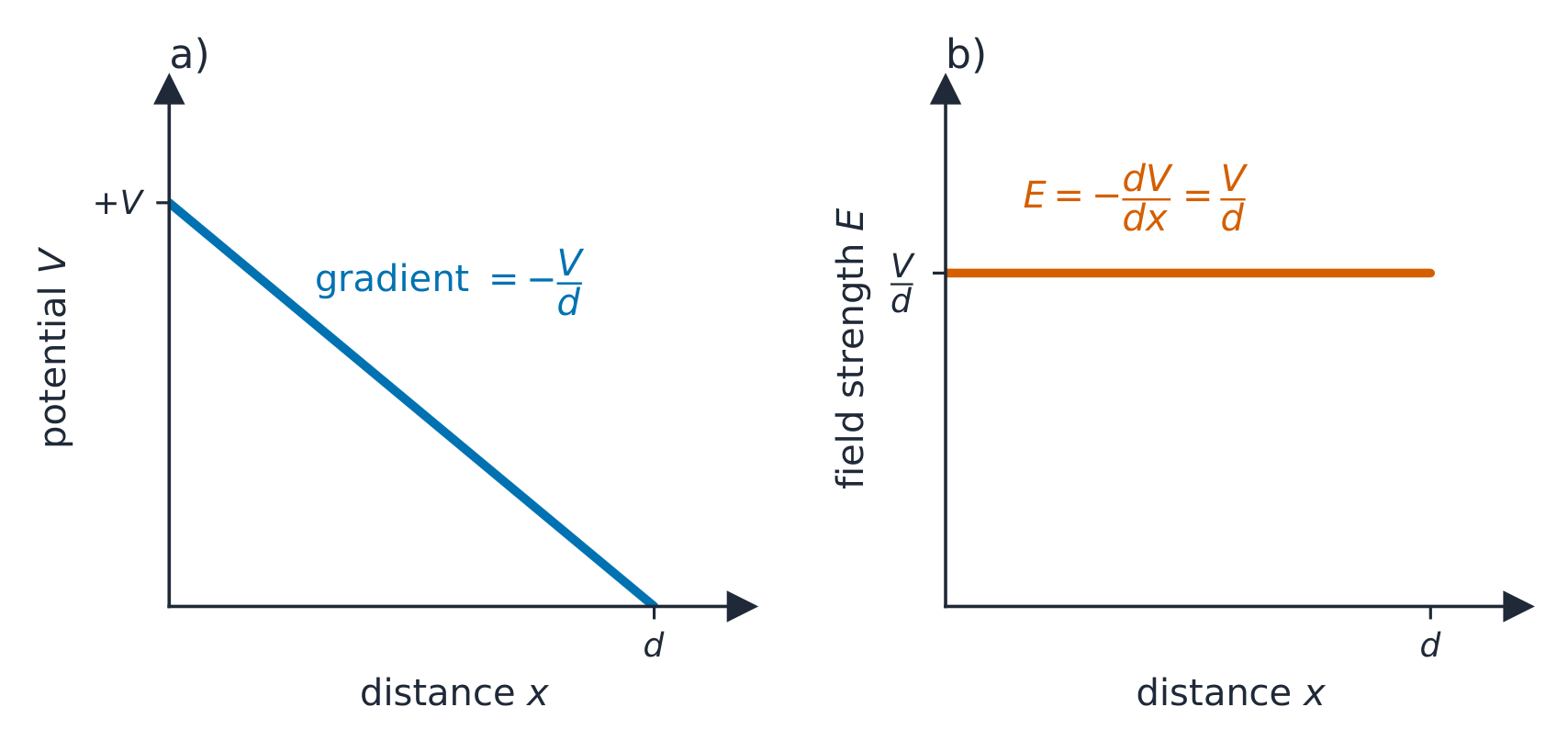
ในสนามสม่ำเสมอ ศักย์จะลดลงอย่างต่อเนื่องตามระยะทาง ดังนั้น E จึงสัมพันธ์กับ V
10.5

Electric Potential · ⁨ศักย์ไฟฟ้า⁩

Syllabus · ⁨หลักสูตร⁩
English

Learning Objective 10.5.A: Describe the electric potential due to a configuration of charged objects.

  • 10.5.A.1 Electric potential describes the electric potential energy per unit charge at a point in space.
  • 10.5.A.2 The electric potential due to multiple point charges can be determined by the principle of scalar superposition of the electric potential due to each of the point charges.
    • Equation: $V = \dfrac{1}{4\pi\varepsilon_0}\sum_{i}\dfrac{q_i}{r_i}$
  • 10.5.A.3 The electric potential difference between two points is the change in electric potential energy per unit charge when a test charge is moved between the two points.
    • Equation: $\Delta V = \dfrac{\Delta U_E}{q}$
    • 10.5.A.3.i Electric potential difference may also result from chemical processes that cause positive and negative charges to separate, such as in a battery.
  • 10.5.A.4 When conductors are in electrical contact, electrons will be redistributed such that the surfaces of the conductors are at the same electric potential.

Learning Objective 10.5.B: Describe the relationship between electric potential and electric field.

  • 10.5.B.1 The average electric field between two points in space is equal to the electric potential difference between the two points divided by the distance between the two points.
    • Equation: $\left|\vec{E}\right| = \left|\dfrac{\Delta V}{\Delta r}\right|$
  • 10.5.B.2 Electric field vector maps and equipotential lines are tools to describe the field produced by a charge or configuration of charges and can be used to predict the motion of charged objects in the field.
    • 10.5.B.2.i Equipotential lines represent lines of equal electric potential in space. These lines are also referred to as isolines of electric potential.
    • 10.5.B.2.ii Isolines are perpendicular to electric field vectors. An isoline map of electric potential can be constructed from an electric field vector map, and an electric field map may be constructed from an isoline map.
    • 10.5.B.2.iii An electric field vector points in the direction of decreasing potential.
    • 10.5.B.2.iv There is no component of an electric field along an isoline.

Boundary statement: As the methods to calculate the electric potential due to extended charges exceed the scope of the course, AP Physics 2 only expects that students calculate the electric potential of configurations of four or fewer particles (or more in situations of high symmetry).

ไทย

จุดประสงค์การเรียนรู้ 10.5.A: อธิบายศักย์ไฟฟ้าที่เกิดจากการจัดเรียงวัตถุที่มีประจุ

  • 10.5.A.1 ศักย์ไฟฟ้าอธิบายถึงพลังงานศักย์ไฟฟ้าต่อหน่วยประจุ ณ จุดหนึ่งในอวกาศ
  • 10.5.A.2 ศักย์ไฟฟ้าจากประจุจุดหลายตัวสามารถหาได้จากหลักการซ้อนทับสเกลาร์ (scalar superposition) ของศักย์ไฟฟ้าจากประจุจุดแต่ละตัว
    • สมการ: $V = \dfrac{1}{4\pi\varepsilon_0}\sum_{i}\dfrac{q_i}{r_i}$
  • 10.5.A.3 ความต่างศักย์ไฟฟ้าระหว่างสองจุดคือการเปลี่ยนแปลงของพลังงานศักย์ไฟฟ้าต่อหน่วยประจุเมื่อเคลื่อนย้ายประจุทดสอบระหว่างสองจุดนั้น
    • สมการ: $\Delta V = \dfrac{\Delta U_E}{q}$
    • 10.5.A.3.i ความต่างศักย์ไฟฟ้าอาจเกิดจากกระบวนการทางเคมีที่ทำให้ประจุบวกและประจุลบแยกออกจากกัน เช่น ในแบตเตอรี่
  • 10.5.A.4 เมื่อตัวนำอยู่ในสภาพสัมผัสทางไฟฟ้า อิเล็กตรอนจะมีการจัดเรียงใหม่จนผิวด้านบนของตัวนำเหล่านี้มีศักย์ไฟฟ้าเท่ากัน

จุดประสงค์การเรียนรู้ 10.5.B: อธิบายความสัมพันธ์ระหว่างศักย์ไฟฟ้ากับสนามไฟฟ้า

  • 10.5.B.1 สนามไฟฟ้าเฉลี่ยระหว่างสองจุดในอวกาศเท่ากับความต่างศักย์ไฟฟ้าระหว่างสองจุดนั้นหารด้วยระยะห่างระหว่างสองจุดนั้น
    • สมการ: $\left|\vec{E}\right| = \left|\dfrac{\Delta V}{\Delta r}\right|$
  • 10.5.B.2 แผนที่เวกเตอร์สนามไฟฟ้าและเส้น equipotential เป็นเครื่องมือในการอธิบายสนามที่เกิดจากประจุหรือการจัดเรียงของประจุ และสามารถใช้ทำนายการเคลื่อนที่ของวัตถุที่มีประจุในสนามนั้นได้
    • 10.5.B.2.i เส้น equipotential แทนเส้นที่มีค่าศักย์ไฟฟ้าเท่ากันในอวกาศ เส้นเหล่านี้ยังเรียกว่า isolines ของศักย์ไฟฟ้า
    • 10.5.B.2.ii Isolines ตั้งฉากกับเวกเตอร์สนามไฟฟ้า สามารถสร้างแผนที่ isolines ของศักย์ไฟฟ้าจากแผนที่เวกเตอร์สนามไฟฟ้าได้ และสามารถสร้างแผนที่สนามไฟฟ้าจากแผนที่ isolines ได้เช่นกัน
    • 10.5.B.2.iii เวกเตอร์สนามไฟฟ้าชี้ไปในทิศทางที่ศักย์ไฟฟ้าลดลง
    • 10.5.B.2.iv ไม่มีองค์ประกอบของสนามไฟฟ้าตามแนวเส้น isoline

คำชี้ขอบเขต: เนื่องจากวิธีการคำนวณศักย์ไฟฟ้าจากประจุขนาดใหญ่เกินขอบเขตของรายวิชา AP Physics 2 จึงคาดหวังว่านักเรียนจะคำนวณศักย์ไฟฟ้าของการจัดเรียงอนุภาคสี่ตัวหรือน้อยกว่าเท่านั้น (หรือมากกว่าในสถานการณ์ที่มีความสมมาตรสูง)

Source: College Board AP Course and Exam Description · ⁨แหล่งที่มา: คำอธิบายหลักสูตรและข้อสอบ College Board AP⁩

English

Electric potential 电势 $V$ is the potential energy per unit charge – a scalar field, measured in volts:

$$V=\frac{U}{q}=\frac{kQ}{r}.$$
The potential difference (voltage) 电压 between two points is the work per unit charge to move between them: $\Delta V=\dfrac{\Delta U}{q}$, and $U=qV$. Positive charges move from high to low potential on their own. Because potential is a scalar, adding the potentials from several charges is much easier than adding field vectors.

ไทย

ศักย์ไฟฟ้า $V$ คือพลังงานศักย์ต่อหน่วยประจุ – เป็นสเกลาร์ฟังก์ชัน, วัดเป็นโวลต์:

$$V=\frac{U}{q}=\frac{kQ}{r}.$$
ผลต่างศักย์ (แรงดันไฟฟ้า) ระหว่างจุดสองจุดคืองานต่อหน่วยประจุในการเคลื่อนระหว่างจุดนั้น: $\Delta V=\dfrac{\Delta U}{q}$, และ $U=qV$. ประจุบวกจะเคลื่อนจากศักย์สูงไปต่ำโดยธรรมชาติ เนื่องจากศักย์เป็น สเกลาร์, การรวมศักย์จากหลายประจุจึงง่ายกว่าการบวกเวกเตอร์สนามมาก.

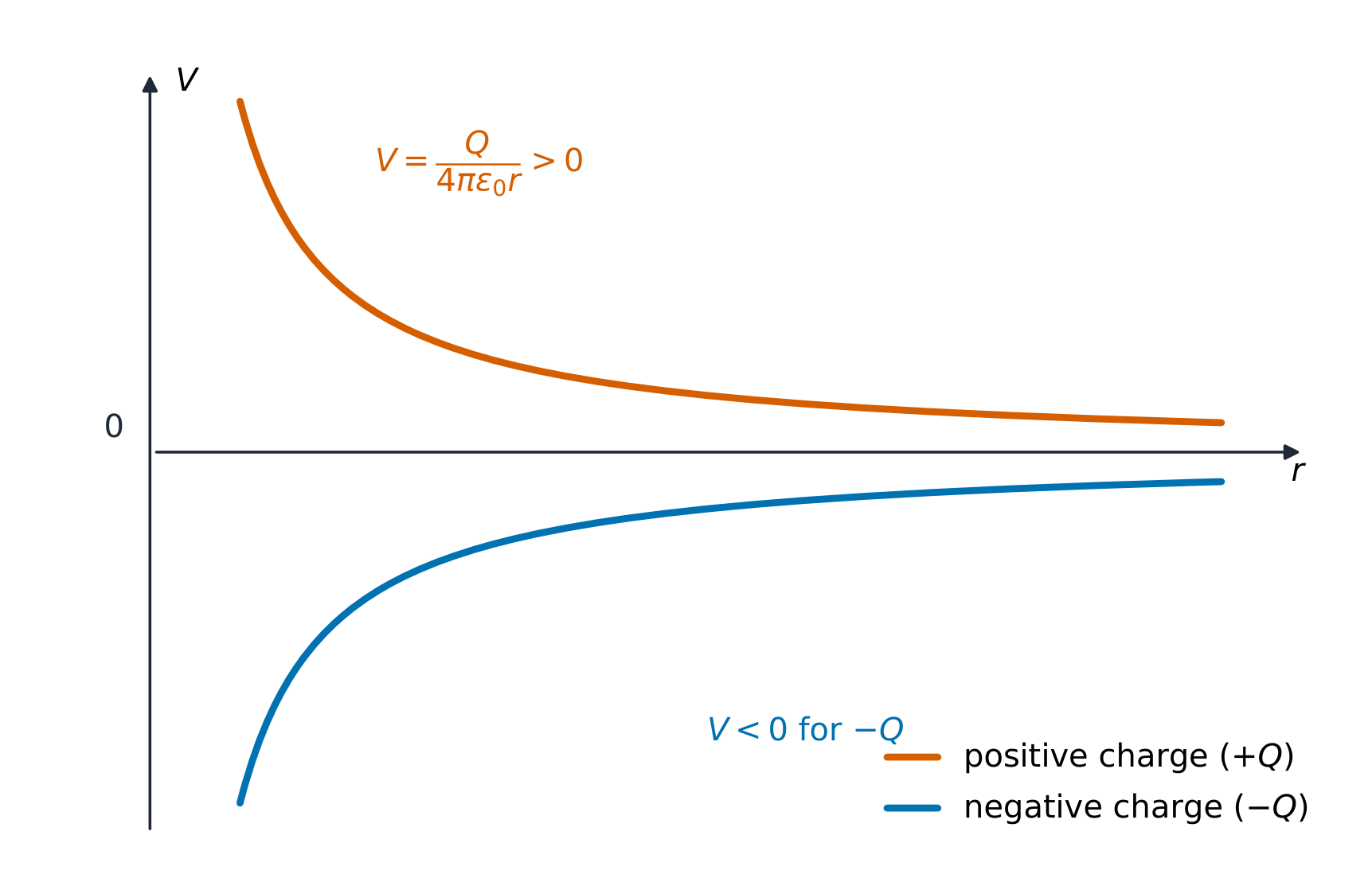
ศักย์ใกล้ประจุจุดแปรผันตาม 1/r
10.6

Capacitors · ⁨ตัวเก็บประจุ⁩

Syllabus · ⁨หลักสูตร⁩
English

Learning Objective 10.6.A: Describe the physical properties of a parallel-plate capacitor.

  • 10.6.A.1 A parallel-plate capacitor consists of two separated parallel conducting surfaces that can hold equal amounts of charge with opposite signs.
  • 10.6.A.2 Capacitance relates the magnitude of the charge stored on each plate to the electric potential difference created by the separation of those charges.
    • Equation: $C = \dfrac{Q}{\Delta V}$
    • 10.6.A.2.i The capacitance of a capacitor depends only on the physical properties of the capacitor, such as the capacitor's shape and the material used to separate the plates.
    • 10.6.A.2.ii The capacitance of a parallel-plate capacitor is proportional to the area of one of its plates and inversely proportional to the distance between its plates. The constant of proportionality is the product of the dielectric constant, $\kappa$, of the material between the plates and the electric permittivity of free space, $\varepsilon_0$.
      • Equation: $C = \kappa\varepsilon_0\dfrac{A}{d}$
  • 10.6.A.3 The electric field between two charged parallel plates with uniformly distributed electric charge, such as in a parallel-plate capacitor, is constant in both magnitude and direction, except near the edges of the plates.
    • 10.6.A.3.i The magnitude of the electric field between two charged parallel plates, where the plate separation is much smaller than the dimensions of the plates, can be described with the equation
      • Equation: $E_C = \dfrac{Q}{\kappa\varepsilon_0 A}$
    • 10.6.A.3.ii A charged particle between two oppositely charged parallel plates undergoes constant acceleration and therefore its motion shares characteristics with the projectile motion of an object with mass in the gravitational field near Earth's surface.
  • 10.6.A.4 The electric potential energy stored in a capacitor is equal to the work done by an external force to separate that amount of charge on the capacitor.
  • 10.6.A.5 The electric potential energy stored in a capacitor is described by the equation
    • Equation: $U_C = \dfrac{1}{2}Q\Delta V$
  • 10.6.A.6 Adding a dielectric between two plates of a capacitor changes the capacitance of the capacitor and induces an electric field in the dielectric in the opposite direction to the field between the plates.

Boundary statement: While other shapes are also able to separate charges, only the analysis and descriptions of parallel-plate capacitors are required for AP Physics 2. Edge effects will be ignored unless explicitly stated otherwise.

ไทย

จุดประสงค์การเรียนรู้ 10.6.A: อธิบายคุณสมบัติทางกายภาพของตัวเก็บประจุแบบแผ่นขนาน

  • 10.6.A.1 ตัวเก็บประจุแบบแผ่นขนานประกอบด้วยพื้นผิวตัวนำขนานสองชั้นที่แยกออกจากกัน ซึ่งสามารถเก็บประจุได้ในปริมาณเท่ากันแต่มีสัญญาณตรงข้ามกัน
  • 10.6.A.2 ความจุไฟฟ้าเชื่อมโยงขนาดของประจุที่เก็บไว้บนแผ่นแต่ละด้านกับความต่างศักย์ไฟฟ้าที่เกิดจากการแยกประจุเหล่านั้น
    • สมการ: $C = \dfrac{Q}{\Delta V}$
    • 10.6.A.2.i ความจุไฟฟ้าของตัวเก็บประจุขึ้นอยู่กับคุณสมบัติทางกายภาพของตัวเก็บประจุเท่านั้น เช่น รูปร่างของตัวเก็บประจุและวัสดุที่ใช้แยกแผ่นทั้งสอง
    • 10.6.A.2.ii ความจุไฟฟ้าของตัวเก็บประจุแบบแผ่นขนานแปรผันตรงกับพื้นที่ของแผ่นด้านหนึ่ง และแปรผกผันกับระยะห่างระหว่างแผ่น ค่าคงที่แปรผันคือผลคูณของค่าคงที่ไดอิเล็กทริก $\kappa$ ของวัสดุระหว่างแผ่นและความจุนำไฟฟ้าของสุญญากาศ $\varepsilon_0$
      • สมการ: $C = \kappa\varepsilon_0\dfrac{A}{d}$
  • 10.6.A.3 สนามไฟฟ้าระหว่างแผ่นตัวนำขนานที่มีประจุสองด้านซึ่งมีการกระจายตัวของประจุไฟฟ้าสม่ำเสมอ (เช่น ในตัวเก็บประจุแบบแผ่นขนาน) จะมีทั้งขนาดและทิศทางคงที่ ยกเว้นบริเวณใกล้ขอบแผ่น
    • 10.6.A.3.i ขนาดของความเข้มสนามไฟฟ้าระหว่างแผ่นขนานที่มีประจุ ซึ่งระยะห่างระหว่างแผ่นน้อยกว่าขนาดของแผ่นมาก สามารถอธิบายได้ด้วยสมการ
      • สมการ: $E_C = \dfrac{Q}{\kappa\varepsilon_0 A}$
    • 10.6.A.3.ii อนุภาคที่มีประจุระหว่างแผ่นตัวนำขนานที่มีประจุตรงข้ามกันจะมีความเร่งคงที่ ดังนั้นการเคลื่อนที่ของมันจึงมีลักษณะคล้ายกับการเคลื่อนที่แบบโปรเจกไทล์ของวัตถุที่มีมวลในสนามโน้มถ่วงใกล้พื้นผิวโลก
  • 10.6.A.4 พลังงานศักย์ไฟฟ้าที่เก็บไว้ในตัวเก็บประจุเท่ากับงานที่ทำโดยแรงภายนอกเพื่อแยกประจุจำนวนนั้นออกจากตัวเก็บประจุ
  • 10.6.A.5 พลังงานศักย์ไฟฟ้าที่เก็บไว้ในตัวเก็บประจุถูกอธิบายด้วยสมการ
    • สมการ: $U_C = \dfrac{1}{2}Q\Delta V$
  • 10.6.A.6 การใส่ไดอิเล็กทริกระหว่างแผ่นของตัวเก็บประจุจะเปลี่ยนความจุไฟฟ้าของตัวเก็บประจุและเหนี่ยวนำให้เกิดสนามไฟฟ้าในไดอิเล็กทริกซึ่งมีทิศทางตรงข้ามกับสนามไฟฟ้าระหว่างแผ่น

คำชี้ขอบเขต: แม้รูปร่างอื่น ๆ ก็สามารถแยกประจุได้เช่นกัน แต่สำหรับการเรียน AP Physics 2 กำหนดให้วิเคราะห์และอธิบายเฉพาะตัวเก็บประจุแบบแผ่นขนานเท่านั้น ผลกระทบจากขอบแผ่นจะถูกละเว้นเว้นแต่จะระบุไว้เป็นลายลักษณ์อักษร

Source: College Board AP Course and Exam Description · ⁨แหล่งที่มา: คำอธิบายหลักสูตรและข้อสอบ College Board AP⁩

English
Discharging a capacitor: τ = RC
Charging a capacitor (RC)

A capacitor 电容器 stores charge and energy on two conductors separated by a gap. Its capacitance 电容 relates charge to voltage:

$$C=\frac{Q}{V},$$
and the stored energy is $U=\tfrac{1}{2}CV^2$. Capacitance depends on the plates' geometry and the material between them, not on the charge placed on it.

Worked example. A $100\ \mu\text{F}$ capacitor is charged to $12\ \text{V}$. It holds $Q=CV=100\times10^{-6}\times12=1.2\times10^{-3}\ \text{C}$ of charge and stores $U=\tfrac12 CV^2=\tfrac12\times100\times10^{-6}\times12^2=7.2\times10^{-3}\ \text{J}$ of energy.

ไทย
การคายประจุของตัวเก็บประจุ: τ = RC
การชาร์จตัวเก็บประจุ (RC)

ตัวเก็บประจุ เก็บประจุและพลังงานบนตัวนำสองชนิดที่แยกด้วยช่องว่าง ความจุไฟฟ้า ของมันเชื่อมโยงประจุกับแรงดันไฟฟ้า:

$$C=\frac{Q}{V},$$
และพลังงานที่เก็บไว้คือ $U=\tfrac{1}{2}CV^2$. ความจุไฟฟ้าขึ้นอยู่กับเรขาคณิตของแผ่นและวัสดุระหว่างมัน ไม่ใช่ขึ้นกับประจุที่ถูกใส่เข้าไป.

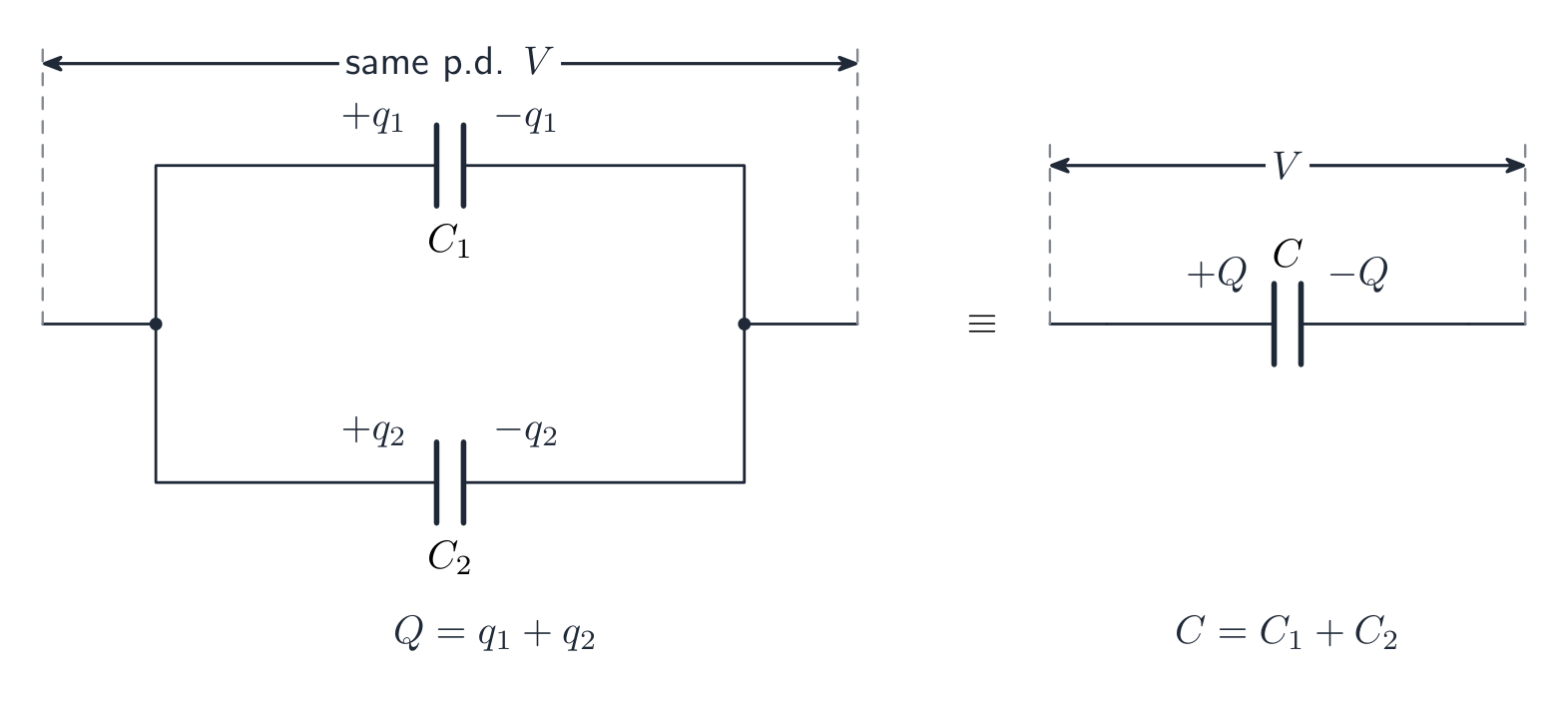
ตัวเก็บประจุแบบขนานแบ่งปัน p.d. เหมือนกัน และประจุของพวกมันรวมกัน

ตัวอย่างวิธีทำ. ตัวเก็บประจุ $100\ \mu\text{F}$ ถูกชาร์จถึง $12\ \text{V}$. มันมี $Q=CV=100\times10^{-6}\times12=1.2\times10^{-3}\ \text{C}$ ของประจุและเก็บ $U=\tfrac12 CV^2=\tfrac12\times100\times10^{-6}\times12^2=7.2\times10^{-3}\ \text{J}$ ของพลังงาน.

Explore · ⁨สำรวจ⁩

Charge and discharge a capacitor · ⁨ชาร์จและคายประจุตัวเก็บประจุ⁩

A capacitor stores charge on two plates. It fills and empties exponentially, set by the time constant $\tau = RC$ — bigger $R$ or $C$ means slower charging. · ⁨ตัวเก็บประจุ เก็บประจุไว้บนแผ่นทองแดงสองแผ่น มันจะชาร์จและคายประจุแบบเอ็กซ์โพเนนเชียล ซึ่งกำหนดโดย ค่าคงที่เวลา $\tau = RC$ — ค่า $R$ หรือ $C$ ที่ใหญ่ขึ้นหมายถึงการชาร์จที่ช้าลง⁩

Vocabulary · ⁨คำศัพท์⁩ Train · ⁨ฝึกฝน⁩
English ไทย
capacitor/kəˈpæsɪtə/ ตัวเก็บประจุ
capacitance/kəˈpæsɪtəns/ ความจุไฟฟ้า
10.7

Conservation of Electric Energy · ⁨การอนุรักษ์พลังงานไฟฟ้า⁩

Syllabus · ⁨หลักสูตร⁩
English

Learning Objective 10.7.A: Describe changes in energy in a system due to a difference in electric potential between two locations.

  • 10.7.A.1 When a charged object moves between two locations with different electric potentials, the resulting change in the electric potential energy of the object-field system is given by the following equation.
    • Equation: $\Delta U_E = q\Delta V$
  • 10.7.A.2 The movement of a charged object between two points with different electric potentials results in a change in kinetic energy of the object consistent with the conservation of energy.
ไทย

จุดประสงค์การเรียนรู้ 10.7.A: อธิบายการเปลี่ยนแปลงของพลังงานในระบบอันเนื่องมาจากความต่างศักย์ไฟฟ้าระหว่างสองตำแหน่ง

  • 10.7.A.1 เมื่อวัตถุที่มีประจุเคลื่อนที่ระหว่างสองตำแหน่งที่มีความต่างศักย์ไฟฟ้าต่างกัน การเปลี่ยนแปลงพลังงานศักย์ไฟฟ้าของระบบวัตถุ-สนามจะกำหนดโดยสมการดังนี้
    • สมการ: $\Delta U_E = q\Delta V$
  • 10.7.A.2 การเคลื่อนที่ของวัตถุที่มีประจุระหว่างสองจุดที่มีความต่างศักย์ไฟฟ้าต่างกัน จะส่งผลให้เกิดการเปลี่ยนแปลงพลังงานจลน์ของวัตถุนั้นสอดคล้องกับกฎการอนุรักษ์พลังงาน

Source: College Board AP Course and Exam Description · ⁨แหล่งที่มา: คำอธิบายหลักสูตรและข้อสอบ College Board AP⁩

English

Energy is conserved for charges just as for masses. A charge released in a field converts electric potential energy into kinetic energy:

$$q\,\Delta V=\tfrac{1}{2}mv^2 \quad(\text{gaining speed as it "falls" through a potential difference}).$$

Worked example. An electron ($q=1.6\times10^{-19}\ \text{C}$, $m=9.1\times10^{-31}\ \text{kg}$) is accelerated from rest through a potential difference of $100\ \text{V}$. Its final speed is

$$v=\sqrt{\frac{2q\,\Delta V}{m}}=\sqrt{\frac{2\times1.6\times10^{-19}\times100}{9.1\times10^{-31}}}=5.9\times10^{6}\ \text{m/s}.$$
This is exactly how the electron gun in an old television or an electron microscope works.

ไทย

พลังงานถูกอนุรักษ์สำหรับประจุเช่นเดียวกับมวล ประจุที่ปล่อยในสนามจะแปลงพลังงานศักย์ไฟฟ้าเป็นพลังงานจลน์:

$$q\,\Delta V=\tfrac{1}{2}mv^2 \quad(\text{gaining speed as it "falls" through a potential difference}).$$

ตัวอย่างวิธีทำ. อิเล็กตรอน ($q=1.6\times10^{-19}\ \text{C}$, $m=9.1\times10^{-31}\ \text{kg}$) เร่งความเร็วจากหยุดนิ่งผ่านผลต่างศักย์ $100\ \text{V}$. ความเร็วสุดท้ายของมันคือ

$$v=\sqrt{\frac{2q\,\Delta V}{m}}=\sqrt{\frac{2\times1.6\times10^{-19}\times100}{9.1\times10^{-31}}}=5.9\times10^{6}\ \text{m/s}.$$
นี่คือวิธีทำงานของปืนอิเล็กตรอนในโทรทัศน์เก่าหรือกล้องจุลทรรศน์อิเล็กตรอน

Vocabulary · ⁨คำศัพท์⁩ Train · ⁨ฝึกฝน⁩
English ไทย
potential difference/pəˈtenʃl ˈdɪfrəns/ ต่างศักย์
10.7

Exam tips · ⁨ข้อแนะนำสำหรับการสอบ⁩

English
  • Coulomb's law and the point-charge field are inverse-square — doubling the separation makes the force (or field) four times smaller.
  • Use magnitudes for the size of a force and decide direction from the signs; the field points the way a positive test charge would move.
  • Potential ($V$) is a scalar so potentials from several charges simply add; the field ($E$) is a vector and must be added by direction.
  • For a charge accelerated through a voltage use energy conservation $qV=\tfrac12 mv^2$.
  • Capacitor relations: $C=Q/V$ (capacitance is fixed by geometry) and energy $U=\tfrac12 CV^2$.
ไทย
  • กฎของคูลอมบ์ และสนามประจุ点是 กำลังสองผกผัน – การเพิ่มระยะห่างเป็นสองเท่าจะทำให้แรง (หรือสนาม) น้อยลงสี่เท่า.
  • ใช้ขนาดเพื่อหาขนาดของแรงและตัดสินใจทิศทางจาก เครื่องหมาย; สนามชี้ไปในทิศทางที่ประจุทดสอบ บวก จะเคลื่อน
  • ศักย์ ($V$) เป็นสเกลาร์ ดังนั้นศักย์จากหลายประจุจึงรวมกันได้โดยตรง; สนาม ($E$) เป็นเวกเตอร์ ต้องบวกตามทิศทาง.
  • สำหรับประจุที่เร่งผ่านแรงดันไฟฟ้า ให้ใช้การอนุรักษ์พลังงาน $qV=\tfrac12 mv^2$.
  • ความสัมพันธ์ของตัวเก็บประจุ: $C=Q/V$ (ความจุไฟฟ้ากำหนดโดยเรขาคณิต) และพลังงาน $U=\tfrac12 CV^2$.

Interactive lessons on this topic · ⁨บทเรียนเชิงโต้ตอบสำหรับหัวข้อนี้⁩

Work through it step by step, with instant-check exercises. · ⁨ทำทีละขั้นตอน พร้อมแบบฝึกหัดตรวจสอบผลทันที⁩

Past Papers · ⁨ข้อสอบย้อนหลัง⁩

More topics in AP Physics 2 · ⁨หัวข้อเพิ่มเติมใน AP Physics 2⁩

Log in or create account · ⁨เข้าสู่ระบบหรือสร้างบัญชี⁩

IGCSE, A-Level & AP