Skip to content · ⁨ข้ามไปยังเนื้อหา⁩

Imperfect Competition · ⁨การแข่งขันที่ไม่สมบูรณ์⁩

AP Microeconomics · ⁨AP เศรษฐศาสตร์จุลภาค⁩ · Topic 4 · ⁨หัวข้อ 4⁩

Video lesson for this topic · ⁨บทเรียนวิดีโอสำหรับหัวข้อนี้⁩ Open the video page · ⁨เปิดหน้าวิดีโอ⁩
8:32

การแข่งขันที่ไม่สมบูรณ์

มองออกนอกตำรา บริษัทผลิตรถกำหนดราคาของตัวเอง เมืองของคุณมีผู้จัดจำหน่ายน้ำเพียงรายเดียว ไม่มีทางเลือกที่สอง บริษัทเหล่านี้ไม่รับราคา...

English narration · English + 中文 subtitles burned in · ⁨การบรรยายภาษาอังกฤษ · คำบรรยายภาษาอังกฤษ + 中文 ลอยตัวบนภาพ⁩

4.1

Imperfect Competition and Market Power · ⁨ตลาดไม่สมบูรณ์แบบและอำนาจตลาด⁩

Syllabus · ⁨หลักสูตร⁩
English

Enduring Understanding (PRD-3): Even with a common goal of profit-maximization, market structure constrains and influences prices, output, and efficiency.

Learning Objective PRD-3.B: a. Define (using graphs where appropriate) the characteristics of imperfectly competitive markets and inefficiency.

  • PRD-3.B.1 Imperfectly competitive markets include monopoly, oligopoly, and monopolistic competition in product markets and monopsony in factor markets.
  • PRD-3.B.2 In imperfectly competitive output markets and assuming all else is constant, a firm must lower price to sell additional units.
  • PRD-3.B.3 In imperfectly competitive markets, consumers and producers respond to prices that are above the marginal costs of production and/or marginal benefits of consumption (i.e., price is greater than marginal cost in an inefficient market).
  • PRD-3.B.4 Incentives to enter an industry may be mitigated by barriers to entry. Barriers to entry—such as high fixed/start-up costs, legal barriers to entry, and exclusive ownership of key resources—can sustain imperfectly competitive market structures.
ไทย

ความเข้าใจที่ยั่งยืน (PRD-3): แม้จะมีเป้าหมายร่วมกันคือการทำให้กำไรสูงสุด โครงสร้างตลาดก็จำกัดและมีอิทธิพลต่อราคา outputs และประสิทธิภาพ

วัตถุประสงค์การเรียนรู้ PRD-3.B: a. นิยาม (โดยใช้กราฟเมื่อเหมาะสม) ลักษณะของตลาดที่ไม่แข่งขันสมบูรณ์และความไม่ประสิทธิภาพ

  • PRD-3.B.1 ตลาดที่ไม่แข่งขันสมบูรณ์ประกอบด้วย มอนوپولی โอลิโกปولی และการแข่งขันแบบมอโนโปลิสติกในตลาดสินค้า และโมโนปซันในตลาดปัจจัยการผลิต
  • PRD-3.B.2 ในตลาดผลผลิตที่ไม่แข่งขันสมบูรณ์และโดยสมมติว่าสิ่งอื่นใดคงที่ บริษัทต้องลดราคาเพื่อขายหน่วยเพิ่มเติมได้
  • PRD-3.B.3 ในตลาดที่ไม่แข่งขันสมบูรณ์ ผู้บริโภคและผู้ผลิตตอบสนองต่อราคาที่สูงกว่าต้นทุนส่วนเพิ่มของการผลิตและ/หรือประโยชน์ส่วนเพิ่มจากการบริโภค (นั่นคือ ราคาสูงกว่าต้นทุนส่วนเพิ่มในตลาดที่ไม่มีประสิทธิภาพ)
  • PRD-3.B.4 แรงจูงใจในการเข้าสู่อุตสาหกรรมอาจถูกจำกัดด้วยกำแพงการเข้า壁垒 barriers to entry กำแพงการเข้า壁垒 เช่น ต้นทุนคงที่/เริ่มต้นสูง ขีดจำกัดทางกฎหมายต่อการเข้า壁垒 และการเป็นเจ้าของแหล่งทรัพยากรสำคัญเพียงฝ่ายเดียว สามารถรักษาโครงสร้างตลาดที่ไม่แข่งขันสมบูรณ์ไว้ได้

Source: College Board AP Course and Exam Description · ⁨แหล่งที่มา: คำอธิบายหลักสูตรและข้อสอบ College Board AP⁩

English

Most real markets are imperfectly competitive 不完全竞争: firms have some market power 市场势力 – the ability to set price rather than take it. The source of that power is a downward-sloping demand curve facing the firm, which means that to sell one more unit the firm must lower the price on all units.

Because of this, marginal revenue is below price ($MR) for every firm with market power. On a straight-line demand curve the MR curve has the same intercept but twice the slope, lying below demand. This one fact – $MR – separates every imperfect market from perfect competition and explains why they produce less and charge more.

Worked example. A firm with market power faces demand $P=100-Q$. Selling $1$ unit gives $P=\$99$ and total revenue $\$99$; selling a $2$nd forces the price down to $\$98$ on both units, so revenue rises to $2\times98=\$196$. The marginal revenue of that $2$nd unit is $196-99=\$97$ – below its $\$98$ price. In general $MR=100-2Q$, falling twice as fast as demand.

ไทย
สายประกอบรถยนต์: อำนาจตลาดและขนาดบริษัทแตกต่างกันภายใต้ตลาดไม่สมบูรณ์แบบ

ตลาดส่วนใหญ่ในโลกจริงเป็น ตลาดไม่สมบูรณ์แบบ: บริษัทมี อำนาจตลาด บางส่วน – ซึ่งคือการกำหนดราคาเองได้แทนที่จะรับราคาตามตลาด แหล่งที่มาของอำนาจนี้คือ เส้นความต้องการที่มีแนวโน้มลดลง ที่บริษัทเผชิญ ซึ่งหมายความว่าเพื่อขายสินค้าเพิ่มอีกหนึ่งหน่วย บริษัทต้อง ลดราคาสำหรับสินค้าทุกหน่วย

โครงสร้างตลาดมีความหลากหลายตั้งแต่ตลาดแข่งขันสมบูรณ์ไปจนถึงผูกขาด

เนื่องจาก原因นี้ รายได้ส่วนเพิ่ม (Marginal Revenue) จะต่ำกว่าราคา ($MR) สำหรับบริษัททุกแห่งที่มีอำนาจตลาด บนเส้นความต้องการที่เป็นเส้นตรง เส้น MR จะมีจุดตัดแกนเดียวกันแต่มี ความชันเป็นสองเท่า อยู่ใต้เส้นความต้องการ ข้อเท็จจริงเดียวนี้ – $MR – แยกตลาดที่ไม่สมบูรณ์แบบออกจากตลาดแข่งขันสมบูรณ์ และอธิบายว่าทำไมจึงผลิต น้อยลง และคิดราคา สูงกว่า

ตัวอย่างวิธีทำ. บริษัทที่มีอำนาจตลาดเผชิญกับเส้นความต้องการ $P=100-Q$. การขาย $1$ หน่วย ให้ $P=\$99$ and total revenue $\$99$; การขาย $2$nd ทำให้ราคาตกลงมาอยู่ที่ $\$98$ on both units, so revenue rises to $2×98=$196$. รายได้ส่วนเพิ่มของ$2$nd หน่วยนั้นคือ$196-99=$97$– below its$$98$ราคา โดยทั่วไป$MR=100-2Q$, ลดลงสองเท่าของความชันของเส้นความต้องการ

4.2

Monopoly · ⁨การผูกขาด⁩

Syllabus · ⁨หลักสูตร⁩
English

Enduring Understanding (PRD-3): Even with a common goal of profit-maximization, market structure constrains and influences prices, output, and efficiency.

Learning Objective PRD-3.B: b. Explain (using graphs where appropriate) equilibrium, firm decision making, consumer surplus, producer surplus, profit (loss), and deadweight loss in imperfectly competitive markets and why prices in imperfectly competitive markets cannot be relied on to coordinate the actions of all possible market participants and can lead to inefficient outputs. c. Calculate (using data from a graph or table as appropriate) areas of consumer surplus, producer surplus, profit (loss), and deadweight loss in imperfectly competitive markets.

  • PRD-3.B.5 A monopoly exists because of barriers to entry.
  • PRD-3.B.6 In a monopoly, equilibrium (profit-maximizing) quantity is determined by equating marginal revenue (MR) to marginal cost (MC). The price charged is greater than the marginal cost.
    • Equation: $MR = MC$
  • PRD-3.B.7 In a natural monopoly, long-run economies of scale for a single firm exist throughout the entire effective demand of its product.
ไทย

ความเข้าใจที่ยั่งยืน (PRD-3): แม้จะมีเป้าหมายร่วมกันคือการทำให้กำไรสูงสุด โครงสร้างตลาดก็จำกัดและมีอิทธิพลต่อราคา outputs และประสิทธิภาพ

วัตถุประสงค์การเรียนรู้ PRD-3.B: b. อธิบาย (โดยใช้กราฟเมื่อเหมาะสม) ภาวะสมดุล การตัดสินใจของบริษัท ความเหลือเฟือของผู้บริโภค ความเหลือเฟือของผู้ผลิต กำไร (ขาดทุน) และความสูญเสียที่ไร้ประสิทธิภาพ (deadweight loss) ในตลาดที่ไม่แข่งขันสมบูรณ์ และทำไมราคาในตลาดที่ไม่แข่งขันสมบูรณ์จึงไม่สามารถเชื่อถือได้ว่าจะประสานการกระทำของผู้เข้าร่วมตลาดทั้งหมดและนำไปสู่ผลลัพธ์ที่ไม่มีประสิทธิภาพ c. คำนวณ (โดยใช้ข้อมูลจากกราฟหรือตารางเมื่อเหมาะสม) พื้นที่ของความเหลือเฟือของผู้บริโภค ความเหลือเฟือของผู้ผลิต กำไร (ขาดทุน) และความสูญเสียที่ไร้ประสิทธิภาพในตลาดที่ไม่แข่งขันสมบูรณ์

  • PRD-3.B.5 มอนوپolibol เกิดขึ้นเนื่องจากกำแพงการเข้า壁垒
  • PRD-3.B.6 ในมอนوپolibol ปริมาณในภาวะสมดุล (เพื่อทำกำไรมากที่สุด) ถูกกำหนดโดยการทำให้รายได้ส่วนเพิ่ม (MR) เท่ากับต้นทุนส่วนเพิ่ม (MC) ราคาที่เรียกเก็บจะสูงกว่าต้นทุนส่วนเพิ่ม
    • สมการ: $MR = MC$
  • PRD-3.B.7 ในมอนوپolibol ตามธรรมชาติ ประโยชน์จาก economies of scale ของบริษัทเดียวมีอยู่ตลอดทั้งช่วงความต้องการที่มีประสิทธิผลของผลิตภัณฑ์

Source: College Board AP Course and Exam Description · ⁨แหล่งที่มา: คำอธิบายหลักสูตรและข้อสอบ College Board AP⁩

English
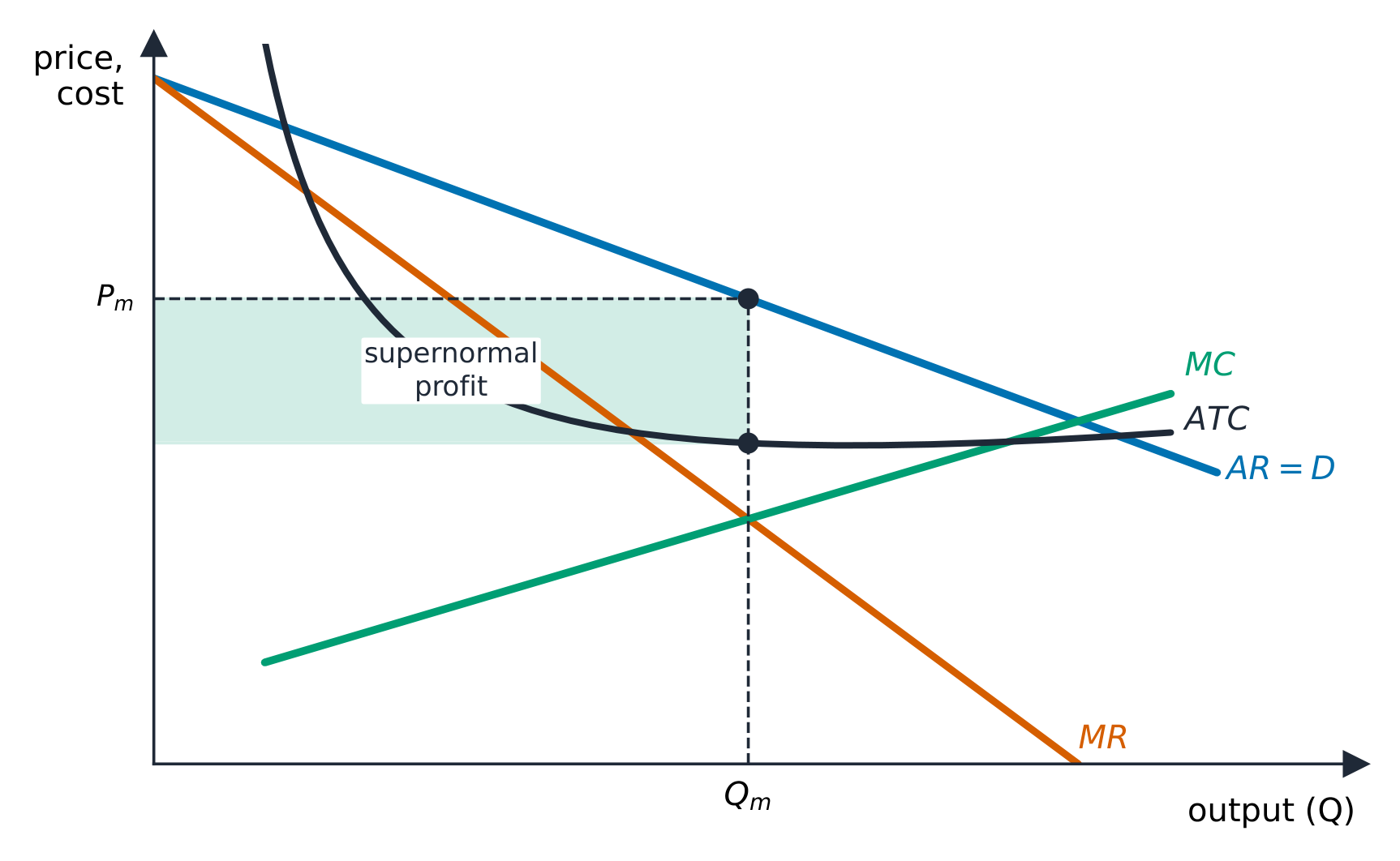
Monopoly: MR = MC pricing

A monopoly 垄断 is a single seller of a product with no close substitutes, protected by barriers to entry 进入壁垒 (economies of scale – a natural monopoly 自然垄断 – control of a key resource, patents, or government license).

  • The monopolist maximizes profit at $MR=MC$, then charges the highest price the demand curve allows at that quantity (read price up to the demand curve, not the MR curve).
  • Compared with perfect competition it produces less and charges more, earning long-run economic profit because entry is blocked.
  • This under-production creates deadweight loss 无谓损失 – the monopoly is allocatively inefficient because $P>MC$: the last unit is worth more than it costs, yet is not made.

Governments may respond with antitrust 反垄断 law, or regulate a natural monopoly's price toward $P=MC$ (socially optimal, but may cause a loss) or $P=ATC$ (fair-return, break-even).

Exam skill: the monopoly graph is a staple – show quantity at $MR=MC$, price up on the demand curve, and shade profit (between $P$ and $ATC$) and deadweight loss (the triangle to the competitive quantity).

ไทย
การผูกขาด: กำหนดราคาโดย MR = MC

การผูกขาด คือผู้ขายรายเดียวของผลิตภัณฑ์ที่ไม่มีสินค้าทดแทนที่ใกล้เคียงกัน ปกป้องด้วย กำแพงการเข้าสู่ตลาด (economies of scale – natural monopoly – การควบคุมแหล่งทรัพยากรสำคัญ, สิทธิบัตร, หรือใบอนุญาตจากรัฐบาล)

การผูกขาดเพิ่มกำไรสูงสุดที่ MC = MR และสามารถทำกำไรเกินปกติ
  • ผู้ผูกขาดเพิ่มกำไรสูงสุดที่ $MR=MC$, จากนั้นกำหนด ราคาสูงสุดที่เส้นความต้องการอนุญาต ที่ปริมาณนั้น (อ่านราคาขึ้นไปที่เส้นความต้องการ ไม่ใช่เส้น MR)
  • เมื่อเทียบกับตลาดแข่งขันสมบูรณ์ ผลิต น้อยลง และคิดราคา สูงกว่า, ทำกำไรทางเศรษฐศาสตร์ในระยะยาวเพราะการเข้าสู่ตลาดถูกขัดขวาง
  • การผลิตที่น้อยเกินไปนี้สร้าง deadweight loss – การผูกขาดเป็น allocatively inefficient เพราะ $P>MC$: หน่วยสุดท้ายมีค่ามากกว่าต้นทุน แต่ไม่ได้ผลิตออกมา

รัฐบาลอาจตอบสนอง bằng กฎหมายต่อต้านการผูกขาด, หรือควบคุมราคาของ natural monopoly ให้เข้าใกล้ $P=MC$ (** socially optimal , แต่อาจทำให้ขาดทุน) หรือ $P=ATC$ ( fair-return **, break-even)

ทักษะข้อสอบ: กราฟการผูกขาดเป็นเรื่องพื้นฐาน – แสดงปริมาณที่ $MR=MC$, ราคาขึ้นไปที่เส้นความต้องการ, และ shade กำไร (ระหว่าง $P$ และ $ATC$) และ deadweight loss (สามเหลี่ยมไปยังปริมาณตลาดแข่งขัน)

โรงงานพลังงานขนาดใหญ่: การผูกขาดและอำนาจตลาดหมายถึงบริษัทเดียวสามารถกำหนดราคาเหนือ marginal cost
Explore · ⁨สำรวจ⁩

A monopoly's cost curves · ⁨เส้นโค้งต้นทุนของมอโนโพลี⁩

A monopoly is the sole seller, so it faces the whole downward demand curve and its marginal revenue lies below price. It produces where MR = MC — less output, higher price than competition. · ⁨มอโนโพลี เป็นผู้ขายเพียงรายเดียว ดังนั้นจึง面对的ทั้งเส้นอุปสงค์แนวลง และรายได้เชิงพจน์จะต่ำกว่าราคา They ผลิตที่ MR = MC — ผลผลิตน้อยกว่า ราคาสูงกว่าในตลาดแข่งขัน⁩

Vocabulary · ⁨คำศัพท์⁩ Train · ⁨ฝึกฝน⁩
English ไทย
imperfectly competitive/ɪmˈpɜːfektlɪ kəmˈpetɪtɪv/ การแข่งขันไม่สมบูรณ์
market power/ˈmɑːkɪt ˈpaʊə/ อำนาจตลาด
monopoly/məˈnɒpəli/ มอนوپولی
barriers to entry/ˈbærɪəz tʊ ˈentri/ กำแพงเข้าสู่ตลาด
natural monopoly/ˈnætʃərəl məˈnɒpəli/ моноโพลธรรมชาติ
deadweight loss/ˈdedweɪt lɒs/ deadweight loss
antitrust/ˌæntɪˈtrʌst/ antitrust
4.3

Price Discrimination · ⁨การแบ่งแยกราคา⁩

Syllabus · ⁨หลักสูตร⁩
English

Enduring Understanding (PRD-3): Even with a common goal of profit-maximization, market structure constrains and influences prices, output, and efficiency.

Learning Objective PRD-3.B: b. Explain (using graphs where appropriate) equilibrium, firm decision making, consumer surplus, producer surplus, profit (loss), and deadweight loss in imperfectly competitive markets and why prices in imperfectly competitive markets cannot be relied on to coordinate the actions of all possible market participants and can lead to inefficient outputs. c. Calculate (using data from a graph or table as appropriate) areas of consumer surplus, producer surplus, profit (loss), and deadweight loss in imperfectly competitive markets.

  • PRD-3.B.8 A firm with market power can engage in price discrimination to increase its profits or capture additional consumer surplus under certain conditions.
  • PRD-3.B.9 With perfect price discrimination, a monopolist produces the quantity where price equals marginal cost (just as a competitive market would) but extracts all economic surplus associated with its product and eliminates all deadweight loss.
    • Equation: $P = MC$
ไทย

ความเข้าใจที่ยั่งยืน (PRD-3): แม้จะมีเป้าหมายร่วมกันคือการทำให้กำไรสูงสุด โครงสร้างตลาดก็จำกัดและมีอิทธิพลต่อราคา outputs และประสิทธิภาพ

วัตถุประสงค์การเรียนรู้ PRD-3.B: b. อธิบาย (โดยใช้กราฟเมื่อเหมาะสม) ภาวะสมดุล การตัดสินใจของบริษัท ความเหลือเฟือของผู้บริโภค ความเหลือเฟือของผู้ผลิต กำไร (ขาดทุน) และความสูญเสียที่ไร้ประสิทธิภาพ (deadweight loss) ในตลาดที่ไม่แข่งขันสมบูรณ์ และทำไมราคาในตลาดที่ไม่แข่งขันสมบูรณ์จึงไม่สามารถเชื่อถือได้ว่าจะประสานการกระทำของผู้เข้าร่วมตลาดทั้งหมดและนำไปสู่ผลลัพธ์ที่ไม่มีประสิทธิภาพ c. คำนวณ (โดยใช้ข้อมูลจากกราฟหรือตารางเมื่อเหมาะสม) พื้นที่ของความเหลือเฟือของผู้บริโภค ความเหลือเฟือของผู้ผลิต กำไร (ขาดทุน) และความสูญเสียที่ไร้ประสิทธิภาพในตลาดที่ไม่แข่งขันสมบูรณ์

  • PRD-3.B.8 บริษัทที่มีอำนาจในตลาดสามารถดำเนินการแบ่งแยก pricing เพื่อเพิ่มกำไรหรือจับความเหลือเฟือของผู้บริโภคเพิ่มเติมภายใต้เงื่อนไขบางประการ
  • PRD-3.B.9 ด้วยการแบ่งแยก price อย่างสมบูรณ์ มอนوپolibol ผลิตที่ปริมาณที่ราคาเท่ากับต้นทุนส่วนเพิ่ม (เหมือนตลาดที่แข่งขัน) แต่ดึงเอาความเหลือเฟือทางเศรษฐกิจทั้งหมดที่เกี่ยวข้องกับผลิตภัณฑ์ของตนออกมาและกำจัดความสูญเสียที่ไร้ประสิทธิภาพทั้งหมด
    • สมการ: $P = MC$

Source: College Board AP Course and Exam Description · ⁨แหล่งที่มา: คำอธิบายหลักสูตรและข้อสอบ College Board AP⁩

English

Price discrimination 价格歧视 is charging different buyers different prices for the same good. It requires market power, the ability to separate buyers by willingness to pay, and the ability to prevent resale.

Under perfect (first-degree) price discrimination, the firm charges each buyer their maximum price. The result: the firm produces the efficient quantity (where $P=MC$, no deadweight loss), but converts all consumer surplus into producer surplus (profit). Real examples – student discounts, airline fares, coupons – are partial versions.

ไทย

Price discrimination คือการเรียกเก็บราคาต่างจากลูกค้าแต่ละคนสำหรับสินค้าเดียวกัน ต้องมี อำนาจตลาด, ความสามารถในการ แยก ลูกค้าตาม willingness to pay, และความสามารถในการ ป้องกันการขายต่อ

ภายใต้ perfect (first-degree) price discrimination, บริษัทเรียกเก็บราคาสูงสุดจากลูกค้าแต่ละคน ผลลัพธ์: บริษัทผลิตปริมาณ efficient (ที่ $P=MC$, ไม่มี deadweight loss), แต่แปลง consumer surplus ทั้งหมด เป็น producer surplus (กำไร) ตัวอย่างในโลกจริง – ส่วนลดนักศึกษา, fares flights, คูปอง – เป็นรูปแบบ partial

Explore · ⁨สำรวจ⁩

Elasticity and price discrimination · ⁨ความยืดหยุ่นและการแบ่งแยกราคา⁩

Price discrimination charges each group a different price by their elasticity: inelastic buyers (who won't switch) pay more, elastic buyers pay less. Stretch the curve to see why. · ⁨การแบ่งแยกราคา เก็บเงินจากแต่ละกลุ่มด้วยราคาต่างกันตาม ความยืดหยุ่น: ผู้ซื้อที่ไม่ยืดหยุ่น (who ไม่เปลี่ยนแบรนด์) จ่ายแพงกว่า ผู้ซื้อที่ยืดหยุ่นจ่ายน้อยกว่า ดึงเส้นโค้งเพื่อดูเหตุผล⁩

Vocabulary · ⁨คำศัพท์⁩ Train · ⁨ฝึกฝน⁩
English ไทย
Price discrimination/praɪs dɪˌskrɪmɪˈneɪʃn/ การแบ่งราคา
4.4

Monopolistic Competition · ⁨การแข่งขันแบบ Monopolistic Competition⁩

Syllabus · ⁨หลักสูตร⁩
English

Enduring Understanding (PRD-3): Even with a common goal of profit-maximization, market structure constrains and influences prices, output, and efficiency.

Learning Objective PRD-3.B: b. Explain (using graphs where appropriate) equilibrium, firm decision making, consumer surplus, producer surplus, profit (loss), and deadweight loss in imperfectly competitive markets and why prices in imperfectly competitive markets cannot be relied on to coordinate the actions of all possible market participants and can lead to inefficient outputs. c. Calculate (using data from a graph or table as appropriate) areas of consumer surplus, producer surplus, profit (loss), and deadweight loss in imperfectly competitive markets.

  • PRD-3.B.10 In a market with monopolistic competition, firms producing differentiated products may earn positive, negative, or zero economic profit in the short run. Firms typically use advertising as a means of differentiating their product. Free entry and exit drive profits to zero in the long run. The output level, however, is smaller than the output level needed to minimize average total costs, creating excess capacity. The price is greater than marginal cost, creating allocative inefficiency.
ไทย

ความเข้าใจที่ยั่งยืน (PRD-3): แม้จะมีเป้าหมายร่วมกันคือการทำให้กำไรสูงสุด โครงสร้างตลาดก็จำกัดและมีอิทธิพลต่อราคา outputs และประสิทธิภาพ

วัตถุประสงค์การเรียนรู้ PRD-3.B: b. อธิบาย (โดยใช้กราฟเมื่อเหมาะสม) ภาวะสมดุล การตัดสินใจของบริษัท ความเหลือเฟือของผู้บริโภค ความเหลือเฟือของผู้ผลิต กำไร (ขาดทุน) และความสูญเสียที่ไร้ประสิทธิภาพ (deadweight loss) ในตลาดที่ไม่แข่งขันสมบูรณ์ และทำไมราคาในตลาดที่ไม่แข่งขันสมบูรณ์จึงไม่สามารถเชื่อถือได้ว่าจะประสานการกระทำของผู้เข้าร่วมตลาดทั้งหมดและนำไปสู่ผลลัพธ์ที่ไม่มีประสิทธิภาพ c. คำนวณ (โดยใช้ข้อมูลจากกราฟหรือตารางเมื่อเหมาะสม) พื้นที่ของความเหลือเฟือของผู้บริโภค ความเหลือเฟือของผู้ผลิต กำไร (ขาดทุน) และความสูญเสียที่ไร้ประสิทธิภาพในตลาดที่ไม่แข่งขันสมบูรณ์

  • PRD-3.B.10 ในตลาดที่มีการแข่งขันแบบมอโนโปลิสติก บริษัทที่ผลิตสินค้าที่แตกต่างอาจได้รับกำไรทางเศรษฐกิจเป็นบวก เป็นลบ หรือเป็นศูนย์ในระยะสั้น บริษัทมักใช้การโฆษณาเป็น Means เพื่อสร้างความแตกต่างให้กับสินค้า loro Entry และ Exit ที่อิสระจะผลักกำไรให้เป็นศูนย์ในระยะยาว อย่างไรก็ตาม ระดับผลผลิตนั้นน้อยกว่าระดับผลผลิตที่ต้องการเพื่อลดค่าเฉลี่ยรวมให้ต่ำสุดที่สุด สร้าง excess capacity ราคาสูงกว่าต้นทุนส่วนเพิ่ม สร้างความไม่ประสิทธิภาพในการจัดสรรทรัพยากร

Source: College Board AP Course and Exam Description · ⁨แหล่งที่มา: คำอธิบายหลักสูตรและข้อสอบ College Board AP⁩

English

Monopolistic competition 垄断竞争 has many firms selling differentiated 差异化 products with easy entry and exit (restaurants, salons, clothing brands). Product differentiation gives each firm a downward-sloping demand curve and thus some price-setting power.

  • Short run: like a monopoly – produce at $MR=MC$, and profit or loss is possible.
  • Long run: easy entry competes away profit, so each firm earns zero economic profit, producing where demand is tangent to ATC.
  • Because it still charges $P>MC$ and does not produce at minimum ATC, it has excess capacity 过剩产能 and is neither allocatively nor productively efficient. The trade-off society accepts is product variety and choice.
ไทย

Monopolistic competition มี many firms ขาย differentiated products พร้อม easy entry and exit (ร้านอาหาร, สาลอน, แบรนด์เสื้อผ้า) Product differentiation ให้แต่ละบริษัทมี downward-sloping demand curve และดังนั้นจึงมีอำนาจกำหนดราคาบ้าง

  • ระยะสั้น: เหมือนการผูกขาด – ผลิตที่ $MR=MC$, และกำไรหรือขาดทุนเป็นไปได้
  • ระยะยาว: การเข้าตลาดที่ง่ายจะแข่งขันจนกำไรหายไป, ดังนั้นแต่ละบริษัทจะได้ zero economic profit, ผลิตที่เส้นความต้องการ tangent กับ ATC
  • เนื่องจากยังกำหนด $P>MC$ และ not ผลิตที่ระดับ ATC ต่ำสุด จึงมี excess capacity และไม่ neither allocatively nor productively efficient. Trade-off ที่สังคมยอมรับคือ product variety และทางเลือก
Vocabulary · ⁨คำศัพท์⁩ Train · ⁨ฝึกฝน⁩
English ไทย
Monopolistic competition/məˈnɒpəlɪstɪk ˌkɒmpəˈtɪʃn/ การแข่งขันแบบผูกขาด
differentiated/ˌdɪfəˈrenʃɪeɪtɪd/ มีความแตกต่างกัน
excess capacity/ekˈses kəˈpæsɪti/ ความจุส่วนเกิน
4.5

Oligopoly and Game Theory · ⁨Oligopoly และทฤษฎีเกม⁩

Syllabus · ⁨หลักสูตร⁩
English

Enduring Understanding (PRD-3): Even with a common goal of profit-maximization, market structure constrains and influences prices, output, and efficiency.

Learning Objective PRD-3.C: a. Define (using tables as appropriate) key terms, strategies, and concepts relating to oligopolies and simple games. b. Explain (using tables as appropriate) strategies and equilibria in simple games and the connections to theoretical behaviors in various oligopoly market and non-market settings. c. Calculate (using tables as appropriate) the incentive sufficient to alter a player's dominant strategy.

  • PRD-3.C.1 An oligopoly is an inefficient market structure with high barriers to entry, where there are few firms acting interdependently.
  • PRD-3.C.2 Firms in an oligopoly have an incentive to collude and form cartels.
  • PRD-3.C.3 A game is a situation in which a number of individuals take actions, and the payoff for each individual depends directly on both the individual's own choice and the choices of others.
  • PRD-3.C.4 A strategy is a complete plan of actions for playing a game; the normal form model of a game shows the payoffs that result from each collection of strategies (one for each player).
  • PRD-3.C.5 A player has a dominant strategy when the payoff to a particular action is always higher independent of the action taken by the other player.
  • PRD-3.C.6 A Nash equilibrium is a condition describing the set of actions in which no player can increase his or her payoff by unilaterally taking another action, given the other players' actions.
    • Exclusion statement: Dominant strategies and Nash equilibrium with more than two players or more than two actions per player, mixed-strategy equilibria, extensive form games, and normal form games with more than two players or more than two actions per player are beyond the scope of the course and the AP Exam.
  • PRD-3.C.7 Oligopolists have difficulty achieving the monopoly outcome for reasons similar to those that prevent players from achieving a cooperative outcome in the Prisoner's Dilemma; nevertheless, prices are generally higher and quantities lower with oligopoly (or duopoly) than with perfect competition.
ไทย

ความเข้าใจที่ยั่งยืน (PRD-3): แม้จะมีเป้าหมายร่วมกันคือการทำให้กำไรสูงสุด โครงสร้างตลาดก็จำกัดและมีอิทธิพลต่อราคา outputs และประสิทธิภาพ

วัตถุประสงค์การเรียนรู้ PRD-3.C: a. นิยาม (โดยใช้ตารางเมื่อเหมาะสม) คำศัพท์ กลยุทธ์ และแนวคิดหลักเกี่ยวกับโอลิگوปoli และเกม đơn giản b. อธิบาย (โดยใช้ตารางเมื่อเหมาะสม) กลยุทธ์และภาวะสมดุลในเกม đơn giảnและความเชื่อมโยงกับพฤติกรรมเชิงทฤษฎีในสภาพแวดล้อมตลาดและนอกตลาดต่างๆ ของโอลิگوปoli c. คำนวณ (โดยใช้ตารางเมื่อเหมาะสม) แรงจูงใจที่เพียงพอที่จะเปลี่ยน dominant strategy ของผู้เล่น

  • PRD-3.C.1 โอลิگوปoli เป็นโครงสร้างตลาดที่ไม่มีประสิทธิภาพซึ่งมีกำแพงการเข้า壁垒สูง และมีบริษัทจำนวนน้อยที่กระทำอย่างพึ่งพาซึ่งกันและกัน
  • PRD-3.C.2 บริษัทในโอลิگوปoli มีแรงจูงใจที่จะ collusion และสร้าง cartel
  • PRD-3.C.3 เกมคือสถานการณ์ที่บุคคลจำนวนมาก采取行动 และผลตอบแทนของแต่ละบุคคลขึ้นอยู่กับทั้งตัวเลือกของตนเองและตัวเลือกของผู้อื่นโดยตรง
  • PRD-3.C.4 กลยุทธ์คือแผนการกระทำที่ครบถ้วนสำหรับการเล่นเกม; แบบจำลองรูปแบบปกติ (normal form model) ของเกมแสดงผลตอบแทนที่เกิดจากการรวมกลยุทธ์แต่ละชุด (หนึ่งสำหรับแต่ละผู้เล่น)
  • PRD-3.C.5 ผู้เล่นมี dominant strategy เมื่อผลตอบแทนจากการกระทำเฉพาะอย่างหนึ่งสูงกว่าเสมอโดยไม่ขึ้นอยู่กับ اینکه player คนอื่นเลือกทำอะไร
  • PRD-3.C.6 Nash equilibrium คือสภาวะที่อธิบายชุดการกระทำซึ่งไม่มีผู้เล่นคนใดสามารถเพิ่มผลตอบแทนของตนได้โดยการเปลี่ยนทางเลือกโดยลำพัง给定การกระทำของผู้เล่นคนอื่น
    • ข้อความยกเว้น: กลยุทธ์เด่นและสมดุลแนชที่มีผู้เล่นมากกว่าสองคนหรือมากกว่าสองทางเลือกต่อผู้เล่น, สมดุลกลยุทธ์ผสม, เกมในรูปขยาย และเกมในรูปปกติที่มีผู้เล่นมากกว่าสองคนหรือมากกว่าสองทางเลือกต่อผู้เล่นอยู่นอกเหนือขอบเขตของหลักสูตรและข้อสอบ AP
  • PRD-3.C.7 บริษัทในอุตสาหกรรมออลิโกปอลیมีความยากที่จะบรรลุผลลัพธ์แบบผูกขาด เนื่องจากเหตุผลคล้ายคลึงกับที่ขัดขวางผู้เล่นจากการบรรลุผลลัพธ์ร่วมมือในเกม Prisoner's Dilemma; อย่างไรก็ตาม ราคาโดยทั่วไปจะสูงกว่าและปริมาณต่ำกว่าในกรณีของออลิโกปอลี (หรือไดโอปอลี) เมื่อเทียบกับตลาดแข่งขันสมบูรณ์

Source: College Board AP Course and Exam Description · ⁨แหล่งที่มา: คำอธิบายหลักสูตรและข้อสอบ College Board AP⁩

English

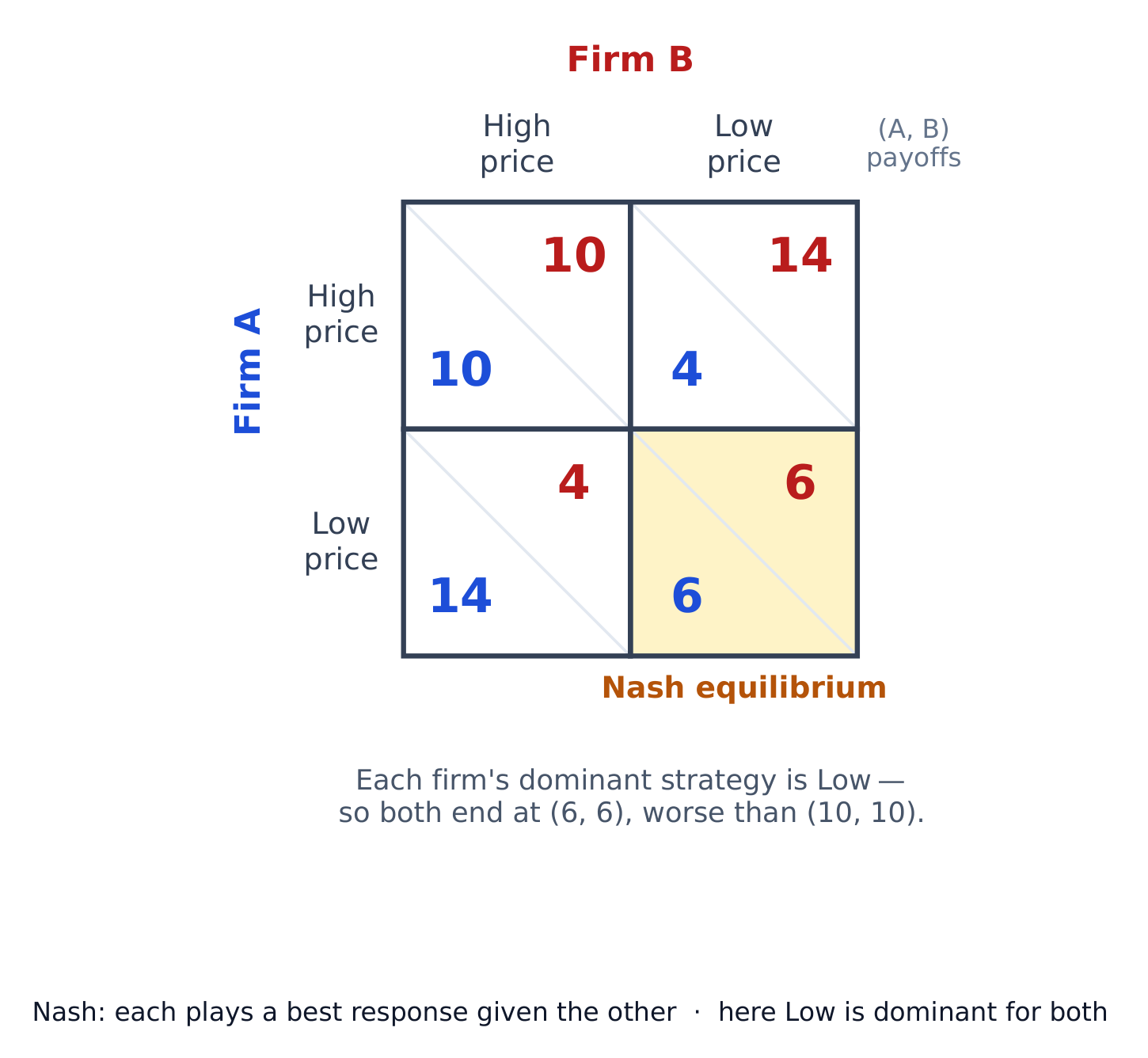
An oligopoly 寡头垄断 is a market with a few large, interdependent 相互依存 firms (cars, airlines, phones). Because each firm's best move depends on rivals' moves, we analyze them with game theory 博弈论.

  • A payoff matrix 收益矩阵 shows each firm's profit for every combination of choices.
  • A dominant strategy 优势策略 is a firm's best choice regardless of what the rival does.
  • A Nash equilibrium 纳什均衡 is an outcome where no firm can do better by unilaterally changing its choice.
  • The classic prisoners' dilemma 囚徒困境 shows why firms often fail to cooperate: both would gain by colluding 勾结 (acting like a monopoly), but each has an incentive to cheat, so they end up at the competitive-ish, lower-profit outcome. Collusion and cartels 卡特尔 are unstable for the same reason (and usually illegal).

Worked example. Two firms each choose a High or Low price. Profits (A, B): both High $\to(10,10)$; A Low, B High $\to(14,4)$; A High, B Low $\to(4,14)$; both Low $\to(6,6)$. For A: if B plays High, Low ($14$) beats High ($10$); if B plays Low, Low ($6$) beats High ($4$) – so Low is A's dominant strategy, and by symmetry B's too. The Nash equilibrium is both Low $(6,6)$, worse for both than the cooperative $(10,10)$ – the prisoners' dilemma in action.

Exam skill: be able to find each firm's dominant strategy and the Nash equilibrium from a 2×2 payoff matrix, and explain why the cooperative outcome is hard to sustain.

ไทย

ออลิกوپอลี่ (oligopoly) คือตลาดที่มี บริษัทใหญ่จำนวนน้อย ที่มีความ พึ่งพาซึ่งกันและกัน (เช่น รถยนต์, สายการบิน, โทรศัพท์) เนื่องจากกลยุทธ์ที่ดีที่สุดของแต่ละบริษัทขึ้นอยู่กับกลยุทธ์ของคู่แข่ง เราจึงวิเคราะห์ด้วย ทฤษฎีเกม

  • เมทริกซ์ผลตอบแทน (payoff matrix) แสดงกำไรของแต่ละบริษัทสำหรับทุกชุดการเลือก
  • กลยุทธ์ที่เหนือกว่า (dominant strategy) คือทางเลือกที่ดีที่สุดของบริษัท โดยไม่ importar ว่าคู่แข่งจะทำอะไร
  • สมดุลนัช (Nash equilibrium) คือผลลัพธ์ที่ ไม่มี บริษัทใดสามารถทำได้ดีขึ้นโดยการเปลี่ยนทางเลือกเพียงฝ่ายเดียว
  • กรณีศึกษาคลาสสิกเรื่อง ความขัดแย้งของนักโทษ (prisoners' dilemma) แสดงว่าทำไมบริษัทมักล้มเหลวในการร่วมมือ: ทั้งคู่จะได้ประโยชน์จากการ ** collusion** ( behaving like a monopoly) แต่แต่ละฝ่ายมีแรงจูงใจที่จะโกง ดังนั้นจึงจบลงที่ผลลัพธ์ที่คล้ายการแข่งขันและมีกำไรต่ำกว่า Collusion และ คาร์เทล ไม่เสถียรด้วยเหตุผลเดียวกัน (และมักผิดกฎหมาย)

ตัวอย่างวิธีทำ. บริษัทสองแห่งเลือก ราคาสูง หรือ ราคาต่ำ กำไร (A, B): สูงทั้งคู่ $\to(10,10)$; A ต่ำ, B สูง $\to(14,4)$; A สูง, B ต่ำ $\to(4,14)$; ต่ำทั้งคู่ $\to(6,6)$. สำหรับ A: ถ้า B เลือกสูง, ต่ำ ($14$) ดีกว่า สูง ($10$); ถ้า B เลือกต่ำ, ต่ำ ($6$) ดีกว่า สูง ($4$) – ดังนั้น ต่าคือกลยุทธ์ที่เหนือกว่าของ A และโดยสมมาตร B ก็เช่นกัน สมดุลนัชคือ ทั้งสองเลือกต่ำ $(6,6)$, ซึ่งแย่กว่าทั้งสองเมื่อเทียบกับผลรวมความร่วมมือ $(10,10)$ – ความขัดแย้งของนักโทษในทางปฏิบัติ

ความขัดแย้งของนักโทษ: กลยุทธ์ที่เหนือกว่าของแต่ละบริษัทคือต่ำ ซึ่งนำไปสู่สมดุลนัช

ทักษะการสอบ: สามารถหากลยุทธ์ที่เหนือกว่าของแต่ละบริษัทและสมดุลนัชจากเมทริกซ์ผลตอบแทน 2×2 และอธิบายว่าทำไมผลลัพธ์ความร่วมมือถึงยากต่อการรักษาไว้

Vocabulary · ⁨คำศัพท์⁩ Train · ⁨ฝึกฝน⁩
English ไทย
oligopoly/ˌɒlɪˈɡɒpəli/ โอளிโกปอลิ
interdependent/ˌɪntədɪˈpendənt/ salingสัมพันธ์
game theory/ɡeɪm ˈθɪəri/ ทฤษฎีเกม
payoff matrix/ˈpeɪɒf ˈmeɪtrɪks/ เมทริกซ์ผลตอบแทน
dominant strategy/ˈdɒmɪnənt ˈstrætədʒi/ กลยุทธ์เด่น
Nash equilibrium/næʃ ˌiːkwɪˈlɪbrɪəm/ จุดสมดุลของนาช
prisoners' dilemma/ˈprɪzənəz daɪˈlemə/ dilemma ของนักโทษ
colluding/kəˈluːdɪŋ/ การ collusion
cartels/kɑːˈtelz/ 卡特尔 cartels
4.5

Exam tips · ⁨ข้อแนะนำสำหรับการสอบ⁩

English
  • A firm with market power faces a downward-sloping demand, so MR < P (MR has twice the slope).
  • A monopoly produces where MR = MC, then charges the price up on the demand curve; it makes deadweight loss because $P > MC$.
  • Under perfect price discrimination the firm produces the efficient quantity but captures all consumer surplus.
  • Monopolistic competition earns zero long-run profit with excess capacity (product variety is the trade-off).
  • In an oligopoly find the dominant strategy and Nash equilibrium from the payoff matrix; the cooperative outcome is hard to sustain.
ไทย
  • บริษัทที่มีอำนาจตลาดเผชิญกับเส้นความต้องการที่ชันลง ทำให้ MR < P (MR มีความชันเป็นสองเท่า)
  • มอนोโพลผลิตที่ MR = MC แล้วตั้งราคา ตามเส้นความต้องการ; มันสร้าง deadweight loss เพราะ $P > MC$.
  • ภายใต้การกำหนดราคาแบบสมบูรณ์ (perfect price discrimination) บริษัทผลิตปริมาณที่มีประสิทธิภาพแต่เก็บส่วนเกินของผู้บริโภคทั้งหมด
  • การแข่งขันแบบมอโนปอลิสติก (monopolistic competition) ได้กำไรศูนย์ในระยะยาวพร้อมกับความจุส่วนเกิน (ความหลากหลายของสินค้าคือสิ่งที่ต้องแลกมา)
  • ในออลิกอปอลี่ ให้หา กลยุทธ์ที่เหนือกว่า และ สมดุลนัช จากเมทริกซ์ผลตอบแทน; ผลรวมความร่วมมือยากที่จะรักษาไว้

Interactive lessons on this topic · ⁨บทเรียนเชิงโต้ตอบสำหรับหัวข้อนี้⁩

Work through it step by step, with instant-check exercises. · ⁨ทำทีละขั้นตอน พร้อมแบบฝึกหัดตรวจสอบผลทันที⁩

Past Papers · ⁨ข้อสอบย้อนหลัง⁩

More topics in AP Microeconomics · ⁨AP เศรษฐศาสตร์จุลภาค⁩ · ⁨หัวข้อเพิ่มเติมใน AP Microeconomics · ⁨AP เศรษฐศาสตร์จุลภาค⁩⁩

Log in or create account · ⁨เข้าสู่ระบบหรือสร้างบัญชี⁩

IGCSE, A-Level & AP