Monopoly
Introduced| English |
|---|
| monopoly/məˈnɒpəli/ |
| price maker/praɪs ˈmeɪkə/ |
| marginal revenue/ˈmɑːdʒɪnl ˈrevənjuː/ |
| deadweight loss/ˈdedweɪt lɒs/ |
| allocatively inefficient/ˈæləkətɪvli ɪnɪˈfɪʃənt/ |
| natural monopoly/ˈnætʃərəl məˈnɒpəli/ |
The only game in town
- One water company. One railway. One patent-holding drug maker.
- When a firm is the sole seller of something with no close substitute, the rules change.
- It no longer takes the price — it makes it.
- That is a monopoly 垄断.
A price maker with MR below price
- A monopoly is a price maker 价格制定者 — it chooses the price by choosing how much to produce.
- To sell one more unit, it must lower the price on every unit.
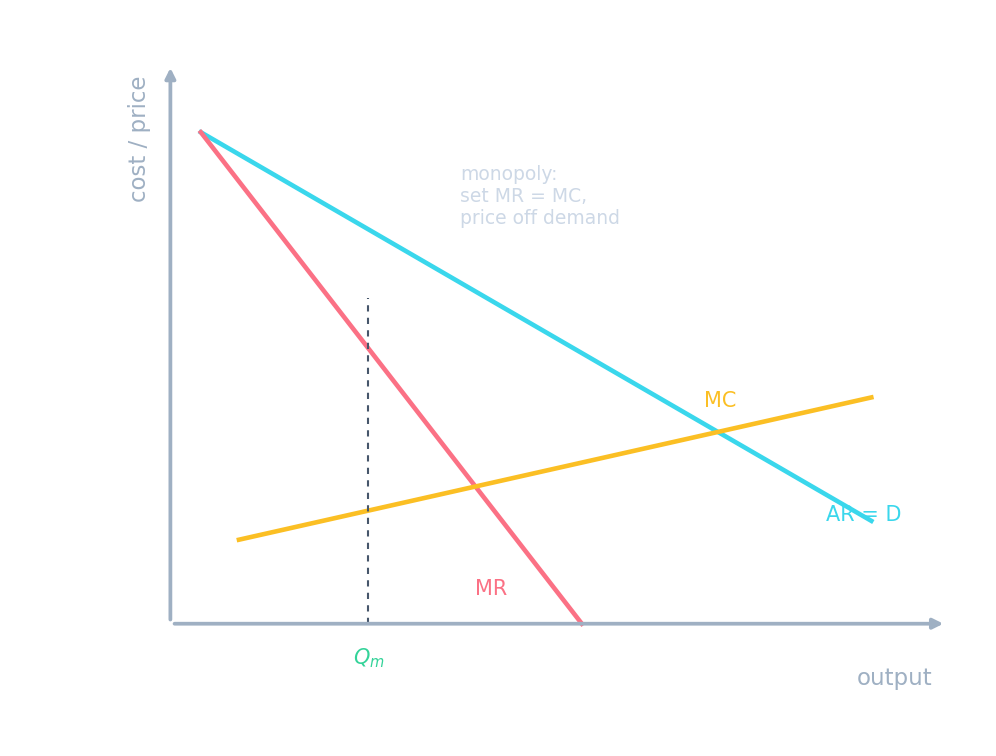
- So its marginal revenue 边际收入 is less than the price — the MR curve lies below demand.
A monopoly is a price maker, which means it:
With no rivals, the monopolist picks the point on the demand curve that maximises profit.
For a monopoly, marginal revenue is below the price because it must cut the price on every unit to sell more.
Lowering the price on all units makes the extra revenue (MR) smaller than the price.
Find the monopoly outcome
- The monopolist still obeys the rule: produce where $MR = MC$ to get $Q_M$.
- Then go up to the demand curve to read the price $P_M$.
- Because $P_M > MC$, the last unit is worth more to buyers than it costs to make — but the monopolist won't make it.
- Those lost trades are the deadweight loss 无谓损失, so a monopoly is allocatively inefficient 配置无效率.
The firm's cost curves
A monopolist still produces where marginal revenue meets marginal cost — but then charges a higher price off its downward-sloping demand.
Demand is P = 100 − Q, so MR = 100 − 2Q. With MC = 20, what is the monopoly quantity where MR = MC?
Set 100 − 2Q = 20 → 2Q = 80 → Q = 40.
Using the same demand P = 100 − Q, what price does the monopolist charge at Q = 40?
Read the price off demand: P = 100 − 40 = 60. Since 60 > MC = 20, there is a deadweight loss.
A monopoly is allocatively inefficient because at its output:
P > MC means the last unit is worth more than it costs, yet it is not made — a deadweight loss.
Natural monopoly
- A natural monopoly 自然垄断 has such large fixed costs (a water or power network) that one firm serves the whole market at lower average cost than two could.
- Here, competition would waste resources by duplicating the network.
A market best served by one firm because of huge fixed costs is a ______ monopoly.
A natural monopoly (like a water network) has one firm serve everyone at lower average cost.
A monopoly is the sole seller and a price maker, with marginal revenue below price. It sets $Q_M$ where $MR = MC$, then charges $P_M$ off the demand curve. Because $P_M > MC$ it is allocatively inefficient — a deadweight loss. A natural monopoly is cheapest served by one firm.