English
| Enduring Understanding | Learning Objective | Essential Knowledge |
|---|---|---|
MEA-4 | MEA-4.A |
|
ไทย
| Enduring Understanding | Learning Objective | Essential Knowledge |
|---|---|---|
MEA-4 | MEA-4.A |
|
AP Macroeconomics · AP เศรษฐศาสตร์มหภาค · Topic 6 · หัวข้อ 6
 8:01
8:01
เศรษฐกิจเปิด—การค้าระหว่างประเทศและการเงิน
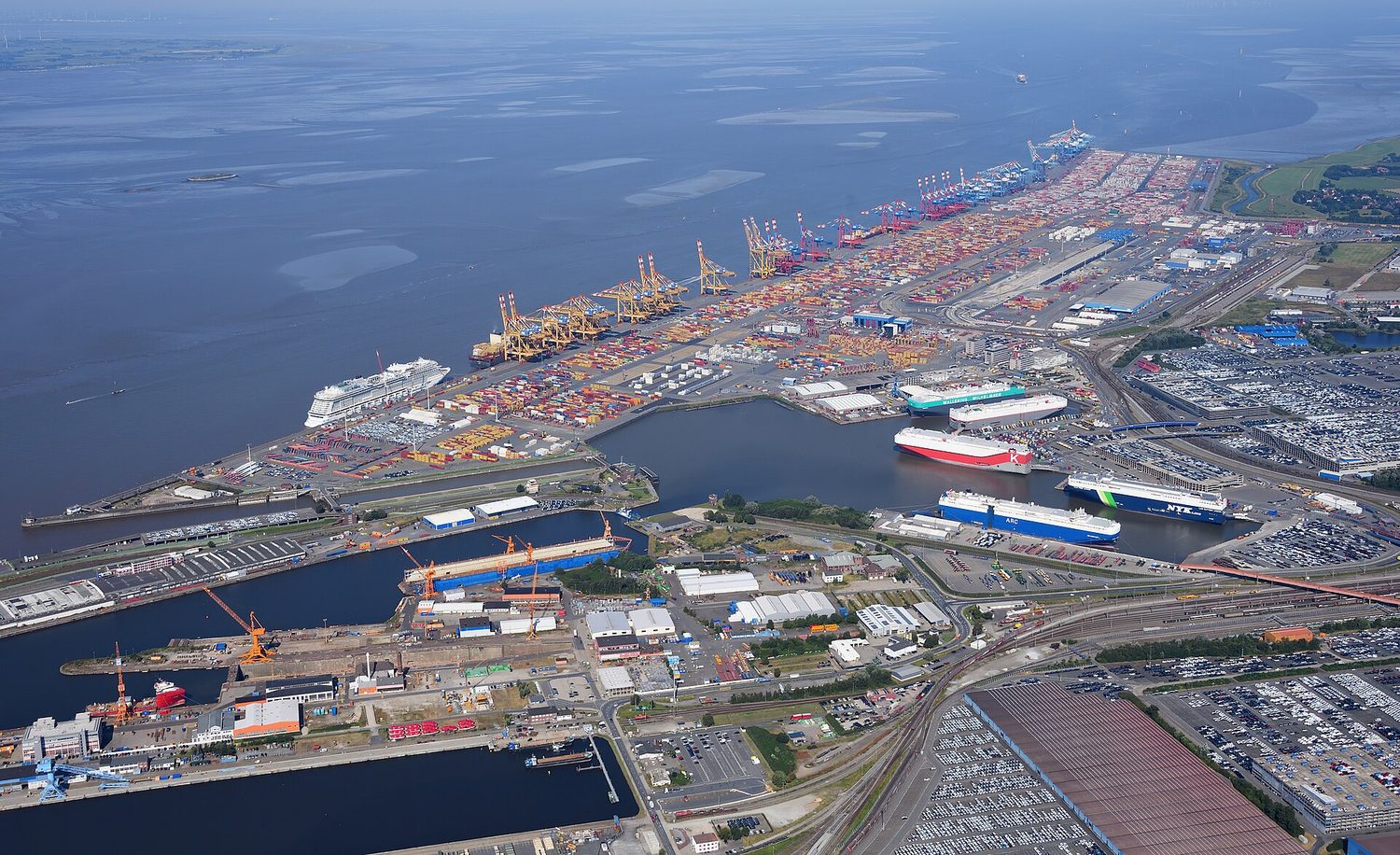
Check the label on almost anything you own. Made somewhere else. It crossed an ocean in a steel box like these, and somebody paid for it in a different money....
English narration · English + 中文 subtitles burned in · การบรรยายภาษาอังกฤษ · คำบรรยายภาษาอังกฤษ + 中文 ลอยตัวบนภาพ
| Enduring Understanding | Learning Objective | Essential Knowledge |
|---|---|---|
MEA-4 | MEA-4.A |
|
| Enduring Understanding | Learning Objective | Essential Knowledge |
|---|---|---|
MEA-4 | MEA-4.A |
|
Source: College Board AP Course and Exam Description · แหล่งที่มา: คำอธิบายหลักสูตรและข้อสอบ College Board AP
The balance of payments 国际收支 records all transactions between a country and the rest of the world, in two main accounts:
The two are mirror images: a current-account deficit is matched by a capital-account surplus (a country that imports more than it exports pays with assets, so foreign investment flows in). They sum to zero.
ดุลการชำระเงิน บันทึกธุรกรรมทั้งหมดระหว่างประเทศกับส่วนที่เหลือของโลก ในสองบัญชีหลัก:
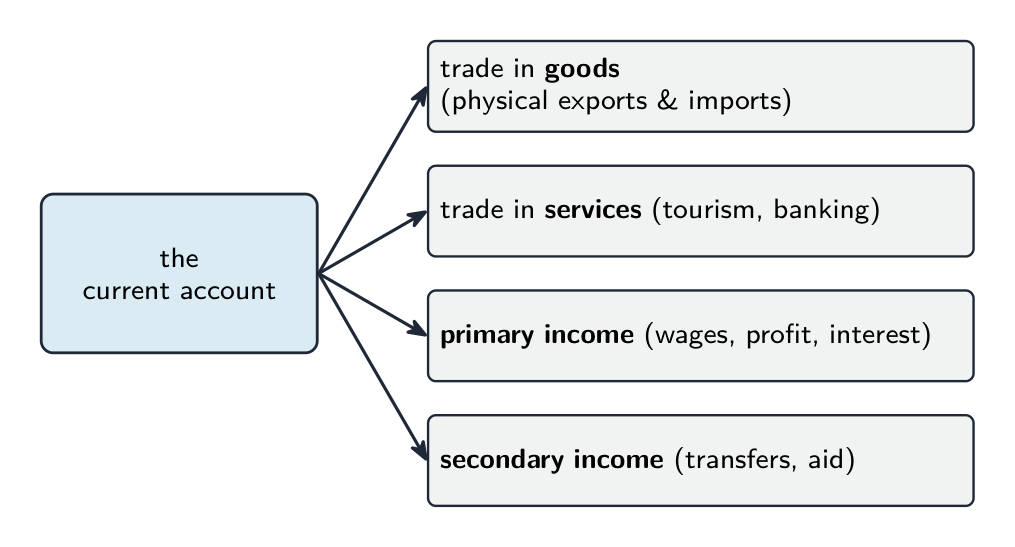
ทั้งสองเป็น ภาพสะท้อน: การขาดดุลบัญชี جاری会被บัญชีทุนส่วนเกิน match (ประเทศที่นำเข้ามากกว่าส่งออกจะชำระด้วยสินทรัพย์, ดังนั้นการลงทุนจากต่างประเทศจึงไหลเข้า) ทั้งสองรวมกันได้เป็นศูนย์
| English | ไทย |
|---|---|
| balance of payments/ˈbæləns ɒv ˈpeɪmənts/ | ดุลการค้า |
| current account/ˈkʌrənt əˈkaʊnt/ | บัญชี جاری |
| capital (financial) account/ˈkæpɪtl əˈkaʊnt/ | บัญชีทุน (การเงิน) |

Enduring Understanding (MKT-5): The interaction of buyers and sellers exchanging the currency of one country for the currency of another determines the equilibrium exchange rate in a flexible exchange market and influences the flow of goods, services, and financial capital between countries.
Learning Objective MKT-5.A: a. Define the exchange rate, currency appreciation, and currency depreciation. b. Explain how currencies are valued relative to one another. c. Calculate the value of one currency relative to another.
ความเข้าใจที่ยั่งยืน (MKT-5): การกระทำระหว่างผู้ซื้อและผู้ขายที่แลกเปลี่ยนสกุลเงินของประเทศหนึ่งกับสกุลเงินของประเทศอื่นกำหนดอัตราแลกเปลี่ยนสมดุลในตลาดอัตราแลกเปลี่ยนแบบยืดหยุ่นและส่งผลต่อการไหลของสินค้า บริการ และทุนทางการเงินระหว่างประเทศ
วัตถุประสงค์การเรียนรู้ MKT-5.A: ก. นิยามอัตราแลกเปลี่ยน การเพิ่มขึ้นของมูลค่าสกุลเงิน และการลดลงของมูลค่าสกุลเงิน ข. อธิบายวิธีการประเมินค่าสกุลเงินเมื่อเทียบกับสกุลเงินอื่น ค. คำนวณมูลค่าของสกุลเงินหนึ่งเมื่อเทียบกับอีกสกุลหนึ่ง
Source: College Board AP Course and Exam Description · แหล่งที่มา: คำอธิบายหลักสูตรและข้อสอบ College Board AP
An exchange rate 汇率 is the price of one currency in terms of another. A currency appreciates 升值 when it gains value (buys more foreign currency) and depreciates 贬值 when it loses value. Always track which currency: if the US dollar appreciates against the euro, the euro depreciates against the dollar – the same event from two sides.
Worked example. Suppose $\$1=\text{€}0.90$, so $\text{€}1=\dfrac{1}{0.90}\approx\$1.11$. If the dollar then appreciates to $\$1=\text{€}1.00$, each dollar now buys more euros, while the euro has depreciated – it now buys only $\$1.00$ instead of $\$1.11$. The single event is an appreciation of the dollar and a depreciation of the euro.
Most currencies today are floating 浮动, set by supply and demand in the foreign-exchange market.
อัตราแลกเปลี่ยน คือราคาของเงินสกุลหนึ่งเมื่อเทียบกับอีกสกุลหนึ่ง เงินสกุลจะ มีค่าขึ้น (appreciates) เมื่อได้รับมูลค่าเพิ่มขึ้น (ซื้อเงินต่างประเทศได้มากขึ้น) และจะ มีค่าลง (depreciates) เมื่อมูลค่าลดลง ต้องระวังเสมอว่า สกุลเงินใด ที่ถูกกล่าวถึง: หากดอลลาร์สหรัฐมีค่าขึ้นต่อยูโร ยูโรจึงมีค่าลงต่อดอลลาร์ – เป็นเหตุการณ์เดียวกันที่มองจากสองมุม
ตัวอย่างวิธีทำ. สมมติ $\$1=\text{€}0.90$, so $\text{€}1=\dfrac{1}{0.90}\approx\$1.11$. หาก afterward ดอลลาร์มีค่าขึ้นเป็น $\$1=\text{€}1.00$, each dollar now buys more euros, while the euro has depreciated – it now buys only $\$1.00$ แทนที่จะเป็น $\$1.11$. เหตุการณ์เดียวนี้คือการมีค่าขึ้นของดอลลาร์ และ การมีค่าลงของยูโร
เงินสกุลส่วนใหญ่ในปัจจุบันเป็น แบบลอยตัว (floating) ซึ่งกำหนดโดยแรง Demand และ Supply ในตลาด valuta
| English | ไทย |
|---|---|
| exchange rate/eksˈtʃeɪndʒ reɪt/ | อัตราแลกเปลี่ยน |
| appreciates/əˈpriːʃɪeɪts/ | มีมูลค่าเพิ่มขึ้น |
| depreciates/dɪˈpriːʃɪeɪts/ | มีมูลค่าลดลง |
| floating/ˈfləʊtɪŋ/ | ลอยตัว |
| capital flows/ˈkæpɪtl fləʊz/ | กระแสเงินทุน |
Enduring Understanding (MKT-5): The interaction of buyers and sellers exchanging the currency of one country for the currency of another determines the equilibrium exchange rate in a flexible exchange market and influences the flow of goods, services, and financial capital between countries.
Learning Objective MKT-5.B: a. Define the foreign exchange market, demand for currency, and supply of currency. b. Explain (using graphs as appropriate) the relationship between the exchange rate and the quantity of currency demanded (supplied).
Learning Objective MKT-5.C: Define (using graphs as appropriate) the equilibrium exchange rate.
Learning Objective MKT-5.D: Explain (using graphs as appropriate) how exchange rates adjust to restore equilibrium in the foreign exchange market.
ความเข้าใจที่ยั่งยืน (MKT-5): การกระทำระหว่างผู้ซื้อและผู้ขายที่แลกเปลี่ยนสกุลเงินของประเทศหนึ่งกับสกุลเงินของประเทศอื่นกำหนดอัตราแลกเปลี่ยนสมดุลในตลาดอัตราแลกเปลี่ยนแบบยืดหยุ่นและส่งผลต่อการไหลของสินค้า บริการ และทุนทางการเงินระหว่างประเทศ
วัตถุประสงค์การเรียนรู้ MKT-5.B: ก. นิยามตลาด valuta ต่างประเทศ ความต้องการสกุลเงิน และอุปทานสกุลเงิน ข. อธิบาย (โดยใช้กราฟตามความเหมาะสม) ความสัมพันธ์ระหว่างอัตราแลกเปลี่ยนกับปริมาณสกุลเงินที่ต้องการ (หรืออุปทาน)
วัตถุประสงค์การเรียนรู้ MKT-5.C: นิยาม (โดยใช้กราฟตามความเหมาะสม) อัตราแลกเปลี่ยนสมดุล
วัตถุประสงค์การเรียนรู้ MKT-5.D: อธิบาย (โดยใช้กราฟตามความเหมาะสม) ว่าอัตราแลกเปลี่ยนปรับตัวอย่างไรเพื่อคืนสู่สมดุลในตลาด valuta ต่างประเทศ
Source: College Board AP Course and Exam Description · แหล่งที่มา: คำอธิบายหลักสูตรและข้อสอบ College Board AP
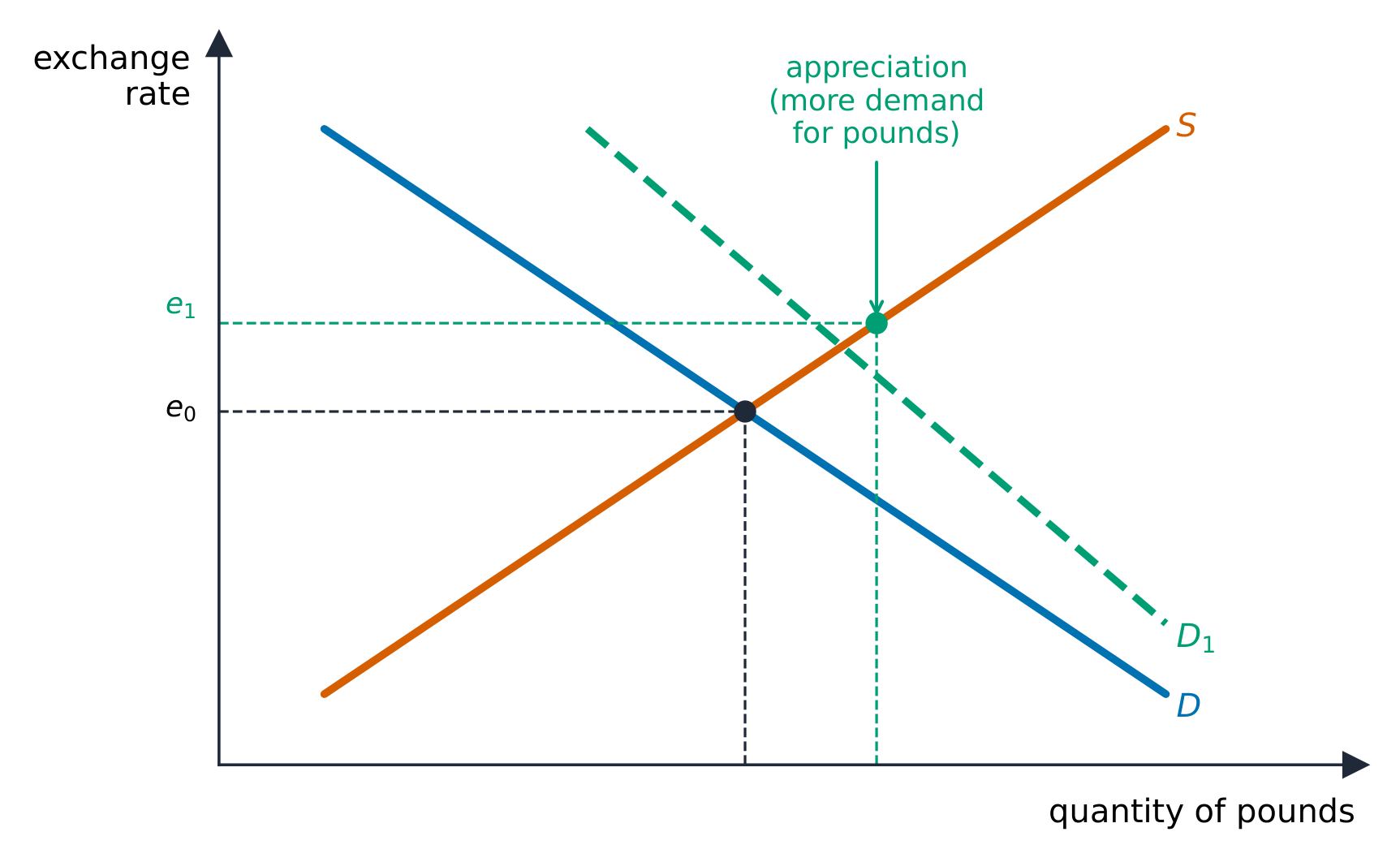
Each currency has its own supply-and-demand graph (price $=$ the exchange rate, quantity $=$ amount of that currency).
The equilibrium exchange rate is where they cross. A rightward shift in demand for a currency causes it to appreciate; a rightward shift in supply causes it to depreciate.
Exam skill: always draw the graph for the currency named in the question, label the axis with that currency's price, and shift the correct curve – mixing up the two currencies' graphs is the most common error.
แต่ละสกุลเงินมีกราฟ Demand-Supply ของตัวเอง (ราคา $=$ คืออัตราแลกเปลี่ยน, ปริมาณ $=$ คือจำนวนเงินสกุลนั้น)
อัตราแลกเปลี่ยนสมดุลคือจุดที่เส้นตัดกัน การเลื่อน Demand ไปทางขวาทำให้เงินสกุลนั้นมีค่าขึ้น; การเลื่อน Supply ไปทางขวาทำให้มีค่าลง
ทักษะการสอบ: ควรวาดกราฟสำหรับ สกุลเงินที่ระบุในโจทย์ เสมอ ทำป้ายแกนด้วยราคาสกุลเงินนั้น และเลื่อนเส้นโค้งให้ถูกต้อง – การสับสนระหว่างกราฟของสองสกุลเงินเป็นข้อผิดพลาดที่พบบ่อยที่สุด
A currency's exchange rate is set where demand for it meets supply. Higher demand for exports or higher interest rates appreciate the currency. · อัตราแลกเปลี่ยน ของเงินตราถูกกำหนดที่จุดที่อุปสงค์และอุปทานบรรจบกัน ความต้องการส่งออกที่สูงขึ้นหรืออัตราดอกเบี้ยที่สูงขึ้นจะทำให้เงินตรามีมูลค่าสูงขึ้น
Enduring Understanding (MKT-5): The interaction of buyers and sellers exchanging the currency of one country for the currency of another determines the equilibrium exchange rate in a flexible exchange market and influences the flow of goods, services, and financial capital between countries.
Learning Objective MKT-5.E: a. Explain (using graphs as appropriate) the determinants of currency demand and supply. b. Explain (using graphs as appropriate) how changes in demand and supply in the foreign exchange market affect the equilibrium exchange rate.
ความเข้าใจที่ยั่งยืน (MKT-5): การกระทำระหว่างผู้ซื้อและผู้ขายที่แลกเปลี่ยนสกุลเงินของประเทศหนึ่งกับสกุลเงินของประเทศอื่นกำหนดอัตราแลกเปลี่ยนสมดุลในตลาดอัตราแลกเปลี่ยนแบบยืดหยุ่นและส่งผลต่อการไหลของสินค้า บริการ และทุนทางการเงินระหว่างประเทศ
วัตถุประสงค์การเรียนรู้ MKT-5.E: ก. อธิบาย (โดยใช้กราฟตามความเหมาะสม) ปัจจัยที่กำหนดความต้องการและอุปทานสกุลเงิน ข. อธิบาย (โดยใช้กราฟตามความเหมาะสม) การเปลี่ยนแปลงในความต้องการและอุปทานในตลาด valuta ต่างประเทศส่งผลต่ออัตราแลกเปลี่ยนสมดุลอย่างไร
Source: College Board AP Course and Exam Description · แหล่งที่มา: คำอธิบายหลักสูตรและข้อสอบ College Board AP
Exchange rates respond to:
Monetary policy has a strong link: expansionary monetary policy lowers interest rates, reduces demand for the currency, and causes depreciation (which then boosts net exports).
อัตราแลกเปลี่ยนตอบสนองต่อ:
นโยบายการเงินมีความสัมพันธ์อย่างใกล้ชิด: นโยบายการเงินแบบ **ขยาย (expansionary)**会降低 interest rates, ลด Demand ต่อสกุลเงิน และทำให้เกิด การมีค่าลง (ซึ่งจะช่วยเพิ่ม Net Exports)
Enduring Understanding (MKT-5): The interaction of buyers and sellers exchanging the currency of one country for the currency of another determines the equilibrium exchange rate in a flexible exchange market and influences the flow of goods, services, and financial capital between countries.
Learning Objective MKT-5.F: Explain (using graphs as appropriate) how changes in the value of a currency can lead to changes in a country's net exports and aggregate demand.
ความเข้าใจที่ยั่งยืน (MKT-5): การกระทำระหว่างผู้ซื้อและผู้ขายที่แลกเปลี่ยนสกุลเงินของประเทศหนึ่งกับสกุลเงินของประเทศอื่นกำหนดอัตราแลกเปลี่ยนสมดุลในตลาดอัตราแลกเปลี่ยนแบบยืดหยุ่นและส่งผลต่อการไหลของสินค้า บริการ และทุนทางการเงินระหว่างประเทศ
วัตถุประสงค์การเรียนรู้ MKT-5.F: อธิบาย (โดยใช้กราฟตามความเหมาะสม) ว่าการเปลี่ยนแปลงมูลค่าของสกุลเงินนำไปสู่การเปลี่ยนแปลง صادراتสุทธิและกำลังซื้อรวมของประเทศได้อย่างไร
Source: College Board AP Course and Exam Description · แหล่งที่มา: คำอธิบายหลักสูตรและข้อสอบ College Board AP
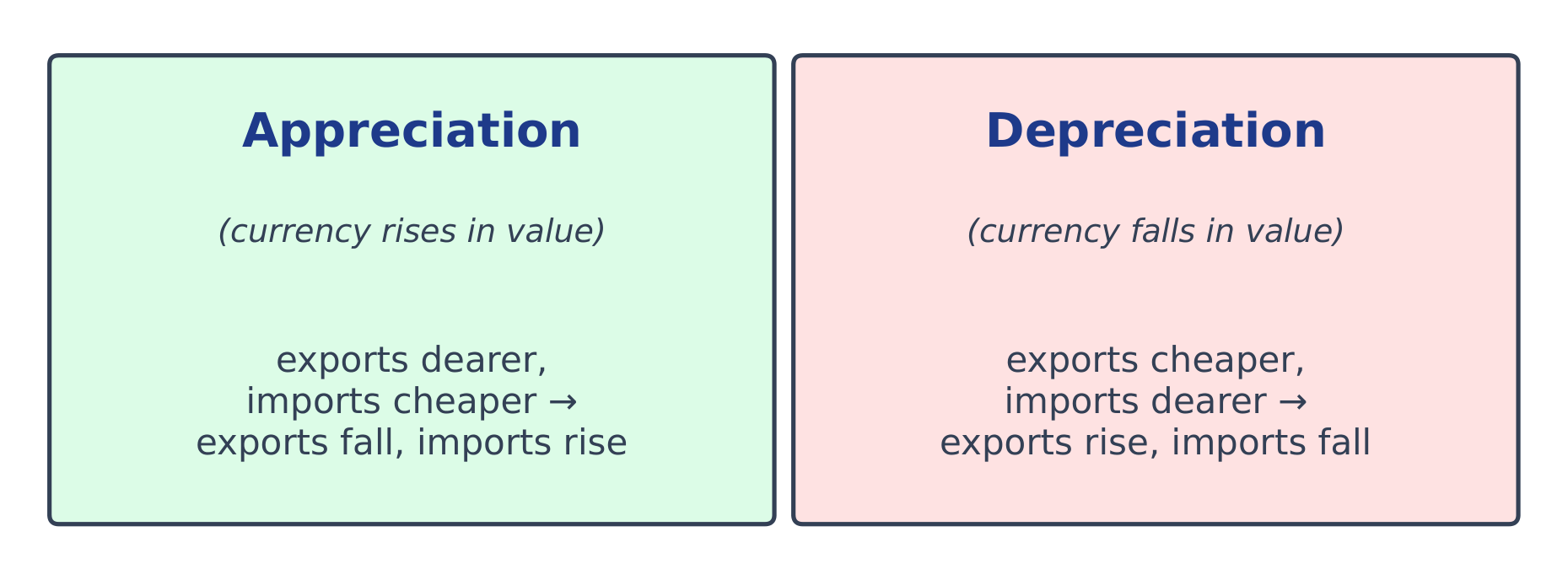
Exchange rates feed back into AD through net exports:
Worked example. A US car priced at $\$30{,}000$ costs a European buyer $\text{€}27{,}000$ when $\$1=\text{€}0.90$. If the dollar depreciates to $\$1=\text{€}0.80$, the same car now costs only $\text{€}24{,}000$ – cheaper for foreigners, so US exports rise while imports (now dearer in dollars) fall, lifting net exports and shifting AD right.
This is how the foreign-exchange market and the AD-AS model connect – a currency change is a channel through which policy reaches output.
อัตราแลกเปลี่ยนส่งผลกระทบต่อ AD ผ่าน Net Exports :
ตัวอย่างวิธีทำ. รถยนต์สหรัฐฯ ราคา $\$30{,}000$ costs a European buyer $\text{€}27{,}000$ when $\$1=\text{€}0.90$. หากดอลลาร์ มีค่าลง เป็น $\$1=\text{€}0.80$, the same car now costs only $\text{€}24{,}000$ – ถูกสำหรับชาวต่างชาติ ดังนั้นการส่งออกของสหรัฐฯ เพิ่มขึ้น ในขณะที่การนำเข้า (ซึ่งตอนนี้แพงขึ้นเมื่อแปลงเป็นดอลลาร์) ลดลง ช่วยเพิ่ม Net Exports และเลื่อน AD ไปทางขวา
นี่คือวิธีการที่ตลาด valuta และโมเดล AD-AS เชื่อมโยงกัน – การเปลี่ยนแปลงของสกุลเงินเป็นช่องทางที่นโยบายส่งผลต่อผลผลิต
Enduring Understanding (MKT-5): The interaction of buyers and sellers exchanging the currency of one country for the currency of another determines the equilibrium exchange rate in a flexible exchange market and influences the flow of goods, services, and financial capital between countries.
Learning Objective MKT-5.G: Explain (using graphs as appropriate) how differences in real interest rates across countries affect financial capital flows, foreign exchange markets, and loanable funds markets.
ความเข้าใจที่ยั่งยืน (MKT-5): การกระทำระหว่างผู้ซื้อและผู้ขายที่แลกเปลี่ยนสกุลเงินของประเทศหนึ่งกับสกุลเงินของประเทศอื่นกำหนดอัตราแลกเปลี่ยนสมดุลในตลาดอัตราแลกเปลี่ยนแบบยืดหยุ่นและส่งผลต่อการไหลของสินค้า บริการ และทุนทางการเงินระหว่างประเทศ
วัตถุประสงค์การเรียนรู้ MKT-5.G: อธิบาย (โดยใช้กราฟตามความเหมาะสม) ว่าความแตกต่างของอัตราดอกเบี้ยจริงระหว่างประเทศส่งผลต่อการไหลเวียนของทุนทางการเงิน ตลาด valuta ต่างประเทศ และตลาดสินเชื่ออย่างไร
Source: College Board AP Course and Exam Description · แหล่งที่มา: คำอธิบายหลักสูตรและข้อสอบ College Board AP
Money chases the highest real return, so capital flows 资本流动 respond to real interest rates:
This ties the whole course together: government borrowing raises the real interest rate (loanable funds), which attracts foreign capital, appreciates the currency, and reduces net exports – so a budget deficit can widen a trade deficit (the "twin deficits"). Tracing these linked effects across the loanable-funds, forex, and AD-AS graphs is the capstone skill of AP Macroeconomics.
เงินวิ่งหาผลตอบแทน จริง สูงสุด ดังนั้น การไหลเวียนของทุน จึงตอบสนองต่ออัตราดอกเบี้ยจริง:
สิ่งนี้เชื่อมโยงเนื้อหาทั้งหมดเข้าด้วยกัน: การกู้ยืมของรัฐบาลทำให้อัตราดอกเบี้ยจริงสูงขึ้น (Loanable Funds) ซึ่งดึงดูดทุนต่างประเทศ มีค่าขึ้น และลด Net Exports – ดังนั้นขาดดุลงบประมาณอาจทำให้ขาดดุลการค้ากว้างขึ้น (Twin Deficits). การติดตามผลกระทบที่เชื่อมโยงกันผ่านกราฟ Loanable Funds, Forex และ AD-AS ทักษะสูงสุดของ AP Macroeconomics
Work through it step by step, with instant-check exercises. · ทำทีละขั้นตอน พร้อมแบบฝึกหัดตรวจสอบผลทันที
Past Papers · ข้อสอบย้อนหลัง
Loading subjects… · กำลังโหลดวิชา…