Skip to content · ⁨ข้ามไปยังเนื้อหา⁩

Economic Indicators and the Business Cycle · ⁨ตัวชี้วัดทางเศรษฐกิจและวัฏจักรทางธุรกิจ⁩

AP Macroeconomics · ⁨AP เศรษฐศาสตร์มหภาค⁩ · Topic 2 · ⁨หัวข้อ 2⁩

Video lesson for this topic · ⁨บทเรียนวิดีโอสำหรับหัวข้อนี้⁩ Open the video page · ⁨เปิดหน้าวิดีโอ⁩
9:58

ตัวชี้วัดทางเศรษฐกิจและวัฏจักรทางธุรกิจ

ฉากธรรมดาสองฉาก走廊超市场过道同一篮子食物今年比去年贵。 And a long queue of people, waiting. Neither is an...

English narration · English + 中文 subtitles burned in · ⁨การบรรยายภาษาอังกฤษ · คำบรรยายภาษาอังกฤษ + 中文 ลอยตัวบนภาพ⁩

2.1

The Circular Flow and GDP · ⁨การไหลเวียนวงกลมและ GDP⁩

Syllabus · ⁨หลักสูตร⁩
English

Enduring Understanding (MEA-1): An economy's performance can be measured by different indicators such as gross domestic product (GDP), the inflation rate, and the unemployment rate.

Learning Objective MEA-1.A: a. Define (using the circular flow diagram as appropriate) how GDP is measured and its components. b. Calculate nominal GDP.

  • MEA-1.A.1 GDP is a measure of final output of the economy.
  • MEA-1.A.2 GDP as a total flow of income and expenditure can be represented by the circular flow diagram.
  • MEA-1.A.3 There are three ways of measuring GDP: the expenditures approach, the income approach, and the value-added approach.
ไทย

ความเข้าใจที่ยั่งยืน (MEA-1): ประสิทธิภาพของเศรษฐกิจสามารถวัดได้ด้วยตัวชี้วัดต่างๆ เช่น ผลิตภัณฑ์มวลรวมภายในประเทศ (GDP) อัตราเงินเฟ้อ และอัตราการว่างงาน

วัตถุประสงค์การเรียนรู้ MEA-1.A: ก. นิยาม (โดยใช้แผนภาพการไหลเวียนวงกลมเมื่อเหมาะสม) วิธีวัด GDP และองค์ประกอบของมัน ข. คำนวณ GDP ชดเชย

  • MEA-1.A.1 GDP คือการวัดผลลัพธ์สุดท้ายของเศรษฐกิจ
  • MEA-1.A.2 GDP ในฐานะกระแสรวมของรายได้และรายจ่าย สามารถแสดงได้ด้วยแผนภาพการไหลเวียนวงกลม
  • MEA-1.A.3 มี 3 วิธีในการวัด GDP: แนวทางการใช้จ่าย, แนวทางรายได้ และแนวทางมูลค่าเพิ่ม
Source: College Board AP Course and Exam Description · ⁨แหล่งที่มา: คำอธิบายหลักสูตรและข้อสอบ College Board AP⁩

English

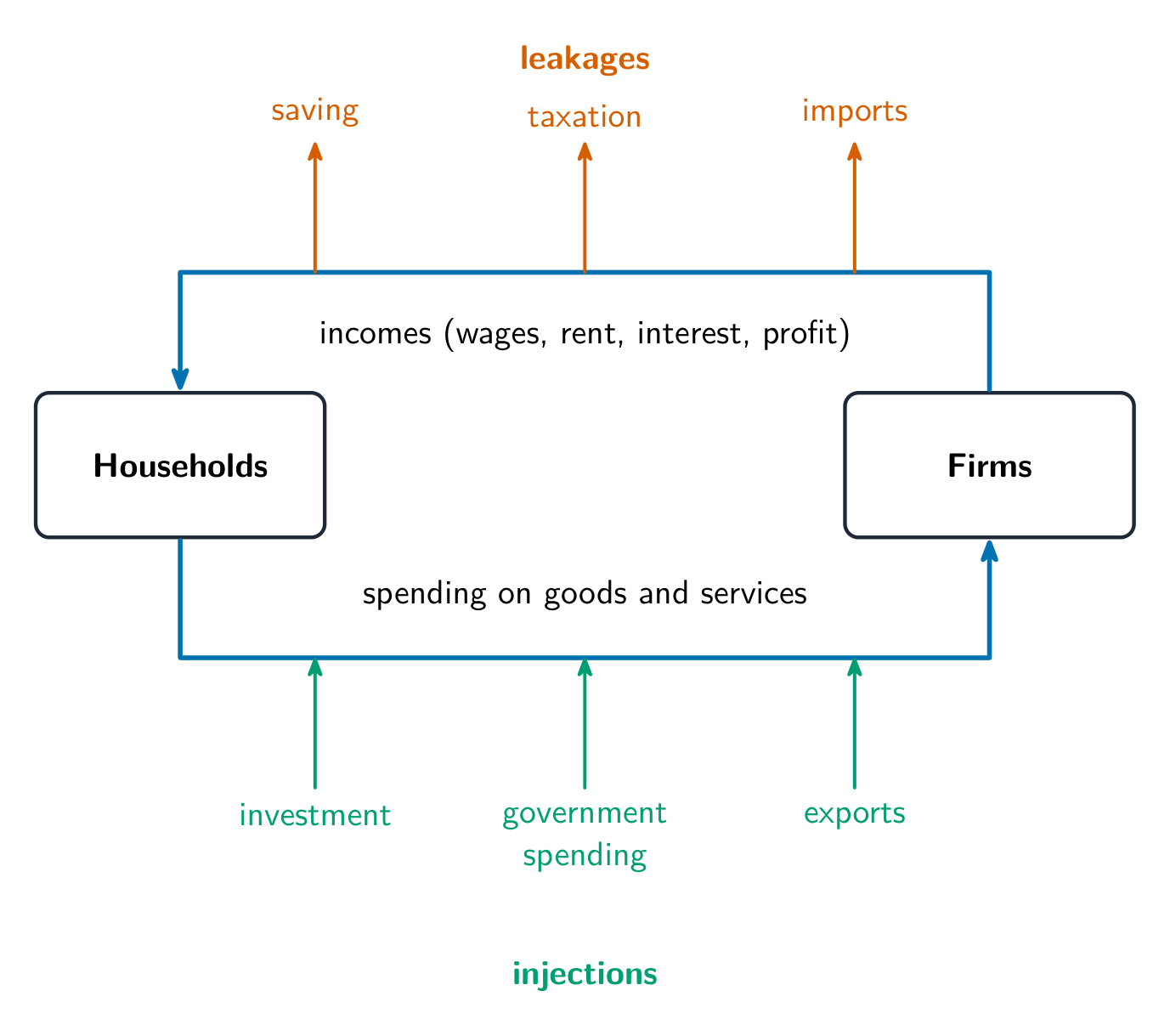
The circular-flow model 循环流动模型 shows money moving between households and firms: households supply factors and earn income; firms sell goods and earn revenue. Every dollar of spending is someone's income, which is why output and income are two sides of the same total.

Gross domestic product (GDP) 国内生产总值 is the market value of all final goods and services produced within a country in a year. Three ways to measure it give the same number:

  • Expenditure approach: $GDP = C + I + G + X_n$ – consumption 消费, investment 投资 (business spending on capital, plus new housing and inventory), government purchases 政府购买, and net exports 净出口 (exports minus imports).
  • Income approach: add up all wages, rent, interest, and profit.

Exclude intermediate goods (avoid double counting), used goods, purely financial transactions, and transfer payments.

ไทย

โมเดลการไหลเวียนวงกลม แสดงให้เห็นการไหลของเงินระหว่าง ครัวเรือน และ บริษัท: ครัวเรือนเสนอปัจจัยการผลิตและได้รับรายได้; บริษัทขายสินค้าและรับรายได้ Every dollar ของการใช้จ่ายคือรายได้ของใครคนหนึ่ง นั่นคือเหตุผลว่าทำไมผลผลิตและรายได้จึงเป็นสองด้านของยอดรวมเดียวกัน

การไหลเวียนของรายได้ พร้อมการรั่วไหลและการฉีดเข้า

ผลิตภัณฑ์มวลรวมในประเทศ (GDP) คือมูลค่าตลาดของสินค้าและบริการ สำเร็จรูป ทั้งหมดที่ผลิต ภายในประเทศ ในช่วงปีหนึ่ง วิธีวัดสามวิธีให้ผลลัพธ์เท่ากัน:

  • วิธีการใช้จ่าย: $GDP = C + I + G + X_n$ – การบริโภค, การลงทุน (ค่าใช้จ่ายของธุรกิจสำหรับทุน รวมถึงบ้านใหม่และสต็อกสินค้า), การซื้อของรัฐบาล และ ** صادراتสุทธิ** (etects ลบด้วย imports).
  • วิธีการรายได้: รวม wages, rent, interest, และ profit ทั้งหมด

ตัดออก สินค้ากึ่งสำเร็จรูป (หลีกเลี่ยงการนับซ้ำ) สินค้าใช้แล้ว ธุรกรรมทางการเงินล้วนๆ และการชำระเงินโอน

Explore · ⁨สำรวจ⁩

Follow money around the circular flow · ⁨ติดตามการไหลเวียนของเงินแบบวงกลม⁩

Money flows from households to firms (spending) and back (wages), while injections (investment, government, exports) and leakages (saving, taxes, imports) can grow or shrink the flow — the size of that flow is GDP. · ⁨เงินไหลจากครัวเรือนไปยังธุรกิจ (ค่าใช้จ่าย) กลับมา (ค่าจ้าง) ในขณะที่การฉีดเข้า (การลงทุน รัฐบาล การส่งออก) และการรั่วไหล (การออม ภาษี การนำเข้า) สามารถขยายหรือหดขนาดการไหลเวียน — ขนาดของการไหลเวียนนี้คือ GDP⁩

2.2

Limitations of GDP · ⁨ข้อจำกัดของ GDP⁩

Syllabus · ⁨หลักสูตร⁩
English

Enduring Understanding (MEA-1): An economy's performance can be measured by different indicators such as gross domestic product (GDP), the inflation rate, and the unemployment rate.

Learning Objective MEA-1.B: Define the limitations of GDP.

  • MEA-1.B.1 GDP is a useful indicator of a nation's economic performance, but it has some limitations, such as failing to account for nonmarket transactions.
ไทย

ความเข้าใจที่ยั่งยืน (MEA-1): ประสิทธิภาพของเศรษฐกิจสามารถวัดได้ด้วยตัวชี้วัดต่างๆ เช่น ผลิตภัณฑ์มวลรวมภายในประเทศ (GDP) อัตราเงินเฟ้อ และอัตราการว่างงาน

จุดประสงค์การเรียนรู้ MEA-1.B: กำหนดข้อจำกัดของ GDP

  • MEA-1.B.1 GDP เป็นตัวชี้วัด有用的ของการดำเนินงานทางเศรษฐกิจของประเทศ แต่มีข้อจำกัดบางประการ เช่น ไม่คำนึงถึงธุรกรรมที่ไม่ใช่ตลาด

Source: College Board AP Course and Exam Description · ⁨แหล่งที่มา: คำอธิบายหลักสูตรและข้อสอบ College Board AP⁩

English

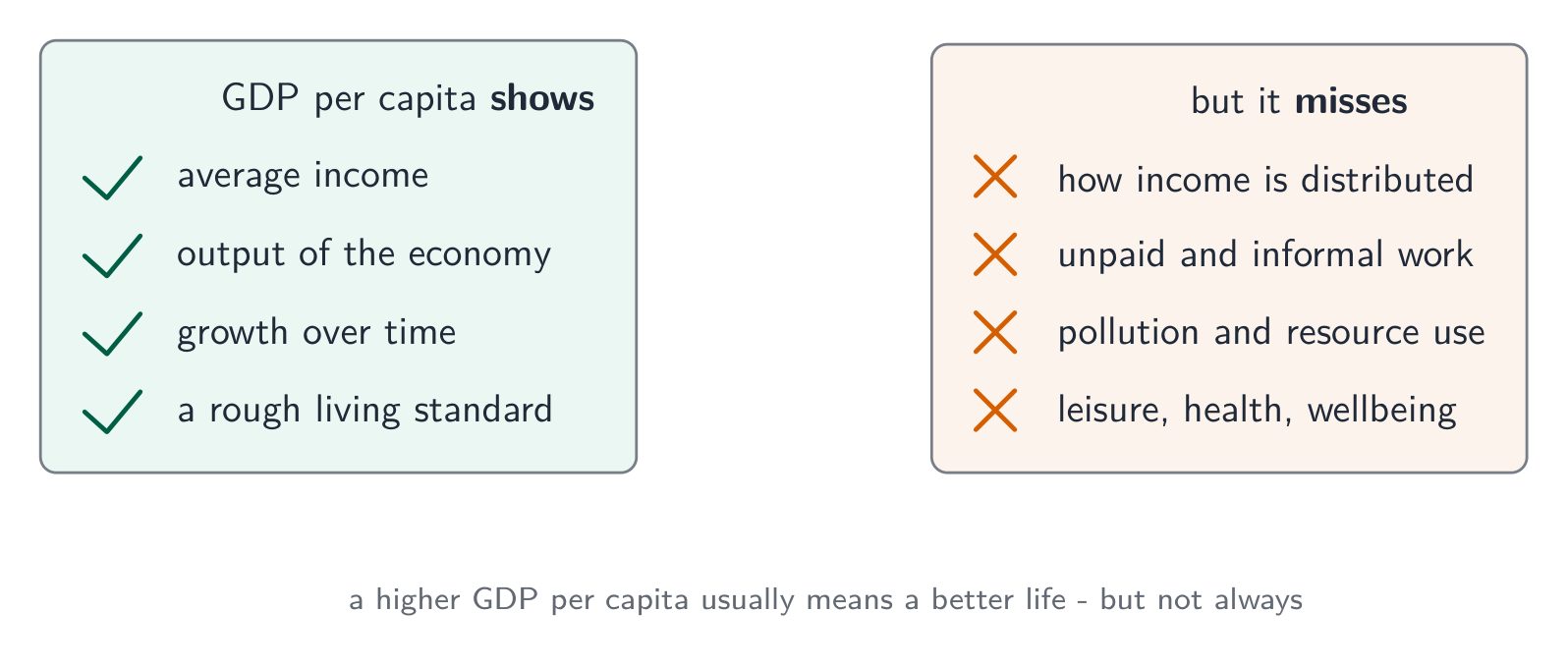
GDP measures market output, not well-being. It omits non-market production (unpaid housework, volunteering), the underground economy 地下经济, leisure, and the distribution of income, and it ignores environmental damage and resource depletion. So a higher GDP does not automatically mean a better standard of living. GDP per capita (GDP $\div$ population) is a better welfare proxy than total GDP.

ไทย

GDP วัดผลผลิตในตลาด ไม่ใช่ความอยู่ดีมีสุข มัน ละเลย การผลิตนอกตลาด (งานบ้านที่ไม่ได้รับค่าจ้าง, การเป็นอาสาสมัคร), เศรษฐกิจใต้ดิน, เวลาว่าง และการ กระจาย รายได้ และมันไม่คำนึงถึงความเสียหายต่อ สิ่งแวดล้อม และการเสื่อมโทรมของทรัพยากร ดังนั้น GDP ที่สูงขึ้นจึงไม่ได้หมายความว่ามาตรฐานการมีชีวิตจะดีขึ้นเสมอไป GDP ต่อหัว (GDP $\div$ ประชากร) เป็นตัวบ่งชี้สวัสดิภาพที่ดีกว่า GDP รวม

GDP ต่อหัวแสดงผลผลิตเฉลี่ยแต่ขาดการกระจาย งานที่ไม่ได้รับค่าจ้าง และอื่นๆ
2.3

Unemployment · ⁨การว่างงาน⁩

Syllabus · ⁨หลักสูตร⁩
English

Enduring Understanding (MEA-1): An economy's performance can be measured by different indicators such as gross domestic product (GDP), the inflation rate, and the unemployment rate.

Learning Objective MEA-1.C: a. Define the labor force, the unemployment rate, and the labor force participation rate. b. Explain how changes in employment and the labor market affect the unemployment rate and the labor force participation rate. c. Calculate the unemployment rate and the labor force participation rate.

  • MEA-1.C.1 The unemployment rate is the percentage of the labor force that is out of work.
  • MEA-1.C.2 The labor force participation rate is another measure of the labor market activity in an economy. The labor force participation rate is the percentage of the adult population that is in the labor force.

Learning Objective MEA-1.D: Define the limitations of the unemployment rate.

  • MEA-1.D.1 The measured unemployment rate is often criticized for understating the level of joblessness because it excludes groups such as discouraged workers and part-time workers.

Learning Objective MEA-1.E: a. Define the types of unemployment and the natural rate of unemployment. b. Explain changes in the types of unemployment.

  • MEA-1.E.1 Economists primarily focus on three types of unemployment: cyclical, frictional, and structural.
  • MEA-1.E.2 The natural rate of unemployment is the unemployment rate that would exist when the economy produces full-employment real output. It is equal to the sum of frictional and structural unemployment.
  • MEA-1.E.3 The deviation of the actual unemployment rate from the natural rate is cyclical unemployment.
  • MEA-1.E.4 The natural rate of unemployment can gradually change over time because of such things as changes in labor force characteristics.
ไทย

ความเข้าใจที่ยั่งยืน (MEA-1): ประสิทธิภาพของเศรษฐกิจสามารถวัดได้ด้วยตัวชี้วัดต่างๆ เช่น ผลิตภัณฑ์มวลรวมภายในประเทศ (GDP) อัตราเงินเฟ้อ และอัตราการว่างงาน

จุดประสงค์การเรียนรู้ MEA-1.C: ก. นิยามกำลังแรงงาน อัตราการว่างงาน และอัตราการมีส่วนร่วมของกำลังแรงงาน ข. อธิบายว่าความเปลี่ยนแปลงในการจ้างงานและตลาดแรงงานส่งผลต่ออัตราการว่างงานและอัตราการมีส่วนร่วมของกำลังแรงงานอย่างไร ค. คำนวณอัตราการว่างงานและอัตราการมีส่วนร่วมของกำลังแรงงาน

  • MEA-1.C.1 อัตราการว่างงานคือเปอร์เซ็นต์ของกำลังแรงงานที่ไร้งานทำ
  • MEA-1.C.2 อัตราการมีส่วนร่วมของกำลังแรงงานเป็นอีกตัวชี้วัดหนึ่งของกิจกรรมในตลาดเศรษฐกิจ อัตราการมีส่วนร่วมของกำลังแรงงานคือเปอร์เซ็นต์ของประชากรผู้ใหญ่ที่อยู่ในกำลังแรงงาน

จุดประสงค์การเรียนรู้ MEA-1.D: กำหนดข้อจำกัดของอัตราการว่างงาน

  • MEA-1.D.1 อัตราการว่างงานที่วัดได้มักถูกวิจารณ์ว่าประเมินระดับการขาดแคลนงานต่ำเกินไป เพราะไม่รวมกลุ่มเช่นผู้หางานที่หมดหวังและผู้ทำงานครึ่งเวลา

จุดประสงค์การเรียนรู้ MEA-1.E: ก. นิยามประเภทของการว่างงานและอัตราว่างงานธรรมชาติ ข. อธิบายความเปลี่ยนแปลงในประเภทของการว่างงาน

  • MEA-1.E.1 นักเศรษฐศาสตร์มุ่งเน้นไปที่ประเภทของการว่างงานหลัก 3 ประเภท: แบบวัฏจักร, แบบเสียดทาน และแบบโครงสร้าง
  • MEA-1.E.2 อัตราว่างงานธรรมชาติคืออัตราการว่างงานที่จะเกิดขึ้นเมื่อเศรษฐกิจผลิตผลผลิตจริงเต็มกำลังการผลิต มันเท่ากับผลรวมของการว่างงานแบบเสียดทานและการว่างงานแบบโครงสร้าง
  • MEA-1.E.3 ความเบี่ยงเบนของอัตราการว่างงานจริงจากอัตราว่างงานธรรมชาติคือการว่างงานแบบวัฏจักร
  • MEA-1.E.4 อัตราว่างงานธรรมชาติสามารถเปลี่ยนแปลงไปอย่างค่อยเป็นค่อยไปตามเวลาเนื่องจากปัจจัยต่าง ๆ เช่น ความเปลี่ยนแปลงในลักษณะของกำลังแรงงาน

Source: College Board AP Course and Exam Description · ⁨แหล่งที่มา: คำอธิบายหลักสูตรและข้อสอบ College Board AP⁩

English

The labor force 劳动力 is the employed plus the unemployed (those without work who are actively looking). People not looking are not in the labor force.

$$\text{Unemployment rate}=\frac{\text{unemployed}}{\text{labor force}}\times 100\%,\qquad \text{Labor-force participation}=\frac{\text{labor force}}{\text{working-age population}}\times100\%.$$

Worked example. A country has $150$ million employed and $10$ million unemployed (actively looking), with $40$ million working-age adults not looking. The labor force is $150+10=160$ million, so the unemployment rate is $\dfrac{10}{160}=6.25\%$ and the participation rate is $\dfrac{160}{200}=80\%$.

Three types of unemployment:

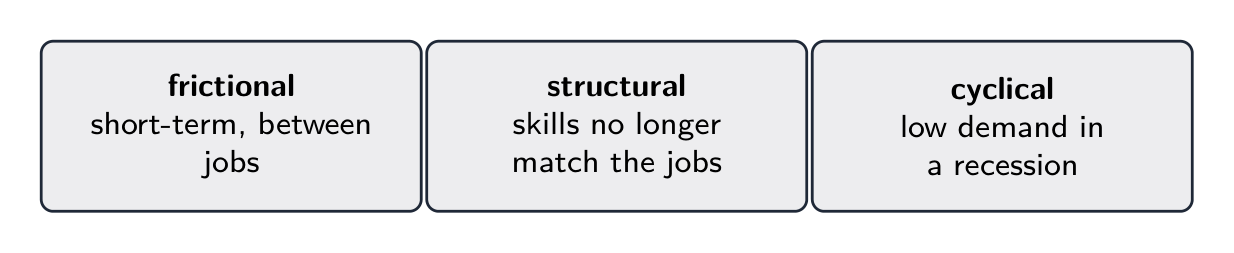
  • Frictional 摩擦性失业: between jobs or searching for a first job (normal, short).
  • Structural 结构性失业: skills or location don't match available jobs (technology, trade).
  • Cyclical 周期性失业: caused by a recession (a downturn in the business cycle).

Frictional + structural make up the natural rate of unemployment 自然失业率. At the natural rate cyclical unemployment is zero and the economy is at full employment 充分就业. The rate understates joblessness because it omits discouraged workers 灰心工人 and the underemployed.

ไทย
คิวคนยาวเหยียด — การว่างงานคือคนที่พร้อมและสามารถทำงานแต่หางานไม่ได้

กำลังแรงงาน คือผู้ที่มีงานทำบวกกับผู้ว่างงาน (那些人ไม่มีงานแต่กำลังค้นหาอย่างกระตือรือร้น) คนที่ไม่กำลังค้นหา ไม่ใช่ ส่วนหนึ่งของกำลังแรงงาน

สามประเภทของการว่างงาน: ธรรมชาติ, โครงสร้าง และรอบธุรกิจ
$$\text{Unemployment rate}=\frac{\text{unemployed}}{\text{labor force}}\times 100\%,\qquad \text{Labor-force participation}=\frac{\text{labor force}}{\text{working-age population}}\times100\%.$$

ตัวอย่างที่คำนวณแล้ว. ประเทศหนึ่งมี $150$ ล้านคนมีงานทำ และ $10$ ล้านคนว่างงาน (กำลังค้นหาอย่างกระตือรือร้น) โดยมี $40$ ล้านผู้ใหญ่ในวัยทำงานที่ไม่กำลังค้นหา กำลังแรงงานคือ $150+10=160$ ล้าน ดังนั้นอัตราการว่างงานคือ $\dfrac{10}{160}=6.25\%$ และอัตราการเข้าร่วมแรงงานคือ $\dfrac{160}{200}=80\%$.

สามประเภทของการว่างงาน:

  • ธรรมชาติ: ระหว่างเปลี่ยนงานหรือกำลังค้นหา就业机会แรก (ปกติ, สั้นๆ).
  • โครงสร้าง: ทักษะหรือสถานที่ไม่ตรงกับตำแหน่งงานที่มีอยู่ (เทคโนโลยี, การค้า).
  • รอบธุรกิจ: เกิดจากภาวะเศรษฐกิจตกต่ำ (ช่วงขาลงของรอบธุรกิจ).

ธรรมชาติ + โครงสร้าง构成了 อัตราว่างงานตามธรรมชาติ. ที่อัตราตามธรรมชาติ การว่างงานรอบธุรกิจจะเป็นศูนย์และเศรษฐกิจจะอยู่ที่ การจ้างงานเต็ม。 อัตรานี้ประเมินการว่างงานต่ำเกินจริงเพราะมันละเลย แรงงานที่หมดความหวัง และ คนที่ถูกจ้างต่ำกว่าศักยภาพ

Vocabulary · ⁨คำศัพท์⁩ Train · ⁨ฝึกฝน⁩
English ไทย
circular-flow model/ˈsɜːkjʊlə fləʊ ˈmɒdl/ โมเดลกระแสหมุนเวียน
Gross domestic product (GDP)/ɡrəʊs dəˈmestɪk ˈprɒdʌkt/ ผลิตภัณฑ์มวลรวมภายในประเทศ (GDP)
consumption/kənˈsʌmpʃn/ การบริโภค
investment/ɪnˈvestmənt/ การลงทุน
government purchases/ˈɡʌvənmənt ˈpɜːtʃɪsɪz/ การซื้อของรัฐบาล
net exports/net ˈekspɔːts/ صادراتสุทธิ
underground economy/ˌʌndəˈɡraʊnd ɪˈkɒnəmi/ underground economy
labor force/ˈleɪbə fɔːs/ labor force
Frictional/ˈfrɪkʃənl/ แบบเสถียร
Structural/ˈstrʌktʃərəl/ Structural
Cyclical/ˈsaɪklɪkl/ แบบรอบธุรกิจ
natural rate of unemployment/ˈnætʃərəl reɪt ɒv ʌnemˈplɔɪmənt/ อัตราการว่างงานตามธรรมชาติ
full employment/fʊl emˈplɔɪmənt/ การจ้างงานเต็มกำลัง
discouraged workers/dɪˈskʌrɪdʒd ˈwɜːkəz/ discouraged workers
2.4

Price Indices and Inflation · ⁨ดัชนีราคาและการเงินเฟ้อ⁩

Syllabus · ⁨หลักสูตร⁩
English

Enduring Understanding (MEA-1): An economy's performance can be measured by different indicators such as gross domestic product (GDP), the inflation rate, and the unemployment rate.

Learning Objective MEA-1.F: a. Define the consumer price index (CPI), inflation, deflation, disinflation, the inflation rate, and real variables. b. Explain how price indices can be used to calculate the inflation rate and to compare nominal variables over time periods. c. Calculate the CPI, the inflation rate, and changes in real variables.

  • MEA-1.F.1 The consumer price index (CPI) measures the change in income a consumer would need in order to maintain the same standard of living over time under a new set of prices as under the original set of prices.
  • MEA-1.F.2 The CPI measures the cost of a fixed basket of goods and services in a given year relative to the base year.
    • Exclusion statement: Calculating the producer price index (PPI) is beyond the scope of the course and AP Exam.
  • MEA-1.F.3 The inflation rate is determined by calculating the percentage change in a price index, such as CPI or the GDP deflator.
  • MEA-1.F.4 Real variables, such as real wages, are the nominal variables deflated by the price level.

Learning Objective MEA-1.G: Define the shortcomings of the CPI as a true measure of inflation.

  • MEA-1.G.1 The CPI as a measure of inflation has some shortcomings, such as substitution bias, causing it to overstate the true inflation rate.
ไทย

ความเข้าใจที่ยั่งยืน (MEA-1): ประสิทธิภาพของเศรษฐกิจสามารถวัดได้ด้วยตัวชี้วัดต่างๆ เช่น ผลิตภัณฑ์มวลรวมภายในประเทศ (GDP) อัตราเงินเฟ้อ และอัตราการว่างงาน

จุดประสงค์การเรียนรู้ MEA-1.F: ก. นิยามดัชนีราคาผู้บริโภค (CPI), เงินเฟ้อ, เงินฝืด, การชะลอเงินเฟ้อ, อัตราเงินเฟ้อ และตัวแปรจริง ข. อธิบาย如何使用ดัชนีราคาเพื่อคำนวณอัตราเงินเฟ้อและเปรียบเทียบตัวแปรนามธรรมในช่วงเวลาต่างๆ ค. คำนวณ CPI, อัตราเงินเฟ้อ และการเปลี่ยนแปลงของตัวแปรจริง

  • MEA-1.F.1 ดัชนีราคาผู้บริโภค (CPI) วัดการเปลี่ยนแปลงของรายได้ที่ผู้บริโภคจำเป็นต้องใช้เพื่อให้รักษามาตรฐานการใช้ชีวิตไว้เท่าเดิมในช่วงเวลาหนึ่ง ภายใต้ชุดราคาใหม่เทียบเท่ากับการใช้ชุดราคาเดิม
  • MEA-1.F.2 CPI วัดต้นทุนของตะกร้าสินค้าและบริการคงที่在某一年相对于基年的情况。
    • ข้อความยกเว้น: การคำนวณดัชนีราคาผู้ผลิต (PPI)超出了课程范围及AP考试范畴。
  • MEA-1.F.3 อัตราเงินเฟ้อกำหนดโดยการคำนวณการเปลี่ยนแปลงเปอร์เซ็นต์ของดัชนีราคา เช่น CPI หรือ GDP deflator
  • MEA-1.F.4 ตัวแปรจริง เช่น ค่าจ้างจริง คือตัวแปรนามธรรมที่ถูกปรับด้วยระดับราคาแล้ว

จุดประสงค์การเรียนรู้ MEA-1.G: กำหนดข้อบกพร่องของ CPI ในฐานะตัววัดเงินเฟ้อที่แท้จริง

  • MEA-1.G.1 CPI ในฐานะตัววัดเงินเฟ้อมีข้อบกพร่องบางประการ เช่น การเบี่ยงเบนจากการแทนที่ ซึ่งทำให้มันประเมินอัตราเงินเฟ้อที่แท้จริงสูงเกินจริง

Source: College Board AP Course and Exam Description · ⁨แหล่งที่มา: คำอธิบายหลักสูตรและข้อสอบ College Board AP⁩

English

Inflation 通货膨胀 is a sustained rise in the average price level. It is measured with a price index 价格指数, most often the consumer price index (CPI) 消费者价格指数, built from a fixed market basket of goods a typical household buys:

$$CPI=\frac{\text{cost of basket this year}}{\text{cost of basket in base year}}\times100.$$

The inflation rate is the percent change in the index between two years. Deflation 通货紧缩 is a falling price level; disinflation is a slowing of inflation.

Worked example. If the CPI is $200$ this year and was $190$ last year, the inflation rate is $\dfrac{200-190}{190}\times100\%=5.3\%$. A basket that cost $\$190$ then costs $\$200$ – the same goods, more dollars.

ไทย
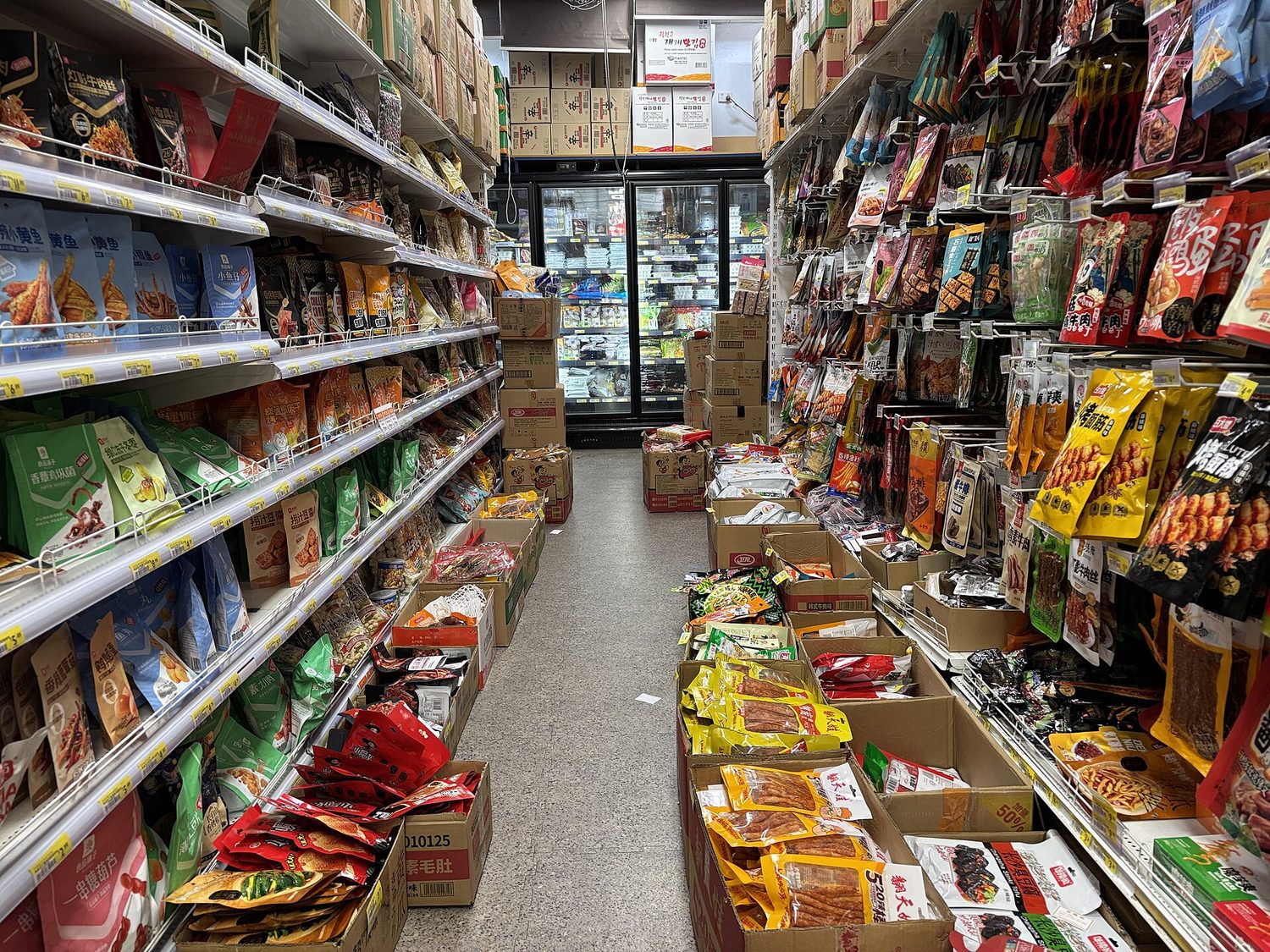
ทางเดินร้านขายของชำ: กระเป๋าสินค้าคงที่วัดเงินเฟ้อผ่านดัชนีราคา

เงินเฟ้อ คือการเพิ่มขึ้นอย่างต่อเนื่องของระดับราคาสถิตวัดด้วย ดัชนีราคา โดยทั่วไปคือ ดัชนีราคาผู้บริโภค (CPI) ซึ่งสร้างมาจาก กระเป๋าสินค้า ของตลาดที่เป็นชุดสินค้าที่ครัวเรือนทั่วไปซื้อ:

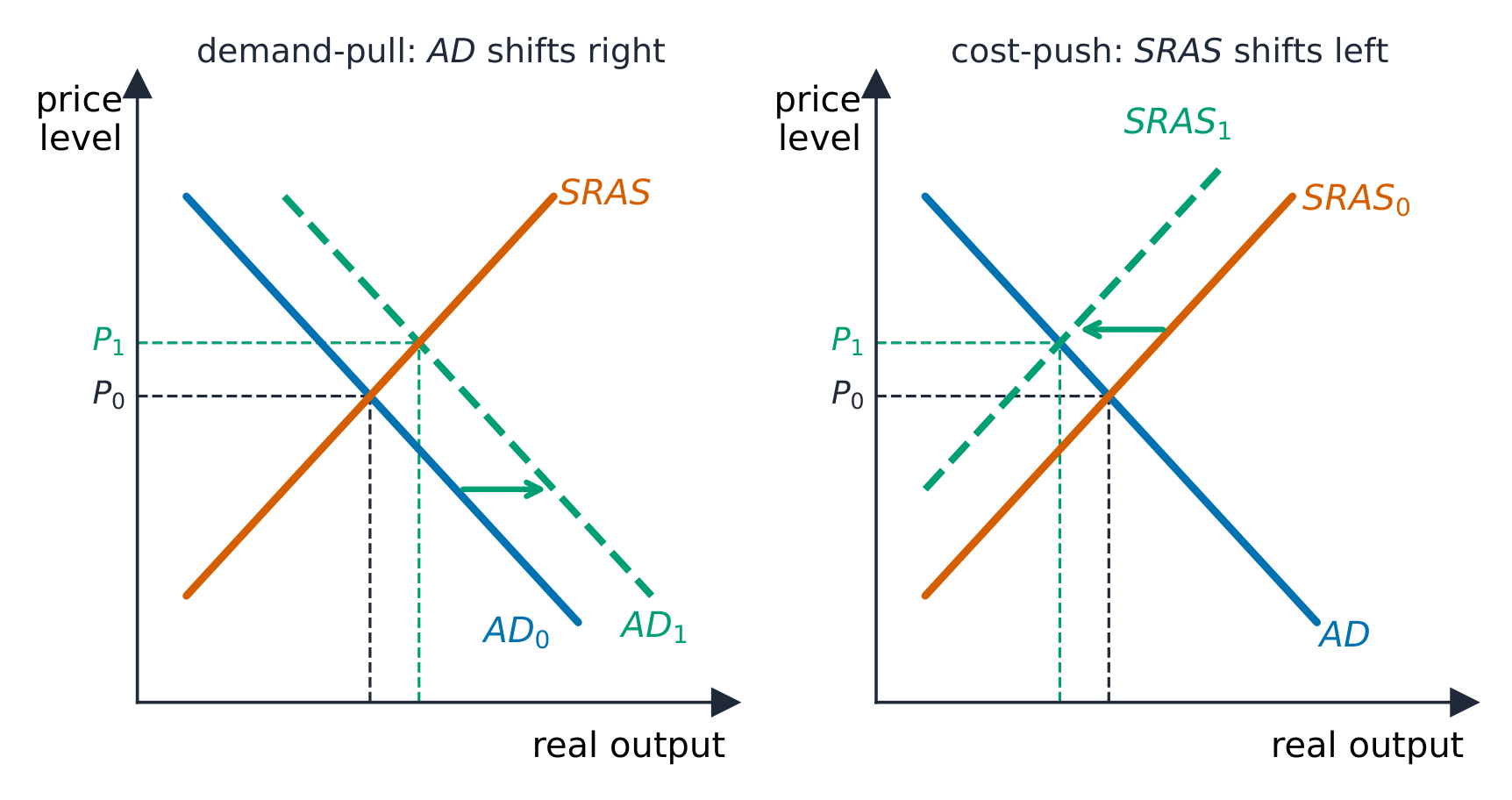
_COLFLEXION ดึงและ COLFLEXION ดันบนแผนภูมิ AD-AS
เงินเฟ้อจากแรงดึงและความดันต้นทุนบนแผนภูมิ AD-AS
$$CPI=\frac{\text{cost of basket this year}}{\text{cost of basket in base year}}\times100.$$

อัตราเงินเฟ้อ คือการเปลี่ยนแปลงเปอร์เซ็นต์ของดัชนีระหว่างสองปี เงินฝืด คือการลดลงของระดับราคา; การชะลอเงินเฟ้อ คือการลดความเร็วของเงินเฟ้อ

ตัวอย่างที่คำนวณแล้ว. หาก CPI คือ $200$ ในปีนี้และเป็น $190$去年, อัตราเงินเฟ้อคือ $\dfrac{200-190}{190}\times100\%=5.3\%$. กระเป๋าที่ tốn $\$190$ then costs $\$200$ – สินค้าเดิมแต่ใช้ดอลลาร์มากขึ้น

Vocabulary · ⁨คำศัพท์⁩ Train · ⁨ฝึกฝน⁩
English ไทย
Inflation/ɪnˈfleɪʃn/ Inflation
2.5

Costs of Inflation · ⁨ต้นทุนของเงินเฟ้อ⁩

Syllabus · ⁨หลักสูตร⁩
English

Enduring Understanding (MEA-1): An economy's performance can be measured by different indicators such as gross domestic product (GDP), the inflation rate, and the unemployment rate.

Learning Objective MEA-1.H: Explain the costs that unexpected inflation (deflation) imposes on individuals and the economy.

  • MEA-1.H.1 Unexpected inflation arbitrarily redistributes wealth from one group of individuals to another group, such as lenders to borrowers.
ไทย

ความเข้าใจที่ยั่งยืน (MEA-1): ประสิทธิภาพของเศรษฐกิจสามารถวัดได้ด้วยตัวชี้วัดต่างๆ เช่น ผลิตภัณฑ์มวลรวมภายในประเทศ (GDP) อัตราเงินเฟ้อ และอัตราการว่างงาน

จุดประสงค์การเรียนรู้ MEA-1.H: อธิบายต้นทุนที่เงินเฟ้อ (หรือเงินฝืด) ที่คาดไม่ถึง imposes on individuals and the economy.

  • MEA-1.H.1 เงินเฟ้อที่คาดหมายไม่ได้กระจายความมั่งคั่งจากกลุ่มบุคคลหนึ่งไปยังอีกกลุ่มหนึ่งอย่างไม่เป็นทางการ เช่น จากเจ้าหนี้ไปยังลูกหนี้

Source: College Board AP Course and Exam Description · ⁨แหล่งที่มา: คำอธิบายหลักสูตรและข้อสอบ College Board AP⁩

English

Inflation redistributes and distorts:

  • It hurts lenders and savers and helps borrowers when it is unexpected, because loans are repaid in cheaper dollars. It erodes the value of money and fixed incomes.
  • Menu costs and uncertainty discourage investment.
  • Anticipated inflation is less harmful because contracts and interest rates adjust for it. This is why we separate nominal and real values.
ไทย

เงินเฟ้อจัดสรรใหม่และทำให้บิดเบี้ยว:

  • มัน กระทบผู้ให้กู้และนักออม และ ช่วยผู้กู้ยืม เมื่อเกิด钱เฟ้อ unexpectedly, เพราะกู้คืนเงินด้วยดอลลาร์ที่มีค่าน้อยลง. มันลดมูลค่าของเงินและรายได้คงที่
  • ต้นทุนเมนู และความไม่แน่นอนขัดขวางการลงทุน
  • เงินเฟ้อที่คาดการณ์ไว้ เป็นอันตรายน้อยกว่าเพราะสัญญาและอัตราดอกเบี้ยปรับตามมัน นี่คือเหตุผลที่เราแยก นามนัย และ ค่าจริง
2.6

Real v. Nominal GDP · ⁨GDP จริง vs นามนัย⁩

Syllabus · ⁨หลักสูตร⁩
English

Enduring Understanding (MEA-1): An economy's performance can be measured by different indicators such as gross domestic product (GDP), the inflation rate, and the unemployment rate.

Learning Objective MEA-1.I: Define nominal GDP and real GDP.

  • MEA-1.I.1 Nominal GDP is a measure of how much is spent on output. Real GDP is a measure of how much is produced.
  • MEA-1.I.2 Nominal GDP measures aggregate output using current prices. Real GDP measures aggregate output using constant prices, thus removing the effect of changes in the overall price level.

Learning Objective MEA-1.J: Calculate real GDP and the GDP deflator.

  • MEA-1.J.1 One way of measuring real GDP is to weigh final goods and services by their prices in a base year. Because this can lead to overstatement of real GDP growth, statistical agencies actually use different methods.
  • MEA-1.J.2 Nominal GDP can be converted to real GDP by using the GDP deflator.
ไทย

ความเข้าใจที่ยั่งยืน (MEA-1): ประสิทธิภาพของเศรษฐกิจสามารถวัดได้ด้วยตัวชี้วัดต่างๆ เช่น ผลิตภัณฑ์มวลรวมภายในประเทศ (GDP) อัตราเงินเฟ้อ และอัตราการว่างงาน

จุดประสงค์การเรียนรู้ MEA-1.I: นิยาม GDP นามธรรมและ GDP จริง

  • MEA-1.I.1 GDP นามธรรมเป็นการวัดว่ามีการใช้จ่ายกับผลผลิตมากแค่ไหน GDP จริงเป็นการวัดว่ามีการผลิตมากแค่ไหน
  • MEA-1.I.2 GDP นามธรรมวัดผลผลิตรวมโดยใช้ราคาปัจจุบัน GDP จริงวัดผลผลิตรวมโดยใช้ราคาคงที่ ดังนั้นจึงขจัดผลกระทบจากการเปลี่ยนแปลงของระดับราคาโดยรวม

จุดประสงค์การเรียนรู้ MEA-1.J: คำนวณ GDP จริงและ GDP deflator

  • MEA-1.J.1 วิธีการหนึ่งในการวัด GDP จริงคือการคูณด้วยน้ำหนักสินค้าและบริการสุดท้ายด้วยราคาในปีฐาน เนื่องจากวิธีนี้可能导致高估真实GDP增长,统计机构实际上使用不同的方法。
  • MEA-1.J.2 GDP นามธรรมสามารถแปลงเป็น GDP จริงได้โดยใช้ GDP deflator

Source: College Board AP Course and Exam Description · ⁨แหล่งที่มา: คำอธิบายหลักสูตรและข้อสอบ College Board AP⁩

English
  • Nominal GDP 名义GDP is valued at current prices, so it rises with both output and prices.
  • Real GDP 实际GDP is valued at constant (base-year) prices, stripping out inflation, so it reflects true output. Real GDP is the honest measure of growth.
$$\text{Real GDP}=\frac{\text{Nominal GDP}}{\text{price index}}\times100,\qquad \text{GDP deflator}=\frac{\text{Nominal GDP}}{\text{Real GDP}}\times100.$$

Worked example. Nominal GDP is $\$22$ trillion and the GDP deflator is $110$. Real GDP is $\dfrac{22}{110}\times100=\$20$ trillion. The extra $\$2$ trillion of nominal GDP is pure price rise, not real output – which is why growth is always measured with real GDP.

Exam skill: be fluent converting nominal to real using a price index, and computing an inflation rate or a growth rate as a percent change.

ไทย
  • GDP นามนัย GDP มีมูลค่าที่ ราคาปัจจุบัน, ดังนั้นมันจึงเพิ่มขึ้นทั้งผลผลิตและราคา
  • GDP จริง GDP มีมูลค่าที่ ราคาคงที่ (ปีฐาน), ล้างเงินเฟ้อออก, ดังนั้นมันจึงสะท้อนผลผลิตที่แท้จริง. GDP จริงคือการวัดการเติบโตที่ซื่อสัตย์ที่สุด
$$\text{Real GDP}=\frac{\text{Nominal GDP}}{\text{price index}}\times100,\qquad \text{GDP deflator}=\frac{\text{Nominal GDP}}{\text{Real GDP}}\times100.$$

ตัวอย่างที่คำนวณแล้ว. GDP นามนัยคือ $\$22$ trillion and the GDP deflator is $110$. Real GDP is $\dfrac{22}{110}\times100=\$20$ trillion. ส่วนเพิ่ม $\$2$万亿ของ GDP นามนัยเป็นการขึ้นราคาล้วนๆ ไม่ใช่ผลผลิตจริง – นั่นคือเหตุผลที่การเติบโตต้องวัดด้วย GDP จริง เสมอ

ทักษะการสอบ: ฝึกคล่องในการแปลงจากนามนัยเป็นจริงโดยใช้ดัชนีราคา, และคำนวณอัตราเงินเฟ้อหรืออัตราการเติบโตเป็นการเปลี่ยนแปลงเปอร์เซ็นต์

Vocabulary · ⁨คำศัพท์⁩ Train · ⁨ฝึกฝน⁩
English ไทย
price index/praɪs ˈɪndeks/ price index
consumer price index (CPI)/kənˈsuːmə praɪs ˈɪndeks/ ดัชนีราคาผู้บริโภค (CPI)
Deflation/diːˈfleɪʃn/ Deflation
Nominal GDP/ˈnɒmɪnl ˌdʒiː diː ˈpiː/ GDP ชั่วคราว
Real GDP/rɪəl ˌdʒiː diː ˈpiː/ GDP จริง
2.7

Business Cycles · ⁨รอบธุรกิจ⁩

Syllabus · ⁨หลักสูตร⁩
English

Enduring Understanding (MEA-2): The economy fluctuates between periods of expansion and contraction in the short run, but economic growth can occur in the long run.

Learning Objective MEA-2.A: a. Define (using graphs and data as appropriate) turning points and phases of the business cycle. b. Explain (using graphs and data as appropriate) turning points and phases of the business cycle.

  • MEA-2.A.1 Business cycles are fluctuations in aggregate output and employment because of changes in aggregate supply and/or aggregate demand.
  • MEA-2.A.2 The phases of a business cycle are recession and expansion.
  • MEA-2.A.3 The turning points of a business cycle are peak and trough.
  • MEA-2.A.4 The difference between actual output and potential output is the output gap.
  • MEA-2.A.5 Potential output is also called full-employment output. It is the level of GDP where unemployment is equal to the natural rate of unemployment. [See EK MEA-1.E.2]
ไทย

ความเข้าใจที่ยั่งยืน (MEA-2): เศรษฐกิจมีความผันผวนระหว่างช่วงการขยายตัวและการหดตัวในระยะสั้น แต่การเติบโตทางเศรษฐกิจสามารถเกิดขึ้นได้ในระยะยาว

จุดประสงค์การเรียนรู้ MEA-2.A: ก. นิยามจุดเปลี่ยนและขั้นตอนของวัฏจักรธุรกิจ(ใช้กราฟและข้อมูลตามความเหมาะสม) ข. อธิบายจุดเปลี่ยนและขั้นตอนของวัฏจักรธุรกิจ(ใช้กราฟและข้อมูลตามความเหมาะสม)

  • MEA-2.A.1 วัฏจักรธุรกิจคือการผันผวนของผลผลิตรวมและการจ้างงานเนื่องจากการเปลี่ยนแปลงของอุปทานรวมและ/หรืออุปสงค์รวม
  • MEA-2.A.2 ขั้นตอนของวัฏจักรธุรกิจคือการถดถอยและการขยายตัว
  • MEA-2.A.3 จุดเปลี่ยนของวัฏจักรธุรกิจคือยอดสูงสุดและจุดต่ำสุด
  • MEA-2.A.4 ความแตกต่างระหว่างผลผลิตจริงและผลผลิตศักยภาพคือช่องว่างของผลผลิต
  • MEA-2.A.5 ผลผลิตที่เป็นไปได้ (Potential output) ยังเรียกว่าผลผลิตที่ระดับการจ้างงานเต็ม (full-employment output) ซึ่งเป็นระดับของ GDP ที่อัตราการว่างงานเท่ากับอัตราการว่างงานตามธรรมชาติ [ดู EK MEA-1.E.2]

Source: College Board AP Course and Exam Description · ⁨แหล่งที่มา: คำอธิบายหลักสูตรและข้อสอบ College Board AP⁩

English
The business cycle

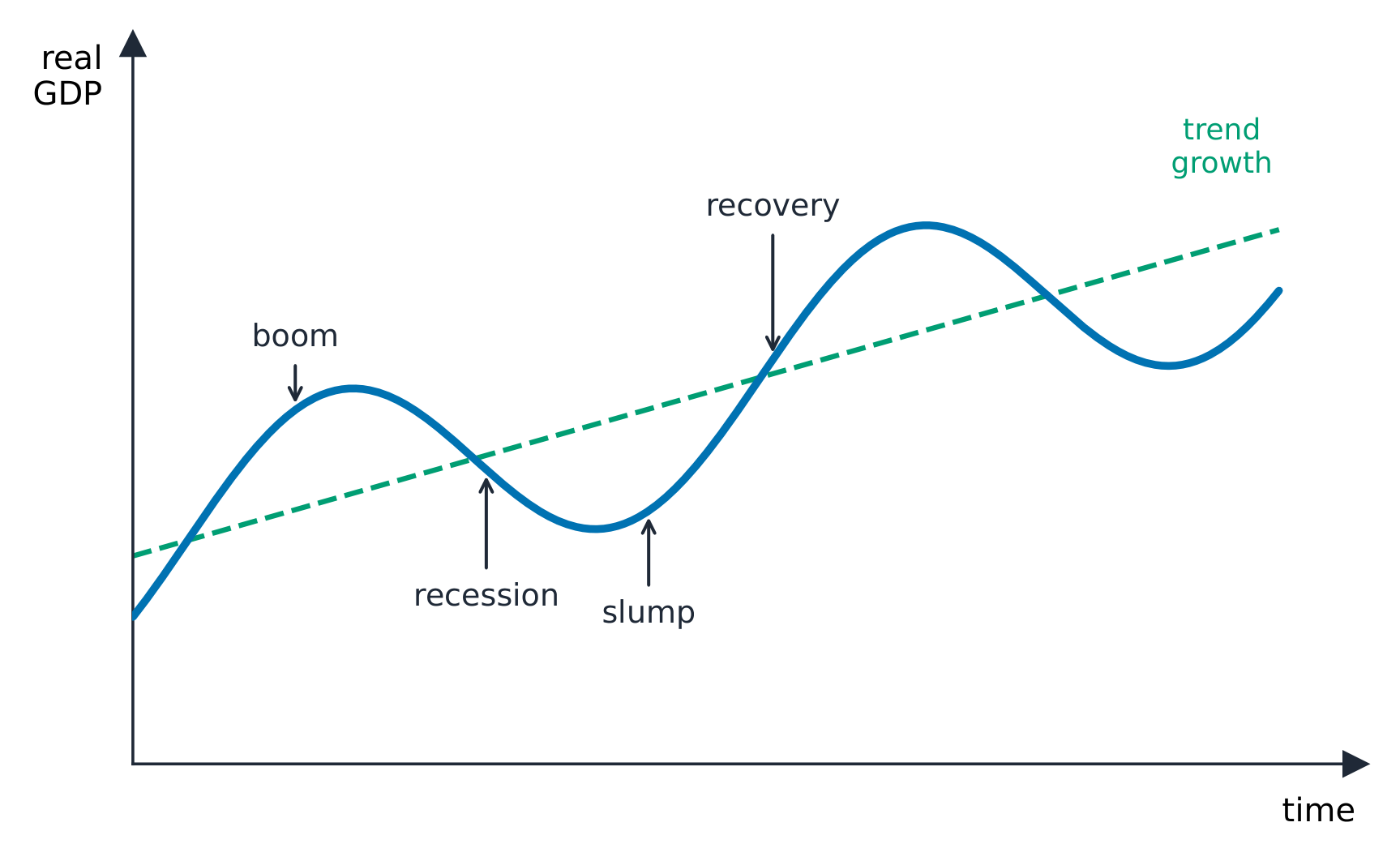
The business cycle 经济周期 is the economy's short-run ups and downs in real GDP around its long-run growth trend: expansion 扩张 (rising output, falling unemployment) up to a peak 顶峰, then contraction/recession 衰退 (falling output, rising cyclical unemployment) down to a trough 谷底, then recovery. A recession is commonly two consecutive quarters of falling real GDP. Unemployment and inflation move roughly opposite over the cycle – the tension the rest of the course tries to manage.

ไทย
รอบธุรกิจ

รอบธุรกิจ คือการขึ้นลงระยะสั้นของเศรษฐกิจใน GDP จริงโดยรอบแนวโน้มการเติบโตระยะยาว: การขยายตัว (ผลผลิตเพิ่มขึ้น, การว่างงานลดลง) ขึ้นสู่ จุดสูงสุด, แล้ว การหดตัว/ภาวะ recession (ผลผลิตลดลง, การว่างงานรอบธุรกิจเพิ่มขึ้น) ลงสู่ จุดต่ำสุด, แล้ว การฟื้นตัว. ภาวะ recession มักหมายถึงสองไตรมาสติดต่อกันที่ GDP จริงลดลง การว่างงานและเงินเฟ้อเคลื่อนไหวในทิศทางตรงกันข้ามโดยประมาณ – ความตึงเครียดที่หลักสูตรส่วนที่เหลือพยายามจัดการ

GDP จริงแกว่งตัวรอบแนวโน้มระยะยาว
Vocabulary · ⁨คำศัพท์⁩ Train · ⁨ฝึกฝน⁩
English ไทย
business cycle/ˈbɪznəs ˈsaɪkl/ วัฏจักรธุรกิจ
expansion/ekˈspænʃn/ expansion
peak/piːk/ ยอดสูง
contraction/recession/kənˈtrækʃn rɪˈseʃn/ การหดตัว/SETTING recession
trough/trɒf/ trough
2.7

Exam tips · ⁨ข้อแนะนำสำหรับการสอบ⁩

English
  • Compute GDP by the expenditure method $C+I+G+X_n$ and count only final goods (avoid double counting).
  • Unemployment rate = unemployed ÷ labor force; discouraged workers leave the labor force (so the rate can understate joblessness).
  • Know the three unemployment types (frictional, structural, cyclical) and that the natural rate excludes cyclical.
  • Inflation is the % change in the CPI; convert nominal to real with a price index and always use real GDP for growth.
  • Place events on the business cycle (expansion → peak → contraction → trough).
ไทย
  • คำนวณ GDP โดยใช้วิธีรายจ่าย $C+I+G+X_n$ และนับเฉพาะสินค้า สุดท้าย (หลีกเลี่ยงการนับซ้ำ)
  • อัตราการว่างงาน = ผู้ว่างงาน ÷ กำลังแรงงาน; แรงงานที่หมดความหวังออกจากกำลังแรงงาน (ดังนั้นอัตราอาจประเมินการว่างงานต่ำ)
  • รู้สามประเภทของการว่างงาน (ธรรมชาติ, โครงสร้าง, รอบธุรกิจ) และอัตราตามธรรมชาติไม่รวมรอบธุรกิจ
  • เงินเฟ้อคือการเปลี่ยนแปลง % ของ CPI; แปลงนามนัยเป็น จริง ด้วยดัชนีราคาและใช้ GDP จริงเสมอสำหรับการเติบโต
  • วางเหตุการณ์บนรอบธุรกิจ (การขยายตัว → จุดสูงสุด → การหดตัว → จุดต่ำสุด)

Interactive lessons on this topic · ⁨บทเรียนเชิงโต้ตอบสำหรับหัวข้อนี้⁩

Work through it step by step, with instant-check exercises. · ⁨ทำทีละขั้นตอน พร้อมแบบฝึกหัดตรวจสอบผลทันที⁩

Past Papers · ⁨ข้อสอบย้อนหลัง⁩

More topics in AP Macroeconomics · ⁨AP เศรษฐศาสตร์มหภาค⁩ · ⁨หัวข้อเพิ่มเติมใน AP Macroeconomics · ⁨AP เศรษฐศาสตร์มหภาค⁩⁩

Log in or create account · ⁨เข้าสู่ระบบหรือสร้างบัญชี⁩

IGCSE, A-Level & AP