Skip to content · ⁨ข้ามไปยังเนื้อหา⁩

Contextual Applications of Differentiation · ⁨การใช้งานบริบทของดิฟเฟอเรนเชียชัน⁩

AP Calculus AB · Topic 4 · ⁨หัวข้อ 4⁩

Video lesson for this topic · ⁨บทเรียนวิดีโอสำหรับหัวข้อนี้⁩ Open the video page · ⁨เปิดหน้าวิดีโอ⁩
6:54

การตีความอนุพันธ์ในบริบท

เมื่อเราสามารถคำนวณอนุพันธ์ได้แล้ว เราจะนำไปใช้อธิบายโลกจริง อนุพันธ์คืออัตราการเปลี่ยนแปลง ประชากรเพิ่มเร็วแค่ไหน? สิ่งใดเพิ่มเร็ว…

English narration · English + 中文 subtitles burned in · ⁨การบรรยายภาษาอังกฤษ · คำบรรยายภาษาอังกฤษ + 中文 ลอยตัวบนภาพ⁩

4.1

Interpreting the Derivative in Context · ⁨การตีความอนุพันธ์ในบริบท⁩

Syllabus · ⁨หลักสูตร⁩
English

Enduring Understanding (CHA-3): Derivatives allow us to solve real-world problems involving rates of change.

Learning Objective CHA-3.A: Interpret the meaning of a derivative in context.

  • CHA-3.A.1 The derivative of a function can be interpreted as the instantaneous rate of change with respect to its independent variable.
  • CHA-3.A.2 The derivative can be used to express information about rates of change in applied contexts.
  • CHA-3.A.3 The unit for $f'(x)$ is the unit for $f$ divided by the unit for $x$.
ไทย

ความเข้าใจที่ยั่งยืน (CHA-3): อนุพันธ์ช่วยให้เราแก้ปัญหาจริงที่เกี่ยวข้องกับอัตราการเปลี่ยนแปลง

วัตถุประสงค์การเรียนรู้ CHA-3.A: ตีความความหมายของอนุพันธ์ในบริบท

  • CHA-3.A.1 อนุพันธ์ของฟังก์ชันสามารถตีความได้เป็นอัตราการเปลี่ยนแปลงทันทีเทียบกับตัวแปรอิสระ
  • CHA-3.A.2 อนุพันธ์สามารถใช้แสดงข้อมูลเกี่ยวกับอัตราการเปลี่ยนแปลงในบริบทการใช้งาน
  • CHA-3.A.3 หน่วยของ $f'(x)$ คือหน่วยของ $f$ หารด้วยหน่วยของ $x$
Source: College Board AP Course and Exam Description · ⁨แหล่งที่มา: คำอธิบายหลักสูตรและข้อสอบ College Board AP⁩

English

Once you can compute derivatives, you use them to describe the real world. The derivative $f'(x)$ is the instantaneous rate of change of $f$ with respect to its input. Reading and reporting this rate correctly is a graded skill.

Units matter. The unit of $f'(x)$ is the unit of $f$ divided by the unit of $x$. If $C(t)$ is a number of acres and $t$ is in weeks, then $C'(t)$ is in acres per week. On the exam, "Using correct units, interpret the meaning of $g'(140)$" wants a full sentence: the value, the quantity, the rate word "per", and the moment. For example: "$g'(140)=2.3$ means that at $x=140$, the quantity is increasing at about $2.3$ units per unit of $x$."

ไทย

เมื่อคุณสามารถหาอนุพันธ์ได้แล้ว ใช้มันเพื่ออธิบายโลกจริง. อนุพันธ์ $f'(x)$ คือ อัตราเปลี่ยนแปลงทันที ของ $f$ เทียบกับตัวแปรเข้าของมัน. การอ่านและรายงานอัตรานี้ถูกต้องเป็นทักษะที่ประเมินคะแนน

หน่วยมีความสำคัญ. หน่วยของ $f'(x)$ คือหน่วยของ $f$ หารด้วยหน่วยของ $x$. หาก $C(t)$ เป็นจำนวนไร่ และ $t$ เป็นสัปดาห์,那么 $C'(t)$ จะอยู่ในหน่วยไร่ต่อสัปดาห์. ในข้อสอบ, "ใช้หน่วยที่ถูกต้อง ตีความความหมายของ $g'(140)$" ต้องการประโยคเต็ม: ค่า, ปริมาณ, คำอัตรา "per", และ ช่วงเวลา. ตัวอย่าง: "$g'(140)=2.3$ หมายความว่า ณ $x=140$, ปริมาณกำลังเพิ่มขึ้นประมาณ $2.3$ หน่วยต่อหน่วยของ $x$."

4.2

Straight-Line Motion: Position, Velocity, and Acceleration · ⁨การเคลื่อนที่แบบเส้นตรง: ตำแหน่ง ความเร็ว และความเร่ง⁩

Syllabus · ⁨หลักสูตร⁩
English

Enduring Understanding (CHA-3): Derivatives allow us to solve real-world problems involving rates of change.

Learning Objective CHA-3.B: Calculate rates of change in applied contexts.

  • CHA-3.B.1 The derivative can be used to solve rectilinear motion problems involving position, speed, velocity, and acceleration.
ไทย

ความเข้าใจที่ยั่งยืน (CHA-3): อนุพันธ์ช่วยให้เราแก้ปัญหาจริงที่เกี่ยวข้องกับอัตราการเปลี่ยนแปลง

วัตถุประสงค์การเรียนรู้ CHA-3.B: คำนวณอัตราการเปลี่ยนแปลงในบริบทการใช้งาน

  • CHA-3.B.1 อนุพันธ์สามารถใช้แก้ปัญหากำหนดเส้นทางที่涉及ตำแหน่ง ความเร็ว ความเร็วเชิงเวกเตอร์ และความเร่ง

Source: College Board AP Course and Exam Description · ⁨แหล่งที่มา: คำอธิบายหลักสูตรและข้อสอบ College Board AP⁩

English

For a particle moving on a line, three functions of time are linked by differentiation:

  • position 位置 $s(t)$;
  • velocity 速度 $v(t)=s'(t)$ – signed; its sign gives direction;
  • acceleration 加速度 $a(t)=v'(t)=s''(t)$.

Key readings (frequent exam parts):

  • The particle is at rest 静止 when $v(t)=0$.
  • It moves right/up when $v(t)>0$ and left/down when $v(t)<0$; it changes direction where $v$ changes sign.
  • Speed 速率 is $|v(t)|$. Speed is increasing when $v$ and $a$ have the same sign (the particle is speeding up), and decreasing when they have opposite signs.

Worked example. A particle moves with $s(t)=t^3-6t^2+9t$. Then $v(t)=3t^2-12t+9=3(t-1)(t-3)$, so it is at rest at $t=1$ and $t=3$, and changes direction at each. At $t=2$, $v(2)=3(1)(-1)=-3<0$ (moving left) and $a(2)=6(2)-12=0$; just after, $a>0$ while $v<0$, so it is slowing down there. Distinguish carefully between velocity (has direction) and speed (does not) – the exam tests this exact difference.

ไทย

สำหรับอนุภาคที่เคลื่อนที่บนเส้นตรง ฟังก์ชันสามชนิดที่เกี่ยวข้องกับเวลาเชื่อมต่อกันด้วยการหาอนุพันธ์:

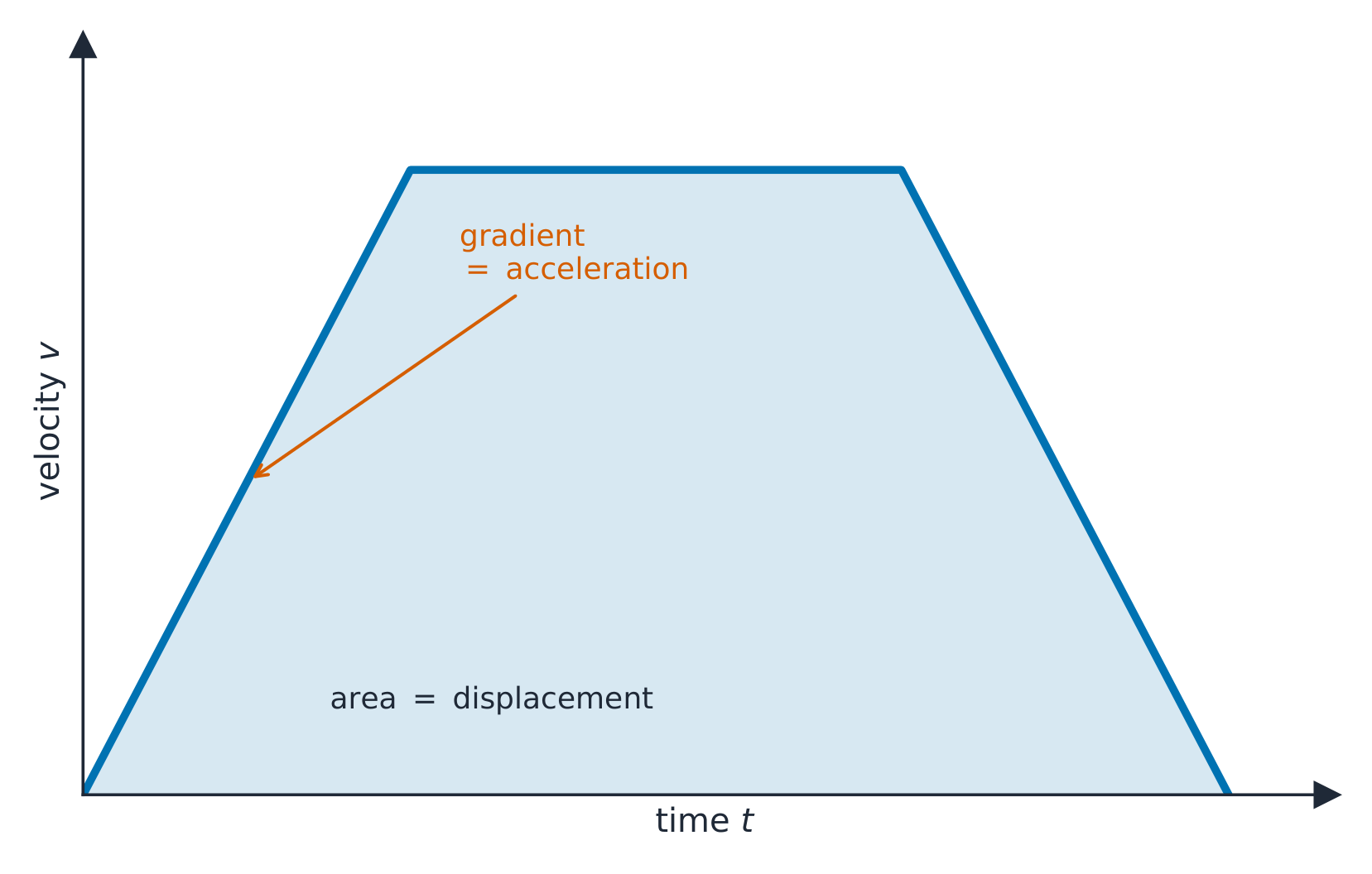
บนกราฟความเร็ว-เวลา พื้นที่คือระยะกระจัดและความชันคือความเร่ง
  • ตำแหน่ง $s(t)$;
  • ความเร็ว $v(t)=s'(t)$ – มีเครื่องหมาย; เครื่องหมายบ่งบอกทิศทาง;
  • ความเร่ง $a(t)=v'(t)=s''(t)$.

การอ่านค่าสำคัญ (ส่วนที่ออกข้อสอบบ่อย):

  • อนุภาค หยุดนิ่ง เมื่อ $v(t)=0$.
  • เคลื่อนที่ ไปทางขวา/ขึ้น เมื่อ $v(t)>0$ และ ไปทางซ้าย/ลง เมื่อ $v(t)<0$;它会เปลี่ยนทิศทางที่ $v$ เปลี่ยนเครื่องหมาย.
  • ความเร็ว (Speed) คือ $|v(t)|$. ความเร็วจะ เพิ่มขึ้น เมื่อ $v$ และ $a$ มี เครื่องหมายเดียวกัน (อนุภาคเร่งตัวขึ้น) และ ลดลง เมื่อมี เครื่องหมายตรงกันข้าม

ตัวอย่างวิธีทำ. อนุภาคเคลื่อนที่ด้วยความเร็ว $s(t)=t^3-6t^2+9t$. จากนั้น $v(t)=3t^2-12t+9=3(t-1)(t-3)$ ดังนั้นจึงหยุดนิ่งที่ $t=1$ และ $t=3$ และเปลี่ยนทิศทางที่จุดเหล่านี้ทุกจุด ที่ $t=2$, $v(2)=3(1)(-1)=-3<0$ (เคลื่อนที่ไปทางซ้าย) และ $a(2)=6(2)-12=0$; ทันทีหลังจากนั้น $a>0$ ในขณะที่ $v<0$ ดังนั้นจึง ชะลอตัวลง ที่นั่น ให้แยกแยะระหว่างความเร็วในเชิงเวกเตอร์ (มีทิศทาง) กับสเกลาร์ (ไม่มีทิศทาง) อย่างละเอียด – การสอบทดสอบความแตกต่างนี้โดยตรง

รถเขย่งบนรางวนลูป
รถเขย่งคือแคลคูลัสที่คุณสัมผัสได้: ความเร็วเป็นอนุพันธ์ของตำแหน่ง และความเร่งเป็นอนุพันธ์ของความเร็ว
Explore · ⁨สำรวจ⁩

Velocity is the slope of position · ⁨ความเร็วคือความชันของตำแหน่ง⁩

y = ax³ + bx² + cx + d

For straight-line motion, velocity is the derivative (slope) of position and acceleration the derivative of velocity. Slide the point to read the instantaneous velocity. · ⁨สำหรับการเคลื่อนที่แบบเส้นตรง ความเร็ว คืออนุพันธ์ (ความชัน) ของตำแหน่ง และ ความเร่ง คืออนุพันธ์ของความเร็ว เลื่อนจุดเพื่ออ่านความเร็วชั่วขณะ⁩

Vocabulary · ⁨คำศัพท์⁩ Train · ⁨ฝึกฝน⁩
English ไทย
position/pəˈzɪʃn/ ตำแหน่ง
velocity/vəˈlɒsɪti/ ความเร็ว
acceleration/əkˌseləˈreɪʃn/ ความเร่ง
at rest/æt rest/ หยุดนิ่ง
Speed/spiːd/ Speed
4.3

Rates of Change Beyond Motion · ⁨อัตราการเปลี่ยนแปลงนอกเหนือจากการเคลื่อนที่⁩

Syllabus · ⁨หลักสูตร⁩
English

Enduring Understanding (CHA-3): Derivatives allow us to solve real-world problems involving rates of change.

Learning Objective CHA-3.C: Interpret rates of change in applied contexts.

  • CHA-3.C.1 The derivative can be used to solve problems involving rates of change in applied contexts.
ไทย

ความเข้าใจที่ยั่งยืน (CHA-3): อนุพันธ์ช่วยให้เราแก้ปัญหาจริงที่เกี่ยวข้องกับอัตราการเปลี่ยนแปลง

วัตถุประสงค์การเรียนรู้ CHA-3.C: ตีความอัตราการเปลี่ยนแปลงในบริบทการใช้งาน

  • CHA-3.C.1 อนุพันธ์สามารถใช้แก้ปัญหารวมถึงอัตราการเปลี่ยนแปลงในบริบทการใช้งาน

Source: College Board AP Course and Exam Description · ⁨แหล่งที่มา: คำอธิบายหลักสูตรและข้อสอบ College Board AP⁩

English

The same derivative idea models any changing quantity: a draining tank, a spreading population, a cooling cup. Whenever a problem says "the rate at which...", it is describing a derivative. Read the units to know which quantity's rate you have, then interpret in context.

ไทย

แนวคิดอนุพันธ์เดียวกันนี้ใช้จำลองปริมาณที่เปลี่ยนแปลงได้หลากหลาย: ถังน้ำที่ไหลออก, ประชากรที่ขยายตัว, แก้วน้ำที่เย็นลง ทุกครั้งที่โจทย์ระบุว่า "อัตราการ..." กำลังอธิบายถึงอนุพันธ์ อ่านหน่วยเพื่อระบุว่าคุณมีอัตราการเปลี่ยนแปลงของปริมาณใด แล้วตีความตามบริบท

4.4

Introduction to Related Rates · ⁨บทนำเรื่องอัตราที่เกี่ยวข้องกัน⁩

Syllabus · ⁨หลักสูตร⁩
English

Enduring Understanding (CHA-3): Derivatives allow us to solve real-world problems involving rates of change.

Learning Objective CHA-3.D: Calculate related rates in applied contexts.

  • CHA-3.D.1 The chain rule is the basis for differentiating variables in a related rates problem with respect to the same independent variable.
  • CHA-3.D.2 Other differentiation rules, such as the product rule and the quotient rule, may also be necessary to differentiate all variables with respect to the same independent variable.
ไทย

ความเข้าใจที่ยั่งยืน (CHA-3): อนุพันธ์ช่วยให้เราแก้ปัญหาจริงที่เกี่ยวข้องกับอัตราการเปลี่ยนแปลง

วัตถุประสงค์การเรียนรู้ CHA-3.D: คำนวณอัตราการเปลี่ยนแปลงที่เกี่ยวข้องในบริบทการใช้งาน

  • CHA-3.D.1 กฎลูกโซ่เป็นพื้นฐานสำหรับการหาอนุพันธ์ของตัวแปรในปัญหาอัตราการเปลี่ยนแปลงที่เกี่ยวข้องเทียบกับตัวแปรอิสระเดียวกัน
  • CHA-3.D.2 กฎการหาอนุพันธ์อื่นๆ เช่น กฎคูณและกฎหาร อาจจำเป็นต่อการหาอนุพันธ์ของตัวแปรทั้งหมดเทียบกับตัวแปรอิสระเดียวกัน

Source: College Board AP Course and Exam Description · ⁨แหล่งที่มา: คำอธิบายหลักสูตรและข้อสอบ College Board AP⁩

English
Related rates: a sliding ladder

In a related rates 相关变化率 problem, several quantities change together over time, and you know some rates but want another. The engine is the chain rule: differentiate a relationship with respect to time $t$. Every variable becomes a function of $t$, so each derivative picks up a "$\,/\,dt$" factor. Product and quotient rules may also be needed.

ไทย
อัตราการเปลี่ยนแปลงที่เกี่ยวข้อง: บันไดเลื่อนลง

ในโจทย์ อัตราที่เกี่ยวข้องกัน ปริมาณหลายอย่างจะเปลี่ยนแปลงไปด้วยกันตามเวลา และคุณทราบบางอัตราแต่ต้องการหาอีกอัตราหนึ่ง เครื่องยนต์หลักคือกฎโซ่: หาอนุพันธ์ของความสัมพันธ์ เทียบกับเวลา $t$. ตัวแปรทุกตัวกลายเป็นฟังก์ชันของ $t$ ดังนั้นแต่ละอนุพันธ์จึงมีปัจจัย "$\,/\,dt$" แทรกอยู่ กฎคูณและกฎหารอาจจำเป็นด้วย

ลูกโป่งลอยสูงขึ้น: อัตราที่เกี่ยวข้องกันเชื่อมโยงความเร็วในการเปลี่ยนแปลงของรัศมี ปริมาตร และความสูง together
ลูกโป่งลอยสูงขึ้น: อัตราที่เกี่ยวข้องกันเชื่อมโยงความเร็วในการเปลี่ยนแปลงของรัศมี ปริมาตร และความสูง
Vocabulary · ⁨คำศัพท์⁩ Train · ⁨ฝึกฝน⁩
English ไทย
related rates/rɪˈleɪtɪd reɪts/ อัตราส่วนที่เกี่ยวข้อง
local linearity/ˈləʊkl lɪˈnɪərɪti/ ความเป็นเส้นตรงในท้องถิ่น
linear approximation/ˈlɪnɪə əˌprɒksɪˈmeɪʃn/ การประมาณเชิงเส้น
overestimate/ˌəʊvəˈrestɪmət/ ค่าประมาณสูง
indeterminate form/ˌɪndɪˈtɜːmɪnət fɔːm/ รูปแบบที่ไม่แน่นอน
L'Hospital's Rule/ˈelhɒspɪtlz ruːl/ กฎของล'Hospital
4.5

Solving Related Rates Problems · ⁨วิธีแก้โจทย์อัตราที่เกี่ยวข้องกัน⁩

Syllabus · ⁨หลักสูตร⁩
English

Enduring Understanding (CHA-3): Derivatives allow us to solve real-world problems involving rates of change.

Learning Objective CHA-3.E: Interpret related rates in applied contexts.

  • CHA-3.E.1 The derivative can be used to solve related rates problems; that is, finding a rate at which one quantity is changing by relating it to other quantities whose rates of change are known.
ไทย

ความเข้าใจที่ยั่งยืน (CHA-3): อนุพันธ์ช่วยให้เราแก้ปัญหาจริงที่เกี่ยวข้องกับอัตราการเปลี่ยนแปลง

วัตถุประสงค์การเรียนรู้ CHA-3.E: ตีความอัตราการเปลี่ยนแปลงที่เกี่ยวข้องในบริบทการใช้งาน

  • CHA-3.E.1 อนุพันธ์สามารถใช้แก้ปัญหาระดับอัตราการเปลี่ยนแปลงที่เกี่ยวข้อง นั่นคือการหาอัตราที่ปริมาณหนึ่งมีการเปลี่ยนแปลงโดยการเชื่อมโยง它与ปริมาณอื่นwhose rates of change are known

Source: College Board AP Course and Exam Description · ⁨แหล่งที่มา: คำอธิบายหลักสูตรและข้อสอบ College Board AP⁩

English

A reliable procedure – and a full-credit template on the exam:

  1. Name the variables and write down the given rates and the unknown rate (e.g. "$\dfrac{dh}{dt}=-2$ cm/day, find $\dfrac{dV}{dt}$").
  2. Write an equation relating the quantities (often a geometric or volume formula).
  3. Differentiate both sides with respect to $t$ (chain rule) – before substituting numbers.
  4. Substitute the known values at the instant of interest, and solve for the unknown rate.
  5. State the answer with units and the correct sign (a decreasing quantity has a negative rate).

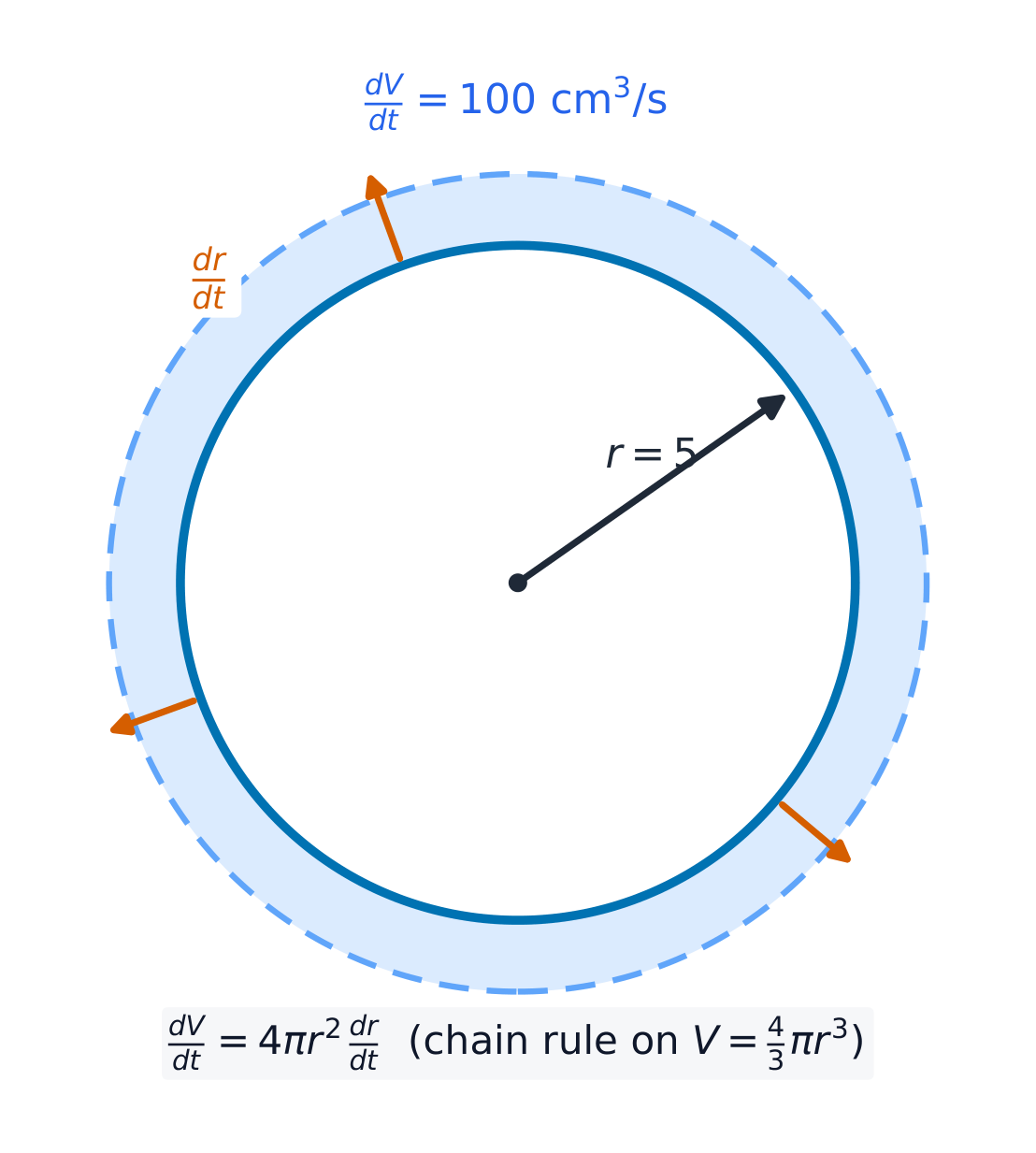
Worked example. Air is pumped into a spherical balloon so its volume grows at $\dfrac{dV}{dt}=100\ \text{cm}^3/\text{s}$. How fast is the radius growing when $r=5\ \text{cm}$? Start from $V=\tfrac43\pi r^3$ and differentiate with respect to $t$ first:

$$\frac{dV}{dt}=4\pi r^2\frac{dr}{dt}\;\Rightarrow\;100=4\pi(5)^2\frac{dr}{dt}\;\Rightarrow\;\frac{dr}{dt}=\frac{100}{100\pi}=\frac{1}{\pi}\approx 0.32\ \text{cm/s}.$$
Substituting $r=5$ too early is the classic error – differentiate the general relationship, then plug in.

ไทย

ขั้นตอนที่เชื่อถือได้ – และรูปแบบเต็มคะแนนในการสอบ:

  1. ตั้งชื่อตัวแปร และเขียนอัตรากำหนดให้และอัตราที่ต้องการหา (เช่น "$\dfrac{dh}{dt}=-2$ ซม./วัน, หา $\dfrac{dV}{dt}$").
  2. เขียนสมการ ที่เชื่อมโยงปริมาณเหล่านั้น (มักเป็นสูตรเรขาคณิตหรือปริมาตร).
  3. หาอนุพันธ์ทั้งสองข้างเทียบกับ $t$ (กฎโซ่) – ก่อน แทนค่าตัวเลข.
  4. แทนค่า ค่า Known ที่ช่วงเวลาที่ต้องการ และแก้หาค่าอัตราที่ไม่ทราบค่า.
  5. ระบุ answer พร้อม หน่วย และ เครื่องหมาย ที่ถูกต้อง (ปริมาณที่ลดลงจะมีอัตราเป็นลบ).

ตัวอย่างวิธีทำ. พัมพ์อากาศเข้าไปในลูกโป่งทรงกลมจนปริมาตรเพิ่มขึ้นที่ $\dfrac{dV}{dt}=100\ \text{cm}^3/\text{s}$. รัศมีเพิ่มเร็วแค่ไหนเมื่อ $r=5\ \text{cm}$? เริ่มจาก $V=\tfrac43\pi r^3$ และหาอนุพันธ์เทียบกับ $t$ ก่อน:

$$\frac{dV}{dt}=4\pi r^2\frac{dr}{dt}\;\Rightarrow\;100=4\pi(5)^2\frac{dr}{dt}\;\Rightarrow\;\frac{dr}{dt}=\frac{100}{100\pi}=\frac{1}{\pi}\approx 0.32\ \text{cm/s}.$$
การแทน $r=5$ เร็วเกินไป เป็นข้อผิดพลาดคลาสสิก – หาอนุพันธ์ความสัมพันธ์ทั่วไปก่อน แล้วค่อยแทนค่า.

ลูกโป่งเป่าพองเชื่อมโยง dV/dt และ dr/dt ผ่านกฎโซ่
4.6

Local Linearity and Linearization · ⁨ความเป็นเส้นตรงในท้องถิ่นและการประมาณเส้นตรง⁩

Syllabus · ⁨หลักสูตร⁩
English

Enduring Understanding (CHA-3): Derivatives allow us to solve real-world problems involving rates of change.

Learning Objective CHA-3.F: Approximate a value on a curve using the equation of a tangent line.

  • CHA-3.F.1 The tangent line is the graph of a locally linear approximation of the function near the point of tangency.
  • CHA-3.F.2 For a tangent line approximation, the function's behavior near the point of tangency may determine whether a tangent line value is an underestimate or an overestimate of the corresponding function value.
ไทย

ความเข้าใจที่ยั่งยืน (CHA-3): อนุพันธ์ช่วยให้เราแก้ปัญหาจริงที่เกี่ยวข้องกับอัตราการเปลี่ยนแปลง

วัตถุประสงค์การเรียนรู้ CHA-3.F: ประมาณค่าบนเส้นโค้งโดยใช้สมการของเส้นสัมผัส

  • CHA-3.F.1 เส้นสัมผัสคือกราฟของการประมาณความเป็นเส้นตรงในพื้นที่ของฟังก์ชันใกล้จุดสัมผัส
  • CHA-3.F.2 สำหรับประมาณค่าด้วยเส้นสัมผัส พฤติกรรมของฟังก์ชันใกล้จุดสัมผัสอาจกำหนดว่าค่าของเส้นสัมผัสเป็นการประมาณค่าที่ต่ำเกินไปหรือสูงเกินไปเมื่อเทียบกับค่าฟังก์ชันที่เกี่ยวข้อง

Source: College Board AP Course and Exam Description · ⁨แหล่งที่มา: คำอธิบายหลักสูตรและข้อสอบ College Board AP⁩

English
Local linearity and linearisation

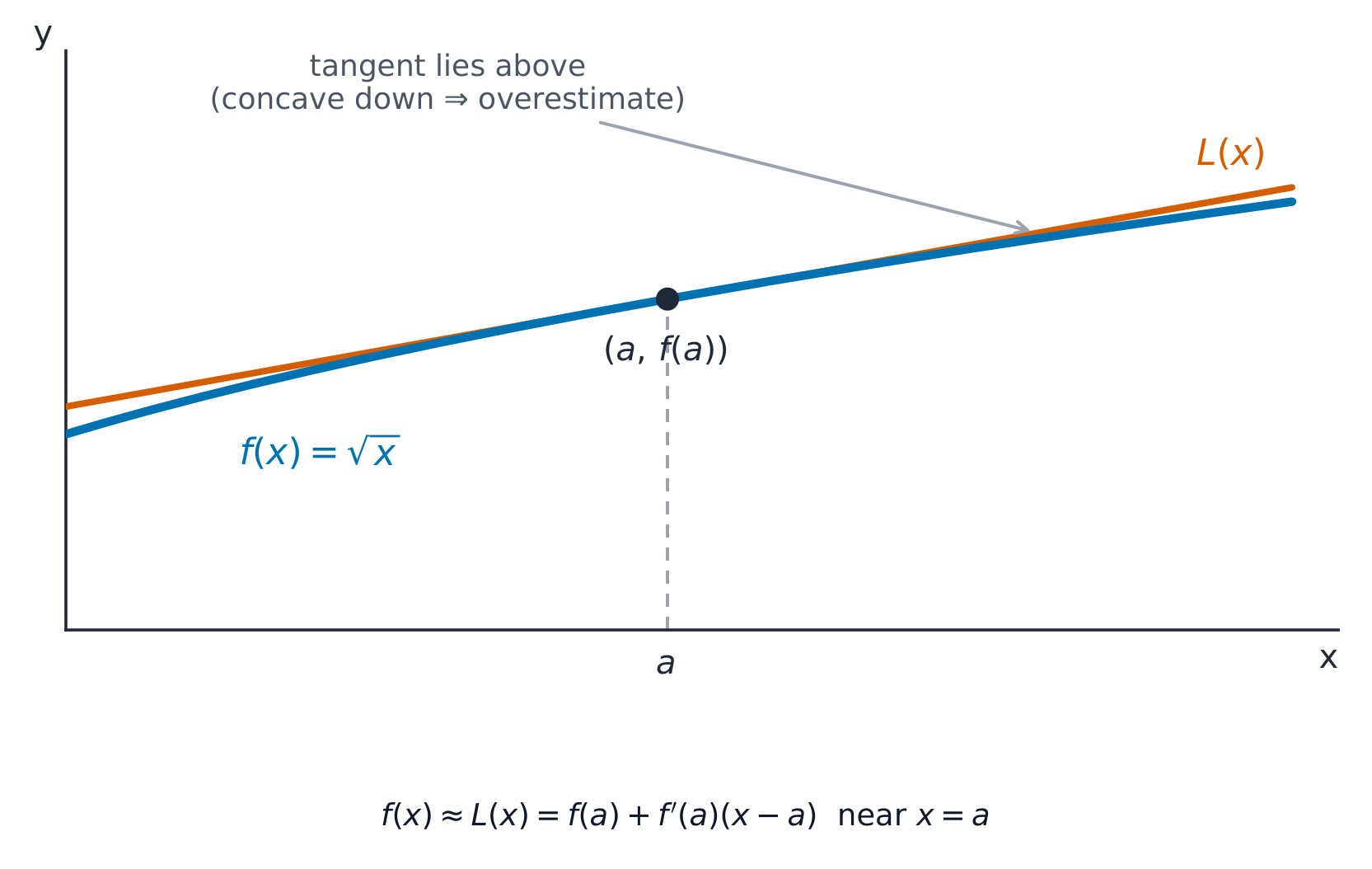
Near a point of tangency, a smooth curve looks like its tangent line – this is local linearity 局部线性. So the tangent line gives a linear approximation 线性近似 (linearization) of the function near that point:

$$f(x) \approx L(x) = f(a) + f'(a)(x-a).$$
Use it to estimate $f$ at an $x$ close to $a$.

Worked example. Estimate $\sqrt{4.1}$. Take $f(x)=\sqrt{x}$ and $a=4$: $f(4)=2$ and $f'(x)=\dfrac{1}{2\sqrt{x}}$ so $f'(4)=\dfrac14$. Then $L(4.1)=2+\tfrac14(4.1-4)=2.025$ (the true value is $2.0248\ldots$). Because $\sqrt{x}$ is concave down, the tangent lies above the curve, so this is a slight overestimate 高估 – justify over/under with the sign of $f''$.

ไทย
ความเป็นเส้นตรงในท้องถิ่นและการประมาณเส้นตรง

ใกล้จุดสัมผัส curves เรียบเนียนดูเหมือนเส้นสัมผัสของมัน – นี่คือ ความเป็นเส้นตรงในท้องถิ่น ดังนั้นเส้นสัมผัสจึงให้การ ประมาณค่าแบบเส้นตรง (linearization) ของฟังก์ชันใกล้จุดนั้น:

$$f(x) \approx L(x) = f(a) + f'(a)(x-a).$$
ใช้มันเพื่อประมาณ $f$ ที่ $x$ ใกล้กับ $a$.

เส้นสัมผัสเป็นการประมาณค่าแบบเส้นตรงที่ดีที่สุดต่อ curve Near จุดสัมผัส

ตัวอย่างวิธีทำ. ประมาณ $\sqrt{4.1}$. เลือก $f(x)=\sqrt{x}$ และ $a=4$: $f(4)=2$ และ $f'(x)=\dfrac{1}{2\sqrt{x}}$ ดังนั้น $f'(4)=\dfrac14$. จากนั้น $L(4.1)=2+\tfrac14(4.1-4)=2.025$ (ค่าจริงคือ $2.0248\ldots$). เนื่องจาก $\sqrt{x}$ เว้าลง เส้นสัมผัสอยู่เหนือ curve ดังนั้นนี่คือการ ประเมินค่าเกินเล็กน้อย – อธิบายว่าเกิน/不足的 ด้วยเครื่องหมายของ $f''$.

Explore · ⁨สำรวจ⁩

Approximate a curve with its tangent line · ⁨ประมาณเส้นโค้งด้วยเส้นสัมผัส⁩

y = ax³ + bx² + cx + d

Local linearity: near a point a smooth curve looks like its tangent line, so the tangent gives a good linear approximation of nearby values. · ⁨ความเป็นเส้นตรงในท้องถิ่น: ใกล้จุดหนึ่ง เส้นโค้งเรียบดูเหมือน เส้นสัมผัส ของมัน ดังนั้นเส้นสัมผัสจึงเป็นการประมาณเชิงเส้นที่ดีสำหรับค่าใกล้เคียง⁩

4.7

L'Hospital's Rule for Indeterminate Forms · ⁨กฎของ L'Hospital สำหรับรูปไม่กำหนดได้⁩

Syllabus · ⁨หลักสูตร⁩
English

Enduring Understanding (LIM-4): L'Hospital's Rule allows us to determine the limits of some indeterminate forms.

Learning Objective LIM-4.A: Determine limits of functions that result in indeterminate forms.

  • LIM-4.A.1 When the ratio of two functions tends to $\dfrac{0}{0}$ or $\dfrac{\infty}{\infty}$ in the limit, such forms are said to be indeterminate.
    • Exclusion statement: There are many other indeterminate forms, such as $\infty - \infty$, for example, but these will not be assessed on either the AP Calculus AB or BC Exam. However, teachers may include these topics, if time permits.
  • LIM-4.A.2 Limits of the indeterminate forms $\dfrac{0}{0}$ or $\dfrac{\infty}{\infty}$ may be evaluated using L'Hospital's Rule.
ไทย

ความเข้าใจที่ยั่งยืน (LIM-4): กฎของลอปีตาลช่วยให้เราสามารถหาค่าลิมิตของรูปไม่确定的บางประเภทได้

วัตถุประสงค์การเรียนรู้ LIM-4.A: หาค่าลิมิตของฟังก์ชันที่นำไปสู่รูปไม่确定的

  • LIM-4.A.1 เมื่ออัตราส่วนของฟังก์ชันสองตัวมีแนวโน้มไปหา $\dfrac{0}{0}$ หรือ $\dfrac{\infty}{\infty}$ ในลิมิต รูปเหล่านี้จะเรียกว่ารูปไม่确定的
    • ข้อจำกัด: มีรูปไม่确定的อีกมากมาย เช่น $\infty - \infty$ เป็นต้น แต่จะไม่มีการทดสอบในสอบ AP Calculus AB หรือ BC อย่างไรก็ตาม ครูผู้สอนอาจรวมหัวข้อเหล่านี้ไว้หากมีเวลาเพียงพอ
  • LIM-4.A.2 ค่าลิมิตของรูปไม่确定的 $\dfrac{0}{0}$ หรือ $\dfrac{\infty}{\infty}$ สามารถคำนวณได้ด้วยกฎของลอปีตาล

Source: College Board AP Course and Exam Description · ⁨แหล่งที่มา: คำอธิบายหลักสูตรและข้อสอบ College Board AP⁩

English

When direct substitution in a quotient of limits gives the indeterminate form 未定式 $\dfrac{0}{0}$ or $\dfrac{\infty}{\infty}$, you may use L'Hospital's Rule 洛必达法则:

$$\lim_{x\to c}\frac{f(x)}{g(x)} = \lim_{x\to c}\frac{f'(x)}{g'(x)},$$
provided the right-hand limit exists. Differentiate the top and bottom separately (this is not the quotient rule), then try the limit again. First confirm the form really is $\tfrac{0}{0}$ or $\tfrac{\infty}{\infty}$ – applying the rule to any other form is a mistake.

Worked example. Evaluate $\displaystyle\lim_{x\to 0}\frac{\sin x}{x}$. Substituting gives $\tfrac00$, so differentiate top and bottom: $\displaystyle\lim_{x\to 0}\frac{\cos x}{1}=\cos 0=1$ – confirming the famous limit from Unit 1.

ไทย

เมื่อแทนค่าโดยตรงในเศษส่วนของลิมิตให้ รูปไม่กำหนดได้ $\dfrac{0}{0}$ หรือ $\dfrac{\infty}{\infty}$ คุณสามารถใช้ กฎของ L'Hospital ได้:

$$\lim_{x\to c}\frac{f(x)}{g(x)} = \lim_{x\to c}\frac{f'(x)}{g'(x)},$$
โดยที่ลิมิตด้านขวามีอยู่. หาอนุพันธ์เศษและส่วนแยกต่างหาก (นี่ไม่ใช่กฎผลหาร) แล้วลองหาลิมิตอีกครั้ง ยืนยันก่อนว่ารูปนั้นเป็น $\tfrac{0}{0}$ หรือ $\tfrac{\infty}{\infty}$ จริงๆ – การ áp dụngกฎนี้กับรูปอื่นถือเป็นการผิด

ตัวอย่างวิธีทำ. คำนวณ $\displaystyle\lim_{x\to 0}\frac{\sin x}{x}$. การแทนค่าจะได้ $\tfrac00$, ดังนั้นหาอนุพันธ์เศษและส่วน: $\displaystyle\lim_{x\to 0}\frac{\cos x}{1}=\cos 0=1$ – ยืนยันลิมิตที่มีชื่อเสียงจากหน่วยที่ 1.

4.7

Exam tips · ⁨ข้อแนะนำสำหรับการสอบ⁩

English
  • In motion problems: velocity is the derivative of position, acceleration the derivative of velocity; speed increases when velocity and acceleration share a sign.
  • For related rates, differentiate the relating equation with respect to time, then substitute the given values last.
  • Use the tangent line for a linear approximation near a known point; it is accurate only close by.
  • Read the sign of a rate: positive means the quantities move together, negative means opposite.
  • Always state units and interpret the answer in context.
ไทย
  • ในโจทย์การเคลื่อนที่: ความเร็วเป็นอนุพันธ์ของตำแหน่ง, ความเร่งเป็นอนุพันธ์ของความเร็ว; ความเร็วเพิ่มขึ้นเมื่อความเร็วและความเร่งมีเครื่องหมายเดียวกัน
  • สำหรับ อัตราที่เกี่ยวข้องกัน, หาอนุพันธ์ของสมการที่เชื่อมโยงเทียบกับ เวลา, แล้วแทนค่าที่กำหนดให้สุดท้าย
  • ใช้เส้นสัมผัสสำหรับการ ประมาณค่าแบบเส้นตรง Near จุดที่ทราบ; มีความแม่นยำเฉพาะใกล้เท่านั้น
  • อ่านเครื่องหมายของอัตรา: บวกหมายความว่าปริมาณเคลื่อนที่ไปในทิศทางเดียวกัน, ลบหมายความว่าตรงกันข้าม
  • ต้องระบุหน่วยเสมอและตีความคำตอบในบริบท

Interactive lessons on this topic · ⁨บทเรียนเชิงโต้ตอบสำหรับหัวข้อนี้⁩

Work through it step by step, with instant-check exercises. · ⁨ทำทีละขั้นตอน พร้อมแบบฝึกหัดตรวจสอบผลทันที⁩

Past Papers · ⁨ข้อสอบย้อนหลัง⁩

More topics in AP Calculus AB · ⁨หัวข้อเพิ่มเติมใน AP Calculus AB⁩

Log in or create account · ⁨เข้าสู่ระบบหรือสร้างบัญชี⁩

IGCSE, A-Level & AP