Skip to content · ⁨ข้ามไปยังเนื้อหา⁩

Differentiation: Composite, Implicit, and Inverse Functions · ⁨ดิฟเฟอเรนเชียชัน: ฟังก์ชันผสม ฟังก์ชันโดยนัย และฟังก์ชันผกผัน⁩

AP Calculus AB · Topic 3 · ⁨หัวข้อ 3⁩

Video lesson for this topic · ⁨บทเรียนวิดีโอสำหรับหัวข้อนี้⁩ Open the video page · ⁨เปิดหน้าวิดีโอ⁩
6:49

กฎโซ่

สังเกตฟังก์ชันนี้:ไซน์ของ x² เป็นจริงว่าประกอบด้วยสองฟังก์ชัน ซ้อนกัน ฟังก์ชันแรกคือกำลังสองของอินพุต จากนั้นจึงนำไซน์ของ…

English narration · English + 中文 subtitles burned in · ⁨การบรรยายภาษาอังกฤษ · คำบรรยายภาษาอังกฤษ + 中文 ลอยตัวบนภาพ⁩

3.1

The Chain Rule · ⁨กฎลูกโซ่⁩

Syllabus · ⁨หลักสูตร⁩
English

Enduring Understanding (FUN-3): Recognizing opportunities to apply derivative rules can simplify differentiation.

Learning Objective FUN-3.C: Calculate derivatives of compositions of differentiable functions.

  • FUN-3.C.1 The chain rule provides a way to differentiate composite functions.
ไทย

ความเข้าใจที่ยั่งยืน (FUN-3): การตระหนักถึงโอกาสในการใช้กฎอนุพันธ์สามารถทำให้การหาอนุพันธ์ง่ายขึ้น

วัตถุประสงค์การเรียนรู้ FUN-3.C: คำนวณอนุพันธ์ของฟังก์ชันประกอบของฟังก์ชันที่หาอนุพันธ์ได้

  • FUN-3.C.1 กฎลูกโซ่เป็นวิธีการหาอนุพันธ์ของฟังก์ชันประกอบ

Source: College Board AP Course and Exam Description · ⁨แหล่งที่มา: คำอธิบายหลักสูตรและข้อสอบ College Board AP⁩

English
The chain rule

Unit 2 differentiated single functions. Unit 3 differentiates functions built inside other functions. The chain rule 链式法则 differentiates a composite function 复合函数 $f\big(g(x)\big)$:

$$\frac{d}{dx}\,f\big(g(x)\big) = f'\big(g(x)\big)\cdot g'(x).$$
"Derivative of the outer function (leaving the inside alone), times the derivative of the inside." The inner derivative $g'(x)$ is the piece students forget, so always ask "what is the inside, and what is its derivative?" Example:
$$\frac{d}{dx}\sin(x^2) = \cos(x^2)\cdot 2x.$$

In Leibniz notation, with $y=f(u)$ and $u=g(x)$, the rule reads $\dfrac{dy}{dx}=\dfrac{dy}{du}\cdot\dfrac{du}{dx}$ – the intermediate $du$ appears to "cancel." Exam questions often give a table for $f$, $g$, $f'$, $g'$ and ask for $h'(a)$ where $h(x)=f\big(g(x)\big)$; evaluate $f'\big(g(a)\big)\cdot g'(a)$ by reading values.

Worked example. Differentiate $h(x)=(2x^2+1)^5$. The outer function is "(something)$^5$", the inner is $2x^2+1$:

$$h'(x)=5(2x^2+1)^4\cdot\frac{d}{dx}(2x^2+1)=5(2x^2+1)^4\cdot 4x=20x(2x^2+1)^4.$$

ไทย
กฎลูกโซ่

หน่วยที่ 2 ทำอนุพันธ์ฟังก์ชันเดี่ยว หน่วยที่ 3 ทำอนุพันธ์ฟังก์ชันที่ถูกสร้าง ภายใน ฟังก์ชันอื่น กฎลูกโซ่ ทำอนุพันธ์ของ ฟังก์ชันประกอบ $f\big(g(x)\big)$:

$$\frac{d}{dx}\,f\big(g(x)\big) = f'\big(g(x)\big)\cdot g'(x).$$
"อนุพันธ์ของฟังก์ชันภายนอก (ทิ้งส่วนภายในไว้ตามเดิม) คูณด้วยอนุพันธ์ของส่วนภายใน" อนุพันธ์ของส่วนภายใน $g'(x)$ คือสิ่งที่นักเรียนมักจะลืม ดังนั้นต้องถามเสมอว่า "ส่วนภายในคืออะไร และอนุพันธ์ของมันคืออะไร" ตัวอย่าง:
$$\frac{d}{dx}\sin(x^2) = \cos(x^2)\cdot 2x.$$

ในสัญลักษณ์莱布นิ茨, ด้วย $y=f(u)$ และ $u=g(x)$, กฎอ่านว่า $\dfrac{dy}{dx}=\dfrac{dy}{du}\cdot\dfrac{du}{dx}$ – ตัวกลาง $du$ ดูเหมือน "ตัดออก" คำถามข้อสอบมักให้ตารางสำหรับ $f$, $g$, $f'$, $g'$ และขอหาค่า $h'(a)$ เมื่อ $h(x)=f\big(g(x)\big)$; คำนวณ $f'\big(g(a)\big)\cdot g'(a)$ โดยการอ่านค่าจากตาราง

ตัวอย่างฝึกหัด หาอนุพันธ์ของ $h(x)=(2x^2+1)^5$ ฟังก์ชันภายนอกคือ "(บางสิ่ง)$^5$", ส่วนภายในคือ $2x^2+1$:

$$h'(x)=5(2x^2+1)^4\cdot\frac{d}{dx}(2x^2+1)=5(2x^2+1)^4\cdot 4x=20x(2x^2+1)^4.$$

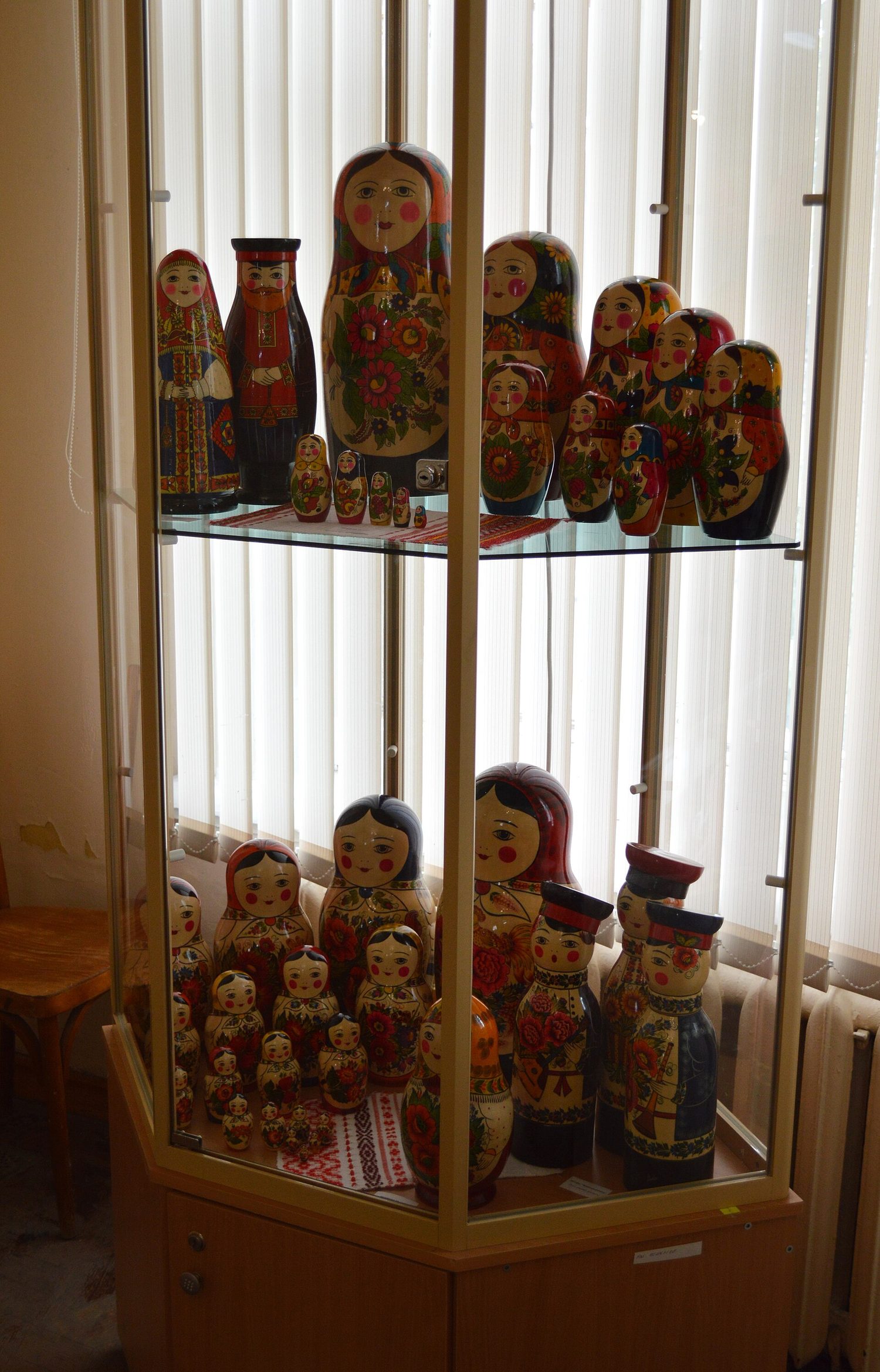
ตุ๊กตาไม้มาทรיוชกา: กฎลูกโซ่ทำอนุพันธ์ฟังก์ชันที่ซ้อนกันทีละชั้น – ภายนอกก่อน แล้วค่อยส่วนในถัดไป
Vocabulary · ⁨คำศัพท์⁩ Train · ⁨ฝึกฝน⁩
English ไทย
chain rule/tʃeɪn ruːl/ กฎโซ่ (Chain Rule)
composite function/ˈkɒmpəzɪt ˈfʌŋkʃn/ ฟังก์ชันประกอบ
Implicit differentiation/ɪmˈplɪsɪt ˌdɪfəˌrenʃɪˈeɪʃn/ การหาอนุพันธ์แบบล่องหน (Implicit Differentiation)
inverse function/ɪnˈvɜːs ˈfʌŋkʃn/ ฟังก์ชันผกผัน
reciprocal/rɪˈsɪprəkl/ ส่วนกลับ
inverse trigonometric functions/ɪnˈvɜːs ˌtrɪɡənəʊˈmetrɪk ˈfʌŋkʃnz/ ฟังก์ชันตรีโกณมิติผกผัน
second derivative/ˈsekənd dɪˈrɪvətɪv/ อนุพันธ์อันดับสอง
3.2

Implicit Differentiation · ⁨การหาอนุพันธ์แบบ ضمن⁩

Syllabus · ⁨หลักสูตร⁩
English

Enduring Understanding (FUN-3): Recognizing opportunities to apply derivative rules can simplify differentiation.

Learning Objective FUN-3.D: Calculate derivatives of implicitly defined functions.

  • FUN-3.D.1 The chain rule is the basis for implicit differentiation.
ไทย

ความเข้าใจที่ยั่งยืน (FUN-3): การตระหนักถึงโอกาสในการใช้กฎอนุพันธ์สามารถทำให้การหาอนุพันธ์ง่ายขึ้น

วัตถุประสงค์การเรียนรู้ FUN-3.D: คำนวณอนุพันธ์ของฟังก์ชันที่กำหนดโดยวิธีซ่อนเร้น

  • FUN-3.D.1 กฎลูกโซ่เป็นพื้นฐานของการหาอนุพันธ์แบบซ่อนเร้น

Source: College Board AP Course and Exam Description · ⁨แหล่งที่มา: คำอธิบายหลักสูตรและข้อสอบ College Board AP⁩

English

Some curves are defined implicitly – by an equation in $x$ and $y$ that is not solved for $y$, such as $x^2+y^2=25$. Implicit differentiation 隐函数求导 finds $\dfrac{dy}{dx}$ without solving for $y$ first. It is just the chain rule, treating $y$ as a function of $x$.

The method: differentiate both sides with respect to $x$; every time you differentiate a $y$-term, multiply by $\dfrac{dy}{dx}$ (the chain rule); then solve algebraically for $\dfrac{dy}{dx}$. For $x^2+y^2=25$:

$$2x + 2y\frac{dy}{dx}=0 \;\Longrightarrow\; \frac{dy}{dx} = -\frac{x}{y}.$$

Worked example. Find the tangent line to the circle $x^2+y^2=25$ at the point $(3,4)$. From above $\dfrac{dy}{dx}=-\dfrac{x}{y}=-\dfrac{3}{4}$ there, so the tangent is

$$y-4=-\tfrac{3}{4}(x-3).$$
Notice the tangent is perpendicular to the radius, as geometry promises – a good sanity check.

Exam skill – "Show that $\dfrac{dy}{dx}=\ldots$". This exact prompt appears most years (e.g. "Show that $\dfrac{dy}{dx}=\dfrac{2y}{y^2-2x}$"). Because the target is given, you must show every algebra step cleanly: differentiate both sides, use the product/chain rules on mixed $xy$ terms, collect all $\dfrac{dy}{dx}$ terms on one side, factor, and divide. A correct final line that skips the algebra earns little. Follow-up parts then ask for a tangent line, or where the tangent is horizontal ($\tfrac{dy}{dx}=0$, so the numerator is $0$) or vertical (the denominator is $0$).

ไทย

บางเส้นโค้งถูกกำหนดโดย นิพจน์ทางอ้อม – จากสมการใน $x$ และ $y$ ที่ไม่ได้แก้หาค่า $y$ ออกมา เช่น $x^2+y^2=25$. การหาอนุพันธ์แบบ นิพจน์ทางอ้อม ช่วยหา $\dfrac{dy}{dx}$ โดยไม่ต้องแก้หาค่า $y$ ก่อน เป็นเพียงการใช้กฎลูกโซ่ โดยพิจารณา $y$ เป็นฟังก์ชันของ $x$.

วิธีการ: หาอนุพันธ์ ทั้งสองข้าง เทียบกับ $x$; ทุกครั้งที่หาอนุพันธ์เทอมที่มี $y$ ให้คูณด้วย $\dfrac{dy}{dx}$ (กฎลูกโซ่); จากนั้นจัดรูปสมการเพื่อหาค่า $\dfrac{dy}{dx}$. สำหรับ $x^2+y^2=25$:

$$2x + 2y\frac{dy}{dx}=0 \;\Longrightarrow\; \frac{dy}{dx} = -\frac{x}{y}.$$

ตัวอย่างวิธีทำ. หาสัมประสิทธิ์ความชันของเส้นสัมผัสวงกลม $x^2+y^2=25$ ที่จุด $(3,4)$. จากส่วนบน $\dfrac{dy}{dx}=-\dfrac{x}{y}=-\dfrac{3}{4}$ จุดนั้น ดังนั้นเส้นสัมผัสคือ

$$y-4=-\tfrac{3}{4}(x-3).$$
สังเกตว่าเส้นสัมผัสตั้งฉากกับรัศมี ตามที่เรขาคณิตบอกไว้ – เป็นการตรวจสอบความถูกต้องที่ดี

การหาอนุพันธ์แบบนิพจน์ทางอ้อมให้เส้นสัมผัสวงกลม ซึ่งตั้งฉากกับรัศมี

ทักษะการสอบ – "แสดงว่า $\dfrac{dy}{dx}=\ldots$". คำสั่งนี้ exact มักปรากฏทุกปี (เช่น "แสดงว่า $\dfrac{dy}{dx}=\dfrac{2y}{y^2-2x}$"). เนื่องจาก target ถูกกำหนดแล้ว, คุณต้องแสดง ทุกขั้นตอนทางพีชคณิต อย่างชัดเจน: หา derivative ทั้งสองข้าง, ใช้กฎผลคูณ/ลูกโซ่กับพจน์ผสม $xy$, รวบรวมพจน์ $\dfrac{dy}{dx}$ ไว้ด้านเดียว, factoring, และหาร. บรรทัดสุดท้ายที่ถูกต้องแต่ข้ามขั้นตอนพีชคณิตจะได้คะแนนน้อย. ส่วนต่อจากนั้นอาจถามหาเส้นสัมผัส, หรือจุดที่เส้นสัมผัสเป็นแนวนอน ($\tfrac{dy}{dx}=0$, ดังนั้นตัวเศษคือ $0$) หรือแนวตั้ง (ตัวส่วนคือ $0$).

3.3

Differentiating Inverse Functions · ⁨การหาอนุพันธ์ของฟังก์ชันผกผัน⁩

Syllabus · ⁨หลักสูตร⁩
English

Enduring Understanding (FUN-3): Recognizing opportunities to apply derivative rules can simplify differentiation.

Learning Objective FUN-3.E: Calculate derivatives of inverse and inverse trigonometric functions.

  • FUN-3.E.1 The chain rule and definition of an inverse function can be used to find the derivative of an inverse function, provided the derivative exists.
ไทย

ความเข้าใจที่ยั่งยืน (FUN-3): การตระหนักถึงโอกาสในการใช้กฎอนุพันธ์สามารถทำให้การหาอนุพันธ์ง่ายขึ้น

วัตถุประสงค์การเรียนรู้ FUN-3.E: คำนวณอนุพันธ์ของฟังก์ชันผกผันและฟังก์ชันตรีโกณมิติผกผัน

  • FUN-3.E.1 กฎลูกโซ่และนิยามของฟังก์ชันผกผันสามารถใช้หาอนุพันธ์ของฟังก์ชันผกผันได้ โดยต้องมีอนุพันธ์อยู่ก่อน

Source: College Board AP Course and Exam Description · ⁨แหล่งที่มา: คำอธิบายหลักสูตรและข้อสอบ College Board AP⁩

English

If $g$ is the inverse function 反函数 of $f$ (so $f(g(x))=x$), the chain rule links their derivatives:

$$g'(x) = \frac{1}{f'\big(g(x)\big)},\qquad\text{provided } f'\big(g(x)\big)\neq 0.$$
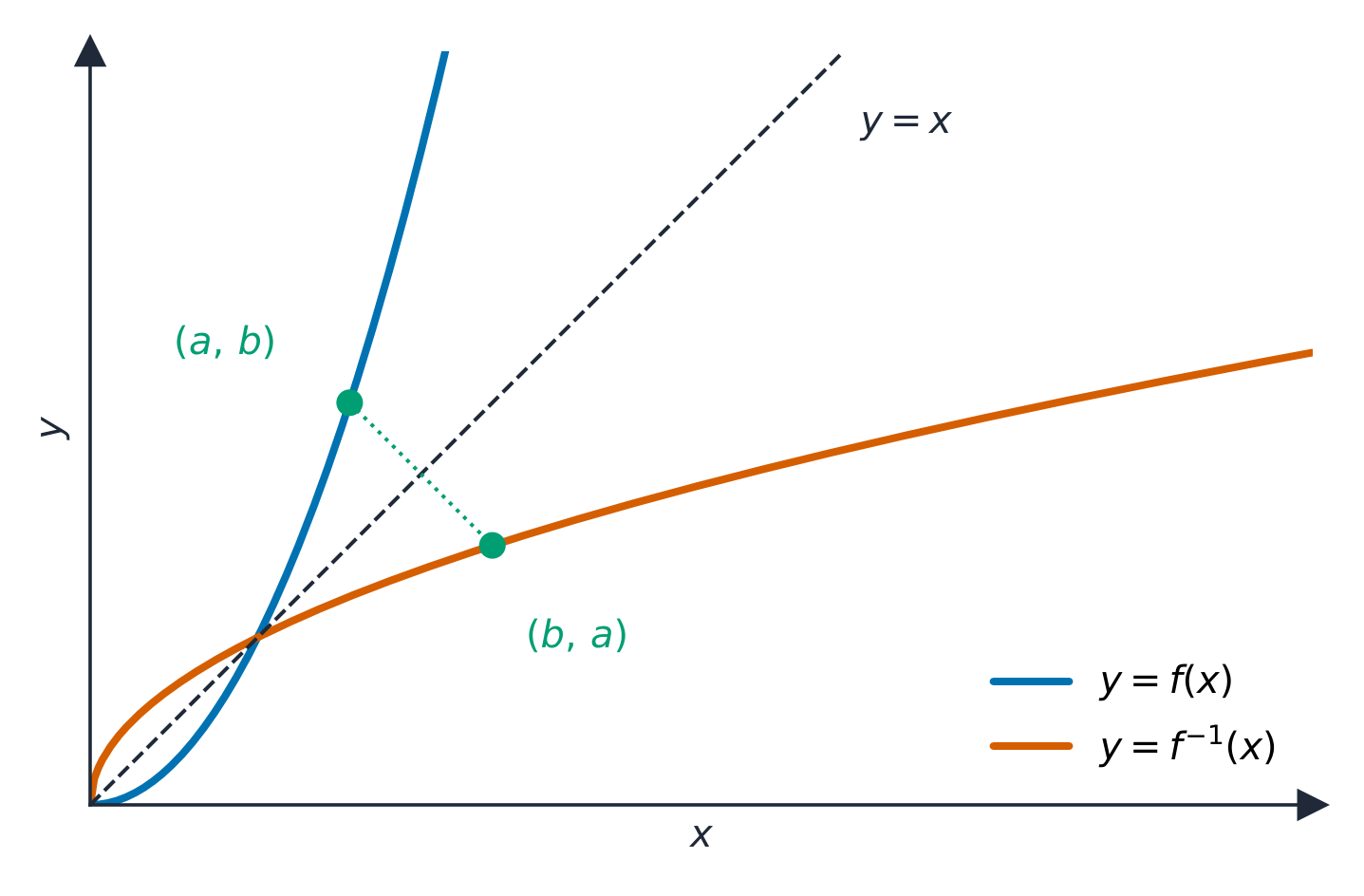
In words: the derivative of the inverse at a point is the reciprocal 倒数 of the derivative of the original function at the matching point. A common exam setup gives a table and a point $(a,b)$ on $f$ (so $(b,a)$ is on $g$), then asks for $g'(b)=\dfrac{1}{f'(a)}$.

Worked example. Suppose $f(2)=5$ and $f'(2)=3$, and $g$ is the inverse of $f$. Because $(2,5)$ lies on $f$, the point $(5,2)$ lies on $g$, and

$$g'(5)=\frac{1}{f'(2)}=\frac{1}{3}.$$
The graphs of $f$ and $g$ are mirror images across $y=x$, so their slopes at matching points are reciprocals.

ไทย

หาก $g$ เป็น ฟังก์ชันผกผัน ของ $f$ (ดังนั้น $f(g(x))=x$), กฎลูกโซ่เชื่อมโยงอนุพันธ์ของทั้งสอง:

$$g'(x) = \frac{1}{f'\big(g(x)\big)},\qquad\text{provided } f'\big(g(x)\big)\neq 0.$$
ตามคำพูด: อนุพันธ์ของฟังก์ชันผกผันที่จุดหนึ่งคือ ค่าผกผัน ของอนุพันธ์ของฟังก์ชันต้นฉบับที่ จุดที่สอดคล้องกัน. การตั้งค่าข้อสอบที่พบบ่อยคือให้ตารางและจุด $(a,b)$ บน $f$ (ดังนั้น $(b,a)$ อยู่บน $g$), แล้วขอหาค่า $g'(b)=\dfrac{1}{f'(a)}$.

กราฟของฟังก์ชันผกผันคือภาพสะท้อนของฟังก์ชันต้นฉบับในเส้น y = x

ตัวอย่างวิธีทำ. สมมติว่า $f(2)=5$ และ $f'(2)=3$, และ $g$ เป็นฟังก์ชันผกผันของ $f$. เนื่องจาก $(2,5)$ อยู่บน $f$, จุด $(5,2)$ จึงอยู่บน $g$, และ

$$g'(5)=\frac{1}{f'(2)}=\frac{1}{3}.$$
กราฟของ $f$ และ $g$ เป็นภาพสะท้อนกันใน $y=x$, ดังนั้นความชันที่จุดที่สอดคล้องกันจะเป็นค่าผกผันกัน

Explore · ⁨สำรวจ⁩

An exponential and its inverse the logarithm · ⁨ฟังก์ชันเอกซ์โพเนนเชียลและฟังก์ชันผกผันคือลอการิทึม⁩

y = a·e^(bx) + c

Inverse functions are mirror images across $y=x$, and their slopes are reciprocals: $\frac{d}{dx}[f^{-1}(x)] = \dfrac{1}{f'(f^{-1}(x))}$. Where one is steep, its inverse is shallow. · ⁨ฟังก์ชันผกผันเป็นภาพสะท้อนกันผ่าน $y=x$ และความชันของพวกมันเป็นผล역กัน: $\frac{d}{dx}[f^{-1}(x)] = \dfrac{1}{f'(f^{-1}(x))}$. ที่ใดหนึ่งชัน ฟังก์ชันผกผันของมันจะแบน⁩

3.4

Differentiating Inverse Trigonometric Functions · ⁨การหาอนุพันธ์ของฟังก์ชันตรีโกณมิติผกผัน⁩

Syllabus · ⁨หลักสูตร⁩
English

Enduring Understanding (FUN-3): Recognizing opportunities to apply derivative rules can simplify differentiation.

Learning Objective FUN-3.E: Calculate derivatives of inverse and inverse trigonometric functions.

  • FUN-3.E.2 The chain rule applied with the definition of an inverse function, or the formula for the derivative of an inverse function, can be used to find the derivatives of inverse trigonometric functions.
ไทย

ความเข้าใจที่ยั่งยืน (FUN-3): การตระหนักถึงโอกาสในการใช้กฎอนุพันธ์สามารถทำให้การหาอนุพันธ์ง่ายขึ้น

วัตถุประสงค์การเรียนรู้ FUN-3.E: คำนวณอนุพันธ์ของฟังก์ชันผกผันและฟังก์ชันตรีโกณมิติผกผัน

  • FUN-3.E.2 การใช้กฎลูกโซ่ร่วมกับนิยามของฟังก์ชันผกผัน หรือสูตรของอนุพันธ์ของฟังก์ชันผกผัน สามารถใช้ในการหาอนุพันธ์ของฟังก์ชันตรีโกณมิติผกผันได้

Source: College Board AP Course and Exam Description · ⁨แหล่งที่มา: คำอธิบายหลักสูตรและข้อสอบ College Board AP⁩

English

The same idea gives the derivatives of the inverse trigonometric functions 反三角函数. The three you should know:

$$\frac{d}{dx}\arcsin x = \frac{1}{\sqrt{1-x^2}}, \quad \frac{d}{dx}\arctan x = \frac{1}{1+x^2}, \quad \frac{d}{dx}\text{arcsec}\,x = \frac{1}{|x|\sqrt{x^2-1}}.$$
Combine these with the chain rule when the input is itself a function, e.g. $\dfrac{d}{dx}\arctan(3x)=\dfrac{3}{1+9x^2}$.

ไทย

แนวคิดเดียวกันนี้ให้ผลอนุพันธ์ของ ฟังก์ชันตรีโกณมิติผกผัน. สามอย่างที่คุณควรจำได้:

$$\frac{d}{dx}\arcsin x = \frac{1}{\sqrt{1-x^2}}, \quad \frac{d}{dx}\arctan x = \frac{1}{1+x^2}, \quad \frac{d}{dx}\text{arcsec}\,x = \frac{1}{|x|\sqrt{x^2-1}}.$$
รวมกับกฎลูกโซ่เมื่อตัวแปรเข้าเป็นฟังก์ชันเอง เช่น $\dfrac{d}{dx}\arctan(3x)=\dfrac{3}{1+9x^2}$.

3.5

Selecting Procedures for Calculating Derivatives · ⁨การเลือกขั้นตอนสำหรับการหาอนุพันธ์⁩

Syllabus · ⁨หลักสูตร⁩
English

This topic is intended to focus on the skill of selecting an appropriate procedure for calculating derivatives. Students should be given opportunities to practice when and how to apply all learning objectives relating to calculating derivatives.

ไทย

หัวข้อนี้มุ่งเน้นทักษะการเลือกขั้นตอนที่เหมาะสมสำหรับการคำนวณอนุพันธ์ นักเรียนควรได้รับโอกาสฝึกฝนเมื่อใดและอย่างไรที่จะนำไปใช้กับวัตถุประสงค์การเรียนรู้ทั้งหมดที่เกี่ยวข้องกับการคำนวณอนุพันธ์

Source: College Board AP Course and Exam Description · ⁨แหล่งที่มา: คำอธิบายหลักสูตรและข้อสอบ College Board AP⁩

English

A skill topic: real derivatives mix several rules, so read the structure of the expression first, from the outside in.

  • Is it a sum? Differentiate term by term.
  • A product or quotient? Apply that rule, and expect to use the chain rule inside.
  • A composite (something inside something)? Chain rule.
  • Given implicitly? Implicit differentiation.

Name the outermost operation, apply its rule, and recurse inward. Neatness prevents the sign and bookkeeping errors that cost marks.

ไทย

หัวข้อทักษะ: อนุพันธ์จริงผสมหลายกฎ ดังนั้นอ่านโครงสร้างของนิพจน์ก่อน โดยเริ่มจากภายนอกเข้าสู่ภายใน

  • เป็น ผลบวก? หาอนุพันธ์ทีละพจน์.
  • เป็น ผลคูณ หรือ ผลหาร? ใช้กฎนั้น และคาดหวังว่าจะต้องใช้กฎลูกโซ่ภายใน.
  • เป็น ฟังก์ชันประกอบ (มีอะไรอยู่ภายในอีก)? ใช้กฎลูกโซ่.
  • กำหนดโดย นิพจน์ทางอ้อม? ใช้การหาอนุพันธ์แบบนิพจน์ทางอ้อม.

ระบุการดำเนินการที่อยู่ชั้นนอกสุด ใช้กฎของมัน แล้ววนลูปเข้าไปด้านใน. ความเรียบร้อยช่วยป้องกันความผิดพลาดเรื่องเครื่องหมายและการบันทึกข้อมูลซึ่งอาจทำให้เสียคะแนน

3.6

Calculating Higher-Order Derivatives · ⁨การคำนวณอนุพันธ์อันดับสูง⁩

Syllabus · ⁨หลักสูตร⁩
English

Enduring Understanding (FUN-3): Recognizing opportunities to apply derivative rules can simplify differentiation.

Learning Objective FUN-3.F: Determine higher order derivatives of a function.

  • FUN-3.F.1 Differentiating $f'$ produces the second derivative $f''$, provided the derivative of $f'$ exists; repeating this process produces higher-order derivatives of $f$.
  • FUN-3.F.2 Higher-order derivatives are represented with a variety of notations. For $y = f(x)$, notations for the second derivative include $\dfrac{d^2 y}{dx^2}$, $f''(x)$, and $y''$. Higher-order derivatives can be denoted $\dfrac{d^n y}{dx^n}$ or $f^{(n)}(x)$.
ไทย

ความเข้าใจที่ยั่งยืน (FUN-3): การตระหนักถึงโอกาสในการใช้กฎอนุพันธ์สามารถทำให้การหาอนุพันธ์ง่ายขึ้น

วัตถุประสงค์การเรียนรู้ FUN-3.F: หาอนุพันธ์ระดับสูงของฟังก์ชัน

  • FUN-3.F.1 การหาอนุพันธ์ $f'$ จะได้อนุพันธ์อันดับสอง $f''$ โดย前提是ว่าอนุพันธ์ของ $f'$ มีอยู่; การทำกระบวนการนี้จะซ้ำ会产生อนุพันธ์ระดับสูงของ $f$
  • FUN-3.F.2 อนุพันธ์ระดับสูงแสดงด้วยสัญลักษณ์หลากหลาย สำหรับ $y = f(x)$ สัญลักษณ์ของอนุพันธ์อันดับสองประกอบด้วย $\dfrac{d^2 y}{dx^2}$, $f''(x)$ และ $y''$ อนุพันธ์ระดับสูงสามารถเขียนแทนได้ด้วย $\dfrac{d^n y}{dx^n}$ หรือ $f^{(n)}(x)$

Source: College Board AP Course and Exam Description · ⁨แหล่งที่มา: คำอธิบายหลักสูตรและข้อสอบ College Board AP⁩

English

Differentiating $f'$ produces the second derivative 二阶导数 $f''$; repeating gives higher-order derivatives. The notations:

$$f''(x)=\frac{d^2y}{dx^2}=y'', \qquad\text{and in general}\qquad f^{(n)}(x)=\frac{d^n y}{dx^n}.$$
The second derivative measures how the slope is changing; it drives concavity 凹凸性 and acceleration in later units. To find $f''$ implicitly, differentiate the expression for $\dfrac{dy}{dx}$ again (with the quotient and chain rules), then substitute $\dfrac{dy}{dx}$ back in.

ไทย

การหาอนุพันธ์ $f'$ จะได้อันตรภาคที่ สอง $f''$; การทำซ้ำจะได้อันตรภาคอันดับสูงขึ้น. สัญลักษณ์:

$$f''(x)=\frac{d^2y}{dx^2}=y'', \qquad\text{and in general}\qquad f^{(n)}(x)=\frac{d^n y}{dx^n}.$$
อนุพันธ์อันดับสองวัดการเปลี่ยนแปลงของ ความชัน;它驱动 later units中的 concavity และ acceleration. ในการหา $f''$ แบบนิพจน์ทางอ้อม, หาอนุพันธ์นิพจน์ของ $\dfrac{dy}{dx}$ อีกครั้ง (โดยใช้กฎผลหารและกฎลูกโซ่), แล้วแทนค่า $\dfrac{dy}{dx}$ กลับเข้าไปใหม่.

Explore · ⁨สำรวจ⁩

Slope of the slope: the second derivative · ⁨ความชันของความชัน: อนุพันธ์อันดับสอง⁩

y = ax³ + bx² + cx + d

Differentiating again gives the second derivative — the rate at which the slope changes. Where the tangent's slope is itself increasing, the curve bends upward (concave up). · ⁨หาอนุพันธ์อีกครั้งจะได้ อนุพันธ์อันดับสอง — อัตราการเปลี่ยนแปลงของความชัน ที่何处ความชันของเส้นสัมผัสเองก็เพิ่มขึ้น เส้นโค้งจะงอขึ้น (เว้าขึ้น)⁩

Vocabulary · ⁨คำศัพท์⁩ Train · ⁨ฝึกฝน⁩
English ไทย
concavity/kənˈkævɪti/ ความเว้า
3.6

Exam tips · ⁨ข้อแนะนำสำหรับการสอบ⁩

English
  • Use the chain rule for composite functions — differentiate the outside, then multiply by the derivative of the inside (the most-forgotten factor).
  • For implicit differentiation, differentiate both sides with respect to $x$ and attach $\tfrac{dy}{dx}$ each time $y$ is differentiated, then solve.
  • Get the second derivative by differentiating twice (velocity → acceleration).
  • Combine rules carefully in layered expressions (chain inside product, etc.).
  • The inverse function's graph is the reflection in $y=x$; its slope is the reciprocal of the original's at the matching point.
ไทย
  • ใช้ กฎลูกโซ่ กับฟังก์ชันประกอบ — หาอนุพันธ์ของส่วนนอก แล้วคูณด้วยอนุพันธ์ของส่วนใน (ปัจจัยที่ถูกลืมมากที่สุด).
  • สำหรับการหาอนุพันธ์แบบ นิพจน์ทางอ้อม, หาอนุพันธ์ทั้งสองข้างเทียบกับ $x$ และติด $\tfrac{dy}{dx}$ ทุกครั้งที่หาอนุพันธ์ $y$, แล้วแก้สมการ.
  • ได้ อนุพันธ์อันดับสอง bằng cáchหาอนุพันธ์สองครั้ง (ความเร็ว → ความเร่ง).
  • รวมกฎอย่างระมัดระวังในนิพซ้อนชั้น (กฎลูกโซ่ภายในผลคูณ, ฯลฯ).
  • กราฟของฟังก์ชันผกผันคือการสะท้อนใน $y=x$; ความชันของมันคือค่าผกผันของความชันเดิมที่จุดที่สอดคล้องกัน.

Interactive lessons on this topic · ⁨บทเรียนเชิงโต้ตอบสำหรับหัวข้อนี้⁩

Work through it step by step, with instant-check exercises. · ⁨ทำทีละขั้นตอน พร้อมแบบฝึกหัดตรวจสอบผลทันที⁩

Past Papers · ⁨ข้อสอบย้อนหลัง⁩

More topics in AP Calculus AB · ⁨หัวข้อเพิ่มเติมใน AP Calculus AB⁩

Log in or create account · ⁨เข้าสู่ระบบหรือสร้างบัญชี⁩

IGCSE, A-Level & AP