Skip to content · ⁨ข้ามไปยังเนื้อหา⁩
Subjects · ⁨รายวิชา⁩

AP 2-D Art and Design · ⁨AP ศิลปะและออกแบบ 2 มิติ⁩

Tips · ⁨เคล็ดลับ⁩

AP 2-D Art and Design is a portfolio course, not an exam course. You submit fifteen Selected Works demonstrating 2-D design skills, and a Sustained Investigation of fifteen images with written evidence showing how one inquiry question developed over time.

The Sustained Investigation is judged on the process, not on fifteen finished pieces. Work that experiments, revises and visibly changes scores higher than fifteen polished but unrelated images.

The writing is assessed too. A vague inquiry question — "I explored colour" — cannot be evidenced; a specific one can. Photograph and date every stage as you go, because the evidence of development cannot be reconstructed at the end.

This is a portfolio course, so the notes deal with what Selected Works and Sustained Investigation actually require, and with writing the accompanying text inside the character limits. There is no written exam to revise for; the library carries the published scoring guidelines instead.

  • 1

    Elements of Art · ⁨องค์ประกอบของศิลปะ⁩

    Watch lesson · ⁨ดูบทเรียน⁩
    1.1

    Line · ⁨เส้น⁩

    Syllabus · ⁨หลักสูตร⁩
    English

    Focus: Line is the most basic element of art — a moving point that the eye follows across a surface.

    • A line is a mark with length and direction: straight, curved, angular, or freeform.
    • Lines vary in quality — thick or thin, smooth or rough, continuous or broken, dark or light.
    • Contour lines trace the edges of a form; gesture lines quickly capture movement and energy.
    • Implied lines are suggested, not drawn — by a row of objects, a pointing arm, or a gaze.
    • Direction carries feeling: horizontal reads as calm, vertical as strength, diagonal as action.
    • Artists use line to build shape, shade value (hatching, cross-hatching), imply texture, and lead the eye.
    ไทย

    จุดเน้น: เส้นคือองค์ประกอบพื้นฐานที่สุดของศิลปะ — จุดที่เคลื่อนที่ซึ่งสายตาตามไปทั่วพื้นผิว

    • เส้น คือเครื่องหมายที่มีความยาวและทิศทาง: ตรง, โค้ง, มุม หรือรูปแบบอิสระ
    • เส้นมีความหลากหลายใน คุณภาพ — หนาหรือบาง, เรียบหรือหยาบ, ต่อเนื่องหรือขาดตอน, ดำหรืออ่อน
    • เส้นขอบ ลากตามขอบของรูปทรง; เส้นท่าทาง จับการเคลื่อนไหวและพลังงานได้อย่างรวดเร็ว
    • เส้นที่สื่อถึง ถูก sugerido, ไม่ได้วาดขึ้นจริง — จากแถวของวัตถุ, แขนชี้, หรือการมอง
    • ทิศทางบ่งบอกอารมณ์: แนวราบอ่านได้ว่าสงบ, แนวตั้งว่าแข็งแกร่ง, แนวทแยงคือการกระทำ
    • ศิลปินใช้เส้นเพื่อสร้างรูปร่าง, บานสี ค่า (การขีดข่วน, การขีดข่วนไขว้), สื่อถึงพื้นผิว, และนำสายตา
    Source: College Board AP Course and Exam Description · ⁨แหล่งที่มา: คำอธิบายหลักสูตรและข้อสอบ College Board AP⁩

    English

    The elements of art 艺术元素 are the visual "building blocks" every artist uses. The first is line 线条 — a moving point that the eye follows.

    • A line has length and direction; it can be straight, curved, angular, or freeform.
    • Lines have quality: thick or thin, smooth or rough, continuous or broken, dark or light.
    • Contour 轮廓 lines trace the edges of a form; gesture 动态速写 lines capture movement quickly.
    • Implied lines 隐含线 are not drawn but suggested — by a row of objects or a person's gaze.

    Direction carries feeling: horizontal lines feel calm, vertical lines feel strong, and diagonal lines feel active. Artists use line to build shape, shade value (hatching), imply texture, and lead the viewer's eye.

    ไทย

    องค์ประกอบของศิลปะ คือ "บล็อกสร้าง" ทางภาพที่ศิลปินทุกคนใช้ องค์แรกคือ เส้น — จุดที่เคลื่อนที่ที่สายตาตามติดตาม

    • เส้นมี ความยาวและทิศทาง; สามารถเป็นเส้นตรง, โค้ง, มุม, หรือรูปร่างอิสระ
    • เส้นมี คุณภาพ: หนาหรือบาง, เรียบหรือหยาบ, ต่อเนื่องหรือขาดตอน, ดำหรือขาว
    • เส้นขอบ (Contour lines) ลากตามขอบของรูปทรง; เส้นท่าทาง (Gesture lines) จับการเคลื่อนไหวอย่างรวดเร็ว
    • เส้นเชิงอรรถ (Implied lines) ไม่ได้วาดแต่ถูกสื่อขึ้น — โดยแถวของวัตถุ หรือสายตามนุษย์
    ภาพไม้แกะสลักของโฮกุไซะ depicting คลื่นยักษ์หมุนวนที่กำลังจะซัดเรือเล็ก, dengan-mount Fuji เล็กๆ ในฉากหลัง
    The Great Wave off Kanagawa ของ Hokusai: เส้นโค้ง-bold นำสายตาไปตามคลื่น, และเส้นคล้ายกรงเล็บของฟองน้ำสร้างความเคลื่อนไหว
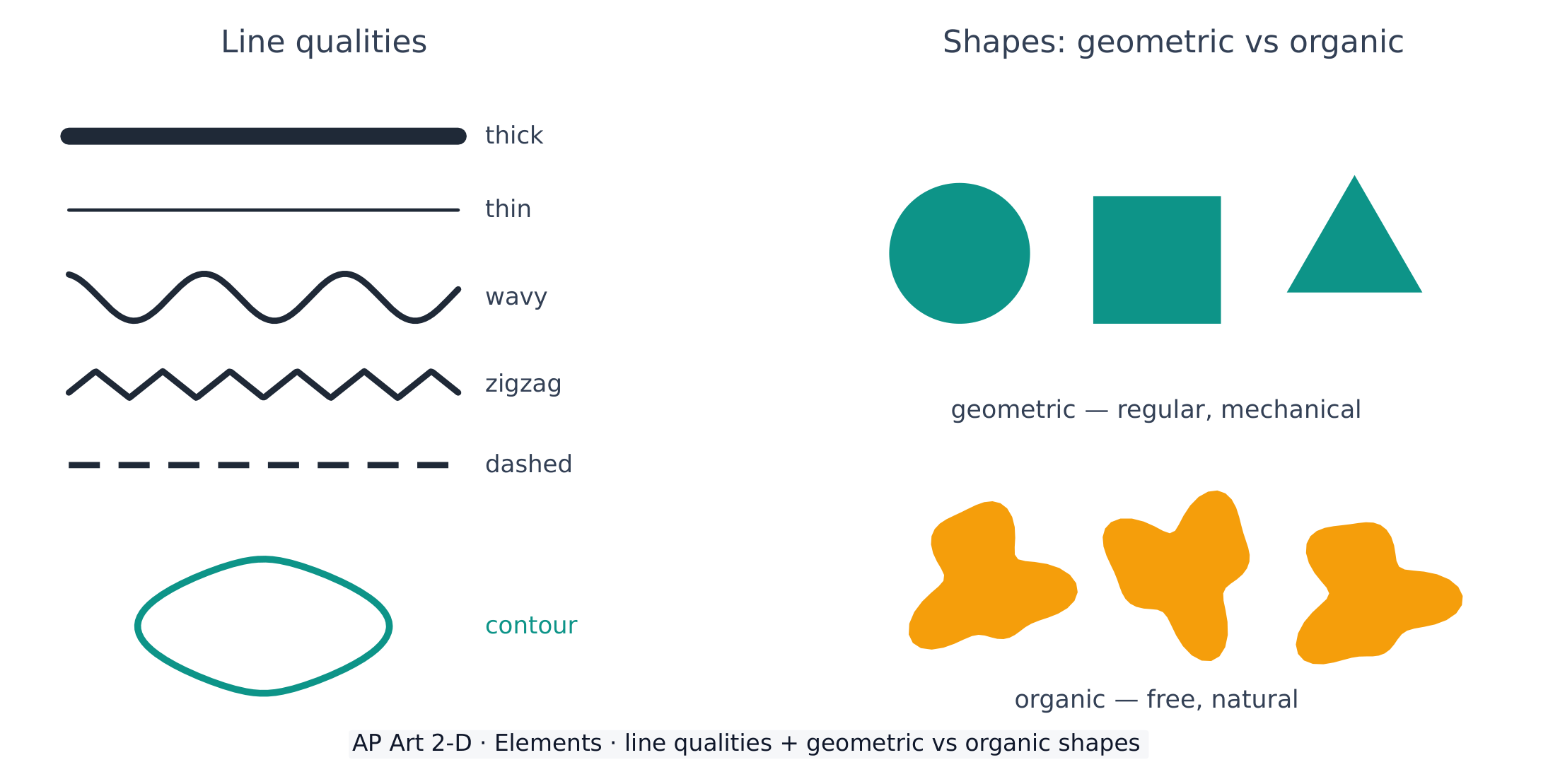
    คุณภาพของเส้นและความแตกต่างระหว่างรูปร่างเรขาคณิตกับออร์แกนิก
    เส้นมีความหนักและลักษณะต่างกัน; รูปร่างจะเป็นเรขาคณิต (สม่ำเสมอ) หรือออร์แกนิก (ธรรมชาติ)

    ทิศทางส่งความรู้สึก: เส้นแนวนอนให้ความรู้สึกสงบ, เส้นแนวตั้ง感觉很แข็งแรง, และเส้นทแยงมุม感觉很 active. ศิลปินใช้เส้นในการสร้างรูปร่าง, ทำshade value (hatching), สื่อtexture, และนำสายตาผู้ชม

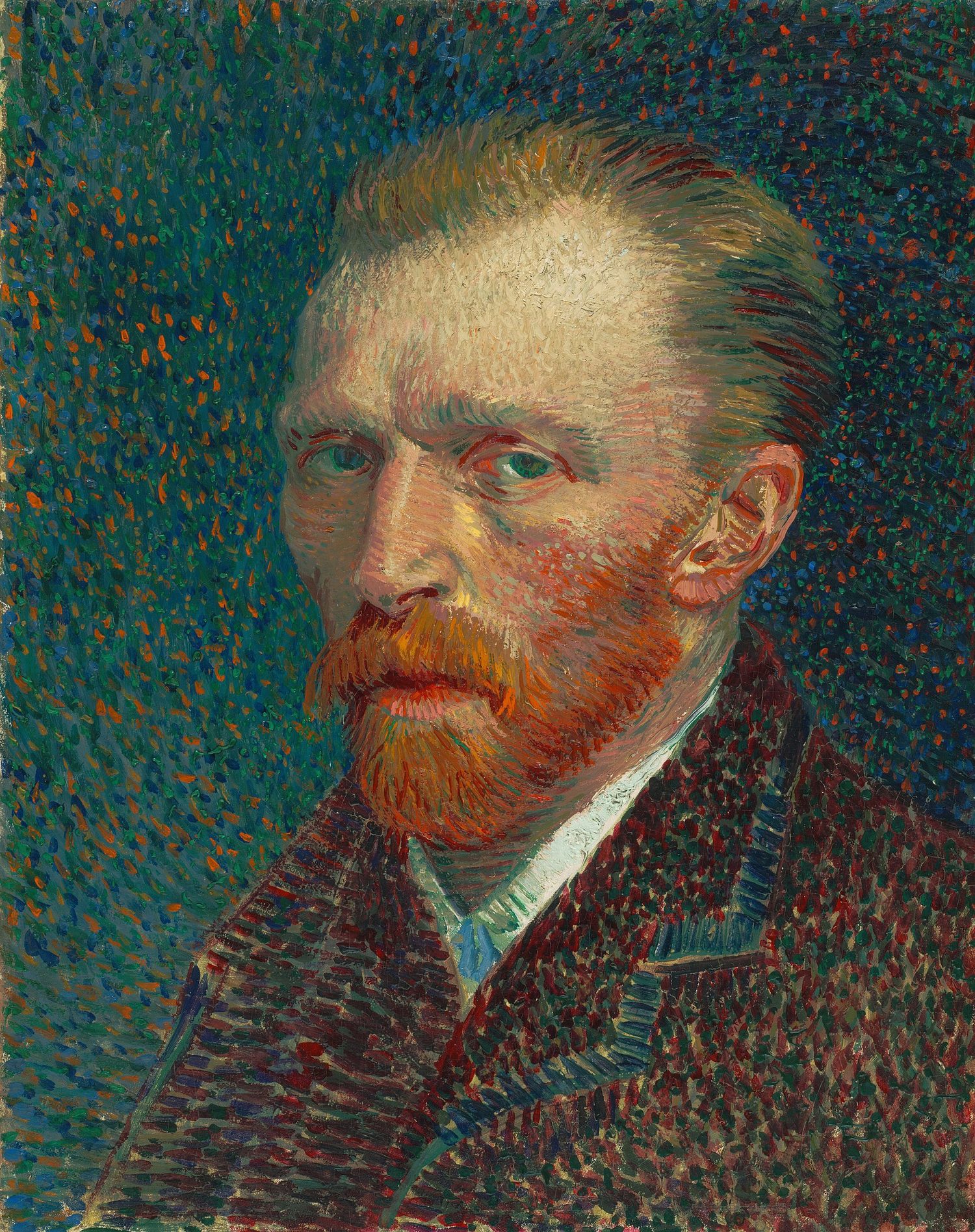
    ภาพ/self-portrait ของ Van Gogh: เปรียบเสมือน short restless diagonal brushstrokes เติมเต็มพื้นหลัง, ในขณะที่ไหล่และปกเสื้อยังคงกว้างและสงบ
    ภาพ/self-portrait ของ Van Gogh: เส้นทแยงมุมที่ restlessness อยู่ด้านหลังของไหล่แนวนอนที่ calm — ทิศทางเดียวกันสองอย่างทำงานตรงข้ามกันในภาพเดียว
    Vocabulary · ⁨คำศัพท์⁩ Train · ⁨ฝึกฝน⁩
    English ไทย
    elements of art/ˈelɪmənts ɒv ɑːt/ องค์ประกอบของศิลปะ
    line/laɪn/ เส้นตรง
    Contour/ˈkɒntʊə/ เส้นขอบ
    gesture/ˈdʒestʃə/ ท่าทาง
    Implied lines/ɪmˈplaɪd laɪnz/ เส้นที่บ่งบอก
    shape/ʃeɪp/ รูปร่าง
    Value/ˈvæljuː/ ค่าโทนสี (Value)
    Texture/ˈtekstʃə/ พื้นผิว (Texture)
    Actual (tactile) texture/ˈæktʃuːəl ˈtekstʃə/ พื้นผิวจริง (สัมผัส)
    Implied (visual) texture/ɪmˈplaɪd ˈtekstʃə/ พื้นผิวที่สื่อ (ภาพ)
    1.2

    Shape and Form · ⁨รูปร่างและรูปทรง⁩

    Syllabus · ⁨หลักสูตร⁩
    English

    Focus: Shape is a flat, enclosed area; form is the illusion of a three-dimensional object on a 2-D surface.

    • A shape is a two-dimensional area with a boundary; form appears three-dimensional (height, width, depth).
    • Geometric shapes (circle, square, triangle) are regular and mechanical; organic shapes are free and natural.
    • Positive shapes are the objects; negative shapes are the empty spaces around and between them.
    • Form is created on a flat surface through value (shading), overlapping, and perspective.
    • Recognising negative space helps an artist see and compose more accurately.
    ไทย

    จุดเน้น: รูปทรง (Shape) เป็นพื้นที่แบนที่มีขอบเขตปิด; รูปร่าง (Form) คือภาพลวงตาของวัตถุสามมิติบนพื้นผิว 2-D.

    • รูปทรง เป็นพื้นที่สองมิติที่มีขอบเขต; รูปร่าง ดูมีสามมิติ (มีความสูง กว้าง ลึก)
    • รูปร่างเรขาคณิต (Geometric shapes: circle, square, triangle) เป็นสม่ำเสมอและเครื่องจักร; รูปร่างออร์แกนิก เป็นอิสระและเป็นธรรมชาติ
    • รูปทรงบวก คือวัตถุ本身; รูปทรงลบ คือพื้นที่ว่างรอบๆ และระหว่างวัตถุเหล่านั้น
    • รูปร่างถูกสร้างบนพื้นผิวแบนผ่าน ค่าความเข้ม/อ่อน (Value) (การแรเงา), การซ้อนทับ, และ มุมมอง
    • การจดจำพื้นที่ว่างช่วยให้นักวาดภาพมองเห็นและจัดองค์ประกอบได้แม่นยำยิ่งขึ้น

    Source: College Board AP Course and Exam Description · ⁨แหล่งที่มา: คำอธิบายหลักสูตรและข้อสอบ College Board AP⁩

    English

    A shape 形状 is a flat, enclosed area; a form 形体 has the illusion of three dimensions (height, width, and depth).

    • Geometric 几何 shapes (circle, square, triangle) are regular and mechanical; organic 有机 shapes are free and natural.
    • Positive shape 正形 is the object; negative shape 负形 is the empty space around and between objects — learning to see it makes drawing far more accurate.
    • Form is created on a flat surface with value (shading), overlapping, and perspective.
    ไทย

    รูปร่าง (Shape) คือพื้นที่แบนที่ปิดล้อม; รูปทรง (Form) มี ảo visual ว่าสามมิติ (สูง, กว้าง, ลึก)

    • รูปร่างเรขาคณิต (Geometric shapes: circle, square, triangle) เป็นสม่ำเสมอและเครื่องจักร; รูปร่างออร์แกนิก เป็นอิสระและเป็นธรรมชาติ
    • รูปร่างบวก (Positive shape) คือวัตถุ; รูปร่างลบ (Negative shape) คือพื้นที่ว่างรอบๆ และระหว่างวัตถุ — การเรียนรู้ที่จะมองเห็นมันจะทำให้การวาดแม่นยำมากขึ้น
    • รูปทรงถูกสร้างบนพื้นผิวแบนด้วย value (การ Shade), การซ้อนทับ, และ Perspective
    Vocabulary · ⁨คำศัพท์⁩ Train · ⁨ฝึกฝน⁩
    English ไทย
    form/fɔːm/ รูปทรง
    Geometric/ˌdʒiːəʊˈmetrɪk/ เรขาคณิต (Geometric)
    organic/ɔːˈɡænɪk/ ออร์แกนิค
    Positive shape/ˈpɒzɪtɪv ʃeɪp/ รูปร่างบวก
    negative shape/ˈneɡətɪv ʃeɪp/ รูปทรงลบ
    1.3

    Value

    Syllabus · ⁨หลักสูตร⁩
    English

    Focus: Value is the lightness or darkness of a colour or tone — the key to showing form and depth.

    • Value runs from white through greys to black; a value scale shows the gradual steps.
    • Highlight, midtone, core shadow, reflected light, and cast shadow describe light on a form.
    • Strong value contrast creates drama and a clear focal point; close values feel soft and calm.
    • Chiaroscuro is the bold use of light and dark to model three-dimensional form.
    • Squinting removes colour and helps an artist judge value relationships.
    ไทย

    จุดเน้น: ค่าความเข้ม/อ่อน คือระดับความสว่างหรือความมืดของสีหรือโทนสี — ซึ่งเป็นกุญแจสำคัญในการแสดงรูปร่างและความลึก

    • ค่าความเข้ม/อ่อน RUNNING จากขาว ผ่านเทาสู่ดำ; สเกลค่าความเข้ม/อ่อน แสดงขั้นตอนการเปลี่ยนแปลงทีละน้อย
    • จุดสว่าง, โทนกลาง, เงาหลัก, แสงสะท้อน, และ เงาตกกระทบ อธิบายแสงบนรูปร่าง
    • ความแตกต่างของ ค่าความเข้ม/อ่อน ที่ชัดเจน สร้างบรรยากาศและจุดเด่นที่ชัดเจน; ค่าที่ใกล้เคียงกันให้ความรู้สึกนุ่มนวลและสงบ
    • ** chiaroscuro** คือการใช้แสงและเงาอย่างเข้มข้นเพื่อสร้างรูปร่างสามมิติ
    • การจ้องตาเบลอช่วยตัดสีออกและช่วยให้ผู้วาดประเมินความสัมพันธ์ของค่าความเข้ม/อ่อนได้ดีขึ้น

    Source: College Board AP Course and Exam Description · ⁨แหล่งที่มา: คำอธิบายหลักสูตรและข้อสอบ College Board AP⁩

    English
    Light logic: how light describes form
    The value scale

    Value 明度 is the lightness or darkness of a tone — the single most powerful tool for showing three-dimensional form.

    • A value scale 明度阶 runs from white through greys to black.
    • Light on a form has a highlight 高光, midtones 中间调, a core shadow 明暗交界线, reflected light 反光, and a cast shadow 投影.
    • Chiaroscuro 明暗对照法 is the bold use of light and dark to model form. Squinting removes colour and helps you judge value.
    ไทย
    Light logic: วิธีที่แสงอธิบายรูปทรง
    The value scale

    Value คือความสว่างหรือความมืดของโทนสี —เครื่องมือที่มีพลังที่สุดสำหรับแสดงรูปทรงสามมิติ

    A value scale runs in even steps from white to black
    A value scale ขยับเท่าๆ กันจากสีขาวไปสีดำ; ความต่างของ value ที่รุนแรงสร้าง drama และจุดโฟกัส
    • สเกลค่าความเข้ม ครอบคลุมตั้งแต่สีขาว ผ่านสีเทา ไปจนถึงสีดำ
    • แสงบนรูปทรงมี highlight, midtones, core shadow, reflected light, และ cast shadow
    • Chiaroscuro คือการใช้แสงและเงาอย่าง Bold เพื่อสร้างรูปทรง การ squinting ลบสีออกและช่วยให้คุณjudge value ได้
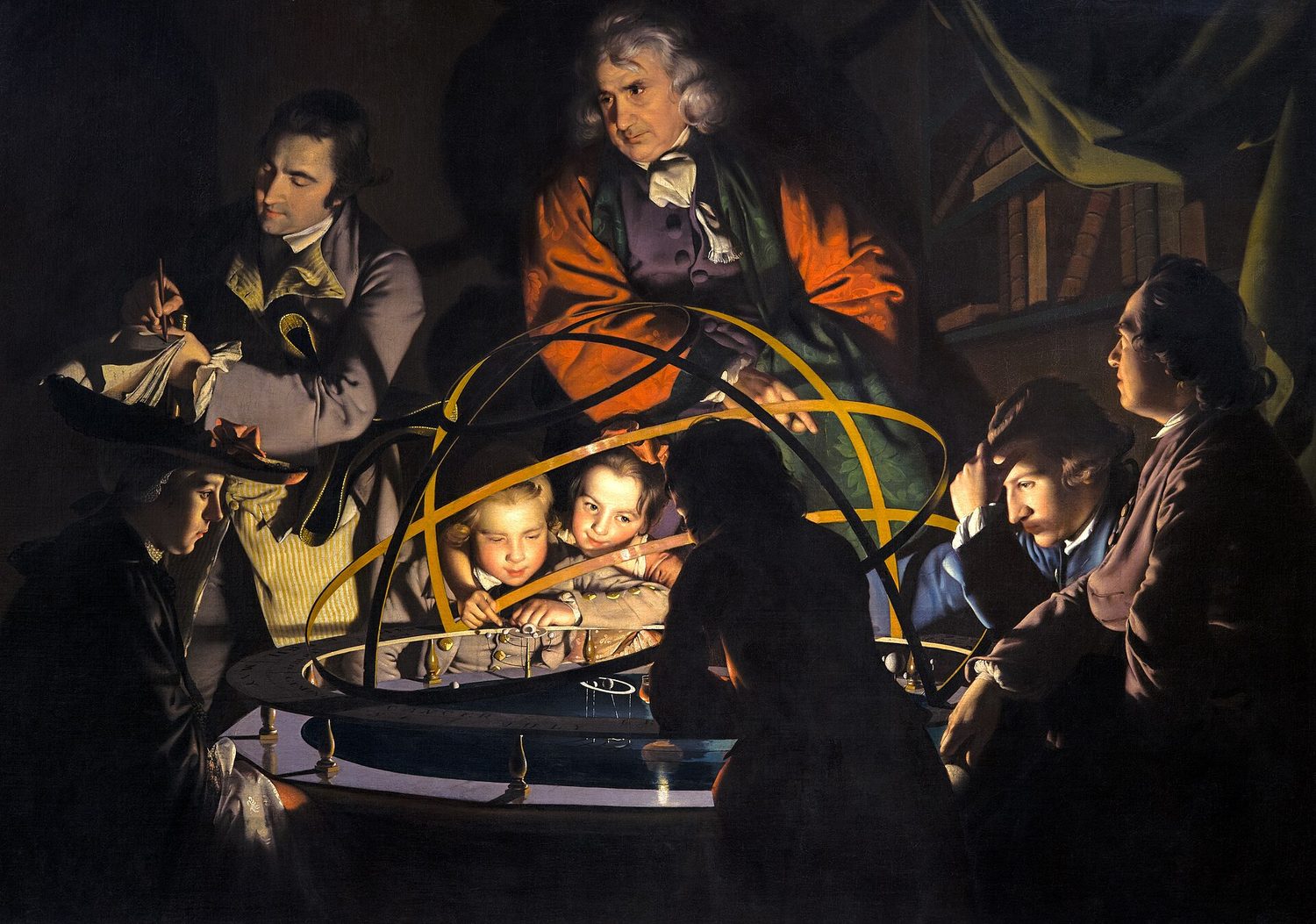
    A candle-lit 18th-century painting where people gather around a model of the solar system, their faces glowing against a dark background
    A Philosopher Lecturing on the Orrery ของ Joseph Wright: แสงซ่อนหนึ่งจุดตรงกลางสร้าง strong value contrast (chiaroscuro), ยกใบหน้าแต่ละใบออกจากความมืด
    Vocabulary · ⁨คำศัพท์⁩ Train · ⁨ฝึกฝน⁩
    English ไทย
    value scale/ˈvæljuː skeɪl/ มาตราส่วนค่าความเข้มของสี
    highlight/ˈhaɪlaɪt/ highlight
    midtones/ˈmɪdtəʊnz/ โทนกลาง
    core shadow/kɔː ˈʃædəʊ/ core shadow
    reflected light/rɪˈflektɪd laɪt/ แสงสะท้อน (Reflected light)
    cast shadow/kæst ˈʃædəʊ/ เงาตกกระทบ
    Chiaroscuro/ˌtʃaɪərəˈskjʊərəʊ/ การตัดแสงและเงา (Chiaroscuro)
    background/ˈbækɡraʊnd/ พื้นหลัง
    Linear perspective/ˈlɪnɪə pəˈspektɪv/ มุมมองเชิงเส้น (Linear perspective)
    vanishing point/ˈvænɪʃɪŋ pɔɪnt/ จุดหายไป
    1.4

    Color · ⁨สี⁩

    Syllabus · ⁨หลักสูตร⁩
    English

    Focus: Colour is light reflected from a surface; it has three properties and follows the logic of the colour wheel.

    • Colour has three properties: hue (its name), value (light/dark), and saturation/intensity (dull to vivid).
    • Primary colours (red, yellow, blue) mix to make secondary (orange, green, violet) and tertiary colours.
    • Colour schemes: complementary, analogous, monochromatic, triadic, warm, and cool.
    • Warm colours (red, orange, yellow) advance and energise; cool colours (blue, green, violet) recede and calm.
    • Adding white makes a tint, black makes a shade, grey makes a tone.
    • Complementary colours placed side by side intensify each other; mixed together they dull (neutralise).
    ไทย

    จุดเน้น: สีคือแสงที่สะท้อนจากพื้นผิว; มีสามคุณสมบัติและสอดคล้องกับตรรกะของวงล้อสี

    • สีมีสามคุณสมบัติ: โทนสี (Hue) (ชื่อเรียก), ค่าความเข้ม/อ่อน (Value) (สว่าง/มืด), และ ความอิ่มตัว/ความเข้ม (Saturation/Intensity) (ทื่อไปจนถึงสดชื่น
    • สีปฐมภูมิ (แดง เหลือง น้ำเงิน) ผสมกันเกิดเป็น สีรอง (ส้ม เขียว ม่วง) และ สี terciario
    • แผนภาพสี: สีสันคู่ตรงข้าม, สีใกล้เคียง, สีเดียว, สามสี, สีอุ่น, และสีเย็น
    • สีอุ่น (แดง ส้ม เหลือง) ดึงดูดสายตาและสร้างความกระตือรือร้น; สีเย็น (น้ำเงิน เขียว ม่วง) ถอยหลังและสร้างความสงบ
    • การเพิ่มสีขาวทำให้เป็น โทนสว่าง (Tint), สีดำทำให้เป็น โทนเข้ม (Shade), เทาทำให้เป็น **โทนกลาง (Tone)
    • สีสันคู่ตรงข้ามวางข้างกันจะเสริมความเข้มให้กันเอง; ผสมกันจะลดความสด (เป็นกลาง)

    Source: College Board AP Course and Exam Description · ⁨แหล่งที่มา: คำอธิบายหลักสูตรและข้อสอบ College Board AP⁩

    English
    The colour wheel and its schemes

    Colour 色彩 is light reflected from a surface. It has three properties and follows the logic of the colour wheel 色轮.

    • Colour's three properties: hue 色相 (its name), value (light/dark), and saturation 饱和度 (dull to vivid).
    • Primary 三原色 (red, yellow, blue) mix to make secondary 间色 and tertiary colours.
    • Complementary 互补色 colours sit opposite on the wheel: placed side by side they intensify each other, but mixed together they neutralise 中和 into a dull grey-brown. Analogous 邻近色 colours sit next to each other and harmonise.
    • Warm 暖色 colours (red, orange, yellow) advance; cool 冷色 colours (blue, green, violet) recede. A tint adds white, a shade adds black.
    ไทย
    The colour wheel and its schemes

    สี คือแสงที่สะท้อนออกจากพื้นผิว มีสามคุณสมบัติและเป็นไปตามตรรกะของ วงล้อสี

    วงล้อสี: เฉดสีหลัก, เฉดรอง และเฉดที่สาม พร้อมครึ่งสีอุ่นและสีเย็น
    สีหลักผสมกันเป็นเฉดรองและเฉดที่สาม; สีตรงข้ามจะอยู่ตรงข้ามกัน
    • สามคุณสมบัติของสี: เฉดสี (ชื่อเรียก), ค่าความสว่าง-มืด (light/dark) และ ความอิ่มตัว (จางจนสดใส)
    • สีหลัก (แดง เหลือง น้ำเงิน) ผสมกันเพื่อสร้าง สีรอง และ สีที่สาม
    • สีตรงข้าม อยู่ตรงข้ามกันในวงล้อ: เมื่อวางคู่กันจะเสริมกันให้สดขึ้น แต่เมื่อ ผสม กันจะเกิด ความเป็นกลาง เป็นสีเทา-น้ำตาลหม่น สีใกล้เคียง จะอยู่ติดกันและเข้ากันได้
    • สีอุ่น (แดง ส้ม เหลือง) ดูเด่นออกมาด้านหน้า; สีเย็น (น้ำเงิน เขียว ม่วง) ดูถอยหลัง โทนสว่าง เติมสีขาว, โทนเข้ม เติมสีดำ

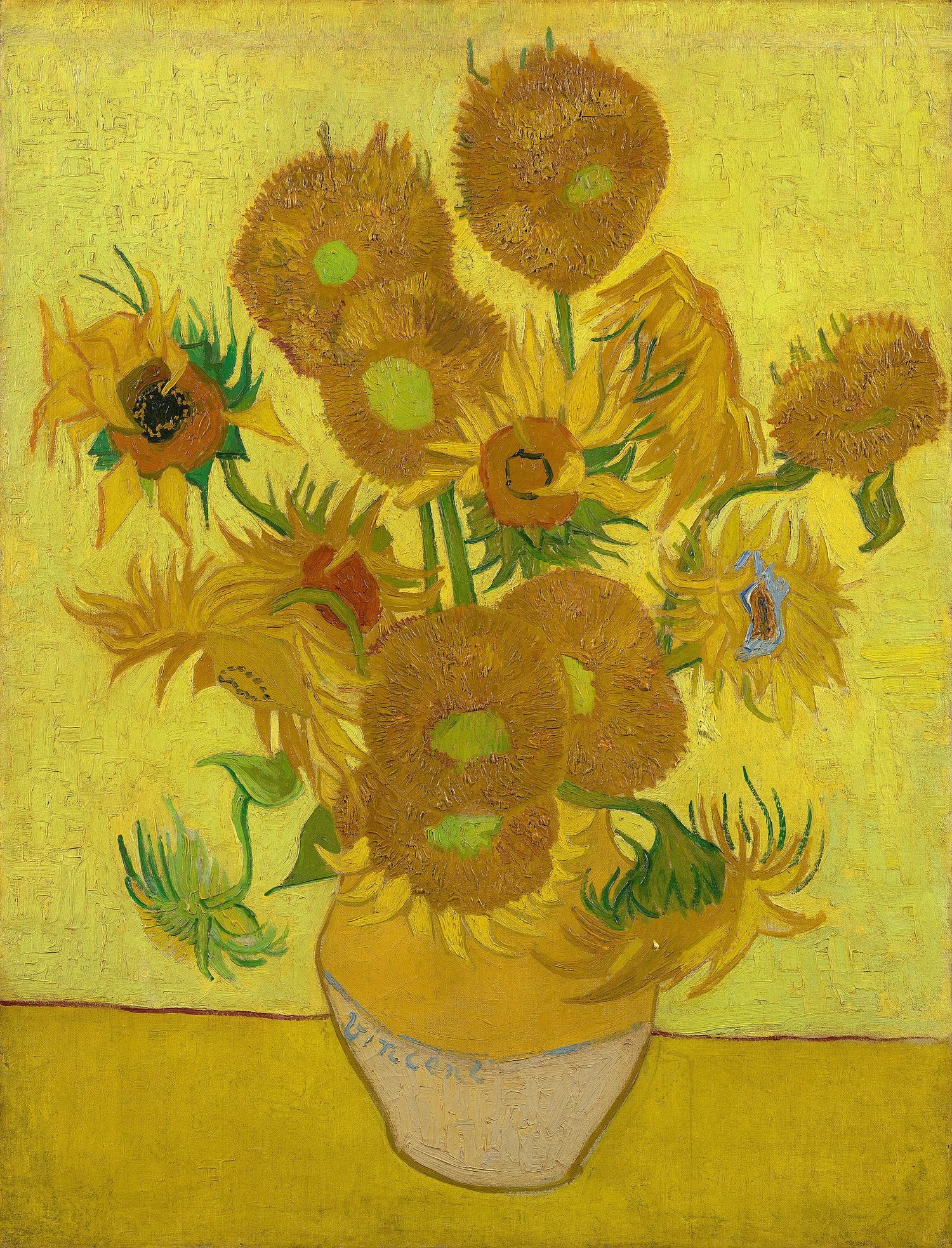
    ภาพนิ่งของ Van Gogh ที่วาดแจกันดอกไม้ทานตะวัน 几乎所有的都用เหลืองและทอง shade *Sunflowers ของ Van Gogh สร้างจากโทนสีเหลืองและส้มอุ่นเกือบทั้งหมด ซึ่งเป็นสchemes สีใกล้เคียงที่ให้ความรู้สึกสว่างและเป็นหนึ่งเดียว

    Explore · ⁨สำรวจ⁩

    Warm or cool colour? · ⁨สีอุ่นหรือสีเย็น?⁩

    Warm colours (red, orange, yellow) feel energetic and seem to advance; cool colours (blue, green, violet) feel calm and seem to recede. · ⁨สีอุ่น (แดง ส้ม เหลือง) ดูมีชีวิตชีวาและดู_advance; สีเย็น (น้ำเงิน เขียว ม่วง) ดูสงบและดู_recede⁩

    Vocabulary · ⁨คำศัพท์⁩ Train · ⁨ฝึกฝน⁩
    English ไทย
    Colour/ˈkʌlə/ สี
    colour wheel/ˈkʌlə wiːl/ วงล้อสี
    hue/hjuː/ เฉดสี (Hue)
    saturation/ˌsætʃəˈreɪʃn/ saturation
    Primary/ˈpraɪməri/ ขั้นต้น
    secondary/ˈsekəndəri/ ทุติยภูมิ
    Complementary/ˌkɒmplɪˈmentəri/ สีคู่互补 (Complementary)
    neutralise/ˈnjuːtrəlaɪz/ ทำให้เป็นกลาง
    Analogous/əˈnæləɡəs/ สีใกล้เคียง (Analogous)
    Warm/wɔːm/ อุ่น (Warm)
    cool/kuːl/ เย็น (Cool)
    1.5

    Texture · ⁨เนื้อสัมผัส⁩

    Syllabus · ⁨หลักสูตร⁩
    English

    Focus: Texture is the surface quality of a work — how it feels or how it appears to feel.

    • Actual (tactile) texture can be physically touched (thick paint, collage, rough paper).
    • Implied (visual) texture is the illusion of a surface, created with marks, value, and pattern.
    • Texture is built through mark-making: stippling, hatching, dry-brush, impasto, and frottage (rubbing).
    • Contrasting smooth and rough areas adds interest and can direct attention.
    • In photography and digital work, texture comes from light, focus, and surface detail.
    ไทย

    จุดเน้น: เนื้อสัมผัสคือคุณภาพของพื้นผิวงานศิลปะ — ทั้งความรู้สึกเมื่อสัมผัสและลักษณะที่ดูเหมือนสัมผัสได้

    • เนื้อสัมผัสจริง (Actual/Tactile) สามารถสัมผัสได้ด้วยกาย (สีหนา คอลลาจ กระดาษหยาบ)
    • เนื้อสัมผัสทางสายตา (Implied/Visual) คือภาพลวงตาของพื้นผิว ซึ่งสร้างขึ้นด้วยเส้นขีดเขียน ค่าความเข้ม/อ่อน และลวดลาย
    • เนื้อสัมผัสสร้างขึ้นจากการขีดเขียน: จุด (Stippling), เส้นขนาน (Hatching), แปรงแห้ง (Dry-brush), สีหนา (Impasto), และการถู (Frottage/Rubbing)
    • การเปรียบเทียบพื้นผิวเรียบและหยาบเพิ่มความน่าสนใจและสามารถนำสายตาไปยังจุดที่ต้องการ
    • ใน摄影และงานดิจิทัล เนื้อสัมผัสมาจากแสง ความชัด และรายละเอียดของพื้นผิว

    Source: College Board AP Course and Exam Description · ⁨แหล่งที่มา: คำอธิบายหลักสูตรและข้อสอบ College Board AP⁩

    English

    Texture 肌理 is the surface quality of a work — how it feels, or how it appears to feel.

    • Actual (tactile) texture 实际肌理 can be physically touched (thick paint, collage, rough paper).
    • Implied (visual) texture 视觉肌理 is the illusion of a surface, made with marks, value, and pattern.
    • Techniques include stippling, hatching, impasto 厚涂 (thick paint), and dry-brush. Contrasting smooth and rough areas adds interest and can direct the eye.
    ไทย

    เนื้อสัมผัส คือคุณภาพของพื้นผิวงานศิลปะ — ทั้งความรู้สึกจริงหรือการมองเห็นว่าดูรู้สึกอย่างไร

    • เนื้อสัมผัสจริง (สัมผัสได้) สามารถสัมผัสได้ด้วยกาย (สีหนา, คอลลาจ, กระดาษหยาบ)
    • เนื้อสัมผัสทางสายตา (imaginary texture) คือภาพลวงตาของพื้นผิว สร้างขึ้นด้วยรอยขีดเขียน ค่าความสว่าง/มืด และลวดลาย
    • เทคนิครวมถึงจุด (stippling), เส้นขนาน (hatching), impasto (สีหนา) และแปรงแห้ง การตัดกันระหว่างพื้นที่เรียบและหยาบเพิ่ม interest และสามารถนำสายตาได้

    ภาพ close-up เดนิมทอ: เนื้อสัมผัสคือคุณภาพพื้นผิวที่คุณเห็นหรือสัมผัสได้ — จริงหรือทางสายตา *ภาพ close-up เดนิมทอ: เนื้อสัมผัสคือคุณภาพพื้นผิวที่คุณเห็นหรือสัมผัสได้ — จริงหรือทางสายตา

    Vocabulary · ⁨คำศัพท์⁩ Train · ⁨ฝึกฝน⁩
    English ไทย
    impasto/ɪmˈpæstəʊ/ อิมพา스토 (Impasto)
    Space/speɪs/ พื้นที่ (Space)
    overlapping/ˌəʊvəˈlæpɪŋ/ การซ้อนทับ
    foreground/ˈfɔːɡraʊnd/ ฉากหน้า
    middle ground/ˈmɪdl ɡraʊnd/ พื้นที่กลาง
    1.6

    Space · ⁨พื้นที่⁩

    Syllabus · ⁨หลักสูตร⁩
    English

    Focus: Space is the area within, around, and between the parts of a work, including the illusion of depth.

    • Positive space is filled by the subject; negative space is the empty area around it.
    • Artists create the illusion of depth with overlapping, size, placement, and detail.
    • Linear perspective uses a horizon line and vanishing point(s) so parallel lines converge.
    • Atmospheric (aerial) perspective makes distant objects paler, bluer, and less detailed.
    • Foreground, middle ground, and background organise a scene from near to far.
    • The format and cropping of the picture plane shape how space is read.
    ไทย

    จุดเน้น: พื้นที่คือพื้นที่ภายใน รอบๆ และระหว่างส่วนต่างๆ ของงาน รวมถึงภาพลวงตาของความลึก

    • พื้นที่บวก ถูกเติมเต็มโดยวัตถุ; พื้นที่ลบ คือพื้นที่ว่างรอบๆ วัตถุ
    • นักวาดภาพสร้างภาพลวงตาของ ความลึก ผ่านการซ้อนทับ ขนาด ตำแหน่ง และความละเอียด
    • มุมมองเชิงเส้น (Linear Perspective) ใช้เส้นแนวนอนและจุดรวมสายตาเพื่อให้เส้นขนานบรรจบกัน
    • มุมมองทางอากาศ (Atmospheric/Aerial Perspective) ทำให้วัตถุที่อยู่ไกลดูจางลง ฟ้าขึ้น และมีรายละเอียดน้อยลง
    • ฉากหน้า ฉากกลาง และฉากหลัง จัดลำดับฉากจากใกล้ไปไกล
    • กรอบภาพ (Format) และการ ตัดต่อ (Cropping) ของระนาบภาพกำหนดวิธีการอ่านพื้นที่

    Source: College Board AP Course and Exam Description · ⁨แหล่งที่มา: คำอธิบายหลักสูตรและข้อสอบ College Board AP⁩

    English
    Atmospheric perspective
    One-point perspective

    Space 空间 is the area within, around, and between the parts of a work, including the illusion of depth on a flat surface.

    • Positive space is filled by the subject; negative space is the empty area around it.
    • Depth is created with overlapping 重叠, size, placement, and detail.
    • A scene organises into three depth planes: foreground 前景 (nearest), middle ground 中景, and background 背景 (farthest). The nearest plane usually carries the most detail and contrast, the farthest the least.
    • Linear perspective 线性透视 uses a horizon line and vanishing point 灭点 so parallel lines converge; atmospheric perspective 空气透视 makes distant things paler, bluer, and less detailed.
    • The format and cropping of the picture plane shape how the space is read.

    Worked example (applying the concept). Asked to describe how line creates meaning in a portrait, a strong answer names the element, its quality, and its effect: "The artist uses thick, jagged diagonal lines in the background, and their restless, active direction makes the calm horizontal lines of the sitter's shoulders feel even more still." Naming the element and linking it to a feeling is what portfolio written evidence and analysis questions both reward.

    ไทย

    *มุมมองเชิงบรรยากาศ

    *มุมมองเชิงเส้นแบบจุดเดียว

    พื้นที่ คือพื้นที่ภายใน รอบๆ และระหว่างส่วนต่างๆ ของงาน รวมถึงภาพลวงตาของความลึกบนพื้นผิวแบน

    • พื้นที่บวก ถูกเติมเต็มโดยวัตถุ; พื้นที่ลบ คือพื้นที่ว่างรอบๆ วัตถุ
    • มิติความลึกสร้างได้จาก การซ้อนทับ, ขนาด, ตำแหน่ง placement, และความละเอียด
    • ฉากถูกจัดเรียงเป็นสามระนาบความลึก: ฉากหน้า (ใกล้ที่สุด), ฉากกลาง, และ ฉากหลัง (ไกลที่สุด) ระนาบที่ใกล้ที่สุดมักมีรายละเอียดและความขัดแย้งมากที่สุด ส่วนไกลที่สุดมีน้อยที่สุด
    • มุมมองเชิงเส้น ใช้เส้นขอบฟ้าและ จุดหายไป เพื่อให้เส้นขนานรวมกัน; มุมมองเชิงบรรยากาศ ทำให้สิ่งของ远处的จางลง azul และไม่มีรายละเอียดเท่าเดิม
    • format และการ ตัดกรอบ ของระนาบภาพกำหนดวิธีการอ่านพื้นที่

    ตัวอย่างทำข้อสอบ (การประยุกต์ใช้แนวคิด). เมื่อถูกถามให้บรรยายว่า เส้น สร้างความหมายในภาพบุคคลได้อย่างไร คำตอบที่ดีจะระบุองค์ประกอบ คุณภาพ และผลกระทบ: "ศิลปินใช้เส้นทแยงมุมขรุขระหนาในฉากหลัง และทิศทางที่วุ่นวายกระตือรือร้นทำให้เส้นแนวนอนสงบนิ่งของไหล่ผู้ถูกวาดดูนิ่งสงบยิ่งขึ้น" การระบุองค์ประกอบ และ เชื่อมโยงกับความรู้สึกคือสิ่งที่ใบสมัครและคำถามวิเคราะห์ต้องการ

    Vocabulary · ⁨คำศัพท์⁩ Train · ⁨ฝึกฝน⁩
    English ไทย
    atmospheric perspective/ˌætməsˈferɪk pəˈspektɪv/ atmospheric perspective
    1.6

    Exam tips · ⁨ข้อแนะนำสำหรับการสอบ⁩

    English
    • Name the element precisely — line, shape or form, value, colour, texture, space — in any analysis.
    • Justify how form is modelled with a value scale and a single light source.
    • Read the colour wheel: identify complementary versus analogous schemes and warm or cool temperature.
    • Separate shape (2-D) from form (3-D) and actual from implied texture.
    • Explain depth with overlap, size, linear perspective, and atmospheric perspective.
    ไทย
    • ระบุ องค์ประกอบ ให้ชัดเจน — เส้น, รูปทรงหรือรูปร่าง, ค่าความสว่าง-มืด, สี, เนื้อสัมผัส, พื้นที่ — ใน任何การวิเคราะห์
    • อธิบายว่า รูปทรง ถูกสร้างด้วย สเกลค่าความสว่าง-มืด และแหล่งกำเนิดแสงเดียว
    • อ่าน วงล้อสี: ระบุ สีตรงข้าม เทียบกับ สchemes สีใกล้เคียง และความอบอุ่นหรือความเย็นของอุณหภูมิสี
    • แยกแยะ รูปทรง (2-D) ออกจาก รูปทรง (3-D) และ เนื้อสัมผัสจริง ออกจาก เนื้อสัมผัสทางสายตา
    • อธิบายความลึกด้วย การทับซ้อน, ขนาด, มุมมองเชิงเส้น และ มุมมองเชิงบรรยากาศ
  • 2

    Principles of Design · ⁨หลักการออกแบบ⁩

    Watch lesson · ⁨ดูบทเรียน⁩
    2.1

    Balance · ⁨ความสมดุล⁩

    Syllabus · ⁨หลักสูตร⁩
    English

    Focus: Balance is the visual distribution of weight in a composition so it feels stable.

    • Symmetrical (formal) balance mirrors both sides of a central axis — calm and orderly.
    • Asymmetrical (informal) balance uses different elements of equal visual weight — dynamic and lively.
    • Radial balance arranges elements around a central point.
    • Visual weight is affected by size, colour, value, texture, and position.
    • A large, dull shape can balance a small, bright one on the other side.
    ไทย

    จุดเน้น: ความสมดุลคือการกระจายน้ำหนักภาพในองค์ประกอบเพื่อให้ดูมั่นคง

    • ความสมดุลแบบสมมาตร (Symmetrical/Formal) สะท้อนด้านซ้ายและขวาของแกนกลาง — ให้ความรู้สึกสงบและเป็นระเบียบ
    • ความสมดุลแบบไม่สมมาตร (Asymmetrical/Informal) ใช้องค์ประกอบที่แตกต่างกันแต่มีน้ำหนักภาพเท่ากัน — มีความเคลื่อนไหวและมีชีวิตชีวา
    • ความสมดุลแบบกึ่งวงกลม (Radial) เรียงองค์ประกอบรอบจุดศูนย์กลาง
    • น้ำหนักภาพได้รับอิทธิพลจากขนาด สี ค่าความเข้ม/อ่อน เนื้อสัมผัส และตำแหน่ง
    • รูปทรงขนาดใหญ่แต่ทึบแสง สามารถสมดุลกับรูปทรงขนาดเล็กแต่สว่างสดใสด้านตรงข้ามได้

    Source: College Board AP Course and Exam Description · ⁨แหล่งที่มา: คำอธิบายหลักสูตรและข้อสอบ College Board AP⁩

    English
    Balance: symmetrical, asymmetrical, radial

    The principles of design 设计原则 are the "rules" for arranging the elements of art. The first is balance 平衡 — the visual distribution of weight so a work feels stable.

    • Symmetrical (formal) balance 对称平衡 mirrors both sides of a central axis — calm and orderly.
    • Asymmetrical (informal) balance 非对称平衡 uses different elements of equal visual weight 视觉重量 — dynamic and lively.
    • Radial balance 辐射平衡 arranges elements around a central point.

    Visual weight is affected by size, colour, value, and position: a small bright shape can balance a large dull one.

    ไทย

    *ความสมดุล: สมมาตร, ไม่สมมาตร, แบบรัศมี

    หลักการออกแบบ คือ "กฎ" ในการจัดวางองค์ประกอบศิลปะ หลักแรกคือ ความสมดุล — การกระจายน้ำหนักทางสายตาเพื่อให้งานดูมั่นคง

    สามประเภทของความสมดุล: สมมาตร, ไม่สมมาตร, และแบบรัศมี *ความสมดุลแบบสมมาตรสะท้อนแกนกลาง; ความสมดุลไม่สมมาตรถ่วงน้ำหนักองค์ประกอบต่าง; ความสมดุลแบบรัศมีแผ่ออกมาจากศูนย์กลาง

    • ความสมดุลแบบสมมาตร (ทางการ) สะท้อนทั้งสองข้างของแกนกลาง — สงบและเป็นระเบียบ
    • ความสมดุลไม่สมมาตร (ไม่เป็นทางการ) ใช้องค์ประกอบต่างกันที่มี น้ำหนักทางสายตา เท่ากัน — มีชีวิตชีวาและเคลื่อนไหว
    • ความสมดุลแบบกึ่งกลาง จัดองค์ประกอบรอบจุดกึ่งกลาง

    น้ำหนักทางสายตาได้รับอิทธิพลจากขนาด, สี, ค่าความสว่าง-มืด, และตำแหน่ง: รูปทรงเล็กแต่สว่างสามารถถ่วงน้ำหนักรูปทรงใหญ่แต่หม่นได้

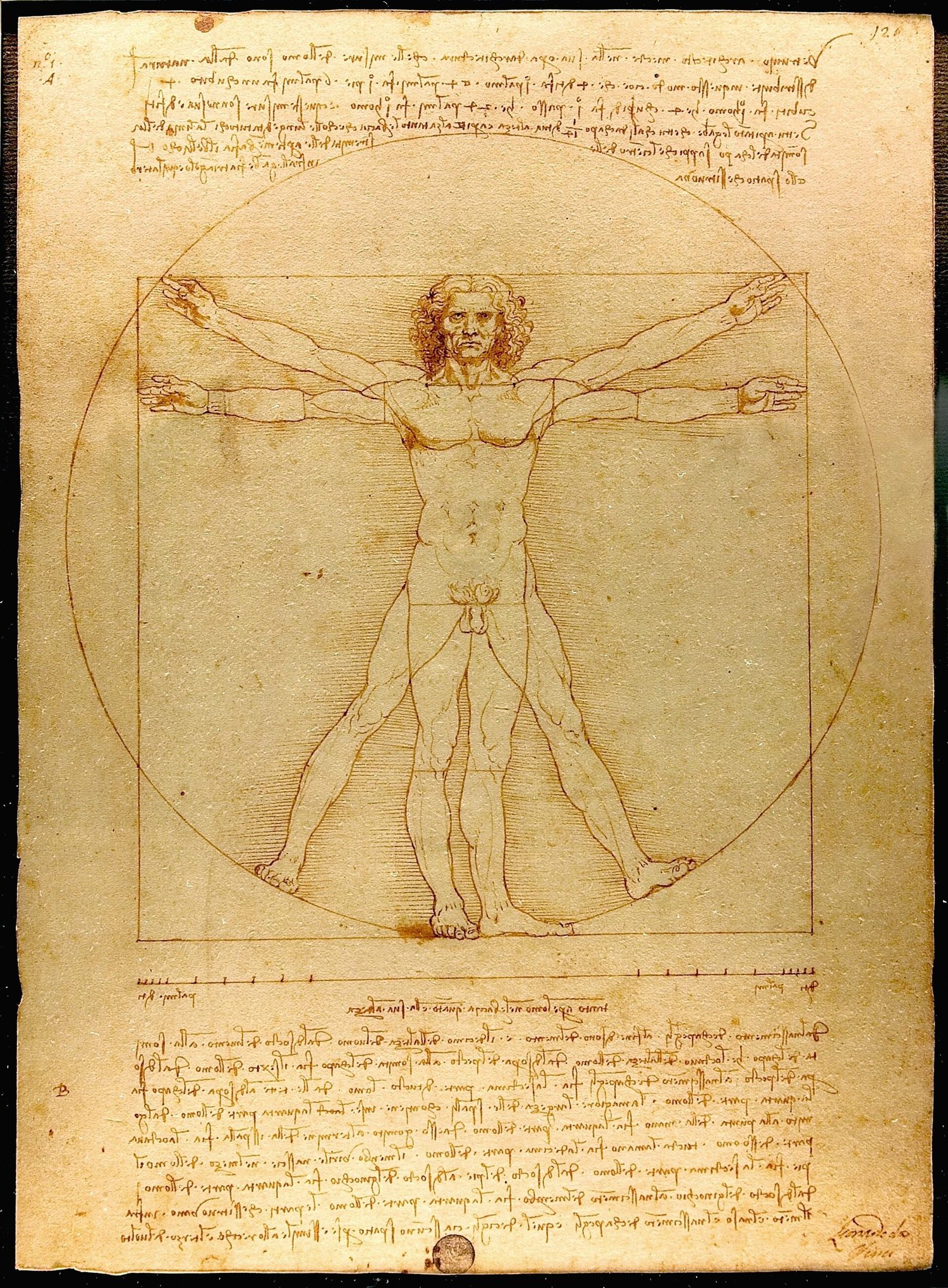
    ภาพวาดหมึกของ Leonardo ที่วาดชายคนหนึ่งกางแขนขา ใส่อยู่ในวงกลมและสี่เหลี่ยม *Vitruvian Man ของ Leonardo: ร่าง人被วาดด้วยความสมมาตรเกือบสมบูรณ์แบบรอบแกนแนวตั้งกลาง, และวงกลมรอบนอกก็ให้ความสมดุลแบบรัศมีเช่นกัน

    การจัดองค์ประกอบถ่วงน้ำหนักแสง, มวล, และความสนใจ across ระนาบภาพ *การจัดองค์ประกอบถ่วงน้ำหนักแสง, มวล, และความสนใจ across ระนาบภาพ

    Explore · ⁨สำรวจ⁩

    Which kind of balance? · ⁨เป็นความสมดุลแบบใด?⁩

    Symmetrical balance mirrors a central axis; asymmetrical balance weighs different elements of equal visual weight; radial balance radiates from a centre. · ⁨สมดุลแบบสมมาตร สะท้อนแกนกลาง; สมดุลแบบไม่สมมาตร ชั่งน้ำหนักองค์ประกอบต่าง ๆ ที่มีน้ำหนักภาพเท่ากัน; สมดุลแบบรัศมี ลามตัวจากศูนย์กลาง⁩

    Vocabulary · ⁨คำศัพท์⁩ Train · ⁨ฝึกฝน⁩
    English ไทย
    principles of design/ˈprɪnsɪplz ɒv dɪˈzaɪn/ หลักการออกแบบ
    balance/ˈbæləns/ สมดุล
    Symmetrical (formal) balance/sɪˈmetrɪkl ˈbæləns/ สมดุลแบบสมมาตร (ทางการ)
    Asymmetrical (informal) balance/ˌeɪsɪˈmetrɪkl ˈbæləns/ สมดุลแบบไม่สมมาตร (ไม่เป็นทางการ)
    visual weight/ˈvɪʒuːəl weɪt/ น้ำหนักทางสายตา
    Radial balance/ˈreɪdɪəl ˈbæləns/ สมดุลแบบรัศมี
    Emphasis/ˈemfəsɪs/ จุดเด่น
    focal point/ˈfəʊkl pɔɪnt/ จุดโฟกัส
    Subordination/ˌsʌbɔːdɪˈneɪʃn/ การลดทอน
    Contrast/ˈkɒntræst/ ความขัดแย้ง
    visual hierarchy/ˈvɪʒuːəl ˈhaɪərɑːki/ ลำดับความสำคัญทางภาพ
    2.2

    Emphasis and Focal Point · ⁨จุดเน้นและจุดโฟกัส⁩

    Syllabus · ⁨หลักสูตร⁩
    English

    Focus: Emphasis makes one part of a work stand out as the centre of interest (the focal point).

    • A focal point is where the eye is drawn first; emphasis creates it.
    • Emphasis is built through contrast — of size, colour, value, isolation, or placement.
    • Convergence (lines that point) and the rule of thirds help locate a strong focal point.
    • Subordination keeps other areas quieter so the focal point leads.
    • A work may have one dominant focal point and smaller secondary accents.
    ไทย

    จุดเน้น: จุดเด่นทำให้ส่วนหนึ่งของงานโดดเด่นออกมาเป็นจุดสนใจ (จุดเด่น)

    • จุดสนใจ คือจุดที่สายตาถูกดึงเข้าไปเป็นอันดับแรก; จุดเด่นสร้างจุดนั้นขึ้นมา
    • จุดเด่นสร้างขึ้นผ่าน ความแตกต่าง — ของขนาด สี ค่าความเข้ม/อ่อน ความโดดเดี่ยว หรือตำแหน่ง
    • การบรรจบกัน (เส้นชี้) และ กฎสามส่วน ช่วยหาจุดสนใจที่แข็งแรง
    • การลดทอนความสำคัญ ทำให้พื้นที่อื่นๆ เงียบลงเพื่อให้จุดโฟกัสเป็นผู้นำ
    • งานอาจมีจุดสนใจหลักเพียงจุดเดียวและจุดเน้นรองขนาดเล็กอื่นๆ

    Source: College Board AP Course and Exam Description · ⁨แหล่งที่มา: คำอธิบายหลักสูตรและข้อสอบ College Board AP⁩

    English

    Emphasis 强调 makes one part of a work stand out as the centre of interest — the focal point 视觉焦点, where the eye is drawn first.

    • Emphasis is created through contrast — of size, colour, value, isolation, or placement.
    • Leading lines and the rule of thirds help place a strong focal point.
    • Subordination 从属 keeps other areas quieter so the focal point leads.
    ไทย

    จุดเน้น ทำให้ส่วนหนึ่งของงานโดดเด่นเป็นจุดสนใจ — จุดโฟกัส, ที่ซึ่งสายตามองไปก่อน

    • จุดเน้นถูกสร้างผ่าน ความขัดแย้ง — ของขนาด, สี, ค่าความสว่าง-มืด, การแยกออก, หรือการจัดวาง
    • เส้นนำสายตาและกฎสามส่วนช่วยจัดวางจุดโฟกัสที่แข็งแรง
    • การลดทอนความสำคัญ ทำให้พื้นที่อื่นๆ เงียบลงเพื่อให้จุดโฟกัสเป็นผู้นำ
    2.3

    Contrast · ⁨ความขัดแย้ง⁩

    Syllabus · ⁨หลักสูตร⁩
    English

    Focus: Contrast is the difference between elements — it creates energy, variety, and readability.

    • Contrast can be of value (light/dark), colour (complementary), shape, texture, or size.
    • Strong contrast attracts attention and defines a focal point.
    • Low contrast unifies a work and can feel calm, subtle, or moody.
    • Contrast in direction (horizontal vs diagonal) adds movement.
    • In graphic design, value and size contrast create clear visual hierarchy.
    ไทย

    จุดเน้น: ความแตกต่างคือข้อแตกต่างระหว่างองค์ประกอบ — สร้างพลังงาน ความหลากหลาย และความสามารถในการอ่าน

    • ความแตกต่างอาจเป็นของ ค่าความเข้ม/อ่อน (สว่าง/มืด), สี (คู่ตรงข้าม), รูปทรง, เนื้อสัมผัส, หรือ **ขนาด
    • ความขัดแย้งที่ชัดเจนดึงดูดความสนใจและกำหนดจุดโฟกัส
    • ความแตกต่างต่ำทำให้งานเชื่อมโยงกันและอาจให้ความรู้สึกสงบ นุ่มนวล หรือดุดัน
    • ความแตกต่างใน ทิศทาง (แนวนอนเทียบกับแนวเฉียง) เพิ่มการเคลื่อนไหว
    • ในการออกแบบกราฟิก ความแตกต่างของค่าความเข้ม/อ่อนและขนาดสร้างลำดับชั้นภาพที่ชัดเจน

    Source: College Board AP Course and Exam Description · ⁨แหล่งที่มา: คำอธิบายหลักสูตรและข้อสอบ College Board AP⁩

    English

    Contrast 对比 is the difference between elements — it creates energy, variety, and readability.

    • Contrast can be of value (light/dark), colour (complementary), shape, texture, or size.
    • Strong contrast attracts attention and defines a focal point; low contrast unifies and calms.
    • In design, value and size contrast create clear visual hierarchy 视觉层次.
    ไทย

    ความขัดแย้ง คือความแตกต่างระหว่างองค์ประกอบ — สร้างพลังงาน, ความหลากหลาย, และความอ่านง่าย

    • ความขัดแย้งอาจเป็นค่าความสว่าง-มืด (สว่าง/มืด), สี (ตรงข้าม), รูปทรง, เนื้อสัมผัส, หรือขนาด
    • ความขัดแย้งสูงดึงดูดความสนใจและกำหนดจุดโฟกัส; ความขัดแย้งต่ำทำให้เป็นหนึ่งเดียวและสงบ
    • ในการออกแบบ ค่าความแตกต่างและขนาดสร้างความ ลำดับชั้นทางสายตา ที่ชัดเจน
    2.4

    Movement and Rhythm · ⁨การเคลื่อนไหวและจังหวะ⁩

    Syllabus · ⁨หลักสูตร⁩
    English

    Focus: Movement leads the viewer's eye through a work; rhythm is the repetition that creates a visual beat.

    • Movement is the path the eye takes, guided by line, edges, colour, and placement.
    • Rhythm is created by repeating elements with regular or varied spacing.
    • Types of rhythm: regular (even), flowing (curving), progressive (gradual change), and random.
    • Directional forces (leading lines, gazes, gestures) create implied motion.
    • Repetition with variation keeps rhythm interesting rather than monotonous.
    ไทย

    จุดเน้น: การนำพาสายตามองผ่านงาน; จังหวะคือการซ้ำซ้อนที่สร้างจังหวะภาพ

    • การเคลื่อนไหว คือเส้นทางที่สายตามอง นำทางโดยเส้น ขอบ สี และตำแหน่ง
    • จังหวะ สร้างขึ้นโดยการซ้ำซ้อนองค์ประกอบด้วยระยะห่างที่เป็นระเบียบหรือไม่เป็นระเบียบ
    • ประเภทของจังหวะ: สม่ำเสมอ (เท่ากัน), ไหลลื่น (โค้ง), พัฒนา (เปลี่ยนแปลงทีละน้อย), และ **สุ่ม
    • แรงกระทำทางทิศทาง (เส้นนำ สายตา การเคลื่อนไหวมือ) สร้างการเคลื่อนไหวทางอ้อม
    • การซ้ำซ้อนพร้อมการเปลี่ยนแปลงช่วยให้จังหวะน่าสนใจและไม่น่าเบื่อ

    Source: College Board AP Course and Exam Description · ⁨แหล่งที่มา: คำอธิบายหลักสูตรและข้อสอบ College Board AP⁩

    English

    Movement 动感 leads the viewer's eye through a work; rhythm 节奏 is the repetition that creates a visual "beat".

    • Movement is the path the eye takes, guided by line, edges, colour, and placement.
    • Rhythm types: regular (even), flowing (curving), progressive 渐进 (gradual change), and random.
    • Repetition with variation keeps rhythm interesting rather than monotonous.
    ไทย

    การเคลื่อนไหว นำสายตาผู้ชมผ่านผลงานศิลปะ; จังหวะ คือการซ้ำซ้อนที่สร้าง "จังหวะ" ทางสายตา

    • การเคลื่อนไหวคือเส้นทางที่ตามองนำโดยเส้น ขอบ สี และการจัดวาง
    • ประเภทของจังหวะ: สม่ำเสมอ (เท่ากัน), ลื่นไหล (โค้งมน), พัฒนาการ (เปลี่ยนแปลงทีละน้อย) และสุ่ม
    • การซ้ำซ้อนพร้อมการเปลี่ยนแปลงช่วยให้จังหวะน่าสนใจและไม่น่าเบื่อ
    ภาพวาดของ Van Gogh ที่แสดงท้องฟ้ายามค่ำคืนเต็มไปด้วยเกลียวหมุนขนาดใหญ่ของแสงเหนือหมู่บ้านเงียบสงบ
    The Starry Night ของ Van Gogh: แสงพู่กันหมุนวนพาสายตาผ่านท้องฟ้า (การเคลื่อนไหว) และการม้วนซ้ำให้จังหวะที่ลื่นไหล
    Vocabulary · ⁨คำศัพท์⁩ Train · ⁨ฝึกฝน⁩
    English ไทย
    Movement/ˈmuːvmənt/ การเคลื่อนไหว
    rhythm/ˈrɪðəm/ จังหวะ
    progressive/prəˈɡresɪv/ เชิงพัฒนาการ
    2.5

    Pattern and Repetition · ⁨ลวดลายและการซ้ำซ้อน⁩

    Syllabus · ⁨หลักสูตร⁩
    English

    Focus: Repetition reuses an element; pattern is the repeated element arranged in a predictable way.

    • Repetition of shape, colour, or line builds unity and rhythm.
    • A pattern is a repeated motif — regular (grid, tessellation) or irregular.
    • Patterns can fill a shape, define a texture, or become the subject itself.
    • Motif is the single unit that repeats; changing scale or colour varies the pattern.
    • Too much repetition can feel monotonous; variation keeps it engaging.
    ไทย

    จุดเน้น: การซ้ำซ้อนใช้ซ้ำองค์ประกอบ; ลวดลายคือองค์ประกอบที่ถูกซ้ำซ้อนและเรียงในรูปแบบที่คาดเดาได้

    • การซ้ำซ้อน ของรูปทรง สี หรือเส้นสร้างความกลมกลืนและจังหวะ
    • ลวดลาย คือ _motif ที่ซ้ำซ้อน — แบบสม่ำเสมอ (ตาราง, Tessellation) หรือไม่สม่ำเสมอ
    • ลวดลายสามารถเติมเต็มรูปทรง กำหนดเนื้อสัมผัส หรือกลายเป็นหัวข้อเอง
    • Motif (ลวดลายซ้ำ) คือหน่วยย่อยที่ซ้ำกัน; การเปลี่ยนขนาดหรือสีจะเปลี่ยนแปลงลวดลาย
    • การซ้ำซ้อนมากเกินไปอาจทำให้ดูน่าเบื่อ; ความหลากหลายช่วยให้มีความน่าสนใจ

    Source: College Board AP Course and Exam Description · ⁨แหล่งที่มา: คำอธิบายหลักสูตรและข้อสอบ College Board AP⁩

    English

    Repetition 重复 reuses an element; a pattern 图案 is the repeated element arranged in a predictable way.

    • Repetition of shape, colour, or line builds unity and rhythm.
    • A pattern is a repeated motif 母题 — regular (a grid or tessellation) or irregular.
    • Too much repetition feels monotonous; changing scale or colour adds variety.
    ไทย

    การซ้ำซ้อน นำองค์ประกอบกลับมาใช้ใหม่; ลวดลาย คือองค์ประกอบที่ถูกซ้ำซ้อนโดยเรียงเป็นรูปแบบที่คาดเดาได้

    • การซ้ำซ้อนของรูปร่าง สี หรือเส้น สร้างความเป็นหนึ่งเดียวและจังหวะ
    • ลวดลายคือ ลวดลายซ้ำ — แบบสม่ำเสมอ (ตารางหรือการเรียงแผ่น) หรือแบบไม่สม่ำเสมอ
    • การซ้ำซ้อนมากเกินไปอาจทำให้ดูน่าเบื่อ; การเปลี่ยนขนาดหรือสีจะสร้างความหลากหลาย
    ผ้าลายที่มีนกสีน้ำเงินอยู่ท่ามกลางสตรอว์เบอร์รีสีแดงและใบไม้สีเขียว ลวดลายเดิมซ้ำกันทั่วทั้งผืน
    William Morris's Strawberry Thief: ลวดลายหนึ่ง consisting of นกท่ามกลางสตรอว์เบอร์รีซ้ำกันในลวดลายสม่ำเสมอทั่วทั้งผืน
    Vocabulary · ⁨คำศัพท์⁩ Train · ⁨ฝึกฝน⁩
    English ไทย
    Repetition/ˌrepəˈtɪʃn/ การซ้ำ
    pattern/ˈpætn/ ลวดลาย
    motif/məʊˈtiːf/ โม tif
    Proportion/prəˈpɔːʃn/ สัดส่วน
    scale/skeɪl/ สเกล / ขอบเขต
    Hierarchical scale/haɪəˈrɑːkɪkl skeɪl/ ขนาดเชิงลำดับขั้น
    golden ratio/ˈɡəʊldn ˈreɪʃɪəʊ/ อัตราส่วนทองคำ
    Unity/ˈjuːnɪti/ ความสามัคคี
    variety/vəˈraɪəti/ ความหลากหลาย
    proximity/prɒkˈsɪmɪti/ ความใกล้ชิด (Proximity)
    continuity/kɒntɪˈnjuːɪti/ ความต่อเนื่อง
    Harmony/ˈhɑːməni/ ความกลมกลืน (Harmony)
    2.6

    Proportion and Scale · ⁨สัดส่วนและขนาด⁩

    Syllabus · ⁨หลักสูตร⁩
    English

    Focus: Proportion is the size relationship between parts; scale is the size of the work or an element relative to something else.

    • Proportion compares the sizes of parts within a work (e.g. head to body).
    • Scale compares an element to the whole, to the human body, or to the real world.
    • Hierarchical scale makes the most important element largest.
    • Exaggerated or distorted proportion can express emotion or draw attention.
    • The golden ratio and canon of proportions are historic guides to pleasing relationships.
    ไทย

    จุดเน้น: สัดส่วนคือความสัมพันธ์ของขนาดระหว่างส่วนต่างๆ; ขนาดคือขนาดของงานหรือองค์ประกอบเมื่อเทียบกับสิ่งอื่น

    • สัดส่วน เปรียบเทียบขนาดของส่วนภายในงาน (เช่น หัวต่อตัว)
    • ขนาด เปรียบเทียบองค์ประกอบกับภาพรวม, กับร่างกายมนุษย์ หรือกับโลกจริง
    • ขนาดแบบลำดับชั้น ทำให้องค์ประกอบที่สำคัญที่สุดมีขนาดใหญ่ที่สุด
    • สัดส่วนที่เกินจริงหรือบิดเบือนสามารถสื่ออารมณ์หรือดึงดูดความสนใจ
    • อัตราส่วนทองคำ และกฎเกณฑ์ทางสัดส่วนเป็นแนวทาง historically ที่สร้างความสัมพันธ์ที่น่าพอใจ

    Source: College Board AP Course and Exam Description · ⁨แหล่งที่มา: คำอธิบายหลักสูตรและข้อสอบ College Board AP⁩

    English

    Proportion 比例 is the size relationship between parts; scale 尺度 is the size of an element relative to something else.

    • Proportion compares the sizes of parts within a work (head to body).
    • Hierarchical scale 等级比例 makes the most important element the largest.
    • Exaggerated or distorted proportion can express emotion or draw attention. The golden ratio 黄金比例 is a historic guide to pleasing proportions.
    ไทย

    สัดส่วน คือความสัมพันธ์ของขนาดระหว่างส่วนต่างๆ; ขนาด คือขนาดขององค์ประกอบเมื่อเทียบกับสิ่งอื่น

    เครื่องมือการจัดองค์ประกอบ: กฎสามส่วนและขนาดเชิงลำดับชั้น
    กฎสามส่วนวางองค์ประกอบสำคัญบนเส้นแบ่งสามส่วน; ขนาดเชิงลำดับชั้นทำให้องค์ประกอบที่สำคัญมีขนาดใหญ่ที่สุด
    • สัดส่วนเปรียบเทียบขนาดของส่วนต่างๆ ภายในงาน (เช่น หัวต่อตัว)
    • สเกลเชิงลำดับชั้น ทำให้องค์ประกอบที่สำคัญที่สุดมีขนาดใหญ่ที่สุด
    • สัดส่วนที่เกินจริงหรือบิดเบี้ยวสามารถสื่ออารมณ์หรือดึงดูดความสนใจได้ อัตราส่วนทองคำ เป็นแนวทางทางประวัติศาสตร์สำหรับการจัดสัดส่วนที่น่าพึงพอใจ
    Vocabulary · ⁨คำศัพท์⁩ Train · ⁨ฝึกฝน⁩
    English ไทย
    Composition/ˌkɒmpəˈzɪʃn/ การจัดองค์ประกอบ (Composition)
    picture plane/ˈpɪktʃə pleɪn/ ระนาบภาพ
    format/ˈfɔːmæt/ รูปแบบ (Format)
    rule of thirds/ruːl ɒv θɜːdz/ กฎสามส่วน
    Cropping/ˈkrɒpɪŋ/ การตัดกรอบ (Cropping)
    2.7

    Unity and Variety · ⁨ความกลมกลืนและความหลากหลาย⁩

    Syllabus · ⁨หลักสูตร⁩
    English

    Focus: Unity holds a work together as a whole; variety adds interest so it is not dull. Good design balances the two.

    • Unity is a sense that all parts belong together (through repetition, proximity, and a limited palette).
    • Variety is difference that adds interest and prevents monotony.
    • Harmony comes from elements that are similar; tension from those that differ.
    • Proximity (grouping) and continuity (alignment) strengthen unity.
    • The best works achieve unity with variety — order that still surprises.
    ไทย

    จุดเน้น: ความกลมกลืนยึดเหนี่ยวงานให้เป็นหนึ่งเดียว; ความหลากหลายเพิ่มความสนใจไม่ให้ดูน่าเบื่อ การออกแบบที่ดีจะสมดุลระหว่างสองอย่างนี้

    • ความกลมกลืน คือความรู้สึกว่าทุกส่วนเกี่ยวข้องกับกัน (ผ่านการซ้ำซ้อน, ระยะใกล้, และการใช้สีจำกัด)
    • ความหลากหลาย คือความแตกต่างที่เพิ่มความสนใจและป้องกันความน่าเบื่อ
    • ความเข้ากันได้ เกิดจากองค์ประกอบที่คล้ายกัน; ความตึงเครียด เกิดจากองค์ประกอบที่แตกต่างกัน
    • ระยะใกล้ (การจัดกลุ่ม) และ ความต่อเนื่อง (การจัดแนว) ช่วยเสริมความกลมกลืน
    • งานที่ดีที่สุดจะบรรลุความกลมกลืน พร้อมด้วย ความหลากหลาย — ความมีระเบียบที่ยังคงสร้างความประหลาดใจ

    Source: College Board AP Course and Exam Description · ⁨แหล่งที่มา: คำอธิบายหลักสูตรและข้อสอบ College Board AP⁩

    English

    Unity 统一 holds a work together as a whole; variety 变化 adds interest so it is not dull. Good design balances the two.

    • Unity comes from repetition, proximity 邻近 (grouping), continuity 连续性 (aligning elements along a line or edge so they read as one group), and a limited palette.
    • Variety is difference that prevents monotony. Harmony 和谐 comes from similar elements.
    • The best works achieve unity with variety — order that still surprises.
    ไทย

    ความกลมกลืน ทำให้ชิ้นงานเป็นเอกภาพ; ความหลากหลาย เพิ่มความน่าสนใจไม่ให้ดูน่าเบื่อ การออกแบบที่ดีจะสมดุลระหว่างทั้งสองอย่าง

    • ความกลมกลืนเกิดจากการซ้ำซ้อน, ระยะใกล้ (การรวมกลุ่ม), ความต่อเนื่อง (การจัดเรียงองค์ประกอบตามแนวเส้นหรือขอบเพื่อให้อ่านว่าเป็นกลุ่มเดียว) และการใช้โทนสีจำกัด
    • ความหลากหลายคือความแตกต่างที่ช่วยป้องกันความน่าเบื่อ ความเข้ากัน เกิดจากองค์ประกอบที่คล้ายคลึงกัน
    • งานที่ดีที่สุดจะบรรลุความกลมกลืน พร้อมด้วย ความหลากหลาย — ความมีระเบียบที่ยังคงสร้างความประหลาดใจ
    2.8

    Composition · ⁨การจัดองค์ประกอบ⁩

    Syllabus · ⁨หลักสูตร⁩
    English

    Focus: Composition is how all the elements and principles are arranged within the picture plane.

    • The picture plane is the flat surface; its format (portrait, landscape, square) shapes the design.
    • The rule of thirds places key elements along thirds lines and their intersections.
    • Cropping decides what is included and what is cut, changing emphasis and tension.
    • Leading lines, framing, and balance guide the eye and hold the composition together.
    • A strong composition unifies the elements while creating a clear focal point.
    ไทย

    จุดเน้น: การจัดองค์ประกอบคือการจัดวางองค์ประกอบและหลักการทั้งหมดภายในระนาบภาพ

    • ระนาบภาพ คือพื้นผิวเรียบ; รูปแบบ (แนวตั้ง, แนวขวาง, สี่เหลี่ยม) กำหนดการออกแบบ
    • กฎสามส่วน วางองค์ประกอบสำคัญตามเส้นแบ่งสามส่วนและจุดตัด
    • การตัดกรอบ กำหนดว่าอะไรถูกนำเข้ามาและอะไรถูกตัดออก ซึ่งส่งผลต่อการเน้นย้ำและความตึงเครียด
    • เส้นนำสายตา, กรอบ framing, และความสมดุลนำสายตาและยึดเหนี่ยวการจัดองค์ประกอบ
    • การจัดองค์ประกอบที่แข็งแรงจะรวมองค์ประกอบเข้าด้วยกันพร้อมสร้างจุดเด่นที่ชัดเจน

    Source: College Board AP Course and Exam Description · ⁨แหล่งที่มา: คำอธิบายหลักสูตรและข้อสอบ College Board AP⁩

    English

    Composition 构图 is how all the elements and principles are arranged within the picture plane 画面.

    • The format 画幅 (portrait, landscape, square) shapes the design.
    • The rule of thirds 三分法 places key elements along third-lines and their intersections.
    • Cropping 裁剪 decides what is included and what is cut, changing emphasis and tension.
    • A strong composition unifies the elements while creating a clear focal point — this is what the AP portfolio's 2-D skills are judged on.

    Worked example (applying the concept). To explain balance in a composition: "The large dark shape on the left is balanced by three small bright shapes on the right — this is asymmetrical balance, which gives the piece visual weight on both sides while keeping it dynamic rather than static." A full answer names the principle, points to specific evidence in the work, and states the effect on the viewer.

    ไทย

    การจัดองค์ประกอบ คือวิธีการจัดวางองค์ประกอบและหลักการทั้งหมดภายใน ระนาบภาพ

    • รูปแบบ (แนวตั้ง, แนวนอน, สี่เหลี่ยม) กำหนดทิศทางของการออกแบบ
    • กฎสามส่วน วางองค์ประกอบสำคัญตามเส้นแบ่งสามส่วนและจุดตัด
    • การตัดกรอบ กำหนดว่าอะไรถูกนำเข้ามาและอะไรถูกตัดออก ซึ่งส่งผลต่อการเน้นย้ำและความตึงเครียด
    • การจัดองค์ประกอบที่แข็งแกร่งจะรวมองค์ประกอบต่างๆ เข้าด้วยกันและสร้างจุดเด่นที่ชัดเจน — นี่คือเกณฑ์การประเมินทักษะ 2-D ของแฟ้มสะสมผลงาน AP

    ตัวอย่างวิธีทำ (การประยุกต์ใช้แนวคิด). เพื่ออธิบาย ความสมดุล ในองค์ประกอบ: "รูปทรงสีเข้มขนาดใหญ่ทางซ้าย ถูกดุลด้วยรูปทรงสีสว่างขนาดเล็กสามรูปทางขวา — นี่คือความสมดุลแบบไม่สมมาตร ซึ่งให้น้ำหนักภาพทั้งสองด้านขณะคงความมีพลวัตและไม่นิ่งทื่อ" คำตอบที่สมบูรณ์ต้องระบุหลักการ ชี้หลักฐานเฉพาะในผลงาน และ อธิบายผลกระทบที่มีต่อผู้ชม

    2.8

    Exam tips · ⁨ข้อแนะนำสำหรับการสอบ⁩

    English
    • For every work, state which principle organises it — balance, emphasis, contrast, movement, or unity.
    • Justify balance through visual weight, not just symmetry.
    • Ensure one clear focal point, and name the emphasis technique that creates it.
    • Aim for unity with variety — name the unifying device and the source of interest.
    • Plan composition with the rule of thirds and thumbnails before committing.
    ไทย
    • สำหรับแต่ละผลงาน ให้ระบุว่า หลักการ ใดจัดระเบียบงานนั้น — ความสมดุล, จุดเด่น, ความขัดแย้ง, การเคลื่อนไหว หรือความกลมกลืน
    • อธิบาย ความสมดุล ผ่าน น้ำหนักภาพ ไม่ใช่แค่ความสมมาตร
    • ทำให้มี จุดเด่น ที่ชัดเจนหนึ่งจุด และระบุเทคนิค การเน้น ที่สร้างขึ้นเพื่อจุดนั้น
    • มุ่งสู่ ความกลมกลืนพร้อมความหลากหลาย — ระบุอุปกรณ์สร้างความกลมกลืนและแหล่งที่มาของความสนใจ
    • วางแผน การจัดองค์ประกอบ โดยใช้ กฎสามส่วน และร่างภาพย่อก่อนลงมือจริง
  • 3

    2-D Media, Materials, and Techniques · ⁨สื่อ 2 มิติ วัสดุ และเทคนิค⁩

    Watch lesson · ⁨ดูบทเรียน⁩
    3.1

    Drawing Media · ⁨สื่อวาดภาพ⁩

    Syllabus · ⁨หลักสูตร⁩
    English

    Focus: Drawing media make marks directly on a surface — the foundation of most 2-D work.

    • Dry media: graphite (pencil), charcoal, conte, chalk and oil pastel, coloured pencil.
    • Wet media: pen and ink, brush and ink, markers.
    • Mark-making techniques: hatching, cross-hatching, stippling, blending, and scribbling.
    • Choice of media and paper (tooth/texture) changes the line and value possible.
    • Drawing is used both to investigate ideas (studies, sketches) and to make finished works.
    ไทย

    จุดเน้น: วัสดุสำหรับการวาดภาพสร้างรอยขีดข่วนบนพื้นผิวโดยตรง — เป็นพื้นฐานของงาน 2 มิติส่วนใหญ่

    • วัสดุแห้ง: ดินสอ (กราไฟต์), ถ่าน, كونเต้, ชอล์ก, สีพาสเทลน้ำมัน, ปากกาสี
    • วัสดุเปียก: ปากกาหมึก, พู่กันหมึก, มาร์คเกอร์
    • เทคนิคการสร้างลายเส้น: การขีดเส้นตรง, การขีดไขว้, การขีดจุด, การเกลี่ยสี, และการขีดพาดๆ
    • การเลือกวัสดุและกระดาษ (ความหยาบ/พื้นผิว) เปลี่ยนแปลงลักษณะเส้นและค่าโทนสีที่เป็นไปได้
    • การวาดภาพใช้เพื่อ สำรวจ ไอเดีย (การศึกษา, สเก็ตช์) และเพื่อสร้างผลงานสำเร็จรูป

    Source: College Board AP Course and Exam Description · ⁨แหล่งที่มา: คำอธิบายหลักสูตรและข้อสอบ College Board AP⁩

    English

    Media 媒介 are the materials an artist works with. Drawing media make marks directly on a surface and are the foundation of most 2-D work.

    • Dry media 干性媒介: graphite (pencil), charcoal, conté, chalk and oil pastel, coloured pencil.
    • Wet media 湿性媒介: pen and ink, brush and ink, markers.
    • Mark-making techniques: hatching 排线, cross-hatching 交叉排线, stippling 点画, blending, and scribbling.
    • The tooth 纸纹 (texture) of the paper changes the line and value possible.

    Drawing is used both to investigate ideas (studies and sketches) and to make finished works.

    ไทย

    สื่อ คือวัสดุที่ศิลปินใช้ทำงาน สื่อวาดภาพสร้างเส้นตรงบนพื้นผิวและเป็นรากฐานของงาน 2-D ส่วนใหญ่

    • สื่อแห้ง: กราไฟต์ (ดินสอ), Than charcoal, conté, ชอล์ก และ油性 pastel, ดินสอสี
    • สื่อแบบเปียก: ปากกาหมึก, แปรงกับหมึก,-marker
    • เทคนิคการสร้างลายเส้น: การขีดเส้น, การขีดไขว้, การจุด, การผสม และ การขีดเขียนมั่วซั่ว
    • ความหยาบ (เนื้อกระดาษ) ของกระดาษส่งผลต่อลักษณะเส้นและค่าโทนที่เป็นไปได้

    การวาดภาพใช้ทั้งเพื่อ สำรวจ แนวคิด (การศึกษาและสเก็ตช์) และการสร้างผลงานสำเร็จรูป

    3.2

    Painting Media · ⁨สื่อบนผ้าใบ/สี⁩

    Syllabus · ⁨หลักสูตร⁩
    English

    Focus: Painting applies pigment suspended in a binder to a surface, building colour, value, and texture.

    • Common media: watercolour (transparent), gouache (opaque water-based), acrylic (fast-drying), oil (slow, blendable).
    • Support and ground (paper, canvas, board; primer/gesso) affect how paint behaves.
    • Techniques: washes, glazing, wet-on-wet, dry-brush, impasto, and layering.
    • Water-based paints dry quickly and clean with water; oils dry slowly and blend richly.
    • Brush choice, dilution, and paint thickness control mark, edge, and texture.
    ไทย

    จุดเน้น: การระบายสีเป็นการติดเม็ดสีที่แขวนลอยในสาร связ onto a surface, สร้างสี, ค่าโทนสี, และพื้นผิว

    • วัสดุทั่วไป: สีอะคริลิก (โปร่งแสง), กาวเช (ทึบแสง, น้ำ溶性), อะคริลิก (แห้งเร็ว), สีน้ำมัน (แห้งช้า, ผสมสีได้)
    • ฐานรองรับ และ พื้นรองสี (กระดาษ, ผ้าใบ, กระดาน; โปสเตอร์/กิสโซ) ส่งผลต่อการ behaving ของสี
    • เทคนิค: การล้างสี, การเคลือบ, เปียกบนเปียก, แปรงแห้ง, อิมแป스토, และการลงชั้นสี
    • สีน้ำ溶性 แห้งเร็วและล้างออกด้วยน้ำ; น้ำมันแห้งช้าและผสมสีได้อย่างอุดมสมบูรณ์
    • การเลือกแปรง, การเจือจาง, และความหนาของสีควบคุมลายเส้น, ขอบ, และพื้นผิว

    Source: College Board AP Course and Exam Description · ⁨แหล่งที่มา: คำอธิบายหลักสูตรและข้อสอบ College Board AP⁩

    English

    Painting 绘画 applies pigment held in a binder 粘合剂 to a surface, building colour, value, and texture.

    • Watercolour 水彩 is transparent; gouache 水粉 is opaque and water-based; acrylic 丙烯 dries fast; oil 油画 dries slowly and blends richly.
    • The support 底材 and ground (paper, canvas, board; primer or gesso 石膏底料) affect how paint behaves.
    • Techniques include washes, glazing 罩染, wet-on-wet, dry-brush, and impasto.
    ไทย

    การวาดสี ใช้สารสีที่ผสมกับ ตัวประสาน ทาบนพื้นผิว เพื่อสร้างสี ค่าโทน และพื้นผิว

    • สีน้ำ ใส; กัวช opaque และใช้น้ำเป็นฐาน; อะคริลิก แห้งเร็ว; สีน้ำมัน แห้งช้าและผสมได้ละเอียด
    • รองรับ และ พื้นรอง (กระดาษ, ผ้าใบ, กระดาน; สีรองพื้นหรือ กesses) ส่งผลต่อการ behaving ของสี
    • เทคนิค รวมถึง Washes, กลาซซิ่ง (Glazing), Wet-on-wet, Dry-brush, และ Impasto
    สีน้ำมันสร้างสีเป็นชั้นๆ: ตัวเลือกสื่อกำหนดพื้นผิว ค่าโทนและพื้นที่
    สีน้ำมันสร้างสีเป็นชั้นๆ: ตัวเลือกสื่อกำหนดพื้นผิว ค่าโทนและพื้นที่
    Vocabulary · ⁨คำศัพท์⁩ Train · ⁨ฝึกฝน⁩
    English ไทย
    Painting/ˈpeɪntɪŋ/ จิตรกรรม
    binder/ˈbaɪndə/ สารยึดเกาะ
    Watercolour/ˈwɔːtəkʌlə/ ไวท์วอเตอร์
    gouache/ɡwɑːtʃ/ โกอาช
    acrylic/əˈkrɪlɪk/ อะคริลิก
    oil/ɔɪl/ สีน้ำมัน
    support/səˈpɔːt/ ฐานรองรับ
    gesso/ˈdʒesəʊ/ สีรองพื้น (เจสโซ)
    glazing/ˈɡleɪzɪŋ/ การเคลือบสี
    3.3

    Printmaking · ⁨การพิมพ์⁩

    Syllabus · ⁨หลักสูตร⁩
    English

    Focus: Printmaking transfers an image from a prepared surface (matrix) to paper, allowing multiple copies (an edition).

    • Relief (linocut, woodcut): ink the raised surface; the cut-away areas stay blank.
    • Intaglio (etching, engraving): ink sits in incised lines below the surface.
    • Planographic (lithography): image and non-image areas are on the same level, using grease and water.
    • Stencil (screen printing): ink is pushed through open areas of a mesh.
    • Prints are usually made in a numbered edition; the reversed matrix flips the image.
    ไทย

    จุดเน้น: การพิมพ์ภาพเป็นการถ่ายโอนภาพจากพื้นผิวที่เตรียมไว้ (แม่พิมพ์) ไปยังกระดาษ, อนุญาตให้ทำสำเนาหลายฉบับ (ชุดพิมพ์)

    • แบบนูน (ลิโนคัต, ไม้แกะสลัก): ทาหมึกบนส่วนที่ยื่นออกมา; ส่วนที่ถูกตัดออกไปจะว่างเปล่า
    • แบบลึก (การกัด, การแกะสลัก): หมึกอยู่ในร่องที่ขุดลึกอยู่ใต้พื้นผิว
    • Planographic (Lithography):的区域ภาพและพื้นที่ที่ไม่ใช่ภาพอยู่บนระดับเดียวกัน โดยใช้ไขมันและน้ำ
    • Stencil (Screen printing): หมึกถูกดันผ่านช่องเปิดของตาข่าย
    • ภาพพิมพ์มักทำเป็น ชุดพิมพ์ ที่มีหมายเลข; แม่พิมพ์ที่กลับด้านจะทำให้ภาพกลับด้าน

    Source: College Board AP Course and Exam Description · ⁨แหล่งที่มา: คำอธิบายหลักสูตรและข้อสอบ College Board AP⁩

    English

    Printmaking 版画 transfers an image from a prepared surface (the matrix 版) to paper, so many copies (an edition 版数) can be made.

    • Relief 凸版 (linocut, woodcut) — ink sits on the raised surface; cut-away areas stay blank.
    • Intaglio 凹版 (etching, engraving) — ink sits in lines cut below the surface.
    • Planographic 平版 (lithography) — image and non-image areas are on the same level, using grease and water.
    • Stencil 孔版 (screen printing) — ink is pushed through open areas of a mesh.

    The matrix is reversed, so the printed image is a mirror of the plate.

    ไทย

    การพิมพ์ คือการถ่ายโอนภาพจากพื้นผิวที่เตรียมไว้ (คือ แม่แบบ) ไปยังกระดาษ ทำให้สามารถผลิตสำเนาได้จำนวนมาก (ซึ่งเรียกว่า ชุดพิมพ์)

    ครอบครัวสี่ประเภทของการพิมพ์: ผิวนูน, ลึก, แพลนোগราฟ และสเต็มซิล
    งานพิมพ์ผิวนูนเกิดจากพื้นผิวที่ยื่นออกมา; งานพิมพ์ลึกเกิดจากร่องที่ขุดลึกลงไป; แพลนोगราฟเกิดจากภาพที่มีมันบนพื้นเรียบ; สเต็มซิลใช้วิธีดันหมึกผ่านตาข่าย
    • งานพิมพ์ผิวนูน (เช่น ปั้นลิโนเลอัม, ตัดไม้) — หมึกจะเกาะอยู่บนส่วนที่ยื่น ออก; ส่วนที่ถูกตัดออกไปจะว่างเปล่า
    • งานพิมพ์ลึก (เช่น อีทชิ่ง, แกะสลัก) — หมึกจะเกาะอยู่ในร่องที่ถูก ขุดลึกลงไป จากพื้นผิว
    • แพลงโกลาฟ (เช่น ลิโทกราฟ) — พื้นที่ที่เป็นภาพและพื้นที่ที่ไม่ใช่ภาพอยู่บน ระดับเดียวกัน โดยใช้หลักการของน้ำมันและน้ำ
    • สเตนซิล (การพิมพ์สกรีน) — หมึกถูกดัน ผ่าน พื้นที่เปิดของตาข่าย

    เมทริกซ์กลับด้าน ดังนั้นภาพที่พิมพ์ออกมาจึงเป็นภาพสะท้อนของแผ่นพิมพ์

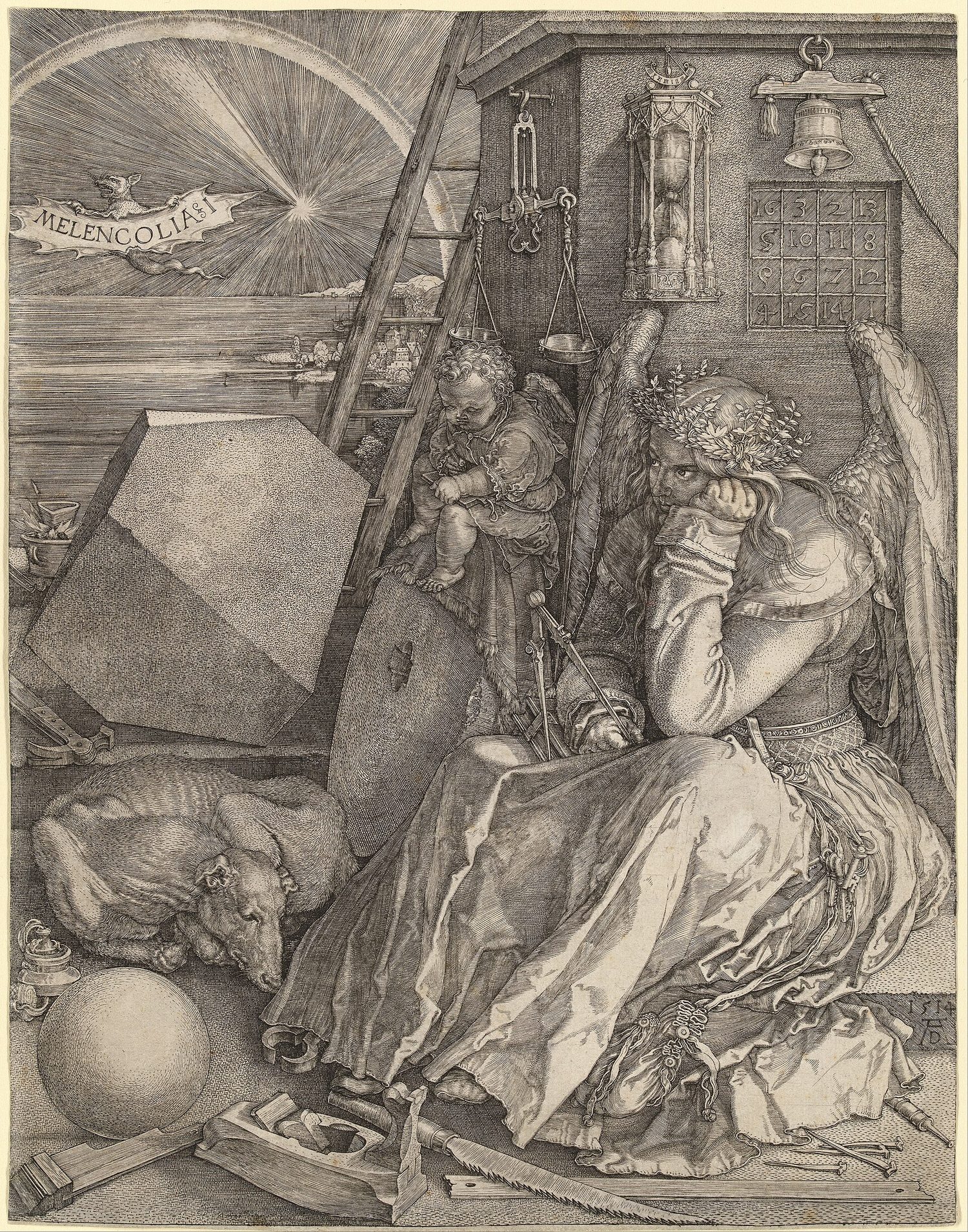
    ภาพพิมพ์เก่าที่หนาแน่นและมีรายละเอียดสูงมากของรูปทรงมีปีกนั่งอยู่ ล้อมรอบด้วยเครื่องมือและสัญลักษณ์ทั้งหมดสร้างจากเส้นแกะสลักละเอียด
    งานแกะสลักของดูเรอร์เรื่อง Melencolia I: ในเทคนิคอินตaglio เส้นจะถูกขูดเข้าไปในแผ่นโลหะ และเส้นที่ละเอียดและหนาแน่นซึ่งการแกะสลักเอื้อให้สร้างเงาที่ลึกและรายละเอียดที่อุดมสมบูรณ์
    Explore · ⁨สำรวจ⁩

    Which printmaking process? · ⁨กระบวนการพิมพ์ประเภทใด?⁩

    Relief prints from the raised surface; intaglio from lines cut below the surface; planographic from a flat greasy image; stencil pushes ink through a mesh. · ⁨พิมพ์นูน จากพื้นผิวที่ยกสูง; พิมพ์ฉลุ จากเส้นที่ตัดลึกเข้าไป; พิมพ์หิน จากภาพมันบนพื้นเรียบ; สแตนซิล ดันหมึกผ่านตาข่าย⁩

    Vocabulary · ⁨คำศัพท์⁩ Train · ⁨ฝึกฝน⁩
    English ไทย
    Printmaking/ˈprɪntmeɪkɪŋ/ งานพิมพ์
    matrix/ˈmeɪtrɪks/ เมทริกซ์
    edition/ɪˈdɪʃn/ ชุดพิมพ์
    Intaglio/ɪnˈtæɡlɪəʊ/ Intaglio
    Planographic/ˌplænəˈɡræfɪk/ พิมพ์หิน
    Stencil/ˈstensl/ Stencil
    Collage/kɒˈlɑːʒ/ คอลลาจ
    mixed media/mɪkst ˈmiːdiːə/ ผสมผสานสื่อ
    3.4

    Collage and Mixed Media · ⁨คอลลาจและสื่อผสม⁩

    Syllabus · ⁨หลักสูตร⁩
    English

    Focus: Collage assembles found materials onto a surface; mixed media combines two or more materials or processes.

    • Collage glues papers, photos, fabric, or found objects into a composition.
    • Mixed media layers, for example, drawing over paint, or print with stitching.
    • These processes add actual texture and unexpected juxtapositions of image and meaning.
    • Materials can carry meaning (a ticket, a map) beyond their visual role.
    • Good mixed-media work still uses the elements and principles to stay unified.
    ไทย

    จุดเน้น: คอลลาจคือการประกอบวัสดุที่หาได้จากภายนอก onto a surface; มิกซ์เมเดียเป็นการรวมวัสดุหรือกระบวนการตั้งแต่สองชนิดขึ้นไป

    • คอลลาจ ยึดกระดาษ, ภาพถ่าย, ผ้า, หรือวัตถุที่หาได้ เข้ากับการจัดองค์ประกอบ
    • มิกซ์เมเดีย ลงชั้น, เช่น การวาดภาพทับสี, หรือภาพพิมพ์พร้อมการเย็บ
    • กระบวนการเหล่านี้เพิ่ม พื้นผิวจริง และการ juxtapositions ที่ไม่คาดคิดของภาพและความหมาย
    • วัสดุสามารถสื่อความหมาย (บัตร, แผนที่) นอกเหนือจากบทบาททางสายตา
    • งานมิกซ์มีเดียที่ดียังคงใช้องค์ประกอบและหลักการเพื่อให้คงความเป็นหนึ่งเดียว

    Source: College Board AP Course and Exam Description · ⁨แหล่งที่มา: คำอธิบายหลักสูตรและข้อสอบ College Board AP⁩

    English

    Collage 拼贴 assembles found materials onto a surface; mixed media 综合媒介 combines two or more materials or processes.

    • Collage glues papers, photos, fabric, or found objects into a composition.
    • Mixed media layers processes — for example, drawing over paint, or print with stitching.
    • These add actual texture and unexpected meaning; a found material (a ticket, a map) can carry meaning beyond its look.
    ไทย

    คอลลาจ คือการประกอบวัสดุที่หาได้มาบนพื้นผิว; สื่อผสม คือการรวมวัสดุหรือกระบวนการตั้งแต่สองชนิดขึ้นไปเข้าด้วยกัน

    • คอลลาจใช้กาวติดกระดาษ ภาพถ่าย ผ้า หรือวัตถุที่หาได้เข้ามาเป็นส่วนหนึ่งขององค์ประกอบ
    • สื่อผสมเป็นการซ้อนชั้นกระบวนการ เช่น การวาดทับสี หรือการพิมพ์พร้อมเย็บ
    • สิ่งเหล่านี้เพิ่ม เนื้อสัมผัสจริง และความหมายที่ไม่คาดคิด; วัสดุที่หาได้มา (เช่น ตั๋ว, แผนที่) สามารถพกพาความหมายที่เกินกว่ารูปลักษณ์ของมันได้
    3.5

    Photography and Lens-Based Media · ⁨การถ่ายภาพและสื่อที่ใช้เลนส์⁩

    Syllabus · ⁨หลักสูตร⁩
    English

    Focus: Photography makes images with light and a lens; the same elements and principles apply to the frame.

    • Key controls: framing/composition, focus, exposure (light), depth of field, and viewpoint.
    • The rule of thirds, leading lines, and negative space compose a photograph.
    • Light direction and quality (hard/soft) shape value, form, and mood.
    • Editing (cropping, contrast, colour) is part of the creative process, not just correction.
    • Digital and darkroom processes both count as lens-based 2-D art and design.
    ไทย

    จุดเน้น: การถ่ายภาพสร้างภาพด้วยแสงและเลนส์; องค์ประกอบและหลักการเดียวกันนี้ยังใช้กับกรอบภาพได้

    • ปุ่มควบคุมหลัก: การจัดเฟรม/การจัดองค์ประกอบ, การโฟกัส, การเปิดรับแสง (แสง), ความลึกของ-field, และมุมมอง
    • กฎสามส่วน, เส้นนำสายตา และพื้นที่ว่าง ช่วยในการจัดองค์ประกอบภาพถ่าย
    • ทิศทางและคุณภาพของแสง (แข็ง/นุ่ม) สร้างค่าความสว่างรูปร่าง (value/form) และอารมณ์ของภาพ
    • การแก้ไข (ตัดต่อ, ความ tươngต่าง, สี) เป็นส่วนหนึ่งของกระบวนการสร้างสรรค์ ไม่ใช่แค่การแก้ไข
    • กระบวนการดิจิทัลและห้องพัฒนาฟิล์ม ล้วนถือเป็นศิลปะและการออกแบบสองมิติที่อาศัยเลนส์ 2-D

    Source: College Board AP Course and Exam Description · ⁨แหล่งที่มา: คำอธิบายหลักสูตรและข้อสอบ College Board AP⁩

    English

    Photography 摄影 makes images with light and a lens; the elements and principles apply to the frame just as in any 2-D work.

    • Key controls: framing, focus 对焦, exposure 曝光 (light), depth of field 景深, and viewpoint.
    • The rule of thirds, leading lines, and negative space compose a photograph.
    • Editing 后期 (cropping, contrast, colour) is part of the creative process, not just correction.
    ไทย

    การถ่ายภาพ สร้างภาพด้วยแสงและเลนส์; องค์ประกอบและหลักการนำไปใช้ได้กับกรอบภาพเท่ากับงานศิลปะ任何其他 2-มิติ

    ภาพถ่ายขาวดำผู้โดยสารบนเรือหนาแน่น ซึ่งถูกแบ่งด้วยทางเดินเป็นสองชั้น สร้างรูปทรงเรขาคณิตที่ชัดเจน *The Steerage ของ Alfred Stieglitz เป็นภาพถ่ายศิลปะที่มีชื่อเสียงในยุคแรก: ทางเดิน ท่อไอเสีย และบุคคลสร้างองค์ประกอบทางเรขาคณิตที่แข็งแกร่ง ดังนั้นองค์ประกอบและหลักการจึงใช้กับการถ่ายภาพได้ด้วย

    • การควบคุมหลัก: การจัดเฟรม, โฟกัส, การเปิดรับแสง (แสง), ความลึกของพื้นที่ชัด, และมุมมอง
    • กฎสามส่วน เส้นนำสายตา และพื้นที่ว่างช่วยจัดองค์ประกอบภาพถ่าย
    • การแก้ไข (ตัดต่อ, ความ tươngต่าง, สี) เป็นส่วนหนึ่งของกระบวนการสร้างสรรค์ ไม่ใช่แค่การแก้ไข
    Vocabulary · ⁨คำศัพท์⁩ Train · ⁨ฝึกฝน⁩
    English ไทย
    Photography/fəˈtɒɡrəfi/ การถ่ายภาพ
    focus/ˈfəʊkəs/ focus
    exposure/ekˈspəʊʒə/ exposure
    depth of field/depθ ɒv fiːld/ depth of field
    Editing/ˈedɪtɪŋ/ การแก้ไข
    Digital media/ˈdɪdʒɪtl ˈmiːdiːə/ สื่อดิจิทัล
    3.6

    Digital Art and Design · ⁨ศิลปะดิจิทัลและการออกแบบ⁩

    Syllabus · ⁨หลักสูตร⁩
    English

    Focus: Digital tools create and edit images on a computer or tablet, working in layers and pixels or vectors.

    • Raster images are made of pixels (photo editing, painting apps); vector images use math paths (scalable).
    • Layers let an artist build, mask, and revise non-destructively.
    • Digital colour uses RGB (screen, additive) or CMYK (print, subtractive).
    • Resolution (DPI/PPI) affects print quality; keep files high-resolution for the portfolio.
    • The same elements and principles guide digital work as any other 2-D medium.
    ไทย

    จุดเน้น: เครื่องมือดิจิทัลช่วยสร้างและแก้ไขภาพบนคอมพิวเตอร์หรือแท็บเล็ต โดยใช้ระบบเลเยอร์ พิกเซล หรือเวกเตอร์

    • ภาพ Raster สร้างจากพิกเซล (ใช้สำหรับแอปตัดต่อภาพ, วาดภาพ); ภาพ Vector ใช้เส้นโค้งทางคณิตศาสตร์ (ปรับขนาดได้ไม่เสียคุณภาพ)
    • เลเยอร์ (Layers) ช่วยให้นักสร้างสรรค์สร้าง, บังคับ, และแก้ไขงานได้อย่างปลอดภัยโดยไม่ทำลายชั้นเดิม
    • สีดิจิทัลใช้ RGB (หน้าจอ, เพิ่มแสง) หรือ CMYK (พิมพ์, ลดแสง)
    • ความละเอียด (DPI/PPI) ส่งผลต่อคุณภาพการพิมพ์; ควรเก็บไฟล์ที่มีความละเอียดสูงไว้ในพอร์ตโฟลิโอ
    • องค์ประกอบและหลักการเดียวกันนี้ยังใช้กำกับงานดิจิทัลเช่นเดียวกับสื่อ 2-D อื่นๆ

    Source: College Board AP Course and Exam Description · ⁨แหล่งที่มา: คำอธิบายหลักสูตรและข้อสอบ College Board AP⁩

    English

    Digital media 数字媒介 create and edit images on a computer or tablet, working in layers.

    • Raster 位图 images are made of pixels (photo editing, digital painting); vector 矢量 images use maths paths and scale without losing quality.
    • Layers 图层 let an artist build, mask, and revise without damaging earlier work.
    • Digital colour uses RGB (screen, additive) or CMYK (print, subtractive); keep files high-resolution 分辨率 for the portfolio.
    ไทย

    สื่อดิจิทัล สร้างและแก้ไขภาพบนคอมพิวเตอร์หรือแท็บเล็ต โดยใช้การทำงานแบบชั้น

    • ภาพเรสเตอร์ สร้างจากพิกเซล (การแก้ไขภาพ, การวาดดิจิทัล); ภาพเวกเตอร์ ใช้เส้นทางคณิตศาสตร์และปรับขนาดโดยไม่สูญเสียคุณภาพ
    • ชั้น ช่วยให้งานศิลปะสามารถสร้าง บังคับ และแก้ไขโดยไม่ต้องทำลายชิ้นงานเดิม
    • สีดิจิทัลใช้ RGB (หน้าจอ, แบบบวก) หรือ CMYK (การพิมพ์, แบบลบ); เก็บไฟล์ที่มีความละเอียดสูงสำหรับแฟ้มผลงาน

    สีแบบบวกและลบ *การผสมแสง (RGB) จะสว่างขึ้น向着สีขาว; การผสมสี.extent (CMY) จะมืดลง向着สีดำ

    3.7

    Graphic Design and Illustration · ⁨การออกแบบกราฟิกและการวาดภาพประกอบ⁩

    Syllabus · ⁨หลักสูตร⁩
    English

    Focus: Graphic design communicates a message visually; illustration makes images that support or tell a story.

    • Design combines type, image, colour, and layout to communicate to a viewer or client.
    • Visual hierarchy (size, weight, contrast, placement) guides the eye to what matters first.
    • Typography — typeface, size, spacing, alignment — is a core design element.
    • Illustration serves a purpose: editorial, book, product, poster, or narrative.
    • Design and illustration are problem-solving: audience and message shape every choice.
    ไทย

    จุดเน้น: การออกแบบกราฟิกสื่อสารข้อความผ่านภาพ; การวาดภาพ (Illustration) สร้างภาพเพื่อสนับสนุนเรื่องราวหรือบอกเล่าเรื่องราว

    • การออกแบบรวม ตัวอักษร, ภาพ, สี และการจัดวาง เพื่อสื่อสารกับผู้ชมหรือลูกค้า
    • ลำดับความสำคัญทางภาพ (Visual hierarchy) (ขนาด, น้ำหนัก, ความแตกต่าง, ตำแหน่ง) นำสายตาไปยังสิ่งที่สำคัญที่สุดก่อน
    • ตัวอักษร (Typography) — ฟอนต์, ขนาด, ระยะห่าง, การจัดแนว — เป็นองค์ประกอบการออกแบบที่สำคัญ
    • การวาดภาพมีวัตถุประสงค์: สำหรับหนังสือพิมพ์, หนังสือ, ผลิตภัณฑ์, โปสเตอร์, หรือการเล่าเรื่อง
    • การออกแบบและการสร้างภาพคือการแก้ปัญหา: ผู้ชมและข้อความกำหนดทุกการตัดสินใจ

    Source: College Board AP Course and Exam Description · ⁨แหล่งที่มา: คำอธิบายหลักสูตรและข้อสอบ College Board AP⁩

    English

    Graphic design 平面设计 communicates a message visually; illustration 插画 makes images that support or tell a story.

    • Design combines type 字体, image, colour, and layout to reach a viewer or client.
    • Visual hierarchy guides the eye to what matters first, through size, weight, and placement.
    • Typography 字体排印 — typeface, size, spacing, alignment — is a core design tool.
    • Design and illustration are problem-solving: the audience and message shape every choice.

    Worked example (writing about process). When your written evidence must explain a material and process: "I used charcoal on toned paper because its soft, smudgeable line let me build deep shadow quickly, and I lifted highlights with an eraser to suggest form." Notice the shape — name the medium, say why you chose it, and connect it to the idea you were exploring. Listing a material with no reason earns little.

    ไทย

    การออกแบบกราฟิก สื่อสารข้อความผ่านภาพ; ภาพประกอบ สร้างภาพเพื่อสนับสนุนหรือบอกเล่าเรื่องราว

    • การออกแบบรวม ตัวอักษร, ภาพ, สี และการจัดวางเพื่อเข้าถึงผู้ชมหรือลูกค้า
    • ลำดับขั้นทางภาพ นำสายตาไปยังสิ่งที่สำคัญที่สุดก่อน ผ่านขนาด น้ำหนัก และการวางตำแหน่ง
    • Typography — ตัวอักษร, ขนาด, ระยะห่าง, การจัดแนว — เป็นเครื่องมือหลักในการออกแบบ
    • การออกแบบและการวาดภาพประกอบคือ การแก้ปัญหา: ผู้ชมและข้อความกำหนดทุกการเลือก

    ตัวอย่างวิธีทำ (การเขียนเกี่ยวกับกระบวนการ). เมื่อหลักฐานการเขียนต้องอธิบาย วัสดุและกระบวนการ: "ฉันใช้ถ่านบนกระดาษสีเพราะเส้นที่นุ่มและเลอะง่ายช่วยให้ฉันสร้างเงาที่ลึกได้อย่างรวดเร็ว และฉันดึงไฮไลท์ด้วยยางลบเพื่อแสดงรูปร่าง" ระวังรูปแบบ — ชื่อบันเทิง手段, บอก ทำไม ถึงเลือกใช้มัน, และเชื่อมโยง它与 แนวคิด ที่กำลังสำรวจ การระบุวัสดุโดยไม่มีเหตุผลจะได้รับการประเมินต่ำ

    Vocabulary · ⁨คำศัพท์⁩ Train · ⁨ฝึกฝน⁩
    English ไทย
    Typography/taɪˈpɒɡrəfi/ ตัวอักษร
    3.7

    Exam tips · ⁨ข้อแนะนำสำหรับการสอบ⁩

    English
    • Match the medium to the intended effect, and justify the choice.
    • For printmaking, state relief versus intaglio, and remember the printed image reverses.
    • Explain transparent versus opaque paint, and layers and vector versus raster in digital work.
    • Treat collage and mixed media materials as meaning, not just texture.
    • In graphic design, show a clear visual hierarchy serving the message.
    ไทย
    • จับคู่ -media手段 กับผลลัพธ์ที่ต้องการ และให้เหตุผลในการเลือก
    • สำหรับ การพิมพ์, ระบุ relief เทียบกับ intaglio, และจำไว้ว่าภาพที่พิมพ์ออกมามีการกลับด้าน
    • อธิบายสี โปร่งใส เทียบกับ ทึบแสง, และ ชั้น และ vector เทียบกับ raster ในงานดิจิทัล
    • จัดการวัสดุ คอลลาจ และ สื่อผสม ว่ามีความหมาย ไม่ใช่แค่เนื้อสัมผัส
    • ในการ ออกแบบกราฟิก, แสดง ลำดับขั้นทางภาพ ที่ชัดเจนเพื่อรองรับข้อความ
    Vocabulary · ⁨คำศัพท์⁩ Train · ⁨ฝึกฝน⁩
    English ไทย
    Media/ˈmiːdiːə/ สื่อ
    Dry media/draɪ ˈmiːdiːə/ สื่อแบบแห้ง
    Wet media/wet ˈmiːdiːə/ สื่อแบบเปียก
    hatching/ˈhætʃɪŋ/ การขีดเส้นทแยงมุม
    cross-hatching/krɒs ˈhætʃɪŋ/ การขีดเส้นไขว้
    stippling/ˈstɪplɪŋ/ stippling
    tooth/tuːθ/ ความหยาบของพื้นผิว
    Relief/rɪˈliːf/ Relief
    Raster/ˈræstə/ เรสเตอร์
    vector/ˈvektə/ เวกเตอร์
    Layers/ˈleɪəz/ ชั้น
    resolution/ˌrezəˈluːʃn/ ความละเอียด
    Graphic design/ˈɡræfɪk dɪˈzaɪn/ กราฟิกดีไซน์
    illustration/ˌɪləˈstreɪʃn/ ภาพประกอบ
    type/taɪp/ ตัวอักษร
  • 4

    Investigate: Inquiry and the Artistic Process · ⁨สืบสวน: การสำรวจและกระบวนการทางศิลปะ⁩

    Watch lesson · ⁨ดูบทเรียน⁩
    4.1

    Inquiry and Asking Questions · ⁨การตั้งคำถามและการสอบถาม⁩

    Syllabus · ⁨หลักสูตร⁩
    English

    Focus: In AP Art and Design, making begins with inquiry — asking questions that guide a sustained investigation. (CED Big Idea 1)

    • Inquiry is asking questions to find information and drive investigation.
    • A sustained investigation is an in-depth, question-driven study of materials, processes, and ideas over time.
    • Questions can be simple — who, what, when, where, why, how, what if, and why not.
    • Investigation includes perception, curiosity, examination, discovery, imagination, and conversation.
    • Questions evolve: early questions lead to new questions as the work develops.
    ไทย

    จุดเน้น: ใน AP Art and Design การเริ่มต้นทำคือ การตั้งคำถาม — การตั้งคำถามที่นำไปสู่การสืบสวนอย่างต่อเนื่อง (แนวคิดหลัก CED 1)

    • Inquiry คือการตั้งคำถามเพื่อค้นหาข้อมูลและขับเคลื่อนการสืบเสาะ
    • Sustained investigation (การสืบเสาะต่อเนื่อง) เป็นการศึกษาอย่างลึกซึ้งที่ขับเคลื่อนด้วยคำถามเกี่ยวกับวัสดุ กระบวนการ และแนวคิดตลอดระยะเวลาหนึ่ง
    • คำถามอาจเรียบง่าย — ใคร, อะไร, เมื่อไหร่, ที่ไหน, ทำไม, อย่างไร, ถ้า...จะเป็นอย่างไร, และทำไมไม่...
    • การสืบเสาะรวมถึงการรับรู้ ความอยากรู้ การตรวจสอบ การค้นพบ จินตนาการ และการสนทนา
    • คำถาม พัฒนาขึ้น: คำถามต้นทางนำไปสู่คำถามใหม่ๆ เมื่อผลงานพัฒนาไป

    Source: College Board AP Course and Exam Description · ⁨แหล่งที่มา: คำอธิบายหลักสูตรและข้อสอบ College Board AP⁩

    English

    In AP Art and Design, making begins with inquiry 探究 — asking questions that guide a sustained investigation 持续探究 over time. This is Big Idea 1.

    • Inquiry is asking questions to find information and drive investigation.
    • A sustained investigation is an in-depth, question-driven study of materials, processes, and ideas.
    • Good questions can be simple — who, what, when, where, why, how, what if, and why not.
    • Questions evolve: early questions lead to new questions as the work develops.
    ไทย

    ใน AP Art and Design การเริ่มต้นคือ การตั้งคำถาม — การถามคำถามที่จะนำทาง การสืบสวนอย่างยั่งยืน ตามเวลา นี่คือ Big Idea 1

    กระบวนการสร้างสรรค์งานศิลปะเป็นวงจรของการตั้งคำถาม การสืบค้น การสร้าง และการสะท้อนคิด *การตั้งคำถามขับเคลื่อนวงจร: ถามคำถาม สืบสวน สร้าง สะท้อน — และปล่อยให้คำตอบแต่ละข้อยกคำถามใหม่ขึ้นมา

    • การตั้งคำถามคือการถามคำถามเพื่อค้นหาข้อมูลและขับเคลื่อนการสืบสวน
    • การสืบสวนอย่างยั่งยืนคือการศึกษาอย่างลึกซึ้งที่ขับเคลื่อนด้วยคำถามเกี่ยวกับวัสดุ กระบวนการ และแนวคิด
    • คำถามที่ดีอาจเรียบง่าย — ใคร, อะไร, เมื่อไหร่, ที่ไหน, ทำไม, อย่างไร, ถ้า..., และทำไมไม่
    • คำถาม พัฒนาขึ้น: คำถามต้นทางนำไปสู่คำถามใหม่ๆ เมื่อผลงานพัฒนาไป
    4.2

    Sources of Ideas and Experiences · ⁨แหล่งที่มาของแนวคิดและประสบการณ์⁩

    Syllabus · ⁨หลักสูตร⁩
    English

    Focus: Artists' and designers' experiences inform why, how, and what they make. (CED 1.A)

    • An experience is an event or occurrence — real surroundings, imagined concepts, communication, or research.
    • Reflecting on experiences sparks questions and inspires investigation.
    • Experiences can be documented with drawings, photos, diagrams, notes, or sound.
    • Ideas come from observation, memory, other disciplines, and other artists' work.
    • Recording experiences becomes a resource for the sustained investigation.
    ไทย

    Focus: ประสบการณ์ ของศิลปินและนักออกแบบเป็นปัจจัยกำหนดว่าทำไม他们ถึงสร้างสิ่งใด และอย่างไร (CED 1.A)

    • Experience (ประสบการณ์) คือเหตุการณ์หรือเหตุการณ์ที่เกิดขึ้น — สภาพแวดล้อมจริง แนวคิดในจินตนาการ การสื่อสาร หรือการวิจัย
    • การสะท้อนถึงประสบการณ์จุดประกายคำถามและแรงบันดาลใจในการสืบสวน
    • ประสบการณ์สามารถถูก บันทึก ได้ bằngภาพวาด ภาพถ่าย แผนภูมิ หมายเหตุ หรือเสียง
    • ไอเดียมาจาก การสังเกต ความทรงจำ วิชาอื่น ๆ และผลงานของศิลปินคนอื่น
    • การบันทึกประสบการณ์กลายเป็นแหล่งทรัพยากรสำหรับการสืบเสาะต่อเนื่อง

    Source: College Board AP Course and Exam Description · ⁨แหล่งที่มา: คำอธิบายหลักสูตรและข้อสอบ College Board AP⁩

    English

    Artists' and designers' experiences 经历 inform why, how, and what they make.

    • An experience is any event — real surroundings, imagined ideas, communication, or research.
    • Reflecting on experiences sparks questions and inspires investigation.
    • Ideas come from observation 观察, memory, other disciplines, and other artists' work.
    • Experiences can be documented with drawings, photos, notes, or sound, becoming a resource.
    ไทย

    ประสบการณ์ ของศิลปินและนักออกแบบ informs为什么, bagaimana, และอะไรที่พวกเขาสร้าง

    • ประสบการณ์คือเหตุการณ์ใดๆ — สภาพแวดล้อมจริง, ความคิดจินตนาการ, การสื่อสาร, หรือการวิจัย
    • การสะท้อนถึงประสบการณ์จุดประกายคำถามและแรงบันดาลใจในการสืบสวน
    • ไอเดียมาจาก การสังเกต, ความทรงจำ สาขาวิชาอื่น และผลงานของศิลปินคนอื่น
    • ประสบการณ์สามารถ บันทึก ได้ด้วยการวาดภาพ photographs, หมายเหตุ, หรือเสียง กลายเป็นทรัพยากร

    แหล่งที่มาของแนวคิดสำหรับการสืบค้นอย่างต่อเนื่อง *คำถามการสืบสวนที่แข็งแกร่งเกิดจากประสบการณ์ การสังเกต ศิลปะอื่น วัฒนธรรม Issues, และวัสดุ

    4.3

    Materials, Processes, and Ideas · ⁨วัสดุ กระบวนการ และแนวคิด⁩

    Syllabus · ⁨หลักสูตร⁩
    English

    Focus: Every work is built from three interacting components — materials, processes, and ideas. (CED 1.C)

    • Materials are what a work is made of; processes are how it is made; ideas are what it is about.
    • These components interact: a material suggests a process; a process shapes an idea.
    • Investigating materials, processes, and ideas expands the possibilities for making.
    • The components an artist chooses influence how viewers interpret the work.
    • Documenting these choices shows the thinking behind the making.
    ไทย

    Focus: ผลงานทุกชิ้นสร้างขึ้นจากสามองค์ประกอบที่เชื่อมโยงกัน — วัสดุ, กระบวนการ และไอเดีย (CED 1.C)

    • วัสดุ คือสิ่งที่งานทำ; กระบวนการ คือวิธีการสร้าง; แนวคิด คือเนื้อหา
    • องค์ประกอบเหล่านี้มีปฏิสัมพันธ์กัน: วัสดุบ่งบอกถึงกระบวนการ; กระบวนการช่วยขึ้นรูปไอเดีย
    • การสำรวจวัสดุ กระบวนการ และไอเดียจะขยายความเป็นไปได้ในการสร้างสรรค์
    • องค์ประกอบที่ศิลปินเลือกส่งผลต่อการตีความผลงานของผู้ชม
    • การบันทึกตัวเลือกเหล่านี้แสดงถึงกระบวนการคิดเบื้องหลังการสร้างงาน

    Source: College Board AP Course and Exam Description · ⁨แหล่งที่มา: คำอธิบายหลักสูตรและข้อสอบ College Board AP⁩

    English

    Every work is built from three interacting components — materials, processes, and ideas 材料、过程与想法.

    • Materials are what a work is made of; processes are how it is made; ideas are what it is about.
    • The components interact: a material suggests a process; a process shapes an idea.
    • Investigating all three expands the possibilities for making, and influences how viewers interpret the work.
    ไทย

    งานศิลปะแต่ละชิ้นสร้างขึ้นจากสามองค์ประกอบที่สัมพันธ์กัน — วัสดุ, กระบวนการ, และแนวคิด、

    • วัสดุ คือสิ่งที่งานทำ; กระบวนการ คือวิธีการสร้าง; แนวคิด คือเนื้อหา
    • องค์ประกอบเชื่อมโยงกัน: วัสดุชี้แนะกระบวนการ; กระบวนการ shaping conceptual
    • การสืบสวนทั้งสามขยายความเป็นไปได้ในการสร้างสรรค์ และส่งผลต่อการตีความงานของผู้ชม

    กลับไปยังวงล้อสีเมื่อเลือกความเข้ากันได้ของสีสำหรับชุดงาน *กลับไปใช้วงกลมสีเมื่อเลือกโทนสีสำหรับซีรีส์

    Explore · ⁨สำรวจ⁩

    Material, process, or idea? · ⁨วัสดุ กระบวนการ หรือไอเดีย?⁩

    Every work combines materials (what it is made of), processes (how it is made), and ideas (what it is about). · ⁨งานศิลปะทุกชิ้นผสมผสาน วัสดุ (สิ่งที่ทำ), กระบวนการ (วิธีทำ) และ แนวคิด (เนื้อหา)⁩

    4.4

    Art and Design in Context · ⁨ศิลปะและการออกแบบในบริบท⁩

    Syllabus · ⁨หลักสูตร⁩
    English

    Focus: Works are made and understood within contexts — traditions, cultures, and other disciplines. (CED 1.D)

    • Context is when, where, how, why, and by whom a work was made and viewed.
    • Artists work within (or challenge) art and design traditions from cultures around the world.
    • Comparing works reveals similarities and differences in materials, processes, and ideas.
    • Acknowledging references and influences shows integrity.
    • Understanding context helps both makers and viewers interpret a work.
    ไทย

    Focus: ผลงานถูกสร้างและเข้าใจภายใน บริบท — ประเพณี วัฒนธรรม และสาขาวิชาอื่น ๆ (CED 1.D)

    • Context (บริบท) คือ เวลา สถานที่ วิธีการ เหตุผล และผู้ who สร้างและชมผลงาน
    • ศิลปินทำงานภายใต้ (หรือท้าทาย) ประเพณีศิลปะและการออกแบบจากวัฒนธรรมทั่วโลก
    • การเปรียบเทียบผลงานจะเปิดเผยความคล้ายคลึงและความแตกต่างในวัสดุ กระบวนการ และแนวคิด
    • การยกย่องอ้างอิงและอิทธิพลแสดงถึง ความซื่อสัตย์ทางวิชาการ
    • การเข้าใจบริบทช่วยทั้งผู้สร้างและผู้รับชมในการตีความผลงาน

    Source: College Board AP Course and Exam Description · ⁨แหล่งที่มา: คำอธิบายหลักสูตรและข้อสอบ College Board AP⁩

    English

    Works are made and understood within a context 语境 — traditions, cultures, and other disciplines.

    • Context is when, where, how, why, and by whom a work was made and viewed.
    • Artists work within, or challenge, art and design traditions 传统 from cultures around the world.
    • Comparing works reveals similarities and differences in materials, processes, and ideas.
    • Acknowledging references and influences shows integrity 诚信 — never copying without credit.
    ไทย

    งานถูกสร้างและเข้าใจภายใน บริบท — ธรรมเนียม, วัฒนธรรม, และสาขาวิชาอื่น

    • บริบทคือเมื่อไร ที่ไหน อย่างไร ทำไม และโดยใครที่ผลงานถูกสร้างและรับชม
    • ศิลปินทำงานภายใน หรือท้าทาย ธรรมเนียม ทางศิลปะและการออกแบบจากวัฒนธรรมทั่วโลก
    • การเปรียบเทียบผลงานจะเปิดเผยความคล้ายคลึงและความแตกต่างในวัสดุ กระบวนการ และแนวคิด
    • การยอมรับการอ้างอิงและอิทธิพลแสดงถึง ความซื่อสัตย์ — ไม่มีการลอกเลียนแบบโดยไม่ให้เครดิต
    ฮอกุไซในบริบท: ผลงานประวัติศาสตร์สอนการจัดองค์ประกอบเพื่อใช้ในการสืบค้น
    ฮอกุไซในบริบท: งานประวัติศาสตร์สอนการวางองค์ประกอบสำหรับการสืบสวน
    Vocabulary · ⁨คำศัพท์⁩ Train · ⁨ฝึกฝน⁩
    English ไทย
    context/ˈkɒntekst/ บริบท
    traditions/trəˈdɪʃnz/ ประเพณี
    integrity/ɪnˈteɡrɪti/ ความถูกต้องสมบูรณ์
    evaluated/ɪˈvæljuːeɪtɪd/ ถูกประเมินแล้ว
    criteria/kraɪˈtɪərɪə/ เกณฑ์
    synthesis/ˈsɪnθəsɪs/ synthesis
    4.5

    Evaluating Art and Design · ⁨การประเมินงานศิลปะและการออกแบบ⁩

    Syllabus · ⁨หลักสูตร⁩
    English

    Focus: Works can be evaluated by using evidence to compare them with specific criteria. (CED 1.E)

    • Evaluation uses visual evidence to judge a work against criteria (as the AP scoring guidelines do).
    • Observe carefully: identify materials, processes, and ideas, and how they connect.
    • Consider whether the components show synthesis — parts working together for one effect.
    • Evaluation can be informal (as you work) or formal (peer critique, feedback).
    • Reflecting on evaluation improves later thinking and making.
    ไทย

    Focus: ผลงานสามารถ ประเมิน ได้โดยใช้หลักฐานเพื่อเปรียบเทียบกับเกณฑ์เฉพาะ (CED 1.E)

    • Evaluation (การประเมิน) ใช้หลักฐานทางสายตาในการตัดสินผลงานตามเกณฑ์ (เช่นเดียวกับแนวทางการให้คะแนน AP)
    • สังเกตอย่างละเอียด: ระบุวัสดุ กระบวนการ และไอเดีย以及如何เชื่อมโยงกัน
    • พิจารณาว่าส่วนประกอบแสดงถึง การบูรณาการ — ส่วนต่างๆ ทำงานร่วมกันเพื่อสร้างผลลัพธ์เดียวหรือไม่
    • การประเมินอาจเป็นแบบไม่เป็นทางการ (ขณะทำงาน) หรือเป็นทางการ (การวิจารณ์โดยเพื่อน, คำตอบรับ)
    • การสะท้อนคิดต่อการประเมินจะช่วยพัฒนาการคิดและการสร้างงานในอนาคต

    Source: College Board AP Course and Exam Description · ⁨แหล่งที่มา: คำอธิบายหลักสูตรและข้อสอบ College Board AP⁩

    English

    Works can be evaluated 评价 by using visual evidence to compare them with specific criteria 标准 (as the AP scoring guidelines do).

    • Observe carefully: identify the materials, processes, and ideas, and how they connect.
    • Consider whether the components show synthesis 综合 — parts working together for one effect.
    • Evaluation can be informal (as you work) or formal (a critique 评图 with peers or a teacher).
    • Reflecting on evaluation improves your later thinking and making.
    ไทย

    สามารถ ประเมิน งานโดยใช้หลักฐานทางภาพเพื่อเปรียบเทียบกับ เกณฑ์ เฉพาะ (ตามแนวทางการให้คะแนนของ AP)

    • สังเกตอย่างละเอียด: ระบุวัสดุ กระบวนการ และแนวคิด以及如何 they connect
    • พิจารณาว่าส่วนประกอบแสดงถึง การบูรณาการ — ส่วนต่างๆ ทำงานร่วมกันเพื่อสร้างผลลัพธ์เดียวหรือไม่
    • การประเมินสามารถเป็นแบบไม่เป็นทางการ (ขณะทำงาน) หรือเป็นทางการ (critique กับเพื่อนร่วมชั้นหรือครู)
    • การสะท้อนคิดเกี่ยวกับการประเมินจะช่วยพัฒนาความคิดและการสร้างสรรค์ในภายหลัง
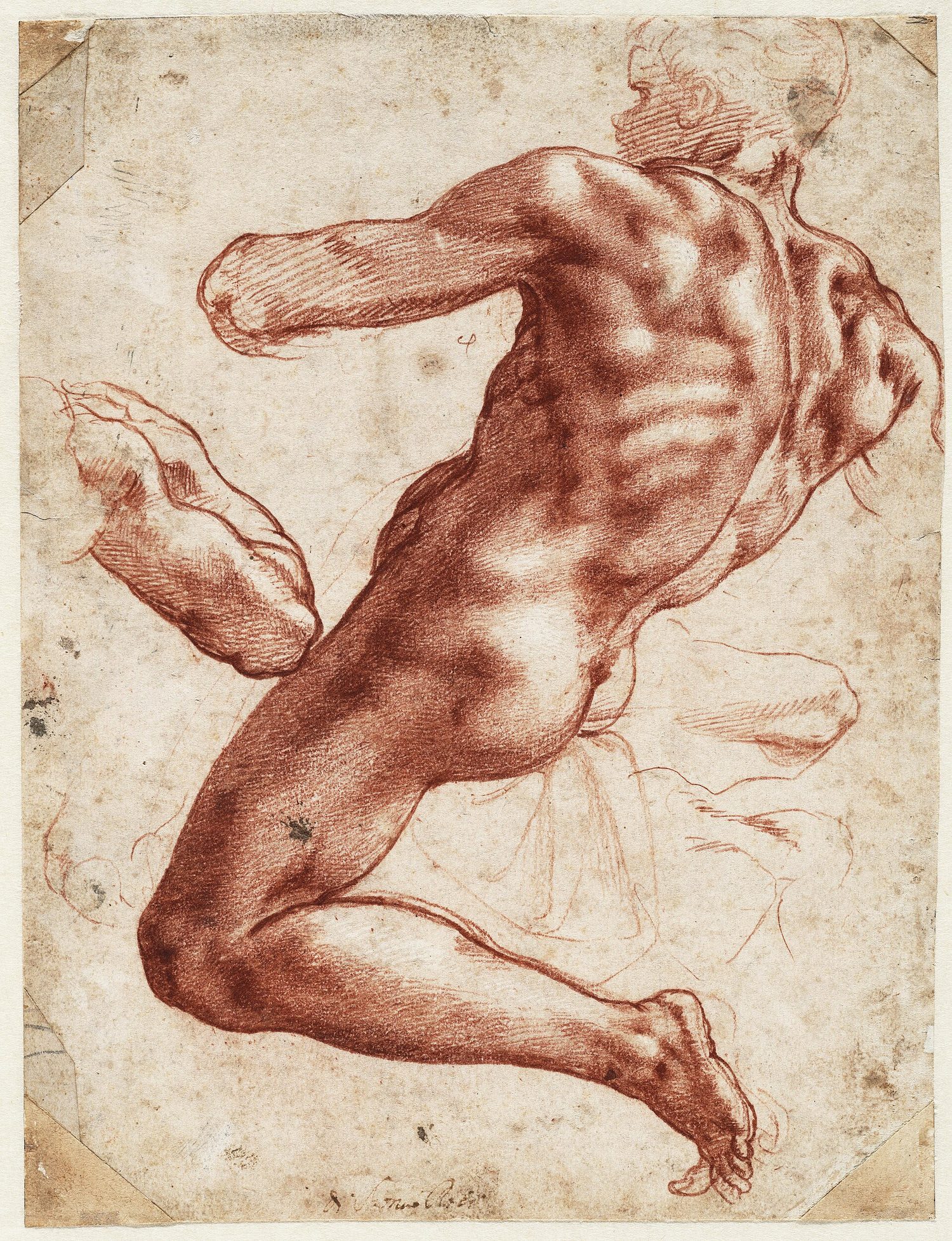
    การวิจารณ์ระบุหลักฐานทางภาพ: เส้น, โทนสี และการจัดองค์ประกอบในงานวาดชิ้นเอกของปรมาจารย์
    การวิจารณ์ระบุหลักฐานทางภาพ: เส้น, โทนสี และการจัดองค์ประกอบในงานวาดชิ้นเอกของปรมาจารย์
    Vocabulary · ⁨คำศัพท์⁩ Train · ⁨ฝึกฝน⁩
    English ไทย
    critique/krɪˈtiːk/ การวิจารณ์
    Documentation/ˌdɒkjuːmənˈteɪʃn/ การบันทึก
    4.6

    Documentation and the Process Journal · ⁨การบันทึกและสมุดบันทึกกระบวนการ⁩

    Syllabus · ⁨หลักสูตร⁩
    English

    Focus: Documentation records information and becomes a resource for the sustained investigation. (CED 1.A/1.B)

    • Documentation takes many forms: images, notes, diagrams, samples, and written reflection.
    • A process journal (sketchbook) records questions, experiments, and revisions over time.
    • Documenting your lines of inquiry shows how the investigation developed.
    • Good documentation can be shared with viewers and included as part of the work.
    • Consistent documentation makes writing the portfolio's written evidence far easier.
    ไทย

    Focus: การบันทึกข้อมูลเป็นแหล่งทรัพยากรสำหรับการสืบเสาะต่อเนื่อง (CED 1.A/1.B)

    • Documentation (การบันทึก) มีหลายรูปแบบ: ภาพ หมายเหตุ แผน ตัวอย่าง และการสะท้อนคิดเป็นลายลักษณ์อักษร
    • Process journal (sketchbook) บันทึกคำถาม การทดลอง และการแก้ไขตามเวลา
    • การบันทึก lines of inquiry ของคุณแสดงถึงการพัฒนาของการตรวจสอบ
    • การบันทึกที่ดีสามารถแชร์ให้ผู้ชมเห็นและเป็นส่วนหนึ่งของผลงานได้
    • การบันทึกที่สม่ำเสมอทำให้การเขียนหลักฐานแบบลายลักษณ์อักษรในพอร์ตโฟลิโอได้ง่ายขึ้นมาก

    Source: College Board AP Course and Exam Description · ⁨แหล่งที่มา: คำอธิบายหลักสูตรและข้อสอบ College Board AP⁩

    English

    Documentation 记录 records information and becomes a resource for the sustained investigation.

    • It takes many forms: images, notes, diagrams, material samples, and written reflection.
    • A process journal 创作日志 (sketchbook) records questions, experiments, and revisions over time.
    • Documenting your lines of inquiry 探究路径 shows how the investigation developed.
    • Consistent documentation makes writing the portfolio's written evidence far easier.

    Worked example (framing an inquiry). A weak sustained-investigation question is really just a topic: "My investigation is about the ocean." A strong one is a real question that can drive many artworks: "How can I use colour and texture to show the ocean shifting from calm to dangerous?" The question names an idea and points to the visual choices you will test — exactly what raises a portfolio's score.

    ไทย

    การบันทึก เก็บข้อมูลและเป็นแหล่งทรัพยากรสำหรับการสืบสวนอย่างต่อเนื่อง

    • มีหลากหลายรูปแบบ: ภาพ, หมายเหตุ, แผนภูมิ, ตัวอย่างวัสดุ และการสะท้อนคิดเป็นลายลักษณ์อักษร
    • Process journal (sketchbook) บันทึกคำถาม การทดลอง และการแก้ไขตามเวลา
    • การบันทึก lines of inquiry ของคุณแสดงถึงการพัฒนาของการตรวจสอบ
    • การบันทึกที่สม่ำเสมอทำให้การเขียนหลักฐานแบบลายลักษณ์อักษรในพอร์ตโฟลิโอได้ง่ายขึ้นมาก

    ตัวอย่างวิธีทำ (การจัดกรอบการตั้งคำถาม) คำถามการสืบสวนต่อเนื่องที่อ่อนแอจริง ๆ แล้วเป็นเพียงหัวข้อ: “การสืบสวนของฉันเกี่ยวกับมหาสมุทร” แต่คำถามที่แข็งแรงคือ คำถาม จริง ๆ ที่สามารถขับเคลื่อนงานศิลปะได้หลายชิ้น: “ฉันสามารถใช้สีและพื้นผิวเพื่อแสดงความเปลี่ยนแปลงของมหาสมุทรจากความสงบสู่ความอันตรายได้อย่างไร?” คำถามนี้ระบุแนวคิด และ ชี้ไปยังทางเลือกทางภาพที่คุณจะทดสอบ — ซึ่งตรงกับสิ่งที่ช่วยเพิ่มคะแนนพอร์ตโฟลิโอ

    หน้าสมุดบันทึกกระบวนการ: หมายเหตุการสืบสวนและการทดลองเล็กๆ บันทึกการพัฒนาของความคิด
    หน้าสมุดบันทึกกระบวนการ: หมายเหตุการสืบสวนและการทดลองเล็กๆ บันทึกการพัฒนาของความคิด
    Vocabulary · ⁨คำศัพท์⁩ Train · ⁨ฝึกฝน⁩
    English ไทย
    inquiry/ɪnˈkwaɪəri/ การสืบเสาะ
    sustained investigation/səˈsteɪnd ɪnˌvestɪˈɡeɪʃn/ การสืบสวนอย่างต่อเนื่อง
    experiences/ekˈspɪərɪənsɪz/ ประสบการณ์
    observation/ɒbzəˈveɪʃn/ observation
    materials, processes, and ideas/məˈtɪərɪəlz ˈprəʊsesɪz ænd aɪˈdɪəz/ วัสดุ กระบวนการ และแนวคิด
    process journal/ˈprəʊses ˈdʒɜːnl/ สมุดบันทึกกระบวนการ
    lines of inquiry/laɪnz ɒv ɪnˈkwaɪəri/ เส้นทางการสืบสวน
    4.6

    Exam tips · ⁨ข้อแนะนำสำหรับการสอบ⁩

    English
    • Frame the work with an open guiding question, not a closed yes/no one.
    • Draw on varied sources — observation, experience, research — and cite your influences.
    • Aim for synthesis: materials and processes chosen because they carry the idea.
    • Evaluate through critique using the elements and principles, then plan a revision.
    • Keep a process journal: record experiments and failures as evidence of inquiry.
    ไทย
    • จัดกรอบงานด้วย คำถามนำเปิด, ไม่ใช่คำถามปิดแบบใช่/ไม่ใช่
    • อ้างอิงจาก แหล่งที่มา ที่หลากหลาย — การสังเกต, ประสบการณ์, การวิจัย — และยกอ้างอิงอิทธิพลของคุณ
    • มุ่งมั่นสู่ การบูรณาการ: เลือกวัสดุและ กระบวนการ เพราะ они承载แนวคิด
    • ประเมินผ่าน การวิจารณ์ โดยใช้องค์ประกอบและหลักการ แล้ววางแผน การแก้ไข
    • รักษาสัมมนา กระบวนการ: บันทึกการทดลองและความล้มเหลวในฐานะหลักฐานของการสืบสวน
  • 5

    Make: Practice, Experimentation, and Revision · ⁨สร้าง: การฝึกปฏิบัติ การทดลอง และการทบทวน⁩

    Watch lesson · ⁨ดูบทเรียน⁩
    5.1

    The Sustained Investigation · ⁨การสืบสวนต่อเนื่อง⁩

    Syllabus · ⁨หลักสูตร⁩
    English

    Focus: The Sustained Investigation is a body of work exploring one question or idea in depth over time. (CED Big Idea 2)

    • A sustained investigation is guided by questions or inquiry and develops as you make.
    • It shows practice, experimentation, and revision — not a set of unrelated pieces.
    • The 2-D portfolio's Sustained Investigation section is 15 images plus written evidence.
    • A clear, focused inquiry gives the whole body of work direction and coherence.
    • The investigation can change direction as new questions emerge — and that evolution is valued.
    ไทย

    Focus: Sustained Investigation (การสืบเสาะต่อเนื่อง) คือชุดผลงานที่สำรวจคำถามหรือไอเดียใดข้อหนึ่งอย่างลึกซึ้งตลอดเวลา (CED Big Idea 2)

    • การสืบสวนต่อเนื่องถูก นำโดยคำถามหรือการสืบสวน และพัฒนาขึ้นเมื่อคุณสร้างสรรค์งาน
    • แสดงให้เห็นถึง การฝึกฝน, การทดลอง และการแก้ไข — ไม่ใช่ชุดชิ้นงานที่ไม่เกี่ยวข้องกัน
    • ส่วนการสืบสวนต่อเนื่องของพอร์ตโฟลิโอ 2 มิติประกอบด้วย 15 ภาพ บวกกับหลักฐานแบบลายลักษณ์อักษร
    • Inquiry ที่ชัดเจนและมีจุดมุ่งหมายจะมอบทิศทางและความสอดคล้องให้กับชุดผลงานทั้งหมด
    • การสืบเสาะสามารถเปลี่ยนทิศทางเมื่อมีคำถามใหม่เกิดขึ้น — และการเปลี่ยนแปลงนี้ได้รับการยอมรับ

    Source: College Board AP Course and Exam Description · ⁨แหล่งที่มา: คำอธิบายหลักสูตรและข้อสอบ College Board AP⁩

    English

    Big Idea 2 is about making. Its heart is the Sustained Investigation 持续探究 — a body of work that explores one question or idea in depth over time.

    • A sustained investigation is guided by questions or inquiry and develops as you make.
    • It shows practice, experimentation, and revision — not a set of unrelated pieces.
    • The 2-D portfolio's Sustained Investigation section is 15 images plus written evidence.
    • A clear, focused inquiry gives the whole body of work direction and coherence 连贯性.
    ไทย

    แนวคิดใหญ่ข้อ 2 เกี่ยวกับการ สร้างสรรค์ หัวใจสำคัญคือ การสืบสวนต่อเนื่อง — ชุดงานที่สำรวจคำถามหรือแนวคิดหนึ่งอย่างลึกซึ้งตลอดเวลา

    • การสืบสวนต่อเนื่องถูก นำโดยคำถามหรือการสืบสวน และพัฒนาขึ้นเมื่อคุณสร้างสรรค์งาน
    • แสดงให้เห็นถึง การฝึกฝน, การทดลอง และการแก้ไข — ไม่ใช่ชุดชิ้นงานที่ไม่เกี่ยวข้องกัน
    • ส่วนการสืบสวนต่อเนื่องของพอร์ตโฟลิโอ 2 มิติประกอบด้วย 15 ภาพ บวกกับหลักฐานแบบลายลักษณ์อักษร
    • การสืบสวนที่ชัดเจนและมีจุดมุ่งหมายช่วยให้ชุดงานทั้งหมดมีทิศทางและความ สอดคล้องกัน
    5.2

    Practice, Experimentation, and Revision · ⁨การฝึกฝน, การทดลอง และการแก้ไข⁩

    Syllabus · ⁨หลักสูตร⁩
    English

    Focus: Making advances through three linked actions — practice, experimentation, and revision. (CED 2.B)

    • Practice is repeated work to build skill and understanding.
    • Experimentation tries new materials, processes, and ideas to discover possibilities.
    • Revision changes a work based on reflection, feedback, or new questions.
    • These actions are shown across the body of work, not just in one final piece.
    • Evidence of experimentation and revision is exactly what the AP readers look for.
    ไทย

    Focus: การก้าวหน้าผ่านการกระทำสามอย่างที่เกี่ยวข้องกัน — การฝึกฝน, การทดลอง และการปรับปรุงแก้ไข (CED 2.B)

    • การฝึกฝน (Practice) คือการทำงานซ้ำๆ เพื่อสร้างทักษะและความเข้าใจ
    • การทดลอง ลองใช้วัสดุ, กระบวนการ และแนวคิดใหม่เพื่อค้นพบความเป็นไปได้
    • การปรับปรุง (Revision) เปลี่ยนแปลงชิ้นงานโดยอ้างอิงจากการสะท้อนคิด คำติชม หรือคำถามใหม่
    • การกระทำเหล่านี้ปรากฏAcross ชุดผลงาน ไม่ใช่แค่ในชิ้นสุดท้ายเท่านั้น
    • หลักฐานของการทดลองและการปรับปรุงแก้ไขคือสิ่งที่นักอ่าน AP มองหา

    Source: College Board AP Course and Exam Description · ⁨แหล่งที่มา: คำอธิบายหลักสูตรและข้อสอบ College Board AP⁩

    English

    Making advances through three linked actions.

    • Practice 练习 is repeated work to build skill and understanding.
    • Experimentation 实验 tries new materials, processes, and ideas to discover possibilities.
    • Revision 修改 changes a work based on reflection, feedback, or new questions.
    • These are shown across the body of work, not just in one final piece. Evidence of experimentation and revision is exactly what the AP readers look for.
    ไทย

    การสร้างผลงานให้ก้าวหน้าผ่านสามการกระทำที่เชื่อมโยงกัน

    การสร้างผลงานให้ก้าวหน้าด้วยการฝึกฝน, ทดลอง และแก้ไขตลอดเวลา *การฝึกฝนสร้างความชำนาญ, การทดลองพยายามความเป็นไปได้ใหม่ และการแก้ไขปรับปรุงงาน — ทำซ้ำ across整个作品集

    • การฝึกฝน (Practice) คือการทำงานซ้ำๆ เพื่อสร้างทักษะและความเข้าใจ
    • การทดลอง ลองใช้วัสดุ, กระบวนการ และแนวคิดใหม่เพื่อค้นพบความเป็นไปได้
    • การปรับปรุง (Revision) เปลี่ยนแปลงชิ้นงานโดยอ้างอิงจากการสะท้อนคิด คำติชม หรือคำถามใหม่
    • สิ่งเหล่านี้แสดงออก ** Across整个作品集**, ไม่ใช่แค่ในชิ้นงานสุดท้าย หลักฐานของการทดลองและการแก้ไขคือสิ่งที่ผู้พิจารณาของ APมองหา
    การศึกษาชิ้นเอก: การฝึกฝน, การทดลอง และการแก้ไขคือวิธีสะสมทักษะ 2 มิติตลอดเวลา
    การศึกษาชิ้นเอก: การฝึกฝน, การทดลอง และการแก้ไขคือวิธีสะสมทักษะ 2 มิติตลอดเวลา
    Explore · ⁨สำรวจ⁩

    Practice, experiment, or revise? · ⁨ฝึกฝน ทดลอง หรือทบทวน?⁩

    Practice is repeated work to build skill; experimentation tries new materials or ideas; revision changes a work after reflection or feedback. · ⁨ฝึกฝน คือการทำงานซ้ำเพื่อสร้างทักษะ; การทดลอง พยายามวัสดุหรือแนวคิดใหม่; การปรับปรุง เปลี่ยนแปลงงานหลังจากการคิดวิเคราะห์หรือรับคำติชม⁩

    Vocabulary · ⁨คำศัพท์⁩ Train · ⁨ฝึกฝน⁩
    English ไทย
    Sustained Investigation/səˈsteɪnd ɪnˌvestɪˈɡeɪʃn/ การสืบเสาะอย่างต่อเนื่อง
    coherence/kəʊˈhɪərəns/ coherence
    Practice/ˈpræktɪs/ ฝึกฝน
    Experimentation/ekˌsperɪmənˈteɪʃn/ การทดลอง
    Revision/rɪˈvɪʒn/ การทบทวน
    synthesis/ˈsɪnθəsɪs/ synthesis
    2-D skills/tuː diː skɪlz/ ทักษะ 2-D
    Selected Works/sɪˈlektɪd wɜːks/ ผลงานที่เลือก
    Craft/kræft/ ฝีมือ
    Craftsmanship/ˈkræftsmənʃɪp/ ความชำนาญ
    developing/dɪˈveləpɪŋ/ กำลังพัฒนา
    5.3

    Synthesis of Materials, Processes, and Ideas · ⁨การบูรณาการวัสดุ, กระบวนการ และแนวคิด⁩

    Syllabus · ⁨หลักสูตร⁩
    English

    Focus: Strong works show synthesis — materials, processes, and ideas integrated so the whole is more than its parts. (CED 2.C)

    • Synthesis means the components combine (coalesce) to create a unified effect.
    • The choice of material should support the idea; the process should serve both.
    • When components are integrated, viewers read one clear message rather than separate parts.
    • Synthesis develops through investigation — trying combinations and keeping what works.
    • The relationships among components are what evaluation and scoring examine.
    ไทย

    Focus: ผลงานที่มีคุณภาพสูงแสดงถึง Synthesis (การสังเคราะห์) — วัสดุ กระบวนการ และไอเดียที่รวมเข้าด้วยกันจนส่วนรวมมีคุณค่ามากกว่าส่วนย่อย (CED 2.C)

    • Synthesis (การสังเคราะห์) หมายถึงองค์ประกอบที่ผสานรวมกัน (coalesce) เพื่อสร้างผลลัพธ์ที่เป็นเอกภาพ
    • การเลือกวัสดุควรสนับสนุนไอเดีย; กระบวนการควรให้บริการต่อทั้งสองอย่าง
    • เมื่อส่วนประกอบถูกรวมเข้าด้วยกัน ผู้ชมจะอ่านข้อความที่ชัดเจนแทนที่จะเห็นส่วนแยกต่างหาก
    • การสังเคราะห์พัฒนาขึ้นผ่านการสืบสวน — การลองผสมผสานและเก็บรักษาสิ่งที่ทำงานได้ดี
    • ความสัมพันธ์ระหว่างองค์ประกอบคือสิ่งที่การประเมินและให้คะแนนพิจารณา

    Source: College Board AP Course and Exam Description · ⁨แหล่งที่มา: คำอธิบายหลักสูตรและข้อสอบ College Board AP⁩

    English

    Strong works show synthesis 综合 — materials, processes, and ideas integrated so the whole is more than its parts.

    • Synthesis means the components combine to create a unified effect.
    • The chosen material should support the idea; the process should serve both.
    • When components are integrated, viewers read one clear message rather than separate parts.
    • Synthesis develops through investigation — trying combinations and keeping what works.
    ไทย

    งานที่แข็งแกร่งแสดงถึง การบูรณาการ — วัสดุ, กระบวนการ และแนวคิดที่รวมเข้าด้วยกันจนส่วนรวมมีคุณค่ามากกว่าผลรวมของส่วนย่อย

    • การบูรณาการหมายความว่าส่วนประกอบผสมผสานกันเพื่อสร้างผลลัพธ์ที่เป็นอันหนึ่งอันเดียวกัน
    • วัสดุที่เลือกควรสนับสนุนไอเดีย และกระบวนการควรบริการทั้งสองอย่าง
    • เมื่อส่วนประกอบถูกรวมเข้าด้วยกัน ผู้ชมจะอ่านข้อความที่ชัดเจนแทนที่จะเห็นส่วนแยกต่างหาก
    • การสังเคราะห์พัฒนาขึ้นผ่านการสืบสวน — การลองผสมผสานและเก็บรักษาสิ่งที่ทำงานได้ดี
    5.4

    Demonstrating 2-D Skills · ⁨การแสดงทักษะ 2 มิติ⁩

    Syllabus · ⁨หลักสูตร⁩
    English

    Focus: The portfolio must show 2-D skills — the elements and principles used to organise a two-dimensional surface. (CED 2.D)

    • 2-D skills are the use of the elements of art and principles of design on a flat surface.
    • Skilful work shows control of value, colour, composition, and mark-making.
    • Skills are demonstrated across many works, in a range of materials and processes.
    • The Selected Works section (5 works) is where 2-D skills are judged most directly.
    • Skill is shown by decisions that are clear, purposeful, and support the idea.
    ไทย

    Focus: Portfoliol ต้องแสดงถึง 2-D skills (ทักษะ 2 มิติ) — องค์ประกอบและหลักการที่ใช้จัดระเบียบพื้นผิวสองมิติ (CED 2.D)

    • ทักษะ 2-D คือการใช้องค์ประกอบศิลปะและหลักการออกแบบบนพื้นผิวสองมิติ
    • งานที่ชำนาญแสดงถึงการควบคุมค่าสี สี การจัดองค์ประกอบ และการทำเครื่องหมาย
    • ทักษะแสดงออก Across หลายผลงาน ในหลากหลายวัสดุและกระบวนการ
    • ส่วน งานที่คัดเลือก (5 ชิ้น) เป็นสถานที่ที่ทักษะ 2 มิติถูกตัดสินโดยตรงที่สุด
    • ทักษะแสดงออกจากการตัดสินใจที่ชัดเจน มีวัตถุประสงค์ และสนับสนุนไอเดีย

    Source: College Board AP Course and Exam Description · ⁨แหล่งที่มา: คำอธิบายหลักสูตรและข้อสอบ College Board AP⁩

    English

    The portfolio must show 2-D skills 二维技能 — the elements and principles used to organise a flat surface.

    • 2-D skills are the skilful use of line, shape, value, colour, texture, space, and the principles of design.
    • Skilful work shows control of value, colour, composition, and mark-making.
    • Skills are demonstrated across many works, in a range of materials and processes.
    • The Selected Works 精选作品 section is where 2-D skills are judged most directly.
    ไทย

    พอร์ตโฟลิโอต้องแสดง ทักษะ 2 มิติ — องค์ประกอบและหลักการที่ใช้ในการจัดระเบียบพื้นผิวเรียบ

    • ทักษะ 2 มิติคือการใช้งานเส้น, รูปร่าง, ค่าความสว่าง, สี, พื้นผิว, พื้นที่ และหลักการออกแบบอย่างเชี่ยวชาญ
    • งานที่ชำนาญแสดงถึงการควบคุมค่าสี สี การจัดองค์ประกอบ และการทำเครื่องหมาย
    • ทักษะแสดงให้เห็น Across多个作品, ในหลากหลายวัสดุและกระบวนการ
    • ส่วน งานที่เลือก เป็นส่วนที่ตัดสินทักษะ 2 มิติโดยตรงที่สุด
    Starry Night ของ Van Gogh: เส้น, สี และจังหวะที่สื่ออารมณ์ในฐานะทักษะ 2 มิติ
    Starry Night ของ Van Gogh: เส้น, สี และจังหวะที่สื่ออารมณ์ในฐานะทักษะ 2 มิติ
    5.5

    Composition and Craft in Making · ⁨การจัดองค์ประกอบและฝีมือในการสร้างสรรค์⁩

    Syllabus · ⁨หลักสูตร⁩
    English

    Focus: Craft is the quality of making; composition is the arrangement of the work — both communicate care and intent.

    • Craftsmanship is the skilful, controlled handling of materials and processes.
    • Composition applies the principles of design to organise the picture plane.
    • Purposeful decisions about surface, edges, and finish strengthen a work.
    • Craft should serve the idea — sometimes rough or raw handling is the right choice.
    • Consistent quality across the body of work signals a developed artist.
    ไทย

    Focus: Craft (ความประณีต) คือคุณภาพของการสร้าง; Composition (การจัดองค์ประกอบ) คือการจัดวางของงาน — ทั้งคู่สื่อถึงความใส่ใจและเจตนารมณ์

    • ฝีมือการผลิต คือการจัดการวัสดุและกระบวนการอย่างเชี่ยวชาญและควบคุมได้
    • Composition (การจัดองค์ประกอบ) ใช้หลักการออกแบบเพื่อจัดระเบียบระนาบภาพ
    • การตัดสินใจอย่างมีวัตถุประสงค์เกี่ยวกับพื้นผิว ขอบ และพื้นผิวเสริมสร้างผลงาน
    • Craft ควร服务于ไอเดีย — บางครั้งการจับต้องแบบหยาบหรือดิบก็เป็นการเลือกที่เหมาะสม
    • คุณภาพที่สม่ำเสมอตลอดผลงานแสดงถึงศิลปินที่มีความเจริญเติบโต

    Source: College Board AP Course and Exam Description · ⁨แหล่งที่มา: คำอธิบายหลักสูตรและข้อสอบ College Board AP⁩

    English

    Craft 工艺 is the quality of making; composition is the arrangement of the work — both communicate care and intent.

    • Craftsmanship 匠艺 is the skilful, controlled handling of materials and processes.
    • Composition applies the principles of design to organise the picture plane.
    • Craft should serve the idea — sometimes a rough or raw handling is the right choice.
    • Consistent quality across the body of work signals a developed artist.
    ไทย

    ฝีมือ คือคุณภาพของการสร้างสรรค์; การจัดองค์ประกอบ คือการเรียงลำดับของงาน — ทั้งสองสื่อสารถึงความใส่ใจและเจตนา

    • ฝีมือการผลิต คือการจัดการวัสดุและกระบวนการอย่างเชี่ยวชาญและควบคุมได้
    • การจัดองค์ประกอบใช้หลักการออกแบบเพื่อจัดระเบียบพื้นภาพ
    • ฝีมือควรสนับสนุนแนวคิด — บางครั้งการใช้มือที่หยาบหรือดิบก็เป็นการเลือกที่เหมาะสม
    • คุณภาพที่สม่ำเสมอตลอดผลงานแสดงถึงศิลปินที่มีความเจริญเติบโต
    Great Wave ของ Hokusai: การจัดองค์ประกอบและฝีมือชี้นำสายตาข้ามระนาบภาพ
    Great Wave ของ Hokusai: การจัดองค์ประกอบและฝีมือชี้นำสายตาข้ามระนาบภาพ
    5.6

    Developing Ideas Over Time · ⁨การพัฒนาแนวคิดตลอดเวลา⁩

    Syllabus · ⁨หลักสูตร⁩
    English

    Focus: A sustained investigation shows ideas developing — growing and changing across the body of work. (CED 2.B)

    • Development is visible when later works build on discoveries in earlier ones.
    • New questions, materials, or processes push the investigation forward.
    • Not every experiment succeeds — evidence of what did not work is still valuable.
    • Documenting the sequence shows the readers a genuine journey of inquiry.
    • A body of work with clear development scores higher than a set of finished-but-static pieces.
    ไทย

    Focus: การสืบเสาะต่อเนื่องแสดงให้เห็นว่าไอเดียกำลัง developing (พัฒนา) — เติบโตและเปลี่ยนแปลง Across ชุดผลงาน (CED 2.B)

    • การพัฒนาจะเห็นได้เมื่อผลงานหลังสร้างบนค้นพบจากผลงานก่อนหน้า
    • คำถามใหม่ วัสดุ หรือกระบวนการ mới是推动การสืบสวนไปข้างหน้า
    • ไม่ทุกการทดลองประสบความสำเร็จ — หลักฐานของสิ่งที่ล้มเหลวก็ยังมีค่า
    • การลำดับขั้นตอนเป็นการบันทึกแสดงให้นักอ่านเห็นการเดินทางของการสืบเสาะที่แท้จริง
    • ชุดงานที่มีการพัฒนาที่ชัดเจนได้คะแนนสูงกว่าชุดชิ้นงานที่เสร็จสมบูรณ์แต่นิ่ง不動

    Source: College Board AP Course and Exam Description · ⁨แหล่งที่มา: คำอธิบายหลักสูตรและข้อสอบ College Board AP⁩

    English

    A sustained investigation shows ideas developing 发展 — growing and changing across the body of work.

    • Development is visible when later works build on discoveries in earlier ones.
    • New questions, materials, or processes push the investigation forward.
    • Not every experiment succeeds — evidence of what did not work is still valuable.
    • A body of work with clear development scores higher than a set of finished-but-static pieces.

    Worked example (showing development). The Sustained Investigation is scored on evidence of thinking, not just finished pieces: "My first three works used flat colour; after seeing they felt lifeless, I experimented with layered glazes in works 4–6, then in works 7–9 I combined the best of both." Describing a change and the reason for it is how you demonstrate practice, experimentation, and revision.

    ไทย

    การสืบสวนต่อเนื่องแสดงให้เห็นแนวคิด กำลังพัฒนา — เติบโตและเปลี่ยนแปลง Across整个作品集

    • การพัฒนาจะเห็นได้เมื่อผลงานหลังสร้างบนค้นพบจากผลงานก่อนหน้า
    • คำถามใหม่ วัสดุ หรือกระบวนการ mới是推动การสืบสวนไปข้างหน้า
    • ไม่ทุกการทดลองจะสำเร็จ — หลักฐานของสิ่งที่ not works ก็ยังมีค่า
    • ชุดงานที่มีการพัฒนาที่ชัดเจนได้คะแนนสูงกว่าชุดชิ้นงานที่เสร็จสมบูรณ์แต่นิ่ง不動

    การสืบสวนต่อเนื่องลึกซึ้งขึ้นเมื่องานพัฒนา *การสำรวจเบื้องต้นถูกแทนที่ด้วยการทดลองและการแก้ไข จากนั้นคือการบูรณาการ — การคิดลึกซึ้งขึ้นอย่างเห็นได้ชัด Across整个作品集

    ตัวอย่างวิธีทำ (แสดงการพัฒนา) การสืบสวนต่อเนื่อง đượcให้คะแนนบน หลักฐานของการคิด, ไม่ใช่แค่ชิ้นงานที่เสร็จสมบูรณ์: “สามชิ้นแรกของฉันใช้สีแบน; หลังจากเห็นว่ามันดูไร้ชีวิตชีวา ฉันจึงทดลองใช้การทาสีชั้นซ้อนในชิ้นที่ 4-6, แล้วในชิ้นที่ 7-9 ฉันรวมสิ่งที่ดีที่สุดของทั้งสอง” การอธิบายการเปลี่ยนแปลง และ เหตุผลเบื้องหลังมันคือวิธีที่คุณแสดงถึงการฝึกฝน, การทดลอง และการแก้ไข

    5.6

    Exam tips · ⁨ข้อแนะนำสำหรับการสอบ⁩

    English
    • Build the sustained investigation as a connected body of work, not one-offs.
    • Show practice, experimentation, and revision — a documented failure still earns credit.
    • Push synthesis and clear 2-D skills, and keep craft clean to the edges.
    • Let each work develop from the last, raising the next question.
    • Choose materials and processes that embody the guiding question.
    ไทย
    • สร้างงาน การสืบเสาะอย่างต่อเนื่อง ให้เป็นชุดผลงานที่เชื่อมโยงกัน ไม่ใช่การทำงานแบบแยกส่วน
    • แสดงให้เห็นถึง การฝึกฝน การทดลอง และการแก้ไข — แม้ความล้มเหลวที่ยังบันทึกไว้ก็ยังคงได้รับคะแนน
    • เน้นการ สังเคราะห์ และทักษะ 2-D ที่ชัดเจน รวมถึงรักษา ฝีมือ ให้เรียบร้อยและคมชัดตามขอบ
    • ให้แต่ละชิ้นงาน พัฒนาต่อยอด จากชิ้นก่อนหน้า โดยตั้งคำถามใหม่ในขั้นตอนถัดไป
    • เลือกวัสดุและกระบวนการที่สะท้อนถึง คำถามนำทาง ของคุณ
  • 6

    Present: Communication and the AP Portfolio · ⁨นำเสนอ: การสื่อสารและพอร์ตโฟลิโอ AP⁩

    Watch lesson · ⁨ดูบทเรียน⁩
    6.1

    The AP 2-D Art and Design Portfolio · ⁨แฟ้มสะสมผลงาน AP 2-D Art and Design⁩

    Syllabus · ⁨หลักสูตร⁩
    English

    Focus: The AP exam is a portfolio, not a written test. It has two sections that are submitted digitally. (CED Big Idea 3)

    • The Sustained Investigation section: 15 images showing inquiry, practice, experimentation, and revision, plus written evidence.
    • The Selected Works section: 5 works that best show your 2-D skills and synthesis, with written information.
    • Works may be physical or digital, but all are submitted as digital images (and short video where relevant).
    • There is no written exam and no timed section — the portfolio is built across the whole course.
    • Both sections are scored against the College Board scoring guidelines.
    ไทย

    Focus: การสอบ AP เป็น portfolio (พอร์ตโฟลิโอ) ไม่ใช่การสอบเขียน มีสองส่วนที่ส่งผ่านระบบดิจิทัล (CED Big Idea 3)

    • ส่วน การสืบเสาะอย่างต่อเนื่อง: 15 ภาพ ที่แสดงถึงการสืบเสาะ การฝึกฝน การทดลอง และการแก้ไข พร้อมหลักฐานเชิงข้อความ
    • ส่วน Selected Works (ผลงานที่เลือก): 5 ชิ้น ที่แสดงทักษะ 2 มิติและการสังเคราะห์ของคุณดีที่สุด พร้อมข้อมูลเชิงข้อความ
    • ผลงานอาจเป็นงานจริงหรืองานดิจิทัล แต่ทั้งหมดส่งเป็น digital images (ภาพดิจิทัล) (และวิดีโอสั้นหากเกี่ยวข้อง)
    • ไม่มีการสอบเขียนและไม่มีส่วนที่กำหนดเวลา — พอร์ตโฟลิโอถูกสร้างAcross整个 course
    • ทั้งสองส่วนให้คะแนนตาม scoring guidelines (แนวทางการให้คะแนน) ของ College Board

    Source: College Board AP Course and Exam Description · ⁨แหล่งที่มา: คำอธิบายหลักสูตรและข้อสอบ College Board AP⁩

    English

    Big Idea 3 is about presenting your work. The AP exam is a portfolio 作品集 — not a written test. It has two sections, both submitted digitally.

    • The Sustained Investigation 持续探究 section: 15 images showing inquiry, practice, experimentation, and revision, plus written evidence.
    • The Selected Works 精选作品 section: 5 works that best show your 2-D skills, with written information.
    • Works may be physical or digital, but all are submitted as digital images. There is no timed exam — the portfolio is built across the whole course.
    ไทย

    แนวคิดหลักข้อ 3 เกี่ยวกับการ นำเสนอ ผลงานของคุณ การสอบ AP เป็น แฟ้มสะสมผลงาน — ไม่ใช่ข้อเขียน มี สองส่วน ทั้งคู่ส่งผ่านระบบดิจิทัล

    แฟ้มสะสมผลงาน 2-D มีสองส่วน: การสืบเสาะอย่างต่อเนื่องจำนวน 15 ภาพ และผลงานที่เลือกมา 5 ชิ้น
    แฟ้มสะสมผลงานประกอบด้วย การสืบเสาะอย่างต่อเนื่องจำนวน 15 ภาพ และผลงานที่เลือกมา 5 ชิ้น ส่งเป็นไฟล์ภาพดิจิทัล
    • ส่วน การสืบเสาะอย่างต่อเนื่อง: 15 ภาพ ที่แสดงถึงการสืบเสาะ การฝึกฝน การทดลอง และการแก้ไข พร้อมหลักฐานเชิงข้อความ
    • ส่วน ผลงานที่เลือกมา: 5 ชิ้น ที่แสดงทักษะ 2-D ที่ดีที่สุดของคุณ พร้อมข้อมูลเชิงข้อความ
    • ผลงานอาจเป็นงานจริงหรืองานดิจิทัล แต่ทั้งหมดต้องส่งเป็น ไฟล์ภาพดิจิทัล ไม่มีข้อสอบกำหนดเวลา — แฟ้มสะสมผลงานสร้างได้ตลอดทั้งหลักสูตร
    องค์ประกอบทั้งสองของแฟ้มสะสมผลงาน AP 2-D Art and Design
    การสืบเสาะอย่างต่อเนื่อง (15 ภาพ พร้อมหลักฐานเชิงข้อความ) มีน้ำหนักมากกว่า ผลงานที่เลือกมา (5 ชิ้น)
    Vocabulary · ⁨คำศัพท์⁩ Train · ⁨ฝึกฝน⁩
    English ไทย
    portfolio/pɔːtˈfəʊlɪəʊ/ พอร์ตโฟลิโอ
    Sustained Investigation/səˈsteɪnd ɪnˌvestɪˈɡeɪʃn/ การสืบเสาะอย่างต่อเนื่อง
    6.2

    Sustained Investigation: Images and Written Evidence · ⁨การสืบเสาะอย่างต่อเนื่อง: ภาพและหลักฐานเชิงข้อความ⁩

    Syllabus · ⁨หลักสูตร⁩
    English

    Focus: The Sustained Investigation is judged on the inquiry and the practice, experimentation, and revision it shows. (CED 3.A/3.B)

    • Submit 15 images — works and process documentation that show the investigation over time.
    • Provide written evidence: identify the questions that guided the investigation, and describe how the work shows practice, experimentation, and revision.
    • Images should tell the story of the inquiry, not just show finished pieces.
    • Detail images and in-progress shots are allowed and often helpful.
    • Clear writing (within the character limit) makes the investigation easy to follow.
    ไทย

    Focus: การสืบเสาะต่อเนื่องถูกประเมินตาม inquiry (การสืบเสาะ) และ practice, experimentation, and revision (การฝึกฝน, การทดลอง, และการปรับปรุงแก้ไข) ที่แสดงออกมา (CED 3.A/3.B)

    • ส่ง 15 ภาพ — ทั้งผลงานและเอกสาร documenting กระบวนการ ที่แสดงการสืบเสาะตามช่วงเวลาต่างๆ
    • ให้ written evidence (หลักฐานเชิงข้อความ): ระบุคำถามที่นำทางการสืบเสาะ และอธิบายว่าผลงานแสดงถึงการฝึกฝน, การทดลอง, และการปรับปรุงแก้ไขอย่างไร
    • ภาพควรเล่าเรื่องราวของการสืบเสาะหาความรู้ ไม่ใช่แค่แสดงผลงานที่เสร็จสมบูรณ์
    • สามารถใช้ภาพรายละเอียดและภาพระหว่างทำได้ ซึ่งมักจะเป็นประโยชน์
    • การเขียนที่ชัดเจน (ตามจำนวนตัวอักษรที่กำหนด) ทำให้การติดตามการวิจัยทำได้ง่ายขึ้น

    Source: College Board AP Course and Exam Description · ⁨แหล่งที่มา: คำอธิบายหลักสูตรและข้อสอบ College Board AP⁩

    English

    The Sustained Investigation is judged on the inquiry and the practice, experimentation, and revision it shows.

    • Submit 15 images — works and process documentation that show the investigation over time.
    • Provide written evidence 书面材料: identify the guiding questions 引导性问题, and describe how the work shows practice, experimentation, and revision.
    • Images should tell the story of the inquiry, not just show finished pieces. Detail and in-progress shots are allowed.
    ไทย

    การสืบเสาะอย่างต่อเนื่องจะได้รับการประเมินจาก การสืบเสาะ และ การฝึกฝน การทดลอง และการแก้ไข ที่ปรากฏ

    • ส่ง 15 ภาพ — ทั้งผลงานและเอกสาร documenting กระบวนการ ที่แสดงการสืบเสาะตามช่วงเวลาต่างๆ
    • จัดหา หลักฐานเชิงข้อความ: ระบุ คำถามนำทาง และอธิบายว่าผลงานแสดงถึงการฝึกฝน การทดลอง และการแก้ไขอย่างไร
    • ภาพควรเล่าเรื่องราวของการสืบเสาะ ไม่ใช่แค่แสดงผลงานสำเร็จรูป สามารถใช้รายละเอียดและภาพระหว่างทำได้
    6.3

    Selected Works: Demonstrating Skills · ⁨ผลงานที่เลือกมา: แสดงทักษะ⁩

    Syllabus · ⁨หลักสูตร⁩
    English

    Focus: The Selected Works section shows your best evidence of 2-D skills and synthesis of materials, processes, and ideas. (CED 3.D/3.E)

    • Submit 5 works (physical or digital) as high-quality images.
    • For each, give the materials, processes, and ideas used, plus the size.
    • These works are judged mainly on the skilful use of the elements and principles.
    • They do not have to belong to the sustained investigation.
    • Choose works that most clearly show control, decision-making, and synthesis.
    ไทย

    จุดเน้น: ส่วนผลงานที่เลือกแสดงหลักฐานที่ดีที่สุดของคุณเกี่ยวกับ ทักษะ 2 มิติ และการสังเคราะห์วัสดุ กระบวนการ และแนวคิด (CED 3.D/3.E)

    • ส่ง 5 ผลงาน (แบบกายภาพหรือดิจิทัล) ในรูปแบบภาพถ่ายคุณภาพสูง
    • สำหรับแต่ละชิ้น ระบุ วัสดุ กระบวนการ และแนวคิด ที่ใช้ รวมถึงขนาด
    • ผลงานเหล่านี้ถูกตัดสินโดยการใช้องค์ประกอบและหลักการอย่างชำนาญเป็นสำคัญ
    • ไม่จำเป็นต้องเป็นส่วนหนึ่งของการสืบเสาะหาความรู้ต่อเนื่อง
    • เลือกผลงานที่แสดงถึงการควบคุม การตัดสินใจ และการสังเคราะห์ได้อย่างชัดเจนที่สุด

    Source: College Board AP Course and Exam Description · ⁨แหล่งที่มา: คำอธิบายหลักสูตรและข้อสอบ College Board AP⁩

    English

    The Selected Works section shows your best evidence of 2-D skills 二维技能 and synthesis of materials, processes, and ideas.

    • Submit 5 works (physical or digital) as high-quality images.
    • For each, give the materials, processes, and ideas used, plus the size.
    • These works are judged mainly on the skilful use of the elements and principles; they need not belong to the sustained investigation.
    ไทย

    ส่วนผลงานที่เลือกมาแสดงหลักฐานที่ดีที่สุดของคุณเกี่ยวกับ ทักษะ 2-D และการสังเคราะห์วัสดุ กระบวนการ และแนวคิด

    • ส่ง 5 ผลงาน (แบบกายภาพหรือดิจิทัล) ในรูปแบบภาพถ่ายคุณภาพสูง
    • สำหรับแต่ละชิ้น ระบุ วัสดุ กระบวนการ และแนวคิด ที่ใช้ รวมถึงขนาด
    • ผลงานเหล่านี้จะประเมินจากการใช้หลักการและองค์ประกอบอย่างชำนาญ ไม่จำเป็นต้องอยู่ในชุดการสืบเสาะอย่างต่อเนื่อง
    ผลงานที่เลือกมาที่เสร็จสมบูรณ์: ฝีมือ การจัดวาง และทักษะต้องอ่านออกชัดเจนในภาพที่ส่ง
    ผลงานที่เลือกมาที่เสร็จสมบูรณ์: ฝีมือ การจัดวาง และทักษะต้องอ่านออกชัดเจนในภาพที่ส่ง
    Monet water lilies: ผลงานที่เลือกมาต้องการฝีมือและการนำเสนอที่ชัดเจนในภาพ
    Monet water lilies: ผลงานที่เลือกมาต้องการฝีมือและการนำเสนอที่ชัดเจนในภาพ
    Vocabulary · ⁨คำศัพท์⁩ Train · ⁨ฝึกฝน⁩
    English ไทย
    Selected Works/sɪˈlektɪd wɜːks/ ผลงานที่เลือก
    written evidence/ˈrɪtn ˈevɪdəns/ หลักฐานการเขียน
    guiding questions/ˈɡaɪdɪŋ ˈkwestʃnz/ คำถามนำ
    2-D skills/tuː diː skɪlz/ ทักษะ 2-D
    character limits/ˈkærɪktə ˈlɪmɪts/ ขีดจำกัดจำนวนตัวอักษร
    6.4

    Writing About Your Work · ⁨การเขียนเกี่ยวกับผลงานของคุณ⁩

    Syllabus · ⁨หลักสูตร⁩
    English

    Focus: Writing communicates your inquiry, processes, and ideas to viewers who cannot ask you questions. (CED 3.A/3.B/3.C)

    • Written evidence must fit within the College Board character limits — be concise and specific.
    • State the question(s) that guided the sustained investigation clearly.
    • Describe how the work shows practice, experimentation, and revision — use evidence.
    • For Selected Works, name the materials, processes, and ideas.
    • Write plainly; the reader should understand your intent from the words plus the images.
    ไทย

    จุดเน้น: การเขียนสื่อสาร การสืบเสาะหาความรู้ กระบวนการ และแนวคิด ของคุณไปยังผู้ชมที่ไม่สามารถถามคำถามได้โดยตรง (CED 3.A/3.B/3.C)

    • หลักฐานเชิงข้อความต้องอยู่ภายใน ขีดจำกัดจำนวนตัวอักษร ของ College Board — เขียนให้กระชับและเจาะจง
    • ระบุ คำถาม(们) ที่นำไปสู่การสืบเสาะหาความรู้อย่างต่อเนื่องให้ชัดเจน
    • อธิบายว่า อย่างไร ผลงานนั้นแสดงถึงการฝึกฝน การทดลอง และการแก้ไข — ใช้หลักฐานสนับสนุน
    • สำหรับผลงานที่เลือก ระบุวัสดุ กระบวนการ และแนวคิด
    • เขียนให้เข้าใจง่าย ผู้อ่านควรเข้าใจเจตนาของคุณจากข้อความร่วมกับภาพ

    Source: College Board AP Course and Exam Description · ⁨แหล่งที่มา: คำอธิบายหลักสูตรและข้อสอบ College Board AP⁩

    English

    Writing communicates your inquiry, processes, and ideas to viewers who cannot ask you questions.

    • Written evidence must fit within the College Board character limits 字数限制 — be concise and specific.
    • State the guiding question(s) of the sustained investigation clearly.
    • Describe how the work shows practice, experimentation, and revision — use evidence, not vague claims.
    ไทย

    การเขียนสื่อสาร การสืบเสาะ กระบวนการ และแนวคิด ของคุณไปยังผู้ชมที่ไม่สามารถถามคำถามคุณได้

    • หลักฐานเชิงข้อความต้องอยู่ภายใน ขีดจำกัดจำนวนตัวอักษร ของ College Board — เขียนให้กระชับและเจาะจง
    • ระบุ คำถามนำทาง ของการสืบเสาะอย่างต่อเนื่องอย่างชัดเจน
    • อธิบาย วิธีที่ ผลงานแสดงถึงการฝึกฝน การทดลอง และการแก้ไข — ใช้หลักฐาน ไม่ใช่คำอ้างที่คลุมเครือ
    หลักฐานเชิงข้อความเริ่มต้นจากจดหมายสืบเสาะ: ระบุวัสดุ กระบวนการ และแนวคิดด้วยภาษาที่มองเห็นได้ชัดเจน
    หลักฐานเชิงข้อความเริ่มต้นจากจดหมายสืบเสาะ: ระบุวัสดุ กระบวนการ และแนวคิดด้วยภาษาที่มองเห็นได้ชัดเจน
    6.5

    Presentation and Image Quality · ⁨การนำเสนอและคุณภาพภาพ⁩

    Syllabus · ⁨หลักสูตร⁩
    English

    Focus: How work is presented affects how viewers interpret it — image quality is part of the grade. (CED 3.F)

    • Photograph work with even lighting, sharp focus, true colour, and no distracting background.
    • Crop images to the work; avoid glare, shadows, and keystoning (tilted edges).
    • Follow the required file formats and sizes; keep resolution high.
    • Consistent, clean presentation lets the readers see the work, not the photograph.
    • Poor images can hide real skill — good documentation protects your score.
    ไทย

    จุดเน้น: การ นำเสนอ ผลงานมีผลต่อการตีความของผู้ชม — คุณภาพของภาพเป็นส่วนหนึ่งของคะแนน (CED 3.F)

    • ถ่ายภาพงานด้วย แสงที่สม่ำเสมอ มุมโฟกัสชัด สีจริง และไม่มีฉากหลังรบกวนสายตา
    • ตัดภาพให้อยู่เฉพาะในกรอบงาน หลีกเลี่ยงแสงสะท้อน เงา และมุมเอียงของขอบภาพ
    • ปฏิบัติตาม รูปแบบไฟล์และขนาดที่กำหนด; รักษาความละเอียดให้สูง
    • การนำเสนอที่เป็นระเบียบและสะอาดตาช่วยให้ผู้อ่านมองเห็นผลงาน ไม่ใช่ภาพถ่าย
    • ภาพถ่ายที่ไม่ดีอาจบดบังทักษะจริง — การบันทึกข้อมูลที่ดีช่วยปกป้องคะแนนของคุณ

    Source: College Board AP Course and Exam Description · ⁨แหล่งที่มา: คำอธิบายหลักสูตรและข้อสอบ College Board AP⁩

    English

    How work is presented affects how viewers interpret it — image quality is part of the grade.

    • Photograph work with even lighting, sharp focus, true colour, and no distracting background.
    • Crop to the work; avoid glare, shadows, and tilted edges (keystoning 梯形失真).
    • Follow the required file formats and sizes; keep resolution 分辨率 high. Poor images can hide real skill.
    ไทย

    การนำเสนอ ผลงานมีผลต่อการตีความของผู้ชม — คุณภาพภาพเป็นส่วนหนึ่งของคะแนน

    • ถ่ายภาพผลงานด้วย แสงสม่ำเสมอ โฟกัสคมชัด สีจริง และไม่มีพื้นหลังรบกวน
    • ตัดกรอบ ให้เฉพาะผลงาน หลีกเลี่ยงแสงสะท้อน ร่มเงา และขอบเอียง (keystoning)
    • ปฏิบัติตามรูปแบบและขนาดไฟล์ที่กำหนด; รักษา ความละเอียด ให้สูง ภาพที่ไม่ดีอาจบดบังทักษะจริง
    Explore · ⁨สำรวจ⁩

    Helps or hurts your portfolio image? · ⁨สิ่งนี้ช่วยหรือทำร้ายคุณภาพภาพ Portfolio ของคุณ?⁩

    Good documentation lets the readers see your work clearly; poor images can hide real skill. · ⁨เอกสารประกอบที่ดีช่วยให้ผู้อ่านเห็นงานของคุณชัดเจน; ภาพที่แย่อาจซ่อนทักษะที่แท้จริงไว้⁩

    Vocabulary · ⁨คำศัพท์⁩ Train · ⁨ฝึกฝน⁩
    English ไทย
    keystoning/ˈkiːstənɪŋ/ การปรับมุมภาพ
    resolution/ˌrezəˈluːʃn/ ความละเอียด
    6.6

    Understanding the Scoring Guidelines · ⁨ความเข้าใจในเกณฑ์การให้คะแนน⁩

    Syllabus · ⁨หลักสูตร⁩
    English

    Focus: Both portfolio sections are scored against published guidelines — knowing them helps you build the portfolio.

    • The Sustained Investigation is scored on inquiry and on evidence of practice, experimentation, and revision (and their visual relationships).
    • Selected Works are scored on 2-D skills and the synthesis of materials, processes, and ideas.
    • Readers use visual evidence in the work plus your writing to apply the criteria.
    • Scores use a rubric with described levels; the top levels show clear, sustained, well-integrated evidence.
    • Designing your work with the criteria in mind (not to a formula) leads to a stronger portfolio.
    ไทย

    จุดเน้น: ทั้งสองส่วนของพอร์ตฟolio đượcประเมินตาม เกณฑ์ ที่ประกาศไว้ — การรู้เกณฑ์จะช่วยในการสร้างพอร์ตฟolio

    • การ สืบเสาะหาความรู้ต่อเนื่อง ถูกประเมินจากกระบวนการสืบเสาะหาความรู้และหลักฐานของการฝึกฝน การทดลอง และการแก้ไข (รวมถึงความสัมพันธ์ทางภาพของสิ่งเหล่านี้)
    • ชิ้นงานที่เลือก (Selected Works) จะถูกประเมินจากทักษะ 2 มิติและการสังเคราะห์วัสดุ กระบวนการ และแนวคิด
    • ผู้อ่านใช้ หลักฐานทางภาพในงาน plus การเขียนของคุณ เพื่อใช้เกณฑ์การประเมิน
    • คะแนนใช้ตารางคะแนนที่มีระดับที่อธิบายไว้; ระดับสูงสุดแสดงหลักฐานที่ชัดเจน ต่อเนื่อง และบูรณาการได้ดี
    • การออกแบบงานโดยคำนึงถึงเกณฑ์ (ไม่ใช่สูตรสำเร็จ) นำไปสู่พอร์ตฟolioที่แข็งแกร่งขึ้น

    Source: College Board AP Course and Exam Description · ⁨แหล่งที่มา: คำอธิบายหลักสูตรและข้อสอบ College Board AP⁩

    English

    Both sections are scored against published scoring guidelines 评分标准 — knowing them helps you build the portfolio.

    • The Sustained Investigation is scored on inquiry and on evidence of practice, experimentation, and revision.
    • Selected Works are scored on 2-D skills and the synthesis of materials, processes, and ideas.
    • Readers use visual evidence in the work plus your writing to apply the criteria. Design your work with the criteria in mind — not to a formula.
    ไทย

    ทั้งสองส่วน都会被评分 against published scoring guidelines — การรู้จักเกณฑ์เหล่านี้จะช่วยคุณสร้างแฟ้มสะสมผลงาน

    • การสืบเสาะอย่างต่อเนื่อง จะถูกประเมินจากการสืบเสาะและหลักฐานของการฝึกฝน การทดลอง และการแก้ไข
    • ชิ้นงานที่เลือก (Selected Works) จะถูกประเมินจากทักษะ 2 มิติและการสังเคราะห์วัสดุ กระบวนการ และแนวคิด
    • ผู้ประเมินใช้ หลักฐานทางสายตาในผลงานร่วมกับข้อความของคุณ ในการใช้เกณฑ์ ออกแบบงานโดยคำนึงถึงเกณฑ์ — ไม่ใช่ตามสูตรสำเร็จ
    Vocabulary · ⁨คำศัพท์⁩ Train · ⁨ฝึกฝน⁩
    English ไทย
    scoring guidelines/ˈskɔːrɪŋ ˈɡaɪdlaɪnz/ เกณฑ์การให้คะแนน
    published or photographic sources/ˈpʌblɪʃt ɔː ˌfəʊtəˈɡræfɪk ˈsɔːsɪz/ แหล่งที่มาที่ตีพิมพ์หรือภาพถ่าย
    cite/saɪt/ cite
    integrity/ɪnˈteɡrɪti/ ความถูกต้องสมบูรณ์
    6.7

    Academic Integrity and Citing Sources · ⁨จริยธรรมทางวิชาการและการอ้างอิงแหล่งที่มา⁩

    Syllabus · ⁨หลักสูตร⁩
    English

    Focus: Portfolios must be your own work; using others' work without permission or citation is a serious violation.

    • Work based on published or photographic sources you did not take must move far beyond duplication and cite the source.
    • Never present another artist's work — or an AI-generated image — as your own.
    • Cite influences and references; acknowledging them shows integrity, not weakness.
    • The College Board can withhold scores for portfolios that violate integrity policies.
    • When in doubt, work from your own photos, observation, and imagination.
    ไทย

    จุดเน้น: พอร์ตฟolioต้องเป็นงาน ของคุณเอง; การใช้ผลงานของผู้อื่นโดยไม่ได้รับอนุญาตหรือไม่มีการอ้างอิงถือเป็นละเมิดอย่างร้ายแรง

    • งานที่อ้างอิงจาก แหล่งที่มาที่ตีพิมพ์หรือภาพถ่าย ที่ไม่ได้ถ่ายเอง ต้องพัฒนาให้ไกลกว่าแค่การลอกเลียนแบบและต้องอ้างอิงแหล่งที่มา
    • ห้ามนำเสนอผลงานของศิลปินคนอื่น — หรือภาพที่สร้างโดย AI — เป็นผลงานของคุณเอง
    • อ้างอิงอิทธิพลและแหล่งอ้างอิง; การยอมรับสิ่งเหล่านี้แสดงถึง จริยธรรม ไม่ใช่ความอ่อนแอ
    • College Board สามารถระงับคะแนนสำหรับพอร์ตฟolioที่ละเมิดนโยบายจริยธรรม
    • เมื่อไม่แน่ใจ ให้ทำงานจาก ภาพถ่าย自身 การสังเกต และจินตนาการของคุณเอง

    Source: College Board AP Course and Exam Description · ⁨แหล่งที่มา: คำอธิบายหลักสูตรและข้อสอบ College Board AP⁩

    English

    Portfolios must be your own work; using others' work without permission or citation is a serious violation.

    • Work based on published or photographic sources 参考来源 you did not create must move far beyond duplication and cite 注明出处 the source.
    • Never present another artist's work — or an AI-generated image — as your own.
    • Citing influences shows integrity 诚信, not weakness. When in doubt, work from your own photos, observation, and imagination.

    Worked example (portfolio written evidence). For the Sustained Investigation you write a short statement about your inquiry and how the work developed. A strong statement links idea, materials, and change: "My inquiry asked how repetition can show the passing of time. I began with pencil grids, then moved to printmaking so I could repeat one image with small changes, revising the spacing in later prints to slow the visual rhythm." One or two sentences that connect idea → process → revision score far better than a description of the finished pictures alone.

    ไทย

    แฟ้มสะสมผลงานต้องเป็นงาน ของคุณเอง การใช้ผลงานผู้อื่นโดยไม่ได้รับอนุญาตหรือไม่มีการอ้างอิงถือเป็นละเมิดร้ายแรง

    • งานที่อ้างอิงจาก แหล่งเผยแพร่หรือภาพถ่ายที่คุณไม่ได้สร้างเอง ต้องก้าวข้ามแค่การคัดลอกและ อ้างอิง แหล่งที่มา
    • ห้ามนำเสนอผลงานของศิลปินคนอื่น — หรือภาพที่สร้างโดย AI — เป็นผลงานของคุณเอง
    • การอ้างอิงอิทธิพลแสดงถึง จริยธรรม ไม่ใช่จุดอ่อน หากไม่แน่ใจ ให้ใช้ภาพถ่ายของตนเอง การสังเกต และจินตนาการ

    ตัวอย่างงาน (หลักฐานเชิงข้อความสำหรับแฟ้มสะสมผลงาน). สำหรับการสืบเสาะอย่างต่อเนื่อง คุณเขียนคำชี้แจงสั้นๆ เกี่ยวกับการสืบเสาะและการพัฒนาผลงาน คำชี้แจงที่ดีเชื่อมโยงแนวคิด วัสดุ และการเปลี่ยนแปลง: "การสืบเสาะของฉันตั้งคำถามว่าความซ้ำซ้อนสามารถสื่อถึงการไหลผ่านของเวลาได้อย่างไร ฉันเริ่มต้นด้วยตารางดินสอ แล้วเปลี่ยนเป็นการพิมพ์เพื่อซ้ำภาพเดียวด้วยการเปลี่ยนแปลงเล็กน้อย แก้ไขระยะห่างในการพิมพ์ครั้งหลังๆ เพื่อลดจังหวะทางสายตาลง" คำชี้แจงหนึ่งหรือสองประโยคที่เชื่อมโยง แนวคิด → กระบวนการ → การแก้ไข ได้ดีมากกว่าการบรรยายภาพ成品เพียงอย่างเดียว

    6.7

    Exam tips · ⁨ข้อแนะนำสำหรับการสอบ⁩

    English
    • Know the two sections: the sustained investigation (15 images) and selected works (5 works).
    • Use images for process, not only finished pieces, and name the guiding question in the writing.
    • Write specifically and within the character limits — point to visible evidence.
    • Photograph well: even light, true colour, avoid keystoning, and keep resolution high.
    • Keep it your own work: transform any sources far beyond copying and cite them.
    ไทย
    • รู้จักสองส่วน: การสืบเสาะอย่างต่อเนื่อง (15 ภาพ) และ ผลงานที่เลือกมา (5 ชิ้น)
    • ใช้ภาพสำหรับ กระบวนการ ไม่ใช่เฉพาะผลงานสำเร็จรูป และระบุ คำถามนำทาง ในข้อความ
    • เขียนให้เจาะจงและอยู่ภายใน ขีดจำกัดจำนวนตัวอักษร — ชี้ไปที่หลักฐานที่มองเห็นได้
    • ถ่ายภาพให้ดี: แม้แสงจะเบา สีต้องจริง หลีกเลี่ยง การบิดเบี้ยวของแนวตั้ง (keystoning) และรักษา ความละเอียด ให้สูง
    • รักษาให้เป็น ผลงานของคุณเอง: ดัดแปลง แหล่งที่มา ใดๆ ออกไปจากการลอกเลียนแบบอย่างมีนัยสำคัญและ อ้างอิง它们

Log in or create account · ⁨เข้าสู่ระบบหรือสร้างบัญชี⁩

IGCSE, A-Level & AP