Skip to content

2-D Media, Materials, and Techniques

AP 2-D Art and Design · Topic 3

Train
3.1

Drawing Media

Syllabus

Focus: Drawing media make marks directly on a surface — the foundation of most 2-D work.

  • Dry media: graphite (pencil), charcoal, conte, chalk and oil pastel, coloured pencil.
  • Wet media: pen and ink, brush and ink, markers.
  • Mark-making techniques: hatching, cross-hatching, stippling, blending, and scribbling.
  • Choice of media and paper (tooth/texture) changes the line and value possible.
  • Drawing is used both to investigate ideas (studies, sketches) and to make finished works.

Source: College Board AP Course and Exam Description

Media 媒介 are the materials an artist works with. Drawing media make marks directly on a surface and are the foundation of most 2-D work.

  • Dry media 干性媒介: graphite (pencil), charcoal, conté, chalk and oil pastel, coloured pencil.
  • Wet media 湿性媒介: pen and ink, brush and ink, markers.
  • Mark-making techniques: hatching 排线, cross-hatching 交叉排线, stippling 点画, blending, and scribbling.
  • The tooth 纸纹 (texture) of the paper changes the line and value possible.

Drawing is used both to investigate ideas (studies and sketches) and to make finished works.

Vocabulary Train
English Chinese Pinyin
Media 媒介 méi jiè
Dry media 干性媒介 gàn xìng méi jiè
Wet media 湿性媒介 shī xìng méi jiè
hatching 排线 pái xiàn
cross-hatching 交叉排线 jiāo chā pái xiàn
stippling 点画 diǎn huà
tooth 纸纹 zhǐ wén
3.2

Painting Media

Syllabus

Focus: Painting applies pigment suspended in a binder to a surface, building colour, value, and texture.

  • Common media: watercolour (transparent), gouache (opaque water-based), acrylic (fast-drying), oil (slow, blendable).
  • Support and ground (paper, canvas, board; primer/gesso) affect how paint behaves.
  • Techniques: washes, glazing, wet-on-wet, dry-brush, impasto, and layering.
  • Water-based paints dry quickly and clean with water; oils dry slowly and blend richly.
  • Brush choice, dilution, and paint thickness control mark, edge, and texture.

Source: College Board AP Course and Exam Description

Painting 绘画 applies pigment held in a binder 粘合剂 to a surface, building colour, value, and texture.

  • Watercolour 水彩 is transparent; gouache 水粉 is opaque and water-based; acrylic 丙烯 dries fast; oil 油画 dries slowly and blends richly.
  • The support 底材 and ground (paper, canvas, board; primer or gesso 石膏底料) affect how paint behaves.
  • Techniques include washes, glazing 罩染, wet-on-wet, dry-brush, and impasto.
Vocabulary Train
English Chinese Pinyin
Painting 绘画 huì huà
binder 粘合剂 nián hé jì
Watercolour 水彩 shuǐ cǎi
gouache 水粉 shuǐ fěn
acrylic 丙烯 bǐng xī
oil 油画 yóu huà
support 底材 dǐ cái
gesso 石膏底料 shí gāo dǐ liào
glazing 罩染 zhào rǎn
3.3

Printmaking

Syllabus

Focus: Printmaking transfers an image from a prepared surface (matrix) to paper, allowing multiple copies (an edition).

  • Relief (linocut, woodcut): ink the raised surface; the cut-away areas stay blank.
  • Intaglio (etching, engraving): ink sits in incised lines below the surface.
  • Planographic (lithography): image and non-image areas are on the same level, using grease and water.
  • Stencil (screen printing): ink is pushed through open areas of a mesh.
  • Prints are usually made in a numbered edition; the reversed matrix flips the image.

Source: College Board AP Course and Exam Description

Printmaking 版画 transfers an image from a prepared surface (the matrix) to paper, so many copies (an edition 版数) can be made.

Four printmaking families: relief, intaglio, planographic, and stencil Relief prints from the raised surface; intaglio from incised lines; planographic from a flat greasy image; stencil pushes ink through a mesh

  • Relief 凸版 (linocut, woodcut) — ink sits on the raised surface; cut-away areas stay blank.
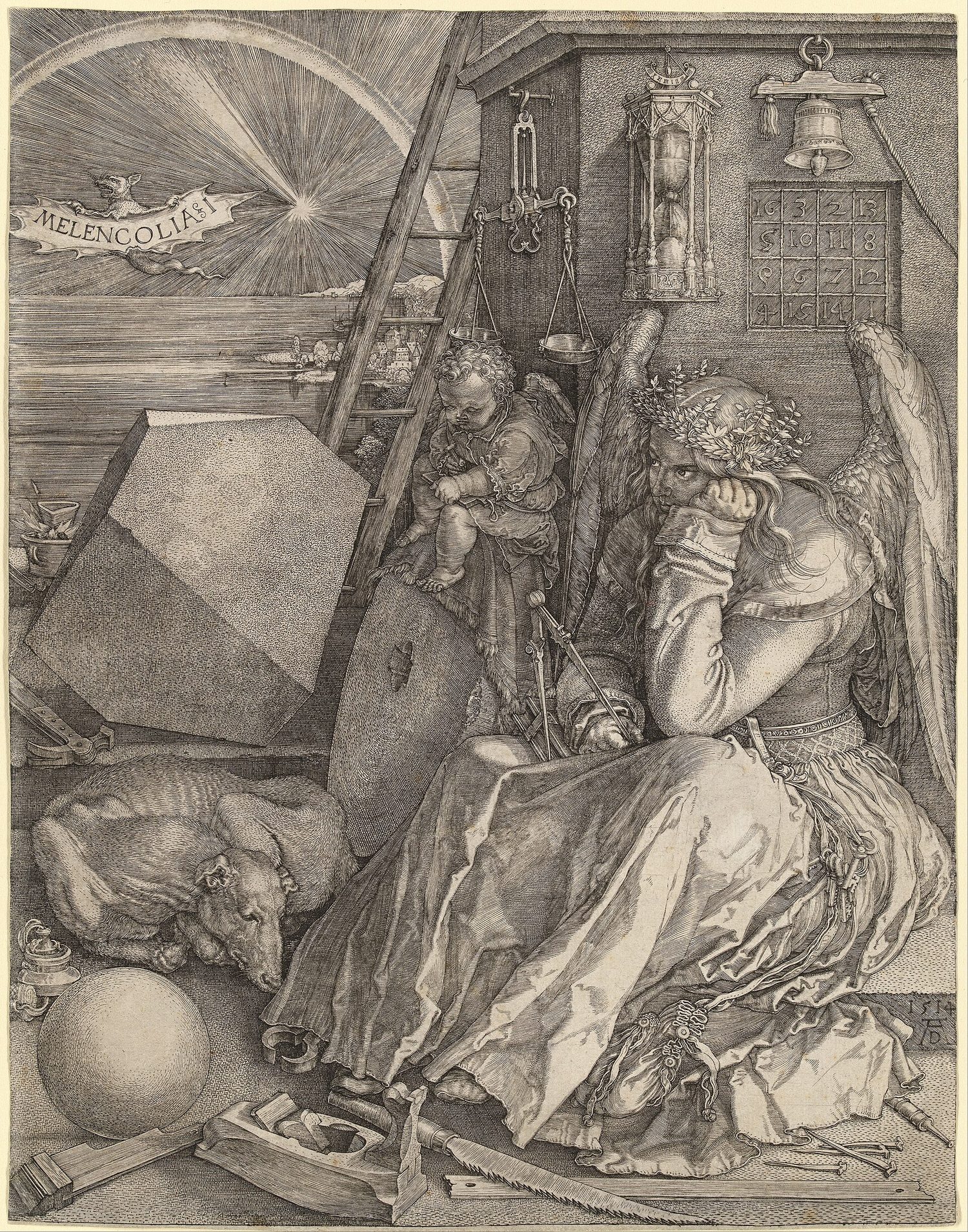
  • Intaglio 凹版 (etching, engraving) — ink sits in lines cut below the surface.
  • Planographic 平版 (lithography) — image and non-image areas are on the same level, using grease and water.
  • Stencil 孔版 (screen printing) — ink is pushed through open areas of a mesh.

The matrix is reversed, so the printed image is a mirror of the plate.

A dense, highly detailed old print of a seated winged figure surrounded by tools and symbols, all built from fine engraved lines Dürer's engraving Melencolia I: in intaglio the lines are cut into a metal plate, and the fine, dense lines that engraving allows build deep shadow and rich detail

Explore

Which printmaking process?

Relief prints from the raised surface; intaglio from lines cut below the surface; planographic from a flat greasy image; stencil pushes ink through a mesh.

Vocabulary Train
English Chinese Pinyin
Printmaking 版画 bǎn huà
matrix bǎn
edition 版数 bǎn shù
Relief 凸版 tū bǎn
Intaglio 凹版 āo bǎn
Planographic 平版 píng bǎn
Stencil 孔版 kǒng bǎn
3.4

Collage and Mixed Media

Syllabus

Focus: Collage assembles found materials onto a surface; mixed media combines two or more materials or processes.

  • Collage glues papers, photos, fabric, or found objects into a composition.
  • Mixed media layers, for example, drawing over paint, or print with stitching.
  • These processes add actual texture and unexpected juxtapositions of image and meaning.
  • Materials can carry meaning (a ticket, a map) beyond their visual role.
  • Good mixed-media work still uses the elements and principles to stay unified.

Source: College Board AP Course and Exam Description

Collage 拼贴 assembles found materials onto a surface; mixed media 综合媒介 combines two or more materials or processes.

  • Collage glues papers, photos, fabric, or found objects into a composition.
  • Mixed media layers processes — for example, drawing over paint, or print with stitching.
  • These add actual texture and unexpected meaning; a found material (a ticket, a map) can carry meaning beyond its look.
Vocabulary Train
English Chinese Pinyin
Collage 拼贴 pīn tiē
mixed media 综合媒介 zōng hé méi jiè
3.5

Photography and Lens-Based Media

Syllabus

Focus: Photography makes images with light and a lens; the same elements and principles apply to the frame.

  • Key controls: framing/composition, focus, exposure (light), depth of field, and viewpoint.
  • The rule of thirds, leading lines, and negative space compose a photograph.
  • Light direction and quality (hard/soft) shape value, form, and mood.
  • Editing (cropping, contrast, colour) is part of the creative process, not just correction.
  • Digital and darkroom processes both count as lens-based 2-D art and design.

Source: College Board AP Course and Exam Description

Photography 摄影 makes images with light and a lens; the elements and principles apply to the frame just as in any 2-D work.

A black-and-white photograph of passengers on a crowded ship, split by a gangway into two levels, forming strong geometric shapes Alfred Stieglitz's The Steerage, a famous early art photograph: the gangway, funnel, and figures form a strong geometric composition, so the elements and principles apply to a photo too

  • Key controls: framing, focus 对焦, exposure 曝光 (light), depth of field 景深, and viewpoint.
  • The rule of thirds, leading lines, and negative space compose a photograph.
  • Editing 后期 (cropping, contrast, colour) is part of the creative process, not just correction.
Vocabulary Train
English Chinese Pinyin
Photography 摄影 shè yǐng
focus 对焦 duì jiāo
exposure 曝光 bào guāng
depth of field 景深 jǐng shēn
Editing 后期 hòu qī
3.6

Digital Art and Design

Syllabus

Focus: Digital tools create and edit images on a computer or tablet, working in layers and pixels or vectors.

  • Raster images are made of pixels (photo editing, painting apps); vector images use math paths (scalable).
  • Layers let an artist build, mask, and revise non-destructively.
  • Digital colour uses RGB (screen, additive) or CMYK (print, subtractive).
  • Resolution (DPI/PPI) affects print quality; keep files high-resolution for the portfolio.
  • The same elements and principles guide digital work as any other 2-D medium.

Source: College Board AP Course and Exam Description

Digital media 数字媒介 create and edit images on a computer or tablet, working in layers.

  • Raster 位图 images are made of pixels (photo editing, digital painting); vector 矢量 images use maths paths and scale without losing quality.
  • Layers 图层 let an artist build, mask, and revise without damaging earlier work.
  • Digital colour uses RGB (screen, additive) or CMYK (print, subtractive); keep files high-resolution 分辨率 for the portfolio.

Additive versus subtractive colour Mixing light (RGB) brightens toward white; mixing pigment (CMY) darkens toward black

Vocabulary Train
English Chinese Pinyin
Digital media 数字媒介 shù zì méi jiè
Raster 位图 wèi tú
vector 矢量 shǐ liàng
Layers 图层 tú céng
resolution 分辨率 fēn biàn lǜ
3.7

Graphic Design and Illustration

Syllabus

Focus: Graphic design communicates a message visually; illustration makes images that support or tell a story.

  • Design combines type, image, colour, and layout to communicate to a viewer or client.
  • Visual hierarchy (size, weight, contrast, placement) guides the eye to what matters first.
  • Typography — typeface, size, spacing, alignment — is a core design element.
  • Illustration serves a purpose: editorial, book, product, poster, or narrative.
  • Design and illustration are problem-solving: audience and message shape every choice.

Source: College Board AP Course and Exam Description

Graphic design 平面设计 communicates a message visually; illustration 插画 makes images that support or tell a story.

  • Design combines type 字体, image, colour, and layout to reach a viewer or client.
  • Visual hierarchy guides the eye to what matters first, through size, weight, and placement.
  • Typography 字体排印 — typeface, size, spacing, alignment — is a core design tool.
  • Design and illustration are problem-solving: the audience and message shape every choice.

Worked example (writing about process). When your written evidence must explain a material and process: "I used charcoal on toned paper because its soft, smudgeable line let me build deep shadow quickly, and I lifted highlights with an eraser to suggest form." Notice the shape — name the medium, say why you chose it, and connect it to the idea you were exploring. Listing a material with no reason earns little.

Vocabulary Train
English Chinese Pinyin
Graphic design 平面设计 píng miàn shè jì
illustration 插画 chā huà
type 字体 zì tǐ
Typography 字体排印 zì tǐ pái yìn
3.7

Exam tips

  • Match the medium to the intended effect, and justify the choice.
  • For printmaking, state relief versus intaglio, and remember the printed image reverses.
  • Explain transparent versus opaque paint, and layers and vector versus raster in digital work.
  • Treat collage and mixed media materials as meaning, not just texture.
  • In graphic design, show a clear visual hierarchy serving the message.

Log in or create account

IGCSE & A-Level