Skip to content

Principles of Design

AP 2-D Art and Design · Topic 2

Train
2.1

Balance

Syllabus

Focus: Balance is the visual distribution of weight in a composition so it feels stable.

  • Symmetrical (formal) balance mirrors both sides of a central axis — calm and orderly.
  • Asymmetrical (informal) balance uses different elements of equal visual weight — dynamic and lively.
  • Radial balance arranges elements around a central point.
  • Visual weight is affected by size, colour, value, texture, and position.
  • A large, dull shape can balance a small, bright one on the other side.
Source: College Board AP Course and Exam Description

Balance: symmetrical, asymmetrical, radial

The principles of design 设计原则 are the "rules" for arranging the elements of art. The first is balance 平衡 — the visual distribution of weight so a work feels stable.

Three kinds of balance: symmetrical, asymmetrical, and radial Symmetrical balance mirrors a central axis; asymmetrical balance weighs different elements; radial balance radiates from a centre

  • Symmetrical (formal) balance 对称平衡 mirrors both sides of a central axis — calm and orderly.
  • Asymmetrical (informal) balance 非对称平衡 uses different elements of equal visual weight 视觉重量 — dynamic and lively.
  • Radial balance 辐射平衡 arranges elements around a central point.

Visual weight is affected by size, colour, value, and position: a small bright shape can balance a large dull one.

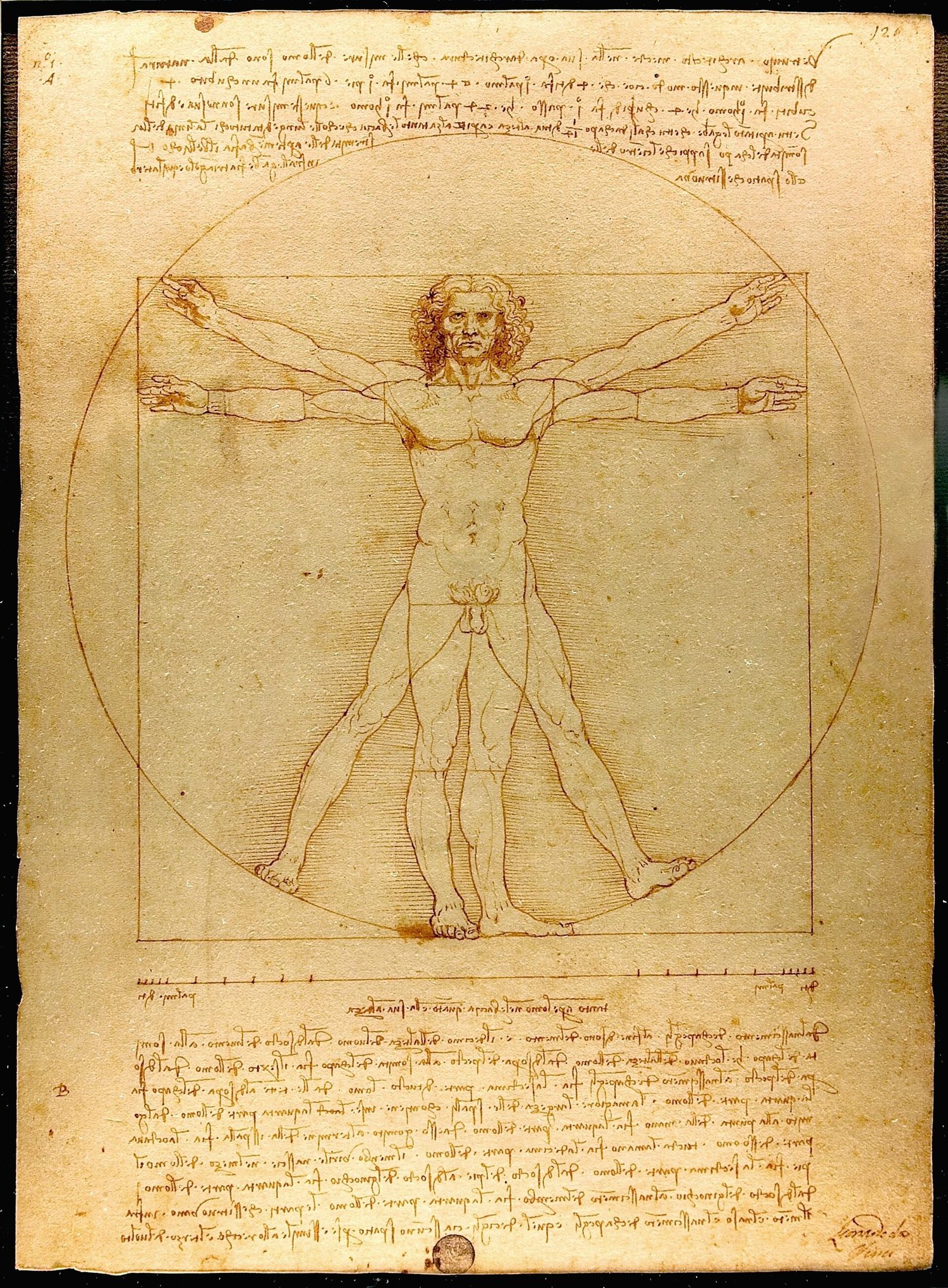
Leonardo's ink drawing of a man with arms and legs outstretched, fitted inside both a circle and a square Leonardo's Vitruvian Man: the figure is drawn with near-perfect symmetry about a central vertical axis, and the surrounding circle gives it radial balance too

Explore

Which kind of balance?

Symmetrical balance mirrors a central axis; asymmetrical balance weighs different elements of equal visual weight; radial balance radiates from a centre.

Vocabulary Train
English Chinese Pinyin
principles of design 设计原则 shè jì yuán zé
balance 平衡 píng héng
Symmetrical (formal) balance 对称平衡 duì chèn píng héng
Asymmetrical (informal) balance 非对称平衡 fēi duì chèn píng héng
visual weight 视觉重量 shì jué zhòng liàng
Radial balance 辐射平衡 fú shè píng héng
2.2

Emphasis and Focal Point

Syllabus

Focus: Emphasis makes one part of a work stand out as the centre of interest (the focal point).

  • A focal point is where the eye is drawn first; emphasis creates it.
  • Emphasis is built through contrast — of size, colour, value, isolation, or placement.
  • Convergence (lines that point) and the rule of thirds help locate a strong focal point.
  • Subordination keeps other areas quieter so the focal point leads.
  • A work may have one dominant focal point and smaller secondary accents.

Source: College Board AP Course and Exam Description

Emphasis 强调 makes one part of a work stand out as the centre of interest — the focal point 视觉焦点, where the eye is drawn first.

  • Emphasis is created through contrast — of size, colour, value, isolation, or placement.
  • Leading lines and the rule of thirds help place a strong focal point.
  • Subordination 从属 keeps other areas quieter so the focal point leads.
Vocabulary Train
English Chinese Pinyin
Emphasis 强调 qiáng diào
focal point 视觉焦点 shì jué jiāo diǎn
Subordination 从属 cóng shǔ
2.3

Contrast

Syllabus

Focus: Contrast is the difference between elements — it creates energy, variety, and readability.

  • Contrast can be of value (light/dark), colour (complementary), shape, texture, or size.
  • Strong contrast attracts attention and defines a focal point.
  • Low contrast unifies a work and can feel calm, subtle, or moody.
  • Contrast in direction (horizontal vs diagonal) adds movement.
  • In graphic design, value and size contrast create clear visual hierarchy.

Source: College Board AP Course and Exam Description

Contrast 对比 is the difference between elements — it creates energy, variety, and readability.

  • Contrast can be of value (light/dark), colour (complementary), shape, texture, or size.
  • Strong contrast attracts attention and defines a focal point; low contrast unifies and calms.
  • In design, value and size contrast create clear visual hierarchy 视觉层次.
Vocabulary Train
English Chinese Pinyin
Contrast 对比 duì bǐ
visual hierarchy 视觉层次 shì jué céng cì
2.4

Movement and Rhythm

Syllabus

Focus: Movement leads the viewer's eye through a work; rhythm is the repetition that creates a visual beat.

  • Movement is the path the eye takes, guided by line, edges, colour, and placement.
  • Rhythm is created by repeating elements with regular or varied spacing.
  • Types of rhythm: regular (even), flowing (curving), progressive (gradual change), and random.
  • Directional forces (leading lines, gazes, gestures) create implied motion.
  • Repetition with variation keeps rhythm interesting rather than monotonous.

Source: College Board AP Course and Exam Description

Movement 动感 leads the viewer's eye through a work; rhythm 节奏 is the repetition that creates a visual "beat".

  • Movement is the path the eye takes, guided by line, edges, colour, and placement.
  • Rhythm types: regular (even), flowing (curving), progressive 渐进 (gradual change), and random.
  • Repetition with variation keeps rhythm interesting rather than monotonous.

Van Gogh's painting of a night sky full of large swirling spirals of light above a quiet village Van Gogh's The Starry Night: swirling brushstrokes sweep the eye across the sky (movement), and the repeated curls give it a rolling rhythm

Vocabulary Train
English Chinese Pinyin
Movement 动感 dòng gǎn
rhythm 节奏 jié zòu
progressive 渐进 jiàn jìn
2.5

Pattern and Repetition

Syllabus

Focus: Repetition reuses an element; pattern is the repeated element arranged in a predictable way.

  • Repetition of shape, colour, or line builds unity and rhythm.
  • A pattern is a repeated motif — regular (grid, tessellation) or irregular.
  • Patterns can fill a shape, define a texture, or become the subject itself.
  • Motif is the single unit that repeats; changing scale or colour varies the pattern.
  • Too much repetition can feel monotonous; variation keeps it engaging.

Source: College Board AP Course and Exam Description

Repetition 重复 reuses an element; a pattern 图案 is the repeated element arranged in a predictable way.

  • Repetition of shape, colour, or line builds unity and rhythm.
  • A pattern is a repeated motif 母题 — regular (a grid or tessellation) or irregular.
  • Too much repetition feels monotonous; changing scale or colour adds variety.

A patterned fabric of blue birds among red strawberries and green leaves, the same motif repeating across it William Morris's Strawberry Thief: one motif of birds among strawberries repeats in a regular pattern across the whole cloth

Vocabulary Train
English Chinese Pinyin
Repetition 重复 chóng fù
pattern 图案 tú àn
motif 母题 mǔ tí
2.6

Proportion and Scale

Syllabus

Focus: Proportion is the size relationship between parts; scale is the size of the work or an element relative to something else.

  • Proportion compares the sizes of parts within a work (e.g. head to body).
  • Scale compares an element to the whole, to the human body, or to the real world.
  • Hierarchical scale makes the most important element largest.
  • Exaggerated or distorted proportion can express emotion or draw attention.
  • The golden ratio and canon of proportions are historic guides to pleasing relationships.

Source: College Board AP Course and Exam Description

Proportion 比例 is the size relationship between parts; scale 尺度 is the size of an element relative to something else.

Composition tools: the rule of thirds and hierarchical scale The rule of thirds places key elements on the third-lines; hierarchical scale makes the important element largest

  • Proportion compares the sizes of parts within a work (head to body).
  • Hierarchical scale 等级比例 makes the most important element the largest.
  • Exaggerated or distorted proportion can express emotion or draw attention. The golden ratio 黄金比例 is a historic guide to pleasing proportions.
Vocabulary Train
English Chinese Pinyin
Proportion 比例 bǐ lì
scale 尺度 chǐ dù
Hierarchical scale 等级比例 děng jí bǐ lì
golden ratio 黄金比例 huáng jīn bǐ lì
2.7

Unity and Variety

Syllabus

Focus: Unity holds a work together as a whole; variety adds interest so it is not dull. Good design balances the two.

  • Unity is a sense that all parts belong together (through repetition, proximity, and a limited palette).
  • Variety is difference that adds interest and prevents monotony.
  • Harmony comes from elements that are similar; tension from those that differ.
  • Proximity (grouping) and continuity (alignment) strengthen unity.
  • The best works achieve unity with variety — order that still surprises.

Source: College Board AP Course and Exam Description

Unity 统一 holds a work together as a whole; variety 变化 adds interest so it is not dull. Good design balances the two.

  • Unity comes from repetition, proximity 邻近 (grouping), continuity 连续性 (aligning elements along a line or edge so they read as one group), and a limited palette.
  • Variety is difference that prevents monotony. Harmony 和谐 comes from similar elements.
  • The best works achieve unity with variety — order that still surprises.
Vocabulary Train
English Chinese Pinyin
Unity 统一 tǒng yī
variety 变化 biàn huà
proximity 邻近 lín jìn
continuity 连续性 lián xù xìng
Harmony 和谐 hé xié
2.8

Composition

Syllabus

Focus: Composition is how all the elements and principles are arranged within the picture plane.

  • The picture plane is the flat surface; its format (portrait, landscape, square) shapes the design.
  • The rule of thirds places key elements along thirds lines and their intersections.
  • Cropping decides what is included and what is cut, changing emphasis and tension.
  • Leading lines, framing, and balance guide the eye and hold the composition together.
  • A strong composition unifies the elements while creating a clear focal point.

Source: College Board AP Course and Exam Description

Composition 构图 is how all the elements and principles are arranged within the picture plane 画面.

  • The format 画幅 (portrait, landscape, square) shapes the design.
  • The rule of thirds 三分法 places key elements along third-lines and their intersections.
  • Cropping 裁剪 decides what is included and what is cut, changing emphasis and tension.
  • A strong composition unifies the elements while creating a clear focal point — this is what the AP portfolio's 2-D skills are judged on.

Worked example (applying the concept). To explain balance in a composition: "The large dark shape on the left is balanced by three small bright shapes on the right — this is asymmetrical balance, which gives the piece visual weight on both sides while keeping it dynamic rather than static." A full answer names the principle, points to specific evidence in the work, and states the effect on the viewer.

Vocabulary Train
English Chinese Pinyin
Composition 构图 gòu tú
picture plane 画面 huà miàn
format 画幅 huà fú
rule of thirds 三分法 sān fēn fǎ
Cropping 裁剪 cái jiǎn
2.8

Exam tips

  • For every work, state which principle organises it — balance, emphasis, contrast, movement, or unity.
  • Justify balance through visual weight, not just symmetry.
  • Ensure one clear focal point, and name the emphasis technique that creates it.
  • Aim for unity with variety — name the unifying device and the source of interest.
  • Plan composition with the rule of thirds and thumbnails before committing.

Log in or create account

IGCSE & A-Level