Skip to content

Elements of Art

AP 2-D Art and Design · Topic 1

Train
1.1

Line

Syllabus

Focus: Line is the most basic element of art — a moving point that the eye follows across a surface.

  • A line is a mark with length and direction: straight, curved, angular, or freeform.
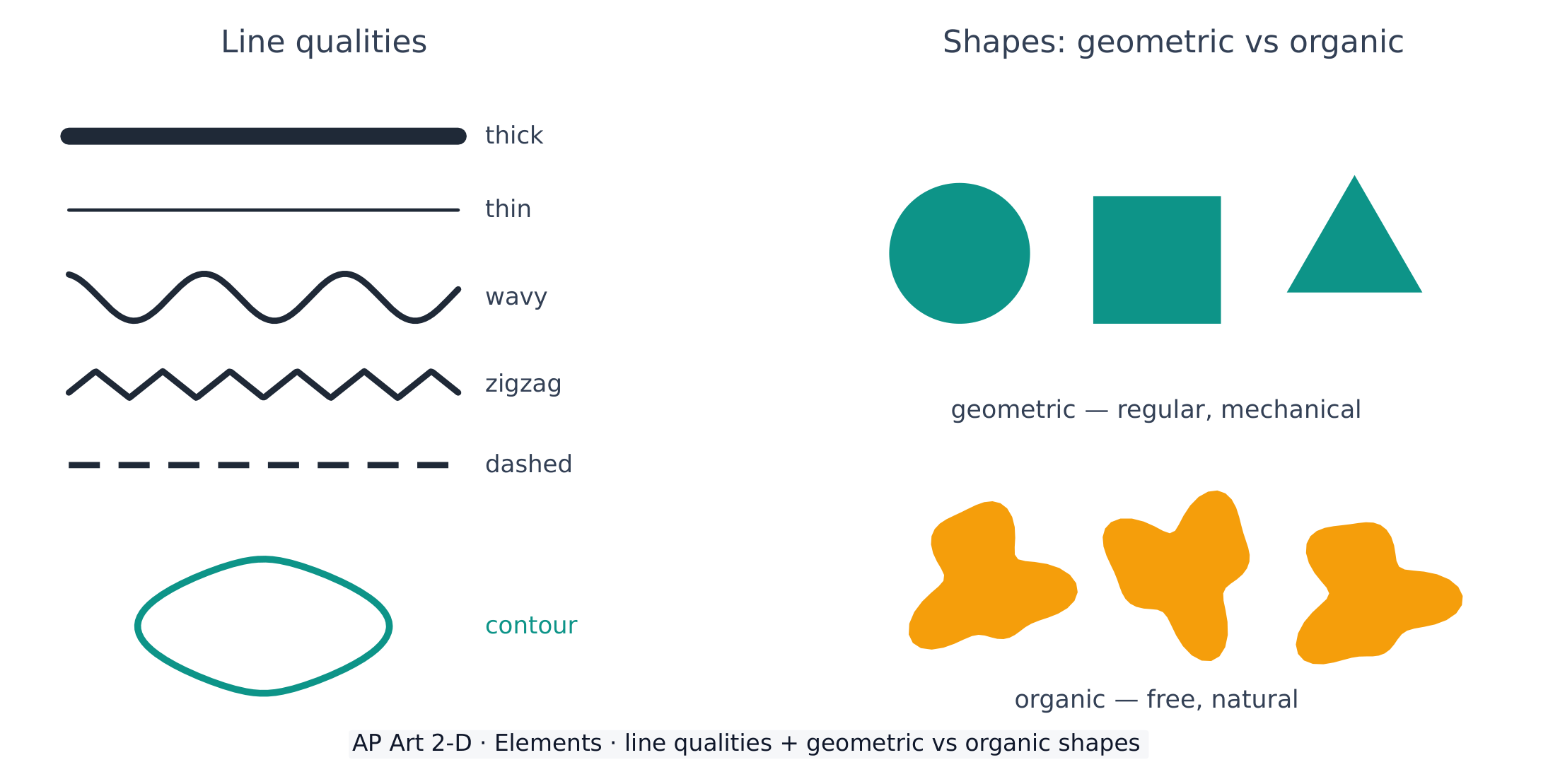
  • Lines vary in quality — thick or thin, smooth or rough, continuous or broken, dark or light.
  • Contour lines trace the edges of a form; gesture lines quickly capture movement and energy.
  • Implied lines are suggested, not drawn — by a row of objects, a pointing arm, or a gaze.
  • Direction carries feeling: horizontal reads as calm, vertical as strength, diagonal as action.
  • Artists use line to build shape, shade value (hatching, cross-hatching), imply texture, and lead the eye.
Source: College Board AP Course and Exam Description

The elements of art 艺术元素 are the visual "building blocks" every artist uses. The first is line 线条 — a moving point that the eye follows.

  • A line has length and direction; it can be straight, curved, angular, or freeform.
  • Lines have quality: thick or thin, smooth or rough, continuous or broken, dark or light.
  • Contour 轮廓 lines trace the edges of a form; gesture 动态速写 lines capture movement quickly.
  • Implied lines 隐含线 are not drawn but suggested — by a row of objects or a person's gaze.

Hokusai's woodblock print of a giant curling wave about to crash over small boats, with Mount Fuji small in the distance Hokusai's The Great Wave off Kanagawa: bold curved outlines carry the eye along the wave, and the claw-like lines of foam create movement

Line qualities and the difference between geometric and organic shapes Line varies in weight and character; shapes are either geometric (regular) or organic (natural)

Direction carries feeling: horizontal lines feel calm, vertical lines feel strong, and diagonal lines feel active. Artists use line to build shape, shade value (hatching), imply texture, and lead the viewer's eye.

Vocabulary Train
English Chinese Pinyin
elements of art 艺术元素 yì shù yuán sù
line 线条 xiàn tiáo
Contour 轮廓 lún kuò
gesture 动态速写 dòng tài sù xiě
Implied lines 隐含线 yǐn hán xiàn
1.2

Shape and Form

Syllabus

Focus: Shape is a flat, enclosed area; form is the illusion of a three-dimensional object on a 2-D surface.

  • A shape is a two-dimensional area with a boundary; form appears three-dimensional (height, width, depth).
  • Geometric shapes (circle, square, triangle) are regular and mechanical; organic shapes are free and natural.
  • Positive shapes are the objects; negative shapes are the empty spaces around and between them.
  • Form is created on a flat surface through value (shading), overlapping, and perspective.
  • Recognising negative space helps an artist see and compose more accurately.

Source: College Board AP Course and Exam Description

A shape 形状 is a flat, enclosed area; a form 形体 has the illusion of three dimensions (height, width, and depth).

  • Geometric 几何 shapes (circle, square, triangle) are regular and mechanical; organic 有机 shapes are free and natural.
  • Positive shape 正形 is the object; negative shape 负形 is the empty space around and between objects — learning to see it makes drawing far more accurate.
  • Form is created on a flat surface with value (shading), overlapping, and perspective.
Vocabulary Train
English Chinese Pinyin
shape 形状 xíng zhuàng
form 形体 xíng tǐ
Geometric 几何 jǐ hé
organic 有机 yǒu jī
Positive shape 正形 zhèng xíng
negative shape 负形 fù xíng
1.3

Value

Syllabus

Focus: Value is the lightness or darkness of a colour or tone — the key to showing form and depth.

  • Value runs from white through greys to black; a value scale shows the gradual steps.
  • Highlight, midtone, core shadow, reflected light, and cast shadow describe light on a form.
  • Strong value contrast creates drama and a clear focal point; close values feel soft and calm.
  • Chiaroscuro is the bold use of light and dark to model three-dimensional form.
  • Squinting removes colour and helps an artist judge value relationships.

Source: College Board AP Course and Exam Description

Light logic: how light describes form
The value scale

Value 明度 is the lightness or darkness of a tone — the single most powerful tool for showing three-dimensional form.

A value scale runs in even steps from white to black A value scale steps evenly from white to black; strong value contrast creates drama and a focal point

  • A value scale 明度阶 runs from white through greys to black.
  • Light on a form has a highlight 高光, midtones 中间调, a core shadow 明暗交界线, reflected light 反光, and a cast shadow 投影.
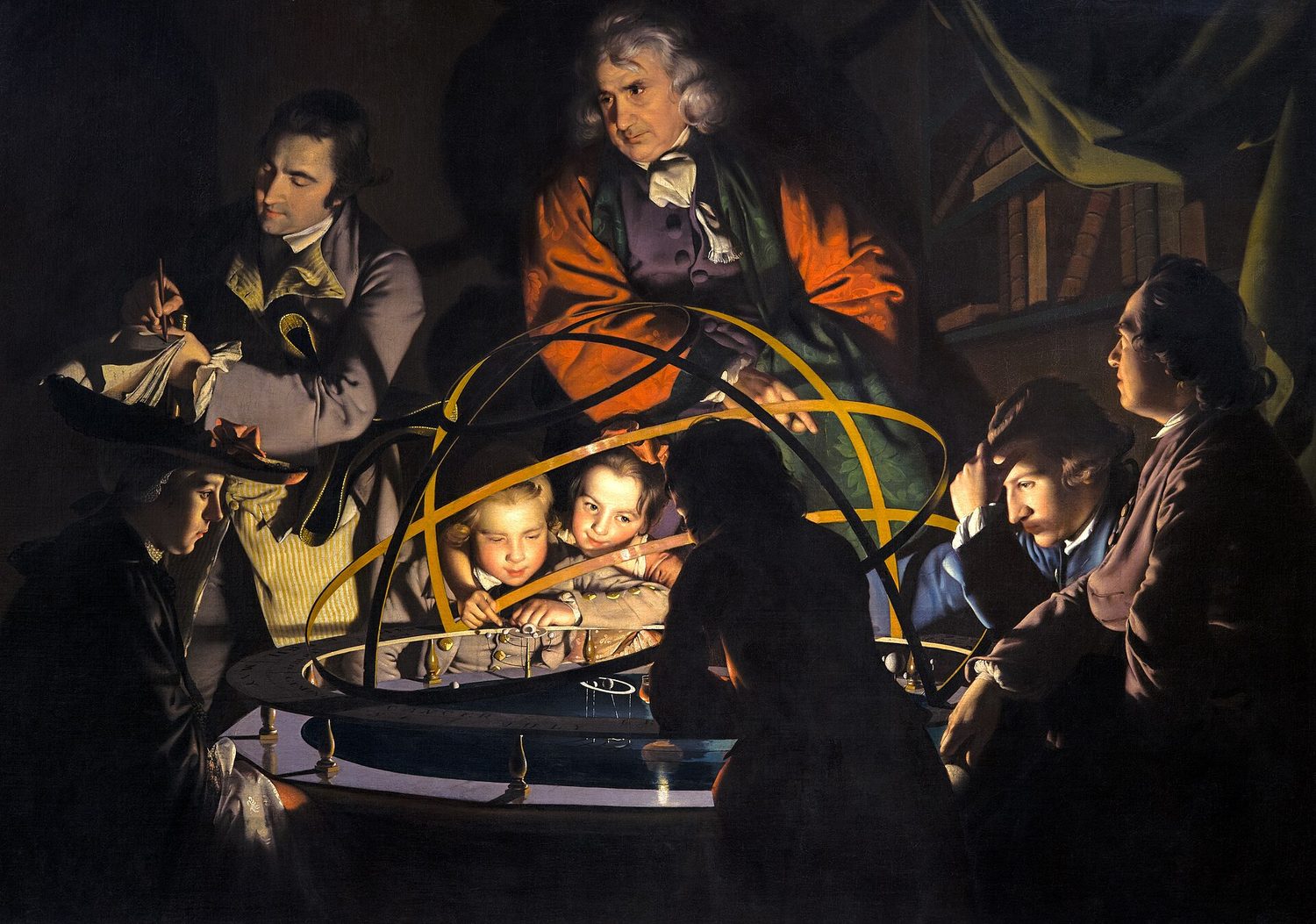
  • Chiaroscuro 明暗对照法 is the bold use of light and dark to model form. Squinting removes colour and helps you judge value.

A candle-lit 18th-century painting where people gather around a model of the solar system, their faces glowing against a dark background Joseph Wright's A Philosopher Lecturing on the Orrery: one hidden light in the centre creates strong value contrast (chiaroscuro), lifting each face out of the dark

Vocabulary Train
English Chinese Pinyin
Value 明度 míng dù
value scale 明度阶 míng dù jiē
highlight 高光 gāo guāng
midtones 中间调 zhōng jiān diào
core shadow 明暗交界线 míng àn jiāo jiè xiàn
reflected light 反光 fǎn guāng
cast shadow 投影 tóu yǐng
Chiaroscuro 明暗对照法 míng àn duì zhào fǎ
1.4

Color

Syllabus

Focus: Colour is light reflected from a surface; it has three properties and follows the logic of the colour wheel.

  • Colour has three properties: hue (its name), value (light/dark), and saturation/intensity (dull to vivid).
  • Primary colours (red, yellow, blue) mix to make secondary (orange, green, violet) and tertiary colours.
  • Colour schemes: complementary, analogous, monochromatic, triadic, warm, and cool.
  • Warm colours (red, orange, yellow) advance and energise; cool colours (blue, green, violet) recede and calm.
  • Adding white makes a tint, black makes a shade, grey makes a tone.
  • Complementary colours placed side by side intensify each other; mixed together they dull (neutralise).

Source: College Board AP Course and Exam Description

The colour wheel and its schemes

Colour 色彩 is light reflected from a surface. It has three properties and follows the logic of the colour wheel 色轮.

The colour wheel: primary, secondary, and tertiary hues, with warm and cool halves Primary colours mix to secondary and tertiary hues; complementary colours sit opposite each other

  • Colour's three properties: hue 色相 (its name), value (light/dark), and saturation 饱和度 (dull to vivid).
  • Primary 三原色 (red, yellow, blue) mix to make secondary 间色 and tertiary colours.
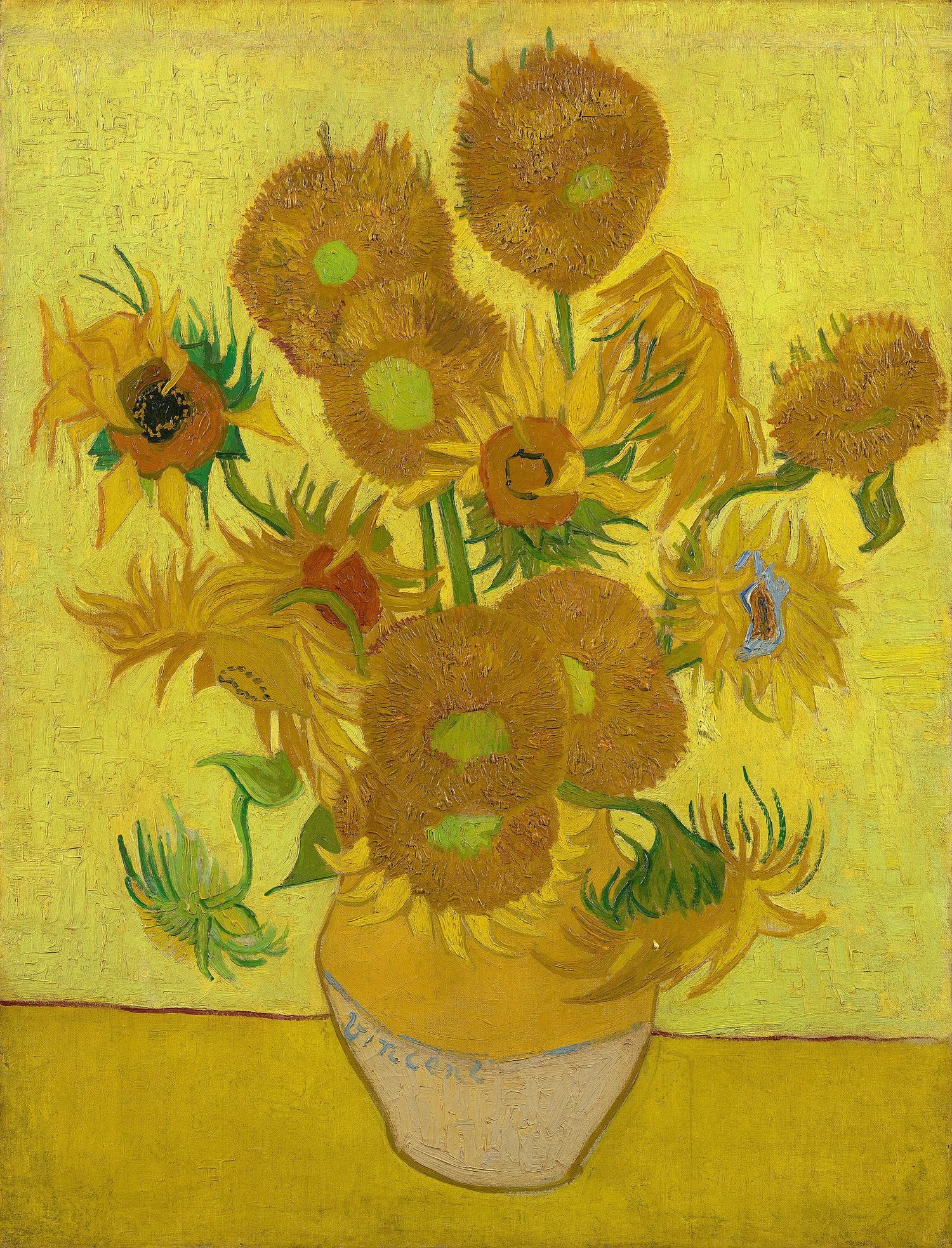
  • Complementary 互补色 colours sit opposite on the wheel and intensify each other; analogous 邻近色 colours sit next to each other and harmonise.
  • Warm 暖色 colours (red, orange, yellow) advance; cool 冷色 colours (blue, green, violet) recede. A tint adds white, a shade adds black.

Van Gogh's still-life painting of a vase of sunflowers, painted almost entirely in shades of yellow and gold Van Gogh's Sunflowers is built almost entirely from warm yellows and oranges, an analogous colour scheme that feels bright and unified

Explore

Warm or cool colour?

Warm colours (red, orange, yellow) feel energetic and seem to advance; cool colours (blue, green, violet) feel calm and seem to recede.

Vocabulary Train
English Chinese Pinyin
Colour 色彩 sè cǎi
colour wheel 色轮 sè lún
hue 色相 sè xiàng
saturation 饱和度 bǎo hé dù
Primary 三原色 sān yuán sè
secondary 间色 jiàn sè
Complementary 互补色 hù bǔ sè
analogous 邻近色 lín jìn sè
Warm 暖色 nuǎn sè
cool 冷色 lěng sè
1.5

Texture

Syllabus

Focus: Texture is the surface quality of a work — how it feels or how it appears to feel.

  • Actual (tactile) texture can be physically touched (thick paint, collage, rough paper).
  • Implied (visual) texture is the illusion of a surface, created with marks, value, and pattern.
  • Texture is built through mark-making: stippling, hatching, dry-brush, impasto, and frottage (rubbing).
  • Contrasting smooth and rough areas adds interest and can direct attention.
  • In photography and digital work, texture comes from light, focus, and surface detail.

Source: College Board AP Course and Exam Description

Texture 肌理 is the surface quality of a work — how it feels, or how it appears to feel.

  • Actual (tactile) texture 实际肌理 can be physically touched (thick paint, collage, rough paper).
  • Implied (visual) texture 视觉肌理 is the illusion of a surface, made with marks, value, and pattern.
  • Techniques include stippling, hatching, impasto 厚涂 (thick paint), and dry-brush. Contrasting smooth and rough areas adds interest and can direct the eye.
Vocabulary Train
English Chinese Pinyin
Texture 肌理 jī lǐ
Actual (tactile) texture 实际肌理 shí jì jī lǐ
Implied (visual) texture 视觉肌理 shì jué jī lǐ
impasto 厚涂 hòu tú
1.6

Space

Syllabus

Focus: Space is the area within, around, and between the parts of a work, including the illusion of depth.

  • Positive space is filled by the subject; negative space is the empty area around it.
  • Artists create the illusion of depth with overlapping, size, placement, and detail.
  • Linear perspective uses a horizon line and vanishing point(s) so parallel lines converge.
  • Atmospheric (aerial) perspective makes distant objects paler, bluer, and less detailed.
  • Foreground, middle ground, and background organise a scene from near to far.
  • The format and cropping of the picture plane shape how space is read.

Source: College Board AP Course and Exam Description

Atmospheric perspective
One-point perspective

Space 空间 is the area within, around, and between the parts of a work, including the illusion of depth on a flat surface.

  • Positive space is filled by the subject; negative space is the empty area around it.
  • Depth is created with overlapping 重叠, size, placement, and detail.
  • Linear perspective 线性透视 uses a horizon line and vanishing point 灭点 so parallel lines converge; atmospheric perspective 空气透视 makes distant things paler, bluer, and less detailed.
  • The format and cropping of the picture plane shape how the space is read.

Worked example (applying the concept). Asked to describe how line creates meaning in a portrait, a strong answer names the element, its quality, and its effect: "The artist uses thick, jagged diagonal lines in the background, and their restless, active direction makes the calm horizontal lines of the sitter's shoulders feel even more still." Naming the element and linking it to a feeling is what portfolio written evidence and analysis questions both reward.

Vocabulary Train
English Chinese Pinyin
Space 空间 kōng jiān
overlapping 重叠 chóng dié
Linear perspective 线性透视 xiàn xìng tòu shì
vanishing point 灭点 miè diǎn
atmospheric perspective 空气透视 kōng qì tòu shì
1.6

Exam tips

  • Name the element precisely — line, shape or form, value, colour, texture, space — in any analysis.
  • Justify how form is modelled with a value scale and a single light source.
  • Read the colour wheel: identify complementary versus analogous schemes and warm or cool temperature.
  • Separate shape (2-D) from form (3-D) and actual from implied texture.
  • Explain depth with overlap, size, linear perspective, and atmospheric perspective.

Log in or create account

IGCSE & A-Level