Skip to content · ⁨ข้ามไปยังเนื้อหา⁩

Motion in a circle · ⁨การเคลื่อนที่ในวงกลม⁩

A-Level Physics · ⁨Physics A-Level⁩ · Topic 12 · ⁨หัวข้อ 12⁩

Video lesson for this topic · ⁨บทเรียนวิดีโอสำหรับหัวข้อนี้⁩ Open the video page · ⁨เปิดหน้าวิดีโอ⁩
13:00

การเคลื่อนที่วงกลม

เทน้ำลงในถัง สบกระแทกวนรอบหัวด้วยความเร็วสูง — และน้ำไม่หยดลงมาเลย แม้ว่าจะคว่ำหัวลงก็ตาม ทำไมน้ำถึงไม่...

English narration · English + 中文 subtitles burned in · ⁨การบรรยายภาษาอังกฤษ · คำบรรยายภาษาอังกฤษ + 中文 ลอยตัวบนภาพ⁩

12.1

Angles in radians · ⁨มุมในเรเดียน⁩

Syllabus · ⁨หลักสูตร⁩
English
  1. define the radian and express angular displacement in radians
  2. understand and use the concept of angular speed
  3. recall and use $\omega = 2\pi / T$ and $v = r\omega$
ไทย
  1. นิยาม เรเดียน และแสดง การกระจัดเชิงมุม เป็นเรเดียน
  2. เข้าใจและใช้แนวคิดของ ความเร็วเชิงมุม
  3. จำและใช้ $\omega = 2\pi / T$ และ $v = r\omega$

Source: Cambridge International syllabus · ⁨แหล่งที่มา: หลักสูตร Cambridge International⁩

English
Uniform circular motion: velocity & acceleration

The radian 弧度 is the angle made at the centre of a circle by an arc 弧 whose length equals the radius. For an arc of length $s$ on a circle of radius $r$, the angle in radians is

$$\theta = \frac{s}{r}.$$

Radians have no unit (a ratio of lengths). A full circle has $s = 2\pi r$, so $\theta = 2\pi\ \text{rad}$. A half-circle is $\pi\ \text{rad}$; a quarter is $\pi/2\ \text{rad}$.

To convert: $1\ \text{rad} = 180°/\pi \approx 57.3°$. Set your calculator to radians for this topic; "degree" mode will give wrong answers.

The one-mark definition. The radian is the angle subtended at the centre of a circle by an arc equal in length to the radius of the circle. Give it in words — $\theta = s/r$ on its own is not a definition — and keep $s = r\theta$ ready for turning a distance along the arc into an angle, or back.

ไทย
การเคลื่อนที่วงกลมสม่ำเสมอ: ความเร็วและความเร่ง

เรเดียน คือมุมที่เกิดที่จุดศูนย์กลางของวงกลมจาก ส่วนโค้ง ที่มียาวเท่ากับรัศมี สำหรับส่วน弧ที่มีความยาว $s$ บนวงกลมที่มีรัศมี $r$, มุมในหน่วยเรเดียนคือ

$$\theta = \frac{s}{r}.$$

เรเดียนไม่มีหน่วย (เป็นอัตราส่วนของความยาว) วงกลมเต็มมี $s = 2\pi r$, ดังนั้น $\theta = 2\pi\ \text{rad}$. ครึ่งวงกลมคือ $\pi\ \text{rad}$;.spark部分是 $\pi/2\ \text{rad}$.

A circle with a shaded sector; the two bounding radii each have length r and the arc has length s = r, so the angle at the centre is one radian
หนึ่งเรเดียนคือมุมที่มีความยาวส่วน弧เท่ากับรัศมี

เพื่อแปลงค่า: $1\ \text{rad} = 180°/\pi \approx 57.3°$. ตั้งค่าเครื่องคิดเลขของคุณไปที่ เรเดียน สำหรับหัวข้อนี้; โหมด "องศา" จะให้คำตอบที่ผิด

นิยามแบบ 1 คะแนน. เรเดียนคือมุมที่สร้างที่จุดศูนย์กลางของวงกลมโดยส่วน弧ที่มียาวเท่ากับรัศมีของวงกลม. ให้เป็นคำพูด — $\theta = s/r$ อย่างเดียวไม่ใช่คำนิยาม — และเก็บ $s = r\theta$ ไว้สำหรับเปลี่ยนระยะทางตามส่วน弧ให้เป็นมุม, หรือกลับด้าน

Vocabulary · ⁨คำศัพท์⁩ Train · ⁨ฝึกฝน⁩
English ไทย
radian/ˈreɪdɪən/ เรเดียน
velocity/vəˈlɒsɪti/ ความเร็ว
acceleration/əkˌseləˈreɪʃn/ ความเร่ง
arc/ɑːk/ ส่วนโค้ง
12.1

Uniform circular motion: angular speed · ⁨การเคลื่อนที่วงกลมสม่ำเสมอ: ความเร็วเชิงมุม⁩

English

An object moves in a circle of radius $r$ at constant speed $v$. Define:

  • angular displacement 角位移 $\theta$ — the angle (in radians) turned through by the radius from a chosen start line.
  • angular speed 角速度 $\omega$ — the rate of change of angular displacement.

For uniform motion $\omega$ is constant and

$$\omega = \frac{\theta}{t}.$$

Unit: $\text{rad s}^{-1}$.

What stays constant and what varies. In uniform circular motion the speed, the angular speed, the period and the magnitude of the acceleration are constant; the velocity, the displacement from the centre and the acceleration all change continuously, because their direction changes. Asked to "state two quantities that vary", give two of velocity, acceleration, displacement and momentum — and say it is the direction that varies.

Period and frequency

If the object goes once round ($2\pi\ \text{rad}$, one revolution 圈) in time $T$ (the period 周期), then

$$\omega = \frac{2\pi}{T} = 2\pi f,$$

where $f = 1/T$ is the frequency 频率 of turning (Hz).

Linear and angular speed

In one period $T$ the object travels a distance $2\pi r$ (the circumference 周长) at constant speed, so

$$v = \frac{2\pi r}{T} = r \omega.$$

This links the linear (tangential 切向) speed $v$ with the angular speed $\omega$. At a larger radius (for the same angular speed) the linear speed is larger — a child on the edge of a merry-go-round moves faster than one near the centre, even though both go round once in the same time.

Worked example. A fairground ride of radius $4.0\ \text{m}$ completes one turn every $8.0\ \text{s}$. Find its angular speed and the linear speed of a rider on the edge.

$$\omega = \frac{2\pi}{T} = \frac{2\pi}{8.0} = 0.79\ \text{rad s}^{-1}, \qquad v = r\omega = 4.0 \times 0.79 = 3.1\ \text{m s}^{-1}.$$

Worked example. The minute hand of a clock turns once every hour. A piece of modelling clay on the hand moves a total distance of $0.44\ \text{m}$ in $1400\ \text{s}$. Find the angular speed of the hand, the angle the clay turns through in that time, and its distance from the centre of the clock.

$\omega = 2\pi/T = 2\pi/3600 = 1.75 \times 10^{-3}\ \text{rad s}^{-1}$. Angular displacement $\theta = \omega t = 1.75 \times 10^{-3} \times 1400 = 2.44\ \text{rad}$. Distance along the arc $s = r\theta$, so $r = s/\theta = 0.44/2.44 = 0.18\ \text{m}$. Check: $v = s/t = 3.1 \times 10^{-4}\ \text{m s}^{-1}$ and $r\omega = 0.18 \times 1.75 \times 10^{-3} = 3.1 \times 10^{-4}\ \text{m s}^{-1}$ — the same. A common trap in these questions is a radius measured from the rim: a lump $1.2\ \text{cm}$ in from the edge of a $9.3\ \text{cm}$ disc moves in a circle of radius $8.1\ \text{cm}$.

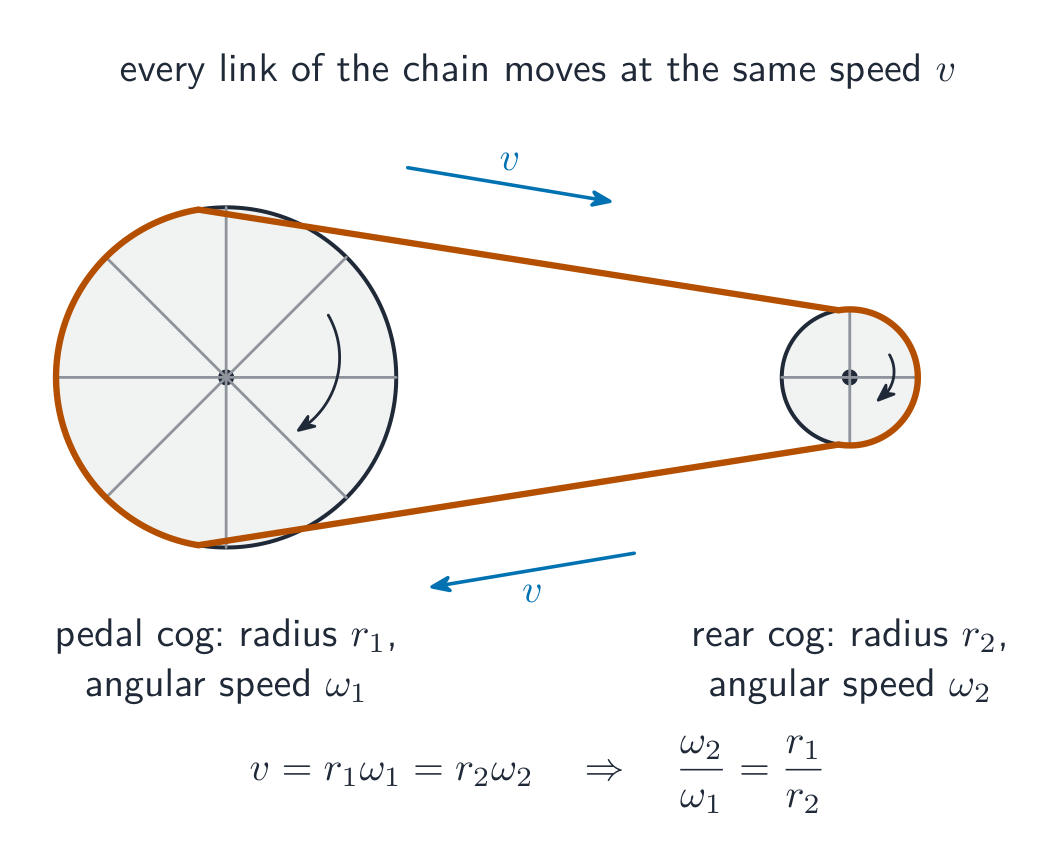
Worked example. A bicycle chain passes round a pedal cog of radius $0.095\ \text{m}$ and a rear-wheel cog of radius $0.038\ \text{m}$. The pedals turn at $1.2$ revolutions per second. Find the speed of the chain and the angular speed of the rear cog. The chain is then moved to a smaller rear cog while the bicycle's speed stays the same; explain, without calculation, what happens to the angular speed of the pedals.

Pedal angular speed $\omega_{1} = 2\pi \times 1.2 = 7.5\ \text{rad s}^{-1}$. Every link of the chain moves at the speed of the rim of the pedal cog: $v = r_{1}\omega_{1} = 0.095 \times 7.5 = 0.72\ \text{m s}^{-1}$. The rear cog's rim moves at the same speed, so $\omega_{2} = v/r_{2} = 0.72/0.038 = 19\ \text{rad s}^{-1}$. With the bicycle's speed unchanged, the rear wheel keeps the same angular speed; the smaller cog's rim therefore moves more slowly ($v = r\omega$ with a smaller $r$), so the chain moves more slowly, and the pedal cog, driven by the same chain, turns at a lower angular speed.

ไทย
A spinning fairground ride lit up at night
เครื่องเล่นหมุนในสวนสนุก: ผู้โดยสารทุกคนหมุนผ่านมุมเดียวกันต่อวินาที

วัตถุเคลื่อนที่ในวงกลมรัศมี $r$ ด้วยความเร็วคงที่ $v$ กำหนดให้:

  • การกระจัดเชิงมุม $\theta$ — มุม (ในหน่วยเรเดียน) ที่รัศมีหมุนผ่านจากเส้นเริ่มต้นที่กำหนด
  • ความเร็วเชิงมุม $\omega$ — อัตราการเปลี่ยนแปลงของการกระจัดเชิงมุม

สำหรับการเคลื่อนที่สม่ำเสมอ $\omega$ เป็นค่าคงที่และ

$$\omega = \frac{\theta}{t}.$$

หน่วย: $\text{rad s}^{-1}$

สิ่งที่คงที่และสิ่งที่แปรผัน ในการเคลื่อนที่วงกลมสม่ำเสมอ ความเร็ว, ความเร็วเชิงมุม, ระยะเวลา และ ขนาด ของความเร่งเป็นค่าคงที่; ความเร็ว, การกระจัด จากจุดศูนย์กลาง และ ความเร่ง เปลี่ยนไปอย่างต่อเนื่อง เนื่องจาก ทิศทาง เปลี่ยนไป ถูกถามว่า "บอกปริมาณสองอย่างที่แปรผัน" ให้บอกสองอย่างจาก ความเร็ว, ความเร่ง, การกระจัด และโมเมนตัม — และบอกว่าสิ่งที่แปรผันคือทิศทาง

ระยะเวลาและความถี่

หากวัตถุวนรอบหนึ่ง ($2\pi\ \text{rad}$, หนึ่งรอบหมุน) ในเวลา $T$ (ช่วงคาบ), แล้ว

$$\omega = \frac{2\pi}{T} = 2\pi f,$$

โดยที่ $f = 1/T$ คือ ความถี่ ของการหมุน (Hz).

ความเร็วเชิงเส้นและความเร็วเชิงมุม

ในช่วงเวลาหนึ่ง $T$ วัตถุเดินทางระยะทาง $2\pi r$ (เส้นรอบวง) ด้วยความเร็วคงที่, ดังนั้น

$$v = \frac{2\pi r}{T} = r \omega.$$

สิ่งนี้เชื่อมโยงความเร็วเชิงเส้น (แนวสัมผัส) $v$ กับความเร็วเชิงมุม $\omega$. ที่รัศมียิ่งใหญ่ขึ้น (ด้วยความเร็วเชิงมุมเท่าเดิม) ความเร็วเชิงเส้นจะยิ่งใหญ่ขึ้น — เด็กที่อยู่ขอบมERRY-GO-ROUND เคลื่อนที่เร็วกว่าเด็กที่อยู่ใกล้จุดศูนย์กลาง แม้ว่าจะวนรอบหนึ่งพร้อมกันในเวลาที่เท่ากันก็ตาม

A turntable with two riders sharing the same angular speed; the inner rider has a short velocity arrow and the outer rider a long one, because v equals r times omega
ความเร็วเชิงมุมเท่ากัน แต่ผู้โดยสารอยู่ที่รัศมียิ่งใหญ่มีความเร็วเชิงเส้นยิ่งใหญ่ ($v = r\omega$)

ตัวอย่างวิธีทำ. เครื่องเล่นในสวนสนุกที่มีรัศมี $4.0\ \text{m}$ หมวนรอบหนึ่งทุก $8.0\ \text{s}$. หาความเร็วเชิงมุมและความเร็วเชิงเส้นของผู้โดยสารที่ขอบ

$$\omega = \frac{2\pi}{T} = \frac{2\pi}{8.0} = 0.79\ \text{rad s}^{-1}, \qquad v = r\omega = 4.0 \times 0.79 = 3.1\ \text{m s}^{-1}.$$

ตัวอย่างวิธีทำ. เข็มนาฬิกา.minute หมวนรอบหนึ่งทุกชั่วโมง. ก้อนดินน้ำมันบนเข็มนาฬิกาเดินทางรวมระยะทาง $0.44\ \text{m}$ ใน $1400\ \text{s}$. หาความเร็วเชิงมุมของเข็ม, มุมที่ก้อนดินหมุนผ่าน在这段时间, และระยะห่างจากจุดศูนย์กลางของนาฬิกา

$\omega = 2\pi/T = 2\pi/3600 = 1.75 \times 10^{-3}\ \text{rad s}^{-1}$. การกระจัดเชิงมุม $\theta = \omega t = 1.75 \times 10^{-3} \times 1400 = 2.44\ \text{rad}$. ระยะทางตามส่วน弧 $s = r\theta$, ดังนั้น $r = s/\theta = 0.44/2.44 = 0.18\ \text{m}$. ตรวจสอบ: $v = s/t = 3.1 \times 10^{-4}\ \text{m s}^{-1}$ และ $r\omega = 0.18 \times 1.75 \times 10^{-3} = 3.1 \times 10^{-4}\ \text{m s}^{-1}$ — เหมือนกัน.陷阱ที่พบบ่อยในคำถามเหล่านี้คือรัศมิตวัด จากขอบ: ก้อนstuff $1.2\ \text{cm}$ เข้าไปในขอบของดิสก์$9.3\ \text{cm}$ เคลื่อนที่ในวงกลมที่มีรัศมี $8.1\ \text{cm}$.

A bicycle chain round a large pedal cog and a small rear cog; every link of the chain moves at the same speed v, so v equals r1 omega1 equals r2 omega2 and the small cog turns faster
เฟืองสองตัวเชื่อมต่อกันด้วยสายพานแบ่งกันความเร็วของสายพาน, ไม่ใช่ความเร็วเชิงมุม: $v = r_{1}\omega_{1} = r_{2}\omega_{2}$

ตัวอย่างทำข้อ. โซ่จักรยานผ่านรอบเฟืองที่เท้าเหยียบซึ่งมีรัศมี $0.095\ \text{m}$ และเฟืองที่ล้อหลังซึ่งมีรัศมี $0.038\ \text{m}$. เท้าเหยียบหมุนที่ $1.2$ รอบต่อนาที. จงหาความเร็วของโซ่และความเร็วเชิงมุมของเฟืองหลัง. จากนั้นโซ่ถูกย้ายไปใส่เฟืองหลังที่มีขนาดเล็กกว่าในขณะที่ความเร็วของจักรยานคงที่; อธิบายโดยไม่ใช้การคำนวณว่าความเร็วเชิงมุมของเท้าเหยียบจะเกิดอะไรขึ้น

ความเร็วเชิงมุมของเท้าเหยียบ $\omega_{1} = 2\pi \times 1.2 = 7.5\ \text{rad s}^{-1}$. ทุกลิงก์ของโซ่เคลื่อนที่ด้วยความเร็วเท่ากับขอบของเฟืองเท้าเหยียบ: $v = r_{1}\omega_{1} = 0.095 \times 7.5 = 0.72\ \text{m s}^{-1}$. ขอบของเฟืองหลังเคลื่อนที่ด้วยความเร็วเดียวกัน ดังนั้น $\omega_{2} = v/r_{2} = 0.72/0.038 = 19\ \text{rad s}^{-1}$. เมื่อความเร็วของจักรยานไม่เปลี่ยนแปลง ล้อ หลัง จะรักษาความเร็วเชิงมุมเดิมไว้; ดังนั้นขอบของเฟืองที่มีขนาดเล็กกว่าจึงเคลื่อนที่ช้าลง ($v = r\omega$ เมื่อ $r$ มีค่าน้อยลง), ทำให้โซ่เคลื่อนที่ช้าลง และเฟืองเท้าเหยียบ ซึ่งขับเคลื่อนโดยโซ่เดียวกัน หมุนด้วยความเร็วเชิงมุม ต่ำกว่า.

วัตถุเคลื่อนที่รอบวงกลมที่มีรัศมี r; เมื่อรัศมีกวาดผ่านมุม วัตถุจะเคลื่อนที่ไปตามส่วนโค้ง และความเร็ว v ชี้ตามแนวสัมผัส
เมื่อรังสีหมุนผ่าน $\Delta\theta$ วัตถุเคลื่อนที่ตามส่วนโค้ง $\Delta s$ ด้วยความเร็ว $v$
Explore · ⁨สำรวจ⁩

Angular speed · ⁨ความเร็วเชิงมุม⁩

s = rθ

Angular speed turns angle per time; arc length s = rθ. · ⁨ความเร็วเชิงมุมเปลี่ยน มุม ต่อเวลา; ความยาวส่วนโค้ง s = rθ⁩

Vocabulary · ⁨คำศัพท์⁩ Train · ⁨ฝึกฝน⁩
English ไทย
angular speed/ˈæŋɡjʊlə spiːd/ ความเร็วเชิงมุม
angular displacement/ˈæŋɡjʊlə dɪˈspleɪsmənt/ การกระจัดเชิงมุม
period/ˈpɪərɪəd/ รอบ
frequency/ˈfriːkwənsi/ ความถี่
revolution/ˌrevəˈluːʃn/ انقلاب
circumference/sɜːˈkʌmfrəns/ เส้นรอบวง
tangential/tænˈdʒenʃl/ แนวสัมผัส
centripetal acceleration/senˈtrɪpɪtl əkˌseləˈreɪʃn/ ความเร่งเข้าสู่ศูนย์กลาง
perpendicular/ˌpɜːpənˈdɪkjʊlə/ ตั้งฉาก
12.2

Centripetal acceleration · ⁨ความเร่งเข้าหาศูนย์กลาง⁩

Syllabus · ⁨หลักสูตร⁩
English
  1. understand that a force of constant magnitude that is always perpendicular to the direction of motion causes centripetal acceleration
  2. understand that centripetal acceleration causes circular motion with a constant angular speed
  3. recall and use $a = r\omega^2$ and $a = v^2 / r$
  4. recall and use $F = mr\omega^2$ and $F = mv^2 / r$
ไทย
  1. เข้าใจว่าแรงที่มีขนาดคงที่และตั้งฉากกับทิศทางการเคลื่อนที่เสมอ จะทำให้เกิด ความเร่งสู่ศูนย์กลาง
  2. เข้าใจว่าความเร่งสู่ศูนย์กลางทำให้เกิด การเคลื่อนที่วงกลม ด้วย ความเร็วเชิงมุม ที่คงที่
  3. จำและใช้ $a = r\omega^2$ และ $a = v^2 / r$
  4. จำและใช้ $F = mr\omega^2$ และ $F = mv^2 / r$

Source: Cambridge International syllabus · ⁨แหล่งที่มา: หลักสูตร Cambridge International⁩

English

An object moving in a circle at constant speed still has a changing velocity 速度 — its direction keeps changing, even though its size stays the same. A changing velocity needs an acceleration 加速度. This acceleration points towards the centre and is the centripetal acceleration 向心加速度.

The two-mark description. In uniform circular motion the speed is constant but the velocity is continuously changing, because its direction changes; the acceleration is constant in magnitude and is always directed towards the centre of the circle, perpendicular to the velocity. "State what is meant by centripetal acceleration": the acceleration of an object moving along a circular path, directed towards the centre of the circle.

Size

$$a = \frac{v^{2}}{r} = r\omega^{2}.$$

The two forms are equal because $v = r\omega$. Pick the one with the quantities you have.

The centripetal acceleration is perpendicular 垂直 to the velocity at every instant — never along the direction of motion. (If part of it were along the motion, the speed would change.) Unit: $\text{m s}^{-2}$.

Why the speed does not change. The centripetal force is perpendicular to the displacement at every instant, so it does no work on the object; its kinetic energy, and so its speed, stays constant. Only the direction of the velocity changes — which is exactly what an acceleration perpendicular to the velocity does.

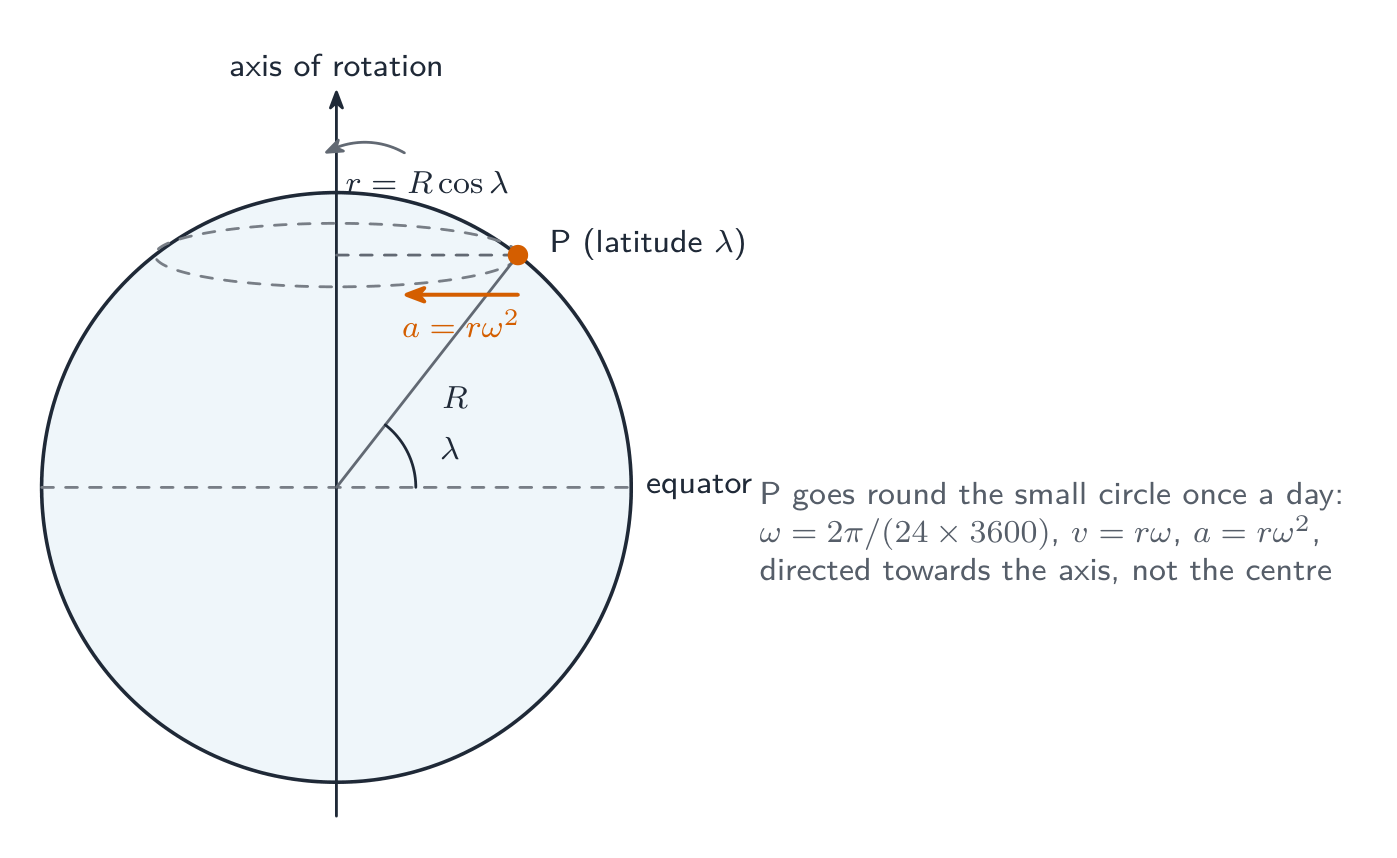
Worked example. The Earth is a sphere of radius $6.37 \times 10^{6}\ \text{m}$ rotating once in $24$ hours. Cambridge is at latitude 纬度 $52.2°$ north. Find the radius of the circle in which Cambridge moves, its speed, and its centripetal acceleration. A student of mass $58.6\ \text{kg}$ stands on bathroom scales there; state and explain the effect of the rotation on the reading.

The circle is about the axis, so $r = R\cos\lambda = 6.37 \times 10^{6} \times \cos 52.2° = 3.90 \times 10^{6}\ \text{m}$. $\omega = 2\pi/(24 \times 3600) = 7.27 \times 10^{-5}\ \text{rad s}^{-1}$, so $v = r\omega = 284\ \text{m s}^{-1}$ and $a = r\omega^{2} = 3.90 \times 10^{6} \times (7.27 \times 10^{-5})^{2} = 2.1 \times 10^{-2}\ \text{m s}^{-2}$. The student needs a resultant force $ma = 1.2\ \text{N}$ towards the axis, which can only come from the weight exceeding the upward contact force; so the scales read less than the weight $mg = 575\ \text{N}$ — by about one newton (the acceleration has a component $a\cos\lambda = 0.013\ \text{m s}^{-2}$ along the vertical, i.e. $0.7\ \text{N}$ of the $1.2\ \text{N}$). Small, but the sign and the reason are the marks.

ไทย

วัตถุที่เคลื่อนที่ในวงกลมด้วยความเร็วคงที่ยังคงมีความ ความเร็ว ที่เปลี่ยนอยู่ — ทิศทางของมันเปลี่ยนแปลงอย่างต่อเนื่อง แม้ขนาดจะคงที่ก็ตาม การเปลี่ยนความเร็วจำเป็นต้องมี ความเร่ง. ความเร่งนี้ชี้ เข้าหาศูนย์กลาง และเรียกว่า ความเร่งเข้าหาศูนย์กลาง.

คำอธิบายสำหรับข้อ 2 คะแนน. ในการเคลื่อนที่วงกลมแบบสม่ำเสมอ ความเร็วจะคงที่แต่ความเร็วจะเปลี่ยนแปลงอย่างต่อเนื่อง เนื่องจากทิศทางเปลี่ยนแปลง; ความเร่งจะมีขนาดคงที่และชี้เข้าหาศูนย์กลางของวงกลมเสมอ ตั้งฉากกับความเร็ว. "บอกความหมายของความเร่งเข้าหาศูนย์กลาง": ความเร่งของวัตถุที่เคลื่อนที่ตามเส้นทางวงกลม ชี้เข้าหาศูนย์กลางของวงกลม.

ขนาด

$$a = \frac{v^{2}}{r} = r\omega^{2}.$$

ทั้งสองรูปแบบมีค่าเท่ากันเพราะ $v = r\omega$. เลือกแบบที่มีปริมาณที่คุณทราบ

ความเร่งเข้าสู่ศูนย์กลางมีทิศทาง ตั้งฉาก กับความเร็วในทุกขณะ — ไม่เคยอยู่ในแนวการเคลื่อนที่เลย (หากมีองค์ประกอบใดอยู่แนวการเคลื่อนที่ ความเร็วจะเปลี่ยนแปลง) หน่วย: $\text{m s}^{-2}$.

ลูกบอลเคลื่อนที่ตามเส้นทางวงกลม: ความเร็วชี้ตามแนวสัมผัส mientras แรงและความเร่งชี้เข้าด้านในสู่ศูนย์กลาง
ความเร็วชี้ตามเส้นสัมผัส; แรงและความเร่งชี้เข้าสู่ศูนย์กลาง

ทำไมความเร็วถึงไม่เปลี่ยน. แรงเข้าหาศูนย์กลางตั้งฉากกับการกระจัดทุกขณะ จึง ไม่ได้做功 (ไม่ทำงาน) กับวัตถุ; พลังงานจลน์ของมัน และดังนั้นความเร็ว จะคงที่. เพียงทิศทางของความเร็วเท่านั้นที่เปลี่ยน — ซึ่งนี่คือสิ่งที่ความเร่งที่ตั้งฉากกับความเร็วดำเนินการ

โลกพร้อมแกนหมุน; จุด P ที่ละติจูด lambda เคลื่อนที่ในวงกลมเล็กรอบแกนที่มีรัศมี R cos lambda, และความเร่งเข้าหาศูนย์กลางของมันชี้เข้าหาแกน
จุดบนโลกที่หมุนเคลื่อนที่ในวงกลมรอบแกน, ที่มีรัศมี $R\cos\lambda$, ไม่ใช่รอบศูนย์กลางของโลก

ตัวอย่างฝึกหัด. โลกเป็นทรงกลมรัศมี $6.37 \times 10^{6}\ \text{m}$ หมุนรอบตัวเองครั้งละ $24$ ชั่วโมง Cambridge อยู่ที่ เส้น vĩ $52.2°$ เหนือ จงหารัศมีของวงกลมที่ Cambridge เคลื่อนที่ ความเร็ว และความเร่งเข้าสู่ศูนย์กลาง ของนักเรียนมวล $58.6\ \text{kg}$ ยืนอยู่บนเครื่องชั่งน้ำหนักที่นั่น ระบุและอธิบายผลกระทบของการหมุนต่อค่าที่อ่านได้

วงกลมอยู่รอบ แกน, ดังนั้น $r = R\cos\lambda = 6.37 \times 10^{6} \times \cos 52.2° = 3.90 \times 10^{6}\ \text{m}$. $\omega = 2\pi/(24 \times 3600) = 7.27 \times 10^{-5}\ \text{rad s}^{-1}$, ดังนั้น $v = r\omega = 284\ \text{m s}^{-1}$ และ $a = r\omega^{2} = 3.90 \times 10^{6} \times (7.27 \times 10^{-5})^{2} = 2.1 \times 10^{-2}\ \text{m s}^{-2}$. นักเรียนต้องการแรงลัพธ์ $ma = 1.2\ \text{N}$ เข้าหาแกน, ซึ่งสามารถมาจากน้ำหนักที่มากกว่าแรงสัมผัสขึ้นด้านบน; ดังนั้นเครื่องชั่งจะอ่านค่า น้อยกว่า น้ำหนัก $mg = 575\ \text{N}$ — ประมาณหนึ่งนิวตัน (ความเร่งมีองค์ประกอบ $a\cos\lambda = 0.013\ \text{m s}^{-2}$ ตามแนวตั้ง, นั่นคือ $0.7\ \text{N}$ ของ $1.2\ \text{N}$). เล็กมาก แต่เครื่องหมายและเหตุผลคือคะแนน

Vocabulary · ⁨คำศัพท์⁩ Train · ⁨ฝึกฝน⁩
English ไทย
latitude/ˈlætɪtjuːd/ ละติจูด
weight/weɪt/ น้ำหนัก
tension/ˈtenʃn/ แรงตึง
friction/ˈfrɪkʃn/ แรงเสียดทาน
normal contact force/ˈnɔːml ˈkɒntækt fɔːs/ แรงสัมผัสปกติ
Watch lesson · ⁨ดูบทเรียน⁩
12.2

Centripetal force · ⁨แรงเข้าหาศูนย์กลาง⁩

English

By Newton's second law, the resultant force 力 on a body in circular motion at constant speed is

$$F = m a = \frac{m v^{2}}{r} = m r \omega^{2}.$$

This is the centripetal force 向心力. It always points towards the centre — perpendicular to the velocity.

The centripetal force is not a new kind of force — it is the net result of the real forces acting (tension, gravity, friction, electric attraction, normal contact force, …). In a problem, work out which real force(s) provide it.

Worked example. A $0.20\ \text{kg}$ ball on a string is whirled in a horizontal circle of radius $0.50\ \text{m}$ at $3.0\ \text{m s}^{-1}$. Find the centripetal force (the tension in the string).

$$F = \frac{mv^{2}}{r} = \frac{0.20 \times 3.0^{2}}{0.50} = 3.6\ \text{N}.$$

Where the centripetal force comes from

  • Ball on a string in a horizontal circle: the tension 张力 in the string.
  • Car turning a flat corner: the friction 摩擦力 between tyres and road ($F = m v^{2}/r$). If the car goes too fast, friction is not enough and it skids outwards.
  • Banked corner 倾斜 (no friction): the horizontal part of the normal contact force 支持力; $\tan\theta = v^{2}/(rg)$ for the angle that needs no friction.
  • A planet or satellite 卫星 in orbit 轨道: the gravitational attraction 引力, $G M m / r^{2} = m v^{2}/r$.
  • Electron 电子 in a circular orbit (Bohr-style model): the electrostatic 静电 attraction between the electron and the positive nucleus 原子核:
$$\frac{kZe^{2}}{r^{2}} = \frac{m_{e} v^{2}}{r},$$

where $k = 1/(4\pi\varepsilon_{0})$ and $Z$ is the nuclear charge. Solve for $v$ to get the orbital speed; then $T = 2\pi r/v$.

The tilted force: conical pendulum, cone and swing-ride

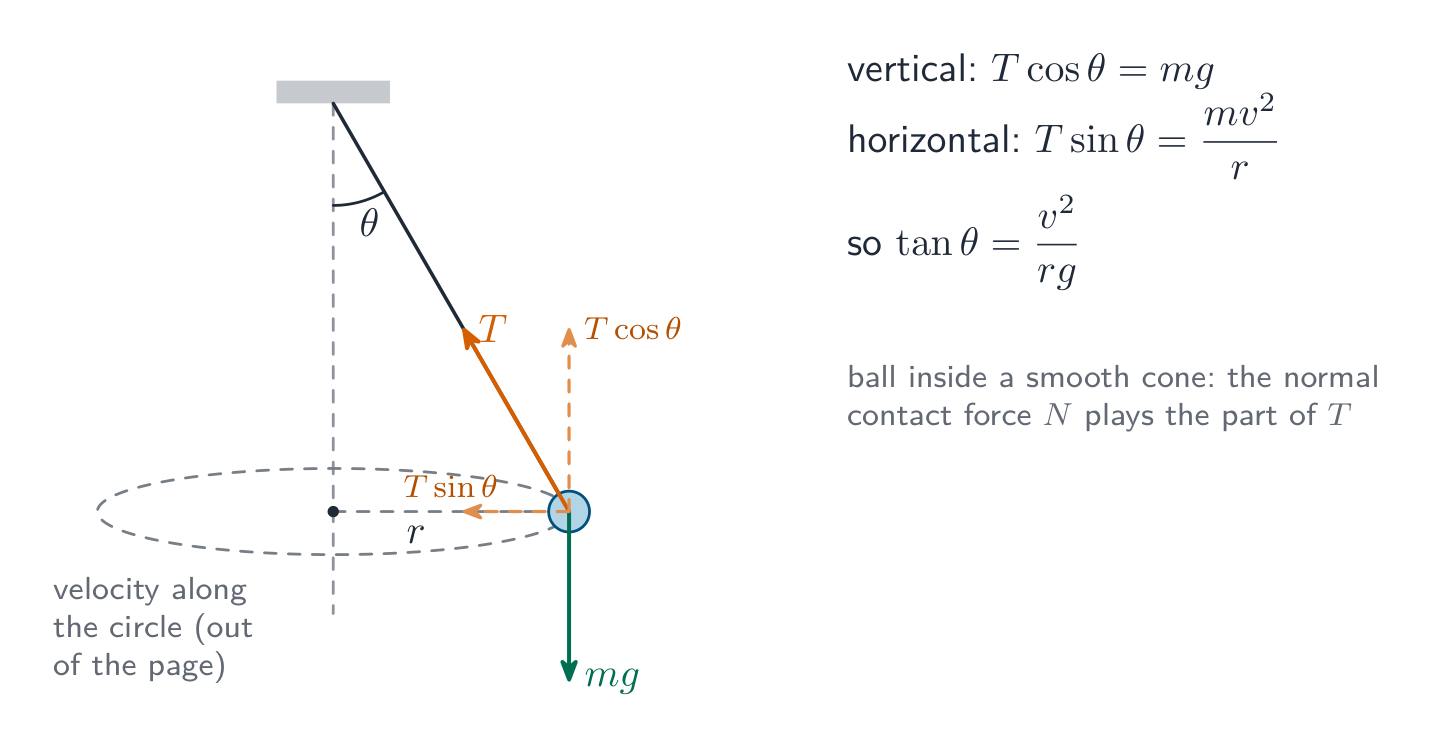
A ball on a string swung in a horizontal circle (a conical pendulum 圆锥摆), a ball rolling round the inside of a smooth cone, a chair on a fairground swing-ride and a car on a banked track are all the same problem: one force (the tension or the normal contact force) is tilted at an angle $\theta$ to the vertical. Resolve it. Its vertical component balances the weight; its horizontal component is the whole centripetal force:

$$F\cos\theta = mg, \qquad F\sin\theta = \frac{mv^{2}}{r} \qquad\Rightarrow\qquad \tan\theta = \frac{v^{2}}{rg}.$$

Never add a separate "centripetal force" to the diagram: the two real forces are the weight and the tilted force, and their resultant is horizontal, towards the centre.

Worked example. A steel ball moves in a horizontal circle of radius $0.12\ \text{m}$ on the smooth inside surface of a cone whose surface makes $52°$ with the horizontal. Name the two forces on the ball, state the direction of their resultant, and find the speed of the ball and the period of its motion.

The forces are the weight (vertically down) and the normal contact force from the cone's surface (perpendicular to the surface, so at $52°$ to the vertical); their resultant is horizontal, towards the centre of the circle. Vertically $N\cos 52° = mg$; horizontally $N\sin 52° = mv^{2}/r$. Dividing: $v^{2} = rg\tan 52° = 0.12 \times 9.81 \times 1.28 = 1.51$, so $v = 1.2\ \text{m s}^{-1}$, and $T = 2\pi r/v = 2\pi \times 0.12/1.23 = 0.61\ \text{s}$. The mass cancels — the speed does not depend on it.

Worked example. A sphere of mass $0.29\ \text{kg}$ hangs from a spring of spring constant $40\ \text{N m}^{-1}$ and unstretched length $6.0\ \text{cm}$. It is set moving in a horizontal circle so that the spring makes $30°$ with the vertical. Find the tension, the radius of the circle and the speed.

Vertically $T\cos 30° = mg$, so $T = 0.29 \times 9.81/0.866 = 3.3\ \text{N}$. The extension is $x = T/k = 3.28/40 = 0.082\ \text{m}$, so the spring's length is $0.060 + 0.082 = 0.142\ \text{m}$ and $r = 0.142\sin 30° = 0.071\ \text{m}$. Horizontally $T\sin 30° = mv^{2}/r$: $v^{2} = 3.28 \times 0.5 \times 0.071/0.29 = 0.40$, $v = 0.63\ \text{m s}^{-1}$. Hooke's law supplies the length; the circle supplies the rest.

Vertical circles

When the circle is upright, the speed is not constant (gravity does work) — but at each instant the net force towards the centre still equals $m v^{2}/r$:

  • at the bottom of a loop: tension up, weight 重力 down, so $T - mg = m v^{2}/r$ — the tension is largest here.
  • at the top of a loop: tension and weight both point down (towards the centre), so $T + mg = m v^{2}/r$ — the tension is smallest. For the slowest speed at the top with the string just tight, set $T = 0$: $mg = m v_{\text{min}}^{2}/r$, giving $v_{\text{min}} = \sqrt{gr}$.

Worked example. A car goes round a vertical loop of radius $2.0\ \text{m}$. Find the minimum speed at the top for the car to keep contact with the track (take $g = 9.81\ \text{m s}^{-2}$).

At the slowest speed the track force is zero, so gravity alone provides the centripetal force: $mg = m v_{\text{min}}^{2}/r$, giving $v_{\text{min}} = \sqrt{gr}$:

$$v_{\text{min}} = \sqrt{9.81 \times 2.0} \approx 4.4\ \text{m s}^{-1}.$$

The constant-speed result ($v = r\omega$, $\omega$ constant) holds for horizontal circles, or where the force only bends the path (orbits in gravity, charges in a magnetic field 磁场).

Circles in fields

Worked example. A helium atom is modelled as a nucleus of charge $+2e$ with two electrons in the same circular orbit of radius $170\ \text{pm}$, always on opposite sides of the nucleus. Find the resultant electric force on one electron and its speed.

Each electron is attracted by the nucleus, distance $r$ away, and repelled by the other electron, distance $2r$ away, along the same line: $F = \dfrac{1}{4\pi\varepsilon_{0}}\left(\dfrac{2e^{2}}{r^{2}} - \dfrac{e^{2}}{(2r)^{2}}\right) = \dfrac{e^{2}}{4\pi\varepsilon_{0}r^{2}} \times 1.75 = \dfrac{2.31 \times 10^{-28}}{(1.7 \times 10^{-10})^{2}} \times 1.75 = 1.4 \times 10^{-8}\ \text{N}$. This is the centripetal force: $v = \sqrt{Fr/m} = \sqrt{1.40 \times 10^{-8} \times 1.7 \times 10^{-10}/(9.11 \times 10^{-31})} = 1.6 \times 10^{6}\ \text{m s}^{-1}$.

Worked example. A proton (mass $1.67 \times 10^{-27}\ \text{kg}$) moving at $2.0 \times 10^{6}\ \text{m s}^{-1}$ enters a uniform magnetic field of flux density $0.50\ \text{T}$ at right angles to the field. Find the radius of its path and the time for one revolution.

The magnetic force $Bqv$ is always perpendicular to the velocity, so it is a centripetal force and the speed is constant: $Bqv = mv^{2}/r$ gives $r = \dfrac{mv}{Bq} = \dfrac{1.67 \times 10^{-27} \times 2.0 \times 10^{6}}{0.50 \times 1.60 \times 10^{-19}} = 4.2 \times 10^{-2}\ \text{m}$, and $T = \dfrac{2\pi r}{v} = \dfrac{2\pi m}{Bq} = 1.3 \times 10^{-7}\ \text{s}$ — independent of the speed, which is why a faster proton makes a larger circle in the same time. For a satellite the gravitational force plays the same part: $\dfrac{GMm}{r^{2}} = mr\omega^{2}$, and the orbital speed and period follow from $r$ alone.

ไทย
รถเหวี่ยงขนาดใหญ่
รถเหวี่ยง: แรงเข้าหาศูนย์กลางเข้าสู่ศูนย์กลางทำให้แต่ละรถเคลื่อนที่ในวงกลม.

ตามกฎข้อที่สองของนิวตัน, แรงลัพธ์ที่กระทำต่อวัตถุในการเคลื่อนที่วงกลมด้วยความเร็วคงที่คือ

$$F = m a = \frac{m v^{2}}{r} = m r \omega^{2}.$$

นี่คือ แรงเข้าหาศูนย์กลาง. มัน ชี้เข้าหาศูนย์กลางเสมอ — ตั้งฉากกับความเร็ว

แรงเข้าหาศูนย์กลางไม่ใช่แรงชนิดใหม่ — มันคือ ผลรวม ของแรงจริงที่กระทำ (แรงตึง, แรงโน้มถ่วง, แรงเสียดทาน, แรงดึงดูดไฟฟ้า, แรงสัมผัสปกติ, …). ในโจทย์ ให้หาว่าแรงจริงใดให้แรงนี้

ตัวอย่างทำข้อ. ลูกบอล $0.20\ \text{kg}$ บนเชือกถูกเหวี่ยงในวงกลมแนวนอนที่มีรัศมี $0.50\ \text{m}$ ที่ $3.0\ \text{m s}^{-1}$. จงหาแรงเข้าหาศูนย์กลาง (แรงตึงในเชือก)

$$F = \frac{mv^{2}}{r} = \frac{0.20 \times 3.0^{2}}{0.50} = 3.6\ \text{N}.$$

แหล่งที่มาของแรงเข้าหาศูนย์กลาง

  • ลูกบอลบนเชือก ในวงกลมแนวนอน: แรงตึงในเชือก
  • รถเลี้ยวโค้งราบ: แรงเสียดทานระหว่างยางและถนน ($F = m v^{2}/r$). ถ้ารถเร็วเกินไป แรงเสียดทานไม่เพียงพอและรถไถลออกด้านนอก
  • โค้งลาด (ไม่มีแรงเสียดทาน): ส่วนแนวนอนของ แรงสัมผัสปกติ; $\tan\theta = v^{2}/(rg)$ สำหรับมุมที่ไม่ต้องใช้แรงเสียดทาน
  • ดาราหรือ ดาวเทียม ใน วงโคจร: แรงดึงดูด, $G M m / r^{2} = m v^{2}/r$
  • อิเล็กตรอน ในวงโคจรวงกลม (โมเดลแบบโบร์): แรงดึงดูดทางไฟฟ้าระหว่างอิเล็กตรอนและ นิวเคลียสที่มีประจุบวก:
$$\frac{kZe^{2}}{r^{2}} = \frac{m_{e} v^{2}}{r},$$

โดยที่ $k = 1/(4\pi\varepsilon_{0})$ และ $Z$ คือประจุของนิวเคลียส. แก้สมการเพื่อหา $v$ เพื่อรับความเร็ววงโคจร; แล้ว $T = 2\pi r/v$

รถบนรางลาด; แรงสัมผัสปกติ F จากถนนต่อรถแยกออกเป็นส่วนตั้งฉาก F_v สมดุลกับน้ำหนักและส่วนแนวนอน F_h ชี้สู่ศูนย์กลางของวงกลม
บนทางโค้งที่เอียง ส่วนประกอบแนวนอนของแรงจากพื้นให้แรงสู่ศูนย์กลาง

แรงเอียง: คอนิกเพนดูลัม,กรวยและรถเหวี่ยง

ลูกบอลผูกเชือกหมุนเป็นวงกลมแนวนอน ( ลูกตุ้มนาฬิกาข้อมือ ) ลูกบอลกลิ้งรอบด้านในของกรวยเรียบ เก้าอี้บนเครื่องเล่นสวนสนุก และรถยนต์บนถนนโค้ง ล้วนเป็นปัญหาเดียวกัน: แรงหนึ่ง (แรงตึงหรือแรงสัมผัสปกติ) มี ความเอียง เป็นมุม $\theta$ จากแนวตั้ง แยกองค์ประกอบออก องค์ประกอบ แนวตั้ง จะสมดุลกับน้ำหนัก ส่วนองค์ประกอบ แนวนอน คือแรงเข้าศูนย์กลางทั้งหมด:

$$F\cos\theta = mg, \qquad F\sin\theta = \frac{mv^{2}}{r} \qquad\Rightarrow\qquad \tan\theta = \frac{v^{2}}{rg}.$$

ห้ามเพิ่ม "แรงเข้าศูนย์กลาง" แยกต่างหากลงในแผนภาพ: แรงจริงสองแรงคือน้ำหนักและแรงที่เอียง และผลรวมของแรงทั้งสองมีทิศทางแนวนอน เข้าหาจุดศูนย์กลาง

ลูกตุ้มนาฬิกาข้อมือ: เชือกทำมุม theta กับแนวตั้ง ขณะลูกตุ้มเคลื่อนที่เป็นวงกลมแนวนอน; แรงตึง T แยกเป็น T cos theta ชี้ขึ้น เพื่อสมดุลกับน้ำหนัก และ T sin theta ชี้เข้าหาจุดศูนย์กลาง เพื่อสร้างแรงเข้าศูนย์กลาง
แยกองค์ประกอบแรงที่เอียง: องค์ประกอบแนวตั้ง $= mg$, องค์ประกอบแนวนอน $= mv^{2}/r$

ตัวอย่างโจทย์ ลูกบอลเหล็กเคลื่อนที่เป็นวงกลมแนวนอนรัศมี $0.12\ \text{m}$ บนพื้นผิวภายในเรียบของกรวย whose surface makes $52°$ กับแนวนอน ระบุชื่อแรงสองแรงที่กระทำต่อลูกบอล บอกทิศทางของผลรวมแรง และหาค่าความเร็วและคาบของการเคลื่อนที่ของลูกบอล

แรงคือ น้ำหนัก (ชี้ลงแนวตั้ง) และ แรงสัมผัสปกติ จากพื้นผิวกรวย (ตั้งฉากกับพื้นผิว ดังนั้นทำมุม $52°$ กับแนวตั้ง); ผลรวมของแรงทั้งสองมีทิศทางแนวนอน เข้าหาจุดศูนย์กลาง ของวงกลม แนวตั้ง $N\cos 52° = mg$; แนวนอน $N\sin 52° = mv^{2}/r$. นำมาหารกัน: $v^{2} = rg\tan 52° = 0.12 \times 9.81 \times 1.28 = 1.51$, ดังนั้น $v = 1.2\ \text{m s}^{-1}$, และ $T = 2\pi r/v = 2\pi \times 0.12/1.23 = 0.61\ \text{s}$. มวลจะตัดกัน — ความเร็วไม่ขึ้นอยู่กับมวล

ตัวอย่างโจทย์ spheres of mass $0.29\ \text{kg}$ แขวนจากสปริงที่มีค่าคงที่ $40\ \text{N m}^{-1}$ และความยาวตามธรรมชาติ $6.0\ \text{cm}$. ตั้งให้เคลื่อนที่เป็นวงกลมแนวนอนจนสปริงทำมุม $30°$ กับแนวตั้ง หาแรงตึง รัศมีของวงกลม และความเร็ว

แนวตั้ง $T\cos 30° = mg$, ดังนั้น $T = 0.29 \times 9.81/0.866 = 3.3\ \text{N}$. การยืดออกคือ $x = T/k = 3.28/40 = 0.082\ \text{m}$, ดังนั้นความยาวของสปริงคือ $0.060 + 0.082 = 0.142\ \text{m}$ และ $r = 0.142\sin 30° = 0.071\ \text{m}$. แนวนอน $T\sin 30° = mv^{2}/r$: $v^{2} = 3.28 \times 0.5 \times 0.071/0.29 = 0.40$, $v = 0.63\ \text{m s}^{-1}$. กฎของฮุคให้ความยาว; วงกลมให้ความเหลืออีกส่วน

วงกลมแนวตั้ง

เมื่อวงกลมตั้งตรง ความเร็ว ไม่ใช่ ค่าคงที่ (แรงโน้มถ่วงทำงาน) — แต่ในขณะใดขณะหนึ่ง แรงลัพธ์เข้าหาจุดศูนย์กลาง ยังคงเท่ากับ $m v^{2}/r$:

  • ที่ก้นวงแหวน: แรงตึงชี้ขึ้น, น้ำหนัก ชี้ลง, ดังนั้น $T - mg = m v^{2}/r$ — แรงตึงจะมีค่ามากที่สุดในจุดนี้
  • ที่ยอดของวงLoop: แรงตึงเชือกและแรงโน้มถ่วงชี้ลงทั้งหมด (เข้าหาศูนย์กลาง), ดังนั้น $T + mg = m v^{2}/r$ — แรงตึงเชือกมีค่าน้อยที่สุด สำหรับความเร็วต่ำสุดที่ยอดโดยที่เชือกตึงพอดี ตั้งให้ $T = 0$: $mg = m v_{\text{min}}^{2}/r$, จะได้ $v_{\text{min}} = \sqrt{gr}$.

วัตถุบนเครื่องเล่นวงกลมวาดไว้ที่ยอดและก้นของวงแหวน; ที่ยอด น้ำหนัก W และแรงสัมผัสปกติ R_t ชี้ลง, ที่ก้น แรงสัมผัสปกติ R_b ชี้ขึ้น และน้ำหนัก W ชี้ลง *แรงที่กระทำต่อบุคคลที่ยอดและก้นของวงกลมแนวตั้ง

ตัวอย่างโจทย์ รถยนต์วิ่งผ่านวงแหวนแนวตั้งรัศมี $2.0\ \text{m}$. หาค่าความเร็วขั้นต่ำที่ยอดเพื่อให้รถยนต์ยังคงติดกับราง (ใช้ $g = 9.81\ \text{m s}^{-2}$).

ที่ความเร็วต่ำสุด แรงจากรางจะเป็นศูนย์ ดังนั้นแรงโน้มถ่วงเพียงอย่างเดียวที่จะสร้างแรงเข้าศูนย์กลาง: $mg = m v_{\text{min}}^{2}/r$, ทำให้ได้ $v_{\text{min}} = \sqrt{gr}$:

$$v_{\text{min}} = \sqrt{9.81 \times 2.0} \approx 4.4\ \text{m s}^{-1}.$$

ผลลัพธ์ของความเร็วมูลค่าคงที่ ($v = r\omega$, $\omega$ คงที่) ใช้ได้กับวงกลมแนวนอน หรือบริเวณที่แรงเพียงแต่ทำให้เส้นทางโค้ง (วงโคจรภายใต้แรงโน้มถ่วง,ประจุไฟฟ้าใน สนามแม่เหล็ก ).

วงกลมในสนาม

ตัวอย่างโจทย์ อะตอมฮีเลียมถูกจำลองว่าเป็นนิวเคลียสที่มีประจุ $+2e$ และมีอิเล็กตรอนสองตัวอยู่ในวงโคจรวงกลมเดียวกันรัศมี $170\ \text{pm}$ โดยอยู่ตรงข้ามกันเสมอบนนิวเคลียส หาแรงไฟฟ้าลัพธ์ที่กระทำต่ออิเล็กตรอนตัวหนึ่งและความเร็วของมัน

อิเล็กตรอนแต่ละตัวถูกดึงดูดโดยนิวเคลียส ระยะ $r$ และถูกผลักโดยอิเล็กตรอนอีกตัวหนึ่ง ระยะ $2r$ ตามเส้นตรงเดียวกัน: $F = \dfrac{1}{4\pi\varepsilon_{0}}\left(\dfrac{2e^{2}}{r^{2}} - \dfrac{e^{2}}{(2r)^{2}}\right) = \dfrac{e^{2}}{4\pi\varepsilon_{0}r^{2}} \times 1.75 = \dfrac{2.31 \times 10^{-28}}{(1.7 \times 10^{-10})^{2}} \times 1.75 = 1.4 \times 10^{-8}\ \text{N}$. นี่คือแรงเข้าศูนย์กลาง: $v = \sqrt{Fr/m} = \sqrt{1.40 \times 10^{-8} \times 1.7 \times 10^{-10}/(9.11 \times 10^{-31})} = 1.6 \times 10^{6}\ \text{m s}^{-1}$.

ตัวอย่างโจทย์ โปรตอน (มวล $1.67 \times 10^{-27}\ \text{kg}$) เคลื่อนที่ด้วยความเร็ว $2.0 \times 10^{6}\ \text{m s}^{-1}$ เข้าไปในสนามแม่เหล็กสม่ำเสมอที่มีความหนาแน่นฟลักซ์ $0.50\ \text{T}$ ในมุมฉากกับสนาม หารัศมีของเส้นทางและเวลาสำหรับการหมุนหนึ่งรอบ

แรงแม่เหล็ก $Bqv$ มีทิศทางตั้งฉากกับความเร็วเสมอ จึงเป็นแรงเข้าศูนย์กลางและความเร็วคงที่: $Bqv = mv^{2}/r$ ทำให้ได้ $r = \dfrac{mv}{Bq} = \dfrac{1.67 \times 10^{-27} \times 2.0 \times 10^{6}}{0.50 \times 1.60 \times 10^{-19}} = 4.2 \times 10^{-2}\ \text{m}$, และ $T = \dfrac{2\pi r}{v} = \dfrac{2\pi m}{Bq} = 1.3 \times 10^{-7}\ \text{s}$ — ไม่ขึ้นอยู่กับความเร็ว นั่นคือเหตุผลว่าทำไมโปรตอนที่มีความเร็วสูงกว่าจะเคลื่อนที่เป็นวงกลมที่ใหญ่กว่าในเวลาเดียวกัน สำหรับดาวเทียม แรงโน้มถ่วงทำหน้าที่เดียวกัน: $\dfrac{GMm}{r^{2}} = mr\omega^{2}$, และความเร็ววงโคจรและคาบจะหาได้จาก $r$ เพียงอย่างเดียว

Explore · ⁨สำรวจ⁩

Centripetal force and speed · ⁨แรงสู่ศูนย์กลางและความเร็ว⁩

F = mv²/r

For circular motion the force needed grows with the square of the speed — double v, four times the force. · ⁨สำหรับการเคลื่อนที่แบบวงกลม แรงที่ต้องการจะเพิ่มขึ้นตาม กำลังสองของความเร็ว — ถ้าเพิ่ม v เป็นสองเท่า แรงจะ增加到สี่เท่า⁩

Vocabulary · ⁨คำศัพท์⁩ Train · ⁨ฝึกฝน⁩
English ไทย
force/fɔːs/ แรง
centripetal force/senˈtrɪpɪtl fɔːs/ แรงเข้าสู่ศูนย์กลาง
Banked corner/bæŋkt ˈkɔːnə/ ทางโค้งที่มีระดับ
banked/bæŋkt/ ทางโค้งเอียง
satellite/ˈsætəlaɪt/ ดาวเทียม
orbit/ˈɔːbɪt/ วงโคจร
gravitational attraction/ˌɡrævɪˈteɪʃənl əˈtrækʃn/ แรงดึงดูดโน้มถ่วง
electron/ɪˈlektrɒn/ อิเล็กตรอน
electrostatic/ɪˌlektrəʊˈstætɪk/ สถิตไฟฟ้า
nucleus/ˈnjuːklɪəs/ นิวเคลียส
conical pendulum/ˈkɒnɪkl ˈpendjʊləm/ ลูกตุ้มนาฬิกาขี้ผึ้ง
magnetic field/mæɡˈnetɪk fiːld/ สนามแม่เหล็ก
radial/ˈreɪdɪəl/ แบบรัศมี
12.2

How to structure a circular-motion answer · ⁨วิธีจัดรูปแบบคำตอบเกี่ยวกับการเคลื่อนที่วงกลม⁩

English
  1. Find the radius $r$ and choose $v$ or $\omega$. Use $v = r\omega$ to switch between them.
  2. Find the centripetal acceleration with $a = v^{2}/r$ or $r\omega^{2}$.
  3. List the real forces and write Newton's second law in the radial 径向 direction (towards the centre is positive). Set the net inward force equal to $m v^{2}/r$.
  4. For period or frequency: use $\omega = 2\pi/T$, or $T = 2\pi r / v$.
  5. Check the directions: centripetal force and acceleration point to the centre; the velocity is along the tangent.
ไทย
  1. หาค่ารัศมี $r$ และเลือก $v$ หรือ $\omega$. ใช้ $v = r\omega$ เพื่อเปลี่ยนระหว่างกัน
  2. หาค่าความเร่งเข้าศูนย์กลาง โดยใช้ $a = v^{2}/r$ หรือ $r\omega^{2}$.
  3. ระบุแรงจริง และเขียนกฎข้อที่สองของนิวตันในทิศทาง รัศมี (เข้าหาจุดศูนย์กลางเป็นบวก) ตั้งให้แรงลัพธ์เข้าหาจุดศูนย์กลางเท่ากับ $m v^{2}/r$.
  4. สำหรับ คาบหรือความถี่: ใช้ $\omega = 2\pi/T$, หรือ $T = 2\pi r / v$.
  5. ตรวจสอบ ทิศทาง: แรงเข้าศูนย์กลางและความเร่งชี้เข้าหาจุดศูนย์กลาง; ความเร็วอยู่ตามเส้นสัมผัส
12.2

Definitions the examiner accepts · ⁨คำนิยามที่ผู้สอบยอมรับ⁩

English

A definition question is marked against fixed wording. Learn these exactly, and give one answer only.

Term Definition
radian the angle subtended at the centre of a circle by an arc equal in length to the radius
angular displacement the angle, in radians, through which the radius has turned from its starting position
angular speed the angle swept out by the radius per unit time (the rate of change of angular displacement)
period the time taken for one complete revolution
uniform circular motion motion in a circle at constant speed, with a velocity that changes continuously in direction and an acceleration of constant magnitude directed towards the centre
centripetal acceleration the acceleration of an object moving in a circular path, directed towards the centre of the circle and perpendicular to the velocity
centripetal force the resultant force on an object in circular motion, directed towards the centre, of magnitude $mv^{2}/r$
ไทย

คำถามคำนิยามจะให้คะแนนตามข้อความที่กำหนดไว้你必须 exact. เรียนรู้ให้ถูกต้องและตอบเพียงคำตอบเดียวเท่านั้น

พจน์ นิยาม
เรเดียน มุมที่วัดได้ที่จุดศูนย์กลางของวงกลมโดยส่วนโค้งที่มีความยาวเท่ากับรัศมี
การกระจัดเชิงมุม มุม (หน่วยเรเดียน) ที่รัศมีหมุนจากตำแหน่งเริ่มต้น
ความเร็วเชิงมุม มุมที่รัศมีกวาดผ่านต่อหน่วยเวลา (อัตราการเปลี่ยนแปลงของการกระจัดเชิงมุม)
คาบ เวลาที่ใช้สำหรับการหมุนครบหนึ่งรอบ
การเคลื่อนที่วงกลมแบบสม่ำเสมอ การเคลื่อนที่เป็นวงกลมด้วยความเร็วคงที่ โดยมีความเร็วที่เปลี่ยนทิศทางอย่างต่อเนื่องและความเร่งที่มีขนาดคงที่ชี้เข้าหาจุดศูนย์กลาง
ความเร่งเข้าศูนย์กลาง ความเร่งของวัตถุที่เคลื่อนที่ตามวงกลม มีทิศทางเข้าสู่จุดกึ่งกลางวงกลมและตั้งฉากกับความเร็ว
แรงเข้าศูนย์กลาง แรงลัพธ์ที่กระทำต่อวัตถุในวงกลม มีทิศทางเข้าสู่จุดกึ่งกลาง ขนาด $mv^{2}/r$
12.2

Exam tips · ⁨ข้อแนะนำสำหรับการสอบ⁩

English
  • Work in radians; angular speed $\omega = 2\pi/T = v/r$, and arc length $s = r\theta$ turns a distance along the circle into an angle.
  • Centripetal acceleration $a = v^2/r = \omega^2 r$; the net force acts towards the centre — it is provided by tension/gravity/friction/a contact force, not an extra force.
  • Always state what provides the centripetal force in the situation given, and for a tilted force resolve it: vertical component $= mg$, horizontal component $= mv^{2}/r$.
  • Read the radius carefully: a point measured from the rim moves in a smaller circle; a point on the rotating Earth moves in a circle about the axis, radius $R\cos\lambda$.
  • Two cogs on one chain share the chain's speed; two points on one rigid wheel share its angular speed.

Common mistakes

  • Defining the radian as "$180/\pi$ degrees" or as $\theta = s/r$. The mark needs the arc equal in length to the radius.
  • Saying the velocity is constant in uniform circular motion. The speed is constant; the velocity changes direction, which is why there is an acceleration.
  • Drawing a "centripetal force" arrow as an extra force alongside the tension or contact force. It is their resultant, not a third force.
  • Using degrees in $\omega t$ or $v = r\omega$. Every formula in this topic assumes radians.
  • Forgetting that the force does no work: a force perpendicular to the motion changes direction, not speed, so kinetic energy is constant.
  • Taking $r$ as the Earth's radius for a point at latitude $\lambda$. The circle is about the axis, so $r = R\cos\lambda$.
ไทย
  • งานใน เรเดียน; ความเร็วเชิงมุม $\omega = 2\pi/T = v/r$, และความยาวส่วนโค้ง $s = r\theta$ เปลี่ยนระยะทางบนวงกลมเป็นมุม.
  • ความเร่งเข้าศูนย์กลาง $a = v^2/r = \omega^2 r$; แรงสุทธิมีทิศทาง เข้าสู่จุดกึ่งกลาง — เกิดจากแรงตึง/แรงโน้มถ่วง/แรงเสียดทาน/แรงสัมผัส ไม่ใช่แรงเพิ่มขึ้นมาใหม่.
  • ระบุเสมอว่า อะไรคือแหล่งกำเนิดของแรงเข้าศูนย์กลาง ในสถานการณ์ที่กำหนด และหากมีแรงเอียงให้แยกองค์ประกอบ: องค์ประกอบแนวตั้ง $= mg$, องค์ประกอบแนวนอน $= mv^{2}/r$.
  • อ่านค่ารัศมีให้ละเอียด: จุดที่วัด จากริม จะเคลื่อนที่เป็นวงกลมเล็กกว่า; จุดบนโลกหมุนจะเคลื่อนที่เป็นวงกลมรอบ แกน, รัศมี $R\cos\lambda$.
  • ฟันเฟืองสองตัวบนสายพานเดียวกันมี ความเร็ว ของสายพานร่วมกัน; จุดสองจุดบนล้อแข็งเดียวกันมี ความเร็วเชิงมุม ร่วมกัน.

ข้อผิดพลาดที่พบบ่อย

  • การนิยามเรเดียนว่าเป็น "$180/\pi$ องศา" หรือ $\theta = s/r$. คะแนนต้องการให้ความยาวส่วนโค้งเท่ากับรัศมี.
  • บอกว่าความเร็วเป็นค่าคงที่ในการเคลื่อนที่วงกลมสม่ำเสมอ. อัตราเร็ว เป็นค่าคงที่; ความเร็ว เปลี่ยนทิศทาง จึงมีความเร่ง.
  • วาดลูกศร "แรงเข้าศูนย์กลาง" เป็นแรงเสริม alongside กับแรงตึงหรือแรงสัมผัส. มันเป็นแรงลัพธ์ ไม่ใช่แรงที่สาม.
  • ใช้องศาใน $\omega t$ หรือ $v = r\omega$. สูตรทุกสูตรในหัวข้อนี้สมมติใช้เรเดียน.
  • ลืมว่าแรงไม่ทำงาน: แรงตั้งฉากกับการเคลื่อนที่เปลี่ยนเพียงทิศทาง ไม่เปลี่ยนอัตราเร็ว ดังนั้นพลังงานจลน์คงที่.
  • ถือ $r$ เป็นรัศมีของโลกสำหรับจุดที่ละติจูด $\lambda$. วงกลมอยู่รอบแกน ดังนั้น $r = R\cos\lambda$.

Interactive lessons on this topic · ⁨บทเรียนเชิงโต้ตอบสำหรับหัวข้อนี้⁩

Work through it step by step, with instant-check exercises. · ⁨ทำทีละขั้นตอน พร้อมแบบฝึกหัดตรวจสอบผลทันที⁩

Past Papers · ⁨ข้อสอบย้อนหลัง⁩

More topics in A-Level Physics · ⁨Physics A-Level⁩ · ⁨หัวข้อเพิ่มเติมใน A-Level Physics · ⁨Physics A-Level⁩⁩

Log in or create account · ⁨เข้าสู่ระบบหรือสร้างบัญชี⁩

IGCSE, A-Level & AP