Skip to content · ⁨ข้ามไปยังเนื้อหา⁩

Further Mechanics · ⁨กลศาสตร์เพิ่มเติม⁩

A-Level Further Mathematics · ⁨Further Mathematics A-Level⁩ · Topic 3 · ⁨หัวข้อ 3⁩

Video lesson for this topic · ⁨บทเรียนวิดีโอสำหรับหัวข้อนี้⁩ Open the video page · ⁨เปิดหน้าวิดีโอ⁩
8:04

กลศาสตร์เพิ่มเติม

โยนลูกบอล ยิงน้ำ喷射 หรือปล่อยอะไรบางอย่างขึ้นฟ้า — และมันจะวาดเส้นโค้งเดียวกันที่สวยงาม: พาราโบลา ความลับคือการแยกการเคลื่อนที่ออกเป็นสอง…

English narration · English + 中文 subtitles burned in · ⁨การบรรยายภาษาอังกฤษ · คำบรรยายภาษาอังกฤษ + 中文 ลอยตัวบนภาพ⁩

English

This handout covers Topic 3: Further Mechanics 进阶力学. It extends mechanics to projectiles, rigid bodies, circular motion, elastic strings, variable forces and collisions. Take $g = 10\ \text{m s}^{-2}$.

ไทย

เอกสารฉบับนี้ครอบคลุมหัวข้อที่ 3: กลศาสตร์ขั้นสูง ซึ่งขยายเนื้อหากลศาสตร์ไปยังวัตถุโปรเจกไทล์ วัตถุแข็งเกร็ง การเคลื่อนที่วงกลม สายยางยืด แรงแปรผัน และการชนกัน เลือก $g = 10\ \text{m s}^{-2}$

3.1

Motion of a projectile · ⁨การเคลื่อนที่ของวัตถุโปรเจกไทล์⁩

Syllabus · ⁨หลักสูตร⁩
English
Candidates should be able to: Notes and examples
• model the motion of a projectile as a particle moving with constant acceleration and understand any limitations of the model Vector methods are not required
• use horizontal and vertical equations of motion to solve problems on the motion of projectiles, including finding the magnitude and direction of the velocity at a given time or position, the range on a horizontal plane and the greatest height reached
• derive and use the Cartesian equation of the trajectory of a projectile, including problems in which the initial speed and/or angle of projection may be unknown. Knowledge of the 'bounding parabola' for accessible points is not included.
ไทย
ผู้เข้าสอบควรสามารถ: หมายเหตุและตัวอย่าง
📐 สร้างแบบจำลองการเคลื่อนที่ของ วัตถุถูกยิง ว่าเป็นอนุภาคที่เคลื่อนที่ด้วยความเร่งคงที่ และเข้าใจข้อจำกัดของแบบจำลอง ไม่จำเป็นต้องใช้วิธีการเวกเตอร์
📐 ใช้สมการการเคลื่อนที่แนวนอนและแนวตั้งเพื่อแก้ปัญหาเกี่ยวกับการเคลื่อนที่ของวัตถุถูกยิง, รวมถึงการหาขนาดและทิศทางของความเร็ว ณ เวลาหรือตำแหน่งที่กำหนด, ระยะทางบนระนาบแนวนอน และความสูงสูงสุดที่ถึงได้
• หาและใช้ สมการคาร์ทีเซียน ของเส้นทางการเคลื่อนที่ของวัตถุที่กระโดดขึ้นในอากาศ รวมถึงปัญหาที่มีความเร็วเริ่มต้นและ/หรือมุมในการยิงไม่ทราบค่า ไม่รวมถึงความรู้เกี่ยวกับ 'พาราโบลาจำกัด' สำหรับจุดที่เข้าถึงได้

Source: Cambridge International syllabus · ⁨แหล่งที่มา: หลักสูตร Cambridge International⁩

English
Dropped vs thrown: falling together

A projectile 抛射体 moves freely under gravity, so it has constant acceleration 匀加速 $g$ downwards and no horizontal acceleration. Treat the horizontal and vertical motions separately. If it is launched at speed $u$ and angle $\alpha$:

$$\text{horizontal: } x = u\cos\alpha\,\cdot t, \qquad \text{vertical: } y = u\sin\alpha\,\cdot t - \tfrac12 g t^2.$$
Eliminating $t$ gives the Cartesian equation 直角坐标方程 of the trajectory 轨迹 (the path), which is a parabola. For a fixed launch speed, all the trajectories lie under a bounding parabola 包络抛物线 (the envelope of reachable points). The range on level ground is $\dfrac{u^2\sin 2\alpha}{g}$ and the greatest height is $\dfrac{u^2\sin^2\alpha}{2g}$.

Worked example. A ball is thrown at $u = 20\ \text{m s}^{-1}$ at $30^\circ$ to the horizontal. Find the range and greatest height.

$$\text{range} = \frac{20^2\sin 60^\circ}{10} = 40\times 0.866 = 34.6\ \text{m}, \qquad \text{height} = \frac{20^2\sin^2 30^\circ}{2\times 10} = \frac{400\times 0.25}{20} = 5\ \text{m}.$$

ไทย
ปล่อย vs ทิ้ง: หล่นพร้อมกัน
น้ำพวยพุ่งเป็นโค้งในบ่อน้ำใหญ่
พวยงาน้ำเคลื่อนที่ตามเส้นทางพาราโบลา — การเคลื่อนที่แบบโปรเจกไทล์คลาสสิกภายใต้แรงโน้มถ่วง

วัตถุ โปรเจกไทล์ เคลื่อนที่อย่างอิสระภายใต้แรงโน้มถ่วง จึงมี ความเร่งคงที่ $g$ ชี้ลงด้านล่างและไม่มีความเร่งแนวนอน พิจารณาการเคลื่อนที่แนวนอนและแนวตั้งแยกจากกัน หากมันถูกยิงด้วยความเร็ว $u$ ที่มุม $\alpha$:

$$\text{horizontal: } x = u\cos\alpha\,\cdot t, \qquad \text{vertical: } y = u\sin\alpha\,\cdot t - \tfrac12 g t^2.$$
การกำจัด $t$ จะได้ สมการคาร์ทีเซียน ของ เส้นทาง (trajectory) ซึ่งเป็นพาราโบลา สำหรับความเร็วในการยิงคงที่ เส้นทางทั้งหมดจะอยู่ใต้ พาราโบลาค่าจำกัด (bounding parabola; envelope of reachable points) ระยะทางบนพื้นราบคือ $\dfrac{u^2\sin 2\alpha}{g}$ และความสูงสูงสุดคือ $\dfrac{u^2\sin^2\alpha}{2g}$

เส้นทางพาราโบลาที่แยกความเร็วในการยิงออกเป็นองค์ประกอบแนวนอนและแนวตั้ง
เส้นทางเป็นพาราโบลา; ความเร็วในการยิง $u$ แยกออกเป็นองค์ประกอบแนวนอนที่คงที่และองค์ประกอบแนวตั้งที่ช้าลงเนื่องจากแรงโน้มถ่วง

ตัวอย่างวิธีทำ. ขวดยิงด้วยความเร็ว $u = 20\ \text{m s}^{-1}$ ที่มุม $30^\circ$ เทียบกับแนวนอน หาระยะทางและความสูงสูงสุด

$$\text{range} = \frac{20^2\sin 60^\circ}{10} = 40\times 0.866 = 34.6\ \text{m}, \qquad \text{height} = \frac{20^2\sin^2 30^\circ}{2\times 10} = \frac{400\times 0.25}{20} = 5\ \text{m}.$$

Explore · ⁨สำรวจ⁩

Launch a projectile · ⁨ยิงวัตถุ⁩

Fire the ball, then change the angle and speed. The horizontal motion is steady while gravity pulls it down — together they trace a parabola. Find the angle for the longest range, and try the Moon. · ⁨ยิงลูกบอล แล้วเปลี่ยนมุมและความเร็ว การเคลื่อนที่แนวนอนมีความคงที่ขณะที่แรงโน้มถ่วงดึงลง — ทั้งสองรวมกันสร้างเส้นโค้งพาราโบลา หามุมที่ให้ระยะทางไกลที่สุด และลองทำบนดวงจันทร์⁩

Vocabulary · ⁨คำศัพท์⁩ Train · ⁨ฝึกฝน⁩
English ไทย
Further Mechanics/ˈfɜːðə mɪˈkænɪks/ กลศาสตร์เพิ่มเติม
projectile/prəˈdʒektaɪl/ วัตถุถูกยิง
constant acceleration/ˈkɒnstənt əkˌseləˈreɪʃn/ ความเร่งคงที่
Cartesian equation/kɑːˈtiːzɪən ɪˈkweɪʒn/ สมการคาร์ทีเซียน
trajectory/trəˈdʒektəri/ เส้นทาง
bounding parabola/ˈbaʊndɪŋ pəˈræbələ/ พาราโบลาขอบเขต
3.2

Equilibrium of a rigid body · ⁨สมดุลของวัตถุแข็งเกร็ง⁩

Syllabus · ⁨หลักสูตร⁩
English
Candidates should be able to: Notes and examples
• calculate the moment of a force about a point For questions involving coplanar forces only; understanding of the vector nature of moments is not required.
• use the result that the effect of gravity on a rigid body is equivalent to a single force acting at the centre of mass of the body, and identify the position of the centre of mass of a uniform body using considerations of symmetry
• use given information about the position of the centre of mass of a triangular lamina and other simple shapes Proofs of results given in the MF19 List of formulae are not required.
• determine the position of the centre of mass of a composite body by considering an equivalent system of particles Simple cases only, e.g. a uniform L-shaped lamina, or a uniform cone joined at its base to a uniform hemisphere of the same radius.
• use the principle that if a rigid body is in equilibrium under the action of coplanar forces then the vector sum of the forces is zero and the sum of the moments of the forces about any point is zero, and the converse of this
• solve problems involving the equilibrium of a single rigid body under the action of coplanar forces, including those involving toppling or sliding.
ไทย
ผู้เข้าสอบควรสามารถ: หมายเหตุและตัวอย่าง
• คำนวณ โมเมนต์ ของแรงรอบจุดหนึ่ง สำหรับข้อสอบที่เกี่ยวข้องกับ แรงระนาบ เท่านั้น; ความเข้าใจในลักษณะเวกเตอร์ของโมเมนต์ไม่จำเป็น
• ใช้ผลลัพธ์ที่ว่าผลของแรงโน้มถ่วงต่อ ร่างกายแข็ง มีผลเทียบเท่าแรงเดียวกระทำที่ จุดศูนย์กลางมวล ของร่างกาย และระบุตำแหน่งของจุดศูนย์กลางมวลของร่างกายสม่ำเสมอโดยใช้หลักการสมมาตร
• ใช้ข้อมูลที่กำหนดให้เกี่ยวกับตำแหน่งของจุดศูนย์กลางมวลของแผ่นบางรูปสามเหลี่ยมและรูปร่างเรียบง่ายอื่นๆ การพิสูจน์ผลลัพธ์ที่ระบุไว้ในรายการสูตร MF19 ไม่จำเป็น
• กำหนดตำแหน่งของจุดศูนย์กลางมวลของ ร่างกายประกอบ โดยพิจารณาจากระบบอนุภาคที่เทียบเท่า กรณีง่ายเท่านั้น เช่น แผ่นบางรูปตัว L สม่ำเสมอ หรือกรวยสม่ำเสมอเชื่อมฐานกับครึ่งทรงกลมสม่ำเสมอที่มีรัศมีเท่ากัน
• ใช้หลักการที่ว่าถ้าร่างกายแข็งอยู่ใน สมดุล ภายใต้การกระทำของแรงระนาบ แล้วผลรวมของแรงเป็นศูนย์และผลรวมของโมเมนต์ของแรงรอบจุดใดๆ เป็นศูนย์ และกลับด้านของสิ่งนี้
• แก้ปัญหา涉及到การสมดุลของร่างกายแข็งภายใต้การกระทำของแรงระนาบ بماที่涉及到 การล้ม หรือ การลื่นไถล

Source: Cambridge International syllabus · ⁨แหล่งที่มา: หลักสูตร Cambridge International⁩

English

The moment 力矩 of a force about a point is force $\times$ perpendicular distance; it measures turning effect. The weight of a body acts at its centre of mass 质心, which you can find using symmetry 对称 for a uniform flat shape (a lamina 薄片), or by treating a composite body as a set of particles.

A rigid body under coplanar forces 共面力 is in equilibrium 平衡 when two conditions both hold: the vector sum of the forces is zero, and the sum of the moments about any point is zero. A body may also be on the edge of toppling 翻倒 (turning over) or sliding 滑动 (slipping).

Worked example. A uniform beam $AB$ of length $4\ \text{m}$ and weight $100\ \text{N}$ rests on a pivot at $A$. A vertical force $F$ at $B$ keeps it horizontal. Find $F$.

Take moments about $A$ (the weight acts at the centre, $2\ \text{m}$ from $A$):

$$F\times 4 = 100\times 2 \;\Rightarrow\; F = 50\ \text{N}.$$

ไทย

โมเมนต์ ของแรงรอบจุดหนึ่งคือ แรง $\times$ คูยะ距ตั้งฉาก; เป็นตัววัดผลหมุน น้ำหนักของวัตถุกระทำที่ ศูนย์มวล ซึ่งคุณสามารถหาได้โดยใช้ ความสมมาตร สำหรับรูปร่างแบนเรียบสม่ำเสมอ (แผ่นบาง; lamina), หรือโดยการพิจารณาวัตถุผสมเป็นกลุ่มของอนุภาค

วัตถุแข็งเกร็งที่อยู่ภายใต้ แรงระนาบ อยู่ในสภาวะ สมดุล เมื่อเงื่อนไขทั้งสองนี้เป็นจริง: ผลรวมเวกเตอร์ของแรงเป็นศูนย์ และผลรวมโมเมนต์รอบจุดใด ๆ เป็นศูนย์ วัตถุนั้นอาจอยู่ในสภาวะใกล้จะ คว่ำ (toppling) หรือ ลื่นไถล (sliding)

คานบนจุดหมุนที่มีน้ำหนักอยู่ที่ศูนย์กลางและรับแรงที่ปลายอีกด้านหนึ่ง
การคำนวณโมเมนต์รอบจุดหมุน $A$ ทำให้ผลหมุนสมดุล: $F\times4 = 100\times2$.

ตัวอย่างวิธีทำ. คานสม่ำเสมอ $AB$ ยาว $4\ \text{m}$ และมีน้ำหนัก $100\ \text{N}$ วางอยู่บนจุดหมุนที่ $A$. แรงตั้งฉาก $F$ ที่ $B$ ทำให้คานอยู่ในแนวนอน หา $F$

คำนวณโมเมนต์รอบ $A$ (น้ำหนักกระทำที่ศูนย์กลาง, $2\ \text{m}$ จาก $A$):

$$F\times 4 = 100\times 2 \;\Rightarrow\; F = 50\ \text{N}.$$

Explore · ⁨สำรวจ⁩

Equilibrium of forces · ⁨สมดุลของแรง⁩

resultant = 0 · ⁨ผลรวม = 0⁩

A body is in equilibrium when the forces add tip-to-tail back to zero. · ⁨วัตถุอยู่ใน สมดุล เมื่อผลรวมของแรง ปลายต่อหัว กลับไปเป็นศูนย์⁩

Vocabulary · ⁨คำศัพท์⁩ Train · ⁨ฝึกฝน⁩
English ไทย
moment/ˈməʊmənt/ ปัจจุบัน
centre of mass/ˈsentə ɒv mæs/ ศูนย์กลางมวล
symmetry/ˈsɪmətri/ symmetry
equilibrium/ˌiːkwɪˈlɪbrɪəm/ จุดดุลยภาพ
toppling/ˈtɒplɪŋ/ การล้มลง
sliding/ˈslaɪdɪŋ/ การเลื่อน
angular speed/ˈæŋɡjʊlə spiːd/ ความเร็วเชิงมุม
centripetal acceleration/senˈtrɪpɪtl əkˌseləˈreɪʃn/ ความเร่งเข้าสู่ศูนย์กลาง
horizontal circle/ˌhɒrɪˈzɒntl ˈsɜːkl/ วงกลมแนวนอน
vertical circle/ˈvɜːtɪkl ˈsɜːkl/ วงกลมแนวตั้ง
Hooke's law/hʊks lɔː/ กฎของฮুক
modulus of elasticity/ˈmɒdjʊləs ɒv ɪlæˈstɪsɪti/ โมดูลัสของความยืดหยุ่น
elastic potential energy/ɪˈlæstɪk pəˈtenʃl ˈenədʒi/ พลังงานศักย์ยืดหยุ่น
differential equation/ˌdɪfəˈrenʃl ɪˈkweɪʒn/ สมการเชิงอนุพันธ์
lamina/ˈlæmɪnə/ แผ่นบาง
coplanar forces/ˌkəʊˈpleɪnə ˈfɔːsɪz/ แรงระนาบ
3.3

Circular motion · ⁨การเคลื่อนที่วงกลม⁩

Syllabus · ⁨หลักสูตร⁩
English
Candidates should be able to: Notes and examples
understand the concept of angular speed for a particle moving in a circle, and use the relation $v = r\omega$
understand that the acceleration of a particle moving in a circle with constant speed is directed towards the centre of the circle, and use the formulae $r\omega^2$ and $\frac{v^2}{r}$. Proof of the acceleration formulae is not required.
solve problems which can be modelled by the motion of a particle moving in a horizontal circle with constant speed
solve problems which can be modelled by the motion of a particle in a vertical circle without loss of energy. Including finding a normal contact force or the tension in a string, locating points at which these are zero, and conditions for complete circular motion.
ไทย
ผู้เข้าสอบควรสามารถ: หมายเหตุและตัวอย่าง
เข้าใจแนวคิดของ ความเร็วเชิงมุม สำหรับอนุภาคที่เคลื่อนที่ในวงกลม และใช้ความสัมพันธ์ $v = r\omega$
เข้าใจว่า ความเร่ง ของอนุภาคที่เคลื่อนที่ในวงกลมด้วยความเร็วคงที่จะชี้เข้าหาจุดศูนย์กลางของวงกลม และใช้สูตร $r\omega^2$ และ $\frac{v^2}{r}$ ไม่จำเป็นต้องพิสูจน์สูตรความเร่ง
แก้ปัญหาที่สามารถจำลองด้วยการเคลื่อนที่ของอนุภาคในวงกลมแนวนอนด้วยความเร็วคงที่
แก้ปัญหาที่สามารถจำลองด้วยการเคลื่อนที่ของอนุภาคในวงกลมแนวตั้งโดยไม่สูญเสียพลังงาน รวมถึงการหา แรงสัมผัสปกติ หรือ แรงตึง ในเชือก การหาจุดที่แรงเหล่านี้เป็นศูนย์ และเงื่อนไขสำหรับการเคลื่อนที่วงกลมเต็มวง

Source: Cambridge International syllabus · ⁨แหล่งที่มา: หลักสูตร Cambridge International⁩

English

For a particle moving in a circle of radius $r$, the angular speed 角速度 $\omega$ links to the speed by $v = r\omega$. The acceleration points towards the centre — the centripetal acceleration 向心加速度 — with size

$$a = r\omega^2 = \frac{v^2}{r}.$$

In a horizontal circle 水平圆 the speed is constant — as in a conical pendulum 圆锥摆 (a mass swung on a string). In a vertical circle 竖直圆 use energy conservation, because the speed changes with height; the normal contact force 法向接触力 or string tension provides the centripetal force.

Worked example. A particle moves in a horizontal circle of radius $2\ \text{m}$ with angular speed $3\ \text{rad s}^{-1}$. Find its speed and acceleration.

$$v = r\omega = 2\times 3 = 6\ \text{m s}^{-1}, \qquad a = r\omega^2 = 2\times 3^2 = 18\ \text{m s}^{-2}.$$

ไทย

สำหรับอนุภาคที่เคลื่อนที่ในวงกลมรัศมี $r$, ความเร็วเชิงมุม $\omega$ เชื่อมโยงกับความเร็วด้วย $v = r\omega$. ความเร่งชี้เข้าหาจุดศูนย์กลาง —即 ความเร่งสู่ศูนย์กลาง — ซึ่งมีขนาด

$$a = r\omega^2 = \frac{v^2}{r}.$$

อนุภาคบนวงกลมที่มีความเร็วตามเส้นสัมผัสและความเร่งเข้าหาจุดศูนย์กลาง
ความเร็วชี้ตามเส้นสัมผัส; ความเร่งชี้เข้าหาจุดศูนย์กลาง
นักกีฬาหมุนลูกค้อนบนเชือกตึงไปด้านข้าง ลูกบอลเบลอด้วยความเร็ว
นักเหมาลูกค้อนเป็นแผนภาพเคลื่อนที่ของหน้าจอบน. เชือกตึงดึงลูกบอลเข้าหาจุดศูนย์กลาง —即แรงดึงเข้าหานั้นคือแรงสู่ศูนย์กลาง — ในขณะที่ความเร็วของลูกบอลชี้ตามเส้นสัมผัส ปล่อยมือออกแล้ว ไม่มีแรงเข้าหาเหลืออยู่ ลูกบอลจะบินตรงออกจากเส้นสัมผัส

ใน วงกลมแนวนอน ความเร็วคงที่ — какใน ลูกตุ้มนูน (conical pendulum; มวลแขวนบนเชือก) ใน วงกลมแนวตั้ง ใช้กฎอนุรักษ์พลังงาน เพราะความเร็วเปลี่ยนตามความสูง; แรงสัมผัสปกติ หรือแรงตึงเชือกทำหน้าที่เป็นแรงสู่ศูนย์กลาง

ตัวอย่างวิธีทำ. อนุภาคเคลื่อนที่ในวงกลมแนวนอนรัศมี $2\ \text{m}$ ด้วยความเร็วเชิงมุม $3\ \text{rad s}^{-1}$. หาความเร็วและความเร่งของมัน

$$v = r\omega = 2\times 3 = 6\ \text{m s}^{-1}, \qquad a = r\omega^2 = 2\times 3^2 = 18\ \text{m s}^{-2}.$$

Explore · ⁨สำรวจ⁩

Angle in radians · ⁨มุมในหน่วยเรเดียน⁩

Circular motion is measured in radians: drag the angle θ and radius r to see the arc swept — angular speed ω turns this into v = rω. · ⁨การเคลื่อนที่วงกลมวัดด้วยเรเดียน: ลากมุม θ และรัศมี r เพื่อดูส่วนโค้งที่กวาดผ่าน — ความเร็วเชิงมุม ω เปลี่ยนสิ่งนี้ให้เป็น v = rω⁩

Vocabulary · ⁨คำศัพท์⁩ Train · ⁨ฝึกฝน⁩
English ไทย
conical pendulum/ˈkɒnɪkl ˈpendjʊləm/ ลูกตุ้มนาฬิกาขี้ผึ้ง
normal contact force/ˈnɔːml ˈkɒntækt fɔːs/ แรงสัมผัสปกติ
oblique impact/əˈbliːk ˈɪmpækt/ การชนเฉียง
3.4

Hooke's law · ⁨กฎของฮุก⁩

Syllabus · ⁨หลักสูตร⁩
English
Candidates should be able to: Notes and examples
use Hooke’s law as a model relating the force in an elastic string or spring to the extension or compression, and understand the term modulus of elasticity
use the formula for the elastic potential energy stored in a string or spring Proof of the formula is not required.
solve problems involving forces due to elastic strings or springs, including those where considerations of work and energy are needed. e.g. a particle moving horizontally or vertically or on an inclined plane while attached to one or more strings or springs, or a particle attached to an elastic string acting as a 'conical pendulum'.
ไทย
ผู้เข้าสอบควรสามารถ: หมายเหตุและตัวอย่าง
ใช้ กฎของฮุค เป็นแบบจำลองที่เชื่อมโยงแรงในเชือกยืดหยุ่นหรือสปริงกับการยืดหรือการอัด และเข้าใจคำศัพท์ โมดูลัสของความยืดหยุ่น
ใช้สูตรสำหรับ พลังงานศักย์ยืดหยุ่น ที่สะสมในเชือกหรือสปริง ไม่จำเป็นต้องพิสูจน์สูตร
แก้ปัญหา涉及到แรงจากเชือกยืดหยุ่นหรือสปริง بماที่涉及到需要考虑功和能量 เช่น อนุภาคเคลื่อนที่ในแนวนอนหรือแนวตั้งหรือบนพื้นเอียงโดยยึดติดกับหนึ่งหรือหลายเชือกหรือสปริง หรืออนุภาคที่ยึดติดกับเชือกยืดหยุ่นที่ทำหน้าที่เป็น 'ลูกตุ้มนูน'

Source: Cambridge International syllabus · ⁨แหล่งที่มา: หลักสูตร Cambridge International⁩

English

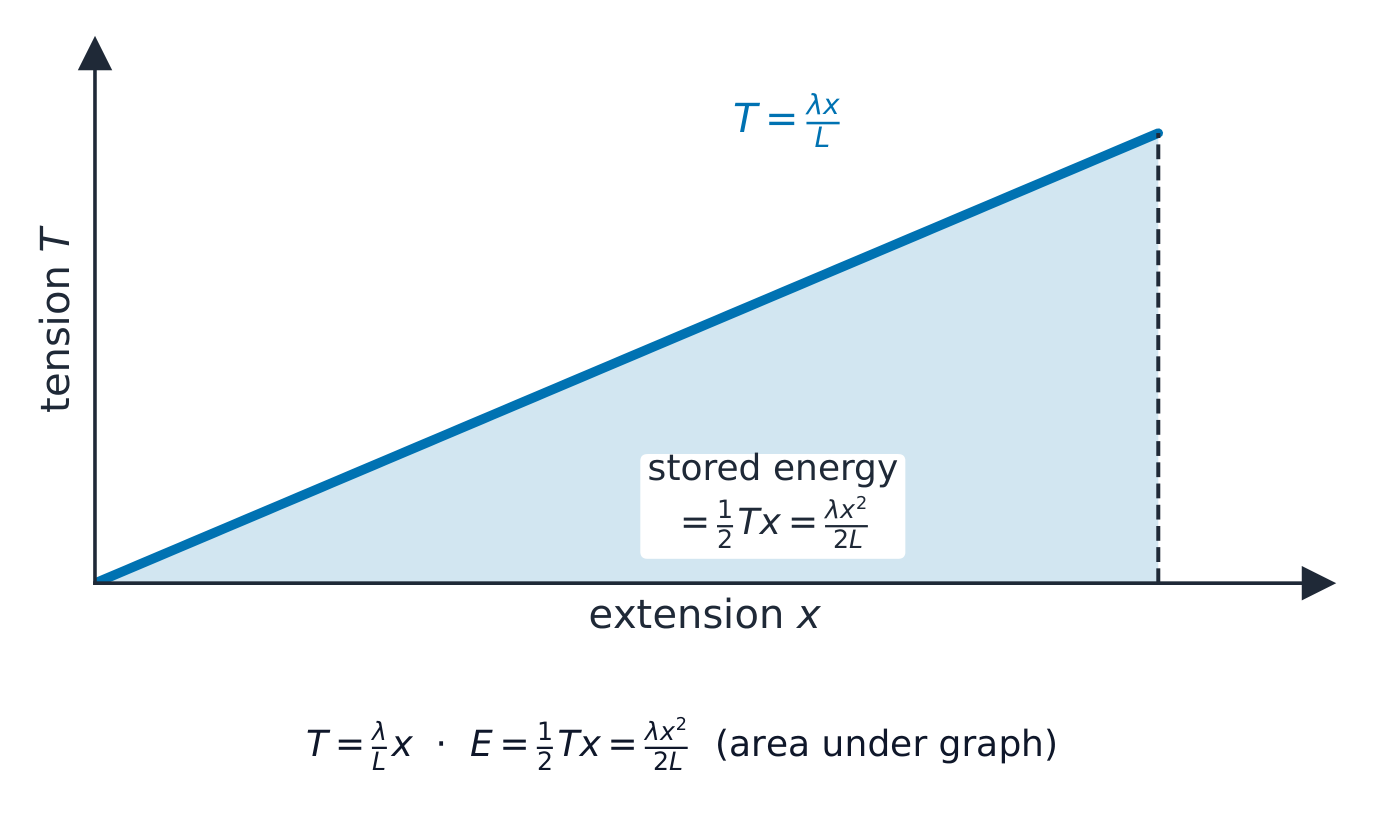
Hooke's law 胡克定律 says the tension in an elastic string or spring is proportional to its extension $x$:

$$T = \frac{\lambda x}{L},$$
where $L$ is the natural length and $\lambda$ is the modulus of elasticity 弹性模量. Stretching stores elastic potential energy 弹性势能:
$$E = \frac{\lambda x^2}{2L}.$$

Worked example. An elastic string of natural length $2\ \text{m}$ and modulus $50\ \text{N}$ is stretched by $0.5\ \text{m}$. Find the tension and the stored energy.

$$T = \frac{50\times 0.5}{2} = 12.5\ \text{N}, \qquad E = \frac{50\times 0.5^2}{2\times 2} = 3.125\ \text{J}.$$

ไทย

กฎของฮุก บอกว่าแรงตึงในสายยางยืดหรือสปริงเป็นสัดส่วนกับการยืดออก $x$:

$$T = \frac{\lambda x}{L},$$
โดยที่ $L$ คือความยาวธรรมชาติและ $\lambda$ คือ โมดูลัสของความยืดหยุ่น. การยืดออกเก็บ พลังงานศักย์ยืดหยุ่น ไว้:
$$E = \frac{\lambda x^2}{2L}.$$

เส้นกราฟแรงตึง-การยืดออกตรง พร้อมสามเหลี่ยมใต้เส้นที่ถูกแรเงาเพื่อแสดงพลังงาน
แรงตึงเพิ่มขึ้นตามสัดส่วนกับการยืดออก; สามเหลี่ยมที่แรเงาคือพลังงานยืดหยุ่นที่เก็บไว้

ตัวอย่างวิธีทำ. สายยางยืดมีความยาวธรรมชาติ $2\ \text{m}$ และโมดูลัส $50\ \text{N}$ ถูกยืดออก $0.5\ \text{m}$. หาแรงตึงและพลังงานที่เก็บไว้

$$T = \frac{50\times 0.5}{2} = 12.5\ \text{N}, \qquad E = \frac{50\times 0.5^2}{2\times 2} = 3.125\ \text{J}.$$

Explore · ⁨สำรวจ⁩

Hooke's law · ⁨กฎของฮুক⁩

F = k·x

Force is proportional to extension — the gradient is the stiffness k. · ⁨แรง แปรผันตรงกับ การยืด — ความชันคือค่าความแข็ง k⁩

3.5

Linear motion under a variable force · ⁨การเคลื่อนที่เชิงเส้นภายใต้แรงแปรผัน⁩

Syllabus · ⁨หลักสูตร⁩
English
Candidates should be able to: Notes and examples
solve problems which can be modelled as the linear motion of a particle under the action of a variable force, by setting up and solving an appropriate differential equation. Including use of $v \frac{\mathrm{d}v}{\mathrm{d}x}$ for acceleration, where appropriate. Calculus required is restricted to content from Pure Mathematics 3 in Cambridge International A Level Mathematics (9709). Only differential equations in which the variables are separable are included.
ไทย
ผู้เข้าสอบควรสามารถ: หมายเหตุและตัวอย่าง
แก้ปัญหาที่สามารถจำลองเป็นการเคลื่อนที่เชิงเส้นของอนุภาคภายใต้การกระทำของ แรงแปรผัน โดยการตั้งและแก้ สมการเชิงอนุพันธ์ ที่เหมาะสม รวมถึงการใช้ $v \frac{\mathrm{d}v}{\mathrm{d}x}$ สำหรับความเร่ง เมื่อเหมาะสม calculus ที่ต้องการจำกัดอยู่เฉพาะเนื้อหาจาก Pure Mathematics 3 ใน Cambridge International A Level Mathematics (9709) มีเพียงสมการเชิงอนุพันธ์ที่แยกตัวแปรได้เท่านั้น

Source: Cambridge International syllabus · ⁨แหล่งที่มา: หลักสูตร Cambridge International⁩

English

When the force depends on position $x$, use acceleration in the form $a = v\dfrac{dv}{dx}$, which turns Newton's law into a differential equation 微分方程 relating $v$ and $x$.

Worked example. A particle of mass $8\ \text{kg}$ moves along a line under a variable force 变力 of size $(x^3 + 4x)\ \text{N}$ acting in the direction of motion. When $x = 0$, $v = 1$. Find $v$ in terms of $x$.

Newton's law gives $8v\dfrac{dv}{dx} = x^3 + 4x$. Separating and integrating:

$$\int 8v\,dv = \int (x^3 + 4x)\,dx \;\Rightarrow\; 4v^2 = \tfrac14 x^4 + 2x^2 + C.$$
At $x = 0$, $v = 1$ gives $C = 4$, so $4v^2 = \tfrac14 x^4 + 2x^2 + 4 = 4\left(\tfrac{x^2}{4} + 1\right)^2$. Hence $v = \tfrac14 x^2 + 1$.

ไทย

เมื่อแรงขึ้นอยู่กับตำแหน่ง $x$, ใช้ความเร่งในรูปแบบ $a = v\dfrac{dv}{dx}$ ซึ่งแปลงกฎของนิวตันให้เป็น สมการเชิงอนุพันธ์ ที่เชื่อมโยง $v$ กับ $x$

การเลือกรูปแบบความเร่ง: ใช้ dv/dt เมื่อแรงขึ้นกับเวลา, v(dv/dx) เมื่อแรงขึ้นกับตำแหน่ง
ใช้ dv/dt เมื่อแรงขึ้นกับเวลา, v(dv/dx) เมื่อแรงขึ้นกับตำแหน่ง

ตัวอย่างที่คำนวณแล้ว. อนุภาคที่มีมวล $8\ \text{kg}$ เคลื่อนที่ตามเส้นตรงภายใต้ แรงแปรผัน ขนาด $(x^3 + 4x)\ \text{N}$ ที่กระทำในทิศทางของการเคลื่อนที่ เมื่อ $x = 0$, $v = 1$. จงหา $v$ ในรูปของ $x$.

กฎของนิวตันให้ $8v\dfrac{dv}{dx} = x^3 + 4x$. แยกตัวแปรและอินทิเกรต:

$$\int 8v\,dv = \int (x^3 + 4x)\,dx \;\Rightarrow\; 4v^2 = \tfrac14 x^4 + 2x^2 + C.$$
เมื่อ $x = 0$, $v = 1$ ให้ $C = 4$, ดังนั้น $4v^2 = \tfrac14 x^4 + 2x^2 + 4 = 4\left(\tfrac{x^2}{4} + 1\right)^2$. จึงได้ $v = \tfrac14 x^2 + 1$.

ตัวอย่างที่คำนวณแล้วในรูปแบบแผนภาพ: กฎของนิวตันกลายเป็นสมการเชิงอนุพันธ์ แยกตัวแปรและอินทิเกรต จากนั้นใช้เงื่อนไขเริ่มต้นเพื่อหาค่า v เป็นฟังก์ชันของ x
แรงที่ขึ้นอยู่กับตำแหน่งจะกลายเป็นสมการเชิงอนุพันธ์ในตัวแปร v และ x
Explore · ⁨สำรวจ⁩

Work from a variable force · ⁨งานจากแรงแปรผัน⁩

W = ∫ F dx

When the force changes, the work done is the area under the force–distance graph. · ⁨เมื่อแรงเปลี่ยนไป งานที่ทำ คือ พื้นที่ ภายใต้กราฟแรง–ระยะทาง⁩

Vocabulary · ⁨คำศัพท์⁩ Train · ⁨ฝึกฝน⁩
English ไทย
variable force/ˈveərɪəbl fɔːs/ แรงแปรผัน
conservation of momentum/ˌkɒnsəˈveɪʃn ɒv məʊˈmentəm/ การอนุรักษ์โมเมนตัม
Newton's experimental law/ˈnjuːtnz ekˌsperɪˈmentl lɔː/ กฎการทดลองของนิวตัน
coefficient of restitution/ˌkəʊɪˈfɪʃənt ɒv rɪstɪˈtjuːʃn/ สัมประสิทธิ์การคืนตัว
3.6

Momentum · ⁨โมเมนตัม⁩

Syllabus · ⁨หลักสูตร⁩
English
Candidates should be able to: Notes and examples
recall Newton’s experimental law and the definition of the coefficient of restitution, the property $0 \leqslant e \leqslant 1$, and the meaning of the terms ‘perfectly elastic’ ($e = 1$) and ‘inelastic’ ($e = 0$)
use conservation of linear momentum and/or Newton’s experimental law to solve problems that may be modelled as the direct or oblique impact of two smooth spheres, or the direct or oblique impact of a smooth sphere with a fixed surface.
ไทย
ผู้เข้าสอบควรสามารถ: หมายเหตุและตัวอย่าง
จำ กฎการทดลองของนิวตัน และนิยามของ สัมประสิทธิ์การคืนตัว คุณสมบัติ $0 \leqslant e \leqslant 1$ และความหมายของคำว่า 'ยืดหยุ่นสมบูรณ์' ($e = 1$) และ 'ไม่ยืดหยุ่น' ($e = 0$)
ใช้ การอนุรักษ์โมเมนตัมเชิงเส้น และ/หรือ กฎการทดลองของนิวตัน เพื่อแก้ปัญหาที่อาจจำลองเป็นการ ชนตรง หรือ ชนเฉียง ของทรงกลมเรียบสองลูก หรือ ชนตรง หรือ ชนเฉียง ของทรงกลมเรียบกับพื้นผิวคงที่

Source: Cambridge International syllabus · ⁨แหล่งที่มา: หลักสูตร Cambridge International⁩

English

In a collision, total linear momentum is conserved — the conservation of linear momentum 动量守恒. The bounciness is measured by Newton's experimental law 牛顿实验定律, which defines the coefficient of restitution 恢复系数 $e$:

$$e = \frac{\text{speed of separation}}{\text{speed of approach}}, \qquad 0 \leqslant e \leqslant 1.$$
Here $e = 1$ is perfectly elastic (no energy lost) and $e = 0$ is inelastic (the bodies stay together). In an oblique impact 斜碰撞, resolve the velocities along and perpendicular to the line of impact, applying restitution along it.

Worked example. A sphere $A$ of mass $2\ \text{kg}$ moving at $5\ \text{m s}^{-1}$ hits a stationary sphere $B$ of mass $3\ \text{kg}$, with $e = 0.5$. Find the speeds afterwards.

Momentum: $2(5) = 2v_A + 3v_B$, so $2v_A + 3v_B = 10$. Restitution: $v_B - v_A = 0.5(5) = 2.5$. Solving together gives $v_A = 0.5\ \text{m s}^{-1}$ and $v_B = 3.0\ \text{m s}^{-1}$.

ไทย
ลูกบอลเหล็กห้าลูกในเครื่องแสดงการ conserveโมเมนตัมของนิวตัน
เครื่องแสดงการ conserveโมเมนตัมของนิวต้อนสาธิตหลักการ conserveโมเมนตัมในการชนกัน.

ในการชนกัน โมเมนตัมเชิงเส้นรวม จะถูก conserve — ซึ่งเรียกว่า การ conserveโมเมนตัมเชิงเส้น. ความยืดหยุ่นวัดโดย กฎการทดลองของนิวตัน ซึ่งนิยาม สัมประสิทธิ์ความคืนตัว $e$:

$$e = \frac{\text{speed of separation}}{\text{speed of approach}}, \qquad 0 \leqslant e \leqslant 1.$$
ที่นี่ $e = 1$ คือการชนแบบยืดหยุ่นสมบูรณ์ (ไม่มีการสูญเสียพลังงาน) และ $e = 0$ คือการชนแบบไม่ยืดหยุ่น (วัตถุติดกัน) ในการชนแบบ เอียง ให้แยกความเร็วตามแนวและตั้งฉากกับแนวการชน โดยประยุกต์ใช้ค่าสัมประสิทธิ์ความคืนตัวตามแนวนั้นเท่านั้น

ทรงกลมสองลูกก่อนและหลังการชน เคลื่อนที่ออกจากกันด้วยความเร็วต่างกัน
สัมประสิทธิ์ความคืนตัว $e$ เปรียบเทียบความเร็วที่วัตถุแยกออกจากกันกับความเร็วก่อนที่เข้ามาชนกัน.

ตัวอย่างที่คำนวณแล้ว. ทรงกลม $A$ ที่มีมวล $2\ \text{kg}$ เคลื่อนที่ด้วยความเร็ว $5\ \text{m s}^{-1}$ ชนกับทรงกลม $B$ ที่หยุดนิ่งซึ่งมีมวล $3\ \text{kg}$ โดยมี $e = 0.5$. จงหาความเร็วหลังจากการชน

โมเมนตัม: $2(5) = 2v_A + 3v_B$, ดังนั้น $2v_A + 3v_B = 10$. สัมประสิทธิ์ความคืนตัว: $v_B - v_A = 0.5(5) = 2.5$. แก้ระบบสมการจะได้ $v_A = 0.5\ \text{m s}^{-1}$ และ $v_B = 3.0\ \text{m s}^{-1}$.

Explore · ⁨สำรวจ⁩

A collision · ⁨การชน⁩

Set each mass and speed, then collide them. Total momentum is conserved — see how the velocities come out. · ⁨ตั้งมวลและความเร็วของแต่ละวัตถุแล้วชนกัน โมเมนตัมรวมอนุรักษ์ไว้ — ดูความเร็วสุดท้ายที่เกิดขึ้น⁩

3.6

Exam tips · ⁨ข้อแนะนำสำหรับการสอบ⁩

English
  • For projectiles, resolve into horizontal (constant velocity) and vertical ($a = g$) motion, linked by the same time.
  • For a rigid body in equilibrium, take moments about a point that removes an unknown force.
  • For circular motion, use $F = mv^2/r = m\omega^2 r$ towards the centre; in a vertical circle check the minimum speed at the top.
  • With a variable force, use $a = v\,\frac{dv}{dx}$ and integrate; elastic PE $= \frac{\lambda x^2}{2L}$.
ไทย
  • สำหรับ ** projectile** ให้แยกเป็นcomponent การเคลื่อนที่แนวนอน (ความเร็วคงที่) และแนวตั้ง ($a = g$) เชื่อมต่อกันด้วยเวลาเดียวกัน
  • สำหรับ วัตถุแข็งที่สมดุล ให้หาโมเมนต์รอบจุดที่ลบแรงที่ไม่ทราบค่าออก
  • สำหรับการเคลื่อนที่วงกลม ใช้ $F = mv^2/r = m\omega^2 r$ เข้าหาจุดศูนย์กลาง; ในวงกลมแนวตั้งต้องตรวจสอบความเร็วขั้นต่ำที่สุดที่จุดสูงสุด
  • กับ แรงแปรผัน ใช้ $a = v\,\frac{dv}{dx}$ และอินทิเกรต; พลังงานศักย์ยืดหยุ่น $= \frac{\lambda x^2}{2L}$.

Interactive lessons on this topic · ⁨บทเรียนเชิงโต้ตอบสำหรับหัวข้อนี้⁩

Work through it step by step, with instant-check exercises. · ⁨ทำทีละขั้นตอน พร้อมแบบฝึกหัดตรวจสอบผลทันที⁩

Past Papers · ⁨ข้อสอบย้อนหลัง⁩

More topics in A-Level Further Mathematics · ⁨Further Mathematics A-Level⁩ · ⁨หัวข้อเพิ่มเติมใน A-Level Further Mathematics · ⁨Further Mathematics A-Level⁩⁩

Log in or create account · ⁨เข้าสู่ระบบหรือสร้างบัญชี⁩

IGCSE, A-Level & AP