Momentum (Further Mechanics)
Introduced| English | Meaning |
|---|---|
| momentum/məʊˈmentəm/ | The product of mass and velocity. |
| collision/kəˈlɪʒn/ | An interaction in which objects or particles strike or exert large forces on one another over a short time. |
| conservation of momentum/ˌkɒnsəˈveɪʃn ɒv məʊˈmentəm/ | Total momentum remains constant when no resultant external force acts. |
| coefficient of restitution/ˌkəʊɪˈfɪʃənt ɒv rɪstɪˈtjuːʃn/ | The ratio of relative speed of separation to relative speed of approach along the line of impact in a collision. |
| perfectly elastic/ˈpɜːfektlɪ ɪˈlæstɪk/ | perfectly elastic |
| kinetic energy/kɪˈnetɪk ˈenədʒi/ | The energy an object has because of its motion. |
| perfectly inelastic/ˈpɜːfektlɪ ɪnɪˈlæstɪk/ | perfectly inelastic |
Newton's cradle and the perfect bounce
- Drop one ball of a Newton's cradle and exactly one flies off the far end. Why one, not two?
- The answer is two conservation ideas working together: momentum 动量, and how much bounce a collision 碰撞 has.
Conservation of momentum 动量守恒
- In any collision (or explosion), with no external force, total momentum is conserved:
Momentum before equals momentum after — the single most useful equation in collisions.
Conservation of momentum
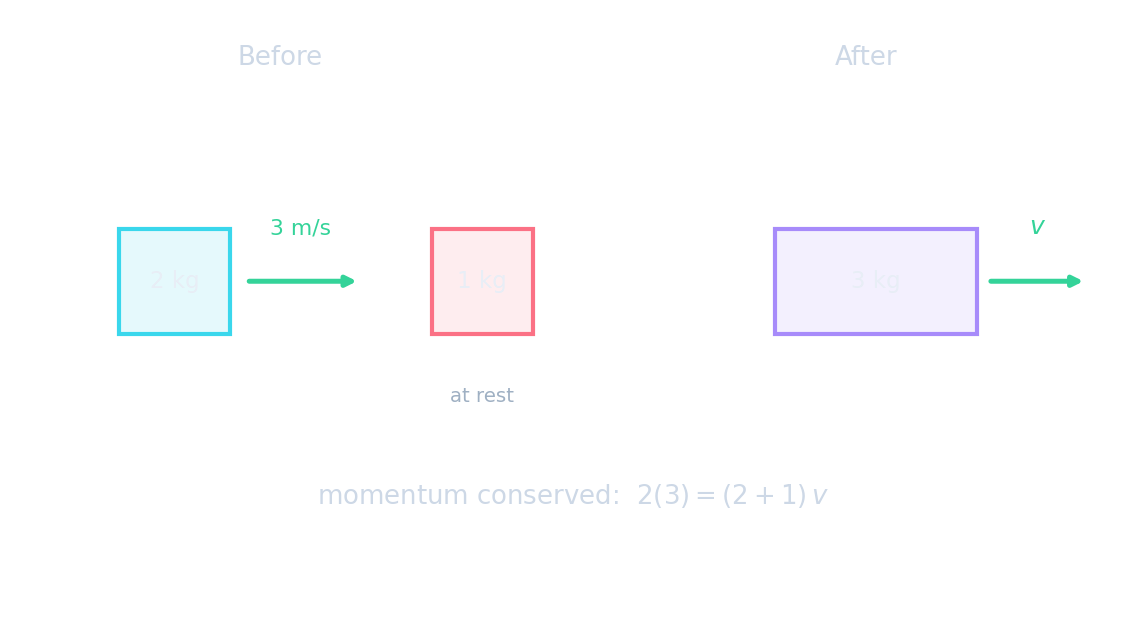
m₁u₁ + m₂u₂ = (m₁+m₂)v
Two bodies collide — the total momentum before equals the total after.
A 2 kg body at 3 m/s hits a stationary 1 kg body and they stick together. By momentum conservation 2(3) = (2+1)v, find v (m/s).
Difficulty 2/5 · 140 coins + a small bonus on first completion today
6 = 3v, so v = 2 m/s.
The coefficient of restitution 恢复系数
- How bouncy is the collision? The coefficient of restitution $e$ compares the speeds:
- $e = 1$: perfectly elastic 完全弹性 (no kinetic energy 动能 lost). $e = 0$: perfectly inelastic 完全非弹性 (bodies stick together).

The coefficient of restitution $e$ compares how fast the bodies separate with how fast they approached

A Newton's cradle demonstrates conservation of momentum in collisions
The coefficient of restitution e always lies in which range?
Difficulty 1/5 · 100 coins + a small bonus on first completion today
e runs from 0 (perfectly inelastic) to 1 (perfectly elastic).
The coefficient of restitution e = speed of separation ÷ speed of ______.
Difficulty 1/5 · 100 coins + a small bonus on first completion today
e = separation speed / approach speed.
If two bodies coalesce (stick together) on impact, the coefficient of restitution is:
Difficulty 1/5 · 100 coins + a small bonus on first completion today
They move off together (zero separation speed), so e = 0 — perfectly inelastic.
Using both equations
- Two unknowns (the final speeds) need two equations: momentum conservation and Newton's restitution law ($\text{separation} = e \times \text{approach}$).
- Solve them together to find both final velocities.
Kinetic energy is only conserved when $e = 1$. For any $e < 1$ some kinetic energy is lost (to heat and sound) — so never assume energy is conserved in a collision unless told it is perfectly elastic.
- In a direct or oblique impact, total linear momentum is conserved (conservation of linear momentum) and Newton's experimental law gives the coefficient of restitution.
Kinetic energy is conserved only when the coefficient of restitution e = 1.
Difficulty 1/5 · 100 coins + a small bonus on first completion today
Only a perfectly elastic collision (e = 1) conserves kinetic energy; otherwise some is lost.
You've got it
- total momentum is conserved: $m_1u_1 + m_2u_2 = m_1v_1 + m_2v_2$
- $e = \dfrac{\text{separation speed}}{\text{approach speed}}$, with $0 \leq e \leq 1$
- combine momentum + restitution to find both final speeds; KE conserved only if $e = 1$