Continuous random variables (Further)
Introduced| English | Meaning |
|---|---|
| continuous variable/kənˈtɪnjuːəs ˈveərɪəbl/ | A variable that can take any value within a specified interval, rather than only separate values. |
| probability density function/ˌprɒbəˈbɪlɪti ˈdensɪti ˈfʌŋkʃn/ | A function whose area over an interval gives the probability that a continuous random variable falls within that interval. |
| expectation/ekspɪkˈteɪʃn/ | The probability-weighted average value of a random variable. |
| cumulative distribution function/ˈkjuːmjʊlətɪv ˌdɪstrɪˈbjuːʃn ˈfʌŋkʃn/ | A function giving the probability that a random variable is less than or equal to a specified value. |
| median/ˈmiːdiːən/ | The middle value when data are arranged in order, or the mean of the two middle values for an even number of observations. |
| percentile/pəˈsentaɪl/ | A value marking a specified percentage of observations at or below it in an ordered distribution. |
| quartile/ˈkwɔːtaɪl/ | One of the three boundary values that divide ordered data into four parts of approximately equal size. |
Probability as area
- For a continuous variable 连续变量 — a height, a waiting time — no single exact value has a probability; there are infinitely many.
- Instead, probability is the area under a curve, the probability density function 概率密度函数 $f(x)$. The whole area is $1$.
The density function and expectation 期望
- $P(a < X < b) = \displaystyle\int_a^b f(x)\,dx$, and the total area $\int f = 1$.
- The mean of any function of $X$:
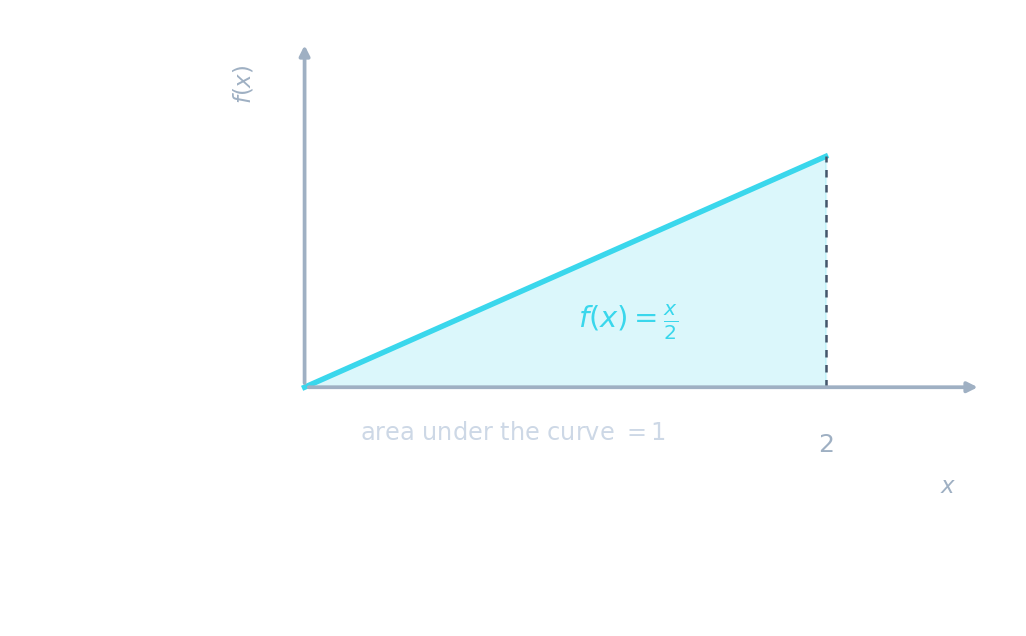
Probabilities are areas under f(x); the total area over the whole range is exactly 1.
Continuous random variables
P(a < X < b) = ∫ f(x) dx
For a continuous variable, probability is the area under the density curve.
What must the total area under a probability density function equal?
Difficulty 2/5 · 140 coins + a small bonus on first completion today
A pdf integrates to 1 over its whole range.
The cumulative distribution function 累积分布函数
- The CDF accumulates probability from the left:
- It runs from $0$ to $1$, and differentiating recovers the density: $f(x) = F'(x)$.
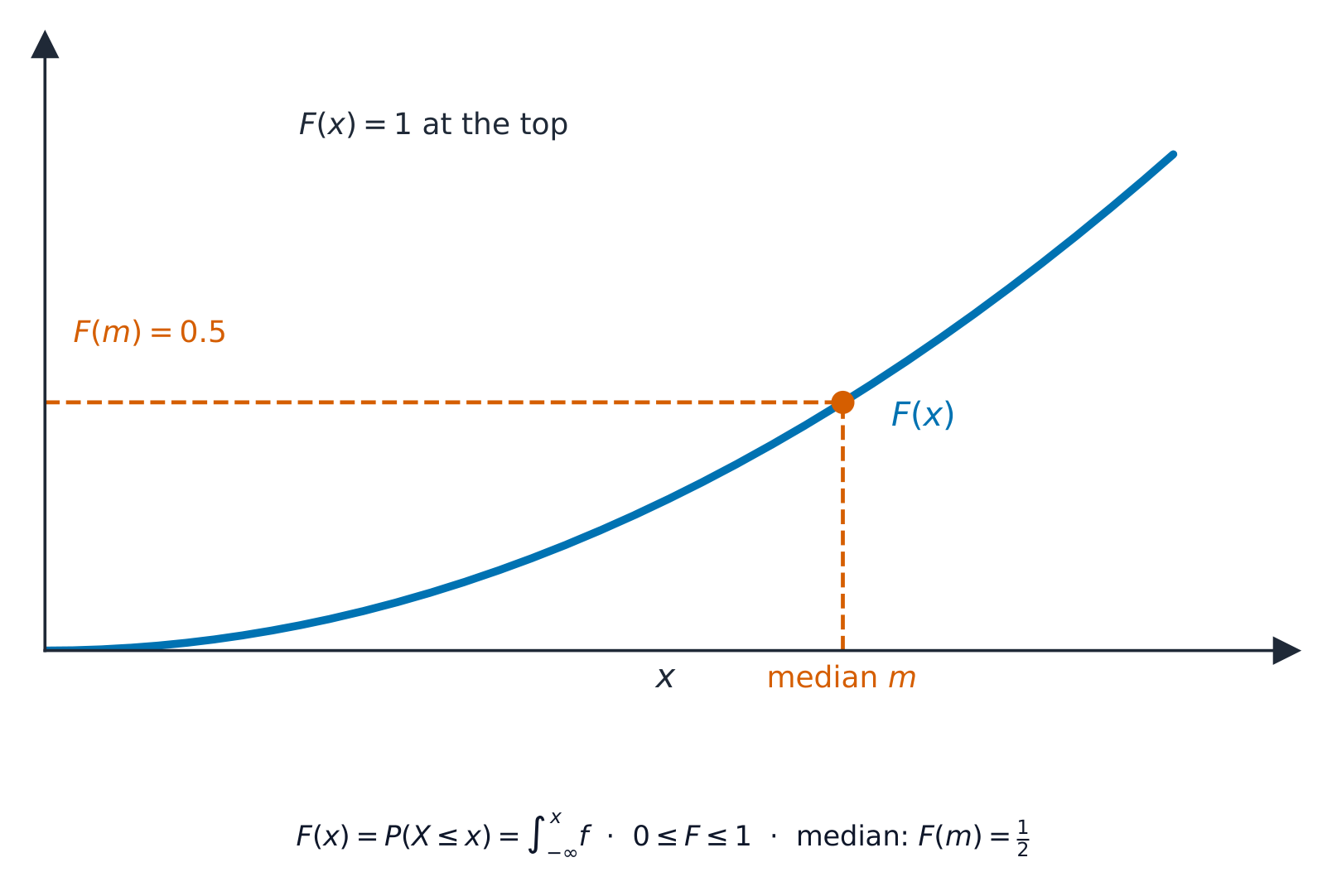
The CDF $F(x)$ rises from 0 to 1; the median is read off where it reaches a height of 0.5
The cumulative distribution function F(x) gives:
Difficulty 1/5 · 100 coins + a small bonus on first completion today
F(x) = P(X ≤ x), the accumulated area up to x.
Differentiating the CDF gives the density: f(x) = F-______(x).
Difficulty 1/5 · 100 coins + a small bonus on first completion today
f(x) = F′(x): the density is the derivative of the CDF.
Worked example — the median 中位数
- The median $m$ splits the area in half: $F(m) = 0.5$.
- For $f(x) = \tfrac12 x$ on $[0, 2]$: $F(x) = \tfrac14 x^2$, so $\tfrac14 m^2 = 0.5$ gives $m = \sqrt2 \approx 1.41$.
Percentiles 百分位数 work the same way. The lower quartile 四分位数 solves $F(x) = 0.25$; the 90th percentile solves $F(x) = 0.9$. Always set $F$ equal to the fraction you want.
For f(x) = ½x on [0,2], F(x) = ¼x². The median solves ¼m² = 0.5. What is m? (2 dp)
Difficulty 2/5 · 140 coins + a small bonus on first completion today
¼m² = 0.5 → m² = 2 → m = √2 ≈ 1.41.
The median m of a continuous distribution satisfies:
Difficulty 1/5 · 100 coins + a small bonus on first completion today
The median splits the area in half: F(m) = 0.5.
Density is not probability
$f(x)$ can exceed 1. A density isn't a probability — only the area is. A tall narrow peak can have $f(x) > 1$ as long as the total area stays $1$.
- Use cumulative distribution functions (CDFs) to find probabilities and percentiles, and the CDF of a related variable.
A probability density f(x) can never be greater than 1.
Difficulty 1/5 · 100 coins + a small bonus on first completion today
False. Only the total area must equal 1; over a narrow interval the density itself can exceed 1, e.g. the uniform density on [0, 0.5] is 2.
You've got it
- probability = area under $f(x)$; total area $= 1$ (density itself can exceed 1)
- the CDF $F(x) = P(X \leq x) = \int f$, and $f = F'$
- the median solves $F(m) = 0.5$; percentiles solve $F(x) =$ that fraction
Write from a median of 4
- A uniform density on the interval from 2 to 6 has total area 1.
- Find the median. A density value may be greater than 1.
A continuous distribution is uniform from 2 to 6. What is the median, and why can a probability density be greater than 1?
For a uniform distribution the median and the mean are the centre of the interval. Probability is the area under the density.
What is the median?
Difficulty 1/5 · 100 coins + a small bonus on first completion today
The midpoint of 2 and 6 is 4. Other options — 1 (the total area under a density); 1.41 (the lesson median).