Skip to content · ⁨ข้ามไปยังเนื้อหา⁩

Hydroxy compounds · ⁨สารประกอบไฮดรอกซี (Hydroxy compounds)⁩

A-Level Chemistry · ⁨Chemistry A-Level⁩ · Topic 16 · ⁨หัวข้อ 16⁩

Video lesson for this topic · ⁨บทเรียนวิดีโอสำหรับหัวข้อนี้⁩ Open the video page · ⁨เปิดหน้าวิดีโอ⁩
8:20

สารประกอบไฮดรอกซี (Hydroxy compounds)

บีบเจลล้างมือลงบนมือ มันรู้สึกเย็น และหายไปทันที นั่นคือเอทานอล — แอลกอฮอล์ที่ฆ่าจุลินทรีย์ เอทานอลเป็นเพียง…

English narration · English + 中文 subtitles burned in · ⁨การบรรยายภาษาอังกฤษ · คำบรรยายภาษาอังกฤษ + 中文 ลอยตัวบนภาพ⁩

16.1

Alcohols · ⁨แอลกอฮอล์⁩

Syllabus · ⁨หลักสูตร⁩
English
  1. recall the reactions (reagents and conditions) by which alcohols can be produced: (a) electrophilic addition of steam to an alkene, $\text{H}_2\text{O(g)}$ and $\text{H}_3\text{PO}_4$ catalyst (b) reaction of alkenes with cold dilute acidified potassium manganate(VII) to form a diol (c) substitution of a halogenoalkane using $\text{NaOH(aq)}$ and heat (d) reduction of an aldehyde or ketone using $\text{NaBH}_4$ or $\text{LiAlH}_4$ (e) reduction of a carboxylic acid using $\text{LiAlH}_4$ (f) hydrolysis of an ester using dilute acid or dilute alkali and heat
  2. describe: (a) the reaction with oxygen (combustion) (b) substitution to form halogenoalkanes, e.g. by reaction with $\text{HX(g)}$; or with $\text{KCl}$ and concentrated $\text{H}_2\text{SO}_4$ or concentrated $\text{H}_3\text{PO}_4$; or with $\text{PCl}_3$ and heat; or with $\text{PCl}_5$; or with $\text{SOCl}_2$ (c) the reaction with $\text{Na(s)}$ (d) oxidation with acidified $\text{K}_2\text{Cr}_2\text{O}_7$ or acidified $\text{KMnO}_4$ to: (i) carbonyl compounds by distillation (ii) carboxylic acids by refluxing (primary alcohols give aldehydes which can be further oxidised to carboxylic acids, secondary alcohols give ketones, tertiary alcohols cannot be oxidised) (e) dehydration to an alkene, by using a heated catalyst, e.g. $\text{Al}_2\text{O}_3$ or a concentrated acid (f) formation of esters by reaction with carboxylic acids and concentrated $\text{H}_2\text{SO}_4$ as catalyst as exemplified by ethanol
  3. (a) classify alcohols as primary, secondary and tertiary alcohols, to include examples with more than one alcohol group (b) state characteristic distinguishing reactions, e.g. mild oxidation with acidified $\text{K}_2\text{Cr}_2\text{O}_7$, colour change from orange to green
  4. deduce the presence of a $\text{CH}_3\text{CH(OH)}-$ group in an alcohol, $\text{CH}_3\text{CH(OH)}-\text{R}$, from its reaction with alkaline $\text{I}_2\text{(aq)}$ to form a yellow precipitate of tri-iodomethane and an ion, $\text{RCO}_2^-$
  5. explain the acidity of alcohols compared with water
ไทย
  1. ทบทวนปฏิกิริยา (สารตั้งต้นและสภาวะ) ที่สามารถผลิตแอลกอฮอล์ได้: (a) การเพิ่มอิเล็กโทรฟิลิกของไอน้ำกับอัลซีน, $\text{H}_2\text{O(g)}$ และตัวเร่งปฏิกิริยา $\text{H}_3\text{PO}_4$ (b) ปฏิกิริยาของอัลซีนกับdatetime potassium manganate(VII) เข้มข้นเจือจางเย็นเพื่อสร้างไดโอล (c) การแทนที่ของฮาโลเจนอัลเคนโดยใช้ $\text{NaOH(aq)}$ และความร้อน (d) การรีดิวซ์ของอัลดีไฮด์หรือคีทोनโดยใช้ $\text{NaBH}_4$ หรือ $\text{LiAlH}_4$ (e) การรีดิวซ์ของกรดคาร์บอกซิลิกโดยใช้ $\text{LiAlH}_4$ (f) การไฮโดรไลซิสของเอสเทอร์โดยใช้กรดเจือจางหรือเบสเจือจางและความร้อน
  2. อธิบาย: (a) ปฏิกิริยากับออกซิเจน (การเผาไหม้) (b) การแทนที่เพื่อสร้างฮาโลเจนอัลเคน เช่น bằngปฏิกิริยากับ $\text{HX(g)}$; หรือกับ $\text{KCl}$ และ $\text{H}_2\text{SO}_4$ แบบเข้มข้น หรือ $\text{H}_3\text{PO}_4$ แบบเข้มข้น; หรือกับ $\text{PCl}_3$ และความร้อน; หรือกับ $\text{PCl}_5$; หรือกับ $\text{SOCl}_2$ (c) ปฏิกิริยากับ $\text{Na(s)}$ (d) การออกซิเดชันด้วย $\text{K}_2\text{Cr}_2\text{O}_7$ หรือ $\text{KMnO}_4$ ที่ถูกทำให้เป็นกรดไปเป็น: (i) สารประกอบคาร์บอนิลด้วยการกลั่น (ii) กรดคาร์บอกซิลิกด้วยการ回流 (แอลกอฮอล์ปฐมให้อัลดีไฮด์ซึ่งสามารถออกซิเดชันต่อไปเป็นกรดคาร์บอกซิลิก, แอลกอฮอล์ทุติยภูมิให้คีทোন, แอลกอฮอล์ตติยภูมิไม่สามารถออกซิเดชันได้) (e) การกำจัดน้ำเพื่อเป็นอัลซีน, โดยใช้ตัวเร่งปฏิกิริยาที่ร้อน, เช่น $\text{Al}_2\text{O}_3$ หรือกรดเข้มข้น (f) การสร้างเอสเทอร์โดยการปฏิกิริยากับกรดคาร์บอกซิลิกและ $\text{H}_2\text{SO}_4$ แบบเข้มข้นเป็นตัวเร่งปฏิกิริยา ตัวอย่างเช่น ethanol
  3. (a) จัดประเภทแอลกอฮอล์เป็น แอลกอฮอล์ปฐม, แอลกอฮอล์ทุติยภูมิ และ แอลกอฮอล์ตติยภูมิ ซึ่งรวมถึงตัวอย่างที่มีหมู่แอลกอฮอล์มากกว่าหนึ่ง (b) ระบุปฏิกิริยาเฉพาะเจาะจงในการแยกแยะ เช่น การออกซิเดชันอ่อนๆ ด้วย $\text{K}_2\text{Cr}_2\text{O}_7$ ที่ทำให้เป็นกรด, เปลี่ยนสีจากส้มเป็นเขียว
  4. สรุปการมีอยู่ของหมู่ $\text{CH}_3\text{CH(OH)}-$ ในแอลกอฮอล์, $\text{CH}_3\text{CH(OH)}-\text{R}$, จากปฏิกิริยากับ $\text{I}_2\text{(aq)}$ ที่มีความเป็นเบสเพื่อสร้างตะกอนเหลืองของ tri-iodomethane และไอออน, $\text{RCO}_2^-$
  5. อธิบายความเป็น กรด ของแอลกอฮอล์เมื่อเทียบกับน้ำ
Source: Cambridge International syllabus · ⁨แหล่งที่มา: หลักสูตร Cambridge International⁩

English

An alcohol 醇 has the $\text{–OH}$ (hydroxyl) functional group.

Making alcohols

Method Reagents and conditions
addition of steam to an alkene $\text{H}_2\text{O(g)}$, $\text{H}_3\text{PO}_4$ catalyst (electrophilic addition 亲电加成)
an alkene 烯烃 with cold dilute $\text{KMnO}_4$ gives a diol 二醇 (two $\text{–OH}$ groups)
substitution of a halogenoalkane 卤代烷 $\text{NaOH(aq)}$, heat
reduction 还原 of an aldehyde 醛 or ketone 酮 $\text{NaBH}_4$ or $\text{LiAlH}_4$
reduction of a carboxylic acid 羧酸 $\text{LiAlH}_4$
hydrolysis 水解 of an ester 酯 dilute acid or alkali, heat

Reactions of alcohols

  • combustion: alcohols burn in oxygen to give carbon dioxide and water.
  • substitution to a halogenoalkane, for example with $\text{HX}$, $\text{PCl}_5$, $\text{PCl}_3$ and heat, or $\text{SOCl}_2$.
  • with sodium: alcohols react with sodium metal to give hydrogen and a sodium alkoxide — like water, but more slowly.
  • oxidation 氧化 with acidified $\text{K}_2\text{Cr}_2\text{O}_7$ (or $\text{KMnO}_4$). The product depends on the class of alcohol (see below).
  • dehydration 脱水 to an alkene, using a hot $\text{Al}_2\text{O}_3$ catalyst or concentrated acid.
  • ester formation: an alcohol reacts with a carboxylic acid (with concentrated $\text{H}_2\text{SO}_4$ catalyst) to make an ester.

Three classes and how oxidation tells them apart

An alcohol is primary 伯, secondary 仲 or tertiary 叔, depending on how many carbons are joined to the carbon holding the $\text{–OH}$. Some molecules have more than one $\text{–OH}$ group.

Class Oxidation product
primary aldehyde (by distillation 蒸馏), then carboxylic acid (by reflux 回流)
secondary a ketone
tertiary not oxidised

In a quick test, acidified $\text{K}_2\text{Cr}_2\text{O}_7$ turns from orange to green with a primary or secondary alcohol, but stays orange with a tertiary alcohol.

  • distillation removes the aldehyde as it forms, before it can be oxidised further.
  • reflux keeps boiling the mixture and returning the vapour, so the alcohol is fully oxidised to the carboxylic acid.

The iodoform test

If you warm an alcohol that contains the $\text{CH}_3\text{CH(OH)}-$ group with alkaline aqueous iodine, you get a pale yellow precipitate of tri-iodomethane 三碘甲烷 ($\text{CHI}_3$) and the ion $\text{RCO}_2^-$. This is a useful test for that group.

Acidity of alcohols

The $\text{–OH}$ group makes alcohols very weakly acidic: they can lose the $\text{H}^+$ to form an $\text{RO}^-$ ion. But their acidity 酸性 is lower than that of water. This is because the alkyl group pushes electron density onto the oxygen, which makes the $\text{RO}^-$ ion less stable, so the alcohol holds onto its $\text{H}^+$ more tightly.

Worked example. Three unlabelled bottles hold butan-1-ol, butan-2-ol and 2-methylpropan-2-ol. How does warming each with acidified $\text{K}_2\text{Cr}_2\text{O}_7$ tell them apart? What matters is how many hydrogens sit on the carbon carrying the $\text{OH}$. Butan-1-ol is primary (two such hydrogens): the orange dichromate turns green, and by distilling you collect an aldehyde (butanal), or by refluxing you get the carboxylic acid (butanoic acid). Butan-2-ol is secondary (one such hydrogen): also green, but the product is a ketone (butanone), which will not oxidise further. 2-methylpropan-2-ol is tertiary (no such hydrogen): there is nothing to remove, so the dichromate stays orange. The colour only separates the tertiary from the other two - to split primary from secondary you must identify the product (an aldehyde gives a silver mirror with Tollens', a ketone does not).

ไทย

แอลกอฮอล์มี $\text{–OH}$ (hydroxyl) เป็น functional group

ขวดเจลล้างมือ
เอทานอล ซึ่งเป็นแอลกอฮอล์ในเจลล้างมือ สามารถฆ่าจุลินทรีย์ได้

การสร้างแอลกอฮอล์

วิธี สารตั้งต้นและสภาวะ
การเพิ่มไอน้ำให้กับอัลคีน $\text{H}_2\text{O(g)}$, $\text{H}_3\text{PO}_4$ ตัวเร่งปฏิกิริยา (electrophilic addition)
อัลคีน กับ $\text{KMnO}_4$ จางเย็น ให้ diol (สอง $\text{–OH}$ groups)
แทนซิชันของ ฮาโลเจนอัลเคน $\text{NaOH(aq)}$, ร้อน
reduction ของ aldehyde หรือ ketone $\text{NaBH}_4$ หรือ $\text{LiAlH}_4$
reduction ของ carboxylic acid $\text{LiAlH}_4$
hydrolysis ของ ester กรดจางหรือเบส, ร้อน
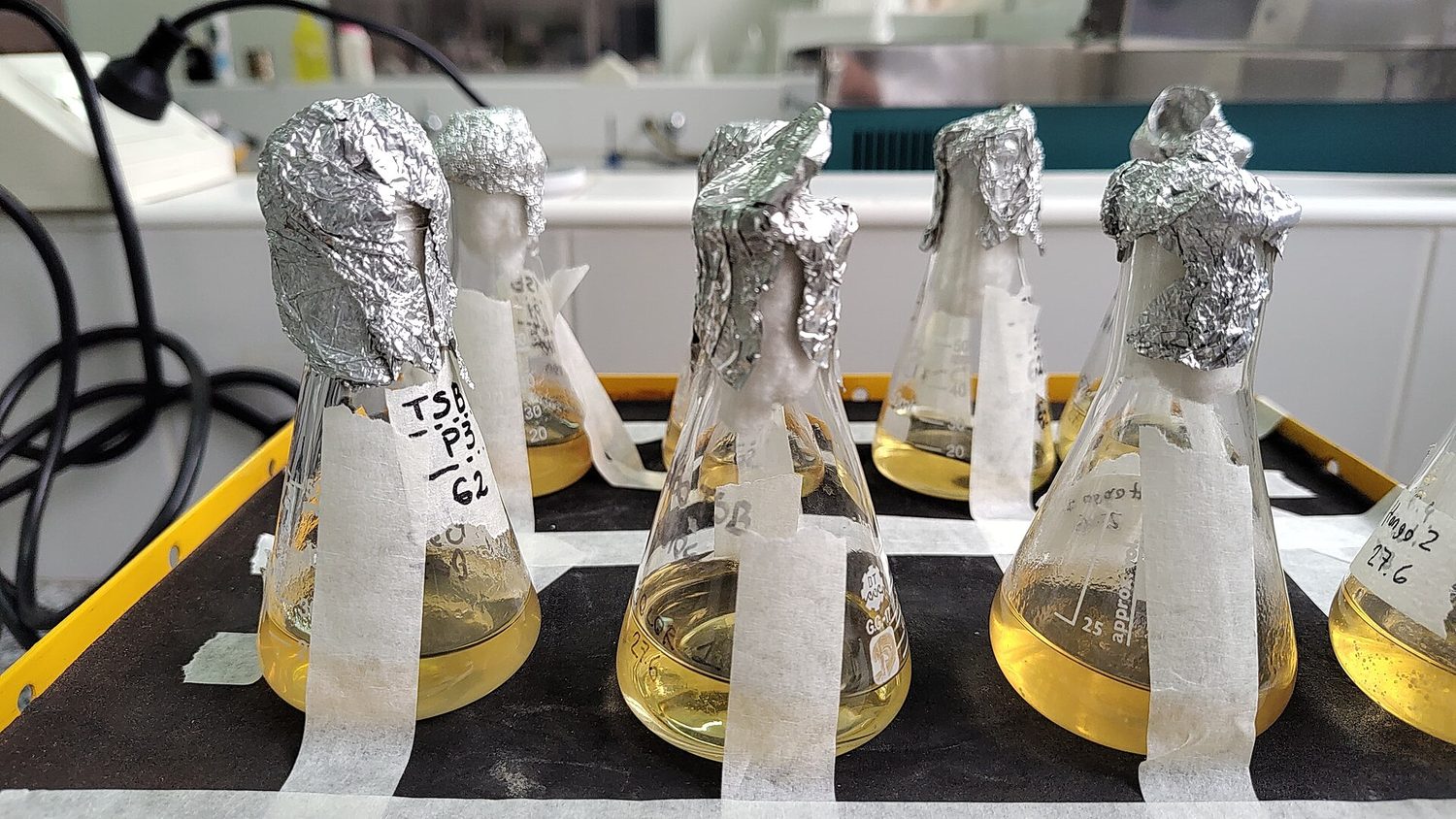
กระบอกวัดรูปกรวยที่มีของเหลวขุ่นปิดด้วยฟอยล์กำลังหมักในห้องปฏิบัติการ
ในระดับอุตสาหกรรม เอทานอลยังผลิตจากการหมักน้ำตาล再用 fractional distillation แยกออกจากน้ำ

ปฏิกิริยาของแอลกอฮอล์

  • combustion: แอลกอฮอล์เผาไหม้ในออกซิเจนเพื่อให้เกิดคาร์บอนไดออกไซด์และน้ำ
  • substitution เป็นฮาโลเจนอัลเคน เช่น กับ $\text{HX}$, $\text{PCl}_5$, $\text{PCl}_3$ และร้อน, หรือ $\text{SOCl}_2$
  • กับโซเดียม: แอลกอฮอล์ทำปฏิกิริยากับโลหะโซเดียมเพื่อเกิดไฮโดรเจนและ sodium alkoxide — เหมือนน้ำแต่ช้ากว่า
  • oxidation ด้วย $\text{K}_2\text{Cr}_2\text{O}_7$ ที่酸化 (หรือ $\text{KMnO}_4$). ผลิตภัณฑ์ขึ้นอยู่กับประเภทของแอลกอฮอล์ (ดูด้านล่าง)
  • dehydration เป็นอัลคีน โดยใช้ $\text{Al}_2\text{O}_3$ ตัวเร่งปฏิกิริาร้อนหรือกรดเข้มข้น
  • formation of ester: แอลกอฮอล์ทำปฏิกิริยากับ carboxylic acid (ด้วย $\text{H}_2\text{SO}_4$ ตัวเร่งปฏิกิริาเข้มข้น) เพื่อสร้าง ester
แอลกอฮอล์ทำปฏิกิริยาสี่แบบ: combustion, dehydration เป็นอัลคีน, esterification, และ oxidation
แอลกอฮอล์สามารถเผาไหม้,脱水,形成 ester หรือถูกออกซิไดซ์

สามประเภทและวิธีการแยกแยะด้วยการ oxidation

แอลกอฮอล์เป็น primary, secondary หรือ tertiary ขึ้นอยู่กับว่ามีคาร์บอนกี่ตัวเชื่อมต่อกับคาร์บอนที่ถือ $\text{–OH}$ บางโมเลกุลมี $\text{–OH}$ groups มากกว่าหนึ่ง

คาร์บอนกลางสามตัวที่แต่ละตัวถือ OH: primary มี R group หนึ่งตัวและไฮโดรเจนสองตัว, secondary มี R group สองตัวและไฮโดรเจนหนึ่งตัว, tertiary มี R group สามตัว
ประเภทกำหนดโดยคาร์บอนที่ถือ –OH: R group หนึ่งตัวคือ primary, สองตัวคือ secondary, สามตัวคือ tertiary — ซึ่งกำหนดการ氧化
ประเภท ผลิตภัณฑ์ออกซิเดชัน
primary aldehyde (โดย distillation), แล้ว carboxylic acid (โดย reflux)
secondary ketone
tertiary ไม่ถูก oxidize
แผนภาพ: แอลกอฮอล์ primary oxidize เป็น aldehyde แล้วเป็น carboxylic acid, แอลกอฮอล์ secondary เป็น ketone, และแอลกอฮอล์ tertiary ไม่ถูก oxidize
Oxidation ตามประเภท: แอลกอฮอล์ primary ให้ aldehyde แล้วเป็น carboxylic acid, secondary ให้ ketone, tertiary ไม่ถูก oxidize

ในการทดสอบquick test, $\text{K}_2\text{Cr}_2\text{O}_7$ ที่酸化 เปลี่ยนจาก ส้มเป็นเขียว กับ primary หรือ secondary alcohol แต่คงสีส้มกับ tertiary alcohol

หลอดทดลองสองtube ของ dichromate สีส้ม: tube ที่มี primary หรือ secondary alcohol เปลี่ยนเป็นเขียว, tube ที่มี tertiary alcohol ยังคงเป็นส้ม *Acidified dichromate เปลี่ยนจากส้มเป็นเขียวกับ primary หรือ secondary alcohol แต่คงเป็นส้มกับ tertiary alcohol

  • distillation เอา aldehyde ออกทันทีที่เกิด เพื่อไม่ให้ถูก oxidize ต่อ
  • reflux ทำให้อุณหภูมิเดือดและนำ vapor กลับมา ทำให้แอลกอฮอล์ถูก oxidize เป็น carboxylic acid เต็มรูปแบบ

ชุดอุปกรณ์สองชุด: reflux พร้อม condenser ตั้งตรงนำ vapor กลับสู่กระบอก, และ distillation พร้อม condenserเฉียงนำไปยัง collection flask *Distillationเอา aldehyde ออกทันทีที่เกิด; refluxเก็บ boiling และนำ vapor กลับมา oxidize เป็น acid เต็มรูปแบบ

คอลัมน์fractional-distillation ในห้องปฏิบัติการพร้อมเทอร์โมมิเตอร์และ water condenser
setup Distillation จริง: vapor เดือดออก เย็นตัวใน condenser และถูกเก็บ — หลักการเดียวกันนี้ใช้แยกเอทานอลจากสารหมัก

การทดสอบ iodoform

หากคุณอุ่นแอลกอฮอล์ที่มี $\text{CH}_3\text{CH(OH)}-$ group กับไอโอดินในน้ำ碱性 คุณจะได้ precipitate สีเหลืองอ่อนของ tri-iodomethane ($\text{CHI}_3$) และ ion $\text{RCO}_2^-$. นี่คือ useful test สำหรับ group นั้น

ความกรดของแอลกอฮอล์

หมู่ $\text{–OH}$ ทำให้แอลกอฮอล์มีความเป็นกรดอ่อนมาก: สามารถสูญเสีย $\text{H}^+$ เพื่อสร้างไอออน $\text{RO}^-$ ได้ แต่ ความเป็นกรด ของมัน ต่ำกว่า น้ำ เนื่องจากหมู่อัลคิลดันความหนาแน่นของอิเล็กตรอนเข้าไปที่อะตอมออกซิเจน ซึ่งทำให้ไอออน $\text{RO}^-$ มีความเสถียรน้อยลง ดังนั้นแอลกอฮอล์จึงยึด $\text{H}^+$ ไว้แน่นกว่า

ตัวอย่างวิธีทำ ขวดที่ไม่ติดฉลากสามขวดมี butan-1-ol, butan-2-ol และ 2-methylpropan-2-ol จะแยกแยะได้อย่างไรโดยการอุ่นแต่ละชนิดกับ $\text{K}_2\text{Cr}_2\text{O}_7$ ที่ผสมกรด สิ่งที่สำคัญคือจำนวนไฮโดรเจนที่ติดอยู่บน คาร์บอนที่ถือ $\text{OH}$ butan-1-ol เป็น พรีเมียวรี่ (มีไฮโดรเจนสองตัว): สีส้มของไดโครเมทเปลี่ยนเป็น สีเขียว และการกลั่นจะเก็บ อัลดีไฮด์ (butanal) หรือการ回流จะได้ กรดคาร์บอกซิลิก (butanoic acid) butan-2-ol เป็น เซคอนดารี (มีไฮโดรเจนหนึ่งตัว): ก็เปลี่ยนเป็น สีเขียว เช่นกัน แต่ผลิตภัณฑ์คือ คีโตน (butanone) ซึ่งจะไม่เกิดปฏิกิริยาออกซิเดชันต่อไป 2-methylpropan-2-ol เป็น เทอร์เชียรี่ (ไม่มี ไฮโดรเจนเช่นนี้): ไม่มีอะไรให้ดึงออก ดังนั้นสีไดโครเมทจึงคงเป็น สีส้ม สีเพียงอย่างเดียวที่แยกเทอร์เชียรี่ออกจากอีกสองชนิดได้ -若要 แยกพรีเมียวรี่จากเซคอนดารี คุณต้องระบุ ผลิตภัณฑ์ (อัลดีไฮด์ให้กระจกเงินกับ Tollens', คีโตนไม่ให้)

Explore · ⁨สำรวจ⁩

Alcohol reaction map · ⁨แผนภาพปฏิกิริยาของแอลกอฮอล์⁩

Choose what happens to alcohols under different reagents. · ⁨เลือกสิ่งที่เกิดขึ้นกับแอลกอฮอล์ภายใต้รีเจ้นต์ต่างๆ⁩

Explore · ⁨สำรวจ⁩

Alcohol oxidation test lab · ⁨ห้องปฏิบัติการทดสอบออกซิเดชันแอลกอฮอล์⁩

Classify alcohols by oxidation product and observation. · ⁨จำแนกแอลกอฮอล์ตามผลิตภัณฑ์ออกซิเดชันและผลสังเกต⁩

Vocabulary · ⁨คำศัพท์⁩ Train · ⁨ฝึกฝน⁩
English ไทย
alcohol/ˈælkəhɒl/ แอลกอฮอล์
electrophilic addition/ɪˌlektrəʊˈfɪlɪk əˈdɪʃn/ การเติมแบบอิเล็กโทรฟิลิก
alkene/ˈælkiːn/ อัลคีน
diol/dɪˈɒl/ diol
halogenoalkane/ˈheɪləʊdʒnəʊlkeɪn/ ฮาโลเจนอัลเคน
reduction/rɪˈdʌkʃn/ การลดรูป (reduction)
aldehyde/ˈældɪhaɪd/ อัลดีไฮด์
ketone/ˈketəʊn/ คีตอน
carboxylic acid/ˌkɑːbəkˈsɪlɪk ˈæsɪd/ กรดคาร์บอกซิลิก
hydrolysis/haɪˈdrɒləsɪs/ hydrolysis
ester/ˈestə/ ester
oxidation/ˌɒksɪˈdeɪʃn/ การออกซิเดชัน
dehydration/ˌdiːhaɪˈdreɪʃn/ การกำจัดน้ำ
primary/ˈpraɪməri/ ปฐมภูมิ
secondary/ˈsekəndəri/ ทุติยภูมิ
tertiary/ˈtɜːʃjəri/ เทอร์เทียรี
distillation/dɪstɪˈleɪʃn/ การกลั่น
reflux/ˈriːflʌks/ 回流
tri-iodomethane/traɪ ˈaɪədəʊmθeɪn/ ไตรไอโอดোเมเทน
acidity/æˈsɪdɪti/ ความเป็นกรด
16.1

Exam tips · ⁨ข้อแนะนำสำหรับการสอบ⁩

English
  • Classify the alcohol as primary, secondary or tertiary first — it decides the oxidation product.
  • Oxidation with acidified $\text{K}_2\text{Cr}_2\text{O}_7$ (orange → green): primary → aldehyde (distil) → acid (reflux); secondary → ketone; tertiary → no reaction.
  • Distinguish the conditions for aldehyde vs acid from a primary alcohol (distillation vs reflux).
  • Name esters correctly (the acid part comes second, ending "-oate").
ไทย
  • จำแนกแอลกอฮอล์ว่าเป็น พรีเมียวรี่, เซคอนดารี หรือ เทอร์เชียรี่ ก่อน — จะกำหนดผลิตภัณฑ์การออกซิเดชัน
  • ออกซิเดชัน ด้วย $\text{K}_2\text{Cr}_2\text{O}_7$ ที่ผสมกรด (ส้ม → เขียว): พรีเมียวรี่ → อัลดีไฮด์ (กลั่น) → กรด (reflux); เซคอนดารี → คีโตน; เทอร์เชียรี่ → ไม่เกิดปฏิกิริยา
  • แยกเงื่อนไขสำหรับ อัลดีไฮด์ vs กรด จากแอลกอฮอล์พรีเมียวรี่ (การกลั่น vs reflux)
  • ตั้งชื่อเอสเตอร์ให้ถูกต้อง (ส่วนกรดมาหลังสุด ลงท้ายด้วย "-oate")

Interactive lessons on this topic · ⁨บทเรียนเชิงโต้ตอบสำหรับหัวข้อนี้⁩

Work through it step by step, with instant-check exercises. · ⁨ทำทีละขั้นตอน พร้อมแบบฝึกหัดตรวจสอบผลทันที⁩

Past Papers · ⁨ข้อสอบย้อนหลัง⁩

More topics in A-Level Chemistry · ⁨Chemistry A-Level⁩ · ⁨หัวข้อเพิ่มเติมใน A-Level Chemistry · ⁨Chemistry A-Level⁩⁩

Log in or create account · ⁨เข้าสู่ระบบหรือสร้างบัญชี⁩

IGCSE, A-Level & AP