- understand the concept of work, and recall and use $\text{work done} = \text{force} \times \text{displacement in the direction of the force}$
- recall and apply the principle of conservation of energy
- recall and understand that the efficiency of a system is the ratio of useful energy output from the system to the total energy input
- use the concept of efficiency to solve problems
- define power as work done per unit time
- solve problems using $P = W/t$
- derive $P = Fv$ and use it to solve problems
Work, energy and power
A-Level Physics · Topic 5
5.1
Work, energy and power

Syllabus
Source: Cambridge International syllabus
Work done by a force
Work 功 is done when a force moves its point of contact along the line of the force. For the one-mark definition write: work done is the product of the force and the distance moved in the direction of the force. The work done by a constant force $F$ that causes a displacement 位移 $s$ is
$$W = F \cdot s \cdot \cos\theta,$$
where $\theta$ is the angle between the force and the displacement. Only the component 分量 of the force along the displacement does work.

Worked example. A child pulls a sledge $5.0\ \text{m}$ across the snow with a rope, using a force of $20\ \text{N}$ at $60°$ to the ground. Find the work done by the rope.
$$W = Fs\cos\theta = 20 \times 5.0 \times \cos 60° = 20 \times 5.0 \times 0.50 = 50\ \text{J}.$$
Unit: $\text{J} = \text{N m}$. Work is a scalar 标量.
Special cases:
- force in the same direction as the motion ($\theta = 0$): $W = Fs$, positive work, energy 能量 given to the object.
- force at right angles to the motion ($\theta = 90°$): $W = 0$. The normal contact force 支持力 on a car on a flat road does no work.
- force opposite to the motion ($\theta = 180°$): $W = -Fs$, negative work, energy taken from the object (for example friction 摩擦力).

For an object moving up a slope at angle $\alpha$ to the horizontal 水平, the work done against gravity in rising a height $h$ is $mgh$, while the work done by a horizontal push over the slope length $L$ uses $\cos\alpha$.
Two multiple-choice tests of the definition: no work is done on an object that slides at constant velocity along a frictionless surface (no force along the motion), or on one that is simply held still (no distance moved); work is done when a force lifts it. And when a box is pushed at constant velocity across a rough floor, the work done by the push is $F \times d$ for the whole distance, however the path is split into stages.
Worked example. A block of mass $4.9\ \text{kg}$ is pushed at constant velocity up a rough slope of length $8.0\ \text{m}$ that rises $1.5\ \text{m}$, by a force of $12\ \text{N}$ acting along the slope. Find the work done against friction.
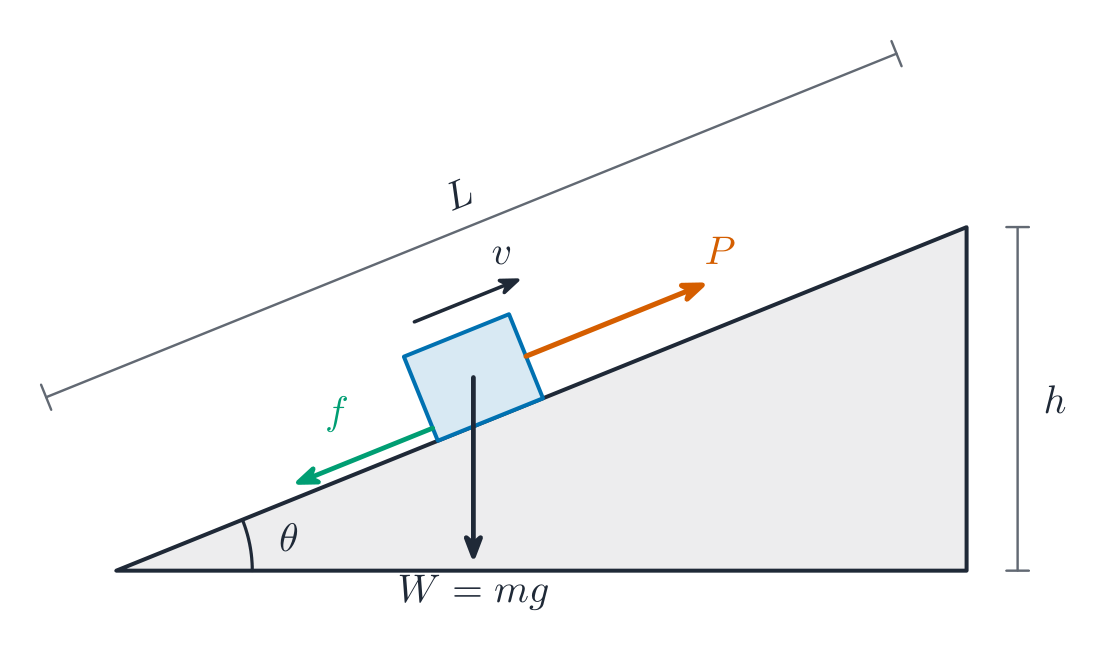
Constant velocity means no change in kinetic energy, so the work done by the push is shared between the gain in gravitational potential energy and the work done against friction. Work by the push: $12 \times 8.0 = 96\ \text{J}$. Gain in GPE, using the vertical rise: $4.9 \times 9.81 \times 1.5 = 72\ \text{J}$. So the work done against friction is $96 - 72 = 24\ \text{J}$, and the friction force is $24 / 8.0 = 3.0\ \text{N}$. Using the slope length in $mgh$ is the commonest error on this question.
Conservation of energy
Energy is never made or destroyed — it only changes from one form to another, or moves from one object to another. In a closed system 封闭系统, the total energy stays constant. This is conservation of energy 能量守恒, stated for the marks as: energy cannot be created or destroyed; it can only be transferred from one form to another (so the total energy of a closed system is constant).
When you write an energy equation, list every form the energy starts as and ends as. Common forms in this syllabus: kinetic, gravitational potential, elastic potential energy 弹性势能, electrical 电能, thermal, sound, chemical energy 化学能.
A ball rolling down a frictionless 无摩擦 ramp 斜坡 turns gravitational potential energy 重力势能 into kinetic energy 动能: $mgh = \tfrac{1}{2} m v^{2}$, so $v = \sqrt{2gh}$. With friction, some of this energy becomes thermal energy 热能 of the ramp and the air.

Worked example. A ball is released from rest at the top of a smooth ramp $1.2\ \text{m}$ high. Find its speed at the bottom (take $g = 9.81\ \text{m s}^{-2}$).
All the gravitational potential energy becomes kinetic energy, so $v = \sqrt{2gh}$ (the mass cancels):
$$v = \sqrt{2 \times 9.81 \times 1.2} \approx 4.9\ \text{m s}^{-1}.$$
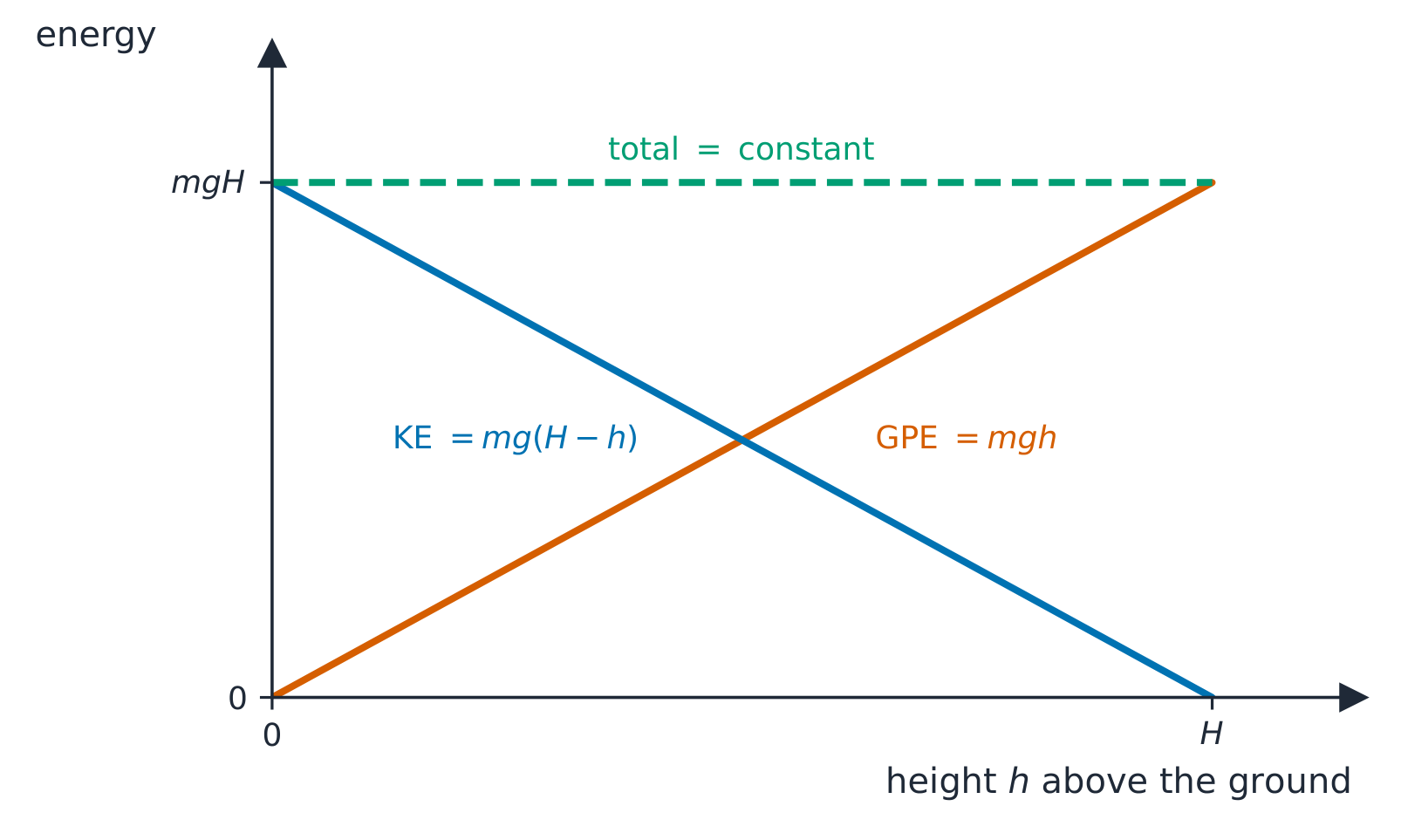
The same idea reads a graph. For a ball falling from height $H$ with air resistance negligible, the GPE falls in a straight line with height ($mgh$), the KE rises in a straight line ($mg(H - h)$), and the two add to the constant $mgH$ at every height.
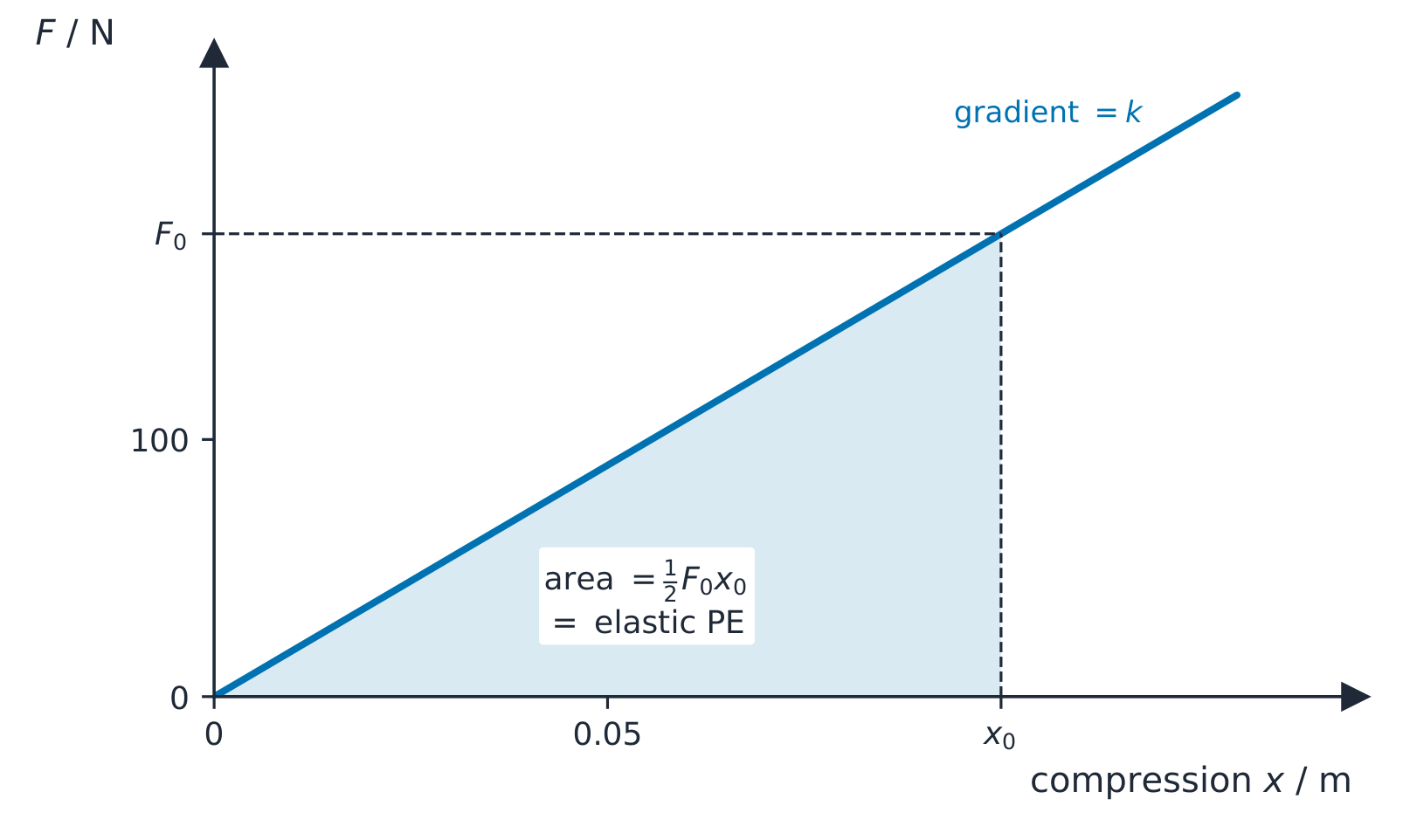
The energy chain can pass through a spring. A block that hits a spring with kinetic energy $110\ \text{J}$ while sliding a little downhill, so that its GPE falls by a further $20\ \text{J}$ before the spring stops it, stores $110 + 20 = 130\ \text{J}$ of elastic potential energy at the greatest compression, if nothing is lost to friction. The spring's force–compression graph then gives the compression: the energy stored is the area under the line, $\tfrac{1}{2} F_{0} x_{0}$ for a spring that obeys Hooke's law (topic 6), so a maximum force of $2600\ \text{N}$ means $x_{0} = 2 \times 130 / 2600 = 0.10\ \text{m}$. At that instant the resultant force on the block is the spring force minus the component of the weight down the slope, and its acceleration follows from $F = ma$ (topic 3).
Efficiency
The efficiency 效率 of a system is
$$\text{efficiency} = \frac{\text{useful energy output}}{\text{total energy input}} \times 100\%.$$
The same idea with power:
$$\text{efficiency} = \frac{\text{useful power output}}{\text{total power input}} \times 100\%.$$
Efficiency is always less than 100% in a real system, because some input energy becomes "useless" forms — usually thermal energy. If a total energy $E$ is supplied and an amount $Q$ is wasted, the useful output is $E - Q$ and the efficiency is $(E - Q) / E$; a motor rated at $1.7\ \text{kW}$ input with efficiency $53\%$ delivers $0.53 \times 1.7 = 0.90\ \text{kW}$ of useful output.

For an electric motor lifting a load with efficiency $\eta$ at voltage 电压 $V$ and current 电流 $I$, the useful output power is $\eta V I$. From this you can find a force, a lifting speed, or a tension 张力.
Worked example. An electric motor lifts a $50\ \text{kg}$ load at a steady $0.40\ \text{m s}^{-1}$ while drawing $250\ \text{W}$ of electrical power. Find its efficiency (take $g = 9.81\ \text{m s}^{-2}$).
The useful output power is $P = mgv = 50 \times 9.81 \times 0.40 = 196\ \text{W}$, so
$$\text{efficiency} = \frac{196}{250} \times 100\% \approx 78\%.$$
Worked example. A motor raises a block with a force of $240\ \text{N}$ through a vertical distance of $12\ \text{m}$ in $60\ \text{s}$. The input power to the motor is $900\ \text{W}$. Find the useful output power and the efficiency.
Work done on the block: $W = Fd = 240 \times 12 = 2880\ \text{J}$. Useful output power: $P = W / t = 2880 / 60 = 48\ \text{W}$. Efficiency: $48 / 900 \times 100\% = 5.3\%$. Most of the input goes into thermal energy in the motor and its cable. Turned round, a lift motor of useful output $20\ \text{kW}$ raising $1500\ \text{kg}$ through $20\ \text{m}$ takes $t = mgh / P = 1500 \times 9.81 \times 20 / 20\,000 = 15\ \text{s}$.
Explore
Energy flow & efficiency
The input energy divides into useful work and wasted energy; efficiency = useful ÷ input, and useful + wasted always equals the input.
Explore
Work, energy & power
PE + KE = constant
Work transfers energy; as it falls, PE becomes KE with the total fixed.
Vocabulary
Train
| English | Chinese | Pinyin |
|---|---|---|
| Work | 功 | gōng |
| displacement | 位移 | wèi yí |
| component | 分量 | fèn liàng |
| scalar | 标量 | biāo liàng |
| energy | 能量 | néng liàng |
| normal contact force | 支持力 | zhī chí lì |
| friction | 摩擦力 | mó cā lì |
| horizontal | 水平 | shuǐ píng |
| closed system | 封闭系统 | fēng bì xì tǒng |
| conservation of energy | 能量守恒 | néng liàng shǒu héng |
| elastic potential energy | 弹性势能 | tán xìng shì néng |
| electrical | 电能 | diàn néng |
| chemical energy | 化学能 | huà xué néng |
| frictionless | 无摩擦 | wú mó cā |
| ramp | 斜坡 | xié pō |
| gravitational potential energy | 重力势能 | zhòng lì shì néng |
| kinetic energy | 动能 | dòng néng |
| thermal energy | 热能 | rè néng |
| efficiency | 效率 | xiào lǜ |
| voltage | 电压 | diàn yā |
| current | 电流 | diàn liú |
| tension | 张力 | zhāng lì |
5.1
Power

Power 功率 is the rate of doing work, or the rate of transferring energy:
$$P = \frac{W}{t} = \frac{\Delta E}{\Delta t}.$$
Unit: $\text{W} = \text{J s}^{-1}$. Power is a scalar.
Power, force and velocity
For an object moving at velocity 速度 $v$ with a force $F$ along the direction of motion, in a short time $\Delta t$ the displacement is $v\,\Delta t$ and the work done is $F v\,\Delta t$. Dividing by $\Delta t$:
$$P = F v.$$
This is one of the most useful results in mechanics. A "derive $P = Fv$" answer needs exactly those three lines: $P = W / t$, $W = Fs$ for a force along the motion, and $s / t = v$; then use it to solve problems in which a vehicle or a load moves at constant speed.
Worked example. A car travels at a steady $25\ \text{m s}^{-1}$ against a total resistive force of $600\ \text{N}$. Find the output power of its engine.
At constant speed the driving force equals the resistive force, so
$$P = Fv = 600 \times 25 = 15\,000\ \text{W} = 15\ \text{kW}.$$
- For a car at constant velocity $v$ on a flat road, the engine power must balance the total resistive force: $P = F_{\text{resist}} \cdot v$. If the drag 阻力 grows with $v^{2}$, doubling the speed roughly quadruples the power needed.
- For lifting a weight 重力 $mg$ straight up at constant speed $v$, the useful output power is $P = mg \cdot v$.
- For an aircraft hovering at a fixed height, the lift force equals the weight, and a large power is needed because air must be pushed downwards all the time.
- A crane raising $600\ \text{kg}$ at a steady $12\ \text{m}$ per minute lifts at $v = 0.20\ \text{m s}^{-1}$, so its useful output power is $mgv = 600 \times 9.81 \times 0.20 = 1.2\ \text{kW}$. Convert the speed to $\text{m s}^{-1}$ first.
- A sailboat pushed by a constant wind force at constant velocity must also feel an equal resistive force from the water: constant velocity means zero resultant force, so the wind's power $Fv$ is all going into work against the water.
Vocabulary
Train
| English | Chinese | Pinyin |
|---|---|---|
| Power | 功率 | gōng lǜ |
| velocity | 速度 | sù dù |
| drag | 阻力 | zǔ lì |
| weight | 重力 | zhòng lì |
5.2
Gravitational potential energy

Syllabus
- derive, using $W = Fs$, the formula $\Delta E_{\text{P}} = mg\Delta h$ for gravitational potential energy changes in a uniform gravitational field
- recall and use the formula $\Delta E_{\text{P}} = mg\Delta h$ for gravitational potential energy changes in a uniform gravitational field
- derive, using the equations of motion, the formula for kinetic energy $E_{\text{K}} = \frac{1}{2}mv^2$
- recall and use $E_{\text{K}} = \frac{1}{2}mv^2$
Source: Cambridge International syllabus
In a uniform gravitational field (close to a planet's surface), the change in gravitational potential energy of mass 质量 $m$ rising or falling through a height $\Delta h$ is
$$\Delta E_{\text{P}} = m g \Delta h.$$
Where it comes from
The work done against gravity to raise a mass $m$ slowly (no change in kinetic energy) through height $\Delta h$ equals the gravitational potential energy gained:
- the gravitational force on the mass is $mg$ downwards,
- the force needed to lift it slowly is $mg$ upwards,
- the work done by this force is $W = F \cdot s = mg \cdot \Delta h$,
- this work becomes $\Delta E_{\text{P}}$.
So $\Delta E_{\text{P}} = mg \Delta h$. To use it you need $m$ and $\Delta h$ (and $g$). You do not need speed or time. The two-mark derivation wants the same four lines, with the condition stated: the block is raised at constant speed, so the lifting force equals the weight $mg$, and the work done by that force over the vertical distance $\Delta h$ is $mg\Delta h$, which is the gain in gravitational potential energy. A $100\ \text{g}$ object falling $10\ \text{m}$ loses $0.100 \times 9.81 \times 10 = 9.8\ \text{J}$, about $10\ \text{J}$; the mass must be in kilograms.
Vocabulary
Train
| English | Chinese | Pinyin |
|---|---|---|
| mass | 质量 | zhì liàng |
5.2
Kinetic energy
The kinetic energy of an object of mass $m$ moving at speed $v$ is
$$E_{\text{K}} = \tfrac{1}{2} m v^{2}.$$
Where it comes from
Apply a resultant force $F$ to a mass $m$ that starts at rest. It speeds up evenly from $0$ to $v$ over a displacement $s$. From $v^{2} = u^{2} + 2as$ with $u = 0$,
$$s = \frac{v^{2}}{2a}.$$
The work done on the mass is
$$W = F \cdot s = m a \cdot \frac{v^{2}}{2a} = \tfrac{1}{2} m v^{2}.$$
All this work becomes kinetic energy, so $E_{\text{K}} = \tfrac{1}{2} m v^{2}$. In the exam, state the assumptions as you go: the object starts from rest, the force is constant, so the acceleration is uniform, and $F = ma$ is Newton's second law.
Because $E_{\text{K}} \propto v^{2}$, quadrupling the speed multiplies the kinetic energy by sixteen: an object with $1500\ \text{J}$ at $10\ \text{m s}^{-1}$ has $24\,000\ \text{J}$ at $40\ \text{m s}^{-1}$. The same square is why a stopping force is found from energy: a ball of mass $1.2\ \text{kg}$ moving at $3.0\ \text{m s}^{-1}$ that is stopped by a cushion over $0.020\ \text{m}$ loses $\tfrac{1}{2} \times 1.2 \times 3.0^{2} = 5.4\ \text{J}$, so the average force on it is $5.4 / 0.020 = 270\ \text{N}$: the work done by the cushion equals the kinetic energy lost.
Kinetic energy and momentum
Combining $p = mv$ and $E_{\text{K}} = \tfrac{1}{2} m v^{2}$:
$$E_{\text{K}} = \frac{p^{2}}{2m}.$$
This is handy when the momentum 动量 is given but not the velocity. For a momentum change from $p_{1}$ to $p_{2}$ at constant mass, the change in kinetic energy is $(p_{2}^{2} - p_{1}^{2}) / (2m)$.
Explore
Kinetic & potential energy
PE + KE = constant
Potential energy turns into kinetic energy — the total never changes.
Vocabulary
Train
| English | Chinese | Pinyin |
|---|---|---|
| momentum | 动量 | dòng liàng |
5.2
Using energy methods

A useful plan for problems that mix forces and energy:
- Find the start and end states. Write the kinetic and potential energies in each.
- List any work done by outside forces (friction, a push). Friction usually takes energy out; a push can add it.
- Conservation of energy: $E_{\text{start}} + W_{\text{in}} = E_{\text{end}} + W_{\text{lost as heat etc.}}$.
Examples:
- A box pushed at constant velocity up a ramp of length $L$ rising by $h$: $E_{\text{K}}$ does not change, so the work done by the push goes into $\Delta E_{\text{P}}$ plus the work done against friction.
- A block sliding into a spring 弹簧 with kinetic energy $E_{\text{K}}$ on a frictionless surface: at greatest compression 压缩 $x$, all the kinetic energy has become elastic potential energy $\tfrac{1}{2} k x^{2}$ (where $k$ is the spring constant 劲度系数).
- A ball dropped from height $h_{1}$ that bounces to height $h_{2}$: the ratio $h_{2}/h_{1}$ is the fraction of mechanical energy kept, $h_{2}/h_{1} = (v_{\text{up}}/v_{\text{down}})^{2}$.
- A projectile 抛体 thrown to the same height at different angles: the final speed is the same (only the height matters); use components to get its direction.
- A bungee jumper 蹦极者: from the platform to the point where the cord goes taut, GPE becomes KE; from there the cord stretches and takes energy as elastic potential energy, so the KE reaches its maximum where the cord's pull first equals the weight, then falls to zero at the lowest point, where GPE lost $=$ elastic PE stored (plus any thermal energy).
Explore
Conservation of energy
Drop the mass and watch GPE turn into KE. With no friction the total energy stays the same — that's the energy method.
Vocabulary
Train
| English | Chinese | Pinyin |
|---|---|---|
| spring | 弹簧 | tán huáng |
| compression | 压缩 | yā suō |
| spring constant | 劲度系数 | jìn dù xì shù |
| projectile | 抛体 | pāo tǐ |
| bungee jumper | 蹦极者 | bèng jí zhě |
5.2
Definitions the examiner accepts
A definition question is marked against fixed wording. Learn these exactly, and give one answer only.
| Term | Definition |
|---|---|
| work done by a force | the product of the force and the distance moved in the direction of the force |
| principle of conservation of energy | energy cannot be created or destroyed, only transferred from one form to another, so the total energy of a closed system is constant |
| efficiency | the ratio of useful energy (or power) output from a system to the total energy (or power) input, usually as a percentage |
| power | the work done per unit time, or the rate at which energy is transferred |
| gravitational potential energy | the energy an object has because of its position in a gravitational field |
| kinetic energy | the energy an object has because of its motion |
| elastic potential energy | the energy stored in an object that has been stretched or compressed |
5.2
Exam tips
- Work $=$ force $\times$ distance moved in the direction of the force — use $Fs\cos\theta$ when they are at an angle.
- Use conservation of energy: loss in GPE $=$ gain in KE ($+$ work done against resistance).
- Power $=$ work $/$ time $= Fv$; efficiency $=$ useful output $\div$ total input.
- GPE uses the vertical height gained, not the distance along a slope.
Common mistakes
- Giving the change in height as the answer to a change-in-energy question. Finish the calculation: $\Delta E_{\text{P}} = mg\Delta h$.
- Using the distance along a slope as the height in $mg\Delta h$, or using mass where weight is needed. Use the vertical height gained, and check whether the quantity wanted is $m$ in kg or $W$ in N.
- Putting the resistive force into $P = Fv$ for a car that is accelerating. $F$ is the driving force; only at constant speed does it equal the resistive force.
- Efficiency above 100%, or efficiency as output divided by wasted. It is useful output divided by total input, and the total input is always the larger number.
- Reading a force–extension graph's gradient when the question wants the energy. Energy stored is the area under the line, not its slope.
Interactive lessons on this topic
Work through it step by step, with instant-check exercises.