IGCSE Economics (0455) включает шесть тем: базовая экономическая проблема, распределение ресурсов, микроэкономические субъекты принятия решений, государство и макроэкономика, экономическое развитие и международная торговля. Экзамен состоит из двух работ — одной тестовой и одной с развернутыми ответами.
Оценку за работу с развернутыми ответами определяет структура, а за саму работу — графики. Ответ на вопрос о спросе и предложении, написанный сплошным текстом, получит меньше баллов, чем тот же ответ, дополненный подписанным графиком и четко указанной направлением сдвига.
Умейте рисовать каждый график с чистого листа — обе оси подписаны, стрелкой показан сдвиг. На экзамене вы не распознаете рисунок, а создаете его. В заданиях с наибольшим количеством баллов требуется оценка, что означает указание условий, при которых ваш вывод может быть неверен.
understand the economic problem: finite (scarce) resources and unlimited wants
distinguish economic goods (scarce, have an opportunity cost) and free goods
understand that the economic problem forces consumers, workers, producers and governments to make choices
Русский
понять экономическую проблему: конечные (дефицитные) ресурсы и неограниченные потребности
различать экономические блага (дефицитные, имеют альтернативные издержки) и свободные блага
понимать, что экономическая проблема вынуждает потребителей, работников, производителей и правительства делать выбор
Source: Cambridge International syllabus · Источник: Программа Cambridge International
English
Economics is about how people use resources 资源 to meet their needs and wants. The main idea is simple. People want a lot, but there are not enough resources to make everything. This is the economic problem 经济问题.
Two facts cause the economic problem:
Resources are finite 有限的. There is only a limited amount of them.
People's wants 欲望 are unlimited. People always want more and better things.
Because wants are unlimited but resources are limited, resources are scarce 稀缺. We call this problem scarcity 稀缺性. Scarcity is the root of all economics.
Goods, services, and choices
We use resources to make goods 物品 (things you can touch, like food and phones) and services 服务 (jobs done for you, like a haircut or a bus ride).
Because resources are scarce, we cannot have everything. So everyone must make choices. Scarcity forces four groups to choose:
consumers 消费者 — people who buy and use goods and services. They choose what to buy.
workers 工人 — they choose which job to do.
producers 生产者, also called firms 企业 — they make goods and services. They choose what to produce.
governments 政府 — they choose what to provide and how to spend public money.
Economic goods and free goods
Most things are economic goods 经济物品. They are scarce, so making or using one means giving something else up. Economic goods have an opportunity cost 机会成本 (explained below).
A few things are free goods 免费物品. They are not scarce — there is enough for everyone and they cost nothing to use. Examples are the air you breathe and sunlight. A free good has no opportunity cost.
Be careful: a "free" sample or a "free" gift is not a free good. Resources were used to make it, so it is still an economic good.
Русский
Экономика изучает то, как люди используют ресурсы для удовлетворения своих потребностей и желаний. Основная идея проста. Люди хотят многого, но ресурсов недостаточно для производства всего. Это называется экономической проблемой.
Два факта вызывают экономическую проблему:
Ресурсы ограничены. Их количество конечно.
Желания людей безграничны. Люди всегда хотят большего и лучшего.
Поскольку желания безграничны, а ресурсы ограничены, ресурсы являются дефицитными. Мы называем эту проблему дефицитом. Дефицит является корнем всей экономики.
Экономическая проблема: дефицит заставляет выбирать, и каждый выбор имеет альтернативные издержки
Товары, услуги и выбор
Мы используем ресурсы для создания товаров (вещей, которые можно потрогать, например, еды или телефонов) и услуг (работы, выполняемой для вас, например, стрижки или поездки на автобусе).
Поскольку ресурсы дефицитны, мы не можем иметь всё. Поэтому каждый обязан делать выбор. Дефицит заставляет четыре группы принимать решения:
потребители — люди, покупающие и использующие товары и услуги. Они выбирают, что купить.
работники — они выбирают, какую работу выполнять.
производители, также называемые фирмами — они производят товары и услуги. Они выбирают, что производить.
правительства — они решают, что предоставлять и как тратить государственные средства.
Экономические блага и бесплатные блага
Большинство вещей являются экономическими благами. Они дефицитны, поэтому производство или использование одного означает отказ от чего-то другого. Экономические блага имеют альтернативные издержки (объясняются ниже).
Некоторые вещи являются бесплатными благами. Они не дефицитны — их достаточно для всех, и их использование ничего не стоит. Примеры — воздух, которым вы дышите, и солнечный свет. Бесплатное благо не имеет альтернативных издержек.
Будьте осторожны: «бесплатный» образец или «бесплатный» подарок не является бесплатным благом. Для его производства были использованы ресурсы, поэтому это всё ещё экономическое благо.
Explore · Исследовать
Scarcity and choice · Ограниченность ресурсов и выбор
Limited resources mean producing more of one good costs some of the other — the opportunity cost, shown by the frontier. · Ограниченные ресурсы означают, что производство большего количества одного блага требует отказа от части другого — это альтернативные издержки, показанные на кривой производственных возможностей.
объяснить мобильность факторов производства и причины изменений их количества и качества
Source: Cambridge International syllabus · Источник: Программа Cambridge International
English
To make goods and services, firms use four types of resource. We call them the factors of production 生产要素.
The four factors
Factor
What it is
Example
land 土地
natural resources
fields, water, oil, forests
labour 劳动
human work
a teacher, a builder, a nurse
capital 资本
man-made things used to produce
machines, tools, factories
enterprise 企业家才能
organising the other three and taking risks
a person who starts a business
The person who provides enterprise is the entrepreneur 企业家. They bring the other factors together and risk their own money to start and run a business.
The reward to each factor
Each factor earns a reward 报酬 — the income it gets for being used:
Factor
Reward
land
rent 地租
labour
wages 工资
capital
interest 利息
enterprise
profit 利润
Mobility, quantity and quality
The mobility 流动性 of a factor means how easily it can move to a different use or place. A worker with many skills can change jobs easily, so labour is mobile. A worker with only one skill, or a factory that cannot be moved, is less mobile.
The quantity and quality of factors can change:
Quantity can rise or fall. The amount of labour grows if the birth rate rises or people move into the country to work. Land can be lost to the sea or gained by draining it.
Quality can rise. Training and education make labour better. New technology makes capital better. Higher quality means each factor can produce more.
Русский
Для производства товаров и услуг фирмы используют четыре типа ресурсов. Мы называем их факторами производства.
Четыре фактора производства и вознаграждение, которое получает каждый
Четыре фактора
Фактор
Что это
Пример
земля
природные ресурсы
поля, вода, нефть, леса
труд
человеческий труд
учитель, строитель, медсестра
капитал
созданные человеком предметы, используемые для производства
машины, инструменты, заводы
предпринимательство
организация остальных трех факторов и принятие рисков
человек, открывающий бизнес
Человек, осуществляющий предпринимательство, является предпринимателем. Он объединяет остальные факторы и рискует собственными деньгами для открытия и ведения бизнеса.
Земля — природных ресурсов, таких как сельскохозяйственные угодья — одного из четырех факторов производства
Вознаграждение каждому фактору
Каждый фактор получает вознаграждение — доход, который он приносит за свое использование:
Фактор
Вознаграждение
земля
рента
труд
зарплата
капитал
процент
предпринимательство
прибыль
Подвижность, количество и качество
Подвижность фактора означает, насколько легко он может быть перенаправлен на иное использование или другое место. Работник с множеством навыков может легко сменить работу, поэтому труд подвижен. Работник с одним навыком или завод, который нельзя переместить, менее подвижны.
Количество и качество факторов могут изменяться:
Количество может расти или падать. Количество труда увеличивается при росте рождаемости или иммиграции людей на работу. Земля может теряться из-за моря или появляться в результате осушения болот.
Качество может повышаться. Обучение и образование делают труд лучше. Новые технологии улучшают капитал. Более высокое качество означает, что каждый фактор может производить больше.
Explore · Исследовать
Factors of production lab · Лабораторная работа по факторам производства
Sort real resources by the factor of production they represent. · Распределите реальные ресурсы по фактору производства, который они представляют.
define opportunity cost as the next best alternative given up when a choice is made
explain how opportunity cost influences decisions made by consumers, workers, producers and governments
Русский
определить альтернативные издержки как лучшую упущенную альтернативу при принятии выбора
объяснить влияние альтернативных издержек на решения, принимаемые потребителями, работниками, производителями и правительством
Source: Cambridge International syllabus · Источник: Программа Cambridge International
English
The PPF and opportunity cost
When you choose one thing, you give up the next best choice. That is the real cost of your decision.
Opportunity cost is the next best alternative 替代选择 you give up when you make a choice.
It affects every decision-maker:
A consumer who buys a game gives up the book they could have bought instead.
A worker who takes one job gives up the pay of the next job they could have done.
A producer who makes more cars uses factors that could have made trucks.
A government that builds a hospital gives up the school it could have built with the same money.
Opportunity cost matters because resources are scarce. Every choice has a cost, even when no money changes hands.
Русский
KPV и альтернативные издержкиПотребители, выбирающие, что купить, на оживленном рынке — редкость вынуждает всех делать выборВыбор одной вещи означает отказ от лучшей следующей альтернативы
Когда вы выбираете одну вещь, вы отказываетесь от следующего по ценности варианта. Это реальная стоимость вашего решения.
Альтернативные издержки — это следующий лучший альтернативный вариант, от которого вы отказываетесь при принятии выбора.
Они влияют на каждого лица, принимающего решения:
Потребитель, покупающий игру, отказывается от книги, которую мог бы купить вместо нее.
Работник, занимающий одну должность, отказывается от оплаты следующей работы, которую мог бы выполнить.
Производитель, выпускающий больше автомобилей, использует факторы, которые могли бы использоваться для производства грузовиков.
Правительство, строящее больницу, отказывается от школы, которую могло бы построить на те же деньги.
Альтернативные издержки имеют значение, потому что ресурсы ограничены. У каждого выбора есть цена, даже если при этом не происходит денежного обмена.
Explore · Исследовать
Opportunity cost on the frontier · Альтернативные издержки на кривой производственных возможностей
Moving along the frontier, gaining more of one good always means giving up some of the other — that sacrifice is the opportunity cost. · Движение вдоль кривой производственных возможностей, получение большего количества одного блага всегда означает отказ от части другого — этот отказ и есть альтернативные издержки.
draw and interpret a PPC showing the maximum combinations of two goods that can be produced
explain points on, inside and outside the curve and movements along the curve (opportunity cost)
explain causes of shifts in the PPC (changes in the quantity/quality of resources, economic growth or decline)
Русский
начертить и интерпретировать PPC, показывающую максимальные комбинации двух благ, которые могут быть произведены
объяснить точки на, внутри и вне кривой, а также перемещения вдоль кривой (альтернативные издержки)
объяснить причины сдвигов PPC (изменения количества/качества ресурсов, экономический рост или спад)
Source: Cambridge International syllabus · Источник: Программа Cambridge International
English
A production possibility curve 生产可能性曲线 (PPC) shows the largest amounts of two goods a country can make when it uses all its resources fully.
Imagine an economy that makes only two types of good, one on each axis:
capital goods — used to make other goods, like machines.
consumer goods — used up by people, like food and clothes.
The PPC is the line joining every point where the economy uses all its resources to make the most it can.
Reading the diagram
Picture the two goods on the two axes. The PPC is a curve that bends from one axis down to the other (it usually bows outward, away from the corner):
A point on the curve: all resources are used fully. The economy makes the most it can.
A point inside the curve: resources are wasted or not all used — for example, there is unemployment 失业. The economy could make more.
A point outside the curve: this is impossible now. There are not enough resources to reach it.
Movements along the curve
If the economy already uses all its resources (a point on the curve), making more of one good means making less of the other. You must move factors from one good to the other. This is a trade-off 取舍.
The amount of the second good you give up is the opportunity cost of the extra first good. This is why the PPC is a clear picture of opportunity cost.
Worked example. An economy on its PPC makes 40 machines and 60 tonnes of food. To make 50 machines it must cut food to 45 tonnes. Give the opportunity cost of the extra machines. Then say what a point of 30 machines and 40 tonnes of food would tell you. The economy is already on the curve, so more of one good must mean less of the other: the 10 extra machines cost 60 − 45 = 15 tonnes of food. That lost food is the opportunity cost, so quote it in tonnes of food - never in money. The second point lies inside the curve, which means resources are idle or wasted, most likely through unemployment; from there the economy could make more of both goods, so moving out to the curve costs nothing at all. Opportunity cost only bites once you are on the curve.
Shifts of the curve
The whole curve can move:
It shifts outward (to the right) when the country can make more of both goods. This is economic growth 经济增长. Causes: more resources (a bigger workforce, more land discovered) or better-quality resources (training, new technology).
It shifts inward (to the left) when the country can make less. This is economic decline 经济衰退. Causes: fewer or worse resources — for example a war, a natural disaster, or using up non-renewable resources 不可再生资源 (resources like oil and coal that cannot be replaced once used).
Do not confuse the two. Moving from inside the curve to the curve (by using idle resources) is a short-term gain. Moving the whole curve outward is a long-term change.
Русский
Кривая производственных возможностей (КПВ) показывает максимальное количество двух видов благ, которые страна может произвести при полном использовании всех своих ресурсов.
Представьте экономику, которая производит только два вида благ: одно по каждой оси:
капитальные блага — используются для производства других товаров, например, машины.
потребительские блага — расходуются людьми, например, еда и одежда.
КПВ — это линия, соединяющая все точки, где экономика использует все ресурсы для производства максимально возможного объема продукции.
Чтение диаграммы
Представьте два вида благ на двух осях. КПВ — это кривая, которая идет от одной оси вниз к другой (обычно она выпуклая, отогнутая наружу от угла):
Точка на кривой: все ресурсы использованы полностью. Экономика производит максимально возможный объем.
Точка внутри кривой: ресурсы тратятся впустую или используются не полностью — например, существует безработица. Экономика могла бы произвести больше.
Точка вне кривой: сейчас это невозможно. Не хватает ресурсов, чтобы достичь этого уровня.
Точка на кривой означает полное использование ресурсов; точка внутри — часть ресурсов потрачена впустую (например, безработица); вне кривой недостижимо при сегодняшних ресурсах.
Движения вдоль кривой
Если экономика уже использует все ресурсы (точка на кривой), увеличение производства одного вида блага требует сокращения производства другого. Необходимо переместить факторы производства из одной отрасли в другую. Это компромисс.
Количество второго вида блага, от которого приходится отказаться, является альтернативными издержками дополнительного количества первого блага. Вот почему КПВ наглядно иллюстрирует альтернативные издержки.
Разобранное решение. Экономика на своей КПВ производит 40 машин и 60 тонн продовольствия. Чтобы произвести 50 машин, ей придется сократить производство продовольствия до 45 тонн. Найдите альтернативные издержки дополнительных машин. Затем скажите, что говорит о себе точка с 30 машинами и 40 тоннами продовольствия. Экономика уже находится на кривой, поэтому увеличение одного вида блага должно означать уменьшение другого: 10 дополнительных машин стоят 60 − 45 = 15 тонн продовольствия. Потерянное продовольствие и есть альтернативные издержки, поэтому указывайте их в тоннах продовольствия — никогда в деньгах. Вторая точка лежит внутри кривой, что означает наличие простаивающих или неиспользованных ресурсов, вероятнее всего из-за безработицы; оттуда экономика могла бы увеличить производство обоих видов благ, поэтому выход к кривой ничего не стоит. Альтернативные издержки возникают только тогда, когда вы находитесь на кривой.
Сдвиги кривой
Вся кривая может перемещаться:
Она сдвигается наружу (вправо), когда страна может производить больше обоих видов благ. Это экономический рост. Причины: больше ресурсов (увеличение численности рабочей силы, открытие новых земель) или более качественные ресурсы (подготовка кадров, новые технологии).
Она сдвигается внутрь (влево), когда страна может производить меньше. Это экономический спад. Причины: меньше ресурсов или качество ресурсов ухудшается — например, война, стихийное бедствие или исчерпание невозобновляемых ресурсов (таких как нефть и уголь, которые нельзя восстановить после использования).
Больше или лучше ресурсы сдвигают всю КПВ наружу (рост); война, катастрофа или истощение ресурсов сдвигают ее внутрь (спад).
Не путайте эти два случая. Переход изнутри кривой к кривой (за счет использования простаивающих ресурсов) — это краткосрочная прибыль. Сдвиг всей кривой наружу — это долгосрочное изменение.
Explore · Исследовать
The production possibility curve · Кривая производственных возможностей
Move along the curve: making more of one good means making less of the other — that's opportunity cost. · Двигайтесь вдоль кривой: увеличение производства одного блага означает производство меньшего количества другого — это альтернативные издержки.
Scarcity (unlimited wants, limited resources) forces choice, and every choice has an opportunity cost — the next best alternative you give up.
Learn the four factors of production and the reward each earns: land–rent, labour–wages, capital–interest, enterprise–profit.
On a PPC, a point on the curve uses all resources fully, inside wastes some (e.g. unemployment), and outside is impossible for now. Moving along the curve shows opportunity cost.
Moving to the curve (using idle resources) is a short-term gain; shifting the whole curve outward is long-term economic growth from more or better resources.
Русский
Ограниченность ресурсов (неограниченные потребности при ограниченном количестве ресурсов) заставляет делать выбор, и у каждого выбора есть альтернативные издержки — лучшая из упущенных альтернатив.
Выучите четыре фактора производства и вознаграждение, которое каждое из них получает: земля–рента, труд–зарплата, капитал–процент, предпринимательство–прибыль.
На КПВ точка на кривой означает полное использование ресурсов, внутри — часть ресурсов простаивает (например, безработица), а вне кривой сейчас недостижимо. Движение вдоль кривой показывает альтернативные издержки.
Движение к кривой (использование простаивающих ресурсов) — это краткосрочная прибыль; сдвиг всей кривой наружу — это долгосрочный экономический рост благодаря большему количеству или лучшему качеству ресурсов.
explain how the market (price mechanism) allocates resources through the signalling, incentive and rationing functions of price
Русский
определить микроэкономику и макроэкономику
объяснить, как рынок (ценовой механизм) распределяет ресурсы через сигнальную, стимулирующую и нормирующую функции цены
Source: Cambridge International syllabus · Источник: Программа Cambridge International
Economics is split into two parts:
microeconomics 微观经济学 — the study of single parts of the economy, such as one industry or one product.
macroeconomics 宏观经济学 — the study of the whole economy, like total jobs, prices, and growth.
A market 市场 is any place or system where buyers and sellers meet to trade. It does not need a building — it can be online or over the phone.
A stock exchange is a market: as buyers and sellers trade, their offers set the price of each share
When a market is free, no one is in charge of deciding what to make. Instead, the price mechanism 价格机制 (the free movement of prices) allocates 配置resources 资源 — it decides what is made, how, and for whom. Price does three jobs:
the signalling 信号 function — a price change tells buyers and sellers what is happening. A rising price signals "make more"; a falling price signals "make less".
the incentive 激励 function — a higher price gives firms 企业 a reason to produce more, because they can earn more.
the rationing 配给 function — when a product is scarce, its price rises. The high price shares out the limited amount to those willing to pay.
Explore · Исследовать
How markets allocate resources · Как рынки распределяют ресурсы
Price moves to where demand meets supply. That equilibrium price signals firms what to produce and rations goods to buyers. · Цена движется к точке пересечения спроса и предложения. Эта равновесная цена сигнализирует фирмам, что производить, и рациирует товары для покупателей.
define demand and explain the law of demand (inverse relationship with price), ceteris paribus
draw demand curves and distinguish a movement along (change in price) from a shift (change in conditions of demand)
list the conditions of demand (income, tastes, price of substitutes and complements, population, advertising)
Русский
определить спрос и объяснить закон спроса (обратная зависимость от цены), ceteris paribus
начертить кривые спроса и различать движение вдоль (изменение цены) и сдвиг (изменение условий спроса)
перечислить условия спроса (доход, вкусы, цены товаров-заменителей и дополняющих, население, реклама)
Source: Cambridge International syllabus · Источник: Программа Cambridge International
Demand 需求 is the amount of a good 物品 that consumers 消费者 (buyers) are willing and able to buy at each price, in a period of time.
The law of demand 需求定律 says: when the price of a good rises, the quantity demanded falls; when the price falls, the quantity demanded rises. Price and quantity move in opposite directions — an inverse relationship 反向关系. This is true ceteris paribus 其他条件不变 (a Latin phrase meaning "all other things stay the same").
Movements and shifts
It helps to separate two ideas:
quantity demanded 需求量 — the amount bought at one price.
demand — the whole pattern of buying at every price.
On a demand diagram, price is on the up axis and quantity on the across axis. The demand curve 需求曲线 slopes downward from left to right: high price, low quantity; low price, high quantity.
A change in the good's own price causes a movement along the demand curve. You slide to a new point on the same line.
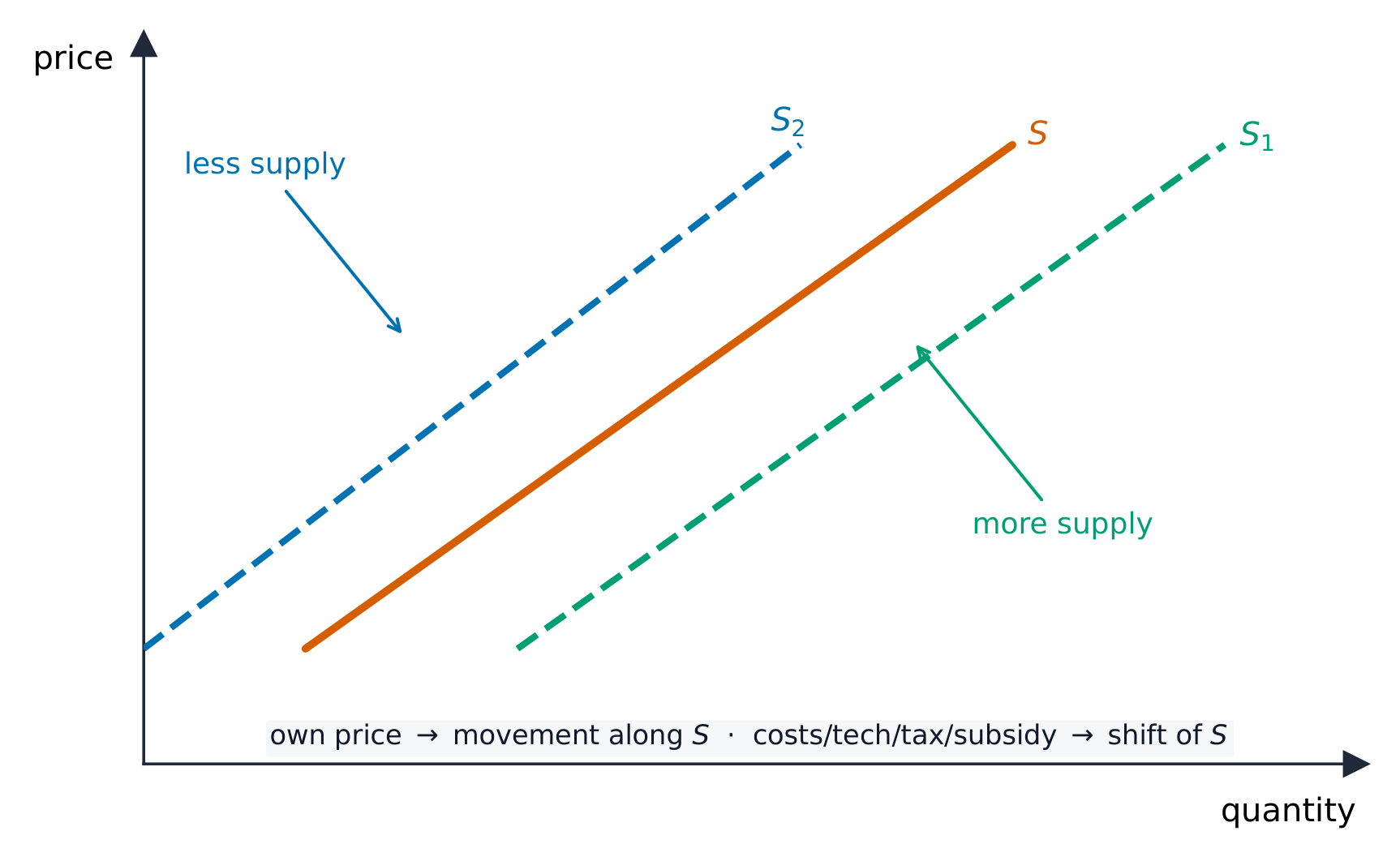
A change in any other condition causes a shift 移动 of the whole curve. A rightward shift means more is demanded at every price; a leftward shift means less.
Conditions of demand
These are the things (other than the good's own price) that shift the demand curve:
income 收入 — more income usually means more demand.
tastes 偏好 — if a good becomes popular, demand rises.
price of substitutes 替代品 — goods used instead of each other (tea and coffee). If coffee gets dearer, demand for tea rises.
price of complements 互补品 — goods used together (cars and fuel). If cars get dearer, demand for fuel falls.
population 人口 — more people means more demand.
advertising 广告 — good adverts raise demand.
The demand curve slopes down. A change in income, tastes, population or related prices shifts the whole curve; a change in the good's own price is a movement along it.
Explore · Исследовать
Demand & supply · Спрос и предложение
Demand slopes down — cheaper means more wanted. · Спрос имеет нисходящий наклон — чем дешевле, тем больше желающих.
define supply and explain the law of supply (direct relationship with price)
draw supply curves and distinguish a movement along from a shift
list the conditions of supply (costs of production, technology, taxes/subsidies, weather, number of firms)
Русский
определить предложение и объяснить закон предложения (прямая зависимость от цены)
начертить кривые предложения и различать движение вдоль и сдвиг
перечислить условия предложения (затраты на производство, технологии, налоги/субсидии, погода, количество фирм)
Source: Cambridge International syllabus · Источник: Программа Cambridge International
Supply shifts right: P falls, Q rises
Supply 供给 is the amount of a good that firms are willing and able to sell at each price, in a period of time.
The law of supply 供给定律 says: when the price rises, the quantity supplied rises too. Price and quantity move the same way — a direct relationship 正向关系. Firms supply more at a high price because they can earn more.
Movements and shifts
quantity supplied 供给量 — the amount offered at one price.
The supply curve 供给曲线 slopes upward from left to right.
A change in the good's own price → a movement along the curve.
A change in any other condition → a shift of the whole curve.
Conditions of supply
costs of production 生产成本 — if costs rise, firms supply less (curve shifts left).
technology 技术 — better technology lowers costs, so supply rises.
taxes and subsidies — a tax 税收 on a good raises firms' costs (supply falls); a subsidy 补贴 (money from the government) lowers costs (supply rises).
weather — important for farm goods.
number of firms — more firms means more supply.
The supply curve slopes up. Lower costs, better technology or a subsidy shift it right; higher costs or a tax shift it left.
Explore · Исследовать
Demand & supply · Спрос и предложение
Supply slopes up — dearer means more made. · Предложение имеет восходящий наклон — чем дороже, тем больше производится.
Source: Cambridge International syllabus · Источник: Программа Cambridge International
When a curve shifts, the crossing point moves, so price and quantity change:
Demand rises (shifts right): price rises and quantity rises.
Demand falls (shifts left): price falls and quantity falls.
Supply rises (shifts right): price falls and quantity rises.
Supply falls (shifts left): price rises and quantity falls.
Disequilibrium
If the price is not at equilibrium, the market is in disequilibrium 非均衡:
If price is below equilibrium, buyers want more than firms supply. This is excess demand 超额需求, also called a shortage 短缺. Buyers compete, so the price is pushed up until equilibrium returns.
If price is above equilibrium, firms supply more than buyers want. This is excess supply 超额供给, also called a surplus 过剩. Sellers cut the price until equilibrium returns.
Above the equilibrium price there is excess supply; below it there is excess demand (a shortage). Either way the price is pushed back to equilibrium.
Explore · Исследовать
Demand & supply · Спрос и предложение
A shift in demand or supply moves the equilibrium. · Сдвиг спроса или предложения изменяет равновесие.
define and calculate PED (% change in quantity demanded ÷ % change in price)
interpret values (elastic, inelastic, unit) and the determinants of PED
explain the relationship between PED and total revenue and the usefulness of PED to firms and government
Русский
определить и рассчитать PED (% изменение объема спроса ÷ % изменение цены)
интерпретировать значения (эластичный, неэластичный, единичный) и детерминанты PED
объяснить связь между PED и общей выручкой, а также полезность PED для фирм и правительства
Source: Cambridge International syllabus · Источник: Программа Cambridge International
Elastic vs inelastic demand
Price elasticity of demand 需求价格弹性 measures how much the quantity demanded changes when the price changes.
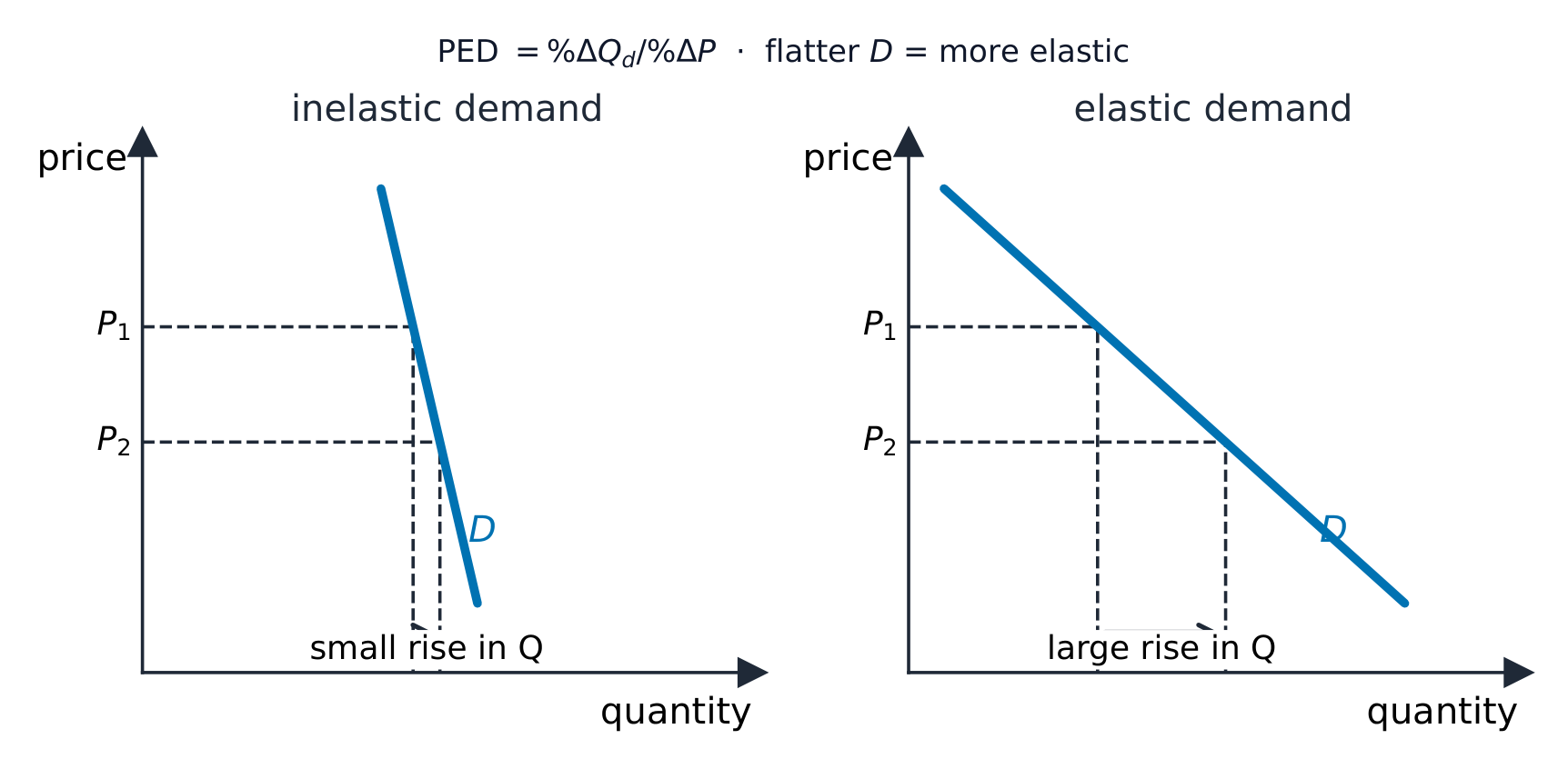
PED = (% change in quantity demanded) ÷ (% change in price)
(We usually ignore the minus sign and read the size of the number.) The determinants 决定因素 (the things that decide PED) include whether the good has close substitutes, whether it is a need or a luxury, and what share of income it takes.
Worked example. When the price of a good rises by 20%, the quantity demanded falls by 10%. Find the PED.
PED = (% change in quantity demanded) ÷ (% change in price) = 10 ÷ 20 = 0.5.
Because 0.5 is less than 1, demand is inelastic — the quantity changed by a smaller percentage than the price.
Reading the value
PED greater than 1: demand is elastic 富有弹性. Quantity changes by a large %. (Goods with many substitutes, like one brand of crisps.)
PED less than 1: demand is inelastic 缺乏弹性. Quantity changes by a small %. (Needs with few substitutes, like petrol or salt.)
PED equal to 1: unit elastic 单位弹性. Quantity changes by the same % as price.
When demand is inelastic (steep) a price change barely changes quantity; when it is elastic (shallow) the same change moves quantity a lot.
PED and total revenue
Total revenue 总收益 is the money a firm gets from sales: price × quantity sold. (To the buyer, the same money is total expenditure 总支出.) PED tells a firm what happens to revenue if it changes its price:
If demand is inelastic, raising the price raises total revenue (quantity falls only a little).
If demand is elastic, raising the price lowers total revenue (quantity falls a lot).
This is useful. A firm sets prices knowing how buyers will react. A government taxes inelastic goods (like cigarettes) because people keep buying them, so the tax raises a lot of money.
Worked example. A bus company sells 1,000 tickets a day at £2 each. It raises the price by 10% to £2.20, and daily sales fall by 5% to 950. Find the PED and what happens to total revenue.
PED = 5 ÷ 10 = 0.5, so demand is inelastic (less than 1).
old revenue = £2 × 1,000 = £2,000.
new revenue = £2.20 × 950 = £2,090.
Total revenue rose by £90. Because demand is inelastic, the price rose by a bigger percentage than the quantity fell, so raising the price raised revenue.
The same price rise raises revenue when demand is inelastic, but lowers it when demand is elastic
Explore · Исследовать
Elasticity & total revenue · Эластичность и совокупный доход
PED is the % change in quantity over the % change in price; whether it is above or below 1 decides how total revenue moves. · PED — это процентное изменение количества деленное на процентное изменение цены; то, находится ли она выше или ниже 1, определяет движение совокупного дохода.
Explore · Исследовать
Demand & supply · Спрос и предложение
Elasticity of demand is the steepness of the curve. · Эластичность спроса определяется крутизной кривой.
explain how a market economy allocates resources through the price mechanism
explain the advantages and disadvantages of the market economic system
Русский
объяснить, как рыночная экономика распределяет ресурсы через ценовой механизм
объяснить преимущества и недостатки рыночной экономической системы
Source: Cambridge International syllabus · Источник: Программа Cambridge International
In a market economy 市场经济, the price mechanism makes all the choices. There is no government planning. (The opposite is a planned economy 计划经济, where the government makes the choices.)
Advantages of the market system:
Prices guide resources to where they are wanted, without anyone planning.
Firms compete, so they cut costs and create new and better goods.
Consumers have wide choice.
Disadvantages:
Some useful goods are not made because they earn no profit.
The strong (rich firms and people) do well; the weak may be left with nothing.
Markets can fail (see below).
Explore · Исследовать
How a market allocates · Как рынок распределяет ресурсы
In a market system, price moves to where demand meets supply — that price signal decides what gets made. Shift the curves and watch it settle. · В рыночной системе цена устанавливается там, где спрос встречается с предложением — этот ценовой сигнал определяет, что производить. Сдвиньте кривые и посмотрите, как она устроится.
define market failure as the inefficient allocation of resources
explain the causes: external costs and external benefits (social vs private costs/benefits), merit and demerit goods, public goods and the abuse of monopoly power
Русский
определить провал рынка как неэффективное распределение ресурсов
объяснить причины: внешние издержки и внешние выгоды (социальные против частных издержек/выгод), мериторные и демариторные блага, общественные блага и злоупотребление монопольной властью
Source: Cambridge International syllabus · Источник: Программа Cambridge International
Market failure 市场失灵 happens when the price mechanism leads to an inefficient 低效率 use of resources — resources are not shared out in the best way for society. The main causes:
External costs and benefits
Pollution from a power station is an external cost — it falls on third parties, not just the producer
When you produce or consume something, the cost or benefit to you is not always the cost or benefit to everyone.
a private cost 私人成本 is the cost to the person doing the activity.
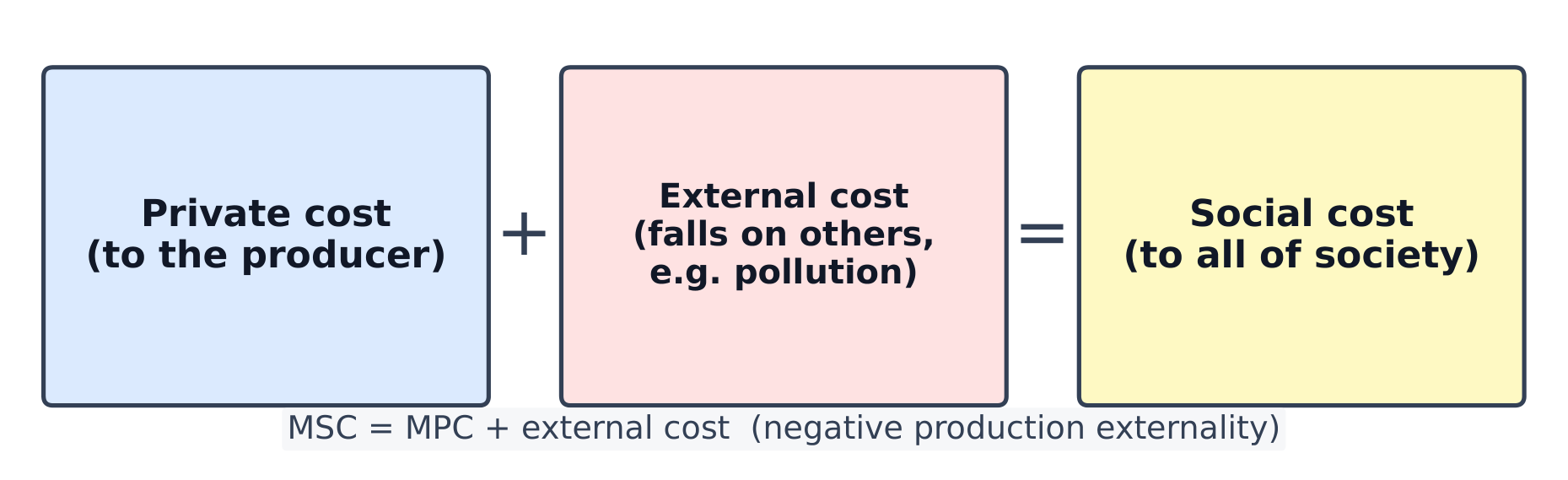
an external cost 外部成本 is a cost paid by other people — for example, smoke from a factory harms nearby families.
the social cost 社会成本 is the private cost plus the external cost (the cost to the whole of society).
In the same way:
a private benefit 私人效益 is the benefit to the person doing the activity.
an external benefit 外部效益 is a benefit that others get for free — for example, your neighbour's tidy garden is nice for you too.
the social benefit 社会效益 is the private benefit plus the external benefit.
Markets fail because firms and consumers only think about their private costs and benefits, not the external ones.
An external cost (e.g. pollution) falls on third parties, so the social cost is greater than the producer's private cost
Merit, demerit and public goods
merit goods 有益物品 are better for you than you realise, so the market makes too few (education, healthcare).
demerit goods 有害物品 are worse for you than you realise, so the market makes too many (cigarettes, alcohol).
public goods 公共物品 are things everyone can use and no one can be stopped from using, like street lights or national defence. The market makes none, because firms cannot charge for them.
A private good is rival and excludable (firms supply it); a public good is non-rival and non-excludable (the government must supply it)Merit and demerit goods are mis-judged because of information failure
Abuse of monopoly power
A monopoly 垄断 is a single firm that controls a market. With no competition, it can charge high prices and make poor-quality goods. This is another market failure.
Explore · Исследовать
Demand & supply · Спрос и предложение
Market failure: the free-market crossing isn't always best for society. · Провал рынка: свободный рынок не всегда оптимален для общества.
explain the features of a mixed economy (private sector and public sector)
explain methods of government intervention to address market failure: maximum and minimum prices, indirect taxes, subsidies, regulation and direct provision
evaluate the effects of intervention
Русский
объяснить особенности смешанной экономики (частный сектор и государственный сектор)
объяснить методы государственного вмешательства для устранения провала рынка: максимальные и минимальные цены, косвенные налоги, субсидии, регулирование и прямое предоставление
оценить последствия вмешательства
Source: Cambridge International syllabus · Источник: Программа Cambridge International
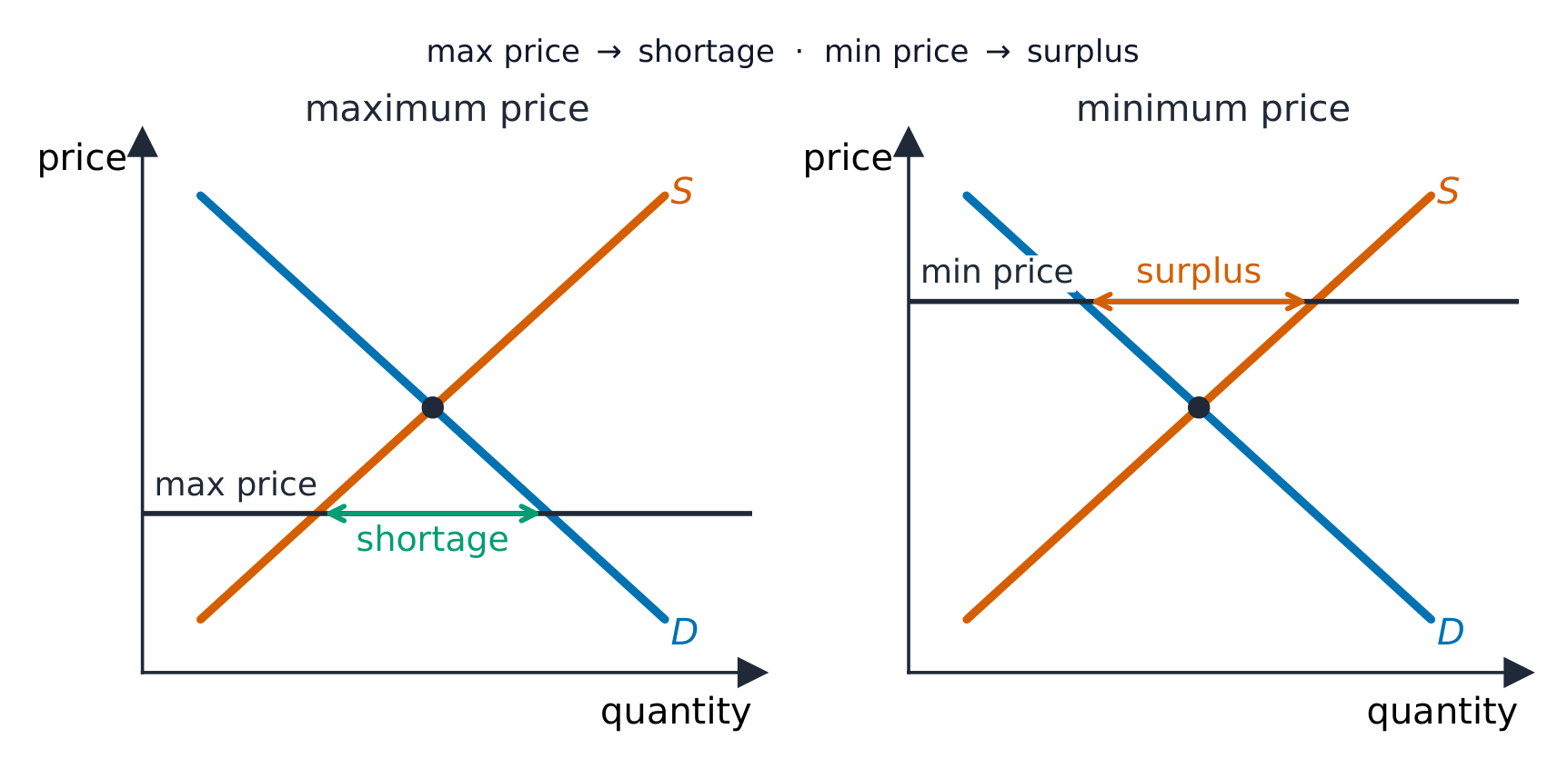
A maximum price creates a shortage
A mixed economy 混合经济 has both:
a private sector 私营部门 — firms owned by people, guided by the price mechanism.
a public sector 公共部门 — activity run by the government.
Most real economies are mixed; China's, for example, is a socialist market economy. The government steps in to correct market failure. This is government intervention 干预. The main methods:
Method
What it does
maximum price 最高价格
a price ceiling, set below equilibrium, to keep a good (like rent) cheap — but it causes a shortage
minimum price 最低价格
a price floor, set above equilibrium, to keep a price up (like a fair wage) — but it causes a surplus
indirect tax 间接税
a tax on a good (added to its price) to cut demand for demerit goods
subsidy
money paid to firms to cut the price and raise output of merit goods
regulation 监管
rules and laws, like banning smoking in public
direct provision 直接提供
the government makes and gives out goods itself, like state schools
A maximum price set below equilibrium causes a shortage; a minimum price set above equilibrium causes a surplus.
Judging intervention
Intervention can fix market failure, but it has costs. Taxes and rules cost money to collect and check. Governments can get things wrong too (this is called government failure). So you should always weigh the good effects against the bad ones before deciding.
Explore · Исследовать
Economics case lab · Лаборатория экономических кейсов
Classify real examples by the economic idea they show. · Классифицируйте реальные примеры по экономической идее, которую они иллюстрируют.
A change in a good's own price is a movement along the curve; a change in anything else (income, tastes, related prices) shifts the whole curve.
Equilibrium is where demand meets supply. Below it there is excess demand (a shortage, so price rises); above it there is excess supply (a surplus, so price falls).
PED = %ΔQ ÷ %ΔP. Demand is inelastic if PED < 1 (raising price raises revenue) and elastic if PED > 1 (raising price lowers revenue).
Market failure (external costs, merit/demerit/public goods, monopoly) means resources are used badly; the government corrects it with taxes, subsidies, rules and direct provision.
state the functions of money (medium of exchange, store of value, unit of account, means of deferred payment) and the characteristics of money
explain the role of central banks and commercial banks
Русский
изложите функции денег (средство обращения, средство накопления, мера стоимости, средство отсроченного платежа) и характеристики денег
объясните роль центральных и коммерческих банков
Source: Cambridge International syllabus · Источник: Программа Cambridge International
English
Long ago, people swapped goods directly. This is called barter 物物交换. Barter is hard: you must find someone who has what you want and wants what you have. Money 货币 solves this problem.
The functions of money
Money does four jobs:
a medium of exchange 交换媒介 — you swap money for goods, so you do not need barter.
a store of value 价值储藏 — you can hold money now and spend it later, because it keeps its value.
a unit of account 记账单位 — money measures and compares the value of things (this is the price).
a means of deferred payment 延期支付手段 — you can buy now and pay later.
The characteristics of money
Good money must be:
durable 耐用的 — it lasts a long time.
portable 便于携带的 — easy to carry.
divisible 可分割的 — can be split into small amounts for small payments.
limited in supply, hard to copy, and accepted by everyone.
Banks
A central bank 中央银行 is the government's bank. It issues notes, looks after the banking system, and sets interest rates 利率. There is one in each country.
commercial banks 商业银行 are the ordinary banks that people and firms 企业 use. They keep savings safe, lend money, and let people pay each other.
Русский
Давным-давно люди обменивались товарами напрямую. Это называется бартер. Бартер сложен: нужно найти человека, у которого есть то, что вам нужно, и который хочет то, что у вас есть. Деньги решают эту проблему.
Функции денег
Деньги выполняют четыре функции:
средство обмена — вы меняете деньги на товары, поэтому бартер не нужен.
средство накопления стоимости — вы можете хранить деньги сейчас и тратить их позже, так как они сохраняют свою ценность.
мера стоимости — деньги измеряют и сравнивают ценность вещей (это и есть цена).
средство отложенного платежа — вы можете купить сейчас, а заплатить позже.
Четыре функции денег: средство обмена, средство накопления стоимости, мера стоимости и средство отложенного платежаДеньги — банкноты и монеты — служат средством обмена, средством накопления, единицей счета и средством отложенного платежа
Характеристики денег
Хорошие деньги должны быть:
долговечными — служить долго.
переносимыми — легкими для переноски.
делимыми — делимы на мелкие части для небольших платежей.
ограниченные по предложению, трудные для подделки и принимаемые всеми.
Банки
Центральный банк — это государственный банк. Он выпускает банкноты, обеспечивает функционирование банковской системы и устанавливает процентные ставки. Центральный банк есть в каждой стране.
Коммерческие банки — это обычные банки, которыми пользуются люди и фирмы. Они обеспечивают сохранность сбережений, выдают кредиты и позволяют людям расплачиваться друг с другом.
Explore · Исследовать
Economics case lab · Лаборатория экономических кейсов
Classify real examples by the economic idea they show. · Классифицируйте реальные примеры по экономической идее, которую они иллюстрируют.
means of deferred payment/miːnz ɒv dɪˈfɜːd ˈpeɪmənt/
средства отсроченной выплаты
durable/ˈdjʊərəbl/
устойчивая
portable/ˈpɔːtəbl/
переносимый
divisible/dɪˈvɪzɪbl/
делимый
central bank/ˈsentrəl bæŋk/
центральном банке
interest rate/ˈɪntrest reɪt/
процентной ставке
commercial banks/kəˈmɜːʃl bæŋks/
коммерческие банки
firms/fɜːmz/
фирмами
household/ˈhaʊshəʊld/
домохозяйство
saving/ˈseɪvɪŋ/
сбережения
borrowing/ˈbɒrəʊɪŋ/
заемных
3.2
Households · Домохозяйства
Syllabus · Программа
English
explain the influences on spending, saving and borrowing by households (income, interest rates, confidence)
Русский
объясните влияние на расходы, сбережения и заимствования домохозяйств (доходы, процентные ставки, уверенность)
Source: Cambridge International syllabus · Источник: Программа Cambridge International
English
A household 家庭 is a person or group living together and making money decisions. Each household must choose how much to spend, save, and borrow.
saving 储蓄 is income that is not spent now.
borrowing 借贷 is spending money you do not have yet, and paying it back later (usually with an extra charge).
Three main things change these choices:
income 收入 — with more income, people spend and save more.
interest rates — a higher interest rate makes saving more rewarding and borrowing dearer. So saving rises and borrowing falls.
confidence 信心 — if people feel sure about their jobs and the future, they spend and borrow more. If they are worried, they save more.
Русский
Домохозяйство — это человек или группа людей, живущих вместе и принимающих финансовые решения. Каждое домохозяйство должно выбирать, сколько тратить, сберегать и занимать.
Домохозяйство может потратить, отложить часть дохода или уплатить налоги
сбережения — это доход, который не тратится сейчас.
заем — это трата денег, которых еще нет, с обязательством вернуть их позже (обычно с дополнительной надбавкой).
Три основных фактора влияют на эти выборы:
доход — при увеличении дохода люди больше тратят и больше сберегают.
процентные ставки — более высокая ставка делает сбережения более выгодными, а займы — дороже. Следовательно, сбережения растут, а займы сокращаются.
уверенность — если люди уверены в своих рабочих местах и будущем, они больше тратят и занимают. Если они обеспокоены, они больше сберегают.
Explore · Исследовать
Economics case lab · Лаборатория экономических кейсов
Classify real examples by the economic idea they show. · Классифицируйте реальные примеры по экономической идее, которую они иллюстрируют.
explain the factors that determine an individual's choice of occupation (wage and non-wage factors)
explain the reasons for differences in earnings (skills, qualifications, danger, trade unions, discrimination)
explain division of labour/specialisation and its advantages and disadvantages
Русский
объясните факторы, определяющие выбор профессии отдельным человеком (зарплатные и незарплатные факторы)
объясните причины различий в уровне доходов (квалификация, образование, опасность, профсоюзы, дискриминация)
объясните разделение труда/специализацию и их преимущества и недостатки
Source: Cambridge International syllabus · Источник: Программа Cambridge International
English
Choosing a job
When a worker chooses an occupation 职业 (a type of job), two kinds of factor matter:
wage factors — the pay. The wage 工资 is the money you earn. Higher pay attracts more workers.
non-wage factors — everything else: working hours, holidays, how safe or pleasant the job is, whether you enjoy the work, distance from home, and the chance to move up to a higher job.
Why workers earn different amounts
Workers are not all paid the same. The reasons include:
skill 技能 and qualifications 资格 — workers who are hard to replace, or who studied for years, earn more.
danger — risky or dirty jobs may pay more to attract workers.
trade unions 工会 — a trade union is a group of workers who join together to bargain for better pay and conditions. Strong unions can raise pay.
discrimination 歧视 — unfair treatment because of gender, race, or age can cause unfair pay gaps.
Division of labour
Division of labour 劳动分工 (also called specialisation 专业化) means splitting a job into small tasks, with each worker doing one task again and again.
Advantages: workers get faster and better at their one task; less time is wasted moving between tasks; this raises output.
Disadvantages: doing one task is boring, so workers may make mistakes or leave; if one worker is absent, the whole line can stop; each worker learns only one skill.
Русский
Выбор профессии
Когда работник выбирает профессию (тип работы), важны два вида факторов:
факторы оплаты труда — размер заработной платы. Заработная плата — это деньги, которые вы зарабатываете. Более высокая оплата привлекает больше работников.
неденежные факторы — всё остальное: рабочий график, отпуска, безопасность или комфорт работы, удовольствие от труда, расстояние до дома и возможность карьерного роста.
Почему работники получают разную оплату
Работников платят неодинаково. Причины включают:
Заработная плата зависит от навыков, сложности работы и спроса
навыки и квалификация — работники, которых трудно заменить или которые учились годами, получают больше.
опасность — рискованные или грязные работы могут оплачиваться выше, чтобы привлечь работников.
профсоюзы — профсоюз это объединение работников, которые совместно ведут переговоры о повышении заработной платы и улучшении условий труда. Сильные профсоюзы способны повысить зарплату.
дискриминация — несправедливое отношение по признаку пола, расы или возраста может приводить к несправедливым разрывам в оплате труда.
Разделение труда
Разделение труда (также называемое специализацией) означает разделение работы на мелкие операции, при этом каждый работник выполняет одну и ту же операцию многократно.
Преимущества: работники становятся быстрее и точнее в выполнении своей операции; меньше времени тратится на перемещение между операциями; это повышает объем производства.
Недостатки: выполнение одной операции скучно, поэтому работники могут допускать ошибки или увольняться; если один работник отсутствует, весь процесс может остановиться; каждый работник осваивает лишь один навык.
Разделение труда: разделение работы на мелкие повторяющиеся операции повышает выпуск на одного работника
Explore · Исследовать
Economics case lab · Лаборатория экономических кейсов
Classify real examples by the economic idea they show. · Классифицируйте реальные примеры по экономической идее, которую они иллюстрируют.
classify firms by size and explain why some firms remain small and why/how firms grow (mergers: horizontal, vertical, conglomerate)
explain the causes of business failure
Русский
классифицируйте предприятия по размеру и объясните, почему некоторые остаются малыми и как/почему предприятия растут (слияния: горизонтальные, вертикальные, конгломератные)
объясните причины банкротства бизнеса
Source: Cambridge International syllabus · Источник: Программа Cambridge International
English
Economies of scale: average cost falls
The size of firms
Firms come in many sizes, from one person to huge companies. We can measure size by the number of workers, the amount of capital 资本 used, or the output.
Some firms stay small because: the market 市场 is small; the product is personal (like a hairdresser); the owner wants to stay in control; or there is little money to grow.
How firms grow
Firms grow by selling more, or by joining with other firms. When two firms join, it is a merger 合并 (or takeover). There are three types:
horizontal merger 横向合并 — two firms at the same stage of the same industry join (two car makers).
vertical merger 纵向合并 — two firms at different stages of the same industry join (a car maker and a tyre maker). "Backward" is towards the supplier; "forward" is towards the seller.
conglomerate merger 混合合并 — two firms in different industries join (a car maker and a food company).
Business failure
Firms can suffer business failure 企业倒闭 (they close down) for many reasons: costs too high, too few sales, poor management, too many rivals, not enough cash, or a fall in demand 需求.
Русский
Экономия на масштабе: средние издержки снижаются
Размер предприятий
Предприятия бывают разных размеров: от одного человека до огромных корпораций. Размер можно измерить количеством работников, объемом используемого капитала или объемом выпускаемой продукции.
Некоторые предприятия остаются небольшими, потому что: рынок мал; продукт индивидуален (например, парикмахер); владелец хочет сохранять контроль; или у него мало денег для расширения.
Как предприятия растут
Предприятия растут за счет увеличения продаж или путем объединения с другими предприятиями. Когда два предприятия объединяются, это называется слиянием (или поглощением). Существует три типа:
горизонтальное слияние — два предприятия на одном и том же этапе той же самой отрасли объединяются (два автопроизводителя).
вертикальное слияние — два предприятия на различных этапах одной отрасли объединяются (автопроизводитель и производитель шин). «Обратное» направление направлено к поставщику; «прямое» — к продавцу.
конгломератное слияние — два предприятия из разных отраслей объединяются (автопроизводитель и пищевая компания).
Три типа интеграции: горизонтальная (один этап), вертикальная (различные этапы одной отрасли) и конгломератная (разные отрасли)
Предпринимательский провал
Предприятия могут потерпеть предпринимательский провал (закрыться) по многим причинам: слишком высокие затраты, слишком низкие продажи, плохое управление, слишком много конкурентов, недостаточная ликвидность или падение спроса.
Explore · Исследовать
Firm objective lab · Лаборатория целей фирмы
Classify real firm decisions by the objective they reveal. · Классифицируйте реальные решения фирмы по цели, которую они раскрывают.
3.5
Firms and production · Предприятия и производство
Syllabus · Программа
English
distinguish labour-intensive and capital-intensive production and explain productivity
explain demand for and supply of factors of production and economies and diseconomies of scale
Русский
отличите трудоемкое и капиталоемкое производство и объясните производительность
объясните спрос и предложение факторов производства, а также экономию и неэкономии масштаба
Source: Cambridge International syllabus · Источник: Программа Cambridge International
English
Labour-intensive and capital-intensive
labour-intensive 劳动密集型 production uses a lot of labour 劳动 (many workers) and little machinery — for example, hand-made crafts.
capital-intensive 资本密集型 production uses a lot of capital (machines) and few workers — for example, a modern car factory.
Productivity
Productivity 生产率 means output per worker (or per machine) in a set time. Higher productivity means each worker makes more, so the cost of each unit falls. Training, better machines, and good management all raise productivity.
Demand for and supply of factors
Firms buy factors of production 生产要素 (land 土地, labour, capital, and enterprise 企业家才能). The price and amount of each factor are set by its own demand and supply, just like any market. For example, if many firms want skilled workers, the wage for those workers rises.
Economies and diseconomies of scale
As a firm grows and makes more, the cost of each unit can change:
economies of scale 规模经济 — as output rises, the average cost of each unit falls. Reasons: buying materials in bulk is cheaper, big machines work more efficiently, and large firms borrow money cheaply.
diseconomies of scale 规模不经济 — if a firm grows too big, the average cost of each unit starts to rise. Reasons: a huge firm is hard to manage, messages travel slowly, and workers may feel less important.
These can be internal (caused by the firm's own size) or external (caused by the whole industry growing).
Русский
Трудоемкое и капиталоемкое производство
трудоемкое производство использует много труда (множество рабочих) и мало машин — например, ручные ремесла.
капиталоемкое производство использует много капитала (машин) и мало рабочих — например, современный автомобильный завод.
Конвейер сборки автомобилей капиталоемок (много машин, мало рабочих) и использует разделение труда — каждый рабочий выполняет одну операцию
Производительность
Производительность означает выпуск на одного работника (или на одну машину) за определенное время. Более высокая производительность означает, что каждый работник производит больше, поэтому стоимость каждой единицы снижается. Обучение, улучшение оборудования и хорошее управление повышают производительность.
Спрос и предложение факторов производства
Предприятия покупают факторы производства (землю, труд, капитал и предпринимательство). Цена и количество каждого фактора определяются его собственным спросом и предложением, так же, как на любом рынке. Например, если многие предприятия ищут квалифицированных рабочих, заработная плата таких рабочих растет.
Экономия и неэкономия от масштаба
По мере роста предприятия и увеличения выпуска стоимость единицы продукции может меняться:
эффект масштаба — при увеличении объема производства средние затраты на каждую единицу снижаются. Причины: закупка материалов оптом дешевле, большие машины работают эффективнее, а крупные компании занимают деньги под дешевые проценты.
неэффект масштаба — если предприятие становится слишком большим, средние затраты на каждую единицу начинают расти. Причины: огромное предприятие сложно управлять, сообщения распространяются медленно, а работники могут чувствовать себя менее значимыми.
Средние затраты снижаются по мере роста предприятия (эффект масштаба), достигают минимума, а затем растут, если предприятие становится слишком большим (неэффект масштаба).
Они могут быть внутренними (вызванными размером самого предприятия) или внешними (вызванными ростом всей отрасли).
Explore · Исследовать
Factors of production lab · Лабораторная работа по факторам производства
Sort real resources by the factor of production they represent. · Распределите реальные ресурсы по фактору производства, который они представляют.
Firms' costs, revenue and objectives · Затраты, выручка и цели предприятий
Syllabus · Программа
English
define and calculate fixed, variable, total and average costs
define and calculate total and average revenue
explain the objectives of firms (profit, survival, growth, social objectives)
Русский
определите и рассчитайте постоянные, переменные, общие и средние затраты
определите и рассчитайте общую и среднюю выручку
объясните цели предприятий (прибыль, выживание, рост, социальные цели)
Source: Cambridge International syllabus · Источник: Программа Cambridge International
English
Costs
A cost 成本 is money a firm spends to produce. Costs split into:
fixed costs 固定成本 — costs that do not change with output, such as rent and insurance. You pay them even if you make nothing.
variable costs 可变成本 — costs that change with output, such as materials and power. More output means more variable cost.
total cost 总成本 — fixed cost plus variable cost.
average cost 平均成本 — the cost of each unit: total cost divided by the number of units made.
Revenue
Revenue 收益 is the money a firm gets from selling its goods.
total revenue 总收益 — the price multiplied by the quantity sold.
average revenue 平均收益 — total revenue divided by the quantity sold (this is the same as the price).
Profit and other objectives
Profit 利润 is what is left after costs:
profit = total revenue − total cost
Worked example. A firm has fixed costs of £2,000 and variable costs of £3 per unit. It makes 500 units and sells them at £10 each. Find its total cost, total revenue, profit and average cost.
variable cost = 3 × 500 = £1,500, so total cost = 2,000 + 1,500 = £3,500.
total revenue = 10 × 500 = £5,000.
profit = 5,000 - 3,500 = £1,500.
average cost = total cost ÷ units = 3,500 ÷ 500 = £7 per unit.
The firm makes a profit because the price (£10) is above the average cost (£7).
Most firms want as much profit as possible. But firms can have other objectives 目标:
survival 生存 — a new firm first just wants to stay open.
growth 增长 — getting bigger, to gain economies of scale and market power.
social objectives — some firms aim to help people or protect the environment, not only to earn profit.
Русский
Издержки
Затраты — это деньги, которые предприятие тратит на производство. Затраты делятся на:
постоянные затраты — затраты, которые не изменяются в зависимости от объема выпуска, такие как аренда и страховка. Вы платите их даже если ничего не производите.
переменные затраты — затраты, которые изменяются в зависимости от объема выпуска, такие как материалы и электроэнергия. Больше выпуска означает больше переменных затрат.
средние затраты — затраты на каждую единицу: общие затраты, деленные на количество произведенных единиц.
Постоянные затраты остаются неизменными при росте выпуска; переменные затраты растут; общие затраты равны сумме постоянных и переменных, поэтому разница между общими и переменными затратами составляет постоянные затраты.
Выручка
Выручка — это деньги, которые предприятие получает от продажи своих товаров.
общая выручка — цена, умноженная на проданное количество.
средняя выручка — общая выручка, деленная на проданное количество (это то же самое, что и цена).
Прибыль и другие цели
Прибыль — это то, что остается после вычета затрат:
прибыль = общая выручка − общие затраты
Разобранное решение. У компании постоянные расходы составляют £2,000, а переменные расходы — £3 за единицу. Она производит 500 единиц и продает их по £10 каждая. Найдите ее общие затраты, общую выручку, прибыль и средние затраты.
средние затраты = общие затраты ÷ количество единиц = 3,500 ÷ 500 = £7 за единицу.
Фирма получает прибыль, потому что цена (10 £) выше средних издержек (7 £).
Большинство фирм стремятся к максимальной прибыли. Однако у фирм могут быть другие цели:
выживание — новая фирма сначала просто хочет остаться на рынке.
рост — увеличение масштабов для получения эффекта масштаба и рыночной власти.
социальные цели — некоторые фирмы стремятся помогать людям или защищать окружающую среду, а не только зарабатывать прибыль.
Explore · Исследовать
A firm's cost curves · Кривые издержек фирмы
Change output and see how average cost falls then rises — and where marginal cost crosses it. · Измените объём выпуска и наблюдайте, как средние издержки сначала снижаются, затем растут, и где предельные издержки пересекают их.
describe the characteristics of competitive markets and monopoly
explain the advantages and disadvantages of competition for consumers and firms
Русский
опишите характеристики конкурентных рынков и монополии
объясните преимущества и недостатки конкуренции для потребителей и предприятий
Source: Cambridge International syllabus · Источник: Программа Cambridge International
English
Markets differ by how many firms there are and how hard it is for new firms to join.
Competitive markets
A competitive market has many firms selling similar goods, and it is easy for new firms to enter. This is strong competition 竞争. In such a market:
firms must keep prices low and quality high, or buyers go elsewhere.
firms work hard to cut costs and make new products.
This is good for consumers: low prices, wide choice, and good quality.
Monopoly
A monopoly 垄断 is a market with only one firm, or one firm that controls most of it. New firms find it hard to enter because of barriers to entry 进入壁垒 — for example, very high start-up costs, or the one firm controlling key supplies.
In a monopoly:
the firm can charge high prices, because buyers have no other choice.
there is little pressure to improve quality or cut costs.
but a large monopoly may gain economies of scale, and may use its profit to pay for research.
Competition versus monopoly
Consumers
Firms
competition
lower prices, more choice, better quality
lower profit; must work hard to survive
monopoly
higher prices, less choice
higher profit and an easy life, but may grow lazy
Русский
Рынки различаются по количеству фирм и тому, насколько легко новым firmам войти на рынок.
Рынки варьируются от монополии (один продавец) до совершенной конкуренции (многие)
Конкурентные рынки
Конкурентный рынок характеризуется множеством фирм, продающих похожие товары, и легким входом новых фирм. Это сильная конкуренция. На таком рынке:
фирмы должны держать цены низкими, а качество высоким, иначе покупатели уйдут к другим.
фирмы усердно работают над снижением издержек и созданием новых продуктов.
Это выгодно потребителям: низкие цены, широкий выбор и высокое качество.
В конкурентном рынке многие компании продают похожие товары, поэтому каждая должна держать цены низкими, а качество высоким, чтобы привлечь покупателей
Монополия
Монополия — это рынок, где действует лишь одна фирма или одна фирма контролирует большую его часть. Новым фирмам трудно войти на рынок из-за барьеров для входа, например, очень высоких стартовых затрат или контроля одной фирмы над ключевыми ресурсами.
В условиях монополии:
фирма может устанавливать высокие цены, так как у покупателей нет альтернативы.
отсутствует давление в сторону повышения качества или снижения издержек.
но крупная монополия может получить эффект масштаба и использовать прибыль для финансирования исследований.
Конкуренция против монополии
Потребители
Фирмы
конкуренция
более низкие цены, больший выбор, лучшее качество
меньшая прибыль; необходимо усердно работать ради выживания
монополия
более высокие цены, меньший выбор
большая прибыль и спокойная жизнь, но возможна лень
Explore · Исследовать
Economics case lab · Лаборатория экономических кейсов
Classify real examples by the economic idea they show. · Классифицируйте реальные примеры по экономической идее, которую они иллюстрируют.
state the macroeconomic aims of government (economic growth, full employment/low unemployment, price stability, balance of payments stability, redistribution of income)
explain why aims may conflict
Русский
изложите макроэкономические цели государства (экономический рост, полная занятость/низкая безработица, стабильность цен, стабильность платежного баланса, перераспределение доходов)
объясните, почему цели могут конфликтовать
Source: Cambridge International syllabus · Источник: Программа Cambridge International
Governments try to manage the whole economy — the macroeconomy 宏观经济. They have five main aims:
Five main aims: growth, low unemployment, stable prices, balance of payments stability, fair incomes
economic growth 经济增长 — the economy makes more goods and services each year.
full employment 充分就业 — almost everyone who wants a job has one, so unemployment 失业 is low.
price stability 价格稳定 — prices rise only slowly, so inflation 通货膨胀 is low.
balance of payments 国际收支 stability — the money flowing in and out of the country (from trade) is roughly even.
redistribution of income 收入再分配 — sharing income more fairly, so the gap between rich and poor is not too wide.
These aims can conflict 冲突 (work against each other). For example, fast growth can pull prices up, causing inflation. Cutting unemployment can do the same. So a government must balance its aims.
The government's three sets of policy tools for managing the macroeconomy
Government policy moves aggregate demand against aggregate supply to steer output and the price level. · Правительственная политика направлена против совокупного спроса к совокупному предложению, чтобы регулировать выпуск и уровень цен.
redistribution of income/ˌriːˌdɪstrɪˈbjuːʃn ɒv ˈɪŋkʌm/
перераспределение доходов
conflict/ˈkɒnflɪkt/
противоречить друг другу
4.2
Fiscal policy
Syllabus · Программа
English
define fiscal policy (government spending and taxation) and the government budget (surplus, deficit, balance)
distinguish direct and indirect taxes and progressive, regressive and proportional taxes
explain the effects of fiscal policy on government macroeconomic aims
Русский
определите фискальную политику (государственные расходы и налогообложение) и государственный бюджет (профицит, дефицит, баланс)
отличите прямые и косвенные налоги, а также прогрессивные, регрессивные и пропорциональные налоги
объясните влияние фискальной политики на макроэкономические цели государства
Source: Cambridge International syllabus · Источник: Программа Cambridge International
Fiscal policy 财政政策 means the government changing two things to manage the economy:
government spending 政府支出 — money the government spends, for example on schools, hospitals, and roads.
taxation 税收 — money the government takes from people and firms.
The government budget 预算 sets spending against tax. There are three outcomes:
a budget deficit 预算赤字 — spending is more than the tax raised, so the government must borrow.
a budget surplus 预算盈余 — the tax raised is more than spending.
a balanced budget — the two are equal.
Types of tax
Taxes are grouped in two ways. By what is taxed:
a direct tax 直接税 is paid straight to the government from income 收入 or profit 利润 (income tax, corporation tax).
an indirect tax 间接税 is added to the price of goods and paid when you spend (a sales tax).
By how the rate changes with income:
a progressive tax 累进税 takes a bigger % from higher incomes. This helps redistribute income.
a regressive tax 累退税 takes a smaller % from higher incomes, so it hits the poor harder.
a proportional tax 比例税 takes the same % from everyone.
Under a progressive tax the average rate rises with income; under a regressive tax it falls; under a proportional tax it stays the same.
What fiscal policy does
To boost the economy (raise growth and jobs), the government can spend more or cut taxes. This raises total demand 需求 — but if demand grows too fast, it can cause inflation.
To slow the economy (fight inflation), the government can spend less or raise taxes. This lowers demand, but can raise unemployment.
Explore · Исследовать
Fiscal policy shifts AD · Фискальная политика сдвигает совокупный спрос
Spending more or taxing less shifts aggregate demand right — raising output, but also the price level. · Увеличение расходов или снижение налогов сдвигает совокупный спрос вправо — повышая выпуск, но также и уровень цен.
define monetary policy (interest rates, money supply) and the role of the central bank
explain the effects of changes in interest rates on the economy
Русский
определите денежно-кредитную политику (процентные ставки, денежная масса) и роль центрального банка
объясните влияние изменений процентных ставок на экономику
Source: Cambridge International syllabus · Источник: Программа Cambridge International
Monetary policy 货币政策 is the central bank 中央银行 changing interest rates 利率 (and the money supply 货币供给) to manage the economy. The interest rate is the cost of borrowing and the reward for saving.
Lower interest rates: borrowing is cheaper, so people and firms spend and invest 投资 more. Demand rises, giving more growth and jobs — but maybe more inflation.
Higher interest rates: borrowing is dearer, so spending falls. Demand falls, giving less inflation — but maybe more unemployment.
The central bank runs monetary policy: it sets the interest rate to manage demand, inflation and growth
Explore · Исследовать
Monetary policy shifts AD · Денежно-кредитная политика сдвигает совокупный спрос
define supply-side policy (education and training, privatisation, deregulation, incentives)
explain the effects of supply-side policy on government macroeconomic aims
Русский
определите политику предложения (образование и профессиональное обучение, приватизация, deregulation, стимулы)
объясните влияние политики предложения на макроэкономические цели государства
Source: Cambridge International syllabus · Источник: Программа Cambridge International
Supply-side policy 供给侧政策 tries to raise the amount the economy can produce. It improves the quantity and quality of the factors of production 生产要素. Methods include:
education and training — better skills raise productivity 生产率.
privatisation 私有化 — selling state-owned firms to private owners, who may run them better.
deregulation 放松管制 — removing rules that hold firms back.
incentives 激励 — lower taxes on income and profit, so people work harder and firms invest more.
Supply-side policy can raise growth and jobs and lower inflation at the same time. Its weakness is that it works slowly.
Explore · Исследовать
Economics case lab · Лаборатория экономических кейсов
Classify real examples by the economic idea they show. · Классифицируйте реальные примеры по экономической идее, которую они иллюстрируют.
define economic growth as an increase in real GDP; define GDP and real GDP
describe the business cycle (boom, recession, slump, recovery)
explain the causes, consequences (costs and benefits) of economic growth and recession
Русский
определите экономический рост как увеличение реального ВВП; определите ВВП и реальный ВВП
опишите деловой цикл (подъем, рецессия, спад, восстановление)
объясните причины, последствия (затраты и выгоды) экономического роста и рецессии
Source: Cambridge International syllabus · Источник: Программа Cambridge International
Economic growth is a rise in real GDP.
GDP (gross domestic product 国内生产总值) is the total value of all goods and services a country produces in a year. Real 实际 GDP is GDP after the effect of rising prices is removed, so it shows the true change in output.
Worked example. A country's real GDP was £500 billion last year and £515 billion this year. Find the rate of economic growth.
economic growth = (515 - 500) ÷ 500 × 100 = 3%.
Because this uses real GDP (with the effect of rising prices taken out), the 3% is a true rise in output, not just higher prices. If prices had risen but output had not, real GDP — and so growth — would be zero.
Investment in new buildings and capital, seen in Shanghai's Pudong skyline, drives economic growth
The business cycle
Real GDP does not rise smoothly. It moves through a business cycle 经济周期 with four stages:
boom 繁荣 — fast growth; output and jobs are high, but prices rise quickly.
recession 衰退 — output falls and jobs are lost. (A recession is often defined as falling real GDP for six months.)
slump 萧条 — the bottom of the cycle; very low output and high unemployment.
recovery 复苏 — output starts to rise again.
Real GDP moves through boom, recession, slump and recovery around its rising trend.
Causes and effects
Growth comes from more or better factors of production: investment in new machines, a bigger or more skilled workforce, and new technology.
Good effects: higher incomes, more jobs, better living standards 生活水平, and more tax for the government to spend.
Bad effects: prices may rise (inflation); the gap between rich and poor may grow; and there may be more pollution and use of scarce resources.
A recession brings the opposite: lower incomes, more unemployment, and business failures.
Explore · Исследовать
Economic growth · Экономический рост
Growth shifts the whole frontier outward — the economy can now produce more of both goods. · Рост смещает всю границу наружу — теперь экономика может производить больше обоих товаров.
define and measure unemployment (claimant count, labour force survey)
explain the types of unemployment (frictional, structural, cyclical/demand-deficient) and their causes
explain the consequences of unemployment and the patterns/changes in employment
Русский
определите и измерьте безработицу (количество получателей пособий, опрос рабочей силы)
объясните типы безработицы (фрикционная, структурная, циклическая/дефицит спроса) и их причины
объясните последствия безработицы и тенденции/изменения в занятости
Source: Cambridge International syllabus · Источник: Программа Cambridge International
Measuring unemployment
Unemployment is people who can work and want to work, but cannot find a job. There are two ways to measure it:
the claimant count 失业救济申领人数 — it counts people who claim unemployment benefit 失业救济金. It misses those who want work but cannot claim.
the labour force survey 劳动力调查 — a survey that counts people who are not working but are looking for work and are ready to start.
The labour force 劳动力 is everyone who is working plus everyone who is unemployed (and looking for work).
Worked example. A country has 24 million people in work and 2 million people who are unemployed and looking for work. Find the labour force and the unemployment rate.
labour force = 24 + 2 = 26 million.
unemployment rate = 2 ÷ 26 × 100 = 7.7%.
People who are not looking for work (for example retired people or full-time students) are counted in neither figure, so a fall in the rate is good news only if it means more people found jobs, not that they stopped looking.
Types of unemployment
frictional unemployment 摩擦性失业 — short-term unemployment between jobs (a worker who just left one job and is looking for the next).
structural unemployment 结构性失业 — a whole industry shrinks and workers' skills are no longer wanted (for example, coal miners after the mines close).
cyclical unemployment 周期性失业 — caused by a recession, when total demand is low so firms need fewer workers. (It is also called demand-deficient unemployment.)
Unemployment means people who want a job cannot find oneThe four types of unemployment: frictional (between jobs), structural (skills no longer match), cyclical (low demand in a recession) and seasonal
Effects of unemployment
workers lose income and may lose their skills.
the country loses the output those workers could have made.
the government pays more in benefits and collects less in tax.
crime and poor health may rise.
Sectors and the changing pattern of employment
The economy has three sectors:
the primary sector 第一产业 extracts raw materials (farming, fishing, mining);
the secondary sector 第二产业 makes things (manufacturing, construction);
the tertiary sector 第三产业 provides services (banking, tourism, retail, transport).
As a country develops, jobs shift primary → secondary → tertiary. Early on most work is farming; industrialisation moves workers into factories; then deindustrialisation 去工业化 and rising incomes grow the service sector, so most jobs end up tertiary. Modern economies also see more part-time and flexible work.
A long queue of people — unemployment is people willing and able to work who cannot find jobs
Explore · Исследовать
Development chain lab · Лаборатория цепочки развития
Follow how policy and resources can change living standards. · Отслеживайте, как политика и ресурсы могут изменять уровень жизни.
define inflation and deflation and explain how they are measured (Consumer Prices Index)
explain the causes (demand-pull and cost-push) and the consequences of inflation and deflation
Русский
определите инфляцию и дефляцию и объясните, как они измеряются (Индекс потребительских цен)
объясните причины (спроса и предложения) и последствия инфляции и дефляции
Source: Cambridge International syllabus · Источник: Программа Cambridge International
Inflation is a rise in the average level of prices over time. The opposite — falling prices — is deflation 通货紧缩.
Measuring inflation
Inflation is measured by the Consumer Prices Index 消费者价格指数 (CPI). We pick a "basket" of goods a typical family buys, give each good a weight 权重 (a bigger weight for things people spend more on), and track how the price of the whole basket changes each year.
Worked example. A country's Consumer Prices Index (CPI) was 100 last year and 104 this year. Find the rate of inflation.
inflation rate = (104 - 100) ÷ 100 × 100 = 4%.
Prices rose by 4% on average. If next year the index reaches 107, the inflation rate is (107 - 104) ÷ 104 × 100 = 2.9%. Prices are still rising, but more slowly — a smaller inflation rate is not the same as deflation, because for deflation the index itself would have to fall.
Causes
demand-pull 需求拉动 inflation — total demand grows faster than the economy can supply, so prices are pulled up.
cost-push 成本推动 inflation — firms' costs rise (wages, materials), so they raise prices to cover them.
The two causes of inflation: demand-pull (excess demand) and cost-push (rising costs)
Effects of inflation
money loses purchasing power 购买力 — each unit of money buys less.
savings become worth less.
firms must keep changing prices on labels and lists, which costs time and money.
the country's goods become dearer than other countries' goods, which hurts exports.
Deflation
Falling prices sound good, but deflation can be harmful. People put off buying, hoping for lower prices later. So demand falls, firms cut output, and unemployment rises.
Explore · Исследовать
Demand-pull inflation · Инфляция спроса
When aggregate demand rises faster than supply, the price level is pulled up — that is inflation. Push demand and watch prices climb. · Когда совокупный спрос растет быстрее предложения, уровень цен поднимается вверх — это инфляция. Стимулируйте спрос и следите за ростом цен.
Learn the government's five aims (growth, low unemployment, low inflation, balance of payments, fair incomes) — they can conflict, e.g. fast growth can pull up inflation.
Fiscal policy = government spending and taxes; monetary policy = the central bank changing interest rates; supply-side policy = raising what the economy can produce.
Key rates: unemployment rate = unemployed ÷ labour force × 100; inflation rate = change in CPI ÷ old CPI × 100; growth = change in real GDP ÷ old real GDP × 100.
Deflation (falling prices) can be harmful, because people delay buying, so demand and jobs fall.
explain the indicators of living standards (real GDP per head, Human Development Index — HDI)
compare living standards and income distribution within and between countries and the limitations of comparisons
Русский
объясните показатели уровня жизни (реальный ВВП на душу населения, Индекс человеческого развития — HDI)
сравните уровень жизни и распределение доходов внутри стран и между странами, а также ограничения сравнений
Source: Cambridge International syllabus · Источник: Программа Cambridge International
English
"Living standards" means how well people live — their income, health, education, and quality of life.
Indicators of living standards
An indicator 指标 is a number we use to measure something. Two indicators of living standards 生活水平 are common.
Real GDP per head is the main one. GDP (gross domestic product 国内生产总值) is the total value of goods and services a country makes in a year. Real 实际 means after rising prices are taken out. Per head 人均 means divided by the number of people. So real GDP per head shows the average output — and roughly the average income 收入 — of each person. Higher real GDP per head usually means higher living standards.
Worked example. A country produces real GDP of £600 billion and has a population of 50 million people. Find its real GDP per head.
real GDP per head = 600 billion ÷ 50 million = £12,000 per person.
This is only an average. It does not show how the income is shared: the same £12,000 average could hide most people being much poorer while a few are very rich. That is why HDI, below, adds health and education.
The Human Development Index 人类发展指数 (HDI) is a wider measure. It combines three things: income per head, education (years of schooling), and health (measured by life expectancy 预期寿命 — how long people are expected to live). HDI gives a fuller picture than GDP alone.
Limits of the comparison
Comparing living standards is not simple:
GDP per head is an average. It hides the income distribution 收入分配 — a country can have a high average but a few rich people and many poor people.
it leaves out unpaid work, and work in the hidden economy.
it does not measure pollution, free time, or safety.
prices and money differ between countries, so the same income buys different amounts.
This is why HDI, which adds health and education, is often a better guide.
Русский
"Уровень жизни" означает то, насколько хорошо живут люди — их доходы, здоровье, образование и качество жизни.
Показатели уровня жизни
Показатель — это число, которое мы используем для измерения чего-либо. Два показателя уровня жизни являются общепринятыми.
Реальный ВВП на душу населения — основной из них. ВВП (валовой внутренний продукт) — это общая стоимость товаров и услуг, произведенных страной за год. Реальный означает после вычета роста цен. На душу населения означает деление на количество людей. Таким образом, реальный ВВП на душу населения показывает средний выпуск продукции — и примерно средний доход каждого человека. Более высокий реальный ВВП на душу населения обычно означает более высокий уровень жизни.
Решенный пример. Страна производит реальный ВВП на сумму 600 миллиардов фунтов стерлингов и имеет население 50 миллионов человек. Найдите ее реальный ВВП на душу населения.
реальный ВВП на душу населения = 600 млрд ÷ 50 млн = £12,000 на человека.
Это лишь среднее значение. Оно не показывает, как распределяется доход: один и тот же средний показатель в £12,000 может скрывать то, что большинство людей значительно беднее, а единицы — очень богаты. Именно поэтому ИЧР, приведенный ниже, включает показатели здоровья и образования.
Индекс человеческого развития (HDI) — это более широкий показатель. Он объединяет три вещи: доход на душу населения, образование (количество лет обучения) и здоровье (измеряемое через ожидаемую продолжительность жизни — сколько лет ожидается, что люди проживут). HDI дает более полную картину, чем один только ВВП.
HDI объединяет доход (ВНП на душу населения), образование (годы обучения) и здоровье (ожидаемую продолжительность жизни) в одно число от 0 до 1
Ограничения сравнения
Сравнение уровня жизни не является простым:
ВВП на душу населения — это среднее. Оно скрывает распределение доходов — страна может иметь высокий средний показатель, но при этом у нее есть богатые люди и много бедных.
он не учитывает неоплачиваемый труд и работу в теневой экономике.
он не измеряет загрязнение, свободное время или безопасность.
цены и деньги различаются между странами, поэтому одинаковый доход позволяет покупать разное количество товаров.
Именно поэтому HDI, который добавляет здоровье и образование, часто служит лучшим ориентиром.
Explore · Исследовать
Economics case lab · Лаборатория экономических кейсов
Classify real examples by the economic idea they show. · Классифицируйте реальные примеры по экономической идее, которую они иллюстрируют.
5.2
Poverty · Бедность
Syllabus · Программа
English
distinguish absolute and relative poverty and explain the causes of poverty
explain policies to alleviate poverty and redistribute income
Русский
отличите абсолютную и относительную бедность и объясните причины бедности
объясните политики по смягчению бедности и перераспределению доходов
Source: Cambridge International syllabus · Источник: Программа Cambridge International
English
Poverty 贫困 is when people cannot afford a basic standard of living. There are two types:
absolute poverty 绝对贫困 — people cannot afford even the basics: enough food, clean water, shelter, and clothing.
relative poverty 相对贫困 — people are poor compared with others in the same country. They can afford the basics but much less than most people around them.
Causes of poverty
low income, low wages 工资, or no job (unemployment).
poor education and poor health, which make it hard to get good work.
old age, or having many children to support.
Policies to reduce poverty
economic growth 经济增长 — a growing economy creates jobs and income.
redistribute 再分配 income — use progressive taxes on the rich to pay for help for the poor.
a minimum wage 最低工资 — a legal lowest wage, so low-paid workers earn more.
state benefits 福利 — money paid by the government to the poor, old, or unemployed.
better state education and healthcare, so the poor can improve their lives.
Русский
Бедность — это когда люди не могут позволить себе базовый уровень жизни. Существует два типа:
абсолютная бедность — люди не могут позволить себе даже необходимое: достаточно еды, чистой воды, жилья и одежды.
относительная бедность — люди бедны по сравнению с другими в той же стране. Они могут позволить себе базовое, но гораздо меньше, чем большинство окружающих их людей.
Два типа бедности: абсолютная (невозможность оплатить базовые потребности) и относительная (бедность по сравнению с другими в той же стране)Абсолютная бедность: в неофициальных поселениях у многих людей нет базовых потребностей, таких как безопасное жилье, чистая вода и санитария
Причины бедности
низкий доход, низкие зарплаты или отсутствие работы (безработица).
плохое образование и плохое здоровье, что затрудняет получение хорошей работы.
пожилой возраст или необходимость содержать много детей.
Политические меры по сокращению бедности
экономический рост — растущая экономика создает рабочие места и доходы.
перераспределение доходов — использование прогрессивного налогообложения богатых для финансирования помощи бедным.
минимальная заработная плата — установленный законом минимальный размер оплаты труда, благодаря чему работникам с низким доходом платят больше.
государственные пособия — денежные средства, выплачиваемые государством бедным, пожилым людям или безработным.
улучшение государственного образования и здравоохранения, что позволяет бедным улучшать свою жизнь.
Explore · Исследовать
Economics case lab · Лаборатория экономических кейсов
Classify real examples by the economic idea they show. · Классифицируйте реальные примеры по экономической идее, которую они иллюстрируют.
Human Development Index/ˈhjuːmən dɪˈveləpmənt ˈɪndeks/
Индекс развития человеческого потенциала
life expectancy/laɪf ekˈspektənsi/
продолжительность жизни
income distribution/ˈɪŋkʌm ˌdɪstrɪˈbjuːʃn/
распределение доходов
poverty/ˈpɒvəti/
бедность
absolute poverty/ˈæbsəluːt ˈpɒvəti/
абсолютная бедность
relative poverty/ˈrelətɪv ˈpɒvəti/
относительная бедность
wages/ˈweɪdʒɪz/
заработная плата
economic growth/ˌiːkəˈnɒmɪk ɡrəʊθ/
экономический рост
redistribute/ˌriːˈdɪstrɪbjuːt/
перераспределять
minimum wage/ˈmɪnɪməm weɪdʒ/
минимальная заработная плата
benefits/ˈbenɪfɪts/
преимущества
5.3
Population · Население
Syllabus · Программа
English
explain the factors affecting population growth (birth rate, death rate, net migration) and the structure of a population (population pyramids)
explain the effects of changes in the size and structure of population (e.g. ageing population) on an economy
Русский
объясните факторы, влияющие на рост населения (урождаемость, смертность, чистая миграция) и структуру населения (демографические пирамиды)
объясните влияние изменений численности и структуры населения (например, старение населения) на экономику
Source: Cambridge International syllabus · Источник: Программа Cambridge International
English
A country's population 人口 is the number of people living in it. Three things change its size.
the birth rate 出生率 — the number of births each year for every 1000 people.
the death rate 死亡率 — the number of deaths each year for every 1000 people.
migration 移民 — people moving between countries. immigration 迁入 is people moving in; emigration 迁出 is people moving out. Net migration 净移民 is immigration minus emigration.
The population grows when births plus immigration are more than deaths plus emigration.
Worked example. In one year a country has 800,000 births, 500,000 deaths, 300,000 immigrants and 100,000 emigrants. Find the net migration and the total change in population.
net migration = immigration - emigration = 300,000 - 100,000 = 200,000 (a net gain).
total change = natural change + net migration = 300,000 + 200,000 = 500,000.
So the population grew by 500,000 people that year.
Population structure
The population structure 人口结构 is how the population is split by age and sex. We often draw it as a population pyramid 人口金字塔 — a chart with age groups stacked up, males on one side and females on the other.
An ageing population
In many richer countries the ageing population 人口老龄化 is a big change: people live longer and have fewer children, so the share of old people rises. Effects:
fewer workers compared with the number of retired people, so each worker must support more people.
the government spends more on pensions and healthcare.
it may need higher taxes, or workers from other countries, to fill the gap.
Русский
Население страны — это количество людей, проживающих в ней. Три фактора изменяют его численность.
урождаемость — число родившихся за год на каждые 1000 человек населения.
смертность — число умерших за год на каждые 1000 человек населения.
миграция — перемещение людей между странами. Иммиграция — это переезд в страну; эмиграция — переезд из страны. Сальдо миграции — иммиграция минус эмиграция.
Численность населения растет, когда сумма рождаемости и иммиграции превышает сумму смертности и эмиграции.
Разбор примера. За один год в стране произошло 800,000 рождений, 500,000 смертей, 300,000 иммигрантов и 100,000 эмигрантов. Найдите чистую миграцию и общее изменение численности населения.
общее изменение = естественное изменение + чистая миграция = 300,000 + 200,000 = 500,000.
Таким образом, население увеличилось на 500,000 человек в этом году.
Численность населения страны растет, если сумма рождаемости и иммиграции больше суммы смертности и эмиграции
Структура населения
Структура населения показывает распределение населения по возрасту и полу. Обычно её изображают в виде населенной пирамиды — графика, где возрастные группы расположены друг над другом, мужчины — с одной стороны, женщины — с другой.
У развивающейся страны пирамида широкая у основания (молодое население); у развитой страны она более прямоугольная с расширением кверху (стареющее население).
Стареющее население
Во многих богатых странах стареющее население является значительным изменением: люди живут дольше и имеют меньше детей, поэтому доля пожилых людей увеличивается. Последствия:
меньше работающих по сравнению с числом пенсионеров, поэтому каждый работающий должен содержать больше людей.
государство тратит больше средств на пенсии и здравоохранение.
могут потребоваться более высокие налоги или привлечение рабочих из других стран для восполнения нехватки.
Основные последствия стареющего населения
Explore · Исследовать
Development chain lab · Лаборатория цепочки развития
Follow how policy and resources can change living standards. · Отслеживайте, как политика и ресурсы могут изменять уровень жизни.
Differences in economic development between countries · Различия в экономическом развитии между странами
Syllabus · Программа
English
explain the differences in economic development between countries (income, productivity, population, resources, education, health, debt, trade)
explain how these differences affect living standards and the relationship between developed and developing economies
Русский
объясните различия в экономическом развитии между странами (доходы, производительность, население, ресурсы, образование, здравоохранение, долг, торговля)
объясните, как эти различия влияют на уровень жизни и отношения между развитыми и развивающимися экономиками
Source: Cambridge International syllabus · Источник: Программа Cambridge International
English
Economic development 经济发展 means a rise in people's well-being, not just more output. We often split the world into developed countries 发达国家 (rich, like Japan or Germany) and developing countries 发展中国家 (poorer, with lower incomes).
Why countries differ
income — developed countries have much higher income per head.
productivity 生产率 — developed countries use more capital and skill, so each worker produces more. In many developing countries, farmers do subsistence farming 自给农业 (growing food just for their own family), which produces little to sell.
population — developing countries often have higher birth rates and younger populations.
resources, education, and health — better schools, hospitals, and use of resources all raise development.
debt 债务 — many developing countries owe large amounts of money, and paying it back leaves less for schools and hospitals.
trade 贸易 — developed countries trade more, and often sell higher-value goods.
How developed and developing countries are linked
The two groups depend on each other. Developing countries sell raw materials and cheap goods to developed countries, and buy machines and skills from them. Trade, aid, and investment from richer countries can help poorer countries develop — but developing countries can also become too dependent on them.
Русский
Экономическое развитие означает повышение благосостояния людей, а не просто увеличение объема производства. Мы часто делим мир на развитые страны (богатые, такие как Япония или Германия) и развивающиеся страны (более бедные, с более низкими доходами).
Развитая экономика: высокие доходы обеспечивают современный город с офисами, финансами и сферой услуг
Почему страны различаются
доходы — в развитых странах значительно выше доходы на душу населения.
производительность — развитые страны используют больше капитала и квалифицированной рабочей силы, поэтому каждый рабочий производит больше. Во многих развивающихся странах фермеры занимаются подсобным хозяйством (выращиванием пищи только для собственной семьи), что дает мало продукции для продажи.
население — в развивающихся странах обычно более высокая рождаемость и более молодое население.
ресурсы, образование и здоровье — лучшие школы, больницы и эффективное использование ресурсов повышают уровень развития.
долг — многие развивающиеся страны имеют большие долги, и их погашение оставляет меньше средств на школы и больницы.
торговля — развитые страны ведут более активную торговлю и часто продают товары с высокой добавленной стоимостью.
Связь развитых и развивающихся стран
Обе группы взаимозависимы. Развивающиеся страны продают сырье и дешевые товары развитым странам и покупают у них оборудование и технологии. Торговля, помощь и инвестиции из богатых стран могут способствовать развитию бедных стран, но развивающиеся страны также могут стать слишком зависимыми от них.
Explore · Исследовать
Development chain lab · Лаборатория цепочки развития
Follow how policy and resources can change living standards. · Отслеживайте, как политика и ресурсы могут изменять уровень жизни.
5.4
Exam tips · Советы для экзамена
English
Real GDP per head = GDP ÷ population, but it is an average that hides how income is shared. HDI adds health and education for a fuller picture.
A population grows when births + immigration is greater than deaths + emigration. Net migration = immigration − emigration.
An ageing population means fewer workers for each retired person, so more government spending on pensions and healthcare.
Distinguish absolute poverty (cannot afford basic needs like food and shelter) from relative poverty (poor compared with others in the same country).
Русский
ВВП на душу населения = ВВП ÷ численность населения, но это среднее значение, скрывающее неравенство в распределении доходов. ИПЧ включает показатели здоровья и образования для получения полной картины.
Численность населения растет, когда рождаемость + иммиграция больше, чем смертность + эмиграция. Сальдо миграции = иммиграция − эмиграция.
Стареющее население означает меньшее число работающих на каждого пенсионера, поэтому увеличиваются расходы государства на пенсии и здравоохранение.
Отличайте абсолютную бедность (невозможность удовлетворить базовые потребности, такие как еда и жилье) от относительной бедности (бедность по сравнению с другими жителями той же страны).
Specialisation and free trade · Специализация и свободная торговля
Syllabus · Программа
English
explain specialisation at national level and the benefits and disadvantages of free international trade
explain the role of free trade in raising living standards
Русский
объясните специализацию на национальном уровне и преимущества и недостатки свободной международной торговли
объясните роль свободной торговли в повышении уровня жизни
Source: Cambridge International syllabus · Источник: Программа Cambridge International
English
Countries trade 贸易 with each other: they sell some goods and buy others. Just as one worker can focus on one task, a whole country can focus on making the goods it is best at. This is specialisation 专业化 at a national level.
When a country specialises, it sells the goods it makes well (exports 出口) and buys the goods other countries make well (imports 进口).
Free trade
Free trade 自由贸易 means trade between countries with no barriers — no taxes or limits on imports. Its benefits:
countries can buy some goods more cheaply from abroad than by making them at home.
consumers get a wider choice of goods.
firms can sell to bigger markets, so they gain economies of scale.
more competition makes domestic 国内的 firms (firms in your own country) work harder and improve.
All of this can raise living standards 生活水平: lower prices and more goods for everyone.
Free trade also has disadvantages:
domestic firms may not be able to compete 竞争 with cheaper foreign goods, so they close. This causes job losses.
a country can become too dependent 依赖 on other countries for important goods.
new, small industries may never grow if they face strong foreign rivals from the start.
Русский
Страны торгуют друг с другом: они продают одни товары и покупают другие. Как один рабочий может сосредоточиться на одной задаче, так и целая страна может специализироваться на производстве товаров, в которых она наиболее эффективна. Это специализация на национальном уровне.
Каждая страна производит то, в чем она лучше всего, затем торгуетЭкспорт продается за рубежом; импорт покупается из-за рубежаКонтейнерный порт: страны специализируются и торгуют огромными объемами товаров по морю
Когда страна специализируется, она продает производимые ею товары (экспорт) и покупает товары, которые хорошо производятся другими странами (импорт).
Свободная торговля
Свободная торговля означает торговлю между странами без барьеров — без налогов или ограничений на импорт. Её преимущества:
страны могут покупать некоторые товары за границей дешевле, чем производить их дома.
потребители получают широкий выбор товаров.
компании могут продавать на более крупные рынки, благодаря чему получают эффект масштаба.
более жесткая конкуренция заставляет отечественные компании (компании в вашей стране) работать усерднее и совершенствоваться.
Все это может повысить уровень жизни: снижаются цены, а товары становятся доступнее для всех.
Свободная торговля также имеет недостатки:
отечественные компании могут не выдержать конкуренции с более дешевым иностранным товаром и закрыться. Это ведет к потере рабочих мест.
страна может стать слишком зависимой от других стран в получении важных товаров.
новые, малые отрасли могут так и не вырасти, если столкнутся со сильными иностранными конкурентами с самого начала.
Explore · Исследовать
Specialisation and trade
By specialising where its opportunity cost is lowest and trading, a country can consume beyond its own frontier.
Globalisation and trade protection · Глобализация и торговая защита
Syllabus · Программа
English
define globalisation and explain the role and impact of multinational companies (benefits and drawbacks to host countries)
describe methods of trade protection (tariffs, quotas, subsidies, embargoes) and the reasons for and consequences of protection
Русский
определите глобализацию и объясните роль и влияние транснациональных компаний (преимущества и недостатки для принимающих стран)
опишите методы торговой защиты (тарифы, квоты, субсидии, эмбарго) и причины и последствия протекционизма
Source: Cambridge International syllabus · Источник: Программа Cambridge International
English
Globalisation 全球化 is the way the world's economies are becoming more and more joined together — through trade, travel, the internet, and firms working across borders.
Multinational companies
A multinational company 跨国公司 (MNC) is a firm that produces in more than one country — for example, a car maker with factories in several countries. The country an MNC sets up in is the host country 东道国.
Benefits to the host country: new jobs, investment, new skills and technology, and more tax.
Drawbacks: profits may flow back to the MNC's home country; local firms may be pushed out; and some MNCs pay low wages or pollute (for example, by sending waste to poorer countries).
Trade protection
Trade protection 贸易保护 is a government putting up barriers to limit imports and protect its own firms. The main methods:
a tariff 关税 — a tax on imports, which makes them dearer.
a quota 配额 — a limit on the amount of a good that can be imported.
a subsidy 补贴 — money paid to domestic firms so they can sell more cheaply than foreign rivals.
an embargo 禁运 — a total ban on trade in a good, or with a country.
Reasons for protection: to protect jobs; to protect an infant industry 幼稚产业 (a new industry too small to compete yet); to stop dumping 倾销 (foreign firms selling below cost to destroy local rivals); and to raise government revenue from tariffs.
But protection has costs. Prices rise and choice falls for consumers; protected firms stay weak and lazy; and other countries may hit back with their own barriers — a trade war.
Русский
Глобализация — это процесс все большего сближения экономик мира через торговлю, путешествия, интернет и деятельность компаний за рубежом.
Транснациональные корпорации
Транснациональная компания (TNC) — это фирма, производящая продукцию более чем в одной стране — например, автоконцерн с заводами в нескольких странах. Страна, где TNC размещает производство, называется принимающей страной.
Преимущества для принимающей страны: новые рабочие места, инвестиции, новые навыки и технологии, а также рост налоговых поступлений.
Недостатки: прибыль может уходить обратно в страну происхождения TNC; местные компании могут быть вытеснены; некоторые TNC платят низкие зарплаты или загрязняют окружающую среду (например, отправляя отходы в бедные страны).
Торговая защита
Торговая защита — это действия правительства по созданию барьеров для ограничения импорта и защиты собственных фирм. Основные методы:
тариф — налог на импорт, повышающий его стоимость.
квота — ограничение количества товара, которое можно импортировать.
субсидия — денежные выплаты отечественным фирмам, позволяющие им продавать дешевле иностранных конкурентов.
эмбарго — полный запрет торговли определенным товаром или с конкретной страной.
Четыре основных метода торговой защиты
Причины защиты: защита рабочих мест; защита молодой отрасли (новой отрасли, пока еще слишком слабой для конкуренции); борьба с демпингом (продажей иностранной продукции ниже себестоимости для уничтожения местных конкурентов); повышение доходов бюджета за счет тарифов.
Однако защита имеет свои издержки. Цены растут, а выбор сокращается для потребителей; защищенные фирмы остаются слабыми и ленивыми; другие страны могут ответить своими барьерами — торговая война.
Тариф повышает цену от мировой до «мировой цены + тариф»: внутреннее предложение растет, спрос падает, импорт сокращается, а заштрихованный блок — это тарифные доходы государства
Explore · Исследовать
Trade restrictions in the market
A tariff raises the price of imports, shifting effective supply and protecting home producers at consumers' expense.
define the exchange rate and explain how it is determined by demand and supply of currency (floating system)
explain the causes and consequences of changes in the exchange rate (appreciation and depreciation) for the economy
Русский
определите валютный курс и объясните, как он определяется спросом и предложением валюты (плавающий режим)
объясните причины и последствия изменений валютного курса (укрепление и ослабление) для экономики
Source: Cambridge International syllabus · Источник: Программа Cambridge International
English
Exchange rates: appreciation
The exchange rate 汇率 is the price of one currency 货币 in terms of another — for example, £1 = 1.30 US dollars.
How the rate is set
In a floating exchange rate 浮动汇率 system, the rate is set by the demand 需求 for and supply 供给 of the currency, just like any market.
if more people want a currency — to buy that country's exports, or to invest there — demand for it rises, so its price (the exchange rate) rises.
for example, if a country's interest rates rise, foreigners want to save money there, so demand for its currency rises and the rate goes up.
Appreciation and depreciation
appreciation 升值 — the currency rises in value (it buys more foreign money).
depreciation 贬值 — the currency falls in value.
A change in the rate changes the price of exports and imports:
if a currency appreciates (rises), its exports become dearer for foreigners and its imports become cheaper. So exports fall and imports rise.
if a currency depreciates (falls), its exports become cheaper for foreigners and its imports become dearer. So exports rise and imports fall.
Worked example. The exchange rate is £1 = 1.30 US dollars. (a) A UK firm sells a machine for £2,000 — what is its price to a US buyer? (b) A US laptop costs 650 dollars — what does it cost a UK buyer?
To change pounds into dollars you multiply by the rate; to change dollars into pounds you divide. Now suppose the pound appreciates to £1 = 1.50 dollars. The same £2,000 machine then costs a US buyer 2,000 × 1.50 = 3,000 dollars — dearer than before, which is why a stronger pound makes a country's exports harder to sell abroad.
Русский
Валютные курсы: укрепление валюты
Валютный курс — это цена одной валюты относительно другой — например, £1 = 1,30 доллара США.
Формирование курса
В системе плавающего валютного курса курс определяется спросом на валюту и ее предложением, как и на любом рынке.
если больше людей хотят получить валюту — чтобы купить экспорт этой страны или инвестировать туда, — спрос на нее возрастает, и её цена (валютный курс) повышается.
например, если процентные ставки в стране растут, иностранцы хотят хранить там деньги, поэтому спрос на её валюту увеличивается, и курс растет.
Валютный курс устанавливается в точке пересечения спроса и предложения. Если спрос снижается ($D \to D_1$), курс падает — происходит обесценение.
Укрепление и ослабление валюты
укрепление — рост стоимости валюты (она покупает больше иностранной валюты).
ослабление — снижение стоимости валюты.
Изменение курса влияет на цены экспорта и импорта:
если валюта укрепляется (растет), её экспорт становится дороже для иностранцев, а импорт — дешевле. Поэтому экспорт снижается, а импорт растет.
если валюта ослабевает (падает), её экспорт становится дешевле для иностранцев, а импорт — дороже. Поэтому экспорт растет, а импорт снижается.
Как изменение валютного курса влияет на экспорт и импорт
Разбор примера. Валютный курс составляет £1 = 1.30 долларов США. (a) Британская компания продает станок за £2,000 — какова его цена для американского покупателя? (b) Ноутбук из США стоит 650 долларов — сколько он стоит британскому покупателю?
(a) цена в долларах = 2,000 × 1.30 = 2,600 долларов.
(b) цена в фунтах = 650 ÷ 1,30 = £500.
Чтобы перевести фунты в доллары, вы умножаете на курс; чтобы перевести доллары в фунты, вы делите. Теперь предположим, что фунт укрепился до курса £1 = 1.50 долларов. Тот же станок за £2,000 теперь стоит американскому покупателю 2,000 × 1.50 = 3,000 долларов — дороже, чем раньше, именно поэтому укрепление фунта затрудняет экспорт страны за рубеж.
Explore · Исследовать
The foreign-exchange market
A currency is bought and sold like any good. More demand for it raises its exchange rate — it appreciates.
объясните причины и последствия, а также меры по устранению дефицита или профицита текущего счета
Source: Cambridge International syllabus · Источник: Программа Cambridge International
English
The balance of payments 国际收支 is a record of all the money flowing into and out of a country. Its main part is the current account 经常账户, which has four sections:
trade in goods 货物贸易 — exports and imports of physical goods (cars, food, oil).
trade in services 服务贸易 — exports and imports of services (tourism, banking, shipping).
primary income 初次收入 — wages, interest, and profit earned from abroad.
secondary income 二次收入 — money sent with nothing given in return, such as aid and gifts.
Deficit and surplus
a current account deficit 逆差 — more money flows out than in (the country buys more from abroad than it sells).
a current account surplus 顺差 — more money flows in than out.
Correcting a deficit
A country with a large deficit must borrow money or sell assets to pay for it. To correct a deficit, a government can:
cut total demand, so people buy fewer imports.
let the currency depreciate, to make exports cheaper and imports dearer.
use trade protection (tariffs and quotas) to cut imports.
use supply-side policy to improve the competitiveness 竞争力 of its firms, so exports rise.
Русский
Платежный баланс — это запись всех денежных потоков, поступающих в страну и outgoing из неё. Его основная часть — текущий счет, который включает четыре раздела:
Экспорт выше импорта — это профицит; ниже — дефицит
торговля товарами — экспорт и импорт физических товаров (автомобили, еда, нефть).
торговля услугами — экспорт и импорт услуг (туризм, банковское дело, судоходство).
первичный доход — заработная плата, проценты и прибыль, полученные из-за рубежа.
вторичный доход — переводы денег без получения эквивалентного встречного платежа, такие как помощь и подарки.
Грузовые суда перевозят товары между странами — это часть текущего счета по торговле товарами
Дефицит и профицит
дефицит текущего счета — из страны流出 больше денег, чем в неё流入 (страна импортирует больше, чем экспортирует).
профицит текущего счета — в страну流入 больше денег, чем из неё流出.
Коррекция дефицита
Страна с большим дефицитом должна занимать деньги или продавать активы для его покрытия. Для коррекции дефицита правительство может:
снизить совокупный спрос, чтобы люди покупали меньше импортных товаров.
допустить обесценивание валюты, чтобы сделать экспорт дешевле, а импорт дороже.
использовать торговую защиту (тарифы и квоты) для сокращения импорта.
применять политики на стороне предложения для повышения конкурентоспособности своих компаний, чтобы увеличить экспорт.
Explore · Исследовать
Current account flow
Track exports, imports and income flows into the current account.
To convert currency: pounds → dollars, multiply by the rate; dollars → pounds, divide by the rate.
When a currency appreciates, its exports become dearer and its imports cheaper (so exports fall, imports rise); a depreciation does the opposite.
Trade protection (tariffs, quotas, subsidies, embargoes) can protect jobs and infant industries, but it raises prices, cuts choice, and can start a trade war.
A current account deficit means more money flows out than in. It can be reduced by cutting demand, letting the currency depreciate, or improving competitiveness.
Русский
При конвертации валюты: фунты → доллары, умножить на курс; доллары → фунты, разделить на курс.
Когда валюта крепнет, её экспорт становится дороже, а импорт — дешевле (экспорт снижается, импорт растет); обесценивание дает обратный эффект.
Торговая защита (тарифы, квоты, субсидии, эмбарго) может защищать рабочие места и «молодые» отрасли, но повышает цены, ограничивает выбор и может спровоцировать торговую войну.
Дефицит текущего счета означает, что из страны流出 больше денег, чем в неё流入. Его можно сократить за счет снижения спроса, обесценивания валюты или повышения конкурентоспособности.
Pick one and the site follows you — notes, papers, videos and practice all open on it. · Выберите один, и сайт будет вести вас — конспекты, работы, видео и практика откроются там.
Type to search notes, lessons, code, vocabulary and past-paper questions across every subject. · Введите запрос для поиска заметок, уроков, кода, словаря и вопросов с реальных экзаменов по всем предметам.