| Learning Objective | Essential Knowledge |
|---|---|
12.1.A |
|
12.1.B |
|
12.1.C |
|
Magnetic Fields and Electromagnetism · Магнитные поля и электромагнетизм
AP Physics C: Electricity and Magnetism · AP Физика C: Электричество и магнетизм · Topic 12 · Тема 12
 12:45
12:45
Магнитные поля и электромагнетизм
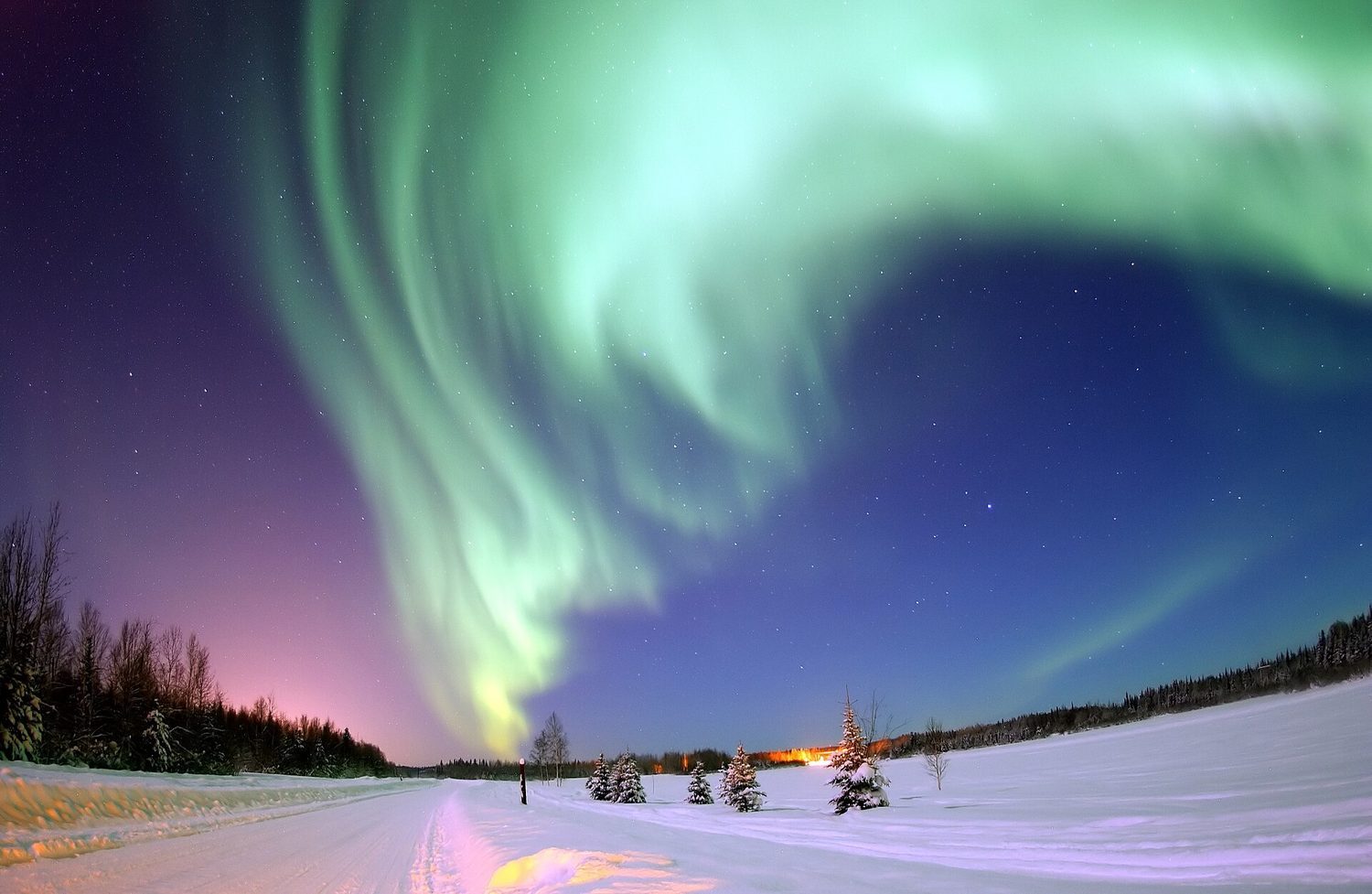
Посмотрите на север ясной зимней ночью, достаточно далеко на север, и небо светится зеленым. Эти огни включаются магнитным полем. Солнце выбрасывает заряженные…
English narration · English + 中文 subtitles burned in · Английское озвучивание · Английский + китайские субтитры (встроенные)
12.1
Magnetic Fields · Магнитные поля
Syllabus · Программа
Source: College Board AP Course and Exam Description · Источник: Описание курса и экзамена College Board AP
English
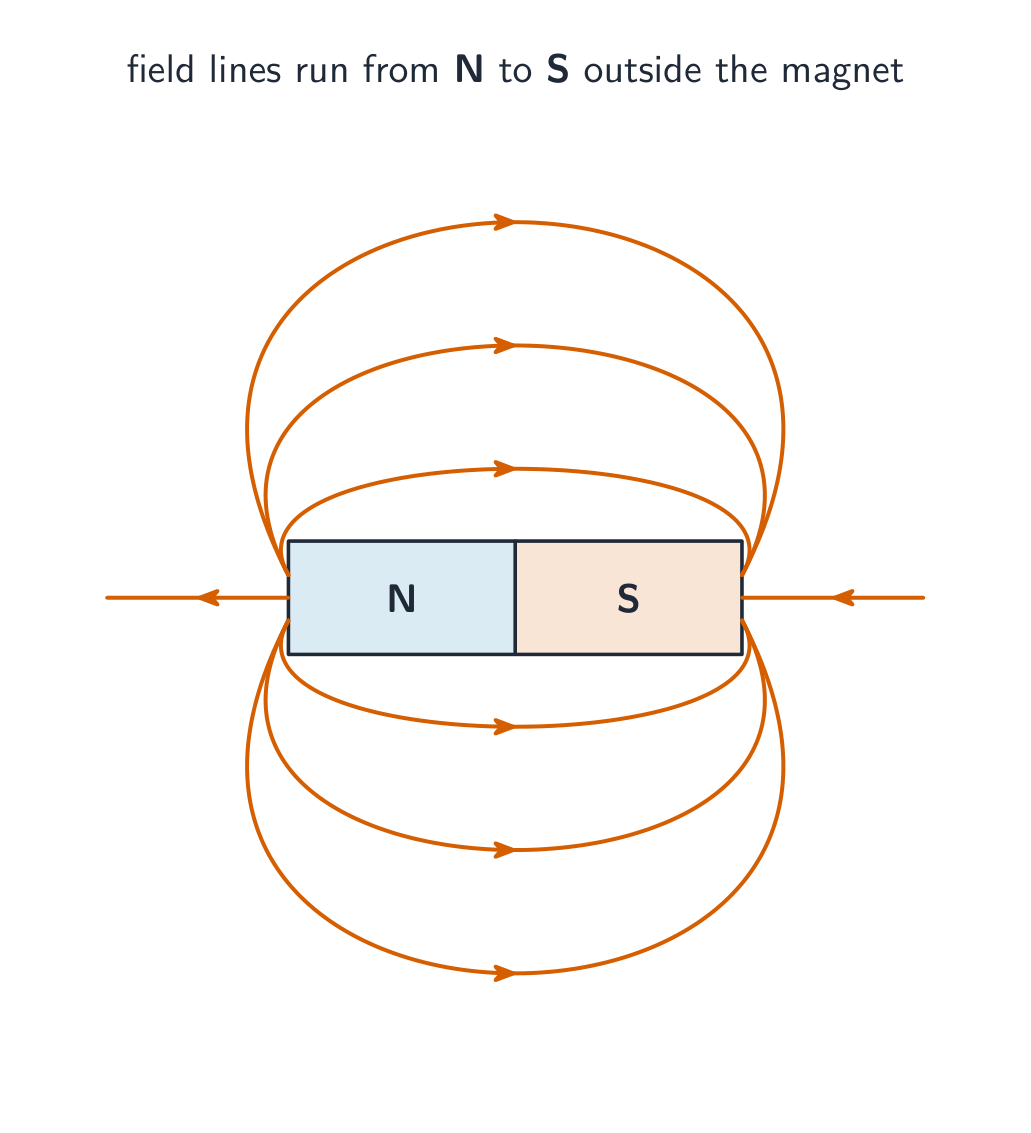
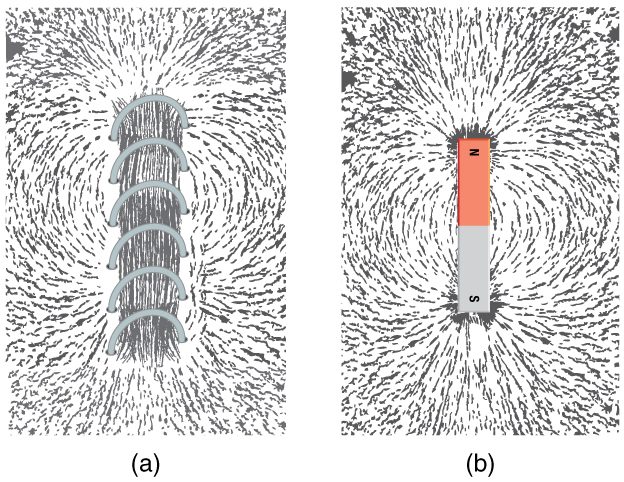
A magnetic field 磁场 $\vec{B}$ is a vector field 矢量场 that surrounds magnets, moving charges, and currents; it determines the magnetic force on any moving charge placed in it. Magnetic field lines 磁感线 must form closed loops: they leave the north pole, return to the south pole, and continue through the magnet. Denser lines mean a stronger field.
Closed loops are the content of Gauss's law for magnetism, the second of Maxwell's equations 麦克斯韦方程组:
$$\oint \vec{B}\cdot d\vec{A}=0.$$
The net magnetic flux through any closed surface is zero – as many field lines leave as enter. That is exactly the statement that isolated magnetic monopoles 磁单极子 do not exist. Every source of magnetism is a magnetic dipole 磁偶极子 (a north–south pair), made by circulating charge – in materials, the motion of electrons. Break a bar magnet in half and you get two smaller dipoles, never a lone pole. Like poles repel, opposite poles attract, and a free dipole – a compass 指南针 – rotates to line up with the local field. Earth's own field is approximately a dipole, which is why a compass works. Dipole fields weaken with distance.
How a material responds to an external field depends on how its internal dipoles behave:
- Ferromagnetic 铁磁性 (iron, nickel, cobalt): an external field aligns whole magnetic domains 磁畴, and the alignment survives after the field is removed – a permanent magnet.
- Paramagnetic 顺磁性 (aluminum, titanium): dipoles align weakly with the field but relax when it is removed.
- Diamagnetic 抗磁性 (all materials): the electronic structure produces a usually weak alignment opposite to the field.
The strength of a material's response is its magnetic permeability 磁导率. Free space has the constant value $\mu_0$ (the vacuum permeability); the permeability of matter differs from $\mu_0$ and is not even constant – it varies with temperature, orientation, and field strength.
Русский
Магнитное поле $\vec{B}$ является векторным полем, окружающим магниты, движущиеся заряды и токи; оно определяет магнитную силу, действующую на любой движущийся заряд, помещенный в него. Линии магнитного поля должны образовывать замкнутые петли: они выходят из северного полюса, возвращаются к южному и продолжаются внутри магнита. Более плотные линии означают более сильное поле.
Замкнутые петли — это содержание закона Гаусса для магнетизма, второго из уравнений Максвелла:
$$\oint \vec{B}\cdot d\vec{A}=0.$$
Суммарный магнитный поток через любую замкнутую поверхность равен нулю — столько же линий выходит, сколько входит. Это именно утверждение о том, что изолированные магнитные монополи не существуют. Каждый источник магнетизма является магнитным диполем (пара север–южный), образованным циркулирующим зарядом — в материалах это движение электронов. Разбейте стержневой магнит пополам, и вы получите два меньших диполя, но никогда не одиночный полюс. Одинаковые полюса отталкиваются, противоположные притягиваются, а свободный диполь — компас — поворачивается, чтобы выровняться по локальному полю. Собственное поле Земли приблизительно дипольно, поэтому компас работает. Поля диполей ослабевают с расстоянием.
Как материал реагирует на внешнее поле, зависит от поведения его внутренних диполей:
- Ферромагнитные (железо, никель, кобальт): внешнее поле выравнивает целые магнитные домены, и это выравнивание сохраняется после снятия поля — постоянный магнит.
- Парамагнитные (алюминий, титан): диполи слабо выравниваются по полю, но релаксируют при его снятии.
- Диэлектрические (все материалы): электронная структура создает обычно слабое выравнивание противоположно полю.
Сила реакции материала — это его магнитная проницаемость. В вакууме она имеет постоянное значение $\mu_0$ (магнитная постоянная); проницаемость вещества отличается от $\mu_0$ и даже не является постоянной — она варьируется с температурой, ориентацией и强度 поля.
Explore · Исследовать
See a magnet's field lines · Увидьте линии магнитного поля
Magnetic field lines run from north to south outside a magnet; where they crowd together the field is strongest. · Линии магнитного поля идут от северного полюса к южному снаружи магнита; там, где они сгущены, поле сильнее всего.
12.2
Magnetism and Moving Charges · Магнетизм и движущиеся заряды
Syllabus · Программа
English
Learning Objective 12.2.A: Describe the magnetic field produced by moving charged objects.
- 12.2.A.1 A single moving charged object produces a magnetic field.
- 12.2.A.1.i The magnetic field at a particular point produced by a moving charged object depends on the object's velocity and the distance between the point and the object.
- 12.2.A.1.ii At a point in space, the direction of the magnetic field produced by a moving charged object is perpendicular to both the velocity of the object and the position vector from the object to that point in space and can be determined using the right-hand rule.
- 12.2.A.1.iii The magnitude of the magnetic field is a maximum when the velocity vector and the position vector from the object to that point in space are perpendicular.
Learning Objective 12.2.B: Describe the force exerted on moving charged objects by a magnetic field.
- 12.2.B.1 A magnetic field will exert a force on a charged object moving within that field, with magnitude and direction that depend on the cross-product of the charge's velocity and the magnetic field.
- Equation: $\vec{F}_B = q\left(\vec{v} \times \vec{B}\right)$
- 12.2.B.2 In a region containing both a magnetic field and an electric field, a moving charged object will experience independent forces from each field.
- 12.2.B.3 The Hall effect describes the potential difference created in a conductor by an external magnetic field that has a component perpendicular to the direction of charges moving in the conductor.
Русский
Цель обучения 12.2.A: Описать магнитное поле, создаваемое движущимися заряженными объектами.
- 12.2.A.1 Один движущийся заряженный объект создает магнитное поле.
- 12.2.A.1.i Магнитное поле в конкретной точке, создаваемое движущимся заряженным объектом, зависит от скорости этого объекта и расстояния между точкой и объектом.
- 12.2.A.1.ii В данной точке пространства направление магнитного поля, создаваемого движущимся заряженным объектом, перпендикулярно как вектору скорости объекта, так и радиус-вектору, проведенному от объекта к этой точке в пространстве; это направление определяется с помощью правила правой руки.
- 12.2.A.1.iii Величина магнитного поля максимальна, когда вектор скорости и радиус-вектор, проведенный от объекта к данной точке в пространстве, перпендикулярны друг другу.
Цель обучения 12.2.B: Описать силу, действующую на движущиеся заряженные объекты со стороны магнитного поля.
- 12.2.B.1 Магнитное поле будет действовать на заряженный объект, движущийся в этом поле, при этом величина и направление силы зависят от векторного произведения скорости заряда и магнитного поля.
- Уравнение: $\vec{F}_B = q\left(\vec{v} \times \vec{B}\right)$
- 12.2.B.2 В области, содержащей как магнитное, так и электрическое поле, движущийся заряженный объект будет испытывать независимые силы со стороны каждого из полей.
- 12.2.B.3 Эффект Холла описывает разность потенциалов, возникающую в проводнике под действием внешнего магнитного поля, имеющего компоненту, перпендикулярную направлению движения зарядов в проводнике.
Source: College Board AP Course and Exam Description · Источник: Описание курса и экзамена College Board AP
English
A moving charge does two things: it creates a magnetic field, and it feels a force in an external one. The field it creates at a point is perpendicular 垂直 to both its velocity and the position vector from charge to point (right-hand rule again), and is largest where those two are perpendicular – zero directly ahead of or behind the motion.
The force on a charge moving in a field $\vec{B}$ is the cross product
$$\vec{F}_B=q\,\vec{v}\times\vec{B},\qquad F=qvB\sin\theta,$$
perpendicular to both $\vec{v}$ and $\vec{B}$ – point the fingers of your right hand along $\vec{v}$, curl toward $\vec{B}$, and the thumb gives the force on a positive charge (reverse it for negative). Because $\vec{F}_B\perp\vec{v}$, the magnetic force does no work on the charge: it changes direction, never speed.
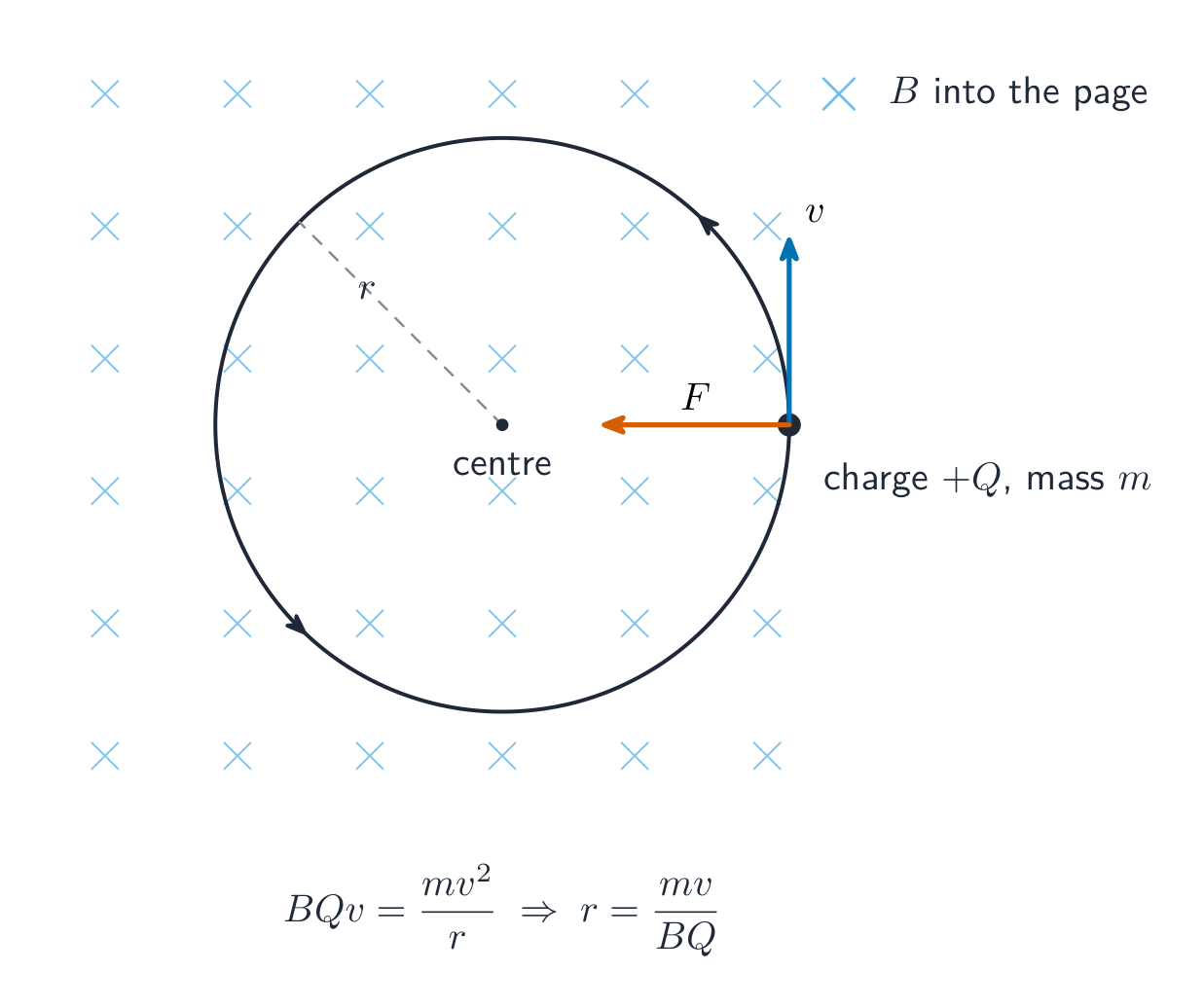
A charge moving perpendicular to a uniform field therefore travels in a circle, the magnetic force supplying the centripetal force 向心力:
$$qvB=\frac{mv^2}{r}\quad\Rightarrow\quad r=\frac{mv}{qB},\qquad T=\frac{2\pi m}{qB}.$$
Notice the period $T$ does not depend on the speed – faster particles ride larger circles in the same time.
Worked example. A proton ($q=1.6\times10^{-19}\ \text{C}$, $m=1.67\times10^{-27}\ \text{kg}$) enters a $0.50\ \text{T}$ field at $2.0\times10^{5}\ \text{m/s}$, perpendicular to it. The magnetic force $F=qvB=1.6\times10^{-14}\ \text{N}$ bends it into a circle of radius $r=\dfrac{mv}{qB}=\dfrac{1.67\times10^{-27}(2.0\times10^{5})}{1.6\times10^{-19}(0.50)}=4.2\times10^{-3}\ \text{m}$.
In a region with both an electric and a magnetic field, the two forces act independently and add as vectors. Balancing them makes a velocity selector 速度选择器: with $\vec{E}$ and $\vec{B}$ crossed, only charges with $qE=qvB$, i.e. $v=E/B$, pass straight through. The Hall effect 霍尔效应 is the same physics inside a conductor: a field with a component perpendicular to the current pushes the moving carriers sideways, charge builds up on one face, and a measurable potential difference appears across the conductor – its sign reveals whether the carriers are positive or negative.
Русский
Движущийся заряд совершает две вещи: он создает магнитное поле и чувствует силу во внешнем. Поле, которое он создает в точке, перпендикулярно как скорости, так и вектору положения от заряда до точки (правило правой руки снова), и максимально там, где эти два перпендикулярны — равно нулю прямо перед или позади движения.
Сила, действующая на заряд, движущийся в поле $\vec{B}$, есть векторное произведение
$$\vec{F}_B=q\,\vec{v}\times\vec{B},\qquad F=qvB\sin\theta,$$
перпендикулярное как $\vec{v}$, так и $\vec{B}$ — направьте пальцы правой руки вдоль $\vec{v}$, согните их в сторону $\vec{B}$, и большой палец укажет направление силы на положительный заряд (разверните его для отрицательного). Поскольку $\vec{F}_B\perp\vec{v}$, магнитная сила не совершает работы над зарядом: она меняет направление, но не скорость.
Заряд, движущийся перпендикулярно однородному полю, движется по окружности, обеспечиваемой магнитной силой как центростремительной силой:
$$qvB=\frac{mv^2}{r}\quad\Rightarrow\quad r=\frac{mv}{qB},\qquad T=\frac{2\pi m}{qB}.$$
Обратите внимание, что период $T$ не зависит от скорости — более быстрые частицы проходят большие окружности за то же время.
Разбор примера. Протон ($q=1.6\times10^{-19}\ \text{C}$, $m=1.67\times10^{-27}\ \text{kg}$) входит в $0.50\ \text{T}$ поле со скоростью $2.0\times10^{5}\ \text{m/s}$, перпендикулярно ему. Магнитная сила $F=qvB=1.6\times10^{-14}\ \text{N}$ изгибает траекторию в окружность радиуса $r=\dfrac{mv}{qB}=\dfrac{1.67\times10^{-27}(2.0\times10^{5})}{1.6\times10^{-19}(0.50)}=4.2\times10^{-3}\ \text{m}$.
В области, где действуют одновременно электрическое и магнитное поля, две силы действуют независимо и складываются как векторы. Их баланс образует селектор скорости: при скрещенных $\vec{E}$ и $\vec{B}$ прямую траекторию проходят только заряды со скоростью $qE=qvB$, т. е. $v=E/B$. Эффект Холла основан на той же физике внутри проводника: поле с компонентой, перпендикулярной току, смещает движущиеся носители вбок, заряд накапливается на одной поверхности, и возникает измеримая разность потенциалов через проводник — ее знак показывает, являются ли носители положительными или отрицательными.
Explore · Исследовать
Force on a moving charge · Сила, действующая на движущийся заряд
A charge moving through a magnetic field feels a force $F=qvB$ at right angles to both its velocity and the field — the basis of the motor effect. Reverse either and the force flips. · Заряд, движущийся в магнитном поле, испытывает силу $F=qvB$, направленную под прямым углом как к скорости, так и к полю — это основа эффекта мотора. Измените направление любого из них, и сила развернется.
12.3
Magnetic Fields of Current-Carrying Wires · Магнитные поля токоведущих проводов
Syllabus · Программа
English
Learning Objective 12.3.A: Describe the magnetic field produced by a current-carrying wire.
- 12.3.A.1 The Biot-Savart law defines the magnitude and direction of a magnetic field created by an electrical current.
- Equation: $d\vec{B} = \dfrac{\mu_0}{4\pi} \dfrac{I(d\vec{\ell} \times \hat{r})}{r^2}$
- 12.3.A.2 The magnetic field vectors around a small segment of a current-carrying wire are tangent to concentric circles centered on that wire. The field has no component toward, away from, or parallel to the segment of the current-carrying wire.
- 12.3.A.3 The Biot-Savart law can be used to derive the magnitudes and directions of magnetic fields around segments of current-carrying wires, for example at the center of a circular loop of wire.
- Equation: $B_{\text{center of loop}} = \dfrac{\mu_0 I}{2R}$
Learning Objective 12.3.B: Describe the force exerted on current-carrying wires by a magnetic field.
- 12.3.B.1 A magnetic field will exert a force on a current-carrying wire.
- Equation: $\vec{F}_B = \int I\left(d\vec{\ell} \times \vec{B}\right)$
Boundary statement: AP Physics C: Electricity & Magnetism only expects students to perform quantitative analysis of certain cases of current-carrying conductors using the Biot-Savart law, such as at a location along the perpendicular bisector of a straight conductor, at a location along the central axis of a circular loop, or at the center of a segment of a circular loop.
Русский
Цель обучения 12.3.A: Описать магнитное поле, создаваемое проводником с током.
- 12.3.A.1 Закон Био-Савара-Лапласа определяет величину и направление магнитного поля, создаваемого электрическим током.
- Уравнение: $d\vec{B} = \dfrac{\mu_0}{4\pi} \dfrac{I(d\vec{\ell} \times \hat{r})}{r^2}$
- 12.3.A.2 Векторы магнитного поля вокруг малого участка токоведущего провода касательны к концентрическим окружностям, центр которых находится на этом проводе. Поле не имеет компоненты, направленной к проводу, от него или параллельно ему.
- 12.3.A.3 Закон Био-Савара-Лапласа может быть использован для вывода величин и направлений магнитных полей вокруг участков токоведущих проводов, например, в центре круговой петли.
- Уравнение: $B_{\text{center of loop}} = \dfrac{\mu_0 I}{2R}$
Цель обучения 12.3.B: Описать силу, действующую на токоведущие провода со стороны магнитного поля.
- 12.3.B.1 Магнитное поле будет действовать на токоведущий провод.
- Уравнение: $\vec{F}_B = \int I\left(d\vec{\ell} \times \vec{B}\right)$
Граничное утверждение: AP Physics C: Электричество и магнетизм требует от студентов только проведения количественного анализа определенных случаев токоведущих проводников с использованием закона Био-Савара-Лапласа, таких как точка на перпендикуляре к прямому проводнику, точка на центральной оси круговой петли или центр сегмента круговой петли.
Source: College Board AP Course and Exam Description · Источник: Описание курса и экзамена College Board AP
English
A current is a stream of moving charges, so it creates a magnetic field. The Biot–Savart law 毕奥-萨伐尔定律 adds up the field of each current element:
$$d\vec{B}=\frac{\mu_0}{4\pi}\frac{I\,d\vec{l}\times\hat{r}}{r^2}.$$
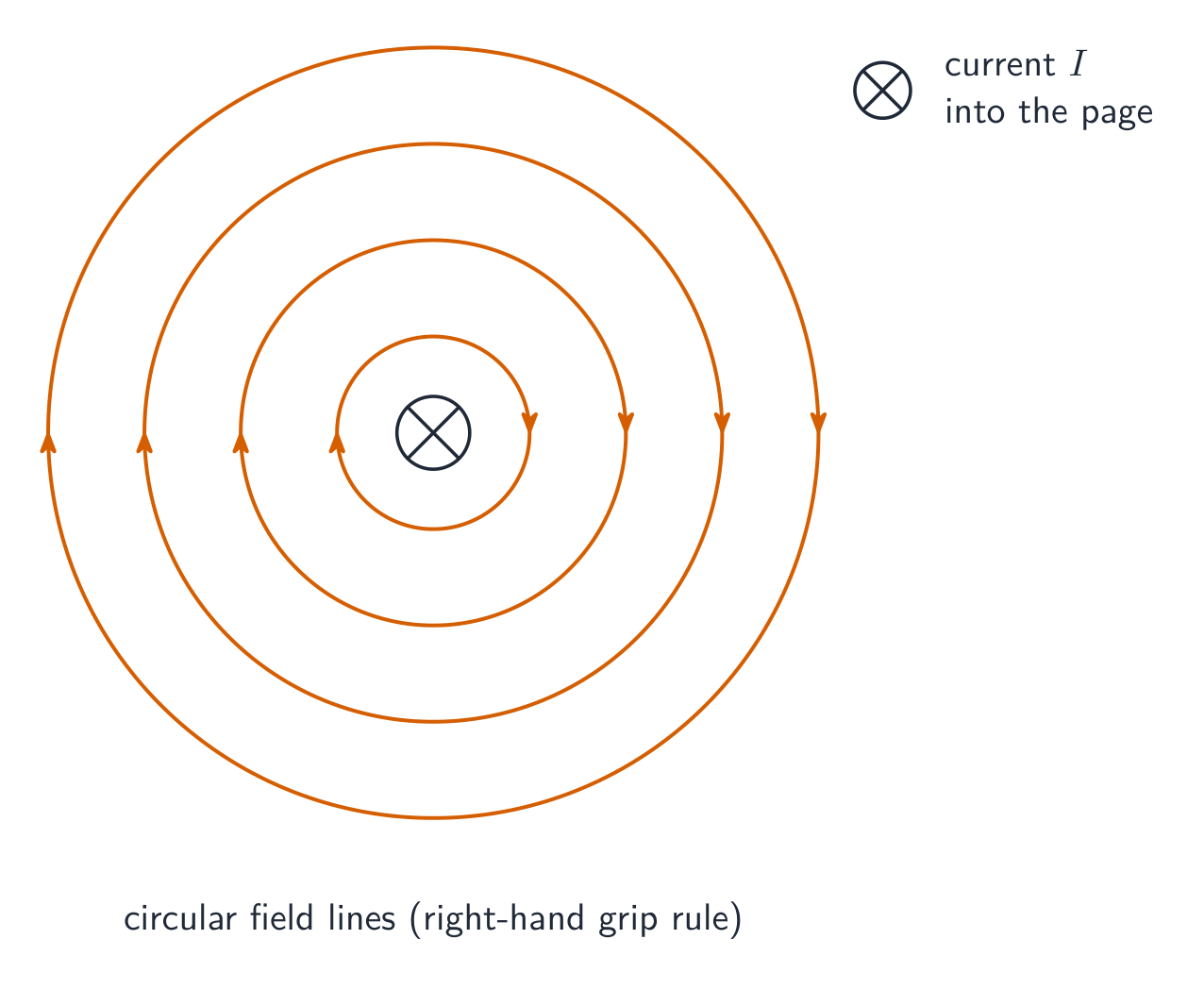
Around any straight segment the field vectors are tangent 相切 to concentric circles 同心圆 centred on the wire – no component toward, away from, or along the wire. Curl your right hand around the wire with the thumb along the current: your fingers give the field direction.
The Biot–Savart integrals AP expects: a long straight wire ($B=\dfrac{\mu_0 I}{2\pi r}$, or a point on the perpendicular bisector of a finite wire), and the centre of a circular loop,
$$B_{\text{centre of loop}}=\frac{\mu_0 I}{2R},$$
where every element $d\vec{l}$ is perpendicular to $\hat{r}$ and equally distant $R$ – say that in an FRQ derivation. An arc that is a fraction of a full circle contributes that same fraction of $\mu_0 I/2R$ at its centre.
A field also pushes on a current-carrying wire, element by element:
$$\vec{F}_B=\int I\,d\vec{l}\times\vec{B}\qquad(\vec{F}=I\vec{L}\times\vec{B}\ \text{for a straight wire in a uniform field}).$$
Worked example. Two long parallel wires a distance $d=0.10\ \text{m}$ apart each carry $5.0\ \text{A}$ in the same direction. Wire 1's field at wire 2 is $B=\dfrac{\mu_0 I}{2\pi d}=1.0\times10^{-5}\ \text{T}$, so wire 2 feels $\dfrac{F}{L}=I B=5.0\times10^{-5}\ \text{N/m}$, pulled toward wire 1. Same-direction currents attract; opposite currents repel.
Русский
Ток — это поток движущихся зарядов, поэтому он создает магнитное поле. Закон Био-Савара суммирует вклад каждого элемента тока:
$$d\vec{B}=\frac{\mu_0}{4\pi}\frac{I\,d\vec{l}\times\hat{r}}{r^2}.$$
Вокруг любого прямого участка векторы поля касательны концентрическим окружностям, центрам которых является провод — нет компоненты ни к, ни от, ни вдоль провода. Обхватите провод правой рукой, большой палец направлен по току: пальцы покажут направление поля.
Интегралы Био-Савара, ожидаемые AP: длинный прямой провод ($B=\dfrac{\mu_0 I}{2\pi r}$, или точка на серединном перпендикуляре конечного провода) и центр круговой петли,
$$B_{\text{centre of loop}}=\frac{\mu_0 I}{2R},$$
где каждый элемент $d\vec{l}$ перпендикулярен $\hat{r}$ и находится на одинаковом расстоянии $R$ — скажите это в выводе FRQ. Дуга, составляющая долю полного круга, вносит ту же долю $\mu_0 I/2R$ в его центре.
Поле также действует на токоведущий провод поэлементно:
$$\vec{F}_B=\int I\,d\vec{l}\times\vec{B}\qquad(\vec{F}=I\vec{L}\times\vec{B}\ \text{for a straight wire in a uniform field}).$$
Разбор примера. Два длинных параллельных провода на расстоянии $d=0.10\ \text{m}$ друг от друга несут ток $5.0\ \text{A}$ в одном направлении. Поле провода 1 в месте провода 2 равно $B=\dfrac{\mu_0 I}{2\pi d}=1.0\times10^{-5}\ \text{T}$, поэтому провод 2 испытывает силу $\dfrac{F}{L}=I B=5.0\times10^{-5}\ \text{N/m}$, направленную к проводу 1. Токи в одном направлении притягиваются, в противоположных — отталкиваются.
Vocabulary · Словарь
Train · Тренировать
| English | Русский |
|---|---|
| magnetic field/mæɡˈnetɪk fiːld/ | магнитным полем |
| vector field/ˈvektə fiːld/ | векторное поле |
| magnetic field lines/mæɡˈnetɪk fiːld laɪnz/ | линии магнитного поля |
| Maxwell's equations/ˈmækswelz ɪˈkweɪʒnz/ | Уравнения Максвелла |
| magnetic monopoles/mæɡˈnetɪk ˈmɒnəʊpəʊlz/ | магнитные монополи |
| magnetic dipole/mæɡˈnetɪk ˈdaɪpəʊl/ | магнитный диполь |
| compass/ˈkʌmpəs/ | компас |
| Ferromagnetic/ˌferəməɡˈnetɪk/ | ферромагнитный |
| magnetic domains/mæɡˈnetɪk dəˈmeɪnz/ | магнитные домены |
| Paramagnetic/ˌpærəməɡˈnetɪk/ | парамагнитный |
| Diamagnetic/ˌdaɪəməɡˈnetɪk/ | диамагнитный |
| magnetic permeability/mæɡˈnetɪk ˌpɜːməˈbɪlɪti/ | магнитная проницаемость |
| perpendicular/ˌpɜːpənˈdɪkjʊlə/ | перпендикулярны |
| centripetal force/senˈtrɪpɪtl fɔːs/ | центробежная сила |
| velocity selector/vəˈlɒsɪti sɪˈlektə/ | скоростной селектор |
| Hall effect/hɔːl ɪˈfekt/ | эффект Холла |
| Biot–Savart law/ˈbɪɒt ˈsævɑːt lɔː/ | закон Био–Савара – Лапласа |
| tangent/ˈtændʒənt/ | касательную |
| concentric circles/kənˈsentrɪk ˈsɜːklz/ | концентрические окружности |
| Ampère's law/ˈæmpeəz lɔː/ | Закон Ампера |
| Amperian loop/æmˈpɪərɪən luːp/ | амперов контур |
| current density/ˈkʌrənt ˈdensɪti/ | плотность тока |
| superposition/ˌsuːpəpəˈzɪʃn/ | суперпозиция |
| solenoid/ˈsəʊlənɔɪd/ | соленоид |
12.4
Ampère's Law · Закон Ампера
Syllabus · Программа
English
Learning Objective 12.4.A: Use Ampère's law to describe the magnetic field created by a moving charge carrier.
- 12.4.A.1 Ampère's law relates the magnitude of the magnetic field to the current enclosed by a closed imaginary path called an Amperian loop.
- Equation: $\oint \vec{B} \cdot d\vec{\ell} = \mu_0 I_{\text{enc}}$
- 12.4.A.1.i Ampère's law can be used to determine the magnetic field near a long, straight current-carrying wire.
- Equation: $B_{\text{wire}} = \dfrac{\mu_0}{2\pi} \dfrac{I}{r}$
- 12.4.A.1.ii Unless otherwise stated, all solenoids are assumed to be very long, with uniform magnetic fields inside the solenoids and negligible magnetic fields outside the solenoids.
- 12.4.A.1.iii Ampère's law can be used to determine the magnetic field inside of a long solenoid.
- Equation: $B_{\text{sol}} = \mu_0 n I$
- 12.4.A.2 An Amperian loop is a closed path around a current-carrying conductor.
- 12.4.A.3 The principle of superposition can be used to determine the net magnetic field at a point in space created by various combinations of current-carrying conductors, or conducting loops, segments, or cylinders.
- 12.4.A.4 Maxwell's equations are the collection of equations that fully describe electromagnetism. Maxwell's fourth equation is Ampère's law with Maxwell's addition; it states that magnetic fields can be generated by electric current (Ampère's law) and that a changing electric field creates a magnetic field, similar to the way a moving charge creates a magnetic field (Maxwell's addition).
- Equation: $\oint \vec{B} \cdot d\vec{\ell} = \mu_0 I + \mu_0 \varepsilon_0 \dfrac{d\Phi_E}{dt}$
Boundary statement: AP Physics C: Electricity & Magnetism only expects quantitative application of Ampère's law limited to situations involving symmetrical magnetic fields. Long straight wires, long solenoids carrying currents, as well as conductive slabs or cylindrical conductors carrying a current density, are the types of shapes to which Ampère's law will be applied on the AP Physics C: Electricity & Magnetism Exam.
Boundary statement: AP Physics C: Electricity & Magnetism does not expect students to use Maxwell's fourth equation with a changing electric field. However, students should understand that a changing electric field generates a magnetic field.
Русский
Цель обучения 12.4.A: Использовать закон Ампера для описания магнитного поля, создаваемого движущимся носителем заряда.
- 12.4.A.1 Закон Ампера связывает величину магнитного поля с током, охватываемым замкнутым воображаемым контуром, называемым контуром Ампера.
- Уравнение: $\oint \vec{B} \cdot d\vec{\ell} = \mu_0 I_{\text{enc}}$
- 12.4.A.1.i Закон Ампера может быть использован для определения магнитного поля вблизи длинного прямого токоведущего провода.
- Уравнение: $B_{\text{wire}} = \dfrac{\mu_0}{2\pi} \dfrac{I}{r}$
- 12.4.A.1.ii Если не указано иное, все соленоиды считаются очень длинными, с однородным магнитным полем внутри соленоидов и пренебрежимо малым магнитным полем вне соленоидов.
- 12.4.A.1.iii Закон Ампера может быть использован для определения магнитного поля внутри длинного соленоида.
- Уравнение: $B_{\text{sol}} = \mu_0 n I$
- 12.4.A.2 Контур Ампера — это замкнутый путь вокруг токоведущего проводника.
- 12.4.A.3 Принцип суперпозиции может быть использован для определения результирующего магнитного поля в точке пространства, созданного различными комбинациями токоведущих проводников, петель, сегментов или цилиндров.
- 12.4.A.4 Уравнения Максвелла — это совокупность уравнений, которые полностью описывают электромагнетизм. Четвертое уравнение Максвелла — закон Ампера с добавлением Максвелла; оно гласит, что магнитные поля могут генерироваться электрическим током (закон Ампера) и что изменяющееся электрическое поле создает магнитное поле, подобно тому, как движущийся заряд создает магнитное поле (добавление Максвелла).
- Уравнение: $\oint \vec{B} \cdot d\vec{\ell} = \mu_0 I + \mu_0 \varepsilon_0 \dfrac{d\Phi_E}{dt}$
Граничное утверждение: AP Physics C: Электричество и магнетизм ограничивает количественное применение закона Ампера ситуациями, связанными с симметричными магнитными полями. Длинными прямыми проводами, длинными соленоидами, несущими ток, а также проводящими пластинами или цилиндрическими проводниками, несущими плотность тока, являются типами форм, к которым закон Ампера будет применяться на экзамене AP Physics C: Электричество и магнетизм.
Граничное утверждение: AP Physics C: Электричество и магнетизм не требует от студентов использования четвертого уравнения Максвелла с изменяющимся электрическим полем. Однако студенты должны понимать, что изменяющееся электрическое поле порождает магнитное поле.
Source: College Board AP Course and Exam Description · Источник: Описание курса и экзамена College Board AP
English
For symmetric current distributions, Ampère's law 安培定律 finds the field far faster than Biot–Savart:
$$\oint \vec{B}\cdot d\vec{l}=\mu_0 I_{\text{enc}}.$$
Choose an Amperian loop 安培环路 that matches the symmetry, so that $B$ is constant along the loop (and parallel to it) and comes out of the integral. AP applies it to long straight wires, long solenoids, and conductors carrying a current density 电流密度 (slabs and cylinders); combinations are handled by superposition 叠加.
Worked example. Find the field $0.10\ \text{m}$ from a long wire carrying $5.0\ \text{A}$. A circular loop of radius $r$ shares the field's symmetry, so $B(2\pi r)=\mu_0 I$ and
$$B=\frac{\mu_0 I}{2\pi r}=\frac{(4\pi\times10^{-7})(5.0)}{2\pi(0.10)}=1.0\times10^{-5}\ \text{T}.$$
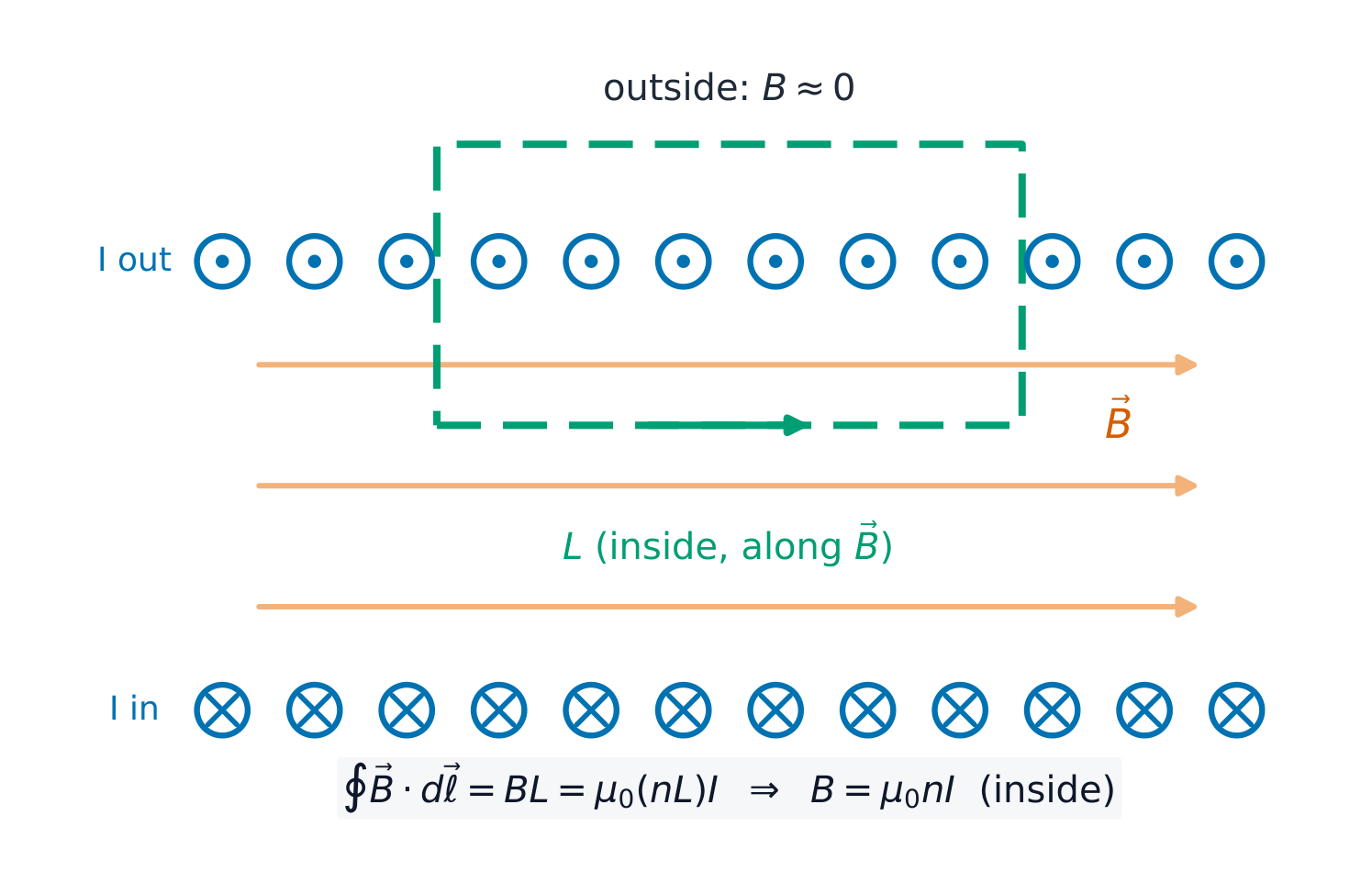
A long solenoid 螺线管 (assumed: uniform field inside, negligible field outside) is the other classic. Take a rectangular loop with one side of length $L$ inside, parallel to the axis: only that side contributes to the integral, so $BL=\mu_0 (nL) I$ and
$$B_{\text{sol}}=\mu_0 n I,$$
with $n$ the turns per metre.
Worked example (cylinder). A solid cylindrical conductor of radius $R$ carries current $I$ spread uniformly over its cross-section. Inside ($r
Exam skill. Every Ampère's-law answer earns its marks in the setup: name the loop, state why $B$ is constant and parallel to it (symmetry), and count $I_{\text{enc}}$ carefully before you solve. Maxwell's fourth equation adds one more idea you should know qualitatively: a changing electric field also creates a magnetic field – but AP will not ask you to compute with that term.
Русский
Для симметричных распределений тока закон Ампера позволяет найти поле гораздо быстрее, чем закон Био-Савара:
$$\oint \vec{B}\cdot d\vec{l}=\mu_0 I_{\text{enc}}.$$
Выберите контур Ампера, соответствующий симметрии, чтобы $B$ был постоянным вдоль контура (и параллельным ему) и выносился за знак интеграла. AP применяет его для длинных прямых проводов, длинных соленоидов и проводников с плотностью тока (пластины и цилиндры); комбинации рассматриваются методом суперпозиции.
Разбор примера. Найдите поле $0.10\ \text{m}$ от длинного провода с током $5.0\ \text{A}$. Круговой контур радиусом $r$ обладает той же симметрией, что и поле, поэтому $B(2\pi r)=\mu_0 I$ и
$$B=\frac{\mu_0 I}{2\pi r}=\frac{(4\pi\times10^{-7})(5.0)}{2\pi(0.10)}=1.0\times10^{-5}\ \text{T}.$$
Длинный соленоид (предполагается: однородное поле внутри, пренебрежимо малое поле снаружи) — другой классический случай. Возьмите прямоугольный контур, одна сторона которого длиной $L$ находится внутри, параллельно оси: только эта сторона вносит вклад в интеграл, поэтому $BL=\mu_0 (nL) I$ и
$$B_{\text{sol}}=\mu_0 n I,$$
где $n$ — число витков на метр.
Разбор примера (цилиндр). Сплошной цилиндрический проводник радиусом $R$ несёт ток $I$, равномерно распределённый по поперечному сечению. Внутри ($r
Экзаменационный навык. За каждый ответ по закону Ампера начисляются баллы за правильно составленную схему: назовите контур, объясните, почему $B$ постоянен и параллелен ему (в силу симметрии), и внимательно подсчитайте $I_{\text{enc}}$ перед решением. Четвёртое уравнение Максвелла добавляет ещё одну идею, которую нужно знать качественно: изменяющееся электрическое поле также создаёт магнитное поле, но AP не будет требовать от вас вычисления с этим членом.
12.4
Exam tips · Советы для экзамена
English
- The magnetic force $\vec F=q\vec v\times\vec B$ is perpendicular to velocity — use the right-hand rule and note it does no work.
- A charge in a uniform field moves in a circle with $r=\tfrac{mv}{qB}$.
- Find the field of currents with Biot–Savart $d\vec B=\tfrac{\mu_0}{4\pi}\tfrac{I\,d\vec l\times\hat r}{r^2}$ or Ampère's law $\oint \vec B\cdot d\vec l=\mu_0 I_{enc}$ when there is symmetry.
- Force on a wire is $\vec F=I\vec L\times\vec B$; keep the cross-product direction straight.
- Distinguish the force on a charge from the field the current creates.
Русский
- Магнитная сила $\vec F=q\vec v\times\vec B$ перпендикулярна скорости — используйте правило правой руки и注意点, что она не совершает работы.
- Заряд в однородном поле движется по окружности с $r=\tfrac{mv}{qB}$.
- Найдите поле токов с помощью закона Био–Савара $d\vec B=\tfrac{\mu_0}{4\pi}\tfrac{I\,d\vec l\times\hat r}{r^2}$ или закона Ампера $\oint \vec B\cdot d\vec l=\mu_0 I_{enc}$ при наличии симметрии.
- Сила, действующая на провод, равна $\vec F=I\vec L\times\vec B$; следите за направлением векторного произведения.
- Различайте силу, действующую на заряд, и поле, которое создаёт ток.
Interactive lessons on this topic · Интерактивные уроки по этой теме
Work through it step by step, with instant-check exercises. · Пройдите его шаг за шагом с упражнениями мгновенной проверки.
Past Papers · Архив экзаменационных работ