English
Learning Objective 11.1.A: Describe the movement of electric charges through a medium.
- 11.1.A.1 Current is the rate at which charge passes through a cross-sectional area of a wire.
- Equation: $I = \dfrac{dq}{dt}$
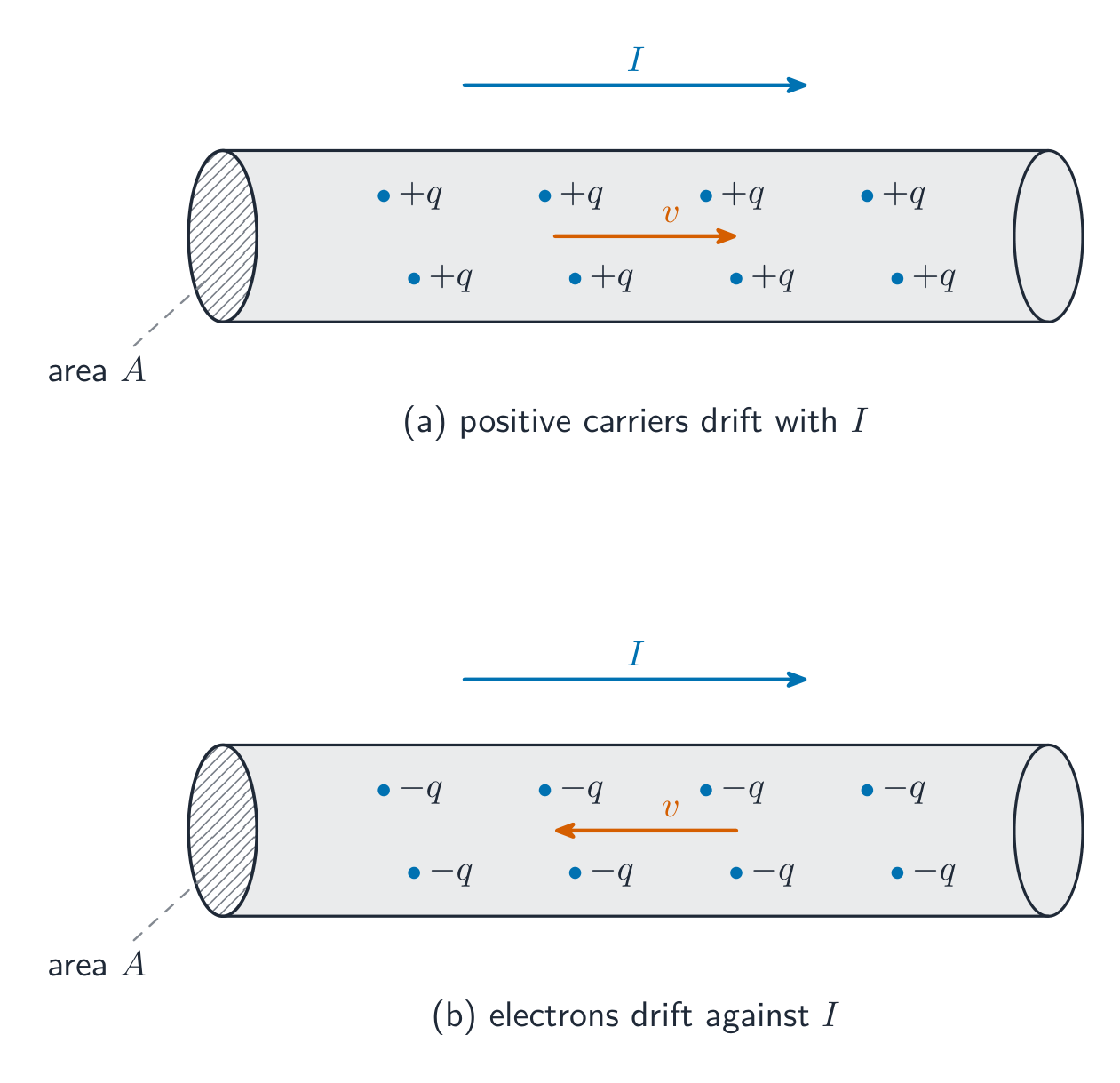
- 11.1.A.1.i Current within a conductor consists of charge carriers traveling through the conductor with an average drift velocity.
- Equation: $I = nqv_d A$
- 11.1.A.1.ii Electric charge moves in a circuit in response to an electric potential difference, sometimes referred to as electromotive force, or $\mathrm{emf}$ ($\mathcal{E}$).
- 11.1.A.1.iii If the current is zero in a section of wire, the net motion of charge carriers in the wire is also zero, although individual charge carriers will not have zero speed.
- 11.1.A.2 Current density is the flow of charge per unit area.
- Equation: $I = \int \vec{J} \cdot d\vec{A}$
- 11.1.A.2.i Current density is related to the motion of the charge carriers within a conductor.
- Equation: $\vec{J} = nq\vec{v}_d$
- 11.1.A.2.ii Current density is a vector quantity.
- 11.1.A.2.iii A potential difference across a conductor creates an electric field within the conductor that is proportional to the resistivity of the conductor and the current density.
- Equation: $\vec{E} = \rho\vec{J}$
- 11.1.A.3 If a function of current density is given, the total current can be determined by integrating the current density over the area.
- Equation: $I_{\text{tot}} = \int \vec{J}(r) \cdot d\vec{A}$
- 11.1.A.4 Although current is a scalar quantity, it does have a direction. Because its direction is relative to the current carrier and not space, current does not obey the laws of vector addition and has no vector components.
- 11.1.A.4.i The direction of conventional current is chosen to be the direction in which positive charge would move.
- 11.1.A.4.ii In common circuits, the current is actually due to the movement of electrons (negative charge carriers).
Русский
Цель обучения 11.1.A: Описывать движение электрических зарядов через среду.
- 11.1.A.1 Ток — это скорость прохождения заряда через поперечное сечение провода.
- Уравнение: $I = \dfrac{dq}{dt}$
- 11.1.A.1.i Ток внутри проводника состоит из носителей заряда, движущихся через проводник со средней скоростью дрейфа.
- Уравнение: $I = nqv_d A$
- 11.1.A.1.ii Электрический заряд движется в цепи под действием разности электрических потенциалов, которую иногда называют электродвижущей силой, или $\mathrm{emf}$ ($\mathcal{E}$).
- 11.1.A.1.iii Если ток равен нулю на участке провода, то и суммарное движение носителей заряда в этом проводе также равно нулю, хотя отдельные носители заряда не будут иметь нулевую скорость.
- 11.1.A.2 Плотность тока — это поток заряда на единицу площади.
- Уравнение: $I = \int \vec{J} \cdot d\vec{A}$
- 11.1.A.2.i Плотность тока связана с движением носителей заряда внутри проводника.
- Уравнение: $\vec{J} = nq\vec{v}_d$
- 11.1.A.2.ii Плотность тока является векторной величиной.
- 11.1.A.2.iii Разность потенциалов на проводнике создает электрическое поле внутри него, которое пропорционально удельному сопротивлению проводника и плотности тока.
- Уравнение: $\vec{E} = \rho\vec{J}$
- 11.1.A.3 Если задана функция плотности тока, полный ток можно определить, интегрируя плотность тока по площади.
- Уравнение: $I_{\text{tot}} = \int \vec{J}(r) \cdot d\vec{A}$
- 11.1.A.4 Хотя ток является скалярной величиной, он имеет направление. Поскольку его направление относительно носителя тока, а не пространства, ток не подчиняется законам сложения векторов и не имеет векторных компонент.
- 11.1.A.4.i Направление условного тока принимается равным направлению, в котором двигался бы положительный заряд.
- 11.1.A.4.ii В обычных цепях ток на самом деле обусловлен движением электронов (отрицательных носителей заряда).