Skip to content · ⁨Перейти к содержанию⁩
Subjects · ⁨Предметы⁩

AP Physics C: Electricity and Magnetism · ⁨AP Физика C: Электричество и магнетизм⁩

Tips · ⁨Советы⁩

AP Physics C: Электричество и магнетизм — это курс по электромагнетизму на основе дифференциального исчисления: заряды, поля и закон Гаусса; электрический потенциал; проводники и конденсаторы; цепи; магнитные поля; и электромагнитная индукция. Его обычно изучают после механики, предполагая соответствующий уровень математической подготовки.

Закон Гаусса и закон Ампера определяют восприятие этого курса. Оба они по сути是关于 выбора поверхности или контура, который упрощает интеграл — навыка, который вырабатывается решением множества задач, а не чтением законов. Симметрия — это всё.

Вопросы на индукцию чаще всего наказывают за ошибки в знаках, поэтому зафиксируйте одно правило направления потока и используйте его всегда.

Примечания охватывают закон Гаусса до уравнений Максвелла по разделам, с подробным векторным исчислением. В библиотеке хранятся выпущенные FRQ; самые сложные баллы в E&M даются за правильный выбор симметрии перед интегрированием, поэтому примеры начинаются с этого.

  • 8

    Electric Charges, Fields, and Gauss's Law · ⁨Электрические заряды, поля и теорема Гаусса⁩

    Watch lesson · ⁨Смотреть урок⁩
    8.1

    Electric Charge and Electric Force · ⁨Электрический заряд и электрическая сила⁩

    Syllabus · ⁨Программа⁩
    English

    Learning Objective 8.1.A: Describe the electric force that results from the interactions between charged objects or systems.

    • 8.1.A.1 Charge is a fundamental property of all matter.
      • 8.1.A.1.i Charge is a scalar quantity and is described as positive or negative.
      • 8.1.A.1.ii The magnitude of the charge of a single electron or proton, the elementary charge $e$, can be considered to be the smallest indivisible amount of charge.
      • 8.1.A.1.iii The charge of an electron is $-e$ and the charge of a proton is $+e$, and a neutron has no electric charge.
      • 8.1.A.1.iv A point charge is a model in which the physical size of a charged object or system is negligible in the context of the situation being analyzed.
    • 8.1.A.2 Coulomb's law describes the electrostatic force between two charged objects as directly proportional to the magnitude of each of the charges and inversely proportional to the square of the distance between the objects.
      • Relevant equation: $\left| \vec{F}_E \right| = \dfrac{1}{4\pi\varepsilon_0} \dfrac{|q_1 q_2|}{r^2} = k \dfrac{|q_1 q_2|}{r^2}$
    • 8.1.A.3 The direction of the electrostatic force depends on the signs of the charges of the interacting objects and is along the line of separation between the objects.
      • 8.1.A.3.i Two objects with charges of the same sign exert repulsive forces on each other.
      • 8.1.A.3.ii Two objects with charges of opposite signs exert attractive forces on each other.
    • 8.1.A.4 Electric forces are responsible for some of the macroscopic properties of objects in everyday experiences. However, the large number of particle interactions that occur make it more convenient to treat everyday forces in terms of nonfundamental forces called contact forces, such as normal force, friction, and tension.

    Learning Objective 8.1.B: Describe the electric and gravitational forces that result from interactions between charged objects with mass.

    • 8.1.B.1 Electrostatic forces can be attractive or repulsive, while gravitational forces are always attractive.
    • 8.1.B.2 For any two objects that have mass and electric charge, the magnitude of the gravitational force is usually much smaller than the magnitude of the electrostatic force.
    • 8.1.B.3 Gravitational forces dominate at larger scales even though they are weaker than electrostatic forces, because systems at large scales tend to be electrically neutral.

    Learning Objective 8.1.C: Describe the electric permittivity of a material or medium.

    • 8.1.C.1 Electric permittivity is a measurement of the degree to which a material or medium is polarized in the presence of an electric field.
    • 8.1.C.2 Electric polarization can be modeled as the induced rearrangement of electrons by an external electric field, resulting in a separation of positive and negative charges within a material or medium.
    • 8.1.C.3 Free space has a constant value of electric permittivity, $\varepsilon_0$, that appears in physical relationships.
    • 8.1.C.4 The permittivity of matter has a value different from that of free space that arises from the matter's composition and arrangement.
      • 8.1.C.4.i In a given material, electric permittivity is determined by the ease with which electrons can change configurations within the material.
      • 8.1.C.4.ii Conductors are made from electrically conducting materials in which charge carriers move easily; insulators are made from electrically nonconducting materials in which charge carriers cannot move easily.

    Boundary statement: AP Physics C: Electricity & Magnetism only expects students to make calculations of the electric force between four or fewer interacting charged objects or systems. The analysis of the resulting electric force from more charges is allowed in situations of high symmetry. Note that students are expected to calculate the electric fields of charge distributions, as described in Topics 8.4 and 8.6.

    Русский

    Цель обучения 8.1.A: Описать электрическую силу, возникающую в результате взаимодействия заряженных объектов или систем.

    • 8.1.A.1 Заряд — это фундаментальное свойство всей материи.
      • 8.1.A.1.i Заряд является скалярной величиной и характеризуется как положительный или отрицательный.
      • 8.1.A.1.ii Модуль заряда одного электрона или протона, элементарный электрический заряд $e$, можно считать наименьшей неделимой порцией заряда.
      • 8.1.A.1.iii Заряд электрона равен $-e$, заряд протона равен $+e$, а нейтрон не имеет электрического заряда.
      • 8.1.A.1.iv Точечный заряд — это модель, в которой физический размер заряженного объекта или системы считается пренебрежимо малым в контексте анализируемой ситуации.
    • 8.1.A.2 Закон Кулона описывает электростатическую силу между двумя заряженными объектами как прямо пропорциональную модулю каждого из зарядов и обратно пропорциональную квадрату расстояния между объектами.
      • Соответствующее уравнение: $\left| \vec{F}_E \right| = \dfrac{1}{4\pi\varepsilon_0} \dfrac{|q_1 q_2|}{r^2} = k \dfrac{|q_1 q_2|}{r^2}$
    • 8.1.A.3 Направление электростатической силы зависит от знаков зарядов взаимодействующих объектов и направлено вдоль линии, соединяющей объекты.
      • 8.1.A.3.i Два объекта с зарядами одинакового знака отталкиваются друг от друга.
      • 8.1.A.3.ii Два объекта с зарядами противоположных знаков притягиваются друг к другу.
    • 8.1.A.4 Электрические силы отвечают за некоторые макроскопические свойства объектов в повседневном опыте. Однако большое количество частичных взаимодействий делает более удобным рассмотрение повседневных сил через нефундаментальные силы, называемые силами контакта, такими как сила нормальной реакции опоры, сила трения и сила натяжения.

    Цель обучения 8.1.B: Описать электрические и гравитационные силы, возникающие в результате взаимодействия заряженных объектов с массой.

    • 8.1.B.1 Электростатические силы могут быть как притягивающими, так и отталкивающими, тогда как гравитационные силы всегда являются притягивающими.
    • 8.1.B.2 Для любых двух объектов, имеющих массу и электрический заряд, модуль гравитационной силы обычно намного меньше модуля электростатической силы.
    • 8.1.B.3 Гравитационные силы доминируют на больших масштабах, несмотря на то что они слабее электростатических, поскольку системы на больших масштабах, как правило, электрически нейтральны.

    Цель обучения 8.1.C: Описать электрическую проницаемость материала или среды.

    • 8.1.C.1 Электрическая проницаемость — это мера степени поляризации материала или среды под действием электрического поля.
    • 8.1.C.2 Электрическую поляризацию можно смоделировать как индуцированное перераспределение электронов под действием внешнего электрического поля, приводящее к разделению положительных и отрицательных зарядов внутри материала или среды.
    • 8.1.C.3 вакуум имеет постоянное значение электрической проницаемости $\varepsilon_0$, которое появляется в физических соотношениях.
    • 8.1.C.4 Проницаемость вещества имеет значение, отличное от проницаемости вакуума, и обусловлена составом и структурой самого вещества.
      • 8.1.C.4.i В данном материале электрическая проницаемость определяется тем, насколько легко электроны могут изменять свою конфигурацию внутри этого материала.
      • 8.1.C.4.ii Проводники изготовлены из электрически проводящих материалов, в которых носители заряда перемещаются легко; диэлектрики изготовлены из электрически непроводящих материалов, в которых носители заряда не могут перемещаться легко.

    Пограничное утверждение: AP Physics C: Электричество и магнетизм предполагает, что студенты выполняют расчеты электрической силы между четырьмя или меньшим числом взаимодействующих заряженных объектов или систем. Анализ resulting электрической силы от большего количества зарядов допускается в ситуациях высокой симметрии. Обратите внимание, что от студентов ожидается вычисление электрических полей распределений зарядов, как описано в темах 8.4 и 8.6.
    Source: College Board AP Course and Exam Description · ⁨Источник: Описание курса и экзамена College Board AP⁩

    English

    Electric charge 电荷 comes in positive and negative; like charges repel, opposites attract. Charge is quantized 量子化 – every charge is a whole-number multiple of the elementary charge 基本电荷 $e=1.6\times10^{-19}\ \text{C}$ – and obeys conservation of charge 电荷守恒: charge is never created or destroyed, only moved. The force between two point charges 点电荷 is Coulomb's law 库仑定律:

    $$\vec{F}=\frac{1}{4\pi\varepsilon_0}\frac{q_1 q_2}{r^2}\,\hat{r},$$

    an inverse-square 平方反比 force along the line joining them, with $\dfrac{1}{4\pi\varepsilon_0}=k=9.0\times10^{9}\ \text{N}\cdot\text{m}^2/\text{C}^2$. For several charges (AP uses four or fewer, unless symmetry helps), add the force vectors on the charge you care about – superposition 叠加.

    Charge is a fundamental property 基本属性 of matter, and a point charge is a model that ignores the size of a charged object. The constant $\varepsilon_0$ is the permittivity of free space 真空介电常数 – a material property of the vacuum. The permittivity of matter differs from $\varepsilon_0$, set by how easily the material polarizes, which is why a dielectric between charges weakens the force. Note too that although the electric force is far stronger than gravity, gravity dominates at astronomical scales because large bodies are nearly neutral.

    Worked example. Two $+2.0\ \mu\text{C}$ charges sit $0.30\ \text{m}$ apart: $F=\dfrac{kq_1q_2}{r^2}=\dfrac{9.0\times10^{9}(2.0\times10^{-6})^2}{(0.30)^2}=0.40\ \text{N}$, repulsive.

    Worked example (vectors). Charges $+3.0\ \mu\text{C}$ and $-3.0\ \mu\text{C}$ sit at two corners of a right angle, each $0.30\ \text{m}$ from a $+1.0\ \mu\text{C}$ charge at the corner. Each exerts $F=\dfrac{(9.0\times10^{9})(3.0\times10^{-6})(1.0\times10^{-6})}{0.09}=0.30\ \text{N}$ – one a push, one a pull, at right angles to each other. The net force is $F_{\text{net}}=\sqrt{0.30^2+0.30^2}=0.42\ \text{N}$, pointing between them. Never add magnitudes blindly: components first.

    Русский

    Электрический заряд бывает положительным и отрицательным; одноимённые заряды отталкиваются, разноимённые — притягиваются. Заряд квантуется — любой заряд является целочисленным кратным элементарного заряда $e=1.6\times10^{-19}\ \text{C}$ — и подчиняется закону сохранения заряда: заряд не создается и не уничтожается, а лишь перемещается. Сила между двумя точечными зарядами описывается законом Кулона:

    $$\vec{F}=\frac{1}{4\pi\varepsilon_0}\frac{q_1 q_2}{r^2}\,\hat{r},$$

    это обратно-квадратичная сила вдоль линии, соединяющей их, с $\dfrac{1}{4\pi\varepsilon_0}=k=9.0\times10^{9}\ \text{N}\cdot\text{m}^2/\text{C}^2$. Для нескольких зарядов (AP использует четыре или меньше, если симметрия не помогает) сложите векторы сил, действующих на интересующий вас заряд — принцип суперпозиции.

    Заряд — это фундаментальное свойство материи, а точечный заряд — модель, не учитывающая размеры заряженного объекта. Константа $\varepsilon_0$ — это диэлектрическая проницаемость вакуума — свойство среды вакуума. Диэлектрическая проницаемость вещества отличается от $\varepsilon_0$ и определяется тем, насколько легко материал поляризуется, поэтому диэлектрик между зарядами ослабляет силу. Также注意: хотя электрическая сила значительно сильнее гравитации, гравитация доминирует на астрономических масштабах, потому что крупные тела практически нейтральны.

    Разобранный пример. Два заряда $+2.0\ \mu\text{C}$ находятся на расстоянии $0.30\ \text{m}$ друг от друга: $F=\dfrac{kq_1q_2}{r^2}=\dfrac{9.0\times10^{9}(2.0\times10^{-6})^2}{(0.30)^2}=0.40\ \text{N}$, отталкивающиеся.

    Разобранный пример (векторы). Заряды $+3.0\ \mu\text{C}$ и $-3.0\ \mu\text{C}$ расположены в двух углах прямого угла, каждый на расстоянии $0.30\ \text{m}$ от заряда $+1.0\ \mu\text{C}$ в вершине. Каждый из них действует с силой $F=\dfrac{(9.0\times10^{9})(3.0\times10^{-6})(1.0\times10^{-6})}{0.09}=0.30\ \text{N}$ — один толкает, другой тянет, под прямым углом друг к другу. Равнодействующая сила составляет $F_{\text{net}}=\sqrt{0.30^2+0.30^2}=0.42\ \text{N}$, направлена между ними. Никогда не складывайте модули слепо: сначала разложите на компоненты.

    Explore · ⁨Исследовать⁩

    Explore the field of a source charge · ⁨Исследуйте поле точечного заряда⁩

    Change the charge's sign and size. Lines point away from positive and toward negative, and their $1/r^2$ crowding near the charge mirrors why Coulomb's force $F = k\,|q_1 q_2|/r^2$ weakens with distance. · ⁨Измените знак и величину заряда. Линии направлены от положительных зарядов и к отрицательным, а их $1/r^2$ скопление вблизи заряда объясняет, почему сила Кулона $F = k\,|q_1 q_2|/r^2$ уменьшается с расстоянием.⁩

    8.2

    Electric Charge and the Process of Charging · ⁨Электрический заряд и процесс заряжания⁩

    Syllabus · ⁨Программа⁩
    English

    Learning Objective 8.2.A: Describe the behavior of a system using conservation of charge.

    • 8.2.A.1 The net charge or charge distribution of a system can change in response to the presence of, or changes in, the net charge or charge distribution of other systems.
      • 8.2.A.1.i The net charge of a system can change due to friction or contact between systems.
      • 8.2.A.1.ii Induced charge separation occurs when the electrostatic force between two systems alters the distribution of charges within the systems, resulting in the polarization of one or both systems.
      • 8.2.A.1.iii Induced charge separation can occur in neutral systems.
    • 8.2.A.2 Any change to a system's net charge is due to a transfer of charge between the system and its surroundings.
      • 8.2.A.2.i The charging of a system typically involves the transfer of electrons to and from the system.
      • 8.2.A.2.ii The net charge of a system will be constant unless there is a transfer of charge to or from the system.
    • 8.2.A.3 Grounding involves electrically connecting a charged object to a much larger and approximately neutral system (e.g., Earth).
    Русский

    Цель обучения 8.2.A: Описать поведение системы с использованием закона сохранения заряда.

    • 8.2.A.1 Суммарный заряд или распределение заряда системы может изменяться в ответ на наличие или изменения суммарного заряда или распределения заряда других систем.
      • 8.2.A.1.i Суммарный заряд системы может измениться из-за трения или контакта между системами.
      • 8.2.A.1.ii Индуцированное разделение зарядов происходит, когда электростатическая сила между двумя системами изменяет распределение зарядов внутри этих систем, что приводит к поляризации одной или обеих систем.
      • 8.2.A.1.iii Индуцированное разделение зарядов может происходить в нейтральных системах.
    • 8.2.A.2 Любое изменение суммарного заряда системы обусловлено переносом заряда между системой и окружающей средой.
      • 8.2.A.2.i Заряд системы обычно возникает в результате переноса электронов к системе или от нее.
      • 8.2.A.2.ii Суммарный заряд системы остается постоянным, если не происходит переноса заряда к системе или от нее.
    • 8.2.A.3 Заземление предполагает электрическое соединение заряженного объекта с гораздо более крупной и приблизительно нейтральной системой (например, с Землей).

    Source: College Board AP Course and Exam Description · ⁨Источник: Описание курса и экзамена College Board AP⁩

    English

    A conductor 导体 lets charge move freely; an insulator 绝缘体 holds it in place. Objects gain net charge three ways:

    • Charging by friction 摩擦起电: rubbing transfers electrons from one surface to the other.
    • Charging by conduction 传导起电: touching a charged object shares charge of the same sign.
    • Charging by induction 感应起电: a nearby charge pushes the conductor's charge apart; ground 接地 the far side, remove the ground wire first, and the conductor is left with the opposite sign – all without contact.

    An insulator cannot pass charge, but it can develop polarization 极化: its molecules stretch or turn so one face is slightly positive and the other slightly negative. That is why a charged comb picks up neutral paper scraps. An electroscope 验电器 shows net charge by its leaves repelling; on any isolated conductor the excess charge sits entirely on the outer surface.

    Русский

    Проводник позволяет заряду свободно перемещаться; диэлектрик (изолятор) удерживает его на месте. Объекты приобретают суммарный заряд тремя способами:

    • Заряжение трением: трение переносит электроны с одной поверхности на другую.
    • Заряжение контактным способом: касание заряженного объекта приводит к разделению заряда того же знака.
    • Заряжение индукцией: близкий заряд расталкивает заряд проводника; заземлите дальнюю сторону, сначала уберите заземляющий провод, и проводник останется с зарядом противоположного знака — всё без контакта.

    Изолятор не проводит заряд, но может проявлять поляризацию: его молекулы растягиваются или поворачиваются так, что одна сторона становится слегка положительной, а другая — слегка отрицательной. Именно поэтому заряженная расчёска притягивает нейтральные кусочки бумаги. Электрометр показывает наличие суммарного заряда отклонением своих пластинок; на любом изолированном проводнике избыточный заряд располагается полностью на внешней поверхности.

    Explore · ⁨Исследовать⁩

    Explore charging by rubbing · ⁨Исследуйте заряд трением⁩

    Rubbing transfers electrons onto the object, leaving it negative. A charged object then attracts a neutral wall or hair (by polarization) but repels another like-charged object — the same electron transfer behind friction, conduction, and induction. · ⁨При трении электроны передаются на объект, делая его отрицательным. Заряженный объект затем притягивает нейтральную стену или волосы (за счет поляризации), но отталкивает другой объект с тем же знаком заряда — тот же перенос электронов лежит в основе трения, проводимости и индукции.⁩

    8.3

    Electric Fields · ⁨Электрическое поле⁩

    Syllabus · ⁨Программа⁩
    English

    Learning Objective 8.3.A: Describe the electric field produced by a charged object or configuration of point charges.

    • 8.3.A.1 Electric fields may originate from charged objects.
    • 8.3.A.2 The electric field at a given point is the ratio of the electric force exerted on a test charge at the point to the charge of the test charge.
      • Relevant equation: $\vec{E} = \dfrac{\vec{F}_E}{q}$
      • 8.3.A.2.i A test charge is a point charge of small enough magnitude such that its presence does not significantly affect an electric field in its vicinity.
      • 8.3.A.2.ii An electric field points away from isolated positive charges and toward isolated negative charges.
      • 8.3.A.2.iii The electric force exerted on a positive test charge by an electric field is in the same direction as the electric field.
    • 8.3.A.3 The electric field is a vector quantity and can be represented in space using vector field maps.
      • 8.3.A.3.i The net electric field at a given location is the vector sum of individual electric fields created by nearby charged objects.
      • 8.3.A.3.ii Electric field maps use vectors to depict the magnitude and direction of the electric field at many locations within a given region.
      • 8.3.A.3.iii Electric field line diagrams are simplified models of electric field maps and can be used to determine the relative magnitude and direction of the electric field at any position in the diagram.

    Learning Objective 8.3.B: Describe the electric field generated by charged conductors or insulators.

    • 8.3.B.1 While in electrostatic equilibrium, the excess charge of a conductor is distributed on the surface of the conductor, and the electric field within the conductor is zero.
      • 8.3.B.1.i At the surface of a charged conductor, the electric field is perpendicular to the surface.
      • 8.3.B.1.ii The electric field outside an isolated sphere with spherically symmetric charge distribution is the same as the electric field due to a point charge with the same net charge as the sphere located at the center of the sphere.
    • 8.3.B.2 While in electrostatic equilibrium, the excess charge of an insulator is distributed throughout the interior of the insulator as well as at the surface, and the electric field within the insulator may have a nonzero value.
    Русский

    Цель обучения 8.3.A: Описать электрическое поле, создаваемое заряженным объектом или конфигурацией точечных зарядов.

    • 8.3.A.1 Электрические поля могут исходить от заряженных объектов.
    • 8.3.A.2 Электрическое поле в данной точке равно отношению электрической силы, действующей на пробный заряд в этой точке, к величине этого пробного заряда.
      • Соответствующее уравнение: $\vec{E} = \dfrac{\vec{F}_E}{q}$
      • 8.3.A.2.i Пробный заряд — это точечный заряд малой величины, присутствие которого не оказывает значительного влияния на электрическое поле в окружающей его области.
      • 8.3.A.2.ii Направление вектора электрического поля направлено от изолированных положительных зарядов и к изолированным отрицательным зарядам.
      • 8.3.A.2.iii Электрическая сила, действующая на положительный пробный заряд со стороны электрического поля, направлена так же, как и само электрическое поле.
    • 8.3.A.3 Электрическое поле является векторной величиной и может быть представлено в пространстве с помощью карт векторных полей.
      • 8.3.A.3.i Результирующее электрическое поле в данной точке является векторной суммой отдельных электрических полей, создаваемых близлежащими заряженными объектами.
      • 8.3.A.3.ii Карты электрического поля используют векторы для изображения модуля и направления электрического поля во многих точках заданной области.
      • 8.3.A.3.iii Диаграммы линий электрического поля являются упрощенными моделями карт электрического поля и могут использоваться для определения относительного модуля и направления электрического поля в любой точке диаграммы.

    Цель обучения 8.3.B: Описать электрическое поле, генерируемое заряженными проводниками или диэлектриками.

    • 8.3.B.1 В состоянии электростатического равновесия избыточный заряд проводника распределен по его поверхности, а электрическое поле внутри проводника равно нулю.
      • 8.3.B.1.i На поверхности заряженного проводника электрическое поле перпендикулярно поверхности.
      • 8.3.B.1.ii Электрическое поле вне изолированной сферы с сферически симметричным распределением заряда совпадает с полем точечного заряда, имеющего ту же суммарную величину заряда, что и сфера, расположенного в центре этой сферы.
    • 8.3.B.2 В состоянии электростатического равновесия избыточный заряд диэлектрика распределен как по его объему, так и на поверхности, а электрическое поле внутри диэлектрика может иметь ненулевое значение.

    Source: College Board AP Course and Exam Description · ⁨Источник: Описание курса и экзамена College Board AP⁩

    English
    The electric field of a dipole

    The electric field 电场 at a point is the force per unit charge that a small positive test charge 检验电荷 would feel there:

    $$\vec{E}=\frac{\vec{F}}{q},\qquad \vec{E}=\frac{1}{4\pi\varepsilon_0}\frac{q}{r^2}\,\hat{r}\ \text{(point charge)}.$$

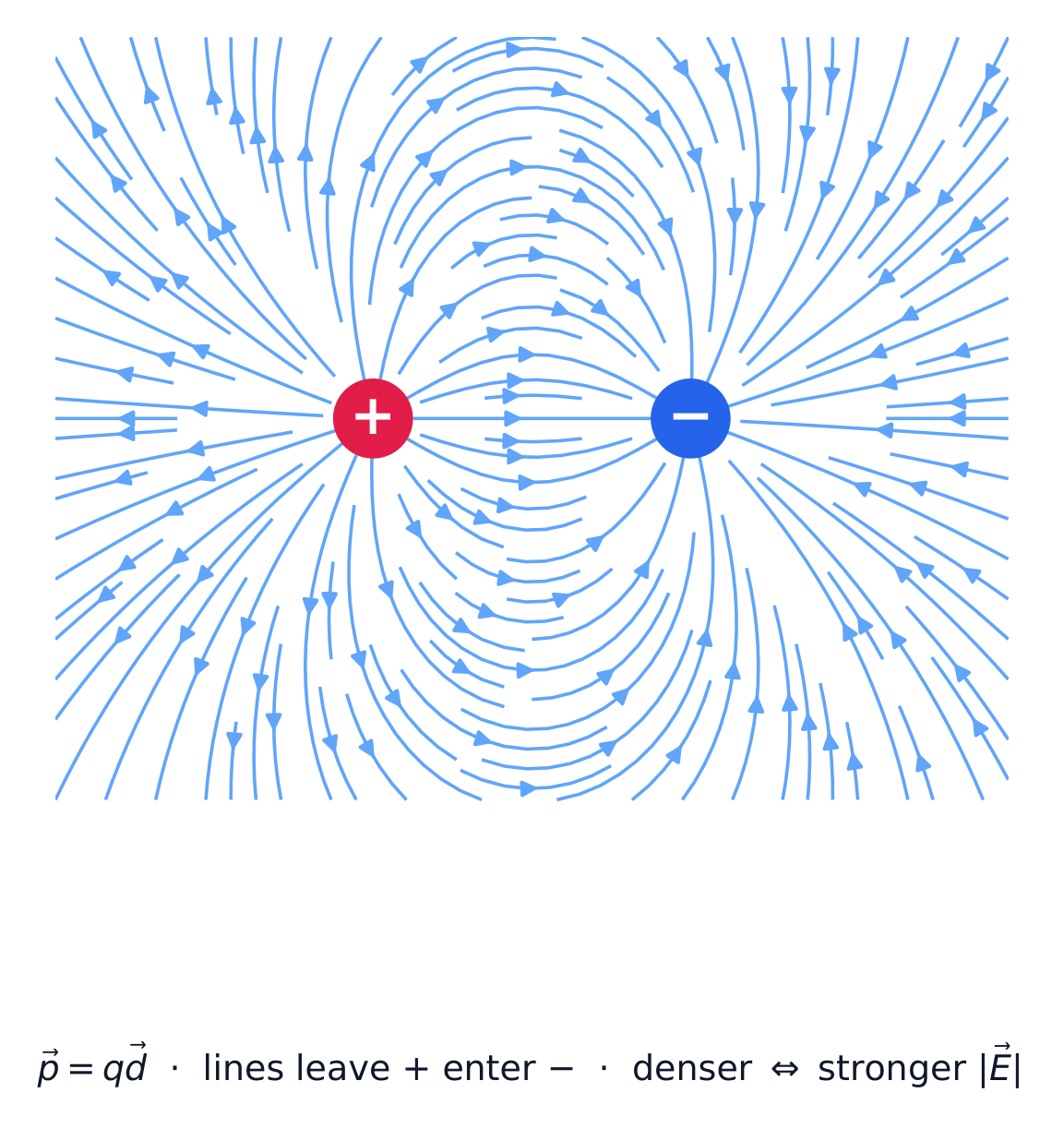
    A charge placed in a field feels $\vec{F}=q\vec{E}$ – positive charges along the field, negative charges against it. Fields from several sources add as vectors (superposition again). Field lines 电场线 make the field visible: they point away from positive charge and toward negative, their density shows the strength, and they never cross.

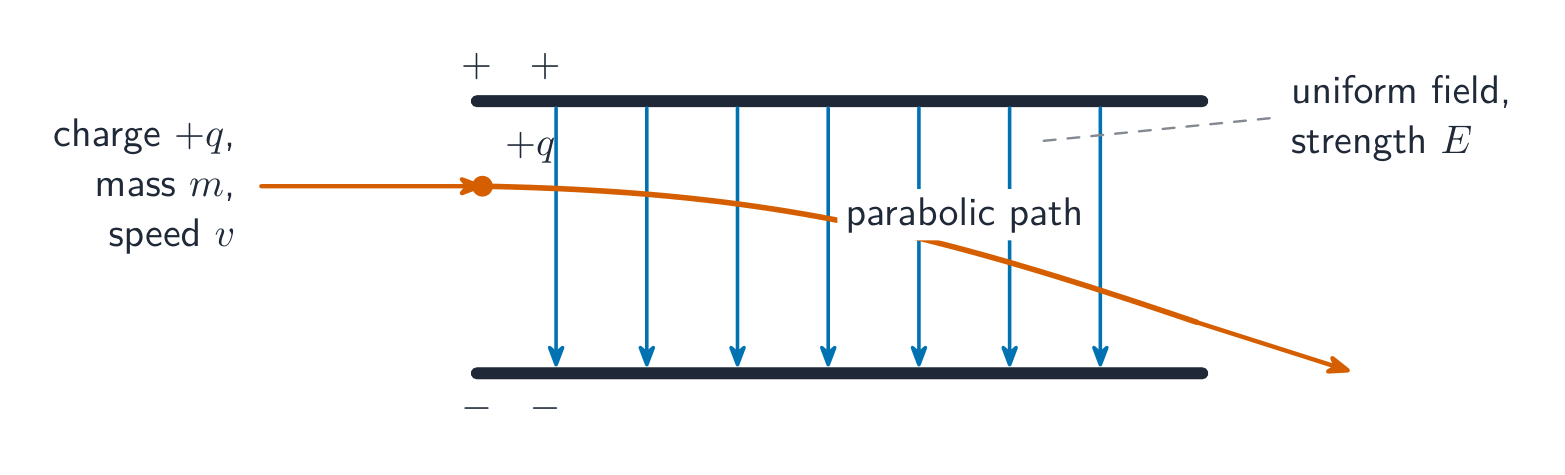
    In a uniform 均匀 field a charge feels a constant force, so it accelerates uniformly – launched sideways, it follows a parabola, just like a projectile in gravity.

    Русский
    Электрическое поле диполя
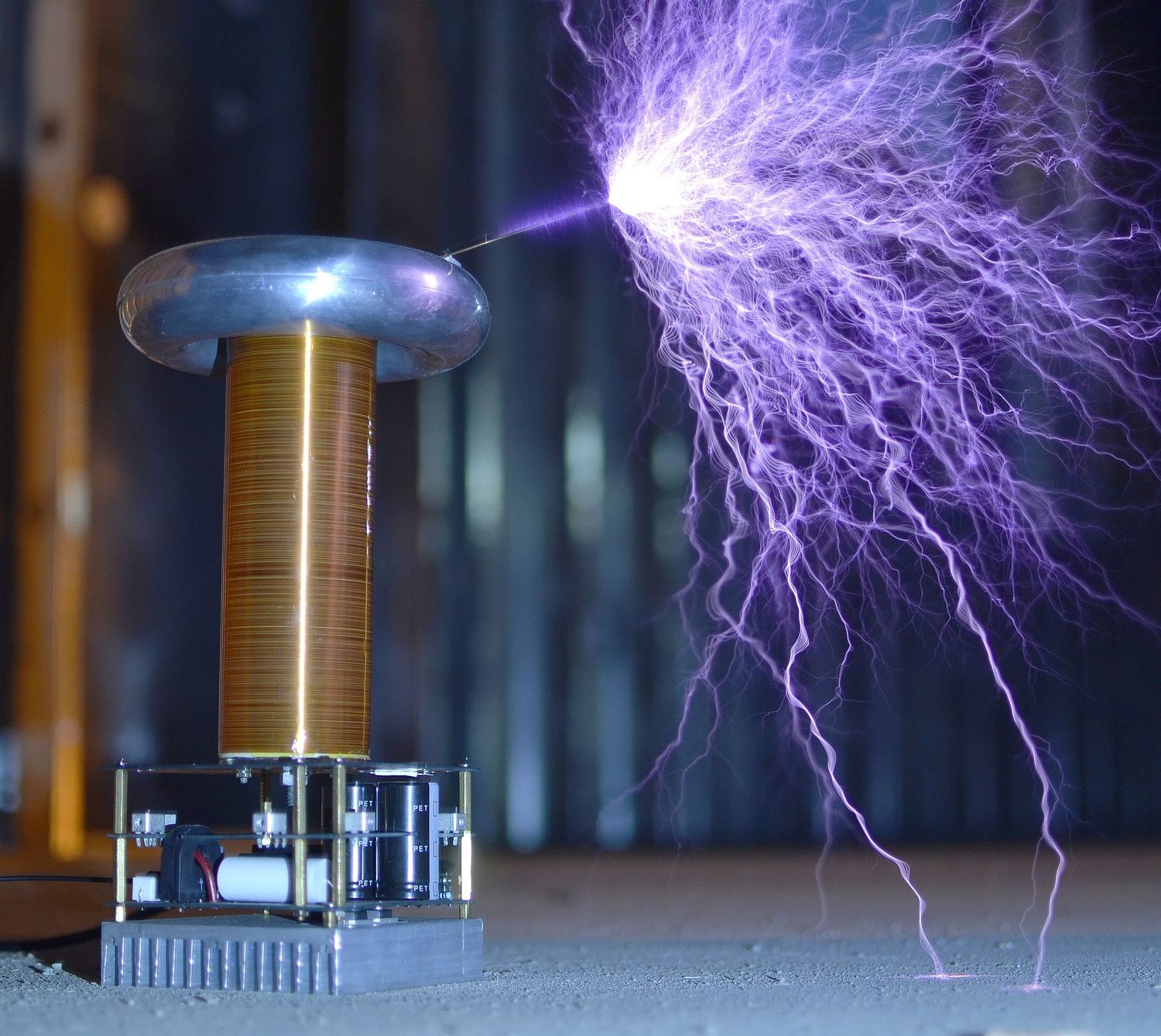
    Тесла-катушка с металлическим кольцом сверху, выбрасывающая длинные фиолетовые искры в воздух
    Тесла-катушка выбрасывает искры: она повышает напряжение настолько высоко, что электрическое поле ионизирует окружающий воздух, и заряд перепрыгивает в виде видимого разряда

    Электрическое поле в точке — это сила, приходящаяся на единицу заряда, которую испытала бы маленькая положительная пробная заряженная частица в этой точке:

    $$\vec{E}=\frac{\vec{F}}{q},\qquad \vec{E}=\frac{1}{4\pi\varepsilon_0}\frac{q}{r^2}\,\hat{r}\ \text{(point charge)}.$$

    Заряд, помещённый в поле, испытывает $\vec{F}=q\vec{E}$ — положительные заряды вдоль поля, отрицательные — против него. Поля от нескольких источников складываются как векторы (снова суперпозиция). Линии поля делают поле видимым: они направлены от положительного заряда к отрицательному, их плотность отражает напряжённость, и они никогда не пересекаются.

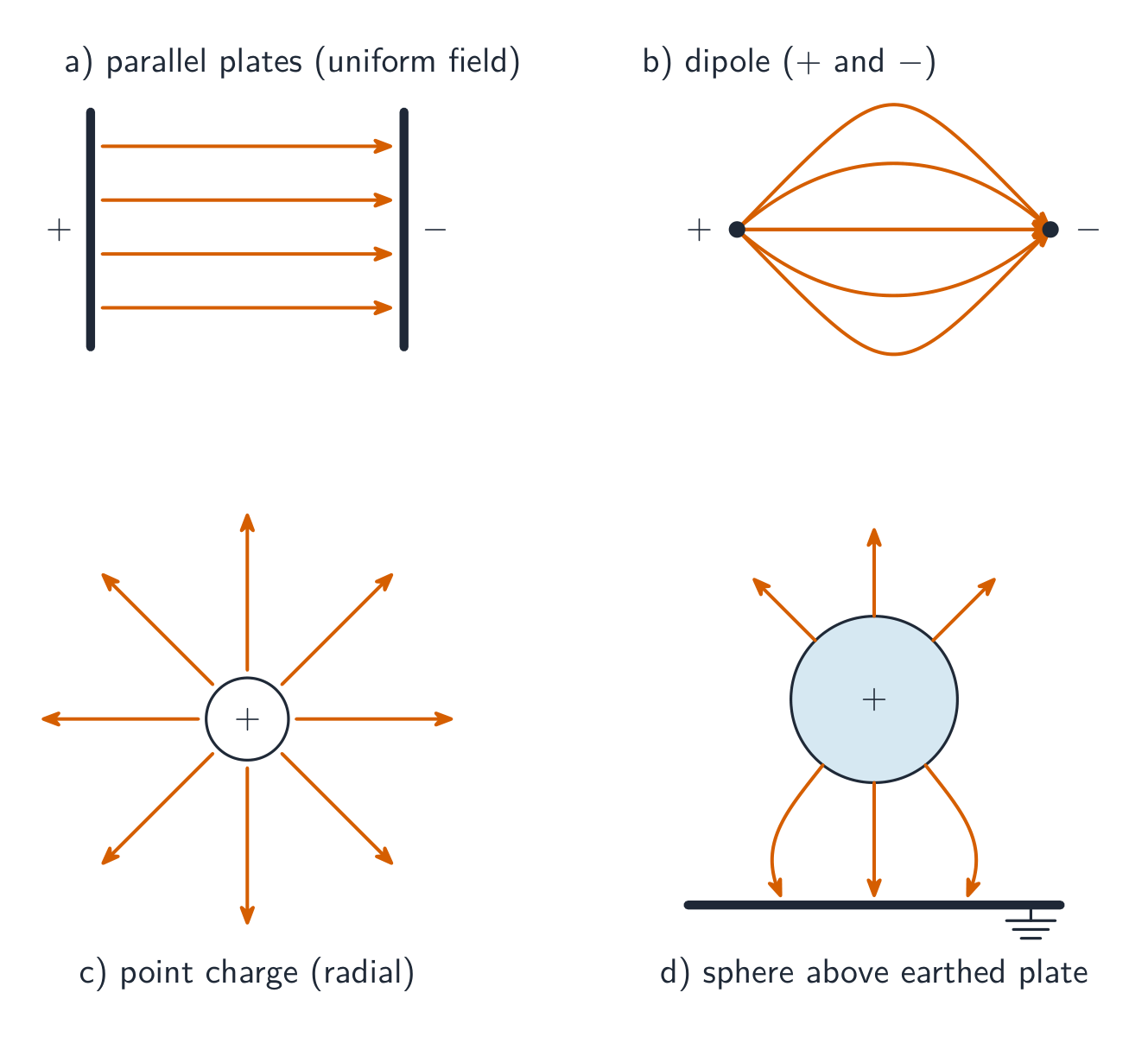
    Рисунок линий электрического поля для параллельных пластин, диполя и точечного заряда
    Рисунок линий электрического поля для параллельных пластин, диполя и точечного заряда
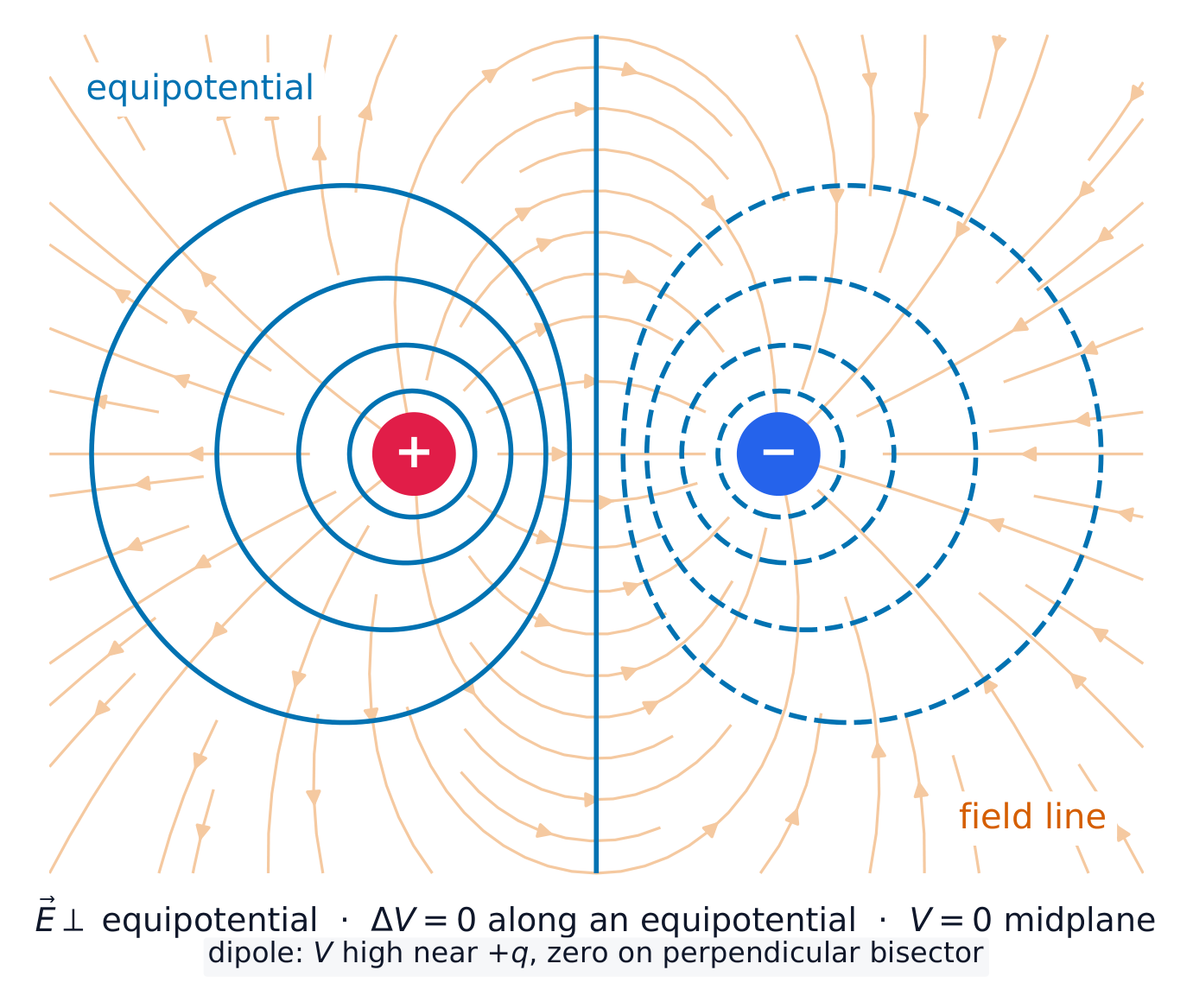
    Линии электрического поля диполя идут от положительного к отрицательному заряду
    Линии электрического поля диполя идут от положительного к отрицательному заряду

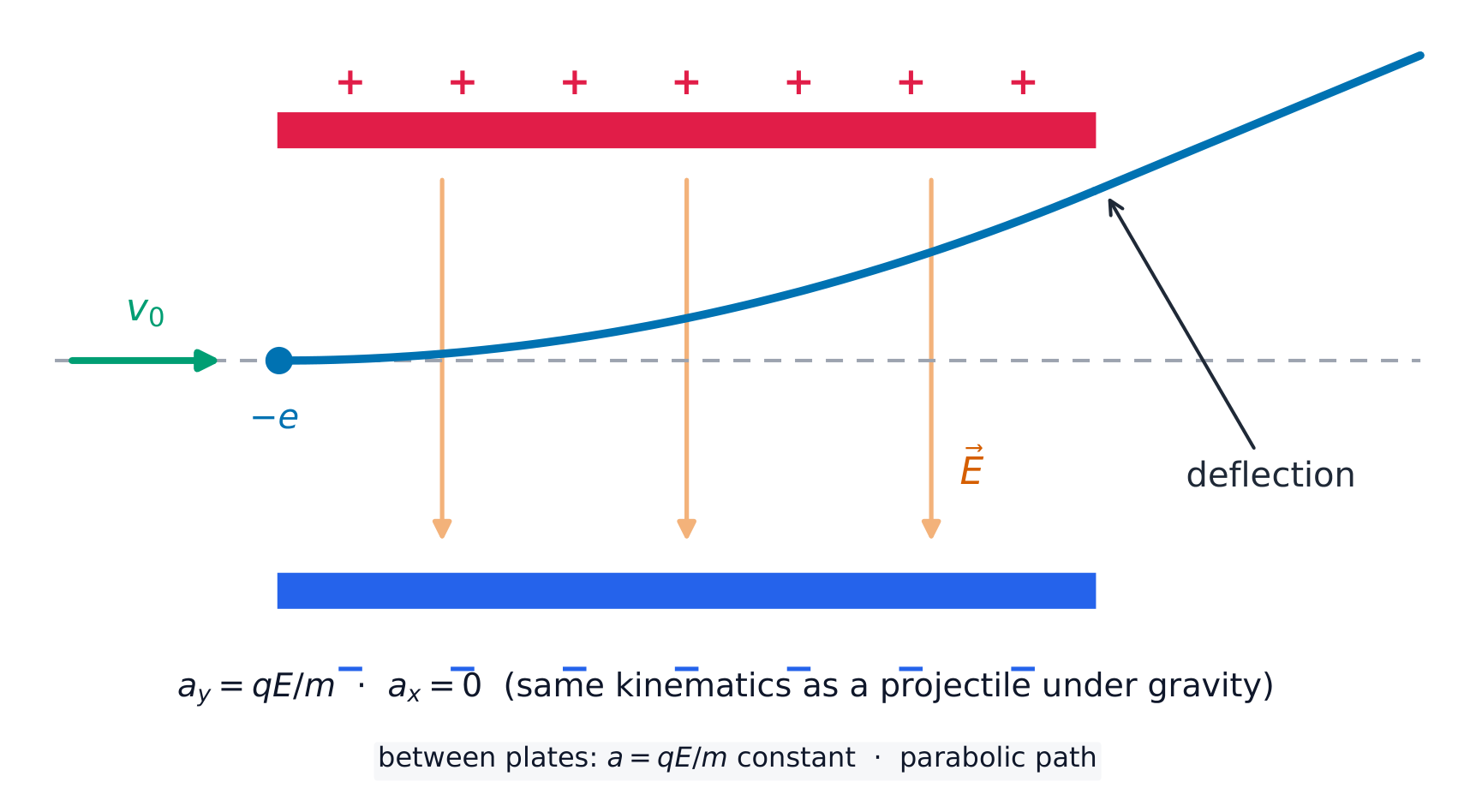
    В однородном поле заряд испытывает постоянную силу, поэтому движется с постоянным ускорением — запущенный боком, он следует параболической траектории, подобно снаряду в гравитационном поле.

    Заряд, проходящий через однородное поле, следует по параболической траектории
    Заряд, проходящий через однородное поле, следует по параболической траектории
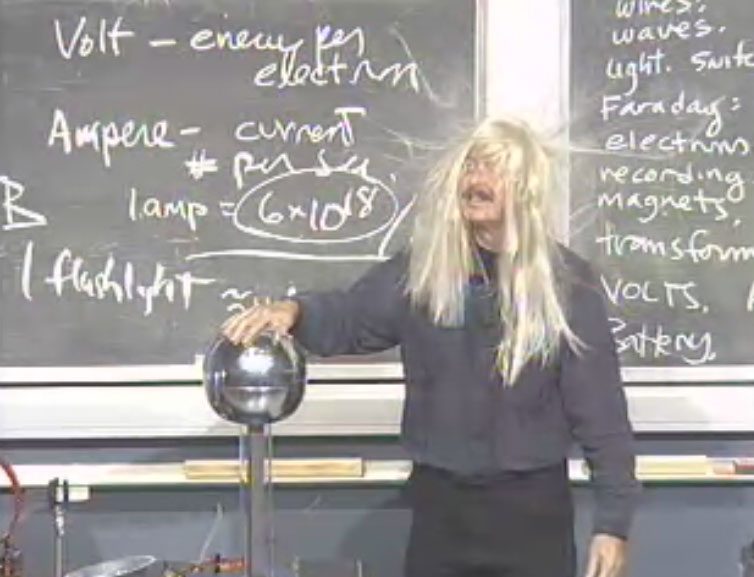
    Человек касается генератора Ван де Граафа, его волосы подняты вверх
    Заряд распределяется по куполу и волосам; одноимённые заряды отталкиваются, поэтому пряди расходятся
    Explore · ⁨Исследовать⁩

    Explore field lines of a point charge · ⁨Исследуйте силовые линии точечного заряда⁩

    Set the charge positive or negative. Field lines start on positive and end on negative charge, never cross, and crowd together where $\vec{E}$ is strongest — the line density is proportional to the field magnitude. · ⁨Установите заряд положительным или отрицательным. Силовые линии начинаются на положительном и заканчиваются на отрицательном заряде, никогда не пересекаются и сгущаются там, где $\vec{E}$ поле максимально — плотность линий пропорциональна величине поля.⁩

    Vocabulary · ⁨Словарь⁩ Train · ⁨Тренировать⁩
    English Русский
    Electric charge/ɪˈlektrɪk tʃɑːdʒ/ электрический заряд
    quantized/ˈkwɒntaɪzd/ квантованными
    elementary charge/ˌelɪˈmentəri tʃɑːdʒ/ элементарный заряд
    conservation of charge/ˌkɒnsəˈveɪʃn ɒv tʃɑːdʒ/ закон сохранения заряда
    point charges/pɔɪnt ˈtʃɑːdʒɪz/ точечные заряды
    Coulomb's law/ˈkuːlɒmz lɔː/ Закон Кулона
    inverse-square/ɪnˈvɜːs skweə/ обратный квадрат
    superposition/ˌsuːpəpəˈzɪʃn/ суперпозиция
    fundamental property/ˌfʌndəˈmentl ˈprɒpəti/ фундаментальное свойство
    permittivity of free space/ˌpɜːmɪˈtɪvəti ɒv friː speɪs/ диэлектрическая проницаемость вакуума
    conductor/kənˈdʌktə/ проводник
    insulator/ˈɪnsjuːleɪtə/ диэлектрик
    Charging by friction/ˈtʃɑːdʒɪŋ baɪ ˈfrɪkʃn/ зарядка трением
    Charging by conduction/ˈtʃɑːdʒɪŋ baɪ kənˈdʌkʃn/ зарядка проводником (кондукция)
    Charging by induction/ˈtʃɑːdʒɪŋ baɪ ɪnˈdʌkʃn/ зарядка индукцией
    ground/ɡraʊnd/ основание
    polarization/ˌpəʊləraɪˈzeɪʃn/ поляризация
    electroscope/ɪˌlektrəʊˈskəʊp/ электрометр
    electric field/ɪˈlektrɪk fiːld/ электрическое поле
    test charge/test tʃɑːdʒ/ пробный заряд
    Field lines/fiːld laɪnz/ силовые линии поля
    uniform/ˈjuːnɪfɔːm/ однородное
    continuous charge distribution/kənˈtɪnjuːəs tʃɑːdʒ ˌdɪstrɪˈbjuːʃn/ непрерывное распределение заряда
    linear charge density/ˈlɪnɪə tʃɑːdʒ ˈdensɪti/ линейная плотность заряда
    surface charge density/ˈsɜːfɪs tʃɑːdʒ ˈdensɪti/ поверхностная плотность заряда
    volume charge density/ˈvɒljuːm tʃɑːdʒ ˈdensɪti/ объемная плотность заряда
    symmetry/ˈsɪmətri/ симметрию
    8.4

    Electric Fields of Charge Distributions · ⁨Электрические поля распределений заряда⁩

    Syllabus · ⁨Программа⁩
    English

    Learning Objective 8.4.A: Describe the electric field resulting from a given charge distribution.

    • 8.4.A.1 Expressions for the electric field of specified charge distributions can be found using integration and the principle of superposition.
      • Relevant equation: $\vec{E} = \dfrac{1}{4\pi\varepsilon_0} \displaystyle\int \dfrac{dq}{r^2} \hat{r}$
    • 8.4.A.2 Symmetry considerations of certain charge distributions can simplify analysis of the electric field resulting from those charge distributions.

    Boundary statement: AP Physics C: Electricity & Magnetism only expects students to use calculus to find the electric field resulting from the following charge distributions and locations: an infinitely long, uniformly charged wire or cylinder at a distance from its central axis, a thin ring of charge at a location along the axis of the ring, a semicircular arc or part of a semicircular arc at its center, and a finite wire or line charge at a point collinear with the line charge or at a location along its perpendicular bisector.

    Русский

    Цель обучения 8.4.A: Описать электрическое поле, возникающее в результате заданного распределения зарядов.

    • 8.4.A.1 Выражения для электрического поля конкретных распределений зарядов можно найти с использованием интегрирования и принципа суперпозиции.
      • Соответствующее уравнение: $\vec{E} = \dfrac{1}{4\pi\varepsilon_0} \displaystyle\int \dfrac{dq}{r^2} \hat{r}$
    • 8.4.A.2 Соображения симметрии некоторых распределений зарядов могут упростить анализ resulting электрического поля.

    Граничное условие: AP Physics C: Электричество и магнетизм требует от студентов использования дифференциального и интегрального исчисления исключительно для нахождения электрического поля следующих типов распределений и в указанных точках: бесконечно длинного равномерно заряженного провода или цилиндра на расстоянии от его центральной оси, тонкого кольца заряда в точке вдоль оси кольца, полуокружности или части полуокружности в ее центре, а также конечного провода или линейного заряда в точке, коллинеарной с линейным зарядом, или в точке на перпендикуляре, проведенном к середине линейного заряда.

    Source: College Board AP Course and Exam Description · ⁨Источник: Описание курса и экзамена College Board AP⁩

    English

    For a continuous charge distribution 连续电荷分布, cut the object into pieces $dq$ and integrate their point-charge fields:

    $$\vec{E}=\frac{1}{4\pi\varepsilon_0}\int \frac{dq}{r^2}\,\hat{r}.$$

    Write $dq$ using the right density: $\lambda\,dl$ with the linear charge density 线电荷密度 (a line or ring), $\sigma\,dA$ with the surface charge density 面电荷密度, or $\rho\,dV$ with the volume charge density 体电荷密度. Then use symmetry 对称性 to cancel components before integrating – that sentence is usually a scored step. AP's calculus cases: a finite line (collinear point or perpendicular bisector), an infinite wire or cylinder, a ring on its axis, and an arc at its centre.

    Worked example (ring, on axis). A ring of radius $R$ carries charge $Q$. At a point $z$ along the axis, each element is a distance $\sqrt{R^2+z^2}$ away, and by symmetry the sideways components cancel, leaving only the axial part ($\cos\alpha=z/\sqrt{R^2+z^2}$):

    $$E_z=\frac{1}{4\pi\varepsilon_0}\int\frac{dq}{R^2+z^2}\cdot\frac{z}{\sqrt{R^2+z^2}}=\frac{1}{4\pi\varepsilon_0}\frac{Qz}{(R^2+z^2)^{3/2}}.$$

    Check the limits: $E=0$ at the centre ($z=0$), and far away ($z\gg R$) it becomes $kQ/z^2$ – a point charge, as it must.

    Русский

    Для непрерывного распределения заряда разрежьте объект на элементы $dq$ и проинтегрируйте поля точечных зарядов:

    $$\vec{E}=\frac{1}{4\pi\varepsilon_0}\int \frac{dq}{r^2}\,\hat{r}.$$

    Запишите $dq$, используя правильную плотность: $\lambda\,dl$ с линейной плотностью заряда (для нити или кольца), $\sigma\,dA$ с поверхностной плотностью заряда, или $\rho\,dV$ с объёмной плотностью заряда. Затем используйте симметрию, чтобы сократить компоненты до интегрирования — этот шаг обычно оценивается баллами. Случаи вычисления интегралов в AP: конечная нить (точка на оси или перпендикулярный биссектор), бесконечный провод или цилиндр, кольцо на своей оси и дуга в её центре.

    Разобранный пример (кольцо, на оси). Кольцо радиусом $R$ несёт заряд $Q$. В точке на расстоянии $z$ вдоль оси каждый элемент находится на расстоянии $\sqrt{R^2+z^2}$, и в силу симметрии поперечные компоненты сокращаются, остаётся только осевая часть ($\cos\alpha=z/\sqrt{R^2+z^2}$):

    $$E_z=\frac{1}{4\pi\varepsilon_0}\int\frac{dq}{R^2+z^2}\cdot\frac{z}{\sqrt{R^2+z^2}}=\frac{1}{4\pi\varepsilon_0}\frac{Qz}{(R^2+z^2)^{3/2}}.$$

    Проверьте пределы: $E=0$ в центре ($z=0$), и далеко ($z\gg R$) выражение превращается в $kQ/z^2$ — как для точечного заряда, что и должно быть.

    8.5

    Electric Flux · ⁨Электрический поток⁩

    Syllabus · ⁨Программа⁩
    English

    Learning Objective 8.5.A: Describe the electric flux through an arbitrary area or geometric shape.

    • 8.5.A.1 Flux describes the amount of a given quantity that passes through a given area.
    • 8.5.A.2 For an electric field $\vec{E}$ that is constant across an area $\vec{A}$, the electric flux through the area is defined as $\Phi_E = \vec{E} \bullet \vec{A}$.
      • 8.5.A.2.i The direction of the area vector is defined as perpendicular to the plane of the surface and outward from a closed surface.
      • 8.5.A.2.ii The sign of flux is given by the dot product of the electric field vector and the area vector.
    • 8.5.A.3 The total electric flux passing through a surface is defined by the surface integral of the electric field over the surface.
      • Relevant equation: $\Phi_E = \displaystyle\int \vec{E} \cdot d\vec{A}$
    Русский

    Цель обучения 8.5.A: Описать электрический поток через произвольную площадь или геометрическую фигуру.

    • 8.5.A.1 Поток описывает количество определенной величины, проходящей через заданную площадь.
    • 8.5.A.2 Для электрического поля $\vec{E}$, постоянного по всей площади $\vec{A}$, электрический поток через эту площадь определяется выражением $\Phi_E = \vec{E} \bullet \vec{A}$.
      • 8.5.A.2.i Направление вектора площади определяется как перпендикулярное плоскости поверхности и направленное наружу от замкнутой поверхности.
      • 8.5.A.2.ii Знак потока определяется скалярным произведением вектора электрического поля и вектора площади.
    • 8.5.A.3 Полный электрический поток, проходящий через поверхность, определяется поверхностным интегралом от вектора электрического поля по этой поверхности.
      • Соответствующее уравнение: $\Phi_E = \displaystyle\int \vec{E} \cdot d\vec{A}$

    Source: College Board AP Course and Exam Description · ⁨Источник: Описание курса и экзамена College Board AP⁩

    English
    Electric flux & Gauss's law

    Electric flux 电通量 measures how much field passes through a surface:

    $$\Phi_E=\int \vec{E}\cdot d\vec{A}.$$

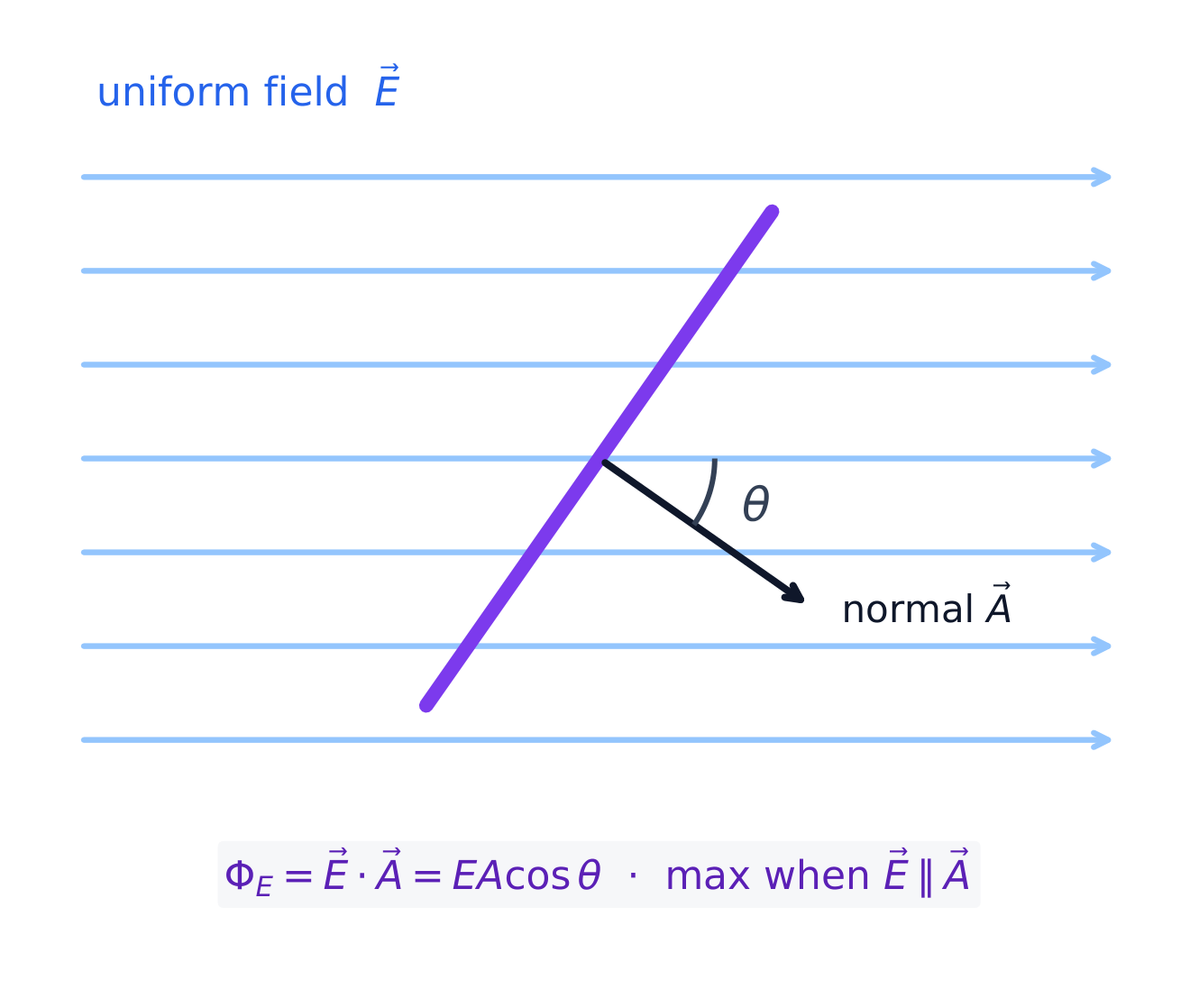
    For a uniform field through a flat area, $\Phi_E=EA\cos\theta$, where the area vector 面积矢量 is perpendicular to the surface. Flux is positive where field lines exit a closed surface and negative where they enter – only the perpendicular component of $\vec{E}$ counts.

    Русский
    Электрический поток и закон Гаусса

    Электрический поток измеряет, сколько поля проходит через поверхность:

    $$\Phi_E=\int \vec{E}\cdot d\vec{A}.$$

    Для однородного поля через плоскую площадь $\Phi_E=EA\cos\theta$, где вектор площади перпендикулярен поверхности. Поток положителен там, где линии поля выходят из замкнутой поверхности, и отрицателен там, где они входят — учитывается только перпендикулярная компонента $\vec{E}$.

    Электрический поток через поверхность зависит от угла между полем и нормалью к поверхности
    Электрический поток через поверхность зависит от угла между полем и нормалью к поверхности
    Vocabulary · ⁨Словарь⁩ Train · ⁨Тренировать⁩
    English Русский
    Electric flux/ɪˈlektrɪk flʌks/ Электрический поток
    area vector/ˈeərɪə ˈvektə/ вектор площади
    Gauss's law/ˈɡaʊsɪz lɔː/ Закон Гаусса
    8.6

    Gauss's Law · ⁨Закон Гаусса⁩

    Syllabus · ⁨Программа⁩
    English

    Learning Objective 8.6.A: Describe the properties of a charge distribution by applying Gauss's law.

    • 8.6.A.1 Gauss's law relates electric flux through a Gaussian surface to the charge enclosed by that surface.
      • Relevant equations: $\Phi_E = \dfrac{q_{\text{enc}}}{\varepsilon_0}$ and $\displaystyle\oint \vec{E} \cdot d\vec{A} = \dfrac{q_{\text{enc}}}{\varepsilon_0}$
    • 8.6.A.2 A Gaussian surface is a three-dimensional, closed surface.
    • 8.6.A.3 The total electric flux through a Gaussian surface is independent of the size of the Gaussian surface if the amount of enclosed charge remains constant.
    • 8.6.A.4 Gaussian surfaces are typically constructed such that the electric field generated by the enclosed charge is either perpendicular or parallel to different regions of the Gaussian surface, resulting in a simplified surface integral.
    • 8.6.A.5 If a function of charge density is given for a charge distribution, the total charge can be determined by integrating the charge density over the length (one dimension), area (two dimensions), or volume (three dimensions) of the charge distribution. For example: $Q_{\text{total}} = \displaystyle\int \rho(\vec{r})\, dV$
    • 8.6.A.6 Maxwell's equations are the collection of equations that fully describe electromagnetism. Gauss's law is Maxwell's first equation.
      • Relevant equation: $\displaystyle\oint \vec{E} \cdot d\vec{A} = \dfrac{q_{\text{enc}}}{\varepsilon_0}$

    Boundary statement: AP Physics C: Electricity & Magnetism only expects students to quantitatively apply Gauss's law to point charges and charge distributions that have spherical, cylindrical, or planar symmetry.

    Русский

    Цель обучения 8.6.A: Описать свойства распределения зарядов, применяя закон Гаусса.

    • 8.6.A.1 Закон Гаусса связывает электрический поток через гауссову поверхность с зарядом, заключенным внутри этой поверхности.
      • Соответствующие уравнения: $\Phi_E = \dfrac{q_{\text{enc}}}{\varepsilon_0}$ и $\displaystyle\oint \vec{E} \cdot d\vec{A} = \dfrac{q_{\text{enc}}}{\varepsilon_0}$
    • 8.6.A.2 Гауссова поверхность — это трехмерная замкнутая поверхность.
    • 8.6.A.3 Полный электрический поток через гауссову поверхность не зависит от размера этой поверхности при неизменном количестве заключенного заряда.
    • 8.6.A.4 Гауссовы поверхности обычно выбирают таким образом, чтобы электрическое поле, создаваемое заключенным зарядом, было либо перпендикулярным, либо параллельным различным участкам гауссовой поверхности, что приводит к упрощению поверхностного интеграла.
    • 8.6.A.5 Если задана функция плотности заряда для распределения заряда, полный заряд можно определить, интегрируя плотность заряда по длине (одно измерение), площади (два измерения) или объему (три измерения) распределения заряда. Например: $Q_{\text{total}} = \displaystyle\int \rho(\vec{r})\, dV$
    • 8.6.A.6 Уравнения Максвелла — это совокупность уравнений, которые полностью описывают электромагнетизм. Закон Гаусса является первым уравнением Максвелла.
      • Соответствующее уравнение: $\displaystyle\oint \vec{E} \cdot d\vec{A} = \dfrac{q_{\text{enc}}}{\varepsilon_0}$

    Предельное утверждение: AP Physics C: Электричество и магнетизм требует от студентов только количественного применения закона Гаусса к точечным зарядам и распределениям зарядов, обладающим сферической, цилиндрической или плоской симметрией.

    Source: College Board AP Course and Exam Description · ⁨Источник: Описание курса и экзамена College Board AP⁩

    English

    Gauss's law 高斯定律 – the first of Maxwell's equations – relates the flux through any closed surface to the charge inside it:

    $$\oint \vec{E}\cdot d\vec{A}=\frac{Q_{\text{enc}}}{\varepsilon_0}.$$

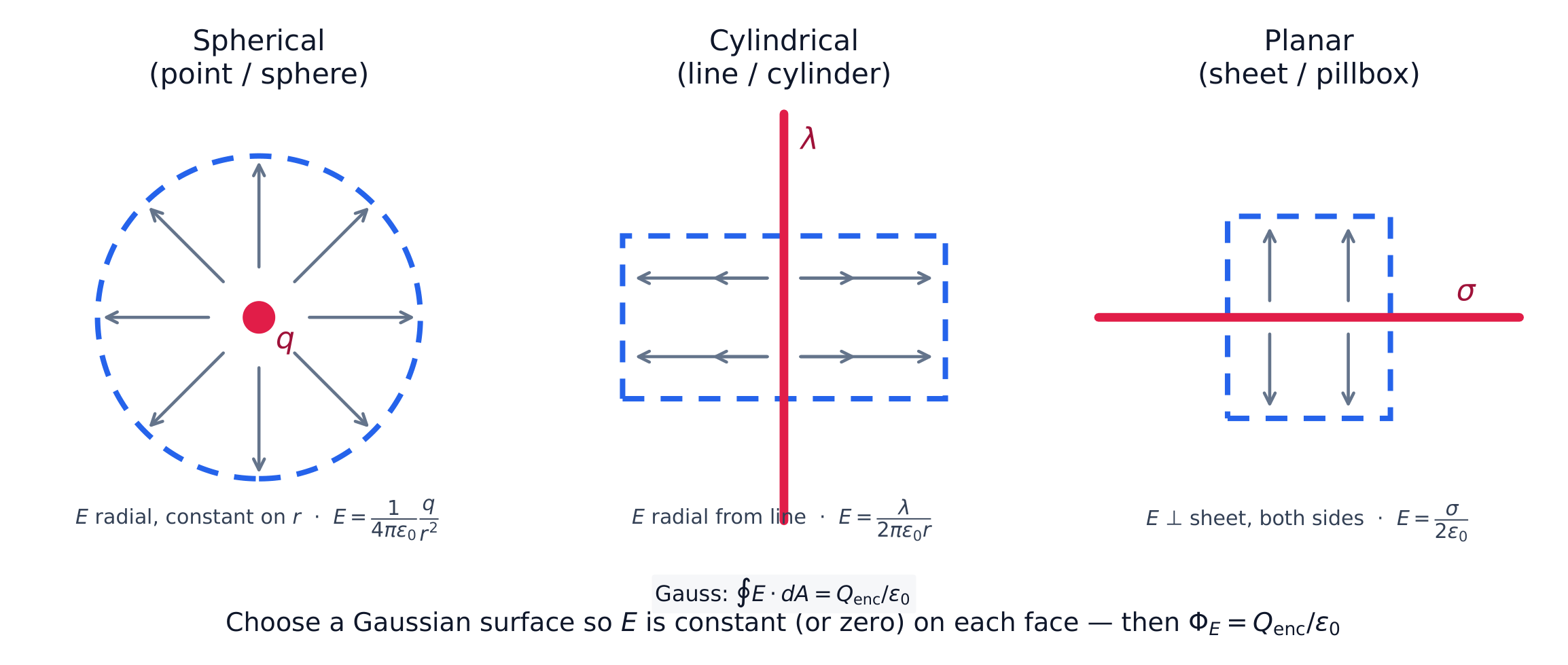
    It is true for any closed surface, but it solves for $E$ only when symmetry lets you choose a Gaussian surface 高斯面 on which $E$ is constant and perpendicular (or parallel, contributing zero). The three symmetries AP tests: spherical symmetry 球对称 (concentric sphere), cylindrical symmetry 柱对称 (coaxial cylinder), and planar symmetry 平面对称 (a straddling "pillbox").

    Worked example (sphere). Outside a sphere of total charge $Q$, a spherical Gaussian surface of radius $r$ gives $E(4\pi r^2)=Q/\varepsilon_0$, so $E=\dfrac{kQ}{r^2}$ – identical to a point charge at the centre. Inside a uniformly charged solid sphere of radius $R$, the surface encloses only $Q_{\text{enc}}=Q\,r^3/R^3$, so $E=\dfrac{kQr}{R^3}$: zero at the centre, growing linearly to the surface.

    Worked example (wire). For an infinite wire with charge per length $\lambda$, take a coaxial cylinder of radius $r$ and length $L$. The ends contribute nothing ($\vec{E}\perp d\vec{A}$), so $E(2\pi rL)=\dfrac{\lambda L}{\varepsilon_0}$ and $E=\dfrac{\lambda}{2\pi\varepsilon_0 r}$. The same pillbox method gives an infinite sheet's field, $E=\dfrac{\sigma}{2\varepsilon_0}$, uniform on both sides.

    Exam skill. A full-credit Gauss's-law answer has four parts: name the surface, state the symmetry argument (why $E$ is constant and perpendicular on it), count $Q_{\text{enc}}$, then solve. Skipping the symmetry sentence loses the reasoning point – and remember Gauss's law also explains why $E=0$ inside any conductor in equilibrium.

    Русский

    Закон Гаусса — первое из уравнений Максвелла — связывает поток через любую замкнутую поверхность с зарядом внутри неё:

    $$\oint \vec{E}\cdot d\vec{A}=\frac{Q_{\text{enc}}}{\varepsilon_0}.$$

    Это верно для любой замкнутой поверхности, но оно позволяет вычислить $E$ только тогда, когда симметрия позволяет выбрать гауссову поверхность, на которой $E$ является постоянным и перпендикулярным (или параллельным, дающим нулевой вклад). Три вида симметрии, проверяемые в AP: сферическая симметрия (концентрическая сфера), цилиндрическая симметрия (соосный цилиндр) и плоскостная симметрия (используемая «пилюля»-образная поверхность).

    Выбрана гауссова поверхность, соответствующая симметрии распределения заряда
    Выбрана гауссова поверхность, соответствующая симметрии распределения заряда

    Разобранный пример (сфера). Вне сферы с полным зарядом $Q$ сферическая гауссова поверхность радиуса $r$ дает $E(4\pi r^2)=Q/\varepsilon_0$, следовательно, $E=\dfrac{kQ}{r^2}$ – аналогично точечному заряду в центре. Внутри равномерно заряженного сплошного шара радиуса $R$, поверхность охватывает только $Q_{\text{enc}}=Q\,r^3/R^3$, поэтому $E=\dfrac{kQr}{R^3}$: равно нулю в центре и линейно возрастает до поверхности.

    Разобранное решение (провод). Для бесконечного провода с зарядом на единицу длины $\lambda$, возьмите соосный цилиндр радиуса $r$ и длины $L$. Торцы не дают вклада ($\vec{E}\perp d\vec{A}$), поэтому $E(2\pi rL)=\dfrac{\lambda L}{\varepsilon_0}$ и $E=\dfrac{\lambda}{2\pi\varepsilon_0 r}$. Тот же метод «пилюли» дает поле бесконечной плоскости, $E=\dfrac{\sigma}{2\varepsilon_0}$, равномерное по обе стороны.

    Экзаменационный навык. Полный ответ по закону Гаусса должен включать четыре части: назвать поверхность, указать аргумент симметрии (почему $E$ постоянен и перпендикулярен к ней), подсчитать $Q_{\text{enc}}$, затем решить уравнение. Пропуск предложения о симметрии лишает балла за рассуждения — также помните, что закон Гаусса объясняет, почему $E=0$ внутри любого проводника в равновесии равен нулю.

    Vocabulary · ⁨Словарь⁩ Train · ⁨Тренировать⁩
    English Русский
    Gaussian surface/ˈɡaʊʃn ˈsɜːfɪs/ гауссова поверхность
    spherical symmetry/sˈferɪkl ˈsɪmətri/ сферическая симметрия
    cylindrical symmetry/sɪˈlɪndrɪkl ˈsɪmətri/ цилиндрическая симметрия
    planar symmetry/ˈpleɪnə ˈsɪmətri/ плоская симметрия
    8.6

    Exam tips · ⁨Советы для экзамена⁩

    English
    • Use Coulomb's law $F=\tfrac{1}{4\pi\varepsilon_0}\tfrac{q_1 q_2}{r^2}$ and superpose forces as vectors (components, not magnitudes).
    • For a continuous charge, integrate $d\vec E$ over $dq=\lambda\,dl,\ \sigma\,dA,\ \rho\,dV$; use symmetry to cancel components.
    • The field points away from positive and toward negative charge; draw field lines correctly.
    • Distinguish the force on a charge ($\vec F=q\vec E$) from the field the charge creates.
    • Keep the constant $k=\tfrac{1}{4\pi\varepsilon_0}$ straight and check units.
    Русский
    • Используйте закон Кулона $F=\tfrac{1}{4\pi\varepsilon_0}\tfrac{q_1 q_2}{r^2}$ и суперпозицию сил как векторов (компоненты, а не модули).
    • Для непрерывного распределения заряда интегрируйте $d\vec E$ по $dq=\lambda\,dl,\ \sigma\,dA,\ \rho\,dV$; используйте симметрию для сокращения компонент.
    • Поле направлено от положительного и к отрицательному заряду; правильно рисуйте силовые линии.
    • Различайте силу, действующую на заряд ($\vec F=q\vec E$), и поле, создаваемое этим зарядом.
    • Держите под рукой константу $k=\tfrac{1}{4\pi\varepsilon_0}$ и проверяйте размерности.
  • 9

    Electric Potential · ⁨Электрический потенциал⁩

    Watch lesson · ⁨Смотреть урок⁩
    9.1

    Electric Potential Energy · ⁨Электрический потенциальная энергия⁩

    Syllabus · ⁨Программа⁩
    English

    Learning Objective 9.1.A: Describe the electric potential energy of a system.

    • 9.1.A.1 The electric potential energy of a system of two point charges equals the amount of work required for an external force to bring the point charges to their current positions from infinitely far away.
    • 9.1.A.2 The general form for the electric potential energy between two charged objects is given by the equation
      • Equation: $U_E = \dfrac{1}{4\pi\varepsilon_0}\dfrac{q_1 q_2}{r} = k\dfrac{q_1 q_2}{r}$.
    • 9.1.A.3 The total electric potential energy of a system can be determined by finding the sum of the electric potential energies of the individual interactions between each pair of charged objects in the system.
    Русский

    Цель обучения 9.1.A: Описать электростатический потенциал системы.

    • 9.1.A.1 Электростатический потенциал системы двух точечных зарядов равен работе внешней силы, необходимой для перемещения этих точечных зарядов из бесконечно удаленного расстояния в их текущие положения.
    • 9.1.A.2 Общий вид выражения для электростатического потенциала между двумя заряженными объектами задается уравнением
      • Уравнение: $U_E = \dfrac{1}{4\pi\varepsilon_0}\dfrac{q_1 q_2}{r} = k\dfrac{q_1 q_2}{r}$.
    • 9.1.A.3 Полный электростатический потенциал системы может быть определен как сумма электростатических потенциалов отдельных взаимодействий между каждой парой заряженных объектов в системе.

    Source: College Board AP Course and Exam Description · ⁨Источник: Описание курса и экзамена College Board AP⁩

    English

    When you push two like charges together, you do work 功 against the electric force. That work is stored by the pair as electric potential energy 电势能:

    $$U_E=\frac{1}{4\pi\varepsilon_0}\frac{q_1 q_2}{r}=k\frac{q_1 q_2}{r}.$$

    $U_E$ is defined as the work an external force must do to bring the charges from infinitely far away to a distance $r$ apart. The signs carry the physics:

    • Like charges: $U_E>0$. An outside push was needed to bring them together. If released, they fly apart, and the stored energy becomes kinetic energy 动能.
    • Opposite charges: $U_E<0$. The pair is bound. You must supply $|U_E|$ of work to pull them apart to infinity.

    The electric force is a conservative force 保守力: the work it does depends only on the start and end points, not the path, and equals $-\Delta U_E$.

    For a system 系统 of several charges, add the potential energy of every distinct pair:

    $$U_{\text{total}}=k\!\left(\frac{q_1q_2}{r_{12}}+\frac{q_1q_3}{r_{13}}+\frac{q_2q_3}{r_{23}}\right).$$

    Worked example. Three $+2.0\ \mu\text{C}$ charges sit at the corners of an equilateral triangle with sides $0.30\ \text{m}$. Each pair stores $U=\dfrac{kq^2}{r}=\dfrac{(9.0\times10^{9})(2.0\times10^{-6})^2}{0.30}=0.12\ \text{J}$. There are three pairs, so $U_{\text{total}}=3\times0.12\ \text{J}=0.36\ \text{J}$. This is the work needed to assemble the triangle from infinity – and the kinetic energy the charges would share if all three were released.

    Русский

    Когда вы сближаете два одноименных заряда, вы совершаете работу против электрической силы. Эта работа накапливается парой в виде электрического потенциальной энергии:

    $$U_E=\frac{1}{4\pi\varepsilon_0}\frac{q_1 q_2}{r}=k\frac{q_1 q_2}{r}.$$

    $U_E$ определяется как работа внешней силы, которую необходимо совершить для перемещения зарядов из бесконечно удаленного места на расстояние $r$ друг от друга. Знаки имеют физический смысл:

    • Одноименные заряды: $U_E>0$. Для их сближения потребовалось внешнее давление. Если их отпустить, они разлетятся, и накопленная энергия превратится в кинетическую энергию.
    • Разноименные заряды: $U_E<0$. Пара связана. Вы должны совершить работу $|U_E|$, чтобы разъединить их на бесконечность.

    Электрическая сила является консервативной силой: совершаемая ею работа зависит только от начальной и конечной точек, а не от траектории, и равна $-\Delta U_E$.

    Для системы нескольких зарядов сложите потенциальную энергию каждой отдельной пары:

    $$U_{\text{total}}=k\!\left(\frac{q_1q_2}{r_{12}}+\frac{q_1q_3}{r_{13}}+\frac{q_2q_3}{r_{23}}\right).$$

    Разобранное решение. Три заряда $+2.0\ \mu\text{C}$ расположены в вершинах равностороннего треугольника со сторонами $0.30\ \text{m}$. Каждая пара хранит энергию $U=\dfrac{kq^2}{r}=\dfrac{(9.0\times10^{9})(2.0\times10^{-6})^2}{0.30}=0.12\ \text{J}$. Таких пар три, поэтому $U_{\text{total}}=3\times0.12\ \text{J}=0.36\ \text{J}$. Это работа, необходимая для сборки треугольника из бесконечности — и кинетическая энергия, которую заряды получили бы, если бы все три были отпущены.

    9.2

    Electric Potential · ⁨Электрический потенциал⁩

    Syllabus · ⁨Программа⁩
    English

    Learning Objective 9.2.A: Describe the electric potential due to a configuration of charged objects.

    • 9.2.A.1 Electric potential describes the electric potential energy per unit charge at a point in space.
    • 9.2.A.2 Expressions for the electric potential of charge distributions can be found using integration and the principle of superposition.
      • Equation: $V = \dfrac{1}{4\pi\varepsilon_0}\displaystyle\int \dfrac{dq}{r}$
      • 9.2.A.2.i The electric potential for single point charge is
        • Equation: $V = \dfrac{q}{4\pi\varepsilon_0 r}$.
      • 9.2.A.2.ii The electric potential due to multiple point charges can be determined by the principle of scalar superposition of the electric potential due to each of the point charges.
        • Equation: $V = \dfrac{1}{4\pi\varepsilon_0}\displaystyle\sum_i \dfrac{q_i}{r_i}$
    • 9.2.A.3 The electric potential difference between two points is the change in electric potential energy per unit charge when a test charge is moved between the two points.
      • Equation: $\Delta V = \dfrac{\Delta U_E}{q}$
    • 9.2.A.4 Electric potential difference may also result from chemical processes that cause positive and negative charges to separate, such as in a battery.

    Boundary statement: AP Physics C: Electricity & Magnetism only expects students to use calculus to find the electric potential resulting from the following charge distributions and locations: an infinitely long, uniformly charged wire or cylinder at a distance from its central axis, a thin ring of charge at a location along the axis of the ring, a semicircular arc or part of a semicircular arc at its center, and a finite wire or line charge at a point collinear with the line charge or at a location along its perpendicular bisector.

    Learning Objective 9.2.B: Describe the relationship between electric potential and electric field.

    • 9.2.B.1 The value of an electric field component in any direction at a given location is equal to the negative of the spatial rate of change in electric potential at that location.
      • Equation: $E_x = -\dfrac{dV}{dx}$
    • 9.2.B.2 The change in electric potential between two points can be determined by integrating the dot product of the electric field and the displacement along the path connecting the points.
      • Equation: $\Delta V = V_b - V_a = -\displaystyle\int_a^b \vec{E}\cdot d\vec{r}$
    • 9.2.B.3 Electric field vector maps and equipotential lines are tools to describe the field produced by a charge or configuration of charges and can be used to predict the motion of charged objects in the field.
      • 9.2.B.3.i Equipotential lines represent lines of equal electric potential. These lines are also referred to as isolines of electric potential.
      • 9.2.B.3.ii Isolines are perpendicular to electric field vectors. An isoline map of electric potential can be constructed from an electric field vector map, and an electric field map may be constructed from an isoline map.
      • 9.2.B.3.iii An electric field vector points in the direction of decreasing potential.
      • 9.2.B.3.iv There is no component of an electric field along an isoline.
    Русский

    Цель обучения 9.2.A: Описать электрический потенциал, создаваемый конфигурацией заряженных объектов.

    • 9.2.A.1 Электрический потенциал характеризует энергию электрического поля на единицу заряда в данной точке пространства.
    • 9.2.A.2 Выражения для электрического потенциала распределений зарядов могут быть получены с помощью интегрирования и принципа суперпозиции.
      • Уравнение: $V = \dfrac{1}{4\pi\varepsilon_0}\displaystyle\int \dfrac{dq}{r}$
      • 9.2.A.2.i Электрический потенциал для одиночного точечного заряда равен
        • Уравнение: $V = \dfrac{q}{4\pi\varepsilon_0 r}$.
      • 9.2.A.2.ii Электрический потенциал, создаваемый несколькими точечными зарядами, определяется по принципу скалярной суперпозиции потенциалов каждого из точечных зарядов.
        • Уравнение: $V = \dfrac{1}{4\pi\varepsilon_0}\displaystyle\sum_i \dfrac{q_i}{r_i}$
    • 9.2.A.3 Разность электрических потенциалов между двумя точками равна изменению электрической потенциальной энергии на единицу заряда при перемещении проб Charge между этими точками.
      • Уравнение: $\Delta V = \dfrac{\Delta U_E}{q}$
    • 9.2.A.4 Разность электрических потенциалов также может возникать в результате химических процессов, приводящих к разделению положительных и отрицательных зарядов, например, в батарее.

    Предельное утверждение: AP Physics C: Электричество и магнетизм требует от студентов использования дифференциального исчисления для нахождения электрического потенциала, создаваемого следующими распределениями зарядов и в следующих точках: бесконечно длинный равномерно заряженный проводник или цилиндр на расстоянии от его центральной оси, тонкое кольцо заряда в точке на оси кольца, полукруговая дуга или часть полукруговой дуги в ее центре, а также конечный проводник или линейный заряд в точке, коллинеарной с линейным зарядом, или в точке на перпендикуляре к нему, проходящем через середину.

    Цель обучения 9.2.B: Описать связь между электрическим потенциалом и электрическим полем.

    • 9.2.B.1 Значение компоненты вектора электрического поля в любом направлении в данной точке равно отрицательному значению пространственной производной электрического потенциала в этой точке.
      • Уравнение: $E_x = -\dfrac{dV}{dx}$
    • 9.2.B.2 Изменение электрического потенциала между двумя точками может быть определено путем интегрирования скалярного произведения вектора электрического поля и вектора перемещения вдоль пути, соединяющего эти точки.
      • Уравнение: $\Delta V = V_b - V_a = -\displaystyle\int_a^b \vec{E}\cdot d\vec{r}$
    • 9.2.B.3 Векторные карты электрического поля и линии эквипотенциалов являются инструментами для описания поля, создаваемого зарядом или конфигурацией зарядов, и могут использоваться для предсказания движения заряженных объектов в этом поле.
      • 9.2.B.3.i Линии эквипотенциал представляют собой линии с одинаковым значением электрического потенциала. Эти линии также называются изолиниями электрического потенциала.
      • 9.2.B.3.ii Изолинии перпендикулярны векторам электрического поля. Карту изолиний электрического потенциала можно построить по векторной карте электрического поля, и наоборот — векторную карту электрического поля можно построить по карте изолиний.
      • 9.2.B.3.iii Вектор электрического поля направлен в сторону уменьшения потенциала.
      • 9.2.B.3.iv Вдоль изолинии отсутствует компонента вектора электрического поля.

    Source: College Board AP Course and Exam Description · ⁨Источник: Описание курса и экзамена College Board AP⁩

    English

    Electric potential 电势 is electric potential energy per unit charge at a point in space. It is measured in volts ($1\ \text{V}=1\ \text{J/C}$):

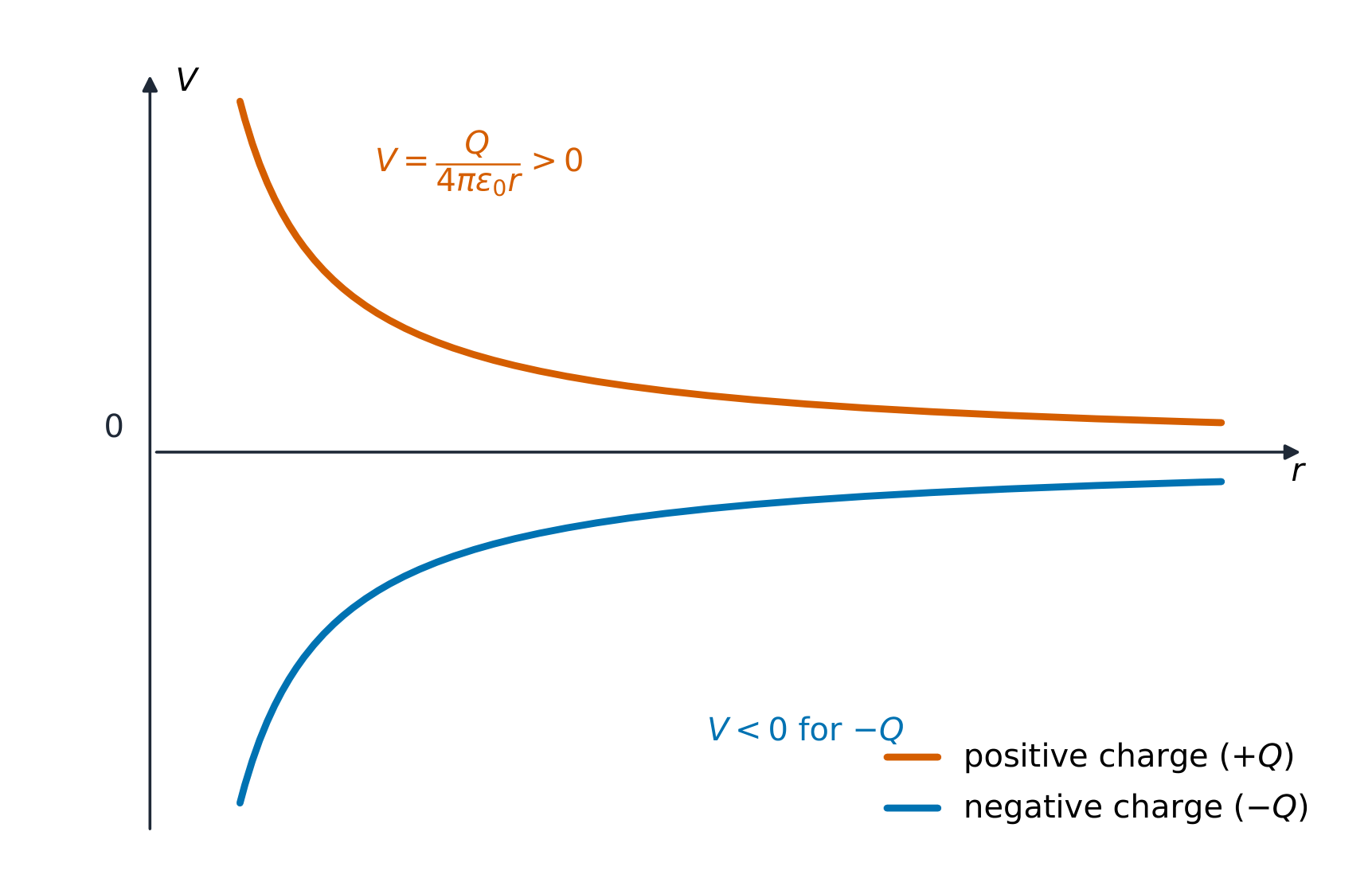
    $$V=\frac{U_E}{q},\qquad V=\frac{1}{4\pi\varepsilon_0}\frac{q}{r}\ \text{(point charge)}.$$

    Potential is a scalar 标量: it has a sign but no direction. This makes $V$ far easier to work with than the field $\vec{E}$. For several point charges 点电荷, use scalar superposition 叠加 – add the potentials with their signs:

    $$V=\frac{1}{4\pi\varepsilon_0}\sum_i \frac{q_i}{r_i}.$$

    Worked example. The potential $0.10\ \text{m}$ from a $+3.0\ \text{nC}$ point charge is $V=\dfrac{kq}{r}=\dfrac{9.0\times10^{9}(3.0\times10^{-9})}{0.10}=270\ \text{V}$. Now add a $-3.0\ \text{nC}$ charge $0.30\ \text{m}$ from the same point: it contributes $\dfrac{9.0\times10^{9}(-3.0\times10^{-9})}{0.30}=-90\ \text{V}$, so the total is $270-90=180\ \text{V}$. Just a signed sum – no vector components to resolve.

    Continuous charge distributions

    For a continuous charge distribution 连续电荷分布, cut it into small pieces $dq$, treat each piece as a point charge, and integrate 积分:

    $$V=\frac{1}{4\pi\varepsilon_0}\int\frac{dq}{r}.$$

    This is a scalar integral, so it is usually much easier than the field integral. AP expects you to handle four shapes with calculus: a thin ring (at a point on its axis), an arc (at its centre), a finite line or wire (collinear, or on its perpendicular bisector), and an infinitely long wire or cylinder (at a distance from its axis).

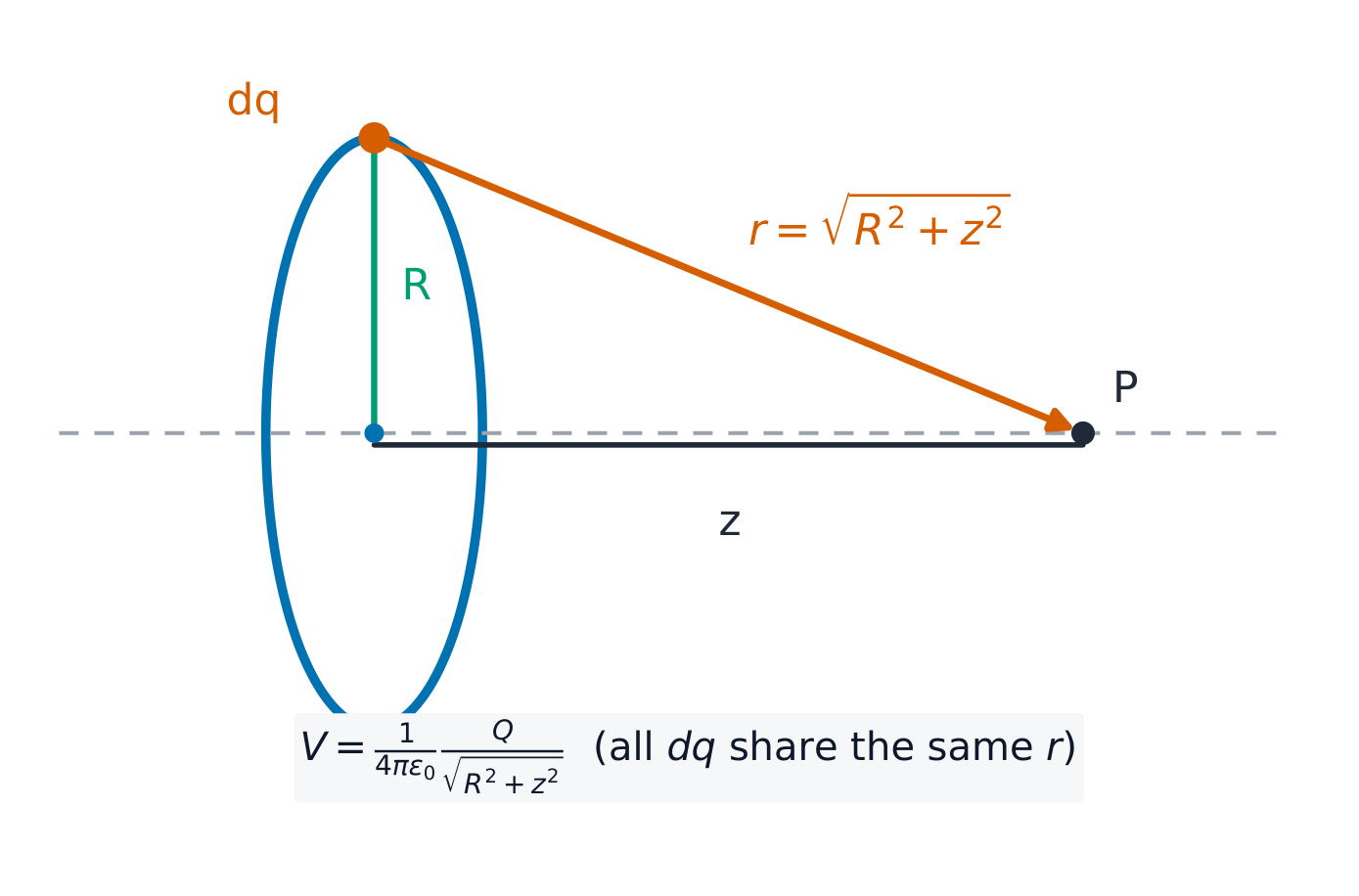
    Worked example (ring of charge). A thin ring of radius $R$ carries total charge $Q$. For a point $P$ on the axis a distance $z$ from the centre, every element $dq$ sits at the same distance $r=\sqrt{R^2+z^2}$ from $P$. The distance is constant, so it comes out of the integral:

    $$V=\frac{1}{4\pi\varepsilon_0}\int\frac{dq}{\sqrt{R^2+z^2}}=\frac{1}{4\pi\varepsilon_0}\frac{Q}{\sqrt{R^2+z^2}}.$$

    On an FRQ, say that $r$ is the same for every element – that statement is the marked step. The same idea gives $V=kQ/R$ at the centre of any arc, whatever its angle.

    From potential to field

    Potential and field contain the same information, linked by a derivative in each direction and by a path integral:

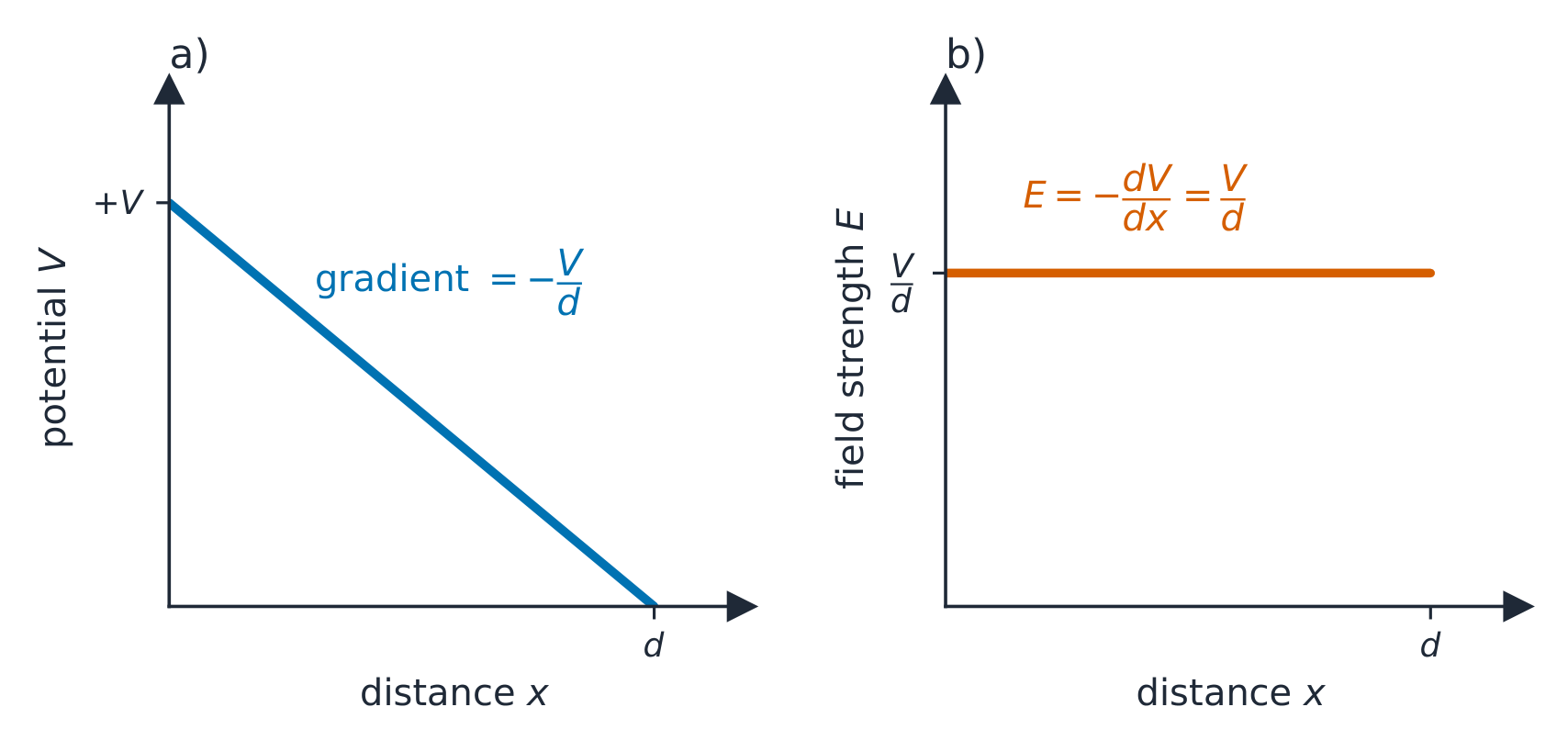
    $$E_x=-\frac{dV}{dx},\qquad \Delta V=V_b-V_a=-\int_a^b \vec{E}\cdot d\vec{r}.$$

    The field is the negative gradient 梯度 of the potential: $\vec{E}$ points from high potential to low potential, "downhill". Where $V$ changes quickly, the field is strong.

    Worked example. Along the $x$-axis, $V(x)=3x^{2}-2x$ (volts, with $x$ in metres). Then $E_x=-\dfrac{dV}{dx}=2-6x\ \text{V/m}$. At $x=0.50\ \text{m}$, $E_x=-1.0\ \text{V/m}$: the field there points in the $-x$ direction.

    The potential difference 电势差 between two points is the change in potential energy per unit charge moved between them: $\Delta V=\Delta U_E/q$. A battery makes a potential difference chemically: reactions inside separate positive from negative charge and hold the terminals a fixed $\Delta V$ apart.

    Equipotential maps

    An equipotential 等势面 line (also called an isoline 等值线) joins points that share the same potential. Four rules let you read any map:

    • Isolines are perpendicular 垂直 to field lines 电场线 everywhere they cross.
    • $\vec{E}$ points from high $V$ to low $V$ – never along an isoline. Moving a charge along an isoline takes no work.
    • Closely spaced isolines mean a strong field: $E\approx-\Delta V/\Delta x$.
    • You can sketch the field map from an isoline map, and the isoline map from a field map.

    Exam skill. Given a map with isolines every $10\ \text{V}$ spaced about $2\ \text{cm}$ apart, estimate $E\approx\dfrac{10}{0.02}=500\ \text{V/m}$, pointing from the higher-value line to the lower one. The work an external agent does moving a charge $q$ slowly from $A$ to $B$ is $W=q(V_B-V_A)$ – the path taken does not matter.

    Русский

    Электрический потенциал — это потенциальная энергия на единицу заряда в данной точке пространства. Он измеряется в вольтах ($1\ \text{V}=1\ \text{J/C}$):

    $$V=\frac{U_E}{q},\qquad V=\frac{1}{4\pi\varepsilon_0}\frac{q}{r}\ \text{(point charge)}.$$

    Потенциал является скаляром: он имеет знак, но не имеет направления. Это делает $V$ гораздо удобнее для работы, чем поле $\vec{E}$. Для нескольких точечных зарядов используйте скалярную суперпозицию — складывайте потенциалы с учетом их знаков:

    $$V=\frac{1}{4\pi\varepsilon_0}\sum_i \frac{q_i}{r_i}.$$

    Разобранный пример. Потенциал $0.10\ \text{m}$ от точечного заряда $+3.0\ \text{nC}$ равен $V=\dfrac{kq}{r}=\dfrac{9.0\times10^{9}(3.0\times10^{-9})}{0.10}=270\ \text{V}$. Теперь добавим заряд $-3.0\ \text{nC}$ на расстоянии $0.30\ \text{m}$ от той же точки: он вносит вклад $\dfrac{9.0\times10^{9}(-3.0\times10^{-9})}{0.30}=-90\ \text{V}$, поэтому полная сумма равна $270-90=180\ \text{V}$. Это просто алгебраическая сумма – разлагать векторные составляющие не нужно.

    Непрерывные распределения заряда

    Для непрерывного распределения заряда разрежьте его на малые элементы $dq$, каждый элемент Considered as a point charge, and integrate:

    $$V=\frac{1}{4\pi\varepsilon_0}\int\frac{dq}{r}.$$

    Это скалярный интеграл, поэтому обычно он намного проще, чем интеграл для поля. В программе AP ожидается умение работать с четырьмя геометрическими фигурами с помощью исчисления: тонким кольцом (в точке на оси), дугой (в её центре), конечным стержнем или проводом (коллинеарно или на перпендикулярном биссекторе) и бесконечно длинным проводом или цилиндром (на расстоянии от оси).

    Кольцо заряда: каждый элемент dq находится на одинаковом расстоянии от точки на оси
    Изображение кольца с зарядом: каждый элемент dq находится на одинаковом расстоянии от точки на оси

    Разобранное решение (кольцо с зарядом). Тонкое кольцо радиуса $R$ несет полный заряд $Q$. Для точки $P$ на оси, находящейся на расстоянии $z$ от центра, каждый элемент $dq$ находится на одинаковом расстоянии $r=\sqrt{R^2+z^2}$ от точки $P$. Расстояние постоянно, поэтому оно выносится за знак интеграла:

    $$V=\frac{1}{4\pi\varepsilon_0}\int\frac{dq}{\sqrt{R^2+z^2}}=\frac{1}{4\pi\varepsilon_0}\frac{Q}{\sqrt{R^2+z^2}}.$$

    На FRQ скажите, что $r$ одинаков для каждого элемента — это утверждение является ключевым этапом оценки. Та же идея дает результат $V=kQ/R$ в центре любой дуги, независимо от угла.

    От потенциала к полю

    Потенциал и поле содержат одну и ту же информацию, связанную производной в каждом направлении и контурным интегралом:

    $$E_x=-\frac{dV}{dx},\qquad \Delta V=V_b-V_a=-\int_a^b \vec{E}\cdot d\vec{r}.$$

    Поле является отрицательным градиентом потенциала: $\vec{E}$ указывает от высокого потенциала к низкому, «по склону». Там, где $V$ меняется быстро, поле сильное.

    Разобранное решение. Вдоль оси $x$, $V(x)=3x^{2}-2x$ (вольты, при $x$ в метрах). Тогда $E_x=-\dfrac{dV}{dx}=2-6x\ \text{V/m}$. При $x=0.50\ \text{m}$, $E_x=-1.0\ \text{V/m}$: поле там направлено в $-x$ направлении.

    В однородном поле потенциал убывает равномерно с расстоянием
    Изображение в однородном поле потенциал убывает равномерно с расстоянием

    Разность потенциалов между двумя точками — это изменение потенциальной энергии на единицу заряда, перемещаемого между ними: $\Delta V=\Delta U_E/q$. Аккумулятор создает разность потенциалов химическим путем: реакции внутри разделяют положительные и отрицательные заряды и удерживают клеммы на фиксированном расстоянии $\Delta V$ друг от друга.

    Потенциал вблизи точечного заряда изменяется как 1/r
    Потенциал вблизи точечного заряда изменяется как 1/r

    Карты эквипотенциалов

    Эквипотенциальная линия (также называемая изолинией) соединяет точки с одинаковым потенциалом. Четыре правила помогут вам прочитать любую карту:

    • Изолинии перпендикулярны силовым линиям везде, где они их пересекают.
    • $\vec{E}$ указывает от высокого $V$ к низкому $V$ – никогда вдоль изолинии. Перемещение заряда вдоль изолинии не требует работы.
    • Плотное расположение изолиний означает сильное поле: $E\approx-\Delta V/\Delta x$.
    • Вы можете нарисовать карту поля по карте изолиний и карту изолиний по карте поля.
    Эквипотенциальные линии вокруг диполя пересекают силовые линии под прямым углом
    Эквипотенциальные линии вокруг диполя пересекают силовые линии под прямым углом

    Навык для экзамена. Дана карта с изолиниями через каждые $10\ \text{V}$, расположенными примерно на расстоянии $2\ \text{cm}$ друг от друга. Оцените $E\approx\dfrac{10}{0.02}=500\ \text{V/m}$, направленный от линии с большим значением к линии с меньшим. Работа внешнего агента при перемещении заряда $q$ медленно от $A$ до $B$ равна $W=q(V_B-V_A)$ – путь не имеет значения.

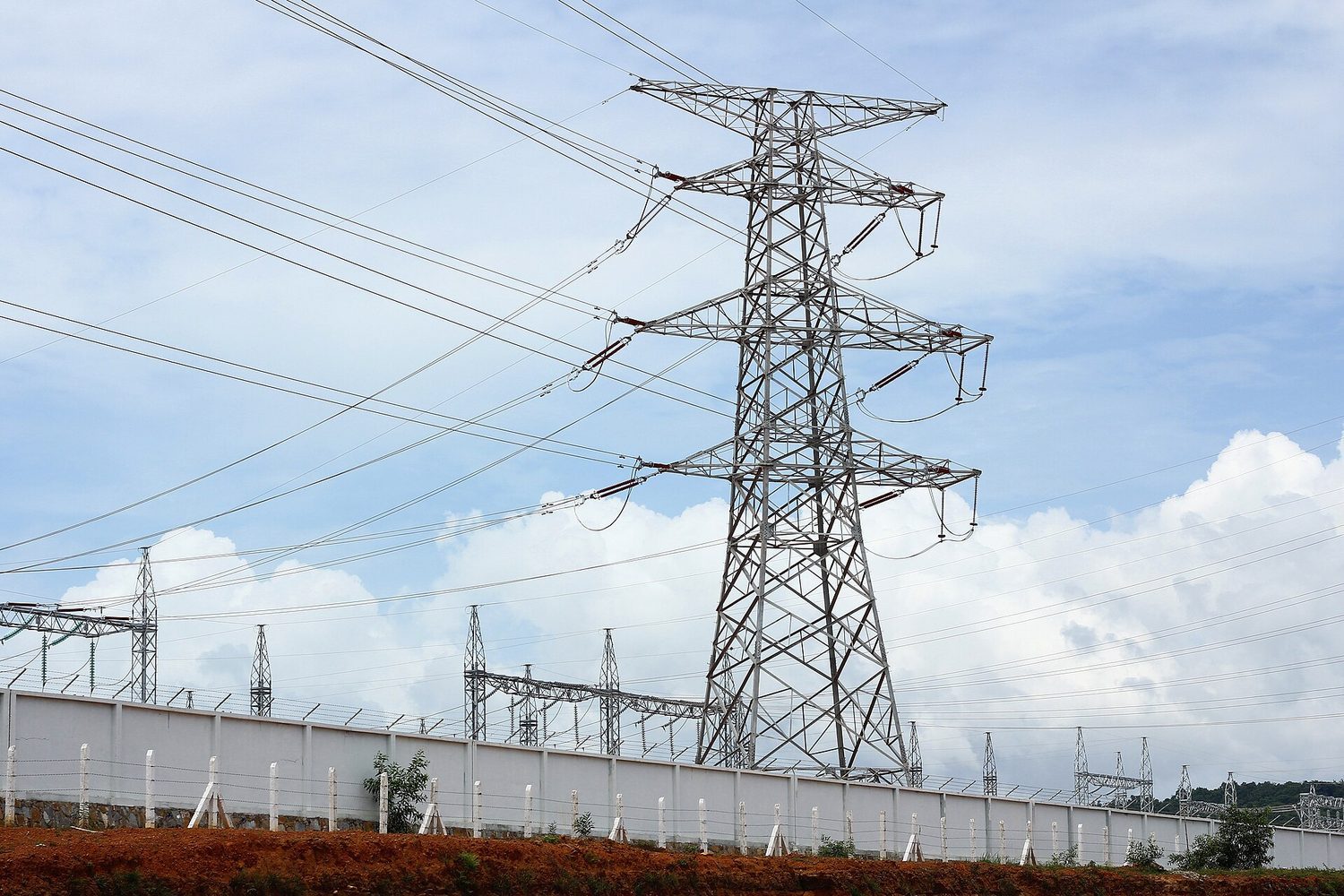
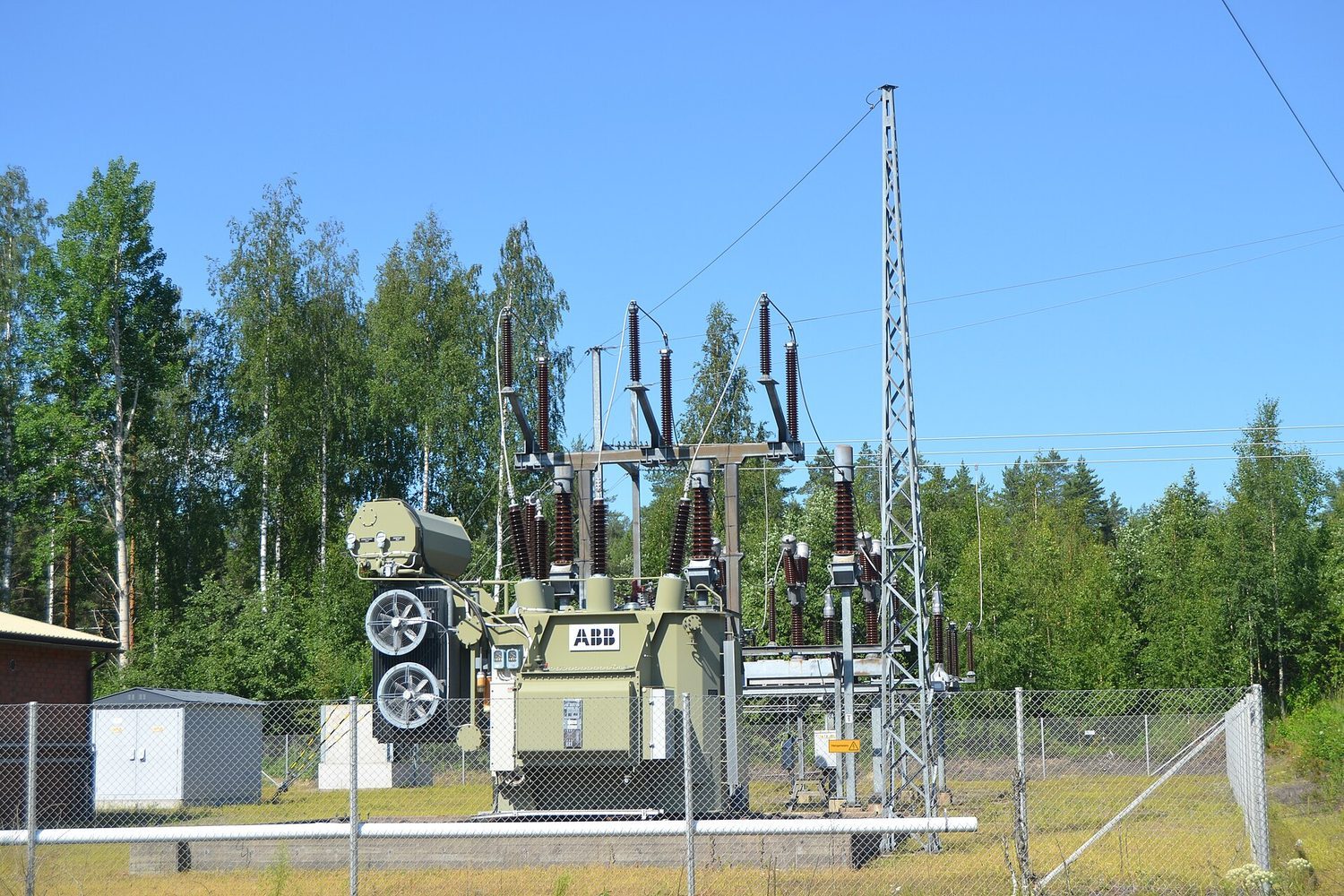
    Высоковольтные линии электропередачи: энергия электрического потенциала преобразуется и передается в виде тока под высоким напряжением
    Высоковольтные линии электропередачи: энергия электрического потенциала преобразуется и передается в виде тока под высоким напряжением
    Explore · ⁨Исследовать⁩

    Field lines and the potential around a charge · ⁨Силовые линии и потенциал вокруг заряда⁩

    Electric potential is the energy per unit charge. It falls off with distance from a positive charge; the field lines point from high potential to low. · ⁨Электрический потенциал — это энергия на единицу заряда. Он убывает с удалением от положительного заряда; силовые линии направлены от высокого потенциала к низкому.⁩

    Vocabulary · ⁨Словарь⁩ Train · ⁨Тренировать⁩
    English Русский
    work/wɜːk/ работа
    electric potential energy/ɪˈlektrɪk pəˈtenʃl ˈenədʒi/ электрический потенциальная энергия
    kinetic energy/kɪˈnetɪk ˈenədʒi/ кинетическую энергию
    conservative force/kənˈsɜːvətɪv fɔːs/ консервативная сила
    system/ˈsɪstəm/ система
    Electric potential/ɪˈlektrɪk pəˈtenʃl/ Электрический потенциал
    scalar/ˈskeɪlə/ скаляр
    point charges/pɔɪnt ˈtʃɑːdʒɪz/ точечные заряды
    superposition/ˌsuːpəpəˈzɪʃn/ суперпозиция
    continuous charge distribution/kənˈtɪnjuːəs tʃɑːdʒ ˌdɪstrɪˈbjuːʃn/ непрерывное распределение заряда
    integrate/ˈɪntɪɡreɪt/ интегрируете
    gradient/ˈɡreɪdɪənt/ наклона (градиента)
    potential difference/pəˈtenʃl ˈdɪfrəns/ разность потенциалов
    equipotential/ˌiːkwɪpəˈtenʃl/ эквипотенциальный
    isoline/ˈaɪsəliːn/ изолиния
    perpendicular/ˌpɜːpənˈdɪkjʊlə/ перпендикулярны
    field lines/fiːld laɪnz/ силовые линии
    9.3

    Conservation of Electric Energy · ⁨Сохранение электрической энергии⁩

    Syllabus · ⁨Программа⁩
    English

    Learning Objective 9.3.A: Describe changes in a system due to a difference in electric potential between two locations.

    • 9.3.A.1 When a charged object moves between two locations with different electric potentials, the resulting change in the electric potential energy of the object-field system is given by the following equation.
      • Equation: $\Delta U_E = q\Delta V$
    • 9.3.A.2 The movement of a charged object between two points with different electric potentials results in a change in kinetic energy of the object consistent with the conservation of energy.
    Русский

    Цель обучения 9.3.A: Описать изменения в системе, вызванные разностью электрических потенциалов между двумя участками.

    • 9.3.A.1 При перемещении заряженного объекта между двумя участками с различными электрическими потенциалами resulting изменение электрической потенциальной энергии системы «объект-поле» задается следующим уравнением.
      • Уравнение: $\Delta U_E = q\Delta V$
    • 9.3.A.2 Перемещение заряженного объекта между двумя точками с разными электрическими потенциалами приводит к изменению кинетической энергии объекта, согласующемуся с законом сохранения энергии.

    Source: College Board AP Course and Exam Description · ⁨Источник: Описание курса и экзамена College Board AP⁩

    English

    When a charge $q$ moves between two points that differ in potential by $\Delta V$, the potential energy of the charge–field system changes by

    $$\Delta U_E=q\,\Delta V.$$

    If only the electric force acts, total energy is conserved, so the kinetic energy changes by the opposite amount:

    $$\Delta K=-\Delta U_E=-q\,\Delta V.$$

    Watch the two signs together: a positive charge speeds up when it moves to lower potential, while a negative charge speeds up when it moves to higher potential. Both are just the system trading potential energy for kinetic energy. This is how particle accelerators give charged particles their energy, and it underlies energy analysis in circuits.

    Worked example. A proton ($q=1.6\times10^{-19}\ \text{C}$, $m=1.67\times10^{-27}\ \text{kg}$) starts at rest and is accelerated through a potential drop of $500\ \text{V}$ (it moves to lower potential, so $\Delta V=-500\ \text{V}$ and $\Delta K=-q\,\Delta V=+8.0\times10^{-17}\ \text{J}$). Setting $\Delta K=\tfrac12 mv^2$:

    $$v=\sqrt{\frac{2(8.0\times10^{-17})}{1.67\times10^{-27}}}=3.1\times10^{5}\ \text{m/s}.$$

    Exam skill. Choose energy methods, not kinematics, whenever the field is non-uniform or the path curves: only the end-point potentials matter. A typical FRQ chain is $q\,\Delta V \to \Delta K \to v$, with one line of justification: "the electric force is conservative, so energy is conserved."

    Русский

    Когда заряд $q$ перемещается между двумя точками, разность потенциалов которых составляет $\Delta V$, потенциальная энергия системы «заряд–поле» изменяется на

    $$\Delta U_E=q\,\Delta V.$$

    Если действует только электрическая сила, полная энергия сохраняется, поэтому кинетическая энергия изменяется на противоположное количество:

    $$\Delta K=-\Delta U_E=-q\,\Delta V.$$

    Следите за обоими знаками одновременно: положительный заряд ускоряется при движении к более низкому потенциалу, а отрицательный — при движении к более высокому потенциалу. В обоих случаях система просто обменивает потенциальную энергию на кинетическую. Именно так ускорители частиц сообщают заряженным частицам энергию, и именно это лежит в основе энергетического анализа в цепях.

    Разобранный пример. Протон ($q=1.6\times10^{-19}\ \text{C}$, $m=1.67\times10^{-27}\ \text{kg}$) начинает движение из состояния покоя и ускоряется через падение потенциала на $500\ \text{V}$ (он движется к более низкому потенциалу, значит $\Delta V=-500\ \text{V}$ и $\Delta K=-q\,\Delta V=+8.0\times10^{-17}\ \text{J}$). Принимая $\Delta K=\tfrac12 mv^2$:

    $$v=\sqrt{\frac{2(8.0\times10^{-17})}{1.67\times10^{-27}}}=3.1\times10^{5}\ \text{m/s}.$$

    Навык для экзамена. Выбирайте методы сохранения энергии, а не кинематику, когда поле неоднородно или траектория изогнута: важны только потенциалы начальной и конечной точек. Типичная цепочка заданий FRQ выглядит как $q\,\Delta V \to \Delta K \to v$, с одной строкой обоснования: «электрическая сила является консервативной, поэтому энергия сохраняется.»

    9.3

    Exam tips · ⁨Советы для экзамена⁩

    English
    • Relate field and potential by $V=-\int \vec E\cdot d\vec l$ and $\vec E=-\nabla V$ (in 1-D, $E_x=-\tfrac{dV}{dx}$).
    • Potential is a scalar — add contributions with signs, no vector components needed.
    • Potential energy of a pair is $U=\tfrac{1}{4\pi\varepsilon_0}\tfrac{q_1 q_2}{r}$; use energy conservation for a charge's speed.
    • Know that no work is done moving along an equipotential, which is perpendicular to $\vec E$.
    • Choose the zero of potential (usually infinity) and state it.
    Русский
    • Связать поле и потенциал можно через $V=-\int \vec E\cdot d\vec l$ и $\vec E=-\nabla V$ (в 1-D: $E_x=-\tfrac{dV}{dx}$).
    • Потенциал является скалярной величиной — складывайте вклады со знаками, векторные компоненты не нужны.
    • Потенциальная энергия пары равна $U=\tfrac{1}{4\pi\varepsilon_0}\tfrac{q_1 q_2}{r}$; используйте закон сохранения энергии для скорости заряда.
    • Знать, что работа не совершается при перемещении вдоль эквипотенциали, которая перпендикулярна $\vec E$.
    • Выберите ноль потенциала (обычно бесконечность) и укажите его.
  • 10

    Conductors and Capacitors · ⁨Проводники и конденсаторы⁩

    Watch lesson · ⁨Смотреть урок⁩
    10.1

    Electrostatics with Conductors

    Syllabus · ⁨Программа⁩
    English

    Learning Objective 10.1.A: Describe the charge distribution within a conductor.

    • 10.1.A.1 An ideal conductor is a material in which electrons are able to move freely.
    • 10.1.A.2 When a conductor is in electrostatic equilibrium, mutual repulsion of excess charge carriers results in those charge carriers residing entirely on the surface of the conductor.
      • 10.1.A.2.i In a conductor with a negative net charge, excess electrons reside on the surface of the conductor.
      • 10.1.A.2.ii In a conductor with a positive net charge, the surface becomes deficient in electrons, and can be modeled as if positive charge carriers reside on the surface of the conductor.
    • 10.1.A.3 Excess charges will move to the surface of a conductor to create a state of electrostatic equilibrium within the conductor.
      • 10.1.A.3.i The time interval over which charges reach electrostatic equilibrium within a conductor is so short as to be negligible.
      • 10.1.A.3.ii When a conductor reaches electrostatic equilibrium, all points on the surface of the conductor have the same electric potential, and the conductor becomes an equipotential surface.
      • 10.1.A.3.iii The charge density on the surface of a conductor will be greater where there are points or edges compared to planar areas.
    • 10.1.A.4 All excess charges reside on the surface of a conductor, which means there is no net charge in the interior of the conductor, and the electric field is zero within the conductor.
    • 10.1.A.5 The electric field is perpendicular to the outer surface of a conductor.
    • 10.1.A.6 A conductor can be polarized in the presence of an external electric field. This is a consequence of the conductor remaining an equipotential surface.
    • 10.1.A.7 Electrostatic shielding is the process of surrounding an area with a closed, conducting shell to create a region inside the conductor that is free from external electric fields.
    Русский

    Цель обучения 10.1.A: Описывать распределение заряда внутри проводника.

    • 10.1.A.1 Идеальный проводник — это материал, в котором электроны способны свободно перемещаться.
    • 10.1.A.2 Когда проводник находится в электростатическом равновесии, взаимное отталкивание избыточных носителей заряда приводит к тому, что эти носители полностью располагаются на поверхности проводника.
      • 10.1.A.2.i В проводнике с отрицательным суммарным зарядом избыточные электроны находятся на поверхности проводника.
      • 10.1.A.2.ii В проводнике с положительным суммарным зарядом поверхность обедняется электронами, и это можно смоделировать так, будто положительные носители заряда находятся на поверхности проводника.
    • 10.1.A.3 Избыточные заряды перемещаются на поверхность проводника для создания состояния электростатического равновесия внутри проводника.
      • 10.1.A.3.i Временной интервал, в течение которого заряды достигают электростатического равновесия внутри проводника, настолько мал, что им можно пренебречь.
      • 10.1.A.3.ii Когда проводник достигает электростатического равновесия, все точки на его поверхности имеют одинаковый электрический потенциал, и сам проводник становится эквипотенциальной поверхностью.
      • 10.1.A.3.iii Плотность заряда на поверхности проводника будет больше в точках или на краях по сравнению с плоскими участками.
    • 10.1.A.4 Все избыточные заряды находятся на поверхности проводника, что означает отсутствие суммарного заряда во внутренней области проводника, а электрическое поле внутри проводника равно нулю.
    • 10.1.A.5 Электрическое поле перпендикулярно внешней поверхности проводника.
    • 10.1.A.6 Проводник может поляризоваться в присутствии внешнего электрического поля. Это является следствием того, что проводник остается эквипотенциальной поверхностью.
    • 10.1.A.7 Электростатическая защита — это процесс окружения области замкнутой проводящей оболочкой для создания внутри проводника региона, свободного от внешних электрических полей.

    Source: College Board AP Course and Exam Description · ⁨Источник: Описание курса и экзамена College Board AP⁩

    In an ideal conductor 导体, electrons move freely. Put extra charge on one and the charges repel each other until, almost instantly, they settle into electrostatic equilibrium 静电平衡. In that state the conductor has four properties you must be able to state and use:

    • The electric field inside the conductor is zero. If it were not, free electrons would still be moving.
    • All excess charge sits on the surface. (Negative net charge = extra electrons on the surface; positive = a shortage of electrons there.)
    • The field just outside is perpendicular 垂直 to the surface, with magnitude $E=\sigma/\varepsilon_0$. Any parallel component would push charge sideways along the surface.
    • The whole conductor is one equipotential surface 等势面: every point, inside and on the surface, is at the same potential.

    Charge density is largest where the surface curves sharply – at points and edges – so the outside field is strongest there. In an external field a conductor polarizes: charge shifts on its surface so that the interior stays field-free and the body stays an equipotential. Surrounding a region with a closed conducting shell keeps outside fields out entirely – electrostatic shielding 静电屏蔽, the idea behind the Faraday cage 法拉第笼.

    Vocabulary · ⁨Словарь⁩ Train · ⁨Тренировать⁩
    English Русский
    conductor/kənˈdʌktə/ проводник
    electrostatic equilibrium/ɪˌlektrəʊˈstætɪk ˌiːkwɪˈlɪbrɪəm/ электростатическое равновесие
    perpendicular/ˌpɜːpənˈdɪkjʊlə/ перпендикулярны
    equipotential surface/ˌiːkwɪpəˈtenʃl ˈsɜːfɪs/ эквипотенциальная поверхность
    electrostatic shielding/ɪˌlektrəʊˈstætɪk ˈʃiːldɪŋ/ электростатическая экранировка
    Faraday cage/ˈfærədeɪ keɪdʒ/ клетка Фарадея
    10.2

    Redistribution of Charge Between Conductors

    Syllabus · ⁨Программа⁩
    English

    Learning Objective 10.2.A: Describe the movement of charge and the resulting interactions when conductors physically contact each other.

    • 10.2.A.1 When conductors are in electrical contact, charges will be redistributed such that the surfaces of each conductor are at the same electric potential.
    • 10.2.A.2 Ground is an idealized reference point that has zero electric potential and can absorb or provide an infinite amount of charge without changing its electric potential.
    • 10.2.A.3 Charge can be induced on a conductor by grounding the conductor in the presence of an external electric field.
    Русский

    Цель обучения 10.2.A: Описать движение заряда и возникающие взаимодействия при физическом контакте проводников друг с другом.

    • 10.2.A.1 Когда проводники находятся в электрическом контакте, заряды перераспределяются таким образом, что поверхности каждого проводника оказываются на одном электрическом потенциале.
    • 10.2.A.2 Земля — это идеализированная опорная точка с нулевым электрическим потенциалом, которая может поглощать или предоставлять бесконечное количество заряда без изменения своего электрического потенциала.
    • 10.2.A.3 Заряд может быть индуцирован на проводнике путем заземления проводника в присутствии внешнего электрического поля.

    Source: College Board AP Course and Exam Description · ⁨Источник: Описание курса и экзамена College Board AP⁩

    When two conductors touch (or are wired together), charge flows between them until both surfaces reach the same potential – that is the stopping condition, not "equal charges". A larger sphere holds more charge at the same potential ($V=kQ/R$), so it takes the larger share.

    Worked example. A small sphere of radius $R$ carrying $+6.0\ \mu\text{C}$ touches a distant sphere of radius $2R$, then they separate. Equal potentials require $\dfrac{kq_1}{R}=\dfrac{kq_2}{2R}$, so $q_2=2q_1$. With $q_1+q_2=6.0\ \mu\text{C}$: $q_1=2.0\ \mu\text{C}$ and $q_2=4.0\ \mu\text{C}$.

    Ground 接地 is an idealized reference at zero potential that can absorb or supply any amount of charge. Grounding a conductor while an external charge is nearby leaves the conductor with a net induced charge 感应电荷: the external field pushes charge of one sign to ground, and cutting the ground wire before removing the external charge traps the rest.

    Vocabulary · ⁨Словарь⁩ Train · ⁨Тренировать⁩
    English Русский
    ground/ɡraʊnd/ основание
    induced charge/ɪnˈdjuːst tʃɑːdʒ/ индуцированный заряд
    10.3

    Capacitors

    Syllabus · ⁨Программа⁩
    English

    Learning Objective 10.3.A: Describe the physical properties of a parallel-plate capacitor.

    • 10.3.A.1 A parallel-plate capacitor consists of two separated parallel conducting surfaces that can hold equal amounts of charge with opposite signs.
    • 10.3.A.2 Capacitance relates the magnitude of the charge stored on each plate to the electric potential difference created by the separation of those charges.
      • Equation: $C = \dfrac{Q}{\Delta V}$
      • 10.3.A.2.i The capacitance of a capacitor depends only on the physical properties of the capacitor, such as the capacitor's shape and the material used to separate the plates.
      • 10.3.A.2.ii The capacitance of a parallel-plate capacitor is proportional to the area of one of its plates and inversely proportional to the distance between its plates. The constant of proportionality is the product of the dielectric constant, $\kappa$, of the material between the plates and the electric permittivity of free space, $\varepsilon_0$.
        • Equation: $C = \dfrac{\kappa \varepsilon_0 A}{d}$
    • 10.3.A.3 The electric field between two charged parallel plates with uniformly distributed electric charge, such as in a parallel-plate capacitor, is constant in both magnitude and direction, except near the edges of the plates.
      • 10.3.A.3.i The magnitude of the electric field between two charged parallel plates, where the plate separation is much smaller than the dimensions of the plates, can be determined by applying Gauss's law and the principle of superposition.
        • Equation: $E = \dfrac{Q}{\varepsilon_0 A}$
      • 10.3.A.3.ii The electric field is proportional to the surface charge density on either plate of the capacitor.
      • 10.3.A.3.iii A charged particle between two oppositely charged parallel plates undergoes constant acceleration, and therefore its motion shares characteristics with the projectile motion of an object with mass in the gravitational field near Earth's surface.
    • 10.3.A.4 The electric potential energy stored in a capacitor is equal to the work done by an external force to separate that amount of charge on the capacitor.
    • 10.3.A.5 The electric potential energy stored in a capacitor is described by the equation $U_C = \dfrac{1}{2} Q \Delta V$.

    Boundary statement: While other shapes are also able to separate charges, AP Physics C: Electricity & Magnetism only expects the quantitative analysis and description of parallel-plate capacitors, concentric spherical capacitors, and coaxial cylindrical capacitors.

    Русский

    Цель обучения 10.3.A: Описать физические свойства плоского конденсатора.

    • 10.3.A.1 Плоский конденсатор состоит из двух разделенных параллельных проводящих поверхностей, которые могут удерживать равные количества заряда противоположных знаков.
    • 10.3.A.2 Ёмкость связывает величину заряда, накопленного на каждой пластине, с разностью электрических потенциалов, создаваемой разделением этих зарядов.
      • Уравнение: $C = \dfrac{Q}{\Delta V}$
      • 10.3.A.2.i Ёмкость конденсатора зависит только от физических свойств самого конденсатора, таких как его форма и материал, используемый для разделения пластин.
      • 10.3.A.2.ii Ёмкость плоского конденсатора пропорциональна площади одной из его пластин и обратно пропорциональна расстоянию между пластинами. Коэффициент пропорциональности равен произведению диэлектрической проницаемости материала между пластинами, $\kappa$, и электрической постоянности вакуума, $\varepsilon_0$.
        • Уравнение: $C = \dfrac{\kappa \varepsilon_0 A}{d}$
    • 10.3.A.3 Электрическое поле между двумя заряженными параллельными пластинами с равномерно распределенным электрическим зарядом, например, в плоском конденсаторе, постоянно как по величине, так и по направлению, за исключением областей вблизи краев пластин.
      • 10.3.A.3.i Величину электрического поля между двумя заряженными параллельными пластинами, где расстояние между пластинами намного меньше размеров самих пластин, можно определить, применяя закон Гаусса и принцип суперпозиции.
        • Уравнение: $E = \dfrac{Q}{\varepsilon_0 A}$
      • 10.3.A.3.ii Электрическое поле пропорционально поверхностной плотности заряда на любой из пластин конденсатора.
      • 10.3.A.3.iii Заряженная частица, находящаяся между двумя oppositely заряженными параллельными пластинами, испытывает постоянное ускорение, поэтому ее движение имеет черты баллистического движения тела массой в гравитационном поле вблизи поверхности Земли.
    • 10.3.A.4 Энергия электрического потенциала, запасенная в конденсаторе, равна работе внешней силы по разделению данного количества заряда на обкладках конденсатора.
    • 10.3.A.5 Энергия электрического потенциала, запасенная в конденсаторе, описывается уравнением $U_C = \dfrac{1}{2} Q \Delta V$.

    Пограничное утверждение: Хотя другие формы также способны разделять заряды, курс AP Physics C: Electricity & Magnetism требует количественного анализа и описания только плоских конденсаторов, коаксиальных цилиндрических конденсаторов и концентрических сферических конденсаторов.

    Source: College Board AP Course and Exam Description · ⁨Источник: Описание курса и экзамена College Board AP⁩

    Charging a capacitor (RC)

    A capacitor 电容器 stores charge on two conductors separated by a gap: $+Q$ on one plate, $-Q$ on the other. Its capacitance 电容 relates the stored charge to the potential difference between the plates:

    $$C=\frac{Q}{\Delta V}.$$

    Capacitance depends only on geometry and the material in the gap – never on $Q$ or $\Delta V$ themselves.

    Worked derivation (parallel plates). For a parallel-plate capacitor 平行板电容器 with plate area $A$ and small gap $d$: Gauss's law plus superposition 叠加 gives a uniform 均匀 field between the plates, $E=\dfrac{\sigma}{\varepsilon_0}=\dfrac{Q}{\varepsilon_0 A}$ (each plate alone contributes $\sigma/2\varepsilon_0$; between the plates the two add, outside they cancel). A uniform field means $\Delta V=Ed=\dfrac{Qd}{\varepsilon_0 A}$, so

    $$C=\frac{Q}{\Delta V}=\frac{\varepsilon_0 A}{d}.$$

    This $E\to\Delta V\to C$ chain is a standard FRQ derivation – learn it as three steps, and quote each one. The same method handles the other two shapes AP expects: concentric spheres ($C=4\pi\varepsilon_0\dfrac{ab}{b-a}$) and a coaxial cylinder of length $L$, where $E=\dfrac{\lambda}{2\pi\varepsilon_0 r}$ gives $\Delta V=\dfrac{\lambda}{2\pi\varepsilon_0}\ln\dfrac{b}{a}$ and so $C=\dfrac{2\pi\varepsilon_0 L}{\ln(b/a)}$.

    Worked example. Plates of area $A=0.020\ \text{m}^2$ and gap $d=1.0\ \text{mm}$: $C=\dfrac{8.85\times10^{-12}(0.020)}{1.0\times10^{-3}}=1.8\times10^{-10}\ \text{F}$. Charged to $100\ \text{V}$ it holds $Q=CV=1.8\times10^{-8}\ \text{C}$.

    Because the field between the plates is uniform, a charged particle there feels a constant force, so it moves with constant acceleration – exactly like projectile motion 抛体运动 in gravity: constant speed across, uniform acceleration towards a plate.

    A charged particle between the plates follows a parabola, like a projectile
    A charged particle between the plates follows a parabola, like a projectile

    Worked example. An electron enters midway between plates at $v_0=2.0\times10^{7}\ \text{m/s}$, parallel to them. The field is $E=1.0\times10^{3}\ \text{N/C}$ and the plates are $4.0\ \text{cm}$ long. Acceleration: $a=\dfrac{eE}{m}=\dfrac{(1.6\times10^{-19})(1.0\times10^{3})}{9.11\times10^{-31}}=1.8\times10^{14}\ \text{m/s}^2$. Time between the plates: $t=\dfrac{0.040}{2.0\times10^{7}}=2.0\times10^{-9}\ \text{s}$. Deflection: $y=\tfrac12at^{2}=\tfrac12(1.8\times10^{14})(2.0\times10^{-9})^{2}\approx3.5\times10^{-4}\ \text{m}$ – about $0.35\ \text{mm}$ towards the positive plate.

    Storing charge takes work 功: an external force must move each bit of charge against the field of the charge already there. The total work ends up as stored potential energy,

    $$U_C=\tfrac12\,Q\,\Delta V=\tfrac12 C(\Delta V)^2=\frac{Q^2}{2C}.$$
    The energy stored in a capacitor is the area under its charge-voltage line
    The energy stored in a capacitor is the area under its charge-voltage line

    The factor $\tfrac12$ is the area of the triangle under the $Q$–$\Delta V$ line: the first charge moved across costs almost nothing, the last costs the full $\Delta V$.

    Capacitors combine oppositely to resistors: in parallel 并联 the capacitances add ($C_{\text{eq}}=C_1+C_2$, same $\Delta V$, charges add), while in series 串联 the reciprocals add ($\tfrac{1}{C_{\text{eq}}}=\tfrac{1}{C_1}+\tfrac{1}{C_2}$, same $Q$, voltages add).

    Capacitors in series carry the same charge, and their p.d.s add
    Capacitors in series carry the same charge, and their p.d.s add

    Worked example. A $2\ \mu\text{F}$ and a $4\ \mu\text{F}$ capacitor in series: $\tfrac{1}{C}=\tfrac12+\tfrac14$, so $C=\tfrac43\ \mu\text{F}$. The same pair in parallel: $6\ \mu\text{F}$.

    Assorted capacitors: devices that store charge and energy in an electric field between conductors
    Assorted capacitors: devices that store charge and energy in an electric field between conductors
    Electrolytic capacitors on a circuit board: capacitance stores energy as U = ½CV²
    Electrolytic capacitors on a circuit board: capacitance stores energy as U = ½CV²
    Explore · ⁨Исследовать⁩

    Charge and discharge a capacitor · ⁨Зарядите и разрядите конденсатор⁩

    A capacitor stores charge on two plates, filling and emptying exponentially with time constant $\tau=RC$. Bigger $R$ or $C$ slows it down. · ⁨Конденсатор накапливает заряд на двух пластинах, заряжаясь и разряжаясь экспоненциально со временной константой $\tau=RC$. Чем больше $R$ или $C$, тем медленнее происходит процесс.⁩

    Vocabulary · ⁨Словарь⁩ Train · ⁨Тренировать⁩
    English Русский
    capacitor/kəˈpæsɪtə/ конденсатора
    capacitance/kəˈpæsɪtəns/ ёмкость (конденсатора)
    parallel-plate capacitor/ˈpærəlel pleɪt kəˈpæsɪtə/ пластинчатый конденсатор
    superposition/ˌsuːpəpəˈzɪʃn/ суперпозиция
    uniform/ˈjuːnɪfɔːm/ однородное
    projectile motion/prəˈdʒektaɪl ˈməʊʃn/ бросок под углом к горизонту
    work/wɜːk/ работа
    parallel/ˈpærəlel/ параллельно
    series/ˈsɪəriːz/ последовательно
    10.4

    Dielectrics

    Syllabus · ⁨Программа⁩
    English

    Learning Objective 10.4.A: Describe how a dielectric inserted between the plates of a capacitor changes the properties of the capacitor.

    • 10.4.A.1 In a dielectric material, electric charges are not as free to move as they are in a conductor. Instead, the material becomes polarized in the presence of an external electric field.
    • 10.4.A.2 The dielectric constant of a material relates the electric permittivity of that material to the permittivity of free space.
      • Equation: $\kappa = \dfrac{\varepsilon}{\varepsilon_0}$
    • 10.4.A.3 The electric field created by a polarized dielectric is opposite in direction to the external field.
    • 10.4.A.4 The electric field between the plates of an isolated parallel-plate capacitor decreases when a dielectric is placed between the plates.
      • Equation: $\kappa = \dfrac{E_0}{E}$
    • 10.4.A.5 The insertion of a dielectric into a capacitor may change the capacitance of the capacitor.
      • Equation: $C = \kappa C_0$
    Русский

    Цель обучения 10.4.A: Описать, как диэлектрик, введенный между пластинами конденсатора, изменяет свойства конденсатора.

    • 10.4.A.1 В диэлектрическом материале электрические заряды не являются такими свободными для движения, как в проводнике. Вместо этого материал поляризуется в присутствии внешнего электрического поля.
    • 10.4.A.2 Диэлектрическая проницаемость материала связывает электрическую проницаемость этого материала с электрической проницаемостью вакуума.
      • Уравнение: $\kappa = \dfrac{\varepsilon}{\varepsilon_0}$
    • 10.4.A.3 Электрическое поле, создаваемое поляризованным диэлектриком, направлено противоположно внешнему полю.
    • 10.4.A.4 Электрическое поле между пластинами изолированного плоского конденсатора уменьшается при помещении диэлектрика между пластинами.
      • Уравнение: $\kappa = \dfrac{E_0}{E}$
    • 10.4.A.5 Вставка диэлектрика в конденсатор может изменить его ёмкость.
      • Уравнение: $C = \kappa C_0$

    Source: College Board AP Course and Exam Description · ⁨Источник: Описание курса и экзамена College Board AP⁩

    A dielectric 电介质 is an insulating material. Its charges cannot travel, but in an external field each molecule stretches or turns slightly – the material becomes polarized 极化. The lined-up molecules create their own small field opposite to the applied one, so the net field inside the material drops:

    $$E=\frac{E_0}{\kappa},\qquad \kappa=\frac{\varepsilon}{\varepsilon_0}\ \ (\kappa>1),$$

    where $\kappa$ is the dielectric constant 介电常数, the ratio of the material's permittivity to the permittivity of free space 真空介电常数.

    A polarized dielectric creates an internal field opposing the applied field
    A polarized dielectric creates an internal field opposing the applied field

    Filling a capacitor with dielectric multiplies its capacitance:

    $$C=\kappa\,C_0\qquad\left(\text{parallel plates: } C=\frac{\kappa\varepsilon_0 A}{d}\right).$$

    What happens next depends on what stays fixed – a favourite exam trap:

    battery stays connected ($\Delta V$ fixed) battery removed first ($Q$ fixed)
    charge $Q$ rises to $\kappa Q_0$ unchanged
    voltage $\Delta V$ unchanged drops to $\Delta V_0/\kappa$
    field $E$ unchanged drops to $E_0/\kappa$
    energy $U$ rises to $\kappa U_0$ drops to $U_0/\kappa$

    Worked example. A $100\ \text{pF}$ capacitor is charged to $12\ \text{V}$, disconnected, then filled with a $\kappa=3$ dielectric. $Q$ is trapped, so $\Delta V$ falls to $4\ \text{V}$ and the stored energy falls to one-third – the missing energy went into pulling the dielectric in. Reconnected to the $12\ \text{V}$ battery instead, the capacitor would hold three times the charge and three times the energy.

    Exam skill. Always begin dielectric questions by writing down which quantity is held fixed ($Q$ or $\Delta V$), then let $C=\kappa C_0$ drive everything else through $Q=C\Delta V$ and $U=\tfrac12 C(\Delta V)^2$.

    Explore · ⁨Исследовать⁩

    Add a dielectric · ⁨Добавьте диэлектрик⁩

    A dielectric between the plates raises the capacitance, so the capacitor holds more charge at the same voltage. Watch the charge build faster. · ⁨Диэлектрик между пластинами увеличивает ёмкость, поэтому конденсатор может удерживать больший заряд при том же напряжении. Наблюдайте, как заряд накапливается быстрее.⁩

    Vocabulary · ⁨Словарь⁩ Train · ⁨Тренировать⁩
    English Русский
    dielectric/ˌdaɪɪˈlektrɪk/ диэлектрик
    polarized/ˈpəʊləraɪzd/ поляризованный
    dielectric constant/ˌdaɪɪˈlektrɪk ˈkɒnstənt/ диэлектрическая проницаемость (диэлектрическая константа)
    permittivity of free space/ˌpɜːmɪˈtɪvəti ɒv friː speɪs/ диэлектрическая проницаемость вакуума
    10.4

    Exam tips

    • In electrostatic equilibrium a conductor has $\vec E=0$ inside and all excess charge on the surface.
    • Apply Gauss's law $\oint \vec E\cdot d\vec A=\tfrac{q_{enc}}{\varepsilon_0}$ with a symmetry-matched Gaussian surface (sphere, cylinder, pillbox).
    • The whole conductor is one equipotential, and the surface field is perpendicular to it.
    • For a capacitor use $C=\tfrac{Q}{V}$, energy $U=\tfrac12 CV^2$, and how a dielectric raises $C$.
    • Pick the Gaussian surface so $\vec E$ is constant and parallel (or zero) on each part.
  • 11

    Electric Circuits · ⁨Электрические цепи⁩

    Watch lesson · ⁨Смотреть урок⁩
    11.1

    Electric Current · ⁨Электрический ток⁩

    Syllabus · ⁨Программа⁩
    English

    Learning Objective 11.1.A: Describe the movement of electric charges through a medium.

    • 11.1.A.1 Current is the rate at which charge passes through a cross-sectional area of a wire.
      • Equation: $I = \dfrac{dq}{dt}$
      • 11.1.A.1.i Current within a conductor consists of charge carriers traveling through the conductor with an average drift velocity.
        • Equation: $I = nqv_d A$
      • 11.1.A.1.ii Electric charge moves in a circuit in response to an electric potential difference, sometimes referred to as electromotive force, or $\mathrm{emf}$ ($\mathcal{E}$).
      • 11.1.A.1.iii If the current is zero in a section of wire, the net motion of charge carriers in the wire is also zero, although individual charge carriers will not have zero speed.
    • 11.1.A.2 Current density is the flow of charge per unit area.
      • Equation: $I = \int \vec{J} \cdot d\vec{A}$
      • 11.1.A.2.i Current density is related to the motion of the charge carriers within a conductor.
        • Equation: $\vec{J} = nq\vec{v}_d$
      • 11.1.A.2.ii Current density is a vector quantity.
      • 11.1.A.2.iii A potential difference across a conductor creates an electric field within the conductor that is proportional to the resistivity of the conductor and the current density.
        • Equation: $\vec{E} = \rho\vec{J}$
    • 11.1.A.3 If a function of current density is given, the total current can be determined by integrating the current density over the area.
      • Equation: $I_{\text{tot}} = \int \vec{J}(r) \cdot d\vec{A}$
    • 11.1.A.4 Although current is a scalar quantity, it does have a direction. Because its direction is relative to the current carrier and not space, current does not obey the laws of vector addition and has no vector components.
      • 11.1.A.4.i The direction of conventional current is chosen to be the direction in which positive charge would move.
      • 11.1.A.4.ii In common circuits, the current is actually due to the movement of electrons (negative charge carriers).
    Русский

    Цель обучения 11.1.A: Описывать движение электрических зарядов через среду.

    • 11.1.A.1 Ток — это скорость прохождения заряда через поперечное сечение провода.
      • Уравнение: $I = \dfrac{dq}{dt}$
      • 11.1.A.1.i Ток внутри проводника состоит из носителей заряда, движущихся через проводник со средней скоростью дрейфа.
        • Уравнение: $I = nqv_d A$
      • 11.1.A.1.ii Электрический заряд движется в цепи под действием разности электрических потенциалов, которую иногда называют электродвижущей силой, или $\mathrm{emf}$ ($\mathcal{E}$).
      • 11.1.A.1.iii Если ток равен нулю на участке провода, то и суммарное движение носителей заряда в этом проводе также равно нулю, хотя отдельные носители заряда не будут иметь нулевую скорость.
    • 11.1.A.2 Плотность тока — это поток заряда на единицу площади.
      • Уравнение: $I = \int \vec{J} \cdot d\vec{A}$
      • 11.1.A.2.i Плотность тока связана с движением носителей заряда внутри проводника.
        • Уравнение: $\vec{J} = nq\vec{v}_d$
      • 11.1.A.2.ii Плотность тока является векторной величиной.
      • 11.1.A.2.iii Разность потенциалов на проводнике создает электрическое поле внутри него, которое пропорционально удельному сопротивлению проводника и плотности тока.
        • Уравнение: $\vec{E} = \rho\vec{J}$
    • 11.1.A.3 Если задана функция плотности тока, полный ток можно определить, интегрируя плотность тока по площади.
      • Уравнение: $I_{\text{tot}} = \int \vec{J}(r) \cdot d\vec{A}$
    • 11.1.A.4 Хотя ток является скалярной величиной, он имеет направление. Поскольку его направление относительно носителя тока, а не пространства, ток не подчиняется законам сложения векторов и не имеет векторных компонент.
      • 11.1.A.4.i Направление условного тока принимается равным направлению, в котором двигался бы положительный заряд.
      • 11.1.A.4.ii В обычных цепях ток на самом деле обусловлен движением электронов (отрицательных носителей заряда).

    Source: College Board AP Course and Exam Description · ⁨Источник: Описание курса и экзамена College Board AP⁩

    English

    Electric current 电流 is the rate at which charge passes a cross-section of wire, $I=\dfrac{dq}{dt}$, measured in amperes 安培. Conventional current points the way positive charge would move. Microscopically, a current is a slow drift of many carriers:

    $$I=nqv_dA,$$

    with $n$ the number of carriers per volume, $q$ the charge each carries, $v_d$ the drift velocity 漂移速度, and $A$ the cross-sectional area 横截面积.

    Worked example. A copper wire with $A=1.0\times10^{-6}\ \text{m}^2$ and $n=8.5\times10^{28}\ \text{m}^{-3}$ carries $1.7\ \text{A}$. Then $v_d=\dfrac{I}{nqA}=\dfrac{1.7}{(8.5\times10^{28})(1.6\times10^{-19})(1.0\times10^{-6})}\approx1.3\times10^{-4}\ \text{m/s}$ – the carriers drift slower than a snail, even though the signal travels near light speed.

    Current density 电流密度 is charge flow per unit area, $\vec{J}=nq\vec{v}_d$, linked to the field driving it by $\vec{E}=\rho\vec{J}$. In general $I=\int\vec{J}\cdot d\vec{A}$; if $J(r)$ varies across the wire, integrate it over the cross-section to get the total current. One care point: current has a direction along its wire, but it is a scalar 标量 – currents do not add as vectors, and there are no "components of current".

    Русский

    Электрический ток — это скорость прохождения заряда через поперечное сечение провода, $I=\dfrac{dq}{dt}$, измеряемая в амперах. Направление обычного тока совпадает с тем, куда двигались бы положительные заряды. Микроскопически ток представляет собой медленное дрейфование большого числа носителей:

    $$I=nqv_dA,$$

    где $n$ — число носителей в единице объема, $q$ — заряд каждого носителя, $v_d$ — скорость дрейфа, а $A$ — площадь поперечного сечения.

    Носители заряда медленно дрейфуют через проводник, создавая ток
    Носители заряда медленно дрейфуют через проводник, создавая ток

    Разобранный пример. Медный провод с площадью сечения $A=1.0\times10^{-6}\ \text{m}^2$ и концентрацией носителей $n=8.5\times10^{28}\ \text{m}^{-3}$ пропускает ток $1.7\ \text{A}$. Тогда скорость дрейфа составляет $v_d=\dfrac{I}{nqA}=\dfrac{1.7}{(8.5\times10^{28})(1.6\times10^{-19})(1.0\times10^{-6})}\approx1.3\times10^{-4}\ \text{m/s}$ — носители движутся медленнее улитки, хотя сам сигнал распространяется со скоростью, близкой к скорости света.

    Плотность тока — это поток заряда на единицу площади, $\vec{J}=nq\vec{v}_d$, связанный с создающим его полем соотношением $\vec{E}=\rho\vec{J}$. В общем случае $I=\int\vec{J}\cdot d\vec{A}$; если плотность тока $J(r)$ меняется поперечного сечения провода, проинтегрируйте её по сечению, чтобы получить полный ток. Важный нюанс: ток имеет направление вдоль провода, но является скаляром — токи не складываются как векторы, и не существует «компонент тока».

    Осциллограф: зависимость напряжения от времени показывает, как меняются ток и заряд в цепи
    Осциллограф: зависимость напряжения от времени показывает, как изменяются ток и заряд в цепи
    Vocabulary · ⁨Словарь⁩ Train · ⁨Тренировать⁩
    English Русский
    Electric current/ɪˈlektrɪk ˈkʌrənt/ Электрический ток
    amperes/ˈæmpeəz/ амперах
    drift velocity/drɪft vəˈlɒsɪti/ скорость дрейфа
    cross-sectional area/krɒs ˈsekʃənl ˈeərɪə/ площадь поперечного сечения
    Current density/ˈkʌrənt ˈdensɪti/ плотность тока
    scalar/ˈskeɪlə/ скаляр
    circuit diagram/ˈsɜːkɪt ˈdaɪəɡræm/ схема электрической цепи
    series/ˈsɪəriːz/ последовательно
    11.2

    Electric Circuits · ⁨Электрические цепи⁩

    Syllabus · ⁨Программа⁩
    English

    Learning Objective 11.2.A: Describe the behavior of a circuit.

    • 11.2.A.1 A circuit is composed of electrical loops, which can include wires, batteries, resistors, lightbulbs, capacitors, inductors, switches, ammeters, and voltmeters.
    • 11.2.A.2 A closed electrical loop is a closed path through which charges may flow.
      • 11.2.A.2.i A closed circuit is one in which charges would be able to flow.
      • 11.2.A.2.ii An open circuit is one in which charges would not be able to flow.
      • 11.2.A.2.iii A short circuit is one in which charges would be able to flow with no change in potential difference.
    • 11.2.A.3 A single circuit element may be part of multiple electrical loops.
    • 11.2.A.4 Circuit schematics are representations used to describe and analyze electric circuits.
      • 11.2.A.4.i The properties of an electric circuit are dependent on the physical arrangement of its constituent elements.
      • 11.2.A.4.ii Circuit elements have common symbols that are used to create schematic diagrams. Variable elements are indicated by a diagonal strikethrough arrow across the standard symbol for that element. (Symbols: Battery, Bulb, Switch, Capacitor, Resistor, Ammeter, Voltmeter, Inductor.)

    Boundary statement: Unless otherwise specified, all circuit schematic diagrams will be drawn using conventional current.

    Русский

    Цель обучения 11.2.A: Описывать поведение электрической цепи.

    • 11.2.A.1 Электрическая цепь состоит из контуров, которые могут включать провода, батареи, резисторы, лампочки, конденсаторы, катушки индуктивности, переключатели, амперметры и вольтметры.
    • 11.2.A.2 Замкнутая электрическая петля — это замкнутый путь, по которому могут протекать заряды.
      • 11.2.A.2.i Замкнутая цепь — это цепь, в которой заряды могли бы протекать.
      • 11.2.A.2.ii Разомкнутая цепь — это цепь, в которой заряды не могли бы протекать.
      • 11.2.A.2.iii Короткое замыкание — это цепь, в которой заряды могли бы протекать без изменения разности потенциалов.
    • 11.2.A.3 Один элемент цепи может быть частью нескольких электрических петель.
    • 11.2.A.4 Схемы электрических цепей — это представления, используемые для описания и анализа электрических цепей.
      • 11.2.A.4.i Свойства электрической цепи зависят от физического расположения её составных элементов.
      • 11.2.A.4.ii Элементы цепи имеют общепринятые символы, используемые для создания схем. Переменные элементы обозначаются диагональной чертой со стрелкой поверх стандартного символа данного элемента. (Символы: Батарея, Лампочка, Выключатель, Конденсатор, Резистор, Амперметр, Вольтметр, Катушка.)

    Предварительная оговорка: Если не указано иное, все схемы электрических цепей будут изображаться с использованием традиционного тока.

    Source: College Board AP Course and Exam Description · ⁨Источник: Описание курса и экзамена College Board AP⁩

    English

    A circuit is a set of closed loops built from wires, batteries, resistors, lightbulbs, capacitors, inductors, switches, and meters; charge can flow only around a closed path. One element can belong to several loops at once – that is what makes multi-loop problems interesting. Every analysis starts by reading the circuit diagram 电路图: trace each loop and identify which elements share the same current (series 串联) and which share the same potential difference (parallel 并联).

    Русский

    Цепь — это совокупность замкнутых контуров, образованных проводами, батареями, резисторами, лампочками, конденсаторами, катушками индуктивности, выключателями и измерительными приборами; заряд может течь только по замкнутому пути. Один элемент может одновременно принадлежать нескольким контурам — именно это делает задачи с несколькими контурами интересными. Любой анализ начинается с чтения схемы цепи: проследите каждый контур и определите, какие элементы соединены последовательно (имеют одинаковый ток) и какие — параллельно (имеют одинаковую разность потенциалов).

    Explore · ⁨Исследовать⁩

    Build series and parallel circuits · ⁨Соберите последовательные и параллельные цепи⁩

    In series the same current flows through every bulb and voltage divides; in parallel each branch gets the full voltage. Switch mode to see the bulbs' brightness change. · ⁨В последовательной цепи через каждую лампочку течет одинаковый ток, а напряжение делится; в параллельной каждой ветви подается полное напряжение. Переключите режим, чтобы увидеть изменение яркости лампочек.⁩

    11.3

    Resistance, Resistivity, and Ohm's Law · ⁨Сопротивление, Удельное сопротивление и Закон Ома⁩

    Syllabus · ⁨Программа⁩
    English

    Learning Objective 11.3.A: Describe the resistance of an object using physical properties of that object.

    • 11.3.A.1 Resistance is a measure of the degree to which an object opposes the movement of electric charge.
    • 11.3.A.2 The resistance of a resistor with uniform geometry is proportional to its resistivity and length and is inversely proportional to its cross-sectional area.
      • Equation: $R = \dfrac{\rho\ell}{A}$
      • 11.3.A.2.i Resistivity is a fundamental property of a material that depends on its atomic and molecular structure and quantifies how strongly the material opposes the motion of electric charge.
      • 11.3.A.2.ii The resistivity of a conductor typically increases with temperature.
      • 11.3.A.2.iii The total resistance of a resistor with uniform geometry, but that is made of a material whose resistivity varies along the length of the resistor, is given by $R = \int \dfrac{\rho(\ell)\,d\ell}{A}$.

    Learning Objective 11.3.B: Describe the electrical characteristics of elements of a circuit.

    • 11.3.B.1 Ohm's law relates current, resistance, and potential difference across a conductive element of a circuit.
      • Equation: $I = \dfrac{\Delta V}{R}$
      • 11.3.B.1.i Materials that obey Ohm's law have constant resistance for all currents and are called ohmic materials.
      • 11.3.B.1.ii The resistivity of an ohmic material is constant regardless of temperature.
      • 11.3.B.1.iii Resistors can also convert electrical energy to thermal energy, which may change the temperature of both the resistor and the resistor's environment.
      • 11.3.B.1.iv The resistance of an ohmic circuit element can be determined from the slope of a graph of the current in the element as a function of the potential difference across the element.
    Русский

    Цель обучения 11.3.A: Описывать сопротивление объекта с использованием его физических свойств.

    • 11.3.A.1 Сопротивление — это мера того, насколько объект препятствует движению электрического заряда.
    • 11.3.A.2 Сопротивление резистора с равномерной геометрией прямо пропорционально его удельному сопротивлению и длине и обратно пропорционально площади поперечного сечения.
      • Уравнение: $R = \dfrac{\rho\ell}{A}$
      • 11.3.A.2.i Удельное сопротивление — это фундаментальное свойство материала, зависящее от его атомной и молекулярной структуры, которое количественно определяет, насколько сильно материал препятствует движению электрического заряда.
      • 11.3.A.2.ii Удельное сопротивление проводника обычно увеличивается с повышением температуры.
      • 11.3.A.2.iii Полное сопротивление резистора с однородной геометрией, но изготовленного из материала, удельное сопротивление которого изменяется вдоль длины резистора, определяется формулой $R = \int \dfrac{\rho(\ell)\,d\ell}{A}$.

    Цель обучения 11.3.B: Описывать электрические характеристики элементов цепи.

    • 11.3.B.1 Закон Ома устанавливает связь между током, сопротивлением и разностью потенциалов на проводящем элементе цепи.
      • Уравнение: $I = \dfrac{\Delta V}{R}$
      • 11.3.B.1.i Материалы, подчиняющиеся закону Ома, имеют постоянное сопротивление при любых силах тока и называются омическими материалами.
      • 11.3.B.1.ii Удельное сопротивление омического материала постоянно независимо от температуры.
      • 11.3.B.1.iii Резисторы также могут преобразовывать электрическую энергию в тепловую, что может изменить температуру как самого резистора, так и окружающей среды.
      • 11.3.B.1.iv Сопротивление омического элемента цепи можно определить по наклону графика зависимости силы тока в элементе от разности потенциалов на нём.

    Source: College Board AP Course and Exam Description · ⁨Источник: Описание курса и экзамена College Board AP⁩

    English

    Resistance 电阻 measures how strongly an object opposes charge flow. It grows with the material's resistivity 电阻率 and the conductor's length, and shrinks with its area:

    $$R=\frac{\rho\,\ell}{A}.$$

    Ohm's law 欧姆定律 relates the current through an element to the potential difference across it:

    $$I=\frac{\Delta V}{R}.$$

    Worked example. Stretch a wire to double its length: the volume is fixed, so the area halves, and $R=\rho\ell/A$ becomes $\rho(2\ell)/(A/2)=4R$ – four times the resistance. An element is ohmic 欧姆性 if $R$ stays constant (a straight line through the origin on an $I$–$\Delta V$ graph); a lightbulb filament, which heats up, is not.

    Русский

    Сопротивление характеризует, насколько сильно объект препятствует потоку заряда. Оно увеличивается с ростом удельного сопротивления материала и длины проводника, и уменьшается с увеличением его площади:

    $$R=\frac{\rho\,\ell}{A}.$$

    Закон Ома связывает ток через элемент с разностью потенциалов на нём:

    $$I=\frac{\Delta V}{R}.$$
    Более длинный проводник имеет большее сопротивление; более широкий — меньшее
    Более длинный проводник имеет большее сопротивление; более широкий — меньшее

    Разобранное решение. Растяните провод так, чтобы его длина удвоилась: объём сохраняется, значит, площадь сечения уменьшается вдвое, а сопротивление $R=\rho\ell/A$ становится равно $\rho(2\ell)/(A/2)=4R$ — в четыре раза больше исходного. Элемент считается омическим, если отношение напряжения к току $R$ постоянно (прямая линия через начало координат на графике зависимости $I$–$\Delta V$); нить лампочки, нагревающаяся при работе, таким элементом не является.

    Explore · ⁨Исследовать⁩

    Apply Ohm's law · ⁨Примените закон Ома⁩

    Ohm's law $V=IR$: for a fixed resistance, current is proportional to voltage. Raise the resistance and the same voltage pushes less current. · ⁨Закон Ома $V=IR$: при постоянном сопротивлении ток пропорционален напряжению. Увеличьте сопротивление, и то же напряжение будет создавать меньший ток.⁩

    Vocabulary · ⁨Словарь⁩ Train · ⁨Тренировать⁩
    English Русский
    resistivity/ˌriːzɪˈstɪvəti/ удельное сопротивление
    Ohm's law/əʊmz lɔː/ Законом Ома
    ohmic/ˈəʊmɪk/ омический
    equivalent resistance/ɪˈkwɪvələnt rɪˈzɪstəns/ эквивалентное сопротивление
    ideal battery/aɪˈdɪəl ˈbætəri/ идеальный источник ЭДС (батарея)
    internal resistance/ɪnˈtɜːnl rɪˈzɪstəns/ внутреннее сопротивление
    terminal voltage/ˈtɜːmɪnl ˈvəʊltɪdʒ/ напряжение на зажимах
    ammeter/ˈæmiːtə/ амперметр
    voltmeter/ˈvəʊltmiːtə/ вольтметр
    Kirchhoff's loop rule/ˈkɜːkhɒfs luːp ruːl/ Правило Кирхгофа для контура
    Kirchhoff's junction rule/ˈkɜːkhɒfs ˈdʒʌŋkʃn ruːl/ Правило Кирхгофа для узла
    junction/ˈdʒʌŋkʃn/ узла
    equivalent capacitance/ɪˈkwɪvələnt kəˈpæsɪtəns/ эквивалентная емкость
    RC circuit/ˌɑː ˈsiː ˈsɜːkɪt/ RC-цепь
    time constant/taɪm ˈkɒnstənt/ постоянная времени
    steady state/ˈstedi steɪt/ установившийся режим
    11.4

    Electric Power · ⁨Электрическая мощность⁩

    Syllabus · ⁨Программа⁩
    English

    Learning Objective 11.4.A: Describe the transfer of energy into, out of, or within an electric circuit, in terms of power.

    • 11.4.A.1 The rate at which energy is transferred, converted, or dissipated by a circuit element depends on the current in the element and the electric potential difference across it.
      • Equation: $P = I\Delta V$
      • Equation: $P = I^2 R = \dfrac{\Delta V^2}{R}$
    • 11.4.A.2 The brightness of a lightbulb increases with power, so power can be used to qualitatively predict the brightness of lightbulbs in a circuit.

    Boundary statement: AP Physics C: Electricity & Magnetism only expects students to analyze the transfer of mechanical and electrical energy, although students should be aware that electrical energy can also be dissipated in the form of thermal energy.

    Русский

    Цель обучения 11.4.A: Описывать передачу энергии в электрическую цепь, из неё или внутри неё в терминах мощности.

    • 11.4.A.1 Скорость передачи, преобразования или рассеивания энергии элементом цепи зависит от силы тока в элементе и разности электрических потенциалов на нём.
      • Уравнение: $P = I\Delta V$
      • Уравнение: $P = I^2 R = \dfrac{\Delta V^2}{R}$
    • 11.4.A.2 Яркость лампочки возрастает с увеличением мощности, поэтому мощность может использоваться для качественной оценки яркости лампочек в цепи.

    Ограничение: AP Physics C: Электричество и магнетизм требует от студентов только анализа переноса механической и электрической энергии, хотя студенты должны знать, что электрическая энергия также может рассеиваться в виде тепловой энергии.

    Source: College Board AP Course and Exam Description · ⁨Источник: Описание курса и экзамена College Board AP⁩

    English

    A charge $q$ falling through a potential difference $\Delta V$ gives up energy $q\Delta V$, so the rate of energy transfer in an element is

    $$P=I\,\Delta V=I^2R=\frac{(\Delta V)^2}{R}.$$

    In a resistor all of it becomes heat. Use the form whose quantities you actually know – and use power to rank lightbulb brightness: brighter = more power, not necessarily more resistance. In series, the larger resistance is brighter ($P=I^2R$, same $I$); in parallel, the smaller one is ($P=\Delta V^2/R$, same $\Delta V$).

    Русский

    Заряд $q$, проходящий через разность потенциалов $\Delta V$, отдает энергию $q\Delta V$, поэтому скорость передачи энергии в элементе равна

    $$P=I\,\Delta V=I^2R=\frac{(\Delta V)^2}{R}.$$

    В резисторе вся она переходит в тепло. Используйте ту формулу, quantities которой вам фактически известны — и используйте мощность для сравнения яркости лампочек: ярче = больше мощности, а не обязательно больше сопротивления. При последовательном соединении ярче тот резистор, у которого большее сопротивление ($P=I^2R$, одинаковый $I$); при параллельном — у которого меньшее ($P=\Delta V^2/R$, одинаковый $\Delta V$).

    Explore · ⁨Исследовать⁩

    Read an I-V characteristic · ⁨Прочитайте ВАХ (вольт-амперную характеристику)⁩

    Power is $P=IV$. A resistor's I-V line is straight, but a lamp curves as it heats and its resistance rises. The area under I-V relates to the energy delivered. · ⁨Мощность равна $P=IV$. ВАХ резистора — прямая линия, но ВАХ лампы искривляется при нагреве, когда ее сопротивление растет. Площадь под ВАХ связана с переданной энергией.⁩

    11.5

    Compound Direct Current Circuits · ⁨Составные цепи постоянного тока⁩

    Syllabus · ⁨Программа⁩
    English

    Learning Objective 11.5.A: Describe the equivalent resistance of multiple resistors connected in a circuit.

    • 11.5.A.1 Circuit elements may be connected in series and/or in parallel.
      • 11.5.A.1.i A series connection is one in which any charge passing through one circuit element must proceed through all elements in that connection and has no other path available. The current in each element in series must be the same.
      • 11.5.A.1.ii A parallel connection is one in which charges may pass through one of two or more paths. Across each path, the potential difference is the same.
    • 11.5.A.2 A collection of resistors in a circuit may be analyzed as though it were a single resistor with an equivalent resistance $R_{\text{eq}}$.
      • 11.5.A.2.i The equivalent resistance of a set of resistors in series is the sum of the individual resistances.
        • Equation: $R_{\text{eq},s} = \sum_{i} R_i$
      • 11.5.A.2.ii The inverse of the equivalent resistance of a set of resistors connected in parallel is equal to the sum of the inverses of the individual resistances.
        • Equation: $\dfrac{1}{R_{\text{eq},p}} = \sum_{i} \dfrac{1}{R_i}$
      • 11.5.A.2.iii When resistors are connected in parallel, the number of paths available to charges increases, and the equivalent resistance of the group of resistors decreases.

    Learning Objective 11.5.B: Describe a circuit with resistive wires and a battery with internal resistance.

    • 11.5.B.1 Ideal batteries have negligible internal resistance. Ideal wires have negligible resistance.
      • 11.5.B.1.i The resistance of wires that are good conductors may normally be neglected, because their resistance is much smaller than that of other elements of a circuit.
      • 11.5.B.1.ii The resistance of wires may only be neglected if the circuit contains other elements that do have resistance.
      • 11.5.B.1.iii The potential difference a battery would supply if it were ideal is the potential difference measured across the terminals when there is no current in the battery and is sometimes referred to as its $\mathrm{emf}$ ($\mathcal{E}$).
    • 11.5.B.2 The internal resistance of a nonideal battery may be treated as the resistance of a resistor in series with an ideal battery and the remainder of the circuit.
    • 11.5.B.3 When there is current in a nonideal battery with internal resistance $r$, the potential difference across the terminals of the battery is reduced relative to the potential difference when there is no current in the battery.
      • Equation: $\Delta V_{\text{terminal}} = \mathcal{E} - Ir$

    Learning Objective 11.5.C: Describe the measurement of current and potential difference in a circuit.

    • 11.5.C.1 Ammeters are used to measure current at a specific point in a circuit.
      • 11.5.C.1.i Ammeters must be connected in series with the element in which current is being measured.
      • 11.5.C.1.ii Ideal ammeters have zero resistance so that they do not affect the current in the element that they are in series with.
    • 11.5.C.2 Voltmeters are used to measure electric potential difference between two points in a circuit.
      • 11.5.C.2.i Voltmeters must be connected in parallel with the element across which potential difference is being measured.
      • 11.5.C.2.ii Ideal voltmeters have infinite resistance so that no charge flows through them.
    • 11.5.C.3 Nonideal ammeters and voltmeters will change the properties of the circuit being measured.

    Boundary statement: Unless otherwise stated, all batteries, wires, and meters are assumed to be ideal. Circuits with batteries of different potential differences connected in parallel will not be assessed.

    Русский

    Цель обучения 11.5.A: Описывать эквивалентное сопротивление нескольких резисторов, соединённых в цепи.

    • 11.5.A.1 Элементы цепи могут быть соединены последовательно и/или параллельно.
      • 11.5.A.1.i Последовательное соединение — это такое соединение, при котором любой заряд, проходящий через один элемент цепи, должен пройти через все элементы этого соединения и не имеет других путей. Сила тока в каждом элементе, соединённом последовательно, должна быть одинаковой.
      • 11.5.A.1.ii Параллельное соединение — это такое, при котором заряды могут проходить через один из двух или более путей. На каждом из этих путей разность потенциалов одинакова.
    • 11.5.A.2 Набор резисторов в цепи можно рассматривать как один эквивалентный резистор с эквивалентным сопротивлением $R_{\text{eq}}$.
      • 11.5.A.2.i Эквивалентное сопротивление набора резисторов, соединенных последовательно, равно сумме их индивидуальных сопротивлений.
        • Уравнение: $R_{\text{eq},s} = \sum_{i} R_i$
      • 11.5.A.2.ii Величина, обратная эквивалентному сопротивлению набора резисторов, соединенных параллельно, равна сумме величин, обратных индивидуальным сопротивлениям.
        • Уравнение: $\dfrac{1}{R_{\text{eq},p}} = \sum_{i} \dfrac{1}{R_i}$
      • 11.5.A.2.iii При параллельном соединении резисторов количество доступных для зарядов путей увеличивается, а эквивалентное сопротивление группы резисторов уменьшается.

    Учебная цель 11.5.B: Описать цепь с резистивными проводами и батареей с внутренним сопротивлением.

    • 11.5.B.1 Идеальные батареи имеют пренебрежимо малым внутренним сопротивлением. Идеальные провода имеют пренебрежимо малое сопротивление.
      • 11.5.B.1.i Сопротивлением проводов-хороших проводников обычно можно пренебречь, так как оно значительно меньше, чем сопротивление других элементов цепи.
      • 11.5.B.1.ii Сопротивлением проводов можно пренебречь только если в цепи присутствуют другие элементы, обладающие сопротивлением.
      • 11.5.B.1.iii Напряжение, которое выдала бы идеальная батарея, равно напряжению, измеряемому на зажимах при отсутствии тока в батарее, и иногда называется её $\mathrm{emf}$ ($\mathcal{E}$).
    • 11.5.B.2 Внутреннее сопротивление неидеальной батареи можно рассматривать как сопротивление резистора, включенного последовательно с идеальной батареей и остальной частью цепи.
    • 11.5.B.3 При наличии тока в неидеальной батарее с внутренним сопротивлением $r$ напряжение на зажимах батареи снижается по сравнению с напряжением при отсутствии тока в батарее.
      • Уравнение: $\Delta V_{\text{terminal}} = \mathcal{E} - Ir$

    Учебная цель 11.5.C: Описать измерение силы тока и напряжения в цепи.

    • 11.5.C.1 Амперметры используются для измерения силы тока в конкретной точке цепи.
      • 11.5.C.1.i Амперметры должны подключаться последовательно с элементом, в котором измеряется сила тока.
      • 11.5.C.1.ii Идеальные амперметры имеют нулевое сопротивление, чтобы не оказывать влияния на ток в элементе, с которым они соединены последовательно.
    • 11.5.C.2 Вольтметры используются для измерения разности электрических потенциалов между двумя точками в цепи.
      • 11.5.C.2.i Вольтметры должны подключаться параллельно элементу, на котором измеряется разность потенциалов.
      • 11.5.C.2.ii Идеальные вольтметры имеют бесконечное сопротивление, поэтому через них не течет заряд.
    • 11.5.C.3 Неидеальные амперметры и вольтметры изменят свойства измеряемой цепи.

    Ограничение: Если не указано иное, все батареи, провода и приборы считаются идеальными. Цепи с батареями, имеющими разные разности потенциалов и соединенными параллельно, не будут оцениваться.

    Source: College Board AP Course and Exam Description · ⁨Источник: Описание курса и экзамена College Board AP⁩

    English

    Reduce resistor networks to an equivalent resistance 等效电阻: series resistances add ($R_{\text{eq}}=R_1+R_2+\cdots$), while parallel resistances add as reciprocals ($\tfrac{1}{R_{\text{eq}}}=\tfrac{1}{R_1}+\tfrac{1}{R_2}+\cdots$ – always less than the smallest branch). Collapse the network step by step to find the battery current, then expand back out to find each element's current and voltage.

    Worked example. A $12\ \text{V}$ battery drives a $4.0\ \Omega$ and a $2.0\ \Omega$ resistor in series: $R_{\text{eq}}=6.0\ \Omega$, $I=2.0\ \text{A}$, the voltages split $8.0\ \text{V}$ and $4.0\ \text{V}$, and the $4.0\ \Omega$ resistor dissipates $P=I^2R=16\ \text{W}$.

    Real batteries are not ideal. Model a battery as an ideal battery 理想电池 of emf $\varepsilon$ in series with its own internal resistance 内阻 $r$. When current flows, some emf is used up inside, so the terminal voltage 端电压 – what a voltmeter across the battery actually reads – drops:

    $$\Delta V_{\text{terminal}}=\varepsilon-Ir.$$

    Worked example. A battery with $\varepsilon=12\ \text{V}$ and $r=0.50\ \Omega$ supplies $2.0\ \text{A}$: the terminals sit at $\Delta V=12-2.0(0.50)=11\ \text{V}$. With no current, a voltmeter reads the full $12\ \text{V}$.

    Meters: an ammeter 电流表 goes in series at the point whose current you want (ideal ammeter: zero resistance); a voltmeter 电压表 goes in parallel across the element (ideal voltmeter: infinite resistance). Non-ideal meters disturb the circuit they measure – a real ammeter adds series resistance, a real voltmeter steals current.

    Русский

    Сведите цепь резисторов к эквивалентному сопротивлению: при последовательном соединении сопротивления складываются ($R_{\text{eq}}=R_1+R_2+\cdots$), а при параллельном — их обратные величины складываются ($\tfrac{1}{R_{\text{eq}}}=\tfrac{1}{R_1}+\tfrac{1}{R_2}+\cdots$ — результат всегда меньше наименьшей ветви). Сворачивайте цепь пошагово, чтобы найти ток батареи, затем разверните обратно, чтобы определить ток и напряжение на каждом элементе.

    Разбор примера. Батарея напряжением $12\ \text{V}$ питает последовательно соединенные резисторы $4.0\ \Omega$ и $2.0\ \Omega$: $R_{\text{eq}}=6.0\ \Omega$, $I=2.0\ \text{A}$, напряжения распределяются как $8.0\ \text{V}$ и $4.0\ \text{V}$, а резистор $4.0\ \Omega$ рассеивает $P=I^2R=16\ \text{W}$.

    Резисторы, соединенные параллельно, дают меньшее эквивалентное сопротивление
    Резисторы, соединенные параллельно, дают меньшее эквивалентное сопротивление

    Реальные батареи не являются идеальными. Представьте батарею как идеальный источник ЭДС со значением $\varepsilon$, соединенный последовательно со своим внутренним сопротивлением $r$. Когда течет ток, часть ЭДС расходуется внутри, поэтому напряжение на зажимах — то, что реально показывает вольтметр, подключенный к батарее, — падает:

    $$\Delta V_{\text{terminal}}=\varepsilon-Ir.$$

    Разбор примера. Батарея с ЭДС $\varepsilon=12\ \text{V}$ и внутренним сопротивлением $r=0.50\ \Omega$ выдает ток $2.0\ \text{A}$: напряжение на зажимах составляет $\Delta V=12-2.0(0.50)=11\ \text{V}$. Без тока вольтметр покажет полное значение $12\ \text{V}$.

    Измерительные приборы: амперметр включается последовательно в точку, ток в которой нужно измерить (идеальный амперметр: нулевое сопротивление); вольтметр включается параллельно к элементу (идеальный вольтметр: бесконечное сопротивление). Неидеальные приборы искажают измеряемую цепь — реальный амперметр добавляет последовательное сопротивление, а реальный вольтметр отбирает ток.

    Vocabulary · ⁨Словарь⁩ Train · ⁨Тренировать⁩
    English Русский
    parallel/ˈpærəlel/ параллельно
    Resistance/rɪˈzɪstəns/ Сопротивление
    11.6

    Kirchhoff's Loop Rule · ⁨Правило контуров Кирхгофа⁩

    Syllabus · ⁨Программа⁩
    English

    Learning Objective 11.6.A: Describe a circuit or elements of a circuit by applying Kirchhoff's loop rule.

    • 11.6.A.1 Energy changes in simple electrical circuits may be represented in terms of charges moving through electric potential differences within circuit elements.
      • Equation: $\Delta U_E = q\Delta V$
    • 11.6.A.2 Kirchhoff's loop rule is a consequence of the conservation of energy.
      • 11.6.A.2.i Kirchhoff's loop rule states that the sum of potential differences across all circuit elements in a single closed loop must equal zero.
        • Equation: $\sum \Delta V = 0$
      • 11.6.A.2.ii The values of electric potential at points in a circuit can be represented by a graph of electric potential as a function of position within a loop.
    Русский

    Учебная цель 11.6.A: Описать цепь или элементы цепи, применяя правило контуров Кирхгофа.

    • 11.6.A.1 Изменения энергии в простых электрических цепях можно представить через движение зарядов через разности электрических потенциалов внутри элементов цепи.
      • Уравнение: $\Delta U_E = q\Delta V$
    • 11.6.A.2 Правило контуров Кирхгофа является следствием закона сохранения энергии.
      • 11.6.A.2.i Правило контуров Кирхгофа гласит, что сумма разностей потенциалов на всех элементах цепи в одном замкнутом контуре должна быть равна нулю.
        • Уравнение: $\sum \Delta V = 0$
      • 11.6.A.2.ii Значения электрического потенциала в точках цепи могут быть представлены графиком зависимости электрического потенциала от положения в контуре.

    Source: College Board AP Course and Exam Description · ⁨Источник: Описание курса и экзамена College Board AP⁩

    English

    Charges moving through potential differences exchange energy ($\Delta U_E=q\Delta V$), and energy must balance around any closed path. That is Kirchhoff's loop rule 基尔霍夫回路定则:

    $$\sum\Delta V=0\ \text{around any closed loop}.$$

    Sign discipline wins these problems: crossing a battery from $-$ to $+$ is $+\varepsilon$; crossing a resistor with the assumed current is $-IR$ (against it, $+IR$). Write one equation per independent loop.

    Русский

    Заряды, движущиеся через разности потенциалов, обмениваются энергией ($\Delta U_E=q\Delta V$), и энергия должна быть сбалансирована вдоль любого замкнутого пути. Это правило контуров Кирхгофа:

    $$\sum\Delta V=0\ \text{around any closed loop}.$$

    Дисциплина знаков решает эти задачи: переход через батарею от $-$ к $+$ дает $+\varepsilon$; переход через резистор по направлению предполагаемого тока дает $-IR$ (против него — $+IR$). Запишите одно уравнение для каждого независимого контура.

    11.7

    Kirchhoff's Junction Rule · ⁨Правило узлов Кирхгофа⁩

    Syllabus · ⁨Программа⁩
    English

    Learning Objective 11.7.A: Describe a circuit or elements of a circuit by applying Kirchhoff's junction rule.

    • 11.7.A.1 Kirchhoff's junction rule is a consequence of the conservation of electric charge.
    • 11.7.A.2 Kirchhoff's junction rule states that the total amount of charge entering a junction per unit time must equal the total amount of charge exiting that junction per unit time.
      • Equation: $\sum I_{\text{in}} = \sum I_{\text{out}}$
    Русский

    Учебная цель 11.7.A: Описать цепь или элементы цепи, применяя правило узлов Кирхгофа.

    • 11.7.A.1 Правило узлов Кирхгофа является следствием закона сохранения электрического заряда.
    • 11.7.A.2 Правило узлов Кирхгофа гласит, что общий заряд, входящий в узел за единицу времени, должен быть равен общему заряду, выходящему из этого узла за единицу времени.
      • Уравнение: $\sum I_{\text{in}} = \sum I_{\text{out}}$

    Source: College Board AP Course and Exam Description · ⁨Источник: Описание курса и экзамена College Board AP⁩

    English

    Kirchhoff's junction rule 基尔霍夫节点定则 is conservation of charge at a junction 节点:

    $$\sum I_{\text{in}}=\sum I_{\text{out}}.$$

    Together the two rules solve any multi-loop circuit: assign a current to each branch, write junction equations, then loop equations, and solve. A negative answer just means that current flows opposite to your assumed direction.

    Worked example. In the circuit above, $\varepsilon_1=12\ \text{V}$ with $R_1=1.0\ \Omega$ on the left, $\varepsilon_2=9.0\ \text{V}$ with $R_2=1.0\ \Omega$ on the right, and a shared middle resistor $R_3=2.0\ \Omega$ carrying $I_3=I_1+I_2$ (junction rule). The two loop equations are

    $$12=I_1+2(I_1+I_2)=3I_1+2I_2,\qquad 9=I_2+2(I_1+I_2)=2I_1+3I_2.$$

    Solving: $I_1=3.6\ \text{A}$, $I_2=0.60\ \text{A}$, so $I_3=4.2\ \text{A}$ through the middle. Check with the second loop: $2(3.6)+3(0.60)=9.0$ ✓.

    Русский

    Правило узлов Кирхгофа — это закон сохранения заряда в узле:

    $$\sum I_{\text{in}}=\sum I_{\text{out}}.$$
    Ток делится в узле: что втекает, то и вытекает
    Ток делится в узле: что втекает, то и вытекает

    Вместе два правила позволяют решить любую схему с несколькими контурами: назначьте ток каждой ветви, запишите уравнения для узлов, затем уравнения для контуров и решите систему. Отрицательный ответ означает лишь, что ток течет в направлении, противоположном выбранному вами.

    Два уравнения контуров и одно уравнение узла решают эту двухбатарейную схему
    Два уравнения контуров и одно уравнение узла решают эту двухбатарейную схему

    Разбор примера. В схеме выше: слева батарея $\varepsilon_1=12\ \text{V}$ с сопротивлением $R_1=1.0\ \Omega$, справа батарея $\varepsilon_2=9.0\ \text{V}$ с сопротивлением $R_2=1.0\ \Omega$, общий средний резистор $R_3=2.0\ \Omega$ несет ток $I_3=I_1+I_2$ (правило узлов). Два уравнения контуров имеют вид

    $$12=I_1+2(I_1+I_2)=3I_1+2I_2,\qquad 9=I_2+2(I_1+I_2)=2I_1+3I_2.$$

    Решение: $I_1=3.6\ \text{A}$, $I_2=0.60\ \text{A}$, значит через средний резистор течет $I_3=4.2\ \text{A}$. Проверка вторым контуром: $2(3.6)+3(0.60)=9.0$ ✓.

    11.8

    Resistor-Capacitor (RC) Circuits · ⁨Резисторно-конденсаторные (RC) цепи⁩

    Syllabus · ⁨Программа⁩
    English

    Learning Objective 11.8.A: Describe the equivalent capacitance of multiple capacitors.

    • 11.8.A.1 A collection of capacitors in a circuit may be analyzed as though it was a single capacitor with an equivalent capacitance $C_{\text{eq}}$.
      • 11.8.A.1.i The inverse of the equivalent capacitance of a set of capacitors connected in series is equal to the sum of the inverses of the individual capacitances.
        • Equation: $\dfrac{1}{C_{\text{eq},s}} = \sum_{i} \dfrac{1}{C_i}$
      • 11.8.A.1.ii The equivalent capacitance of a set of capacitors in series is less than the capacitance of the smallest capacitor.
      • 11.8.A.1.iii The equivalent capacitance of a set of capacitors in parallel is the sum of the individual capacitances.
        • Equation: $C_{\text{eq},p} = \sum_{i} C_i$
    • 11.8.A.2 As a result of conservation of charge, each of the capacitors in series must have the same magnitude of charge on each plate.

    Learning Objective 11.8.B: Describe the behavior of a circuit containing combinations of resistors and capacitors.

    • 11.8.B.1 The charge on a capacitor or the current in a resistor in an RC circuit can be described by a fundamental differential equation derived from Kirchhoff's loop rule.
      • Equation: $\mathcal{E} = \dfrac{dq}{dt}R + \dfrac{q}{C}$
    • 11.8.B.2 The time constant ($\tau$) is a significant feature of an RC circuit.
      • 11.8.B.2.i The time constant of an RC circuit is a measure of how quickly the capacitor will charge or discharge and is defined as $\tau = R_{\text{eq}}C_{\text{eq}}$.
      • 11.8.B.2.ii For a charging capacitor, the time constant represents the time required for the capacitor's charge to increase from zero to approximately 63 percent of its final asymptotic value.
      • 11.8.B.2.iii For a discharging capacitor, the time constant represents the time required for the capacitor's charge to decrease from fully charged to approximately 37 percent of its initial value.
    • 11.8.B.3 The potential difference across a capacitor and the current in the branch of the circuit containing the capacitor each change over time as the capacitor charges and discharges, but both will reach a steady state after a long time interval.
      • 11.8.B.3.i Immediately after being placed in a circuit, an uncharged capacitor acts like a wire, and charge can easily flow to or from the plates of the capacitor.
      • 11.8.B.3.ii As a capacitor charges, changes to the potential difference across the capacitor affect the charge on the plates of the capacitor, the current in the circuit branch in which the capacitor is located, and the electric potential energy stored in the capacitor.
      • 11.8.B.3.iii The potential difference across a capacitor, the current in the circuit branch in which the capacitor is located, and the electric potential energy stored in the capacitor all change with respect to time and asymptotically approach steady state conditions.
      • 11.8.B.3.iv After a long time, a charging capacitor approaches a state of being fully charged, reaching a maximum potential difference at which there is zero current in the circuit branch in which the capacitor is located.
      • 11.8.B.3.v Immediately after a charged capacitor begins discharging, the amount of charge on the capacitor and the energy stored in the capacitor begin to decrease.
      • 11.8.B.3.vi As a capacitor discharges, the amount of charge on the capacitor, the potential difference across the capacitor, and the current in the circuit branch in which the capacitor is located all decrease until a steady state is reached.
      • 11.8.B.3.vii After either charging or discharging for times much greater than the time constant, the capacitor and the relevant circuit branch may be modeled using steady-state conditions.
    Русский

    Учебная цель 11.8.A: Описать эквивалентную ёмкость нескольких конденсаторов.

    • 11.8.A.1 Совокупность конденсаторов в цепи может рассматриваться как единый конденсатор с эквивалентной емкостью $C_{\text{eq}}$.
      • 11.8.A.1.i Величина, обратная эквивалентной ёмкости набора конденсаторов, соединенных последовательно, равна сумме величин, обратных индивидуальным ёмкостям.
        • Уравнение: $\dfrac{1}{C_{\text{eq},s}} = \sum_{i} \dfrac{1}{C_i}$
      • 11.8.A.1.ii Эквивалентная ёмкость набора конденсаторов, соединенных последовательно, меньше ёмкости самого маленького конденсатора.
      • 11.8.A.1.iii Эквивалентная ёмкость набора конденсаторов, соединенных параллельно, равна сумме их индивидуальных ёмкостей.
        • Уравнение: $C_{\text{eq},p} = \sum_{i} C_i$
    • 11.8.A.2 В силу закона сохранения заряда каждый из конденсаторов, соединенных последовательно, должен иметь одинаковый модуль заряда на каждой пластине.

    Учебная цель 11.8.B: Описать поведение цепи, содержащей комбинации резисторов и конденсаторов.

    • 11.8.B.1 Заряд на конденсаторе или ток в резисторе в RC-цепи описываются фундаментальным дифференциальным уравнением, выведенным из правила контуров Кирхгофа.
      • Уравнение: $\mathcal{E} = \dfrac{dq}{dt}R + \dfrac{q}{C}$
    • 11.8.B.2 Постоянная времени ($\tau$) является важной характеристикой RC-цепи.
      • 11.8.B.2.i Постоянная времени RC-цепи является мерой скорости зарядки или разрядки конденсатора и определяется как $\tau = R_{\text{eq}}C_{\text{eq}}$.
      • 11.8.B.2.ii Для заряжающегося конденсатора постоянная времени представляет собой время, необходимое для того, чтобы заряд конденсатора увеличился от нуля до приблизительно 63 процентов от своего конечного асимптотического значения.
      • 11.8.B.2.iii Для разряжающегося конденсатора постоянная времени представляет собой время, необходимое для того, чтобы заряд конденсатора уменьшился от полностью заряженного состояния до приблизительно 37 процентов от начального значения.
    • 11.8.B.3 Разность потенциалов на конденсаторе и ток в ветви цепи, содержащей конденсатор, изменяются со временем по мере зарядки и разрядки, но оба достигают установившегося состояния после длительного интервала времени.
      • 11.8.B.3.i Непосредственно после подключения к цепи незаряженный конденсатор ведет себя как провод, и заряд легко протекает к обкладкам конденсатора или от них.
      • 11.8.B.3.ii По мере зарядки конденсатора изменения разности потенциалов на нем влияют на заряд обкладок, ток в ветви цепи, где расположен конденсатор, и электрический потенциальный запас, накопленный в конденсаторе.
      • 11.8.B.3.iii Разность потенциалов на конденсаторе, ток в ветви цепи, где он расположен, и электрический потенциальный запас, накопленный в нем, изменяются со временем и асимптотически приближаются к установившимся условиям.
      • 11.8.B.3.iv После длительного времени зарядка конденсатора приводит к состоянию, близкому к полному заряду, при котором достигается максимальная разность потенциалов и ток в ветви цепи, содержащей конденсатор, равен нулю.
      • 11.8.B.3.v Непосредственно после начала разрядки заряженного конденсатора количество заряда на нем и энергия, накопленная в нем, начинают уменьшаться.
      • 11.8.B.3.vi По мере разрядки конденсатора количество заряда на нем, разность потенциалов на нем и ток в ветви цепи, где он расположен, уменьшаются до достижения установившегося состояния.
      • 11.8.B.3.vii После зарядки или разрядки в течение временных интервалов, значительно превышающих постоянную времени, конденсатор и соответствующая ветвь цепи можно моделировать, используя условия установившегося состояния.

    Source: College Board AP Course and Exam Description · ⁨Источник: Описание курса и экзамена College Board AP⁩

    English
    Discharging a capacitor: τ = RC
    Charging a capacitor (RC)

    Capacitor networks reduce like resistors but with the rules swapped: parallel capacitances add ($C_{\text{eq}}=C_1+C_2$), series add as reciprocals – and capacitors in series must carry the same charge on each plate, by conservation of charge. Use the equivalent capacitance 等效电容 to analyse the network, then expand back.

    In an RC circuit RC电路, Kirchhoff's loop rule gives the differential equation

    $$\varepsilon=R\frac{dq}{dt}+\frac{q}{C},$$

    whose solutions are exponentials with time constant 时间常数 $\tau=RC$:

    $$q(t)=Q\big(1-e^{-t/RC}\big)\ \text{(charging)},\qquad q(t)=Q\,e^{-t/RC}\ \text{(discharging)},\qquad i(t)=\frac{\varepsilon}{R}e^{-t/RC}.$$

    The current is largest at the first instant and decays – it never "waits" for the capacitor. Learn the two limits: at $t=0$ an uncharged capacitor acts like a plain wire (maximum current); after a long time it is fully charged, no current flows in its branch, and it acts like a break. In any steady state 稳态, cover the capacitor branch with your finger, solve the resistor circuit, then read the capacitor's voltage from the element it sits across.

    Worked example. With $R=5.0\ \text{k}\Omega$, $C=200\ \mu\text{F}$, and a $10\ \text{V}$ battery: $\tau=RC=1.0\ \text{s}$; initial current $\dfrac{\varepsilon}{R}=2.0\ \text{mA}$; after one time constant the charge is $q=CV(1-e^{-1})\approx1.3\times10^{-3}\ \text{C}$, about $63\%$ of full charge, and the current has fallen to $37\%$ of its initial value.

    Русский
    Разрядка конденсатора: τ = RC
    Зарядка конденсатора (RC)

    Сети конденсаторов сводятся аналогично резисторам, но с переставленными правилами: при параллельном соединении емкости складываются ($C_{\text{eq}}=C_1+C_2$), при последовательном — их обратные величины складываются; при этом последовательно соединенные конденсаторы должны иметь одинаковый заряд на каждой пластине благодаря закону сохранения заряда. Используйте эквивалентную емкость для анализа сети, затем разверните её обратно.

    В RC-цепи правило контуров Кирхгофа дает дифференциальное уравнение

    $$\varepsilon=R\frac{dq}{dt}+\frac{q}{C},$$

    решениями которого являются экспоненты с постоянной времени $\tau=RC$:

    $$q(t)=Q\big(1-e^{-t/RC}\big)\ \text{(charging)},\qquad q(t)=Q\,e^{-t/RC}\ \text{(discharging)},\qquad i(t)=\frac{\varepsilon}{R}e^{-t/RC}.$$

    Ток максимален в первый момент и убывает — он никогда не «ждет», пока зарядится конденсатор. Выучите два предельных случая: при $t=0$ незаряженный конденсатор ведет себя как обычный провод (максимальный ток); спустя долгое время он полностью заряжается, ток в его ветви прекращается, и он ведет себя как разрыв. В любом стационарном режиме можно закрыть ветвь конденсатора пальцем, решить цепь резисторов, а затем считать напряжение на конденсаторе по элементу, на котором он установлен.

    Заряд на конденсаторе экспоненциально убывает при разрядке
    Заряд на конденсаторе экспоненциально убывает при разрядке

    Разобранное решение. При напряжении источника $R=5.0\ \text{k}\Omega$, ёмкости $C=200\ \mu\text{F}$ и внутреннем сопротивлении батареи $10\ \text{V}$: установившийся ток $\tau=RC=1.0\ \text{s}$; начальный ток $\dfrac{\varepsilon}{R}=2.0\ \text{mA}$; после одного временного постоянных заряд составляет $q=CV(1-e^{-1})\approx1.3\times10^{-3}\ \text{C}$, что примерно равно $63\%$ от полного заряда, а ток снижается до $37\%$ своего начального значения.

    Электронная схема, собранная на макетной плате
    Реальная схема на макетной плате: резистор и конденсатор вместе определяют скорость нарастания и спада напряжения
    11.8

    Exam tips · ⁨Советы для экзамена⁩

    English
    • Relate current to charge flow $I=\tfrac{dQ}{dt}$ and use $J=\sigma E$, $R=\tfrac{\rho L}{A}$ for resistance.
    • Apply Kirchhoff's laws (junction: charge; loop: energy) with consistent sign conventions.
    • Analyse RC circuits with calculus: charging/discharging give exponentials with time constant $\tau=RC$.
    • Combine resistors (series add, parallel reciprocal) and track power $P=IV=I^2R$.
    • At $t=0$ a capacitor acts like a wire; after a long time ($t\to\infty$) it acts like an open branch.
    Русский
    • Связать ток с потоком заряда $I=\tfrac{dQ}{dt}$ и использовать $J=\sigma E$, $R=\tfrac{\rho L}{A}$ для сопротивления.
    • Применять законы Кирхгофа (для узла: заряд; для контура: энергия) с согласованной системой знаков.
    • Анализировать RC-цепи с помощью дифференциального исчисления: зарядка/разрядка дают экспоненциальные зависимости с постоянной времени $\tau=RC$.
    • Комбинировать резисторы (последовательное сложение, параллельное обратное значение) и отслеживать мощность $P=IV=I^2R$.
    • При $t=0$ конденсатор ведет себя как проводник; после длительного времени ($t\to\infty$) он ведет себя как разомкнутая ветвь.
  • 12

    Magnetic Fields and Electromagnetism · ⁨Магнитные поля и электромагнетизм⁩

    Watch lesson · ⁨Смотреть урок⁩
    12.1

    Magnetic Fields · ⁨Магнитные поля⁩

    Syllabus · ⁨Программа⁩
    Learning ObjectiveEssential Knowledge

    12.1.A
    Describe the properties of a magnetic field.

    • 12.1.A.1 A magnetic field is a vector field that can be used to determine the magnetic force exerted on moving electric charges, electric currents, or magnetic materials.
      • 12.1.A.1.i Magnetic fields can be produced by magnetic dipoles or combinations of dipoles, but never by monopoles.
      • 12.1.A.1.ii Magnetic dipoles have north and south polarity.
    • 12.1.A.2 A magnetic field is a vector quantity and can be represented using vector field maps.
    • 12.1.A.3 Magnetic field lines must form closed loops, as described by Gauss's law for magnetism.
      • 12.1.A.3.i Maxwell's equations are the collection of equations that fully describe electromagnetism. Gauss's law for magnetism is Maxwell's second equation.
        • Equation: $\oint \vec{B} \cdot d\vec{A} = 0$
      • 12.1.A.3.ii Magnetic fields in a bar magnet form closed loops, with the external magnetic field pointing away from one end (defined as the north pole) and returning to the other end (defined as the south pole).

    12.1.B
    Describe the magnetic behavior of a material as a result of the configuration of magnetic dipoles in the material.

    • 12.1.B.1 Magnetic dipoles result from the circular or rotational motion of electric charges. In magnetic materials, this can be the motion of electrons.
      • 12.1.B.1.i Permanent magnetism and induced magnetism are system properties that both result from the alignment of magnetic dipoles within a system.
      • 12.1.B.1.ii No magnetic north pole is ever found in isolation from a south pole. For example, if a bar magnet is broken in half, both halves are magnetic dipoles.
      • 12.1.B.1.iii Magnetic poles of the same polarity will repel; magnetic poles of opposite polarity will attract.
      • 12.1.B.1.iv The magnitude of the magnetic field from a magnetic dipole decreases with increasing distance from the dipole.
    • 12.1.B.2 A magnetic dipole, such as a magnetic compass, placed in a magnetic field will tend to align with the magnetic field.
    • 12.1.B.3 A material's composition influences its magnetic behavior in the presence of an external magnetic field.
      • 12.1.B.3.i Ferromagnetic materials such as iron, nickel, and cobalt can be permanently magnetized by an external field that causes the alignment of magnetic domains or atomic magnetic dipoles.
      • 12.1.B.3.ii Paramagnetic materials such as aluminum, titanium, and magnesium interact weakly with an external magnetic field, in that the magnetic dipoles of the material do not remain aligned after the external field is removed.
      • 12.1.B.3.iii All materials have the property of diamagnetism, in that their electronic structure creates a usually weak alignment of the dipole moments of the material opposite the external magnetic field.
    • 12.1.B.4 Earth's magnetic field may be approximated as a magnetic dipole.

    12.1.C
    Describe the magnetic permeability of a material.

    • 12.1.C.1 Magnetic permeability is a measurement of the amount of magnetization in a material in response to an external magnetic field.
    • 12.1.C.2 Free space has a constant value of magnetic permeability, known as the vacuum permeability $\mu_0$, that appears in equations representing physical relationships.
    • 12.1.C.3 The permeability of matter has values different from that of free space and arises from the matter's composition and arrangement. It is not a constant for a material and varies based on many factors, including temperature, orientation, and strength of the external field.

    Source: College Board AP Course and Exam Description · ⁨Источник: Описание курса и экзамена College Board AP⁩

    English

    A magnetic field 磁场 $\vec{B}$ is a vector field 矢量场 that surrounds magnets, moving charges, and currents; it determines the magnetic force on any moving charge placed in it. Magnetic field lines 磁感线 must form closed loops: they leave the north pole, return to the south pole, and continue through the magnet. Denser lines mean a stronger field.

    Closed loops are the content of Gauss's law for magnetism, the second of Maxwell's equations 麦克斯韦方程组:

    $$\oint \vec{B}\cdot d\vec{A}=0.$$

    The net magnetic flux through any closed surface is zero – as many field lines leave as enter. That is exactly the statement that isolated magnetic monopoles 磁单极子 do not exist. Every source of magnetism is a magnetic dipole 磁偶极子 (a north–south pair), made by circulating charge – in materials, the motion of electrons. Break a bar magnet in half and you get two smaller dipoles, never a lone pole. Like poles repel, opposite poles attract, and a free dipole – a compass 指南针 – rotates to line up with the local field. Earth's own field is approximately a dipole, which is why a compass works. Dipole fields weaken with distance.

    How a material responds to an external field depends on how its internal dipoles behave:

    • Ferromagnetic 铁磁性 (iron, nickel, cobalt): an external field aligns whole magnetic domains 磁畴, and the alignment survives after the field is removed – a permanent magnet.
    • Paramagnetic 顺磁性 (aluminum, titanium): dipoles align weakly with the field but relax when it is removed.
    • Diamagnetic 抗磁性 (all materials): the electronic structure produces a usually weak alignment opposite to the field.

    The strength of a material's response is its magnetic permeability 磁导率. Free space has the constant value $\mu_0$ (the vacuum permeability); the permeability of matter differs from $\mu_0$ and is not even constant – it varies with temperature, orientation, and field strength.

    Русский

    Магнитное поле $\vec{B}$ является векторным полем, окружающим магниты, движущиеся заряды и токи; оно определяет магнитную силу, действующую на любой движущийся заряд, помещенный в него. Линии магнитного поля должны образовывать замкнутые петли: они выходят из северного полюса, возвращаются к южному и продолжаются внутри магнита. Более плотные линии означают более сильное поле.

    Линии поля идут от N к S снаружи стержневого магнита
    Линии поля идут от N к S снаружи стержневого магнита

    Замкнутые петли — это содержание закона Гаусса для магнетизма, второго из уравнений Максвелла:

    $$\oint \vec{B}\cdot d\vec{A}=0.$$

    Суммарный магнитный поток через любую замкнутую поверхность равен нулю — столько же линий выходит, сколько входит. Это именно утверждение о том, что изолированные магнитные монополи не существуют. Каждый источник магнетизма является магнитным диполем (пара север–южный), образованным циркулирующим зарядом — в материалах это движение электронов. Разбейте стержневой магнит пополам, и вы получите два меньших диполя, но никогда не одиночный полюс. Одинаковые полюса отталкиваются, противоположные притягиваются, а свободный диполь — компас — поворачивается, чтобы выровняться по локальному полю. Собственное поле Земли приблизительно дипольно, поэтому компас работает. Поля диполей ослабевают с расстоянием.

    Как материал реагирует на внешнее поле, зависит от поведения его внутренних диполей:

    • Ферромагнитные (железо, никель, кобальт): внешнее поле выравнивает целые магнитные домены, и это выравнивание сохраняется после снятия поля — постоянный магнит.
    • Парамагнитные (алюминий, титан): диполи слабо выравниваются по полю, но релаксируют при его снятии.
    • Диэлектрические (все материалы): электронная структура создает обычно слабое выравнивание противоположно полю.

    Сила реакции материала — это его магнитная проницаемость. В вакууме она имеет постоянное значение $\mu_0$ (магнитная постоянная); проницаемость вещества отличается от $\mu_0$ и даже не является постоянной — она варьируется с температурой, ориентацией и强度 поля.

    Аврора: заряженные частицы от Солна направляются магнитным полем Земли к полюсам
    Аврора: заряженные частицы от Солнечного ветра направляются магнитным полем Земли к полюсам
    Explore · ⁨Исследовать⁩

    See a magnet's field lines · ⁨Увидьте линии магнитного поля⁩

    Magnetic field lines run from north to south outside a magnet; where they crowd together the field is strongest. · ⁨Линии магнитного поля идут от северного полюса к южному снаружи магнита; там, где они сгущены, поле сильнее всего.⁩

    Watch lesson · ⁨Смотреть урок⁩
    12.2

    Magnetism and Moving Charges · ⁨Магнетизм и движущиеся заряды⁩

    Syllabus · ⁨Программа⁩
    English

    Learning Objective 12.2.A: Describe the magnetic field produced by moving charged objects.

    • 12.2.A.1 A single moving charged object produces a magnetic field.
      • 12.2.A.1.i The magnetic field at a particular point produced by a moving charged object depends on the object's velocity and the distance between the point and the object.
      • 12.2.A.1.ii At a point in space, the direction of the magnetic field produced by a moving charged object is perpendicular to both the velocity of the object and the position vector from the object to that point in space and can be determined using the right-hand rule.
      • 12.2.A.1.iii The magnitude of the magnetic field is a maximum when the velocity vector and the position vector from the object to that point in space are perpendicular.

    Learning Objective 12.2.B: Describe the force exerted on moving charged objects by a magnetic field.

    • 12.2.B.1 A magnetic field will exert a force on a charged object moving within that field, with magnitude and direction that depend on the cross-product of the charge's velocity and the magnetic field.
      • Equation: $\vec{F}_B = q\left(\vec{v} \times \vec{B}\right)$
    • 12.2.B.2 In a region containing both a magnetic field and an electric field, a moving charged object will experience independent forces from each field.
    • 12.2.B.3 The Hall effect describes the potential difference created in a conductor by an external magnetic field that has a component perpendicular to the direction of charges moving in the conductor.
    Русский

    Цель обучения 12.2.A: Описать магнитное поле, создаваемое движущимися заряженными объектами.

    • 12.2.A.1 Один движущийся заряженный объект создает магнитное поле.
      • 12.2.A.1.i Магнитное поле в конкретной точке, создаваемое движущимся заряженным объектом, зависит от скорости этого объекта и расстояния между точкой и объектом.
      • 12.2.A.1.ii В данной точке пространства направление магнитного поля, создаваемого движущимся заряженным объектом, перпендикулярно как вектору скорости объекта, так и радиус-вектору, проведенному от объекта к этой точке в пространстве; это направление определяется с помощью правила правой руки.
      • 12.2.A.1.iii Величина магнитного поля максимальна, когда вектор скорости и радиус-вектор, проведенный от объекта к данной точке в пространстве, перпендикулярны друг другу.

    Цель обучения 12.2.B: Описать силу, действующую на движущиеся заряженные объекты со стороны магнитного поля.

    • 12.2.B.1 Магнитное поле будет действовать на заряженный объект, движущийся в этом поле, при этом величина и направление силы зависят от векторного произведения скорости заряда и магнитного поля.
      • Уравнение: $\vec{F}_B = q\left(\vec{v} \times \vec{B}\right)$
    • 12.2.B.2 В области, содержащей как магнитное, так и электрическое поле, движущийся заряженный объект будет испытывать независимые силы со стороны каждого из полей.
    • 12.2.B.3 Эффект Холла описывает разность потенциалов, возникающую в проводнике под действием внешнего магнитного поля, имеющего компоненту, перпендикулярную направлению движения зарядов в проводнике.

    Source: College Board AP Course and Exam Description · ⁨Источник: Описание курса и экзамена College Board AP⁩

    English
    A moving charge in a magnetic field

    A moving charge does two things: it creates a magnetic field, and it feels a force in an external one. The field it creates at a point is perpendicular 垂直 to both its velocity and the position vector from charge to point (right-hand rule again), and is largest where those two are perpendicular – zero directly ahead of or behind the motion.

    The force on a charge moving in a field $\vec{B}$ is the cross product

    $$\vec{F}_B=q\,\vec{v}\times\vec{B},\qquad F=qvB\sin\theta,$$

    perpendicular to both $\vec{v}$ and $\vec{B}$ – point the fingers of your right hand along $\vec{v}$, curl toward $\vec{B}$, and the thumb gives the force on a positive charge (reverse it for negative). Because $\vec{F}_B\perp\vec{v}$, the magnetic force does no work on the charge: it changes direction, never speed.

    A charge moving perpendicular to a uniform field therefore travels in a circle, the magnetic force supplying the centripetal force 向心力:

    $$qvB=\frac{mv^2}{r}\quad\Rightarrow\quad r=\frac{mv}{qB},\qquad T=\frac{2\pi m}{qB}.$$

    Notice the period $T$ does not depend on the speed – faster particles ride larger circles in the same time.

    Worked example. A proton ($q=1.6\times10^{-19}\ \text{C}$, $m=1.67\times10^{-27}\ \text{kg}$) enters a $0.50\ \text{T}$ field at $2.0\times10^{5}\ \text{m/s}$, perpendicular to it. The magnetic force $F=qvB=1.6\times10^{-14}\ \text{N}$ bends it into a circle of radius $r=\dfrac{mv}{qB}=\dfrac{1.67\times10^{-27}(2.0\times10^{5})}{1.6\times10^{-19}(0.50)}=4.2\times10^{-3}\ \text{m}$.

    In a region with both an electric and a magnetic field, the two forces act independently and add as vectors. Balancing them makes a velocity selector 速度选择器: with $\vec{E}$ and $\vec{B}$ crossed, only charges with $qE=qvB$, i.e. $v=E/B$, pass straight through. The Hall effect 霍尔效应 is the same physics inside a conductor: a field with a component perpendicular to the current pushes the moving carriers sideways, charge builds up on one face, and a measurable potential difference appears across the conductor – its sign reveals whether the carriers are positive or negative.

    Русский
    Движущийся заряд в магнитном поле

    Движущийся заряд совершает две вещи: он создает магнитное поле и чувствует силу во внешнем. Поле, которое он создает в точке, перпендикулярно как скорости, так и вектору положения от заряда до точки (правило правой руки снова), и максимально там, где эти два перпендикулярны — равно нулю прямо перед или позади движения.

    Сила, действующая на заряд, движущийся в поле $\vec{B}$, есть векторное произведение

    $$\vec{F}_B=q\,\vec{v}\times\vec{B},\qquad F=qvB\sin\theta,$$

    перпендикулярное как $\vec{v}$, так и $\vec{B}$ — направьте пальцы правой руки вдоль $\vec{v}$, согните их в сторону $\vec{B}$, и большой палец укажет направление силы на положительный заряд (разверните его для отрицательного). Поскольку $\vec{F}_B\perp\vec{v}$, магнитная сила не совершает работы над зарядом: она меняет направление, но не скорость.

    Заряд, движущийся перпендикулярно однородному полю, движется по окружности, обеспечиваемой магнитной силой как центростремительной силой:

    $$qvB=\frac{mv^2}{r}\quad\Rightarrow\quad r=\frac{mv}{qB},\qquad T=\frac{2\pi m}{qB}.$$

    Обратите внимание, что период $T$ не зависит от скорости — более быстрые частицы проходят большие окружности за то же время.

    Заряженная частица, движущаяся через магнитное поле, следует по круговой траектории
    Заряженная частица, движущаяся через магнитное поле, следует по круговой траектории

    Разбор примера. Протон ($q=1.6\times10^{-19}\ \text{C}$, $m=1.67\times10^{-27}\ \text{kg}$) входит в $0.50\ \text{T}$ поле со скоростью $2.0\times10^{5}\ \text{m/s}$, перпендикулярно ему. Магнитная сила $F=qvB=1.6\times10^{-14}\ \text{N}$ изгибает траекторию в окружность радиуса $r=\dfrac{mv}{qB}=\dfrac{1.67\times10^{-27}(2.0\times10^{5})}{1.6\times10^{-19}(0.50)}=4.2\times10^{-3}\ \text{m}$.

    В области, где действуют одновременно электрическое и магнитное поля, две силы действуют независимо и складываются как векторы. Их баланс образует селектор скорости: при скрещенных $\vec{E}$ и $\vec{B}$ прямую траекторию проходят только заряды со скоростью $qE=qvB$, т. е. $v=E/B$. Эффект Холла основан на той же физике внутри проводника: поле с компонентой, перпендикулярной току, смещает движущиеся носители вбок, заряд накапливается на одной поверхности, и возникает измеримая разность потенциалов через проводник — ее знак показывает, являются ли носители положительными или отрицательными.

    Explore · ⁨Исследовать⁩

    Force on a moving charge · ⁨Сила, действующая на движущийся заряд⁩

    A charge moving through a magnetic field feels a force $F=qvB$ at right angles to both its velocity and the field — the basis of the motor effect. Reverse either and the force flips. · ⁨Заряд, движущийся в магнитном поле, испытывает силу $F=qvB$, направленную под прямым углом как к скорости, так и к полю — это основа эффекта мотора. Измените направление любого из них, и сила развернется.⁩

    Watch lesson · ⁨Смотреть урок⁩
    12.3

    Magnetic Fields of Current-Carrying Wires · ⁨Магнитные поля токоведущих проводов⁩

    Syllabus · ⁨Программа⁩
    English

    Learning Objective 12.3.A: Describe the magnetic field produced by a current-carrying wire.

    • 12.3.A.1 The Biot-Savart law defines the magnitude and direction of a magnetic field created by an electrical current.
      • Equation: $d\vec{B} = \dfrac{\mu_0}{4\pi} \dfrac{I(d\vec{\ell} \times \hat{r})}{r^2}$
    • 12.3.A.2 The magnetic field vectors around a small segment of a current-carrying wire are tangent to concentric circles centered on that wire. The field has no component toward, away from, or parallel to the segment of the current-carrying wire.
    • 12.3.A.3 The Biot-Savart law can be used to derive the magnitudes and directions of magnetic fields around segments of current-carrying wires, for example at the center of a circular loop of wire.
      • Equation: $B_{\text{center of loop}} = \dfrac{\mu_0 I}{2R}$

    Learning Objective 12.3.B: Describe the force exerted on current-carrying wires by a magnetic field.

    • 12.3.B.1 A magnetic field will exert a force on a current-carrying wire.
      • Equation: $\vec{F}_B = \int I\left(d\vec{\ell} \times \vec{B}\right)$

    Boundary statement: AP Physics C: Electricity & Magnetism only expects students to perform quantitative analysis of certain cases of current-carrying conductors using the Biot-Savart law, such as at a location along the perpendicular bisector of a straight conductor, at a location along the central axis of a circular loop, or at the center of a segment of a circular loop.

    Русский

    Цель обучения 12.3.A: Описать магнитное поле, создаваемое проводником с током.

    • 12.3.A.1 Закон Био-Савара-Лапласа определяет величину и направление магнитного поля, создаваемого электрическим током.
      • Уравнение: $d\vec{B} = \dfrac{\mu_0}{4\pi} \dfrac{I(d\vec{\ell} \times \hat{r})}{r^2}$
    • 12.3.A.2 Векторы магнитного поля вокруг малого участка токоведущего провода касательны к концентрическим окружностям, центр которых находится на этом проводе. Поле не имеет компоненты, направленной к проводу, от него или параллельно ему.
    • 12.3.A.3 Закон Био-Савара-Лапласа может быть использован для вывода величин и направлений магнитных полей вокруг участков токоведущих проводов, например, в центре круговой петли.
      • Уравнение: $B_{\text{center of loop}} = \dfrac{\mu_0 I}{2R}$

    Цель обучения 12.3.B: Описать силу, действующую на токоведущие провода со стороны магнитного поля.

    • 12.3.B.1 Магнитное поле будет действовать на токоведущий провод.
      • Уравнение: $\vec{F}_B = \int I\left(d\vec{\ell} \times \vec{B}\right)$

    Граничное утверждение: AP Physics C: Электричество и магнетизм требует от студентов только проведения количественного анализа определенных случаев токоведущих проводников с использованием закона Био-Савара-Лапласа, таких как точка на перпендикуляре к прямому проводнику, точка на центральной оси круговой петли или центр сегмента круговой петли.

    Source: College Board AP Course and Exam Description · ⁨Источник: Описание курса и экзамена College Board AP⁩

    English
    The magnetic field around a current

    A current is a stream of moving charges, so it creates a magnetic field. The Biot–Savart law 毕奥-萨伐尔定律 adds up the field of each current element:

    $$d\vec{B}=\frac{\mu_0}{4\pi}\frac{I\,d\vec{l}\times\hat{r}}{r^2}.$$

    Around any straight segment the field vectors are tangent 相切 to concentric circles 同心圆 centred on the wire – no component toward, away from, or along the wire. Curl your right hand around the wire with the thumb along the current: your fingers give the field direction.

    The Biot–Savart integrals AP expects: a long straight wire ($B=\dfrac{\mu_0 I}{2\pi r}$, or a point on the perpendicular bisector of a finite wire), and the centre of a circular loop,

    $$B_{\text{centre of loop}}=\frac{\mu_0 I}{2R},$$

    where every element $d\vec{l}$ is perpendicular to $\hat{r}$ and equally distant $R$ – say that in an FRQ derivation. An arc that is a fraction of a full circle contributes that same fraction of $\mu_0 I/2R$ at its centre.

    A field also pushes on a current-carrying wire, element by element:

    $$\vec{F}_B=\int I\,d\vec{l}\times\vec{B}\qquad(\vec{F}=I\vec{L}\times\vec{B}\ \text{for a straight wire in a uniform field}).$$

    Worked example. Two long parallel wires a distance $d=0.10\ \text{m}$ apart each carry $5.0\ \text{A}$ in the same direction. Wire 1's field at wire 2 is $B=\dfrac{\mu_0 I}{2\pi d}=1.0\times10^{-5}\ \text{T}$, so wire 2 feels $\dfrac{F}{L}=I B=5.0\times10^{-5}\ \text{N/m}$, pulled toward wire 1. Same-direction currents attract; opposite currents repel.

    Русский
    Магнитное поле вокруг проводника с током

    Ток — это поток движущихся зарядов, поэтому он создает магнитное поле. Закон Био-Савара суммирует вклад каждого элемента тока:

    $$d\vec{B}=\frac{\mu_0}{4\pi}\frac{I\,d\vec{l}\times\hat{r}}{r^2}.$$

    Вокруг любого прямого участка векторы поля касательны концентрическим окружностям, центрам которых является провод — нет компоненты ни к, ни от, ни вдоль провода. Обхватите провод правой рукой, большой палец направлен по току: пальцы покажут направление поля.

    Концентрические кольцевые линии поля окружают прямой проводник с током
    Концентрические кольцевые линии поля окружают прямой проводник с током

    Интегралы Био-Савара, ожидаемые AP: длинный прямой провод ($B=\dfrac{\mu_0 I}{2\pi r}$, или точка на серединном перпендикуляре конечного провода) и центр круговой петли,

    $$B_{\text{centre of loop}}=\frac{\mu_0 I}{2R},$$

    где каждый элемент $d\vec{l}$ перпендикулярен $\hat{r}$ и находится на одинаковом расстоянии $R$ — скажите это в выводе FRQ. Дуга, составляющая долю полного круга, вносит ту же долю $\mu_0 I/2R$ в его центре.

    Поле также действует на токоведущий провод поэлементно:

    $$\vec{F}_B=\int I\,d\vec{l}\times\vec{B}\qquad(\vec{F}=I\vec{L}\times\vec{B}\ \text{for a straight wire in a uniform field}).$$

    Разбор примера. Два длинных параллельных провода на расстоянии $d=0.10\ \text{m}$ друг от друга несут ток $5.0\ \text{A}$ в одном направлении. Поле провода 1 в месте провода 2 равно $B=\dfrac{\mu_0 I}{2\pi d}=1.0\times10^{-5}\ \text{T}$, поэтому провод 2 испытывает силу $\dfrac{F}{L}=I B=5.0\times10^{-5}\ \text{N/m}$, направленную к проводу 1. Токи в одном направлении притягиваются, в противоположных — отталкиваются.

    Железные опилки вокруг катушки с током
    Катушка с током (соленоид) создает магнитное поле, форма которого подобна полю постоянного магнита
    Vocabulary · ⁨Словарь⁩ Train · ⁨Тренировать⁩
    English Русский
    magnetic field/mæɡˈnetɪk fiːld/ магнитным полем
    vector field/ˈvektə fiːld/ векторное поле
    magnetic field lines/mæɡˈnetɪk fiːld laɪnz/ линии магнитного поля
    Maxwell's equations/ˈmækswelz ɪˈkweɪʒnz/ Уравнения Максвелла
    magnetic monopoles/mæɡˈnetɪk ˈmɒnəʊpəʊlz/ магнитные монополи
    magnetic dipole/mæɡˈnetɪk ˈdaɪpəʊl/ магнитный диполь
    compass/ˈkʌmpəs/ компас
    Ferromagnetic/ˌferəməɡˈnetɪk/ ферромагнитный
    magnetic domains/mæɡˈnetɪk dəˈmeɪnz/ магнитные домены
    Paramagnetic/ˌpærəməɡˈnetɪk/ парамагнитный
    Diamagnetic/ˌdaɪəməɡˈnetɪk/ диамагнитный
    magnetic permeability/mæɡˈnetɪk ˌpɜːməˈbɪlɪti/ магнитная проницаемость
    perpendicular/ˌpɜːpənˈdɪkjʊlə/ перпендикулярны
    centripetal force/senˈtrɪpɪtl fɔːs/ центробежная сила
    velocity selector/vəˈlɒsɪti sɪˈlektə/ скоростной селектор
    Hall effect/hɔːl ɪˈfekt/ эффект Холла
    Biot–Savart law/ˈbɪɒt ˈsævɑːt lɔː/ закон Био–Савара – Лапласа
    tangent/ˈtændʒənt/ касательную
    concentric circles/kənˈsentrɪk ˈsɜːklz/ концентрические окружности
    Ampère's law/ˈæmpeəz lɔː/ Закон Ампера
    Amperian loop/æmˈpɪərɪən luːp/ амперов контур
    current density/ˈkʌrənt ˈdensɪti/ плотность тока
    superposition/ˌsuːpəpəˈzɪʃn/ суперпозиция
    solenoid/ˈsəʊlənɔɪd/ соленоид
    Watch lesson · ⁨Смотреть урок⁩
    12.4

    Ampère's Law · ⁨Закон Ампера⁩

    Syllabus · ⁨Программа⁩
    English

    Learning Objective 12.4.A: Use Ampère's law to describe the magnetic field created by a moving charge carrier.

    • 12.4.A.1 Ampère's law relates the magnitude of the magnetic field to the current enclosed by a closed imaginary path called an Amperian loop.
      • Equation: $\oint \vec{B} \cdot d\vec{\ell} = \mu_0 I_{\text{enc}}$
      • 12.4.A.1.i Ampère's law can be used to determine the magnetic field near a long, straight current-carrying wire.
        • Equation: $B_{\text{wire}} = \dfrac{\mu_0}{2\pi} \dfrac{I}{r}$
      • 12.4.A.1.ii Unless otherwise stated, all solenoids are assumed to be very long, with uniform magnetic fields inside the solenoids and negligible magnetic fields outside the solenoids.
      • 12.4.A.1.iii Ampère's law can be used to determine the magnetic field inside of a long solenoid.
        • Equation: $B_{\text{sol}} = \mu_0 n I$
    • 12.4.A.2 An Amperian loop is a closed path around a current-carrying conductor.
    • 12.4.A.3 The principle of superposition can be used to determine the net magnetic field at a point in space created by various combinations of current-carrying conductors, or conducting loops, segments, or cylinders.
    • 12.4.A.4 Maxwell's equations are the collection of equations that fully describe electromagnetism. Maxwell's fourth equation is Ampère's law with Maxwell's addition; it states that magnetic fields can be generated by electric current (Ampère's law) and that a changing electric field creates a magnetic field, similar to the way a moving charge creates a magnetic field (Maxwell's addition).
      • Equation: $\oint \vec{B} \cdot d\vec{\ell} = \mu_0 I + \mu_0 \varepsilon_0 \dfrac{d\Phi_E}{dt}$

    Boundary statement: AP Physics C: Electricity & Magnetism only expects quantitative application of Ampère's law limited to situations involving symmetrical magnetic fields. Long straight wires, long solenoids carrying currents, as well as conductive slabs or cylindrical conductors carrying a current density, are the types of shapes to which Ampère's law will be applied on the AP Physics C: Electricity & Magnetism Exam.

    Boundary statement: AP Physics C: Electricity & Magnetism does not expect students to use Maxwell's fourth equation with a changing electric field. However, students should understand that a changing electric field generates a magnetic field.

    Русский

    Цель обучения 12.4.A: Использовать закон Ампера для описания магнитного поля, создаваемого движущимся носителем заряда.

    • 12.4.A.1 Закон Ампера связывает величину магнитного поля с током, охватываемым замкнутым воображаемым контуром, называемым контуром Ампера.
      • Уравнение: $\oint \vec{B} \cdot d\vec{\ell} = \mu_0 I_{\text{enc}}$
      • 12.4.A.1.i Закон Ампера может быть использован для определения магнитного поля вблизи длинного прямого токоведущего провода.
        • Уравнение: $B_{\text{wire}} = \dfrac{\mu_0}{2\pi} \dfrac{I}{r}$
      • 12.4.A.1.ii Если не указано иное, все соленоиды считаются очень длинными, с однородным магнитным полем внутри соленоидов и пренебрежимо малым магнитным полем вне соленоидов.
      • 12.4.A.1.iii Закон Ампера может быть использован для определения магнитного поля внутри длинного соленоида.
        • Уравнение: $B_{\text{sol}} = \mu_0 n I$
    • 12.4.A.2 Контур Ампера — это замкнутый путь вокруг токоведущего проводника.
    • 12.4.A.3 Принцип суперпозиции может быть использован для определения результирующего магнитного поля в точке пространства, созданного различными комбинациями токоведущих проводников, петель, сегментов или цилиндров.
    • 12.4.A.4 Уравнения Максвелла — это совокупность уравнений, которые полностью описывают электромагнетизм. Четвертое уравнение Максвелла — закон Ампера с добавлением Максвелла; оно гласит, что магнитные поля могут генерироваться электрическим током (закон Ампера) и что изменяющееся электрическое поле создает магнитное поле, подобно тому, как движущийся заряд создает магнитное поле (добавление Максвелла).
      • Уравнение: $\oint \vec{B} \cdot d\vec{\ell} = \mu_0 I + \mu_0 \varepsilon_0 \dfrac{d\Phi_E}{dt}$

    Граничное утверждение: AP Physics C: Электричество и магнетизм ограничивает количественное применение закона Ампера ситуациями, связанными с симметричными магнитными полями. Длинными прямыми проводами, длинными соленоидами, несущими ток, а также проводящими пластинами или цилиндрическими проводниками, несущими плотность тока, являются типами форм, к которым закон Ампера будет применяться на экзамене AP Physics C: Электричество и магнетизм.

    Граничное утверждение: AP Physics C: Электричество и магнетизм не требует от студентов использования четвертого уравнения Максвелла с изменяющимся электрическим полем. Однако студенты должны понимать, что изменяющееся электрическое поле порождает магнитное поле.

    Source: College Board AP Course and Exam Description · ⁨Источник: Описание курса и экзамена College Board AP⁩

    English

    For symmetric current distributions, Ampère's law 安培定律 finds the field far faster than Biot–Savart:

    $$\oint \vec{B}\cdot d\vec{l}=\mu_0 I_{\text{enc}}.$$

    Choose an Amperian loop 安培环路 that matches the symmetry, so that $B$ is constant along the loop (and parallel to it) and comes out of the integral. AP applies it to long straight wires, long solenoids, and conductors carrying a current density 电流密度 (slabs and cylinders); combinations are handled by superposition 叠加.

    Worked example. Find the field $0.10\ \text{m}$ from a long wire carrying $5.0\ \text{A}$. A circular loop of radius $r$ shares the field's symmetry, so $B(2\pi r)=\mu_0 I$ and

    $$B=\frac{\mu_0 I}{2\pi r}=\frac{(4\pi\times10^{-7})(5.0)}{2\pi(0.10)}=1.0\times10^{-5}\ \text{T}.$$

    A long solenoid 螺线管 (assumed: uniform field inside, negligible field outside) is the other classic. Take a rectangular loop with one side of length $L$ inside, parallel to the axis: only that side contributes to the integral, so $BL=\mu_0 (nL) I$ and

    $$B_{\text{sol}}=\mu_0 n I,$$

    with $n$ the turns per metre.

    Worked example (cylinder). A solid cylindrical conductor of radius $R$ carries current $I$ spread uniformly over its cross-section. Inside ($r), a circular loop encloses $I_{\text{enc}}=I\dfrac{r^2}{R^2}$, so $B=\dfrac{\mu_0 I r}{2\pi R^2}$ – the field grows linearly to the surface, then falls off as $1/r$ outside.

    Exam skill. Every Ampère's-law answer earns its marks in the setup: name the loop, state why $B$ is constant and parallel to it (symmetry), and count $I_{\text{enc}}$ carefully before you solve. Maxwell's fourth equation adds one more idea you should know qualitatively: a changing electric field also creates a magnetic field – but AP will not ask you to compute with that term.

    Русский

    Для симметричных распределений тока закон Ампера позволяет найти поле гораздо быстрее, чем закон Био-Савара:

    $$\oint \vec{B}\cdot d\vec{l}=\mu_0 I_{\text{enc}}.$$

    Выберите контур Ампера, соответствующий симметрии, чтобы $B$ был постоянным вдоль контура (и параллельным ему) и выносился за знак интеграла. AP применяет его для длинных прямых проводов, длинных соленоидов и проводников с плотностью тока (пластины и цилиндры); комбинации рассматриваются методом суперпозиции.

    Разбор примера. Найдите поле $0.10\ \text{m}$ от длинного провода с током $5.0\ \text{A}$. Круговой контур радиусом $r$ обладает той же симметрией, что и поле, поэтому $B(2\pi r)=\mu_0 I$ и

    $$B=\frac{\mu_0 I}{2\pi r}=\frac{(4\pi\times10^{-7})(5.0)}{2\pi(0.10)}=1.0\times10^{-5}\ \text{T}.$$

    Длинный соленоид (предполагается: однородное поле внутри, пренебрежимо малое поле снаружи) — другой классический случай. Возьмите прямоугольный контур, одна сторона которого длиной $L$ находится внутри, параллельно оси: только эта сторона вносит вклад в интеграл, поэтому $BL=\mu_0 (nL) I$ и

    $$B_{\text{sol}}=\mu_0 n I,$$

    где $n$ — число витков на метр.

    Прямоугольный контур Ампера выводит формулу для однородного поля внутри соленоида
    Прямоугольный контур Ампера выводит формулу для однородного поля внутри соленоида

    Разбор примера (цилиндр). Сплошной цилиндрический проводник радиусом $R$ несёт ток $I$, равномерно распределённый по поперечному сечению. Внутри ($r) круговой контур охватывает $I_{\text{enc}}=I\dfrac{r^2}{R^2}$, поэтому $B=\dfrac{\mu_0 I r}{2\pi R^2}$ — поле растёт линейно до поверхности, затем убывает как $1/r$ снаружи.

    Экзаменационный навык. За каждый ответ по закону Ампера начисляются баллы за правильно составленную схему: назовите контур, объясните, почему $B$ постоянен и параллелен ему (в силу симметрии), и внимательно подсчитайте $I_{\text{enc}}$ перед решением. Четвёртое уравнение Максвелла добавляет ещё одну идею, которую нужно знать качественно: изменяющееся электрическое поле также создаёт магнитное поле, но AP не будет требовать от вас вычисления с этим членом.

    12.4

    Exam tips · ⁨Советы для экзамена⁩

    English
    • The magnetic force $\vec F=q\vec v\times\vec B$ is perpendicular to velocity — use the right-hand rule and note it does no work.
    • A charge in a uniform field moves in a circle with $r=\tfrac{mv}{qB}$.
    • Find the field of currents with Biot–Savart $d\vec B=\tfrac{\mu_0}{4\pi}\tfrac{I\,d\vec l\times\hat r}{r^2}$ or Ampère's law $\oint \vec B\cdot d\vec l=\mu_0 I_{enc}$ when there is symmetry.
    • Force on a wire is $\vec F=I\vec L\times\vec B$; keep the cross-product direction straight.
    • Distinguish the force on a charge from the field the current creates.
    Русский
    • Магнитная сила $\vec F=q\vec v\times\vec B$ перпендикулярна скорости — используйте правило правой руки и注意点, что она не совершает работы.
    • Заряд в однородном поле движется по окружности с $r=\tfrac{mv}{qB}$.
    • Найдите поле токов с помощью закона Био–Савара $d\vec B=\tfrac{\mu_0}{4\pi}\tfrac{I\,d\vec l\times\hat r}{r^2}$ или закона Ампера $\oint \vec B\cdot d\vec l=\mu_0 I_{enc}$ при наличии симметрии.
    • Сила, действующая на провод, равна $\vec F=I\vec L\times\vec B$; следите за направлением векторного произведения.
    • Различайте силу, действующую на заряд, и поле, которое создаёт ток.
  • 13

    Electromagnetic Induction · ⁨Электромагнитная индукция⁩

    Watch lesson · ⁨Смотреть урок⁩
    13.1

    Magnetic Flux

    Syllabus · ⁨Программа⁩
    English

    Learning Objective 13.1.A: Describe the magnetic flux through an arbitrary area or geometric shape.

    • 13.1.A.1 For a magnetic field $\vec{B}$ that is constant across an area $\vec{A}$, the magnetic flux through the area is defined as $\Phi_B = \vec{B} \cdot \vec{A}$ .
      • 13.1.A.1.i The area vector is defined as perpendicular to the plane of the surface and outward from a closed surface.
      • 13.1.A.1.ii The sign of flux is given by the dot product of the magnetic field vector and the area vector.
    • 13.1.A.2 The total magnetic flux passing through a surface is defined by the surface integral of the magnetic field over the surface area.
      • Equation: $\Phi_B = \displaystyle\int \vec{B} \cdot d\vec{A}$
    Русский

    Цель обучения 13.1.A: Описать магнитный поток через произвольную площадь или геометрическую фигуру.

    • 13.1.A.1 Для магнитного поля $\vec{B}$, постоянного по площади $\vec{A}$, магнитный поток через эту площадь определяется как $\Phi_B = \vec{B} \cdot \vec{A}$ .
      • 13.1.A.1.i Вектор площади определяется как перпендикулярный плоскости поверхности и направленный наружу от замкнутой поверхности.
      • 13.1.A.1.ii Знак потока определяется скалярным произведением вектора магнитного поля и вектора площади.
    • 13.1.A.2 Общий магнитный поток, проходящий через поверхность, определяется поверхностным интегралом магнитного поля по площади поверхности.
      • Уравнение: $\Phi_B = \displaystyle\int \vec{B} \cdot d\vec{A}$

    Source: College Board AP Course and Exam Description · ⁨Источник: Описание курса и экзамена College Board AP⁩

    Magnetic flux 磁通量 measures how much magnetic field passes through a surface. For a uniform field through a flat loop it is the dot product $\Phi_B=\vec{B}\cdot\vec{A}=BA\cos\theta$; in general it is the surface integral 面积分

    $$\Phi_B=\int \vec{B}\cdot d\vec{A}.$$

    The area vector 面积矢量 is perpendicular to the surface (outward from a closed one), and the sign of the flux comes from the dot product. Flux changes if $B$ changes, the area changes, or the loop turns – keep all three routes in mind, because each one is an exam question.

    Vocabulary · ⁨Словарь⁩ Train · ⁨Тренировать⁩
    English Русский
    Magnetic flux/mæɡˈnetɪk flʌks/ Магнитный поток
    surface integral/ˈsɜːfɪs ˈɪntɪɡrəl/ поверхностный интеграл
    area vector/ˈeərɪə ˈvektə/ вектор площади
    13.2

    Electromagnetic Induction

    Syllabus · ⁨Программа⁩
    English

    Learning Objective 13.2.A: Describe the induced electric potential difference resulting from a change in magnetic flux.

    • 13.2.A.1 Faraday's law describes the relationship between changing magnetic flux and the resulting induced emf in a system.
      • Equation: $\mathcal{E} = -\dfrac{d\Phi_B}{dt} = -\dfrac{d\left(\vec{B} \cdot \vec{A}\right)}{dt}$
      • 13.2.A.1.i When the area of the surface being considered is constant, the induced emf is equal to the area multiplied by the rate of change in the component of the magnetic field perpendicular to the surface.
      • 13.2.A.1.ii When the magnetic field is constant, the induced emf is equal to the magnetic field multiplied by the rate of change in area perpendicular to the magnetic field.
      • 13.2.A.1.iii When an emf is induced in a long solenoid, the total induced emf is equal to the induced emf in a single loop multiplied by the number of loops in the solenoid.
        • Equation: $\left|\mathcal{E}_{\text{sol}}\right| = N\left|\dfrac{d\Phi_B}{dt}\right|$
    • 13.2.A.2 Lenz's law is used to determine the direction of an induced emf resulting from a changing magnetic flux.
      • 13.2.A.2.i An induced emf generates a current that creates a magnetic field that opposes the change in magnetic flux.
      • 13.2.A.2.ii The right-hand rule is used to determine the relationships between current, emf, and magnetic flux.
    • 13.2.A.3 Maxwell's equations are the collection of equations that fully describe electromagnetism. Maxwell's third equation is Faraday's law of induction, which describes the relationship between a changing magnetic flux and an induced electric field.
      • Equation: $\mathcal{E} = \oint \vec{E} \cdot d\vec{\ell} = -\dfrac{d\Phi_B}{dt}$
    • 13.2.A.4 Maxwell's equations can be used to show that electric and magnetic fields obey wave equations and that electromagnetic waves travel at a constant speed in free space.
      • Equation (derived): $c = \dfrac{1}{\sqrt{\varepsilon_0 \mu_0}}$

    Boundary statement: AP Physics C: Electricity & Magnetism does not expect students to mathematically derive the speed of light in free space from Maxwell's equations. This relationship is included above solely as an indication of the further applications, implications, and connections to physical phenomena that students may study in more advanced physics courses.

    Русский

    Цель обучения 13.2.A: Описать индуцированную разность потенциалов, возникающую в результате изменения магнитного потока.

    • 13.2.A.1 Закон Фарадея описывает связь между изменением магнитного потока и возникающей в системе ЭДС индукции.
      • Уравнение: $\mathcal{E} = -\dfrac{d\Phi_B}{dt} = -\dfrac{d\left(\vec{B} \cdot \vec{A}\right)}{dt}$
      • 13.2.A.1.i Когда площадь рассматриваемой поверхности постоянна, ЭДС индукции равна площади, умноженной на скорость изменения компоненты магнитного поля, перпендикулярной поверхности.
      • 13.2.A.1.ii Когда магнитное поле постоянно, наведенная ЭДС равна произведению магнитного поля на скорость изменения площади, перпендикулярной магнитному полю.
      • 13.2.A.1.iii Когда ЭДС наводится в длинном соленоиде, полная наведенная ЭДС равна наведенной ЭДС в одном контуре, умноженной на число витков соленоида.
        • Уравнение: $\left|\mathcal{E}_{\text{sol}}\right| = N\left|\dfrac{d\Phi_B}{dt}\right|$
    • 13.2.A.2 Закон Ленца используется для определения направления наведенной ЭДС, возникающей из-за изменения магнитного потока.
      • 13.2.A.2.i Наведенная ЭДС порождает ток, который создает магнитное поле, противодействующее изменению магнитного потока.
      • 13.2.A.2.ii Правило правой руки используется для определения соотношений между током, ЭДС и магнитным потоком.
    • 13.2.A.3 Уравнения Максвелла — это совокупность уравнений, полностью описывающих электромагнетизм. Третье уравнение Максвелла представляет собой закон электромагнитной индукции Фарадея, который описывает связь между изменяющимся магнитным потоком и наведенным электрическим полем.
      • Уравнение: $\mathcal{E} = \oint \vec{E} \cdot d\vec{\ell} = -\dfrac{d\Phi_B}{dt}$
    • 13.2.A.4 Уравнения Максвелла могут быть использованы для демонстрации того, что электрические и магнитные поля подчиняются волновым уравнениям и что электромагнитные волны распространяются с постоянной скоростью в вакууме.
      • Уравнение (выведенное): $c = \dfrac{1}{\sqrt{\varepsilon_0 \mu_0}}$

    Граничное условие: AP Physics C: Электричество и магнетизм не требует от студентов математического вывода скорости света в вакууме из уравнений Максвелла. Данная связь приведена выше исключительно как указание на дальнейшие приложения, последствия и связи с физическими явлениями, которые студенты могут изучить в более продвинутых курсах физики.

    Source: College Board AP Course and Exam Description · ⁨Источник: Описание курса и экзамена College Board AP⁩

    Electromagnetic induction

    A changing flux induces an emf 电动势 – Faraday's law 法拉第定律:

    $$\varepsilon=-\frac{d\Phi_B}{dt}.$$

    With constant area, $\varepsilon=-A\,\dfrac{dB_\perp}{dt}$; with constant field, $\varepsilon=-B\,\dfrac{dA_\perp}{dt}$. A coil of $N$ turns multiplies the single-loop emf: $|\varepsilon_{\text{sol}}|=N\left|\dfrac{d\Phi_B}{dt}\right|$.

    Lenz's law 楞次定律 is the minus sign: the induced current 感应电流 flows so that its own magnetic field opposes the change in flux that created it. Push a magnet toward a loop and the loop pushes back; pull it away and the loop pulls it in. Use the right-hand rule 右手定则 to turn "oppose the change" into a current direction.

    Moving a magnet into a coil induces an e.m.f. that drives a current
    Moving a magnet into a coil induces an e.m.f. that drives a current

    A rod of length $L$ sliding at speed $v$ across a field is the special case worth memorising – the motional emf 动生电动势 $\varepsilon=BLv$.

    Worked example. A $0.20\ \text{m}$ rod slides at $3.0\ \text{m/s}$ across a $0.50\ \text{T}$ field: $\varepsilon=BLv=0.50(0.20)(3.0)=0.30\ \text{V}$. Equivalently, if a single loop's flux drops from $0.020\ \text{Wb}$ to $0.008\ \text{Wb}$ in $0.030\ \text{s}$, the average emf is $\varepsilon=\dfrac{0.012}{0.030}=0.40\ \text{V}$.

    Faraday's law is also the third of Maxwell's equations 麦克斯韦方程组, in a deeper form: a changing magnetic flux creates a circulating electric field, $\oint\vec{E}\cdot d\vec{l}=-\dfrac{d\Phi_B}{dt}$ – that field is what pushes the charges around the loop. Together, Maxwell's equations predict electromagnetic waves 电磁波 travelling at $c=1/\sqrt{\varepsilon_0\mu_0}$ (you should know this connection, but AP will not ask you to derive it).

    The coiled rotor of an electric motor
    Coils of wire spinning in a magnetic field: moving them past the field induces a current, the basis of a generator
    A substation transformer: changing magnetic flux in coils induces the voltages that power the grid
    A substation transformer: changing magnetic flux in coils induces the voltages that power the grid
    Explore · ⁨Исследовать⁩

    Induce a current by moving a magnet · ⁨Индуцируйте ток движением магнита⁩

    A changing magnetic flux through a coil induces an EMF (Faraday's law); its direction opposes the change (Lenz's law). Move the magnet faster for a bigger EMF. · ⁨Изменяющийся магнитный поток через катушку индуцирует ЭДС (закон Фарадея); её направление противодействует изменению потока (закон Ленца). Двигайте магнит быстрее для получения большей ЭДС.⁩

    Vocabulary · ⁨Словарь⁩ Train · ⁨Тренировать⁩
    English Русский
    emf/emf/ ЭДС (электродвижущая сила)
    Faraday's law/ˈfærədeɪz lɔː/ Законом Фарадея
    Lenz's law/ˈlentsɪz lɔː/ Правилом Ленца
    induced current/ɪnˈdjuːst ˈkʌrənt/ индуцированный ток
    right-hand rule/raɪt hænd ruːl/ правило правой руки
    motional emf/ˈməʊʃənl emf/ ЭДС движения
    Maxwell's equations/ˈmækswelz ɪˈkweɪʒnz/ Уравнения Максвелла
    electromagnetic waves/ɪˌlektrəʊməɡˈnetɪk weɪvz/ электромагнитных волн
    13.3

    Induced Currents and Magnetic Forces

    Syllabus · ⁨Программа⁩
    English

    Learning Objective 13.3.A: Describe the force exerted on a conductor due to the interaction between an external magnetic field and an induced current within that conductor.

    • 13.3.A.1 When an induced current is created in a conductive loop, the already-present magnetic field will exert a magnetic force on the moving charge carriers within the loop.
      • Equation: $\vec{F}_B = \displaystyle\int I\left(d\vec{\ell} \times \vec{B}\right)$
    • 13.3.A.2 When current is induced in a conducting loop, magnetic forces are only exerted on the segments of the loop that are within the external magnetic field. These magnetic forces may cause translational or rotational acceleration.
    • 13.3.A.3 The force on a conducting loop is proportional to the induced current in the loop, which depends on the rate of change of magnetic flux, the resistance of the loop, and the velocity of the loop.
    • 13.3.A.4 Newton's second law can be applied to a conducting loop moving in a magnetic field as it experiences an induced emf.
    Русский

    Цель обучения 13.3.A: Описать силу, действующую на проводник вследствие взаимодействия внешнего магнитного поля и индуцированного тока внутри этого проводника.

    • 13.3.A.1 Когда в проводящем контуре возникает индуцированный ток, уже существующее магнитное поле будет оказывать магнитную силу на движущиеся заряды внутри контура.
      • Уравнение: $\vec{F}_B = \displaystyle\int I\left(d\vec{\ell} \times \vec{B}\right)$
    • 13.3.A.2 Когда в проводящем контуре индуцируется ток, магнитные силы действуют только на те участки контура, которые находятся во внешнем магнитном поле. Эти магнитные силы могут вызвать поступательное или вращательное ускорение.
    • 13.3.A.3 Сила, действующая на проводящий контур, пропорциональна индуцированному току в контуре, который зависит от скорости изменения магнитного потока, сопротивления контура и скорости движения контура.
    • 13.3.A.4 Второй закон Ньютона может быть применен к проводящему контуру, движущемуся в магнитном поле, при experiencing наведенной ЭДС.

    Source: College Board AP Course and Exam Description · ⁨Источник: Описание курса и экзамена College Board AP⁩

    Once an induced current flows, the external field exerts forces on it ($\vec{F}=\int I\,d\vec{l}\times\vec{B}$) – and by Lenz's law those forces always resist the motion that causes the induction. Only the segments of the loop actually inside the field feel a force, which can make a loop accelerate, rotate, or brake. This is the origin of eddy currents 涡电流 braking, and you can apply Newton's second law to a moving loop or rod like any other mechanics problem.

    Induced eddy currents oppose motion, quickly damping a metal plate swinging in a field
    Induced eddy currents oppose motion, quickly damping a metal plate swinging in a field

    The classic setup is a rod sliding on conducting rails connected by a resistor:

    A rod sliding on rails: the induced current feels a force opposing the motion
    A rod sliding on rails: the induced current feels a force opposing the motion

    Worked example (the full chain). Rails $L=0.20\ \text{m}$ apart with resistance $R=0.60\ \Omega$ sit in a $0.50\ \text{T}$ field into the page. The rod is pushed at a constant $3.0\ \text{m/s}$. Then: $\varepsilon=BLv=0.30\ \text{V}$; $I=\varepsilon/R=0.50\ \text{A}$; the field pushes back on the rod with $F=BIL=0.50(0.50)(0.20)=0.050\ \text{N}$. The pushing force does work at $P=Fv=0.15\ \text{W}$ – exactly the $P=I^2R=0.15\ \text{W}$ dissipated in the resistor. Mechanical work becomes electrical energy: that is a generator 发电机, and energy is conserved. Released with no push, the rod slows exponentially: $ma=-\dfrac{B^2L^2}{R}v$.

    Exam skill. FRQs walk this exact chain: flux $\to$ emf $\to$ current $\to$ force $\to$ Newton's second law. Write each link separately and check the direction with Lenz's law at the end.

    Vocabulary · ⁨Словарь⁩ Train · ⁨Тренировать⁩
    English Русский
    eddy currents/ˈedi ˈkʌrənts/ вихревые токи
    generator/ˈdʒenəreɪtə/ генератором
    13.4

    Inductance

    Syllabus · ⁨Программа⁩
    English

    Learning Objective 13.4.A: Describe the physical and electrical properties of an inductor.

    • 13.4.A.1 Inductance is the tendency of a conductor to oppose a change in electrical current.
      • 13.4.A.1.i Inductance of a conductor depends on the physical properties of the conductor. Straight wires are typically modeled as having zero inductance.
      • 13.4.A.1.ii An inductor, such as a solenoid, is a circuit element that has significant inductance.
      • 13.4.A.1.iii The inductance of a solenoid is dependent on the total number of turns, the length of the solenoid, the cross-sectional area of the solenoid, and magnetic permeability of the solenoid's core.
        • Equation: $L_{\text{sol}} = \dfrac{\mu_{\text{core}} N^2 A}{\ell}$
    • 13.4.A.2 Inductors store energy in the magnetic field that is generated by current in the inductor.
      • Equation: $U_L = \dfrac{1}{2} L I^2$
      • 13.4.A.2.i The energy stored in the magnetic field generated by an inductor in which current is flowing can be dissipated through a resistor or used to charge a capacitor.
      • 13.4.A.2.ii The transfer of energy generated in an inductor to other forms of energy obeys conservation laws.
    • 13.4.A.3 By applying Faraday's law to an inductor and using the definition of inductance, induced emf can be related to inductance and the rate of change of current.
      • Equation: $\mathcal{E}_i = -L\dfrac{dI}{dt}$
    Русский

    Цель обучения 13.4.A: Описать физические и электрические свойства катушки индуктивности (дросселя).

    • 13.4.A.1 Индуктивность — это свойство проводника препятствовать изменению электрического тока.
      • 13.4.A.1.i Индуктивность проводника зависит от его физических свойств. Прямые провода обычно моделируются как имеющие нулевую индуктивность.
      • 13.4.A.1.ii Катушка индуктивности, такая как соленоид, является элементом цепи, обладающим значительной индуктивностью.
      • 13.4.A.1.iii Индуктивность соленоида зависит от общего числа витков, длины соленоида, площади его поперечного сечения и магнитной проницаемости сердечника соленоида.
        • Уравнение: $L_{\text{sol}} = \dfrac{\mu_{\text{core}} N^2 A}{\ell}$
    • 13.4.A.2 Катушки индуктивности накапливают энергию в магнитном поле, создаваемом током в катушке.
      • Уравнение: $U_L = \dfrac{1}{2} L I^2$
      • 13.4.A.2.i Энергия, накопленная в магнитном поле катушки индуктивности, через которую течет ток, может рассеиваться через резистор или использоваться для зарядки конденсатора.
      • 13.4.A.2.ii Передача энергии, генерируемой в катушке индуктивности, в другие формы энергии подчиняется законам сохранения.
    • 13.4.A.3 Применяя закон Фарадея к катушке индуктивности и используя определение индуктивности, наведенную ЭДС можно связать с индуктивностью и скоростью изменения тока.
      • Уравнение: $\mathcal{E}_i = -L\dfrac{dI}{dt}$

    Source: College Board AP Course and Exam Description · ⁨Источник: Описание курса и экзамена College Board AP⁩

    Inductance 电感 is a conductor's tendency to oppose a change in its own current: changing current changes its own flux, which self-induces an emf. From Faraday's law,

    $$\varepsilon=-L\frac{dI}{dt}.$$

    An inductor 电感器 is a circuit element built to have large inductance – usually a solenoid 螺线管, where geometry gives

    $$L_{\text{sol}}=\frac{\mu_{\text{core}}N^2A}{\ell},$$

    with $N$ total turns, area $A$, length $\ell$, and the magnetic permeability 磁导率 of the core. (Straight wires are modelled as having zero inductance.) An inductor carrying current $I$ stores energy in its magnetic field:

    $$U_L=\tfrac{1}{2}LI^2,$$

    which can later be dissipated in a resistor or moved into a capacitor – conservation of energy applies as usual.

    Vocabulary · ⁨Словарь⁩ Train · ⁨Тренировать⁩
    English Русский
    inductance/ɪnˈdʌktəns/ индуктивность
    inductor/ɪnˈdʌktə/ катушка индуктивности
    solenoid/ˈsəʊlənɔɪd/ соленоид
    magnetic permeability/mæɡˈnetɪk ˌpɜːməˈbɪlɪti/ магнитная проницаемость
    13.5

    Circuits with Resistors and Inductors

    Syllabus · ⁨Программа⁩
    English

    Learning Objective 13.5.A: Describe the physical and electrical properties of a circuit containing a combination of resistors and a single inductor.

    • 13.5.A.1 A resistor will dissipate energy that was stored in an inductor as the current changes.
    • 13.5.A.2 Kirchhoff's loop rule can be applied to a series LR circuit with a battery of emf $\mathcal{E}$, resulting in a differential equation that describes the current in the loop.
      • Equation (derived): $\mathcal{E} = IR + L\dfrac{dI}{dt}$
    • 13.5.A.3 The time constant is a significant feature of the behavior of an LR circuit.
      • 13.5.A.3.i The time constant of a circuit is a measure of how quickly an LR circuit will reach a steady state and is described with the equation $\tau = \dfrac{L}{R_{\text{eq}}}$ .
      • 13.5.A.3.ii The time constant represents the time an LR circuit would take to reach a steady state if the system continued to change at the initial rate of change.
      • 13.5.A.3.iii For an inductor that has zero initial current, the time constant represents the time required for the current in the inductor to reach approximately 63 percent of its final asymptotic value.
      • 13.5.A.3.iv For an inductor with an initial current, the time constant represents the time required for the current in the inductor to reach approximately 37 percent of its initial value.
    • 13.5.A.4 The electric properties of inductors change during the time interval in which the current in the inductor changes, but will exhibit steady state behavior after a long time interval.
      • 13.5.A.4.i When a switch is initially closed or opened in a circuit containing an inductor, the induced emf will be equal in magnitude and opposite in direction to the applied potential difference across the branch containing the inductor.
      • 13.5.A.4.ii The potential difference across an inductor, the current in the inductor, and the energy stored in the inductor are exponential with respect to time and have asymptotes that are determined by the initial conditions of the circuit.
      • 13.5.A.4.iii After a time much greater than the time constant of the circuit, an inductor will behave as a conducting wire with zero resistance.
    Русский

    Цель обучения 13.5.A: Описать физические и электрические свойства цепи, содержащей комбинацию резисторов и одной катушки индуктивности.

    • 13.5.A.1 Резистор будет рассеивать энергию, накопленную в катушке индуктивности, по мере изменения тока.
    • 13.5.A.2 Правило Kirchhoff для контуров может быть применено к последовательной LR-цепи с источником ЭДС $\mathcal{E}$, что приводит к дифференциальному уравнению, описывающему ток в контуре.
      • Уравнение (выведенное): $\mathcal{E} = IR + L\dfrac{dI}{dt}$
    • 13.5.A.3 Постоянная времени является важной характеристикой поведения LR-цепи.
      • 13.5.A.3.i Постоянная времени цепи является мерой того, насколько быстро LR-цепь достигнет установившегося состояния, и описывается уравнением $\tau = \dfrac{L}{R_{\text{eq}}}$.
      • 13.5.A.3.ii Постоянная времени представляет собой время, которое потребовалось бы LR-цепи для достижения установившегося состояния, если бы система продолжала меняться с начальной скоростью изменения.
      • 13.5.A.3.iii Для катушки индуктивности с нулевым начальным током постоянная времени представляет собой время, необходимое для того, чтобы ток в катушке достиг приблизительно 63 процентов своего конечного асимптотического значения.
      • 13.5.A.3.iv Для катушки индуктивности с начальным током постоянная времени представляет собой время, необходимое для того, чтобы ток в катушке достиг приблизительно 37 процентов своего начального значения.
    • 13.5.A.4 Электрические свойства катушек индуктивности изменяются в течение интервала времени, в котором меняется ток в катушке, но после длительного интервала времени проявляют поведение установившегося режима.
      • 13.5.A.4.i При первоначальном замыкании или размыкании ключа в цепи, содержащей катушку индуктивности, наведенная ЭДС будет равна по величине и противоположна по направлению приложенной разности потенциалов на ветви, содержащей катушку.
      • 13.5.A.4.ii Разность потенциалов на катушке индуктивности, ток в катушке и энергия, накопленная в катушке, изменяются экспоненциально во времени и имеют асимптоты, определяемые начальными условиями цепи.
      • 13.5.A.4.iii После времени, значительно превышающего постоянную времени цепи, катушка индуктивности будет вести себя как проводник с нулевым сопротивлением.

    Source: College Board AP Course and Exam Description · ⁨Источник: Описание курса и экзамена College Board AP⁩

    In an RL circuit RL电路, Kirchhoff's loop rule for a battery $\varepsilon$, resistor $R$, and inductor $L$ in series gives a differential equation 微分方程:

    $$\varepsilon=IR+L\frac{dI}{dt}\quad\Rightarrow\quad I(t)=\frac{\varepsilon}{R}\big(1-e^{-t/\tau}\big),\qquad \tau=\frac{L}{R}.$$

    The time constant 时间常数 $\tau$ sets the pace: after one $\tau$ a rising current reaches about $63\%$ of its final value (a decaying one falls to $37\%$); it is also how long the change would take at the initial rate. Learn the two limits – they answer most conceptual questions:

    • Just after the switch closes ($t=0$): current cannot jump, so the inductor momentarily blocks it, self-inducing an emf equal and opposite to the applied potential difference.
    • Long after ($t\gg\tau$): the current is steady, $dI/dt=0$, and the inductor behaves as a plain wire – the exact opposite of a capacitor.
    The current in an RL circuit rises exponentially, reaching 63% at one time constant
    The current in an RL circuit rises exponentially, reaching 63% at one time constant

    Worked example. $\varepsilon=12\ \text{V}$, $R=6.0\ \Omega$, $L=3.0\ \text{H}$: final current $\varepsilon/R=2.0\ \text{A}$, $\tau=L/R=0.50\ \text{s}$. At $t=0.50\ \text{s}$ the current is $2.0(1-e^{-1})\approx1.3\ \text{A}$. At $t=0$ the inductor's potential difference is the full $12\ \text{V}$; as $t\to\infty$ it falls to zero. Current, inductor voltage, and stored energy are all exponential in time.

    Vocabulary · ⁨Словарь⁩ Train · ⁨Тренировать⁩
    English Русский
    RL circuit/ˌɑː ˈel ˈsɜːkɪt/ RL-цепь
    differential equation/ˌdɪfəˈrenʃl ɪˈkweɪʒn/ дифференциальное уравнение
    time constant/taɪm ˈkɒnstənt/ постоянная времени
    13.6

    Circuits with Capacitors and Inductors

    Syllabus · ⁨Программа⁩
    English

    Learning Objective 13.6.A: Describe the physical and electrical properties of a circuit containing a combination of capacitors and a single inductor.

    • 13.6.A.1 In circuits containing only a charged capacitor and an inductor (LC circuits), the maximum current in the inductor can be determined using conservation of energy within the circuit.
    • 13.6.A.2 In LC circuits, the time dependence of the charge stored in the capacitor can be modeled as simple harmonic motion.
      • Equation (derived): $\dfrac{d^2 q}{dt^2} = -\dfrac{1}{LC} q$
    • 13.6.A.3 The angular frequency of an oscillating LC circuit can be derived from the differential equation that describes an LC circuit.
      • Equation (derived): $\omega = \dfrac{1}{\sqrt{LC}}$
    Русский

    Цель обучения 13.6.A: Описать физические и электрические свойства цепи, содержащей сочетание конденсаторов и одной катушки индуктивности.

    • 13.6.A.1 В цепях, содержащих только заряженный конденсатор и катушку индуктивности (LC-цепи), максимальный ток в катушке можно определить, используя закон сохранения энергии в цепи.
    • 13.6.A.2 В LC-цепях временная зависимость заряда, накопленного в конденсаторе, может быть смоделирована как гармонические колебания.
      • Уравнение (выведенное): $\dfrac{d^2 q}{dt^2} = -\dfrac{1}{LC} q$
    • 13.6.A.3 Угловая частота колебательной LC-цепи может быть выведена из дифференциального уравнения, описывающего LC-цепь.
      • Уравнение (выведенное): $\omega = \dfrac{1}{\sqrt{LC}}$

    Source: College Board AP Course and Exam Description · ⁨Источник: Описание курса и экзамена College Board AP⁩

    LC circuit: energy sloshes like a spring

    An LC circuit LC电路 has no resistance, so nothing dissipates energy: it oscillates 振荡, sloshing energy between the capacitor's electric field and the inductor's magnetic field. The loop rule gives

    $$\frac{d^2q}{dt^2}=-\frac{1}{LC}\,q,$$

    the same equation as a mass on a spring – simple harmonic motion 简谐运动 with charge playing the role of displacement and

    $$\omega=\frac{1}{\sqrt{LC}}.$$

    The total energy $\dfrac{q^2}{2C}+\tfrac12LI^2$ stays constant: all in the capacitor at maximum charge, all in the inductor at maximum current.

    Worked example. $L=2.0\ \text{H}$, $C=8.0\ \mu\text{F}$: $\omega=\dfrac{1}{\sqrt{2.0(8.0\times10^{-6})}}=250\ \text{rad/s}$, period $T=2\pi/\omega\approx0.025\ \text{s}$. If the capacitor starts charged to $12\ \text{V}$, then $U=\tfrac12CV^2=5.8\times10^{-4}\ \text{J}$, and the maximum current follows from $\tfrac12LI_{\max}^2=U$: $I_{\max}=\sqrt{2U/L}=0.024\ \text{A}$ – conservation of energy 能量守恒, no calculus needed.

    Vocabulary · ⁨Словарь⁩ Train · ⁨Тренировать⁩
    English Русский
    LC circuit/ˌel ˈsiː ˈsɜːkɪt/ LC-цепь
    oscillates/ˈɒsɪleɪts/ колеблется
    simple harmonic motion/ˈsɪmpl hɑːˈmɒnɪk ˈməʊʃn/ простое гармоническое колебание
    conservation of energy/ˌkɒnsəˈveɪʃn ɒv ˈenədʒi/ закон сохранения энергии
    13.6

    Exam tips

    • Compute flux $\Phi_B=\int \vec B\cdot d\vec A$ and get the induced EMF from Faraday's law $\varepsilon=-\tfrac{d\Phi_B}{dt}$.
    • Use Lenz's law (the minus sign) to fix the direction: the induced current opposes the change in flux.
    • Flux changes three ways — changing $B$, changing area, or changing angle — identify which and differentiate.
    • For a rod of length $L$ moving at speed $v$, the motional EMF is $BLv$.
    • An inductor stores energy $\tfrac12 LI^2$ and resists changes in current (RL time constant $\tau=L/R$).

Log in or create account · ⁨Войти или создать аккаунт⁩

IGCSE, A-Level & AP