Skip to content · ⁨Перейти к содержанию⁩

Imperfect Competition · ⁨Несовершенная конкуренция⁩

AP Microeconomics · ⁨AP Микроекономіка⁩ · Topic 4 · ⁨Тема 4⁩

Video lesson for this topic · ⁨Видеоурок по этой теме⁩ Open the video page · ⁨Открыть страницу видео⁩
8:32

Несовершенная конкуренция

Посмотрите за пределы учебника. Автомобильная компания устанавливает свою цену. В вашем городе есть один поставщик воды, и второго, чтобы выбрать. Эти фирмы не принимают цену…

English narration · English + 中文 subtitles burned in · ⁨Английское озвучивание · Английский + китайские субтитры (встроенные)⁩

4.1

Imperfect Competition and Market Power

Syllabus · ⁨Программа⁩
English

Enduring Understanding (PRD-3): Even with a common goal of profit-maximization, market structure constrains and influences prices, output, and efficiency.

Learning Objective PRD-3.B: a. Define (using graphs where appropriate) the characteristics of imperfectly competitive markets and inefficiency.

  • PRD-3.B.1 Imperfectly competitive markets include monopoly, oligopoly, and monopolistic competition in product markets and monopsony in factor markets.
  • PRD-3.B.2 In imperfectly competitive output markets and assuming all else is constant, a firm must lower price to sell additional units.
  • PRD-3.B.3 In imperfectly competitive markets, consumers and producers respond to prices that are above the marginal costs of production and/or marginal benefits of consumption (i.e., price is greater than marginal cost in an inefficient market).
  • PRD-3.B.4 Incentives to enter an industry may be mitigated by barriers to entry. Barriers to entry—such as high fixed/start-up costs, legal barriers to entry, and exclusive ownership of key resources—can sustain imperfectly competitive market structures.
Русский

Постоянное понимание (PRD-3): Даже при общей цели максимизации прибыли рыночная структура ограничивает и влияет на цены, объем выпуска и эффективность.

Цель обучения PRD-3.B: a. Определить (с использованием графиков, где это уместно) характеристики несовершенных конкурентных рынков и неэффективность.

  • PRD-3.B.1 Несовершенные конкурентные рынки включают монополию, олигополию и монопсонистическую конкуренцию на рынках товаров, а также монопсонисты на факторных рынках.
  • PRD-3.B.2 На несовершенных конкурентных рынках товаров и при прочих равных условиях компания должна снижать цену для продажи дополнительных единиц продукции.
  • PRD-3.B.3 На несовершенных конкурентных рынках потребители и производители реагируют на цены, которые превышают предельные издержки производства и/или предельную выгоду потребления (т. е. цена больше предельных издержек в неэффективном рынке).
  • PRD-3.B.4 Стремление войти в отрасль может быть ослаблено барьерами для входа. Барьеры для входа — такие как высокие постоянные/стартовые издержки, правовые ограничения и исключительное владение ключевыми ресурсами — могут поддерживать структуры несовершенной конкуренции.

Source: College Board AP Course and Exam Description · ⁨Источник: Описание курса и экзамена College Board AP⁩

English

Most real markets are imperfectly competitive 不完全竞争: firms have some market power 市场势力 – the ability to set price rather than take it. The source of that power is a downward-sloping demand curve facing the firm, which means that to sell one more unit the firm must lower the price on all units.

Because of this, marginal revenue is below price ($MR) for every firm with market power. On a straight-line demand curve the MR curve has the same intercept but twice the slope, lying below demand. This one fact – $MR – separates every imperfect market from perfect competition and explains why they produce less and charge more.

Worked example. A firm with market power faces demand $P=100-Q$. Selling $1$ unit gives $P=\$99$ and total revenue $\$99$; selling a $2$nd forces the price down to $\$98$ on both units, so revenue rises to $2\times98=\$196$. The marginal revenue of that $2$nd unit is $196-99=\$97$ – below its $\$98$ price. In general $MR=100-2Q$, falling twice as fast as demand.

Русский
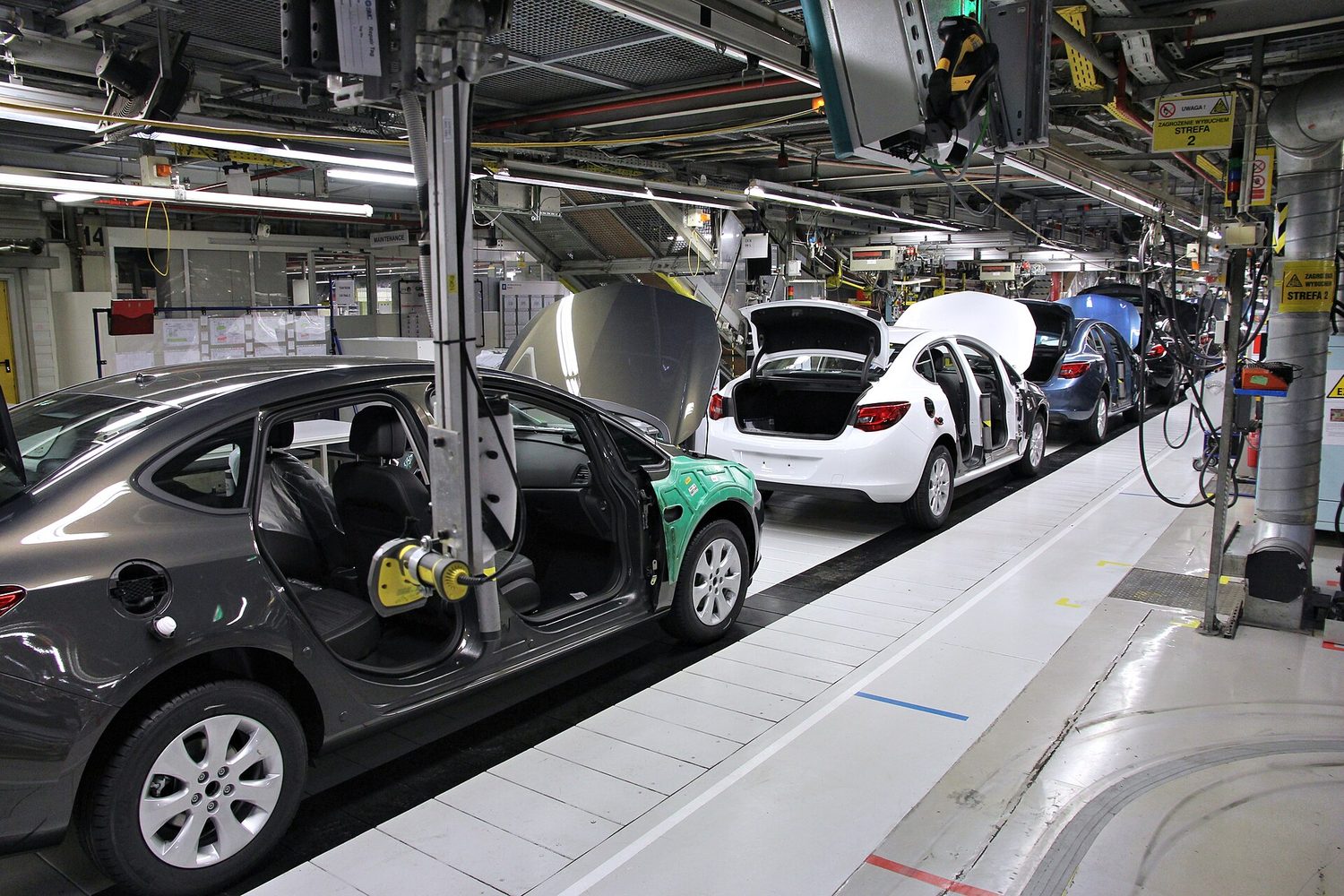
A car assembly line: market power and firm scale differ under imperfect competition

Most real markets are imperfectly competitive: firms have some market power – the ability to set price rather than take it. The source of that power is a downward-sloping demand curve facing the firm, which means that to sell one more unit the firm must lower the price on all units.

Market structures range from perfect competition to monopoly

Because of this, marginal revenue is below price ($MR) for every firm with market power. On a straight-line demand curve the MR curve has the same intercept but twice the slope, lying below demand. This one fact – $MR – separates every imperfect market from perfect competition and explains why they produce less and charge more.

Разобранный пример. Фирма с рыночной властью сталкивается со спросом $P=100-Q$. Продажа $1$ единицы дает $P=\$99$ and total revenue $\$99$; продажа $2$-й единицы вынуждает снизить цену до $\$98$ on both units, so revenue rises to $2\times98=\$196$. Предельный доход этой $2$-й единицы составляет $196-99=\$97$ – below its $\$98$ цены. В целом $MR=100-2Q$, снижаясь вдвое быстрее, чем спрос.

Vocabulary · ⁨Словарь⁩ Train · ⁨Тренировать⁩
English Русский
imperfectly competitive/ɪmˈpɜːfektlɪ kəmˈpetɪtɪv/ несовершенная конкуренция
market power/ˈmɑːkɪt ˈpaʊə/ рыночная власть
monopoly/məˈnɒpəli/ монополия
4.2

Monopoly

Syllabus · ⁨Программа⁩
English

Enduring Understanding (PRD-3): Even with a common goal of profit-maximization, market structure constrains and influences prices, output, and efficiency.

Learning Objective PRD-3.B: b. Explain (using graphs where appropriate) equilibrium, firm decision making, consumer surplus, producer surplus, profit (loss), and deadweight loss in imperfectly competitive markets and why prices in imperfectly competitive markets cannot be relied on to coordinate the actions of all possible market participants and can lead to inefficient outputs. c. Calculate (using data from a graph or table as appropriate) areas of consumer surplus, producer surplus, profit (loss), and deadweight loss in imperfectly competitive markets.

  • PRD-3.B.5 A monopoly exists because of barriers to entry.
  • PRD-3.B.6 In a monopoly, equilibrium (profit-maximizing) quantity is determined by equating marginal revenue (MR) to marginal cost (MC). The price charged is greater than the marginal cost.
    • Equation: $MR = MC$
  • PRD-3.B.7 In a natural monopoly, long-run economies of scale for a single firm exist throughout the entire effective demand of its product.
Русский

Постоянное понимание (PRD-3): Даже при общей цели максимизации прибыли рыночная структура ограничивает и влияет на цены, объем выпуска и эффективность.

Цель обучения PRD-3.B: b. Объяснить (с использованием графиков, где это уместно) равновесие, принятие решений фирмой, потребительский излишек, producer surplus, прибыль (убыток) и мертвый груз в несовершенных конкурентных рынках, а также почему цены в таких рынках нельзя полагаться для координации действий всех возможных участников рынка, и они могут приводить к неэффективным объемам выпуска. c. Рассчитать (используя данные из графика или таблицы, где это уместно) площади потребительского излишка, producer surplus, прибыли (убытка) и мертвого груза в несовершенных конкурентных рынках.

  • PRD-3.B.5 Монополия существует благодаря барьерам для входа.
  • PRD-3.B.6 В монополии равновесный (прибыльно-ориентированный) объем определяется равенством предельного дохода (MR) и предельных издержек (MC). Установленная цена превышает предельные издержки.
    • Уравнение: $MR = MC$
  • PRD-3.B.7 В случае естественной монополии долгосрочные экономия от масштаба для одной компании существуют на всем протяжении эффективного спроса на ее продукцию.

Source: College Board AP Course and Exam Description · ⁨Источник: Описание курса и экзамена College Board AP⁩

English
Monopoly: MR = MC pricing

A monopoly 垄断 is a single seller of a product with no close substitutes, protected by barriers to entry 进入壁垒 (economies of scale – a natural monopoly 自然垄断 – control of a key resource, patents, or government license).

  • The monopolist maximizes profit at $MR=MC$, then charges the highest price the demand curve allows at that quantity (read price up to the demand curve, not the MR curve).
  • Compared with perfect competition it produces less and charges more, earning long-run economic profit because entry is blocked.
  • This under-production creates deadweight loss 无谓损失 – the monopoly is allocatively inefficient because $P>MC$: the last unit is worth more than it costs, yet is not made.

Governments may respond with antitrust 反垄断 law, or regulate a natural monopoly's price toward $P=MC$ (socially optimal, but may cause a loss) or $P=ATC$ (fair-return, break-even).

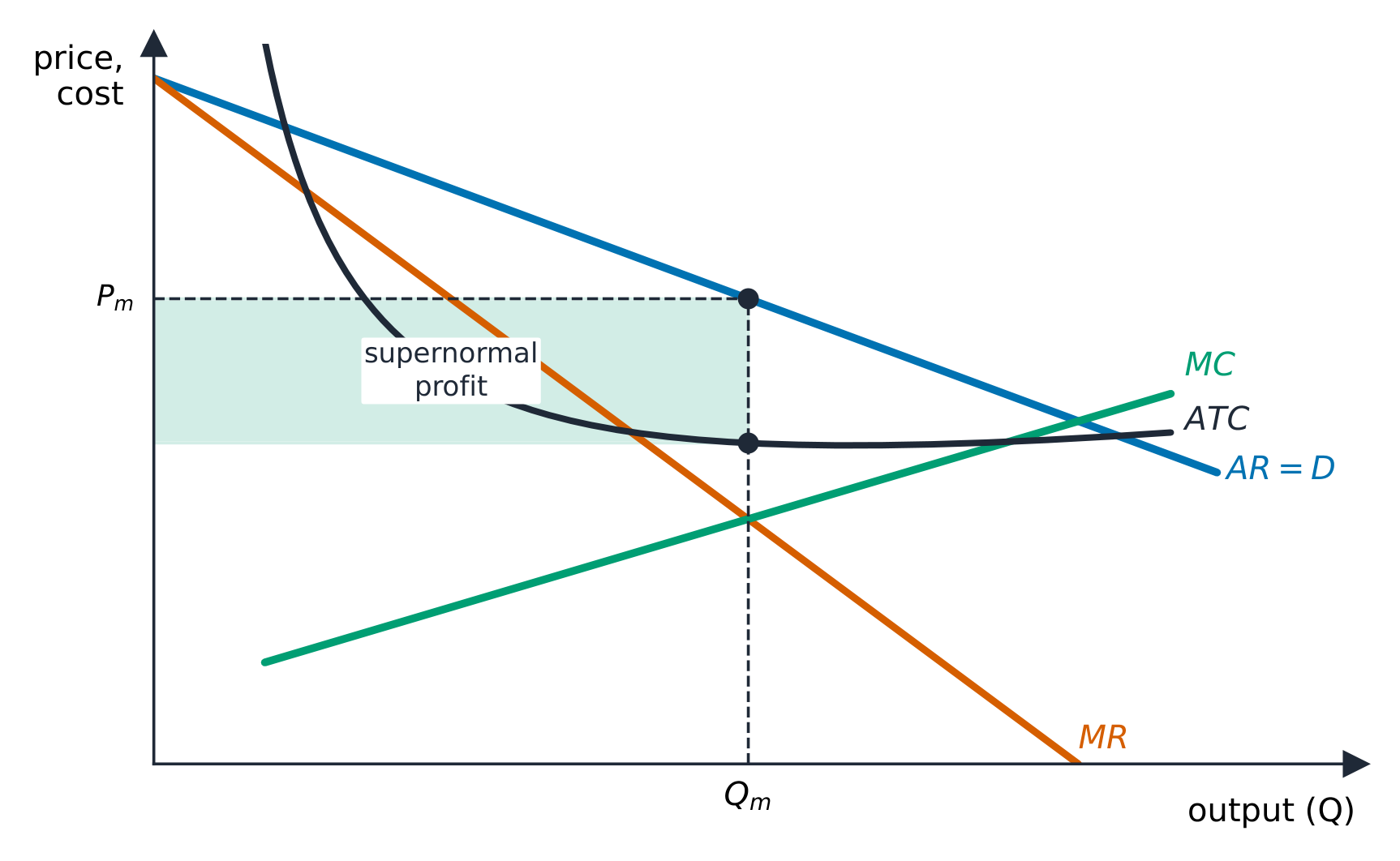
Exam skill: the monopoly graph is a staple – show quantity at $MR=MC$, price up on the demand curve, and shade profit (between $P$ and $ATC$) and deadweight loss (the triangle to the competitive quantity).

Русский
Monopoly: MR = MC pricing

A monopoly is a single seller of a product with no close substitutes, protected by barriers to entry (economies of scale – a natural monopoly – control of a key resource, patents, or government license).

A monopoly maximises profit where MC = MR and can earn supernormal profit
  • The monopolist maximizes profit at $MR=MC$, then charges the highest price the demand curve allows at that quantity (read price up to the demand curve, not the MR curve).
  • Compared with perfect competition it produces less and charges more, earning long-run economic profit because entry is blocked.
  • This under-production creates deadweight loss – the monopoly is allocatively inefficient because $P>MC$: the last unit is worth more than it costs, yet is not made.

Правительства могут реагировать с помощью антимонопольного законодательства или регулировать цены естественной монополии до уровня $P=MC$ (социально оптимально, но может вызвать убытки) или $P=ATC$ (справедливая норма прибыли, выход в ноль).

Exam skill: the monopoly graph is a staple – show quantity at $MR=MC$, price up on the demand curve, and shade profit (between $P$ and $ATC$) and deadweight loss (the triangle to the competitive quantity).

A large utility plant: monopoly and market power mean a single firm can set price above marginal cost
Explore · ⁨Исследовать⁩

A monopoly's cost curves · ⁨Кривые издержек монополии⁩

A monopoly is the sole seller, so it faces the whole downward demand curve and its marginal revenue lies below price. It produces where MR = MC — less output, higher price than competition. · ⁨Монополия — единственный продавец, поэтому она сталкивается со всей нисходящей кривой спроса, а ее предельный доход находится ниже цены. Она производит там, где MR = MC — меньший объем, более высокая цена, чем при конкуренции.⁩

Vocabulary · ⁨Словарь⁩ Train · ⁨Тренировать⁩
English Русский
barriers to entry/ˈbærɪəz tʊ ˈentri/ барьеры для входа
natural monopoly/ˈnætʃərəl məˈnɒpəli/ естественная монополия
deadweight loss/ˈdedweɪt lɒs/ потери безвозмездности
antitrust/ˌæntɪˈtrʌst/ антимонопольной
4.3

Price Discrimination

Syllabus · ⁨Программа⁩
English

Enduring Understanding (PRD-3): Even with a common goal of profit-maximization, market structure constrains and influences prices, output, and efficiency.

Learning Objective PRD-3.B: b. Explain (using graphs where appropriate) equilibrium, firm decision making, consumer surplus, producer surplus, profit (loss), and deadweight loss in imperfectly competitive markets and why prices in imperfectly competitive markets cannot be relied on to coordinate the actions of all possible market participants and can lead to inefficient outputs. c. Calculate (using data from a graph or table as appropriate) areas of consumer surplus, producer surplus, profit (loss), and deadweight loss in imperfectly competitive markets.

  • PRD-3.B.8 A firm with market power can engage in price discrimination to increase its profits or capture additional consumer surplus under certain conditions.
  • PRD-3.B.9 With perfect price discrimination, a monopolist produces the quantity where price equals marginal cost (just as a competitive market would) but extracts all economic surplus associated with its product and eliminates all deadweight loss.
    • Equation: $P = MC$
Русский

Постоянное понимание (PRD-3): Даже при общей цели максимизации прибыли рыночная структура ограничивает и влияет на цены, объем выпуска и эффективность.

Цель обучения PRD-3.B: b. Объяснить (с использованием графиков, где это уместно) равновесие, принятие решений фирмой, потребительский излишек, producer surplus, прибыль (убыток) и мертвый груз в несовершенных конкурентных рынках, а также почему цены в таких рынках нельзя полагаться для координации действий всех возможных участников рынка, и они могут приводить к неэффективным объемам выпуска. c. Рассчитать (используя данные из графика или таблицы, где это уместно) площади потребительского излишка, producer surplus, прибыли (убытка) и мертвого груза в несовершенных конкурентных рынках.

  • PRD-3.B.8 Компания, обладающая рыночной властью, может применять ценовую дискриминацию для увеличения своей прибыли или захвата дополнительного потребительского излишка при определенных условиях.
  • PRD-3.B.9 При идеальной ценовой дискриминации монополист производит объем, при котором цена равна предельным издержкам (как в конкурентном рынке), но извлекает весь экономический излишек, связанный с его продукцией, и устраняет весь мертвый груз.
    • Уравнение: $P = MC$

Source: College Board AP Course and Exam Description · ⁨Источник: Описание курса и экзамена College Board AP⁩

English

Price discrimination 价格歧视 is charging different buyers different prices for the same good. It requires market power, the ability to separate buyers by willingness to pay, and the ability to prevent resale.

Under perfect (first-degree) price discrimination, the firm charges each buyer their maximum price. The result: the firm produces the efficient quantity (where $P=MC$, no deadweight loss), but converts all consumer surplus into producer surplus (profit). Real examples – student discounts, airline fares, coupons – are partial versions.

Русский

Price discrimination is charging different buyers different prices for the same good. It requires market power, the ability to separate buyers by willingness to pay, and the ability to prevent resale.

Under perfect (first-degree) price discrimination, the firm charges each buyer their maximum price. The result: the firm produces the efficient quantity (where $P=MC$, no deadweight loss), but converts all consumer surplus into producer surplus (profit). Real examples – student discounts, airline fares, coupons – are partial versions.

Explore · ⁨Исследовать⁩

Elasticity and price discrimination · ⁨Эластичность и ценовая дискриминация⁩

Price discrimination charges each group a different price by their elasticity: inelastic buyers (who won't switch) pay more, elastic buyers pay less. Stretch the curve to see why. · ⁨Ценовая дискриминация взимает с каждой группы разную цену в зависимости от их эластичности: неэластичные покупатели (которые не переключатся) платят больше, эластичные — меньше. Растяните кривую, чтобы увидеть причину.⁩

Vocabulary · ⁨Словарь⁩ Train · ⁨Тренировать⁩
English Русский
Price discrimination/praɪs dɪˌskrɪmɪˈneɪʃn/ Ценовая дискриминация
4.4

Monopolistic Competition

Syllabus · ⁨Программа⁩
English

Enduring Understanding (PRD-3): Even with a common goal of profit-maximization, market structure constrains and influences prices, output, and efficiency.

Learning Objective PRD-3.B: b. Explain (using graphs where appropriate) equilibrium, firm decision making, consumer surplus, producer surplus, profit (loss), and deadweight loss in imperfectly competitive markets and why prices in imperfectly competitive markets cannot be relied on to coordinate the actions of all possible market participants and can lead to inefficient outputs. c. Calculate (using data from a graph or table as appropriate) areas of consumer surplus, producer surplus, profit (loss), and deadweight loss in imperfectly competitive markets.

  • PRD-3.B.10 In a market with monopolistic competition, firms producing differentiated products may earn positive, negative, or zero economic profit in the short run. Firms typically use advertising as a means of differentiating their product. Free entry and exit drive profits to zero in the long run. The output level, however, is smaller than the output level needed to minimize average total costs, creating excess capacity. The price is greater than marginal cost, creating allocative inefficiency.
Русский

Постоянное понимание (PRD-3): Даже при общей цели максимизации прибыли рыночная структура ограничивает и влияет на цены, объем выпуска и эффективность.

Цель обучения PRD-3.B: b. Объяснить (с использованием графиков, где это уместно) равновесие, принятие решений фирмой, потребительский излишек, producer surplus, прибыль (убыток) и мертвый груз в несовершенных конкурентных рынках, а также почему цены в таких рынках нельзя полагаться для координации действий всех возможных участников рынка, и они могут приводить к неэффективным объемам выпуска. c. Рассчитать (используя данные из графика или таблицы, где это уместно) площади потребительского излишка, producer surplus, прибыли (убытка) и мертвого груза в несовершенных конкурентных рынках.

  • PRD-3.B.10 На рынке с монопсонистической конкуренцией компании, производящие дифференцированную продукцию, могут получать положительную, отрицательную или нулевую экономическую прибыль в краткосрочном периоде. Компании обычно используют рекламу как средство дифференциации своего продукта. Свободный вход и выход приводят к нулевой прибыли в долгосрочном периоде. Однако уровень выпуска меньше, чем уровень, необходимый для минимизации средних совокупных издержек, создавая избыточную мощность. Цена превышает предельные издержки, создавая аллокативную неэффективность.

Source: College Board AP Course and Exam Description · ⁨Источник: Описание курса и экзамена College Board AP⁩

English

Monopolistic competition 垄断竞争 has many firms selling differentiated 差异化 products with easy entry and exit (restaurants, salons, clothing brands). Product differentiation gives each firm a downward-sloping demand curve and thus some price-setting power.

  • Short run: like a monopoly – produce at $MR=MC$, and profit or loss is possible.
  • Long run: easy entry competes away profit, so each firm earns zero economic profit, producing where demand is tangent to ATC.
  • Because it still charges $P>MC$ and does not produce at minimum ATC, it has excess capacity 过剩产能 and is neither allocatively nor productively efficient. The trade-off society accepts is product variety and choice.
Русский

Monopolistic competition has many firms selling differentiated products with easy entry and exit (restaurants, salons, clothing brands). Product differentiation gives each firm a downward-sloping demand curve and thus some price-setting power.

  • Short run: like a monopoly – produce at $MR=MC$, and profit or loss is possible.
  • Long run: easy entry competes away profit, so each firm earns zero economic profit, producing where demand is tangent to ATC.
  • Because it still charges $P>MC$ and does not produce at minimum ATC, it has excess capacity and is neither allocatively nor productively efficient. The trade-off society accepts is product variety and choice.
Vocabulary · ⁨Словарь⁩ Train · ⁨Тренировать⁩
English Русский
Monopolistic competition/məˈnɒpəlɪstɪk ˌkɒmpəˈtɪʃn/ Монполистическая конкуренция
differentiated/ˌdɪfəˈrenʃɪeɪtɪd/ дифференцирована
excess capacity/ekˈses kəˈpæsɪti/ избыточная мощность
oligopoly/ˌɒlɪˈɡɒpəli/ олигополия
interdependent/ˌɪntədɪˈpendənt/ взаимозависимость
game theory/ɡeɪm ˈθɪəri/ теория игр
4.5

Oligopoly and Game Theory

Syllabus · ⁨Программа⁩
English

Enduring Understanding (PRD-3): Even with a common goal of profit-maximization, market structure constrains and influences prices, output, and efficiency.

Learning Objective PRD-3.C: a. Define (using tables as appropriate) key terms, strategies, and concepts relating to oligopolies and simple games. b. Explain (using tables as appropriate) strategies and equilibria in simple games and the connections to theoretical behaviors in various oligopoly market and non-market settings. c. Calculate (using tables as appropriate) the incentive sufficient to alter a player's dominant strategy.

  • PRD-3.C.1 An oligopoly is an inefficient market structure with high barriers to entry, where there are few firms acting interdependently.
  • PRD-3.C.2 Firms in an oligopoly have an incentive to collude and form cartels.
  • PRD-3.C.3 A game is a situation in which a number of individuals take actions, and the payoff for each individual depends directly on both the individual's own choice and the choices of others.
  • PRD-3.C.4 A strategy is a complete plan of actions for playing a game; the normal form model of a game shows the payoffs that result from each collection of strategies (one for each player).
  • PRD-3.C.5 A player has a dominant strategy when the payoff to a particular action is always higher independent of the action taken by the other player.
  • PRD-3.C.6 A Nash equilibrium is a condition describing the set of actions in which no player can increase his or her payoff by unilaterally taking another action, given the other players' actions.
    • Exclusion statement: Dominant strategies and Nash equilibrium with more than two players or more than two actions per player, mixed-strategy equilibria, extensive form games, and normal form games with more than two players or more than two actions per player are beyond the scope of the course and the AP Exam.
  • PRD-3.C.7 Oligopolists have difficulty achieving the monopoly outcome for reasons similar to those that prevent players from achieving a cooperative outcome in the Prisoner's Dilemma; nevertheless, prices are generally higher and quantities lower with oligopoly (or duopoly) than with perfect competition.
Русский

Постоянное понимание (PRD-3): Даже при общей цели максимизации прибыли рыночная структура ограничивает и влияет на цены, объем выпуска и эффективность.

Цель обучения PRD-3.C: a. Определить (с использованием таблиц, где это уместно) ключевые термины, стратегии и концепции, связанные с олигополиями и простыми играми. b. Объяснить (с использованием таблиц, где это уместно) стратегии и равновесия в простых играх и их связь с теоретическим поведением в различных олигопольных рынках и внерыночных условиях. c. Рассчитать (используя таблицы, где это уместно) стимул, достаточный для изменения доминирующей стратегии игрока.

  • PRD-3.C.1 Олигополия — это неэффективная рыночная структура с высокими барьерами для входа, где действует малое число взаимозависимых компаний.
  • PRD-3.C.2 Компании в олигополии имеют стимул к сговору и образованию картелей.
  • PRD-3.C.3 Игра — это ситуация, в которой ряд лиц принимает решения, а выигрыш каждого зависит непосредственно как от собственного выбора, так и от выборов других.
  • PRD-3.C.4 Стратегия — это полный план действий для ведения игры; нормальная форма модели игры показывает выигрыши, возникающие из каждой комбинации стратегий (по одной для каждого игрока).
  • PRD-3.C.5 У игрока есть доминирующая стратегия, когда выигрыш от определенного действия всегда выше, независимо от того, какое действие предпримет другой игрок.
  • PRD-3.C.6 Равновесие Нэша — это условие, описывающее набор действий, при котором ни один игрок не может увеличить свой выигрыш, односторонне изменив свое действие, при заданных действиях других игроков.
    • Исключение: Доминирующие стратегии и равновесие Нэша при участии более двух игроков или более чем двух действиях для каждого игрока, равновесия в смешанных стратегиях, игры в расширенной форме, а также игры в нормальной форме с участием более двух игроков или более чем двумя действиями для каждого игрока выходят за рамки курса и экзамена AP.
  • PRD-3.C.7 Олигополисты испытывают трудности с достижением монопольной цены по причинам, схожим с теми, которые мешают игрокам достичь кооперативного исхода в «Дилемме заключенного»; тем не менее, цены обычно выше, а объемы ниже при олигополии (или дуополии), чем при совершенной конкуренции.

Source: College Board AP Course and Exam Description · ⁨Источник: Описание курса и экзамена College Board AP⁩

English

An oligopoly 寡头垄断 is a market with a few large, interdependent 相互依存 firms (cars, airlines, phones). Because each firm's best move depends on rivals' moves, we analyze them with game theory 博弈论.

  • A payoff matrix 收益矩阵 shows each firm's profit for every combination of choices.
  • A dominant strategy 优势策略 is a firm's best choice regardless of what the rival does.
  • A Nash equilibrium 纳什均衡 is an outcome where no firm can do better by unilaterally changing its choice.
  • The classic prisoners' dilemma 囚徒困境 shows why firms often fail to cooperate: both would gain by colluding 勾结 (acting like a monopoly), but each has an incentive to cheat, so they end up at the competitive-ish, lower-profit outcome. Collusion and cartels 卡特尔 are unstable for the same reason (and usually illegal).

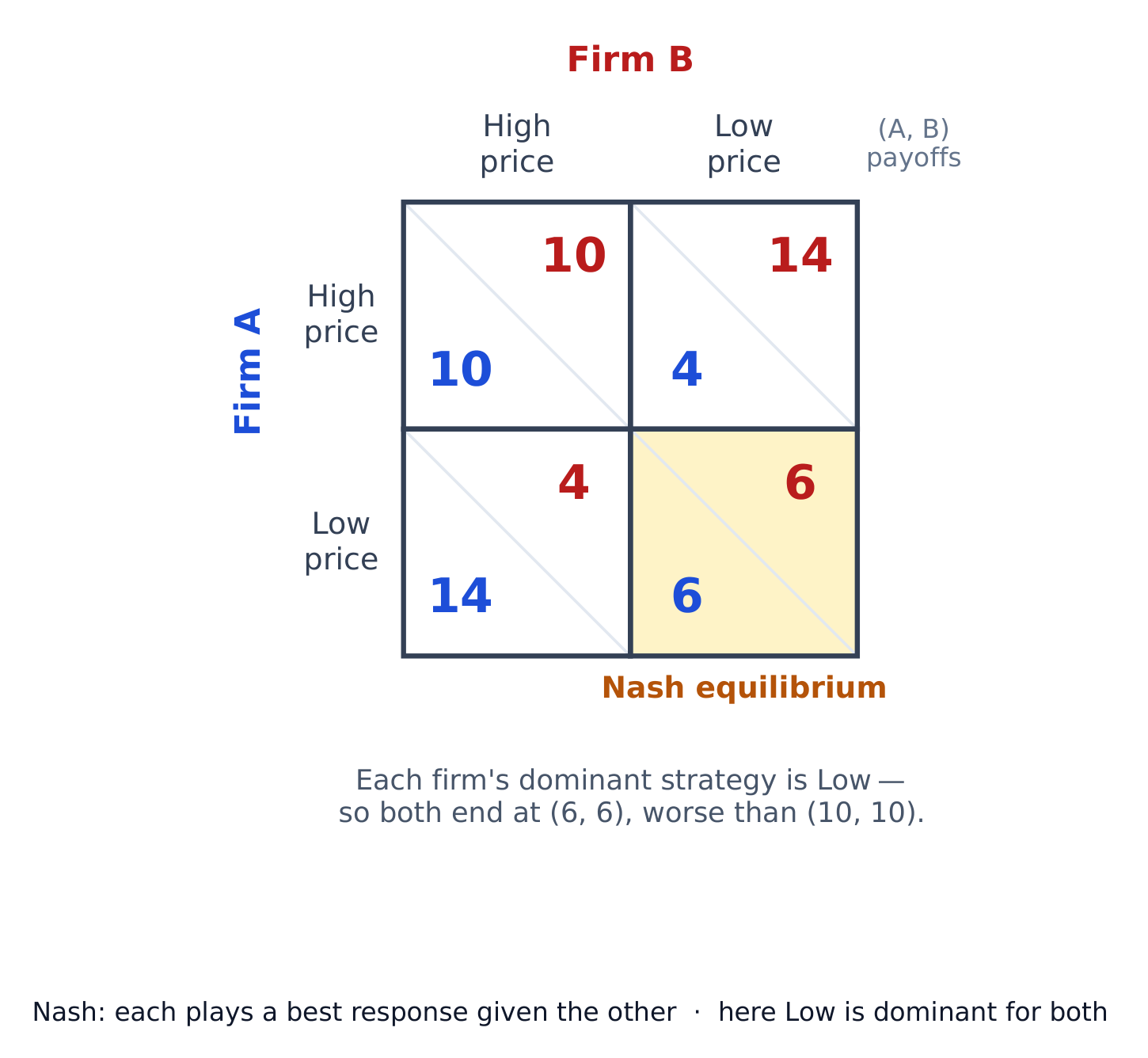
Worked example. Two firms each choose a High or Low price. Profits (A, B): both High $\to(10,10)$; A Low, B High $\to(14,4)$; A High, B Low $\to(4,14)$; both Low $\to(6,6)$. For A: if B plays High, Low ($14$) beats High ($10$); if B plays Low, Low ($6$) beats High ($4$) – so Low is A's dominant strategy, and by symmetry B's too. The Nash equilibrium is both Low $(6,6)$, worse for both than the cooperative $(10,10)$ – the prisoners' dilemma in action.

Exam skill: be able to find each firm's dominant strategy and the Nash equilibrium from a 2×2 payoff matrix, and explain why the cooperative outcome is hard to sustain.

Русский

Олигополия — это рынок, на котором действует несколько крупных взаимозависимых компаний (автомобилестроение, авиаперевозки, телефоны). Поскольку оптимальное решение каждой компании зависит от действий конкурентов, их анализ проводится с помощью теории игр.

  • Матрица выигрышей показывает прибыль каждой компании для каждой комбинации выбранных стратегий.
  • Доминирующая стратегия — это лучший выбор компании независимо от того, что делает соперник.
  • Равновесие Нэша — это исход, при котором ни одна компания не может улучшить свое положение, изменив свою стратегию в одностороннем порядке.
  • Классическая дилемма заключенного объясняет, почему компании часто не сотрудничают: обе выиграли бы от сговора (ведения себя как монополист), но у каждой есть стимул к обману, поэтому они приходят к конкурентному исходу с более низкой прибылью. Сговоры и картели нестабильны по той же причине (и обычно незаконны).

Разбор примера. Две компании выбирают либо Высокую, либо Низкую цену. Прибыль (A, B): обе Высокие $\to(10,10)$; A Низкая, B Высокая $\to(14,4)$; A Высокая, B Низкая $\to(4,14)$; обе Низкие $\to(6,6)$. Для A: если B выбирает Высокое, то Низкое ($14$) лучше Высокого ($10$); если B выбирает Низкое, то Низкое ($6$) лучше Высокого ($4$) — значит, Низкое является доминирующей стратегией A, и в силу симметрии также стратегией B. Равновесие Нэша — обе Низкие $(6,6)$, что хуже для обеих, чем кооперативный $(10,10)$ — дилемма заключенного в действии.

Дилемма заключенного: доминирующая стратегия каждой фирмы — «Низкий», что дает равновесие Нэша
Дилемма заключенного: доминирующей стратегией каждой компании является Низкая, что приводит к равновесию Нэша

Навык для экзамена: уметь находить доминирующую стратегию каждой компании и равновесие Нэша по матрице выигрышей 2×2, а также объяснять, почему кооперативный исход трудно sustaining.

Vocabulary · ⁨Словарь⁩ Train · ⁨Тренировать⁩
English Русский
payoff matrix/ˈpeɪɒf ˈmeɪtrɪks/ матрица выплат
dominant strategy/ˈdɒmɪnənt ˈstrætədʒi/ доминирующая стратегия
Nash equilibrium/næʃ ˌiːkwɪˈlɪbrɪəm/ Равновесие Нэша
prisoners' dilemma/ˈprɪzənəz daɪˈlemə/ дилемма заключенного
colluding/kəˈluːdɪŋ/ сговор
cartels/kɑːˈtelz/ картели
4.5

Exam tips · ⁨Советы для экзамена⁩

English
  • A firm with market power faces a downward-sloping demand, so MR < P (MR has twice the slope).
  • A monopoly produces where MR = MC, then charges the price up on the demand curve; it makes deadweight loss because $P > MC$.
  • Under perfect price discrimination the firm produces the efficient quantity but captures all consumer surplus.
  • Monopolistic competition earns zero long-run profit with excess capacity (product variety is the trade-off).
  • In an oligopoly find the dominant strategy and Nash equilibrium from the payoff matrix; the cooperative outcome is hard to sustain.
Русский
  • Компания, обладающая рыночной властью, сталкивается с нисходящей кривой спроса, поэтому MR < P (MR имеет вдвое круче наклон).
  • Монополист производит там, где MR = MC, затем устанавливает цену вверх по кривой спроса; он создает мертвый груз, потому что $P > MC$.
  • При идеальной ценовой дискриминации фирма производит эффективный объем, но извлекает всю потребительскую прибавку.
  • При монополистической конкуренции долгосрочная прибыль равна нулю из-за избыточной мощности (разнообразие продукции — плата за это).
  • В олигополии найдите доминирующую стратегию и равновесие Нэша по матрице выигрышей; кооперативный исход трудно sustaining.

Interactive lessons on this topic · ⁨Интерактивные уроки по этой теме⁩

Work through it step by step, with instant-check exercises. · ⁨Пройдите его шаг за шагом с упражнениями мгновенной проверки.⁩

Past Papers · ⁨Архив экзаменационных работ⁩

More topics in AP Microeconomics · ⁨AP Микроекономіка⁩ · ⁨Больше тем в AP Microeconomics · ⁨AP Микроекономіка⁩⁩

Log in or create account · ⁨Войти или создать аккаунт⁩

IGCSE, A-Level & AP