디지털 SAT 프레임워크; 원문 연습은 적응형이 아니며scaled-score 예측을 제공하지 않습니다.
중심 아이디어 및 지지 디테일 식별하기
텍스트에 근거한 추론 하기
텍스트 증거 선택 및 정량적 증거 해석하기
선행 지식: 단락의 주제를 식별하고, 명시된 사실과 추론을 구분하십시오.
방법 설명 및 선택
중심 아이디어는 생동감 있는 디테일이 아닌 저자의 주요 주장也包括합니다. 선택하기 전에 각 문장을 요약하십시오.
추론은 명시된 정보를 결합하여 새로운 원인을 추가하지 않습니다. 답변의 모든 단어를 본문과 대조해 보십시오.
증거 질문에 대해서는 먼저 주장을 식별하십시오. 결과가 실제로 존재하더라도 그 주장과 무관할 수 있습니다.
표나 그래프의 경우, 값보다 레이블, 단위, 그룹을 먼저 읽으십시오. 요청된 그룹을 비교하되, 데이터 범위를 벗어난 추세를 추론하지 마십시오.
중심 아이디어는 본문을 연결하는 관계입니다.
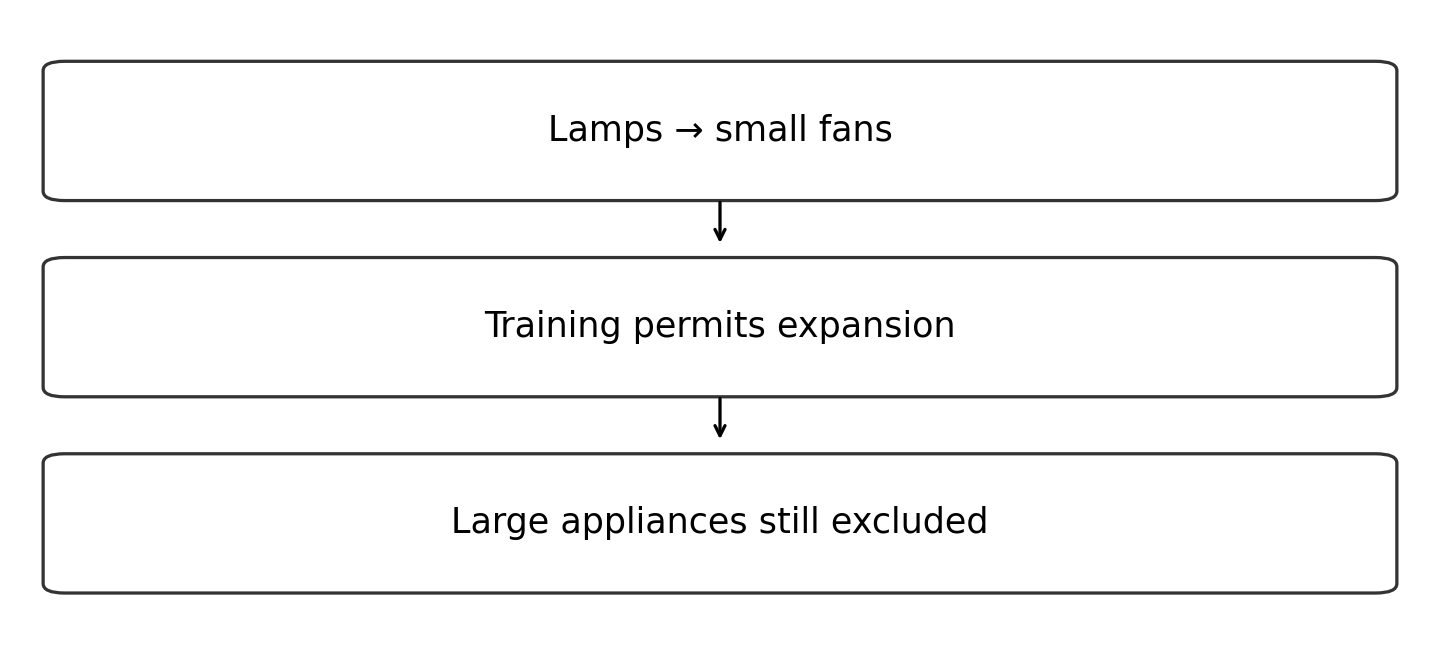
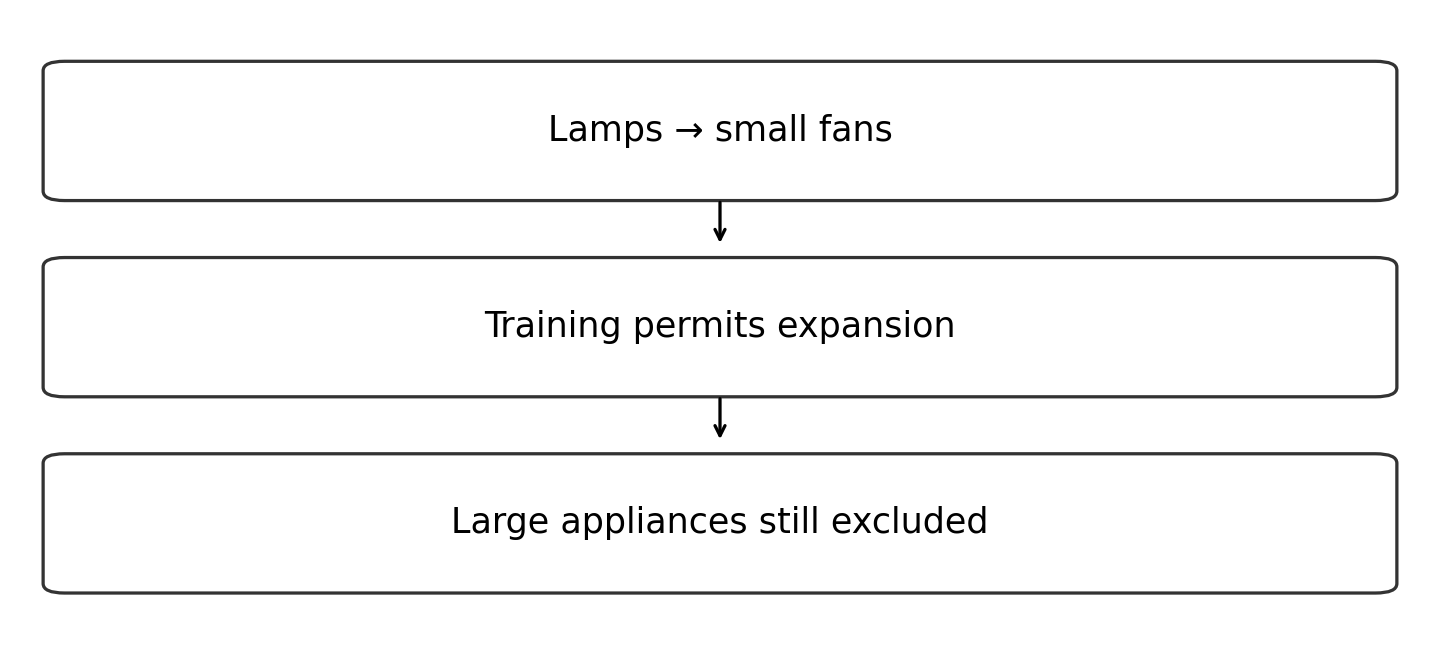
읽기: “수리 카페는 처음에 램프만 수리를 받았고, 후엔 자원봉사자가 훈련을 받은 후 작은 팬을 추가했습니다. 대형 가전제품은 여전히 전문 상점에 보내졌습니다.”
요약이 타당한 것은: 카페가 수리를 일정 범위 내에서 확대했다.
“모든 것을 수리했다”는 마지막 문장을 무시한다. “램프를 수리했다”는 변화를 누락했다.
원본worked 관계 도식; 전체 문구 및 조건을 읽으십시오.
기존 풀이 예제: 연구원은 정오에 두 거리를 측정했다. 그늘진 거리의 온도는 29°C였고, 햇볕에 노출된 거리는 33°C였다. 이는 해당 장소와 시간에 4°C의 차이가 있음을 지지한다. 그러나 다른 요인에서 거리가 다를 수 있으므로 도시 전체의 냉각 효과나 인과관계를 입증할 수 없다.
완전한 원문 맥락
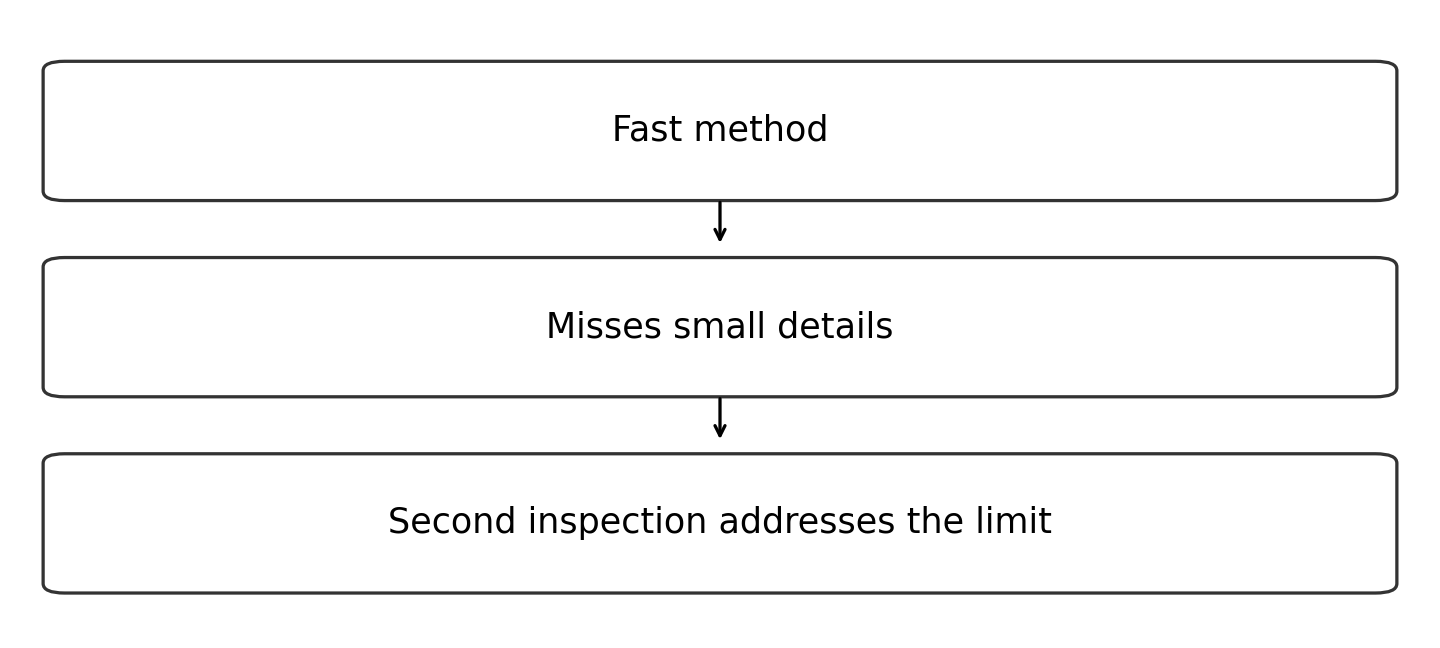
원문: 시 아카이브는 온라인 색인을 통해 손글씨 배송 등록부를 검색할 수 있는 시험을 시작했다. 자원봉사자가 이름과 날짜를 입력했고, 직원들이 읽기 어려운 항목을 확인했다. 이 색인은 종종 연구원이 아카이브를 방문하기 전에 예상되는 페이지를 찾는 데 도움이 되었다. 하지만 이는 등록부 이미지를 대체하지 못했다. 같은 이름을 가진 사람끼리는 여전히 주변 항목을 읽음으로써만 구별할 수 있었다. 따라서 직원은 이 색인이 모든 질문에 대한 최종 답변이 아니라 기록으로 들어가는 경로로 설명했다. 또한研究者们可以看到索引的变化,他们还保留了一份已更正条目的公开列表。
독립 연습 및 검증된 추론
이 개요는 상세한 기술 순서 20, 21, 22를 통해 완성된다. 각 참고 자료와 시트를 순서대로 활용하십시오. 이 방향성 설정은 해당 자료들을 대체하지 않는다.
이양 1
핵심 내용을 한 문장으로 서술하되, 장점과 제한점을 모두 포함해야 한다.
추론: 확인된 색인은 연구원이 관련 기록을 찾는 데 도움을 주지만, 일부 구분은 여전히 원본 등록부를 참조하는 것이 필수적이다. 이는 검색의 장점은 설명하지만 완전한 정확성을 주장하지는 않는다.
이양 2
등록부 이미지가 여전히 필요한 이유를 설명하는 디테일은 무엇인가? 이를 수정 목록의 목적과 구분하시오.
추론: 같은 이름을 가진 사람들은 이를 구별하기 위해 주변 등록부 항목을 필요로 할 수 있다. 반면 수정 목록은 변경 사항을 가시화할 뿐, 자체적으로 모든 사람을 식별하지는 못한다.
이양 3
제안된 요약 각각을 구체적인 증거로 부인하시오 — A “자원봉사자가 직원을 대신함”; B “색인으로 인해 아카이방 방문이 불필요해짐”; C “아카이브가 색인의 변경 사항을 숨김”.
추론: A는 직원이 읽기 어려운 항목을 확인했다는 내용과 모순된다. B는 “자주”라는 표현과 원본 기록을 참조해야 하는 필요성을 과장했으며, 원문은 모든 방문이 대체된다고 명시하지 않았다. C는 공개 수정 목록과 모순된다. 어떤 선택지도 제시된 범위를 보존하지 못한다.
한계 및 향후 활용법
과학적으로 타당해 보이는 답변은 본문에 포함되어 있지 않은 정보를 추가할 수 있다.
여기에 있는 모든 과제는 공식 질문이나 신규 진단이 아닌, 작성자 지침이 포함된 공개 원본 연습입니다. 기존 보호되는 시험 및 모의고사는 별도로 분류됩니다.
디지털 SAT 프레임워크; 원문 연습은 적응형이 아니며scaled-score 예측을 제공하지 않습니다.
문맥 속 단어 의미 파악하기
텍스트 구조 및 목적 분석하기
관련 텍스트 및 견해 비교하기
선행 지식: 문장 의미; 대조 및 설명 단서.
방법 설명 및 선택
선지 보기 전에 출제된 단어를 자신의 평범한 표현으로 치환하시오. 문장이 의미를 통제한다.
해당 문장이 하는 역할 찾기: 증거 제시, 주장의 한정, 방법 설명 또는 대조 도입.
저자의견과 인용된 견해를 분리하시오. 주장을 인용한다고 해서 반드시 동의를 의미하지는 않는다.
교차 텍스트 질문은 관계에 대해 묻습니다. 공통된 주제만이 아니라 정확한 동의 또는 이의 지점을 식별하시오.
문맥 속 단어는 사전 정의뿐만 아니라 해당 관계를 만족시켜야 한다.
"증거가 약하므로 결론은 가설적이다"에서 '가설적'은 수정될 수 있음을 의미합니다.
일시 고용이나 신체의 마른 상태를 뜻하지 않습니다. 선택 전에 의역을 하십시오.
원본worked 관계 도식; 전체 문구 및 조건을 읽으십시오.
기존 풀이 예: 텍스트 1: 소규모 시험에서 필터가 도움이 될 수 있음이 시사됩니다. 텍스트 2: 시험이 너무 작아 유효성을 입증할 수 없습니다. 두 경우 모두 시험의 제한성을 인정합니다. 텍스트 2는 결론에 대해 더 신중하게 접근하며, 필터가 확실히 실패한다고 말하지는 않습니다.
완전한 원문 맥락
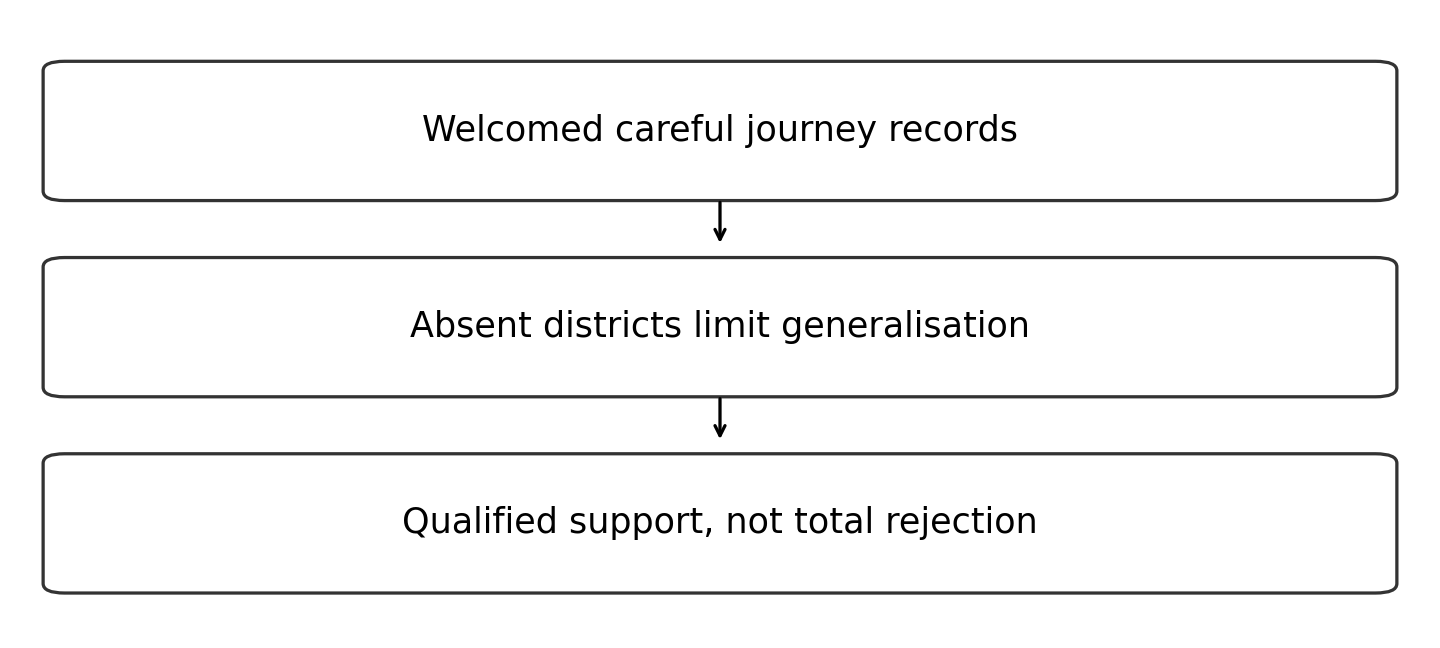
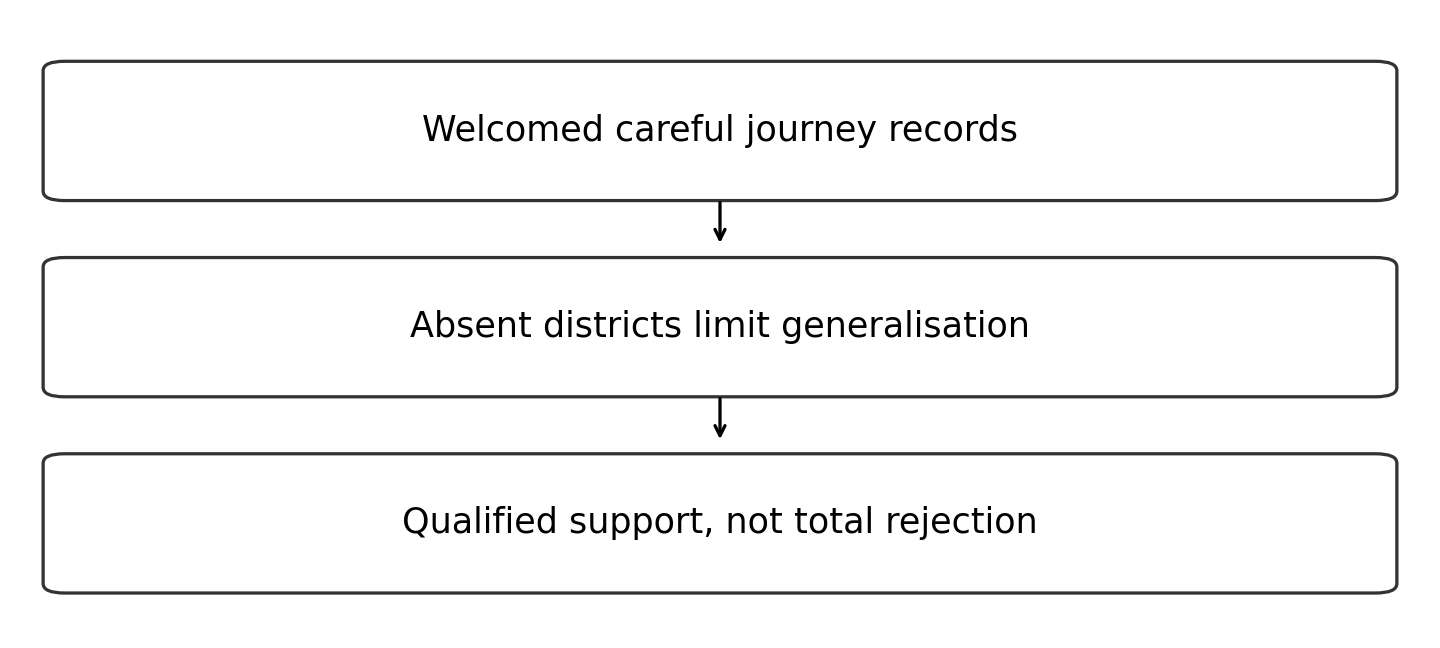
원문: 평론가들은 조사에 따른 개별 여정 기록의 세심함을 환영했지만, 도시 전체에 대한 결론에는 조건부 지지만 표명했습니다. 경로는 편의를 위해 선정되었으며, 몇몇 지역은 포함되지 않았습니다. 한 평론가는 이 기록을 통찰적이라고 평가하여,Previously 간과되었던 이동의 어려움을 이해하기 쉽게 만들었다고 지적했습니다. 다른 평론가는 결론을 확장하려면 더 광범위한 표본이 필요하다고 경고했습니다. 저자들은 이러한 우려를 수용하고 추가 조사를 제안했습니다.
독립 연습 및 검증된 추론
이 overview은 상세한 기술 순서 23, 24, 25를 통해 완성됩니다. 해당 참조 사항과 시트를 순서대로 참고하십시오. 이 방향성 설정은 이를 대체하지 않습니다.
이양 1
해당 문단에서 '조건부(qualified)', '통찰적(illuminating)', '우려(reservation)'의 의미를 설명하고 각에 대한 근거를 인용하십시오.
추론: '조건부'는 제한적이거나 유보된 것을 의미하며, 포함되지 않은 지역과 더 넓은 표본 수집의 필요성으로 뒷받침됩니다. '통찰적'은 밝혀지거나 명확히 하는 것을 의미하며, 난관이 이해하기 쉬워진 점으로 뒷받침됩니다. '우려'는 Concern 또는 제한을 의미하며, 결론의 확장에 대한 경고로 뒷받침되며, 예약된 좌석을 뜻하는 것은 아닙니다.
이양 2
"평론가들은 조사를 배제했다"와 "평론가들은 아무런 유보 없이 그 결론을 찬양했다"를 비교하십시오. 왜 어느 하나도 적합하지 않습니까?
추론: '배제하다'는 세심한 기록에 대한 환영을 무시합니다. '무유보 찬양'은 표본 수집에 대한 우려를 지워버립니다. 태도는 기록에 대한 인정과 broader 결론에 대한 제한적 지지를 결합한 것입니다.
이양 3
'통찰적(illuminating)'을 '밝혀주는(revealing)', '눈부신(dazzling)', '보이는(visible)'으로 교체하십시오. 이 중 어떤 것이Meaning을 가장 잘 보존하고, 나머지들이 여기서 실패한 이유는 무엇입니까?
추론: '밝혀주는'은 기록이 난관을 이해하게 한다는 아이디어를 보존합니다. '눈부신'은 명시된 명확화 beyond에 번쩍임이나 찬미라는 의미를 도입합니다. '보이는'은 인지 가능성을 기술할 뿐, 조사의 설명적 기여를 서술하지 못합니다. 이는 해당 단어가 항상 틀린다는 규칙이 아닌 맥락적 의미 결정입니다.
한계 및 향후 활용법
단어의 일상적 의미는 제공된 문장 내에서의 의미와 다를 수 있다.
여기에 있는 모든 과제는 공식 질문이나 신규 진단이 아닌, 작성자 지침이 포함된 공개 원본 연습입니다. 기존 보호되는 시험 및 모의고사는 별도로 분류됩니다.
Prerequisites: Read a stated rhetorical goal; preserve names, units and relations.
Explain and choose the method
Classify the relationship before choosing a transition 衔接词: contrast, consequence, addition or example.
Read both sides of a blank. A transition must link their meanings, not merely sound natural.
For notes questions, underline the requested goal. Comparison, introduction and emphasis require different selections.
Use only necessary notes. Keep names, dates and quantities attached to the correct object.
Rhetorical synthesis 综合 修辞综合 selects facts for a purpose.
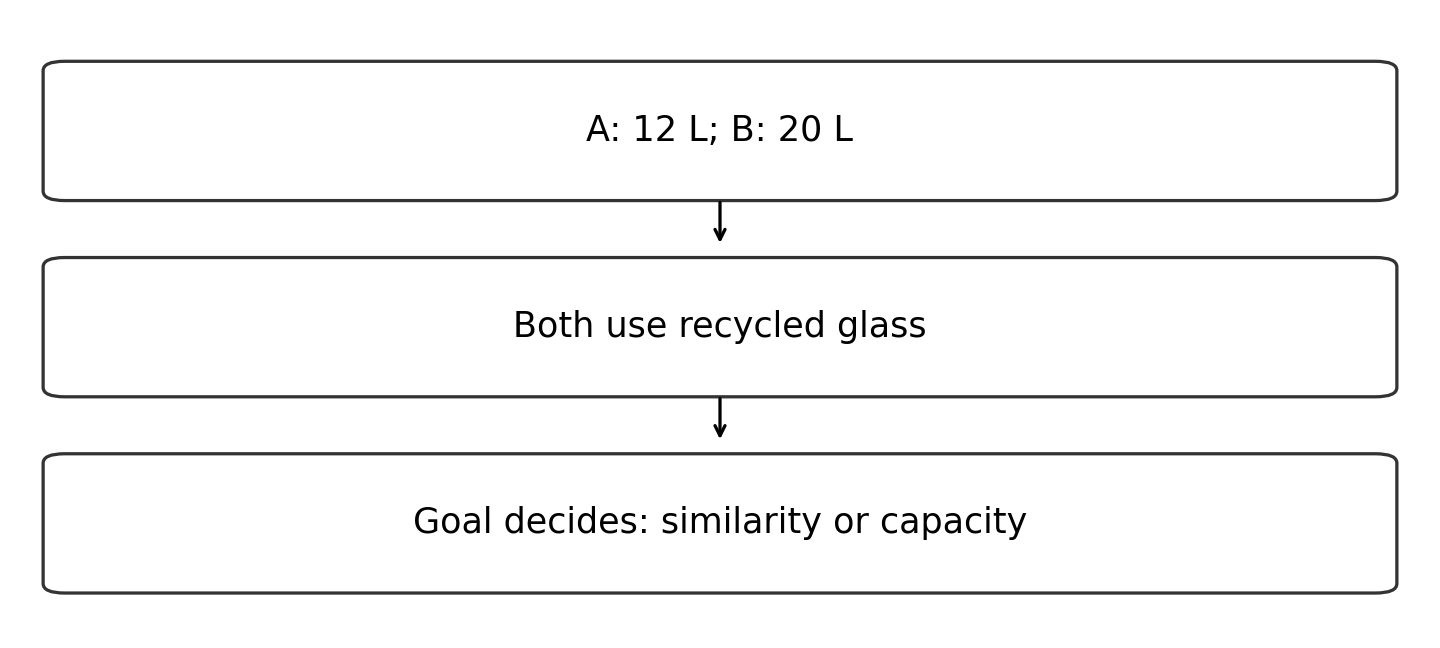
Notes: A stores 12 litres; B stores 20; both use recycled glass.
For a material similarity 相似: “Both containers use recycled glass.”
For a capacity difference: “B stores 8 litres more than A.” The same notes support different sentences.
Original diagram of the worked relationship; read the full wording and qualifications.
Existing worked example: Notes: Route A is 8 km and has six stops. Route B is 8 km and has ten stops. Goal: emphasise a similarity. “Both routes are 8 km long” meets the goal. Discussing stops emphasises a difference instead.
Complete original context
Original research notes:
The Bay project restored 3 km of walking paths in 2024.
The Hill project restored 5 km of walking paths in 2024.
Both projects used volunteer teams.
Bay used local stone for boundary markers.
Hill used recycled timber for boundary markers.
The notes give no costs, visitor counts or durability measurements.
Independent practice and checked reasoning
This overview is completed through the detailed skill sequence: 26, 27. Work those references and sheets in order; this orientation does not replace them.
Transfer 1
Write one sentence emphasising a similarity in staffing and a second emphasising the difference in distance restored.
Reasoning: “Both Bay and Hill used volunteer teams.” “Hill restored 5 km of paths, 2 km more than Bay.” These select staffing and distance respectively without adding a cause.
Transfer 2
A student writes “Hill restored more paths because recycled timber lasts longer.” Identify every unsupported relationship.
Reasoning: The notes do not report why Hill restored a longer distance, nor any durability comparison. They report kilometres, not the number of separate paths. A valid sentence is “Hill restored a longer total distance and used recycled timber for its markers,” without a causal link.
Transfer 3
Goal — contrast marker 转折标记 materials without including irrelevant detail 细节. Write a sentence, then explain why the shared year can be omitted.
Reasoning: “Bay used local stone for boundary markers, whereas Hill used recycled timber.” The shared year does not establish the requested material contrast. Omitting it meets this goal; a historical comparison could require it under a different goal.
Limits and next use
Do not include every note. Extra detail can distract from the requested rhetorical purpose.
All tasks here are public original practice with authored guidance. They are not official questions or fresh diagnostics. Existing protected tests and mocks remain separate.
디지털 SAT 프레임워크; 원문 연습은 적응형이 아니며scaled-score 예측을 제공하지 않습니다.
문장 부호 및 구두부호 사용
주어-동사 일치 및 대명사 명확성 유지
맥락에 맞는 동사 형태 및 수식어 선택
사전 요구 사항: 주어와 유한 동사; 독립절/종속절.
방법 설명 및 선택
각 절에서 유동적 동사와 주어를 찾으십시오. 종속절은 단독으로 완전한 문장을 이루지 못합니다.
완전한 두 절을 마침표, 세미콜론, 또는 쉼표와 조립접속사를 사용하여 연결하십시오.
콜론은 완전한 절 뒤에 올 수 있습니다. 세미콜론은 완전한 절들을 이어 줍니다. 필수 수식어는 본래 서술 대상에 붙여 두십시오.
핵심 명사의 일치를 확인하십시오. “The list of measurements is long”: list이 주어가 되어 is가 맞습니다. measurements는 주어가 아닙니다.
문장 경계는 절의 구조에 따라 결정됩니다.
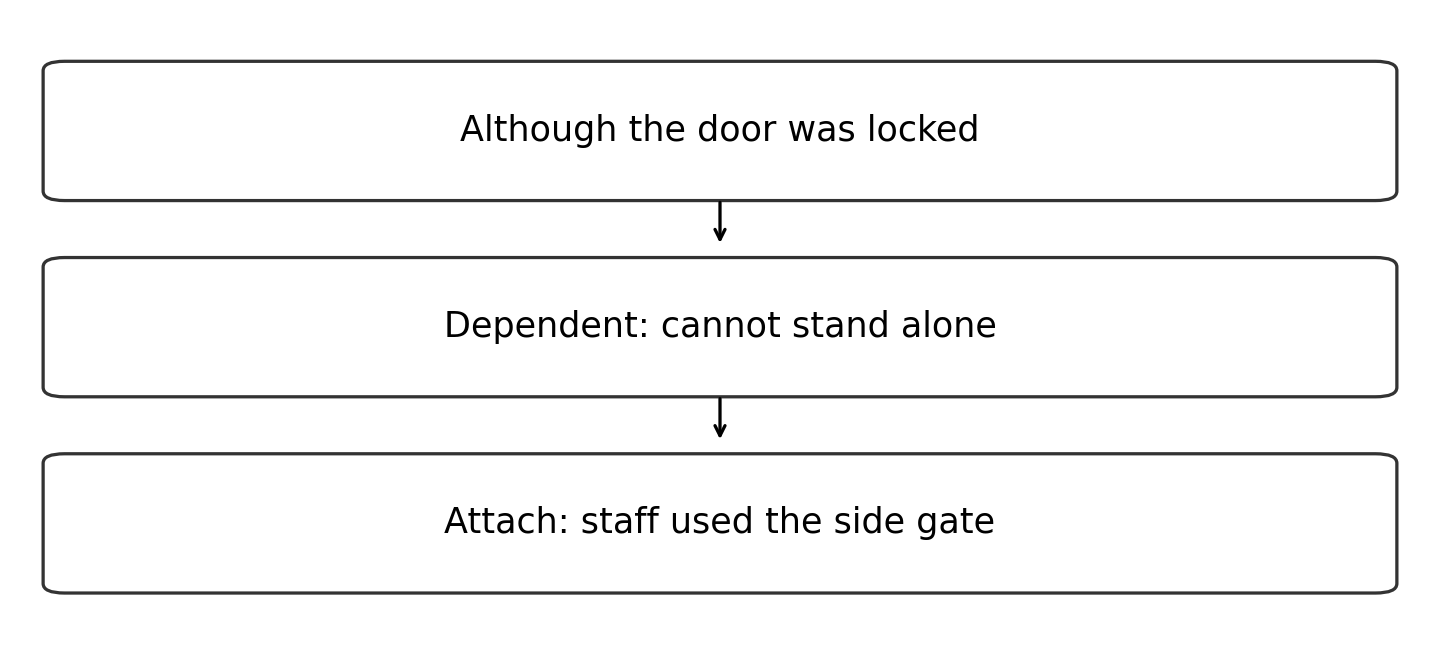
“Although the door was locked”은 종속적이므로 완전한 절에 붙여야 합니다.
“Although the door was locked, staff could enter through the side gate.”
콜론은 완전한 서두 절 뒤에 옵니다: “Staff used one entrance: the side gate.”
원본worked 관계 도식; 전체 문구 및 조건을 읽으십시오.
기존 풀이 예시: The sensor failed; the team replaced it. 양쪽 모두 주어와 동사가 있으므로 세미콜론이 적절합니다. “Because the sensor failed; the team replaced it”는 틀렸습니다: because가 첫 부분을 종속적으로 만들기 때문입니다.
완전한 원문 맥락
원본 교정 passage: Although the old station was closed [1] its clock still worked. The mechanism was simple [2] however, repairing the hands required a specialist. One part needed replacement [3] the narrow axle behind the dial. The clock [4] which stood above the entrance [5] had become a meeting point. 이 연습에서는 시계가 하나뿐이며, which절은 불필요한 정보를 추가합니다.
독립 연습 및 검증된 추론
이 개요는 상세한 기술 순서 28, 29를 통해 완성됩니다. 해당 참고 자료와 시트를 순서대로 활용하십시오. 이 안내는 그 자료를 대체하지 않습니다.
이양 1
[1]–[5]에 부호를 삽입하십시오. [2]에는 최소 두 가지 유효한 경계를 제시하고 절 테스트를 설명하십시오.
추론: [1] 쉼표는 서두 종속절을 붙입니다. [2] 세미콜론이나 마침표, 메커니즘 절과 수리 절이 독립적이기 때문입니다; 마침표 뒤에는 However를 대문자로 시작합니다. [3] 콜론은 완전한 절 “One part needed replacement” 뒤에 오며 내용을 소개합니다. [4],[5] 짝쉼표는 명시된 불필요한 절을 표시하며, 일치하는 대시나 괄호도 가능합니다.
이양 2
“One part needed: a replacement”가 본문 중 유효한 콜론 문장과 다른 이유를 설명하십시오.
추론: Needed은 직접 목적어 “a replacement”를 필요로 하므로, 거기에 콜론을 두면 문법 단위가 끊깁니다. “One part needed replacement: the narrow axle”에서는 독립절이 이미 완성되어 있으며 설명이其后于其后 follows后。
이양 3
두 복원 대상을 유지하면서 “The clock, above the entrance, and the bell was restored”를 수정하십시오. 일치와 택 가능한 부호를 설명하십시오.
추론: “The clock above the entrance and the bell were restored.” 복합 주어에는 were를 사용합니다. “above the entrance” 주위를 쉼표로 감쌀 수 있으나, 이는 식별적이지 않고 보조적인 경우에만 해당하며, 복합 주어의 일치 자체는 변하지 않습니다.
한계 및 향후 활용법
긴 명사 구절이 주위를 숨길 수 있습니다. 가장 가까운 명사와 일치하도록 동사를 선택하지 마십시오.
여기에 있는 모든 과제는 공식 질문이나 신규 진단이 아닌, 작성자 지침이 포함된 공개 원본 연습입니다. 기존 보호되는 시험 및 모의고사는 별도로 분류됩니다.
Digital SAT framework; original paper practice is nonadaptive and gives no scaled-score prediction.
Solve linear equations and inequalities in one variable
Represent and solve two-variable linear systems
Interpret linear functions and parameters in context
Prerequisites: Collect like terms; substitute ordered pairs; signed arithmetic.
Explain and choose the method
Write a variable definition with units before an equation. The intercept 截距 represents an initial amount.
A linear slope 斜率 is change in output divided by change in input. Keep both quantities in the right order.
Solve systems by substitution or elimination. A solution must satisfy both equations.
An inequality reverses direction when multiplied or divided by a negative number. Test a value to check the final region.
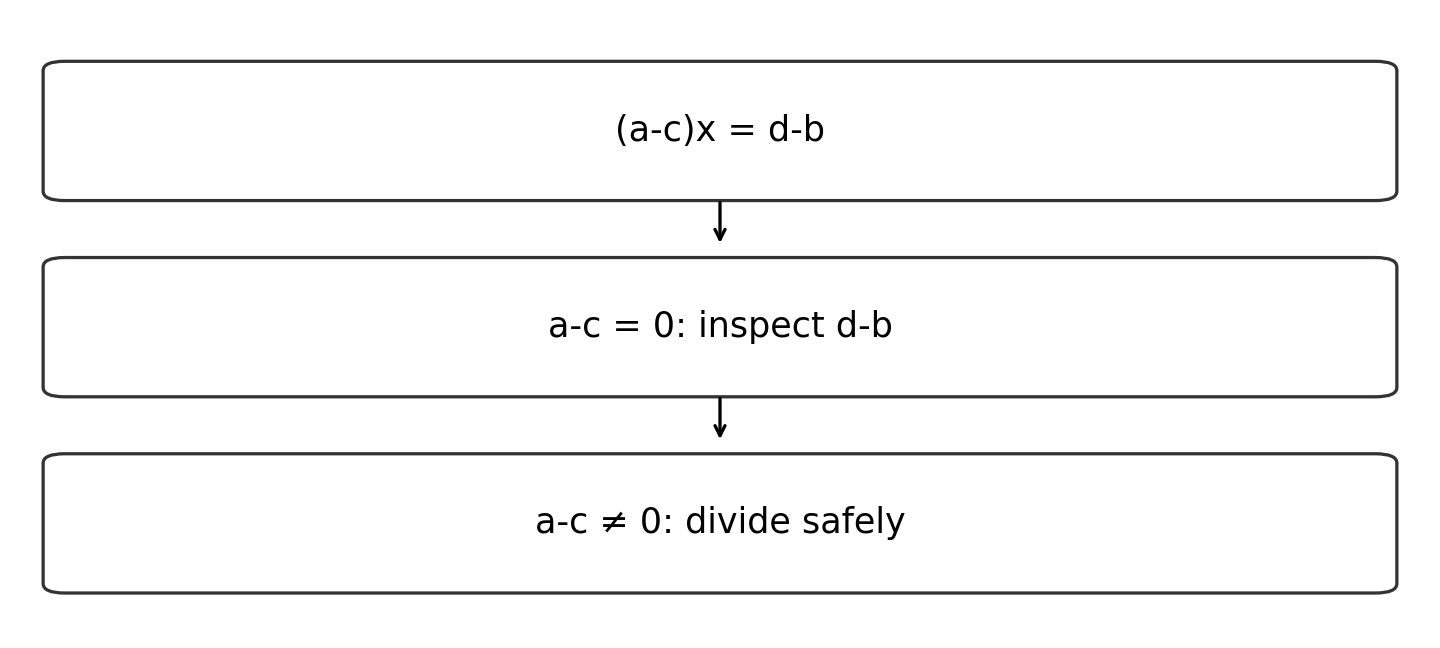
An identity holds for every permitted input. Start with $ax+b=cx+d$.
Collect terms: $(a-c)x=d-b$. Inspect $a-c$ before dividing.
If $a=c$ and $b=d$, every real input works. If only $a=c$, no input works.
Otherwise $x=(d-b)/(a-c)$ gives one solution.
Original worked example from existing native teaching; transfer tasks use their own data.
Existing worked example: Let f be the fixed fee and r the cost per kilometre. f+3r=11 and f+7r=19. Subtract the equations: 4r=8, so r=2. Then f=11−3(2)=5. Both journeys fit; the fixed fee is 5.
Complete original context
Every transfer question states all data it needs.
Independent practice and checked reasoning
This overview is completed through the detailed skill sequence: 9. Work those references and sheets in order; this orientation does not replace them.
Transfer 1
Classify the solutions of $(p-1)x+3=2x+p$ for every real $p$.
Reasoning: Collect terms to get $(p-3)x=p-3$. At $p=3$, the equation is $0=0$, so every real $x$ works. At $p\ne3$, divide by $p-3$ to get $x=1$. There is no value of $p$ giving no solution. Substitution of $x=1$ gives $p+2$ on both sides.
Transfer 2
A hire charge $C$ yuan has a fixed fee $f$ yuan and rate 速率$r$ yuan per hour. Three hours cost 31 yuan; seven hours cost 59 yuan. Find $f,r$ and the greatest affordable whole number of hours with 80 yuan.
Reasoning: Use $C=f+rt$. The equations are $31=f+r(3\,\mathrm{h})$ and $59=f+r(7\,\mathrm{h})$. Subtract: $r=(59-31)\,\mathrm{yuan}/(7-3)\,\mathrm{h}=7\,\mathrm{yuan/h}$. Then $f=31\,\mathrm{yuan}-(7\,\mathrm{yuan/h})(3\,\mathrm{h})=10\,\mathrm{yuan}$. Budget: $10+7t\le80$, so $t\le10$ hours. Ten whole hours is affordable; eleven costs 87 yuan.
Transfer 3
Describe all points satisfying $y>2x-1$ and $y\le-x+5$. Is $(2,3)$ included? State the possible $x$-values.
Reasoning: The first boundary is dashed and the second solid. The common region is above the first line and on or below the second. At $(2,3)$ the first condition is $3>3$, which fails. For the vertical interval to exist, $2x-1<-x+5$, hence $x<2$. The lines meet at $(2,3)$ but their meeting point is excluded.
Limits and next use
The intercept is not always the actual starting value if zero lies outside the model’s stated domain.
All tasks here are public original practice with authored guidance. They are not official questions or fresh diagnostics. Existing protected tests and mocks remain separate.
Digital SAT framework; original paper practice is nonadaptive and gives no scaled-score prediction.
Transform equivalent polynomial and rational expressions
Solve nonlinear equations and systems
Interpret quadratic and exponential functions
Prerequisites: Distributive law; difference of squares; real square roots.
Explain and choose the method
Factor a quadratic when possible. The zero-product rule applies to a product equal to zero.
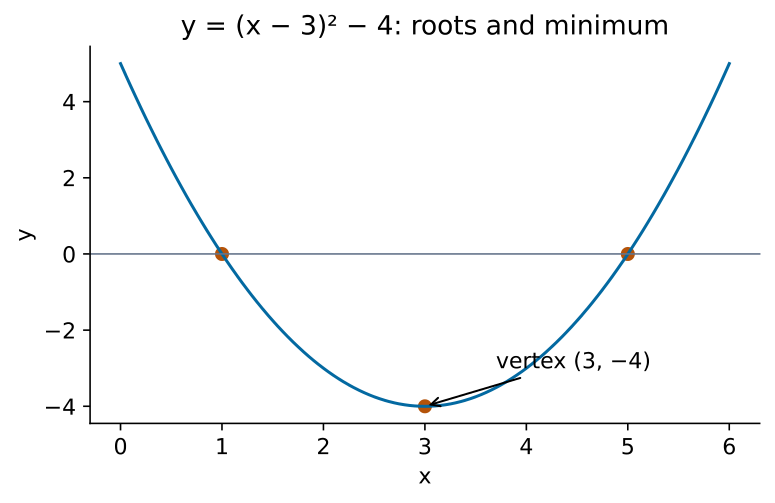
Completing the square reveals a vertex: x²−6x+5=(x−3)²−4.
For rational expressions, record excluded denominator values before cancelling factors.
An exponential model multiplies by a fixed factor per interval. A 20% increase means multiply by 1.2, not add 0.2.
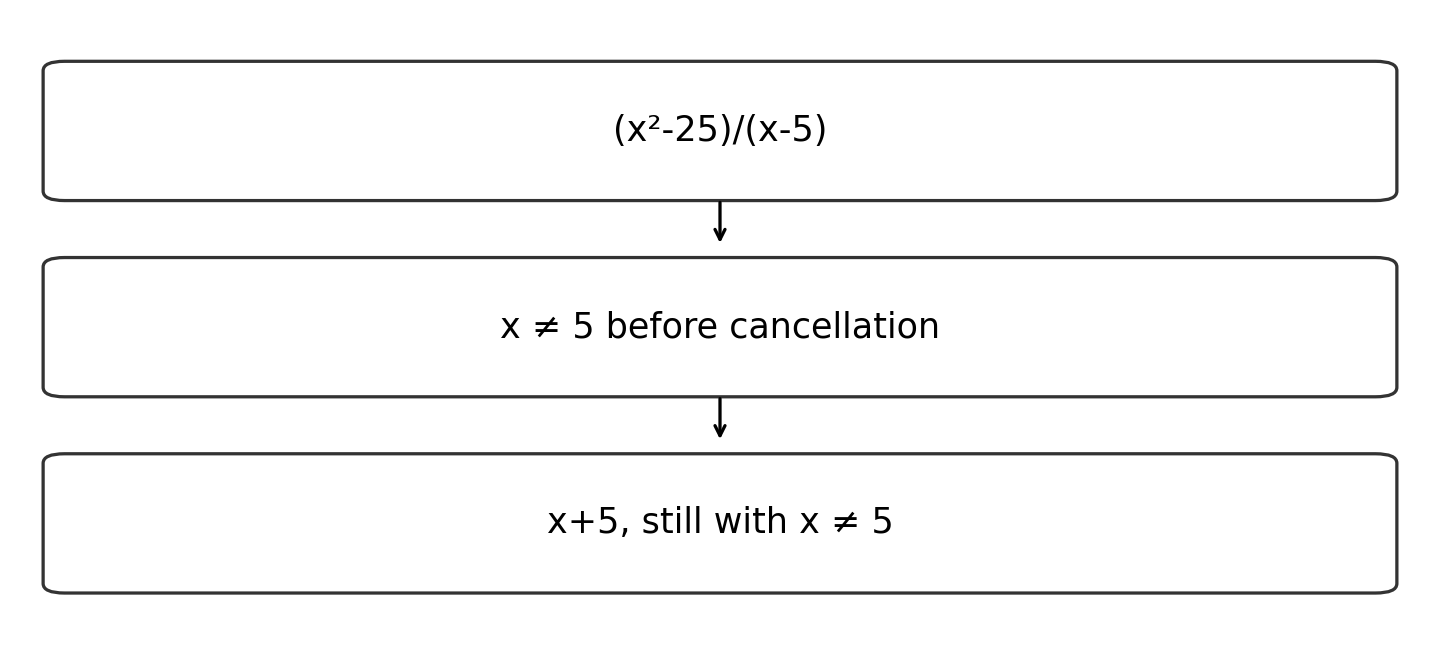
Equivalent expressions 等价表达式 must agree on the stated domain 定义域 .
$E(x)=(x^2-25)/(x-5)=(x+5)$ only for $x\ne5$.
Cancellation removes a factor, but it cannot restore an excluded input.
Also $\sqrt{x^2}=|x|$, because the principal square root 根 cannot be negative.
Original worked example from existing native teaching; transfer tasks use their own data.
Existing worked example: Solve x²−5x+6=0. Factor: (x−2)(x−3)=0. Thus x=2 or 3. If instead (x²−5x+6)/(x−2)=0, x=2 is excluded; only 3 remains.
Complete original context
Every transfer question states all data it needs.
Independent practice and checked reasoning
This overview is completed through the detailed skill sequence: 10, 11, 12. Work those references and sheets in order; this orientation does not replace them.
Transfer 1
Simplify $F(x)=(x^2-4x)/(x^2-16)$. State every original restriction and explain why $F$ is not identical to $x/(x+4)$ on that latter formula's whole domain.
Reasoning: Factor numerator $x(x-4)$ and denominator $(x-4)(x+4)$. The original domain excludes $x=4,-4$. Cancellation gives $F(x)=x/(x+4)$ for $x\ne4,-4$. The latter formula alone permits $4$, where it gives $1/2$, while $F(4)$ is undefined.
Transfer 2
Find the coefficient of $x$ in $(3x-2)(x+5)$ and evaluate $\sqrt{(x-5)^2}$ when $x=1$.
Reasoning: Expansion gives $3x^2+15x-2x-10=3x^2+13x-10$, so the coefficient is 13. The root is $|x-5|$; at $x=1$, it is $|-4|=4$, not $-4$ or 16.
Transfer 3
A student tests $x=2$ and concludes that $x^2$ and $2x$ are equivalent. Refute the conclusion and solve where they actually agree.
Reasoning: At $x=3$ the outputs are 9 and 6, so one matching test is not proof. Solve $x^2=2x$ as $x(x-2)=0$, giving only $x=0,2$.
Limits and next use
Squaring an equation can add extraneous roots. Substitute into the original equation, not just the transformed one.
All tasks here are public original practice with authored guidance. They are not official questions or fresh diagnostics. Existing protected tests and mocks remain separate.
Digital SAT framework; original paper practice is nonadaptive and gives no scaled-score prediction.
Use ratios, rates and percentages
Interpret distributions and compare centre and spread
Calculate probabilities and assess sample claims
Prerequisites: Fractions; unit conversion; percentage base.
Explain and choose the method
Percent change uses the original value as the denominator. Percentage points compare percentages directly.
Convert units explicitly. A rate 速率 denominator describes the amount of time or distance used.
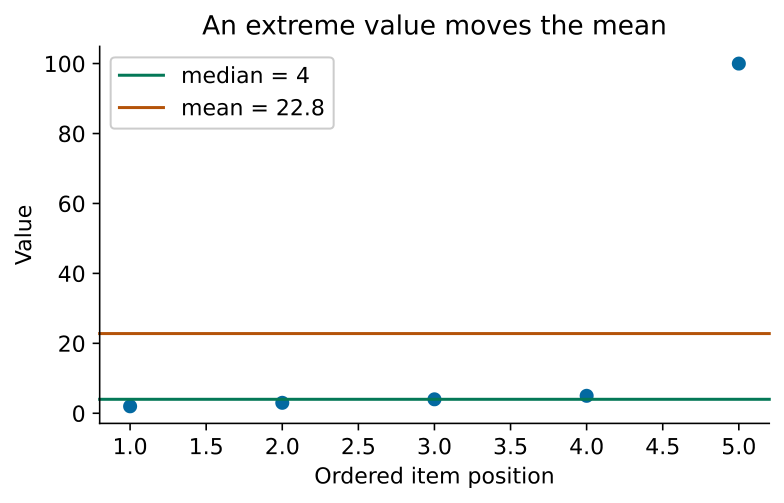
The median 中位数 resists extreme values more than the mean. Spread describes variation, not the average.
A random sample 随机样本 supports generalisation to its sampling population. Random assignment concerns causal comparison, a different issue.
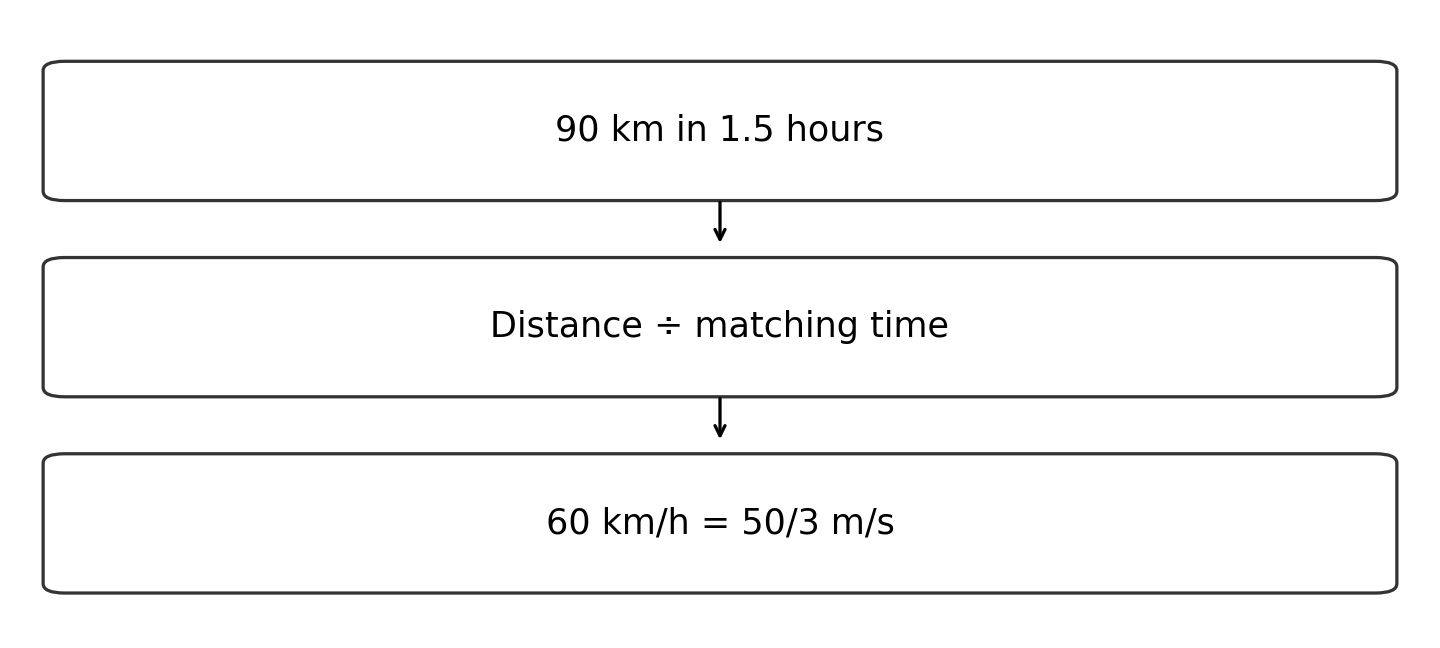
A rate compares quantities with their units.
$v=d/t=(90\,\mathrm{km})/(1.5\,\mathrm{h})=60\,\mathrm{km/h}$.
Convert using cancelling units: $v=(60\,\mathrm{km/h})(1000\,\mathrm{m/km})/(3600\,\mathrm{s/h})=50/3\,\mathrm{m/s}$.
Do not convert only the numerator of a compound rate.
Original worked example from existing native teaching; transfer tasks use their own data.
Existing worked example: A price of 80 falls by 20%: 80×0.8=64. It then rises by 20%: 64×1.2=76.8. The final value is below 80 because the two percentage changes use different bases.
Complete original context
Every transfer question states all data it needs.
Independent practice and checked reasoning
This overview is completed through the detailed skill sequence: 13, 14, 15, 16, 17. Work those references and sheets in order; this orientation does not replace them.
Transfer 1
Mix red and blue paint in ratio 4:7 to make 33 litres. Find each amount. Red paint costs 18 yuan per litre and blue 12. Find total cost.
Reasoning: There are 11 parts, so each is 3 L. Red volume $V_r=33(4/11)=12\,\mathrm{L}$; blue volume $V_b=33(7/11)=21\,\mathrm{L}$. Cost $C=p_rV_r+p_bV_b=(18\,\mathrm{yuan/L})(12\,\mathrm{L})+(12\,\mathrm{yuan/L})(21\,\mathrm{L})=468\,\mathrm{yuan}$.
Transfer 2
A 400-yuan item falls 15% then rises 10%. Find the final price and the single overall percentage change.
Reasoning: Use successive multipliers. $P=P_0(1-0.15)(1+0.10)=(400\,\mathrm{yuan})(0.85)(1.10)=374\,\mathrm{yuan}$. Relative change $r=(P-P_0)/P_0=(374-400)/400=-0.065$, a 6.5% decrease.
Transfer 3
A pump supplies 0.15 litres per second. How long does 54 litres take? If a square has side 30 cm, give its area in square metres.
Reasoning: $t=V/q=(54\,\mathrm{L})/(0.15\,\mathrm{L/s})=360\,\mathrm{s}=6\,\mathrm{min}$. Convert side before squaring: $A=s^2=(0.30\,\mathrm{m})^2=0.09\,\mathrm{m^2}$; the area conversion factor is 10000, not 100.
Limits and next use
A sample from volunteers is not automatically representative, even when it is large.
All tasks here are public original practice with authored guidance. They are not official questions or fresh diagnostics. Existing protected tests and mocks remain separate.
Similarity preserves corresponding angles and length ratios. Areas scale by k² and volumes by k³.
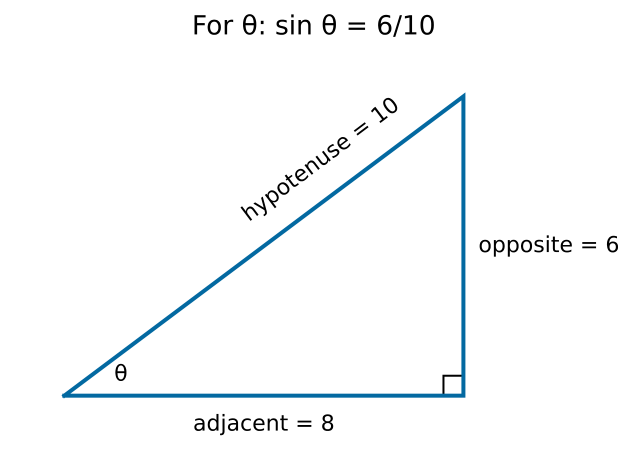
For a right triangle, sin is opposite/hypotenuse, cos adjacent/hypotenuse, and tan opposite/adjacent.
A circle with centre (h,k) and radius r has (x−h)²+(y−k)²=r².
A full turn is 360° or 2π radians. Arc length 弧长 is rθ only when θ is in radians.
A scale factor 比例因子$k$ changes every corresponding length.
$A_2=k^2A_1$ and $V_2=k^3V_1$ for similar shapes.
If $k=3/2$ and $A_1=24\,\mathrm{cm^2}$, $A_2=(3/2)^2(24\,\mathrm{cm^2})=54\,\mathrm{cm^2}$.
Changing only one dimension does not justify these similarity rules.
Original worked example from existing native teaching; transfer tasks use their own data.
Existing worked example: A right triangle has legs 6 and 8. c²=6²+8²=100, so c=10. For the angle opposite 6, sin θ=6/10=0.6. A similar triangle enlarged by factor 3 has area nine times the original.
Complete original context
Every transfer question states all data it needs.
Independent practice and checked reasoning
This overview is completed through the detailed skill sequence: 18, 19. Work those references and sheets in order; this orientation does not replace them.
Transfer 1
Similar containers have surface areas 96 and 216 square centimetres. The smaller volume is 160 cubic centimetres. Find the larger volume.
Reasoning: $k=\sqrt{A_2/A_1}=\sqrt{216/96}=3/2$. Volume uses the cube: $V_2=k^3V_1=(3/2)^3(160\,\mathrm{cm^3})=540\,\mathrm{cm^3}$. Using area ratio directly would give the wrong volume.
Transfer 2
A right triangle has hypotenuse 13 cm and one leg 5 cm. Find the other leg, its area, and the sine of the angle opposite the 5 cm leg.
Two interior angles of a triangle are 42° and 73°. Find the third angle and its adjacent exterior angle. Would those angles alone determine all side lengths?
Reasoning: Third angle is $180-42-73=65$ degrees. Its adjacent exterior angle is $180-65=115$ degrees, also $42+73$. Angles establish shape, not scale; similar triangles can have different side lengths.
Transfer 4
Two parallel lines are cut by a transversal. One corresponding angle is 68°. Find its matching corresponding angle and the adjacent angle on the second line. Explain which given condition justifies each step.
Reasoning: Parallelism gives the matching corresponding angle 68°. The adjacent pair forms a straight angle, so the other is 180°−68°=112°. Equal corresponding angles require the stated parallel lines; the straight-angle sum uses adjacency on one line. A similar-looking sketch without parallelism would not justify the first equality.
Limits and next use
Radius and diameter differ by a factor of two. Using diameter in πr² makes the area four times too large.
All tasks here are public original practice with authored guidance. They are not official questions or fresh diagnostics. Existing protected tests and mocks remain separate.
Digital SAT framework; original paper practice is nonadaptive and gives no scaled-score prediction.
Solve and classify one-variable linear equations with parameters
Interpret two-variable linear equations as sets of ordered pairs
Interpret slope and intercept of a contextual linear function
Classify two-equation linear systems and check their intersections
Represent strict and inclusive inequalities in one or two variables
Prerequisites: Collect like terms; substitute ordered pairs; signed arithmetic.
Explain and choose the method
Collect variable terms and constants separately. An equation ax+b=cx+d becomes (a-c)x=d-b. If a-c is nonzero there is one solution; if both sides reduce to zero there are infinitely many; if the variable coefficient is zero but the constant is nonzero there are none. Never divide by a parameter before checking whether it can be zero.
A two-variable equation gives a set of ordered pairs. In y=mx+b, m is the change in y per unit x and b is y at x=0. For a contextual model, attach units to both: a taxi charge C=3t+5 has a 5-unit initial fee and 3 units per time unit. The intercept may be outside the practical domain even when it exists algebraically.
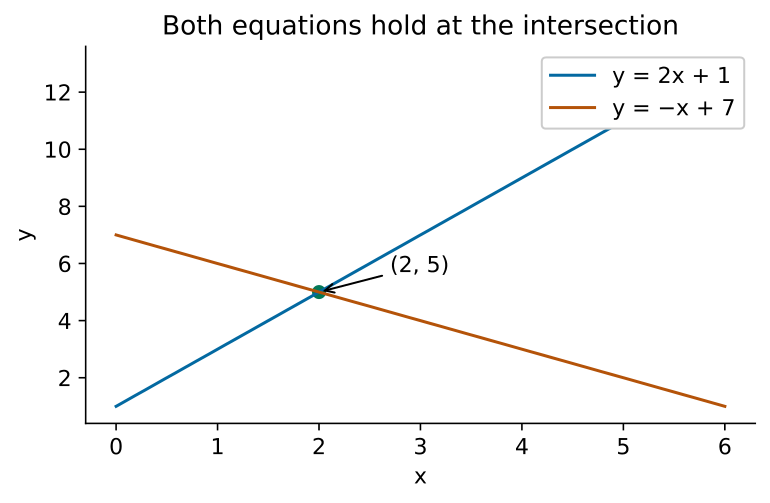
For a system, compare both coefficients and constants. Multiplying one whole equation by a nonzero number produces the same line; matching variable coefficients with different constants gives parallel distinct lines. Otherwise an intersection supplies the pair satisfying both equations. Substitute the pair into both original equations to check it.
Multiplying or dividing an inequality by a negative number reverses its direction. A strict inequality excludes the boundary, while ≤ or ≥ includes it. For two variables, draw the corresponding line and test a point away from it to identify the allowed half-plane. The diagram is a representation of all solutions, not a single preferred point.
An identity 恒等式 holds for every permitted input. Start with $ax+b=cx+d$.
Collect terms: $(a-c)x=d-b$. Inspect $a-c$ before dividing.
If $a=c$ and $b=d$, every real input works. If only $a=c$, no input works.
Otherwise $x=(d-b)/(a-c)$ gives one solution.
Original diagram of the worked relationship; read the full wording and qualifications.
Existing worked example: For kx+6=2x+6, k=2 gives 0=0 and infinitely many solutions; k≠2 gives x=0. For -2x+3<11, subtract 3 and divide by -2 to get x>-4. For y≤2x+1, (0,0) works and the solid boundary is included. The system 2x+4y=10 and x+2y=6 has no solution because doubling the second gives the same left side equal to 12, not 10.
Complete original context
Every transfer question states all data it needs.
Independent practice and checked reasoning
Transfer 1
Classify the solutions of $(p-1)x+3=2x+p$ for every real $p$.
Reasoning: Collect terms to get $(p-3)x=p-3$. At $p=3$, the equation is $0=0$, so every real $x$ works. At $p\ne3$, divide by $p-3$ to get $x=1$. There is no value of $p$ giving no solution. Substitution of $x=1$ gives $p+2$ on both sides.
Transfer 2
A hire charge $C$ yuan has a fixed fee $f$ yuan and rate 速率$r$ yuan per hour. Three hours cost 31 yuan; seven hours cost 59 yuan. Find $f,r$ and the greatest affordable whole number of hours with 80 yuan.
Reasoning: Use $C=f+rt$. The equations are $31=f+r(3\,\mathrm{h})$ and $59=f+r(7\,\mathrm{h})$. Subtract: $r=(59-31)\,\mathrm{yuan}/(7-3)\,\mathrm{h}=7\,\mathrm{yuan/h}$. Then $f=31\,\mathrm{yuan}-(7\,\mathrm{yuan/h})(3\,\mathrm{h})=10\,\mathrm{yuan}$. Budget: $10+7t\le80$, so $t\le10$ hours. Ten whole hours is affordable; eleven costs 87 yuan.
Transfer 3
Describe all points satisfying $y>2x-1$ and $y\le-x+5$. Is $(2,3)$ included? State the possible $x$-values.
Reasoning: The first boundary is dashed and the second solid. The common region is above the first line and on or below the second. At $(2,3)$ the first condition is $3>3$, which fails. For the vertical interval to exist, $2x-1<-x+5$, hence $x<2$. The lines meet at $(2,3)$ but their meeting point is excluded.
Limits and next use
Do not confuse x=0 with a vanished variable coefficient, reverse only when multiplying/dividing by a negative, or shade a half-plane from the line’s slope alone.
All tasks here are public original practice with authored guidance. They are not official questions or fresh diagnostics. Existing protected tests and mocks remain separate.
Digital SAT framework; original paper practice is nonadaptive and gives no scaled-score prediction.
Factor 因式 and expand expressions without changing their values
Simplify rational and radical expressions on the original domain
Use expression structure to identify zeros and coefficients
Prerequisites: Distributive law; difference of squares; real square roots.
Explain and choose the method
Expansion distributes each factor across the others; factorisation reverses that process. x²-5x+6=(x-2)(x-3), so the product form exposes zeros while the expanded form exposes coefficients. Choose the form that serves the question rather than treating one representation as always preferable.
Cancel factors, never terms in a sum. (x²-4)/(x-2) becomes x+2 only for x≠2, because the original expression is undefined at 2. A restriction may remain after every denominator disappears from the simplified formula. State it before cancelling, then carry it through comparisons or equation solving.
Exponent rules depend on their setting: a^m a^n=a^(m+n) and (a^m)^n=a^(mn) in the permitted real domain. Negative exponents form reciprocals and require nonzero bases. With real square roots, √(x²)=|x|, because the principal square root is nonnegative; it is not x for every real x.
To check equivalence, a numerical substitution can expose a mistake, but one matching value does not prove two expressions equal. A valid algebraic identity plus matching domain does. When the question requests a coefficient, expand only as far as needed and account for every contribution to that power.
Equivalent expressions 等价表达式 must agree on the stated domain .
$E(x)=(x^2-25)/(x-5)=(x+5)$ only for $x\ne5$.
Cancellation removes a factor, but it cannot restore an excluded input.
Also $\sqrt{x^2}=|x|$, because the principal square root cannot be negative.
Original diagram of the worked relationship; read the full wording and qualifications.
Existing worked example: (x²-9)/(x-3)=(x-3)(x+3)/(x-3)=x+3 for x≠3. At x=3 the original is undefined. For x=-5, √(x²)=5=|x|. In (2x+1)(x-4), the x coefficient is -8+1=-7 and the full expression is 2x²-7x-4.
Complete original context
Every transfer question states all data it needs.
Independent practice and checked reasoning
Transfer 1
Simplify $F(x)=(x^2-4x)/(x^2-16)$. State every original restriction and explain why $F$ is not identical to $x/(x+4)$ on that latter formula's whole domain.
Reasoning: Factor numerator $x(x-4)$ and denominator $(x-4)(x+4)$. The original domain excludes $x=4,-4$. Cancellation gives $F(x)=x/(x+4)$ for $x\ne4,-4$. The latter formula alone permits $4$, where it gives $1/2$, while $F(4)$ is undefined.
Transfer 2
Find the coefficient of $x$ in $(3x-2)(x+5)$ and evaluate $\sqrt{(x-5)^2}$ when $x=1$.
Reasoning: Expansion gives $3x^2+15x-2x-10=3x^2+13x-10$, so the coefficient is 13. The root is $|x-5|$; at $x=1$, it is $|-4|=4$, not $-4$ or 16.
Transfer 3
A student tests $x=2$ and concludes that $x^2$ and $2x$ are equivalent. Refute the conclusion and solve where they actually agree.
Reasoning: At $x=3$ the outputs are 9 and 6, so one matching test is not proof. Solve $x^2=2x$ as $x(x-2)=0$, giving only $x=0,2$.
Limits and next use
A simplified formula is not automatically an equivalent function on a larger domain; cancelling terms across addition is invalid.
All tasks here are public original practice with authored guidance. They are not official questions or fresh diagnostics. Existing protected tests and mocks remain separate.
Use structure before expanding. A factored quadratic equals zero when at least one factor is zero. An absolute-value equation |u|=a has no real solution for a<0, one condition u=0 when a=0 and two conditions u=±a when a>0. Account for all allowed cases, not just the positive branch.
For a rational equation, exclude denominator zeros before multiplying through. Multiplication may create a candidate at an excluded value. For a radical equation, note that a principal square root is nonnegative, isolate it and square carefully. Squaring is a one-way implication until every resulting candidate is checked in the original.
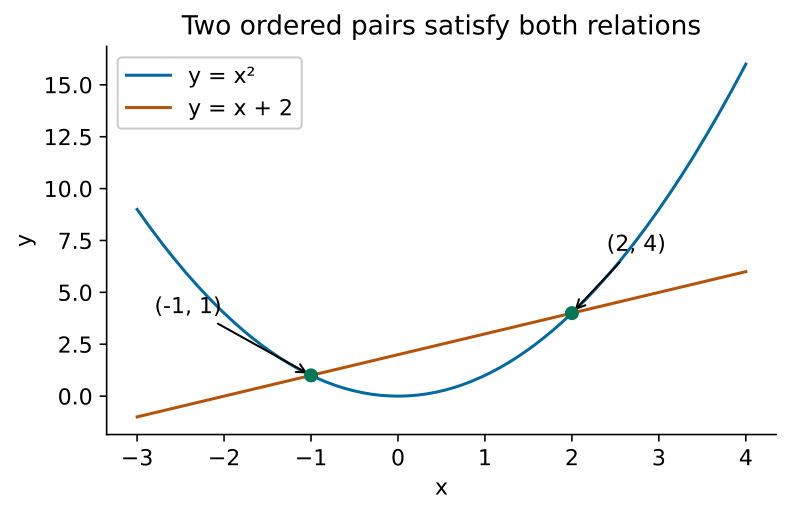
To solve a line–parabola 抛物线 system, substitute the line expression into the quadratic. The real roots give x-values; use the line to recover each y. No real root means no real intersection 交点. A repeated quadratic root gives tangency, while two different real roots give two intersections.
A graph or calculator can help locate candidates and check scale, but rounded intersections are not exact proof when the question asks an exact value or solution count. Relate graphical behaviour to the algebraic equation. A double root should not be counted twice as two different ordered pairs.
A candidate root 候选根 must satisfy the original equation.
In $\sqrt{x+6}=x$, the right side must be nonnegative.
Squaring gives $x^2-x-6=0$, so candidates are $3,-2$.
Only $3$ survives the original check: $\sqrt9=3$.
Original worked example from existing native teaching; transfer tasks use their own data.
Existing worked example: √(x+2)=x requires x≥0. Squaring yields x²-x-2=0, so x=2 or -1; only 2 works in the original. For y=x+2 and y=x², solve x²-x-2=0: x=2,-1, giving (2,4) and (-1,1). For |2x-1|=5, solve 2x-1=5 or -5 to obtain x=3 or -2.
Complete original context
Every transfer question states all data it needs.
Independent practice and checked reasoning
Transfer 1
Solve $\sqrt{2x+3}=x$ over the real numbers, showing why any candidate is rejected.
Reasoning: Require $x\ge0$. Squaring yields $x^2-2x-3=(x-3)(x+1)=0$. Candidates are 3 and -1. The original gives $\sqrt9=3$ at 3, but $\sqrt1=1\ne-1$ at -1. Only $x=3$ works.
Transfer 2
Solve simultaneously $y=x+2$ and $y=(x-1)^2$. Give exact ordered pairs and verify the number of intersections.
Reasoning: Equate outputs to get $x+2=x^2-2x+1$, or $x^2-3x-1=0$. Thus $x=(3\pm\sqrt{13})/2$ and $y=(7\pm\sqrt{13})/2$ with matching signs. The discriminant 13 is positive, so there are two distinct real intersections; both expressions for $y$ agree by the derived equation.
Transfer 3
Solve $|3x+2|=7$ and $(x^2-9)/(x-3)=6$. Explain why these equations have different solution counts.
Reasoning: The absolute value gives $3x+2=7$ or $-7$, hence $x=5/3$ or $-3$. The rational equation requires $x\ne3$ and simplifies to $x+3=6$, whose sole candidate 3 is excluded. It has no solution.
Limits and next use
Do not report every root of a transformed equation before checking the original restriction and branch.
All tasks here are public original practice with authored guidance. They are not official questions or fresh diagnostics. Existing protected tests and mocks remain separate.
Digital SAT framework; original paper practice is nonadaptive and gives no scaled-score prediction.
Interpret zeros, vertices and parameters from useful function forms
Distinguish additive linear change from multiplicative exponential change
Transform a graph while tracking its input and output
Prerequisites: Function notation; squares; growth multipliers.
Explain and choose the method
Vertex form 顶点式 a(x-h)²+k identifies the vertex (h,k) and opening direction; factored form identifies zeros. The same function can have both forms. In context, determine which features are meaningful: a maximum height occurs at the vertex of a downward parabola 抛物线, while a zero can represent returning to ground level.
For y=A b^t, A is the value at t=0 and b is the factor per unit time. A growth rate 速率 r gives b=1+r; decay gives b=1-r. Equal differences indicate a linear model, while equal ratios indicate an exponential model for equal input steps. Neither model should be extrapolated beyond a justified domain without a contextual reason.
An output shift f(x)+k moves every point vertically by k. An input shift f(x-h) moves the graph right by h: the same old input is reached when the new x is larger. A multiplier outside scales output; a negative outside reflects across the x-axis. Determine the transformation 转化 algebraically instead of memorising a direction without checking a point.
For an exponential factor given over several time units, distinguish that interval from one unit. Doubling every three hours means 2^(t/3), not 2^t. For a quadratic, use the requested representation to read an extremum or solve for an input. Keep initial values, growth factors and growth percentages separate.
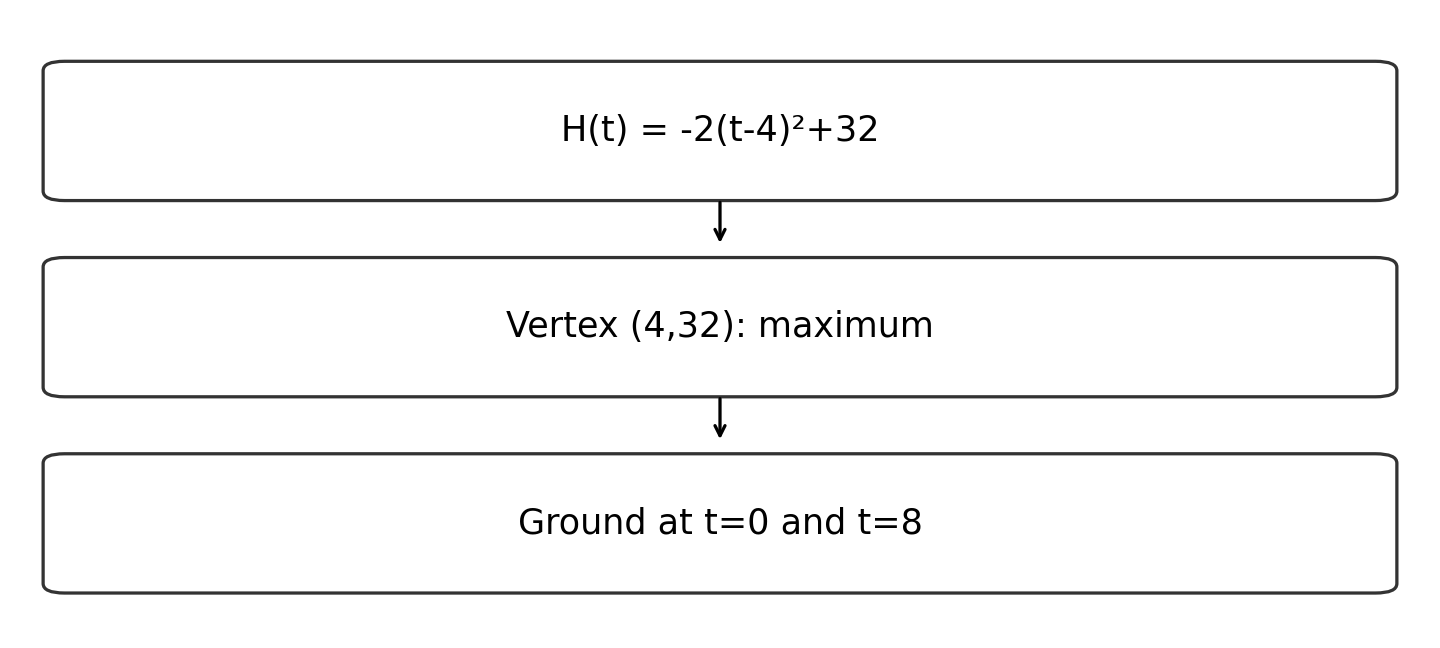
Vertex form $a(x-h)^2+k$ reveals the turning point $(h,k)$.
For $H(t)=-2(t-4)^2+32$, the maximum is 32 when $t=4$.
Setting $H(t)=0$ gives $(t-4)^2=16$, hence $t=0,8$.
Restrict time to the physical interval when the problem represents a flight.
Original diagram of the worked relationship; read the full wording and qualifications.
Existing worked example: h(t)=-4(t-3)²+36 has a maximum 36 at t=3, with zeros t=0 and 6. N(t)=80(1.25)^t starts at 80 and grows 25% per unit; N(2)=125. A quantity doubling every three hours is 80·2^(t/3), so after six hours it is 320. If f(x)=x², f(x-2)+5 has vertex (2,5).
Complete original context
Every transfer question states all data it needs.
Independent practice and checked reasoning
Transfer 1
A model height is $H(t)=-3(t-2)^2+12$ metres, with $t$ seconds from launch until return to ground. Find the domain, greatest height, and time interval with height at least 9 metres.
Reasoning: Ground means $H=0$, so $(t-2)^2=4$ and $t=0,4$. Domain is $0\le t\le4\,\mathrm{s}$. The negative square coefficient gives maximum $H(2)=12\,\mathrm{m}$. For $H\ge9\,\mathrm{m}$, $(t-2)^2\le1$, so $1\le t\le3\,\mathrm{s}$.
Transfer 2
A culture model starts with 120 cells and grows by a factor of 1.5 every two hours. Write $N(t)$ for hours $t$, find $N(4)$, and distinguish factor from percentage growth.
Reasoning: $N(t)=120(1.5)^{t/2}$ cells. $N(4)=120(1.5)^2=270$ cells. The growth is 50% per two hours, not 150%; the four-hour factor is 2.25. The hourly factor would be $\sqrt{1.5}$.
Transfer 3
If $f(x)=(x+1)^2$, find the vertex of $g(x)=-2f(x-3)+5$ and its maximum or minimum.
Reasoning: Substitute the input before interpreting signs. $g(x)=-2(x-2)^2+5$ has vertex $(2,5)$ and maximum 5. The old vertex at $-1$ moved three units right to 2.
Limits and next use
A 1.25 factor means 25% growth, not 125% growth; f(x-2) shifts right, and a repeated percentage uses the updated amount.
All tasks here are public original practice with authored guidance. They are not official questions or fresh diagnostics. Existing protected tests and mocks remain separate.
Digital SAT framework; original paper practice is nonadaptive and gives no scaled-score prediction.
Use proportional relationships while preserving units
Convert rates and distinguish direct from inverse relationships
Calculate successive changes and percentage comparisons using the correct base
Prerequisites: Fractions; unit conversion; percentage base.
Explain and choose the method
A ratio compares quantities in a chosen order. If red:blue=3:5 and the total is 64, the eight equal parts each contain eight, so red is 24 and blue 40. The ratio 3/5 describes red relative to blue; 3/8 describes red relative to the total. Read the requested denominator rather than using the first visible fraction.
A unit rate 速率 单位率 divides quantity by its corresponding time, distance or count. Write conversion factors so unwanted units cancel: 72 km/hour times 1000 m/km divided by 3600 s/hour is 20 m/s. Area and volume conversions square and cube the length factor. A one-centimetre square is not one metre squared divided by one hundred.
In direct proportion y=kx, doubling x doubles y; in inverse proportion xy=k, doubling x halves y. Constant work shared by identical workers gives an inverse time model only when productivity and conditions are fixed. A fixed initial fee added to a rate makes an affine linear model, not direct proportion through the origin.
A percentage change divides the change by the original comparison base. Successive percentage changes multiply their factors: a 20% discount followed by 20% increase gives 0.8·1.2=0.96 of the original. Distinguish percentage points from relative percent: 30% to 36% is six points, but a 20% relative increase.
A rate compares quantities with their units.
$v=d/t=(90\,\mathrm{km})/(1.5\,\mathrm{h})=60\,\mathrm{km/h}$.
Convert using cancelling units: $v=(60\,\mathrm{km/h})(1000\,\mathrm{m/km})/(3600\,\mathrm{s/h})=50/3\,\mathrm{m/s}$.
Do not convert only the numerator of a compound rate.
Original diagram of the worked relationship; read the full wording and qualifications.
Existing worked example: A 250-unit price discounted 20% becomes 200; increasing that result 20% gives 240, four percent below 250. A pump delivers 18 litres in 3 minutes, so its rate is 6 L/min or 0.1 L/s. At a fixed rate, 45 litres takes 7.5 minutes. If a share rises from 40% to 50%, the rise is 10 percentage points and 25% relative to the old share.
Complete original context
Every transfer question states all data it needs.
Independent practice and checked reasoning
Transfer 1
Mix red and blue paint in ratio 4:7 to make 33 litres. Find each amount. Red paint costs 18 yuan per litre and blue 12. Find total cost.
Reasoning: There are 11 parts, so each is 3 L. Red volume $V_r=33(4/11)=12\,\mathrm{L}$; blue volume $V_b=33(7/11)=21\,\mathrm{L}$. Cost $C=p_rV_r+p_bV_b=(18\,\mathrm{yuan/L})(12\,\mathrm{L})+(12\,\mathrm{yuan/L})(21\,\mathrm{L})=468\,\mathrm{yuan}$.
Transfer 2
A 400-yuan item falls 15% then rises 10%. Find the final price and the single overall percentage change.
Reasoning: Use successive multipliers. $P=P_0(1-0.15)(1+0.10)=(400\,\mathrm{yuan})(0.85)(1.10)=374\,\mathrm{yuan}$. Relative change $r=(P-P_0)/P_0=(374-400)/400=-0.065$, a 6.5% decrease.
Transfer 3
A pump supplies 0.15 litres per second. How long does 54 litres take? If a square has side 30 cm, give its area in square metres.
Reasoning: $t=V/q=(54\,\mathrm{L})/(0.15\,\mathrm{L/s})=360\,\mathrm{s}=6\,\mathrm{min}$. Convert side before squaring: $A=s^2=(0.30\,\mathrm{m})^2=0.09\,\mathrm{m^2}$; the area conversion factor is 10000, not 100.
Limits and next use
State which amount is the percentage base and cancel units visibly. Equal positive and negative percentage changes use different bases.
All tasks here are public original practice with authored guidance. They are not official questions or fresh diagnostics. Existing protected tests and mocks remain separate.
Digital SAT framework; original paper practice is nonadaptive and gives no scaled-score prediction.
Compare mean, median 中位数, range and standard deviation 标准差 qualitatively
Predict the effect of adding or multiplying every data value
Read frequency 频数 information without confusing values and counts
Prerequisites: Ordered data; frequency; mean and median.
Explain and choose the method
The mean uses the sum of all observations divided by their count; the median is the middle of the ordered observations. Frequency means a value repeats: if 2 occurs three times and 8 once, the mean is (3·2+8)/4=3.5, not (2+8)/2. The horizontal positions on a display are values and the frequencies determine how many observations they represent.
The range is maximum minus minimum; standard deviation describes typical distances from the mean. You need not memorise a full formula to compare simple equally centred distributions: data clustered close to the mean have smaller standard deviation than data moved further away symmetrically. An outlier can alter mean and spread substantially while leaving the median stable.
Adding c to every observation raises both mean and median by c but leaves range and standard deviation unchanged, because pairwise distances do not change. Multiplying every observation by a positive k multiplies mean, median, range and standard deviation by k. More generally spread scales by |k|, while a negative multiplier reverses ordering.
When comparing plots, inspect the scale and the number of observations before judging apparent width. A graph stretched horizontally can look more variable without representing different values. A claim about equality of standard deviations needs the actual distributions, not merely equal ranges or equal means.
A frequency counts repeated observations.
Values 1, 3, 7 with frequencies 2, 1, 1 represent four observations: 1, 1, 3, 7.
$\bar x=\sum fx/\sum f=(2(1)+1(3)+1(7))/4=3$.
The median is $(1+3)/2=2$; it need not equal the mean.
Original worked example from existing native teaching; transfer tasks use their own data.
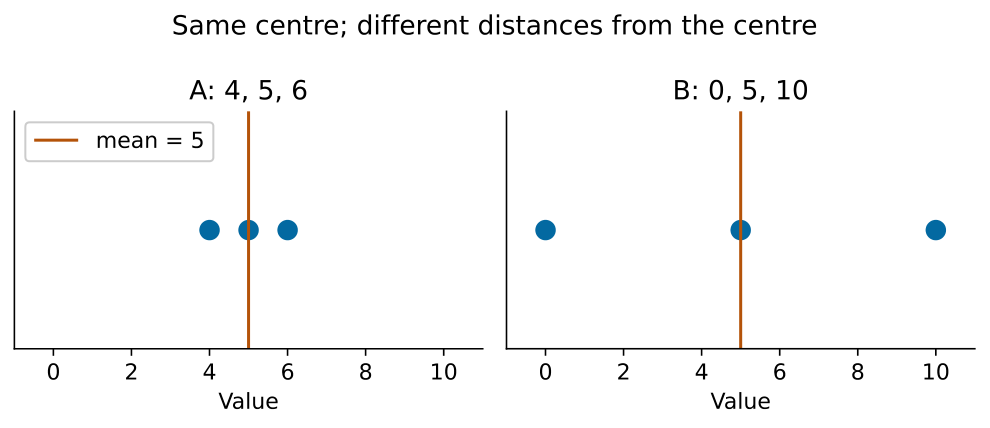
Existing worked example: A={4,5,6} and B={0,5,10} both have mean and median 5, but B has greater spread. Adding 7 gives A+7={11,12,13}, mean 12 and the same standard deviation as A. Multiplying A by 2 gives {8,10,12}; its mean is 10 and its range and standard deviation double. Equal range alone does not guarantee equal standard deviation.
Complete original context
Every transfer question states all data it needs.
Independent practice and checked reasoning
Transfer 1
Values 2, 5, 8 have frequencies 3, 2, 1. Find mean, median and range.
Reasoning: Data are 2,2,2,5,5,8. $\bar x=(3(2)+2(5)+1(8))/6=4$. Median is the average of positions 3 and 4, $(2+5)/2=3.5$. Range $R=8-2=6$.
Transfer 2
Every observation above is changed by $z=3x-4$. Find the new mean, median and range. State how standard deviation changes without computing it.
Reasoning: Mean $\bar z=3\bar x-4=3(4)-4=8$. Median is $3(3.5)-4=6.5$. Range is $3(6)=18$. Standard deviation triples; subtracting 4 changes no distance from the mean.
Transfer 3
Compare A = {0, 0, 10, 10} and B = {0, 5, 5, 10}. Both have range 10. Must their standard deviations agree? Justify.
Reasoning: Both means are 5. Every A observation is 5 from its mean; B distances are 5,0,0,5. B therefore has smaller mean squared deviation and smaller standard deviation. Equal range alone is insufficient.
Limits and next use
Do not average distinct category labels when frequencies differ, or confuse a shifted distribution with a more spread-out one.
All tasks here are public original practice with authored guidance. They are not official questions or fresh diagnostics. Existing protected tests and mocks remain separate.
Digital SAT framework; original paper practice is nonadaptive and gives no scaled-score prediction.
Interpret slope and intercept of a fitted model in context
Calculate a residual 残差 and distinguish interpolation from extrapolation 外推
Choose linear or exponential patterns from equal-step data
Prerequisites: Linear functions; signed subtraction; scatterplot labels.
Explain and choose the method
A scatterplot pairs two quantitative variables, one point per paired observation. A fitted line summarises a trend rather than connecting each point. In a model y=a+bx, b predicts the change in y for one-unit increase in x; its units are y-units per x-unit. The intercept a predicts y when x=0, which may lie outside the data range.
A residual is observed y minus predicted y. Positive means the observation lies above the model; negative means below. Substitute the observed x into the model before subtracting. A large residual marks a poor prediction for that point, not automatically an error in measurement or proof that the trend is absent.
Interpolation predicts inside the observed x-range; extrapolation goes beyond it and needs stronger caution because the relationship may change. Use a model’s contextual domain as well as its algebraic form. A negative predicted travel time, for example, can reveal an unjustified extrapolation rather than a physically possible outcome.
For equal input steps, nearly constant output differences suggest a linear model; nearly constant output ratios suggest an exponential model. Scatter can make either pattern approximate. Association does not identify a cause: both variables may reflect a third factor. A fitted trend is evidence 证据 about prediction, not by itself about intervention.
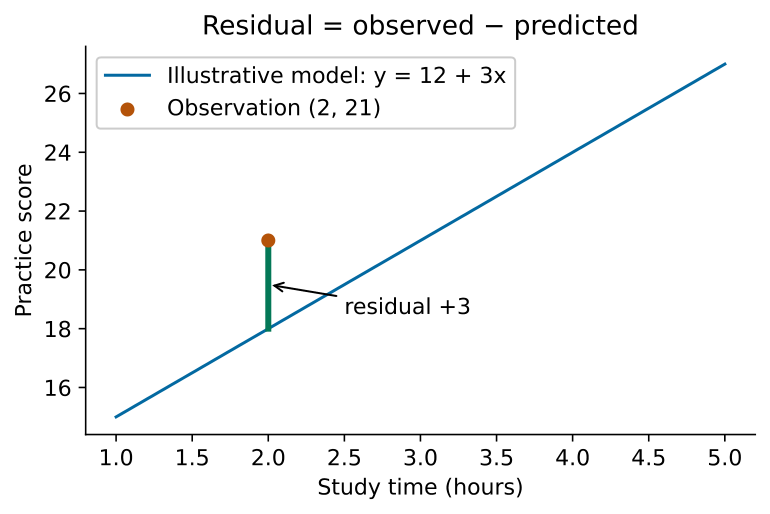
A residual is observed minus predicted output.
A journey model $T=5+2d$ uses minutes for $T$ and kilometres for $d$.
$T(4)=5\,\mathrm{min}+(2\,\mathrm{min/km})(4\,\mathrm{km})=13\,\mathrm{min}$.
For observed time 16 minutes, $e=T_{obs}-T_{pred}=16\,\mathrm{min}-13\,\mathrm{min}=3\,\mathrm{min}$.
Original worked example from existing native teaching; transfer tasks use their own data.
Existing worked example: For study time x hours and predicted practice score y=12+3x, the slope is 3 score points/hour. At x=2 the prediction is 18. If the observed score is 21, residual=21-18=3. With x-values observed from 1 to 5, predicting at x=3 interpolates and x=12 extrapolates. Outputs 5,10,20,40 at equal input steps suggest factor-two exponential growth.
Complete original context
Every transfer question states all data it needs.
Independent practice and checked reasoning
Transfer 1
A fitted delivery model is $T=8+1.5d$ minutes for observed distances 2–10 km. Interpret both parameters. At 6 km the observed time is 15 minutes; find its residual.
Reasoning: The intercept predicts 8 minutes at zero distance; zero lies outside the observed range, so this interpretation is extrapolated. The slope predicts an extra 1.5 minutes per kilometre. $T(6)=8\,\mathrm{min}+(1.5\,\mathrm{min/km})(6\,\mathrm{km})=17\,\mathrm{min}$. Residual $e=15\,\mathrm{min}-17\,\mathrm{min}=-2\,\mathrm{min}$, below the line.
Transfer 2
Predictions are requested at 7 km and 20 km. Classify each, and explain why a fitted slope does not prove distance alone causes all time variation.
Reasoning: Seven is inside 2–10, so interpolation. Twenty is outside, so extrapolation with weaker support. Traffic, loading and other conditions can influence time; a fitted association does not isolate their effects.
Transfer 3
At equally spaced inputs 0,1,2,3, outputs are 6,18,54,162. Choose a simple linear or exponential rule and predict at 4, stating the assumption.
Reasoning: Ratios are all 3, while differences vary. The exponential rule is $y=6(3)^x$. Under continued factor-three growth, $y(4)=6(3)^4=486$. This is a model-based extrapolation, not a guaranteed next observation.
Limits and next use
Keep observed minus predicted in that order. Do not turn a model slope into a causal treatment effect.
All tasks here are public original practice with authored guidance. They are not official questions or fresh diagnostics. Existing protected tests and mocks remain separate.
Digital SAT framework; original paper practice is nonadaptive and gives no scaled-score prediction.
Calculate event and complement probabilities from counts
Use the conditioning group as the denominator
Distinguish independence from disjointness
Prerequisites: Fractions; table totals; event and complement.
Explain and choose the method
A probability based on equally represented observations is favourable count divided by the relevant total. A two-way table has joint counts in cells, group totals on the margins and a grand total. Read whether the question asks about a joint event, either event or one event given another before choosing the denominator.
For P(A given B), restrict attention to the B group and divide the A-and-B count by the B total. It is not generally equal to P(B given A), because the conditioning groups differ. A fraction with the correct numerator but the wrong population still answers the wrong question.
The complement probability is 1-P(A). For either A or B, adding separate probabilities double-counts overlap, so subtract P(A and B). Disjoint events have no overlap; independent events 独立事件 satisfy P(A and B)=P(A)P(B). Two positive-probability disjoint events cannot be independent, since observing one rules out the other.
For without-replacement draws, update both the remaining favourable count and total at each step. For independent repeated choices the probabilities multiply without that update. State the sampling assumptions before calculating. A table of observed relative frequencies supports empirical probabilities for that population, not a guarantee about every future draw.
Conditional probability 条件概率 restricts the denominator.
Of 40 club members, 12 cycle; 8 of those cyclists wear a helmet.
$P(H\mid C)=n(H\cap C)/n(C)=8/12=2/3$.
The group is cyclists, so 40 is not this denominator.
Original worked example from existing native teaching; transfer tasks use their own data.
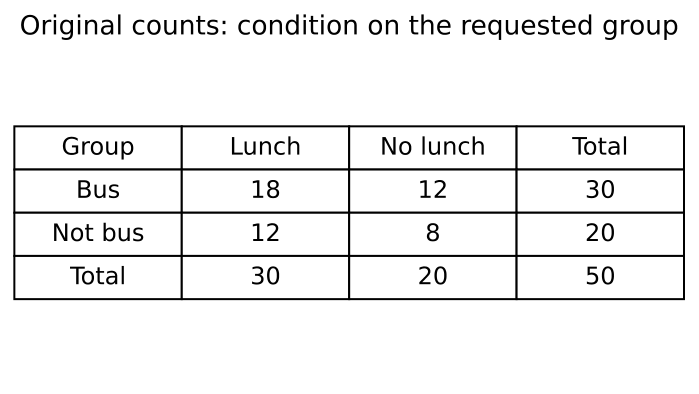
Existing worked example: Original counts: bus users—18 carry a packed lunch, 12 do not; non-bus users—12 carry lunch, 8 do not. Total 50. P(lunch)=30/50=0.6; P(lunch given bus)=18/30=0.6; P(bus given lunch)=18/30=0.6 in this particular balanced table. Change one cell and these need not stay equal. P(bus and lunch)=18/50=0.36, equal here to 0.6·0.6, so the table shows independence of these categories.
Complete original context
Every transfer question states all data it needs.
Independent practice and checked reasoning
Transfer 1
A survey records 12 tea drinkers and 8 non-tea drinkers among 20 cyclists; among 30 walkers it records 9 tea drinkers and 21 non-tea drinkers. Find $P(tea)$, $P(tea\mid cyclist)$ and $P(cyclist\mid tea)$.
Reasoning: Total tea drinkers are 21 of 50, so $P(T)=21/50$. Within cyclists, $P(T\mid C)=12/20=3/5$. Within tea drinkers, $P(C\mid T)=12/21=4/7$. These different denominators make the conditional probabilities unequal.
Transfer 2
In the same survey, are tea drinking and cycling independent? Are they disjoint? Use numbers for both answers.
Reasoning: They are not independent because $P(T\mid C)=3/5\ne21/50=P(T)$. They are not disjoint because 12 respondents do both: $P(T\cap C)=12/50>0$.
Transfer 3
One respondent is chosen uniformly. Find the probability of walking or drinking tea, including those who do both.
Reasoning: Use inclusion–exclusion. $P(W\cup T)=(30+21-9)/50=42/50=21/25$. The 9 tea-drinking walkers must not be counted twice. Equivalently exclude the 8 cyclists who do not drink tea.
Limits and next use
Equal conditional answers in one table are coincidence or structure to check, not a universal rule. Condition first, then count.
All tasks here are public original practice with authored guidance. They are not official questions or fresh diagnostics. Existing protected tests and mocks remain separate.
Digital SAT framework; original paper practice is nonadaptive and gives no scaled-score prediction.
Interpret a sample estimate and its stated margin of error 误差范围
Distinguish random sampling from random assignment 随机分组
Identify the population and causal scope supported by a study
Prerequisites: Percentages; populations; random selection versus assignment.
Explain and choose the method
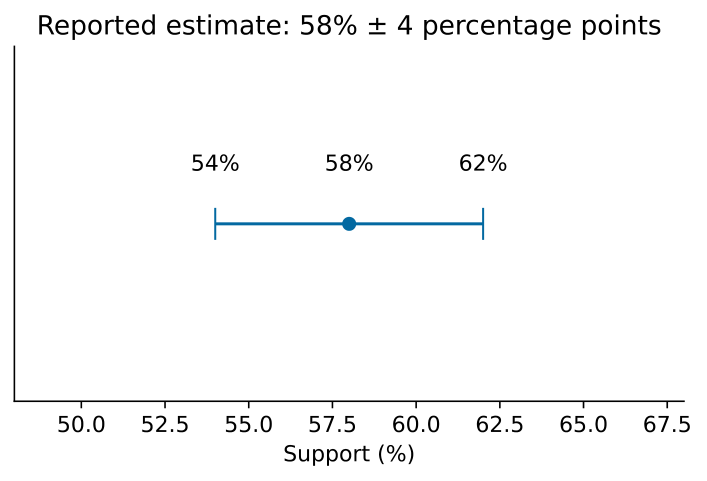
A sample statistic estimates a population quantity. A reported estimate of 58% with margin of error 4 percentage points gives an interval from 54% to 62% under the stated procedure. It does not mean 58% of respondents answered with an error of four percent, nor does it guarantee that every individual sample contains the true value.
A representative random sample helps generalise to the population from which it was drawn. Convenience or voluntary-response samples can be biased even when large. Increasing a well-designed sample generally reduces sampling variability and margin of error at the same confidence level, but cannot automatically cure a systematically excluded group.
Random assignment distributes participants among treatment groups and supports causal inference 推断 by balancing competing factors on average. Random sampling selects who participates. A randomised experiment conducted only with volunteers may support a treatment effect for its participants without establishing that all people share the same effect.
An observational study measures existing differences without assigning treatment; association can reflect confounding. A comparison of students who choose extra tutoring against those who do not may mix tutoring with motivation or prior attainment. To judge a claim, identify selection, assignment, comparison, measured outcome and the exact population before accepting causation or broad generalisation.
A margin of error is added and subtracted in percentage points.
Estimate 63% with margin 4 points gives 59%–67%.
It is an interval from a procedure, not a guarantee that each person's response is near 63%.
Random sampling supports population inference; random assignment addresses treatment comparisons.
Original worked example from existing native teaching; transfer tasks use their own data.
Existing worked example: A random sample of 400 school students yields 58% support ±4 percentage points: stated interval 54%–62%. This estimates the sampled school population, not all students worldwide. If volunteers are randomly assigned to two revision methods, a controlled outcome difference can support a causal comparison among participants; volunteer selection still limits wider generalisation.
Complete original context
Every transfer question states all data it needs.
Independent practice and checked reasoning
Transfer 1
A random sample of 500 registered library members reports 62% support for a change, with stated margin 4 percentage points. State the interval and population. Does it establish support among every town resident?
Reasoning: Interval is $62\%-4\%=58\%$ to $62\%+4\%=66\%$, where the subtraction denotes points. The population is registered members in the sampling frame. Nonmembers were not sampled, so the estimate does not establish all residents' support.
Transfer 2
Forty volunteers are randomly assigned to old or new instructions, with the same task and conditions. The new group finishes faster. What causal and population claims are reasonable?
Reasoning: Random assignment supports a causal comparison of the instruction versions for these participants under the tested conditions, subject to variation. Volunteer selection limits population generalisation. It does not establish that every future user will finish faster.
Transfer 3
A poll of 10000 website volunteers has a narrow reported margin. Explain why size alone cannot repair selection bias, and propose a better recruitment method.
Reasoning: People choosing to respond can differ systematically from those who do not. A margin for sampling variability does not remove that bias. Select randomly from the defined target population and follow up nonresponse; still report limitations.
Limits and next use
Sample size, random selection and random assignment are not interchangeable. A narrow margin does not remove selection bias.
All tasks here are public original practice with authored guidance. They are not official questions or fresh diagnostics. Existing protected tests and mocks remain separate.
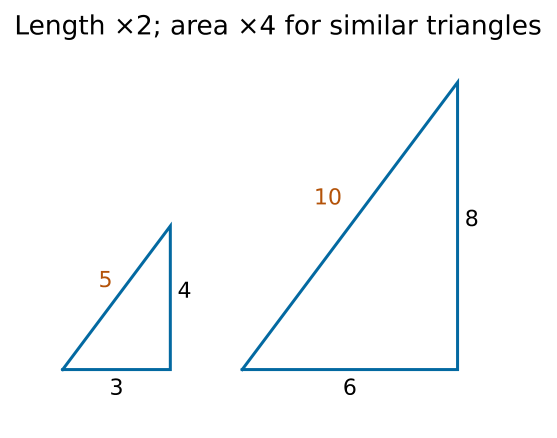
For similar figures with length scale k, corresponding lengths scale by k, areas by k² and volumes by k³. These laws apply when all corresponding dimensions change together. A cylinder with only radius doubled and fixed height has four times the volume, not eight times. State which dimensions are scaled before choosing the power.
Use the correct geometric measure: triangle area is half base times perpendicular height 垂直高度; cylinder volume is base area times height. Surface area adds exposed faces, while volume measures enclosed space. A slant length is not automatically the perpendicular height required by an area formula. Attach square or cubic units to the result.
Vertical angles are equal. For parallel lines cut by a transversal, corresponding and alternate interior angles are equal, and same-side interior angles sum to 180°. A triangle’s interior angles sum to 180°; its exterior angle equals the sum of the two remote interior angles. These rules depend on stated or marked parallelism, not the drawing’s appearance.
Similar triangles share corresponding angles and proportional corresponding sides; congruent triangles also have equal corresponding lengths. Two angles establish similarity but not size equality. Maintain correspondence when writing a ratio. A side–side–angle arrangement does not universally guarantee congruence, whereas side–angle–side includes the angle between the two sides.
A scale factor 比例因子$k$ changes every corresponding length.
$A_2=k^2A_1$ and $V_2=k^3V_1$ for similar shapes.
If $k=3/2$ and $A_1=24\,\mathrm{cm^2}$, $A_2=(3/2)^2(24\,\mathrm{cm^2})=54\,\mathrm{cm^2}$.
Changing only one dimension does not justify these similarity rules.
Original worked example from existing native teaching; transfer tasks use their own data.
Existing worked example: Two similar solids have edge ratio 2:3, so surface-area ratio is 4:9 and volume ratio 8:27. A triangular garden with base 12 m and perpendicular height 5 m has area 30 m². If a triangle has interior angles 48° and 67°, its third is 65° and the adjacent exterior angle is 115°=48°+67°.
Complete original context
Every transfer question states all data it needs.
Independent practice and checked reasoning
Transfer 1
Similar containers have surface areas 96 and 216 square centimetres. The smaller volume is 160 cubic centimetres. Find the larger volume.
Reasoning: $k=\sqrt{A_2/A_1}=\sqrt{216/96}=3/2$. Volume uses the cube: $V_2=k^3V_1=(3/2)^3(160\,\mathrm{cm^3})=540\,\mathrm{cm^3}$. Using area ratio directly would give the wrong volume.
Transfer 2
A right triangle has hypotenuse 13 cm and one leg 5 cm. Find the other leg, its area, and the sine of the angle opposite the 5 cm leg.
Two interior angles of a triangle are 42° and 73°. Find the third angle and its adjacent exterior angle. Would those angles alone determine all side lengths?
Reasoning: Third angle is $180-42-73=65$ degrees. Its adjacent exterior angle is $180-65=115$ degrees, also $42+73$. Angles establish shape, not scale; similar triangles can have different side lengths.
Transfer 4
Two parallel lines are cut by a transversal. One corresponding angle is 68°. Find its matching corresponding angle and the adjacent angle on the second line. Explain which given condition justifies each step.
Reasoning: Parallelism gives the matching corresponding angle 68°. The adjacent pair forms a straight angle, so the other is 180°−68°=112°. Equal corresponding angles require the stated parallel lines; the straight-angle sum uses adjacency on one line. A similar-looking sketch without parallelism would not justify the first equality.
Limits and next use
Use k² or k³ only when the entire shape is scaled; do not infer parallel lines or a perpendicular height from an unmarked sketch.
All tasks here are public original practice with authored guidance. They are not official questions or fresh diagnostics. Existing protected tests and mocks remain separate.
Digital SAT framework; original paper practice is nonadaptive and gives no scaled-score prediction.
Recover circle centre and radius by completing the square
Convert central angles and calculate arc length 弧长 and sector area
Use tangent 切线, inscribed-angle and unit-circle relationships
Prerequisites: Complete the square; radius; radians; right-triangle ratios.
Explain and choose the method
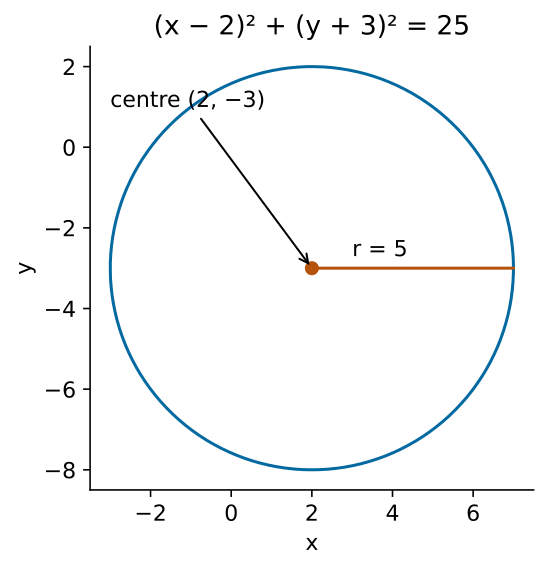
A circle with centre (h,k) and radius r satisfies (x-h)²+(y-k)²=r². For an expanded equation, complete the square in x and y and add the balancing constants to the other side. The resulting right side must be positive for a real nondegenerate circle. Keep the radius distinct from its square.
A central angle θ in radians gives arc length rθ and sector area r²θ/2. In degrees, use the fraction θ/360 of the full circumference or area. A full turn is 2π radians=360°. The formulas rθ and r²θ/2 require radians; inserting degrees without conversion gives a wrong scale.
A tangent at a circle point is perpendicular to the radius there. An inscribed angle is half the central angle subtending the same arc; an angle subtending a diameter is a right angle. Identify the actual shared arc and centre before applying these statements. A chord is not a tangent and need not be perpendicular to a radius unless further conditions establish it.
On the unit circle, a point at angle θ has coordinates (cos θ,sin θ), so cos²θ+sin²θ=1. Signs depend on quadrant. For acute complementary angles, sin θ=cos(90°-θ). Use special triangles for exact values: at 30° the sine is 1/2 and cosine √3/2; at 45° both are √2/2.
Complete both squares in a circle equation 圆方程 .
$x^2+y^2+6x-8y=0$ becomes $(x+3)^2+(y-4)^2=25$.
The centre is $(-3,4)$ and radius is 5.
Arc length is $s=r\theta$ only for radian 弧度 angle $\theta$.
Original worked example from existing native teaching; transfer tasks use their own data.
Existing worked example: x²+y²-4x+6y-12=0 becomes (x-2)²+(y+3)²=25, giving centre (2,-3), radius 5. For radius 6 and central angle π/3, arc length is 2π and sector area 6π. An inscribed angle on that same 60° arc is 30°. At 150°, cosine is -√3/2 and sine 1/2 because the point is in quadrant II.
Complete original context
Every transfer question states all data it needs.
Independent practice and checked reasoning
Transfer 1
Find the centre and radius of $x^2+y^2-8x+2y+8=0$. Does $(7,-1)$ lie on it?
Reasoning: Complete squares to get $(x-4)^2+(y+1)^2=9$. Centre $(4,-1)$, radius 3. Substitution of $(7,-1)$ gives $3^2+0^2=9$, so it is on the circle.
Transfer 2
A sector has radius 8 cm and angle 135°. Find its angle in radians, arc length and area. An inscribed angle elsewhere on the circle intercepts this same arc; find it.
Reasoning: $\theta=135\pi/180=3\pi/4$ radians. $s=r\theta=(8\,\mathrm{cm})(3\pi/4)=6\pi\,\mathrm{cm}$. $A=r^2\theta/2=(8\,\mathrm{cm})^2(3\pi/4)/2=24\pi\,\mathrm{cm^2}$. The inscribed angle is half the central angle: 67.5 degrees.
Transfer 3
A unit-circle point is in quadrant III and has $y=-1/2$. Find its $x$-coordinate and one angle between 0° and 360°.
Reasoning: $x^2+y^2=1$ gives $x^2=3/4$. Quadrant III requires $x<0$, so $x=-\sqrt3/2$. The point is at 210 degrees, with reference angle 30 degrees.
Limits and next use
Check degree/radian units, centre signs and whether an angle is central or inscribed before applying the formula.
All tasks here are public original practice with authored guidance. They are not official questions or fresh diagnostics. Existing protected tests and mocks remain separate.
디지털 SAT 프레임워크; 원문 연습은 적응형이 아니며scaled-score 예측을 제공하지 않습니다.
지문의 핵심 주장을 지지하는 예시와 구분하십시오
명시된 범위를 넓히지 않고 세부 사항을 해석하십시오
전체 지문을 아우르는 정확한 요약을 선택하십시오
선행 지식: 단락의 주제를 식별하고, 명시된 사실과 추론을 구분하십시오.
방법 설명 및 선택
지문의 지배적 관계를 읽으십시오: 문제와 반응, 대비, 설명 또는 제한된 주장 등입니다. '박물관 소장품'과 같은 주제 레이블은 주제를 나타낼 뿐, 저자가 그것에 대해 어떤 말을 하는지는 알려주지 않습니다. 옵션을 비교하기 전에 짧은 문장으로 주요ポイントを 먼저 서술하십시오.
지지 사실은 해당 주장을 설명하거나 구체화하거나 제한합니다. 핵심 아이디어는 아니더라도 기억에 남을 수 있습니다. 지문이 접근성 개선을 위한 두 가지 예시를 제시했다면, 하나의 예시에만 초점을 맞춘 요약은 너무 협소합니다. 만약 하나의 소장품만을 언급했다면, 모든 소장품에 대한 결론은 너무 포괄적입니다.
범위와 확도를 유지하십시오. Some(일부), may(할 수도 있다), in this study(이번 연구에서는)와 같은 표현은 유의미한 제한 조건입니다. 정답은 지문의 어휘를 재사용하되 주장을 '가능함'에서 '확정됨'으로 변경해서는 안 됩니다. 정답의 주어, 행동 및 제한 조건을 단순히 공유되는 단어 수에 의존하지 말고 지문과 대조하여 확인하십시오.
특정 세부 사항에 대한 질문이라면, 습관적으로 핵심 아이디어를 선택하기보다 더 Narrow한 과제를 해결하십시오. 관련 문장을 찾고 주변 맥락을 읽으며, 직접적으로 진술된 것과 제안된 이유를 구분하십시오. 사전 지식은 불필요하며 결여된 증거를 대체해서는 안 됩니다.
중심 아이디어는 본문을 연결하는 관계입니다.
읽기: “수리 카페는 처음에 램프만 수리를 받았고, 후엔 자원봉사자가 훈련을 받은 후 작은 팬을 추가했습니다. 대형 가전제품은 여전히 전문 상점에 보내졌습니다.”
요약이 타당한 것은: 카페가 수리를 일정 범위 내에서 확대했다.
“모든 것을 수리했다”는 마지막 문장을 무시한다. “램프를 수리했다”는 변화를 누락했다.
원본worked 관계 도식; 전체 문구 및 조건을 읽으십시오.
기존 풀이 예시: 원문: “타운 아카이브는 가장 자주 요청된 지도부터 디지털화했습니다. 연구자들은 이후 원격으로 Those 지도를 검토할 수 있었으며, 이는 fragile 원본의 반복적인 취급을 줄였습니다. 스태프는 아직 스캔되지 않은 품목에 대해 감독 하에 접근을 계속 제공했습니다.” 핵심 내용: 선택적 디지털화는 접근성과 보호를 향상시켰으나 물리적 접근은 계속되었습니다. “모든 지도가 온라인으로 사용 가능해졌다”는 과장된 표현이며, “아카이브는 방문을 중단했다”는 마지막 문장과 모순됩니다.
완전한 원문 맥락
원문: 시 아카이브는 온라인 색인을 통해 손글씨 배송 등록부를 검색할 수 있는 시험을 시작했다. 자원봉사자가 이름과 날짜를 입력했고, 직원들이 읽기 어려운 항목을 확인했다. 이 색인은 종종 연구원이 아카이브를 방문하기 전에 예상되는 페이지를 찾는 데 도움이 되었다. 하지만 이는 등록부 이미지를 대체하지 못했다. 같은 이름을 가진 사람끼리는 여전히 주변 항목을 읽음으로써만 구별할 수 있었다. 따라서 직원은 이 색인이 모든 질문에 대한 최종 답변이 아니라 기록으로 들어가는 경로로 설명했다. 또한研究者们可以看到索引的变化,他们还保留了一份已更正条目的公开列表。
독립 연습 및 검증된 추론
이양 1
핵심 내용을 한 문장으로 서술하되, 장점과 제한점을 모두 포함해야 한다.
추론: 확인된 색인은 연구원이 관련 기록을 찾는 데 도움을 주지만, 일부 구분은 여전히 원본 등록부를 참조하는 것이 필수적이다. 이는 검색의 장점은 설명하지만 완전한 정확성을 주장하지는 않는다.
이양 2
등록부 이미지가 여전히 필요한 이유를 설명하는 디테일은 무엇인가? 이를 수정 목록의 목적과 구분하시오.
추론: 같은 이름을 가진 사람들은 이를 구별하기 위해 주변 등록부 항목을 필요로 할 수 있다. 반면 수정 목록은 변경 사항을 가시화할 뿐, 자체적으로 모든 사람을 식별하지는 못한다.
이양 3
제안된 요약 각각을 구체적인 증거로 부인하시오 — A “자원봉사자가 직원을 대신함”; B “색인으로 인해 아카이방 방문이 불필요해짐”; C “아카이브가 색인의 변경 사항을 숨김”.
추론: A는 직원이 읽기 어려운 항목을 확인했다는 내용과 모순된다. B는 “자주”라는 표현과 원본 기록을 참조해야 하는 필요성을 과장했으며, 원문은 모든 방문이 대체된다고 명시하지 않았다. C는 공개 수정 목록과 모순된다. 어떤 선택지도 제시된 범위를 보존하지 못한다.
한계 및 향후 활용법
진실된 디테일이 여전히 잘못된 메인-아이디(핵심 개념) 답이 될 수 있다. 본문이 더 좁은 주장을 하는 경우에 all(모두), always(항상), only(유일하게) 같은 단어를 주의 깊게 확인하라.
여기에 있는 모든 과제는 공식 질문이나 신규 진단이 아닌, 작성자 지침이 포함된 공개 원본 연습입니다. 기존 보호되는 시험 및 모의고사는 별도로 분류됩니다.
디지털 SAT 프레임워크; 원문 연습은 적응형이 아니며scaled-score 예측을 제공하지 않습니다.
명시된 주장을 직접 지지하거나 반대하는 세부 사실을 선택하십시오
표의 레이블, 수량 및 비교 기준을 올바르게 사용하십시오
관련성과 설명을 구별하는 증거를 분리하십시오
선행 학습 요구사항: 표의 제목을 읽고 비율과 수치를 비교하십시오.
방법 설명 및 선택
먼저 목표 주장을 증거 요구 사항으로 번역하십시오. 반복적인 연습이 기억 retention에 도움이 된다는 주장은 학습자들이 활동을 즐겼다는 단순한 진술이 아니라, 서로 다른 연습 조건 하에서의 retention에 대한 정보가 필요합니다. 흥미로운 관련 사실은 특정 관계가 주어진 것임을 지지하지 못할 수 있습니다.
문서적 증거에 대해,谁的的主张이 검증되고 있는지 확인하고, 과제가 지지, 반박 또는 완성을 요구하는지 파악하십시오. 친숙한 명사를 포함하는 인용구만으로는 충분하지 않습니다. 해당 디테일이 사실이라면 어떤 것이 더 신뢰할 수 있거나 less credible가 되는지 묻되, passage의 실제 certainty 수준을 유지하십시오.
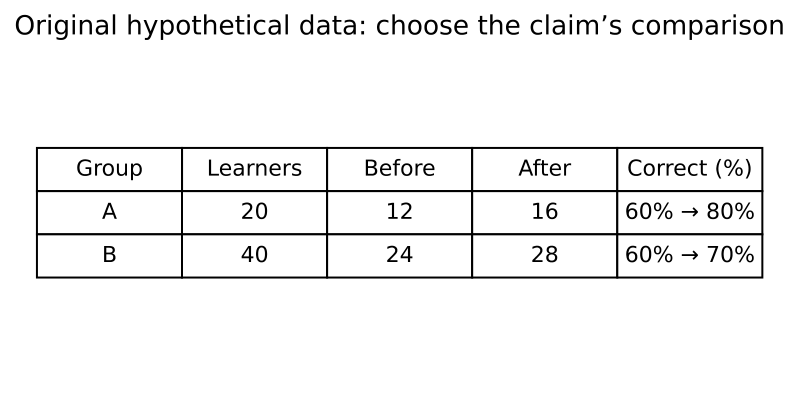
정량적 증거에 대해, 계산하기 전에 제목, 축 또는 헤더, 단위 및 그룹을 읽으십시오. claim이 개선에 관한 경우 before/after 차이를 사용하고, outcomes에 관한 경우 최종 값을 사용하며, 그룹 크기가 다른 경우 비율을 사용하십시오. 더 큰 수는 더 큰 그룹 내에서 더 작은 비중을 나타낼 수 있습니다.
수치 패턴은 서술적 비교를 지지할 수 있으나 그 원인을 증명하지는 못합니다. 무작위 배정이나 통제된 인과 증거가 명시되지 않은 경우, 인과 결론을 피하십시오. 이 수업의 원본 표는 hypothetical teaching dataset이며, 출판된 연구가 아닙니다; 목적은 관계 읽기 연습입니다.
证据는 comparison base를 포함한 exact claim을 지지해야 합니다.
9의 15 tasks가 성공하면, $p=n_{success}/n_{total}=9/15=60\%$.
성공 수가 많은 그룹이라도 성공률이 낮을 수 있습니다.
before/after 데이터는 변화를 설명하지만, 통제된 배정이 없으면 인과를 증명하지 못합니다.
기존 현지 교육용 풀이 예제; 이전 과제는 자체 데이터를 사용합니다.
기존 worked example: Original hypothetical table: Group A has 20 learners, 12 correct before and 16 after; Group B has 40 learners, 24 correct before and 28 after. Both gain four correct responses, but A’s correct share rises from 60% to 80% (20 points), while B rises from 60% to 70% (10 points). This supports “A had the larger percentage-point improvement”, not “A had more correct final responses” or a causal claim about the method.
완전한 원문 맥락
Original hypothetical study: Two groups used a revised catalogue for a second search session. No random assignment is reported. Group P had 30 users, with 12 successful searches before and 21 after. Group Q had 50 users, with 30 successful searches before and 35 after. Each user completed one search in each session. The researchers claimed that P showed the larger percentage-point improvement, while Q still had more successful searches in the second session. A separate comment said the revision must have caused every improvement.
독립 연습 및 검증된 추론
이양 1
두 그룹의 before 및 after 성공률 및 퍼센티지 포인트 변화량을 제시하십시오.
Reasoning: $p_P=12/30=40\%$ before and $21/30=70\%$ after, a 30-point increase. $p_Q=30/50=60\%$ before and $35/50=70\%$ after, a 10-point increase. P has the larger change; both final rates are equal.
이양 2
어떤 주장이 35과 21으로 지지되며, 어떤 주장이 30 포인트와 10 포인트로 지지됩니까?
Reasoning: The final counts support Q having more second-session successes. The percentage-point changes support P improving more. Exchanging those pieces of evidence would confuse final outcome with change and counts with proportions.
이양 3
왜 인과(comment)이 너무 강하게 표현되었는지 설명하십시오. 대안적 설명을 조사하는 데 도움이 될 추가 관찰 사항을 하나 제시하십시오.
Reasoning: Session order, practice or different tasks could contribute; no randomised comparison is described. A control group using the original catalogue in both sessions under otherwise matched conditions could estimate practice effects. It would help test causation, not automatically prove that every user's improvement has one cause.
한계 및 향후 활용법
주장에 명시된 수량을 사용하라. 원수(counts), 상대적 백분율, 그리고 퍼센트 포인트 변화는 서로 다른 질문에 답한다.
여기에 있는 모든 과제는 공식 질문이나 신규 진단이 아닌, 작성자 지침이 포함된 공개 원본 연습입니다. 기존 보호되는 시험 및 모의고사는 별도로 분류됩니다.
uncertainty를 유지하고 인과 과장(causal overstatement)을 피하십시오
Prerequisites: Track contrasts; retain uncertainty and scope.
방법 설명 및 선택
stated facts와 추론해야 할 connection을 분리하십시오. 두 observation이 contrast를 설정한다면, 결론은 그 contrast를 유지해야 합니다. 옵션을 읽기 전에 evidence를 연결하는 short bridge를 작성하십시오; 이는 매력적이지만 관련 없는 설명을 탐지하기 쉽게 만듭니다.
추론은 문장을 그대로 복사할 필요는 없으나, 각 핵심 단계는 반드시 근거에 의해 뒷받침되어야 합니다. 어떤 도구 A가 다른 도구 B가 놓친 특징을 감지했다는 서술은 검출의 차이를 지지할 뿐, 모든 목적에서 도구 A가 우월하다는 것을 의미하지는 않습니다. 전문 지식은 명시되지 않은 조건을 채울 수 없습니다.
한계 qualifier와 대안적 설명을 추적하십시오. 특정 패턴은 확실성을 확립하기보다 가능성만을 시사할 수 있습니다. 만약 본문이 여러 가능한 원인을 인정한다면, 그중 하나만 전적으로 책임지는 완성된 서술은 너무 단정적입니다. 선택지가 새로운 인물, 배경, 동기 또는 시간대를 도입했는지 확인하십시오.
짧은 본문의 마지막에 있는 결론을 검토할 때 논리적 전환어를 살피십시오: 'therefore(따라서)'는 결과를 요구하며, 'however(그러나)'는 제한점을 제시할 수 있습니다. 문법적으로는 매끄러운 연결이라 하더라도 논리적으로 뒷받침되지 않을 수 있습니다. 과잉 가정을 최소화하면서도 과제를 완전히 충족하는 선택지를 우선하십시오.
합리적인 추론 supported inference는 제공된 사실들을 연결하되 인과관계를 추가하지 않습니다.
"짧은 라벨은 초보자에게 도움이 되었지만, 전문가들은 상세한 라벨을 선호했다"는 서술은 독자의 경험에 따라 혜택이 달라질 수 있음을 지지합니다.
"짧은 라벨이 항상 가장 좋다"거나 "전문가는 박물관을 싫어한다"는 주장은 지지되지 않습니다.
원본worked 관계 도식; 전체 문구 및 조건을 읽으십시오.
기존 풀이 예시: 원문: "두 개의 센서가 동일한 다리를 모니터링했습니다. 센서 A는 센서 B가 감지하지 못한 짧은 진동을 기록했으나, 센서 B는 A가 기록을 멈췄던 더 추운 기간 동안 정상적으로 작동했습니다." 합리적인 결론: 관찰된 조건 하에서 두 센서는 서로 보완적인 강점을 가졌습니다. 어느 쪽이 보편적으로 더 정확하다고 단정하거나, 온도가 검출의 모든 차이를 유발했다고 결론지을 수는 없습니다.
완전한 원문 맥락
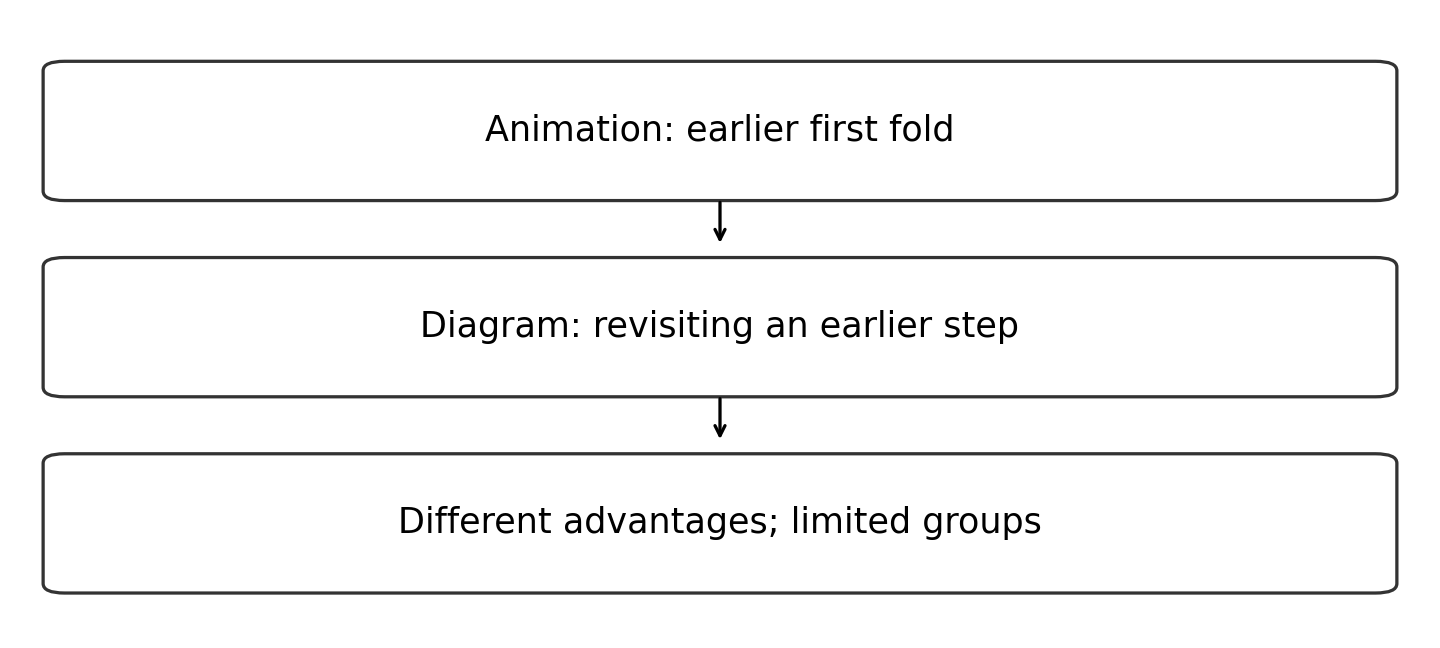
원문: 한 워크숍에서는 접기 과정에 대한 인쇄된 도면과 애니메이션 시연이 제공되었습니다. 애니메이션을 사용한 참가자들은 평균적으로 첫 번째 접기를 더 빨리 시작했습니다. 그러나 나중에 실수를 수리하도록 요청했을 때, 도면을 사용한 참가자들이 도움 없이 더 자주 올바른 이전 단계로 돌아가는 경향이 있었습니다.两组의 규모는 작았으며, 조직자는 참가자들이 동일한 수준의 경험을 가졌는지 보고하지 않았습니다. 그들은 교육 도구의 선택은 과제의 단계에 고려되어야 한다고 결론지었습니다.
독립 연습 및 검증된 추론
이양 1
두 가지 도구에 대한 합리적인 추론으로 결론을 완성하십시오.
추론: 애니메이션은 시작하는 데 도움이 될 수 있으나, 도면은 수정 과정에서 이전 단계를 다시 찾아보는 데 도움이 될 수 있습니다. 증거는 작은 규모와潜在的 unequal 경험이라는 제한조건 하에서 관측된 서로 다른 장점을 지지합니다.
이양 2
"애니메이션은 실수를 방지한다"와 "도면은 시작에 무용지물이다"가 모두 지지되지 않는 이유를 설명하십시오.
추론: 해당 연구는 실수의 부재가 아닌 수정 성능을 보고합니다. 애니메이션을 사용하여 더 빨리 시작한 것이 도면 사용자가 시작할 수 없었다는 것을 의미하지 않습니다. 두 명제 모두 상대적인 관측을 절대적 주장으로 대체하고 있습니다.
이양 3
새로운 연구가 기존 경험과 균형을 맞추어 동일한 수정률을 발견했습니다. 이것이 앞선 결론에 미치는 영향을 설명하되, 첫 번째 관측 결과가 위조되었다고 주장하지 마십시오.
추론: 이는 수정에 대한 도면의 우위에 대한 일반적 주장을 약화시키고, 기존 차이의 원인으로서 경험을 제기합니다. 다른 표본이나 방법론은 첫 번째 관측이 거짓임을 의미하지 않으면서도 서로 다른 결과를 낼 수 있습니다.
한계 및 향후 활용법
관측된 공존을 유일한 원인으로 변형하거나 제한된 비교를 보편적 우위에 확장하지 마십시오.
여기에 있는 모든 과제는 공식 질문이나 신규 진단이 아닌, 작성자 지침이 포함된 공개 원본 연습입니다. 기존 보호되는 시험 및 모의고사는 별도로 분류됩니다.
디지털 SAT 프레임워크; 원문 연습은 적응형이 아니며scaled-score 예측을 제공하지 않습니다.
문장 및 주변 논리로부터 단어의 의도된 의미를 유추하십시오
대조 및 해설을 사용하여 결락된 단어를 결정하십시오
어법, 정도 및コロケーション에 맞는 단어를 선택하십시오
선행 지식: 문장 의미; 대조 및 설명 단서.
방법 설명 및 선택
익숙한 단어에는 여러 뜻이 있을 수 있습니다. 문장에 간단한 paraphrase를 대입하여 관계가 유지되는지 테스트하십시오. 사전의 첫 번째 뜻이 아니라 context(맥락)가 check라는 단어가 inspect(검사하다), restrain(제한하다) 또는 mark a response(응답 표시) 중 무엇을 의미하는지 결정합니다.
공란에 대해 선택지를 보기 전에 필요한 의미와 polarity(극성)를 결정하십시오. 'but'으로 도입된 대조는 기대를 반전시킬 수 있으며, 'because'后面的解释可以缩小意图的含义。如果句子说证据是积极的但不完整,那么表示谨慎或临时性的词比表示确定的词更合理。
어려운 어휘를 가장 화려한 단어를 선택하는 경쟁으로 취급하지 마십시오. 중립적인 재표현을 사용하고, 부정적/긍정적 뉘앙스가 다른 옵션을 배제한 후 남은 의미의 미묘한 차이를 비교하십시오. 문맥과 일반적인 조합이 나중에 기억에 도움이 되므로, 학습한 단어는 전체 구문 형태로 기록해 두십시오.
문맥 속 단어는 사전 정의뿐만 아니라 해당 관계를 만족시켜야 한다.
"증거가 약하므로 결론은 가설적이다"에서 '가설적'은 수정될 수 있음을 의미합니다.
일시 고용이나 신체의 마른 상태를 뜻하지 않습니다. 선택 전에 의역을 하십시오.
원본worked 관계 도식; 전체 문구 및 조건을 읽으십시오.
기존worked example: 원문 “The committee gave the proposal qualified support: members approved its aim but requested a smaller trial before expansion.” 여기서 qualified은 인증된(s certified)이나 숙련된(skilled) 것이 아니라 제한된(limited) 또는 조건부(conditional)를 의미합니다. 빈칸 예시 “Because the observations were few, the author described the conclusion as ___ rather than definitive.”在这里provisional은 definitive와 명확한 대비를 이루므로 적합합니다.
완전한 원문 맥락
원문: 평론가들은 조사에 따른 개별 여정 기록의 세심함을 환영했지만, 도시 전체에 대한 결론에는 조건부 지지만 표명했습니다. 경로는 편의를 위해 선정되었으며, 몇몇 지역은 포함되지 않았습니다. 한 평론가는 이 기록을 통찰적이라고 평가하여,Previously 간과되었던 이동의 어려움을 이해하기 쉽게 만들었다고 지적했습니다. 다른 평론가는 결론을 확장하려면 더 광범위한 표본이 필요하다고 경고했습니다. 저자들은 이러한 우려를 수용하고 추가 조사를 제안했습니다.
독립 연습 및 검증된 추론
이양 1
해당 문단에서 '조건부(qualified)', '통찰적(illuminating)', '우려(reservation)'의 의미를 설명하고 각에 대한 근거를 인용하십시오.
추론: '조건부'는 제한적이거나 유보된 것을 의미하며, 포함되지 않은 지역과 더 넓은 표본 수집의 필요성으로 뒷받침됩니다. '통찰적'은 밝혀지거나 명확히 하는 것을 의미하며, 난관이 이해하기 쉬워진 점으로 뒷받침됩니다. '우려'는 Concern 또는 제한을 의미하며, 결론의 확장에 대한 경고로 뒷받침되며, 예약된 좌석을 뜻하는 것은 아닙니다.
이양 2
"평론가들은 조사를 배제했다"와 "평론가들은 아무런 유보 없이 그 결론을 찬양했다"를 비교하십시오. 왜 어느 하나도 적합하지 않습니까?
추론: '배제하다'는 세심한 기록에 대한 환영을 무시합니다. '무유보 찬양'은 표본 수집에 대한 우려를 지워버립니다. 태도는 기록에 대한 인정과 broader 결론에 대한 제한적 지지를 결합한 것입니다.
이양 3
'통찰적(illuminating)'을 '밝혀주는(revealing)', '눈부신(dazzling)', '보이는(visible)'으로 교체하십시오. 이 중 어떤 것이Meaning을 가장 잘 보존하고, 나머지들이 여기서 실패한 이유는 무엇입니까?
추론: '밝혀주는'은 기록이 난관을 이해하게 한다는 아이디어를 보존합니다. '눈부신'은 명시된 명확화 beyond에 번쩍임이나 찬미라는 의미를 도입합니다. '보이는'은 인지 가능성을 기술할 뿐, 조사의 설명적 기여를 서술하지 못합니다. 이는 해당 단어가 항상 틀린다는 규칙이 아닌 맥락적 의미 결정입니다.
한계 및 향후 활용법
표면적으로 유사한 동의어라도 강도가 잘못되거나 문법적 용법이 다를 수 있다. 콜론(:)后面的 설명을 무시하지 마라.
여기에 있는 모든 과제는 공식 질문이나 신규 진단이 아닌, 작성자 지침이 포함된 공개 원본 연습입니다. 기존 보호되는 시험 및 모의고사는 별도로 분류됩니다.
디지털 SAT 프레임워크; 원문 연습은 적응형이 아니며scaled-score 예측을 제공하지 않습니다.
passage가 중심 주장을 어떻게 전개하는지 파악하기
한 문장이 더 큰 논증에서 어떤 역할을 하는지 설명하기
텍스트의 목적(purpose)과 주제(subject matter)를 구분하기
선행 지식: 문제-대응 서열을 따르며, 인용된 견해를 구분할 수 있어야 합니다.
방법 설명 및 선택
각 부분을 행동(action)으로 요약하십시오: 문제를 제시하다, 접근법을 묘사하다, 증거를 제시하다, 또는 한계를 지적하다. 주체 명사 나열보다 순서 있는 행동들이 구조를 더 정확하게 묘사합니다. 저자가 배경에서 주장으로, 혹은 주장에서 조건부 표현으로 넘어가는 전환점을 찾으십시오.
표시된 문장의 기능을 분석하려면 그 앞뒤 내용을 비교하십시오. 이전 예상과 모순되며 다음 문장이 그 놀라움을 설명한다면, 해당 문장은 예상치 못한 결과를 도입하는 역할을 할 가능성이 있습니다. 마지막에 위치한다고 해서 반드시 저자의 결론인 것은 아닙니다.
목적(purpose)은 저자가 정보를 통해 무엇을 하려는지를 명시합니다: 구분을 설명하거나, 가정을质疑하거나, 방법을 평가하거나, 반응을 묘사하는 것 등입니다. 단순히 주제를 이름만 나열한 선택지는 불완전합니다. 독자를 행동으로 이끄라고说是 persuades readers to take action但必须有 actual advocacy, not an informative description alone.
저자가 제시한 반박(opposition)과 저자가 지지하는 견해를 구분하십시오. 인용된 주장, 예시, 가상의 상황은 논증에 기여할 수 있으나 저자의 최종 입지가 되지 않습니다. passage의 용어 및 관계 표시어를 사용하여 역할을 배분하고, 선호하는 논증 구조를 강요하지 마십시오.
문장 기능(sentence function)은 특정 맥락에서 문장이 수행하는 عمل을 나타냅니다.
"The machine was fast. It damaged thin sheets. The team added a gentler setting."
중간 문장은 장점을 제한하고 대응을 유도합니다. 이를 단순히 “sheets”에 관한 내용이라고 부르는 것은 주제를命名的것이지, 기능을描述的的是错误的。
원본worked 관계 도식; 전체 문구 및 조건을 읽으십시오.
기존worked example: 원문 “Catalogues once grouped these objects by the material from which they were made. That approach placed tools with different uses together. The revised catalogue therefore adds a function label to each entry.” 구조: 기존 방식을 묘사하고, 그 한계를 지적하며, 이후 대응을 설명합니다. 중간 문장은 개정을 motivation하는 한계를 제공할 뿐, 재료가 관련성이 없다고 claim하는 것은 아닙니다.
완전한 원문 맥락
원문: 초기 보행 지도는 모든 경로에 동일한 실선을 표시했습니다. 이는 지도를 단순하게 했지만, 보행자는 경로에 계단이 포함되어 있는지 알 수 없었습니다. 일부 디자이너는 각 계단 옆에 글로 된 주석을 추가할 것을 제안했습니다. 그러나 시연에서는 계단이 없는 경로에 고유한 선 패턴을 사용하고, 이를 명확한 범례에서 설명했습니다. 시연에서 보행자들은 이러한 경로를 더 정확히 식별했으나, 일부 독자는 범례를 인지하는 데 도움을 필요로 했습니다. 디자이너들은 패턴을 유지하고 범례를 더目 prominence하게 만들었습니다.
독립 연습 및 검증된 추론
이양 1
주체 나열 대신 행동(action)을 사용하여 전체 구조를 명시하십시오.
추론: 본문은 이전 디자인을 소개하고, 접근성 문제를.identifies, 하나의 제안을보고, 다른 테스트된 대응을보고, 시연의 성공을qualifies, 그리고 세련된 개선(describe a refinement)을 묘사합니다.
이양 2
"although some readers needed help noticing the legend"가 하는 역할은 무엇입니까? 왜 이것이 전체 시연 실패의 증거가 되는지 설명하십시오.
추론:EXISTING obstacle를지정함으로써향상된 정확성을qualifies합니다. 시연은 여전히 더 정확한 식별을report하므로, total-failure interpretation은 stated improvement와모순됩니다.
이양 3
저자는 각 계단 옆에 글로 된 주석을support합니까? 그 제안을report하는 것과 유지된 디자인을describe하는 것의 차이를 설명하십시오.
추론: 이 자료들은 검증되고 채택된 설계가 아닌 보고된 제안일 뿐이다. 채택된 접근 방식은 범례가 더 두드러진 선 패턴이다. 이 제안을 작가가 최종 권장 사항으로 attribution하는 것은 서로 다른 단계를 혼동하는 것이다.
한계 및 향후 활용법
문장이 다루는 주제와 문장이 수행하는 기능을 혼동하지 마십시오. 또한, 텍스트에 근거가 없는 한 서술된 방법을 권장 사항으로 바꿀 수 없습니다.
여기에 있는 모든 과제는 공식 질문이나 신규 진단이 아닌, 작성자 지침이 포함된 공개 원본 연습입니다. 기존 보호되는 시험 및 모의고사는 별도로 분류됩니다.
Digital SAT framework; original paper practice is nonadaptive and gives no scaled-score prediction.
Identify each author’s claim and degree of certainty separately
Explain agreement, disagreement or qualification on the same issue
Predict one author’s response using their stated reasoning
Prerequisites: Keep speakers separate; distinguish observation from explanation.
Explain and choose the method
Build a brief claim record for each text: topic, position, evidence 证据 and limit. Keep the speakers separate. If Text 1 reports a possibility and Text 2 reports a concern, a response that makes both certain has altered both positions.
Compare claims about the same relationship, not just shared vocabulary. Agreement may concern a benefit while disagreement concerns generalisation. One text may supply evidence absent from the other rather than directly contradict it. Identify exactly which proposition is supported, challenged or narrowed.
When asked how one author would respond, use that author’s reasoning and scope. Do not choose your preferred opinion or a compromise that neither text supports. A response can acknowledge the other text’s evidence while resisting its broad conclusion if that matches the stated limitation.
Check every clause of the answer. A choice may describe Text 1 correctly and misrepresent Text 2, or identify a real disagreement then exaggerate its importance. Trace each assertion back to its source. The final choice must accurately connect both texts, not merely summarise one.
Cross-text comparison 跨文本比较 connects claims about the same issue.
“Signs reduced wrong turns” and “lighting also changed during the trial” can coexist.
The second statement challenges a causal explanation, not necessarily the recorded reduction.
Original diagram of the worked relationship; read the full wording and qualifications.
Existing worked example: Original Text 1: “A trial in one gallery found that longer labels increased the time visitors spent at exhibits, suggesting that detailed labels can promote engagement.” Original Text 2: “Time spent reading does not necessarily indicate deeper engagement; visitors may be trying to understand unclear wording.” Text 2 would question whether time alone supports Text 1’s engagement inference 推断, not deny that the trial recorded more time.
Complete original context
Original Text A: During a two-week trial, a station displayed route information on a large screen. Requests for platform directions fell from 60 in the preceding fortnight to 36. The screen seems a promising way to help travellers find their platforms, and other stations should consider a trial.
Original Text B: Fewer requests were recorded during the screen trial, but several platforms were closed for repairs at the same time. The remaining journeys may have been easier to navigate. Before treating the screen as the explanation, compare similar periods with the same platform arrangement. A further trial is reasonable if it separates these changes.
Independent practice and checked reasoning
Transfer 1
Identify one agreement and the precise disagreement or qualification.
Reasoning: Both accept that recorded requests fell and allow a further trial. B questions attributing the reduction to the screen because platform closures also changed navigation. B does not claim the screen certainly fails.
Transfer 2
How would B most likely respond to “The screen caused a 40% reduction at every station”? Check every part of the claim.
Reasoning: The observed reduction is $(60-36)/60=40\%$ at one station, but B would reject the causal certainty and every-station scope. The simultaneous closures leave an alternative explanation and no observations at other stations are supplied.
Transfer 3
Propose evidence that would address B's concern, and explain why interviewing the screen's designer about its colour would not.
Reasoning: Compare otherwise similar periods or randomised station trials with matched platform arrangements, recording requests and traveller numbers. This addresses confounding and rates. A colour preference interview does not isolate the screen's navigation effect.
Limits and next use
Disagreeing with an interpretation 解释 is different from denying the observation. Keep each author’s evidence and conclusion distinct.
All tasks here are public original practice with authored guidance. They are not official questions or fresh diagnostics. Existing protected tests and mocks remain separate.
Digital SAT framework; original paper practice is nonadaptive and gives no scaled-score prediction.
Translate a rhetorical goal 修辞目标 into a specific information requirement
Select relevant accurate details from notes
Combine notes without inventing a relationship or including irrelevant material
Prerequisites: Read a stated rhetorical goal; preserve names, units and relations.
Explain and choose the method
Read the goal before the notes. Identify the action: introduce a subject, emphasise a similarity 相似, contrast two cases, give an example or explain significance. Turn it into a brief requirement such as mention both objects and their different materials. This determines which facts matter.
Select details that carry out that action. Accurate but irrelevant information can still fail the question. For a contrast, both compared objects and the relevant difference should be present; for a similarity, a shared property should be explicit. Do not assume that including more notes makes a stronger sentence.
Preserve relationships when combining facts. Notes saying a researcher visited a site and later published a book do not prove the visit caused the book. Avoid adding evaluative language such as revolutionary or superior unless the notes support it. Keep time, identity and numerical facts consistent.
Compare answer choices against both goal and factual accuracy. A sentence can meet the goal while misreporting a detail 细节, or be fully accurate while answering a different goal. The correct choice must satisfy both conditions. Clear referents and concise structure help make the requested relationship explicit.
Rhetorical synthesis 综合 修辞综合 selects facts for a purpose.
Notes: A stores 12 litres; B stores 20; both use recycled glass.
For a material similarity: “Both containers use recycled glass.”
For a capacity difference: “B stores 8 litres more than A.” The same notes support different sentences.
Original diagram of the worked relationship; read the full wording and qualifications.
Existing worked example: Original notes: Project Alder used recycled wood; Project Birch used clay; both were temporary outdoor installations; Alder opened in May; Birch opened in June. Goal: emphasise a difference in materials. Suitable synthesis: “Although both were temporary outdoor installations, Alder used recycled wood whereas Birch used clay.” Opening months are accurate but unnecessary for this goal.
Complete original context
Original research notes:
The Bay project restored 3 km of walking paths in 2024.
The Hill project restored 5 km of walking paths in 2024.
Both projects used volunteer teams.
Bay used local stone for boundary markers.
Hill used recycled timber for boundary markers.
The notes give no costs, visitor counts or durability measurements.
Independent practice and checked reasoning
Transfer 1
Write one sentence emphasising a similarity in staffing and a second emphasising the difference in distance restored.
Reasoning: “Both Bay and Hill used volunteer teams.” “Hill restored 5 km of paths, 2 km more than Bay.” These select staffing and distance respectively without adding a cause.
Transfer 2
A student writes “Hill restored more paths because recycled timber lasts longer.” Identify every unsupported relationship.
Reasoning: The notes do not report why Hill restored a longer distance, nor any durability comparison. They report kilometres, not the number of separate paths. A valid sentence is “Hill restored a longer total distance and used recycled timber for its markers,” without a causal link.
Transfer 3
Goal — contrast marker 转折标记 materials without including irrelevant detail. Write a sentence, then explain why the shared year can be omitted.
Reasoning: “Bay used local stone for boundary markers, whereas Hill used recycled timber.” The shared year does not establish the requested material contrast. Omitting it meets this goal; a historical comparison could require it under a different goal.
Limits and next use
Do not mistake a factually accurate sentence for one that satisfies the rhetorical goal. Avoid unsupported causal or evaluative additions.
All tasks here are public original practice with authored guidance. They are not official questions or fresh diagnostics. Existing protected tests and mocks remain separate.
디지털 SAT 프레임워크; 원문 연습은 적응형이 아니며scaled-score 예측을 제공하지 않습니다.
대조, 결과, 예제 및 연속 관계 식별
논리의 흐름을 유지하는 전치사를 선택
논리적 연결과 구문 요구사항 구분
전제 조건: 빈칸의 양쪽을 읽고 논리와 구문을 구분
방법 설명 및 선택
빈칸을 일시적으로 무시하고 두 사상이 어떻게 관련되는지 서술하십시오. 다음 문장이 다른 사례를 추가하거나 결과를 제시하거나, 예제를 제시하거나, 기대를 수정하거나, 다른 주제로 전환합니까? 즉각적인 친숙한 접속사 선택보다 ‘대조’와 같은 짧은 라벨이 더 유용합니다.
'따라서'와 같은 인과적 전치사는 지원된 결과가 필요합니다. 'However'와 'nevertheless'는 대조나 양보를 도입하며, 'for example'은 광범위한 주장의 사례를 도입합니다. 'Similarly'는 단순히 같은 명사를 언급한 두 문장을 비교하는 것이 아니라 매칭된 관계를 비교합니다. 부정이 포함된 양쪽의 의미를 사용하십시오.
양보는 한 점을 인정하면서도 다른 결론을 유지합니다. “경로는 짧지만; 그러나 출퇴근 시간에는 이동 시간이 더 걸린다”는 거리와 이동 시간을 대조합니다. 'In fact'는 진술을 강화하거나 수정할 수 있으며, 'additionally'의 일반적인 대체어가 아닙니다. 선택한 단어를大声으로 의역하여 관계를 테스트하십시오.
논리적 정확성이 문장 경계 규칙을 제거하지는 않습니다. 'However'는 comma만으로 독립절들을 연결하는 동등 접속사가 아닙니다. 전치사 문제에서는 제공된 구문이 이미 고정되어 있을 수 있으며, 교정 작업에서는 구문도 확인해야 합니다. 이 두 가지 결정을 명확히 분리하십시오.
전치사는 논리적 관계를 이름 붙입니다.
"라인은 짧습니다. 그러나 더 느리게 움직입니다"는 크기와 예상되는 속도 이득을 대조합니다.
"많은 항목을 수리할 수 있습니다. 예를 들어, 헐거운 케이블을 교체할 수 있습니다"는 일반적 진술에서 사례로 이동합니다.
단순히 공통 주어를 공유하는 것만으로는 어떤 인과관계도 성립하지 않는다.
원본worked 관계 도식; 전체 문구 및 조건을 읽으십시오.
기존 풀이 예시: 원문: “새로운 기기는 이전 모델보다 작다. 그러나 더 자주 충전해야 한다.” 두 번째 문장은 예상되는 장점을 제한하므로, ‘따라서’를 사용하면 작은 크기가 직접적인 증거 없이 frequent charging의 논리적 결과로 오해할 수 있다. “여러 새는 도구를 사용한다. 예를 들어 한 종은 나뭇가지를 이용해 음식을 가져온다”는 일반적인 주장에서 구체적인 사례로 이동한다.
완전한 원문 맥락
원문: 새로운 카탈로그는 가정에서 검색할 수 있다. [1] 독자는 더 이상 가능한 서고 번호를 찾기 위해 단순히 이동할 필요가 없다. 여전히 몇몇 컬렉션이 누락되어 있다. [2] 목록에 없는 항목을 찾는 독자는 직원에게 연락해야 한다. 일부 항목에는 약어 역시 사용된다. [3] “MS”는 인쇄본이 아닌 필사본을 의미한다.
독립 연습 및 검증된 추론
이양 1
[1], [2], [3]의 가장 적절한 관계를 선택하고 적절한 연결사를 제공하시오. 각 연결의 이유를 설명하시오.
추론: [1] 결과: “Therefore,”는 원격 검색과 검색 목적-only 방문을 피하는 것을 연결함. [2] 결과: “Consequently,”는 누락된 항목이 해당 품목에 대해 직원에게 연락하게 된다는 점을 연결함. [3] 예시: “For example,”는 하나의 약어를 소개함. 해당 관계를 표현하는 등가 연결사는 모두 허용됨.
이양 2
원문 두 짝을 다시 쓰되, 원격 접근과 불완전한 커버리지 간의 대조를 ‘however’를 사용하여 문장 경계를 올바르게 설정하여 나타내시오.
추론: “The catalogue can be searched from home; however, it still omits several collections.” “However,” 앞에도 마크(마침표)를 사용할 수 있음. However는 제한 사항을 나타낼 수 있으나, comma alone로 두 독립절만을 이어줄 수는 없음.
이양 3
왜 similarly가 [3]에서는 약한지, 그리고 왜 “The guide is free. ___, it is only available on weekdays”에서 therefore가 부적절한지 설명하시오.
추론: 이 약어는 일반적인 범위의 일종이지 두 번째 평행 비교가 아니므로 for example이 더 명확함. 요일 중 특정 날에만 이용 가능함은 장점(무료)을 제한하는 것이지만, 무료라는 사실 자체가 그 스케줄을 cause하지는 않음. However가 이 대조를 표현할 수 있음.
한계 및 향후 활용법
공통된 주제가 연결고리를 결정하지 않습니다. 실제로 추론 결과가 지지될 때만 'therefore'를 선택하십시오.
여기에 있는 모든 과제는 공식 질문이나 신규 진단이 아닌, 작성자 지침이 포함된 공개 원본 연습입니다. 기존 보호되는 시험 및 모의고사는 별도로 분류됩니다.
디지털 SAT 프레임워크; 원문 연습은 적응형이 아니며scaled-score 예측을 제공하지 않습니다.
구문 선택 전에 독립절과 종속절을 구분하시오
문법적으로 완전한 절들을 comma splice 없이 연결하시오
문장 구조에 따라 콜론 및 짝짓임마(연결 부호)를 적절히 배치하시오
사전 요구 사항: 주어와 유한 동사; 독립절/종속절.
방법 설명 및 선택
독립절은 주어와 유한 동사를 가지며 문장으로서 독립될 수 있음. although, because 또는 when으로 시작하는 종속절은单独的로 문장이 될 수 없음. 구문 구조를 확인하기 전까지 punctuation을 선택하지 마십시오; 긴 절이 반드시 완전한 것은 아니며 짧은 절이 반드시 불완전한 것은 아님.
두 독립절은 마크(마침표)나 세미콜론으로 분리하거나, and, but와 같은 접속사 및 콤마로 이어질 수 있음. 콤마만으로는 스파이스(comma splice)를 만듦.conjunctive adverb인 however는 접속사를 대체할 수 없으므로 “The test was brief; however, it was demanding.”처럼 사용하시오.
콜론은 완전한 독립절 뒤에 설명, 예시 또는 나열을 도입할 수 있음. 동사와 직접목적어 사이, 또는 전치사가 목적어를 도입한 후에 콜론을 두어서는 안 됨. “The box contains three tools: a ruler, a compass and a square”는 완전한 서술절이 있는 예이며, “The tools include: a ruler…”은 include 구성을 부적절하게 끊는 경우임.
불필요한 부가 정보는 일치하는 콤마, 대시 또는 괄호로 둘러싸일 수 있으며, 필수 식별 정보는 그렇지 않아야 함. 불필요한 삽입어를 제거하면 핵심 문장이 그대로 남음. 삽입어의 양쪽 경계를 주의하고, 주어가 길다고 해서 주어와 주요 동사 사이에 무조건 콤마를 두어서는 안 됨.
문장 경계는 절의 구조에 따라 결정됩니다.
“Although the door was locked”은 종속적이므로 완전한 절에 붙여야 합니다.
“Although the door was locked, staff could enter through the side gate.”
콜론은 완전한 서두 절 뒤에 옵니다: “Staff used one entrance: the side gate.”
원본worked 관계 도식; 전체 문구 및 조건을 읽으십시오.
기존 풀이 예시: 원문: “The catalogue was incomplete; however, the surviving entries were useful.” 두 절 모두 완전하며, 세미콜론이 이를 분리하고 however 뒤에는 콤마가 따름. “The team chose one method: a supervised trial”은 완전한 절 뒤에 콜론을 사용함. “The catalogue, revised last year, includes new photographs”는 제거 가능한 수식어를 두 개의 콤마로 감쌈.
완전한 원문 맥락
원본 교정 passage: Although the old station was closed [1] its clock still worked. The mechanism was simple [2] however, repairing the hands required a specialist. One part needed replacement [3] the narrow axle behind the dial. The clock [4] which stood above the entrance [5] had become a meeting point. 이 연습에서는 시계가 하나뿐이며, which절은 불필요한 정보를 추가합니다.
독립 연습 및 검증된 추론
이양 1
[1]–[5]에 부호를 삽입하십시오. [2]에는 최소 두 가지 유효한 경계를 제시하고 절 테스트를 설명하십시오.
추론: [1] 쉼표는 서두 종속절을 붙입니다. [2] 세미콜론이나 마침표, 메커니즘 절과 수리 절이 독립적이기 때문입니다; 마침표 뒤에는 However를 대문자로 시작합니다. [3] 콜론은 완전한 절 “One part needed replacement” 뒤에 오며 내용을 소개합니다. [4],[5] 짝쉼표는 명시된 불필요한 절을 표시하며, 일치하는 대시나 괄호도 가능합니다.
이양 2
“One part needed: a replacement”가 본문 중 유효한 콜론 문장과 다른 이유를 설명하십시오.
추론: Needed은 직접 목적어 “a replacement”를 필요로 하므로, 거기에 콜론을 두면 문법 단위가 끊깁니다. “One part needed replacement: the narrow axle”에서는 독립절이 이미 완성되어 있으며 설명이其后于其后 follows后。
이양 3
두 복원 대상을 유지하면서 “The clock, above the entrance, and the bell was restored”를 수정하십시오. 일치와 택 가능한 부호를 설명하십시오.
추론: “The clock above the entrance and the bell were restored.” 복합 주어에는 were를 사용합니다. “above the entrance” 주위를 쉼표로 감쌀 수 있으나, 이는 식별적이지 않고 보조적인 경우에만 해당하며, 복합 주어의 일치 자체는 변하지 않습니다.
한계 및 향후 활용법
구두점은 읽을 때 상정되는 정지보다 구조를 따릅니다. however 앞의 콤마만으로는 두 개의 독립절을 수선할 수 없습니다.
여기에 있는 모든 과제는 공식 질문이나 신규 진단이 아닌, 작성자 지침이 포함된 공개 원본 연습입니다. 기존 보호되는 시험 및 모의고사는 별도로 분류됩니다.
디지털 SAT 프레임워크; 원문 연습은 적응형이 아니며scaled-score 예측을 제공하지 않습니다.
동사와 대명사를 실제 지칭 대상과 매칭시키시오
원문의 시간적 관계에 맞춰 시제와 동사 형태를 선택하시오
수식어와 평행 요소를 논리 주체가 명확하도록 배치하시오
선행 조건: 주어의 중심어; 동사의 시간선; 분사와 부정사.
방법 설명 및 선택
가장 가까운 명사에게 일치시키지 말고 주어 중심어를 찾으십시오. 단수 집합 명사는其后의 of구에서 복수 명사가 있어도 is를 사용합니다. 대명사는 선행어와 일치해야 하며 명확하게 지칭해야 합니다. 두 가지 가능한 선행어로 인해 대명사가 모호해지면, 정확한 명사를 사용하여 의도한 지칭을 복원할 수 있습니다.
주변의 시간선과 논리적 관계를 고려하여 동사 시제를 선택하십시오. 특정 과거 시간에 발생한 완료된 사건은 일반적으로 과거형을 사용합니다. 완전형은 다른 기준 시간 이전의 사건을 나타낼 수 있습니다. 부정사나 분사는 자동으로 유한 동사가 될 수 없으며 단독으로 주요 서술어를 제공하지 못합니다.
서술어修饰语는 적절한 주어에 연결되어야 합니다. “갤러리를 거닐며 마야는 새로운 표지를 발견했다”는 문장에서 마야가 걷는 사람입니다. “갤러리를 거닐며 표지가 마야를 끌었다”는 문장은 표지가 걷게 하여 잘못되었습니다. 서술어修饰语의 수행자를 식별한 후 주요 주어를 확인하십시오.
병렬 구조는 유사한 아이디어를 호환되는 문법적 형태로 배치합니다: “수집하고, 분류하며, 전시하는” 또는 “수집, 분류, 전시”. 비교는 같은 사물을 비교해야 합니다. 예를 들어 한 박물관의 운영 시간과 다른 박물관의 운영 시간을 비교해야 하지, 운영 시간과 박물관 자체를 비교해서는 안 됩니다. 의미와 구조는 함께 작동하므로, 문법적으로 올바른 선택이라도 비논리적인 지칭을 만들 수 있습니다.
일치는 가장 가까운 명사가 아닌 주어 중심어를 따릅니다.
"열쇠의 세트가 분실되었다"에서 'set'은 단수입니다.
서술어修饰语는 올바른 행위자를 묘사해야 합니다: “서랍을 열며 미나는 열쇠를 찾았다.”
"서랍을 열며 열쇠가 나타났다"라는 문장은 열쇠가 서랍을 연 것으로 잘못 표현합니다.
원본worked 관계 도식; 전체 문구 및 조건을 읽으십시오.
기존 풀이 예제: 원문 일치: "제안된 변경 사항 목록에는 더 긴 개관 기간이 포함됩니다." 목록(list)은 단수이므로 includes가 맞습니다. 수식어 수리: "표본을 검토한 후 연구진은 예측을 수정했습니다." 연구원이 검토하므로, "표본을 검토한 후 예측은..."으로 시작하면 수식어修饰语가 매달립니다. 병렬 수리: "팀은 결과를 기록, 분석 및 발표하기를 목표로 했습니다."
완전한 원문 맥락
원문 편집 passage: 기증된 도구 모음 [1: include/includes] 세 개의 오래된 드릴이 포함되어 있습니다. 가장 작은 드릴을 검사하며, [2: 균열이 조를 놀라게 했/조는 균열을 발견했다]. 어제 조는 [3: 수리함/수리함]. 자원봉사 팀은 도구를 청소, [4: 표시/표시], 그리고 전시할 계획을 가지고 있습니다. 박물관의 운영 시간은 [5: 아카이브/아카이브의 운영 시간]보다 깁니다.
독립 연습 및 검증된 추론
이양 1
[1]–[5] 위치에서 형태를 선택하고 문법적 및 논리적 역할을 설명하십시오.
추론: [1] includes는 collection과 일치합니다. [2] Jo noticed a crack는 조가 검사자임을 나타냅니다. [3] repaired는 yesterday와 맞습니다. [4] label은 to 뒤에 있는 clean과 display와 평행합니다. [5] the archive's opening hours는 기관이 아닌 시간과 시간을 비교합니다.
이양 2
"매월 월요일에 상점이 열리기 전에 조는 드릴을 점검했다." had checked가 전달하는 관계를 설명하십시오. 두 과거 사건에 대한 모든 문장에서 과거완료형(past perfect)이 필수입니까?
추론: 점검은 과거 기준점인 열리기(opening) 이전에 완료되었습니다. 과거완료형은 그 순서를 명시적으로 만듭니다. 두 사건 기록에서 반드시 필수적이지는 않습니다. before 또는 after 및 맥락에 따라 단순 과거형만으로도 순서가 명확해질 수 있습니다. 보편적인 규칙이 아닌 실제 문장을 판단하십시오.
이양 3
"조가 미나를 만났을 때 그녀는 수리된 드릴을 그녀에게 보여주었다"를 수리하여 조가 제시하는 사람이고 미나가 받는 사람임이 명확해지도록 하십시오. Possible maintenance actions(유지보수 작업)에 대한 병렬 목록 세 가지를 제시하십시오.
추론: "조가 미나를 만났을 때 수리된 드릴을 미나에게 보여주었다." 이는 모호한 she/her 지칭을 제거합니다. 하나의 병렬 목록은 "케이블 점검, 나사 교체, 손잡이 청소"이며, 모두 -ing 형식을 사용합니다.
한계 및 향후 활용법
전치사 구 내부의 명사에 동의하거나, 그 행동을 수행할 수 없는 무생물 주체에 도입된 동작이 연결되지 않도록 하십시오.
여기에 있는 모든 과제는 공식 질문이나 신규 진단이 아닌, 작성자 지침이 포함된 공개 원본 연습입니다. 기존 보호되는 시험 및 모의고사는 별도로 분류됩니다.