Scope and prerequisites
Digital SAT framework; original paper practice is nonadaptive and gives no scaled-score prediction.
- Recover circle centre and radius by completing the square
- Convert central angles and calculate arc length 弧长 and sector area
- Use tangent 切线, inscribed-angle and unit-circle relationships
Prerequisites: Complete the square; radius; radians; right-triangle ratios.
Explain and choose the method
A circle with centre (h,k) and radius r satisfies (x-h)²+(y-k)²=r². For an expanded equation, complete the square in x and y and add the balancing constants to the other side. The resulting right side must be positive for a real nondegenerate circle. Keep the radius distinct from its square.
A central angle θ in radians gives arc length rθ and sector area r²θ/2. In degrees, use the fraction θ/360 of the full circumference or area. A full turn is 2π radians=360°. The formulas rθ and r²θ/2 require radians; inserting degrees without conversion gives a wrong scale.
A tangent at a circle point is perpendicular to the radius there. An inscribed angle is half the central angle subtending the same arc; an angle subtending a diameter is a right angle. Identify the actual shared arc and centre before applying these statements. A chord is not a tangent and need not be perpendicular to a radius unless further conditions establish it.
On the unit circle, a point at angle θ has coordinates (cos θ,sin θ), so cos²θ+sin²θ=1. Signs depend on quadrant. For acute complementary angles, sin θ=cos(90°-θ). Use special triangles for exact values: at 30° the sine is 1/2 and cosine √3/2; at 45° both are √2/2.
Complete both squares in a circle equation 圆方程 . $x^2+y^2+6x-8y=0$ becomes $(x+3)^2+(y-4)^2=25$. The centre is $(-3,4)$ and radius is 5. Arc length is $s=r\theta$ only for radian 弧度 angle $\theta$.
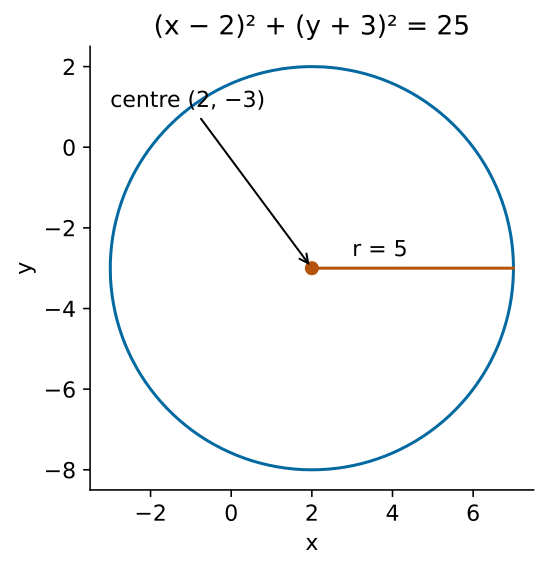
Existing worked example: x²+y²-4x+6y-12=0 becomes (x-2)²+(y+3)²=25, giving centre (2,-3), radius 5. For radius 6 and central angle π/3, arc length is 2π and sector area 6π. An inscribed angle on that same 60° arc is 30°. At 150°, cosine is -√3/2 and sine 1/2 because the point is in quadrant II.
Complete original context
Every transfer question states all data it needs.
Independent practice and checked reasoning
Transfer 1
Find the centre and radius of $x^2+y^2-8x+2y+8=0$. Does $(7,-1)$ lie on it?
Reasoning: Complete squares to get $(x-4)^2+(y+1)^2=9$. Centre $(4,-1)$, radius 3. Substitution of $(7,-1)$ gives $3^2+0^2=9$, so it is on the circle.
Transfer 2
A sector has radius 8 cm and angle 135°. Find its angle in radians, arc length and area. An inscribed angle elsewhere on the circle intercepts this same arc; find it.
Reasoning: $\theta=135\pi/180=3\pi/4$ radians. $s=r\theta=(8\,\mathrm{cm})(3\pi/4)=6\pi\,\mathrm{cm}$. $A=r^2\theta/2=(8\,\mathrm{cm})^2(3\pi/4)/2=24\pi\,\mathrm{cm^2}$. The inscribed angle is half the central angle: 67.5 degrees.
Transfer 3
A unit-circle point is in quadrant III and has $y=-1/2$. Find its $x$-coordinate and one angle between 0° and 360°.
Reasoning: $x^2+y^2=1$ gives $x^2=3/4$. Quadrant III requires $x<0$, so $x=-\sqrt3/2$. The point is at 210 degrees, with reference angle 30 degrees.
Limits and next use
Check degree/radian units, centre signs and whether an angle is central or inscribed before applying the formula.
All tasks here are public original practice with authored guidance. They are not official questions or fresh diagnostics. Existing protected tests and mocks remain separate.