Scope and prerequisites
Digital SAT framework; original paper practice is nonadaptive and gives no scaled-score prediction.
- Use sentence boundaries and punctuation
- Maintain subject–verb agreement and pronoun clarity
- Choose verb forms and modifiers fitting context
Prerequisites: Subjects and finite verbs; independent/dependent clauses.
Explain and choose the method
Find the finite verb 限定动词 and subject in each clause 分句. A dependent clause cannot stand alone as a full sentence.
Join two complete clauses with a full stop, semicolon, or comma plus a coordinating conjunction.
A colon 冒号 follows a complete clause. A semicolon joins complete clauses. Keep essential modifiers attached to what they describe.
Check the head noun for agreement. “The list of measurements is long”: list, not measurements, controls is.
A sentence boundary 句子边界 depends on clause structure. “Although the door was locked” is dependent; attach it to a complete clause. “Although the door was locked, staff could enter through the side gate.” A colon follows a complete introductory clause: “Staff used one entrance: the side gate.”
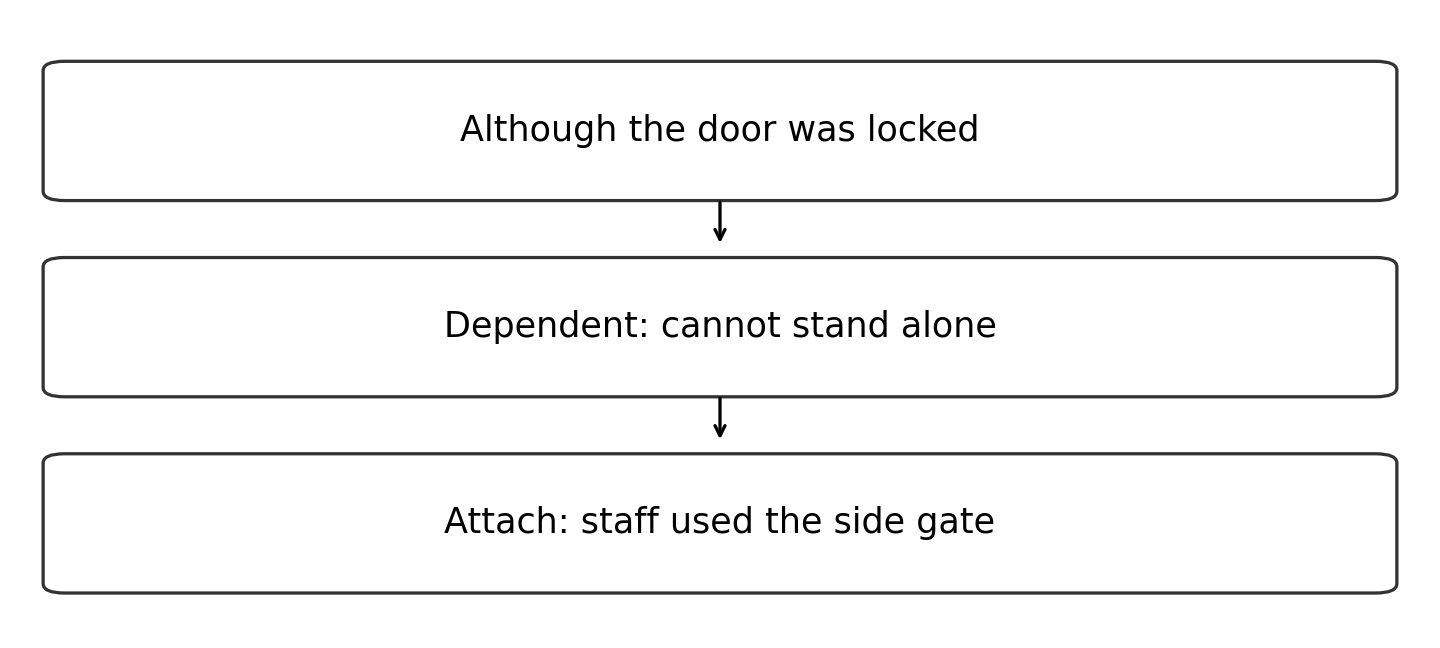
Existing worked example: The sensor failed; the team replaced it. Each side has a subject and verb, so a semicolon works. “Because the sensor failed; the team replaced it” is wrong: because makes the first part dependent.
Complete original context
Original editing passage: Although the old station was closed [1] its clock still worked. The mechanism was simple [2] however, repairing the hands required a specialist. One part needed replacement [3] the narrow axle behind the dial. The clock [4] which stood above the entrance [5] had become a meeting point. For this exercise there is one clock, and the which-clause adds nonessential information.
Independent practice and checked reasoning
This overview is completed through the detailed skill sequence: 28, 29. Work those references and sheets in order; this orientation does not replace them.
Transfer 1
Supply punctuation at [1]–[5]. Give at least two valid boundaries at [2] and explain the clause test.
Reasoning: [1] comma attaches the introductory dependent clause. [2] semicolon or full stop, because the mechanism clause and repairing clause are independent; capitalise However after a full stop. [3] colon follows the complete clause “One part needed replacement” and introduces the part. [4],[5] paired commas mark the specified nonessential clause; matching dashes or parentheses also work.
Transfer 2
Explain why “One part needed: a replacement” differs from the valid colon sentence in the passage.
Reasoning: Needed directly requires its object “a replacement”; placing a colon there interrupts that grammatical unit. In “One part needed replacement: the narrow axle”, the independent clause is already complete and the explanation follows.
Transfer 3
Repair “The clock, above the entrance, and the bell was restored” while preserving the two restored objects. Explain agreement and any optional punctuation.
Reasoning: “The clock above the entrance and the bell were restored.” The compound subject takes were. Commas around “above the entrance” could be used if it is supplementary rather than identifying; that contextual choice does not change the compound agreement.
Limits and next use
Long noun phrases hide the subject. Do not choose a verb merely to match the nearest noun.
All tasks here are public original practice with authored guidance. They are not official questions or fresh diagnostics. Existing protected tests and mocks remain separate.