Scope and prerequisites
Digital SAT framework; original paper practice is nonadaptive and gives no scaled-score prediction.
- Use proportional relationships while preserving units
- Convert rates and distinguish direct from inverse relationships
- Calculate successive changes and percentage comparisons using the correct base
Prerequisites: Fractions; unit conversion; percentage base.
Explain and choose the method
A ratio compares quantities in a chosen order. If red:blue=3:5 and the total is 64, the eight equal parts each contain eight, so red is 24 and blue 40. The ratio 3/5 describes red relative to blue; 3/8 describes red relative to the total. Read the requested denominator rather than using the first visible fraction.
A unit rate 速率 单位率 divides quantity by its corresponding time, distance or count. Write conversion factors so unwanted units cancel: 72 km/hour times 1000 m/km divided by 3600 s/hour is 20 m/s. Area and volume conversions square and cube the length factor. A one-centimetre square is not one metre squared divided by one hundred.
In direct proportion y=kx, doubling x doubles y; in inverse proportion xy=k, doubling x halves y. Constant work shared by identical workers gives an inverse time model only when productivity and conditions are fixed. A fixed initial fee added to a rate makes an affine linear model, not direct proportion through the origin.
A percentage change divides the change by the original comparison base. Successive percentage changes multiply their factors: a 20% discount followed by 20% increase gives 0.8·1.2=0.96 of the original. Distinguish percentage points from relative percent: 30% to 36% is six points, but a 20% relative increase.
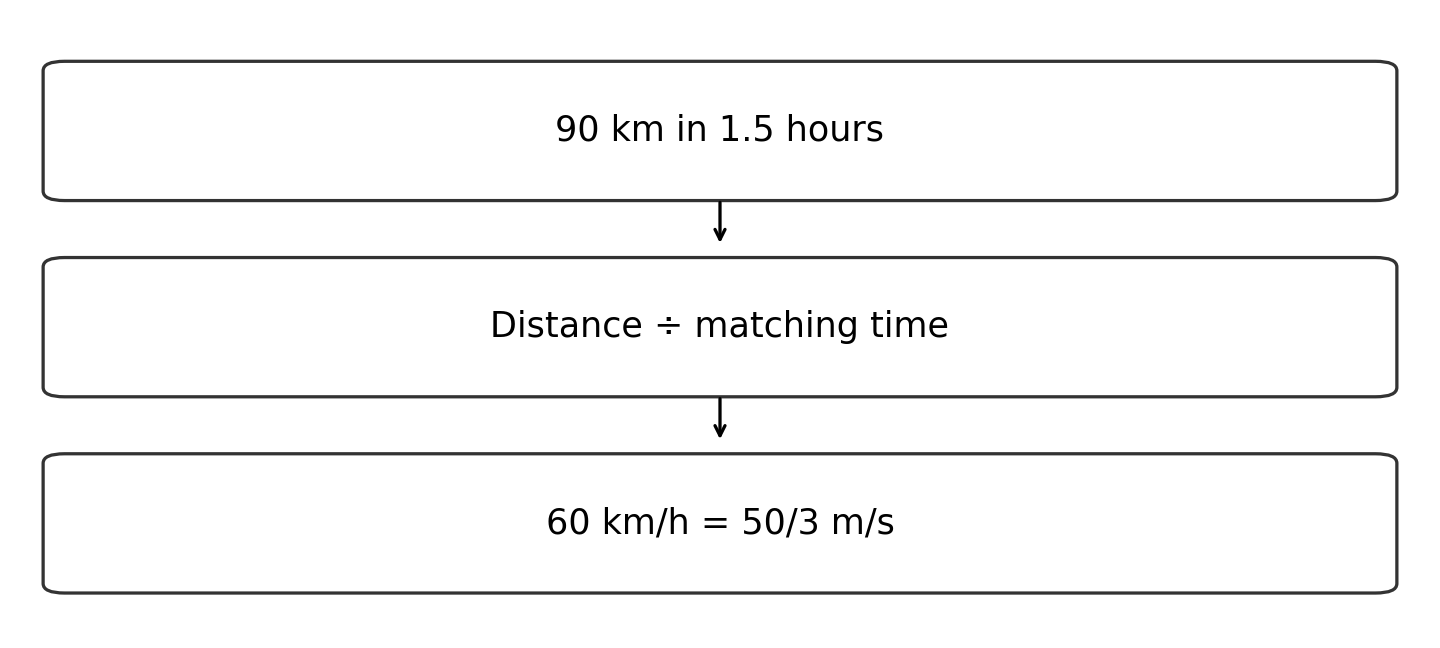
A rate compares quantities with their units. $v=d/t=(90\,\mathrm{km})/(1.5\,\mathrm{h})=60\,\mathrm{km/h}$. Convert using cancelling units: $v=(60\,\mathrm{km/h})(1000\,\mathrm{m/km})/(3600\,\mathrm{s/h})=50/3\,\mathrm{m/s}$. Do not convert only the numerator of a compound rate.
Existing worked example: A 250-unit price discounted 20% becomes 200; increasing that result 20% gives 240, four percent below 250. A pump delivers 18 litres in 3 minutes, so its rate is 6 L/min or 0.1 L/s. At a fixed rate, 45 litres takes 7.5 minutes. If a share rises from 40% to 50%, the rise is 10 percentage points and 25% relative to the old share.
Complete original context
Every transfer question states all data it needs.
Independent practice and checked reasoning
Transfer 1
Mix red and blue paint in ratio 4:7 to make 33 litres. Find each amount. Red paint costs 18 yuan per litre and blue 12. Find total cost.
Reasoning: There are 11 parts, so each is 3 L. Red volume $V_r=33(4/11)=12\,\mathrm{L}$; blue volume $V_b=33(7/11)=21\,\mathrm{L}$. Cost $C=p_rV_r+p_bV_b=(18\,\mathrm{yuan/L})(12\,\mathrm{L})+(12\,\mathrm{yuan/L})(21\,\mathrm{L})=468\,\mathrm{yuan}$.
Transfer 2
A 400-yuan item falls 15% then rises 10%. Find the final price and the single overall percentage change.
Reasoning: Use successive multipliers. $P=P_0(1-0.15)(1+0.10)=(400\,\mathrm{yuan})(0.85)(1.10)=374\,\mathrm{yuan}$. Relative change $r=(P-P_0)/P_0=(374-400)/400=-0.065$, a 6.5% decrease.
Transfer 3
A pump supplies 0.15 litres per second. How long does 54 litres take? If a square has side 30 cm, give its area in square metres.
Reasoning: $t=V/q=(54\,\mathrm{L})/(0.15\,\mathrm{L/s})=360\,\mathrm{s}=6\,\mathrm{min}$. Convert side before squaring: $A=s^2=(0.30\,\mathrm{m})^2=0.09\,\mathrm{m^2}$; the area conversion factor is 10000, not 100.
Limits and next use
State which amount is the percentage base and cancel units visibly. Equal positive and negative percentage changes use different bases.
All tasks here are public original practice with authored guidance. They are not official questions or fresh diagnostics. Existing protected tests and mocks remain separate.