Scope and prerequisites
Digital SAT framework; original paper practice is nonadaptive and gives no scaled-score prediction.
- Interpret zeros, vertices and parameters from useful function forms
- Distinguish additive linear change from multiplicative exponential change
- Transform a graph while tracking its input and output
Prerequisites: Function notation; squares; growth multipliers.
Explain and choose the method
Vertex form 顶点式 a(x-h)²+k identifies the vertex (h,k) and opening direction; factored form identifies zeros. The same function can have both forms. In context, determine which features are meaningful: a maximum height occurs at the vertex of a downward parabola 抛物线, while a zero can represent returning to ground level.
For y=A b^t, A is the value at t=0 and b is the factor per unit time. A growth rate 速率 r gives b=1+r; decay gives b=1-r. Equal differences indicate a linear model, while equal ratios indicate an exponential model for equal input steps. Neither model should be extrapolated beyond a justified domain without a contextual reason.
An output shift f(x)+k moves every point vertically by k. An input shift f(x-h) moves the graph right by h: the same old input is reached when the new x is larger. A multiplier outside scales output; a negative outside reflects across the x-axis. Determine the transformation 转化 algebraically instead of memorising a direction without checking a point.
For an exponential factor given over several time units, distinguish that interval from one unit. Doubling every three hours means 2^(t/3), not 2^t. For a quadratic, use the requested representation to read an extremum or solve for an input. Keep initial values, growth factors and growth percentages separate.
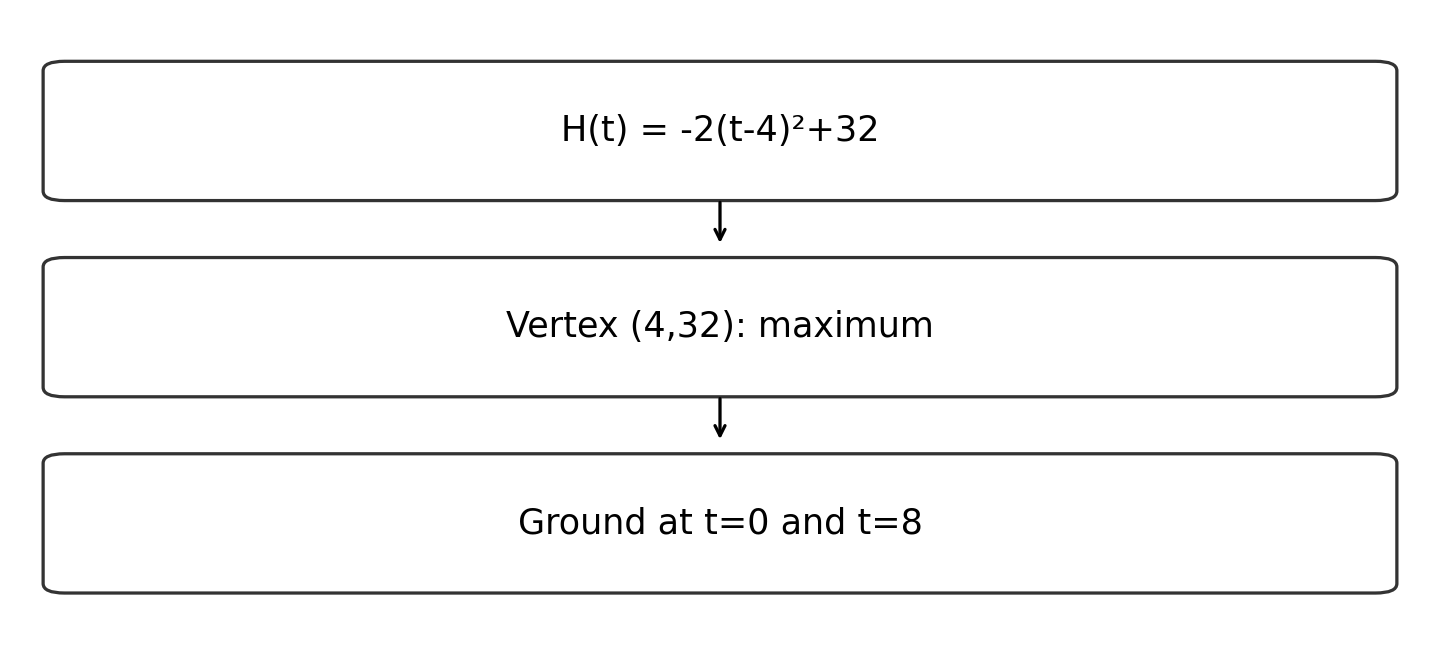
Vertex form $a(x-h)^2+k$ reveals the turning point $(h,k)$. For $H(t)=-2(t-4)^2+32$, the maximum is 32 when $t=4$. Setting $H(t)=0$ gives $(t-4)^2=16$, hence $t=0,8$. Restrict time to the physical interval when the problem represents a flight.
Existing worked example: h(t)=-4(t-3)²+36 has a maximum 36 at t=3, with zeros t=0 and 6. N(t)=80(1.25)^t starts at 80 and grows 25% per unit; N(2)=125. A quantity doubling every three hours is 80·2^(t/3), so after six hours it is 320. If f(x)=x², f(x-2)+5 has vertex (2,5).
Complete original context
Every transfer question states all data it needs.
Independent practice and checked reasoning
Transfer 1
A model height is $H(t)=-3(t-2)^2+12$ metres, with $t$ seconds from launch until return to ground. Find the domain, greatest height, and time interval with height at least 9 metres.
Reasoning: Ground means $H=0$, so $(t-2)^2=4$ and $t=0,4$. Domain is $0\le t\le4\,\mathrm{s}$. The negative square coefficient gives maximum $H(2)=12\,\mathrm{m}$. For $H\ge9\,\mathrm{m}$, $(t-2)^2\le1$, so $1\le t\le3\,\mathrm{s}$.
Transfer 2
A culture model starts with 120 cells and grows by a factor of 1.5 every two hours. Write $N(t)$ for hours $t$, find $N(4)$, and distinguish factor from percentage growth.
Reasoning: $N(t)=120(1.5)^{t/2}$ cells. $N(4)=120(1.5)^2=270$ cells. The growth is 50% per two hours, not 150%; the four-hour factor is 2.25. The hourly factor would be $\sqrt{1.5}$.
Transfer 3
If $f(x)=(x+1)^2$, find the vertex of $g(x)=-2f(x-3)+5$ and its maximum or minimum.
Reasoning: Substitute the input before interpreting signs. $g(x)=-2(x-2)^2+5$ has vertex $(2,5)$ and maximum 5. The old vertex at $-1$ moved three units right to 2.
Limits and next use
A 1.25 factor means 25% growth, not 125% growth; f(x-2) shifts right, and a repeated percentage uses the updated amount.
All tasks here are public original practice with authored guidance. They are not official questions or fresh diagnostics. Existing protected tests and mocks remain separate.