Scope and prerequisites
Digital SAT framework; original paper practice is nonadaptive and gives no scaled-score prediction.
- Combine stated facts to draw a supported conclusion
- Distinguish necessary support from a plausible outside explanation
- Preserve uncertainty and avoid causal overstatement
Prerequisites: Track contrasts; retain uncertainty and scope.
Explain and choose the method
Separate the facts stated from the connection you must infer. If two observations establish a contrast, the conclusion should preserve that contrast. Write a short bridge linking the evidence 证据 before reading the options; this makes an attractive but unrelated explanation easier to detect.
An inference 推断 need not copy a sentence verbatim, but each essential step must be supported. A passage saying a tool detects a feature missed by another supports a difference in detection, not that the first tool is superior for every purpose. Domain knowledge cannot fill an unstated requirement.
Track qualifiers and alternative explanations. A pattern can suggest a possibility rather than establish certainty. If the passage acknowledges several possible causes, a completion blaming one cause exclusively is too strong. Check whether an option introduces new people, settings, motives or time periods.
For a conclusion at the end of a short passage, inspect the logical transition 衔接词: therefore requests a consequence, while however may introduce a limitation. A grammatically smooth continuation can still be logically unsupported. Prefer the option whose claims require the fewest unsupported assumptions while fully answering the task.
A warranted inference 有依据的推断 connects supplied facts without importing a cause. “Short labels helped beginners; experts preferred detailed labels” supports a benefit depending on reader experience. It does not support “short labels are always best” or “experts dislike museums”.
Existing worked example: Original passage: “Two sensors monitored the same bridge. Sensor A recorded brief vibrations that Sensor B did not register, but Sensor B operated successfully during colder periods when A stopped recording.” Warranted conclusion: the sensors had complementary strengths under the observed conditions. It does not follow that either is universally more accurate or that temperature caused every difference in detection.
Complete original context
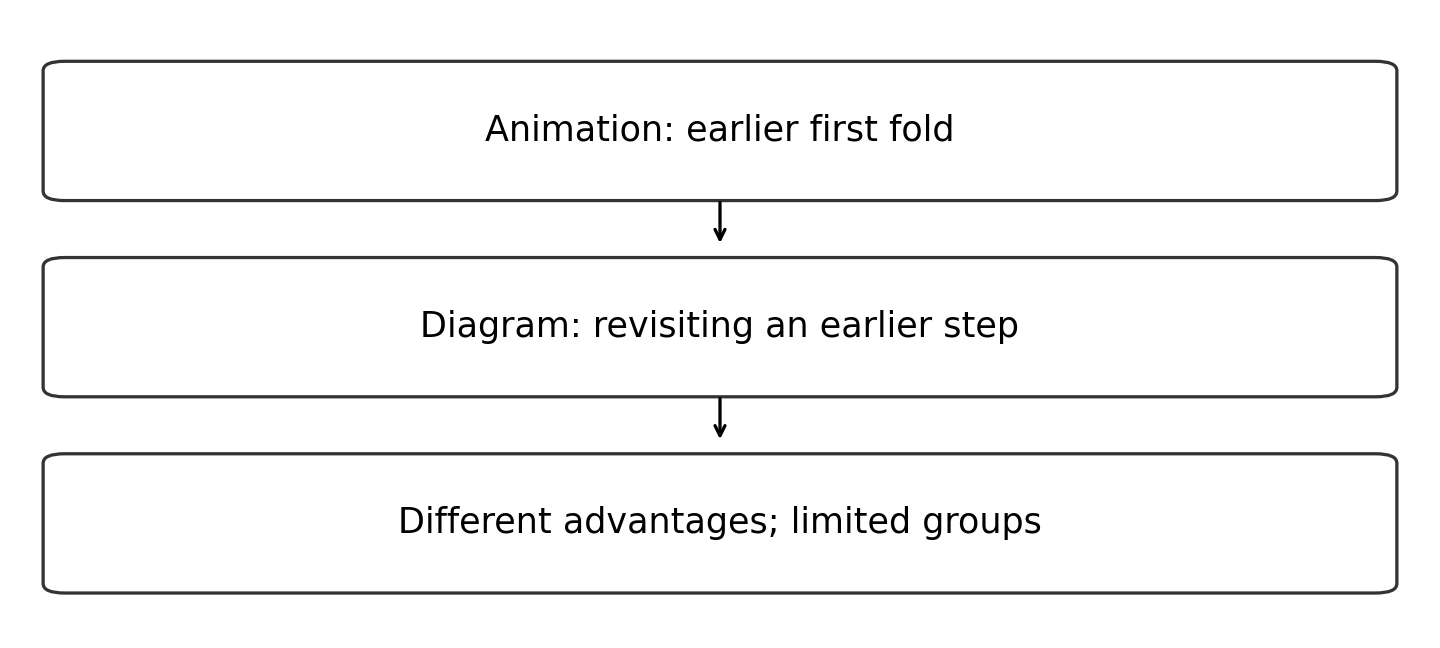
Original passage: A workshop offered a printed diagram and an animated demonstration of a folding process. Participants using the animation began the first fold sooner on average. However, when asked to repair a mistake later, participants using the diagram more often returned to the correct earlier step without help. The groups were small, and the organisers did not report whether participants had equal experience. They concluded that choosing a teaching aid should take account of the stage of the task.
Independent practice and checked reasoning
Transfer 1
Complete the conclusion with a warranted inference about the two aids.
Reasoning: The animation may help people begin, while the diagram may help them revisit earlier steps during correction. The evidence supports different observed advantages, qualified by the small, potentially unequal groups.
Transfer 2
Explain why “animations prevent mistakes” and “diagrams are useless for starting” are both unsupported.
Reasoning: The study reports correction performance, not the absence of mistakes. Starting sooner with animation does not establish that diagram users cannot start. Both statements replace relative observations with absolute claims.
Transfer 3
A new study balances prior experience and finds equal correction rates. Explain how this affects the earlier conclusion without claiming the first observations were fabricated.
Reasoning: It weakens a general claim of diagram superiority for correction and raises experience as a possible explanation of the earlier difference. Different samples or methods can yield different results without making the first observations false.
Limits and next use
Do not turn observed co-occurrence into a unique cause or widen a limited comparison into universal superiority.
All tasks here are public original practice with authored guidance. They are not official questions or fresh diagnostics. Existing protected tests and mocks remain separate.