Scope and prerequisites
Digital SAT framework; original paper practice is nonadaptive and gives no scaled-score prediction.
- Distinguish independent and dependent clauses before choosing punctuation
- Join complete clauses without a comma splice 逗号拼接错误
- Place colons and paired punctuation according to sentence structure
Prerequisites: Subjects and finite verbs; independent/dependent clauses.
Explain and choose the method
An independent clause 独立分句 has a subject and finite predicate and can stand as a sentence. A dependent clause introduced by although, because or when cannot stand alone in that role. Identify the clause structure before choosing punctuation; a long clause is not necessarily complete and a short one may be.
Two independent clauses can be separated by a period or semicolon, or joined with a comma and coordinating conjunction such as and or but. A comma alone creates a splice. A conjunctive adverb such as however does not replace the coordinating conjunction: use “The test was brief; however, it was demanding.”
A colon 冒号 can introduce an explanation, example or list after a complete independent clause. Do not place it between a verb and its direct object or after a preposition introducing its object. “The box contains three tools: a ruler, a compass and a square” has a complete introductory clause; “The tools include: a ruler…” improperly interrupts the include construction.
Nonessential material can be enclosed by matching commas, dashes or parentheses, while essential identifying material should not be separated in that way. Removing a nonessential insertion leaves the core sentence intact. Watch both boundaries of an insertion and avoid placing a comma between the subject and main verb merely because the subject is long.
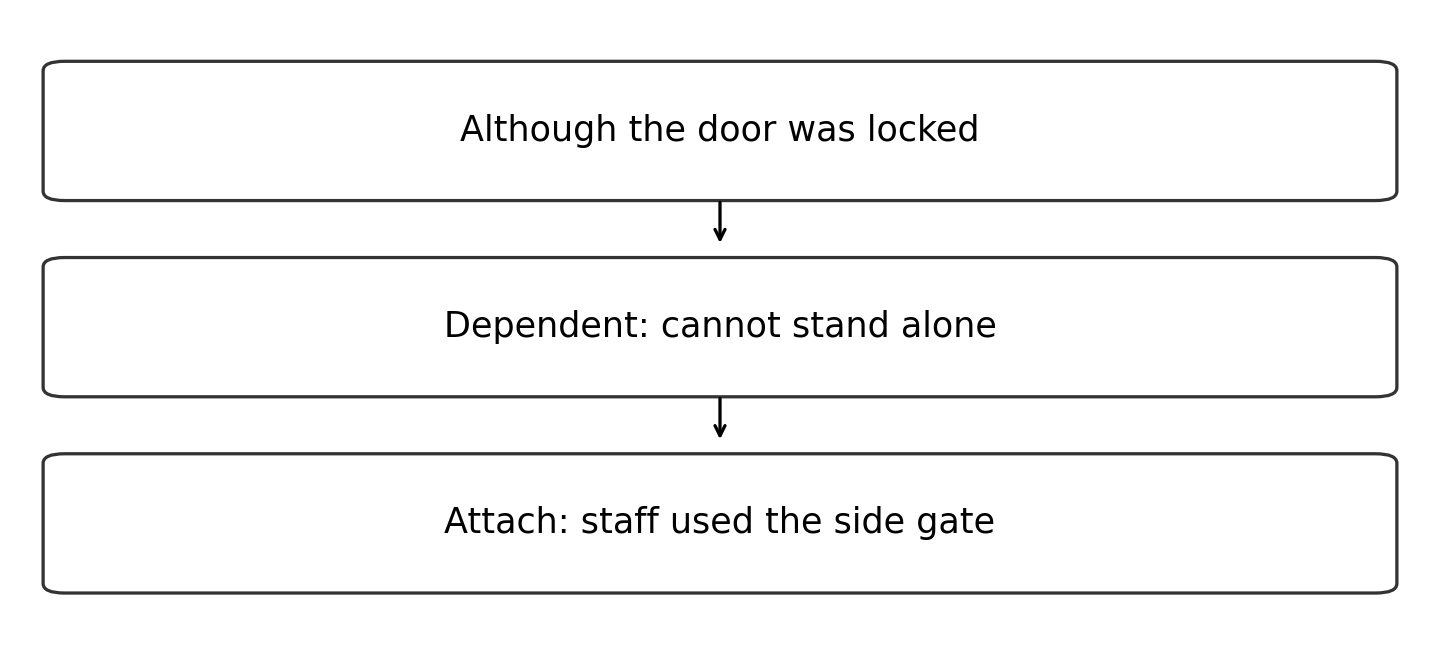
A sentence boundary 句子边界 depends on clause structure. “Although the door was locked” is dependent; attach it to a complete clause. “Although the door was locked, staff could enter through the side gate.” A colon follows a complete introductory clause: “Staff used one entrance: the side gate.”
Existing worked example: Original: “The catalogue was incomplete; however, the surviving entries were useful.” Both clauses are complete; the semicolon separates them and however is followed by a comma. “The team chose one method: a supervised trial” uses a colon after a complete clause. “The catalogue, revised last year, includes new photographs” encloses a removable modifier 修饰语 with two commas.
Complete original context
Original editing passage: Although the old station was closed [1] its clock still worked. The mechanism was simple [2] however, repairing the hands required a specialist. One part needed replacement [3] the narrow axle behind the dial. The clock [4] which stood above the entrance [5] had become a meeting point. For this exercise there is one clock, and the which-clause adds nonessential information.
Independent practice and checked reasoning
Transfer 1
Supply punctuation at [1]–[5]. Give at least two valid boundaries at [2] and explain the clause test.
Reasoning: [1] comma attaches the introductory dependent clause. [2] semicolon or full stop, because the mechanism clause and repairing clause are independent; capitalise However after a full stop. [3] colon follows the complete clause “One part needed replacement” and introduces the part. [4],[5] paired commas mark the specified nonessential clause; matching dashes or parentheses also work.
Transfer 2
Explain why “One part needed: a replacement” differs from the valid colon sentence in the passage.
Reasoning: Needed directly requires its object “a replacement”; placing a colon there interrupts that grammatical unit. In “One part needed replacement: the narrow axle”, the independent clause is already complete and the explanation follows.
Transfer 3
Repair “The clock, above the entrance, and the bell was restored” while preserving the two restored objects. Explain agreement and any optional punctuation.
Reasoning: “The clock above the entrance and the bell were restored.” The compound subject takes were. Commas around “above the entrance” could be used if it is supplementary rather than identifying; that contextual choice does not change the compound agreement.
Limits and next use
Punctuation follows structure, not a pause imagined while reading. A comma before however does not by itself repair two independent clauses.
All tasks here are public original practice with authored guidance. They are not official questions or fresh diagnostics. Existing protected tests and mocks remain separate.