자동차는 움직입니다. 연료를 사용하고 폐기물 가스를 배출하며, 핸들을 돌리면 반응합니다. 자동차는 생명인가? 아니오—생물학은 정확한 이유를 알려줍니다. 생명 ……
English narration · English + 中文 subtitles burned in · 영어 내레이션 · 영어 + 중국어 자막 burned-in
1.1
The seven characteristics of living organisms · 생물의 일곱 가지 특징
Syllabus
English
Core
Supplement
1 Describe the characteristics of living organisms by describing: (a) movement as an action by an organism or part of an organism causing a change of position or place (b) respiration as the chemical reactions in cells that break down nutrient molecules and release energy for metabolism (c) sensitivity as the ability to detect and respond to changes in the internal or external environment (d) growth as a permanent increase in size and dry mass (e) reproduction as the processes that make more of the same kind of organism (f) excretion as the removal of the waste products of metabolism and substances in excess of requirements (g) nutrition as the taking in of materials for energy, growth and development
한국어
핵심
보충
1 생물의 특징을 설명하시오: (a) 이동: 생물이나 생물의 일부가 위치나 장소를 변경하는 작용 (b) 호흡: 영양 분자를 분해하여 대사 에너지를 방출하는 세포 내 화학 반응 (c) 감수성: 내부 또는 외부 환경의 변화를 감지하고 반응하는 능력 (d) 성장: 크기와 건중량이 영구적으로 증가하는 것 (e) 번식: 동일한 종류의 생물을 더 많이 만들어내는 과정 (f) 배설: 대사의 노폐물 및 필요 이상의 물질을 제거하는 것 (g) 영양: 에너지, 성장 및 발달을 위한 물질 섭취
Source: Cambridge International syllabus · 출처: Cambridge International syllabus
English
Every living thing shares the same seven characteristics 特征 — seven life processes 生命过程 that all organisms 生物体 carry out. You can remember them with the letters MRS GREN. The examiner gives marks for the exact wording, so learn each definition.
Movement 运动 — an action by an organism, or part of an organism, that changes its position or place.
Respiration 呼吸作用 — the chemical reactions in cells 细胞 that break down nutrient molecules 营养物质 and release energy 能量 for metabolism 新陈代谢.
Sensitivity 应激性 — the ability to detect and respond to changes in the internal or external environment 环境.
Growth 生长 — a permanent increase in size and dry mass 干重.
Reproduction 生殖 — the processes that make more of the same kind of organism.
Excretion 排泄 — the removal of the waste products 废物 of metabolism, and of substances the body has in excess (more than it needs).
Nutrition 营养 — the taking in of materials for energy, growth and development.
Metabolism means all the chemical reactions that happen inside an organism's cells.
한국어
모든 생명체는 동일한 일곱 가지 특징 — 모든 생물이 수행하는 일곱 가지 생명 현상을 공유합니다. 이를 MRS GREN이라는 글자들로 기억할 수 있습니다. 채점자는 정확한 용어를 요구하므로 각 정의는 반드시 외워두어야 합니다.
일곱 가지 생명 과정은 MRS GREN을 이룹니다
호흡(Respiration) — 세포(cells) 내에서의 chemical reactions으로 **영양 분자(nutrient molecules)**를 분해하여 **대사(metabolism)**를 위해 **에너지(energy)**를 방출하는 과정입니다.
감도(Sensitivity) — 내부 또는 외부 **환경(environment)**의 변화를 감지하고 response하는 능력입니다.
Classification: sorting living things into groups · 분류: 생물을 그룹으로 나누기
Syllabus
Core
Supplement
1 State that organisms can be classified into groups by the features that they share
5 Explain that classification systems aim to reflect evolutionary relationships
2 Describe a species as a group of organisms that can reproduce to produce fertile offspring
3 Describe the binomial system of naming species as an internationally agreed system in which the scientific name of an organism is made up of two parts showing the genus and species
4 Construct and use dichotomous keys based on identifiable features
6 Explain that the sequences of bases in DNA are used as a means of classification
7 Explain that groups of organisms which share a more recent ancestor (are more closely related) have base sequences in DNA that are more similar than those that share only a distant ancestor
Source: Cambridge International syllabus · 출처: Cambridge International syllabus
English
There are millions of kinds of living thing. To study them, scientists classify 分类 them — they sort them into groups by the features they share. Organisms in the same group share more features with each other than with organisms in other groups.
Species and the binomial system
The smallest common group is the species 物种. A species is a group of organisms that can reproduce to make fertile offspring 可育后代 ("fertile" means the offspring can themselves go on to have young).
Each species has a two-part scientific name 学名. This way of naming is the binomial system 双名法 — a system agreed all over the world, so every scientist uses the same name.
The first part is the genus 属 (a larger group that the species belongs to). It starts with a capital letter.
The second part is the species. It starts with a small letter.
The whole name is written in italics, for example Homo sapiens (humans). Two rats named Rattus norvegicus and Rattus rattus belong to the same genus but are different species.
Dichotomous keys
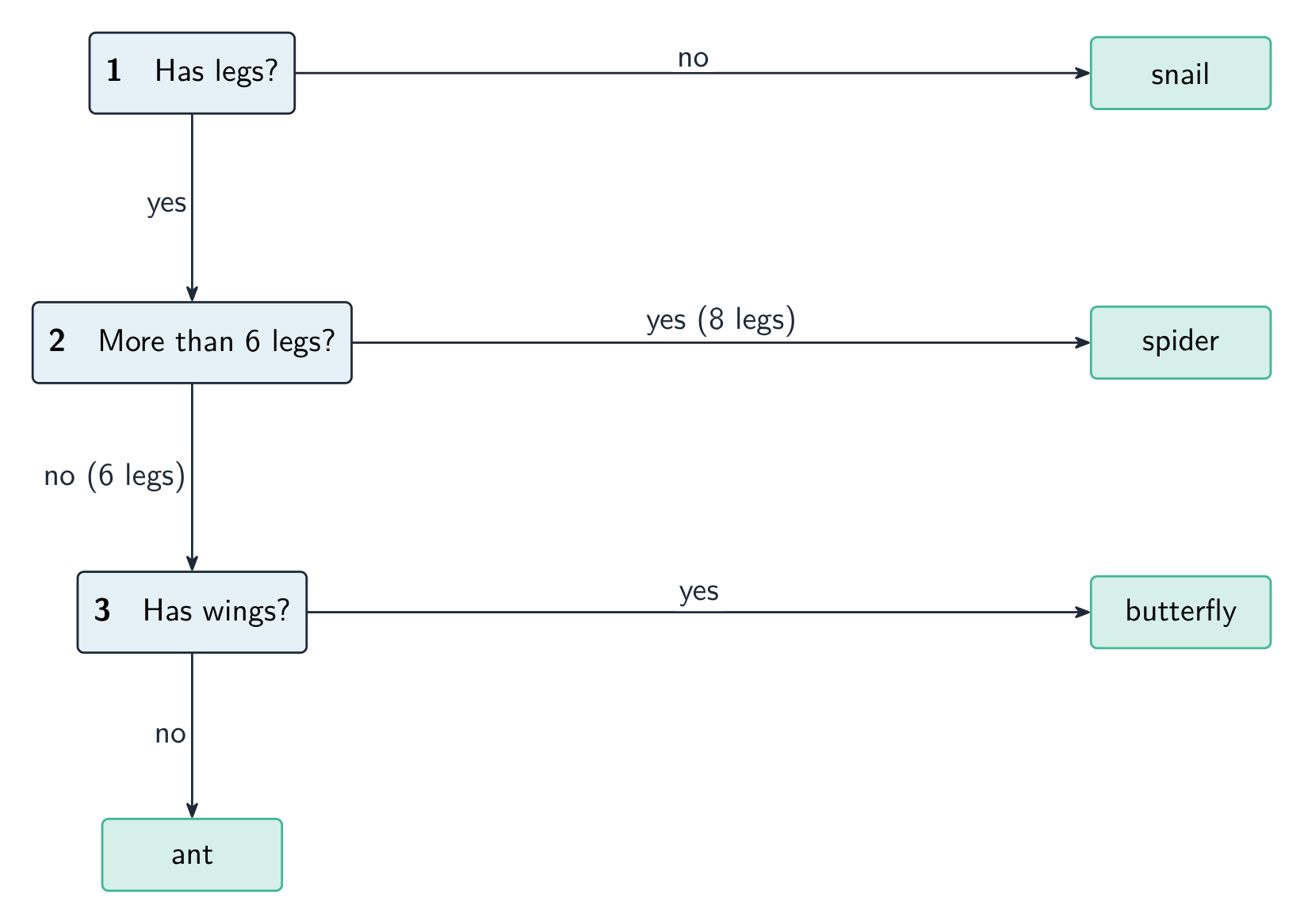
A dichotomous key 二歧检索表 is a tool that helps you identify an unknown organism. "Dichotomous" means "splitting into two". At each step the key gives you two choices about a feature. You pick the one that fits your organism, and that choice sends you on to the next pair of choices. You repeat this until you reach the organism's name.
When you build a key, choose clear features you can see — for example "has wings / has no wings" — not features that change, such as size.
Worked example. A key reads: step 1, has wings, go to 2; no wings, go to 3. Step 2, one pair of wings, it is a housefly; two pairs of wings, it is a butterfly. An unknown insect has two pairs of wings. Step 1 only asks "wings or no wings?", so having wings sends you to step 2. At step 2, "two pairs" gives butterfly. Follow the route the key gives you, one step at a time - never jump straight to the name that looks right.
Classification and DNA (Supplement)
Modern classification tries to show evolutionary relationships 进化关系 — how closely different organisms are related. Organisms that are more closely related share a more recent ancestor 祖先.
To measure this, scientists compare the base sequence 碱基序列 of DNA (the order of the chemical "letters" that make up an organism's genes 基因). The rule is simple:
Organisms that share a more recent ancestor (more closely related) have more similar DNA base sequences.
Organisms that share only a distant ancestor have less similar base sequences.
So a DNA base sequence can be used both to classify organisms and to work out how closely two species are related.
한국어
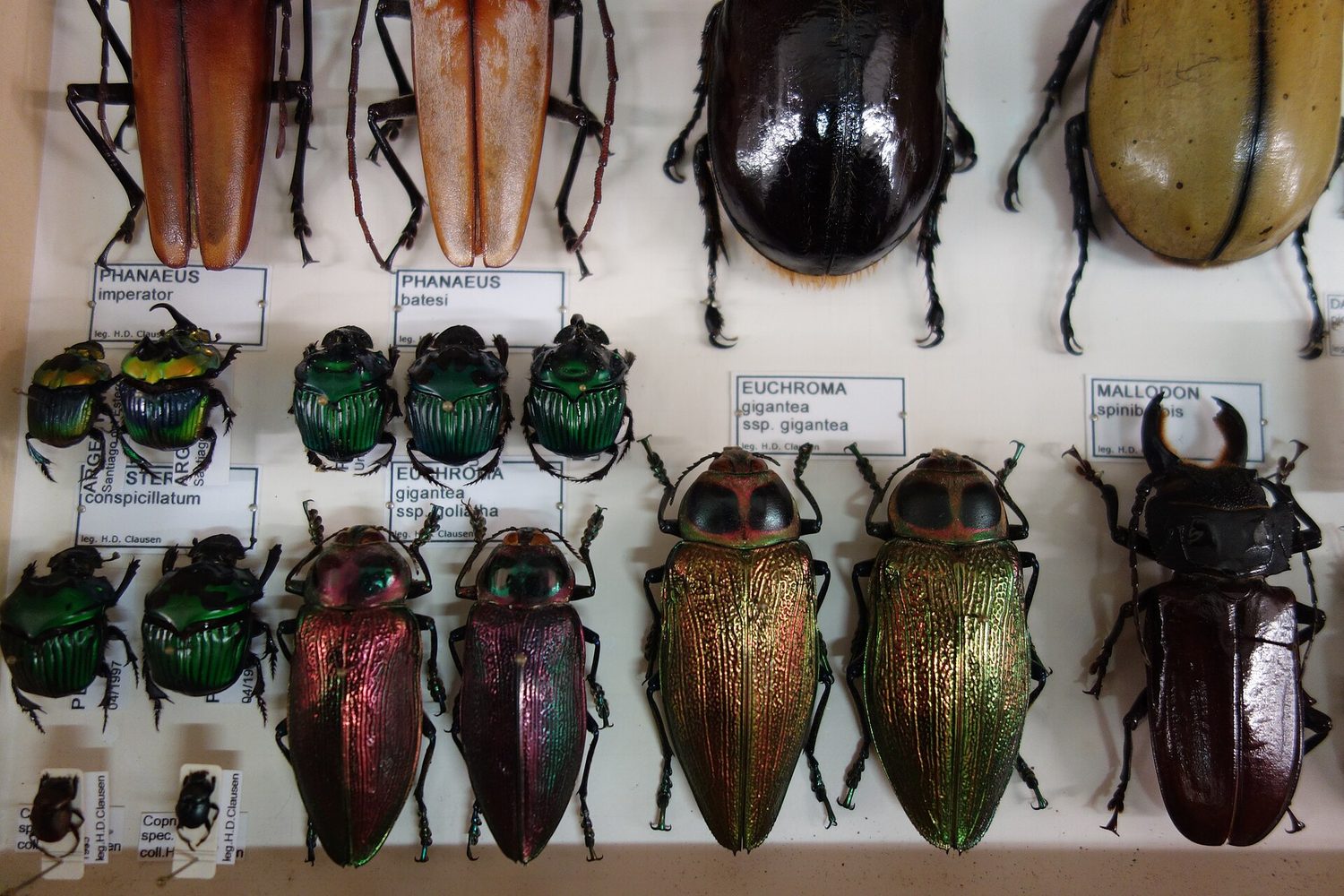
박물관 곤충 보관함: 공유하는 특징에 따라 생물들을 분류합니다
세상에는 수백만种类的 생물이 존재합니다. 이들을 연구하기 위해 과학자들은 분류합니다 — 즉, 공유하는 특징에 따라 그룹으로 나누어 정리합니다. 같은 그룹에 속한 생물들은 다른 그룹의 생물보다 서로 더 많은 특징을 공유합니다.
종과 이명법
가장 작은 공통 그룹은 **종(species)**입니다. 종은 **생식 가능한 자손(fertile offspring)**을 낳을 수 있는 생물들의 집단입니다. ('생식 가능하다'라는 것은 자손이 스스로도 번식을 할 수 있음을 의미합니다).
학명: 대문자 속(genus)与小文字种(species)의 조합
각 종은 두 부분으로 구성된 **학명(scientific name)**을 가집니다. 이 명명 방식은 **이명법(binomial system)**이라 하며, 전 세계 과학자들과 합의된 체계이므로 모든 과학자가 동일한 이름을 사용합니다.
첫 번째 부분은 **속(genus)**입니다 (종이 속하는 더 큰 그룹). 대문자로 시작합니다.
두 번째 부분은 종입니다. 소문자로 시작합니다.
전체 이름은 이탤릭체로 표기하며, 예를 들어 Homo sapiens (인간)와 같습니다. Rattus norvegicus와 Rattus rattus로 알려진 두 쥐는 같은 속에 속하지만 다른 종입니다.
이분 식별표(Dichotomous keys)
**이분 식별표(dichotomous key)**는 미지의 생물을 식별하는 데 도움이 되는 도구입니다. '이분(dichotomous)'은 '두 개로 나뉘다'를 뜻합니다. 각 단계에서 식별표는 특정 특징에 대한 두 가지 선택지를 제공합니다. 자신의 생물에게 맞는 것을 선택하면, 그 선택지는 다음 두 가지 선택지 쌍으로 이어집니다. 생물의 이름을找到할 때까지 이 과정을 반복합니다.
이분법적 식별키: 각 단계마다 두 가지 선택지를 제공하여 최종 생물에 도달함
식별표를 만들 때, 크기처럼 변할 수 있는 특징이 아닌 명확하게 관찰할 수 있는 특징(예: 날개가 있음 / 없음)을 선택해야 합니다.
풀이 예제. 식별표에 다음과 같이 적혀 있습니다: 단계 1, 날개가 있음 → 2로 이동; 날개가 없음 → 3으로 이동. 단계 2, 날개 한 쌍 → 집파리; 날개 두 쌍 → 나비. 미지의 곤충이 날개 두 쌍을 가지고 있습니다. 단계 1에서는 '날개 있음/없음?'만 묻고 있으므로, 날개가 있음은 단계 2로 안내합니다. 단계 2에서 '두 쌍'은 나비를 의미합니다. 식별표가 제시한 경로를 한 단계씩 따라가세요 -適合해 보이는 이름으로 바로跳跃하지 마십시오.
분류와 DNA (심화 과정)
현대 분류는 **진화적 관계(evolutionary relationships)**를 나타내려 합니다 — 서로 다른 생물들이 얼마나 밀접하게 관련되어 있는지. 더 밀접하게 관련된 생물들은 더 최근의 **조상(ancestor)**을 공유합니다.
이를 측정하기 위해 과학자들은 DNA의 염기 서열(base sequence)(생물의 **유전자(genes)**를 구성하는 화학적 '글자'의 순서)를 비교합니다. 규칙은 간단합니다:
더 최근의 조상을 공유하는(더 밀접하게 관련된) 생물들은 더 유사한 DNA 염기 서열을 가집니다.
오직 먼 조상만을 공유하는 생물들은 더 유사하지 않은 염기 서열을 가집니다.
따라서 DNA 염기 서열은 생물들을 분류하고 두 종 간의 관련 정도를 파악하는 데 모두 사용될 수 있습니다.
Explore · 탐색하기
Classification rank lab · 분류 등급 실험
Place examples at the right level in the biological hierarchy. · 예를 생물학적 계층의 올바른 수준에 배치하십시오.
1 State the main features used to place animals and plants into the appropriate kingdoms
4 State the main features used to place all organisms into one of the five kingdoms: animal, plant, fungus, prokaryote, protoctist
2 State the main features used to place organisms into groups within the animal kingdom, limited to: (a) the main groups of vertebrates: mammals, birds, reptiles, amphibians, fish (b) the main groups of arthropods: myriapods, insects, arachnids, crustaceans
5 State the main features used to place organisms into groups within the plant kingdom, limited to ferns and flowering plants (dicotyledons and monocotyledons)
3 Classify organisms using the features identified in 1.3.1 and 1.3.2
6 Classify organisms using the features identified in 1.3.4 and 1.3.5
7 State the features of viruses, limited to a protein coat and genetic material
Source: Cambridge International syllabus · 출처: Cambridge International syllabus
English
The biggest groups that organisms are sorted into are called kingdoms 界. At Core level you place organisms into the first two kingdoms below; for Supplement you need all five kingdoms. You decide where an organism belongs by looking at its main features.
Kingdom
Main features
Animal 动物
made of many cells; cells have no cell wall 细胞壁; cannot make their own food, so they feed on other organisms; most can move their whole body
Plant 植物
made of many cells; cells have a cell wall; make their own food by photosynthesis 光合作用, so many cells contain chloroplasts 叶绿体
Fungus 真菌
for example moulds 霉菌, mushrooms 蘑菇 and yeast 酵母; have cell walls; cannot photosynthesise; feed on dead or living matter
Prokaryote 原核生物
for example bacteria 细菌; single-celled 单细胞; cells have no nucleus 细胞核
Protoctist 原生生物
for example Amoeba and algae 藻类; usually single-celled; cells do have a nucleus
The fungus, prokaryote and protoctist kingdoms are Supplement only.
Grouping the animal kingdom
The animal kingdom is split first into two: animals with a backbone and animals without one.
Vertebrates 脊椎动物 are animals with a backbone 脊柱. There are five main groups.
Group
Main features
Mammals 哺乳动物
have fur 毛发 or hair; feed their young on milk
Birds 鸟类
have feathers 羽毛 and a beak 喙; lay eggs with hard shells
Reptiles 爬行动物
have dry skin covered with scales 鳞片; lay eggs with leathery shells on land
Amphibians 两栖动物
have moist skin; lay eggs in water; the young live in water
Fish 鱼类
have wet scales and fins 鳍; breathe using gills 鳃; lay eggs in water
Arthropods 节肢动物 are animals with no backbone. They have a hard outer skeleton (an exoskeleton 外骨骼) and legs that bend at joints 关节. There are four main groups.
Group
Main features
Insects 昆虫
body in 3 parts; 3 pairs of legs; usually 2 pairs of wings; 1 pair of antennae 触角
Arachnids 蛛形类
body in 2 parts; 4 pairs of legs; no wings; no antennae
Crustaceans 甲壳类
many pairs of legs; 2 pairs of antennae; most live in water
Myriapods 多足类
long body made of many segments 体节; one or two pairs of legs on each segment
Grouping the plant kingdom (Supplement)
Plants are placed into groups too. You need two of them.
Ferns 蕨类植物 — have roots, stems and leaves, but make no flowers or seeds. They reproduce using tiny spores 孢子.
Flowering plants 开花植物 — make flowers, and form seeds 种子 inside the flower. They split into two groups by their seed-leaves (the first leaves inside a seed, called cotyledons 子叶):
Group
Features
Monocotyledons 单子叶植物
seed has one cotyledon; long narrow leaves; veins 叶脉 run side by side (parallel)
Dicotyledons 双子叶植物
seed has two cotyledons; broad leaves; veins form a branching net
Viruses (Supplement)
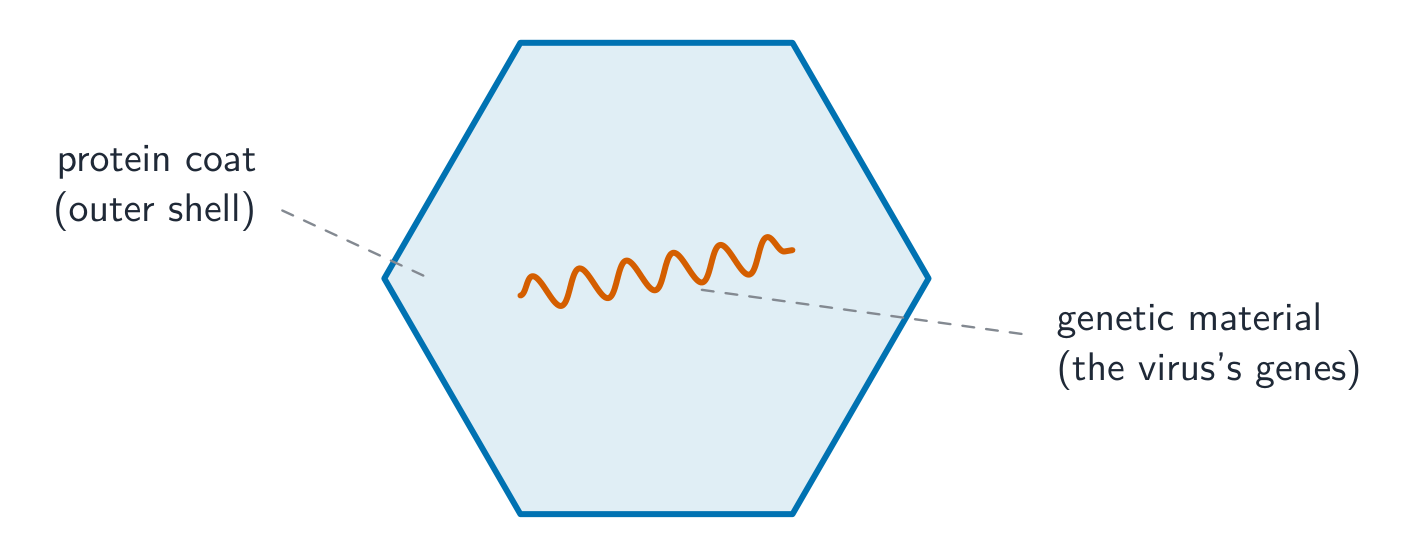
Viruses 病毒 are not placed in any kingdom. They are not made of cells, so many scientists do not count them as living. A virus is very simple, with only two parts:
an outer protein coat 蛋白质外壳, and
genetic material 遗传物质 (its genes) inside.
A virus cannot carry out the life processes on its own. It can only reproduce inside the living cells of a host 宿主 — the organism it infects.
한국어
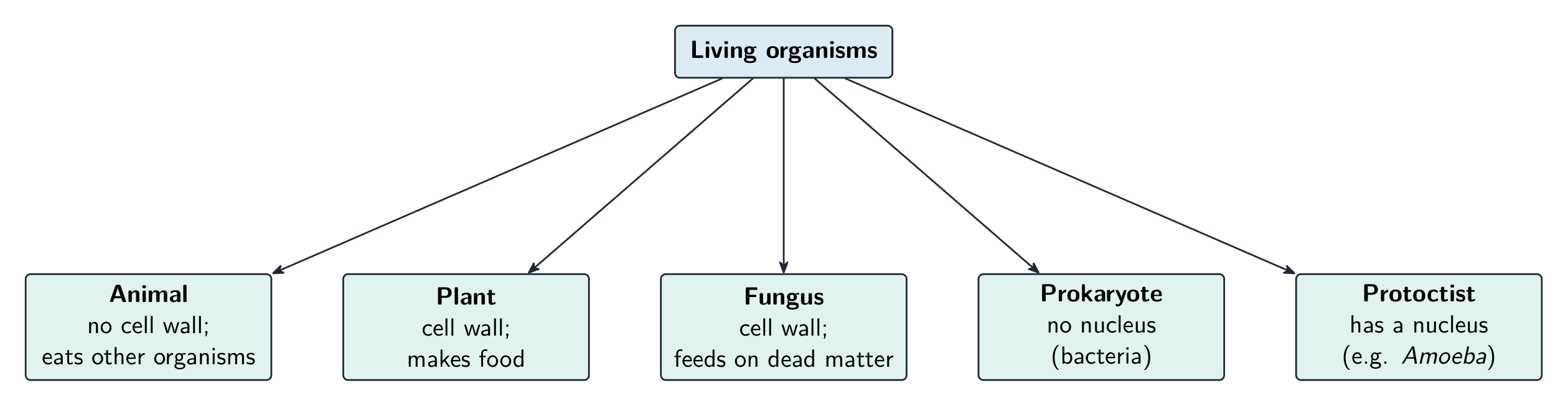
생물들이 분류되는 가장 큰 그룹을 **계(kingdoms)**라고 합니다. 코어(level) 수준에서는 아래 첫 두 개의 계에 생물을 배치하면 되지만, 심화 과정(Supplement)에서는 모든 다섯 개의 계를 알아야 합니다. 생물의 주요 특징을 확인하여 어디에 속하는지 결정합니다.
생명체는 주요 특징에 따라 5개 왕 kingdom으로 분류됩니다
계
주요 특징
동물界
다세포로 이루어져 있음; 세포에 **세포벽(cell wall)**이 없음; 자체적으로 음식을 만들 수 없으므로 다른 생물을 먹음; 대부분 전체 몸을 움직일 수 있음
식물界
다세포로 이루어져 있음; 세포에 세포벽이 있음; **광합성(photosynthesis)**을 통해 자체적으로 음식을 만드므로, 많은 세포에 ** chloroplasts(엽록체)**가 포함됨
균류界
예: 곰팡이(moulds), 버섯(mushrooms), 효모(yeast); 세포벽이 있음; 광합성을 하지 못함; 죽거나 살아있는 물질에서 영양분을 얻음