- Atoms are the building blocks: protons and neutrons in a tiny nucleus, electrons in shells; the outer shell runs the chemistry.
- The periodic table orders elements by atomic number; groups share outer-shell electrons and so share properties.
- Group 0 is unreactive, Group 1 gets more reactive down, Group 7 less; transition metals (chemistry only) behave differently from Group 1.
-
1
원자 구조와 주기율표
1.1
Atomic structure and the periodic table: the particles and the pattern
어휘 연습하기English 한국어 atomic number/əˈtɒmɪk ˈnʌmbə/ 원자 번호 outer shell electron/ˈaʊtə ʃel ɪˈlektrɒn/ 최外层 전자 1.1
Atoms, elements, compounds and mixtures (4.1.1.1–4.1.1.4)
Syllabus
원자, 원소, 화합물 및 혼합물 (AQA 8462 문항 4.1.1.1-4.1.1.4).
- 원자, 원소, 화합물 및 혼합물을 구분하고, 기호 및 화학식을 사용한다.
- 물리적 분리 방법 5가지를 설명하고 주어진 혼합물에 하나를 택한다.
- 구형에서 중성자로 이어지는 원자 모델의 발전을 서술한다.
- 양성자, 중성자 및 전자의 전하 및 질량, 원자 번호 및 질량 수, 동위 원소 및 상대 원자 질량을 사용한다.
- 첫 20개 원소의 전자 배치를 쓴다.
출처: Cambridge International syllabus
All substances are made of atoms 原子 — the smallest part of an element that can exist. Each element has a chemical symbol (O, Na, …); about 100 elements exist, shown in the periodic table.
Compounds 化合物 form when elements combine chemically in fixed proportions; they are represented by formulae and can only be separated back into elements by chemical reactions. Chemical reactions always form one or more new substances, often with a detectable energy change. Equations: word equations and symbol equations with balanced formulae; (HT) balanced half-equations and ionic equations.
Mixtures 混合物: two or more elements or compounds not chemically combined; each substance keeps its properties. Separated by physical processes only — no new substances:
- filtration 过滤 — insoluble solid from liquid;
- crystallisation 结晶 — dissolved solid from solution;
- simple distillation 蒸馏 简单蒸馏 — liquid from dissolved solid (and solvents);
- fractional distillation 分馏 — liquids with different boiling points;
- chromatography 色谱法 — soluble substances in a mixture.
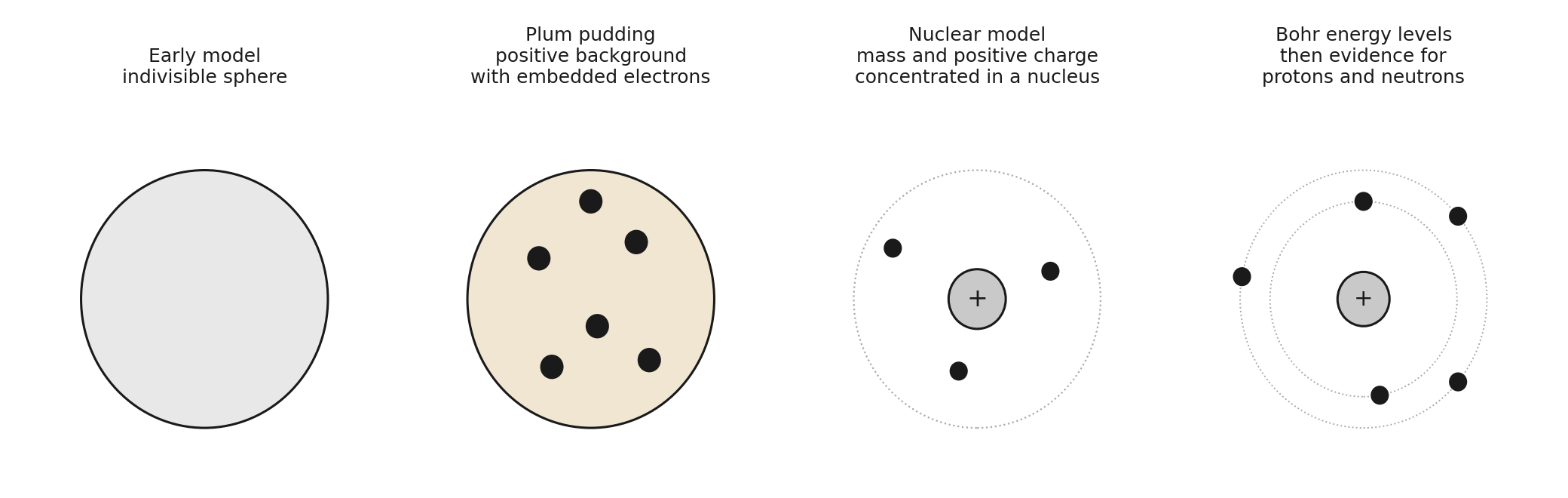
Development of the atom model: atoms were first thought to be indivisible spheres → the electron's discovery gave the plum pudding model 布丁模型 (ball of positive charge with negative electrons embedded) → the alpha-scattering experiment showed mass and positive charge concentrated in a central nucleus (nuclear model) → Bohr: electrons orbit at specific distances → protons identified in the nucleus → Chadwick: the neutron 中子. New evidence changes or replaces models.
particle relative mass relative charge proton 1 +1 neutron 1 0 electron very small −1 In an atom protons = electrons, so no overall charge. Atomic number = protons; mass number = protons + neutrons. Atoms of the same element with different neutron numbers are isotopes 同位素. Atom radius ≈ 0.1 nm (1 × 10⁻¹⁰ m); the nucleus is less than 1/10 000 of that. Almost all mass is in the nucleus.
Relative atomic mass (Ar) averages over the isotopes' abundance — calculate it from percentage abundances. Electronic structure: electrons fill the lowest levels first — sodium is 2,8,1; represent the first twenty elements both as numbers and diagrams.
어휘 연습하기English 한국어 atom/ˈætəm/ 원자 compound/ˈkɒmpaʊnd/ 화합물 mixture/ˈmɪkstʃə/ 혼합물 filtration/fɪlˈtreɪʃn/ 여과 crystallisation/ˌkrɪstəlaɪˈzeɪʃn/ 결정화 distillation/dɪstɪˈleɪʃn/ 증류 chromatography/krəʊməˈtɒɡrəfi/ 색층 분석법 plum pudding model/plʌm ˈpʊdɪŋ ˈmɒdl/ 플럼 푸딩 모델 neutron/ˈnjuːtrɒn/ 중성자 isotope/ˈaɪsətəʊp/ 동위원소 simple distillation/ˈsɪmpl dɪstɪˈleɪʃn/ 단순 증류 fractional distillation/ˈfrækʃənl dɪstɪˈleɪʃn/ 분馏 증류 1.2
The periodic table (4.1.2)
Syllabus
The periodic table (AQA 8462 statement 4.1.2).
- Relate group and period to outer-shell electrons and atomic number.
- Describe the development of the periodic table, including Mendeleev's gaps and the isotope explanation.
- Distinguish metals from non-metals by position and properties.
- State and explain the trends in Groups 0, 1 and 7, including displacement.
출처: Cambridge International syllabus
The table orders elements by atomic (proton) number 原子序数, so that elements with similar properties fall in groups (columns). For main-group elements, group position reflects outer-shell electrons 最外层电子 and similar chemical properties; helium has two outer electrons, while the other Group 0 elements have eight. Explain an element's position from its electronic structure; predict probable reactivity from position.
Development: early tables ordered by atomic weight — incomplete, with some elements misplaced. Mendeleev left gaps for undiscovered elements and sometimes changed the order; his predicted elements were found, supporting his table. Isotopes later explained why atomic-weight order was sometimes wrong.
Metals and non-metals: metals usually lose electrons to form positive ions; many non-metals gain electrons to form negative ions or share electrons in covalent bonds. Metals sit left and lower; non-metals right and upper. Know the characteristic physical and chemical differences, and link atomic structure to position.
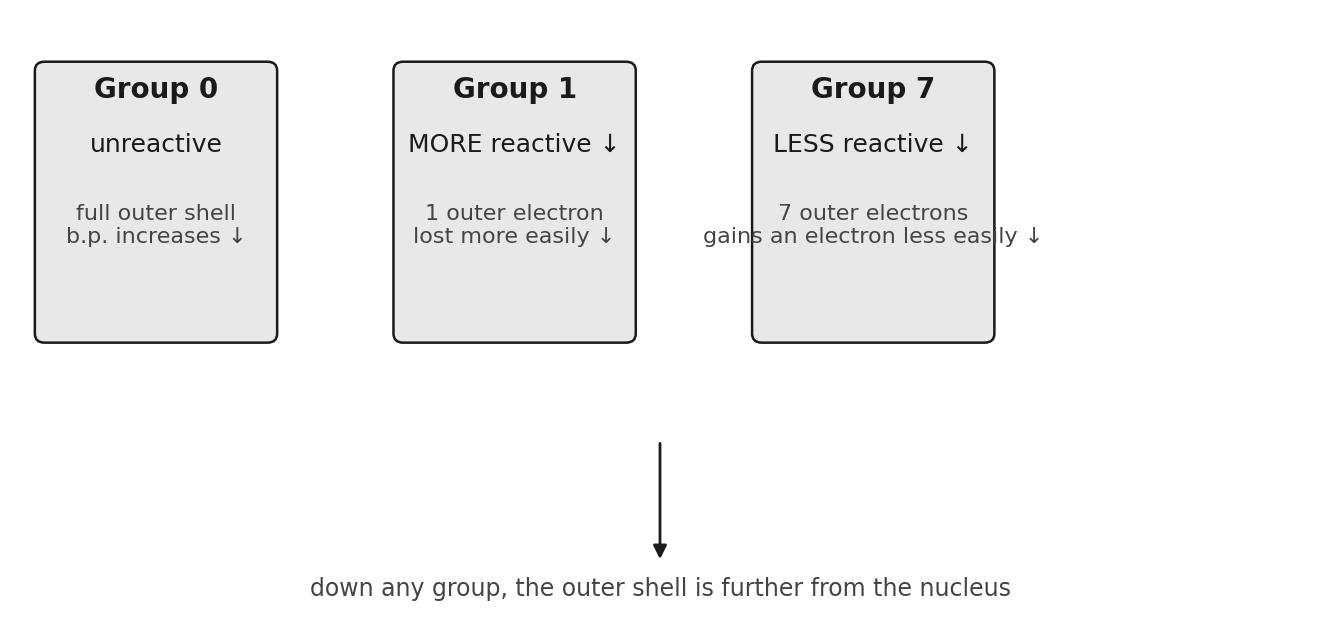
Group 0 — noble gases: unreactive — stable outer-shell arrangements (8 outer electrons; helium 2), so they do not easily form molecules. Boiling points increase down the group (with relative atomic mass).
Group 1 — alkali metals: one outer electron. Reactions of Li, Na, K with oxygen, chlorine and water (e.g. 2 Na + 2 H₂O → 2 NaOH + H₂). Reactivity increases down the group — the outer electron is lost more easily further from the nucleus.
Group 7 — halogens: seven outer electrons; non-metals, diatomic molecules (Cl₂, Br₂, I₂). Reactivity decreases down the group; melting and boiling points increase. A more reactive halogen displaces 置换 a less reactive one from a salt solution (chlorine displaces bromine from potassium bromide).
1.3
Transition metals — chemistry only (4.1.3)
Syllabus
Transition metals, chemistry only (AQA 8462 statement 4.1.3).
- Compare transition elements with Group 1 in melting point, density, strength, hardness and reactivity.
- Describe ions with different charges, coloured compounds and catalysis, with named examples.
출처: Cambridge International syllabus
Compared with Group 1, the transition elements (exemplify with Cr, Mn, Fe, Co, Ni, Cu) have higher melting points, densities, strength and hardness, and are less reactive with oxygen, water and halogens.
Typical properties: ions with different charges (Fe²⁺/Fe³⁺), coloured compounds, and use as catalysts 催化剂 (iron in the Haber process).
어휘 연습하기English 한국어 catalyst/ˈkætəlɪst/ 촉매 1.3
Checklist before you call this topic done
- p/n/e table, atomic and mass numbers, isotopes, Ar from abundance, 2,8,x structures for the first 20.
- The atom-model timeline: sphere → plum pudding → nuclear → Bohr → proton → neutron.
- Five separation methods each matched to a mixture; Mendeleev's gaps and the isotope explanation.
- Group 0/1/7 trends with electron explanations; halogen displacement equations.
- (Chem) transition metals vs Group 1: four differences plus ions, colours, catalysts.
어휘 연습하기English 한국어 displacement/dɪˈspleɪsmənt/ 치환 반응 -
2
결합, 구조 및 물질의 성질
2.1
Bonding, structure and the properties of matter
- Three bonds hold matter together: ionic (transferred electrons, charged ions), covalent (shared electron pairs) and metallic (delocalised electrons).
- Structure follows bonding: giant ionic lattices, small molecules, polymers, giant covalent structure networks and metal lattices — each predicts melting point and conductivity.
- Carbon shows every trick: diamond, graphite, graphene, fullerenes; nanoparticles (chemistry only) turn surface area into properties.
어휘 연습하기English 한국어 delocalised electron/dɪˈlɒkəlaɪzd ɪˈlektrɒn/ 비국소화 전자 fullerene/ˈfʊləren/ 풀러렌 2.1
Ionic, covalent and metallic bonding (4.2.1)
Syllabus
Ionic, covalent and metallic bonding (AQA 8462 statements 4.2.1.1-4.2.1.5).
- Explain the three bond types in terms of electrons and electrostatic forces.
- Draw dot and cross diagrams for electron transfer and for the eight named molecules.
- Deducie ion charges and empirical formulae from group numbers and lattice models; state model limitations.
출처: Cambridge International syllabus
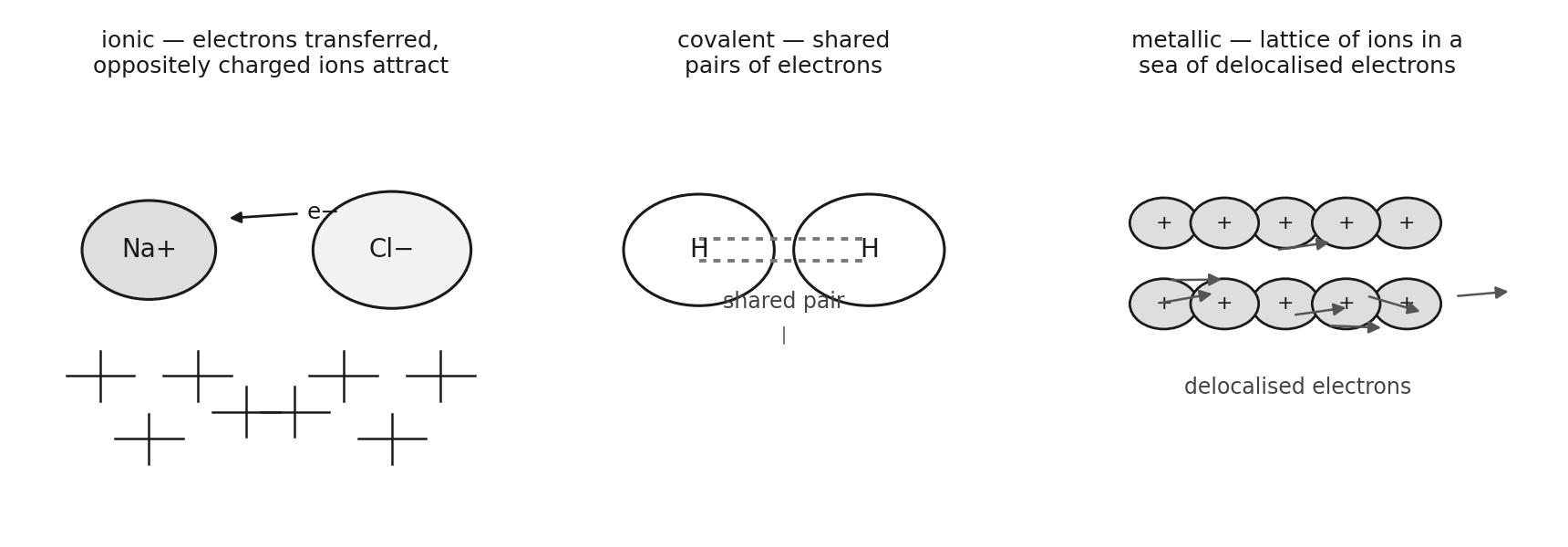
Three strong chemical bonds, all explained by electrostatic forces:
- Ionic 离子键 — a metal atom transfers outer electrons to a non-metal: metal atoms lose electrons to become positive ions; non-metal atoms gain them to become negative ions; Groups 1/2 metals and 6/7 non-metals form ions with noble-gas electronic structures. Draw the electron transfer with dot and cross diagrams; deduce ion charges from group number (Group 1 → +1, Group 2 → +2, Group 6 → −2, Group 7 → −1).
- Covalent 共价键 — non-metal atoms share pairs of electrons. Know dot-and-cross diagrams for H₂, Cl₂, O₂, N₂, HCl, H₂O, NH₃, CH₄, and line representations for small molecules, polymer repeating units and giant covalent structures.
- Metallic 金属键 — a giant lattice of metal atoms with delocalised outer electrons 游离电子 free to move through the whole structure; the sharing of these electrons gives strong metallic bonding.
Know the limitations of models: dot-and-cross, ball-and-stick, 2D and 3D diagrams all simplify — no forces shown, fixed bond lengths, giant structures drawn as small fragments. Deduce empirical formulae from lattice models; molecular formulae from molecule diagrams.
어휘 연습하기English 한국어 metallic bond/məˈtælɪk bɒnd/ 금속 결합 2.2
Bonding, structure and properties (4.2.2)
Syllabus
결합, 구조 및 성질 (AQA 8462 문항 4.2.2.1-4.2.2.8).
- 물질의 상태 및 상태 기호를 입자 이론과 연결하며, (HT) 그 한계를 설명하시오.
- 이온성 화합물, 소분자, 고분자 및 금속의 융점과 전기 전도성을 설명하시오.
- 합금이 순수 금속보다 단단한 이유를 설명하시오.
출처: Cambridge International syllabus
States of matter: solid, liquid, gas; melting/freezing at the melting point, boiling/condensing at the boiling point. Particle theory (small solid spheres) explains the changes; the stronger the forces between particles, the higher the melting/boiling points. (HT) The simple model's limits: no forces shown, all spheres, solid particles. State symbols: (s), (l), (g), (aq).
Structure Bonding/forces Melting point Conducts electricity? ionic lattice strong electrostatic forces in all directions high only when molten or dissolved — ions free to move small molecules strong covalent bonds inside, weak intermolecular forces between 分子间作用力 low — only weak intermolecular forces are overcome no — no overall charge polymers strong covalent chains, stronger intermolecular forces solid at room temperature no giant covalent every atom covalently bonded very high generally no (graphite the exception) metals metallic bonding — delocalised electrons mostly high yes — delocalised electrons carry charge (and heat) Larger molecules → stronger intermolecular forces → higher melting/boiling points. Alloys 合金 are harder than pure metals because different-sized atoms distort the layers, stopping them sliding.
어휘 연습하기English 한국어 ionic bond/aɪˈɒnɪk bɒnd/ 이온 결합 covalent bond/ˈkəʊvələnt bɒnd/ 공유 결합 intermolecular force/ˌɪntəməˈlekjʊlə fɔːs/ 분자 간 힘 alloy/ˈælɔɪ/ 합금 2.3
Structure and bonding of carbon (4.2.3)
Syllabus
탄소의 구조와 결합 (AQA 8462 문항 4.2.3.1-4.2.3.3).
- 네 개의 결합 거대 구조에서 다이아몬드의 성질을 설명하시오.
- 세 개의 결합, 층 및 비국재화 전자의 관점에서 그래파이트의 성질을 설명하시오.
- 그래핀과 풀러렌을 서술하며, 탄소 나노 튜브 및 그 활용 분야를 포함하시오.
출처: Cambridge International syllabus
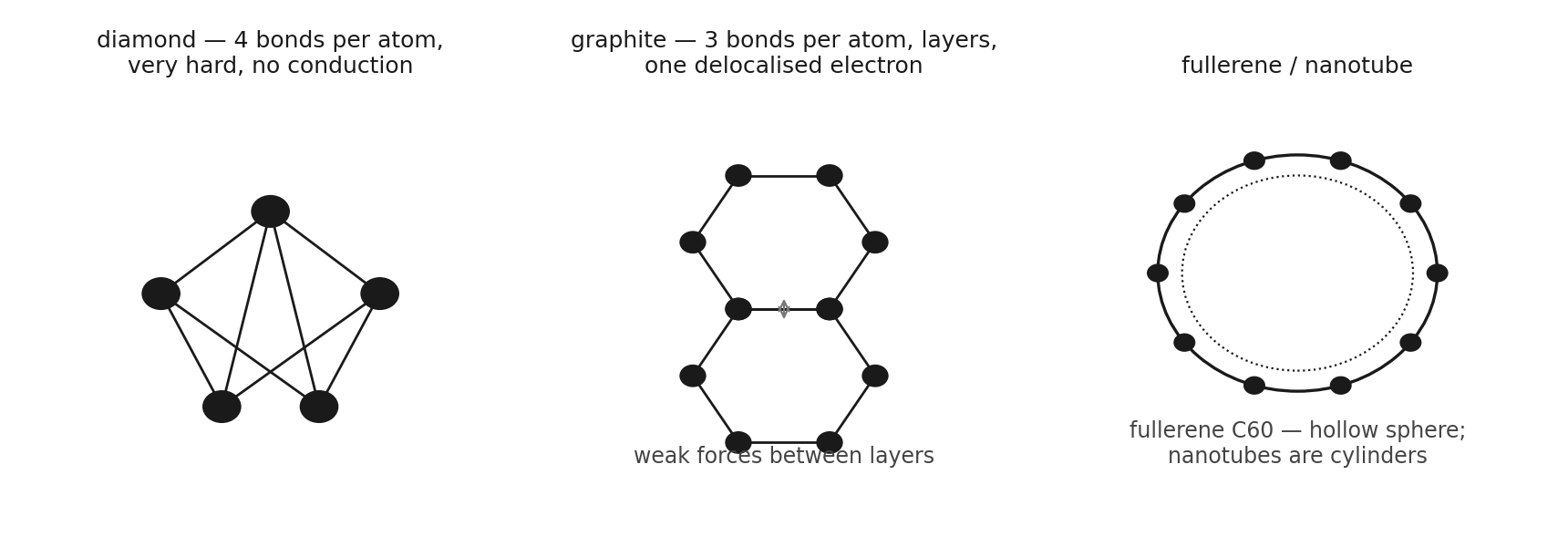
- Diamond — a giant covalent structure 巨型共价结构 in which each carbon forms four covalent bonds: very hard, very high melting point, does not conduct.
- Graphite — each carbon forms three bonds, layers of hexagonal rings with no covalent bonds between layers (soft, slippery — lubricant); one delocalised electron per atom → conducts electricity like a metal.
- Graphene — a single layer of graphite: one atom thick, strong, conducts — electronics and composites.
- Fullerenes — hollow molecules of carbon hexagons (plus 5- or 7-membered rings); Buckminsterfullerene C₆₀ 富勒烯 is spherical. Carbon nanotubes 碳纳米管 — cylindrical fullerenes with huge length-to-diameter ratios: nanotechnology, electronics, materials.
어휘 연습하기English 한국어 giant covalent structure/ˈdʒaɪənt ˈkəʊvələnt ˈstrʌktʃə/ 거대 공유 결합 구조 carbon nanotube/ˈkɑːbən ˌnænəʊˈtjuːb/ 탄소 나노튜브 2.4
Bulk and surface properties incl. nanoparticles — chemistry only (4.2.4)
Syllabus
거시 및 표면 성질(나노 입자 포함), 화학만 (AQA 8462 문항 4.2.4).
- 나노 입자, 미세 입자 및 거친 입자의 크기 범위를 비교하시오.
- 정사각형에 대한 면적 대 부피 비 10 법칙을 적용하시오.
- 나노 입자가 거시 물질과 다른 이유, 활용 분야 및 우려 사항을 설명하시오.
출처: Cambridge International syllabus
Nanoscience = structures 1–100 nm (a few hundred atoms). Nanoparticles 纳米颗粒 are smaller than fine particles (PM2.5, 100–2500 nm), which are smaller than coarse particles/dust (PM10, 1 × 10⁻⁵–2.5 × 10⁻⁶ m).
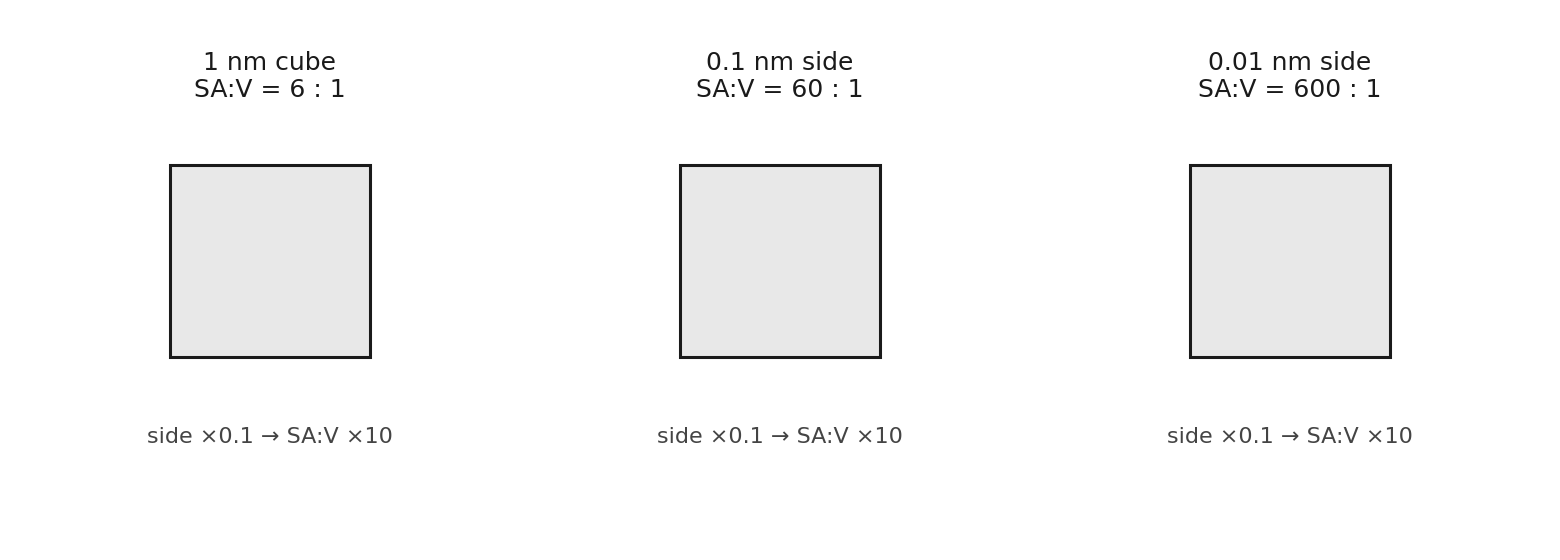
Surface area : volume: as a cube's side decreases 10×, SA:V increases 10×. Nanoparticles may have different properties from the bulk material because of this high ratio — catalysts (smaller quantities work), medicine delivery, cosmetics, electronics. Concerns: effects inside the body and in the environment are not fully known.
어휘 연습하기English 한국어 nanoparticle/ˌnænəʊˈpɑːtɪkl/ 나노 입자 2.4
Checklist before you call this topic done
- The three bonds in terms of electrons and electrostatic forces; ion charges from group numbers.
- Dot-and-cross for the eight named molecules; model limitations named.
- The properties table above rebuilt from memory — which forces are overcome on melting.
- Diamond vs graphite vs graphene vs fullerenes, bonding to property.
- (Chem) SA:V factor-of-10 rule; the three particle-size bands and nanoparticle uses and concerns.
-
3
정량 화학
3.1
Quantitative chemistry: counting atoms by mass
- Atoms are neither lost nor made: the balanced equation is a mass ledger, and conservation of mass closes every account.
- The mole converts grams into particle counts; moles turn equations into reacting-mass arithmetic.
- Yield, atom economy, concentration (chem only) and gas volumes (HT) finish the quantitative toolkit.
3.1
Conservation of mass and equations (4.3.1)
Syllabus
화학 측정, 질량 보존 및 식(AQA 8462 문항 4.3.1.1-4.3.1.4).
- 균형 화학식 작성 및 질량 보존 활용.
- 상대 분자 질량 계산 및 원소별 질량 백분율 산출.
- 기체가 관여할 때 나타나는 겉보기 질량 변화 설명.
- 평균값 주위의 반복 측정 범위에서 불확도 추정.
출처: Cambridge International syllabus
Conservation of mass 质量守恒: no atoms are lost or made, so the mass of products equals the mass of reactants. Symbol equations are balanced in atom numbers; know the difference between a multiplier before a formula (numbers of units) and a subscript within it (atoms in the unit).
Relative formula mass (Mr) 相对分子质量 = sum of the relative atomic masses in the numbers shown. In a balanced equation, ΣMr of reactants = ΣMr of products. Percentage by mass of an element = (Ar × number of atoms ÷ Mr) × 100 %.
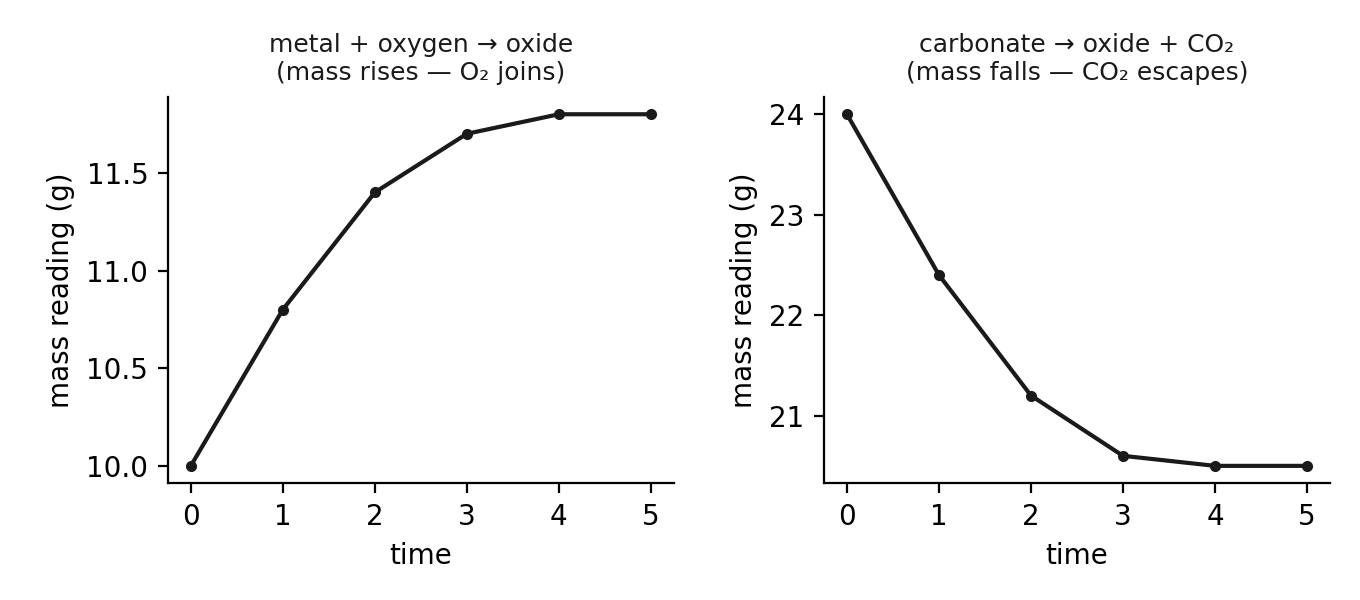
Mass changes with gases: metal + oxygen → oxide gains mass; thermal decomposition of a carbonate loses the escaped CO₂ — no law is broken once the gas is counted.
Uncertainty: every measurement carries uncertainty; use the range of repeated measurements about the mean as its estimate (and mean ± range/2 in calculations).
어휘 연습하기English 한국어 conservation of mass/ˌkɒnsəˈveɪʃn ɒv mæs/ 질량 보존 relative formula mass/ˈrelətɪv ˈfɔːmjʊlə mæs/ 상대 분자 질량 3.2
Moles and reacting masses — HT (4.3.2)
Syllabus
몰과 반응 질량, HT (AQA 8462 문항 4.3.2.1-4.3.2.5).
- 몰, 아보가드로 상수 및 몰 = 질량 / Mr 활용.
- 균형 화학식을 이용한 반응 질량 계산.
- 반응 질량으로부터 화학식 균형 맞추기.
- 제한 반응물 설명 및 활용.
- g/dm3 단위의 농도 계산 및 mol/dm3와 함께 질량-부피 관계 적용.
출처: Cambridge International syllabus
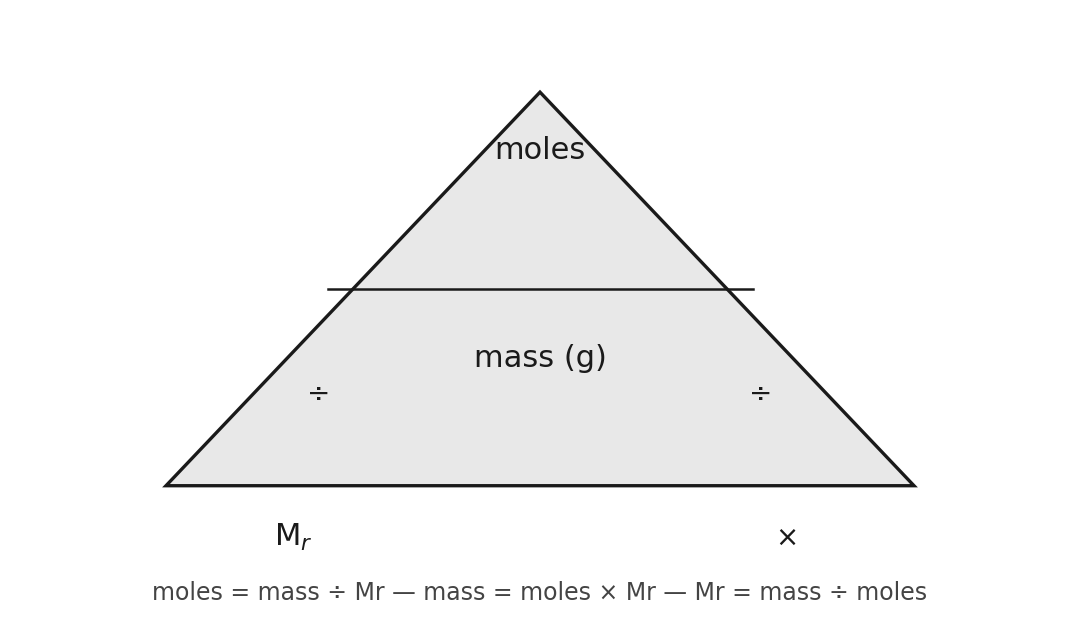
The mole 摩尔: the mass of one mole of a substance in grams is numerically its Mr. One mole contains the Avogadro constant 阿伏伽德罗常数 of particles — 6.02 × 10²³ — the same count of stated particles (atoms, molecules, ions) as a mole of any other substance.
$$\text{moles} = \frac{\text{mass (g)}}{M_r}$$Equations as mole ratios: Mg + 2 HCl → MgCl₂ + H₂ reads "1 mol Mg reacts with 2 mol HCl → 1 mol MgCl₂ + 1 mol H₂". Given any one mass, calculate all others: mass → moles → ratio → moles → mass.
Balancing from masses: convert each mass to moles, divide by the smallest, clear fractions to whole numbers.
Limiting reactant 限量反应物: the reactant completely used up limits the product; an excess of the other ensures completion. Calculate the product from the limiting reactant's moles only.
Concentration 浓度: in g/dm³ for all tiers — mass of solute in a given volume; (HT) also mol/dm³: moles = concentration × volume(dm³), rearranged as needed.
어휘 연습하기English 한국어 mole/məʊl/ 몰 Avogadro constant/ˌævəˈɡædrəʊ ˈkɒnstənt/ 아보가드로 상수 limiting reactant/ˈlɪmɪtɪŋ rɪˈæktənt/ 한계 반응물 concentration/ˌkɒnsənˈtreɪʃn/ 농도 3.3
Yield and atom economy — chemistry only (4.3.3)
Syllabus
수율 및 원자 경제성, 화학 전담 (AQA 8462 문항 4.3.3).
- 수율이 100% 미만인 세 가지 이유 제시.
- 수율 백분율 계산 및 (HT) 이론적 질량 우선 산출.
- 원자 경제성 계산 및 그 중요성 설명.
출처: Cambridge International syllabus
Percentage yield 产率 is below 100 % because: the reaction is reversible; product is lost on separation; reactants react in unwanted ways.
$$\%\ \text{yield} = \frac{\text{mass actually made}}{\text{maximum theoretical mass}} \times 100$$Atom economy 原子经济 measures how much of the starting material ends up in the useful product — high atom economy matters for sustainability and cost:
$$\text{atom economy} = \frac{M_r \text{ of desired product}}{\text{sum of } M_r \text{ of all reactants}} \times 100\ \%$$(HT) calculate the theoretical mass from the balanced equation, then the yield.
어휘 연습하기English 한국어 percentage yield/pəˈsentɪdʒ jiːld/ 수율 atom economy/ˈætəm ɪˈkɒnəmi/ 원자 경제성 3.4
Concentrations in mol/dm³ — chemistry only, HT (4.3.4)
Syllabus
mol/dm3 단위 농도, 화학 전담, HT (AQA 8462 문항 4.3.4).
- 몰, 질량, 부피 및 mol/dm3 단위 농도 간의 관계 설명.
- 적정 부피 및 화학식 계수비로부터 미지 농도 계산.
출처: Cambridge International syllabus
Concentration in mol/dm³ links moles, mass and volume: moles = C × V; from a titration 滴定, knowing the volumes of both solutions and one concentration gives the other — moles of acid = moles of alkali at neutralisation (respect the ratio in the equation).
어휘 연습하기English 한국어 titration/taɪˈtreɪʃn/ 적정법 3.5
Gas volumes — chemistry only, HT (4.3.5)
Syllabus
기체 부피, 화학 전담, HT (AQA 8462 문항 4.3.5).
- 동일한 온도와 압력에서 같은 기체 부피는 같은 몰 수를 포함함을 명시.
- 반응에서 기체 부피를 연결하기 위해 방정식 비를 사용한다.
출처: Cambridge International syllabus
A given volume of gas contains the same number of moles at the same temperature and pressure — equal volumes = equal moles. The volumes of reacting gases (and products) follow the equation's ratio directly, e.g. 2 volumes of hydrogen react with 1 volume of oxygen.
3.5
Checklist before you call this topic done
- Balance equations; Mr and percentage-by-mass sums; explain apparent mass changes with gases.
- (HT) mole ↔ mass conversions, Avogadro constant, ratio chains, balancing from masses, limiting reactant.
- (Chem/HT) percentage yield with its three reasons; atom economy formula; titration concentration; gas-volume ratios.
-
4
화학 변화
4.1
Chemical changes: reactivity, acids and electrolysis
- Metals differ in how easily they lose electrons — the reactivity series 活动性顺序 orders them, drives displacement 置换 and decides how each is extracted.
- Acids donate H⁺; alkalis donate OH⁻; their reaction makes a salt 盐 — and the salt's name reads off the acid and the base.
- Electrolysis forces ions to give up or take electrons at electrodes — extracting the most reactive metals and splitting solutions.
어휘 연습하기English 한국어 reactivity series/rɪəkˈtɪvɪti ˈsɪəriːz/ 활성도 서열 displacement/dɪˈspleɪsmənt/ 치환 반응 salt/sɒlt/ 염 4.1
Reactivity of metals (4.4.1.1–4.4.1.4)
Syllabus
금속의 반응성 (AQA 8462 서술문 4.4.1.1-4.4.1.4).
- 탄소와 수소를 포함한 활동도 순서, 물과 산과의 반응을 포함하여Activity Series을 기억한다.
- 반응성을 양이온 형성 경향으로 설명하고 결과를 바탕으로 순서를 추론한다.
- 추출 방법을 반응성과 연결한다: 탄소 환원법 vs 전해법.
- (HT) OIL RIG를 사용하여 치환 및 산화환원 반응의 이온 방정식을 쓴다.
출처: Cambridge International syllabus
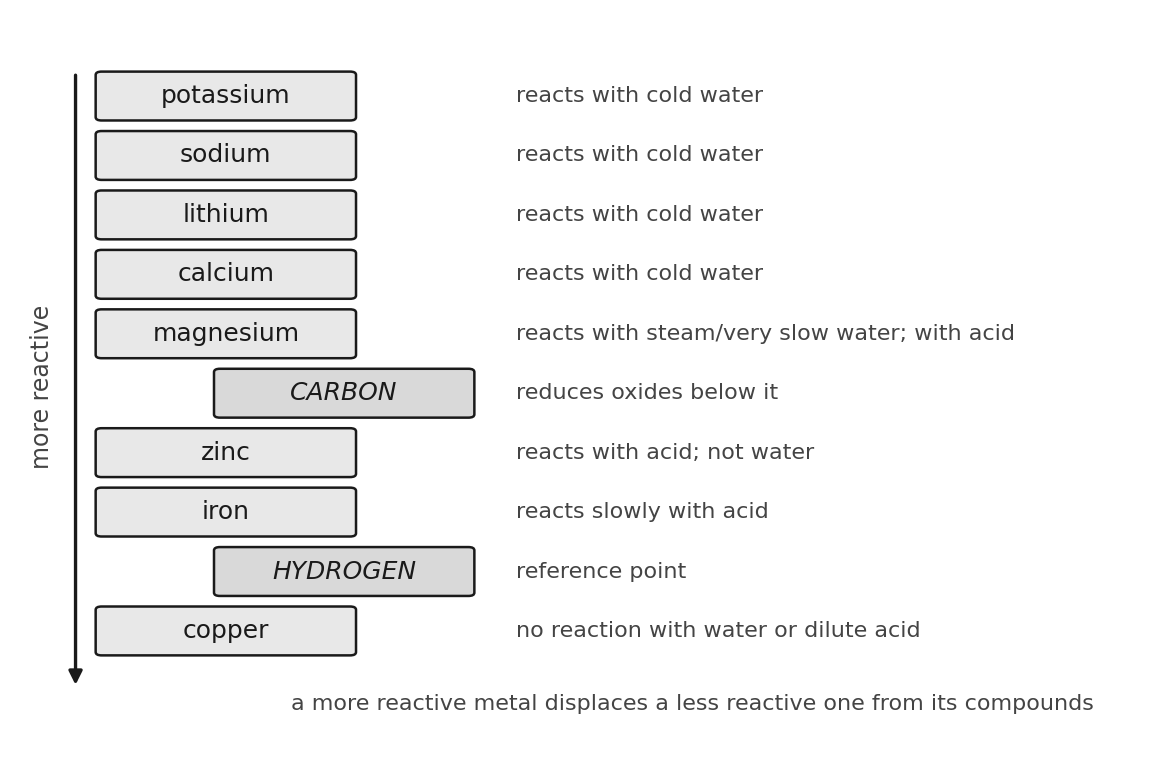
Reactivity series (learn the order): potassium, sodium, lithium, calcium, magnesium, [carbon], zinc, iron, [hydrogen], copper. Reactivity = the metal's tendency to form positive ions.
- With water: K, Na, Li, Ca react ( fizzing, hydroxide + hydrogen); Mg very slow; Zn/Fe/Cu no reaction.
- With dilute acids: Mg, Zn, Fe react → salt + hydrogen; Cu does not.
- A more reactive metal displaces a less reactive one from its compound: Zn + CuSO₄ → ZnSO₄ + Cu.
Extraction: unreactive metals (gold) occur native; metals below carbon are extracted by reduction 还原 with carbon (loss of oxygen); metals above carbon need electrolysis 电解. Identify oxidation 氧化 (gain of oxygen) and reduction (loss of oxygen).
(HT) Redox in electrons: oxidation is loss of electrons, reduction is gain — OIL RIG. Write ionic equations for displacement: Zn + Cu²⁺ → Zn²⁺ + Cu.
어휘 연습하기English 한국어 reduction/rɪˈdʌkʃn/ 환원 oxidation/ˌɒksɪˈdeɪʃn/ 산화 electrolysis/ɪlekˈtrɒləsɪs/ 전해 4.2
Reactions of acids and making salts (4.4.2)
Syllabus
산의 반응 (AQA 8462 서술문 4.4.2.1-4.4.2.6).
- 산-금속 및 산-염기 반응의 생성물을 예측하고, 산과 염기에서 유래한 염의 이름을 붙인다.
- RP1 불용성 산화물 또는 탄산염으로부터 염 제조 과정을 설명한다.
- pH 척도, 범지 지시약 및 pH 프로브를 사용하고 중화 반응의 이온 방정식을 쓴다.
- (Chem) 적정법(startpoint)을 설명하고(RP2), 강산과 약산에 대해 인자-10 pH 법칙을 적용한다.
출처: Cambridge International syllabus
Acids neutralised by alkalis (soluble hydroxides) and bases (insoluble oxides/hydroxides) → salt + water; by metal carbonates → salt + water + carbon dioxide. The acid decides the salt's negative ion: hydrochloric → chlorides, nitric → nitrates, sulfuric → sulfates; the base supplies the positive ion. Predict products and write salt formulae from ion charges.
Making a soluble salt (RP1): add the insoluble solid (metal oxide/carbonate) to warm dilute acid until no more dissolves (excess solid proves completion), filter off the excess, evaporate to the crystallisation point and leave to crystallise; dry the crystals.
pH scale: 0–14, measured with universal indicator or a pH probe; 7 neutral, <7 acid, >7 alkaline. Acids give H⁺(aq); alkalis give OH⁻(aq). Neutralisation 中和: H⁺ + OH⁻ → H₂O.
(Chem) Titrations 滴定 (RP2): measure reacting volumes of a strong acid and strong alkali accurately — burette, pipette, indicator; (HT) calculate concentrations in mol/dm³ and g/dm³ (topic 3.4 methods).
(HT) Strong and weak acids: strong acids (HCl, HNO₃, H₂SO₄) are completely ionised; weak acids (ethanoic, citric, carbonic) are partially ionised. Same concentration → stronger acid → lower pH. Each pH unit down multiplies [H⁺] by 10. Dilute/concentrated = amount of substance per volume — different axis from strong/weak.
어휘 연습하기English 한국어 neutralisation/ˌnjuːtrəlaɪˈzeɪʃn/ 중화 반응 titration/taɪˈtreɪʃn/ 적정법 4.3
Electrolysis (4.4.3)
Syllabus
전해 (AQA 8462 서술문 4.4.3.1-4.4.3.4).
- 전해질, 전극의 인력 및 방전을 설명한다.
- 용융된 이원 화합물 및 수용액에서의 생성물을 예측한다.
- 알루미늄 추출을 설명한다: 크리올라이트 혼합물 및 양극 교체.
- (HT) 두 전극에서의 평형 반응 방정식을 쓴다.
출처: Cambridge International syllabus
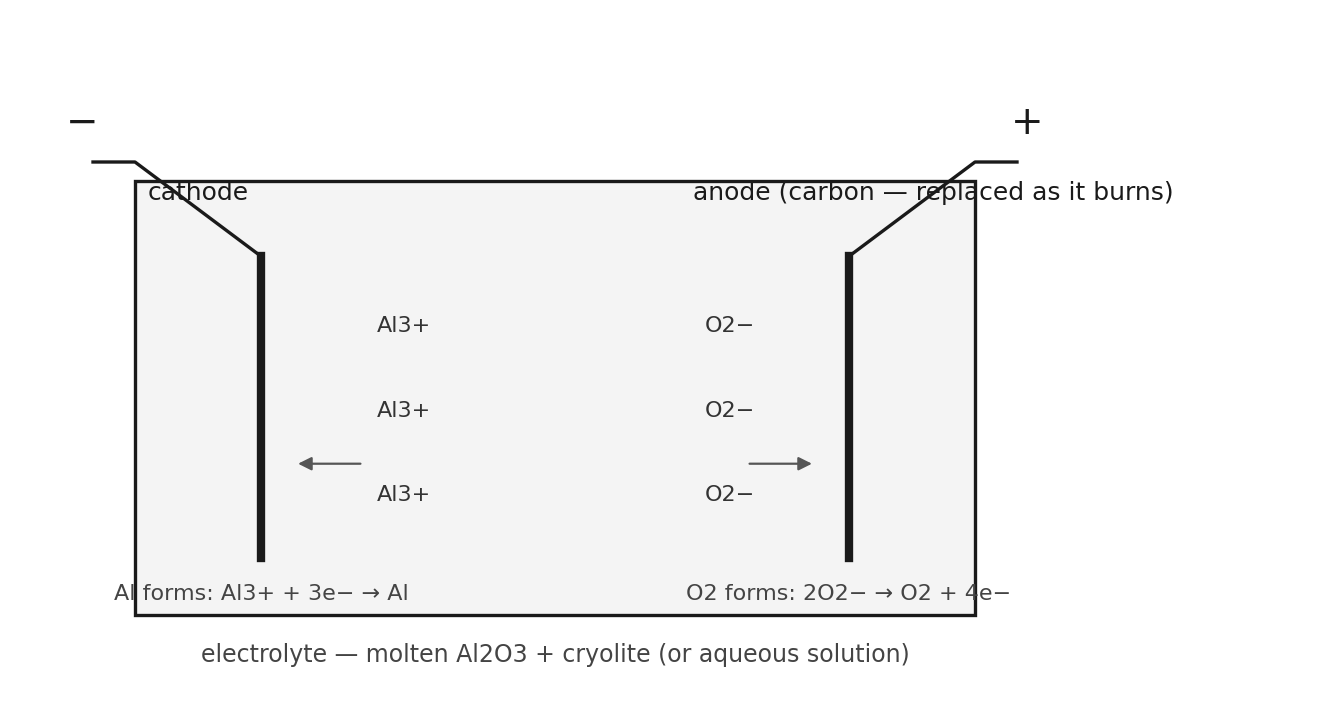
Electrolytes 电解质: molten or dissolved ionic compounds — ions free to move, so they conduct. Positive ions → cathode (negative); negative ions → anode (positive); ions are discharged as elements.
- Molten binary compounds (lead bromide): metal at the cathode, non-metal at the anode.
- Extraction (aluminium): electrolysis of molten Al₂O₃ + cryolite — the mixture lowers the melting point, saving energy; carbon anode burns away (with the oxygen produced) and must be replaced. Electrolysis is used when the metal is too reactive for carbon reduction.
- Aqueous solutions (RP3): at the cathode, hydrogen is produced if the metal is more reactive than hydrogen (else the metal deposits); at the anode, oxygen — unless halide ions are present, when the halogen forms.
(HT) Half-equations 半方程 — balance charge with electrons:
- cathode: Cu²⁺ + 2e⁻ → Cu; 2H⁺ + 2e⁻ → H₂
- anode: 2Cl⁻ → Cl₂ + 2e⁻; 4OH⁻ → O₂ + 2H₂O + 4e⁻
어휘 연습하기English 한국어 cathode/ˈkæθəʊd/ 음극 anode/ˈænəʊd/ 양극 electrolyte/ɪˈlektrəlaɪt/ 전해질 half equation/hɑːf ɪˈkweɪʒn/ 반 반응식 4.3
Checklist before you call this topic done
- Recite the reactivity series with carbon and hydrogen in place; predict water/acid/displacement reactions.
- Extraction: carbon reduction vs electrolysis, with reasons; (HT) OIL RIG with ionic equations.
- Salt names from acid + base; RP1 method in order; H⁺ + OH⁻ → H₂O.
- (Chem) titration method; (HT) strong vs weak with the pH ×10 rule.
- Electrolysis products for molten and aqueous cases; (HT) half-equations both electrodes.
-
5
에너지 변화
5.1
에너지 변화: 발열 반응과 흡열 반응
- 발열 반응은 에너지를 방출하여 주변이 따뜻해지고, 흡열 반응은 에너지를 흡수하여 차가워짐.
- 반응 프로파일은 활성화 에너지와 전체 변화를 보여줍니다; (HT) 결합 에너지를 합산해도 동일한 결론에 도달함.
- 화학 전지 및 연료 전지는(화학 과목 전용) 반응 에너지를 전기 에너지로 전환함.
어휘 연습하기English 한국어 exothermic/eɡzəˈðɜːmɪk/ 발열 반응 endothermic/ˌendəʊˈθɜːmɪk/ 흡열 반응 activation energy/ˌæktɪˈveɪʃn ˈenədʒi/ 활성화 에너지 reaction profile/rɪˈækʃn ˈprəʊfaɪl/ 반응 에너지 도표 fuel cell/ˈfjuːəl sel/ 연료 전지 rechargeable/rɪˈtʃɑːdʒəbl/ 충전식 bond energy/bɒnd ˈenədʒi/ 결합 에너지 5.1
발열 반응과 흡열 반응 (4.5.1)
Syllabus
발열 반응 및 흡열 반응 (AQA 8462 서술문 4.5.1.1-4.5.1.3).
- 온도 변화를 통해 발열 및 흡열 반응을 정의하고, 예시와 활용을 제시한다.
- 활성화 에너지 및 전체 에너지 변화를 포함하는 반응 프로파일을 그리고 해석한다.
- (HT) 결합 에너지를 사용하여 전체 에너지 변화를 계산하고 두 반응 유형의 차이를 설명한다.
출처: Cambridge International syllabus
에너지 보존: 주변으로 전달된 에너지는 생성물의 에너지 저장소에서 나옴. 발열 반응은 에너지를 방출하여 주변의 온도가 상승함(연소, 다수의 산화, 중화반응; 용도: 손난로, 자동 가열 캔). 흡열 반응은 에너지를 흡수하여 온도가 하강함(열분해, 시트론산 + 탄산수소나트륨; 용도: 운동 부상 냉찜질팩). 주변 온도 변화를 통해 판별하면 되며, ΔH 계산은 필요 없음.
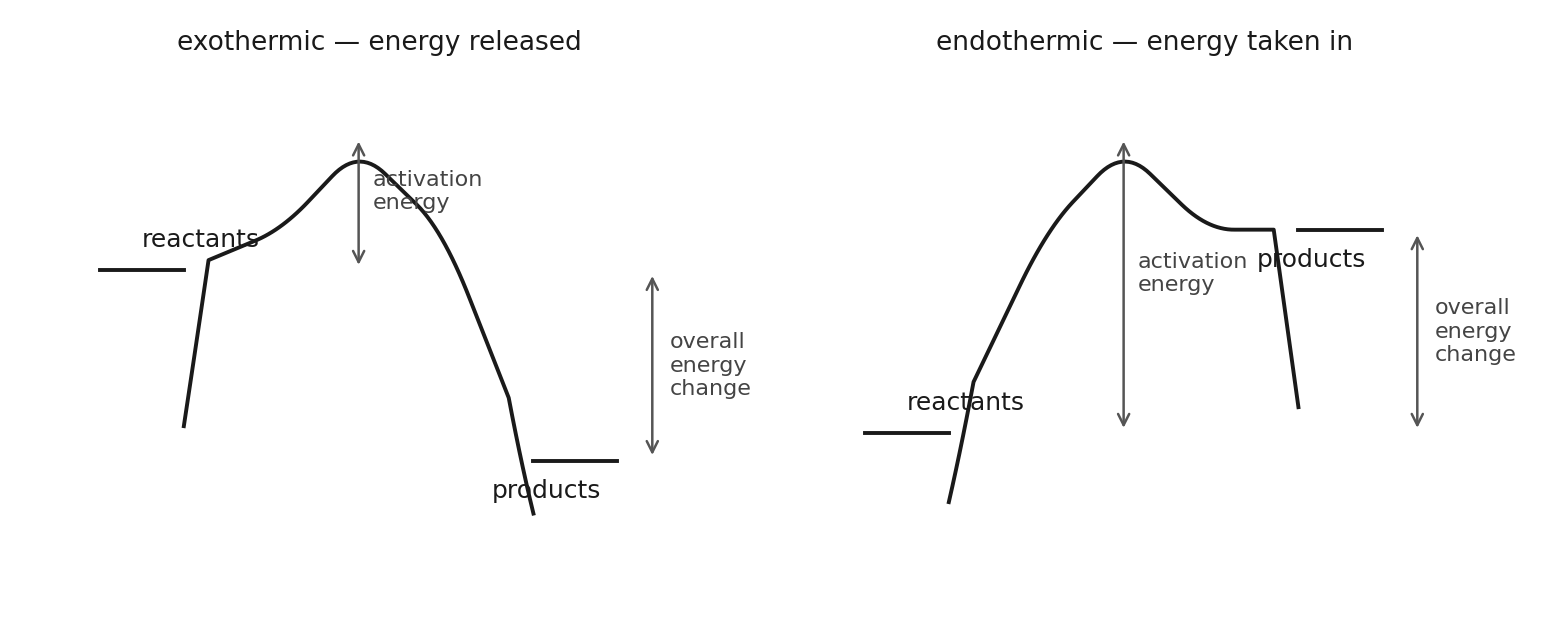
반응 프로파일: 반응은 최소한 활성화 에너지를 가진 충돌 입자를 필요로 함. 에너지 수준 도표를 그리고 읽기 — 반응물과 생성물의 상대적 에너지, 반응물 수준에서 시작하는 활성화 에너지 화살표, 전체 에너지 변화, 곡선으로 연결됨. 발열: 생성물이 반응물 아래; 흡열: 생성물이 반응물 위.
(HT) 결합 에너지: 에너지를 공급하여 반응물 결합을 끊고, 생성물 결합이 형성될 때 방출됨:
- 발열 반응 — 결합 형성 시 방출되는 에너지가 결합 파단에 필요한 에너지보다 더 많습니다;
- 흡열 반응 — 결합 파단에 필요한 에너지가 결합 형성 시 방출되는 에너지보다 더 많습니다.
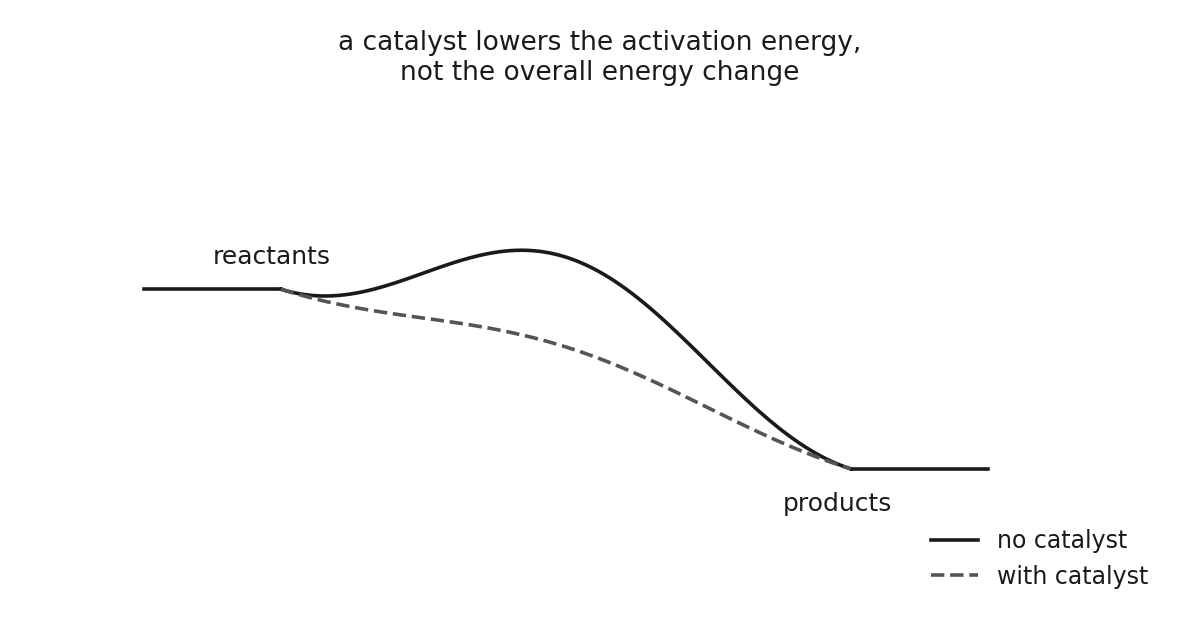
전체 변화량 = Σ(파단된 결합의 에너지) − Σ(형성된 결합의 에너지). 촉매는 활성화 에너지를 낮춥니다 — 전체 에너지 변화량에는 영향을 주지 않습니다.
RP4: 반응 용액의 온도 변화에 영향을 미치는 변수(예: 부피/농도)를 조사함 — 변수 계획, ΔT 측정, 그래프 작성, 결론 도출.
5.2
화학 전지 및 연료 전지 — 화학만 해당 (4.5.2)
Syllabus
화학 전지 및 연료전지, 화학만 (AQA 8462 지문 4.5.2).
- 전지가 전기를 생성하는 원리와 전압이 어떤 요인에 의존하는지 설명하시오.
- 비충전식과 충전식 전지를 비교하시오.
- 수소 연료전지와 (HT) 전극 반반응식을 서술하고, 이를 충전식 전지와 평가하시오.
출처: Cambridge International syllabus
전지는 화학적 반응을 통해 전기를 생성하는 물질로 구성됩니다. 전압은 전극의 종류와 전해질에 따라 결정되며, 단순 전지는 전해질 내에 있는 두 가지 다른 금속으로 이루어집니다. 더 활동적인 금속이 더 높은 전압을 발생시킵니다(전자를 더 쉽게 방출하기 때문입니다). 배터리는 더 높은 전압을 위해 전지를 직렬로 연결한 것입니다.
일회용(알칼리) 전지는 반응물이 소진되면 작동을 멈추며, 충전식 전지는 외부 전류를 공급하면 역반응이 일어납니다.
연료 전지: 연료(예: 수소)와 산소를 지속적으로 공급하며, 연료가 전기화학적으로 산화되어 전위차를 생성합니다. 전체 반응: 수소 → 물. 충전식 배터리와의 비교 평가: 사용 지점에서 오염물질이 없으며 지속 가능한 연료 공급이 가능하지만, 수소 저장, 생산 비용 및 가격 문제가 단점으로 작용합니다. (HT) 수소 연료 전지의 반반응식:
- 음극: 2 H₂ → 4 H⁺ + 4e⁻ (또는 2 H₂ + 4 OH⁻ → 4 H₂O + 4e⁻)
- 양극: O₂ + 4 H⁺ + 4e⁻ → 2 H₂O (또는 O₂ + 2 H₂O + 4e⁻ → 4 OH⁻)
5.2
이 주제를 완료한 후 체크리스트
- 온도 변화를 기준으로 발열/흡열 정의를 하되, 예시 2가지와 용도 2가지를 각각 제시하십시오.
- 활성화 에너지와 전체 변화량이 표시된 두 반응 프로파일도를 그려십시오.
- (HT) 결합 에너지 합계를 두 방향으로 모두 계산하고, 프로파일도에 대한 촉매의 효과를 설명하십시오.
- (Chem) 전지 전압에 영향을 주는 요인; 충전식과 일회용의 차이; 연료 전지의 반응식과 평가 사항.
-
6
화학 변화의 속도와 정도
6.1
The rate and extent of chemical change
- Rate is a quantity per second — read it off tables, graphs and tangents; collision theory 碰撞理论 explains every factor that changes it.
- Reversible reactions settle into dynamic equilibrium 动态平衡; (HT) Le Chatelier predicts how each condition shifts it.
- Industry optimises rate and yield together — compromise conditions.
어휘 연습하기English 한국어 collision theory/kəˈlɪʒn ˈθɪəri/ 충돌 이론 dynamic equilibrium/daɪˈnæmɪk ˌiːkwɪˈlɪbrɪəm/ 동적 평형 Le Chatelier principle/lə ˈtʃeɪtlɪə ˈprɪnsɪpl/ 르 샤틀리에 원리 6.1
Rate of reaction (4.6.1)
Syllabus
반응 속도 (AQA 8462 지문 4.6.1.1-4.6.1.5).
- g/s, cm3/s 및 (HT) mol/s 단위의 평균 반응 속도를 계산하고, 생성물-시간 그래프의 접선을 읽어라.
- 반응 속도에 영향을 미치는 다섯 가지 요인을 기억하고, 농도 실험을 조사하시오 (RP5).
- 각 요인을 입자 충돌 이론과 활성화 에너지를 통해 설명하시오.
- 촉매와 반응 프로파일(에너지 도표)에 미치는 영향을 서술하고, 효소를 포함하시오.
출처: Cambridge International syllabus
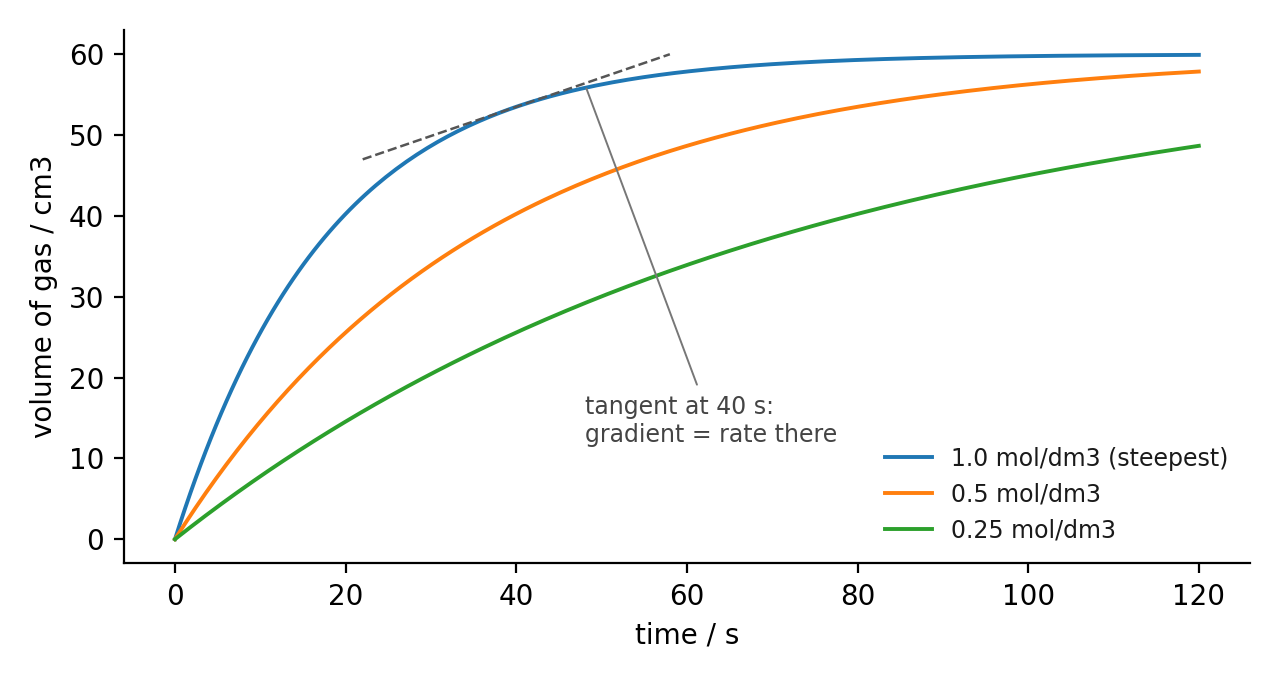
Calculating rates: rate of reaction 反应速率 = quantity of reactant used ÷ time, or product formed ÷ time — in g/s or cm³/s (HT also mol/s). Interpret product-vs-time graphs (steeper start, flattening as reactant runs out); draw tangents 切线 and use their gradient as the rate at that instant (HT calculate it).
Factors affecting rate: concentration (solution), pressure (gas), surface area (solid), temperature, catalyst 催化剂s. RP5: investigate concentration by (a) measuring the volume of gas produced and (b) observing a colour/turbidity change — hypothesis, variables, repeats.
Collision theory: reactions occur only when particles collide with at least the activation energy 活化能. Raising concentration/pressure crowds particles — more frequent collisions; smaller solid pieces raise the surface-area-to-volume ratio — more exposed surface, more frequent collisions; raising temperature gives particles more energy — more collisions AND more collisions that pass the activation energy.
Catalysts: change the rate but are not used up; each reaction has its own catalyst; enzymes are biological catalysts. A catalyst offers an alternative pathway with lower activation energy — identify it by speeding the reaction yet never appearing in the equation. Its reaction profile keeps the same overall energy change with a lower hump:
 어휘 연습하기
English 한국어 rate of reaction/reɪt ɒv rɪˈækʃn/ 반응 속도 activation energy/ˌæktɪˈveɪʃn ˈenədʒi/ 활성화 에너지 catalyst/ˈkætəlɪst/ 촉매 tangent/ˈtændʒənt/ 접선 6.2
Reversible reactions and dynamic equilibrium (4.6.2)
Syllabus
가역 반응과 동적 평형 (AQA 8462 지문 4.6.2.1-4.6.2.3).
- 가역 반응과 그에 수반되는 반대 방향 에너지 변화를 표현하시오.
- 폐쇄계에서 동적 평형을 정의하시오.
- (HT) 르 샤틀리에 원리를 이용해 농도, 압력 및 온도 변화의 영향을 예측하고, 촉매의 무효 효과를 서술하시오.
출처: Cambridge International syllabus
Reversible reactions 可逆反应: the products can react back to the reactants — written with the ⇌ arrow. If exothermic one way, endothermic the other, transferring the same amount of energy.
Equilibrium: in a closed system, equilibrium is reached when the forward and reverse rates are equal — the concentrations stop changing though both reactions continue (dynamic).
(HT) Le Chatelier's principle 勒夏特列原理: a system at equilibrium responds to counteract any change:
- concentration ↑ of a reactant → more product forms (and vice versa);
- pressure ↑ → the position moves to the side with fewer gas molecules;
- temperature ↑ → the position moves in the endothermic direction (↓ for exothermic direction).
A catalyst does not shift the position — it reaches equilibrium faster. Industry picks compromise conditions balancing rate, yield, safety and cost (e.g. the Haber process in topic 10).
어휘 연습하기English 한국어 reversible reaction/rɪˈvɜːsɪbl rɪˈækʃn/ 가역 반응 6.2
Checklist before you call this topic done
- Rate from a table, from a graph's steepness, and (HT) from a tangent gradient.
- Each of the five factors explained by collision theory, naming what happens to collision frequency and energy.
- Catalyst effect on the profile; not used up; enzymes.
- The ⇌ arrow; equilibrium as equal rates; (HT) predict all three condition changes with Le Chatelier; compromise conditions justified.
-
7
유기 화학
7.1
Organic chemistry: carbon's families
- Crude oil — ancient plankton biomass — separates into fractions; alkane 烷烃s (CₙH₂ₙ₊₂) burn as fuels; cracking 裂解 turns big molecules into small alkanes plus reactive alkene 烯烃s (CₙH₂ₙ).
- Alkenes, alcohols and carboxylic acids (chemistry only) are functional-group families with predictable reactions.
- Polymers — addition (alkene monomers) and (HT) condensation — plus nature's own: proteins, starch, cellulose, DNA.
어휘 연습하기English 한국어 alkane/ˈælkeɪn/ 알케인 alkene/ˈælkiːn/ 알켄 cracking/ˈkrækɪŋ/ 크래킹 7.1
Crude oil, fuels and feedstock (4.7.1)
Syllabus
원유, 연료 및 원료 물질 (AQA 8462 지문 4.7.1.1-4.7.1.4).
- 원유의 기원과 조성을 서술하고, 알케인 4종의 명칭과 분자식을 나열하시오.
- 분류 증류법과 fractions의 성질을 용도에 매칭하시오.
- 분자 크기와 끓는점, 점성, 가연성의 관계를 서술하시오.
- 분해(cracking) 조건과 산물을 서술하고, 분해 반응식을 평형화하며 브롬수 시약 시험을 사용하시오.
출처: Cambridge International syllabus
Crude oil is a finite resource in rocks — the remains of ancient biomass, mainly plankton buried in mud. It is a mixture of mostly hydrocarbon 碳氢化合物s (hydrogen + carbon only), chiefly alkanes, general formula CₙH₂ₙ₊₂: methane, ethane, propane, butane (know names + formulae in all representations).
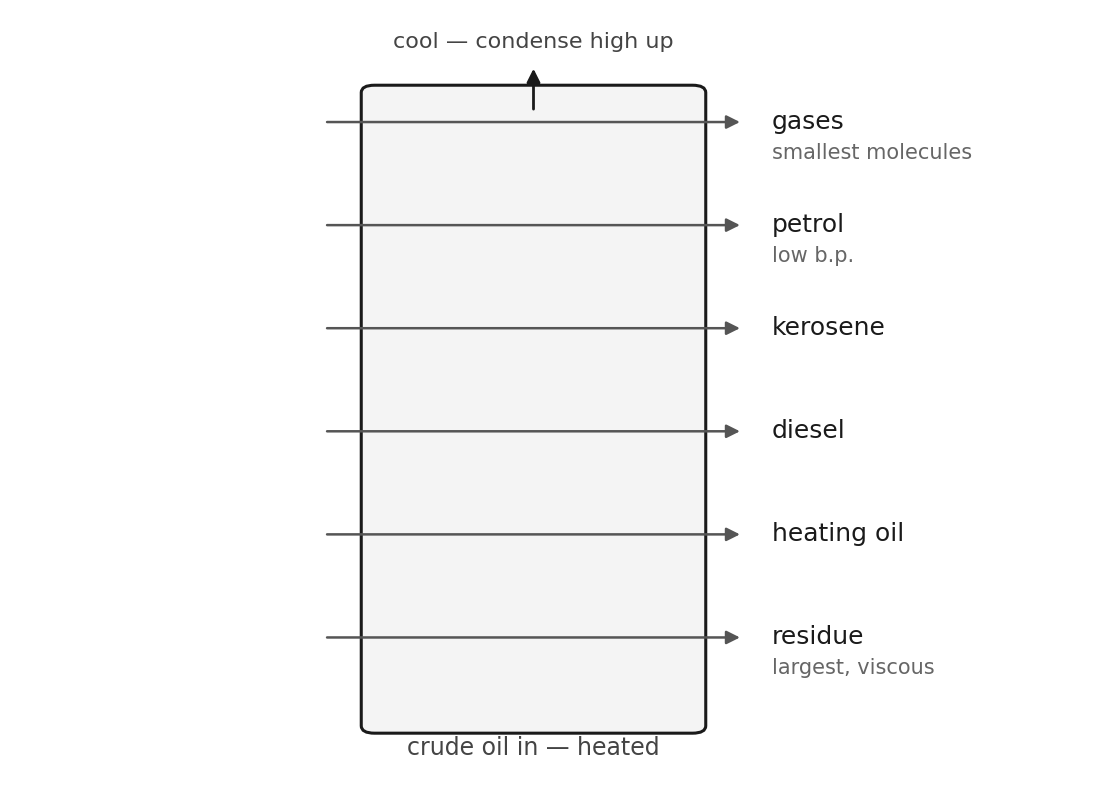
Fractional distillation 分馏: fractions contain molecules with similar carbon numbers; separated by evaporation and condensation at different levels of the column — small molecules at the top (low boiling point), large at the bottom. Fractions give fuels (petrol, diesel, kerosene, heavy fuel oil, LPG) and feedstock for petrochemicals — solvents, lubricants, polymers, detergents.
Properties track molecule size: bigger molecules → higher boiling point, higher viscosity, lower flammability — matching each fraction to its use.
Cracking: breaking large hydrocarbons into smaller, more useful molecules — catalytic cracking (high temperature + catalyst) or steam cracking (high temperature + steam). Products: a smaller alkane (fuel) + an alkene (polymer feedstock). Alkenes are more reactive: they decolourise bromine water (orange → colourless) — the alkene test. Balance cracking equations from given formulae.
어휘 연습하기English 한국어 hydrocarbon/ˈhaɪdrəkɑːbən/ 탄화수소 fractional distillation/ˈfrækʃənl dɪstɪˈleɪʃn/ 분馏 증류 7.2
Alkenes, alcohols and carboxylic acids — chemistry only (4.7.2)
Syllabus
알켄, 알코올 및 카복실산, 화학만 (AQA 8462 지문 4.7.2.1-4.7.2.4).
- 불포화 화합물인 알켄 CnH2n을 식별하고, 그 첨가 반응을 서술하시오.
- 발효 조건을 포함하여 첫 번째 네 가지 알코올의 네 가지 반응과 용도를 설명하시오.
- 에스터 생성 및 (HT) 약산 이온화를 포함하여 첫 번째 네 가지 카복실산의 반응을 설명하시오.
출처: Cambridge International syllabus
Alkenes CₙH₂ₙ contain the C=C double bond — unsaturated (two fewer hydrogens than the alkane with the same carbons). Members: ethene, propene, butene, pentene. Reactions of a functional group 官能团 give a family its reactions:
- combustion — but smoky flames (incomplete);
- with hydrogen → alkane (nickel catalyst); with water → alcohol (steam, phosphoric acid catalyst); with halogens → dihaloalkanes (bromine water test).
Alcohols –OH: methanol, ethanol, propanol, butanol. Reactions: with sodium (fizzing, hydrogen); burning in air (clean combustion — fuels); dissolving in water; oxidised (air/oxidising agent) → carboxylic acid. Uses: fuels, solvents, alcoholic drinks. Fermentation: sugar + yeast → ethanol solution in warm, oxygen-free conditions.
Carboxylic acids –COOH: methanoic, ethanoic, propanoic, butanoic acids. React with carbonates (fizz, CO₂), dissolve in water (weakly acidic — HT: only partially ionised, so higher pH than a strong acid), react with alcohols → esters (ethyl ethanoate) + water.
어휘 연습하기English 한국어 functional group/ˈfʌŋkʃənl ɡruːp/ 관능기 7.3
Polymers (4.7.3)
Syllabus
고분자 (AQA 8462 항목 4.7.3.1-4.7.3.2).
- 알켄 단량체로부터 가중 고분자를 그리며, 반복 단위를 단량체로 되돌려 나타내시오.
- (HT) 기능기, 폴리에스터 및 폴리펩타이드 예시를 들어 축합 중합을 설명하시오.
- DNA의 구조와 단백질, 녹말, 셀룰로스의 단량체를 쓰시오.
출처: Cambridge International syllabus
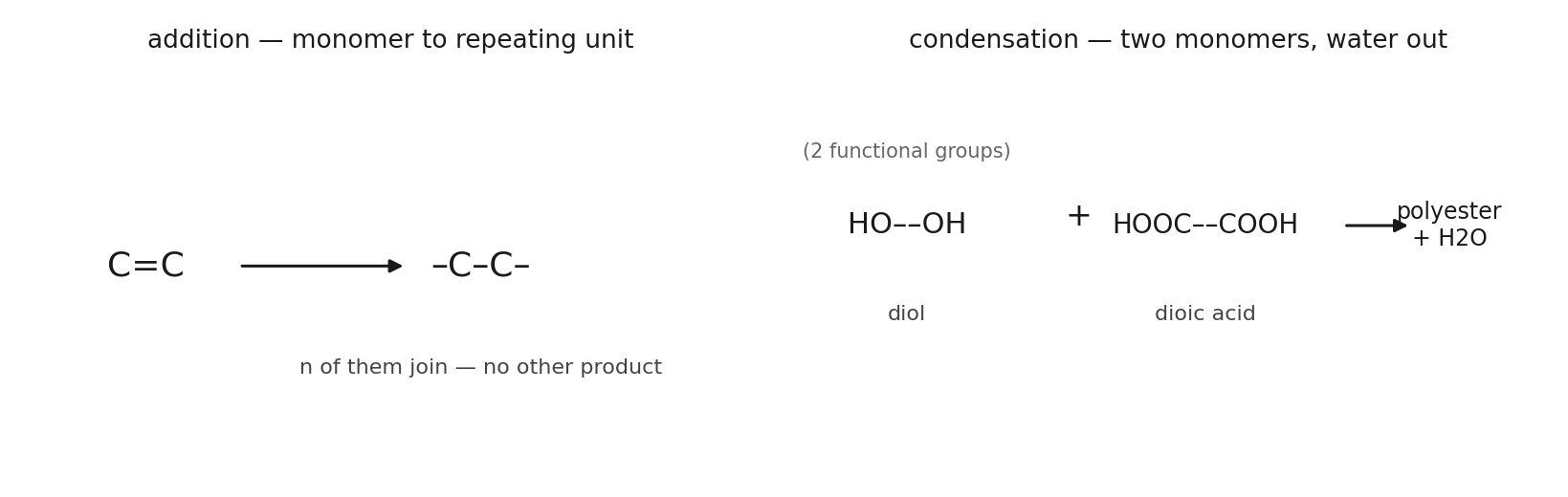
Addition polymerisation 加成聚合: many monomers 单体 (alkenes, with C=C) join into one polymer — poly(ethene) from ethene, poly(propene) from propene. The repeating unit has exactly the monomer's atoms — nothing else is formed. Draw: monomer → repeating unit with the double bond opened.
(HT) Condensation polymerisation: monomers each carry two functional groups; joining loses a small molecule — usually water. Two different monomers with two of the same groups each: e.g. ethanediol + hexanedioic acid → polyester. Amino acids (H₂N…COOH) condense → polypeptides; different amino acids in one chain → proteins (glycine is the example).
Natural polymers: DNA — two polymer chains of four nucleotides in a double helix; proteins (amino-acid monomers), starch (sugars), cellulose (sugars).
어휘 연습하기English 한국어 addition polymerisation/əˈdɪʃn ˌpɒlɪməraɪˈzeɪʃn/ 가성 중합 condensation polymerisation/kɒndenˈseɪʃn ˌpɒlɪməraɪˈzeɪʃn/ 축합 중합 monomer/ˈmɒnəʊmə/ 단량체 7.3
Checklist before you call this topic done
- Alkane names/formulae C1–C4; fraction order with boiling point, viscosity, flammability trends.
- Cracking conditions, products and balanced equations; bromine-water test with the colour change.
- (Chem) Alkene functional group and its three addition reactions; alcohol four reactions + fermentation 发酵 conditions; carboxylic acid three reactions.
- Addition polymer from monomer and back; (HT) condensation principles with polyester; DNA nucleotides + the three other natural polymers' monomers.
어휘 연습하기English 한국어 fermentation/fɜːmənˈteɪʃn/ 발효 -
8
화학 분석
8.1
화학 분석: 존재하는 물질 확인
- 화학에서 순수한 물질은 한 원소 또는 화합물을 의미하며, 융점과 끓는점이 이를 증명합니다. 조제물은 의도적으로 혼합된 것입니다.
- 크로마토그래피는 상 간 분포에 의해 분리되며, Rf 값을 통해 스팟을 식별합니다.
- 기체 테스트(H₂, O₂, CO₂, Cl₂) 및 (화학 전전용) 이온 테스트—염색 반응, 수산화물 침전, 탄산염, 할로겐화물, 황산염—분석가의 도구 모음을 구성합니다.
어휘 연습하기English 한국어 pure substance/pjʊə ˈsʌbstəns/ 순수 물질 formulation/ˌfɔːmjʊˈleɪʃn/ 조성 chromatography/krəʊməˈtɒɡrəfi/ 색층 분석법 stationary phase/ˈsteɪʃənəri feɪz/ 고정상 mobile phase/ˈməʊbaɪl feɪz/ 이동상 precipitate/prɪˈsɪpɪteɪt/ 침전물 flame test/fleɪm test/ 염색 시험 spectroscopy/spekˈtrɒskəpi/ 분광법 8.1
순도, 조제물 및 크로마토그래피(4.8.1)
Syllabus
순도, 배제물 및 크로마토그래피 (AQA 8462 항목 4.8.1.1-4.8.1.3).
- 융점 및 끓는점 데이터를 사용하여 순수 물질과 혼합물을 구별하시오.
- 배제물의 종류를 식별하고 그 목적을 설명하시오.
- 종이 크로마토그래피를 설명하고 Rf 값을 계산하며 크로마토그램을 해석하시오.
출처: Cambridge International syllabus
순수 물질 — 다른 물질이 섞이지 않은 단일 원소나 화합물입니다. 순수 물질은 특정하고 날카로운 온도에서 녹거나 끓으며, 혼합물은 범위 내에서 녹습니다. 융점/끓는점 데이터를 사용하여 두 가지를 구분할 수 있습니다. (일상 용어에서 '순수'는 불순물이 없는, 즉 순수 우유와 같은 다른 의미를 가집니다.)
조제물 — 유용한 제품으로 설계된 혼합물로, 각 성분이 목적에 따라 정밀하게 측정된 양으로 포함됩니다: 연료, 세정제, 페인트, 약품, 합금, 비료, 식품. 주어진 정보에서 하나를 식별하십시오.
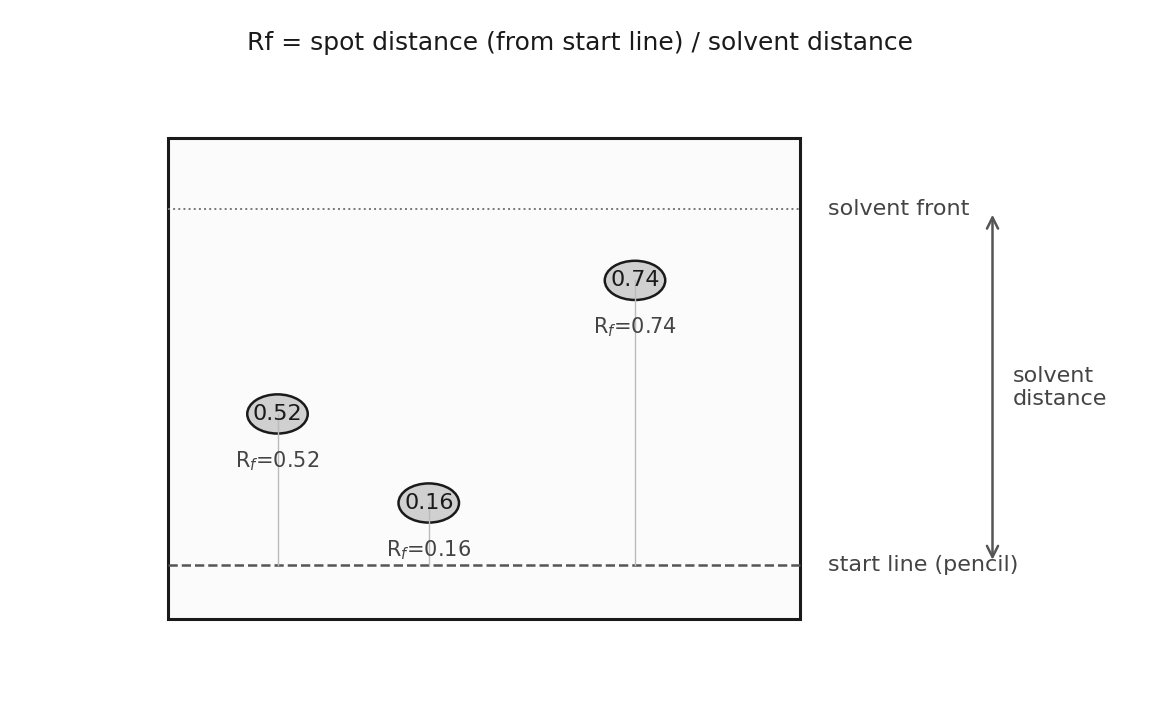
크로마토그래피 — 고정상(종이)과 이동상(용매)이 있으며, 각 물질의 상 간 분포에 따라 분리됩니다. 고정상에 더 강하게 결합된 물질은 아래쪽에 남습니다. 측정:
$$R_f = \\frac{\\text{distance moved by substance}}{\\text{distance moved by solvent}}$$서로 다른 화합물은 서로 다른 용매에서 다른 Rf 값을 가집니다. 이를 활용하여 식별할 수 있으며, 순수한 화합물은 모든 용매에서 단일 스팟을 형성합니다.
8.2
일반 기체의 식별(4.8.2)
Syllabus
일반 기체의 식별 (AQA 8462 항목 4.8.2).
- 수소, 산소, 이산화탄소 및 염소 테스트와 양성 결과를 설명하시오.
출처: Cambridge International syllabus
기체 테스트 양성 결과 수소 타는 스플린트 톡톡거리는 소리 산소 반쯤 꺼진 스플린트 다시 점화됨 이산화탄소 석회수를 거름 우유처럼 흐려짐/구름처럼 변함 염소 물기에 적신 리트머스 종이 탈색되어 하얗게 됨 8.3
이온 식별 — 화학 전전용(4.8.3)
Syllabus
이온의 식별, 화학만 (AQA 8462 항목 4.8.3).
- Li, Na, K, Ca 및 Cu의 불꽃 시험 색상을 주시되, 혼합물에서의遮盖 현상을 유의하시오.
- 수산화 나트륨 용액을 사용하여 금속 이온을 식별하시오. 알루미늄 과잉 테스트를 포함하시오.
- 시약 및 침전물 색상을 사용하여 탄산염, 할화물 및 황산염을 검사하시오.
- (HT) 불꽃 방출 분광법과 그 장점을 설명하시오.
출처: Cambridge International syllabus
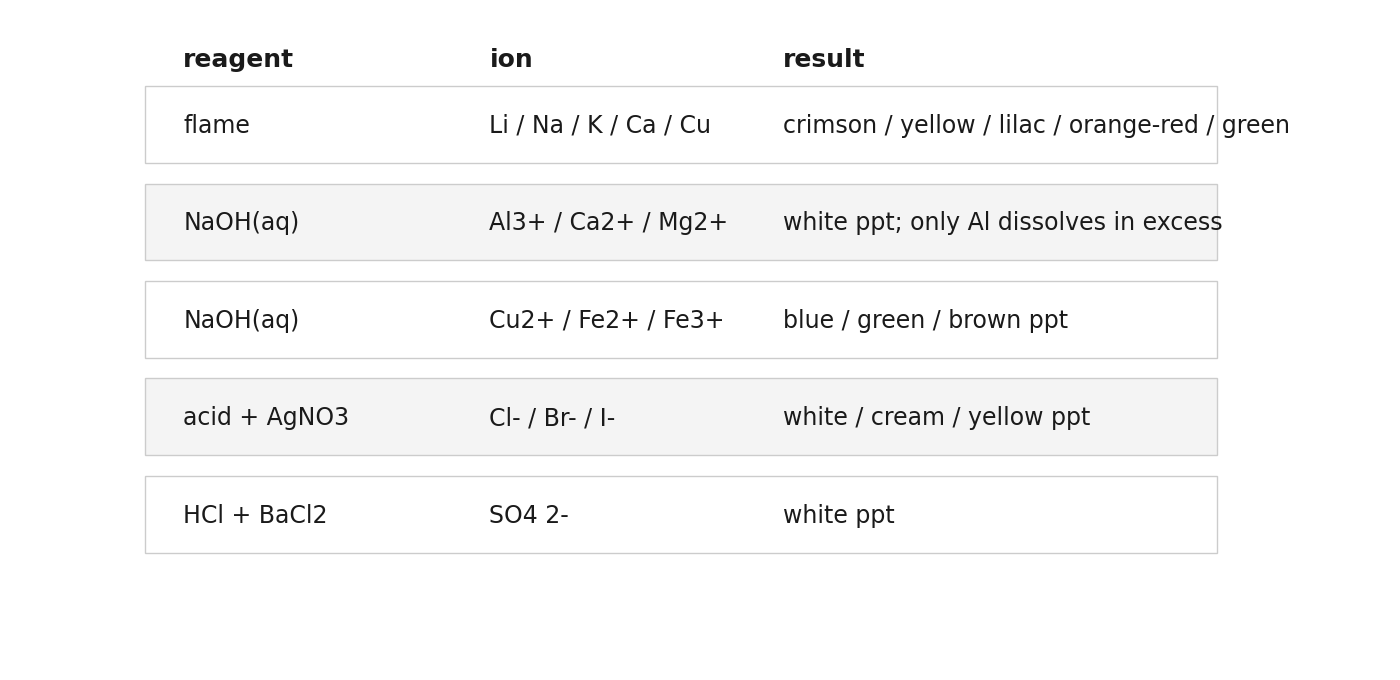
염색 반응(양이온): 리튬 — crimson; 나트륨 — 노란색; 칼륨 — 라일락; 칼슘 — 오렌지-레드; 구리 — 녹색. 혼합물의 경우 일부 색상이 다른 색상을 가릴 수 있습니다.
금속 수산화물 (수산화나트륨 용액): Al³⁺, Ca²⁺, Mg²⁺은 백색 침전물을 형성하지만, Al(OH)₃만 과잉의 NaOH에 녹음; Cu²⁺는 청색, Fe²⁺는 연두색, Fe³⁺는 갈색 침전물을 생성함.
탄산염: 희석 산을 가함 — 기포 발생; 이 가스는 석회수를 흐리게 함.
할화물: 희석 질산 후 질산 은을 가함 — AgCl 백색, AgBr 크림색, AgI 황색 침전물 생성.
황산염: 희석 염산 후 바륨 염화물을 가함 — BaSO₄의 백색 침전물 생성.
(HT) 화염 방출 분광법: 장치가 선형 방출 스펙트럼을 기록함; 선들의 위치가 금속을 식별하고, 강도가 농도를 나타냄. 화염 반응보다 우량점: 매우 민감, 혼합물에도 적용 가능, 신속함.
8.3
이 주제를 완료한 후 체크리스트
- 융점을 통한 순수 물질과 혼합물의 구분; five 가지 조제법을 열거함.
- 크로마토그램에서 Rf 계산; 순수 물질이 단일 점으로 나타나는 이유 설명.
- 네 가지 기체 분석과 그 결과.
- (Chem) 화염 색상; 알루미늄 과잉 시 수산화물 색상; 탄산염/할화물/황산염 시약 및 침전물 색상; (HT) 분광법의 우량점.
-
9
대기의 화학
9.1
Chemistry of the atmosphere: four billion years of air
- The early atmosphere came from volcanic activity — its CO₂ steam-cooled to the oceans; photosynthesis 光合作用 (algae, plants) raised oxygen and buried carbon.
- Greenhouse gases — CO₂ and methane — trap radiation; human activity raises them and the global climate change 全球气候变化s.
- Pollutants from fuels — CO, SO₂, NOₓ, particulates 颗粒物 — each with a source, a chemistry and a consequence.
어휘 연습하기English 한국어 photosynthesis/ˌfəʊtəʊˈsɪnθəsɪs/ 광합성 global climate change/ˈɡləʊbl ˈklaɪmət tʃeɪndʒ/ 지구 기후 변화 particulates/pəˈtɪkjʊleɪts/ 미립자 9.1
Evolution of the Earth's atmosphere (4.9.1)
Syllabus
지구의 대기권 진화 (AQA 8462 항목 4.9.1.1-4.9.1.2).
- 초기 대기의 증거와 구성에 대해 설명하시오.
- 해양, 탄산염 및 광합성이 어떻게 대기권을 오늘날의 비율로 변화시켰는지 설명하시오.
출처: Cambridge International syllabus
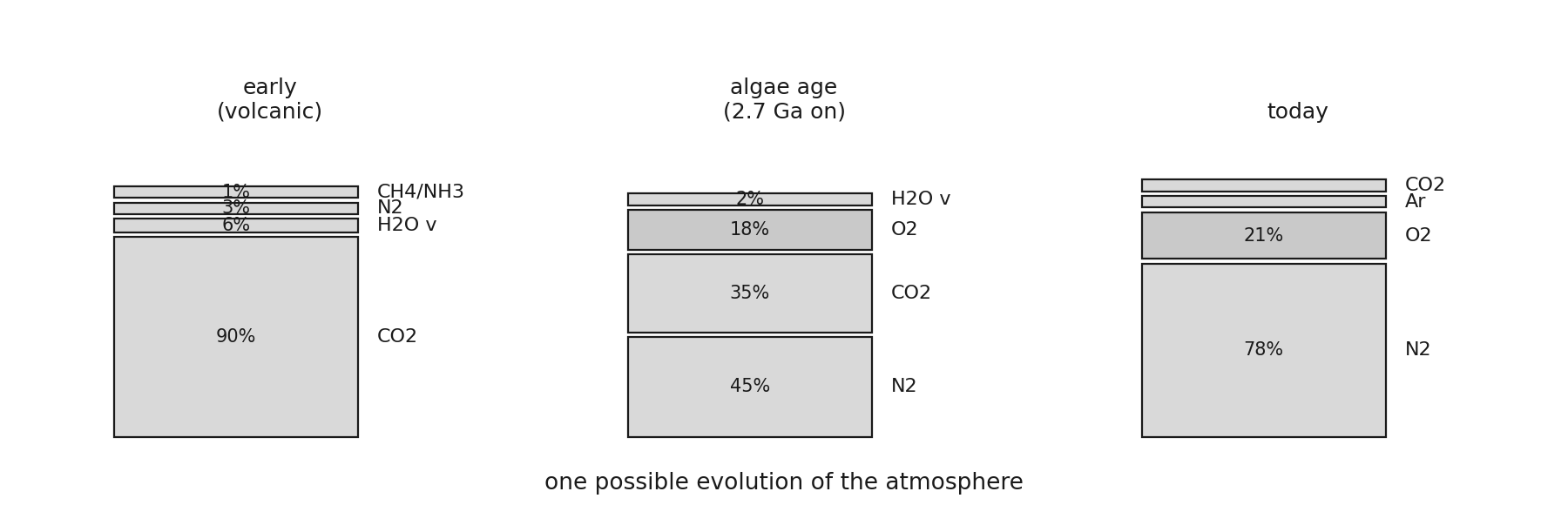
Theories: the early atmosphere cannot be known for certain — evidence comes from gases trapped in ancient ice and from other planets' atmospheres today. Intense volcanic activity released gases: mostly carbon dioxide, with water vapour, nitrogen and traces of methane and ammonia — little or no oxygen.
The water vapour condensed to form the oceans; CO₂ dissolved in them and was locked into carbonate sediments (shells). Over ~2.7 billion years, algae and plants photosynthesised, absorbing CO₂ and releasing oxygen — oxygen rose, CO₂ fell; much carbon was buried as fossil fuel 化石燃料s. Nitrogen, unreactive, accumulated to dominate today's air: about four-fifths N₂, one-fifth O₂, plus argon and ~0.04 % CO₂.
어휘 연습하기English 한국어 fossil fuel/ˈfɒsl ˈfjuːəl/ 화석 연료 9.2
Greenhouse gases and global climate change (4.9.2)
Syllabus
온실 가스와 글로벌 기후 변화 (AQA 8462 문항 4.9.2.1-4.9.2.3).
- 온실 가스의 종류를 나열하고 파장 관점으로 그 메커니즘을 설명하시오.
- 인간 활동과 가스 농도 증가의 관계를 연결하고, 주어진 기후 데이터를 해석하시오.
- 글로벌 기후 변화의 결과를 서술하고 과학적 합의의 근거를 설명하시오.
출처: Cambridge International syllabus
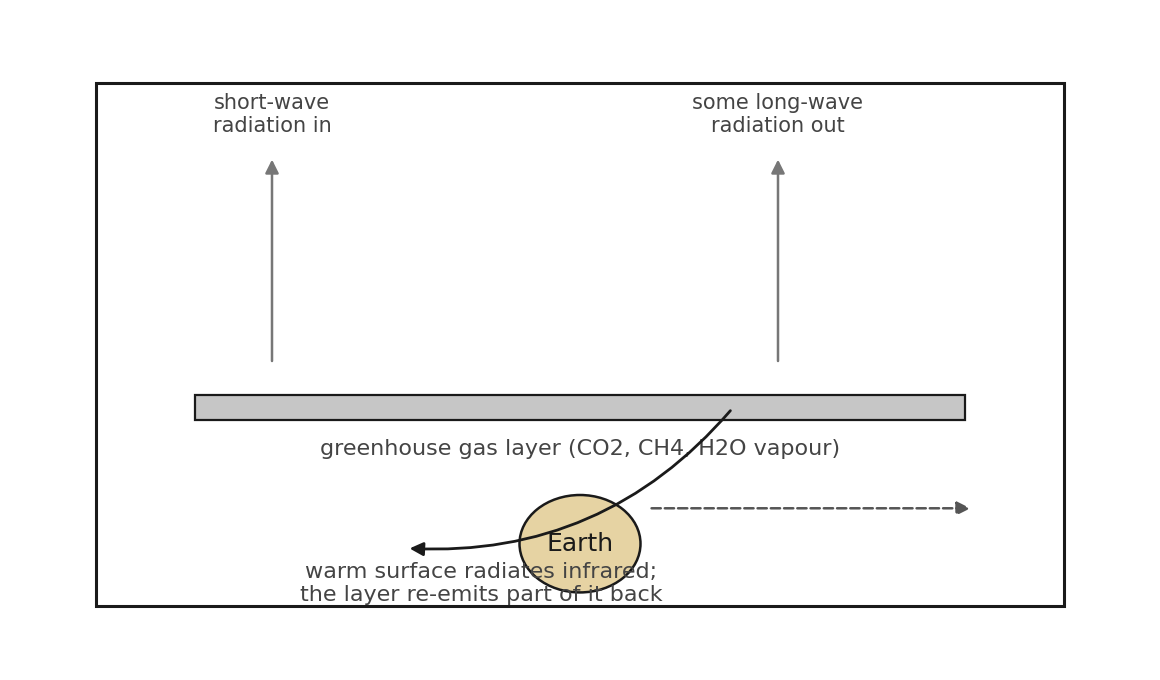
Greenhouse gases 温室气体 — carbon dioxide, methane and water vapour — absorb and re-emit some of the long-wavelength infrared radiation that the warm Earth radiates to space, keeping the surface warmer than it would otherwise be. The global climate change hypothesis says rising greenhouse-gas levels raise the average temperature.
Human causes: deforestation (less CO₂ absorbed), burning fossil fuels (more CO₂), cattle/rice and landfill (methane). Consequences discussed in the spec: melting ice, sea-level rise, changing rainfall and extreme weather. The scientific consensus rests on peer-reviewed evidence — interpret given data on temperature, CO₂ and methane over time.
어휘 연습하기English 한국어 greenhouse gas/ˈɡriːnhaʊs ɡæs/ 온실 가스 9.3
Atmospheric pollutants and their sources (4.9.3)
Syllabus
대기 오염물질 및 그 원인 (AQA 8462 문항 4.9.3).
- 완전 연소와 불완전 연소를 CO2, 물, 일산화탄소(CO), 입자 물질과 연결하여 설명하고, 영향을 기술하시오.
- 산화황 및 질소 산화물의 생성과 영향(산성비 포함)을 설명하고, 감축 방법을 서술하시오.
출처: Cambridge International syllabus
Combustion of fuels releases:
- carbon monoxide (CO) — a toxic gas from incomplete combustion 不完全燃烧 in limited oxygen; binds haemoglobin, reducing oxygen transport;
- carbon particulates (soot) — also from incomplete combustion; worsen respiratory problems and cause global dimming;
- sulfur dioxide (SO₂) and oxides of nitrogen (NOₓ) — from impurities in fuel / nitrogen reacting at engine temperatures; cause acid rain 酸雨 (damaging trees, lakes, buildings) — removed from flue gases by neutralisation with alkalis (e.g. calcium oxide);
- NOₓ also forms at high engine temperatures from N₂ + O₂, and contributes to photochemical smog.
Complete combustion — plenty of oxygen — gives CO₂ and water only.
어휘 연습하기English 한국어 acid rain/ˈæsɪd reɪn/ 산성비 incomplete combustion/ɪŋkəmˈpliːt kəmˈbʌstʃn/ 불완전 연소 9.3
Checklist before you call this topic done
- The evolution sequence with the evidence and its uncertainty; today's composition in fractions.
- Greenhouse mechanism in terms of wavelength; the four human causes; consensus and data interpretation.
- Each pollutant: source, complete vs incomplete combustion, effect, and one mitigation.
-
10
자원 활용
10.1
Using resources: sustainable chemistry
- Resources are used, reused and recycled; potable water 饮用水 — filtered and sterilised fresh water, or desalinated sea water — is the first essential.
- Life cycle assessment 生命周期评估s weigh a product's environmental cost stage by stage; reduce–reuse–recycle cuts every stage.
- (Chem) corrosion 腐蚀 prevention, alloys, ceramics/polymers/composite 复合材料s, and the Haber process 哈伯法's compromise chemistry.
어휘 연습하기English 한국어 potable water/ˈpəʊtəbl ˈwɔːtə/ 식수 life cycle assessment/laɪf ˈsaɪkl əˈsesmənt/ 생명 주기 평가 corrosion/kəˈrəʊʒn/ 부식 composite/ˈkɒmpəzɪt/ 복합재료 Haber process/ˈheɪbə ˈprəʊses/ 하버법 10.1
Resources and potable water (4.10.1)
Syllabus
자원과 음용수 (AQA 8462 문항 4.10.1.1-4.10.1.4).
- 고갈 가능한 자원과 재생 가능 자원을 구분하고 지속 가능한 발전을 정의한다.
- 음용수와 순수한 물을 구분하며 영국의 정수 처리 과정을 서술하고, 염수 담수화와 비교한다.
- 하수 처리 과정을 순서대로 서술하고, 폐수, 지하수, 염수로부터 음용수를 얻기 ease를 비교한다.
- (고난이도) 저급 구리 광석에 대한 식재 채광 및 생물 산출법을 서술한다.
출처: Cambridge International syllabus
Humans use the Earth's resources for warmth, shelter, food and transport; finite resources (ores, fossil fuels) are processed for energy and materials; renewable ones replenish. Sustainable development 可持续发展 meets present needs without compromising future generations.
Potable water — safe to drink: low dissolved salts and microbes — but not pure water (it contains dissolved substances).
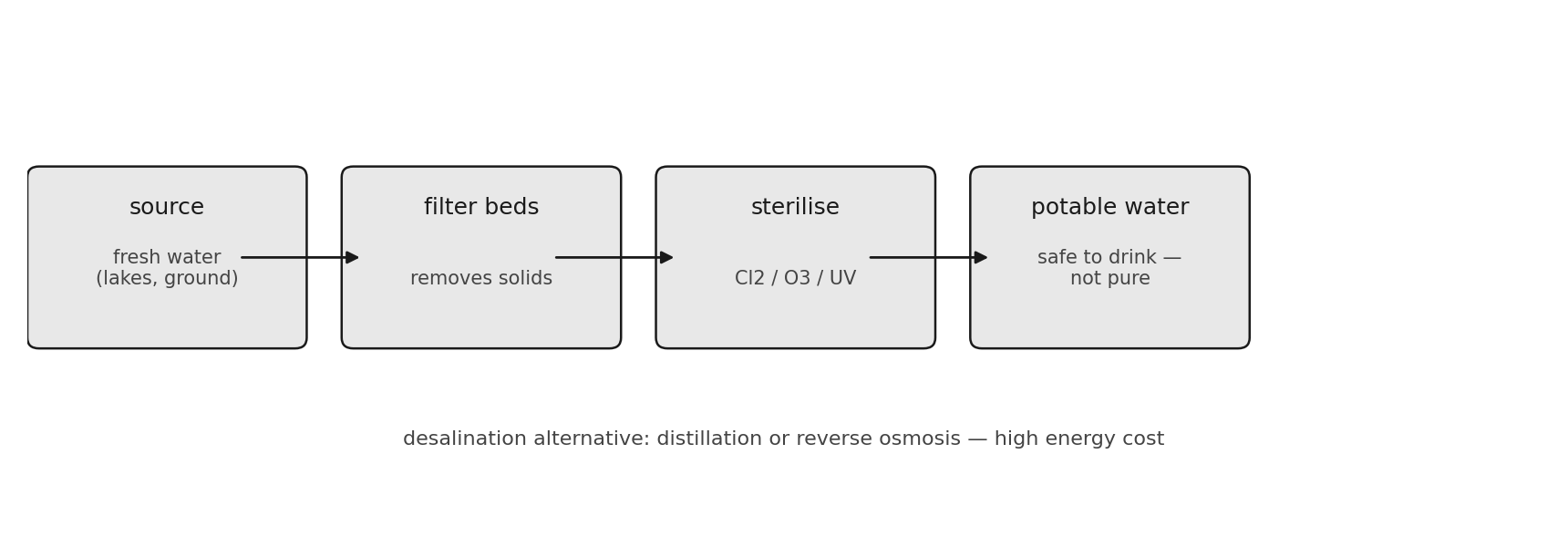
In the UK, fresh rainwater is made potable by: choosing a source → filter beds → sterilising (with chlorine, ozone or UV light). Where fresh water is scarce, desalination — distillation or reverse osmosis — needs large amounts of energy.
Waste water (sewage) treatment: screening and grit removal → sedimentation (sewage sludge + effluent) → anaerobic digestion of the sludge → aerobic biological treatment of the effluent. Potable water is easiest from ground water, harder from waste, hardest (energy-wise) from salt water.
(HT) Alternative metal extraction — copper ores are scarce: phytomining (plants absorb metal compounds; harvest, burn to ash, extract) and bioleaching (bacteria produce leachate solutions of the metal compounds) avoid moving huge amounts of rock.
어휘 연습하기English 한국어 desalination/dɪˌsælɪˈneɪʃn/ 담수화 sustainable development/səˈsteɪnəbl dɪˈveləpmənt/ 지속 가능한 개발 10.2
Life cycle assessment and recycling (4.10.2)
Syllabus
생명주기 평가 및 재활용 (AQA 8462 문항 4.10.2.1-4.10.2.2).
- LCA의 네 단계를 나열하고, LCA가 순수하게 객관적이지 않은 이유를 설명한다.
- 주어진 소재에 대해 감축, 재사용, 재활용을 평가하고 그 이유를 제시한다.
출처: Cambridge International syllabus
LCA stages: extracting and processing raw materials; manufacturing and packaging; use and operation; disposal — including transport at each stage. Energy, water, resource use and waste are quantifiable; pollutant effects need value judgements — so LCAs are not purely objective, and selective LCAs can be misused (advertising). Compare plastic vs paper shopping bags.
Reduce, reuse, recycle: metals, glass, building materials, clay ceramics and most plastics come from limited raw materials; recycling cuts mining/quarrying impact and energy — e.g. glass crushed and remelted; scrap steel added to the blast furnace reduces iron-ore extraction. Some products (glass bottles) are reused; others recycled into different products; separation effort depends on the final product's requirements.
10.3
Using materials — chemistry only (4.10.3)
Syllabus
재료 활용, 화학 과목 전용 (AQA 8462 문항 4.10.3.1-4.10.3.2).
- 부식과 이를 방지하는 방법, 특히 아연의 산화 보호(양극 보호)를 서술한다.
- 구성과 용도를 알 수 있는 합금을 회상하고, 합금 데이터를 해석한다.
- 유리, 점토 세라믹스, 고분자, 복합재를 비교하며 열소성 및 열경성 차이를 설명한다.
출처: Cambridge International syllabus
Corrosion — destruction of materials by chemical reaction with the environment (e.g. iron + oxygen + water → rust). Prevention: greasing, painting, coating (galvanising with zinc, which gives sacrificial protection 牺牲保护 — it corrodes in place of the iron even when scratched) and alloying (stainless steel). Aluminium resists corrosion by its own protective oxide layer.
Alloys: bronze (copper + tin), brass (copper + zinc); gold jewellery alloyed with silver/copper/zinc — purity in carats (24 = 100 %; 18 = 75 %). Steels — iron + carbon (+ metals): high-carbon steel strong but brittle; low-carbon steel softer, shaped easily; stainless steel (Cr, Ni) hard and corrosion-resistant; aluminium alloys low density (aircraft).
Ceramics, polymers, composites: soda-lime glass (sand + sodium carbonate + limestone), borosilicate glass (sand + boron trioxide — higher melting point); clay ceramics (pottery, bricks — shaped wet clay, then fired). Polymers depend on monomers and conditions — LD and HD poly(ethene) both from ethene. Thermosoftening polymers melt on heating (recyclable chains); thermosetting polymer 热固性聚合物 does not (cross-links). Composites — a matrix/binder surrounding a reinforcement (fibres/fragments); know examples (fibreglass, concrete, carbon-fibre).
어휘 연습하기English 한국어 sacrificial protection/ˌsækrɪˈfɪʃl prəˈtekʃn/ 양극 보호 thermosetting polymer/ˈθɜːməsɪtɪŋ ˈpɒlɪmə/ 열경성 고분자 10.4
The Haber process and NPK fertilisers — chemistry only (4.10.4)
Syllabus
The Haber process and NPK fertilisers, chemistry only (AQA 8462 statements 4.10.4.1-4.10.4.2).
- State the raw material sources and conditions of the Haber process.
- Describe the separation and recycling of ammonia and unreacted gases.
- (HT) Apply equilibrium principles to explain the compromise conditions.
- Name the NPK compounds and how they are produced, evaluating fertiliser manufacture.
출처: Cambridge International syllabus
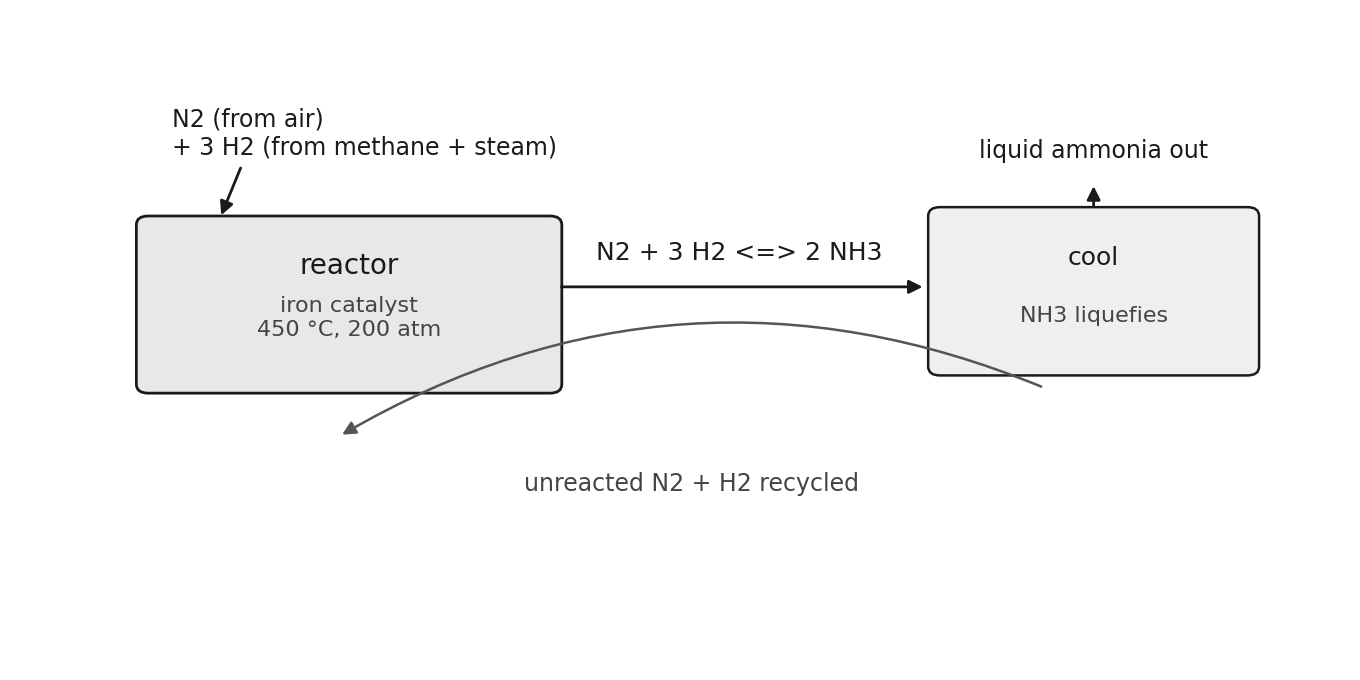
Haber process: N₂ + 3 H₂ ⇌ 2 NH₃ — nitrogen from air, hydrogen from natural gas (methane + steam) [or electrolysis of water]. Conditions: iron catalyst, ~450 °C, ~200 atmospheres; the reaction is reversible — cool the mixture, the ammonia liquefies and is removed; unreacted N₂/H₂ are recycled.
(HT) Higher pressure favours ammonia (fewer gas molecules) but is expensive and unsafe; lower temperature favours the exothermic forward reaction but is slow — so the chosen conditions are a compromise between rate, yield and cost. Apply Le Chatelier to each condition change.
NPK fertilisers — formulations of nitrogen, phosphorus and potassium compounds for plant growth: ammonia → nitric acid (Ostwald); ammonia + nitric acid → ammonium nitrate; potassium chloride/potassium sulfate mined; phosphate rock treated with acid to make superphosphate. Evaluate the industrial production of fertilisers given data (raw materials, energy costs, % yield — e.g. the lab vs industrial ammonium sulfate routes).
10.4
Checklist before you call this topic done
- Potable vs pure; the UK treatment sequence; desalination and its cost; sewage-treatment steps in order.
- (HT) phytomining and bioleaching described end to end.
- LCA four stages with the objectivity caveat; reduce-reuse-recycle examples with reasons.
- (Chem) corrosion prevention incl. sacrificial zinc; named alloys with compositions; thermosoftening vs thermosetting; matrix + reinforcement.
- (Chem/HT) Haber conditions with the compromise explained by equilibrium; the NPK compounds and their origins.