- Atoms are the building blocks: protons and neutrons in a tiny nucleus, electrons in shells; the outer shell runs the chemistry.
- The periodic table orders elements by atomic number; groups share outer-shell electrons and so share properties.
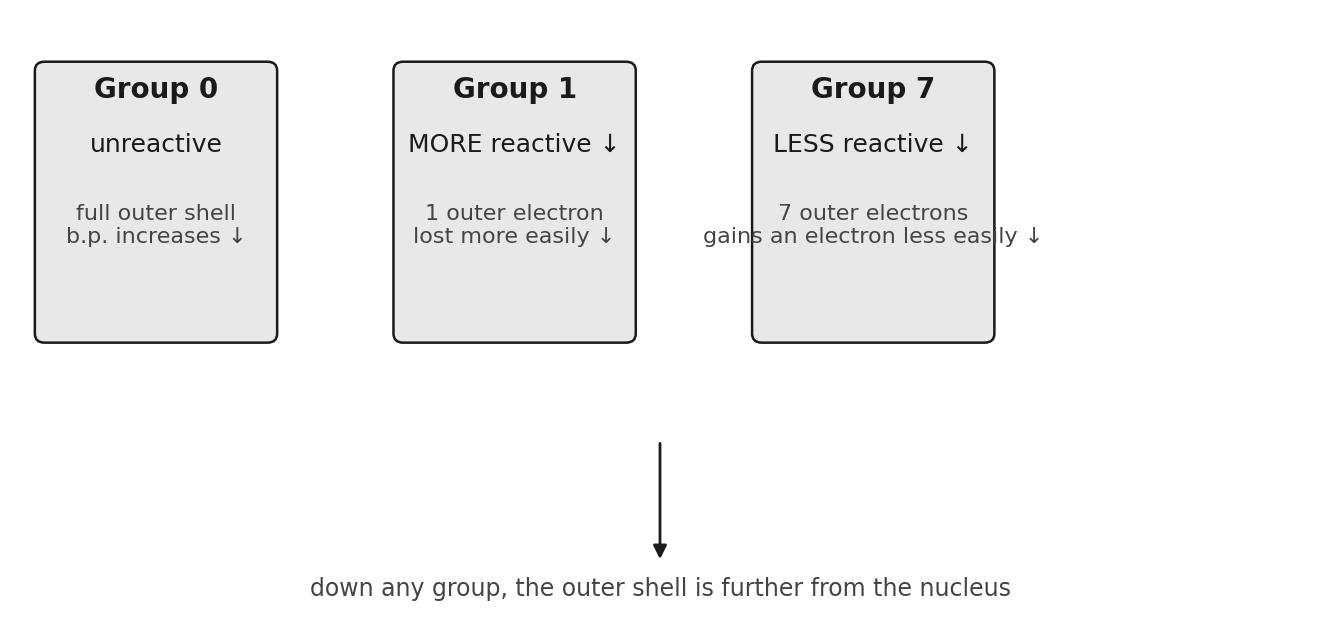
- Group 0 is unreactive, Group 1 gets more reactive down, Group 7 less; transition metals (chemistry only) behave differently from Group 1.
Atomic structure and the periodic table
AQA · GCSE · Chemistry · Topic 1
1.1
Atomic structure and the periodic table: the particles and the pattern
Vocabulary
Train
| English |
|---|
| atomic number/əˈtɒmɪk ˈnʌmbə/ |
| outer shell electron/ˈaʊtə ʃel ɪˈlektrɒn/ |
1.1
Atoms, elements, compounds and mixtures (4.1.1.1–4.1.1.4)
Syllabus
Atoms, elements, compounds and mixtures (AQA 8462 statements 4.1.1.1-4.1.1.4).
- Distinguish atoms, elements, compounds and mixtures, with symbols and formulae.
- Describe the five physical separation methods and choose one for a given mixture.
- Recount the development of the model of the atom from sphere to neutron.
- Use proton, neutron and electron charges and masses, atomic and mass numbers, isotopes and relative atomic mass.
- Write electronic structures for the first twenty elements.
Source: Cambridge International syllabus
All substances are made of atoms 原子 — the smallest part of an element that can exist. Each element has a chemical symbol (O, Na, …); about 100 elements exist, shown in the periodic table.
Compounds 化合物 form when elements elements combine chemically in fixed proportions; they are represented by formulae and can only be separated back into elements by chemical reactions. Chemical reactions always form one or more new substances, often with a detectable energy change. Equations: word equations and symbol equations with balanced formulae; (HT) balanced half-equations and ionic equations.
Mixtures 混合物: two or more elements or compounds not chemically combined; each substance keeps its properties. Separated by physical processes only — no new substances:
- filtration 过滤 — insoluble solid from liquid;
- crystallisation 结晶 — dissolved solid from solution;
- simple distillation 蒸馏 简单蒸馏 — liquid from dissolved solid (and solvents);
- fractional distillation 分馏 — liquids with different boiling points;
- chromatography 色谱法 — soluble substances in a mixture.
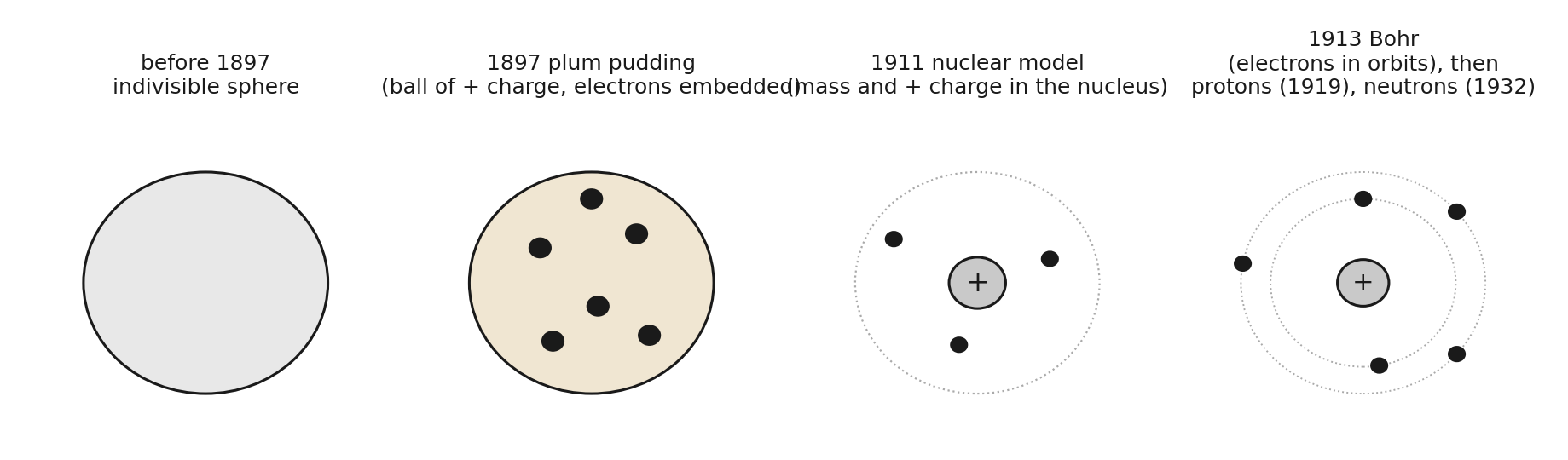
Development of the atom model: atoms were first thought to be indivisible spheres → the electron's discovery gave the plum pudding model 布丁模型 (ball of positive charge with negative electrons embedded) → the alpha-scattering experiment showed mass and positive charge concentrated in a central nucleus (nuclear model) → Bohr: electrons orbit at specific distances → protons identified in the nucleus → Chadwick: the neutron 中子. New evidence changes or replaces models.
| particle | relative mass | relative charge |
|---|---|---|
| proton | 1 | +1 |
| neutron | 1 | 0 |
| electron | very small | −1 |
In an atom protons = electrons, so no overall charge. Atomic number = protons; mass number = protons + neutrons. Atoms of the same element with different neutron numbers are isotopes 同位素. Atom radius ≈ 0.1 nm (1 × 10⁻¹⁰ m); the nucleus is less than 1/10 000 of that. Almost all mass is in the nucleus.
Relative atomic mass (Ar) averages over the isotopes' abundance — calculate it from percentage abundances. Electronic structure: electrons fill the lowest levels first — sodium is 2,8,1; represent the first twenty elements both as numbers and diagrams.
Vocabulary
Train
| English |
|---|
| atom/ˈætəm/ |
| compound/ˈkɒmpaʊnd/ |
| mixture/ˈmɪkstʃə/ |
| filtration/fɪlˈtreɪʃn/ |
| crystallisation/ˌkrɪstəlaɪˈzeɪʃn/ |
| distillation/dɪstɪˈleɪʃn/ |
| chromatography/krəʊməˈtɒɡrəfi/ |
| plum pudding model/plʌm ˈpʊdɪŋ ˈmɒdl/ |
| neutron/ˈnjuːtrɒn/ |
| isotope/ˈaɪsətəʊp/ |
| simple distillation/ˈsɪmpl dɪstɪˈleɪʃn/ |
| fractional distillation/ˈfrækʃənl dɪstɪˈleɪʃn/ |
1.2
The periodic table (4.1.2)
Syllabus
The periodic table (AQA 8462 statement 4.1.2).
- Relate group and period to outer-shell electrons and atomic number.
- Describe the development of the periodic table, including Mendeleev's gaps and the isotope explanation.
- Distinguish metals from non-metals by position and properties.
- State and explain the trends in Groups 0, 1 and 7, including displacement.
Source: Cambridge International syllabus
The table orders elements by atomic (proton) number 原子序数, so that elements with similar properties fall in groups (columns). Same group = same number of outer-shell electrons 最外层电子 = similar chemical properties. Explain an element's position from its electronic structure; predict probable reactivity from position.
Development: early tables ordered by atomic weight — incomplete, with some elements misplaced. Mendeleev left gaps for undiscovered elements and sometimes changed the order; his predicted elements were found, supporting his table. Isotopes later explained why atomic-weight order was sometimes wrong.
Metals and non-metals: metals form positive ions; non-metals do not. Metals sit left and lower; non-metals right and upper. Know the characteristic physical and chemical differences, and link atomic structure to position.
Group 0 — noble gases: unreactive — stable outer-shell arrangements (8 outer electrons; helium 2), so they do not easily form molecules. Boiling points increase down the group (with relative atomic mass).
Group 1 — alkali metals: one outer electron. Reactions of Li, Na, K with oxygen, chlorine and water (e.g. 2 Na + 2 H₂O → 2 NaOH + H₂). Reactivity increases down the group — the outer electron is lost more easily further from the nucleus.
Group 7 — halogens: seven outer electrons; non-metals, diatomic molecules (Cl₂, Br₂, I₂). Reactivity decreases down the group; melting and boiling points increase. A more reactive halogen displaces 置换 a less reactive one from a salt solution (chlorine displaces bromine from potassium bromide).
1.3
Transition metals — chemistry only (4.1.3)
Syllabus
Transition metals, chemistry only (AQA 8462 statement 4.1.3).
- Compare transition elements with Group 1 in melting point, density, strength, hardness and reactivity.
- Describe ions with different charges, coloured compounds and catalysis, with named examples.
Source: Cambridge International syllabus
Compared with Group 1, the transition elements (exemplify with Cr, Mn, Fe, Co, Ni, Cu) have higher melting points, densities, strength and hardness, and are less reactive with oxygen, water and halogens.
Typical properties: ions with different charges (Fe²⁺/Fe³⁺), coloured compounds, and use as catalysts 催化剂 (iron in the Haber process).
Vocabulary
Train
| English |
|---|
| catalyst/ˈkætəlɪst/ |
1.3
Checklist before you call this topic done
- p/n/e table, atomic and mass numbers, isotopes, Ar from abundance, 2,8,x structures for the first 20.
- The atom-model timeline: sphere → plum pudding → nuclear → Bohr → proton → neutron.
- Five separation methods each matched to a mixture; Mendeleev's gaps and the isotope explanation.
- Group 0/1/7 trends with electron explanations; halogen displacement equations.
- (Chem) transition metals vs Group 1: four differences plus ions, colours, catalysts.
Vocabulary
Train
| English |
|---|
| displacement/dɪˈspleɪsmənt/ |
Interactive lessons on this topic
Work through it step by step, with instant-check exercises.
- Collision theory: concentration and reacting-gas pressure
- Temperature and solid size: explain two different rate effects
- Catalysts: a lower barrier, the same overall energy change
- Reversible reactions: the products can reform the reactants
- Reverse reactions: energy transfers reverse direction
- Dynamic equilibrium: equal rates, continuing reactions
- Higher Tier: predict the response to an equilibrium disturbance
- Higher Tier: add a reactant or remove a product
- Higher Tier: warming favours the endothermic direction
- Higher Tier: count gaseous coefficients before predicting a shift
- Crude oil: a finite mixture, not one compound
- Alkanes: connect the formula to the displayed bonds
- Fractional distillation: separate by evaporation and condensation
- Hydrocarbon size: boiling point, viscosity and flammability
- Complete combustion: conserve atoms when hydrocarbons burn
- Cracking: chemical change makes useful smaller molecules
- Chemistry-only: recognise the first four alkenes
- Chemistry-only: hydrogen addition and alkene combustion
- Chemistry-only: chlorine, bromine and iodine addition
- Chemistry-only: steam addition forms an alcohol
- Chemistry-only: alcohol structures, names and uses
- Chemistry-only: four observations for the first alcohols
- Chemistry-only: yeast fermentation produces aqueous ethanol
- Chemistry-only: recognise acids and explain carbonate observations
- Chemistry-only: an acid and an alcohol form an ester
- Higher Tier: carboxylic acids are only partially ionised
- Chemistry-only: an alkene becomes an addition polymer
- Chemistry-only: keep side groups when drawing a repeating unit
- Higher Tier: two-ended monomers form a polyester
- Higher Tier: amino acids join to form polypeptides
- Chemistry-only: DNA is made from nucleotide monomers
- Chemistry-only: match natural polymers to their monomers
- Chemical purity: use melting and boiling evidence
- Formulations: each measured component has a purpose
- Chromatography: phases, spot positions and Rf
- Required practical 6: separate and identify actual food dyes
- Gas identification: hydrogen gives a squeaky pop
- Gas identification: oxygen relights a glowing splint
- Gas identification: carbon dioxide clouds limewater
- Gas identification: chlorine bleaches damp litmus
- Chemistry-only: identify five metal ions by flame colour
- Required practical 7: identify both ions in an actual unknown salt
- Chemistry-only: colour and excess alkali identify metal hydroxides
- Chemistry-only: balance insoluble-hydroxide formation equations
- Chemistry-only: identify carbonate through its carbon dioxide
- Chemistry-only: acidified silver nitrate distinguishes three halides
- Chemistry-only: acidified barium chloride detects sulfate
- Chemistry-only: accuracy, sensitivity and speed of instruments
- Chemistry-only: match emission lines and use calibration data