Chemistry-only: acidified silver nitrate distinguishes three halides
Introduced| English | Meaning |
|---|---|
| silver halide/ˈsɪlvə ˈhælaɪd/ | The insoluble precipitate formed in the halide test, such as AgCl or AgBr. |
| halide test/ˈhælaɪd test/ | Adding nitric acid then silver nitrate: chloride, bromide and iodide give different coloured precipitates. |
Silver and photography
- Old photographic film used silver bromide crystals, which darken when light hits them.
- Silver halides are also how chemists identify chloride, bromide and iodide ions: each gives a different coloured precipitate.
The halide test
- Add dilute nitric acid, then a few drops of silver nitrate solution.
- A precipitate of a silver halide 卤化银 forms if a halide is present.
Which reagents are used in the halide test?
Difficulty 1/5 · 100 coins + a small bonus on first completion today
Acidify, then silver nitrate.
Three colours
- Chloride Cl⁻ → white (silver chloride).
- Bromide Br⁻ → cream (silver bromide).
- Iodide I⁻ → yellow (silver iodide).
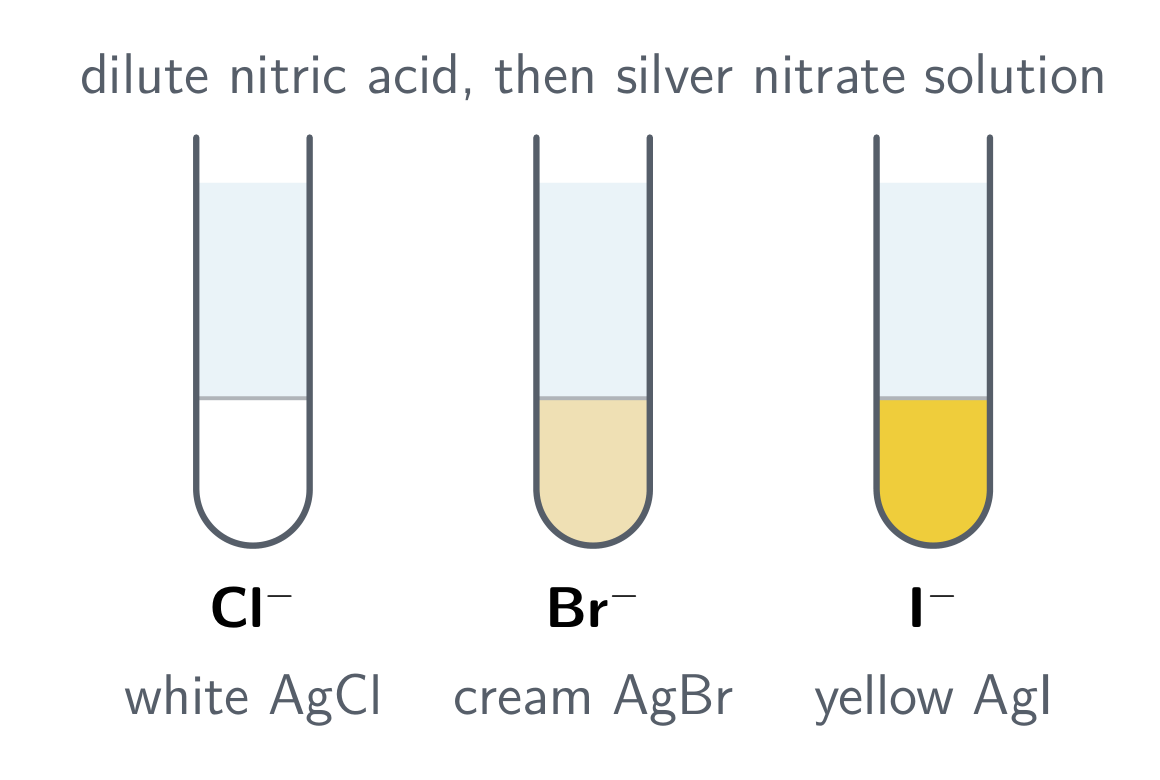
Silver nitrate and the three halides
Acidify with nitric acid, then add silver nitrate: chloride gives a white precipitate, bromide cream and iodide yellow. The acid removes carbonate ions that would also form a precipitate.
Match each halide to its precipitate colour.
Difficulty 2/5 · 140 coins + a small bonus on first completion today
Silver halides.
Worked example: three solutions
Three colourless solutions are acidified and silver nitrate is added.
- Solution 1: white precipitate → chloride. $\text{Ag}^+ + \text{Cl}^- \rightarrow \text{AgCl}$.
- Solution 2: cream → bromide. Solution 3: yellow → iodide.
- Compare them side by side: the colours are pale and easy to confuse alone.
What is the ionic equation for the bromide test?
Difficulty 1/5 · 100 coins + a small bonus on first completion today
Silver ions and bromide ions.
Potassium iodide solution is tested. What is seen?
Difficulty 1/5 · 100 coins + a small bonus on first completion today
Iodide gives yellow.
Why nitric acid?
- The acid removes carbonate ions, which would also give a precipitate with silver nitrate.
- Nitric acid is used because it adds no halide ions — hydrochloric acid would add Cl⁻.
Why is nitric acid added first?
Difficulty 1/5 · 100 coins + a small bonus on first completion today
Carbonates would also precipitate.
Never acidify the halide test with hydrochloric acid. It contains chloride ions, so every sample would give a white precipitate. Use dilute nitric acid.
Hydrochloric acid can be used to acidify the halide test.
Difficulty 1/5 · 100 coins + a small bonus on first completion today
It adds Cl⁻.
The halide test 卤离子检验: acidify with dilute nitric acid, then add silver nitrate. Chloride gives a white precipitate, bromide cream and iodide yellow. Nitric acid removes carbonate and adds no halide.
Describe how to identify which of three solutions contains chloride, bromide or iodide ions.
Compare side by side.