- Metals differ in how easily they lose electrons — the reactivity series 活动性顺序 orders them, drives displacement 置换 and decides how each is extracted.
- Acids donate H⁺; alkalis donate OH⁻; their reaction makes a salt 盐 — and the salt's name reads off the acid and the base.
- Electrolysis forces ions to give up or take electrons at electrodes — extracting the most reactive metals and splitting solutions.
Chemical changes
AQA · GCSE · Chemistry · Topic 4
4.1
Chemical changes: reactivity, acids and electrolysis
Vocabulary
Train
| English |
|---|
| reactivity series/rɪəkˈtɪvɪti ˈsɪəriːz/ |
| displacement/dɪˈspleɪsmənt/ |
| salt/sɒlt/ |
4.1
Reactivity of metals (4.4.1.1–4.4.1.4)
Syllabus
Reactivity of metals (AQA 8462 statements 4.4.1.1-4.4.1.4).
- Recall the reactivity series order including carbon and hydrogen, with water and acid reactions.
- Explain reactivity as the tendency to form positive ions and deduce order from results.
- Relate extraction method to reactivity: carbon reduction vs electrolysis.
- (HT) Use OIL RIG to write ionic equations for displacement and redox.
Source: Cambridge International syllabus
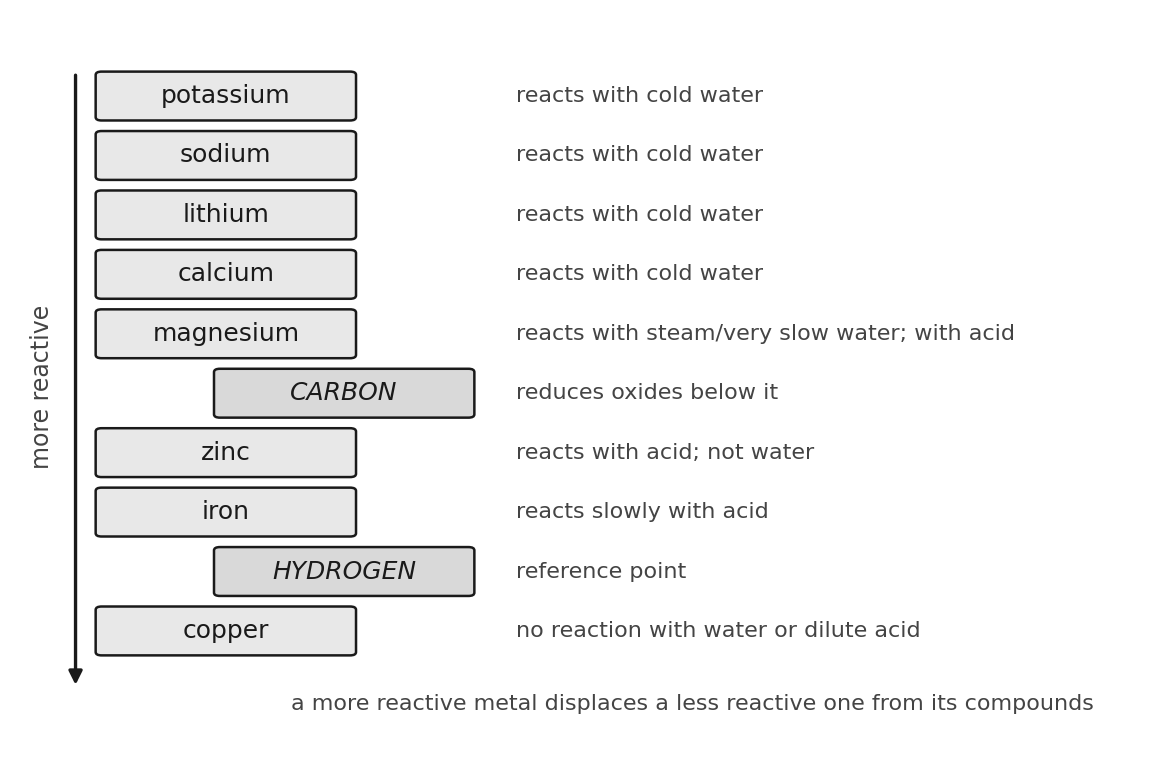
Reactivity series (learn the order): potassium, sodium, lithium, calcium, magnesium, [carbon], zinc, iron, [hydrogen], copper. Reactivity = the metal's tendency to form positive ions.
- With water: K, Na, Li, Ca react ( fizzing, hydroxide + hydrogen); Mg very slow; Zn/Fe/Cu no reaction.
- With dilute acids: Mg, Zn, Fe react → salt + hydrogen; Cu does not.
- A more reactive metal displaces a less reactive one from its compound: Zn + CuSO₄ → ZnSO₄ + Cu.
Extraction: unreactive metals (gold) occur native; metals below carbon are extracted by reduction 还原 with carbon (loss of oxygen); metals above carbon need electrolysis 电解. Identify oxidation 氧化 (gain of oxygen) and reduction (loss of oxygen).
(HT) Redox in electrons: oxidation is loss of electrons, reduction is gain — OIL RIG. Write ionic equations for displacement: Zn + Cu²⁺ → Zn²⁺ + Cu.
Vocabulary
Train
| English |
|---|
| reduction/rɪˈdʌkʃn/ |
| oxidation/ˌɒksɪˈdeɪʃn/ |
| electrolysis/ɪlekˈtrɒləsɪs/ |
4.2
Reactions of acids and making salts (4.4.2)
Syllabus
Reactions of acids (AQA 8462 statements 4.4.2.1-4.4.2.6).
- Predict acid-metal and acid-base products, naming salts from acid and base.
- Describe RP1 salt preparation from an insoluble oxide or carbonate.
- Use the pH scale, universal indicator and pH probe; write the neutralisation ionic equation.
- (Chem) Describe titration method (RP2) and (HT) strong vs weak acids with the factor-of-10 pH rule.
Source: Cambridge International syllabus
Acids neutralised by alkalis (soluble hydroxides) and bases (insoluble oxides/hydroxides) → salt + water; by metal carbonates → salt + water + carbon dioxide. The acid decides the salt's negative ion: hydrochloric → chlorides, nitric → nitrates, sulfuric → sulfates; the base supplies the positive ion. Predict products and write salt formulae from ion charges.
Making a soluble salt (RP1): add the insoluble solid (metal oxide/carbonate) to warm dilute acid until no more dissolves (excess solid proves completion), filter off the excess, evaporate to the crystallisation point and leave to crystallise; dry the crystals.
pH scale: 0–14, measured with universal indicator or a pH probe; 7 neutral, <7 acid, >7 alkaline. Acids give H⁺(aq); alkalis give OH⁻(aq). Neutralisation 中和: H⁺ + OH⁻ → H₂O.
(Chem) Titrations 滴定 (RP2): measure reacting volumes of a strong acid and strong alkali accurately — burette, pipette, indicator; (HT) calculate concentrations in mol/dm³ and g/dm³ (topic 3.4 methods).
(HT) Strong and weak acids: strong acids (HCl, HNO₃, H₂SO₄) are completely ionised; weak acids (ethanoic, citric, carbonic) are partially ionised. Same concentration → stronger acid → lower pH. Each pH unit down multiplies [H⁺] by 10. Dilute/concentrated = amount of substance per volume — different axis from strong/weak.
Vocabulary
Train
| English |
|---|
| neutralisation/ˌnjuːtrəlaɪˈzeɪʃn/ |
| titration/taɪˈtreɪʃn/ |
4.3
Electrolysis (4.4.3)
Syllabus
Electrolysis (AQA 8462 statements 4.4.3.1-4.4.3.4).
- Describe electrolytes, electrode attraction and discharge.
- Predict products for molten binary compounds and aqueous solutions.
- Explain aluminium extraction: cryolite mixture and anode replacement.
- (HT) Write balanced half-equations at both electrodes.
Source: Cambridge International syllabus
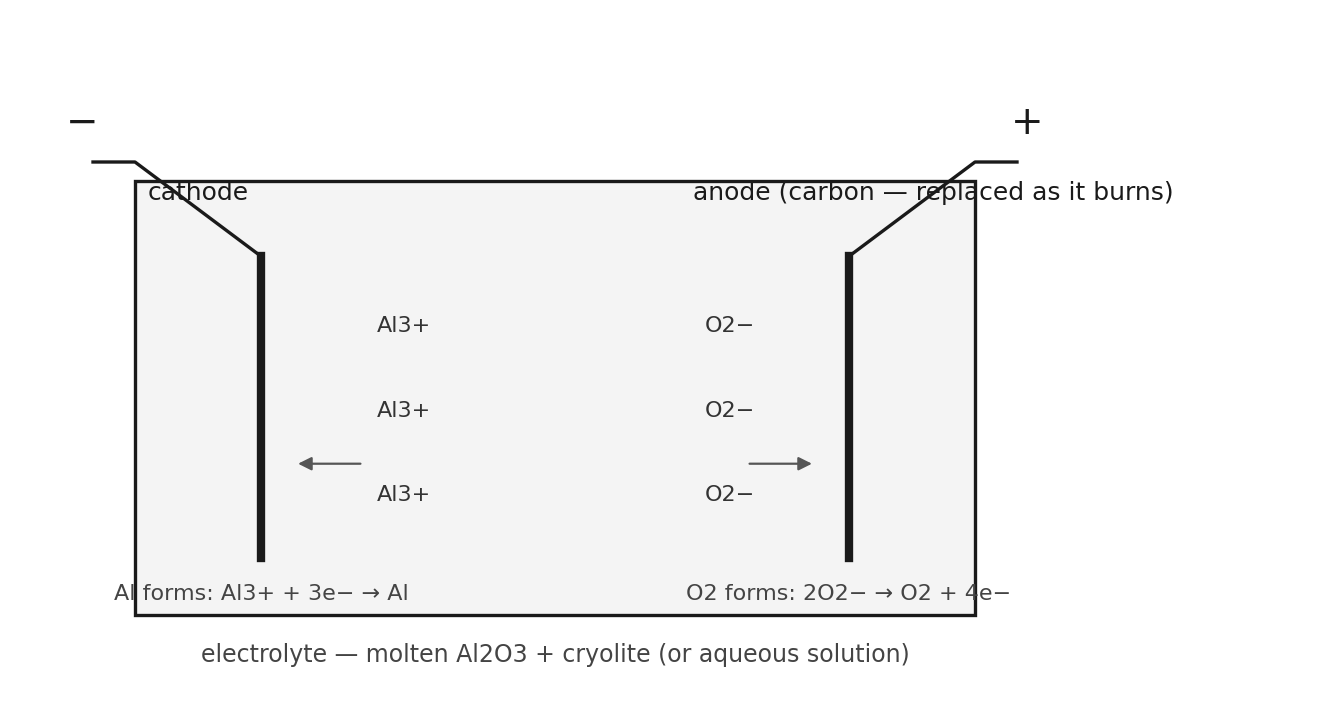
Electrolytes 电解质: molten or dissolved ionic compounds — ions free to move, so they conduct. Positive ions → cathode (negative); negative ions → anode (positive); ions are discharged as elements.
- Molten binary compounds (lead bromide): metal at the cathode, non-metal at the anode.
- Extraction (aluminium): electrolysis of molten Al₂O₃ + cryolite — the mixture lowers the melting point, saving energy; carbon anode burns away (with the oxygen produced) and must be replaced. Electrolysis is used when the metal is too reactive for carbon reduction.
- Aqueous solutions (RP3): at the cathode, hydrogen is produced if the metal is more reactive than hydrogen (else the metal deposits); at the anode, oxygen — unless halide ions are present, when the halogen forms.
(HT) Half-equations 半方程 — balance charge with electrons:
- cathode: Cu²⁺ + 2e⁻ → Cu; 2H⁺ + 2e⁻ → H₂
- anode: 2Cl⁻ → Cl₂ + 2e⁻; 4OH⁻ → O₂ + 2H₂O + 4e⁻
Vocabulary
Train
| English |
|---|
| cathode/ˈkæθəʊd/ |
| anode/ˈænəʊd/ |
| electrolyte/ɪˈlektrəlaɪt/ |
| half equation/hɑːf ɪˈkweɪʒn/ |
4.3
Checklist before you call this topic done
- Recite the reactivity series with carbon and hydrogen in place; predict water/acid/displacement reactions.
- Extraction: carbon reduction vs electrolysis, with reasons; (HT) OIL RIG with ionic equations.
- Salt names from acid + base; RP1 method in order; H⁺ + OH⁻ → H₂O.
- (Chem) titration method; (HT) strong vs weak with the pH ×10 rule.
- Electrolysis products for molten and aqueous cases; (HT) half-equations both electrodes.