- Three bonds hold matter together: ionic (transferred electrons, charged ions), covalent (shared electron pairs) and metallic (delocalised electrons).
- Structure follows bonding: giant ionic lattices, small molecules, polymers, giant covalent structure networks and metal lattices — each predicts melting point and conductivity.
- Carbon shows every trick: diamond, graphite, graphene, fullerenes; nanoparticles (chemistry only) turn surface area into properties.
Bonding, structure and the properties of matter
AQA · GCSE · Chemistry · Topic 2
2.1
Bonding, structure and the properties of matter
Vocabulary
Train
| English |
|---|
| delocalised electron/dɪˈlɒkəlaɪzd ɪˈlektrɒn/ |
| fullerene/ˈfʊləren/ |
2.1
Ionic, covalent and metallic bonding (4.2.1)
Syllabus
Ionic, covalent and metallic bonding (AQA 8462 statements 4.2.1.1-4.2.1.5).
- Explain the three bond types in terms of electrons and electrostatic forces.
- Draw dot and cross diagrams for electron transfer and for the eight named molecules.
- Deducie ion charges and empirical formulae from group numbers and lattice models; state model limitations.
Source: Cambridge International syllabus
Three strong chemical bonds, all explained by electrostatic forces:
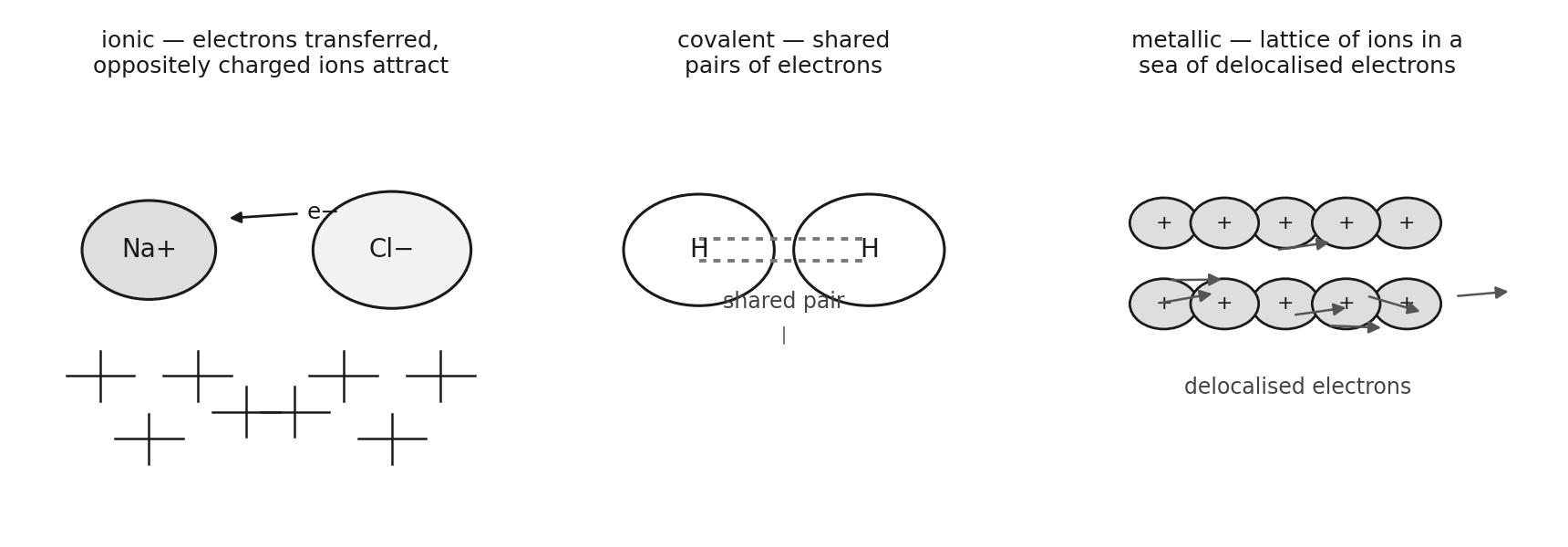
- Ionic 离子键 — a metal atom transfers outer electrons to a non-metal: metal atoms lose electrons to become positive ions; non-metal atoms gain them to become negative ions; Groups 1/2 metals and 6/7 non-metals form ions with noble-gas electronic structures. Draw the electron transfer with dot and cross diagrams; deduce ion charges from group number (Group 1 → +1, Group 2 → +2, Group 6 → −2, Group 7 → −1).
- Covalent 共价键 — non-metal atoms share pairs of electrons. Know dot-and-cross diagrams for H₂, Cl₂, O₂, N₂, HCl, H₂O, NH₃, CH₄, and line representations for small molecules, polymer repeating units and giant covalent structures.
- Metallic 金属键 — a giant lattice of metal atoms with delocalised outer electrons 游离电子 free to move through the whole structure; the sharing of these electrons gives strong metallic bonding.
Know the limitations of models: dot-and-cross, ball-and-stick, 2D and 3D diagrams all simplify — no forces shown, fixed bond lengths, giant structures drawn as small fragments. Deduce empirical formulae from lattice models; molecular formulae from molecule diagrams.
Vocabulary
Train
| English |
|---|
| metallic bond/məˈtælɪk bɒnd/ |
2.2
Bonding, structure and properties (4.2.2)
Syllabus
Bonding, structure and properties (AQA 8462 statements 4.2.2.1-4.2.2.8).
- Link states of matter and state symbols to particle theory, with (HT) its limitations.
- Explain the melting points and conductivity of ionic compounds, small molecules, polymers and metals.
- Explain why alloys are harder than pure metals.
Source: Cambridge International syllabus
States of matter: solid, liquid, gas; melting/freezing at the melting point, boiling/condensing at the boiling point. Particle theory (small solid spheres) explains the changes; the stronger the forces between particles, the higher the melting/boiling points. (HT) The simple model's limits: no forces shown, all spheres, solid particles. State symbols: (s), (l), (g), (aq).
| Structure | Bonding/forces | Melting point | Conducts electricity? |
|---|---|---|---|
| ionic lattice | strong electrostatic forces in all directions | high | only when molten or dissolved — ions free to move |
| small molecules | strong covalent bonds inside, weak intermolecular forces between 分子间作用力 | low — only weak intermolecular forces are overcome | no — no overall charge |
| polymers | strong covalent chains, stronger intermolecular forces | solid at room temperature | no |
| giant covalent | every atom covalently bonded | very high | generally no (graphite the exception) |
| metals | metallic bonding — delocalised electrons | mostly high | yes — delocalised electrons carry charge (and heat) |
Larger molecules → stronger intermolecular forces → higher melting/boiling points. Alloys 合金 are harder than pure metals because different-sized atoms distort the layers, stopping them sliding.
Vocabulary
Train
| English |
|---|
| ionic bond/aɪˈɒnɪk bɒnd/ |
| covalent bond/ˈkəʊvələnt bɒnd/ |
| intermolecular force/ˌɪntəməˈlekjʊlə fɔːs/ |
| alloy/ˈælɔɪ/ |
2.3
Structure and bonding of carbon (4.2.3)
Syllabus
Structure and bonding of carbon (AQA 8462 statements 4.2.3.1-4.2.3.3).
- Explain diamond's properties from its four-bond giant structure.
- Explain graphite's properties from three bonds, layers and delocalised electrons.
- Describe graphene and fullerenes, including carbon nanotubes and their uses.
Source: Cambridge International syllabus
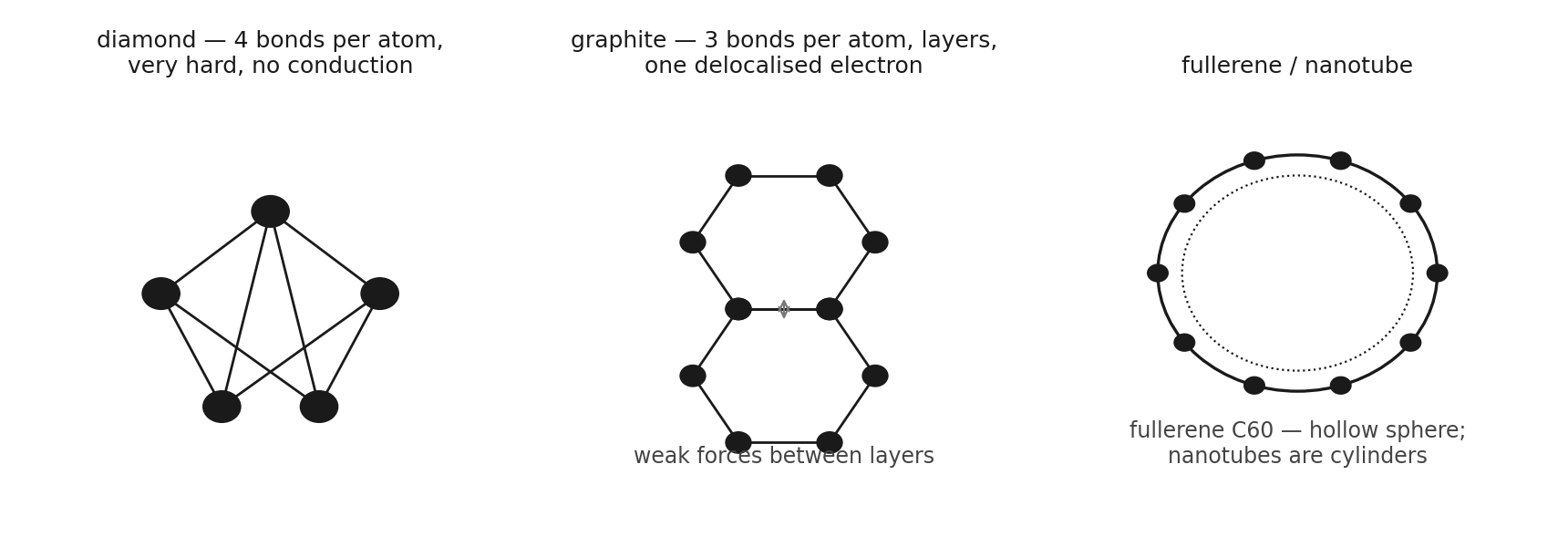
- Diamond — a giant covalent structure 巨型共价结构 in which each carbon forms four covalent bonds: very hard, very high melting point, does not conduct.
- Graphite — each carbon forms three bonds, layers of hexagonal rings with no covalent bonds between layers (soft, slippery — lubricant); one delocalised electron per atom → conducts electricity like a metal.
- Graphene — a single layer of graphite: one atom thick, strong, conducts — electronics and composites.
- Fullerenes — hollow molecules of carbon hexagons (plus 5- or 7-membered rings); Buckminsterfullerene C₆₀ 富勒烯 is spherical. Carbon nanotubes 碳纳米管 — cylindrical fullerenes with huge length-to-diameter ratios: nanotechnology, electronics, materials.
Vocabulary
Train
| English |
|---|
| giant covalent structure/ˈdʒaɪənt ˈkəʊvələnt ˈstrʌktʃə/ |
| carbon nanotube/ˈkɑːbən ˌnænəʊˈtjuːb/ |
2.4
Bulk and surface properties incl. nanoparticles — chemistry only (4.2.4)
Syllabus
Bulk and surface properties including nanoparticles, chemistry only (AQA 8462 statement 4.2.4).
- Compare nanoparticle, fine and coarse particle size ranges.
- Apply the surface-area-to-volume factor-of-10 rule to cubes.
- Explain why nanoparticles differ from bulk materials, their uses and the concerns.
Source: Cambridge International syllabus
Nanoscience = structures 1–100 nm (a few hundred atoms). Nanoparticles 纳米颗粒 are smaller than fine particles (PM2.5, 100–2500 nm), which are smaller than coarse particles/dust (PM10, 1 × 10⁻⁵–2.5 × 10⁻⁶ m).
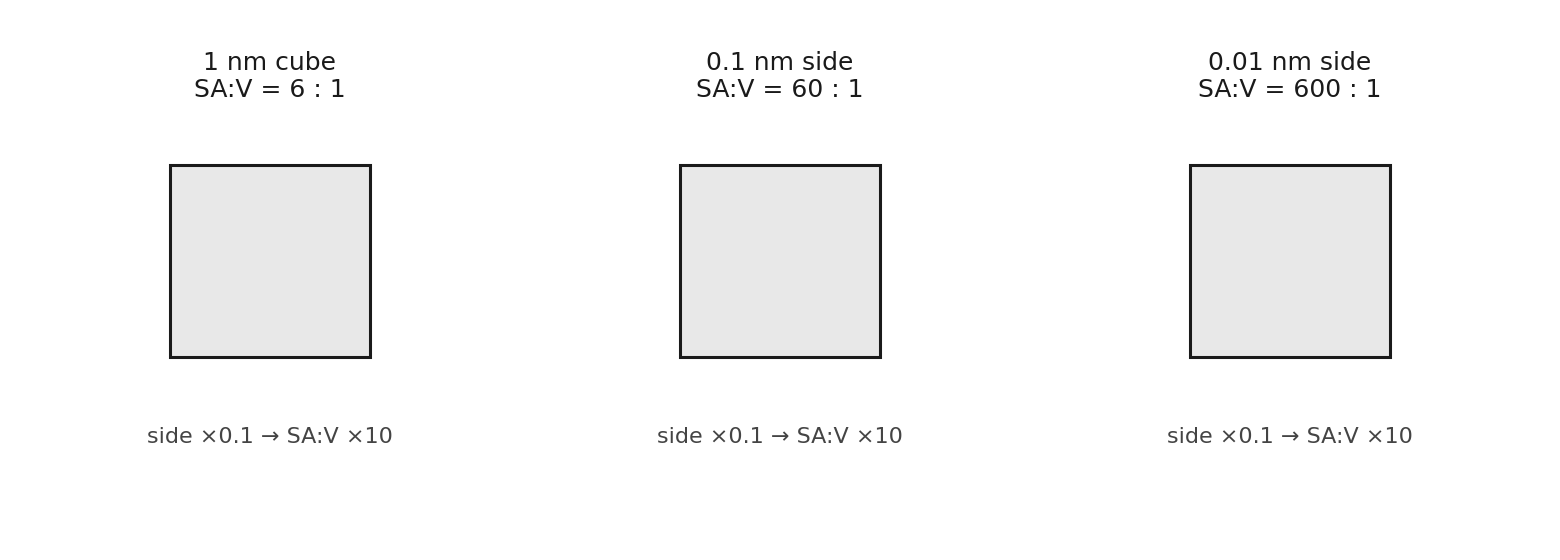
Surface area : volume: as a cube's side decreases 10×, SA:V increases 10×. Nanoparticles may have different properties from the bulk material because of this high ratio — catalysts (smaller quantities work), medicine delivery, cosmetics, electronics. Concerns: effects inside the body and in the environment are not fully known.
Vocabulary
Train
| English |
|---|
| nanoparticle/ˌnænəʊˈpɑːtɪkl/ |
2.4
Checklist before you call this topic done
- The three bonds in terms of electrons and electrostatic forces; ion charges from group numbers.
- Dot-and-cross for the eight named molecules; model limitations named.
- The properties table above rebuilt from memory — which forces are overcome on melting.
- Diamond vs graphite vs graphene vs fullerenes, bonding to property.
- (Chem) SA:V factor-of-10 rule; the three particle-size bands and nanoparticle uses and concerns.