- Crude oil — ancient plankton biomass — separates into fractions; alkane 烷烃s (CₙH₂ₙ₊₂) burn as fuels; cracking 裂解 turns big molecules into small alkanes plus reactive alkene 烯烃s (CₙH₂ₙ).
- Alkenes, alcohols and carboxylic acids (chemistry only) are functional-group families with predictable reactions.
- Polymers — addition (alkene monomers) and (HT) condensation — plus nature's own: proteins, starch, cellulose, DNA.
Organic chemistry
AQA · GCSE · Chemistry · Topic 7
7.1
Organic chemistry: carbon's families
Vocabulary
Train
| English |
|---|
| alkane/ˈælkeɪn/ |
| alkene/ˈælkiːn/ |
| cracking/ˈkrækɪŋ/ |
7.1
Crude oil, fuels and feedstock (4.7.1)
Syllabus
Crude oil, fuels and feedstock (AQA 8462 statements 4.7.1.1-4.7.1.4).
- Describe crude oil's origin and composition; name and formulate the first four alkanes.
- Explain fractional distillation and match fraction properties to uses.
- Relate molecule size to boiling point, viscosity and flammability.
- Describe cracking conditions and products, balance cracking equations and use the bromine-water test.
Source: Cambridge International syllabus
Crude oil is a finite resource in rocks — the remains of ancient biomass, mainly plankton buried in mud. It is a mixture of mostly hydrocarbon 碳氢化合物s (hydrogen + carbon only), chiefly alkanes, general formula CₙH₂ₙ₊₂: methane, ethane, propane, butane (know names + formulae in all representations).
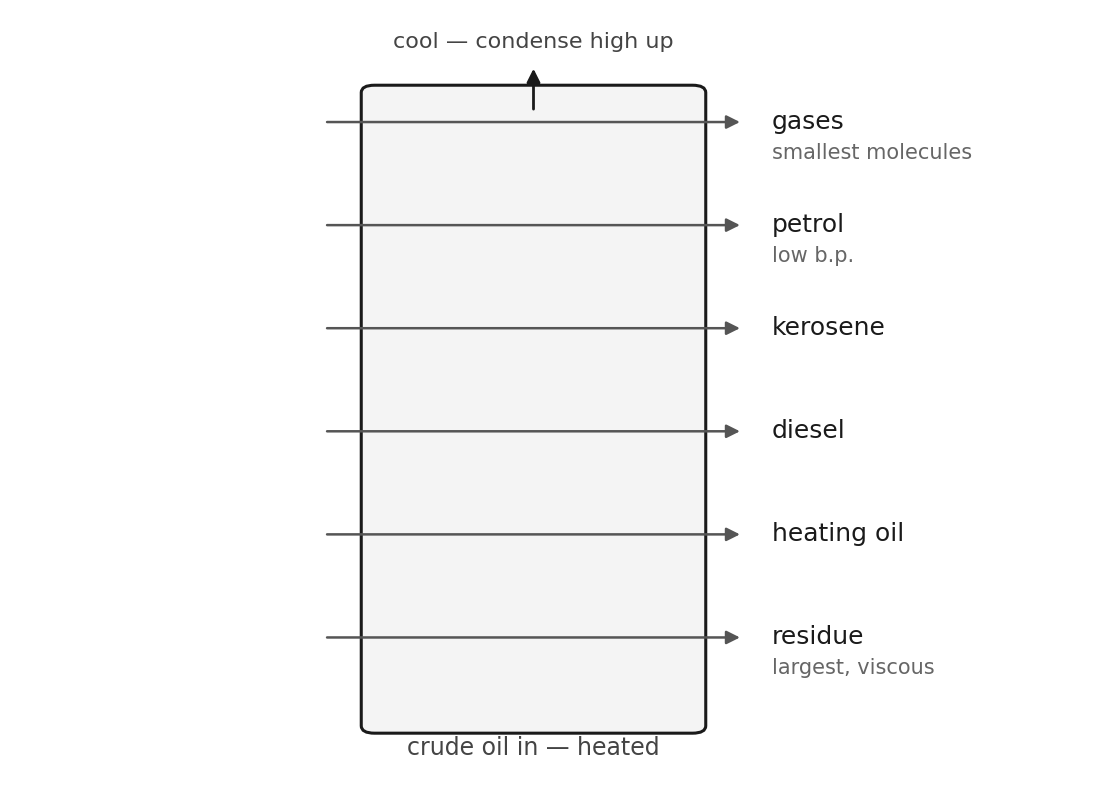
Fractional distillation 分馏: fractions contain molecules with similar carbon numbers; separated by evaporation and condensation at different levels of the column — small molecules at the top (low boiling point), large at the bottom. Fractions give fuels (petrol, diesel, kerosene, heavy fuel oil, LPG) and feedstock for petrochemicals — solvents, lubricants, polymers, detergents.
Properties track molecule size: bigger molecules → higher boiling point, higher viscosity, lower flammability — matching each fraction to its use.
Cracking: breaking large hydrocarbons into smaller, more useful molecules — catalytic cracking (high temperature + catalyst) or steam cracking (high temperature + steam). Products: a smaller alkane (fuel) + an alkene (polymer feedstock). Alkenes are more reactive: they decolourise bromine water (orange → colourless) — the alkene test. Balance cracking equations from given formulae.
Vocabulary
Train
| English |
|---|
| hydrocarbon/ˈhaɪdrəkɑːbən/ |
| fractional distillation/ˈfrækʃənl dɪstɪˈleɪʃn/ |
7.2
Alkenes, alcohols and carboxylic acids — chemistry only (4.7.2)
Syllabus
Alkenes, alcohols and carboxylic acids, chemistry only (AQA 8462 statements 4.7.2.1-4.7.2.4).
- Recognise alkenes CnH2n as unsaturated and describe their addition reactions.
- Describe the four reactions and uses of the first four alcohols, with fermentation conditions.
- Describe the reactions of the first four carboxylic acids, including ester formation, and (HT) weak-acid ionisation.
Source: Cambridge International syllabus
Alkenes CₙH₂ₙ contain the C=C double bond — unsaturated (two fewer hydrogens than the alkane with the same carbons). Members: ethene, propene, butene, pentene. Reactions of a functional group 官能团 give a family its reactions:
- combustion — but smoky flames (incomplete);
- with hydrogen → alkane (nickel catalyst); with water → alcohol (steam, phosphoric acid catalyst); with halogens → dihaloalkanes (bromine water test).
Alcohols –OH: methanol, ethanol, propanol, butanol. Reactions: with sodium (fizzing, hydrogen); burning in air (clean combustion — fuels); dissolving in water; oxidised (air/oxidising agent) → carboxylic acid. Uses: fuels, solvents, alcoholic drinks. Fermentation: sugar + yeast → ethanol solution in warm, oxygen-free conditions.
Carboxylic acids –COOH: methanoic, ethanoic, propanoic, butanoic acids. React with carbonates (fizz, CO₂), dissolve in water (weakly acidic — HT: only partially ionised, so higher pH than a strong acid), react with alcohols → esters (ethyl ethanoate) + water.
Vocabulary
Train
| English |
|---|
| functional group/ˈfʌŋkʃənl ɡruːp/ |
7.3
Polymers (4.7.3)
Syllabus
Polymers (AQA 8462 statements 4.7.3.1-4.7.3.2).
- Draw addition polymers from alkene monomers and relate repeating units back to monomers.
- (HT) Explain condensation polymerisation with functional groups, polyester and polypeptide examples.
- Name DNA's structure and the monomers of proteins, starch and cellulose.
Source: Cambridge International syllabus
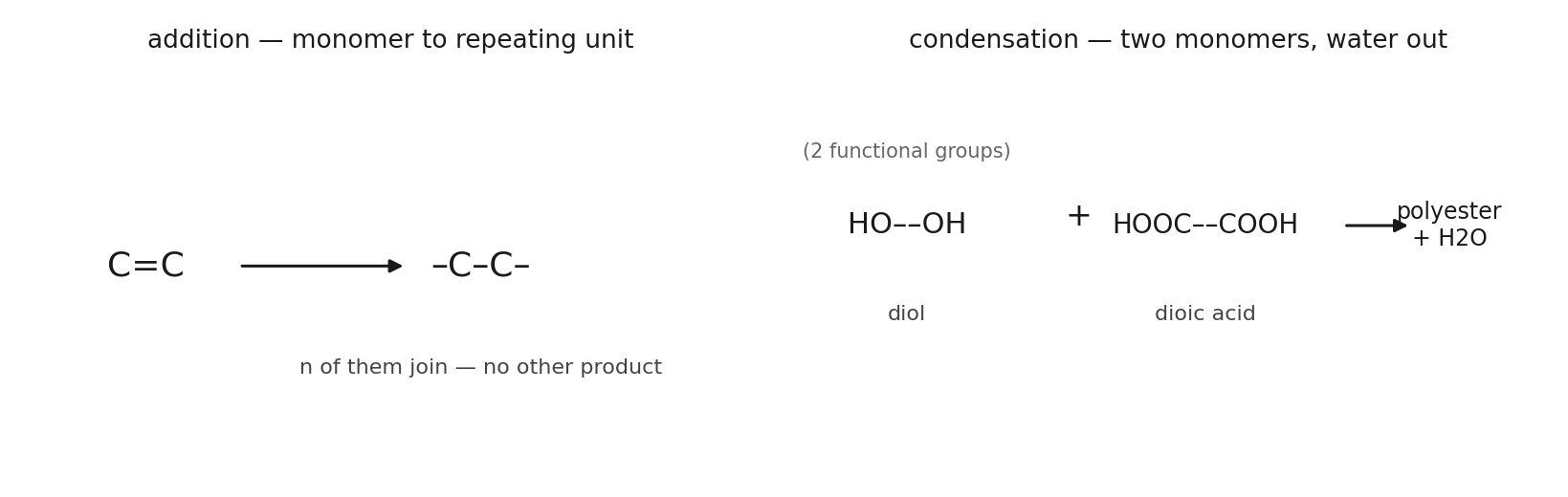
Addition polymerisation 加成聚合: many monomers 单体 (alkenes, with C=C) join into one polymer — poly(ethene) from ethene, poly(propene) from propene. The repeating unit has exactly the monomer's atoms — nothing else is formed. Draw: monomer → repeating unit with the double bond opened.
(HT) Condensation polymerisation: monomers each carry two functional groups; joining loses a small molecule — usually water. Two different monomers with two of the same groups each: e.g. ethanediol + hexanedioic acid → polyester. Amino acids (H₂N…COOH) condense → polypeptides; different amino acids in one chain → proteins (glycine is the example).
Natural polymers: DNA — two polymer chains of four nucleotides in a double helix; proteins (amino-acid monomers), starch (sugars), cellulose (sugars).
Vocabulary
Train
| English |
|---|
| addition polymerisation/əˈdɪʃn ˌpɒlɪməraɪˈzeɪʃn/ |
| condensation polymerisation/kɒndenˈseɪʃn ˌpɒlɪməraɪˈzeɪʃn/ |
| monomer/ˈmɒnəʊmə/ |
7.3
Checklist before you call this topic done
- Alkane names/formulae C1–C4; fraction order with boiling point, viscosity, flammability trends.
- Cracking conditions, products and balanced equations; bromine-water test with the colour change.
- (Chem) Alkene functional group and its three addition reactions; alcohol four reactions + fermentation 发酵 conditions; carboxylic acid three reactions.
- Addition polymer from monomer and back; (HT) condensation principles with polyester; DNA nucleotides + the three other natural polymers' monomers.
Vocabulary
Train
| English |
|---|
| fermentation/fɜːmənˈteɪʃn/ |