- Rate is a quantity per second — read it off tables, graphs and tangents; collision theory 碰撞理论 explains every factor that changes it.
- Reversible reactions settle into dynamic equilibrium 动态平衡; (HT) Le Chatelier predicts how each condition shifts it.
- Industry optimises rate and yield together — compromise conditions.
The rate and extent of chemical change
AQA · GCSE · Chemistry · Topic 6
6.1
The rate and extent of chemical change
Vocabulary
Train
| English |
|---|
| collision theory/kəˈlɪʒn ˈθɪəri/ |
| dynamic equilibrium/daɪˈnæmɪk ˌiːkwɪˈlɪbrɪəm/ |
| Le Chatelier principle/lə ˈtʃeɪtlɪə ˈprɪnsɪpl/ |
6.1
Rate of reaction (4.6.1)
Syllabus
Rate of reaction (AQA 8462 statements 4.6.1.1-4.6.1.5).
- Calculate mean rates in g/s, cm3/s and (HT) mol/s, and read product-time graphs with tangents.
- Recall the five factors affecting rate and investigate concentration (RP5).
- Explain each factor with collision theory and activation energy.
- Describe catalysts and their effect on the reaction profile, including enzymes.
Source: Cambridge International syllabus
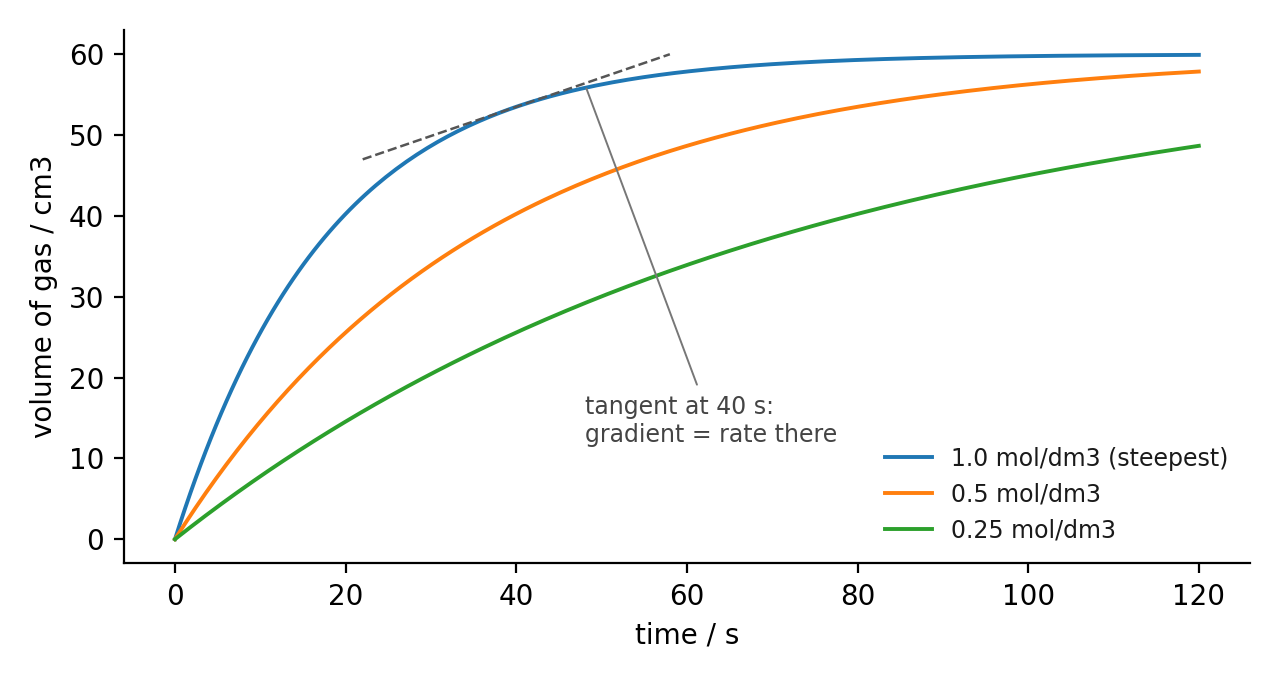
Calculating rates: rate of reaction 反应速率 = quantity of reactant used ÷ time, or product formed ÷ time — in g/s or cm³/s (HT also mol/s). Interpret product-vs-time graphs (steeper start, flattening as reactant runs out); draw tangents 切线 and use their gradient as the rate at that instant (HT calculate it).
Factors affecting rate: concentration (solution), pressure (gas), surface area (solid), temperature, catalyst 催化剂s. RP5: investigate concentration by (a) measuring the volume of gas produced and (b) observing a colour/turbidity change — hypothesis, variables, repeats.
Collision theory: reactions occur only when particles collide with at least the activation energy 活化能. Raising concentration/pressure crowds particles — more frequent collisions; smaller solid pieces raise the surface-area-to-volume ratio — more exposed surface, more frequent collisions; raising temperature gives particles more energy — more collisions AND more collisions that pass the activation energy.
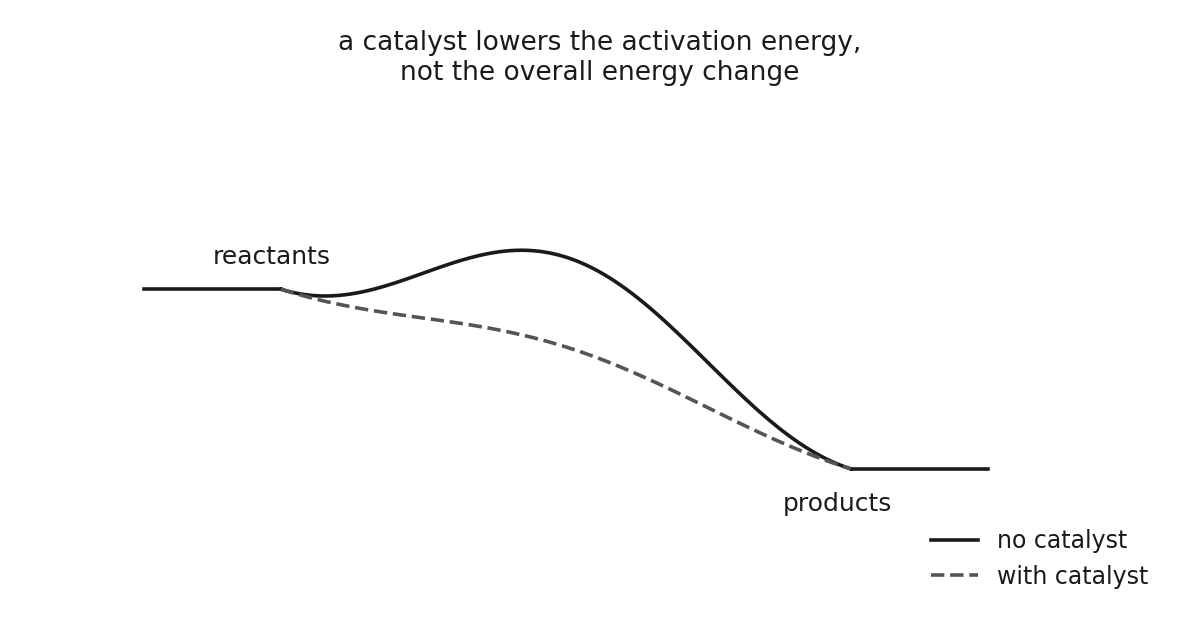
Catalysts: change the rate but are not used up; each reaction has its own catalyst; enzymes are biological catalysts. A catalyst offers an alternative pathway with lower activation energy — identify it by speeding the reaction yet never appearing in the equation. Its reaction profile keeps the same overall energy change with a lower hump:
Vocabulary
Train
| English |
|---|
| rate of reaction/reɪt ɒv rɪˈækʃn/ |
| activation energy/ˌæktɪˈveɪʃn ˈenədʒi/ |
| catalyst/ˈkætəlɪst/ |
| tangent/ˈtændʒənt/ |
6.2
Reversible reactions and dynamic equilibrium (4.6.2)
Syllabus
Reversible reactions and dynamic equilibrium (AQA 8462 statements 4.6.2.1-4.6.2.3).
- Represent reversible reactions and their opposite energy changes.
- Define dynamic equilibrium in a closed system.
- (HT) Predict the effect of concentration, pressure and temperature changes with Le Chatelier's principle, and the catalyst's null effect.
Source: Cambridge International syllabus
Reversible reactions 可逆反应: the products can react back to the reactants — written with the ⇌ arrow. If exothermic one way, endothermic the other, transferring the same amount of energy.
Equilibrium: in a closed system, equilibrium is reached when the forward and reverse rates are equal — the concentrations stop changing though both reactions continue (dynamic).
(HT) Le Chatelier's principle 勒夏特列原理: a system at equilibrium responds to counteract any change:
- concentration ↑ of a reactant → more product forms (and vice versa);
- pressure ↑ → the position moves to the side with fewer gas molecules;
- temperature ↑ → the position moves in the endothermic direction (↓ for exothermic direction).
A catalyst does not shift the position — it reaches equilibrium faster. Industry picks compromise conditions balancing rate, yield, safety and cost (e.g. the Haber process in topic 10).
Vocabulary
Train
| English |
|---|
| reversible reaction/rɪˈvɜːsɪbl rɪˈækʃn/ |
6.2
Checklist before you call this topic done
- Rate from a table, from a graph's steepness, and (HT) from a tangent gradient.
- Each of the five factors explained by collision theory, naming what happens to collision frequency and energy.
- Catalyst effect on the profile; not used up; enzymes.
- The ⇌ arrow; equilibrium as equal rates; (HT) predict all three condition changes with Le Chatelier; compromise conditions justified.