| Learning Objective | Essential Knowledge |
|---|---|
12.1.A |
|
12.1.B |
|
12.1.C |
|
Magnetism and Electromagnetism
AP Physics 2 · AP 물리학 2 · Topic 12 · 주제 12
 9:21
9:21
자기장 및 전자기학
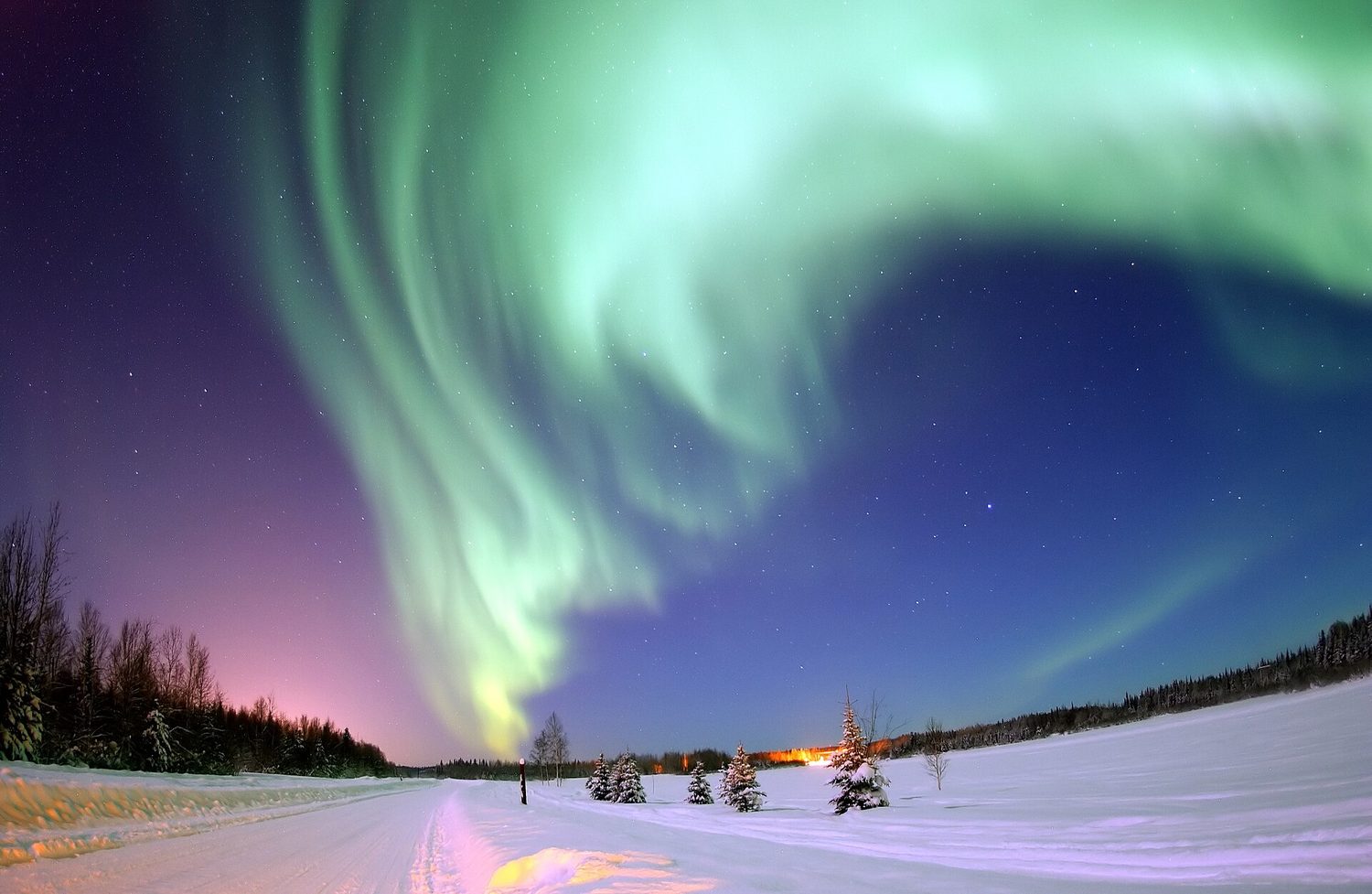
북극 위 고층에서 밤하늘이 초록색으로 빛납니다. 이 빛의 커튼은 불이 아닙니다. 그들은 태양에서 온 전하 입자들이며, 백만 …에 도달합니다.
English narration · English + 中文 subtitles burned in · 영어 내레이션 · 영어 + 중국어 자막 burned-in
12.1
Magnetic Fields · 자기장
Syllabus
Source: College Board AP Course and Exam Description · 출처: College Board AP Course and Exam Description
English
Different materials respond very differently to a magnetic field, and the course names three. Ferromagnetic 铁磁性 materials (iron, nickel, cobalt) have dipoles that align strongly and stay aligned, so they can be permanent magnets. Paramagnetic 顺磁性 materials (aluminium, titanium) align only weakly and do not stay aligned. Diamagnetic 抗磁性 materials - in fact all materials have some diamagnetism - align weakly opposite the field. This behaviour comes from a material property, the permeability 磁导率: free space has a fixed permeability of free space $\mu_0$, while the permeability of matter differs from it and is not even constant for a given material.
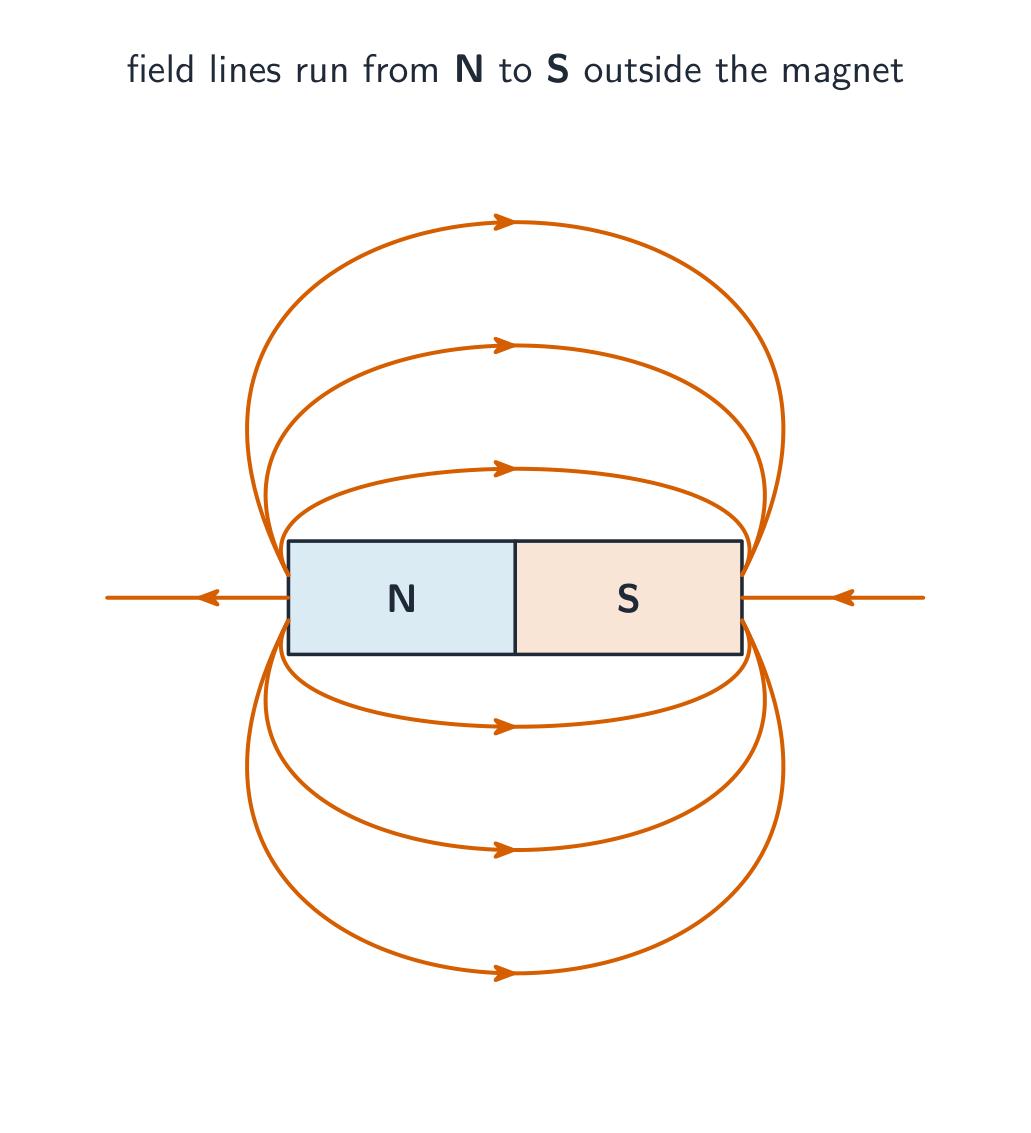
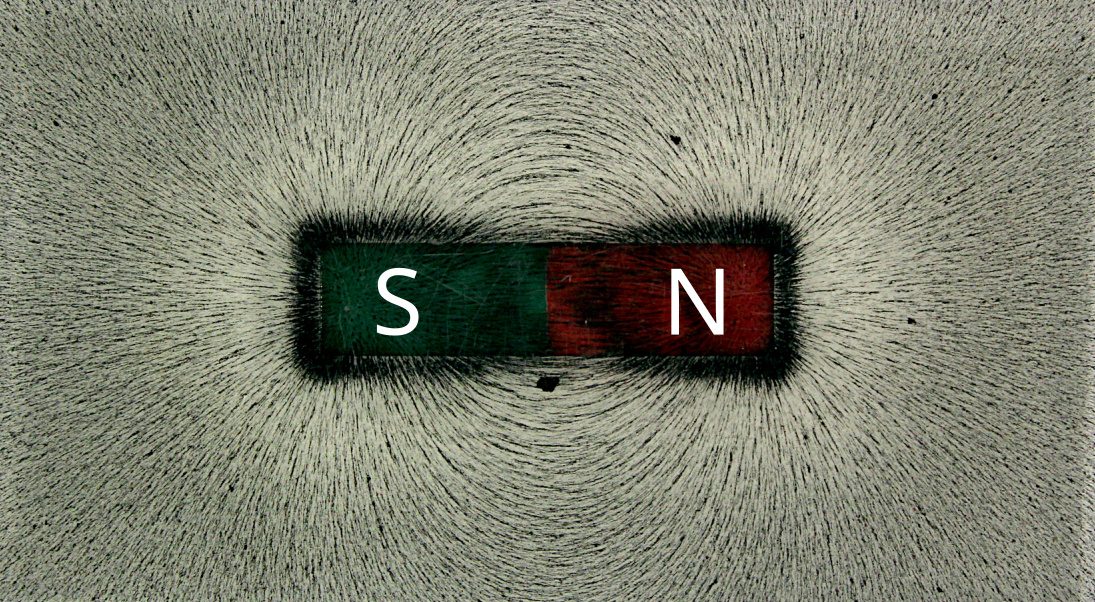
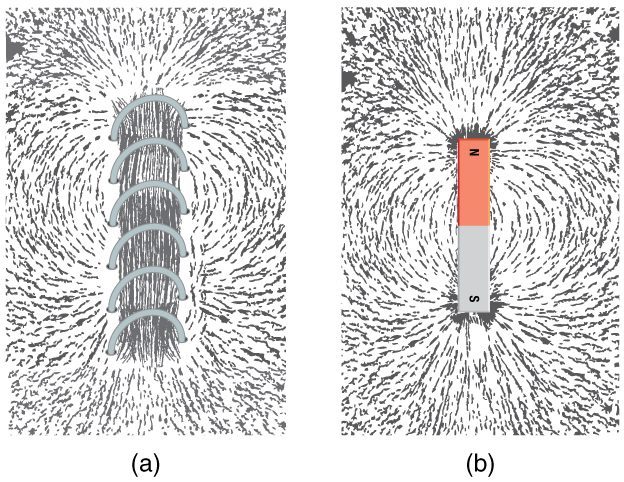
A magnetic field 磁场 $\vec{B}$ surrounds magnets and moving charges. Field lines run from a magnet's north pole to its south pole outside the magnet, and denser lines mean a stronger field. Magnetic poles always come in pairs – cutting a magnet in half makes two smaller magnets, never an isolated pole.
한국어
서로 다른 물질들은 자기장에 매우 다르게 반응하며, 본 과정에서는 세 가지를 다룬다. 자성체(ferromagnetic) 물질(철, 니켈, 코발트)은 쌍극자가 강하게 정렬되고 유지되므로 영구 자석이 될 수 있다. 상자성体(paramagnetic) 물질(알루미늄, 티타늄)은 약하게 정렬되고 유지되지 않는다. 반자성体(diamagnetic) 물질-사실 모든 물질은 약간의 반자성을 가진다-은 자기장과 반대 방향으로 약하게 정렬된다. 이 현상은 물질의 성질인 **투자기도(permeability)**에서 비롯된다: 진공은 고정된 진공 투자기도 $\mu_0$를 가지며, 물질의 투자기도는 이와 다르며 특정 물질에서도 일정하지 않을 수 있다.
자기장 $\vec{B}$은 자석과 이동 전하 주변을 둘러싼다. 자기장 선은 자석 외부에서 북극에서 남극으로 흐르며, 선이 밀집할수록 장이 강함을 의미한다. 자기극은 항상 쌍으로 존재한다-자석을 반으로 잘라내면 두 개의 작은 자석이 생기고, 단일 극은 절대 생성되지 않는다.
Explore · 탐색하기
See a magnet's field lines · 자석의 자기력선 보기
Magnetic field lines run from the north pole to the south pole outside the magnet. Where the lines crowd together the field is strongest. · 자기장의 힘선은 자석 외부에서 북극에서 남극으로 향합니다. 힘선이 밀집한 곳일수록 자기장이最强합니다.
Vocabulary · 어휘
Train · 연습하기
| English | 한국어 |
|---|---|
| Ferromagnetic/ˌferəməɡˈnetɪk/ | 강자성 |
| Paramagnetic/ˌpærəməɡˈnetɪk/ | 자화성 |
| Diamagnetic/ˌdaɪəməɡˈnetɪk/ | 반자성 |
| permeability/ˌpɜːməˈbɪlɪti/ | 자율률 |
| magnetic field/mæɡˈnetɪk fiːld/ | 자기장 |
12.2
Magnetism and Moving Charges · 자기학 및 이동 전하
Syllabus
English
Learning Objective 12.2.A: Describe the magnetic field produced by moving charged objects.
- 12.2.A.1 A single moving charged object produces a magnetic field.
- 12.2.A.1.i The magnetic field at a particular point produced by a moving charged object depends on the object's velocity and the distance between the point and the object.
- 12.2.A.1.ii At a point in space, the direction of the magnetic field produced by a moving charged object is perpendicular to both the velocity of the object and the position vector from the object to that point in space and can be determined using the right-hand rule.
- 12.2.A.1.iii The magnitude of the magnetic field is a maximum when the velocity vector and the position vector from the object to that point in space are perpendicular.
Learning Objective 12.2.B: Describe the force exerted on moving charged objects by a magnetic field.
- 12.2.B.1 Magnetic forces describe interactions between moving charged objects.
- 12.2.B.2 A magnetic field may exert a force on a charged object moving in that field.
- 12.2.B.2.i The magnitude of the force exerted by a magnetic field on a moving charged object is proportional to the magnitude of the charge, the magnitude of the charged object's velocity, and the magnitude of the magnetic field and also depends on the angle between the velocity and magnetic field vectors.
- Equation: $F_B = qvB\sin\theta$
- 12.2.B.2.ii The direction of the force exerted by a magnetic field on a moving charged object is perpendicular to both the direction of the magnetic field and the velocity of the charge, as defined by the right-hand rule.
- 12.2.B.2.i The magnitude of the force exerted by a magnetic field on a moving charged object is proportional to the magnitude of the charge, the magnitude of the charged object's velocity, and the magnitude of the magnetic field and also depends on the angle between the velocity and magnetic field vectors.
- 12.2.B.3 In a region containing both a magnetic field and an electric field, a moving charged object will experience independent forces from each field.
- 12.2.B.4 The Hall effect describes the potential difference created in a conductor by an external magnetic field that has a component perpendicular to the direction of charges moving in the conductor.
Boundary statement: Quantitative treatment of the magnitude of the magnetic force exerted by a magnetic field on a moving charge is limited to angles of 0, 90, and 180 degrees between the velocity and the magnetic field. Qualitative analysis of other angles is permitted.
한국어
학습 목표 12.2.A: 이동하는 전하를 띤 물체가 생성하는 자기장을 설명하시오.
- 12.2.A.1 단일 이동 전하 물체는 자기장을 생성한다.
- 12.2.A.1.i 특정 지점에서 이동 전하 물체에 의해 생성된 자기장은 해당 물체의 속도와 그 지점과 물체 사이의 거리에 의존한다.
- 12.2.A.1.ii 공간상 한 점에서 이동 전하 물체에 의해 생성되는 자기장의 방향은 물체의 속도와 물체로부터 해당 지점까지의 위치 벡터 모두와 수직이며, 오른손 법칙을 사용하여 결정할 수 있다.
- 12.2.A.1.iii 자기장의 크기는 물체의 속도 벡터와 해당 지점까지의 위치 벡터가 서로 수직일 때 최대가 된다.
학습 목표 12.2.B: 자기장이 이동 전하 물체에 가하는 힘에 대해 설명하시오.
- 12.2.B.1 자기력은 이동 전하 물체 간의 상호작용을 서술한다.
- 12.2.B.2 자기장은 해당 장 내에서 이동하는 전하 물체에 힘을 가할 수 있다.
- 12.2.B.2.i 자기장에 의한 이동 전하 물체에 가해지는 힘의 크기는 전하량, 물체의 속도 크기, 자기장 크기에 비례하며, 또한 속도 벡터와 자기장 벡터 사이의 각도에도 의존한다.
- 식: $F_B = qvB\sin\theta$
- 12.2.B.2.ii 자기장에 의한 이동 전하 물체에 가해지는 힘의 방향은 자기장 방향과 전하의 속도 방향 모두와 수직이며, 이는 오른손 법칙으로 정의된다.
- 12.2.B.2.i 자기장에 의한 이동 전하 물체에 가해지는 힘의 크기는 전하량, 물체의 속도 크기, 자기장 크기에 비례하며, 또한 속도 벡터와 자기장 벡터 사이의 각도에도 의존한다.
- 12.2.B.3 자기장과 전기장이 공존하는 영역에서는 이동 전하 물체가 각 장으로부터 독립적인 힘을 받는다.
- 12.2.B.4 홀 효과(Hall effect)는 도체 내로 이동하는 전하의 방향과 수직 성분을 가진 외부 자기장에 의해 도체에 생기는 전위차를 서술한다.
경계 문구: 자기장이 이동 전하에 가하는 자기력의 크기에 대한 정량적 처리는 속도와 자기장 사이의 각도가 0도, 90도, 180도인 경우에만 제한된다. 기타 각도에 대한 정성적 분석은 허용된다.
Source: College Board AP Course and Exam Description · 출처: College Board AP Course and Exam Description
English
A charge moving through a magnetic field feels a magnetic force 磁力:
$$F=qvB\sin\theta,$$
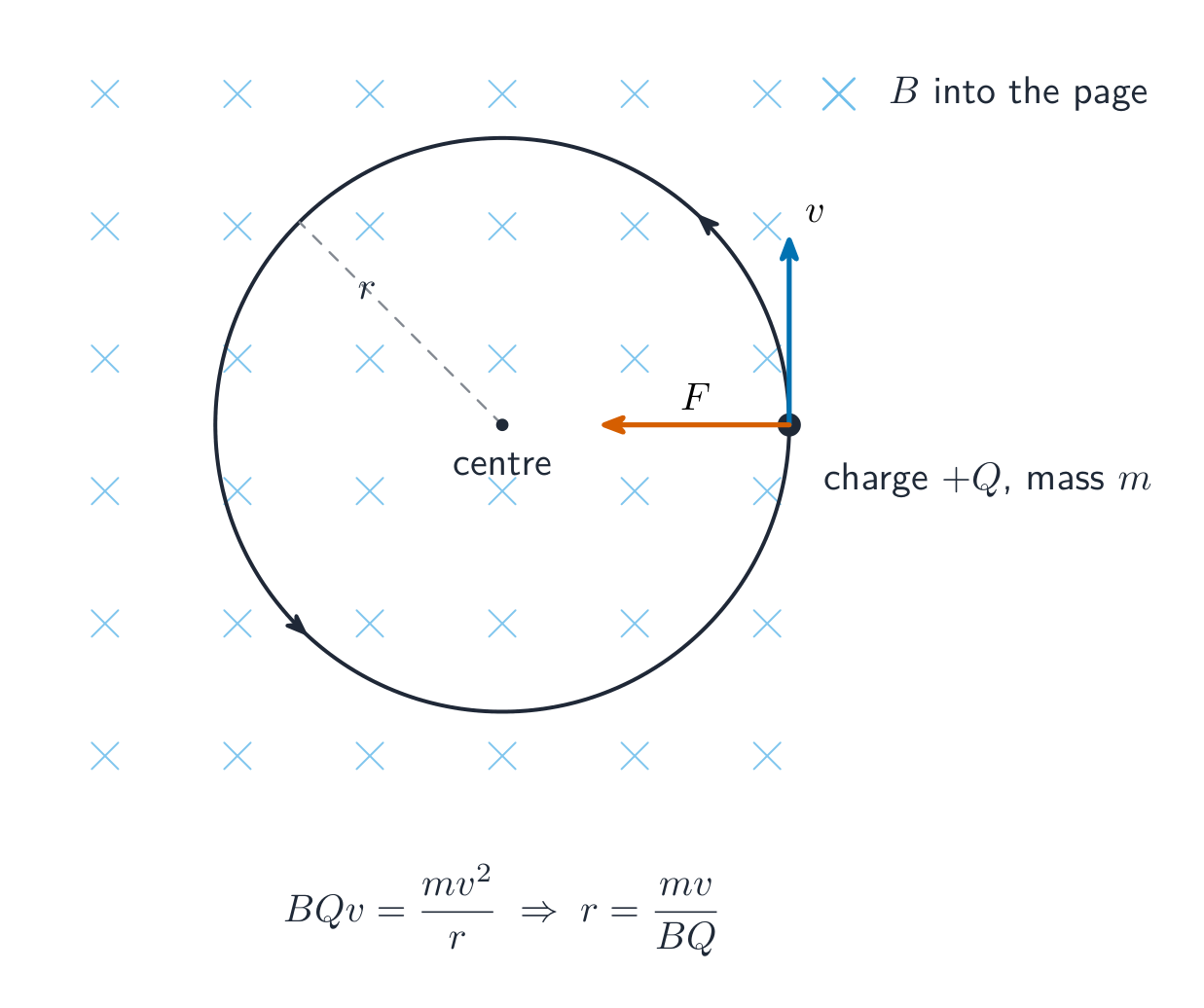
where $\theta$ is the angle between the velocity and the field. The force is perpendicular to both $\vec{v}$ and $\vec{B}$ (use the right-hand rule), so it changes direction but not speed – a charge moving perpendicular to a uniform field travels in a circle. A stationary charge, or one moving parallel to the field, feels no magnetic force.
Worked example. A proton ($q=1.6\times10^{-19}\ \text{C}$, $m=1.67\times10^{-27}\ \text{kg}$) enters a $0.50\ \text{T}$ field at $2.0\times10^{5}\ \text{m/s}$, at right angles to the field. The magnetic force is
$$F=qvB=1.6\times10^{-19}\times2.0\times10^{5}\times0.50=1.6\times10^{-14}\ \text{N}.$$
This force is the centripetal force, so it bends the proton into a circle of radius
$$r=\frac{mv}{qB}=\frac{1.67\times10^{-27}\times2.0\times10^{5}}{1.6\times10^{-19}\times0.50}=4.2\times10^{-3}\ \text{m}.$$
Setting $qvB=\dfrac{mv^2}{r}$ and cancelling gives that neat $r=mv/(qB)$ – the principle behind mass spectrometers.
한국어
자하 자기장 내에서 이동할 때 자기력을 받습니다:
$$F=qvB\sin\theta,$$
여기서 $\theta$는 속도와 장 사이의 각도입니다. 힘은 $\vec{v}$과 $\vec{B}$(오른손 법칙 사용) 모두에 수직이므로 방향만 변경하고 속도는 변화하지 않습니다 – 균일한 자기장에 수직으로 이동하는 하전 입자는 원을 그립니다. 정지해 있거나 자기장 방향으로 이동하는 하전 입자는 자기력을 받지 않습니다.
해설 예제. 양성자($q=1.6\times10^{-19}\ \text{C}$, $m=1.67\times10^{-27}\ \text{kg}$)가 $0.50\ \text{T}$ 자기장 내에 $2.0\times10^{5}\ \text{m/s}$ 속도로 장과 수직으로 진입합니다. 여기에 작용하는 자기력은
$$F=qvB=1.6\times10^{-19}\times2.0\times10^{5}\times0.50=1.6\times10^{-14}\ \text{N}.$$
이 힘은 approcentripetal force(원심력)이므로 양성자를 반지름의 원으로 휘게 만듭니다:
$$r=\frac{mv}{qB}=\frac{1.67\times10^{-27}\times2.0\times10^{5}}{1.6\times10^{-19}\times0.50}=4.2\times10^{-3}\ \text{m}.$$
$qvB=\dfrac{mv^2}{r}$를 대입하고 소거하면 깔끔한 $r=mv/(qB)$ 식이 도출됩니다 – 질량 분광기의 원리입니다.
Vocabulary · 어휘
Train · 연습하기
| English | 한국어 |
|---|---|
| magnetic force/mæɡˈnetɪk fɔːs/ | 자기력 |
12.3
Magnetism and Current-Carrying Wires · 자석과 전류가 흐르는 선
Syllabus
English
Learning Objective 12.3.A: Describe the magnetic field produced by a current-carrying wire.
- 12.3.A.1 A current-carrying wire produces a magnetic field.
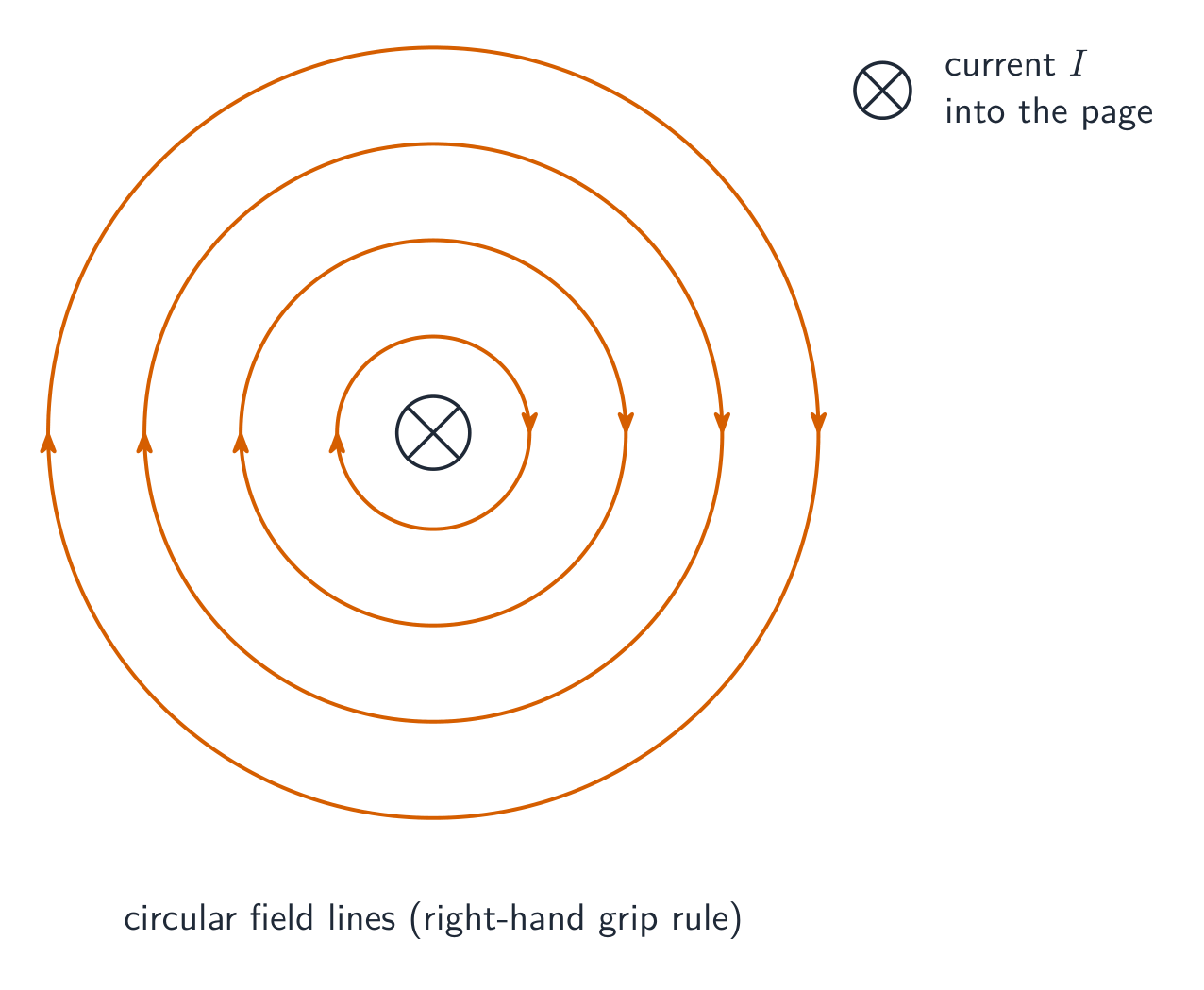
- 12.3.A.1.i The magnetic field vectors around a long, straight, current-carrying wire are tangent to concentric circles centered on that wire. The field has no component toward, away from, or parallel to the long, straight, current-carrying wire.
- 12.3.A.1.ii At a point in space, the magnitude of the magnetic field due to a long, straight, current-carrying wire is proportional to the magnitude of the current in the wire and inversely proportional to the perpendicular distance from the central axis of the wire to the point.
- Equation: $B = \dfrac{\mu_0}{2\pi}\dfrac{I}{r}$
- 12.3.A.1.iii The direction of the magnetic field created by a current-carrying wire is determined with the right-hand rule.
- 12.3.A.1.iv The direction of the magnetic field at the center of a current-carrying loop is directed along the axis of the loop and can be found using the right-hand rule.
- 12.3.A.1.v The magnetic field at a location near two or more current-carrying wires can be determined using vector addition principles.
Learning Objective 12.3.B: Describe the force exerted on a current-carrying wire by a magnetic field.
- 12.3.B.1 A magnetic field may exert a force on a current-carrying wire.
- 12.3.B.1.i The magnitude of the force exerted by a magnetic field on a current-carrying wire is proportional to the current, the length of the portion of the wire within the magnetic field, and the magnitude of the magnetic field, and also depends on the angle between the direction of the current in the wire and the direction of the magnetic field.
- Equation: $F_B = I\ell B\sin\theta$
- 12.3.B.1.ii The direction of the force exerted by the magnetic field on a current-carrying wire is determined by the right-hand rule.
- 12.3.B.1.i The magnitude of the force exerted by a magnetic field on a current-carrying wire is proportional to the current, the length of the portion of the wire within the magnetic field, and the magnitude of the magnetic field, and also depends on the angle between the direction of the current in the wire and the direction of the magnetic field.
한국어
학습 목표 12.3.A: 전류가 흐르는 선이 생성하는 자기장을 설명하시오.
- 12.3.A.1 전류가 흐르는 선은 자기장을 생성한다.
- 12.3.A.1.i 길고 직선적인 전류 도선 주변의 자기장 벡터들은 해당 도선을 중심으로 하는 동심 원에 접한다. 이 장은 길고 직선적인 전류 도선을 향하거나, 그 반대로 향하거나, 또는 평행한 성분을 가지지 않는다.
- 12.3.A.1.ii 공간상 한 점에서의 길고 직선적인 전류 도선에 의한 자기장의 크기는 도선 내 전류의 크기에 비례하고, 도선의 중심 축으로부터 해당 지점까지의 수직 거리에 반비례한다.
- 식: $B = \dfrac{\mu_0}{2\pi}\dfrac{I}{r}$
- 12.3.A.1.iii 전류 도선이 생성하는 자기장의 방향은 오른손 법칙으로 결정된다.
- 12.3.A.1.iv 전류 루프의 중심에서의 자기장 방향은 루프의 축을 따라 향하며, 오른손 법칙을 사용하여 찾을 수 있다.
- 12.3.A.1.v 두 개 이상의 전류 도선 근처의 지점에서의 자기장은 벡터 합성의 원리를 사용하여 결정할 수 있다.
학습 목표 12.3.B: 자기장이 전류가 흐르는 선에 가하는 힘에 대해 설명하시오.
- 12.3.B.1 자기장은 전류가 흐르는 선에 힘을 가할 수 있다.
- 12.3.B.1.i 자기장에 의한 전류 도선에 가해지는 힘의 크기는 전류, 자기장 내에 있는 도선의 길이, 그리고 자기장 크기에 비례하며, 또한 도선 내 전류 방향과 자기장 방향 사이의 각도에도 의존한다.
- 식: $F_B = I\ell B\sin\theta$
- 12.3.B.1.ii 자기장에 의한 전류 도선에 가해지는 힘의 방향은 오른손 법칙으로 결정된다.
- 12.3.B.1.i 자기장에 의한 전류 도선에 가해지는 힘의 크기는 전류, 자기장 내에 있는 도선의 길이, 그리고 자기장 크기에 비례하며, 또한 도선 내 전류 방향과 자기장 방향 사이의 각도에도 의존한다.
Source: College Board AP Course and Exam Description · 출처: College Board AP Course and Exam Description
English
Because a current is moving charge, a magnetic field pushes on a current-carrying wire:
$$F=BIL\sin\theta.$$
A current also creates its own magnetic field: circular field lines wrap around a straight wire (right-hand rule), and a coil (solenoid) makes a field like a bar magnet. This is how electromagnets and motors work.
Worked example. A $0.30\ \text{m}$ length of wire carries $4.0\ \text{A}$ at right angles to a $0.20\ \text{T}$ field. The force on it is $F=BIL=0.20\times4.0\times0.30=0.24\ \text{N}$ – the push that turns a motor's coil.
한국어
전류는 이동하는 전하이므로 자기장이 전류가 흐르는 선에 힘을 가합니다:
$$F=BIL\sin\theta.$$
전류 또한 자체적인 자기장을 생성합니다: 직선 선 주위를 동심원形的인 자기장선이 감싸며(오른손 법칙), 코일(솔레노이드)은 막대자석과 유사한 자기장을 만듭니다. 이것이 전자기석과 모터의 작동 원리입니다.
해설 예제. 길이가 $0.30\ \text{m}$인 선에 전류 $4.0\ \text{A}$가 흐르며, 이는 $0.20\ \text{T}$ 자기장과 수직입니다. 이 선에 작용하는 힘은 $F=BIL=0.20\times4.0\times0.30=0.24\ \text{N}$ – 모터 코일을 회전시키는 힘입니다.
Explore · 탐색하기
Find the force on a current in a field · 장 안에서의 전류에 작용하는 힘 찾기
A current in a magnetic field feels a force $F = BIL$, at right angles to both. Use the left-hand rule; reverse the current or field and the force flips. · 자기장 within 있는 전류는 두 방향 모두에 수직인 힘 $F = BIL$을 받습니다. 왼손 법칙을 사용하십시오; 전류나 장의 방향을 반대로 하면 힘의 방향도 바뀝니다.
12.4
Electromagnetic Induction and Faraday's Law · 전자기 유도 및 패러데이의 법칙
Syllabus
| Learning Objective | Essential Knowledge |
|---|---|
12.4.A |
|
Source: College Board AP Course and Exam Description · 출처: College Board AP Course and Exam Description
English
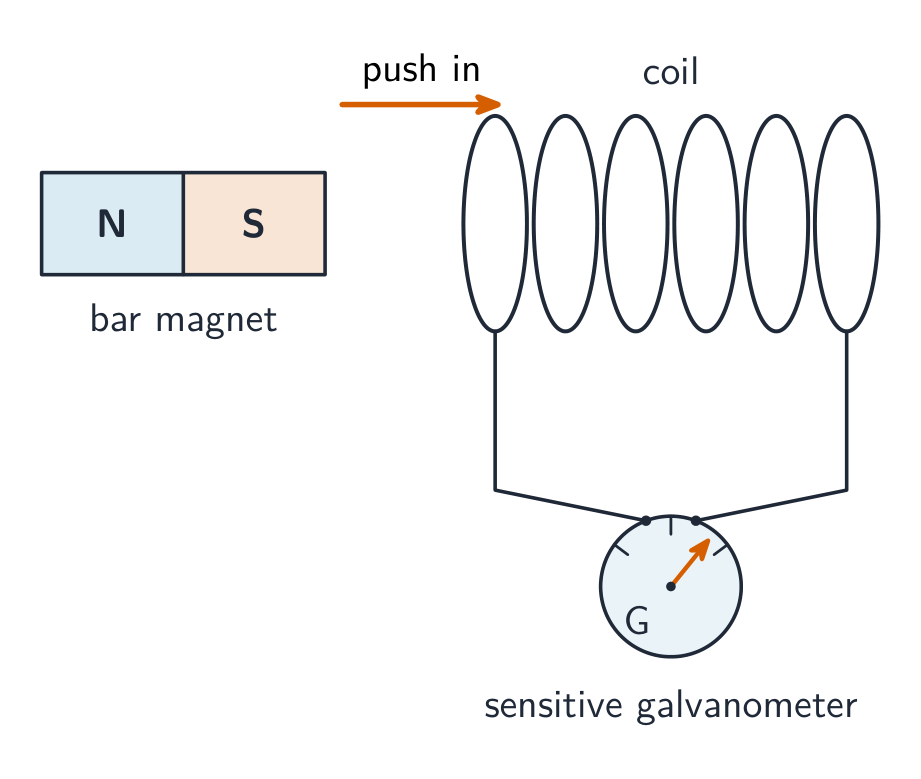
A changing magnetic field through a loop drives a current – electromagnetic induction 电磁感应. The magnetic flux 磁通量 $\Phi=BA\cos\theta$ measures how much field passes through the loop. Faraday's law 法拉第定律 gives the induced emf:
$$\varepsilon=-\frac{\Delta\Phi}{\Delta t}.$$
The flux changes if the field, the area, or the loop's orientation changes. Lenz's law 楞次定律 (the minus sign) says the induced current flows so as to oppose the change that caused it – the basis of generators.
Worked example. The magnetic flux through a single loop drops from $0.020\ \text{Wb}$ to $0.008\ \text{Wb}$ in $0.030\ \text{s}$. The average induced emf is
$$\varepsilon=\left|\frac{\Delta\Phi}{\Delta t}\right|=\frac{0.020-0.008}{0.030}=0.40\ \text{V}.$$
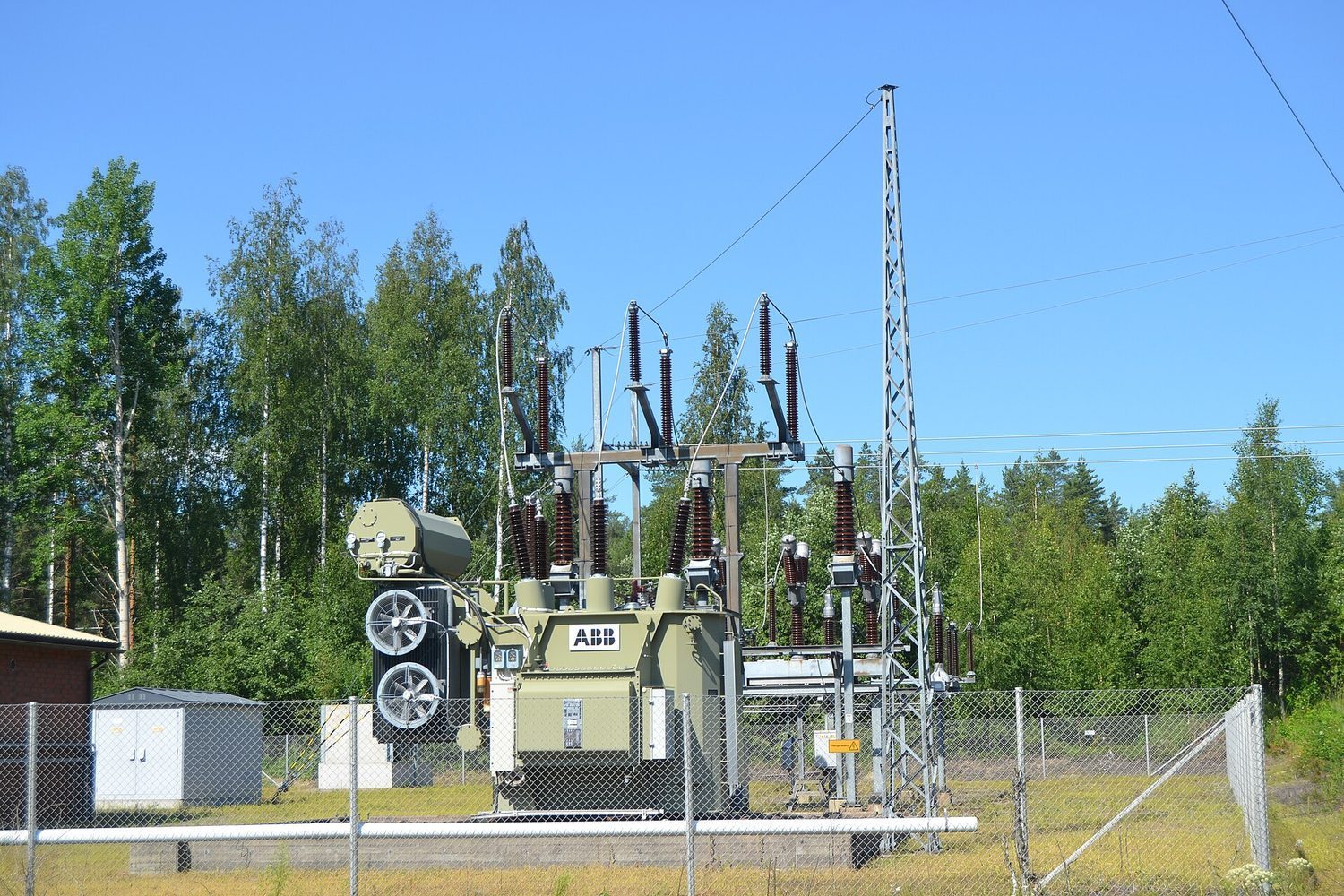
A coil of $N$ turns would give $N$ times this – which is why generators and transformers use many-turn coils.
한국어
루프를 통과하는 변화하는 자기장은 전류를 유도합니다 – 전자기 유도. 자기 플럭스 $\Phi=BA\cos\theta$는 루프를 통과하는 장의 양을 측정합니다. 패러데이의 법칙은 유도된 기전력(emf)을 다음과 같이 줍니다:
$$\varepsilon=-\frac{\Delta\Phi}{\Delta t}.$$
장, 면적, 또는 루프의 방향이 변하면 플럭스가 변화합니다. 렌츠의 법칙(마이너스 부호)은 유도 전류가 이를 유발한 변화를 저항하도록 흐른다고 합니다 – 발전기의 기초입니다.
해설 예제. 단일 루프를 통과하는 자기 플럭스가 $0.020\ \text{Wb}$에서 $0.008\ \text{Wb}$로 $0.030\ \text{s}$ 동안 감소했습니다. 평균 유도 기전력은
$$\varepsilon=\left|\frac{\Delta\Phi}{\Delta t}\right|=\frac{0.020-0.008}{0.030}=0.40\ \text{V}.$$
$N$회 코일은 이 값의 $N$배가 됩니다 – 이것이 발전기와 변압기에 다중 회 코일을 사용하는 이유입니다.
Explore · 탐색하기
Induce a voltage by moving a magnet · 자석을 움직여 전압 유도하기
Faraday's law: a changing magnetic flux through a coil induces a voltage. Move the magnet faster and the induced EMF grows; Lenz's law sets its direction to oppose the change. · 패러데이의 법칙: 코일을 통과하는 자기 흐름의 변화는 전압을 유도합니다. 자석을 빠르게 움직이면 유도 EMF가 커집니다. 렌츠의 법칙은 이 변화를 opposing 하는 방향으로 유도 전압의 방향을 정합니다.
Vocabulary · 어휘
Train · 연습하기
| English | 한국어 |
|---|---|
| electromagnetic induction/ɪˌlektrəʊməɡˈnetɪk ɪnˈdʌkʃn/ | 전자기 유도 |
| magnetic flux/mæɡˈnetɪk flʌks/ | 자기 플럭스 |
| Faraday's law/ˈfærədeɪz lɔː/ | 패러데이의 법칙 |
| Lenz's law/ˈlentsɪz lɔː/ | 렌츠의 법칙 |
12.4
Exam tips · 시험 팁
English
- The magnetic force $F=qvB\sin\theta$ is perpendicular to the velocity, so it changes direction (a circle) but not speed; a stationary charge or one moving along the field feels no force.
- Use $F=BIL$ for the force on a current-carrying wire (the motor effect).
- A current creates a magnetic field (circles around a wire; a solenoid acts like a bar magnet).
- Induction needs a changing flux $\Phi=BA$ — a stationary magnet in a coil induces nothing.
- Faraday: $\varepsilon=\Delta\Phi/\Delta t$ (times $N$ turns); Lenz: the induced current opposes the change (energy conservation).
한국어
- 자기력 $F=qvB\sin\theta$은 속도에 수직이므로 방향(원)만 바꾸고 속도는 일정하며, 정지하거나 장 와 평행하게 이동하는 전하에는 힘이 없습니다.
- 전류가 흐르는 선에作用于하는 힘에 $F=BIL$를 사용합니다 (모터 효과).
- 전류는 자기장을 생성합니다 (선 주변 원형; 솔레노이드는 막대자석처럼 작용함).
- 유도에는 변화하는 플럭스 $\Phi=BA$가 필요합니다 – 코일 내 정지한 자석은何も 유도하지 않습니다.
- 패러데이: $\varepsilon=\Delta\Phi/\Delta t$ (× $N$ 권회 수); 렌츠: 유도 전류는 변화를 반대한다(에너지 보존).
Interactive lessons on this topic · 이 주제에 대한 인터랙티브 수업
Work through it step by step, with instant-check exercises. · 즉시 체크 기능 exercises를 통해 단계별로 진행하세요.