Skip to content · ⁨본문 바로가기⁩

Basic Economic Concepts · ⁨기본 경제 개념⁩

AP Microeconomics · ⁨AP 경제학 (미시)⁩ · Topic 1 · ⁨주제 1⁩

Video lesson for this topic · ⁨이 주제용 영상 수업⁩ Open the video page · ⁨영상 페이지 열기⁩
8:34

기본 경제 개념

하루는 오직 24시간밖에 없다. 그 안에 넣으려는 것을 생각해보라: 수면, 수업, 숙제, 스포츠, 친구들과의 시간.誠実하게 합산하면 …

English narration · English + 中文 subtitles burned in · ⁨영어 내레이션 · 영어 + 중국어 자막 burned-in⁩

1.1

Scarcity · ⁨희소성⁩

Syllabus
English

Enduring Understanding (MKT-1): Most resources are scarce, and in most cases the use of resources involves constraints and trade-offs.

Learning Objective MKT-1.A: Define resources and the cause(s) of their scarcity.

  • MKT-1.A.1 Economic trade-offs arise from the lack of sufficient resources (scarcity) to meet society's wants and needs.
  • MKT-1.A.2 Most factors of production (such as land, labor, and capital) are scarce, but some factors of production (such as established knowledge) may not be scarce due to their non-rival nature.
한국어

지속적 이해 (MKT-1): 대부분의 자원은 희소하며, 대개 자원의 사용에는 제약과交換(trade-offs)이 수반된다.

학습 목표 MKT-1.A: 자원과 그 희소성의 원인을 정의하시오.

  • MKT-1.A.1 경제적交换(trade-offs)은 사회의 욕구와 필요를 충족시키기 위한 충분한 자원이 부족함(희소성)에서 비롯된다.
  • MKT-1.A.2 토지, 노동, 자본과 같은 대부분의 생산 요인은 희소하지만, 비경쟁적(non-rival) 특성 때문에 일부 생산 요인(예: 확립된 지식)은 희소가 아닐 수 있다.
Source: College Board AP Course and Exam Description · ⁨출처: College Board AP Course and Exam Description⁩

English

Economics 经济学 begins with one stubborn fact: people's wants are effectively unlimited, but the resources 资源 to satisfy them are limited. This gap is scarcity 稀缺性, and it is why economics exists – if everything were free and endless, there would be nothing to decide.

The resources (the factors of production 生产要素) are land (natural resources), labor 劳动 (human effort), capital 资本 (tools, machines, buildings), and entrepreneurship 企业家才能 (organizing the other three and taking risks). Because these are scarce, every economy must answer three questions: what to produce, how to produce it, and for whom to produce.

Scarcity forces choice, and every choice has an opportunity cost 机会成本 – the value of the next-best alternative you give up. This single idea runs through the whole course: the true cost of anything is what you sacrifice to get it, not just the money you pay.

한국어
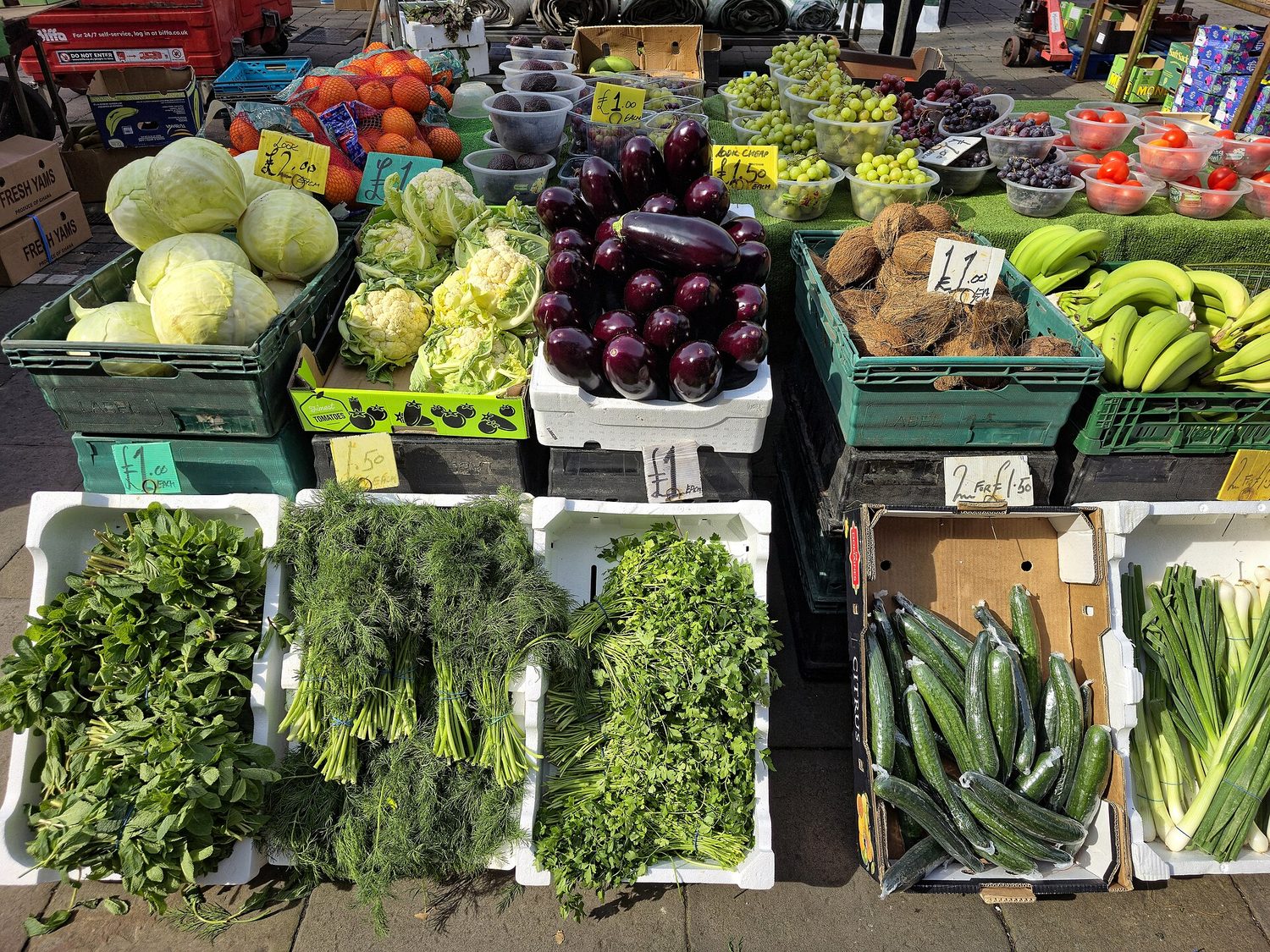
야외 시장: 시장은 경쟁하는 용도 사이에서 희귀 자원을 배분합니다

경제학은 하나의 견고한 사실에서 시작됩니다: 사람들의 욕구는 사실상 무제한이지만, 그것을 충족시키는 자원은 제한되어 있다는 것입니다. 이 격차는 희귀성이며, 이것이 경제학이 존재하는 이유입니다 – 모든 것이 무료로 무제한이라면 결정할 것 자체가 없었을 것입니다.

자원(생산 요소)은 토지(자연 자원), 노동(인간 노력), 자본(도구, 기계, 건물), 그리고 기업가정신(나머지 세 가지를 조직하고 위험을 감당함)입니다. 이들이 희귀하므로 모든 경제체는 세 가지 질문에 답해야 합니다: 무엇을, 어떻게, 누구를 위해 생산할 것인가.

희소성으로 인해 선택이 강제되며, 모든 선택에는 기회비용이 수반됩니다. 기회비용은 포기하게 되는 차선책의 가치입니다. 이 하나의 개념이 전체 과정을 관통합니다: 어떤 것의 진정한 비용은 그것을 얻기 위해 sacrifices하는 것이지, 단순히 지불한 돈이 아닙니다.

Vocabulary · ⁨어휘⁩ Train · ⁨연습하기⁩
English 한국어
Economics/ˌiːkəˈnɒmɪks/ 경제학
resources/rɪˈzɔːsɪz/ 자원
scarcity/ˈskeəsɪti/ 희소성
factors of production/ˈfæktəz ɒv prəˈdʌkʃn/ 생산 요인
labor/ˈleɪbə/ 노동
capital/ˈkæpɪtl/ 자본
entrepreneurship/ˌɒntrɪprəˈnjʊəʃɪp/ Entrepreneurship
opportunity cost/ɒpəˈtjuːnɪti kɒst/ 기회비용
1.2

Resource Allocation and Economic Systems · ⁨자원 배분과 경제 체계⁩

Syllabus
English

Enduring Understanding (MKT-1): Most resources are scarce, and in most cases the use of resources involves constraints and trade-offs.

Learning Objective MKT-1.B: Define how resource allocation is influenced by the economic system adopted by society.

  • MKT-1.B.1 Resource allocation involves answering three basic questions: What goods and services to produce? How to produce those goods and services? And who consumes those goods and services?
  • MKT-1.B.2 Resource allocation is significantly influenced by the economic system adopted by society, such as command economy, market economy, or mixed economy. Each system involves a particular set of institutional arrangements and a coordinating mechanism for allocating scarce resources and distributing output.
한국어

지속적 이해 (MKT-1): 대부분의 자원은 희소하며, 대개 자원의 사용에는 제약과交換(trade-offs)이 수반된다.

학습 목표 MKT-1.B: 사회가 채택한 경제 체제가 자원 배분에 미치는 영향을 정의하시오.

  • MKT-1.B.1 자원 배분은 다음 세 가지 기본 질문에 답하는 것을 포함한다: 어떤 재화와 서비스를 생산할 것인가? 그 재화와 서비스를 어떻게 생산할 것인가? 그리고 누가那些 재화와 서비스를 소비할 것인가?
  • MKT-1.B.2 자원 배분은 사회가 채택한 경제 체제, 즉 계획경제, 시장경제, 혹은 혼합경제에 따라 크게 달라진다. 각 체제는 희소한 자원을 배분하고 산출물을 분배하기 위해 특정의 제도적 배치와 조율 메커니즘을 포함한다.

Source: College Board AP Course and Exam Description · ⁨출처: College Board AP Course and Exam Description⁩

English

An economic system 经济体制 is a society's way of answering the three questions.

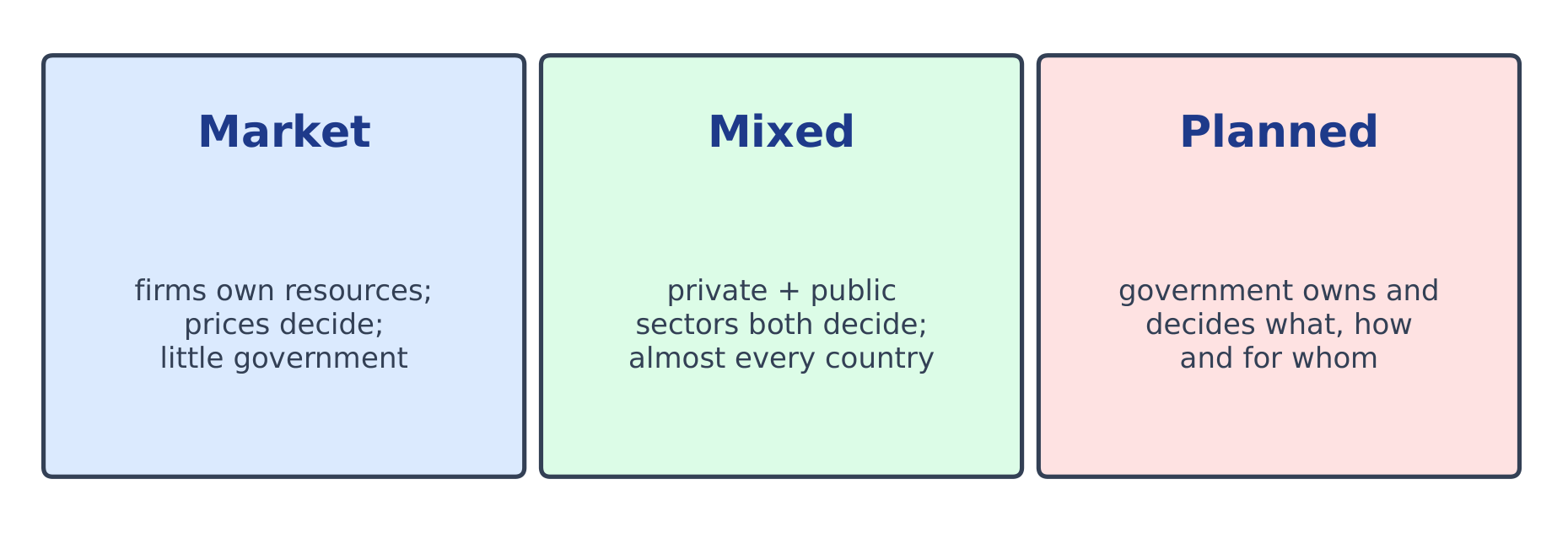
  • In a market economy 市场经济, private buyers and sellers decide through prices; self-interest and competition coordinate them (the "invisible hand").
  • In a command economy 计划经济, the government owns resources and plans production.
  • Real economies are mixed 混合经济 – mostly markets, with government providing some goods and correcting problems.

The key advantage of markets is that prices carry information and incentives 激励 automatically, with no central planner needed.

한국어

경제 체계란 사회가 세 가지 질문(무엇을, 어떻게, 누구를 위해 생산할 것인가)에 답하는 방식입니다.

경제 체제는 자유 시장부터 완전한 정부 계획까지 스펙트럼을 형성함
경제 체제는 자유 시장부터 완전한 정부 계획까지 스펙트럼을 형성합니다
  • 시장 경제에서는 사적 구매자와 판매자가 가격을 통해 결정하며, 이기심과 경쟁이 이를 조율합니다 ("보이지 않는 손").
  • 계획 경제에서는 정부가 자원을 소유하고 생산을 계획합니다.
  • 실제 경제는 혼합형입니다. 대부분 시장이지만, 정부가 일부 재화를 제공하고 문제를 수정합니다.

시장의 핵심적인 장점은 가격이 정보를 내재하고 있으며 유인을 자동으로 제공하여 중앙 계획자가 필요 없다는 점입니다.

Explore · ⁨탐색하기⁩

Explore how prices coordinate a market · ⁨가격이 시장을 조정하는 방식 탐구하기⁩

In a market economy no one is in charge, yet the price finds the level where quantity supplied meets quantity demanded. Drag the demand and supply lines and watch the equilibrium price act as a signal and an incentive. · ⁨시장경제에서는 주체자가 없으나, 가격은 공급량과 수요량이 일치하는 수준을 찾습니다. 수요 및 공급 곡선을 드래그하여 균형 가격이 신호이자 유인으로서 작용하는 것을 확인하십시오.⁩

Vocabulary · ⁨어휘⁩ Train · ⁨연습하기⁩
English 한국어
economic system/ˌiːkəˈnɒmɪk ˈsɪstəm/ 경제 체제
market economy/ˈmɑːkɪt ɪˈkɒnəmi/ 시장 경제
command economy/kəˈmænd ɪˈkɒnəmi/ 지명 경제
mixed/mɪkst/ 혼합됨
incentives/ɪnˈsentɪvz/ 인센티브
production possibilities curve (PPC)/prəˈdʌkʃn ˌpɒsəˈbɪlɪtiz kɜːv/ 생산 가능성 곡선 (PPC)
efficient/ɪˈfɪʃənt/ 효율적
unattainable/ʌnəˈteɪnəbl/ 달성 불가능하다
Economic growth/ˌiːkəˈnɒmɪk ɡrəʊθ/ 경제 성장
specializing/ˈspeʃəlaɪzɪŋ/ 전문화
absolute advantage/ˈæbsəluːt ədˈvæntɪdʒ/ 절대 우위
1.3

The Production Possibilities Curve · ⁨생산 가능성 곡선⁩

Syllabus
English

Enduring Understanding (MKT-1): Most resources are scarce, and in most cases the use of resources involves constraints and trade-offs.

Learning Objective MKT-1.C: a. Define (using graphs as appropriate) the production possibilities curve (PPC) and related terms. b. Explain (using graphs as appropriate) how the production possibilities curve (PPC) illustrates opportunity costs, trade-offs, inefficiency, efficiency, and economic growth or contraction under various conditions. c. Calculate (using data from PPCs or tables as appropriate) opportunity cost.

  • MKT-1.C.1 The PPC is a model used to show the trade-offs associated with allocating resources.
  • MKT-1.C.2 The PPC can be used to illustrate the concepts of scarcity, opportunity cost, efficiency, underutilized resources, and economic growth or contraction.
  • MKT-1.C.3 The shape of the PPC depends on whether opportunity costs are constant, increasing, or decreasing.
  • MKT-1.C.4 The PPC can shift due to changes in factors of production as well as changes in productivity/technology.
  • MKT-1.C.5 Economic growth results in an outward shift of the PPC.
한국어

지속적 이해 (MKT-1): 대부분의 자원은 희소하며, 대개 자원의 사용에는 제약과交換(trade-offs)이 수반된다.

학습목표 MKT-1.C: a. (적절한 경우 그래프를 사용하여) 생산가능곡선(PPC)과 관련 용어를 정의하시오. b. (적절한 경우 그래프를 사용하여) 생산가능곡선(PPC)이 어떤 조건 하에서 기회비용, 타협, 비효율성, 효율성, 그리고 경제 성장 또는 침체를 어떻게 나타내는지 설명하시오. c.的机会 비용을 계산하십시오(적절한 경우 PPC 또는 표의 데이터 사용).

  • MKT-1.C.1 PPC는 자원을 배분하는 데 수반되는 타협을 보여주는 모델이다.
  • MKT-1.C.2 PPC는 희소성, 기회비용, 효율성, 비활용된 자원, 그리고 경제 성장 또는 침체의 개념을 설명하는 데 사용될 수 있다.
  • MKT-1.C.3 PPC의 형태는 기회비용이 일정하게 유지되는지, 증가하는지, 감소하는지에 따라 달라진다.
  • MKT-1.C.4 생산요소의 변화 및 생산성/기술의 변화에 따라 PPC가 이동할 수 있다.
  • MKT-1.C.5 경제 성장은 PPC의 외부로 이동으로 나타난다.

Source: College Board AP Course and Exam Description · ⁨출처: College Board AP Course and Exam Description⁩

English
The production possibility frontier

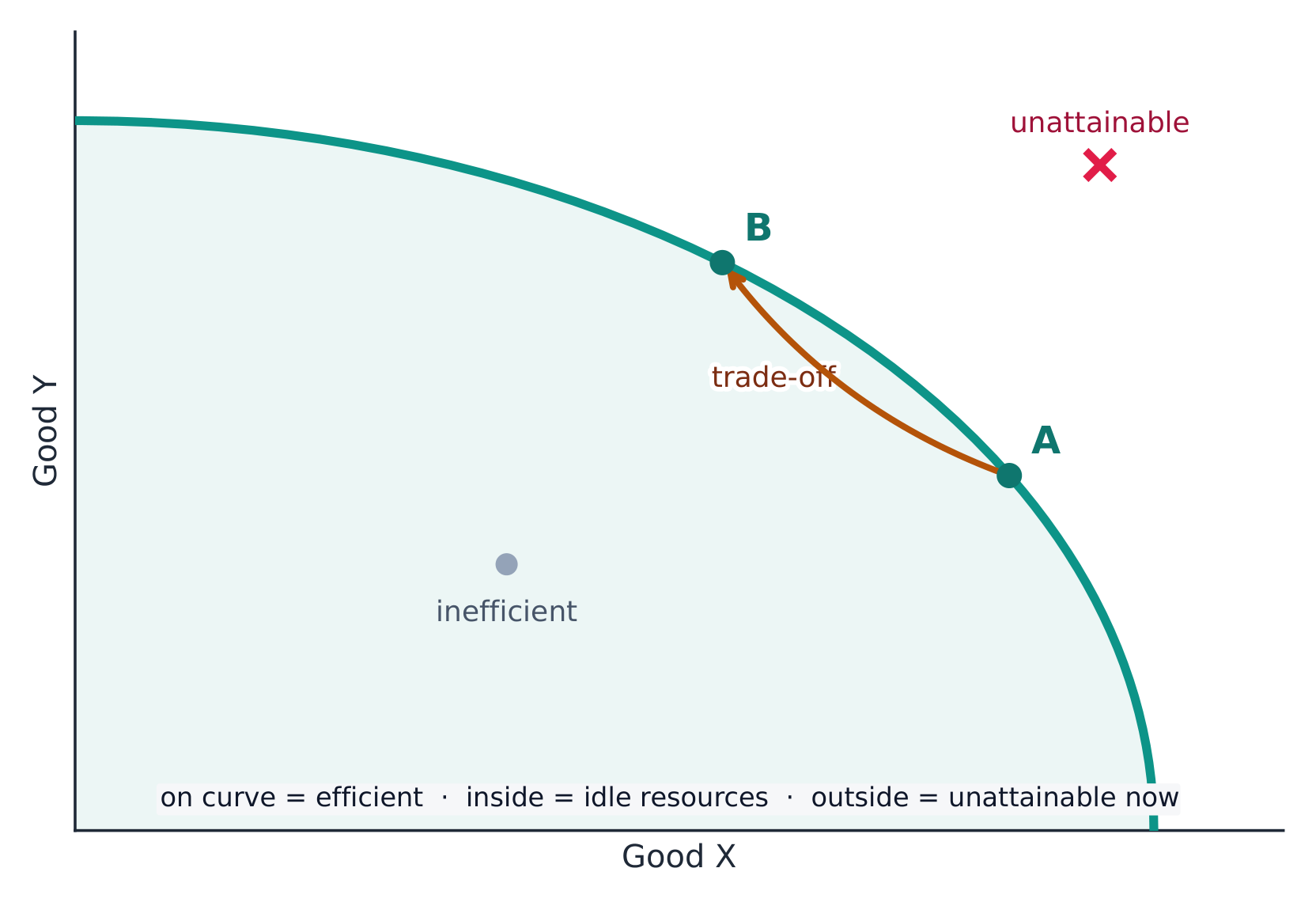
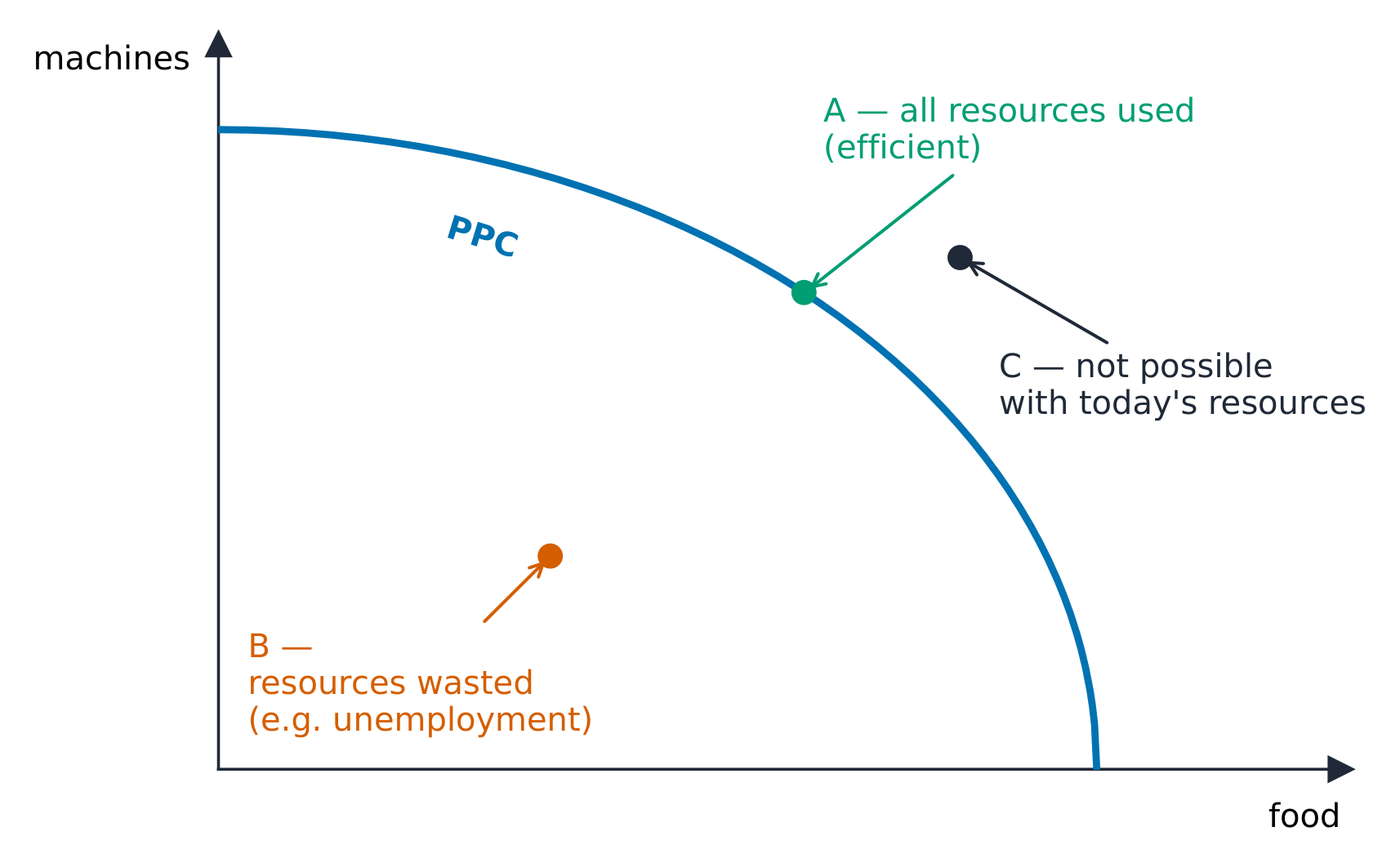
The production possibilities curve (PPC) 生产可能性曲线 shows the maximum combinations of two goods an economy can produce with its resources and technology fully and efficiently used.

  • Points on the curve are efficient 有效率; points inside are inefficient (wasted or unemployed resources); points outside are currently unattainable 无法实现.
  • The PPC's downward slope shows opportunity cost: making more of one good means making less of the other. The slope at a point is the opportunity cost of the good on the horizontal axis.
  • A bowed-out (concave) PPC shows increasing opportunity cost – resources are not equally suited to both goods, so making more of one costs ever more of the other. A straight-line PPC means constant opportunity cost.
  • Economic growth 经济增长 (more resources, better technology) shifts the whole curve outward.

Exam skill: be ready to read opportunity cost off a PPC, decide if a point is efficient/inefficient/unattainable, and explain what shifts the curve.

한국어
생산가능 Frontier

생산 가능성 곡선(PPC) 은 경제가 자원과 기술을 완전히 및 효율적으로 활용할 때 두 재화의 최대 조합을 보여줍니다.

생산 가능성 곡선 위의 점, 내부의 점, 외부의 점
  • 곡선 위의 점은 효율적이고, 곡선 안쪽의 점은 비효율적입니다(자원이 낭비되었거나 실업 상태임); 곡선 바깥의 점은 현재로써 달성 불가능합니다.
  • PPC의 하향 경사는 기회비용을 나타냅니다: 한 재화의 생산량을 늘리면 다른 재화의 생산량은 줄어듭니다. 특정 지점에서의 기울기는 수평축에 있는 재화의 기회비용입니다.
  • 바깥쪽으로 볼록한(오목한) PPC는 증가하는 기회비용을 의미합니다. 자원은 두 재화 모두에 동등하게 적합하지 않으므로, 한 재화의 생산량이 늘어날수록 다른 재화의 생산량 감소분이 커집니다. 직선형 PPC는 일정한 기회비용을 의미합니다.
  • 경제 성장(자원 증가, 기술 발전)은 곡선 전체를 바깥쪽으로 이동시킵니다.

고사 기법: PPC에서 기회비용을 읽거나, 점이 효율적/비효율적/달성 불가능한지를 판단하거나, 곡선을 이동시키는 요인을 설명할 수 있어야 합니다.

생산 가능성 곡선: 효율적, 비효율적, 달성 불가능한 점
Explore · ⁨탐색하기⁩

Explore the production possibilities curve · ⁨생산 가능 곡선을 탐색해 보십시오⁩

Making more of one good means giving up some of the other — that trade-off is the opportunity cost, and the bowed shape shows the law of increasing opportunity cost. Drag along the curve, then grow the economy to push the whole frontier out. · ⁨한 재화의 생산을 늘리면 다른 재화의 일부를 포기해야 합니다. 이 타협은 기회비용이며, 오목한 형태는 기회비용 증가의 법칙을 보여줍니다. 곡선을 드래그하고 경제를 성장시켜 전체 frontier(전개선)를 외측으로 밀어내십시오.⁩

1.4

Comparative Advantage and Gains from Trade · ⁨비교 우위 및 무역의 이점⁩

Syllabus
English

Enduring Understanding (MKT-2): The consequences of scarcity can be mitigated through specialization in production and by exchange.

Learning Objective MKT-2.A: a. Define absolute advantage and comparative advantage. b. Determine (using data from PPCs or tables as appropriate) absolute and comparative advantage.

  • MKT-2.A.1 Absolute advantage describes a situation in which an individual, business, or country can produce more of a good or service than any other producer with the same quantity of resources.
  • MKT-2.A.2 Comparative advantage describes a situation in which an individual, business, or country can produce a good or service at a lower opportunity cost than another producer.

Learning Objective MKT-2.B: a. Explain (using data from PPCs or tables as appropriate) how specialization according to comparative advantage with appropriate terms of trade can lead to gains from trade. b. Calculate (using data from PPCs or tables as appropriate) mutually beneficial terms of trade.

  • MKT-2.B.1 Production specialization according to comparative advantage, not absolute advantage, results in exchange opportunities that lead to consumption possibilities beyond the PPC.
  • MKT-2.B.2 Comparative advantage and opportunity costs determine the terms of trade for exchange under which mutually beneficial trade can occur.
한국어

지속적 이해 (MKT-2): 희소성의 결과들은 생산에서의 전문화와 교환을 통해 완화될 수 있다.

학습 목표 MKT-2.A: a. 절대 우위와 비교 우위를 정의하십시오. b. 절대 우위와 비교 우위를 결정하십시오(적절한 경우 PPC 또는 표의 데이터 사용).

  • MKT-2.A.1 절대 우위는 개인, 기업, 혹은 국가가 동일한 양의 자원으로 다른 모든 생산자보다 더 많은 재화나 서비스를 생산할 수 있는 상황을 말한다.
  • MKT-2.A.2 비교 우위는 개인, 기업, 혹은 국가가 다른 생산자보다 낮은 기회비용으로 재화나 서비스를 생산할 수 있는 상황을 말한다.

학습목표 MKT-2.B: a. 비교 우위에 따른 전문화와 적절한 거래 조건이 거래 이득으로 이어지는 방법을 설명하십시오(적절한 경우 PPC 또는 표의 데이터 사용). b. 상호 유익한 거래 조건을 계산하십시오(적절한 경우 PPC 또는 표의 데이터 사용).

  • MKT-2.B.1 절대 우위가 아닌 비교 우위에 따른 생산 전문화는 생산가능곡선(PPC)을 넘어선 소비 가능성을 제공하는 교환 기회를 창출한다.
  • MKT-2.B.2 비교 우위와 기회비용은 서로에게 유익한 무역이 이루어질 수 있는 교환의 조건을 결정한다.

Source: College Board AP Course and Exam Description · ⁨출처: College Board AP Course and Exam Description⁩

English

Two producers can both gain from trade by specializing 专业化.

  • A producer has an absolute advantage 绝对优势 in a good if it can make more of it with the same resources.
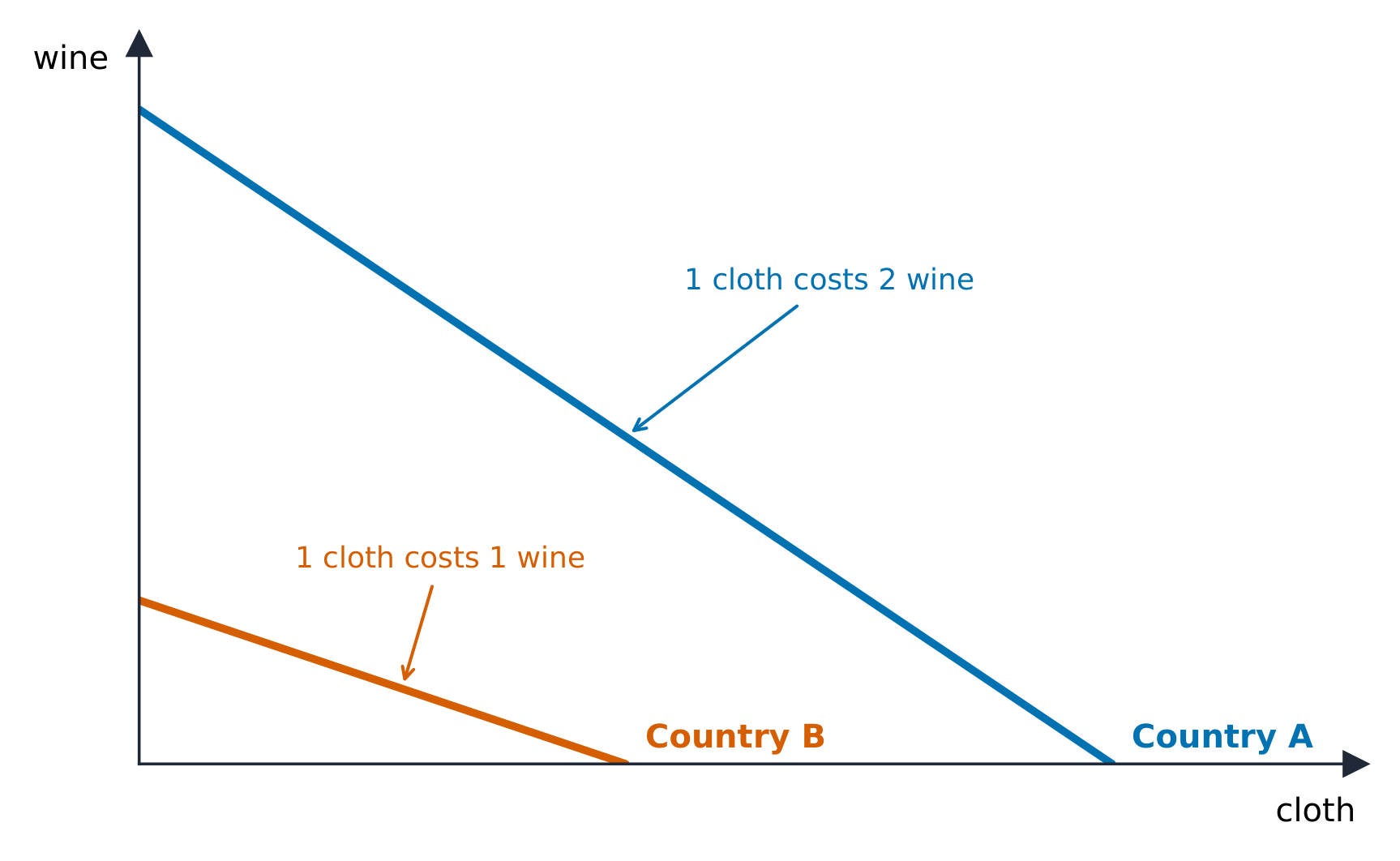
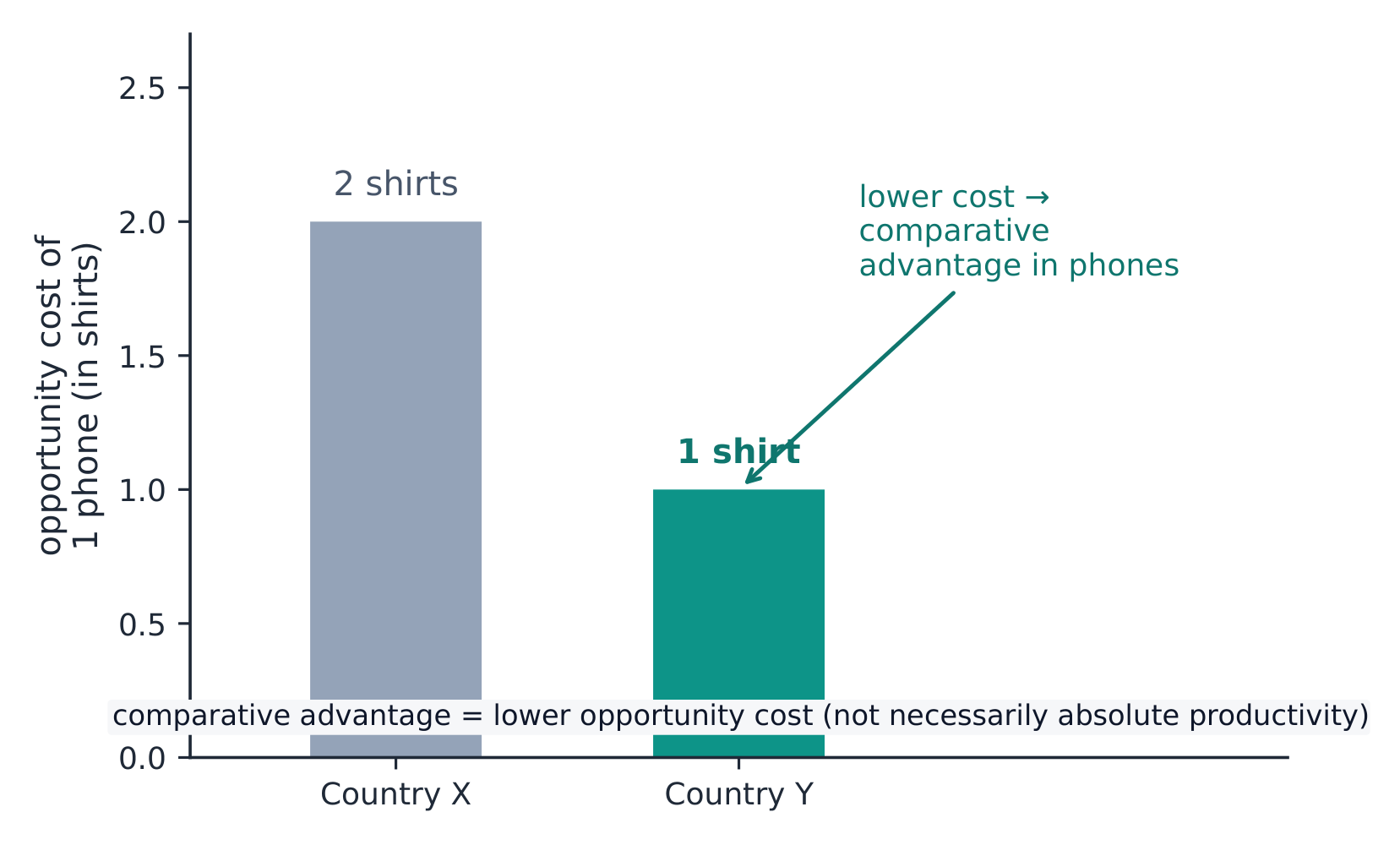
  • A producer has a comparative advantage 比较优势 if it has the lower opportunity cost for that good. Comparative advantage – not absolute – determines who should specialize.
  • Compute opportunity cost from output data: for each producer, one unit of good X costs (units of Y) $\div$ (units of X). The producer who gives up less Y should make X.
  • Both sides gain if they trade at a rate between their two opportunity costs – the terms of trade 贸易条件. Specializing by comparative advantage lets total output exceed what either could make alone, so consumption can lie outside each producer's own PPC.

Worked example. Anna can make $20$ shirts or $10$ tables a day; Ben can make $12$ shirts or $12$ tables. For Anna one table costs $\tfrac{20}{10}=2$ shirts; for Ben it costs $\tfrac{12}{12}=1$ shirt. Ben gives up fewer shirts, so Ben specializes in tables and Anna in shirts. Any terms of trade between $1$ and $2$ shirts per table – say $1.5$ – leaves both better off than producing alone.

Exam skill: these calculations appear almost every year – practice finding comparative advantage from both output tables and input tables, and stating a valid terms-of-trade range.

한국어

두 생산자가 전문화(specialization) 를 통해 교역으로부터 모두 이득을 얻을 수 있습니다.

비교 우위는 기울기가 다른 생산 가능 곡선에서 비롯됩니다
  • 한 생산자가 동일한 자원으로 더 많은 양을 생산할 수 있을 때, 그 재화에 대해 절대 우위를 가집니다.
  • 한 생산자가 해당 재화에 대해 더 낮은 기회비용을 가질 때, 비교 우위를 가집니다. 절대 우위가 아니라 비교 우위가 누가 전문화해야 할지를 결정합니다.
  • 산출 데이터로부터 기회비용을 계산합니다: 각 생산자에 대해 재화 X 1단위의 비용은 Y 단位数 $\div$ ÷ X 단位数 (units of X)입니다. 더 적은 Y를 포기하는 생산자가 X를 생산해야 합니다.
  • 양측이 서로의 기회비용 사이의 비율로 교역할 때(이를 교역 조건이라 함), 모두 이득을 봅니다. 비교 우위에 따른 전문화는 총 산출량을 개별 생산자가 단독으로 생산할 수 있는 것을 초과하게 하므로, 소비는 각 생산자의 own PPC 바깥에 위치할 수 있습니다.

해설 예제. 안나는 하루에 $20$개의 셔츠 또는 $10$개의 테이블을 만들 수 있고, 벤은 하루에 $12$개의 셔츠 또는 $12$개의 테이블을 만들 수 있습니다. 안나에게 테이블 1개는 $\tfrac{20}{10}=2$개의 셔츠를 의미하고, 벤에게는 $\tfrac{12}{12}=1$개의 셔츠를 의미합니다. 벤이 더 적은 셔츠를 포기하므로 벤은 테이블에 전문화하고 안나는 셔츠에 전문화합니다. 테이블당 $1$개와 $2$개 사이의 어떤 교역 조건 – 예를 들어 $1.5$개 – 이라면 두 사람 모두 단독 생산보다 나아집니다.

고사 기법: 이러한 계산은 거의 매년 출제되므로, 산출표와 투입표 모두에서 비교 우위를 찾고 유효한 교역 조건 범위를 서술하는 연습을 하십시오.

비교 우위는 기회 비용이 낮은 생산자에게 배당됩니다
비교 우위는 더 낮은 기회비용을 가진 생산자에게 돌아갑니다
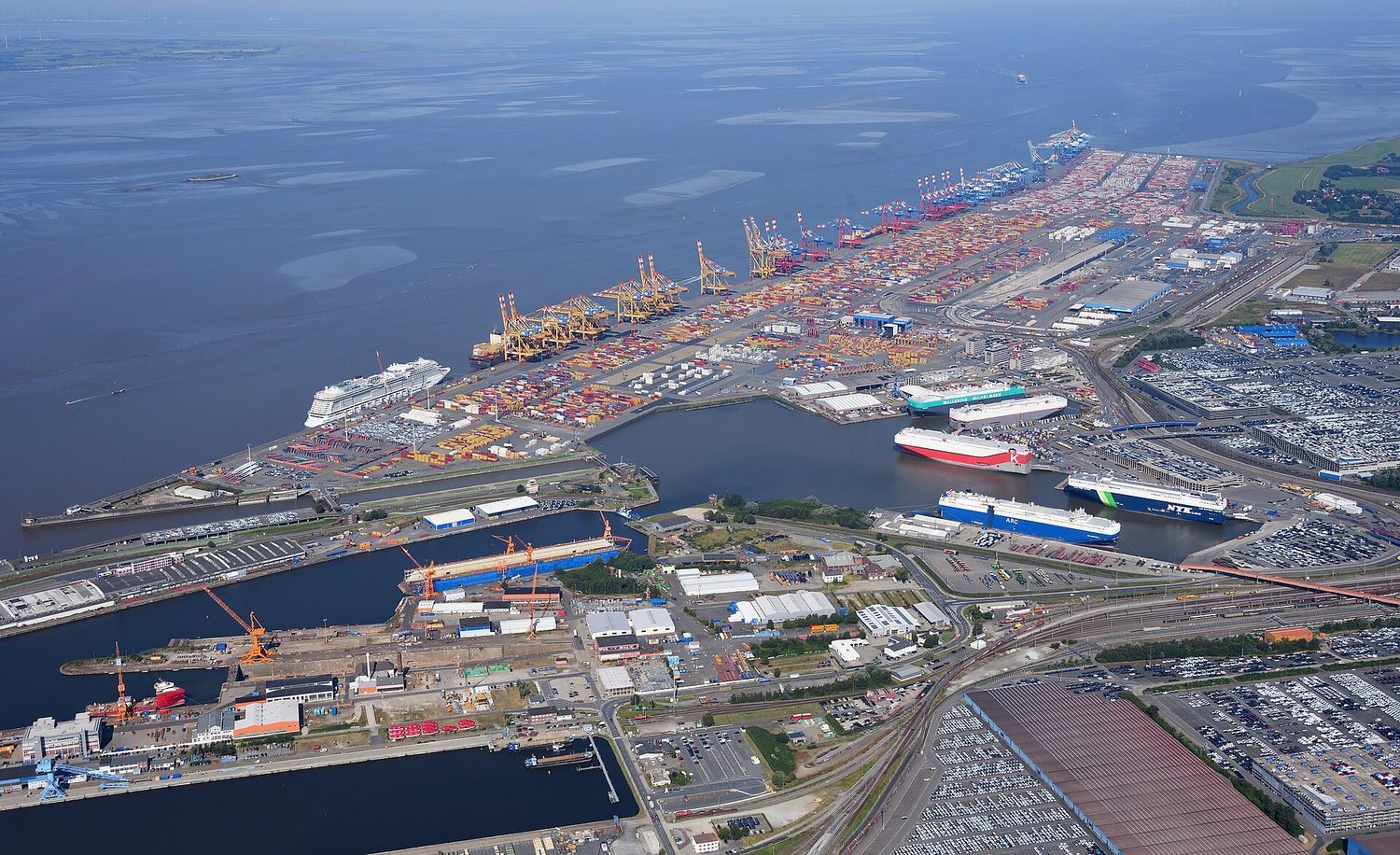
컨테이너 운송: 비교 우위와 무역은 국가의 전문화와 이득을 가능하게 합니다
Explore · ⁨탐색하기⁩

See why trade lets you consume beyond the frontier · ⁨무역이 frontier(전개선) 너머 소비를 가능하게 하는 이유 보기⁩

A producer should specialize where its opportunity cost is lowest, then trade for the rest. Because the terms of trade lie between the two producers' costs, trade lets a country consume outside its own production frontier. · ⁨생산자는 기회비용이 가장 낮은 곳에서 전문화하고 나머지는 무역을 통해 조달해야 합니다. 무역 조건이 두 생산자의 비용 사이에 있으므로, 무역은 국가가 자체 생산 frontier(전개선) 바깥에서 소비할 수 있게 합니다.⁩

Vocabulary · ⁨어휘⁩ Train · ⁨연습하기⁩
English 한국어
comparative advantage/kəmˈpærətɪv ədˈvæntɪdʒ/ 상대적 우위
terms of trade/tɜːmz ɒv treɪd/ Terms of Trade
1.5

Cost-Benefit Analysis · ⁨비용-편익 분석⁩

Syllabus
English

Enduring Understanding (CBA-1): Rational economic decisions require the evaluation of costs and benefits.

Learning Objective CBA-1.A: a. Define opportunity cost. b. Explain the opportunity costs associated with choices. c. Calculate the opportunity costs associated with choices.

  • CBA-1.A.1 Rational agents consider opportunity costs, whether implicit or explicit, when calculating the total economic costs of any decision.
  • CBA-1.A.2 Total benefits form the metric "utility" for consumers and total revenue for firms.

Learning Objective CBA-1.B: a. Explain a decision by comparing total benefits and total costs (using a table or a graph when appropriate). b. Calculate total benefits and total costs (using a table or graph where appropriate).

  • CBA-1.B.1 Total net benefits, the difference between total benefits and total costs, are maximized at the optimal choice.
  • CBA-1.B.2 Some decisions permit rational agents to look at only marginal benefit and marginal cost. Other decisions cannot be broken down into increments in this way and must be evaluated by looking at total benefits and total costs.
한국어

지속적 이해 (CBA-1): 합리적인 경제 결정은 비용과 편익의 평가가 요구된다.

학습목표 CBA-1.A: a. 기회비용을 정의하시오. b. 선택에 수반되는 기회비용을 설명하시오. c. 선택에 수반되는 기회비용을 계산하시오.

  • CBA-1.A.1 합리적 주체는 어떤 결정에 대한 총 경제 비용을 계산할 때 암묵적이든 명시적이든 기회비용을 고려한다.
  • CBA-1.A.2 총 편익은 소비자에게는 '편익'이라는 지표가 되며 기업에게는 총 매출이 된다.

학습목표 CBA-1.B: a. (적절한 경우 표나 그래프를 사용하여) 총 편익과 총 비용을 비교하여 결정을 설명하시오. b. (적절한 경우 표나 그래프를 사용하여) 총 편익과 총 비용을 계산하시오.

  • CBA-1.B.1 총 편익과 총 비용의 차이인 순총 편익은 최적의 선택 지점에서 최대화된다.
  • CBA-1.B.2 일부 결정은 합리적 주체가 한계 편익과 한계 비용만 보게允许한다. 다른 결정들은 이的方式로 세분할 수 없으며, 총 편익과 총 비용을 살펴서 평가되어야 한다.

Source: College Board AP Course and Exam Description · ⁨출처: College Board AP Course and Exam Description⁩

English

Rational decision-makers weigh benefits against costs. An action is worthwhile only when its benefit is at least as large as its cost – including the opportunity cost. Money already spent and unrecoverable is a sunk cost 沉没成本 and should be ignored in decisions: only future costs and benefits matter.

한국어

합리적인 의사결정자는 편익을 비용과 대조합니다. 행동의 편익이 비용 이상일 때만 그 행동은 타당합니다.这里包括机会成本。 이미 지출되어 회수할 수 없는 돈은 沉没成本이며, 의사결정 시 고려해서는 안 됩니다: 오직 미래의 비용과 편익만 중요합니다.

Explore · ⁨탐색하기⁩

Weigh total benefit against total cost · ⁨총편익과 총비용 비교하기⁩

A choice is worth it only while the benefit of one more unit beats its cost. Where total revenue meets total cost is the break-even point; past it, extra activity adds more cost than value. · ⁨한 단위당 편익이 비용보다 클 때까지 택은 가치 있는 것입니다. 총수입과 총비용이 만나는 지점이 손익분기점이며, 그 이후로는 추가 활동이 가치보다 더 많은 비용을 초래합니다.⁩

1.6

Marginal Analysis and Consumer Choice · ⁨한계 분석과 소비자 선택⁩

Syllabus
English

Enduring Understanding (CBA-2): To determine the optimal level at which to pursue an activity whose total benefits exceed total cost, rational economic agents compare marginal benefits and marginal costs.

Learning Objective CBA-2.A: a. Define the key assumptions of consumer choice theory. b. Explain (using a table or graph as appropriate) how a rational consumer's decision making involves the use of marginal benefits and marginal costs. c. Calculate (using a table or a graph when appropriate) how a rational consumer's decision making involves the use of marginal benefits and marginal costs.

  • CBA-2.A.1 Consumers face constraints and have to make optimal decisions accounting for these constraints.
  • CBA-2.A.2 In a model of rational consumer choice, consumers are assumed to make choices so as to maximize their total utility.
  • CBA-2.A.3 Consumers experience diminishing marginal utility in the consumption of goods and services.
  • CBA-2.A.4 Consumers allocate their limited income to purchase the combination of goods that maximizes their utility by equating/comparing the marginal utility of the last dollar spent on each good.
    • Exclusion statement: Indifference curves are beyond the scope of the course and the AP Exam, but equating the ratios of marginal utility to price is within the scope.

Learning Objective CBA-2.B: a. Define marginal analysis and related terms. b. Explain a decision using marginal analysis (using a table or a graph when appropriate).

  • CBA-2.B.1 Marginal analysis involves comparing the additional benefit of increasing a given activity with the additional cost. Comparing marginal benefit (MB) with marginal cost (MC) helps individuals (firms) decide whether to increase, decrease, or maintain their consumption (production) levels.
  • CBA-2.B.2 The optimal quantity at any point in time does not depend on fixed costs (sunk costs) or fixed benefits that have already been determined by past choices.
  • CBA-2.B.3 The optimal quantity is achieved when marginal benefit is equal to marginal cost or where total benefit is maximized.
한국어

지속적 이해 (CBA-2): 총 편익이 총 비용 초과일 때 어떤 활동을 추구할 최적 수준을 결정하기 위해 합리적 경제 주체는 한계 편익과 한계 비용을 비교한다.

학습목표 CBA-2.A: a. 소비자 선택 이론의 핵심 가정들을 정의하시오. b. (적절한 경우 표나 그래프를 사용하여) 합리적 소비자의 의사결정이 한계 편익과 한계 비용의 활용을 어떻게 포함하는지 설명하시오. c. (적절한 경우 표나 그래프를 사용하여) 합리적 소비자의 의사결정이 한계 편익과 한계 비용의 활용을 어떻게 포함하는지 계산하시오.

  • CBA-2.A.1 소비자는 제약을 faced하며, 이러한 제약을 고려하여 최적의 결정을 내린다.
  • CBA-2.A.2 합리적 소비자 선택 모델에서 소비자는 총 편익을 극대화하도록 선택한다고 가정한다.
  • CBA-2.A.3 소비자는 재화와 서비스 소비 시递减한 한계 편익을 경험한다.
  • CBA-2.A.4 소비자는 제한된 소득을 각 재화에_last dollar에 대한 한계 편익을 동일하게 하거나 비교함으로써 편익을 극대화하는 재화의 조합에 할당한다.
    • 제외 문구: 무차별 곡선은 과정 및 AP 시험 범위를 벗어나지만, 한계 편익과 가격의 비율을 동일하게 하는 것은 범위 내에 포함된다.

학습목표 CBA-2.B: a. 한계 분석과 관련 용어를 정의하시오. b. (적절한 경우 표나 그래프를 사용하여) 한계 분석을 사용하여 결정을 설명하시오.

  • CBA-2.B.1 한계 분석은给定 활동의 증가는 추가 편익과 추가 비용을 비교하는 것을 포함한다. 한계 편익(MB)을 한계 비용(MC)과 비교하면 개인(기업)이 소비(생산) 수준을 증가, 감소, 혹은 유지해야 할지 결정하는 데 도움이 된다.
  • CBA-2.B.2 어떤 시점에서의 최적 수량은 과거 선택에 의해 이미 결정된 고정비(沉没成本)나 고정편익에 의존하지 않는다.
  • CBA-2.B.3 최적 수량은 한계 편익이 한계 비용과 같아지거나 총 편익이 최대화되는 지점에서 달성된다.

Source: College Board AP Course and Exam Description · ⁨출처: College Board AP Course and Exam Description⁩

English

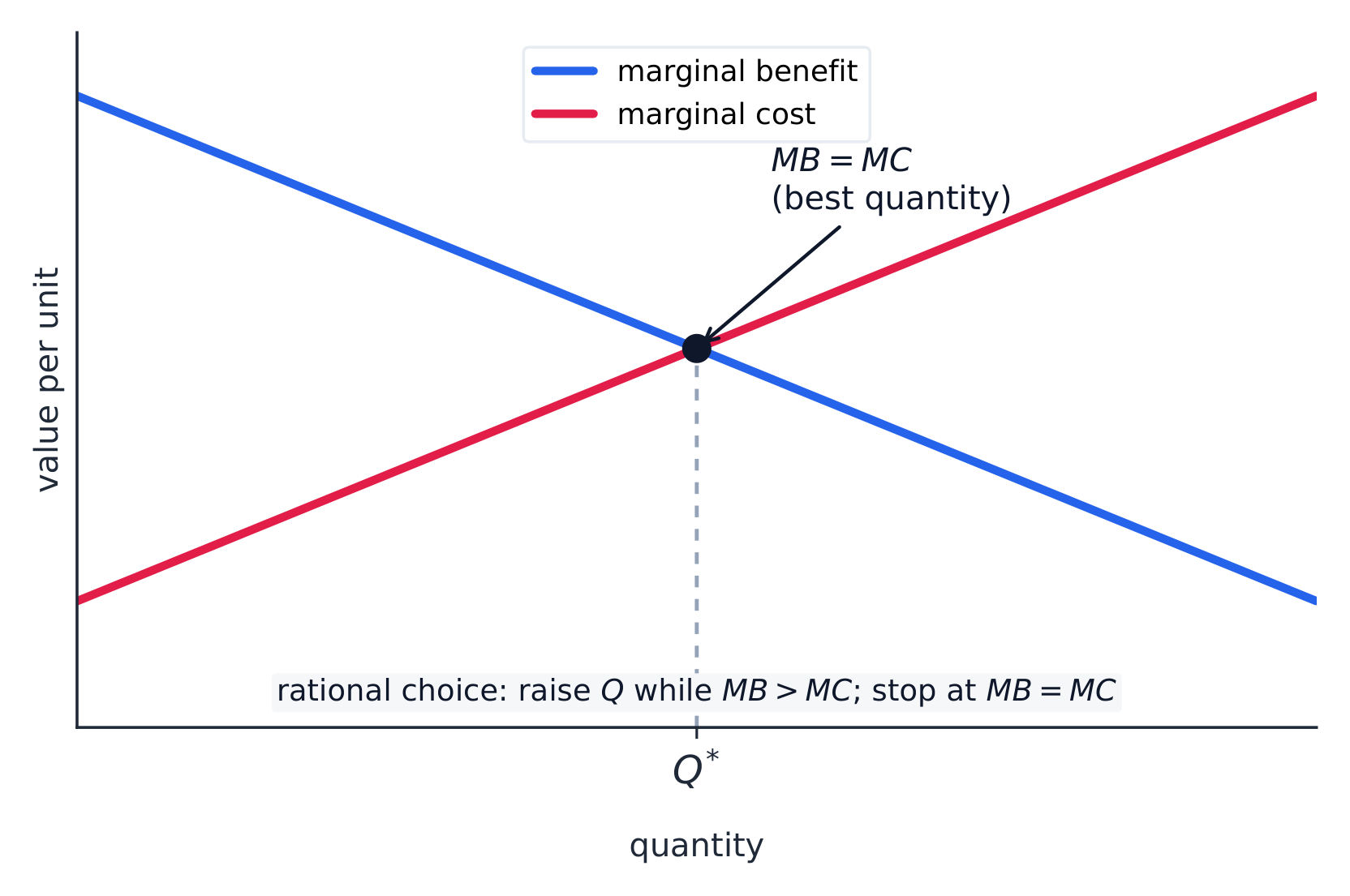
Most real decisions are not "all or nothing" but "a little more or a little less." Marginal analysis 边际分析 compares the marginal benefit 边际收益 (the benefit of one more unit) with the marginal cost 边际成本 (the cost of one more unit).

  • Decision rule: keep doing the activity while marginal benefit $>$ marginal cost; stop where MB $=$ MC. That point maximizes net benefit (total benefit minus total cost).
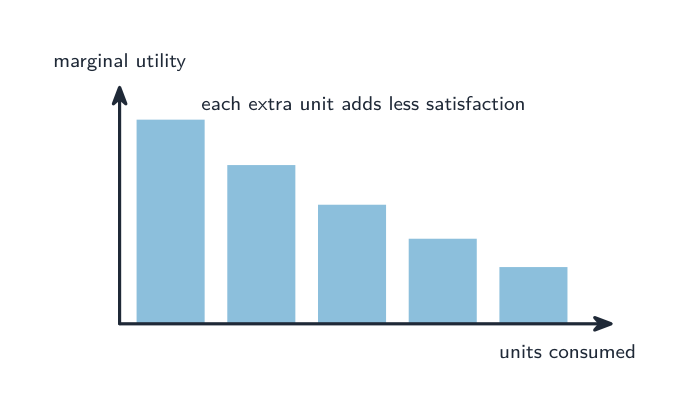
  • Consumers get utility 效用 (satisfaction) from goods, but each extra unit usually gives less added satisfaction – the law of diminishing marginal utility 边际效用递减法则.
  • A consumer maximizes total utility by the utility-maximizing rule: spend so that the marginal utility per dollar is equal across all goods, $\dfrac{MU_x}{P_x}=\dfrac{MU_y}{P_y}$, using up the whole budget. If one good gives more utility per dollar, buy more of it until the ratios equalize.

Worked example. A consumer is choosing between good X ($MU_x=20$, $P_x=\$2$) and good Y ($MU_y=15$, $P_y=\$1$). The utility per dollar is $\tfrac{20}{2}=10$ for X but $\tfrac{15}{1}=15$ for Y. Y delivers more satisfaction per dollar, so the consumer should buy more Y and less X; as they do, $MU_y$ falls and $MU_x$ rises until $\tfrac{MU_x}{2}=\tfrac{MU_y}{1}$ and the budget is spent.

Exam skill: the "MB = MC" logic and the "equal MU-per-dollar" rule are tested repeatedly – be able to find the optimal quantity from a table and explain why it is optimal.

한국어

실제 대부분의 의사결정은 "모두 또는 아무것도"가 아니라 "약간 더 많거나 적게"입니다. 한계 분석은 한계 편익(추가 1단위의 편익)과 한계 비용(추가 1단위의 비용)을 비교합니다.

소비되는 추가 단위마다 추가 만족도가 감소함(한계效用递减)
  • 결정 규칙: 한계 편익 $>$ 한계 비용인 동안 활동을 계속하고, MB $=$ MC 지점에서 중단합니다. 이 점은 순편익(총편익 minus 총비용)을 극대화합니다.
  • 소비자는 재화에서 효용(만족도)을 얻지만, 일반적으로 추가 단위는 더 적은 추가 만족도를 제공합니다 – 이는 한계 효용 체감의 법칙입니다.
  • 소비자는 유틸리티 극대화 규칙에 따라 총 유틸리티를 극대화합니다: 모든 재화에서 달러당 한계效用이 동일하도록, 즉 $\dfrac{MU_x}{P_x}=\dfrac{MU_y}{P_y}$, 전체 예산을 소진하도록 지출합니다. 한 재화가 달러당 더 높은 유틸리티를 제공하면, 비율이 일치할 때까지 그 재화를 더 많이 구매합니다.

해설 예제. 소비자가 재화 X($MU_x=20$, $P_x=\$2$) and good Y ($MU_y=15$, $P_y=\$1$)와 재화 Y 사이에서 선택하고 있습니다. 달러당 유틸리티는 X의 경우 $\tfrac{20}{2}=10$이지만 Y의 경우 $\tfrac{15}{1}=15$입니다. Y가 달러당 더 많은 만족도를 제공하므로 소비자는 Y를 더 많이, X를 적게 구매해야 합니다.这样做时, $MU_y$이 감소하고 $MU_x$이 상승하여 $\tfrac{MU_x}{2}=\tfrac{MU_y}{1}$가 되고 예산이 소진됩니다.

고사 기법: "MB = MC" 논리와 "달러당 한계效用 등가" 규칙은 반복해서 출제됩니다. 표에서 최적 수량을 찾고 왜 그것이 최적인지 설명할 수 있어야 합니다.

합리적 선택: 한계편익이 한계비용을 초과할 때까지 계속하고, 두 값이 같아지는 지점에서 멈춘다
Vocabulary · ⁨어휘⁩ Train · ⁨연습하기⁩
English 한국어
utility/juːˈtɪlɪti/ 유틸리티/utility
law of diminishing marginal utility/lɔː ɒv dɪˈmɪnɪʃɪŋ ˈmɑːdʒɪnl juːˈtɪlɪti/ 한계 효용 체감의 법칙
1.6

Exam tips · ⁨시험 팁⁩

English
  • Opportunity cost is the next-best alternative given up; ignore sunk costs in any decision.
  • Comparative advantage (lower opportunity cost) determines specialisation and the gains from trade.
  • Apply marginal analysis: keep doing an activity while MB > MC, stopping where MB = MC.
  • Maximise utility by equalising the marginal utility per dollar across goods.
  • Read opportunity cost off the PPC slope; a bowed curve shows increasing cost.
한국어
  • 기회비용은 포기한 차선책의 대가이며, **沉没原費( sunk costs)**는 모든 의사결정에서 고려하지 않아야 한다.
  • 비교우위(더 낮은 기회비용)는 전문화와 무역의 이점을 결정한다.
  • 한계분석을 적용하라: MB > MC일 때 해당 활동을 유지하고, MB = MC가 되는 지점에서 멈추라.
  • 재화 간 달러당 한계효용을 동일하게 하여 효용을 극대화하라.
  • PPC의 기울기에서 기회비용을 읽으라. 오목한 곡선은 증가하는 비용을 의미한다.
Vocabulary · ⁨어휘⁩ Train · ⁨연습하기⁩
English 한국어
sunk cost/sʌŋk kɒst/ 沉没成本
Marginal analysis/ˈmɑːdʒɪnl əˈnæləsɪs/ 한계 분석
marginal benefit/ˈmɑːdʒɪnl ˈbenɪfɪt/ 한계 편익
marginal cost/ˈmɑːdʒɪnl kɒst/ 한계비용

Interactive lessons on this topic · ⁨이 주제에 대한 인터랙티브 수업⁩

Work through it step by step, with instant-check exercises. · ⁨즉시 체크 기능 exercises를 통해 단계별로 진행하세요.⁩

Past Papers · ⁨과거 시험지⁩

More topics in AP Microeconomics · ⁨AP 경제학 (미시)⁩ · ⁨AP Microeconomics · ⁨AP 경제학 (미시)⁩ 내 추가 주제⁩

Log in or create account · ⁨로그인 또는 계정 만들기⁩

IGCSE, A-Level & AP