The Production Possibilities Curve
Introduced| English |
|---|
| production possibilities curve/prəˈdʌkʃn ˌpɒsəˈbɪlɪtiz kɜːv/ |
| efficient/ɪˈfɪʃənt/ |
| opportunity cost/ɒpəˈtjuːnɪti kɒst/ |
| law of increasing opportunity cost/lɔː ɒv ɪnˈkriːsɪŋ ɒpəˈtjuːnɪti kɒst/ |
| economic growth/ˌiːkəˈnɒmɪk ɡrəʊθ/ |
Draw the edge of the possible
- Give an economy just two goods to make — say food and phones.
- Draw every combination it could make when nothing is wasted.
- The outer boundary of those combinations is the production possibilities curve 生产可能性曲线 (PPC).
- It turns the whole idea of scarcity into one picture you can point at.
On, inside, or outside
- Points on the curve are efficient 有效率 — every resource is being used.
- Points inside are inefficient — some workers or factories sit idle.
- Points outside are currently unattainable — a direct picture of scarcity.
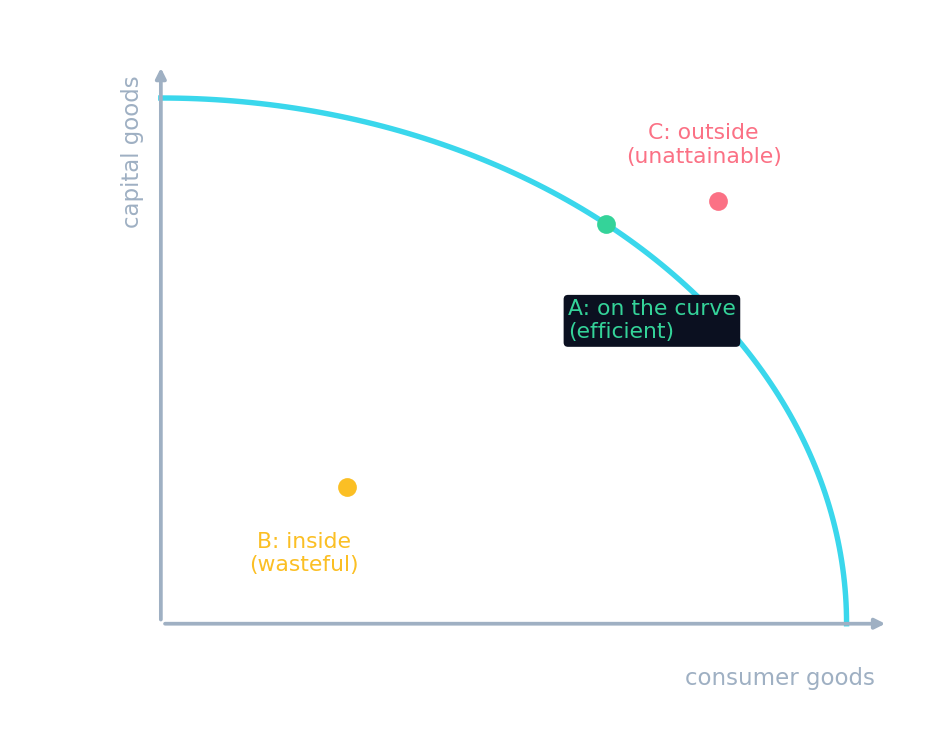
A country is producing at a point inside its PPC. This means:
Inside the curve, resources sit idle — the economy could make more of both goods.
With its current resources, an economy can produce at a point outside its PPC.
Points outside are unattainable now — reaching them needs economic growth.
Why the curve bows outward
- Move along the curve to make more phones, and you must make less food — that sacrifice is the opportunity cost 机会成本.
- The curve usually bows outward, showing the law of increasing opportunity cost 机会成本递增规律.
- Resources are not equally good at both jobs, so each extra phone costs more and more food.
- A straight-line PPC would instead mean a constant opportunity cost.
Explore the production possibilities curve
Making more of one good means giving up some of the other — that trade-off is the opportunity cost, and the outward bow is the law of increasing opportunity cost. Drag along the curve, then grow the economy to push the whole frontier out.
Why does a typical PPC bow outward (concave to the origin)?
As you pour more resources into one good, each extra unit costs ever more of the other — the law of increasing opportunity cost.
Read an opportunity cost off the curve
- Pick two points and compare them — the cost is what you gave up.
- Worked example. At point A the economy makes 100 food, 0 phones. At point B it makes 80 food, 30 phones.
- Moving A → B, it gains 30 phones by giving up 20 food.
- So the opportunity cost of one phone is $20 \div 30 = 0.67$ units of food.
At point A the economy makes 100 food and 0 phones; at B it makes 80 food and 30 phones. What is the opportunity cost of ONE phone, in units of food?
Give up 20 food to gain 30 phones, so each phone costs $20/30 = 0.67$ food.
Growth pushes the whole curve out
- Economic growth 经济增长 shifts the entire curve outward.
- It comes from more resources, better technology, or improved skills.
- Now combinations that were once impossible become reachable.
- Producing inside the curve is not growth — it is just using what you already have more fully.
Better technology shifts the whole curve ______ (which direction?).
Growth expands what is possible, moving the frontier outward.
Select all that shift a PPC outward.
Growth needs more or better resources. Moving onto the curve just removes waste — it is not growth.
The PPC shows the most an economy can make of two goods. On = efficient, inside = wasteful, outside = unattainable. Its outward bow is the law of increasing opportunity cost, and economic growth shifts the whole curve outward.