Skip to content · ⁨본문 바로가기⁩

Open Economy—International Trade and Finance · ⁨개방 경제—국제 무역 및 금융⁩

AP Macroeconomics · ⁨AP 경제학 (거시)⁩ · Topic 6 · ⁨주제 6⁩

Video lesson for this topic · ⁨이 주제용 영상 수업⁩ Open the video page · ⁨영상 페이지 열기⁩
8:01

개방 경제—국제 무역 및 금융

소유한Almost anything에 라벨을 확인해보라. 다른 곳에서 제작되었다. 철제 상자에 들어 바다를 건너왔고, namespace different money로 someone paid for it.

English narration · English + 中文 subtitles burned in · ⁨영어 내레이션 · 영어 + 중국어 자막 burned-in⁩

6.1

Balance of Payments Accounts · ⁨결제 recount accounts⁩

Syllabus
English

Enduring Understanding (MEA-4): Foreign trade accounting measures the flow of goods, services, and financial capital between countries.

Learning Objective MEA-4.A: a. Define the current account (CA), the capital and financial account (CFA), and the balance of payments (BOP). b. Explain how changes in the components of the CA and CFA affect a country's BOP. c. Calculate the CA, the CFA, and the BOP.

  • MEA-4.A.1 The current account (CA) records net exports, net income from abroad, and net unilateral transfers.
  • MEA-4.A.2 The CA is not always balanced; it may show a surplus or a deficit. A nation's balance of trade (i.e., net exports) is part of the current account and may also show a surplus or a deficit.
  • MEA-4.A.3 The capital and financial account (CFA) records financial capital transfers and purchases and sales of assets between countries.
  • MEA-4.A.4 The CFA is not always balanced; it may show a surplus (financial capital inflow) or a deficit (financial capital outflow).
  • MEA-4.A.5 The balance of payments (BOP) is an accounting system that records a country's international transactions for a particular time period. It consists of the CA and the CFA.
  • MEA-4.A.6 Any transaction that causes money to flow into a country is a credit to its BOP account, and any transaction that causes money to flow out is a debit. The sum of all credit entries should match the sum of all debit entries ($CA + CFA = 0$).
한국어

영구적 이해 (MEA-4): 대외 무역 장부는 국가 간 재화, 서비스 및 금융 자본의 흐름을 측정한다.

학습 목표 MEA-4.A: a. 현재 계정(CA), 자본 및 금융 계정(CFA), 대외 거래 장부(BOP)를 정의하십시오. b. CA와 CFA 구성 요소의 변화가 한 나라의 BOP에 미치는 영향을 설명하십시오. c. CA, CFA 및 BOP을 계산하십시오.

  • MEA-4.A.1 현재 계정(CA)은 순수출, 해외 소득 및 순일방이전지출을 기록한다.
  • MEA-4.A.2 CA는 항상 균형을 이루지는 않으며, 과잉 또는 적자를 나타낼 수 있다. 한 나라의 대외 거래(즉, 순수출)는 현재 계정의 일부이며 과잉 또는 적자를 나타낼 수도 있다.
  • MEA-4.A.3 자본 및 금융 계정(CFA)은 국가 간의 금융 자본 이동 및 자산의 구매 및 판매를 기록한다.
  • MEA-4.A.4 CFA는 항상 균형을 이루지는 않으며, 과잉(금융 자본 유입) 또는 적자(금융 자본 유출)를 나타낼 수 있다.
  • MEA-4.A.5 대외 거래 장부(BOP)는 특정 기간 동안 한 나라의 대외 거래를 기록하는 장부 체계이다. 이는 CA와 CFA로 구성된다.
  • MEA-4.A.6一个国家의 BOP 계정으로 돈이 유입되는 모든 거래는 신용(credit)으로, 돈이 유출되는 모든 거래는 차신(debit)으로 기록된다. 모든 신용 항목의 합은 모든 차신 항목의 합과 일치해야 한다($CA + CFA = 0$).
Source: College Board AP Course and Exam Description · ⁨출처: College Board AP Course and Exam Description⁩

English

The balance of payments 国际收支 records all transactions between a country and the rest of the world, in two main accounts:

  • The current account 经常账户 tracks trade in goods and services (exports minus imports), plus income and transfers. A trade deficit makes it negative.
  • The capital (financial) account 资本账户 tracks flows of financial assets – foreigners buying domestic assets, and residents buying foreign assets.

The two are mirror images: a current-account deficit is matched by a capital-account surplus (a country that imports more than it exports pays with assets, so foreign investment flows in). They sum to zero.

한국어
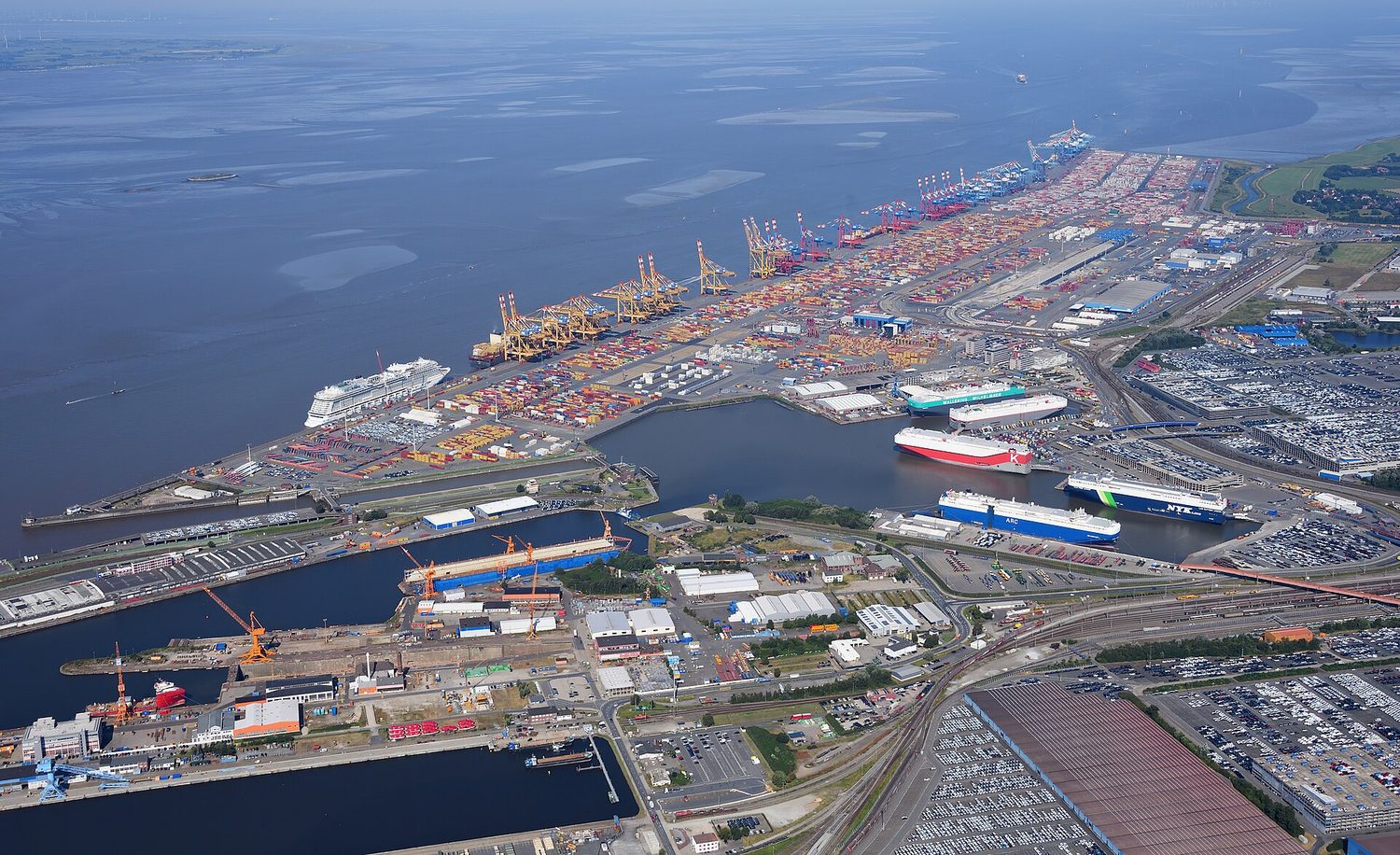
컨테이너 터미널: 수출 및 수입이 국제收支에 기록된다

국제收支는 한 나라와 전 세계 간의 모든 거래를 두 가지 주요 계정으로 기록합니다:

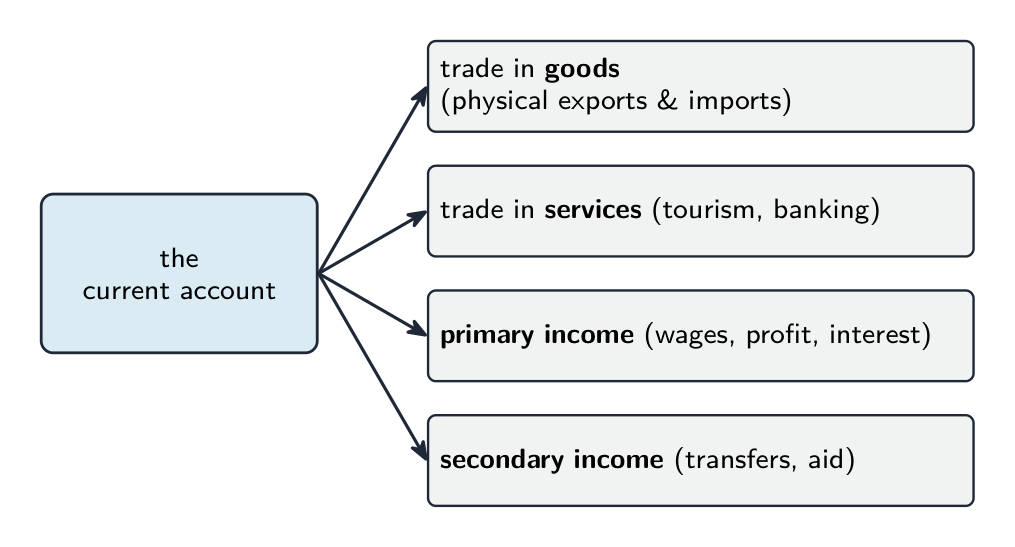
Current account의 네 가지 구성 요소
  • Current account는 재화 및 서비스의 거래(수출 minus 수입), 소득 및 이전을 추적합니다. 무역 적자는 이를 음수로 만듭니다.
  • 자본(금융) 계정은 금융 자산의 흐름을 추적합니다 – 외국인들의 국내 자산 구매 및 거주민들의 해외 자산 구매.

두 계정은 반영 관계입니다: Current account 적자는 Capital account 초과수입과 매칭됩니다(수출보다 더 많이 수입하는 국가는 자산을 지불 수단으로 사용하므로 외국 자본 유입이 발생합니다). 두 계정의 합은 0입니다.

Vocabulary · ⁨어휘⁩ Train · ⁨연습하기⁩
English 한국어
balance of payments/ˈbæləns ɒv ˈpeɪmənts/ 대외 거래 기록
current account/ˈkʌrənt əˈkaʊnt/ 경상 계정에 기록된다.
capital (financial) account/ˈkæpɪtl əˈkaʊnt/ 자본(금융) 계정
6.2

Exchange Rates · ⁨환율⁩

Syllabus
English

Enduring Understanding (MKT-5): The interaction of buyers and sellers exchanging the currency of one country for the currency of another determines the equilibrium exchange rate in a flexible exchange market and influences the flow of goods, services, and financial capital between countries.

Learning Objective MKT-5.A: a. Define the exchange rate, currency appreciation, and currency depreciation. b. Explain how currencies are valued relative to one another. c. Calculate the value of one currency relative to another.

  • MKT-5.A.1 In the foreign exchange market, one currency is exchanged for another; the price of one currency in terms of the other is the exchange rate.
  • MKT-5.A.2 If one currency becomes more valuable in terms of the other, it is said to appreciate. If one currency becomes less valuable in terms of the other, it is said to depreciate.
한국어

지속적 이해 (MKT-5): 구매자와 판매자가 한 국가의 화폐를 다른 국가의 화폐와 교환하는 상호작용은 유연한 환율 시장에서 균형 환율을 결정하며, 국가 간 재화, 서비스 및 금융 자본의 흐름에 영향을 미친다.

학습 목표 MKT-5.A: a. 환율, 화폐 가치 상승(고환율), 화폐 가치 하락(저환율)을 정의하시오. b. 환율이 서로 어떻게 평가되는지 설명하시오. c. 한 화폐의 가치가 다른 화폐에 비해 어떻게 계산되는지 설명하시오.

  • MKT-5.A.1 외환 시장에서 한 화폐는 다른 화폐와 교환되며, 한 화폐가 다른 화폐로 표시된 가격이 환율이다.
  • MKT-5.A.2 한 화폐가 다른 화폐에 비해 가치가 높아지면 그 화폐는 고환율(appreciate)되었다고 한다. 반대로 한 화폐가 다른 화폐에 비해 가치가 낮아지면 저환율(depreciate)되었다고 한다.

Source: College Board AP Course and Exam Description · ⁨출처: College Board AP Course and Exam Description⁩

English

An exchange rate 汇率 is the price of one currency in terms of another. A currency appreciates 升值 when it gains value (buys more foreign currency) and depreciates 贬值 when it loses value. Always track which currency: if the US dollar appreciates against the euro, the euro depreciates against the dollar – the same event from two sides.

Worked example. Suppose $\$1=\text{€}0.90$, so $\text{€}1=\dfrac{1}{0.90}\approx\$1.11$. If the dollar then appreciates to $\$1=\text{€}1.00$, each dollar now buys more euros, while the euro has depreciated – it now buys only $\$1.00$ instead of $\$1.11$. The single event is an appreciation of the dollar and a depreciation of the euro.

Most currencies today are floating 浮动, set by supply and demand in the foreign-exchange market.

한국어
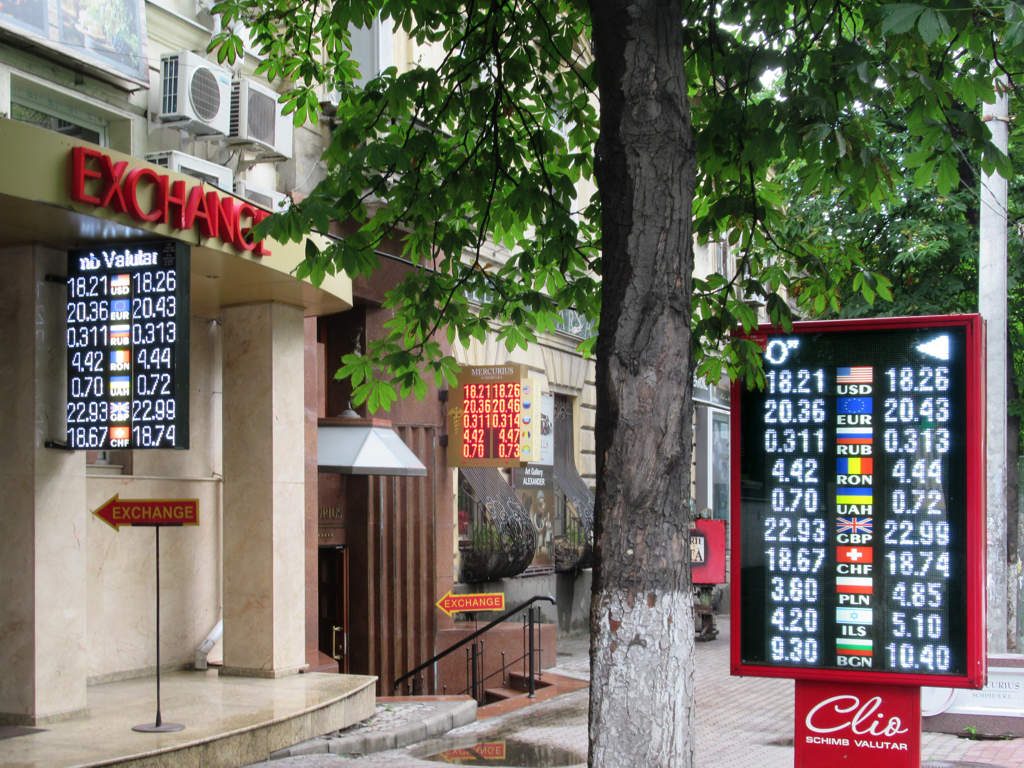
환율 표시판: 환율은 하나의 통화를 다른 통화로 표현한 가격이다

환율은 한 화폐를 다른 화폐로 환산한 가격입니다. 화폐가 가치를 상승하여 더 많은 외화를 구매할 때는 상승한다고 하고, 가치가 하락할 때는 하락합니다. 항상 어떤 화폐에 초점을 맞추는지 확인하세요: 미국 달러가 유로화 대비 상승한다면, 유로화는 달러 대비 하락하는 것입니다 – 같은 사건을 두 관점에서 본 것입니다.

풀이 예제. $\$1=\text{€}0.90$, so $\text{€}1=\dfrac{1}{0.90}\approx\$1.11$라고 가정해 봅시다. 만약달러가 이후 $\$1=\text{€}1.00$, each dollar now buys more euros, while the euro has depreciated – it now buys only $\$1.00$로 상승하고 이전의 $\$1.11$보다 높아진다면, 이는 단일 사건으로서 달러의 상승과 동시에 유로화의 하락입니다.

외화 시장의 수요와 공급에 의해 결정되는 변동 환율

오늘날 대부분의 화폐는 변동하며, 외화 시장에서 수요와 공급에 의해 결정됩니다.

Vocabulary · ⁨어휘⁩ Train · ⁨연습하기⁩
English 한국어
exchange rate/eksˈtʃeɪndʒ reɪt/ 환율
appreciates/əˈpriːʃɪeɪts/ 가치 상승
depreciates/dɪˈpriːʃɪeɪts/ 가치 하락
floating/ˈfləʊtɪŋ/ 유동 환율
capital flows/ˈkæpɪtl fləʊz/ 자본 흐름
6.3

The Foreign Exchange Market · ⁨외화 시장⁩

Syllabus
English

Enduring Understanding (MKT-5): The interaction of buyers and sellers exchanging the currency of one country for the currency of another determines the equilibrium exchange rate in a flexible exchange market and influences the flow of goods, services, and financial capital between countries.

Learning Objective MKT-5.B: a. Define the foreign exchange market, demand for currency, and supply of currency. b. Explain (using graphs as appropriate) the relationship between the exchange rate and the quantity of currency demanded (supplied).

  • MKT-5.B.1 The demand for a currency in a foreign exchange market arises from the demand for the country's goods, services, and financial assets and shows the inverse relationship between the exchange rate and the quantity demanded of a currency.
  • MKT-5.B.2 The supply of a currency in a foreign exchange market arises from making payments in other currencies and shows the positive relationship between the exchange rate and the quantity supplied of a currency.

Learning Objective MKT-5.C: Define (using graphs as appropriate) the equilibrium exchange rate.

  • MKT-5.C.1 In the foreign exchange market, equilibrium is achieved when the exchange rate is such that the quantities demanded and supplied of the currency are equal.

Learning Objective MKT-5.D: Explain (using graphs as appropriate) how exchange rates adjust to restore equilibrium in the foreign exchange market.

  • MKT-5.D.1 Disequilibrium exchange rates create surpluses and shortages in the foreign exchange market. Market forces drive exchange rates toward equilibrium.
한국어

지속적 이해 (MKT-5): 구매자와 판매자가 한 국가의 화폐를 다른 국가의 화폐와 교환하는 상호작용은 유연한 환율 시장에서 균형 환율을 결정하며, 국가 간 재화, 서비스 및 금융 자본의 흐름에 영향을 미친다.

학습 목표 MKT-5.B: a. 외환 시장, 화폐 수요, 화폐 공급을 정의하시오. b. (그래프를 사용하여 필요할 경우) 환율과 화폐 수요량(공급량) 사이의 관계를 설명하시오.

  • MKT-5.B.1 외환 시장의 한 화폐에 대한 수요는 해당 국가의 재화, 서비스, 금융 자산에 대한 수요에서 발생하며, 환율과 화폐 수요량 사이에 역비례 관계가 있음을 보여준다.
  • MKT-5.B.2 외환 시장의 한 화폐에 대한 공급은 다른 화폐로의 결제 과정에서 발생하며, 환율과 화폐 공급량 사이에 정비례 관계가 있음을 보여준다.

학습 목표 MKT-5.C: (그래프를 사용하여 필요할 경우) 균형 환율을 정의하시오.

  • MKT-5.C.1 외환 시장에서 균형이 성립하는 것은 환율이 화폐의 수요량과 공급량이 일치할 때이다.

학습 목표 MKT-5.D: (그래프를 사용하여 필요할 경우) 환율이 어떻게 조정되어 외환 시장의 균형을 회복하는지 설명하시오.

  • MKT-5.D.1 불균형 환율은 외환 시장에서 초과 공급과 초과 수요를 초래한다. 시장 메커니즘이 환율을 균형 수준으로 이동시킨다.

Source: College Board AP Course and Exam Description · ⁨출처: College Board AP Course and Exam Description⁩

English
The foreign exchange market

Each currency has its own supply-and-demand graph (price $=$ the exchange rate, quantity $=$ amount of that currency).

  • Demand for a currency comes from foreigners wanting its goods, services, or assets.
  • Supply of a currency comes from its own residents wanting foreign goods, services, or assets.

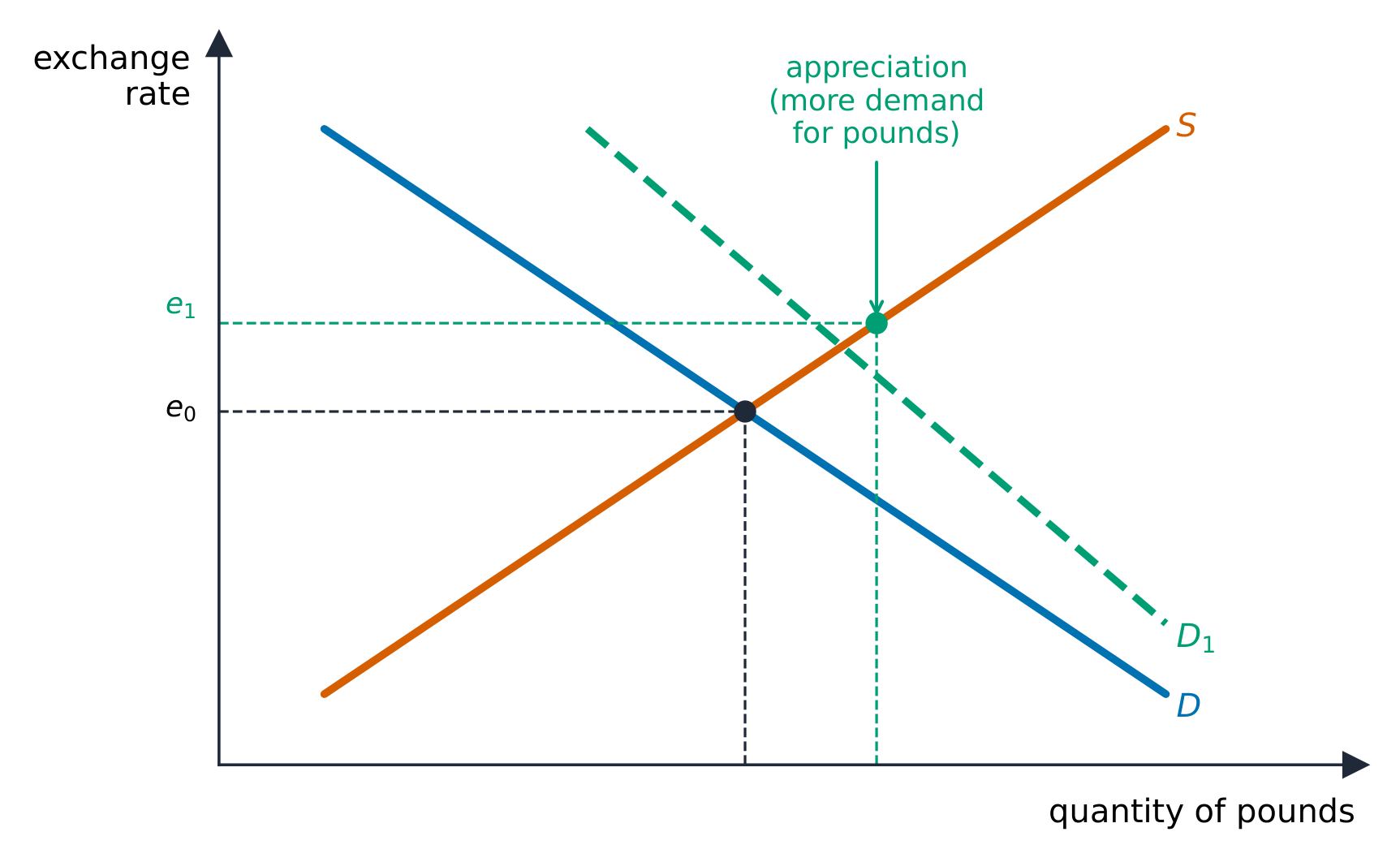
The equilibrium exchange rate is where they cross. A rightward shift in demand for a currency causes it to appreciate; a rightward shift in supply causes it to depreciate.

Exam skill: always draw the graph for the currency named in the question, label the axis with that currency's price, and shift the correct curve – mixing up the two currencies' graphs is the most common error.

한국어
외화 시장

각 화폐에는 자체적인 수요-공급 그래프가 있으며(가격 $=$ 환율, 수량 $=$ 해당 화폐의 양)입니다.

  • 수요: 외국인이 해당 국가의 상품, 서비스 또는 자산을 원할 때 발생합니다.
  • 공급: 해당 국가의 거주자들이 해외의 상품, 서비스 또는 자산을 원할 때 발생합니다.

균형 환율은 두 곡선이 교차하는 지점입니다. 화폐에 대한 수요의 우측 이동은 그 화폐를 상승시키고, 공급의 우측 이동은 그 화폐를 하락시킵니다.

시험 기술: 질문에서 명시된 화폐에 대한 그래프를 반드시 그리세요. 축에 해당 화폐의 가격을 표시하고 올바른 곡선을 이동시키세요. 두 화폐의 그래프를 혼동하는 것이 가장 흔한 실수입니다.

Explore · ⁨탐색하기⁩

The foreign-exchange market · ⁨외화 시장⁩

A currency's exchange rate is set where demand for it meets supply. Higher demand for exports or higher interest rates appreciate the currency. · ⁨통화의 환율은 수요와 공급이 만나는 지점에서 결정됩니다. 수출에 대한 수요 증가나 금리 인상이 통화를 강세(아프리에이션)시킵니다.⁩

6.4

Changes in Policies and Economic Conditions · ⁨정책 및 경제 상황의 변화⁩

Syllabus
English

Enduring Understanding (MKT-5): The interaction of buyers and sellers exchanging the currency of one country for the currency of another determines the equilibrium exchange rate in a flexible exchange market and influences the flow of goods, services, and financial capital between countries.

Learning Objective MKT-5.E: a. Explain (using graphs as appropriate) the determinants of currency demand and supply. b. Explain (using graphs as appropriate) how changes in demand and supply in the foreign exchange market affect the equilibrium exchange rate.

  • MKT-5.E.1 Factors that shift the demand for a currency (such as the demand for that country's goods, services, or assets) and the supply of a currency (such as tariffs or quotas on the other country's goods and services) change the equilibrium exchange rate.
  • MKT-5.E.2 Fiscal policy can influence aggregate demand, real output, the price level, and exchange rates.
  • MKT-5.E.3 Monetary policy can influence aggregate demand, real output, the price level, and interest rates, and thereby affect exchange rates.
한국어

지속적 이해 (MKT-5): 구매자와 판매자가 한 국가의 화폐를 다른 국가의 화폐와 교환하는 상호작용은 유연한 환율 시장에서 균형 환율을 결정하며, 국가 간 재화, 서비스 및 금융 자본의 흐름에 영향을 미친다.

학습 목표 MKT-5.E: a. (그래프를 사용하여 필요할 경우) 화폐 수요와 공급의 결정 요인을 설명하시오. b. (그래프를 사용하여 필요할 경우) 외환 시장의 수요와 공급 변화가 균형 환율에 미치는 영향을 설명하시오.

  • MKT-5.E.1 한 화폐의 수요(해당 국가의 재화, 서비스, 자산에 대한 수요 등)나 공급(타국 재화와 서비스에 대한 관세 또는 물량 제한 등)을 변화시키는 요인은 균형 환율을 변경시킨다.
  • MKT-5.E.2 재정 정책은 총수요, 실질 산출, 물가지수 및 환율에 영향을 미칠 수 있다.
  • MKT-5.E.3 통화 정책은 총수요, 실질 산출, 물가지수 및 금리에 영향을 미침으로써 환율에도 영향을 줄 수 있다.

Source: College Board AP Course and Exam Description · ⁨출처: College Board AP Course and Exam Description⁩

English

Exchange rates respond to:

  • Relative interest rates: a higher domestic real interest rate attracts foreign financial investment, raising demand for the currency and causing appreciation.
  • Relative price levels/inflation: higher domestic inflation makes goods less competitive, lowering demand for the currency (depreciation).
  • Relative incomes: higher domestic income raises imports, increasing the supply of domestic currency (depreciation).
  • Tastes and expectations about future value.

Monetary policy has a strong link: expansionary monetary policy lowers interest rates, reduces demand for the currency, and causes depreciation (which then boosts net exports).

한국어

환율은 다음 요인에 반응합니다:

  • 상대 금리: 국내 실질 금리가 높아지면 해외 금융 투자가 유입되어 수요가 증가하고 상승합니다.
  • 상대 물가 수준/인플레이션: 국내 인플레이션이 높아지면 상품의 경쟁력이 떨어져 화폐에 대한 수요가 감소합니다 (하락).
  • 상대 소득: 국내 소득이 높아지면 수입이 증가하여 국내 화폐의 공급이 늘어나게 됩니다 (하락).
  • 취향 및 미래 가치에 대한 기대감.

통货政策과의 연결고리가 강합니다: 확장적 통화정책은 금리를 낮추고 화폐에 대한 수요를 줄이며 하락을 유발합니다 (이는 subsequently 순수출을 증대시킵니다).

6.5

Exchange Rates and Net Exports · ⁨환율과 순수출⁩

Syllabus
English

Enduring Understanding (MKT-5): The interaction of buyers and sellers exchanging the currency of one country for the currency of another determines the equilibrium exchange rate in a flexible exchange market and influences the flow of goods, services, and financial capital between countries.

Learning Objective MKT-5.F: Explain (using graphs as appropriate) how changes in the value of a currency can lead to changes in a country's net exports and aggregate demand.

  • MKT-5.F.1 Factors that cause a currency to appreciate cause that country's exports to decrease and its imports to increase. As a result, net exports will decrease.
  • MKT-5.F.2 Factors that cause a currency to depreciate cause that country's exports to increase and its imports to decrease. As a result, net exports will increase. [See EK MOD-2.A.3 and EK MOD-2.H.1 for explanations of the effect of changes in net exports on aggregate demand and the resulting effects on output, employment, and the price level.]
한국어

지속적 이해 (MKT-5): 구매자와 판매자가 한 국가의 화폐를 다른 국가의 화폐와 교환하는 상호작용은 유연한 환율 시장에서 균형 환율을 결정하며, 국가 간 재화, 서비스 및 금융 자본의 흐름에 영향을 미친다.

학습 목표 MKT-5.F: (그래프를 사용하여 필요할 경우) 화폐 가치의 변화가 한 국가의 순수출과 총수요에 미치는 영향을 설명하시오.

  • MKT-5.F.1 화폐 가치를 상승시키는 요인은 해당 국가의 수출 감소를 가져오고 수입 증대를 가져온다. 이로 인해 순수출은 감소한다.
  • MKT-5.F.2 화폐 가치를 하락시키는 요인은 해당 국가의 수출 증가를 가져오고 수입 감소를 가져온다. 이로 인해 순수출은 증가한다. [순수출 변화가 총수요에 미치는 영향과 그에 따른 산출, 고용, 물가지수에 미치는 영향에 대한 설명은 EK MOD-2.A.3 및 EK MOD-2.H.1을 참고하시오.]

Source: College Board AP Course and Exam Description · ⁨출처: College Board AP Course and Exam Description⁩

English

Exchange rates feed back into AD through net exports:

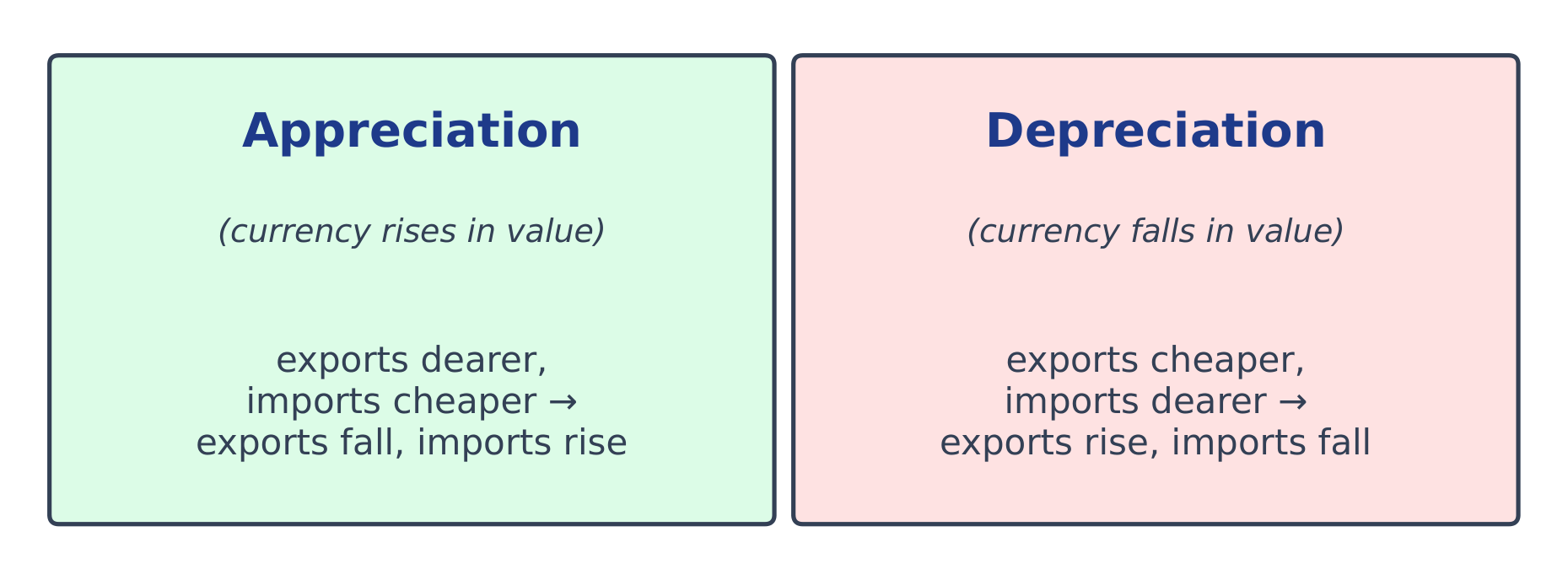
  • A depreciation makes exports cheaper for foreigners and imports dearer, so net exports rise and AD shifts right.
  • An appreciation makes exports dearer and imports cheaper, so net exports fall and AD shifts left.

Worked example. A US car priced at $\$30{,}000$ costs a European buyer $\text{€}27{,}000$ when $\$1=\text{€}0.90$. If the dollar depreciates to $\$1=\text{€}0.80$, the same car now costs only $\text{€}24{,}000$ – cheaper for foreigners, so US exports rise while imports (now dearer in dollars) fall, lifting net exports and shifting AD right.

This is how the foreign-exchange market and the AD-AS model connect – a currency change is a channel through which policy reaches output.

한국어

환율은 순수출을 통해 총수요(AD)에 피드백합니다:

상승은 수출을 비싸게 만들고 수입을 저렴하게 하며, 하락은 그 반대를 유도합니다
  • 하락은 외국인에게 수출을 저렴하게 만들고 수입을 비싸게 하므로 순수출이 증가하고 AD가 우측으로 이동합니다.
  • 상승은 수출을 비싸게 만들고 수입을 저렴하게 하므로 순수출이 감소하고 AD가 좌측으로 이동합니다.

풀이 예제. 미국산 자동차 가격이 $\$30{,}000$ costs a European buyer $\text{€}27{,}000$ when $\$1=\text{€}0.90$라고 합시다. 만약 달러가 하락하여 $\$1=\text{€}0.80$, the same car now costs only $\text{€}24{,}000$이 되면(외국인에게 저렴해짐), 미국 수출이 증가하고 수입(이제 달러 기준 더 비쌈)이 감소하여 순수출이 상승하고 AD가 우측으로 이동합니다.

이것이 외화 시장과 AD-AS 모델이 연결되는 방식입니다. 화폐 변동은 정책을 산출로 전달하는 통로 역할을 합니다.

6.6

Real Interest Rates and International Capital Flows · ⁨실질 금리와 국제 자본 흐름⁩

Syllabus
English

Enduring Understanding (MKT-5): The interaction of buyers and sellers exchanging the currency of one country for the currency of another determines the equilibrium exchange rate in a flexible exchange market and influences the flow of goods, services, and financial capital between countries.

Learning Objective MKT-5.G: Explain (using graphs as appropriate) how differences in real interest rates across countries affect financial capital flows, foreign exchange markets, and loanable funds markets.

  • MKT-5.G.1 In an open economy, differences in real interest rates across countries change the relative values of domestic and foreign assets. Financial capital will flow toward the country with the relatively higher interest rate. [See EK MKT-4.E.2 and EK MEA-4.A.6 for explanations of the impact on the loanable funds market and on net exports.]
  • MKT-5.G.2 Central banks can influence the domestic interest rate in the short run, which in turn will affect net capital inflows.
한국어

지속적 이해 (MKT-5): 구매자와 판매자가 한 국가의 화폐를 다른 국가의 화폐와 교환하는 상호작용은 유연한 환율 시장에서 균형 환율을 결정하며, 국가 간 재화, 서비스 및 금융 자본의 흐름에 영향을 미친다.

학습 목표 MKT-5.G: (그래프를 사용하여 필요할 경우) 국가 간 실질금리의 차이가 금융 자본 흐름, 외환 시장 및 차용 자금 시장에 미치는 영향을 설명하시오.

  • MKT-5.G.1 개방 경제에서 국가 간 실질금리의 차이는 국내 자산과 해외 자산의 상대적 가치를 변화시킨다. 금융 자본은 상대적으로 높은 금리를 가진 국가로 유입된다. [차용 자금 시장 및 순수출에 미치는 영향에 대한 설명은 EK MKT-4.E.2 및 EK MEA-4.A.6을 참고하시오.]
  • MKT-5.G.2 중앙은행은 단기적으로 국내 금리에 영향을 미칠 수 있으며, 이는 곧 순자본 유입에 영향을 준다.

Source: College Board AP Course and Exam Description · ⁨출처: College Board AP Course and Exam Description⁩

English

Money chases the highest real return, so capital flows 资本流动 respond to real interest rates:

  • A higher domestic real interest rate attracts inflows of foreign financial capital – foreigners buy domestic bonds, raising currency demand and causing appreciation.
  • A lower real rate causes outflows and depreciation.

This ties the whole course together: government borrowing raises the real interest rate (loanable funds), which attracts foreign capital, appreciates the currency, and reduces net exports – so a budget deficit can widen a trade deficit (the "twin deficits"). Tracing these linked effects across the loanable-funds, forex, and AD-AS graphs is the capstone skill of AP Macroeconomics.

한국어

자금은 가장 높은 실질 수익을 추구하므로, 자본 흐름은 실질 금리에 반응합니다:

  • 높은 국내 실질 금리는 해외 금융 자본의 유입을 유치합니다 – 외국인이 국내 채권을 구매하여 화폐 수요를 늘리고 상승을 유발합니다.
  • 낮은 실질 금리는 유출과 하락을 유발합니다.

이것은 전체 과정의 핵심을 이룹니다: 정부 차입은 실질 금리를 높이고(대출 가능 자금), 해외 자본을 유치하여 화폐를 상승시키고 순수출을 감소시킵니다. 따라서 예산 적자는 무역 적자를 확대할 수 있습니다("이중 적자"). 대출 가능 자금, 외화, AD-AS 그래프를 따라 이러한 연결된 효과를 추적하는 것은 AP 거시경제학의 종합 능력입니다.

6.6

Exam tips · ⁨시험 팁⁩

English
  • The current account and financial account are mirror images and sum to zero.
  • Always draw the forex graph for the currency named, and label its price with that currency; one currency appreciating is the other depreciating.
  • A depreciation raises net exports (exports cheaper); an appreciation lowers them.
  • Higher domestic real interest rates attract capital inflows → currency appreciates → net exports fall.
  • Link it all: a budget deficit raises the real rate, appreciates the currency, and can widen the trade deficit (twin deficits).
한국어
  • 경상이계와 금융계는 반대 방향이며 합계는 0입니다.
  • 항상 질문에서 명시된 화폐에 대해 외화 그래프를 그리고, 해당 화폐의价格为 표시하세요. 한 화폐가 상승하면 다른 화폐는 하락합니다.
  • 하락은 순수출을 증가시킵니다(수출 저렴); 상승은 감소시킵니다.
  • 높은 국내 실질 금리는 자본 유입 → 화폐 상승 → 순수출 감소를 유발합니다.
  • 이를 모두 연결하세요: 예산 적자는 실질 금리를 높이고, 화폐를 상승시키며, 무역 적자를 확대할 수 있습니다(이중 적자).

Interactive lessons on this topic · ⁨이 주제에 대한 인터랙티브 수업⁩

Work through it step by step, with instant-check exercises. · ⁨즉시 체크 기능 exercises를 통해 단계별로 진행하세요.⁩

Past Papers · ⁨과거 시험지⁩

More topics in AP Macroeconomics · ⁨AP 경제학 (거시)⁩ · ⁨AP Macroeconomics · ⁨AP 경제학 (거시)⁩ 내 추가 주제⁩

Log in or create account · ⁨로그인 또는 계정 만들기⁩

IGCSE, A-Level & AP