Skip to content · ⁨본문 바로가기⁩

Economic Indicators and the Business Cycle · ⁨경제 지표 및 경기 사이클⁩

AP Macroeconomics · ⁨AP 경제학 (거시)⁩ · Topic 2 · ⁨주제 2⁩

Video lesson for this topic · ⁨이 주제용 영상 수업⁩ Open the video page · ⁨영상 페이지 열기⁩
9:58

경제 지표 및 경기 사이클

두 평범한 장면. 슈퍼마켓 진열대,去年的同样的食物篮子现在更贵了。 그리고 긴 줄 서 있는 사람들, 기다리고 있다. 둘 다 …

English narration · English + 中文 subtitles burned in · ⁨영어 내레이션 · 영어 + 중국어 자막 burned-in⁩

2.1

The Circular Flow and GDP · ⁨순환 흐름 및 GDP⁩

Syllabus
English

Enduring Understanding (MEA-1): An economy's performance can be measured by different indicators such as gross domestic product (GDP), the inflation rate, and the unemployment rate.

Learning Objective MEA-1.A: a. Define (using the circular flow diagram as appropriate) how GDP is measured and its components. b. Calculate nominal GDP.

  • MEA-1.A.1 GDP is a measure of final output of the economy.
  • MEA-1.A.2 GDP as a total flow of income and expenditure can be represented by the circular flow diagram.
  • MEA-1.A.3 There are three ways of measuring GDP: the expenditures approach, the income approach, and the value-added approach.
한국어

지속적 이해 (MEA-1): 경제의 성과는 국내총생산(GDP), 인플레이션율, 실업률과 같은 다양한 지표로 측정될 수 있습니다.

학습 목표 MEA-1.A: a. GDP가 어떻게 측정되는지 및 그 구성 요소를 설명하십시오(적절한 경우 순환 흐름도 사용). b. 명목 GDP를 계산하십시오.

  • MEA-1.A.1 GDP는 경제의 최종 산출의 척도입니다.
  • MEA-1.A.2 총소득 및 총지출의 흐름으로서의 GDP는 순환흐름도(circular flow diagram)로 표현할 수 있다.
  • MEA-1.A.3 GDP를 측정하는 세 가지 방법은 지출 Approach, 소득 Approach, 부가가치 Approach이다.
Source: College Board AP Course and Exam Description · ⁨출처: College Board AP Course and Exam Description⁩

English

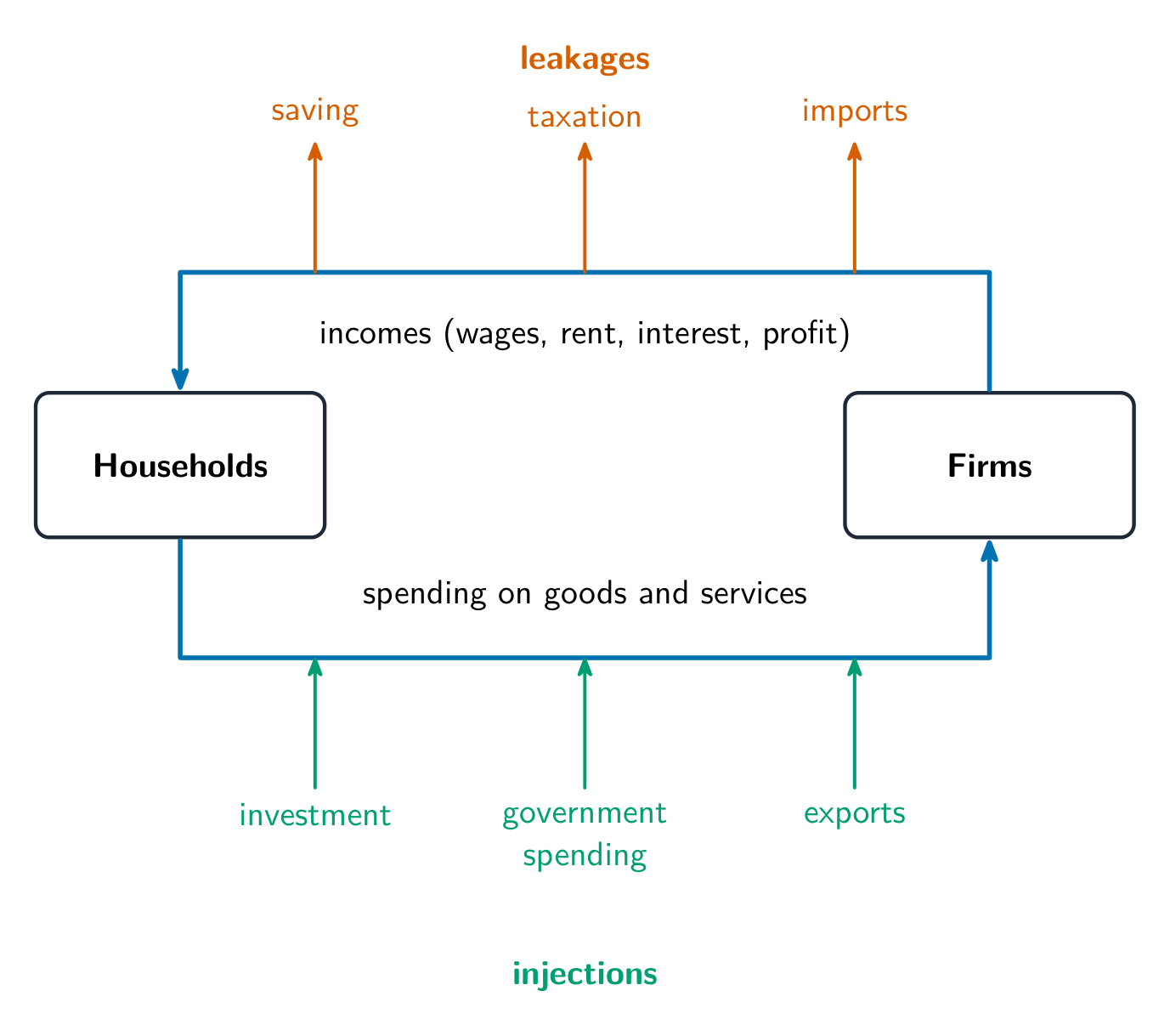
The circular-flow model 循环流动模型 shows money moving between households and firms: households supply factors and earn income; firms sell goods and earn revenue. Every dollar of spending is someone's income, which is why output and income are two sides of the same total.

Gross domestic product (GDP) 国内生产总值 is the market value of all final goods and services produced within a country in a year. Three ways to measure it give the same number:

  • Expenditure approach: $GDP = C + I + G + X_n$ – consumption 消费, investment 投资 (business spending on capital, plus new housing and inventory), government purchases 政府购买, and net exports 净出口 (exports minus imports).
  • Income approach: add up all wages, rent, interest, and profit.

Exclude intermediate goods (avoid double counting), used goods, purely financial transactions, and transfer payments.

한국어

순환 흐름 모델은 가구와 기업 사이에서 돈이 흐르는 과정을 보여줍니다. 가구는 생산 요인을 공급하여 소득을 얻고, 기업은 재화를 판매하여 매출을 얻습니다. 모든 지출은 누군가의 소득이므로, 산출과 소득은 같은 총액의 두 면임을 의미합니다.

순환 흐름: 유출입과 주입이 포함된 그림

**국내총생산(GDP)**은 一国 내에서 일년 동안 생산된 모든 최종 재화와 서비스의 시장 가치입니다. 세 가지 측정 방법은 동일한 값을 제공합니다:

  • 지출 접근법: $GDP = C + I + G + X_n$—소비, 투자(자본에 대한 기업 지출, 신규 주택 및 재고 포함), 정부 구매, 그리고 순수출(수출 minus 수입).
  • 소득 접근법: 모든 임금, 임대료, 이자, 이익을 합산합니다.

제외해야 할 것은 중간재(중복 계산을 피하기 위해), 중고재, 순수 금융 거래, 그리고 전이 지급입니다.

Explore · ⁨탐색하기⁩

Follow money around the circular flow · ⁨资金在循环流动中的流向⁩

Money flows from households to firms (spending) and back (wages), while injections (investment, government, exports) and leakages (saving, taxes, imports) can grow or shrink the flow — the size of that flow is GDP. · ⁨资金从家庭流向企业(支出)并返回(工资),同时注入(投资、政府、出口)和漏出(储蓄、税收、进口)可以使流量增长或收缩——该流量的大小是GDP。⁩

2.2

Limitations of GDP · ⁨GDP의 한계⁩

Syllabus
English

Enduring Understanding (MEA-1): An economy's performance can be measured by different indicators such as gross domestic product (GDP), the inflation rate, and the unemployment rate.

Learning Objective MEA-1.B: Define the limitations of GDP.

  • MEA-1.B.1 GDP is a useful indicator of a nation's economic performance, but it has some limitations, such as failing to account for nonmarket transactions.
한국어

지속적 이해 (MEA-1): 경제의 성과는 국내총생산(GDP), 인플레이션율, 실업률과 같은 다양한 지표로 측정될 수 있습니다.

학습 목표 MEA-1.B: GDP의 한계를 정의한다.

  • MEA-1.B.1 GDP는 국가의 경제 성과에 유용한 지표이지만 비시장 거래를 고려하지 못한다는 등의 한계가 있다.

Source: College Board AP Course and Exam Description · ⁨출처: College Board AP Course and Exam Description⁩

English

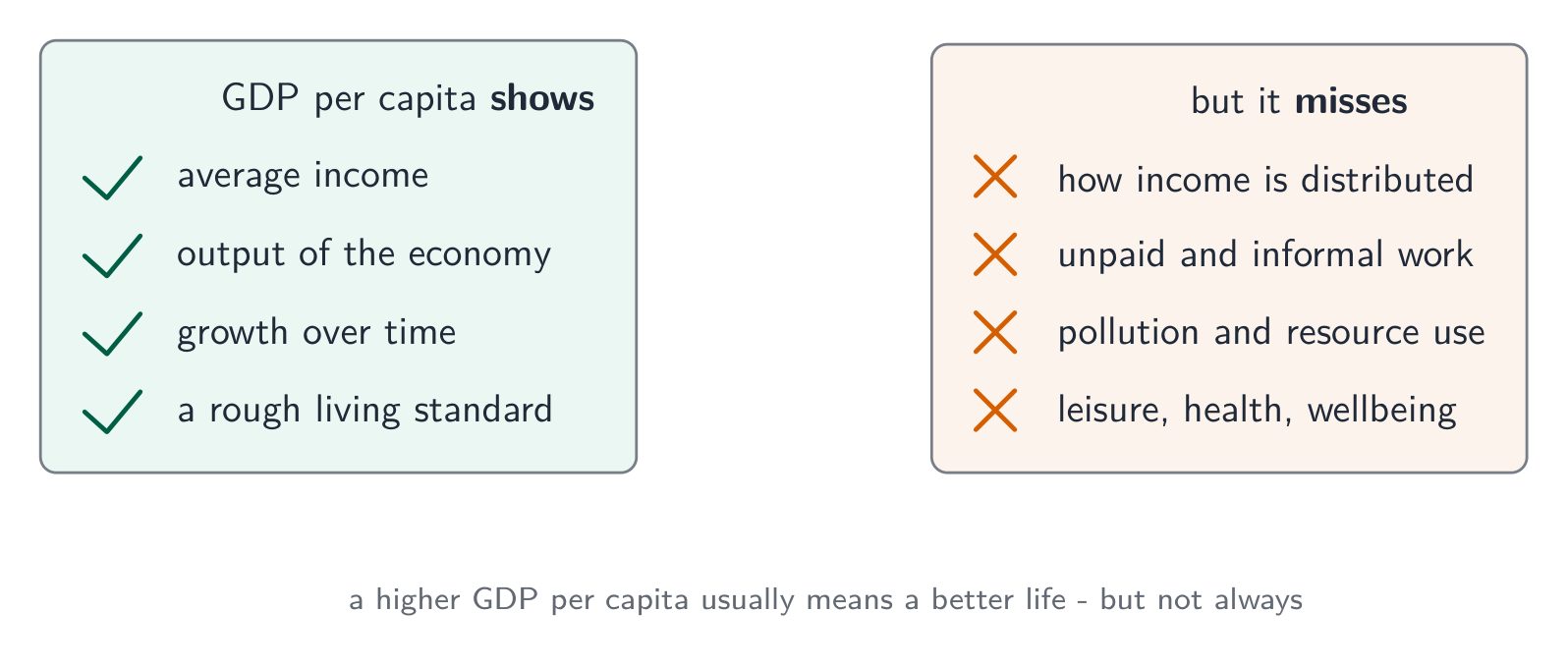
GDP measures market output, not well-being. It omits non-market production (unpaid housework, volunteering), the underground economy 地下经济, leisure, and the distribution of income, and it ignores environmental damage and resource depletion. So a higher GDP does not automatically mean a better standard of living. GDP per capita (GDP $\div$ population) is a better welfare proxy than total GDP.

한국어

GDP는 시장 산출을 측정할 뿐, 복지를 직접적으로 나타내지는 않습니다. GDP는 비시장 생산(무급 가사노동, 자원봉사), 저항 경제, 여가 시간, 소득의 분배를 제외하며, 환경 파괴와 자원 고갈도 고려하지 않습니다. 따라서 GDP가 높아진다고 해서 반드시 생활 수준이 향상된 것은 아닙니다. 인당 GDP(GDP $\div$ 인구)는 총 GDP보다 복지 대안으로 더 적합합니다.

인당 GDP는 평균 산출은 보여주나 분배, 무급 노동 등은 놓칩니다
2.3

Unemployment · ⁨실업⁩

Syllabus
English

Enduring Understanding (MEA-1): An economy's performance can be measured by different indicators such as gross domestic product (GDP), the inflation rate, and the unemployment rate.

Learning Objective MEA-1.C: a. Define the labor force, the unemployment rate, and the labor force participation rate. b. Explain how changes in employment and the labor market affect the unemployment rate and the labor force participation rate. c. Calculate the unemployment rate and the labor force participation rate.

  • MEA-1.C.1 The unemployment rate is the percentage of the labor force that is out of work.
  • MEA-1.C.2 The labor force participation rate is another measure of the labor market activity in an economy. The labor force participation rate is the percentage of the adult population that is in the labor force.

Learning Objective MEA-1.D: Define the limitations of the unemployment rate.

  • MEA-1.D.1 The measured unemployment rate is often criticized for understating the level of joblessness because it excludes groups such as discouraged workers and part-time workers.

Learning Objective MEA-1.E: a. Define the types of unemployment and the natural rate of unemployment. b. Explain changes in the types of unemployment.

  • MEA-1.E.1 Economists primarily focus on three types of unemployment: cyclical, frictional, and structural.
  • MEA-1.E.2 The natural rate of unemployment is the unemployment rate that would exist when the economy produces full-employment real output. It is equal to the sum of frictional and structural unemployment.
  • MEA-1.E.3 The deviation of the actual unemployment rate from the natural rate is cyclical unemployment.
  • MEA-1.E.4 The natural rate of unemployment can gradually change over time because of such things as changes in labor force characteristics.
한국어

지속적 이해 (MEA-1): 경제의 성과는 국내총생산(GDP), 인플레이션율, 실업률과 같은 다양한 지표로 측정될 수 있습니다.

학습 목표 MEA-1.C: a. 노동력(labor force), 실업률(unemployment rate), 노동 participation율(labor force participation rate)을 정의한다. b. 고용 및 노동 시장의 변화가 실업률과 노동 participation율에 미치는 영향을 설명한다. c. 실업률과 노동 participation율을 계산한다.

  • MEA-1.C.1 실업률은 노동력 중 취업하지 않은 사람의 비율(백분율)이다.
  • MEA-1.C.2 노동 participation율은 경제 내 노동 시장 활동의 다른 측정을 의미하며, 노동력에 참여하는 성인 인구의 비율(백분율)이다.

학습 목표 MEA-1.D: 실업률의 한계를 정의한다.

  • MEA-1.D.1 측정된 실업률은 discouraged workers(실업 포기자)와 part-time workers(비정규근로자)와 같은 집단을 제외하므로 실업 수준을 과소 평가한다는 비판을 받는다.

학습 목표 MEA-1.E: a. 실업의 유형과 자연 실업률(natural rate of unemployment)을 정의한다. b. 실업 유형의 변화를 설명한다.

  • MEA-1.E.1 경제학자들은 주로 세 가지 종류의 실업에 주목한다: 순환적 실업(cyclical), 마찰적 실업(frictional), 구조적 실업(structural).
  • MEA-1.E.2 자연 실업률은 경제가 완전 고용 실제 산출물(full-employment real output)을 생산할 때 존재할 실업률이다. 이는 마찰적 실업과 구조적 실업의 합과 같다.
  • MEA-1.E.3 실제 실업률이 자연 실업률에서 벗어난 차이는 순환적 실업이다.
  • MEA-1.E.4 노동력의 특성 변화와 같은 요인 때문에 자연 실업률은 시간이 지남에 따라 서서히 변할 수 있다.

Source: College Board AP Course and Exam Description · ⁨출처: College Board AP Course and Exam Description⁩

English

The labor force 劳动力 is the employed plus the unemployed (those without work who are actively looking). People not looking are not in the labor force.

$$\text{Unemployment rate}=\frac{\text{unemployed}}{\text{labor force}}\times 100\%,\qquad \text{Labor-force participation}=\frac{\text{labor force}}{\text{working-age population}}\times100\%.$$

Worked example. A country has $150$ million employed and $10$ million unemployed (actively looking), with $40$ million working-age adults not looking. The labor force is $150+10=160$ million, so the unemployment rate is $\dfrac{10}{160}=6.25\%$ and the participation rate is $\dfrac{160}{200}=80\%$.

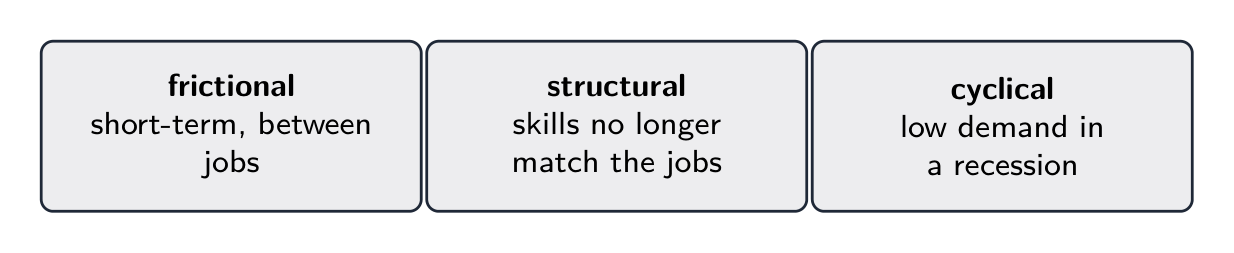
Three types of unemployment:

  • Frictional 摩擦性失业: between jobs or searching for a first job (normal, short).
  • Structural 结构性失业: skills or location don't match available jobs (technology, trade).
  • Cyclical 周期性失业: caused by a recession (a downturn in the business cycle).

Frictional + structural make up the natural rate of unemployment 自然失业率. At the natural rate cyclical unemployment is zero and the economy is at full employment 充分就业. The rate understates joblessness because it omits discouraged workers 灰心工人 and the underemployed.

한국어
긴 행렬의 사람들 — 실업자는 일하고 싶고 능력이 있지만 일자리를 찾지 못하는 사람들입니다

근로 인구는 고용자 + 실업자(일中没有没有工作但 actively searching for work)의 합입니다. 구직 활동을 하지 않는 사람들은 근로 인구에 포함되지 않습니다.

실업의 세 가지 유형: 마찰적, 구조적, 순환적
$$\text{Unemployment rate}=\frac{\text{unemployed}}{\text{labor force}}\times 100\%,\qquad \text{Labor-force participation}=\frac{\text{labor force}}{\text{working-age population}}\times100\%.$$

worked example. 한 나라에 $150$ 백만 명의 고용자와 $10$ 백만 명의 실업자(구직 중)가 있으며, 구직하지 않는 근로 가능 성인population이 $40$ 백만 명이라고 합니다. 근로 인구는 $150+10=160$백만 명이므로, 실업률은 $\dfrac{10}{160}=6.25\%$이고 참여율은 $\dfrac{160}{200}=80\%$입니다.

실업의 세 가지 유형:

  • 마찰적 실업: 직장을 옮기는 과정이나 첫 직장을 찾는 기간(보통, 단기).
  • 구조적 실업: 기술이나 위치가 이용 가능한 일자리와 맞지 않음(기술, 무역).
  • 순환적 실업: 경기 침체(경기 주기의 하락기)로 인해 발생함.

마찰적 + 구조적 실업은 자연 실업률을 형성합니다. 자연 실업률에서는 순환적 실업이 0이며, 경제는 완전 고용 상태입니다. 이 비율은 기피 근로자(discouraged workers) 와 부정규 근로자(underemployed) 를 제외하므로 실업 상태를 과소평가하는 경향이 있습니다.

Vocabulary · ⁨어휘⁩ Train · ⁨연습하기⁩
English 한국어
circular-flow model/ˈsɜːkjʊlə fləʊ ˈmɒdl/ 순환 흐름 모델
Gross domestic product (GDP)/ɡrəʊs dəˈmestɪk ˈprɒdʌkt/ 국내 총생산 (GDP)
consumption/kənˈsʌmpʃn/ 소비
investment/ɪnˈvestmənt/ 투자
government purchases/ˈɡʌvənmənt ˈpɜːtʃɪsɪz/ 정부 구매
net exports/net ˈekspɔːts/ 순수출
underground economy/ˌʌndəˈɡraʊnd ɪˈkɒnəmi/ Underground Economy
labor force/ˈleɪbə fɔːs/ Labor Force
Frictional/ˈfrɪkʃənl/ 마찰적
Structural/ˈstrʌktʃərəl/ 구조적
Cyclical/ˈsaɪklɪkl/ 순환적
natural rate of unemployment/ˈnætʃərəl reɪt ɒv ʌnemˈplɔɪmənt/ 자연 실업률에서 수직이다
full employment/fʊl emˈplɔɪmənt/ 완전 고용
discouraged workers/dɪˈskʌrɪdʒd ˈwɜːkəz/ Discouraged Workers
2.4

Price Indices and Inflation · ⁨물가지수 및 인플레이션⁩

Syllabus
English

Enduring Understanding (MEA-1): An economy's performance can be measured by different indicators such as gross domestic product (GDP), the inflation rate, and the unemployment rate.

Learning Objective MEA-1.F: a. Define the consumer price index (CPI), inflation, deflation, disinflation, the inflation rate, and real variables. b. Explain how price indices can be used to calculate the inflation rate and to compare nominal variables over time periods. c. Calculate the CPI, the inflation rate, and changes in real variables.

  • MEA-1.F.1 The consumer price index (CPI) measures the change in income a consumer would need in order to maintain the same standard of living over time under a new set of prices as under the original set of prices.
  • MEA-1.F.2 The CPI measures the cost of a fixed basket of goods and services in a given year relative to the base year.
    • Exclusion statement: Calculating the producer price index (PPI) is beyond the scope of the course and AP Exam.
  • MEA-1.F.3 The inflation rate is determined by calculating the percentage change in a price index, such as CPI or the GDP deflator.
  • MEA-1.F.4 Real variables, such as real wages, are the nominal variables deflated by the price level.

Learning Objective MEA-1.G: Define the shortcomings of the CPI as a true measure of inflation.

  • MEA-1.G.1 The CPI as a measure of inflation has some shortcomings, such as substitution bias, causing it to overstate the true inflation rate.
한국어

지속적 이해 (MEA-1): 경제의 성과는 국내총생산(GDP), 인플레이션율, 실업률과 같은 다양한 지표로 측정될 수 있습니다.

학습 목표 MEA-1.F: a. 소비자 물가지수(CPI), 인플레이션(inflation), 디플레이션(deflation), 디스인플레이션(disinflation), 인플레이션율, 실제 변수(real variables)를 정의한다. b. 가격 지수를 사용하여 인플레이션율을 계산하고 명목 변수를 기간 간에 비교하는 방법을 설명한다. c. CPI, 인플레이션율, 실제 변수의 변화를 계산한다.

  • MEA-1.F.1 소비자 물가지수(CPI)는 새로운 가격 체계 하에서 기존 가격 체계 하와 동일한 생활 수준을 유지하기 위해 소비자가 필요로 하는 소득의 변화를 측정한다.
  • MEA-1.F.2 CPI는 특정 연도의 고정된 상품 및 서비스 바구니(cost of a fixed basket) 비용을 기준연도(base year) 대비로 측정한다.
    • 제외 문구: 생산자 물가지수(PPI)를 계산하는 것은 과정 및 AP 시험의 범위를 벗어난다.
  • MEA-1.F.3 인플레이션율은 CPI나 GDP deflate 등 가격 지수의 백분율 변화율을 계산하여 결정된다.
  • MEA-1.F.4 실제 임금과 같은 실제 변수는 가격 수준으로 명목 변수를 조정(deflated)한 결과이다.

학습 목표 MEA-1.G: CPI가 진정한 인플레이션 측정 지표로서 가지는 결함을 정의한다.

  • MEA-1.G.1 CPI는 substitution bias(교체 편향)와 같은 단점이 있어 실제 인플레이션율을 과대 평가할 수 있다.

Source: College Board AP Course and Exam Description · ⁨출처: College Board AP Course and Exam Description⁩

English

Inflation 通货膨胀 is a sustained rise in the average price level. It is measured with a price index 价格指数, most often the consumer price index (CPI) 消费者价格指数, built from a fixed market basket of goods a typical household buys:

$$CPI=\frac{\text{cost of basket this year}}{\text{cost of basket in base year}}\times100.$$

The inflation rate is the percent change in the index between two years. Deflation 通货紧缩 is a falling price level; disinflation is a slowing of inflation.

Worked example. If the CPI is $200$ this year and was $190$ last year, the inflation rate is $\dfrac{200-190}{190}\times100\%=5.3\%$. A basket that cost $\$190$ then costs $\$200$ – the same goods, more dollars.

한국어
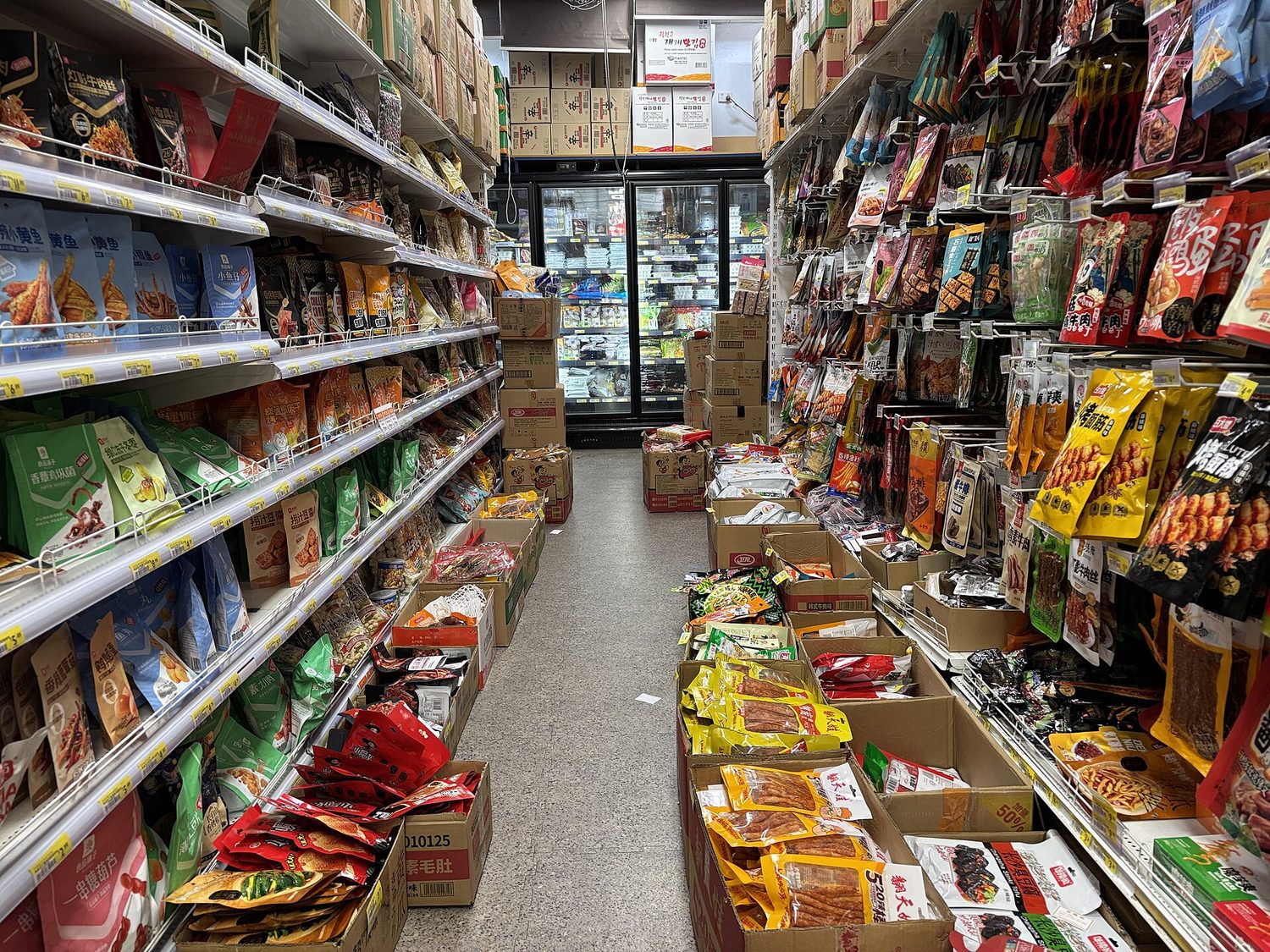
슈퍼마켓 진열대: 고정된 상품 바구니를 통해 물가지수로 인플레이션을 측정합니다

인플레이션은 평균 가격 수준의 지속적 상승입니다. 이는 물가지수(price index) 로 측정되며, 일반적으로 일반 가구가 구매하는 고정된 상품바구니(market basket) 를 기반으로 constructed되는 소비자 물가지수(CPI) 가 가장 많이 사용됩니다:

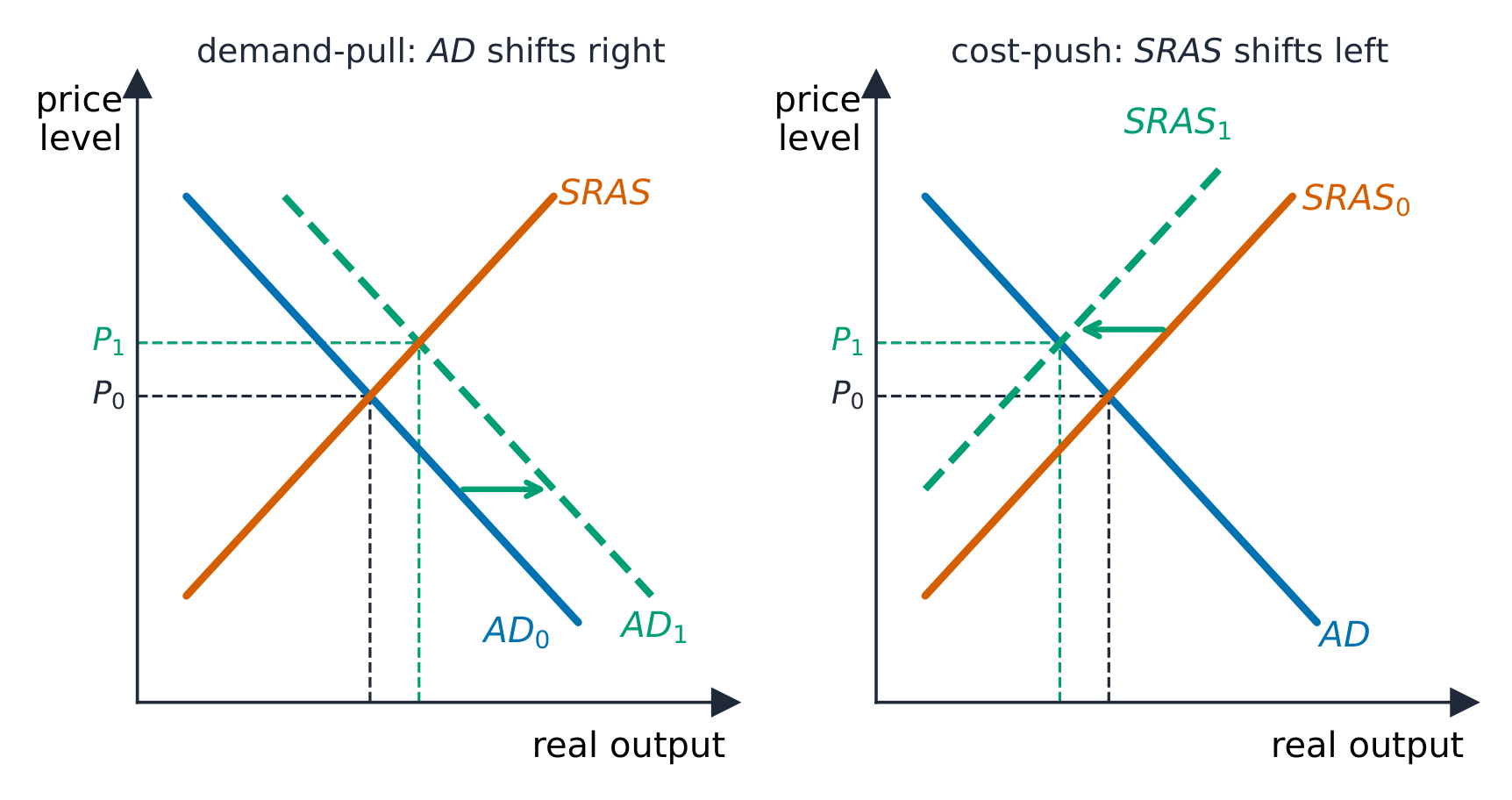
AD-AS 도표에 나타나는 수요 견인 인플레이션과 비용 견인 인플레이션
$$CPI=\frac{\text{cost of basket this year}}{\text{cost of basket in base year}}\times100.$$

인플레이션율은 두 해 사이 지수의 percent change입니다. 디플레이션은 가격 수준의 하락이며, 디인플레이션은 인플레이션 속도의 감소를 의미합니다.

**worked example.**今年的 CPI가 $200$이고 작년에는 $190$이었다면, 인플레이션율은 $\dfrac{200-190}{190}\times100\%=5.3\%$입니다. 바구니 가격이 $\$190$ then costs $\$200$ – 같은 상품이지만 더 많은 달러가 들었습니다.

Vocabulary · ⁨어휘⁩ Train · ⁨연습하기⁩
English 한국어
Inflation/ɪnˈfleɪʃn/ 인플레이션
price index/praɪs ˈɪndeks/ Price Index
consumer price index (CPI)/kənˈsuːmə praɪs ˈɪndeks/ 소비자 물가 지수 (CPI)
Deflation/diːˈfleɪʃn/ 디플레이션
2.5

Costs of Inflation · ⁨인플레이션의 비용⁩

Syllabus
English

Enduring Understanding (MEA-1): An economy's performance can be measured by different indicators such as gross domestic product (GDP), the inflation rate, and the unemployment rate.

Learning Objective MEA-1.H: Explain the costs that unexpected inflation (deflation) imposes on individuals and the economy.

  • MEA-1.H.1 Unexpected inflation arbitrarily redistributes wealth from one group of individuals to another group, such as lenders to borrowers.
한국어

지속적 이해 (MEA-1): 경제의 성과는 국내총생산(GDP), 인플레이션율, 실업률과 같은 다양한 지표로 측정될 수 있습니다.

학습 목표 MEA-1.H: 예상치 못한 인플레이션(디플레이션)이 개인과 경제에 미치는 비용을 설명한다.

  • MEA-1.H.1 예상치 못한 인플레이션은 채권자(borrowers)에서 채무자(lenders) 등으로 부를 임의적으로 재배분할 수 있다.

Source: College Board AP Course and Exam Description · ⁨출처: College Board AP Course and Exam Description⁩

English

Inflation redistributes and distorts:

  • It hurts lenders and savers and helps borrowers when it is unexpected, because loans are repaid in cheaper dollars. It erodes the value of money and fixed incomes.
  • Menu costs and uncertainty discourage investment.
  • Anticipated inflation is less harmful because contracts and interest rates adjust for it. This is why we separate nominal and real values.
한국어

인플레이션은 재분배와 왜곡을 초래합니다:

  • 예상치 못한 경우, 대출금은 더 싼 달러로 상환되므로 채권자와 저축자에게 손을 끼치고 차입자에게 이점을 줍니다. 이는 화폐 가치와 고정소득을 훼손합니다.
  • 메뉴 비용(menu costs) 과 불확실성이 투자를 위축시킵니다.
  • 예상되는 인플레이션은 계약과 이자율이 이에 맞춰 조정되므로 해가 적습니다. 이것이 바로 명목(nominal) 과 실질(real) 가치를 구분하는 이유입니다.
2.6

Real v. Nominal GDP · ⁨실질 GDP vs 명목 GDP⁩

Syllabus
English

Enduring Understanding (MEA-1): An economy's performance can be measured by different indicators such as gross domestic product (GDP), the inflation rate, and the unemployment rate.

Learning Objective MEA-1.I: Define nominal GDP and real GDP.

  • MEA-1.I.1 Nominal GDP is a measure of how much is spent on output. Real GDP is a measure of how much is produced.
  • MEA-1.I.2 Nominal GDP measures aggregate output using current prices. Real GDP measures aggregate output using constant prices, thus removing the effect of changes in the overall price level.

Learning Objective MEA-1.J: Calculate real GDP and the GDP deflator.

  • MEA-1.J.1 One way of measuring real GDP is to weigh final goods and services by their prices in a base year. Because this can lead to overstatement of real GDP growth, statistical agencies actually use different methods.
  • MEA-1.J.2 Nominal GDP can be converted to real GDP by using the GDP deflator.
한국어

지속적 이해 (MEA-1): 경제의 성과는 국내총생산(GDP), 인플레이션율, 실업률과 같은 다양한 지표로 측정될 수 있습니다.

학습 목표 MEA-1.I: 명목 GDP와 실제 GDP를 정의한다.

  • MEA-1.I.1 명목 GDP는 산출물에 대한 지출액을 측정하는 지표이며, 실제 GDP는 산출량을 측정하는 지표이다.
  • MEA-1.I.2 명목 GDP는 현재 가격을 사용하여 총산출을 측정한다. 실제 GDP는 일정 가격을 사용하여 총산출을 측정하므로 전반적인 가격 수준의 변화 효과를 제거한다.

학습 목표 MEA-1.J: 실제 GDP와 GDP deflate를 계산한다.

  • MEA-1.J.1 실제 GDP를 측정하는 하나의 방법은 기준연도의 가격으로 최종 상품 및 서비스에 가중치를 부여하는 것이다. 그러나 이 방법은 실제 GDP 성장률을 과대 평가할 수 있으므로 통계 당국은 실제로 다른 방법을 사용한다.
  • MEA-1.J.2 명목 GDP는 GDP deflate를 사용하여 실제 GDP로 변환할 수 있다.

Source: College Board AP Course and Exam Description · ⁨출처: College Board AP Course and Exam Description⁩

English
  • Nominal GDP 名义GDP is valued at current prices, so it rises with both output and prices.
  • Real GDP 实际GDP is valued at constant (base-year) prices, stripping out inflation, so it reflects true output. Real GDP is the honest measure of growth.
$$\text{Real GDP}=\frac{\text{Nominal GDP}}{\text{price index}}\times100,\qquad \text{GDP deflator}=\frac{\text{Nominal GDP}}{\text{Real GDP}}\times100.$$

Worked example. Nominal GDP is $\$22$ trillion and the GDP deflator is $110$. Real GDP is $\dfrac{22}{110}\times100=\$20$ trillion. The extra $\$2$ trillion of nominal GDP is pure price rise, not real output – which is why growth is always measured with real GDP.

Exam skill: be fluent converting nominal to real using a price index, and computing an inflation rate or a growth rate as a percent change.

한국어
  • 명목 GDP: GDP가 현재 가격으로 평가되므로, 산출량과 가격 모두 상승함에 따라 증가합니다.
  • 실질 GDP: GDP가 고정(기준연도) 가격으로 평가되어 인플레이션을 제거하므로, 실제 산출량을 반영합니다. 실질 GDP는 성장의 정직한 지표입니다.
$$\text{Real GDP}=\frac{\text{Nominal GDP}}{\text{price index}}\times100,\qquad \text{GDP deflator}=\frac{\text{Nominal GDP}}{\text{Real GDP}}\times100.$$

해설 예제. Nominal GDP(명목 GDP)는 $\$22$ trillion and the GDP deflator is $110$. Real GDP is $\dfrac{22}{110}\times100=\$20$ trillion(조 달러)이다. 추가된 $\$2$ trillion(조 달러)의 명목 GDP는 순수 가격 상승일 뿐 실제 산출물은 아니므로, 이것이 바로 성장이 항상 real GDP(실물 GDP) 를 사용하여 측정되는 이유이다.

exam skill: 물가지수를 사용하여 명목을 실일로 변환하는 데 유창해지고, 인플레이션율 또는 성장률을 percent change로 계산할 수 있어야 합니다.

Vocabulary · ⁨어휘⁩ Train · ⁨연습하기⁩
English 한국어
Nominal GDP/ˈnɒmɪnl ˌdʒiː diː ˈpiː/ 명목 GDP
Real GDP/rɪəl ˌdʒiː diː ˈpiː/ 실질 GDP
2.7

Business Cycles · ⁨경기변동(Business Cycles)⁩

Syllabus
English

Enduring Understanding (MEA-2): The economy fluctuates between periods of expansion and contraction in the short run, but economic growth can occur in the long run.

Learning Objective MEA-2.A: a. Define (using graphs and data as appropriate) turning points and phases of the business cycle. b. Explain (using graphs and data as appropriate) turning points and phases of the business cycle.

  • MEA-2.A.1 Business cycles are fluctuations in aggregate output and employment because of changes in aggregate supply and/or aggregate demand.
  • MEA-2.A.2 The phases of a business cycle are recession and expansion.
  • MEA-2.A.3 The turning points of a business cycle are peak and trough.
  • MEA-2.A.4 The difference between actual output and potential output is the output gap.
  • MEA-2.A.5 Potential output is also called full-employment output. It is the level of GDP where unemployment is equal to the natural rate of unemployment. [See EK MEA-1.E.2]
한국어

영구적 이해 (MEA-2): 경제는 단기적으로 확장 및 위축 기간 사이를 진동하지만, 장기적으로는 경제 성장이 발생할 수 있다.

학습 목표 MEA-2.A: a. 적절히 그래프와 데이터를 사용하여 경기 순환의 전점(turning points)과 단계(phases)를 정의한다. b. 적절히 그래프와 데이터를 사용하여 경기 순환의 전점과 단계를 설명한다.

  • MEA-2.A.1 경기 순환은 총공급 및/또는 총수요의 변화로 인한 총산출 및 고용의 변동이다.
  • MEA-2.A.2 경기 순환의 단계는 침체(recession)와 확장(expansion)이다.
  • MEA-2.A.3 경기 순환의 전점은 최고점(peak)과 저점(trough)이다.
  • MEA-2.A.4 실제 산출물과 잠재 산출물 사이의 차이가 산출물 격차(output gap)이다.
  • MEA-2.A.5 잠재적 산출은 완전 고용 산출이라고도 한다. 이는 실업률이 자연 실업률과 동일한 GDP 수준이다. [EK MEA-1.E.2 참고]

Source: College Board AP Course and Exam Description · ⁨출처: College Board AP Course and Exam Description⁩

English
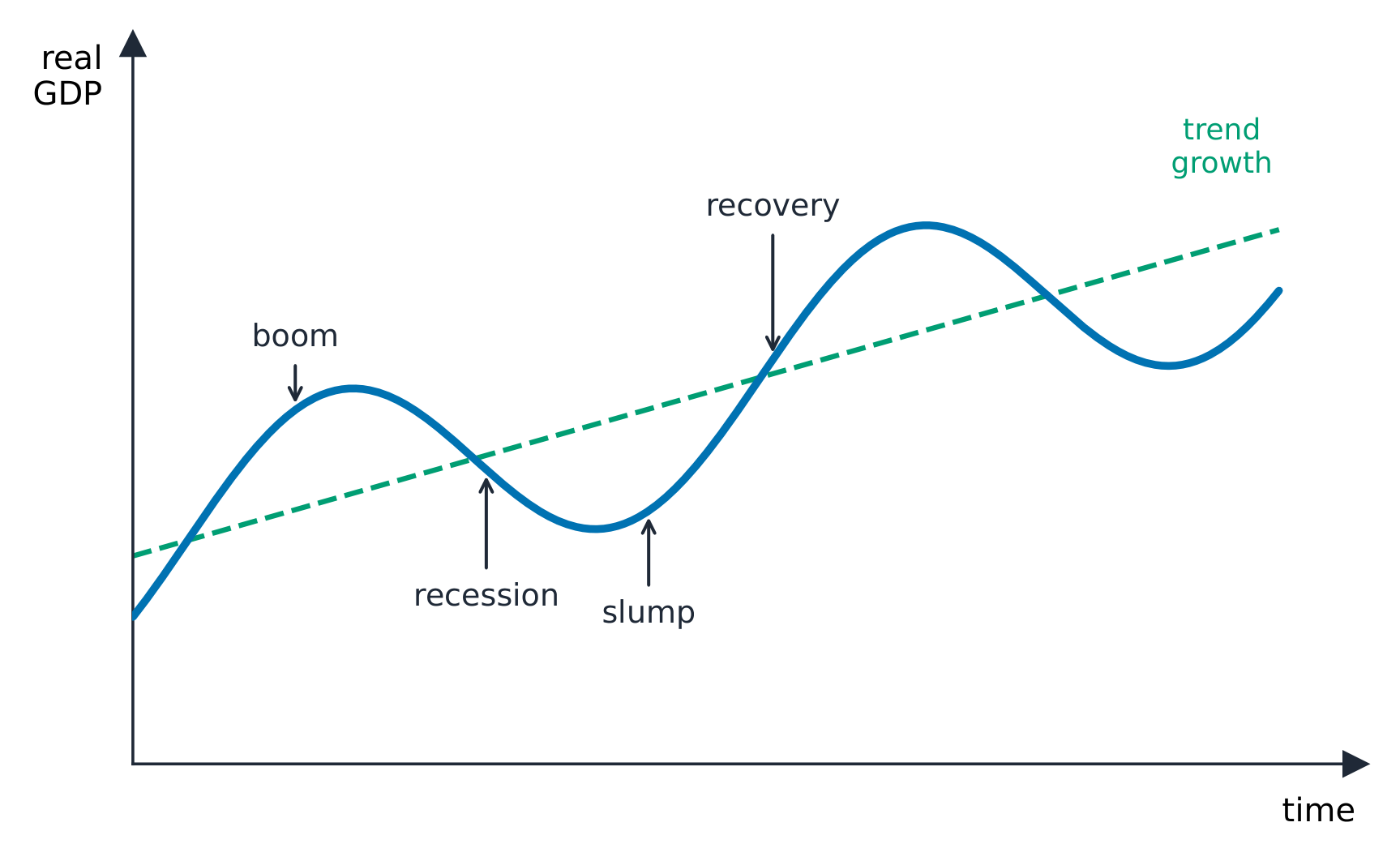
The business cycle

The business cycle 经济周期 is the economy's short-run ups and downs in real GDP around its long-run growth trend: expansion 扩张 (rising output, falling unemployment) up to a peak 顶峰, then contraction/recession 衰退 (falling output, rising cyclical unemployment) down to a trough 谷底, then recovery. A recession is commonly two consecutive quarters of falling real GDP. Unemployment and inflation move roughly opposite over the cycle – the tension the rest of the course tries to manage.

한국어
경기변동

경기변동은 장기 성장 추세를 중심으로 하는 실질 GDP의 단기적 등락입니다: 확장期(산출 증가, 실업 감소) → 최대점(peak), 이후 위축/침체(contraction/recession) (산출 감소, 순환적 실업 증가) → 최저점(trough), 그리고 회복期. 침체는 일반적으로 실질 GDP가 2개 분기 연속으로 하락하는 것을 말합니다. 실업과 인플레이션은 주기 내에서 대체로 반대 방향으로 움직입니다 – 이것이 해당 과정의 나머지 부분이 관리하려는 긴장관계입니다.

실물 GDP가 장기 추세를 중심으로 변동하는 모습
Vocabulary · ⁨어휘⁩ Train · ⁨연습하기⁩
English 한국어
business cycle/ˈbɪznəs ˈsaɪkl/ 경기 순환
expansion/ekˈspænʃn/ 확장(expansion)
peak/piːk/ 봉우리
contraction/recession/kənˈtrækʃn rɪˈseʃn/ 위축/경기 침체
trough/trɒf/ 저점(trough)
2.7

Exam tips · ⁨시험 팁⁩

English
  • Compute GDP by the expenditure method $C+I+G+X_n$ and count only final goods (avoid double counting).
  • Unemployment rate = unemployed ÷ labor force; discouraged workers leave the labor force (so the rate can understate joblessness).
  • Know the three unemployment types (frictional, structural, cyclical) and that the natural rate excludes cyclical.
  • Inflation is the % change in the CPI; convert nominal to real with a price index and always use real GDP for growth.
  • Place events on the business cycle (expansion → peak → contraction → trough).
한국어
  • 지출법을 사용하여 GDP를 계산합니다 $C+I+G+X_n$, 오직 최종재(final goods) 만을 카운트하여 이중 계산을 피해야 합니다.
  • 실업률 = 실업자 ÷ 근로 인구; 기피 근로자가 근로 인구를退出하므로(따라서 실업률이 실업 상태를 과소평가할 수 있음).
  • 세 가지 실업 유형(마찰적, 구조적, 순환적)을 알고, 자연 실업률이 순환적 실업을 제외함을 알아야 합니다.
  • 인플레이션은 CPI의 % change입니다; 물가지수를 사용하여 명목을 실질로 변환하고, 성장은 항상 실질 GDP를 사용해야 합니다.
  • 사건을 경기변동의 흐름에 배치합니다 (확장 → 최대점 → 위축 → 최저점).

Interactive lessons on this topic · ⁨이 주제에 대한 인터랙티브 수업⁩

Work through it step by step, with instant-check exercises. · ⁨즉시 체크 기능 exercises를 통해 단계별로 진행하세요.⁩

Past Papers · ⁨과거 시험지⁩

More topics in AP Macroeconomics · ⁨AP 경제학 (거시)⁩ · ⁨AP Macroeconomics · ⁨AP 경제학 (거시)⁩ 내 추가 주제⁩

Log in or create account · ⁨로그인 또는 계정 만들기⁩

IGCSE, A-Level & AP